




Abstract
This study explored how engaging in critical inquiry through Project-Based Inquiry (PBI) Global fostered social action with high school students. Drawing on theoretical perspectives from critical inquiry and social action and employing a collective case study approach, we focused on six diverse students from two of the 18 teams who participated in a PBI Global examining global water and sanitation over a two-month period. Data sources included semi-structured student interviews, students’ posts and uploads in a shared writing space, and students’ multimodal products of learning. Three themes emerged from the analysis across the data sources: synergistic collaboration, critical analysis and creation of multimodal texts, and understanding global and local interdependence to take social action. The discussion illuminates how students’ engagement in critical inquiry and social action ignite the emergence of Freire’s notion of critical consciousness.
I feel like PBI [Global] actually shows you how much of an impact you’ve made or might make in the future.
Project-Based Inquiry (PBI) Global is a five-phase collaborative inquiry process (Spires et al., 2016; see Figure 1). This article explores the experiences of teams of 11th-grade participants who engaged in PBI Global on an issue related to the project theme “Every Drop Counts: Global Water and Sanitation Issues.” The students attended a high school focused on science, technology, engineering, and math (STEM) in the southeastern United States. Global water and sanitation was chosen as the theme for this PBI Global as having access to clean water and adequate sanitation is fundamental to addressing additional global challenges. This included global challenges such as inclusive and equitable quality education and health and wellness. This PBI Global took place during the United Nations (UN) “International Decade for Action—Water for Sustainable Development” (UN, n.d.).
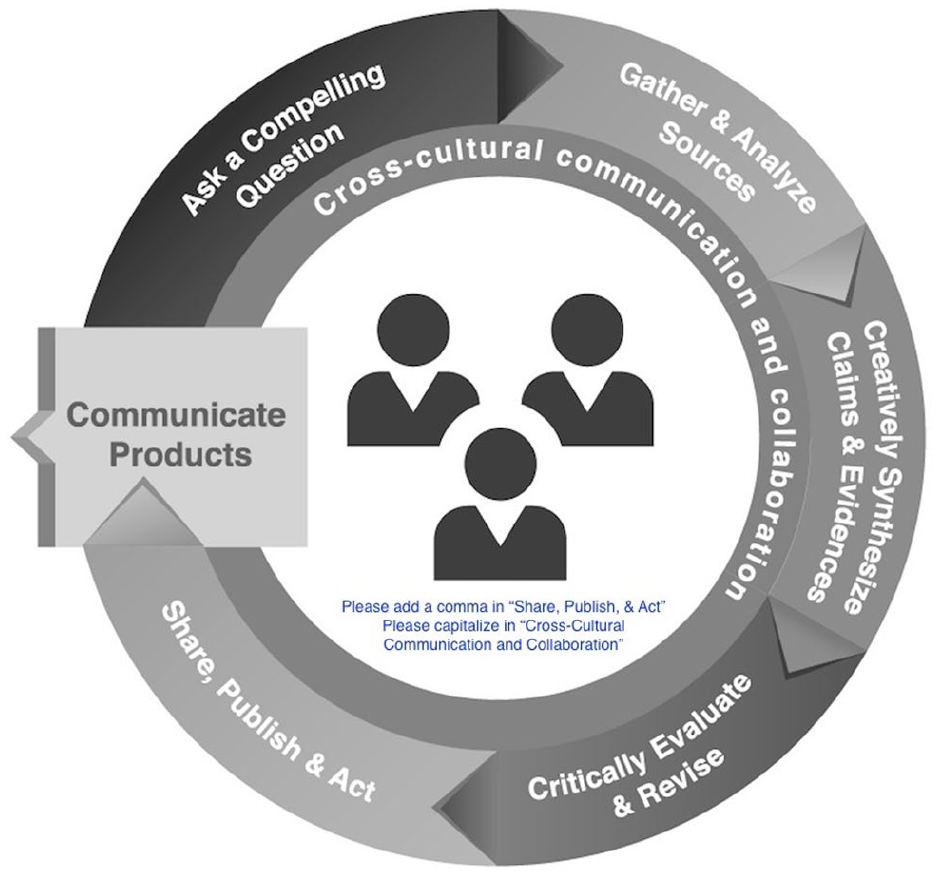
The five phases of PBI Global (Adapted from Spires et al., 2016, p. 3).
PBI Global developed from the researchers’ work connecting disciplinary literacy to inquiry-based learning (Spires et al., 2016, 2020); the framework has also been adapted for inquiry-based learning in a global context (Spires et al., 2018, 2019). To explicitly connect the global themes addressed in each project to an internationally recognized agenda, PBI Global’s focus on the 17 political, economic, environmental, and social issues targeted by UN member states for improvement by 2030 in the Sustainable Development Goals (SDGs; UN, n.d.).
PBI Global responds to the larger call within literacy research and practice to educate for global citizenship, countering narratives of American exceptionalism through “teaching practices that befit our changing understandings of literacy, our views of the needs of individuals and society, to move beyond the echo chambers taking form across the media worlds” (Tierney, 2017, p. 307). PBI Global provides one avenue for teachers to “translate standards into critical inquiry activities” (Beach, 2017, p. 311). Ultimately, this research responds to Morrell’s (2017) penetrating question, “How do we hold ourselves accountable for literacy curricula and literacy policies that produce more engaged and empathetic global citizens?” (p. 456).
Theoretical Framing
Grounded in sociocultural theory (Vygotsky, 1978), PBI Global positions learners as active participants in their own knowledge creation through social and cultural interactions with other team members and alongside teachers who scaffold students forward within their Zone of Proximal Development. During PBI Global, students engage in critical inquiry through the development of a “Compelling Question” that drives evidence gathering and creative synthesis as teachers invite and guide students to “re-perceive and re-examine what they know and how they learned it, as well as question existing conditions” (Oliver & Lalik, 2004, p. 558). Within the PBI Global process, students are expected to share, publish, and act on the findings of their inquiry; thus, the PBI Global process fosters social action among participants. In this section, we situate the following research question within the theoretical frameworks of critical inquiry learning and social action:
Critical Inquiry Learning
The term “critical inquiry” is used in many academic contexts, often to address issues of power and inequality. We examined critical inquiry learning through two lenses: critical inquiry through a critical literacy framework and critical inquiry for project-based learning.
Enacting critical inquiry through a critical literacy framework
Critical inquiry, like critical literacy, assumes that students develop a sense of agency and believe that “they can make a significant positive difference in the world” (Comber & Nixon, 2014, p. 86). We applied a critical perspective to inquiry learning through Morrell’s (2017) critical literacy framework that “privileges teacher agency, critical media production, self-love, love of others, and engagement with communities and the world” (p. 458). Morrell (2008) defined critical literacy as reading and writing that supports students to produce truth, interrogate power, and make change—change that occurs inwardly and externally. To examine positions of power through literary and informational text analysis, students investigate multiple perspectives. We argue that the engagement with texts—in discovering why such texts are read and what knowledge these texts produce—molds students’ identities in seeing how literacy, knowledge, and research are important to them and their world (Jones, 2006; Morrell, 2008).
Critical inquiry elicits Freire’s (1970) notion that readers/writers can assume the role of creative subjects who critically reflect on and act upon the world around them. Similarly, Vasquez (2014) argues that critical literacy is a way that students participate in the world in and out of school. Students who engage in critical inquiry do not respond to global challenges by taking a negative stance, but rather look at the issues in different ways, analyze them, and suggest possibilities for change (Vasquez et al., 2019). Through guided analysis, students begin to understand that the way we read and construct multimodal texts is mediated through our daily experiences, the spaces we encounter, and the languages we use (Vasquez et al., 2019). Similarly, Haddix and Price-Dennis (2013) argued that “when teachers encourage critical literacy, they are providing young people with tools to critique and question the world around them” (p. 254).
In the PBI Global process, learners critically interrogate multimodal texts, meaning semiotic communicative forms that are socially and culturally shaped, including linguistic, visual, audio, spatial, and gestural modes (Kress, 2010). Multimodal texts afford students the ability to critique and question the world in multiple ways to transition their reading into praxis. Reading, writing, speaking, and creating through inquiry are foundational to developing a sense of learner agency (Vaughn, 2020).
Critical inquiry for project-based learning
Critical inquiry promotes learner agency and action within project-based learning. Charmaz (2017) defined critical inquiry as “a transformative paradigm that seeks to expose, oppose, and redress forms of oppression, inequality, and injustice” (p. 35). As a pedagogical orientation, critical inquiry engages students to investigate a variety of disciplinary and multidisciplinary phenomena with an eye toward uncovering inequalities and injustices. Both justice and injustice are “enacted processes, made real through actions performed again and again” (Charmaz, 2005, p. 508). The iterative nature of the PBI Global process afforded students the opportunity to continuously reflect on their biases and assumptions within the context of their inquiry.
Inquiry approaches to learning, which have roots in project-based learning (Boss & Krauss, 2007; Buck Institute for Education, n.d.), build on a strong orientation to real-world problems. The inquiry approach incorporates a rich set of digital tools and resources, which support students in exploring and creating new knowledge by answering a Compelling Question. Likewise, elements of inquiry-based learning possess, what Dewey (1927) referred to as productive inquiry, deliberately seeking what we need to act. Freire (1970) expanded Dewey’s philosophies through a problem-posing model of education in which students co-constructed habits of praxis to transform their reality. Through the PBI Global process, we aimed to engage students in intellectual work that has depth, duration, and complexity, and to challenge and motivate students toward knowledge creation. A collaborative approach to inquiry positions students in relation to their inquiry partners, topics, and social action. As a result, they achieve a deeper understanding and a more critical stance to inquiry (Bautista et al., 2013), and potentially acquire different perspectives.
Learner agency is central to the process of critical inquiry by extending the ways in which students analyze, design, and produce multimodal texts. Critical inquiry invites students “to understand the relationship between texts, meaning-making, and power in order to undertake transformative social action that contributes to the achievement of a more equitable social order” (Janks & Vasquez, 2011, p. 1). By fostering critical inquiry through multimodality, students are able to examine issues and undertake social action.
Social Action
We define social action as the socially just enactment of learners’ critical inquiry findings. Critical literacy scholars assert that critical engagement with texts can lead to social action (Butler, 2017; Campano et al., 2016; Luke, 2014; Morrell, 2008). Critical inquiry fosters students’ interest and motivation to engage in civic projects, human rights, and youth activism. Campano et al. (2016) demonstrated that teaching through a human rights framework with a critical literacy lens can enable students to become socially active. During PBI Global, students engaged in processes of social activism as they used multimodal products to investigate water accessibility and sanitation issues.
Second, we drew on critical global literacies because our PBI Global project’s mission was for students to take social action both globally and locally. A critical global literacy framework integrates global and multicultural dimensions in literacy teaching and learning (Yoon et al., 2018). Because our study investigated how local action is situated within a global context and leads to global action, we draw on critical global literacies’ philosophical idea of cosmopolitanism, recognizing that individuals belong to the larger world rather than a certain nation (Choo, 2020; Yoon et al., 2018). Critical global literacies (Yoon et al., 2018) draw from Appiah’s (2008) and Delanty’s (2009) forms of cosmopolitanism that do not neglect individuals’ own cultures but rather allow them to act as globally oriented people.
In taking social action, students must recognize that their local actions might indirectly or directly affect others globally (Yoon et al., 2018). Social action happens when students conceptualize enduring challenges (i.e., global water and sanitation) as interdependent global and local issues. Students become more aware of global interconnections as they read global texts and conduct research projects on current world issues. Awareness and action become commingled. Similarly, in Lee and Dickstein’s (2019) teacher action research, a high school English teacher adopted the critical global literacies framework to lead her students to social action. After reading A Long Way Gone by Ishmael Beah (2007), students took action to bring Garang Buk Buk Piol, a former South Sudanese child soldier, to graduate school. Local New Jersey action expanded into the global community, specifically impacting Garang’s South Sudanese community. Lee and Dickstein (2019) purported, “To take action is to humanize the issue of our global neighbors and citizens. Social transformation begins with individual transformation” (p. 116).
In addition to responding to the larger call for literacy research and practice toward global citizenship (Beach, 2017; Morrell, 2017; Tierney, 2017), this study advances PBI Global research (Spires et al., 2018, 2019) through a full qualitative account using collective case study with students to examine critical inquiry and social action. This study focuses on a critical inquiry and social action project with students from one U.S. school to more closely examine the evolution of students’ critical global perspectives throughout the course of the project.
Method
Research Context
The PBI Global initiative involved 60 11th-grade students from a STEM-focused high school in the southeastern region of the United States. The school is an early college high school affiliated with a local university. Students must apply to attend the school and, in their final year(s), they enroll in dual-credit courses at the university. The student population is diverse; more than 50% of the student population are becoming first-generation college-goers.
Researcher positionality
The researchers served as facilitators of the initiative along with the students’ English teacher. The authors differ in terms of ethnic and socioeconomic background and collectively value critical pedagogy as a pathway to liberatory education. The first author, Dr. Hiller Spires, a White, first-generation college-goer, has been evolving the PBI model with teachers and diverse learners for over a decade in the United States, China, and Africa, grounding it in social constructivist theories of learning and, more recently, connecting the model to the UN SDGs to embrace global literacy and social action. The second author, Marie Himes, a White, dual-language speaker, began engaging in PBI Global with teachers and students 6 years ago. As a former middle and high school humanities teacher, she is particularly interested in the scalability of global inquiry learning, including the design of instructional supports. The third author, Dr. Crystal Chen Lee, a second-generation Asian American whose work focuses on critical inquiry and social action among marginalized populations, is a teacher educator and former high school English teacher who has a passion for critical global literacies. She helped articulate how critical inquiry and social action were theorized within PBI Global. The fourth author, Andrea Gambino, a White female pursuing her PhD in education with an emphasis on critical literacy drawing upon Freire’s (1974) critical consciousness theory, has 10 years of teaching experience and has worked as a collaborative partner with the PBI Global research team for the past 4 years.
Participants
To delve into students’ learning processes, we conducted a collective case study (Stake, 2000; Yin, 2009), which included six students from two of the 18 teams that participated in this PBI Global initiative. The two teams were selected based on participants’ academic and ethnic diversity, including the fact that they were first-generation college-going students. One of the six participants was born outside of the United States; all participants have family members living outside of the United States. We were intentional about highlighting the voices of diverse students within the project as co-constructors of knowledge, particularly because the project centered around global learning (see Supplemental Appendix A for participant demographics with student pseudonyms).
PBI Global Implementation
Students were introduced to the project within their Honors English III class as part of a unit focusing on global literature and research development. Working in 18 teams of three to four and meeting three times per week for 90 min, students had eight weeks to read a common text, A Long Walk to Water by Linda Sue Park (2011); develop their Compelling Questions related to global water and sanitation issues (e.g., “How does the lack of access to clean water and sanitation impact the physiological and emotional well-being of the people?”); conduct research to create a nuanced, complex response to their questions; produce three multimodal products to represent their research findings; and take social action to meet SDG 6 (access to clean water and sanitation) targets.
During the project launch, student teams rotated stations: (a) addressing the UN SDGs, (b) sharing the PBI Global process and project expectations, (c) surveying global water and sanitation issues, and (d) negotiating project roles and norms. This combination of content and procedural information set the stage for students and teachers to co-construct knowledge and negotiate meaning through an inquiry-to-action project.
To build background knowledge prior to Compelling Question development, students read A Long Walk to Water, the semibiographical dual narrative of Salva Dut, a Sudanese refugee in the 1990s, and Nya, a fictional child living in modern-day South Sudan. While becoming familiar with the enduring causes and effects of the Sudanese water crises, students also inquired about and reflected on how the lives of Salva and Nya compare with their own experiences with water and sanitation in the United States. To further investigate the complex issues described in the book, student teams began formulating their research foci by identifying the interconnections between global water and sanitation (SDG 6) and another SDG, such as how gender equality and access to clean water and sanitation are interrelated.
From this initial research focus, student teams engaged in Compelling Question development through a scaffolded lesson that utilized examples and nonexamples, think-alouds, question stems, peer and teacher feedback, and iterative design. Pedagogical, technological, and evaluative scaffolds were contingently designed and implemented throughout all five phases of PBI Global to support students’ depth and complexity of inquiry. To culminate, students showcased their findings to an audience of more than 150 parents, friends, and community members and carried out a Walk for Water to raise funds for Water for South Sudan, the well-building organization started by Salva Dut, the subject of Park’s book (for more details on PBI Global design and implementation, see Spires et al., 2019).
Data Sources and Analysis
Data sources included two semi-structured student interviews, students’ recorded interactions in their shared writing space, and the students’ PBI Global multimodal products. Two semi-structured interviews were conducted during 30-minute sessions at the beginning and toward the end of the project. Interview questions were constructed to capture the nuances of the individual and collective student experiences of engaging in a PBI Global. Particularly, the questions focused on student experiences with collaboration, critical literacy praxis, and learner agency (see Supplemental Appendix B for a full list of questions). Researchers constructed verbatim transcripts of all interviews.
Students conducted their collaborative work in a Google Doc Hub, a shared writing space that allowed for synchronous and asynchronous work (e.g., see Supplemental Appendix C). This collaborative space helped students collate their research, create an annotated bibliography, and coauthor claims and evidences. The space was also used to share responsibilities and tasks throughout the inquiry process. Researchers and external experts were able to access the space to provide support and feedback throughout the iterative stages of the PBI Global. Students also created multimodal products (i.e., a Claims Sheet, infographic, photojournalistic gallery, and call-to-action handout) that responded to their Compelling Questions.
Once data collection was complete, we employed an iterative coding process to fully understand and analyze the data. The transcripts were open coded (Saldaña, 2009; Strauss & Corbin, 1990) by two of the researchers, resulting in a total of 25 preliminary codes. Table 1 includes themes, sample codes, sample definitions, and sample quotes from our coding process.
Sample Code Book.

Note. PBI = Project-Based Inquiry.
Working from the coded data and through a dialogic process among the researchers (Miles et al., 2014), codes were collapsed into larger categories accompanied by quotes from the transcripts that exemplified emerging themes. After several rounds of analysis, we reached consensus on three major themes (synergistic collaboration, critical analysis and creation of multimodal texts, and understanding of global and local interdependence to take social action). We conducted an additional level of analysis to confirm how the themes reflected our theoretical underpinnings: critical inquiry learning and social action.
We then worked to identify and describe subthemes within each major theme (Bogdan & Biklen, 2007), returning to the data to recode and note examples. Through a recursive process moving back and forth from our data to our theoretical underpinnings, the final analysis resulted in three themes with two correlative subthemes.
Findings
Three themes, focusing on critical aspects of the students’ work and evolving perspectives, emerged: synergistic collaboration, critical analysis and creation of multimodal texts, and understanding global and local interdependence to take social action. The three themes exemplify the affordances in examining the intersections of inquiry learning and social action through a critical lens. Our findings illustrate how PBI Global encourages participants’ understanding of the relationships among “texts, meaning-making, and power to undertake transformative social action that contributes to the achievement of a more equitable social order” (Janks & Vasquez, 2011, p. 1). Following is a discussion of each theme and accompanying subthemes.
Theme 1: Synergistic Collaboration
With students working in teams during PBI Global, learning takes place as group members collectively negotiate meaning and draw on one another’s strengths to pursue their inquiry, create multimodal syntheses of their findings, and carry out meaningful social action. By positioning knowledge acquisition as a common endeavor, students reperceive and reexamine what they know and how they learned it, and question existing conditions.
Sense of community
Students’ sense of classroom cohesion and group community as well as their familiarity with engaging in diverse critical thought and discussion with their teammates supported the efficiency, thoroughness, and thoughtfulness of students’ research and writing. Building on the sense of community and learning norms that are foundational to the school, participants engaged in generative activities in which teachers, students, and facilitators worked collaboratively to surface and share their existing understandings of global water and sanitation challenges and how those issues manifest in their local context.
As Sara from Team A noted, “I think it [the team’s collaboration] is very efficient. Because we’ve known each other for so long, we know each other’s strengths and weaknesses.” Shelby, Sara’s teammate, further elaborated on the thoughtfulness embedded in Team A’s project discussions, saying, One of our first Compelling Questions was about the physical effect that it [clean water and adequate sanitation] had on people, but then we realized that many people probably are affected emotionally too . . . We talked about the different aspects of health because it’s more than just physical.
In addition, Tavi, a member of Team B, described in detail how his team worked together to critically analyze their claim, ensuring the thoroughness and accuracy of their research: There was some debate about what our claims should focus on, specifically our claim relating to South Sudan . . . should [we] keep it close to claim one or change the claim up to match better with the circumstances in South Sudan. We all sat at a table . . . and started backwards with the evidences, looking at what we had read in the book, A Long Walk to Water, and some of the research we had done. Looking at that, we decided what background information we had that would allow us to share more research and a thorough explanation of our claim. We decided we would be able to provide better support with the second type of claim, matching it with the circumstances of South Sudan.
Tavi’s description of their team’s debate demonstrates the collaborative critical inquiry among the PBI Global students in which they investigated and interrogated texts through student-centered dialogue. In interviews, students underscored the synergistic effects of collaboration. Yishai from Team B shared, “By collaborating, we balance each other’s ideas and that helps us develop our ideas even more . . . we build off each other.” Likewise, Carissa, from Team A, underscored this point: You’re all able to share your ideas with each other, and you’re able to . . . see where one person has a downfall; you’re able to uplift them to do different things. And you definitely get to learn each other’s working habits.
In these examples, we see that students reperceive and reexamine what they know by building on and learning from other students’ ideas and positioning the exploration of knowledge as a common, communal endeavor. In this sense, PBI Global structured the learning environment to critically inquire—within the learning process and through authentic thinking, risk-taking, and communication.
Collective praxis
Student participants commented on the meaningfulness of moving from inquiry to social action with their teammates during PBI Global. Sara, from Team A, noted that she and her teammates really “changed something in their [South Sudan’s] community,” contrasting the PBI Global experience with other school projects where they “write a paper and make a presentation.” Contrary to a single product or presentation that is typical of a summative classroom assessment, students viewed PBI Global as a collective project that led them from inquiry to knowledge construction to social action. Murad and Yishai, Team B members, also called attention to how the collaborative social action embedded in PBI Global sets it apart from other inquiry-based learning approaches. Murad concluded, “Action is key because . . . you can talk about all this stuff as researchers, but if you’re not implementing or doing anything, it’s not really worth that much.” Murad demonstrates that his team engaged in collective social praxis as he reflects that reflection and action upon the world is the key to critical inquiry (Freire, 1970).
Shelby from Team A extended Sara’s and Murad’s thoughts by adding how her collaborative social action experiences during PBI Global informed later schoolwork and subsequent social action, sharing, “I have a civics project that is focused on community service. We had to choose and research a local issue and then do something to help make it better.” After the recent hurricane and the students’ involvement in PBI Global, Shelby wanted to “understand more about how water-related natural disasters are affecting the southeastern U.S.” For their community service, the students collected donations of items such as toilet paper, bottled water, diapers, and food, and sent them to those in need along the coast. In addition to donating supplies, Shelby and her classmates must be guided to examine the systemic inequities that are exacerbated during natural disasters, such as hurricanes, and to work to dismantle these injustices.
Murad, from Team B, more broadly discussed the significance of collective praxis during PBI Global: “We have a lot of projects that deal with water at our school . . . but now [through PBI Global] we know more about the impact that water and sanitation have on a human level.” His teammate Tavi added, “And that you don’t have to be an old guy to figure out a way to help.” Through collaborative critical inquiry that examined the impact of water and sanitation, Murad and Tavi were able to reflect and act upon their world together by connecting their texts to transformative change.
Theme 2: Critical Analysis and Creation of Multimodal Texts
Within the inquiry process, students were involved in critical reading and writing as they conducted research and developed their claims and evidences that directly answered their Compelling Question. Their research was then translated into several multimodal products (i.e., a Claims Sheet, Piktochart infographic, photojournalistic picture gallery, and call-to-action handout). As students engaged in the inquiry process, they gathered and analyzed sources to creatively synthesize their inquiry response in their Claims Sheets. Once student teams synthesized their research base, they began to translate those findings into visual form. Translating their findings into multiple visual formats provides students with multiple forms of expressing their constructed knowledge as well as engaging diverse audiences (see Figure 2). Critical engagement with texts throughout the research process helped mold students’ identity in seeing how knowledge construction is important to them and their world (Rowsell, 2013; Street et al., 2009).

Multimodal learning product samples.
Cultivating logos through multimodal texts
The use of multimodal artifacts within the project allowed students to draw on their metacognitive and rhetorical skills to make connections with multimodal texts around global water and sanitation. Visuals often afford opportunities for greater emotional involvement on the part of the viewer than text alone (Messaris & Moriarty, 2005). Engaging in critical analysis, students cultivated logos (the logical appeal) to persuade their audiences about the need to take social action. Particularly, students cultivated logos when writing their claims and evidences. They created multimodal texts that included graphs of water sustainability and geographical maps (see Figure 2) to further illustrate their claims and evidences.
In Figure 2, notice how Team A focused on statistics and facts related to the physical and mental health components of access to clean water, whereas Team B focused on achieving universal access to clean water. Despite the variations the teams used in approaching issues surrounding access to clean water, both included attention toward a critical reading of the common text A Long Walk to Water as well as external research that supported their claims. Both teams utilized images to complement their research and writing surrounding issues of clean water and sanitation. Carissa described the creation of multimodal products, noting, “I’m a very visual person.” She continued to discuss how generating products that contain visuals, text, and multimedia elements afforded a way that she and her teammates could elicit others to engage in social action: “[The products] kind of got everybody thinking . . . this is serious. So, what can we do?”
To move others into social action, Carissa articulated how the creation of multimodal texts allowed her to cultivate logos in her argument: “Also we know from research that people learn more with visuals instead of someone just like lecturing and talking to you.” She emphasizes that visuals, for example, showing bodily organs, demonstrates how dirty water can affect the health of a human body. She and her team made a conscious design choice to create a logical impact with their infographic for viewers. The team deliberated whether to add more statistics to justify their claim. Instead, they chose the power of visuals. Carissa stated, “Instead of more statistics maybe people should actually see like the [bodily] organs that it affects. And like how dirty the water is by having it like brown instead of blue.”
Cultivating pathos through multimodal texts
The students also cultivated pathos (emotional appeal) as they gathered and analyzed sources to develop their multimodal products, particularly their photojournalistic picture galleries. Creating the photojournalistic gallery required students to think critically about the images that they chose to represent global water and sanitation issues. Students used descriptive language in the captions for their images, so that the audience could construct meaning from the images. For example, Team A described an image in their gallery with the following caption: “A Sudanese woman trekking through mud with 2 heavy jugs of water on her shoulders.” This visual choice illustrates the narrative from A Long Walk to Water and students’ inquiry research on how women and children are often responsible for retrieving and carrying large amounts of water long distances. Team A chose this image as a descriptive artifact to explain the lack of water access in South Sudan. We recognize that, in choosing this image, students may have perpetuated stereotypes of people in other countries; however, in our critical analysis, we see how the visual choice was also a rhetorical approach in cultivating the audience’s pathos through inquiry. For example, Shelby noted, If you have visuals that have an emotional impact on you, you’re going to remember it more. When we viewed the video of escalating water [crises], I saw that there are some people around the world who don’t have access to what I have right now. Or, there are some people who are not able to have dinner tonight. So, I just feel like it makes an emotional impact for me, which makes me remember it more.
Shelby’s interactions with multimodal texts during the inquiry process prompted her to critically reflect on social inequities, thereby interrogating her own privilege.
As evidenced by the personal-to-global connections in the teams’ products, PBI Global engaged students in “developing global awareness with an interconnected world concept” (Yoon et al., 2018, p. 206). The students enjoyed the creative process in moving from traditional academic writing with the claims and evidence paper to representing their results in multimodal formats. Sara from Team A noted, “I liked the three products aspect mostly.” Thus, multimodal literacies allow students to critically inquire in different and creative ways.
Theme 3: Understanding Global and Local Interdependence to Take Social Action
During PBI Global, students reveal, reflect, and act upon their world at many levels. Utilizing the SDGs framework intentionally situates water and sanitation issues as simultaneously global and local. Throughout their critical inquiry, students examined Compelling Questions through local, regional, national, and global lenses.
Deepening Awareness of Enduring Challenges in Global and Local Contexts
In many ways, the reading of A Long Walk to Water and subsequent culminating action opened “students’ minds to difference as a rich resource, not a problem, while inviting critical engagement” (Short, 2019, p. 110). Sara, a member of Team A, reflected on her evolving understandings of water challenges in South Sudan, as follows: I didn’t know that they [the South Sudanese] did all this to get water and how much it cost to make a well . . . Usually when people think of South Sudan, they probably think “very poor” or “straight jungle,” but it’s not really like that.
For Sara and her classmates, the common text and inquiry process provided “a safe place to explore cultural diversity” (Short, 2019, p. 110). Immersing herself in how others contend with water issues made Sara reevaluate how those in her own community take water for granted. “Over here [in the United States], we use so much water and don’t even think about people not having access.” However, Sara also recognized that living in a higher income country does not guarantee access to clean water and adequate sanitation. She observed, “There are places in America, like Flint, Michigan, that still don’t have clean water.” (In April 2014, Flint changed its water source and failed to apply corrosion inhibitors, which exposed more than 100,000 residents to elevated toxic levels of lead.) Sara’s description illuminates her connection between local challenges with access to clean water in the United States and South Sudan.
Shelby, Sara’s teammate, highlighted the group’s intentionality of analyzing data sources from other countries, such as India, Ecuador, and Pakistan. She felt it was very important for people to understand that “Africa is not the only continent where people don’t have access to clean water; it’s all around the world.” Similarly, Carissa from Team A expounded upon the ability to revisit diverse perspectives because oftentimes “you get so focused on the place that you live that you don’t think about other people.” Her critical awareness evolved as she claimed, “It was definitely eye-opening for me to learn about what others are experiencing. And my issues aren’t that great compared to what others are going through.”
Local action with global impact
At the beginning of the project, when the English teacher explained to her students that they would be planning a culminating action to put their inquiry research and findings into practice, she presented the Iron Giraffe Challenge, sponsored by Salva Dut’s Water for South Sudan organization, as one option. The Iron Giraffe Challenge provides schools with the opportunity to raise funds (a minimum of US$1,000) for building water wells in South Sudan. After their critical reading of A Long Walk to Water, students came to consensus to share their reading of the word and the world (Freire, 1970) with the community by raising money for Salva Dut’s organization and began collaboratively planning a Walk for Water. Students’ collaborative inquiry and creation of multimodal products reinforced their decision to plan a Walk for Water, an example of social praxis in which they took action through their critical inquiry and analysis.
In leading the community’s walk as a critical means to their reading and inquiry, students recruited friends, family, and community members to walk two miles while each person carried two gallons of water. Through the walk, students raised and donated US$1,000 to Water for South Sudan. While students were excited about their fundraising effort, the most profound part of this experience for many was the physical work of carrying water for miles with the understanding that women and girls spend nearly 200 million hr daily fetching water (UN International Children’s Emergency Fund, 2016). Carissa, one of Sara’s teammates, described the walk as “the most significant part of the project,” stating, We don’t know what it’s like to have to carry jugs on top of our heads and go fetch water. To be able to do it in action and experience how exhausting it is, it puts you in the shoes of the person who has to do it every single day.
By inviting students to participate in a collective social action that amplified their reading of A Long Walk to Water and their inquiry projects, Carissa and her peers were able to “step outside their personal experience to compassionately imagine the lives of others and act civically based on those experiences” (Mirra, 2018, p. 3). Sara added, “Honestly, it [PBI Global] made me want to become a humanitarian and help out the world around me because now I kind of know that I can do it.”
Students reflected on the impact of their fundraising efforts as one aspect of their critical inquiry. Several students mentioned that they had been part of community groups raising funds locally; however, they had not raised money for global efforts at this scale. Yishai observed, When we were spreading the word about the fundraiser and actually raising money, we could see like, “Oh, we’ve raised like five hundred dollars already.” That motivated us to go further because we’re actually making a difference.
Moreover, students began to perceive a continuum of types of meaningful action that could be taken to address enduring global challenges. Tavi noted that “it [the action] can be small, like a fundraiser or walking.” Drawing on the life experiences of Salva Dut, Tavi added, “Or it can be really large where you take a team and you go to South Sudan, establish a project, and create infrastructure and all these wells.” Recognizing the role of agency, Tavi actualized, “Everything depends on how far you’re willing to go.” Tavi’s sentiment is one example of what Freire (1970) meant when he argued that education must embrace “the action and reflection of [individuals] upon their world to transform it” (p. 79).
Discussion
This study explored how PBI Global encourages students to engage in critical inquiry and social action. Through a collective case study design, three themes emerged: synergistic collaboration, critical analysis and creation of multimodal texts, and understanding global and local interdependence to take social action. The findings add to a growing body of research on critical inquiry learning (Boss & Krauss, 2007; Buck Institute for Education, n.d.; Charmaz, 2017; Jones, 2006; Morrell, 2008) and social action (Butler, 2017; Campano et al., 2016; Luke, 2014; Spires et al., 2019; Yoon et al., 2018). The results have the potential to extend current theory and pedagogy by demonstrating how critical perspectives can be applied to collaborative inquiry and social action, all within the context of PBI Global. Of particular note is how the students’ levels of awareness and understanding of global and local interdependence appeared to vary although all six participants were immersed in the inquiry process—embracing the construction of knowledge, multimodal representations of their research, and social action through the Walk for Water and fundraising activity. Through our discussion, we illustrate a primary assertion from our data, namely, that students engaging in critical inquiry and social action through PBI Global demonstrated emergence toward conscientizaçao, or critical consciousness (Freire, 1974).
In examining the data from Freire’s (1974) theory of critical consciousness perspective, we see that, through dialogue and inquiry, students and teachers co-construct knowledge that leads to action, in this case, in line with the UN SDG of ensuring access to clean water and adequate sanitation. Teachers and external experts with students worked to draw upon generative themes and problem-posing solutions. This pedagogical stance in teaching and learning highlights a paradigm shift in which the teacher also becomes a learner with students and recognizes dialogue “not as an empty instructional tactic, but a natural part of the process of knowing” (Freire, 1985, p. 15). Participation in the walk served as a fulcrum for participants’ committed effort to encounter individual and collective conscientizaçao (Freire, 1970, 1974), for example, students who participated in this PBI Global spearheaded an effort at their school to more fully utilize the water bottle refill stations, encouraging their classmates to reduce their use of single-use plastics. In addition, Sara’s PBI Global experience motivated her to pursue a precollege inquiry-to-action research opportunity in which she worked with a national team of engineers to design sustainable, wearable health devices for individuals with asthma within geographic locations of high concentrations of ground-level ozone. Several students have continued to pursue inquiry-to-action opportunities pertaining to their PBI Global research topics by connecting with global and local nonprofit organizations through internships and long-range volunteerism. These post–PBI Global student pursuits demonstrate individual and collective conscientizaçao.
Progress toward critical consciousness development was fortified by students’ collective dialogue and problem-posing issues surrounding clean water and sanitation as co-constructors of knowledge surrounding water crises. The PBI Global project fostered and cultivated students’ critical transitivity (problem-posing actor toward justice) through real-world, problem-posing discussion (Freire, 1974).
First, students’ critical consciousness developed through the examination of the common text, A Long Walk to Water, which provides context on clean water and sanitation in South Sudan. Through the reading of this book, the students reflected on the experiences of the characters and connected them to their own water and sanitation context in the United States. Tavi reflected, A Long Walk to Water focused a lot on access to clean water in South Sudan, and we realized [through our team’s discussions] that so much of society is dependent on basic access to clean water. We [Americans] probably couldn’t function at all if we had to walk two hours to get water. A lot of other issues are connected to not having clean water.
Through team-based discussions supported by the teacher and external experts, students “relate[d] to their world in a critical way . . . to apprehend the objective data of their reality (as well as the ties that link one datum to another) through reflection” (Freire, 1974, p. 4).
Second, through inquiry processes, “students learn as much about critical analysis from being actively involved in the design and production process as they do from their questioning of texts produced by others” (Vasquez et al., 2019, pp. 302-303). Yishai reflected, “This project made me realize that if I want to be an effective leader, I need to be able to show the people I’m working with that I’m worthy of that respect and that I’m capable.” By centering students’ ability to encounter their own critical consciousness and learner agency, inquiry learning prompts students to acknowledge their ability to create social change.
Third, students within this case study engaged in actions supporting the emergence of their critical consciousness and their capabilities as actors of social change. By exploring “how acts of reading, writing, speaking, being, and meaning-making relate to power, place and identities” (Butler, 2017, p. 85), we see that the PBI Global project motivated youth to mobilize peers and community members. This development of critical inquiry and the emergence of critical consciousness enabled students to engage in human rights by leading their neighborhoods to take action abroad. For example, when Murad reflected on the differences between this PBI Global project and other traditional school projects, he asserted, “We actually made a difference,” showcasing his acknowledgment toward his as well as his peers’ praxis—that is, reflection and action upon the world to transform it (Freire, 1970).
Creating the space and opportunity for students to engage in critical inquiry and social action toward critical consciousness development is a lifelong process that takes place within themselves and hopefully their communities. We see the PBI Global project as a step toward engaging deeper commitment to social action. Participating in the inquiry and interrogation of social inequities will allow students to engage beyond just targeting symptoms of injustice in society. As students move forward from the PBI Global project, we can continue to ask questions about how students can become engaged citizens, such as participating in the form of voting or leading more engaged social action projects, which will lead to deeper forms of interrogation and innovation (Mirra & Garcia, 2017).
The ultimate goal of this work is for students to continue to engage the world as citizens, workers, and intellectuals (Morrell, 2008). As Yishai from Team B asserted, “It [PBI Global] gets us thinking at a young age. Because we’re going to be the ones to decide how we’re going to solve these issues, so I actually feel like what I’m doing is for a reason.” Yishai’s notion reflects a transition in his critical consciousness development in which he recognizes a way of thinking and being that centers a knowledge of social issues with an aim of problem-solving. In doing so, Yishai reveals his “point of emergence” (Freire, 1974, p. 42) as he acknowledges his role as a social actor toward “a stance of intervention” (p. 45). As students’ inquiry and actions in the study demonstrate developing critical consciousness, we see this enacted within Yishai’s claim: “We [the kids] are the future.” The students’ agentic and creative work exemplifies the power that youth have to take action within the complex world in which we live.
Implications and Conclusion
Our research has implications for how teachers can encourage critical inquiry that leads to social action in their classrooms—in this case through PBI Global. Teachers who espouse a critical perspective create space for students to go beyond words and take action. This space allows for synergistic collaboration among teachers and students, encouraging them to be leaders in their communities, who care for and take action on global issues. As students engage in inquiry through reading, viewing, writing, and constructing, the critical teacher “becomes a role model setting forth the values of democracy” (Freire, 1998, p. 8). Students investigate critical issues that directly affect them, their families, and their communities—both global and local.
Our research, additionally, demonstrates how PBI Global facilitated students’ engagement in first, critical inquiry, and then social action on an enduring global challenge. In doing so, students recognized their “social and political responsibility” (Freire, 1974, p. 15) by encountering social issues with the purpose of drawing upon their ways of knowing, constructing new knowledge, and becoming a part of a movement of transforming a more just and equitable society. Through this process, students’ critical consciousness was ignited to embolden them to continually contribute and transform their world (Freire, 1970). As Yoon (2019) stated, persisting global challenges, “when examined critically, have the potential to invite students to become socially responsible citizens who see beyond national identities” (p. 92).
As we critically reflect on our research and practice as critical scholars, we note several ways we can position criticality more fully in our future work. First, our focus group questions can be revised to include specific queries into how students might interrogate their own privilege and positioning within the world. As researchers, we can model this type of reflection by interrogating our own privilege and positions with the students. Second, during the project launch, we can be more explicit in setting expectations for critical inquiry with students by creating and sharing a metacognitive scaffold, such as a critical inquiry bookmark, which includes guiding questions, such as “Whose perspectives and narratives are included and excluded in the texts? What are the cultural meanings constructed in the texts?” (Haddix & Rojas, 2011, p. 122). Third, to show how researchers’ and students’ critical consciousness is developing throughout the project, students and researchers can reflect on their understandings at regular intervals through a critical inquiry journal to continuously reflect and act upon the world together (Freire, 1970). As we reflect on the successes of the project, we are also keenly aware of the role that our own intentionality plays in guiding and prompting us and our students to internalize critical reflection as part of our everyday lives.
Future research should continue to illustrate the nuances of how student-centered pedagogies support critical consciousness development for the purpose of engaging students to critically examine their place in the world as well as to create their futures. PBI Global offers one process through which teachers and students can be empowered to examine and reshape our world for the better.
Supplemental Material
sj-zip-1-jlr-10.1177_1086296X211009283 – Supplemental material for “We Are the Future”: Critical Inquiry and Social Action in the Classroom
Supplemental material, sj-zip-1-jlr-10.1177_1086296X211009283 for “We Are the Future”: Critical Inquiry and Social Action in the Classroom by Hiller Spires, Marie Himes, Crystal Chen Lee and Andrea Gambino in Journal of Literacy Research
Footnotes
Declaration of Conflicting Interests
The author(s) declared no potential conflicts of interest with respect to the research, authorship, and/or publication of this article.
Funding
The author(s) received no financial support for the research, authorship, and/or publication of this article.

References
Supplementary Material
Please find the following supplemental material available below.
For Open Access articles published under a Creative Commons License, all supplemental material carries the same license as the article it is associated with.
For non-Open Access articles published, all supplemental material carries a non-exclusive license, and permission requests for re-use of supplemental material or any part of supplemental material shall be sent directly to the copyright owner as specified in the copyright notice associated with the article.
