




Abstract
The internet is a common source of information for parents, educators, and the general public. However, researchers who analyze the quality of internet sources have found they often contain inaccurate and misleading information. Here, we present an analysis of dyslexia on the internet. Employing disability studies in education (DSE), disability critical race studies (DisCrit), and Bakhtin’s construct of ideological becoming, we examined the credibility of sources, the quality of information, and the discourse in which the information is presented. We found the majority of webpages do not meet basic source credibility criteria, much of the content contradicts or is unsupported by research, and most pages convey information in an authoritative discourse, making it seem irreproachable. Building on the findings, we offer criteria for evaluating dyslexia information and suggestions for research and practice. We focus on the need for less divisive, more collaborative dialogue, along with research among stakeholders with multiple perspectives.
When a child struggles to read, families and educators are anxious to understand the challenges and learn what they can do. Due to recent increases in attention to dyslexia in policy, practice, and the media (Gabriel, 2019; Worthy, Villareal et al., 2017), dyslexia is frequently mentioned as a possible reason for reading difficulty. As of May 2020, 46 states have dyslexia-specific legislation (Eide, 2020), and major news outlets have recently published articles with information about dyslexia, much of which is not consistent with research (Hafner, 2018; Hanford, 2018; Stark, 2019). Specifically, research has not identified unique characteristics or patterns that distinguish dyslexia from other decoding challenges, and the construct of dyslexia as a discrete, easily identifiable reading disability is widely contested (Vellutino et al., 2004). According to Elliott and Grigorenko (2014), “the field has been unable to produce a universally accepted definition of dyslexia that is not imprecise, amorphous, or difficult to operationalize” (p. 5).
Dyslexia is a common topic of conversation on the internet, which is a frequently used source of information for the general public and for teachers (Purcell et al., 2013). The Pew Research Center (2019) found that almost 90% of adults in the United States used the internet, and 72% of internet users consulted online sources for information about health and well-being (Nassiri et al., 2014). Thus, especially for people without access to scholarly, peer-reviewed sources, many will turn to the internet to gather dyslexia information. However, the quality and credibility of internet sources is variable, and common resources for evaluation have been widely critiqued (Breakstone et al., 2018). In an earlier study (Worthy, Godfrey et al., 2019), we analyzed internet information about dyslexia and the brain, finding that many sources included distortions and simplifications of neuroscience research, and some sources used this misinformation to bolster efficacy claims for “brain-based” interventions. Such findings are troublesome for educators and caregivers seeking to support students with reading challenges.
Building on the brain study results, we sought to examine dyslexia information on the internet more broadly. In a preliminary examination, we found many assumptions and claims presented as fact but unsupported by research, including that dyslexia can be clearly identified and is characterized by intelligence and creativity, and that there are proven approaches to intervention. Another common theme is that public schools and teacher educators are ill-equipped or unwilling to address dyslexia (Worthy, Salmerón, et al., 2018). Aside from spreading misinformation, such claims can lead to mistrust of schools, investment in ineffective approaches, and potentially negative outcomes for students. Through the current research, we aim to provide guidelines for assessing dyslexia information on the internet, addressing these questions: (a) How credible are the sources of dyslexia information on the internet? (b) What information is presented about dyslexia causes, characteristics, and intervention, and how does it compare to research consensus? (c) What is the nature of the discourse in which information about dyslexia is conveyed?
Theoretical Perspectives
This research is framed by three complementary theoretical perspectives: disability studies in education (DSE), disability critical race studies (DisCrit), and ideological becoming. Bakhtin (1981) offers helpful constructs for thinking about tensions in discourses and ideologies that surround learning difficulties. As humans develop their worldviews, they encounter “various available verbal and ideological points of view, approaches, directions, and values” (p. 346) in the form of internally persuasive discourse (IPD) and authoritative discourse (AD). Ideological becoming is the process of making sense of, or “selectively assimilating” (p. 341), these sometimes-competing discourses. In practice, discourse rarely fits into discrete categories; however, AD and IPD are useful constructs for examining how people communicate ideas.
IPD is grounded in multiple perspectives, exploration of ideas, and negotiation of meaning. According to Bakhtin (1981), “the semantic structure of an IPD is not finite, it is open; in each of the new contexts that dialogize it, this discourse is able to reveal ever newer ways to mean” (p. 346). In a conversation consistent with IPD, participants exchange ideas and negotiate meaning. IPD is also evident in an inquiry approach to conducting research, in which conclusions are stated as provisional, nuanced, and open to alternative explanations, with the understanding that true inquiry is never finished and does not lead to certainty (Ellis et al., 1997, p. 13).
In contrast, AD is static, inflexible, and not open to interpretation. It “enters our verbal consciousness as a compact and indivisible mass. One must either totally affirm it or totally reject it” (Bakhtin, 1981, p. 343). For example, phrases such as “research says. . .” and “we know for a fact” (Worthy, Svrcek, et al., 2018, p. 377) signal that the point being made is established and not open to interpretation, thus limiting possibilities for questioning and multiple perspectives. AD is common in discussions surrounding learning differences, as traditional models of special education are based on a medical model of disability that is “steeped in an expert discourse that privileges the perspectives of professionals over families and learners” (Baglieri et al., 2011, p. 273) and frames learning difficulties as intrinsic disorders and as objective fact (Bishop, 2013; Reid & Valle, 2004).
The current press to diagnose and label dyslexia is consistent with AD and with the medical model critiqued by scholars in disability studies in education, which arose as a challenge to traditional special education (Baglieri et al., 2011). Although DSE scholars acknowledge the struggles of individuals, they do not accept the construct of disability as objective. Instead, they position variation among learners as natural and see disability as socially constructed and dependent on context and on social, political, and historical systems and discourse (Reid & Valle, 2004; Sleeter, 1987). Accordingly, DSE scholars contest categorical labels for learning challenges, particularly for “high-incidence” (Reid & Valle, 2004, p. 468) categories such as behavioral or emotional disorder, learning disability (LD), and dyslexia, because their identification relies on subjective judgment (Baglieri et al., 2011).
The DSE framework stops short of naming race and class as central to constructions of disability, and many critical theories in education are silent about disability and the structures in which students identified as disabled continue to be segregated in special classes and programs (Erevelles, 2000). DisCrit (Annamma et al., 2013) draws on both DSE and critical race theory in questioning the neutrality of dis/ability labels and examining how race, class, privilege, language, and power influence who is (and is not) served well in schools. According to Annamma et al. (2013), “Unfortunately, the legacy of historical beliefs about race and ability, which were clearly based on white supremacy, have become intertwined in complex ways that carry into the present day” (p. 2). From a DisCrit perspective, the current conception of dyslexia as a specific weakness in an otherwise intelligent individual parallels Sleeter’s (1987) analysis of the LD construct. Sleeter argued that the LD category was “created by white middle class parents in an effort to differentiate their children from low-achieving, low-income, and minority children” (p. 210), allowing schools to “continue to serve best those whom schools have always served best: the white middle and upper-middle class” (p. 212). The ways in which dyslexia has recently emerged and been constructed in popular discourse and legislation are strikingly similar to those of LD, as dyslexia is often described as “unexpected” and is conflated with intelligence and creativity. The current use of the term sets up artificial, and arguably discriminatory, distinctions between students who are considered intelligent but with specific reading challenges and those who are considered to have global learning difficulties.
Literature Review
In this overview of literature, we draw on two comprehensive research reviews of dyslexia authored by Elliott and Grigorenko (2014) and Vellutino et al. (2004), supported by additional research, with the goal of determining areas of consensus. After touching upon early theories and milestones, we review current research. Finally, we review research on internet use and evaluation.
From the late 1800s to the early 20th century, dyslexia research was conducted almost exclusively by physicians—primarily ophthalmologists and neurologists—who posited that letter and word reversals were caused by a visual processing deficit that could be remediated with visual training. It is now widely accepted that dyslexia does not relate to vision (Elliott & Grigorenko, 2014; Vellutino et al., 2004); however, vestiges of these theories can be found in descriptions and simulations drawing on visual symptoms, such as print moving around the page, and vision-based remedies like special fonts (Open Dyslexic, n.d.). Orton, a physician and prominent dyslexia researcher of the early 20th century, also noted the commonality of reversals, but theorized they were due to the brain’s failure to establish hemispheric dominance (Ritchey & Goeke, 2006). Orton pioneered an instructional approach designed to “scaffold the links between vision, letter knowledge, and sensory-motor processing by means of multi-sensory stimulation” (Nicholson, 2016, p. 11), the precursor to Orton-Gillingham, or OG (Gillingham & Stillman, 2014).
Most dyslexia research continues to be published by physicians, psychologists, neuropsychologists, and others outside of education (Worthy, Salmerón, et al., 2018). Some scholars, including education researchers, have questioned the construct of dyslexia, arguing there are no clear or consistent criteria or measures for identification (Elliott, 2016; Snowling, 2013). As with LD, dyslexia identification depends on which assessment measures are used and how they are interpreted, and this can differ by region, by state, and even within districts (Moats & Lyon, 1993; Vellutino et al., 2004). Relatedly, there is strong consensus that dyslexia is “not an all or none phenomenon” (Shaywitz et al., 1992, p. 149) but that decoding proficiency exists along a continuum. Consequently, participants in dyslexia studies are included because their scores on reading tests are lower than expected rather than because they fit a dyslexic profile (Elliott, 2016). With this qualification, we review research on the most frequently studied topics in dyslexia: causes, characteristics, and intervention.
Causes
Researchers agree that all reading difficulties, including dyslexia, are multifaceted and there is wide variation among individuals (Hruby & Goswami, 2011; Snowling, 2013). Genetic, neurological, and cognitive components interact with environmental factors, such as schooling, parenting, and access to resources, to influence reading development (Hruby & Goswami, 2011; Rosenberg et al., 2012). So far, “a vast raft of studies has resulted in only limited understanding of how various cognitive processes underpin dyslexia/reading disability” (Elliott & Grigorenko, 2014, p. 87); however, the dominant cognitive theory is that dyslexia stems from a phonological deficit (Bradley & Bryant, 1983; Vellutino et al., 2004). Other theories focus on memory and speed of processing (Norton & Wolf, 2012).
Characteristics
The characteristic most frequently associated with dyslexia is difficulty with accurate and fluent decoding (Shaywitz et al., 2008; Snowling, 2013). However, researchers have been unable to identify signature patterns or processes in reading, spelling, or phonological processing that distinguish dyslexia from other decoding challenges (Cassar et al., 2005; Ellis et al., 1997; Tanaka et al., 2011). The same is true for differences in brain structure, brain function, and genetic markers (Peters & Ansari, 2019; Ramus et al., 2018).
Estimates of dyslexia’s prevalence vary from under 3% (Vellutino et al., 2004), to just over 10% (Orton, as cited in Elliott & Grigorenko), to as much as 20% (International Dyslexia Association, n.d.; Shaywitz, 2003). This is not surprising, considering that definitions and criteria for learning challenges are continually in flux in relation to contexts and policies (Annamma et al., 2013; Moats & Lyon, 1993).
Intervention for Dyslexia
Knowledge of component sounds in language and how they correspond to print is necessary for learning to read in alphabetic languages. Some students have more difficulty than others decoding print automatically and fluently and need more intensive instruction. Researchers from a variety of perspectives agree phonics and decoding instruction are essential but only a part of comprehensive instruction (Compton et al., 2014; Frankel et al., 2010) that includes “multiple components” (Morris et al., 2012) and a “combination” of elements (Shaywitz et al., 2008, p. 463), including reading processes and strategies, meaningful texts (Scanlon et al., 2017), and “inducing students to read independently” (Adams, 1990, p. 295). Instruction should be based upon students’ “particular mix of academic strengths, weaknesses, and needs” (Elliott, 2016, p. 114). Such an approach requires teacher knowledge and skill that includes but goes well beyond phonics and language structure (Hoffman & Duffy, 2016; Scanlon et al., 2017).
The most common interventions for dyslexia are based on OG, a “systematic, sequential, multisensory, synthetic and phonics-based approach to teaching reading” (Ritchey & Goeke, 2006, p. 171). OG is the basis for “structured literacy,” the branded intervention method marketed by the International Dyslexia Association (Malchow, 2014) and for most popular interventions, although it is not well supported by research (Ritchey & Goeke, 2006; What Works Clearinghouse, 2010). Lessons include review and teaching of letters, sounds, spelling patterns, syllable types, and blending letters and phonograms. Comprehension instruction occurs at the sentence or paragraph level and in decodable texts constructed by program developers. According to educators trained in such programs, the instruction is scripted, and learners progress from start to finish, regardless of age, reading proficiency, or word knowledge (Worthy, Svrcek, et al., 2018).
Internet Use and Evaluation
The sheer volume, ready accessibility, and limited regulation of internet information makes it exceptionally complicated to evaluate (Breakstone et al., 2018; Metzger & Flanagin, 2013). People often look to the domain suffix (e.g., .org) as an indicator of trustworthiness (McGrew et al., 2018). However, although the suffixes .edu and .gov are restricted to universities and government organizations, respectively, other domains are less transparent. Although .com has traditionally been used by businesses and .org by nonprofits, both domains are unrestricted, so discerning their aims is not straightforward, and some .org sites may have “dubious” agendas (Breakstone et al., 2018, p. 31). Alsem et al. (2016) surveyed parents about how they evaluated health information websites, finding that the highest rated were connected to major institutions (e.g., governments or hospitals).
Wineburg and McGrew (2017) found that content experts—history professors and students—relied on surface features (e.g., domain, appearance, search order, references, and author credentials) as they evaluated internet sources focused on social and political issues. Although these features mirror commonly used internet evaluation checklists (Breakstone et al., 2018), the participants missed important clues about the sites’ agendas. According to Metzger and Flanagin (2013), these criteria are part of “source credibility,” which focuses primarily on the format and origin of the information, rather than “information credibility” (p. 211), which focuses on the quality.
Methods
Researcher Positionality
We are parents, teachers, and teacher educators with many years of experience teaching students who have reading challenges in public schools and school-based literacy teacher preparation. We have seen increased attention to dyslexia in policy and practice that does not align well with research and effective practice. We are committed to supporting teachers and parents who navigate the complicated terrain of reading difficulties.
Data Collection
We conducted a search of the term “dyslexia” on Google, the most commonly used search engine (Nassiri et al., 2014), using “incognito” mode to block location, past search history, and email content (Consumer Reports, 2018). After excluding sites marked as advertisements, we used the first 50 links (listed in Table 2 in the online supplementary materials). We examined only information that appeared on the landing pages, with two exceptions: (a) analyzing the entire article when part of it appeared on the landing page and (b) transcribing and analyzing videos featured on the landing page. This research is limited by the ever-shifting nature of the internet; websites and rankings we found in the search may be different currently.
Analysis
We conducted the analysis in three phases corresponding to our research questions. In all phases, we wrote analytic memos that included descriptions of developing categories and connections to research and theory.
Phase 1: Source credibility
To address the first research question, concerning credibility of sources, we adapted five criteria from internet evaluation tools on university library websites (Blakeslee, 2004; Mandalios, 2013). We used the following questions as guidelines:
Domain: Is the domain unrestricted?
Purpose: What is the primary aim of the page?
Authority: Is there an author or reviewer with relevant credentials?
Currency: Is there a recent date of publication?
Sources: Are sources clearly identified and reputable?
We categorized a webpage’s purpose based on what we saw as its primary intent. If a page provides information but also sells products and services (e.g., tutoring, program materials, workshops), we categorized the aim as selling. When information is provided without direct sales, we categorized the primary aim as information, also noting if the page endorses branded products, approaches, or services. Other aims included description of research, opinion, definitions, and stories. Due to the limitations of these criteria (Wineburg & McGrew, 2017), we also addressed information credibility (Metzger & Flanagin, 2013).
Phase 2: Information credibility
To address the second research question, focusing on dyslexia causes, characteristics, and intervention and how they conform to research consensus, we examined information about these categories through inductive analysis. Using Miles et al. (2014) as a guide, we first read broadly, reading and recording first impressions, to develop a general overview of the content. Next, we separated the data into the three categories (causes, characteristics, and intervention), entered the information in an online spreadsheet, unitized the data into meaningful segments, and generated descriptive codes. Examples of initial codes are “neurological disorder” (causes), “confuses letters” (characteristics), and “multisensory teaching” (intervention). We condensed the codes to form subcategories, returned to the data to recategorize, and refined the subcategory definitions, repeating this iterative coding three times. After every step, each researcher shared her analysis, including subcategory descriptions with examples and questions about coding, until we were satisfied that our subcategories accurately described and represented the data and counted the frequency of units. Throughout this process, we employed DSE and DisCrit lenses to frame how learning challenges were described—for example, as purely intrinsic or as occurring within sociopolitical contexts. We then compared the findings to a set of statements (Table 1) corresponding to research consensus about causes, characteristics, and intervention, based on comprehensive research reviews (Elliott & Grigorenko, 2014; Vellutino et al., 2004).
Research Consensus About Dyslexia.
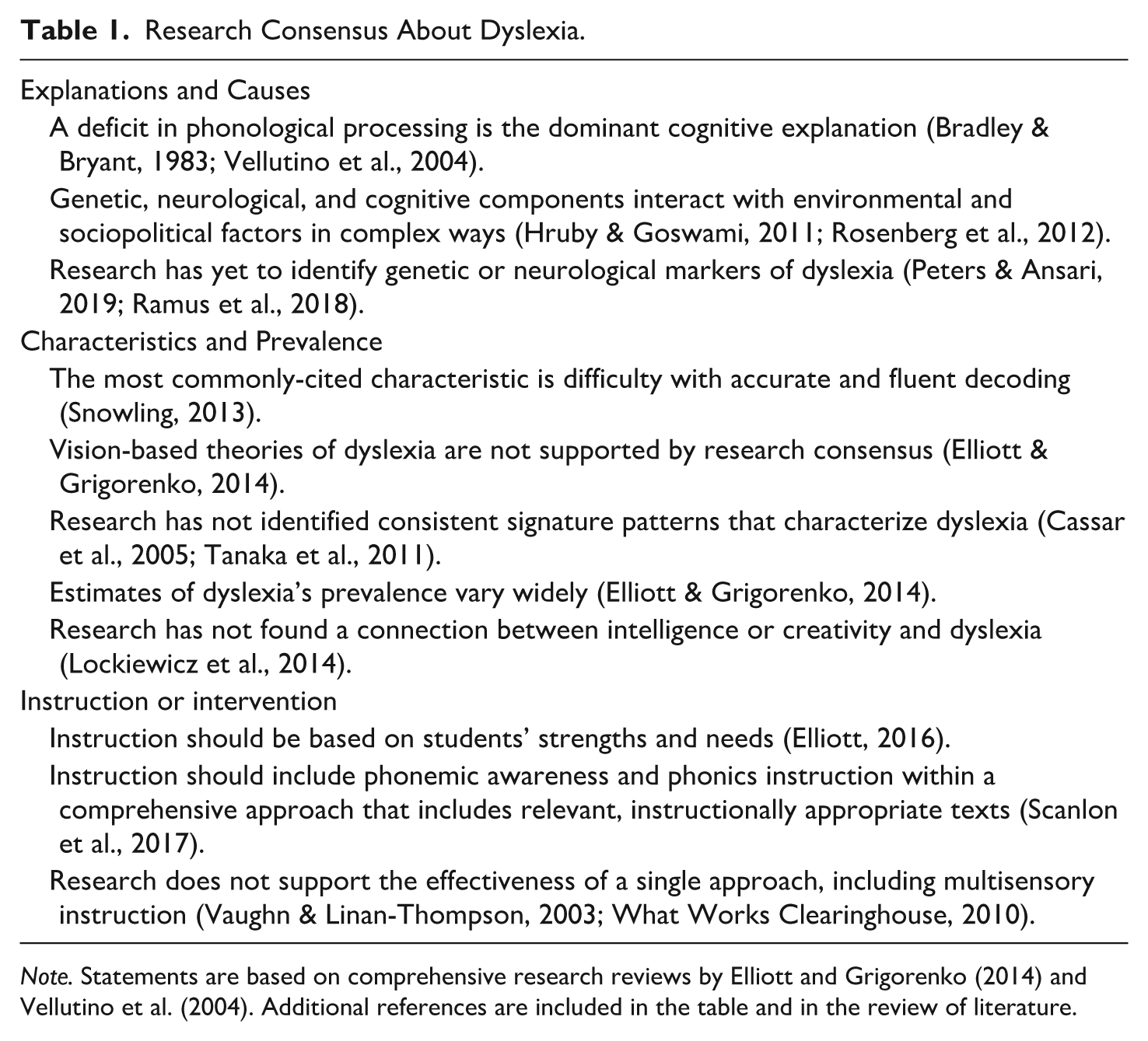
Note. Statements are based on comprehensive research reviews by Elliott and Grigorenko (2014) and Vellutino et al. (2004). Additional references are included in the table and in the review of literature.
Phase 3: Nature of discourse
The third analysis focused on the nature of discourse in which dyslexia information is conveyed. We coded language as AD (Bakhtin, 1981) when it was stated with certainty, as in, “People with dyslexia do not make random reading errors. They make very specific types of errors” (Bright Solutions for Dyslexia, n.d.). IPD statements were more tentative and uncertain, as in, “Some evidence points to the possibility that the condition is genetic, as it often runs in families” (Nordqvist, 2017). We also noted the use of medical terminology, a form of AD highlighted by DSE scholars (Baglieri et al., 2011; Bishop, 2013).
Results
Echoing previous research on the internet, we found the credibility of internet information about dyslexia is, overall, limited. Although some information is supported by research consensus, most claims and statements inaccurately reflect research and are couched in authoritative language. In the following sections, we report the results in more detail, including exceptions to the overall findings. The webpages do not have page numbers, nor are there always headings or clear paragraphs; to locate a quotation within the webpages, use the URL and search for the quotation.
Phase 1: Source Credibility
A summary of source credibility findings, with frequencies, appears in the online supplementary materials (Table 2). Five pages are associated with government or education institutions; the remainder have unrestricted domains. Eleven list or link to peer-reviewed sources, and 19 include a recent (2010 or later) publication date. Fifteen pages name a reviewer or author. Of the three reviewers, one is a neuroscience researcher who studies dyslexia; the others have no apparent credentials or experience in education or reading. The 12 named authors have varied credentials (journalist, cognitive scientist, physician, politician); only one, Sandman-Hurley (2013), has reading- or dyslexia-related credentials (a doctorate in reading education). Sandman-Hurley directs the Dyslexia Training Institute (n.d.), which sells online training in dyslexia advocacy and remediation for parents and educators. Regarding aims, 16 pages primarily sell products or services. Fifteen provide information without direct sales, and eight of those endorse products or services by name. Of the 50 pages, none meet all five credibility criteria; seven, all with unrestricted domains, meet four criteria.
Phase 2: Content
Here, we present findings related to the second research question, which focuses on causes, characteristics, and intervention and how they compare to research consensus (see Table 1). Definitions, exemplars, and frequencies are shown in Tables 4 and 5 in the supplementary materials.
Causes
Traditional models of special education downplay environmental, contextual, and sociopolitical factors (Annamma et al., 2013; Erevelles, 2000; Reid & Valle, 2004). Reflecting such models, most pages mention only intrinsic causes (e.g., genetic, neurological) and ideas that are not supported by research: for example, “Researchers have determined that a gene on the short arm of chromosome #6 is responsible for dyslexia” (Bright Solutions for Dyslexia, n.d.). Only two mention the interaction of intrinsic and extrinsic factors, which is supported by research (Rosenberg et al., 2012). Some pages describe dyslexia as a lifelong disorder. We were unable to find evidence supporting this contention, and it is challenged by research consensus, which finds that a high proportion of young children identified as at risk for reading difficulties or dyslexia go on to become proficient readers with development (Shaywitz et al., 1992) or with meaning-focused intervention (Vellutino & Scanlon, 2002).
Characteristics
Language- and reading-related characteristics
Consistent with research (Elliott & Grigorenko, 2014; Vellutino et al., 2004), the most frequently mentioned challenges are phonological awareness, decoding, and reading fluency, along with secondary difficulties in spelling, comprehension, and vocabulary. According to a video made for K-12 learners, dyslexia “mainly causes problems for people when they’re reading, but it can make writing, spelling, and math difficult” (BrainPop, n.d.).
Some pages list “classic warning signs,” including confusing and reversing letters, difficulty sounding out words, inserting or omitting letters, and confusing words with “the same first and last letters, and the same shape, such as house-horse or beach-bench” (Bright Solutions for Dyslexia, n.d.). Researchers have not identified such patterns in reading or spelling errors in dyslexia, despite decades of research (Cassar et al., 2005; Ellis et al., 1997; Moats, 1983). Furthermore, these characteristics apply to virtually all preschool and early primary-grade children (Bear et al., 2011; Lee & Al Otaiba, 2017).
Strengths
Sixteen webpages note strengths, advantages, or gifts of dyslexia, including intelligence and creativity (Paul, 2012; Time4Learning, n.d.), thinking “outside the box” (BrainPop, n.d.), “gifts” in “areas controlled by the right hemisphere of the brain” (Bright Solutions for Dyslexia, n.d.), and “strengths in creative problem solving and entrepreneurial thinking” (Dyslexic Advantage, n.d.). The connection with intelligence and creativity is a common trope about dyslexia, although it is not supported by research (Lockiewicz et al., 2014; Shaywitz et al., 2008).
Other characteristics
Five webpages address the research-supported idea that dyslexia was previously considered a visual problem but is now thought to be tied to phonological awareness: for example, “Contrary to popular belief, the core indicator of dyslexia is not reversing letters; rather it is a difficulty interpreting the sound (phonological) components of our language” (Dyslexia Help, n.d.). However, an equal number of pages allude to visual underpinnings. For example, the Dyslexie Font.com (n.d.) was developed to eliminate “the common reading errors in dyslexia,” including “swapping, mirroring, changing, turning, and melting letters together.” Similarly, two dyslexia simulations are based on the idea that letters “seem to jump around” or that letters are “reversed, inverted, transposed, and spelling is inconsistent” (Dsxyliea, 2016; Web Accessibility in Mind, n.d.). These claims and characteristics are not supported by research.
Other characteristics, risk factors, and consequences include being accident-prone, having difficulty telling time (Reading Rockets, n.d.), having “messy bedrooms” (Bright Solutions for Dyslexia, n.d.), and learning to “crawl, walk, talk, and ride a bicycle later than the majority of others” (Nordqvist, 2017). Among the risk factors listed by the Mayo Clinic Staff (2017) is “exposure during pregnancy to nicotine, drugs, alcohol, or infection that may alter brain development in the fetus.” Nordqvist (2017) states that people with dyslexia “are more likely to develop immunological problems, such as hay fever, asthma, eczema, and other allergies.” None of these assertions are supported by research.
Intervention
Phonics and early intervention
The most commonly recommended instructional approach is phonics and phonemic awareness instruction, which are components of comprehensive instruction supported by research. However, most of those pages recommend, and often sell, multisensory approaches. Although such approaches are not supported by research (Ritchey & Goeke, 2006; Vaughn & Linan-Thompson, 2003; What Works Clearinghouse, 2010), they are described in the data as “scientifically based” (e.g., Boston Children’s Hospital, n.d.) or “proven” (Dyslexia Help, n.d.; Hanford, 2018). Eight pages assert these interventions can change the dyslexic brain. For example, a video by Sandman-Hurley (2013) claims that after “intensive multisensory intervention,” the brains of individuals with dyslexia “begin using the left hemisphere more efficiently while reading, and their reading improves.” We found no research basis for such claims.
Some sources stress the importance of early phonological awareness and phonics intervention. Vellutino and Scanlon (2002) suggest the incidence of reading difficulties can be reduced through early intervention that is meaning-focused, comprehensive, and responsive. Such instruction includes attention to phonological awareness, decoding, reading in connected text, and writing (Scanlon et al., 2017; Vellutino et al., 2004). However, research does not support identifying students as dyslexic when they are just learning to read (Pedagogy Non-Grata, 2019; Shaywitz et al., 2008); overprescriptive instruction will likely be ineffective and even counterproductive (Nicholson, 2016; Pedagogy Non-Grata, 2019; Wilson, 2009).
Accommodations and technology
Nine webpages recommend strategies for supporting dyslexia, including technology and accommodations like audiobooks, computers, and extra time. Another adaptation mentioned on several webpages is a font designed to help people with dyslexia distinguish between similar and often-confused letters (Dyslexie Font.com, n.d.). Accommodations are often recommended for students who struggle with learning. Research support for vision-based remedies, however, is lacking (Elliott & Grigorenko, 2014).
Responsive instruction
Consistent with research, two webpages recommend basing instruction on students’ specific strengths and needs. According to the National Institute of Neurological Disorders and Stroke (2019), “The main focus of treatment should be on the specific learning problems of affected individuals. The usual course is to modify teaching methods and the educational environment to meet the specific needs of the individual with dyslexia.”
The role of schools
Fifteen webpages mention schools and teachers. Three of these describe the role of schools in intervention—for example, “Dyslexia is typically treated by special education intervention provided in school” (Boston Children’s Hospital, n.d.)—or recommend that parents work with schools to ensure appropriate instruction and support (Reading Rockets, n.d.). Most, however, recommend parents seek diagnosis and intervention outside of school or comment negatively about schools’ and teachers’ lack of knowledge or attention to dyslexia, themes that are common in popular dyslexia discourse (Gabriel, 2019; Worthy, Svrcek, et al., 2018). For example, the International Dyslexia Association (n.d.) states, “Dyslexia can make it very difficult for a student to succeed without phonics-based reading that is unavailable in most public schools.” In a video on the Bright Solutions for Dyslexia (n.d.) webpage, Susan Barton, founder and president, asserts, “Schools will tell you ‘there is no such thing as dyslexia,’ or ‘you can’t test for it,’ or ‘we don’t believe in dyslexia.’” Several articles published on The Mighty (n.d.) webpage have titles that denigrate schools, such as “The Awful Truth About Dyslexia Services at School,” and “Changing the Little White Lie of School Services for Dyslexia.” Writing about dyslexia legislation recently passed in New York, Simon (2017) expresses a hope that the new law will “spur education schools to better prepare aspiring teachers,” and Hanford (2018) asserts that “schools often do a poor job of helping students learn to read.” Regarding teacher education, research does support the need for improved teacher knowledge in basic language constructs that are foundational for reading (Washburn et al., 2011).
Phase 3: Language Analysis
We coded language on the webpages as AD or IPD (Bakhtin, 1981). Statements coded as AD are conveyed as certain or factual, using authoritative language (Bakhtin, 1981). Many AD statements are also consistent with a traditional special education or medical model, as described by DSE scholars (Baglieri et al., 2011), and with the associated claim that dyslexia is a clearly delineated, categorical construct: Children have a 50% chance of having dyslexia if one parent has it. And a 100% chance if both parents have it. (Do Something, n.d.) Scientific research shows that dyslexic children process information differently from non-dyslexics. (Dyslexic Advantage, n.d.)
Language categorized as IPD (Bakhtin, 1981) is more tentative and employs phrases like “research suggests,” as in the following: “Dyslexia is a complex disorder, and there is much that is still not understood about it” (Paul, 2012). Sources employing IPD report research findings without claiming the studies have produced proof or truth. For example, Murnane (2017) describes a research hypothesis that is “plausible” but “awaits empirical support” and suggests that readers “stay tuned as we await the results of further research.” Similarly, Nowogrodzki (2017) emphasizes that it takes multiple studies to produce convincing evidence and that research findings have implications for further study: “Together, these studies build a better understanding of how dyslexia works.… But they also raise a new question.”
After coding the units, we categorized each webpage as mainly IPD (7), mainly AD (26), or mixed, with approximately equal amounts of AD and IPD (11). The remaining six pages state information in a relatively neutral manner; four dictionary pages provide alternative definitions and information about etymology and usage, and two government-sponsored pages provide dyslexia-related information, announcements, and links to resources (e.g., Texas Education Agency, n.d.). Of the 50 pages, 31 use medical language, including “epidemiology,” “complications,” “diagnosis,” “treatment,” “pathology,” “impairment,” and “condition.” Like information delivered by medical and educational individuals and institutions, this language has authoritative overtones, even though it is not always credible (Bishop, 2013). For example, a site billed as being “for medical professionals” and written by a physician (Tidy, 2015) contradicts research consensus in pointing to “visual problems” as a possible cause of dyslexia (Elliott & Grigorenko, 2014; Vellutino et al., 2004) and recommends the use of “coloured overlays.”
Discussion
Writing before the turn of the century, Balajthy (1997) noted the rise of internet use among educators, concluding that “a vast amount of misleading information on dyslexia has also been posted on the Web” (p. 298). More than 20 years later, this description is still accurate. This is troubling considering that many caregivers and educators rely on internet sources for information about children’s health and well-being.
Source Credibility
When considering commonly recommended source criteria for assessing internet information, none of the webpages we reviewed could be considered highly credible. Some that include most criteria have agendas beyond providing information, and many contain questionable content or provenance. Only 19 include a recent date of publication, few contain references, almost half sell or endorse products, training, or intervention, and the only author with education credentials has a financial interest in dyslexia intervention.
Furthermore, the criteria were inadequate for judging quality (Breakstone et al., 2018; Metzger & Flanagin, 2013). Even sources associated with universities contain information unsupported or contradicted by research consensus, such as the claim that dyslexia affects 20% of the population (The Yale Center for Dyslexia & Creativity, n.d., 2014) and the statement that multisensory instruction has been proven effective (Dyslexia Help, n.d.). This is also true of webpages associated with medical institutions and sites that use the .org domain, which internet users commonly consider trustworthy (Alsem et al., 2016). Some include unsubstantiated claims about the causes of dyslexia, including prenatal smoking or alcohol use (Mayo Clinic Staff, 2017) and brain damage (Boston Children’s Hospital, n.d.). Our information credibility analysis helped us more critically examine the quality of information in these sources.
Information Credibility
We employed strategies similar to those used by professional fact-checkers in that we read across a wide range of sources and analyzed webpages well beyond the initial pages of search results (Wineburg & McGrew, 2017). We found that the pages include some research-supported information as well as many inaccurate or misleading claims, often within the same page. Claims concerning visual symptoms, motor skills, and the right brain appear tied to early, now debunked, theories of dyslexia concerning visual perception and hemispheric dominance (Lindell & Kidd, 2011; Worthy, Godfrey et al., 2019). Common characteristics of early literacy learners, including challenges with rhyming, naming letters, and sounding out words, are identified as dyslexia warning signs. Parents are urged to get help immediately—mainly outside of school—if their young children exhibit these signs (Bright Solutions for Dyslexia, n.d.; KidsHealth from Nemours, 2018). It is no wonder that searching for information about dyslexia can be confusing and stressful for caregivers and educators who seek answers about their children’s reading challenges.
It is also understandable that many people embrace the label “dyslexia” because of its association with intelligence, creativity, and success, even though research does not support these connections (Lockiewicz et al., 2014). Many state dyslexia laws contain the language that dyslexia is “unexpected in relation to the students’ other cognitive abilities” (Texas Education Agency, 2014, p. 67). This language explicitly separates students identified as dyslexic from other students with reading difficulties, reflecting Elliott and Grigorenko’s (2014) assertion that “decisions concerning dyslexia, like so many aspects of special education, are not neutral and value-free, but instead reflect a myriad of differing political and social agendas” (p. 176). Thus, the way dyslexia is portrayed in the popular media is similar to how LD originally emerged, as a category for the so-called intelligent and as a mechanism for separating these children from children with less palatable labels, such as “slow learner,” “culturally deprived,” and “mentally retarded” (Sleeter, 1987). As evidence, consider that the LD category–formerly a distinction for those who performed well on culturally biased intelligence tests–now includes a disproportionate number of students from nondominant racial, ethnic, linguistic, and economic groups (Annamma et al., 2013).
Discourse
Congruent with IPD (Bakhtin, 1981), a handful of webpages use language tentatively, in ways that are consistent with how researchers commonly report study results. They acknowledge that individual studies do not settle an issue but instead collectively build knowledge and point toward future research. However, most webpages present information authoritatively, as scientific and research-based, even though much of it contradicts, misrepresents, or is unsupported by research. Regardless of whether the information is accurate, the certainty with which it is presented has a strong influence on perceived credibility and on the ways people can engage together in openly exchanging ideas (Baglieri et al., 2011; Bakhtin, 1981). Resistant to questioning, AD may lead to wholesale acceptance of common but unvalidated assumptions about dyslexia, and stakeholders seeking answers may be vulnerable to solutions presented as irrefutable. Claims like these may be easier to embrace than the research-supported message that reading difficulties are complicated and that there are no clear answers.
Evaluating internet Information About Dyslexia
According to Breakstone et al. (2018), “for every important social and political issue, there are countless groups seeking to gain influence,” and consumers are “easy marks” if they do not have the skills and knowledge to identify hidden agendas (p. 30). Our knowledge and experience in the field of literacy education, and our research on dyslexia, aided us in analyzing the credibility of dyslexia information on the internet. Considering that a goal for this research is to offer guidelines for consumers who may not have our background and experience—including educators, caregivers, policy makers, and other stakeholders—we offer some criteria for negotiating and evaluating the credibility of dyslexia information on the internet and in other sources. These are based on our findings combined with digital literacy research. Taken together, they offer support for parents and other stakeholders searching for credible information on the internet.
Agenda
A first step is to examine websites and webpages to see if there is an agenda, such as selling or endorsing specific products, methods, or services. Links for purchasing merchandise, training programs, or program materials or product endorsements were visible on almost half of the landing pages (e.g., Dyslexic Advantage, n.d.). Another agenda promoted by many sites is a denouncement of public schools and instruction. When an alternative method is recommended or sold, this is a clear conflict of interest. For example, Bright Solutions for Dyslexia (n.d.), which is highly critical of schools, links to training seminars and workshops about how to set up and market a private dyslexia practice. An article by Hanford (2018) describes public schools as “failing to address the needs of students with dyslexia” and recommends instead a branded program, “Fundations” (Wilson Language Training Corporation, n.d.). Gabriel (2019) found a similar “us vs. them” critique of schools in the testimonies of parents supporting proposed dyslexia legislation and argues this theme is consistent with neoliberal school reforms and a school privatization agenda.
Stance toward literacy
Literacy is complex; all students, including those identified as having dyslexia, have individual instructional needs (Hruby & Goswami, 2011; Snowling, 2013). Thus, another important credibility criterion is whether the source recommends a comprehensive, responsive approach delivered by a knowledgeable educator, as supported by research consensus. We found that most sources addressing instruction for dyslexia promote only phonics instruction. One page provides additional recommendations for instruction—including comprehension, vocabulary, and read-aloud—and recommends targeting instruction to students’ specific needs (Mayo Clinic Staff, 2017). Those suggestions were not on the landing page, however, but on a separate page linked by a menu tab.
Multiple perspectives
Scholars from a range of fields conduct research on reading and reading challenges. Yet many webpages refer to scholars from a single or narrow set of perspectives, privileging the voices of scholars in medicine and psychology over those of educators (Baglieri et al., 2011). When sites acknowledge and promote multiple perspectives, users can get a better sense of the complexity of reading and understand why a single program or approach cannot address the needs of all students, even those with the same label. Thus, users should seek out sites that include contributions from a range of educators and scholars across various bodies of research. Among our sources, only one (Reading Rockets, n.d.) includes multiple scholars from various fields on the site. However, those sources did not appear on the landing page but on a separate page linked by a menu tab.
Sociopolitical considerations
Importantly, none of the sites addresses the role of sociopolitical issues such as race and language in the identification or instruction for dyslexia. Even though there is a substantial body of research that focuses on how dyslexia manifests across various languages, none of the webpages we analyzed include discussions of linguistic diversity, multilingualism, or instruction that considers languages other than English. Seen from a DisCrit perspective, this is another indication that many currently popular conceptions of dyslexia exclude individuals outside dominant, privileged groups (Annamma et al., 2013), so consumers should be sensitive to such omissions.
Discourse
Considering the complexity of dyslexia and the variability of reading challenges, statements of fact delivered in authoritative language are disingenuous and inaccurate. From a research and practice perspective, questions about “what works” and claims of “proven” answers to complex questions are simplistic and misguided, while tentative and exploratory language is more appropriate. Consumers should look for language that acknowledges the questions and uncertainty about dyslexia.
Conclusions and Implications
There is a long history of debate about the “best method” of reading instruction and of blaming educators for failing to teach reading correctly (see the discussion in Strauss, 2018). Since at least the 1950s, policy makers and the media have called for educators to “shape up” and embrace this or that “scientific method” of teaching (St. Pierre, 2006, p. 241)—as if there is an obvious answer that educators simply choose to ignore. These arguments continue to be recycled in the media (e.g., Hanford, 2018; Stark, 2019), and we also found them in some of the webpages. Many pages blame teachers and schools for neglecting or even obstructing the education of children with reading challenges and for not embracing what some claim as the only solution—dyslexia interventions and educator training based on simplistic, incomplete models of reading and instruction.
The conversation about dyslexia policy and practice in the media is dominated by people with limited or nonexistent expertise or experience in literacy research or education and with little input from scholars. More recently, after PBS NewsHour aired a report about dyslexia that featured parents sharing their children’s struggles with reading and arguing that schools have ignored the “best way to teach children to read” (Stark, 2019), members of the International Literacy Association’s Reading Hall of Fame wrote a letter asserting that “the NewsHour received inadequate and incomplete scientific advice when producing the segment on dyslexia” (Reinking et al., 2019). In response, the International Dyslexia Association published a rebuttal titled “In Defense of Facts” that contained unsubstantiated information and questioned the motives of the letter signers (Dykstra, 2019). This exchange reflects the divisive nature of the public conversation about dyslexia, which seems to be at an impasse, with various groups and individuals taking sides and accusing others of ignoring facts. We suspect that most people involved in these arguments sincerely want to improve education for children with reading challenges and that there is common ground, even among those who take seemingly opposing stances. However, the nature of public discourse, which often includes AD, impedes productive dialogue and progress.
Here, we offer implications for research and practice. Recent policy shifts have made dyslexia an issue that teachers, students, and families must now contend with. However, until recently, the voices of literacy education scholars, who have knowledge, expertise, and experience in teaching reading, have been missing from dyslexia research and from public conversations. Thus, more research from the perspective of literacy education will help enrich the discourse. Scholars from a range of fields study reading challenges, but this research is often presented and published in silos. It is common for people with divergent views to stay in comfortable spaces, talking to those who agree, which widens existing rifts. Even within the education field, general education and special education scholars often work and teach separately. Thus, another promising step involves scholars from areas that study reading—including education scholars—talking and working together across fields and paradigms to build understandings, clarify misunderstandings, and inform policy. It is important to hold space for multiple perspectives; to engage in open discourse, exploration of ideas, and negotiation of meaning (Bakhtin, 1981); and to keep the focus on shared goals of improving education for all students. We emphasize that the sociopolitical aspects of dis/ability and schooling—language, race, power, and privilege—must be guiding focuses in these conversations. We acknowledge that none of what we suggest will be easy or straightforward.
We also suggest that literacy education researchers should move outside traditional scholarly venues to cultivate a stronger presence in the popular media. Our suggestions for evaluating information about dyslexia can also be a guide for communicating information in public arenas. For example, when literacy researchers and educators write articles for popular media articles, we should be explicit about our goals and stances—our expertise, background, and biases—with a brief description analogous to a positionality statement. While staying true to what we know from experience and research, we must take care not to respond with righteous authority or attempt to replace one AD with another (Morson, 2004).
Engaging in public media is one aspect of joining the conversation on dyslexia, but the challenging work of moving from talk to action will require engaging with multiple stakeholders and perspectives at more personal and local levels. We have been frustrated by our state’s embrace of dyslexia initiatives that we feel are not helpful or effective, including accelerating dyslexia identification for young children, and embracing a narrowly-focused intervention approach that has not been shown to be effective. These initiatives have advanced with limited input from literacy educators, who, along with the children and families we serve, are greatly impacted. Many states, including Texas, require educator preparation programs (EPP) and district professional development (PD) to include state-approved dyslexia content (Youman & Mather, 2018). Our state has developed modules for teacher preparation and standardized PD training that leave limited space for discussion or consideration of local contexts. Although future and current teachers should be familiar with this content, they should also be equipped to critically analyze and contextualize it within sociopolitical contexts and the larger fields of literacy and education. Toward this end, we think it is important for EPPs and schools to engage in dialogue and work together to address dyslexia (dis)information in ways that consider the unique needs of teachers and students in varied circumstances.
Finally, universities and schools must work together to build bridges with policy makers, families, and individuals with reading challenges to better inform policy and practice. We have begun to forge partnerships with local educators, including dyslexia coordinators and other curriculum specialists, focused on developing shared goals for literacy education, teacher preparation, and teacher support. We have varying, sometimes opposing, perspectives about dyslexia, but we share the agenda of supporting students with reading challenges. As we share our perspectives, knowledge, experience, and resources, we seek to negotiate pathways for the benefit of the students we serve. We hope our work can help set the stage for all stakeholders to join in conversation about dyslexia policies and practices, building on research consensus and open dialogue, with the goal of increasing understanding of reading difficulties and how to address them.
Supplemental Material
sj-docx-1-jlr-10.1177_1086296X20986921 – Supplemental material for A Critical Evaluation of Dyslexia Information on the Internet
Supplemental material, sj-docx-1-jlr-10.1177_1086296X20986921 for A Critical Evaluation of Dyslexia Information on the Internet by Jo Worthy, Anne Daly-Lesch, Susan Tily, Vickie Godfrey and Cori Salmerón in Journal of Literacy Research
Supplemental Material
sj-zip-2-jlr-10.1177_1086296X20986921 – Supplemental material for A Critical Evaluation of Dyslexia Information on the Internet
Supplemental material, sj-zip-2-jlr-10.1177_1086296X20986921 for A Critical Evaluation of Dyslexia Information on the Internet by Jo Worthy, Anne Daly-Lesch, Susan Tily, Vickie Godfrey and Cori Salmerón in Journal of Literacy Research
Footnotes
Author’s Note
Susan Tily is now affiliated with University of Wisconsin-Eau Claire, Eau Claire, WI, United States.
Declaration of Conflicting Interests
The author(s) declared no potential conflicts of interest with respect to the research, authorship, and/or publication of this article.
Funding
The author(s) received no financial support for the research, authorship, and/or publication of this article.

References
Supplementary Material
Please find the following supplemental material available below.
For Open Access articles published under a Creative Commons License, all supplemental material carries the same license as the article it is associated with.
For non-Open Access articles published, all supplemental material carries a non-exclusive license, and permission requests for re-use of supplemental material or any part of supplemental material shall be sent directly to the copyright owner as specified in the copyright notice associated with the article.
