




Abstract
In this article, the authors take a reflective, self-study journey that digs into their own embodied literacies as Chicana feminist literacy researchers. Chicana/Latina feminisms offer an/other angle for exploring embodied literacies and are one way to center bodies and knowledge from the margins. The authors emphasize Anzaldúa’s concept of geographies of selves as an entry point for theorizing the embodied literacies of Chicanas/Latinas. To support this excavation process, the authors demonstrate how autohistoria-teoría, as a methodological approach to literacies, can be used to locate, narrate, and document the embodied literacies of Chicanas/Latinas. The findings demonstrate how places and people shape knowledge and ways of reading the world and thus impact the literacies imprinted on bodies.
Introduction
Critical shifts in literacy studies have prompted scholars to consider the expansiveness of literacies across a variety of modalities, such as the body, to understand the complex and ever-shifting forms meaning-making can take (Leander & Boldt, 2013; Vasudevan et al., 2017). Pushing on traditional verbo- and logo-centric frameworks, which limit literacy to a set of cognitive skills, scholars have articulated how literacies and knowledges are embodied (E. Johnson & Vasudevan, 2012). The body is central and never separate from the mind or even the spirit, as Lara (2002) emphasizes by recognizing the whole self as bodymindspirit. Bodies, of course, are situated differently and constantly inhabit various intersections of race, gender, class, sexuality, and citizenship status (Ahmed, 2014; Dutro & Haberl, 2018).
In this article, we take a self-study journey that excavates our own embodied literacies across our multiple positionings, and specifically as Chicana feminist literacy researchers. We draw on Chicana/Latina feminisms and in particular Anzaldúan conceptual tools as theoretical and methodological approaches. We argue that these frameworks offer an/other angle for exploring embodied literacies and a way to center racialized bodies and knowledge from the margins. Women of Color (WoC) scholars in literacy have argued that this is how we begin to see ourselves in literacy research (Haddix et al., 2016; Muhammad & Haddix, 2016; Quiñones, 2016).
We are particularly drawn by Leander and Boldt’s (2013) call on literacy researchers to recognize the unbounded nature of literacies. They state, “Unless as researchers we begin traveling in unbounded circles that literacy travels in, we will miss literacy’s ability to participate in unruly ways because we only see its proprieties” (p. 41). To tread in these unbounded spaces requires theoretical and methodological shifts in the field to look at, reveal, and excavate literacies that live on, within, and through bodies. Requiring theoretical and methodological shifts also echoes Anzaldúa’s (1990) call to find “new kinds of theories with new theorizing methods” (p. xxv). In this article, we are guided by the following questions:
How can we rewrite our own literacy journey through an Anzaldúan framework?
How does using a methodology of autohistoria-teoría foreground Chicana feminist epistemologies?
In this article, we illustrate how Chicana feminist theory provides a grounding for examining literacies and describe the process of working through our embodied literacies, emphasizing two primary theoretical concepts: geographies of selves (Anzaldúa, 2015) and autohistoria-teoría (Anzaldúa, 2015). We conclude with pedagogical implications of autohistoria-teoría for classroom teachers and the importance of women of color (WoC) feminist theories guiding teaching and learning to illuminate and honor the embodied literacies and experiences of students of color.
Chicana/Latina Feminist Theories and Embodied Literacies
We understand Anzaldúan theories as situated within Chicana/Latina feminisms, an interdisciplinary theoretical tradition that emerges from women, femmes, and trans feminists creating spaces where lived and embodied experiences take center stage (Anzaldúa, 1987; Castillo, 1994; Galarte, 2014; Moraga & Anzaldúa, 2015; Pérez, 1999; Saldivar-Hull, 2000; Sandoval, 2000; Soto, 2010; Trujillo, 1998; Zavella et al., 2003). These theoretical contributions have inspired a whole generation of Chicana/Latina feminist scholars who continue this necessary work of centering lived, embodied experiences and knowledges across academic fields such as history, cultural studies, community health, and education (Chabram-Dernersesian & de la Torre, 2008; Elenes, 2010; Pérez, 1999; Saavedra & Nymark, 2008; Villenas, 2006).
Chicana/Latina literacy scholars in the field of literacy education have used the cross-disciplinary theoretical frameworks offered by the theoretical tradition to further understand literacy, particularly within Chicanx/Latinx communities (Brochin & Medina, 2015; de los Ríos, 2017; Gutiérrez, 2008; Pacheco, 2014). These scholars, for example, have situated conversations of home/community literacies alongside Chicana feminist pedagogies to examine how literacies extend beyond the traditional classroom and are rooted in Chicanx/Latinx ways of knowing (Delgado Bernal, 2001; Elenes, 2010). Further, Chicana/Latina feminist literacy scholars have highlighted the literacies that emerge through storytelling across borders (Sánchez, 2007, 2009) and the powerful role mothers and mother figures play in sharing literacies of survival and resistance (Cervantes-Soon & Turner, 2017; Villenas, 2005).
Chicana/Latina feminists have also centralized the body in theorizing knowledge and pedagogy, laying out a foundation for expanding discussions on embodied literacies (Cruz, 2001; Moraga & Anzaldúa, 2015; Saavedra & Nymark, 2008). For example, locating the body as a site of knowledge production and literacies, Anzaldúa (2015) theorizes that “the material body is center and central. The body is the ground of thought. The body is text” (p. 5). We agree with Anzaldúa and understand the role of body in the way that Lara (2002) describes bodymindspirit—a unifying concept that moves toward wholeness of oneself, where the splits between mind and body and spirit are healed and united. The recognition of literacies as embodied helps us “heal [the] fragmented self and move toward wholeness and balance . . . [u]nlearning the western mind/body split and learning to listen to the wisdom of [the] whole self, [the] bodymindspirit” (p. 435).
Geographies of Selves as a Theory of Embodied Experiences
Geographies of selves (Anzaldúa, 2015) helps us further conceptualize embodied literacies. This framework allows us to identify how knowledge, literacy practices, and our genealogies live within and on our bodies. Anzaldúa (2015) asserts that the places we have lived, the borders we have crossed, and the cultures we have come into contact are “like a map with colored web lines of rivers, highways, lakes, towns, and other landscape features en donde pasan y cruzan las cosas, [and] we are ‘marked’” (p. 69). The relationship between who we are and how we come to know is situated within place, space, and land (Pendleton Jiménez, 2006). Our literacies make up these entangled roots that shape our identities and how we make sense of or read the world. In other words, our body encapsulates so much more than the physical body, to include all contact with the material, epistemological, and spiritual.
Through Anzaldúa’s (2015) concept of geographies of selves, we not only center the body, the knowledge and literacies that emerge from it, but also the land. Pendleton Jiménez (2006) states that “for Chicanas, learning about the land risks dredging up at least 500 years of colonial and indigenous knowledges in conflict, or hurtful understandings of ourselves in the world” (p. 220). Paradoxically, these geopolitical sites, geographies in general, hold rich ways of knowing that give rise and are specific to the cultural practices, pedagogies, and, of course, literacies for Chicanx/Latinx communities. In this project, we used geographies of selves to theorize our experiences with literacies through schooling, in our families, in our homes, and with the knowledge and histories of our ancestors. Understanding this entanglement between body, identity, land, and literacies begets a methodology that is autocritical and autoreflexive, such as the one Anzaldúa outlines through autohistoria-teoría, which we detail in the following section.
Autohistoria-Teoría as Method
Autohistoria-teoría is a multigenre, “discursive mode,” (Anzaldúa, 2015, p. 6) where one can make meaning of experiences and further understand identity through inscriptions on the self and blurring the borders between private and public realms. It is a literacy practice that draws upon a variety of modes and allows for fluid language practices, opening spaces for bi/multilingual tellings of the self that are reflective of home, community, and cultural knowledge. It is a creative process of storying and art-making to reflect on the self (autohistoria) and then, in turn, theorize from the experience (autohistoria-teoría). In other words, autohistoria is “your self story” (p. 137) and autohistoria-teoría is the theorizing that emerges from narrating the self.
As Anzaldúa (2015) emphasizes, the methodology emerges through the narrative writing and creation of stories through art and dialogue. In their “mixed-medium arts-based” project, Bhattacharya and Payne (2016) discuss autohistoria-teoría as a methodology that integrates storytelling, narrative writing, art, and theory to acknowledge, understand, and heal the multiple wounds that WoC, in particular, carry as a result of navigating oppressive systems both within and outside of the academy. They emphasize that autohistoria-teoría moves us to dig deep, exposing what we do not even know is there and opening up a space for us to sit within and theorize from these experiences. Furthermore, the creative, art-evoking aspect of autohistoria-teoría “provides a window, revealing the multiple states of consciousness that arise from experiences, desires, and imagination of possibilities” (Bhattacharya & Payne, 2016, p. 15).
In this theory building to rethink literacy, we looked toward the offerings of Chicana/Latina feminists and how Chicanas/Latinas have theorized literacy (even if we/they have not called their work literacy scholarship). In studying Anzaldúan theories, we began to piece together autohistoria-teoría alongside geographies of selves. In other words, geographies of selves became the “onto-epistemological framing of how [we understood] and [came] to the conceptualization and construction” (Bhattacharya & Payne, 2016, p. 3) of autohistoria-teoría. This provided a lens to look at embodied literacies and move into this deeply personal approach to Chicana/Latina feminist methodologies for literacy research.
Figure 1 reveals a simultaneous zoom-in–zoom-out process. We began this process with the question, what are literacies and embodied literacies through a Chicana/Latina feminist framework? That brought us to autohistoria-teoría. To carry out autohistoria-teoría, we looked toward geographies of selves to guide us in uncovering and revealing the literacies and knowledge imprinted on our bodies. Working outward, beginning with the body, moved us through the process to better understand and theorize literacies through a theoretical framework that is informed by the racialized and gendered experiences of Chicanas/Latinas.
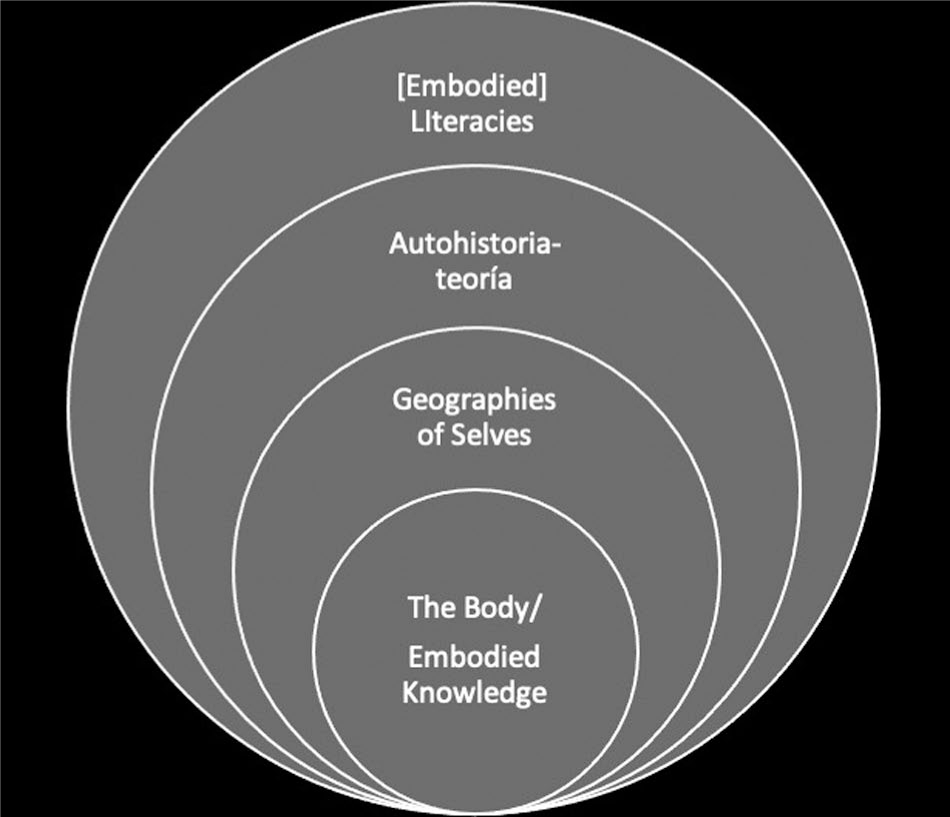
Theoretical and methodological framming.
Autohistoria-teoría, in many ways, is a methodological orientation in response to and in conversation with critical literacy (Luke, 2000; Street, 2003), New Literacy Studies (Lankshear & Knobel, 2007), and multiliteracies (New London Group, 1996), and expands upon critical embodied literacy research (Blackburn, 2015; E. Johnson & Vasudevan, 2012). The aforementioned literacy research, we argue, has centered the power of intellectual analysis to critique oppressive structures and transform identities. However, it lacks the centrality of racialized bodies and the way embodiment can be studied as both living in, against, and outside of oppressive systems. As such, we draw on these Chicana/Latina feminist framings to address these gaps and grapple with the unboundedness of literacies.
Situating Autohistoria-Teoría in Qualitative Research
Autohistoria-teoría relates to Chicana/Latina methodological offerings such as testimonio (Cervantes-Soon, 2014; Delgado Bernal et al., 2012), written and oral narratives of marginalization and resistance, as well as pláticas (Fierros & Delgado Bernal, 2016), sharing and producing new knowledge through dialogue. Autohistoria-teoría can also be situated within the broader umbrella of narrative research. Some researchers may see autohistoria-teoría as similar to or reflective of autoethnography, a method of research that critically examines personal experiences to better understand broader cultural, social, and political phenomena (Boylorn, 2013; Ellis et al., 2011). Or perhaps it is similar to oral history methods, the oral sharing of personal histories, largely taken up in feminist studies to contribute to new knowledge and push back on patriarchal notions of what has been and is taken as normal (Haynes, 2010). Autohistoria-teoría also shares aspects of methods such as self-studies (Hamilton & Pinnegar, 1998; Ohito, 2019), bricolage (Kincheloe, 2004), and portraiture (Lawrence-Lightfoot & Davis, 1997).
Scholars of color and WoC, in particular, continuously seek out and work to create nuevas teorías y metodologías (Anzaldúa, 1990) that certainly may draw from traditional methods but are carried out and guided by the theoretical and epistemological maps reflective of their own histories, cultures, and experiences (Brown, 2014; Quiñones, 2016; Tuhiwai Smith, 2013). Autohistoria-teoría carries with it the theoretical underpinnings that are central to Chicana/Latina feminist theory and critical and embodied literacies. In many ways, autohistoria-teoría makes possible working from a theoretical and methodological framework that already considers intersectional identities and engages texts of the self instead of having to begin with an initial pairing or puzzling together two distinct methods and theories.
Quiénes Somos
Before we move forward with illustrating how this reflective process unfolded, it is important to explain how we got here. We come to this work as two Chicana feminist scholars who continue to engage in “ongoing critical and self-implicating reflexivity about the meaning of race and gender in our lives and the ensuing relationships of power,” within and outside of the academy (Dinzey-Flores et al., 2019). It is important to ground our work within the complexity of Chicanx/Latinx communities, which are diverse representations of race, ethnicity, gender, and language. Our own distinct immigrant and racialized experiences, however, have motivated our search for method(ologies) that align with and feel connected with the epistemological and theoretical underpinnings of our work around the literacies. Over many years of supporting each other through our academic journeys, we reflected on the gap of Chicana/Latina feminist theorizing of literacy methodologies for literacy research. We continued to reflect on our understandings of literacies from our own lived experiences of meaning-making together at the intersections (and outside of them) and further theorizing our literacies, juntas. What we have come to learn is that the knowledge and theories of Chicana feminist theorists shapes our work, our lives, and our understanding of literacy and thus is the foundation of the bridge necessary to engage in such a deeply personal yet collaborative project.
The Excavation Process: Hearing, Seeing, and Feeling Chicana/Latina Embodied Literacies
In this section, we identify the key components of autohistoria-teoría as a methodology for literacy research. The first element is Anzaldúa’s notion of creative acts, which we understand as a call for multimodal creation and the recognition that literacies unfold and must be understood across modalities. The second component is the method of narrative writing as a way to crystalize themes and rich connections that emerged in our creative process. The third and final is the practice of meaning-making as central to literacy theorizing from a Chicana feminist epistemology (Delgado Bernal, 1998). Together, these components of autohistoria-teoría provide both theory and method to carry out literacy research. Below, we detail this methodological approach.
Creative Acts: Literacies Across Modalities
As we began reflecting on and re-examining our literacies from our Chicana feminist standpoints, it was important to approach our literacy genealogies in a way that challenged traditional literacy practices. When we began this work, we realized we could not simply start to write about our experiences in academic, standard American white English. When we attempted to, we ran into walls and found that we could not fully capture the richness and intersections that would emerge through pláticando or meaning-making through dialogue (see Fierros & Delgado Bernal, 2016; González Ybarra, 2018). Consequently, we decided to use other modes, specifically image, art, and our bilingualism, and created what we later decided were visual representations of our geographies of selves.
First, we decided on mapping our literacies using a multimodal approach (Ohito & The Fugitive Literacies Collective, 2020). We gave ourselves complete liberty to incorporate any variety of images, art, photos, and texts to convey a visual representation of moments in our life that were defining and shaping our identity formations. Drawing on geographies of selves and WoC feminisms (Collins, 2002; Lorde, 2020; Moraga & Anzaldúa, 2015) and heavily guided by our critical consciousness developed over the years, we outlined what we could include in these multimodal creations. Below are the raw, unedited notes from these conversations that highlight topics we prepared on a shared document:
(Notes, February 2018)
Journey Maps- Move away from maps; but geopolitical spaces are still really important (cartography)
Entry Brownsville
Get graphics; sections and over lay them
Journey lines—because of those experiences, we are who we are today; these are the stories that fuel our academic pursuits
Some literacy experiences are traumatic
Theorizing; coming to theory to heal.
Countering the traditional questions “did you have books at home, did your mom make a grocery list?”
The “who we are” literacies
Bilingualism; language is central
To think about their own geographies of selves and their embodied knowledge.
And
(Notes, May, 2018)
Mapping one’s story of literacy
Don’t forget about land
Bring in geographies of selves
Our own mapping story as data
Draw autohistoria-teoría
Mapping out our literacy stories
Reimagining identities through one’s own identity (critical self reflection)
The body is raced
Roots you connect to (Honduras, Nicaragua, Borderlands, U.S.–Mexico.
The body holds knowledge
Bringing in genealogical/epistemological maps (Latina Feminist Group)
Language, modes of survival, implications for things you can do with youth and children
You can’t ever cut off your roots
Your identities, past, histories are never lost
Even when you are forced to assimilate and navigate mainstream institutions
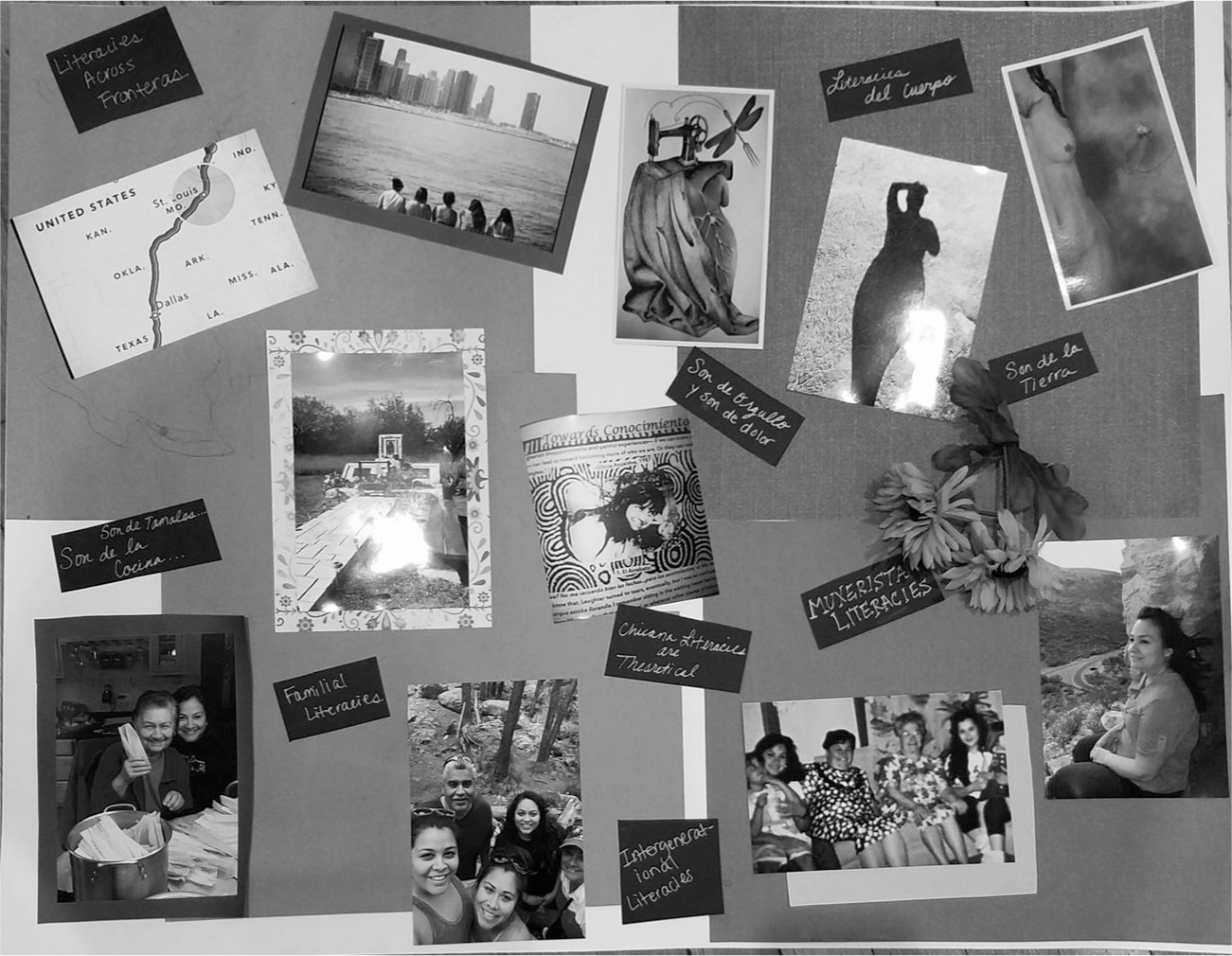
Mónica's geographies of selves visual.
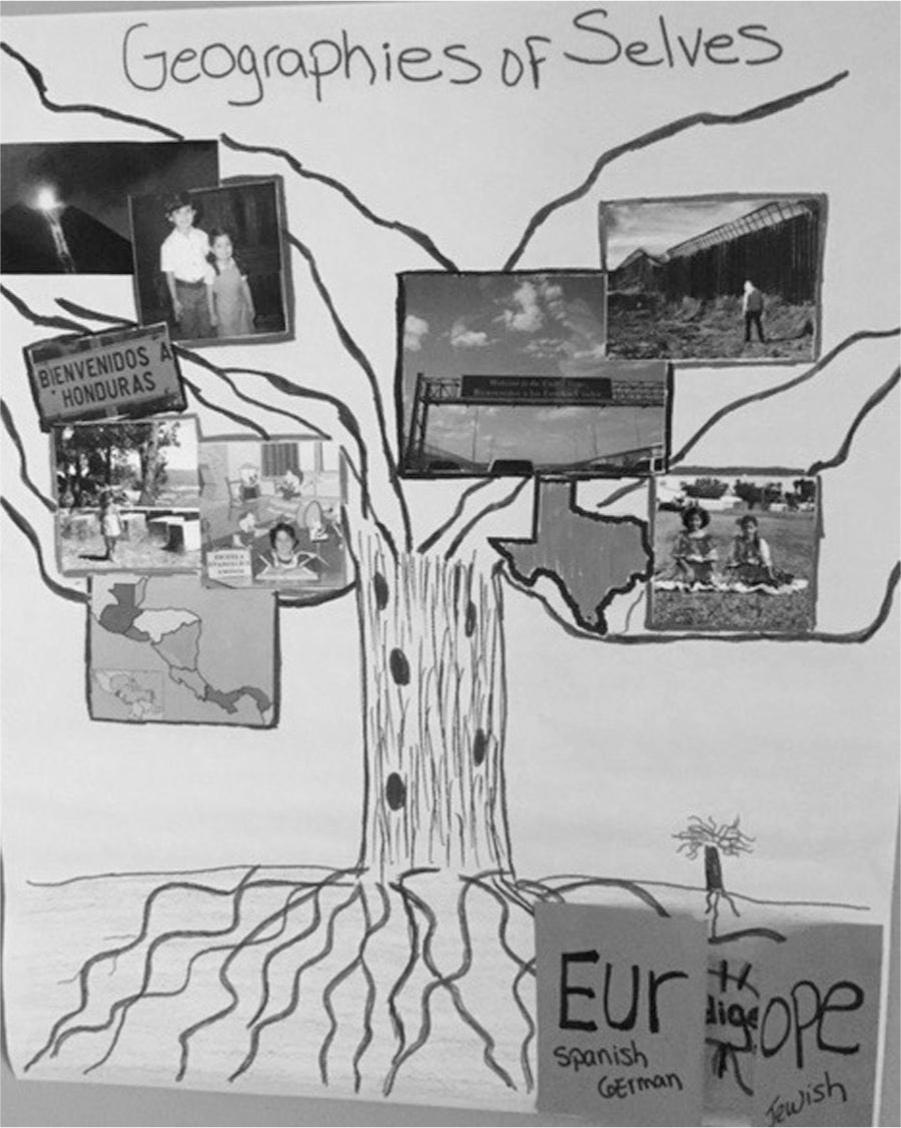
Cinthya's geographies of selves visual.
The visual representations of our literacies promote the notion of creative acts. Anzaldúa (2015) encourages centering visual narratives as creative acts that come from one’s autohistoria-teoría. These creative acts “include the artist’s cultural history—indeed, it’s a kind of making history of inventing our history from our experience and perspective through our art rather than accepting our history by the dominant culture” (p. 62). Our multimodal representations creatively pieced together where we have lived, the borders we have crossed, our embodied knowledge, the women in our lives, and our feminist teachers through photos, drawings, and scribbled lines showing the various dis/connections to our literacies. The images and the way we repieced them together spoke to moments in our lives that were central to what we consider our genealogies of literacy. We retraced our literacy journey differently than how we were taught to think of ourselves as literate and troubled ideas of what counts as literacy for brown bodies. Our visual representation also sparked important and necessary pláticas about who we are and our journeys, as well as a rethinking of our embodied literacies, which developed into our narratives found in the section that follows.
The Method of Narrative Writing
Writing is central to autohistoria-teoría. Anzaldúa (2015) states, “My methodological stances emerge in the writing process, as do the theories” (p. 4). Narrative writing, thus, was a critical component to understanding and rethinking what we mean by literacies in relation to our lives, identities, experiences, and education. At first, our narratives were the textual description of our multimodal geographies of selves projects. Once we saw each other’s projects and read the narratives that emerged from them, we edited and further refined our own. Peering into each other’s literate lives and experiences helped us see what we had not seen in our own initial creations and narrative drafts. This process moved us to re/member and understand how “personal experiences—revised and in other ways redrawn—become a lens with which to reread and rewrite existing cultural stories” (Keating, 2015, p. 242). The process of writing and further engaging in pláticas became a polyvocal process of rethinking and re-narrativizing and, in many ways, revealed the power of storytelling among two Chicanas whose experiences both intersect and depart from each other’s. Below are the “revised,” “redrawn” snapshots of the narratives that emerged through an ongoing process of creating our visual geographies of selves, sharing them with each other, and discussing the multiple layers to our project with each other.
Mónica
In the process of naming, remembering, and locating my literacies, I was particularly interested in the role of identity and what pieces of my identity were significant and interconnected to the way I read and make sense of the world. As I did this, I began to realize how my literacies are largely informed by my experiences of being other[ed]. As a young girl attending predominantly white, well-resourced schools in the suburbs of Chicago, the literacies I carried with me were largely overlooked and/or silenced. Despite having a critical eye and feeling that my culture, language, and literacies were invisible in my all-white classrooms, I found myself in pullout reading and English language learner (ELL) support and hating everything about me that identified me as Mexicana. This included hiding my language, pretending I did not know Spanish while in school or in public places, and being embarrassed at the sound of the music of my home. I distinctly remember once asking my mom to lower the music when she came to pick me up from school. When she said no, I put my hands over my ears to mask the sounds of the accordion and trumpets. Chipping away at who I was became a useless survival tactic that only led to being placed in remedial classes and alienated by my white peers. It was not until I found myself applying to college that I realized how community resources, knowledge, and cultural literacies pushed me to reach that stage and provided a foundation for me to reclaim my identity. Schooling had not.
Now when I think about my literacies, I often begin with the body and how I understand the body as a site for knowledge production. Literacies are embodied; they are imprinted on my flesh and flow along my hips. Literacies del cuerpo son de orgullo y de dolor. After years of body shaming and experiences of sexual assault, loving my body has been a precarious process. My body, however, holds beauty and strength that I inherit and hold within me from generations of mujeres before me. I think about literacies that live and emerge from within me. I think about how my body is read, how I write with it, and how it moves me to make sense of my lived realities. Chicana/Latina feminist theory has been central to this journey and my theorizations of embodied literacies.
Interconnected with the body, my literacies have been largely shaped by the women in my family. I often hold the image of me sitting on my mother’s lap alongside my abuela, my great tía (my abuela’s sister), and my tía (my mom’s sister) with my sister on her lap, in my head. Although not all of these women may identify as feminists, their ways of knowing, navigating and surviving the world, and pedagogies are feminista. Their pedagogies have surfaced through pláticas, convivencia, and in the celebration of mujeres. I am proud to be a part of their lineage. In addition, my feminista literacies—the way I read, write, engage in conversations, make meaning, and come to new understandings of the world—are deeply connected to my mother. Centering feminista literacies in mothers, specifically for me and my mother, moves me to think about literacies framed around love, advocacy, pain, strength, and superviviencia.
Place, space, and land have also been central to my ways of knowing and the way I make sense of the world. My grandparents, and generations before them, are from the border region—south Texas and northern Coahuila. The traditions, pedagogies, and languages that emerge from people of these communities have deeply shaped who I am. These border histories and ways of living have deeply influenced my identity as a third-generation (fourth on my dad’s side) Chicana, growing up in the suburbs of Chicago. For me, witnessing both the trauma of borders and forced migration, as well as the celebration of immigration, surviving, and maintaining familial relationships across time and space is a testament to the complex ways my literacies take shape in relation to borders, but also how they transcend them and are ultimately situated in the metaphorical borderlands.
Cinthya
My story begins now. It is a retelling of the old story of how I see my identity. Chicana/Latina feminists have helped me to rethink my identity. For the longest time, I used to hear the stories of our European heritage, both Spanish and German, with of course no tangible cultural connection to either. My family told this story with honor, with distinction. It helped to weed out any possible connection to an Indigenous past. Therefore, I grew up knowing I had European heritage. But one day, as my mom and her sisters were talking, I overheard them talk about their great-grandfather coming to the Americas, Mexico to be exact, and how he married an Indigenous woman there. That day, my whole perception changed. For the first time, there was an acknowledgment of our Indigenous roots. But even more obvious was my grandmother, whose father was an Indigenous person of Nicaragua. But no one ever mentioned this. Ever! My maternal grandmother simply just existed with no roots, while my grandfather had “European” roots that could be traced through his maternal grandfather. This is how my story of identity changed. I no longer will continue the story of our European heritage; rather, at least for now, I can talk about our mestizaje lineage. The mix that we are yes, European, but also, and most importantly, with plenty of Indigenous roots. This is now the story of my identity.
My body carries and has important knowledges. We are never taught to examine how our bodies move through different spaces and how it learns from those spaces. We are never taught to examine how our bodies experience this world as racialized bodies. It is no wonder that Chicana/Latina feminists use and center Anzaldúa and Moraga’s concept of theory in the flesh to denote how our enfleshed experiences produce important understandings, new theories, and stories about the world. Our theories are lived, not just thought about. We are living and breathing, walking theory. It is not out there, it is in here, within. All this kind of thinking about my being is relatively new for me. This realization also empowers and allows me to see my body in new ways, with a sense of honor and importance. My body has learned to move through different spaces. Perhaps it learns it before the mind/intellect. As I have lived, crossing multiple borders, my body navigates these crossings with patience and understanding. Something my mind does not know how to do. The intellect is impatient, critical, and ego-based. My body feels its way on this Earth through learning to read the terrains.
I had lived in three countries by the time I was eight. I was born in Managua, Nicaragua, and due to the civil war, around the age of four, we moved to Honduras. My dad worked for the Central American bank, had status and connections, and was able to get his job relocated to Tegucigalpa, Honduras. My dad believed at the time that things were getting worse for all of Central America, like Nicaragua and El Salvador. He therefore thought to uproot us again, this time to el Norte. My trip to the United States was to first land in Matamoros, Tamaulipas. We were privileged to cross the Mexican–U.S. border with a tourist visa that my dad had secured. I never realized until later that it was such a privilege to cross with a visa and that it was not too hard for my dad to get one. I juxtapose this border crossing with those of the millions who cross without seeing the sign that says, “Welcome to the United States.” Instead, they cross a river, a desert, climb over a wall to have more economic opportunities—economic opportunities denied in their homelands because of economic policies in place that are negotiated between the elite in their countries and the U.S. government or multinational companies. Crossing borders is also a metaphorical way to understand how an immigrant little girl, second-language learner negotiates and travels through new terrains in language, culture, and epistemology. Needing to cross borders is indicative, then, of the experiences of many who do not belong to neat identity boxes but who constantly cross and traverse them and sometimes live in between them, in nepantla. In this in-between place, the borderlands, new ideas are born from the clash of two opposing ideas, new identities are formed from the merging of two or three previously existing identities. The borderlands is that space where this happens or can happen.
Literacy in schools was never fun or exciting for me. In many ways, I hated to read. I felt completely disconnected from it. I did not see anything to latch on to. I remember how it was not until I read Chicana/Latina feminist literature and poetry that I saw how exciting reading and literature can be. As I think back, I know I had stories to tell and experiences to theorize, such as my growing up as an immigrant second-language learner. I had firsthand knowledge of what it meant to be in a war-torn country. I had firsthand knowledge of what it means to be displaced, to be part of the Central American diaspora. These are literacies, readings and re-readings that would have helped me to a have positive bilingual, bicultural identity. Our literacies in the flesh must be written into literacy, as Anzaldúa always encouraged us to write.
The method of narrative writing moved us to consider the overlap, intersections, and points of difference in our narratives. The practice of sharing our stories allowed for our narratives to become part of collective stories in conversation with each other and resisting dominant, colonial narratives (L. L. Johnson et al., 2017; Morales et al., 2001 ; Solórzano & Yosso, 2002). Autohistoria-teoría lends itself to this idea of situating the self within the larger collective to understand our experiences in relation to community experiences and larger sociopolitical contexts and histories. As Keating (2015) describes, “Autohistoria-teoría focuses on the personal life story, but as the auto-historian tells her own life story, she simultaneously tells the life stories of others” (p. 241). In our own project, we found that sharing our historias with each other led to autohistoria-teoría specifically around the literacies and in relation to the languages and cultural knowledge of Chicanx/Latinx communities. This moved us into our meaning-making process where dialogue and co-constructing knowledge became central to theorizing embodied literacies and grounded in our experiences and epistemologies.
The Meaning-Making Process: Healing Dis-Embodiment
For Anzaldúa, the meaning-making process involves more than the analytical mind. The process serves almost as a way to reinvent oneself and one’s story of disidentification and reidentification while simultaneously providing fluid identities and temporary truths—that is, “should we do this again?” We might have different ways to read our identities and different assertions to make about what we believe to be true. Important, however, is that the meaning-making through autohistoria-teoría breaks the chains of the societal and cultural inscriptions that we have inherited and adopted as capital-T truth for ourselves but no longer serve us. Anzaldúa (2015) resonates here when she writes, Storytelling and reading and listening to stories is not only how we make sense of ourselves, our lives, and our place in the world, and how we make the Self. Storytelling is healing when it expands the autohistorias (self-narratives) of the tellers and the listeners, when it broadens the person that we are. (p. 177)
After creating our visual representations in combination with ongoing pláticas about our narratives, we began to theorize our experiences, resulting in a rethinking of who we are and how we have been telling our story. Anzaldúa (2015) keenly observes that one’s “autohistoria is not carved in stone but drawn on sand and subject to shifting winds. Forced to reword [one’s] story, [inventing] new notions of [self] and reality” (p. 143). Thus, we are able to re-narrativize our story, as demonstrated in the section above, creating perhaps new meanings and new theories.
From our reworkings, we located three central themes: re-envisioning identity, locating embodied literacies, and border/lands. The themes are a representation of critical moments in our ongoing pláticas that revealed a shift away from deficit perspectives of our own adopted perceptions of ourselves due to our miseducation as well as our own cultural and societal inscriptions. Through our autohistoria-teoría, we witnessed how geographies of selves unfolds through our narratives and across our experiences.
Re-envisioninig our identity
Chicana/Latina feminists have theorized identity as shifting, in progress, and deeply interconnected to knowledge and experience (Anzaldúa, 2015). What we have learned from our narratives is that identity is, without a doubt, also connected to literacies. In the process of writing our experiences, we unearthed and reclaimed pieces of our identities that had been silenced, hidden, or chipped away. This was also a process of putting the pieces of ourselves back together in a way that now acknowledges and honors our ways of knowing, cultural heritage, and strategic navigations in and out of school. Rethinking identities become central to the re-reading of who we are. This required confronting our own histories, unpacking our experiences, and problematizing how we thought of our identities. From our identities emerge active literacies, literacies in motion that require a vulnerability, reflexivity, and re-examination, but that can lead to a healing practice. Being able to tell a different story of who one is opens new spaces of possibility and healing.
Locating embodied literacies
The body is a source of knowledge (Cruz, 2001; Moraga & Anzaldúa, 2015). As a site of intellect, our bodies are inseparable from the ways that literacies are produced, practiced, exchanged, and engaged. Examining our embodied literacies through these frameworks allowed us to better understand our bodies as they are situated along and beyond race and gendered lines—our theories in the flesh (Moraga & Anzaldúa, 2015). Through our narratives, we began to understand that these literacies are certainly embodied, but they are also a reflection of our bodymindspirits—our entirety. As such, examining embodied literacies requires that we not only recognize how bodies take up and traverse raced, classed, and sexed spaces but also that we understand literacies as living and breathing within our whole being.
Border/land-based literacies
Chicana/Latina feminists have theorized the border/lands as a conflicted, yet rich site of knowledge production (Anzaldúa, 2002; Calderón, 2014; Pendleton Jiménez, 2006). In our visuals and narratives, we demonstrate how our own ways of practicing and engaging in literacies are learned and inherited not only from places and spaces where we have lived but also from the borders we and our families have crossed. For us, the border/lands offer a space to theorize literacies coupled with the opportunity to be reflexive, motivating critical thinking in between. For both of us, in theorizing from this liminal space, we see how border/lands, space, and place live within and are imprinted on our identity and body.
Our border/land literacies are generational and sociopolitical, and they contribute to the creation of new knowledge and ways of understanding literacies. Our multimodal representations and narratives capture our own border/land knowledge, both physical and metaphorical. In other words, this process forced us to reckon with the distinctions between physical and metaphorical border crossing—what is different between generational and metaphorical border crossing and the actual forced migration and materiality of crossing the border in dangerous, inhumane conditions.
“Now Let Us Shift”: Methodological Shifts for Chicana/Latina Feminist Literacy Research
Si se puede, que asi sea, so be it, estamos listas, vámonos. Now let us shift. —Gloria Anzaldúa (2002, p. 576)
Autohistoria-teoría is by no means limited to the use of Chicana/Latina scholars. It is important, however, to acknowledge the perennial methodological mismatch that Chicana/Latina feminists continue to navigate, especially in our work with Chicanx/Latinx communities, and the struggle of locating methods that reflect and feel like the practices and knowledges that emerge in our homes, communities, families, and bodies. Chicanx/Latinx communities, as well as other communities of color, are often subjects of research methods and are rarely seen as creators of methodologies and as having the knowledge and approaches to engage in inquiry. Therefore, Chicana/Latina feminists, alongside other WoC feminist scholars, have sought out other[ed] methodologies and called for methodological shifts in the academy (Evans-Winters, 2019; Montoya, 1994; Téllez, 2005; Tuhiwai Smith, 2013). Shifts, as Anzaldúa (2015) suggests, are “opportunities for change; [where] we acquire additional, potentially transformative perspectives, different ways to understand ourselves, our circumstances, and our worlds” (As cited in Keating, 2015, p. xxxv). Autohistoria-teoría is part of this methodological shift, where other[ed] knowledge, modes of meaning-making and communication, and the body are recognized as legitimate. Autohistoria-teoría is a humanizing methodological practice (Paris & Winn, 2014) through which the process of narrating and sharing one’s story becomes symbiotic (Fernandes, 2003), where relationships are central, and the knowledge that emerges in the practice adds and becomes part of the collective narratives of the community (San Pedro & Kinloch, 2017). It is a practice through which researchers, in particular, are changed by the projects they engage in because of the ways in which autohistoria-teoría requires vulnerability and engagement of the bodymindspirit (Lara, 2002).
The methodological components of autohistoria-teoría have the potential to heal not only the wounds inflicted on the bodymindspirits (Lara, 2002) of Black, Indigenous, People of Color, and queer folx, through colonial histories and present oppressive structures but also the gashes that are often felt through the pressures and practice of traditional and mainstream methods in research. These methods continue to be upheld as rigorous and valid in literacy research. Autohistoria-teoría allows us to “construct, speak through images of, and (re)frame [our] fragmented narratives while cultivating a sense of fluid, contested, and fleeting wholeness” (Bhattacharya & Payne, 2016, p. 2).
In the spirit of Emma Pérez’s (1999) work in The Decolonial Imaginary, which sought to write Chicanas into history, we found ourselves with the need to write mujeres into literacy. To do this, we have to be intentional about our work in literacy research. We have to unlearn what we have been taught about what counts as literacy and imagine new ways to see literacies. Bringing our own theories and methods can transform our research. In this way, we can be seen by exhuming the rich, complex, fluid literacies and identities that for far too long have been buried and made invisible in literacy research. In re/mapping our lives, identities, and bodies on our terms, we exist and become visible. Equally important is that our theoretical and methodological contributions to literacy studies become legitimated. This is how we have the opportunity to transform research in literacy education and the frameworks through which the literacies of children of color, immigrants, and multilinguals are studied.
Autohistoria-Teoría as Pedagogy: Implications for the Classroom
As our self-study shows, using autohistoria-teoría can help in recognizing unnamed literacies while facilitating spaces for healing. Within the classroom, autohistoria-teoría has the potential to support students in the unlearning of internalized deficit ideologies and messages about their lives and literacies. We urge educators to consider WoC perspectives and literacy practices as necessary and legitimate pedagogical approaches that promote decolonizing literacy practices. Projects that facilitate and support students in the self-examinations and restorying of themselves is central to critical literacy pedagogy in classrooms. Autohistoria-teoría coupled with geographies of selves highlights how narrative pedagogies, multimodal learning, and embodied knowledges and literacies can come together and center the experiences, creativity, literacies, and bodies of Black and Brown children and their families. Educators and students can bridge discussions about how this knowledge informs who they are and what that means for how they see the world.
Considering that the field of teaching in the United States continues to reflect a white, middle-class, woman majority, it is imperative that educators recognize and critically examine how their literacies and lived experiences may not reflect those of their Black and Brown students. As we continue to witness the ongoing state-sanctioned violence on Black and Brown communities, specifically the murders of Black people at the hands of police and the mass incarceration and deportations of migrants, educators have the responsibility to hold space for students to process racial trauma and learn about how their literacies are shaped by current sociopolitical contexts (Garcia & Dutro, 2018). Educators must also recognize that students’ literacies are not solely bounded by their trauma and instead also powerfully shaped by the joys, pedagogies, love, and strength from their families, communities, relationships, and places in and from which they live(d) and migrated (Baker-Bell, 2020; Lyiscott, 2019). A pedagogy informed by geographies of selves and autohistoria-teoría has the potential to lead students to these complexities and tensions while also highlighting the powerful nature of their multifaceted languages and literacies, rather than silencing or erasing them. This pedagogical approach challenges educators to actively work toward reclaiming literacies and healing the wounds of literacy education for Black and Brown children.
Conclusion
Autohistoria-teoría is one way to rethink literacy education and the theories and frameworks we use in our research. Drawing from our own autohistoria-teorías, we argue the following components were critical to our methodological and pedagogical framework: creative acts, narrative writing, and meaning-making. Creative acts, as we outline, highlight the various modes through which literacies emerge. For us, this included image, text, art-making, and dialogue, specifically in the form of pláticas. Narrative writing, we argue, further crystallizes the knowledge that emerges across these multiple modes and adds to the methodological practice of refining, redefining, and better understanding themes and patterns. Autohistoria-teoría requires deep analysis, or meaning-making, not only from the content that emerges through creative acts and narrative writing but also through the process of engaging in methodological and pedagogical practices.
Lastly, we want to acknowledge not only the influence that Gloria Anzaldúa has had in literacy studies but also that her scholarship can be taken up as central to literacy studies. Our work contributes to writing Anzaldúa into literacy theories. We encourage other researchers to keep finding theories and methodologies (Anzaldúa, 1990) that contribute to the reimaginging of literacies. As we rethink the world, we reread the world. And as Anzaldúa (1987) states, “Nothing happens in the ‘real’ world unless it first happens in the images in our heads” (p. 87).
Supplemental Material
sj-zip-1-jlr-10.1177_1086296X20986594 – Supplemental material for Excavating Embodied Literacies Through a Chicana/Latina Feminist Framework
Supplemental material, sj-zip-1-jlr-10.1177_1086296X20986594 for Excavating Embodied Literacies Through a Chicana/Latina Feminist Framework by Mónica González Ybarra and Cinthya M. Saavedra in Journal of Literacy Research
Footnotes
Declaration of Conflicting Interests
The author(s) declared no potential conflicts of interest with respect to the research, authorship, and/or publication of this article.
Funding
The author(s) received no financial support for the research, authorship, and/or publication of this article.

References
Supplementary Material
Please find the following supplemental material available below.
For Open Access articles published under a Creative Commons License, all supplemental material carries the same license as the article it is associated with.
For non-Open Access articles published, all supplemental material carries a non-exclusive license, and permission requests for re-use of supplemental material or any part of supplemental material shall be sent directly to the copyright owner as specified in the copyright notice associated with the article.
