




Abstract
Drawing on Black feminist/womanist storytelling and the three-dimensional narrative inquiry space, this article showcases how one Black girl uses speculative fiction as testimony and counterstory, calling for readers to bear witness to her experiences and inviting witnesses to respond to the negative experiences she faces as a Black girl in the United States. I argue that situating speculative fiction as counterstory creates space for Black girls to challenge dominant narratives and create new realities. Furthermore, I argue that considering speculative fiction as testimony provides another way for readers to engage in a dialogic process with Black girls, affirming their words as legitimate sources of knowledge. Witnessing Black girls’ stories is an essential component to literacy and social justice contexts that tout a humanizing approach to research. They are also vital for dismantling a system bent on the castigation and obliteration of Black girls’ pasts, presents, and futures.
Keywords
In her groundbreaking text Talkin and Testifyin: The Language of Black America, Geneva Smitherman (1977) acknowledged how storytelling is a rhetorical strategy in which Black people condense broad, theoretical observations about life, love, and people into concrete narratives. These narratives include ghost stories, general human interest stories, origin stories, and folk tales, and each retelling “recreates the spiritual reality for others who at the moment vicariously experience what the testifier has gone through” (p. 150). Thus, stories are more than just basic commentary, for they are a means to reaffirm the humanity of the storyteller because they share their lives with those willing to listen. They are more than just fiction, for the stories act as testimony, “a dramatic narration and a communal reenactment of one’s feelings and experiences” (p. 150). Ultimately, the Black narrative tradition imbues truth in the tale, as Black storytellers draw from history, real-life experience, personal feeling, and imagination to create intricate testimonies for their listeners to witness.
The recreation of experience through testimony and the call to witness the narratives of Black people suggest the prominence of the dialogical voice—“the act of listening, writing, and conversing in one’s cultural point of reference” (Evans-Winters, 2019, p. 22)—in the Black intellectual tradition. The storyteller testifies by sharing their experience, invites the listener to witness their testimony, and waits for the listener to provide a response to their call. Through this process, the listener is encouraged to participate by challenging prior suppositions, suspending judgment, analyzing the story for meaning, and situating their own stories within the context of the story being told. Through testimony, then, the personal and communal life of the storyteller is affirmed, and dominant stories are challenged.
The history of Black storytelling predates modern theoretical and methodological paradigms, as African griots and enslaved people engaged in storytelling before these practices were coined by contemporary scholars (Cannon, 1995; Sampson, 2019; Smitherman, 1977). Still, the study of narratives through modern qualitative research methods can help researchers become better witnesses to Black girls’ storied testimonies. Learning to bear witness is essential because the narrative literacies of Black women and girls are “important humanizing projects in contemporary contexts that attempt to dehumanize, oppress, suppress, and annihilate Black bodies” (Evans-Winters, 2019, p. 23). That is, witnessing Black girls’ stories is an essential component to social justice contexts that tout a humanizing approach to research. They are vital for dismantling a system bent on the castigation and obliteration of Black girls’ pasts, presents, and futures.
Given the importance of Black girls’ stories, the purpose of this article is to center the oral and written narratives of one Black girl, Avenae’J, showcasing how she uses speculative fiction as counterstory and testimony. I use speculative fiction to denote a broad category of literature that encompasses all genres that fail to mimic our everyday reality (e.g., science fiction, fantasy, superhero, etc.). I highlight the story of one girl because Black girls’ narratives are layered, vibrant, and complex (Muhammad & Haddix, 2016; Richardson, 2002), so it is essential to allow space for their dynamic storytelling to thrive. Segmenting Black girls’ testimonies to include a larger number of stories dulls their vibrancy, diminishes their complexity, and reduces their layers. Black girl storytelling is a mosaic (Evans-Winters, 2019), and their stories need adequate space to be told.
To situate this article, I rely on the following research questions:
To what extent can speculative fiction serve as a space for personal testimony and a call to action?
How might Black girls use speculative fiction as a counterstorytelling method?
I center these questions not to make generalizations but to examine the possibilities of speculative fiction for Black girls. I begin this analysis by examining Black feminist/womanist storytelling as testimony and allegory as counterstorytelling. I then play with the form of traditional research writing by presenting Avenae’J’s complete speculative fiction short story as a means to bear witness to her words and experiences. I follow this story with a researcher-constructed narrative of Avenae’J’s words, connecting her speculative story to her personal story. In closing, I analyze each narrative through the lens of Black feminist/womanist storytelling, highlighting how Avenae’J’s speculative narrative acts as a counterstory and testimony.
Black Feminist/Womanist Storytelling as Testimony
Baker-Bell (2017) defined Black feminist/womanist storytelling as a methodology that blends autoethnography, Black women’s language and literacy practices, Black feminist and womanist theories, and storytelling to “create an approach that provides Black women with a method for collecting our stories, writing our stories, analyzing our stories, and theorizing our stories at the same time as healing from them” (p. 531). Black feminist/womanist storytelling, then, is a way to centralize the knowledge and stories of Black women and girls. It is a method that enables Black women to reflect upon, analyze, and understand who we are as beings in this world and empowers us to put our stories first.
Black feminist/womanist storytelling aligns with both Black feminism and womanism, as it places Black women’s experiences at the center, highlighting our stories as “sources of legitimate knowledge” (Haddix, 2016, p. 22). This method of storytelling also provides another avenue through which to understand how Black women create knowledge that nurtures personal empowerment and self-definition (Collins, 2000). Furthermore, Baker-Bell’s (2017) methodology is rooted in social justice, as it relies on the everyday storytelling methods of Black women, placing resistance in the hands of those who experience injustice (Phillips, 2006; Walker, 1983). Based on its theoretical underpinnings, Black feminist/womanist storytelling is a way for Black women to transmit our understandings of and experiences in the world in hopes that our narratives can promote self- and communal healing as well as societal change.
Black Women and Testimony
The Black church literacy practice of call-and-response is a dialogic exercise between a speaker and listener in which “all of the speaker’s statements (‘calls’) are punctuated by expressions (‘responses’) from the listener” (Smitherman, 1977, p. 104). The focus on both situates call-and-response as a shared event that requires the participation of the community and the agreement that everyone will perform. Boone (2003) and Richards-Greaves (2016) noted that call-and-response is often associated with the Black church, where a preacher will ask for a specific response from the audience (e.g., “Can I get a witness?” or “Y’all don’t hear me now!”) and the congregation will respond by providing some form of affirmation (e.g., “Say it again, preacher” or “Amen!”). In this way, both the preacher and congregation engage in the storytelling event.
Numerous studies center the calls from the pulpit and the responses from the congregation, but few studies highlight the everyday call-and-response practices of Black people (Richards-Greaves, 2016). However, Boone (2003) argued that the literacy practice of call-and-response can occur anywhere in the Black community as long as there is a speaker and an audience. It can occur in a conversation among friends and family, in an academic presentation, in a secondary classroom, or in a fiction novel. As call-and-response can be found in myriad Black communal spaces, I contend that the Black church literacy practice of call-and-response can also be found in Black women’s testimonies.
Testimonies, also rooted in the Black religious tradition, are often connected to the faith stories Black folks tell after an encounter with God; however, they are more than just stories of God’s divine intervention (Lathan, 2014; Ross, 2003; Smitherman, 1977; Tarpley, 1995). Testimonies can be a means “to define and redefine one’s humanity; to ground oneself in community; to revel in the touch of hands and bodies familiar with the testifier’s pain and joy” (Tarpley, 1995, p. 3). Testimony can also empower the storyteller, as they communicate knowledge and life experience and relate it to larger issues in society (Lathan, 2014). Thus, testimonies provide solace for the teller as they empower themselves through retellings of personal experience and provide information about the world in which they live.
Testimonies often require witnesses, those who can readily recognize the truth in the tale and those who are willing to see beyond the truths they know. In this way, testimony is a call that invites response. Lathan (2014) argued that testifying ideology imposes an intellectual exercise between the teller and listener, as the listener is asked to engage with the testimony and critically reflect on old ideas. Similarly, Ross (2003) acknowledged that witnessing inspires more than personal moral actions, for real witnessing “occurs in how one persistently lives in relation to others and to structures in social life, including how one uses one’s agency to help those in greatest need” (p. 224). These scholars suggest that testimony is a dialogic exercise between storyteller and audience, where the audience is asked to vicariously experience what the testifier has gone through and affirm the storyteller as a source of legitimate knowledge while also agreeing to do something with that knowledge beyond a mere personal change.
Testimony and bearing witness are essential to Black women’s social justice efforts. Ross (2003) contended that Black women engaged in civil rights activism as a presentation of their spiritual identity, situating their justice-centered actions as performative testimony. McGuire (2004) stated that Black women used their testimonies “as weapons in wars against white supremacy” (p. 907), challenging racial injustice, inspiring public protest, and mobilizing communal justice efforts. Berg (2009) acknowledged that Black women’s testimonies provided a counterhistory to the dominant story of the civil rights movement, which centralizes headlining events, Black men, and nonviolence. Ultimately, Black women used their testimonies in a spiritual pursuit meant to not only produce knowledge but also construct truth and provide counterknowledge (Dillard, 2000). Moreover, their testimonies galvanized social justice efforts by inspiring witnesses to act, and they gave Black women the space to heal in a society bent on dehumanizing, oppressing, and annihilating them.
The act of testimony as well as the call to witness and take action exhibits a call–response framework rooted in Black church literacy practices, and they are vital for Black feminist/womanist storytelling. Just like Black women in the civil rights era spoke to other Black women and girls, narrating their personal experiences to form community, Baker-Bell (2017) spoke to Black women, those who could readily recognize truth in the tale, and asked them to use her testimony in the examination of their own stories. Just like Black women have historically used their personal stories to speak against oppression-centered institutions, Baker-Bell spoke to institutions, asking them to see beyond what they have historically known and shift the academic culture to affirm Black women. Thus, Black feminist/womanist storytelling can act as testimony, inviting readers and listeners to witness, to respond, to heal.
Black Girls and Fiction Writing
Evans-Winters (2019) noted that Black women “have presented in alternative textual forms the daily struggles Black women endure from conjointly race-based and gendered perspectives” (p. 25). That is, Black women tell stories in myriad formats. Still, there is scant research centering how Black girls engage in alternate methods of storytelling. Anne Haas Dyson (1995) studied how Tina, a Black girl in the third grade, used superhero-centered fiction to alter the constructed world and the constructed self. Winn (2010, 2012, 2015) conducted out-of-school writing workshops where formerly incarcerated Black girls used playwriting and performance to center and discuss important topics, like family and the reasons they were incarcerated (Winn, 2010); counterstories and the methods they pursued to ensure future change within themselves (Winn & Jackson, 2011); and their need to speak against the hegemonic institutions that had confined them (Winn, 2012). The workshops enabled the girls to reintroduce themselves to those who limited them to stereotypical labels (Winn, 2015) and to rewrite their lives and perform possible futures.
Muhammad (2012, 2015a, 2015b) used summer literacy collaboratives to highlight Black girls’ self-representation through writing. Grounded in themes of identity, resilience, solidarity, and advocacy, the summer institutes were designed to help the girls use their writing in powerful ways (Muhammad, 2012). Throughout the collaboratives, she used poetry, personal narratives, essays, short stories, and letters, and she found that Black girls used various modes of writing to express and empower themselves and each other. Departing from a traditional article format, Brown et al. (2015) presented Black girls’ performative writing to show their complexity and highlight their “complications, struggles, contradictions, and overall beauty” (p. 137). Brown and her colleagues emphasized the possibilities of social change that arise from writing and centering creativity as a method of Black girls’ theorizing.
Scholars like Winn, Muhammad, Dyson, and Brown et al. included creative writing in their studies, and their collective work centers how Black girls use storytelling to examine their lived experience, counter negative stereotypes, and share their knowledge with each other and the world. Still, fictional prose assumes a minoritized role in research on writing with Black girls. Rooks (1989) argued, however, that scholarly writing, personal narratives, and fictional stories provide an essential trifecta in the examination of Black women’s lives. Therefore, there is a need for further research that explores the different formats Black girls might use to tell their stories, especially when that format is fiction.
Counterstorytelling and Allegory
As testimony can provide a way to define one’s humanity, empower the storyteller, and provide information about how the speaker experiences the world, some testimonies can also provide counterstories. Critical race theory (CRT) recognizes the legitimacy of experiential and embodied knowledge and maintains that the voices and stories of people of color are vital to comprehending, analyzing, and educating about racial injustice (Delgado & Stefancic, 2001; Ladson-Billings & Tate, 1995; Martinez, 2013; Solórzano & Yosso, 2002a, 2002b). The desire to examine the lived experiences of minoritized people lead CRT scholars to focus on and develop the practice of counterstorytelling (Miller et al., 2020), a method that allows people of color to name their reality. Naming one’s truth is essential, as it can elucidate the constructed nature of social reality, catalyze social change by challenging oppressors’ mindsets, and create space for people of color to heal (Ladson-Billings & Tate, 1995). In this way, counterstories uplift the narratives of minoritized people while also challenging dominant narratives, providing windows into new realities that allow readers to envision possibilities for a world beyond the one in which we currently live (Delgado, 1989).
There are at least three counterstorytelling formats: autobiographical narratives that describe an individual’s experiences, biographical stories that tell of another person’s experiences, and composite narratives that combine various data to create characters and situations that describe how racialized others experience oppression (Solórzano & Yosso, 2002b; Yosso, 2006). Ladson-Billings and Tate (1995) also outline the numerous formats of counterstorytelling, contending that Critical Race scholars use “parables, chronicles, stories, counterstories, poetry, fiction, and revisionist histories to illustrate the false necessity and irony of much of current civil rights doctrine” (p. 57). Thus, counterstories are not solely limited to realistic narratives.
Acknowledging the various counterstorytelling formats, some CRT scholars have used allegory, an extended metaphor “in which the entire narrative introduces and elaborates upon a metaphorical source domain to evoke larger than life themes” (Gibbs, 2011, p. 49). Allegory enables writers to create metaphorical renderings of real situations and engage readers in a thought experiment that asks them to transfer ideas about stories to events in the real world. Bell (1987) argued that allegory offers a way to explore real situations and remove the distortion of jargon. Delgado (1995) offered that allegorical storytelling can challenge reality, construct a counter-reality, and dismantle dominant narratives. In addition, Martinez (2013) argued that allegory is “a trope by which to render invisible forms of racism (structural or colorblind), visible” (p. 2). Essentially, allegory is a storying method that allows the author to place the realistic world into a fantastic tale, and CRT scholars have used this method to create counterstories that can make visible the stories of minoritized people.
Of course, Solórzano and Yosso (2002b) argued that counterstories differ from fictional narratives because researchers do not develop “imaginary characters that engage in fictional scenarios. Instead, the ‘composite’ characters we develop are grounded in real-life experiences and actual empirical data and are contextualized in social situations that are also grounded in real life, not fiction” (p. 36). In this article, however, I contend that composite counterstories can be situated in a fictional world while also being grounded in real-life experiences.
Method
To better understand Avenae’J’s speculative fiction story and how she might use her tale as testimony and counterstory, I relied upon narrative inquiry. According to Clandinin (2013), “narrative inquirers study the individual’s experience in the world, an experience that is storied both in the living and telling” (p. 18). Focalizing individuals’ narratives is significant because people commonly use storytelling as a method for understanding their own experiences or assisting others in understanding their experiences.
Research Context
This article draws from data gathered during a 2-month writing workshop for Black middle school girls that took place in the southeast United States in the summer of 2019. I met with the group on Saturdays and Sundays in an out-of-school context to better understand how Black girls might use oral storytelling and speculative short story writing to critique social injustice and position themselves as agents of social change. The workshop included four major components: (a) the use of a mentor text, (b) a researcher-facilitated mini-lesson focused on fictional writing skills, (c) a short writing task based on the mini-lesson and mentor text, and (d) writing and sharing time as a whole group, in small groups, or in pairs.
I selected mentor texts written by Black women in hopes that these literary mentors could help the girls develop their own writing ideas, understand speculative text features, and write text that could evoke responses from readers (Muhammad, 2015b). Mentor texts included excerpts from Orleans by Sherri Smith, Binti by Nnedi Okorafor, Mother of the Sea by Zetta Elliot, and Parable of the Sower by Octavia Butler. The mini-lessons and writing tasks were also grounded in Black women’s work, as I used exercises created by Jewell Parker Rhodes (1999) in her book on fiction lessons for Black authors as well as a few of Toliver and Miller’s (2019) thought experiment phases. Rhodes’s exercises are predominantly based in realism, while Toliver and Miller center science fiction, or fiction based on imagined futures. Through this combination of mentor texts and writing exercises, I was able to connect both reality and fantasy.
Researcher’s Positionality
I self-identify as a Black female nerd, researcher, and educator. As a Black adult woman, I was situated as both an insider and an outsider in this study. Still, I wanted to create a space where the girls and I could build a writing community. To create this space, I participated in the workshop by writing and sharing with the girls. I took part in every writing exercise, and I wrote a speculative story alongside them. I held space for and participated in conversations around various topics, including racism, anime, police brutality, Harry Potter, and heterosexism. In addition, we wrote our stories during the last 2 days of the workshop, and I did not give any direction as to the length, content, or focus of the stories other than the request that they be speculative in nature. I wanted to see what stories they would write without someone telling them to edit or revise what they had written. Thus, the stories within the larger data corpus, including the story within this article, are all first drafts. In transferring Avenae’J’s draft to this article, I personally edited for grammar and spelling only if it greatly detracted from the overall narrative, but I did not edit for content because it is her story, not mine.
Research Partner
I use the term research partners deliberately to highlight the girls as specialists of their sociopolitical location (McArthur & Lane, 2019). Furthermore, stories emerge “through the interaction or dialogue of the researchers and participant(s)” (Creswell & Poth, 2017, p. 142), so research centering people’s storied lives is a joint endeavor, where the stories are co-constructed within a research space. Owing to the increased collaboration necessary for storied research, it is essential to acknowledge the girls’ role in the study. More importantly, as this research calls upon the Black feminist/womanist tradition, it is essential to describe the girls as active partners rather than passive participants in this work.
For this study, I recruited six partners who self-identified as Black girls, but for this article, I focus on one participant, Avenae’J. During the second interview, I asked each girl if there were parts of their stories that mirrored events, people, or places from their own lives. Five of the six participants gave in-depth examples connecting story events to their personal lives, but they did not explicitly state that the full story was about their individual experiences. However, when I spoke to Avenae’J, she said, “Well, there is like, they don’t like mirror anything. It’s kinda just like my story.” From her statement, I surmised that there was a deeper correlation between her speculative and real-life stories, one that was more interconnected than that of the other girls in the writing workshop.
At the time of this study, Avenae’J was 13 years old, an avid reader and writer, a straight-A student, and a member of her middle school’s astronaut club. However, I believe it is important to note how Avenae’J self-identifies, so I include her personal description below: My friends think I’m funny and pretty; my parents think I’m intelligent; and my teachers think I’m dependable and mature. I think I’m weird because I have an entire collection of sloth-inspired things and a bunch of stuffed animals. I think I’m awkward because I’m an extremely nervous person. I’m always shaking and can barely talk to people I don’t know. I pray when I’m scared or nervous. I also like to think my face is beautiful. I’m very tall, and I’m not skinny. I’m probably one of the tallest women in my family. I’m also a very honest person. I think I’m intelligent, and I think of myself as a mathematician. I like math a lot. I’m very good at it. Then what else? I’m a dreamer. I like to dream about things, and I want to make my dreams come true. I want to be happy. I want to make sure everyone is happy. I know I can’t do that, but I try my hardest to. I want people to be happy, even if I’m sad.
Data Sources and Analysis
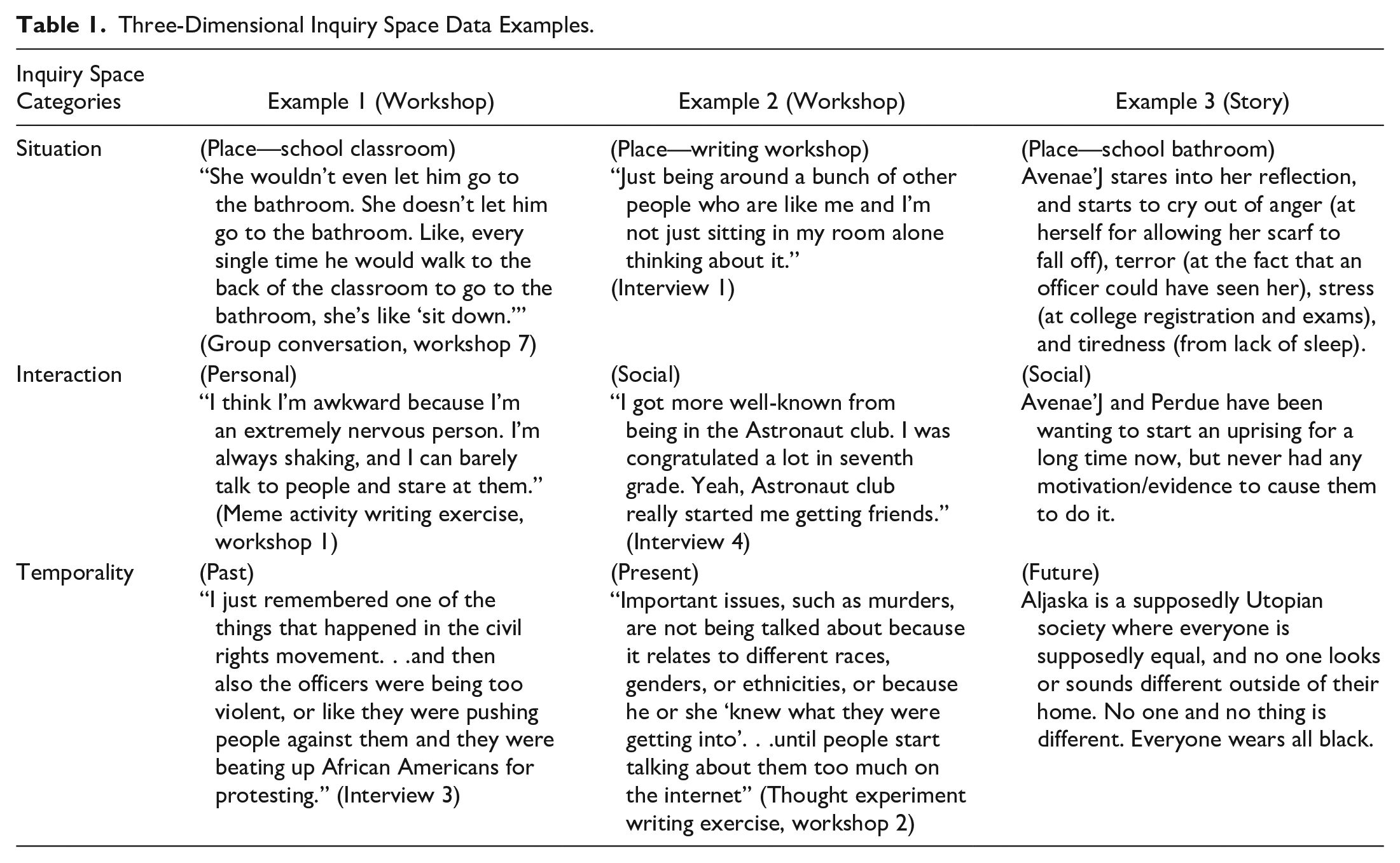
To analyze Avenae’J’s individual story, I isolated her information from the larger data corpus. These data sources included six audio-recorded and transcribed workshop sessions, 23 workshop artifacts, four individual interviews, and one short story, resulting in more than 200 pages of data. To determine how Avenae’J used speculative fiction, I used Clandinin and Connelly’s (2000) three-dimensional narrative inquiry space to pinpoint where experiences happened (situation), identify who was involved in an experience (interaction), and examine where in time an experience occurred (temporality). Following Ollerenshaw and Creswell (2002), I read and reread each transcript and artifact, considering situation, interaction, and temporality with every read (see Table 1). I examined the data for places where Avenae’J discussed her personal experiences as well as her experiences with other people. I searched for information about her past and present experiences as well as her ideas and dreams about the future. I scrutinized the data for physical places present within her stories. After gathering these narratives, I moved “away from the actual transcript” and asked, “‘what it means’ and what its ‘social significance’ is” (Ollerenshaw and Creswell, 2002, p. 342) to interpret the implications of the narrative. I completed the same process with Avenae’J’s short story to note similarities between the written story and her personal life narratives.
Three-Dimensional Inquiry Space Data Examples.
After reviewing all the data, I restoried the data into an assembled whole, embedding the words Avenae’J wrote and said during the workshop and interviews into a constructed story. For example, in one workshop session, Avenae’J shared how she based some of the violence in her speculative story on events occurring during the civil rights movement. This statement is explicitly included in the narrative alongside a statement Avenae’J made in an interview about why the characters in her story have yet to fight back against the police. I connected these two excerpts because police brutality during the civil rights era provided inspiration for the police brutality in the story even though these comments were given at different times in the workshop. In addition, her thought experiment artifact helped me understand how Avenae’J conceptualized oppression against minoritized groups and how this cognizance of subjugation influenced the plot of the story. Her interviews helped me understand her narrative voice and how her personality shows up through oral conversation, which aided me in creating a casual tone for the constructed story. Once assembled, I shared the constructed narrative with Avenae’J to ensure that I accurately captured her story.
The final product unites various artifacts gathered from our time together, so I see the assembled story as both an extension of Avenae’J’s speculative writing as well as an integral part of my analytic process. The constructed story is a necessary companion to the science fiction story, granting readers in-depth access to Avenae’J’s thoughts, similar to the way an author’s note provides essential details at the end of a novel. However, the constructed narrative was also integral to my analytic process because connecting both speculative and constructed story allowed me to better elucidate how she used her story to name her truth, locate herself as a legitimate source of knowledge, and call for social change.
A Speculative Counterstory and a Constructed Narrative
Following Brown et al. (2015), this section plays with form in that it begins with Avenae’J’s short story. I include the story not as a finding, but as a way to centralize her knowledge and experiences and to bear witness to her words, aligning this work with the Black feminist/womanist tradition. I follow her story with the constructed narrative to showcase how Avenae’J drew from history, real-life experience, personal feeling, and imagination to create her story. Following both narratives, I discuss the connections between the fictional story and the constructed story, and I link Avenae’J’s writing to Black feminist/womanist storytelling, counterstory, and testimony.
The Story: Dystopia
Aljaska is a supposedly Utopian society where everyone is supposedly equal, and no one looks or sounds different outside of their home. No one and no thing is different. Everyone wears all black, the clothing is all loose and long so no one can tell the body shape of another or the race of anyone, they wear black scarves tied around their faces so that no one can tell their race or see their beauty, and lastly they have monotone voice machines attached to them so when they talk an accent cannot be heard. Everyone has the same amount of income, the same amount of living space, equal opportunities at education and life, and there is only one known type of flower and tree. Myosotis, commonly known as Forget-Me-Nots, are used in medicines to erase the minds and suck out the souls of all who put it in their bodies. The white spruce tree is used to keep the people in the town, and its bark and sticks are used to deprive people of their personality. They are only used for the ones who start uprisings and show their faces and bodies to people.
January 14, 2070: Avenae’J’s house
Her alarm bell rings, and Avenae’J Marino turns over to turn it off, but in the midst of turning, falls off the bed, hits her arm on her bedside table knocking her alarm clock on the floor, and lands face first into her carpet floor groaning out of pain and tiredness. With the alarm bell still ringing her ears off, she contemplates getting up, and then remembers her important exam that tests to see what colleges she should and could get into. Standing up and walking to the bathroom, she realizes how much this test means to her and could mean for her future in chemical engineering.
She straightens up, and places a stud in her nose, and pulls her medium length jet black hair with dyed blue ends into a low ponytail tucking it into her long-sleeved black blouse. As she did this, she daydreamed about a world where everyone could be themselves without any officers attacking them for doing so.
Front of high school
She arrives at her school, and right before she walks through the archway, she notices a man being beaten for his scarf coming off. He sits there with his arms crossed over his face and covered in slash marks from the whip of the officer. Then the officer stops whipping and without the guy noticing, pulls out his club, and when the guy removes his arms, they hit him so hard in the head that he was knocked out, and the officer drags him over to a long black car with a golden emblem in the front resembling that of a tiger. The head of officers, Officer Carabinieri, steps out of the car and throws the guy into the car and climbs back in, yelling at everyone to mind their business and go to school. She walks away and walks through the high Roman archway and walks along the path behind it to large wooden doors that mark the entrance to an even larger white stone brick building with vines and moss growing all over it that shows how long it’s been there.
Lobby of high school
Walking inside the building, she is trampled by people and falls face first with her books sliding across the slick tile. She hurries up, and while picking them up, a guy offers to help her up, and she doesn’t realize until she bumps into his legs. When she grabs his hand, and gets up, he hands her a book, and he looks like he’s just seen a ghost, and says, “Your scarf.” He is so mesmerized by what he believes to be the most beautiful person he has ever seen, that he almost does not realize that Avenae’J starts to walk quickly away. He immediately starts to follow her until she reaches the women’s bathroom, and he waits outside for her.
Women’s bathroom
In the bathroom, Avenae’J stares into her reflection, and starts to cry out of anger (at herself for allowing her scarf to fall off), terror (at the fact that an officer could have seen her), stress (at college registration and exams), and tiredness (from lack of sleep). To calm herself down, she takes a deep breath and then punches her hand. She repeats this combination 3 more times to make it 4 times, and this relieves her. The deep breaths calm her terror and stress, and punching her hand relieves her anger. She then splashes her face with cold water, to relieve her tiredness, and she looks into the mirror again staring into her eyes and telling herself that she will ace this exam, and with that, she wraps her scarf around her face making sure it’s tight enough. She then grabs her belongings and exits the bathroom, walking face first into the chest of the guy who saw her without her scarf.
June 14, 2070: Avenae’J’s house
“Ok, ok, on a more serious note, there is something else we want to tell you,” Avenae’J says looking at him directly in the eyes. “We have found a sort of feeling/attraction towards one another, and we believe it to be love, and we want other people to feel this way as well.”
“Not only romantic love, but family love and friendly love,” Phillipé says finishing her statement.
“What exactly are you guys thinking,” Perdue says with a concerned but excited facial expression. “Because I want to make sure that we are on the same page.”
“Yes, Perdue we want to start an uprising,” Avenae’J says causing Perdue’s eyes to pop out of his head with excitement. Avenae’J and Perdue have been wanting to start an uprising for a long time now, but never had any motivation/evidence to cause them to do it.
June 21, 2070: Outside the change room
Crouched behind bushes, they notice a familiar golden emblem, telling them they are in the right place, and they see Officer Carabinieri step out of the car dragging a numb body behind her leaving a bloody trail in their wake. Then they also notice an unfamiliar woman step out of the car, wearing a pencil skirt and blouse, which makes Avenae’J a little suspicious and angry because that is not how Aljaskians dress, and it makes her punch her hand four times to calm down. She is a very pale woman with bright red hair and bright red eyes that’s covered by a pair of red aviators. Officer Carabinieri and the woman walk over to a large steel door and the woman puts a number into the keypad without gloves.
The woman walks in first and Officer Carabinieri walks in second dragging the body with her and the door shuts. After a few minutes, the black car leaves, and Avenae’J motions to Perdue and Phillipé to follow her, and she pulls out a weird flashlight. When she turns it on, instead of it being a bright white or yellow light, it is a black light which emits ultraviolet light. She flashes it on the keypad, and it shows fingerprints on the numbers 2, 4, 0, and 5.
“There are 24 combinations that could be the key to this keypad,” Avenae’J says thinking aloud. “Phillipé type in 2045.”
The elevator
He does that and the steel door automatically opens into an elevator, and they all walk in and the door closes.
“How’d you know that was the combination?” Perdue asks.
“It’s the year Alaska became Aljaska,” Avenae’J answers suddenly being jerked back by the force of the elevator.
The change room
The elevator opens to reveal a dimly lit passageway with doors running down each side of it, and they all immediately get chills, letting them know they are in The Change Room. As they walked through the halls, there was the constant sound of water drip dropping into puddles formed on the floor, and an occasional scream that would go on for minutes. Lights flickered on and off giving the place a very dreary look and the dimness of the lights gave the place an even more dark look than the steel walls do. The officer’s boots could be heard alongside the click clacking of the mysterious woman’s heels and the dragging of the body. Drops of blood can also be slightly seen, and then it gets quiet. A grunt is heard after the thud.
“Get in there,” Officer Carabinieri says and slams the door with the sound of screaming following it. They start to speed up walking and check each door until they get to one that is locked. Avenae’J nods to Phillipé, and he pulls a lock picker out of his book bag and puts it into the lock. He presses a button, and almost instantly the lock clicks and the door opens, revealing a traumatized young man sitting in the corner with his head in his arms, and slash marks across his arms and forehead. They walk in and over to the man cautiously trying not to frighten him, and Avenae’J pulls out a first aid kit and Perdue pulls out a camera.
“What’s that for,” Phillipé questions.
“For evidence,” Perdue replies.
If you want to start an uprising, you have to make sure you have photographic evidence that shows the people why they should rise against the powerful. Don’t clean him up yet Avenae’J, I’ve got to get good and genuine photos.
He takes a couple shots, and halfway through the guy wakes up and seems very frightened and confused to be surrounded by three unknown people.
“Hey, it’s ok, we’re here to help, my brother’s taking pictures of your scars to show what’s happened,” Avenae’J calmly states.
“Oh ok,” the man says. “I’m Bishmal.”
“Ok Bishmal could you remove your arms from your face so I can get the scars,” Perdue asks politely.
“You should take pictures of the entire facility, bet that would scare the heck out of people,” Bishmal suggests.
“I have been, I even took pictures of how you were brought here,” Perdue replies.
“How come we didn’t hear you?” Phillipé asks.
“My camera has a setting where I can turn the noise off,” Perdue answers.
Footsteps are soon heard coming down the corridor, and Bishmal motions for them to go hide in the corner behind the door, but right before, Avenae’J places a pill into Bishmal’s mouth. When the door opens, a man in a doctor’s coat walks in with a large wagon of medical supplies, that makes the corner behind the door a perfect hiding place because the wagon makes it difficult to close the door. Perdue crawls over a bit so he can get a good shot and starts to record, and when he does, Bishmal screams as the doctor scrapes off a piece of his skin and puts it into a vial, then he sticks a needle into him and takes out a syringe full of blood and divides it into four different colored glasses, he then cuts some hair off and puts in a vial as well, and he continues to remove things from Bishmal, and then he leaves. As soon as it was safe enough Avenae’J, Perdue, and Phillipé step out of the corner and over to Bishmal.
“Hey dude, are you ok,” Perdue asks.
“Yeah I’m good, whatever she gave me, worked really fast and I felt absolutely nothing,” he replies. “I was acting the entire time.”
“Welp, you could’ve fooled me,” Perdue says laughing as Avenae’J and Phillipé clean Bishmal up. Perdue stands up and just as he does the door opens up to reveal Officer Carabinieri. Perdue pulls out a club and smacks him across the face, and just as he does, he calls out, “Officers, we have a breach.”
“RUN!!!!” Perdue yells to everyone. They run in the opposite direction in which they came, and come up to a crossroads, Avenae’J and Phillipé go right and Bishmal and Perdue take a left. As they take a right, Bishmal screams a loud ear shredding scream, and it echoes through the halls and rings through Avenae’J and Phillipé’s ears as they run to a near door and hide inside of it. It turns out to be a closet, and it has many vials and test tubes containing chemicals and ingredients used to make medicines, in particular the mind erasing and the personality/soul depriving medicine. When they start to look around and see what they can find, a gun is shot, and a loud thud follows it. Then, a man groans.
“Please, don’t,” he says. Then a final gunshot is fired, and it goes dead silent. Avenae’J goes and sits back against the door and starts to silently cry in her knees. Phillipé walks over and sits beside her allowing her to place her head onto his shoulder, and he rubs her shoulder and gives her comfort.
“I bet you that it was not your brother,” he says caressing her shoulder.
Let’s look at the signs, it was Bishmal that screamed, he had no shoes on, he has lost quite a bit of blood, has not eaten, and he’s drugged from the medicine you gave him. Perdue has none of those symptoms, and he has a perfect bill of health with a pretty good football coach.
“Yeah, I guess you’re right,” she says. “I just feel so bad that Bishmal died that way, he did not deserve that.”
This is why we’re on this suicide mission, to help the people remember who they are, to celebrate the past ones who died because of these people, and to give our descendants a future that they will want and appreciate, Phillipé reminds her.
“Yeah, I guess you’re right, let’s get off this floor and get something useful,” Avenae’J says standing up and turning on her white light flashlight, handing one to Phillipé as well. They notice that on one wall, it is lined with vials that have a label on each. The labels say what it contains, the date it was collected, and a name.
“Grab them all, we’ll figure out where to take them when we get back to town. I’ll also grab a few of each of the ingredients,” Avenae’J says stuffing as much as she can into her bag. They finish getting everything they need and start out the door as cautiously as possible, peeking out the door making sure no one is out there before they go. Once they are out, they walk quickly toward the end of the hallway, where they find Perdue taking pictures of blood on the walls. When they find each other, they celebrate in silence and make their way to the elevator conveniently located a door down from where they are. When they get inside, they press the up button surprised as to why this one has buttons, but the other elevator didn’t, and when they reach the top, they run out only to be stopped by an epic plot twist.
Outside the change room
When they turn around, they see a familiar white stone brick building with an archway and vines and moss growing all over it. The Change Room is beneath their high school, meaning that Area 140 is beneath the town.
“Oh my freakin’ gosh,” Avenae’J exclaims with her jaw dropped.
“The Change Room and Area 140 were beneath us this entire time,” Perdue says looking as if he was about to pass out.
“I need more than a physical shower, I need a mental shower, because I legit need to clear my mind of everything that just happened,” Phillipé says jokingly but means it in a serious way.
“For real,” Avenae’J agreed, “but first we need to make copies of the SD card in your camera, Perdue.”
June 22, 2070: Phillipé’s house
They sit there in his house for hours upon hours researching people/addresses, hacking into private/personal servers, clearing up photos, copying SD cards, and making antidotes. After hours and hours, they make a list of the people on the vials, where they live, and their status being if they are alive or deceased, and they have clear photographic evidence to start an uprising.
The letter
Dear everyone, If you are receiving this letter, that means you have been asked to join an uprising. This is the year everything changes, it has gone on this way for too long. People want to express themselves again, like how it was 50+ years ago, we want to be able to have relationships with the people we love. We have witnessed The Change Room ourselves, and what is there is horrendous. There are constantly people screaming out of terror and pain, blood is all over the walls, and the people there get pieces of them taken so that they can be tested, not only hair and urine, but pieces of skin. If you do not believe us, we’ve attached the pictures to an email that has been sent out. Also on that email, there are simple blueprints to making a gun and a drawing of the things needed to make the gunpowder inside of the guns. You can simply find these things at the store, just do not make it noticeable. As Barack Obama once said, “We are the change that we seek.” The uprising will take place July 4, 2070 at 12:00 pm, the uprising will not start unless we feel that we have enough people, so we hope all of you join, because we cannot do this by ourselves, we need everyone.
Signed,
Avenae’J Marino, Perdue Marino, and Phillipé Moretti
Avenae’J the Storyteller: A Constructed Narrative
When I was writing this story, my problem was that people, a lot of African Americans, were being killed and then not being represented because of color. There is a lot of African American women who are not being represented even if they’re being killed just because they are African American. There are murders of certain races, genders, or ethnicities, not because they did anything but just because people feel a certain way toward that group. You got people who have done nothing wrong, and they cannot do anything like police are. I thought that in 10 years, if it did not stop, there was going to be more killings because they are going to focus on those target groups. There will be more murders of certain ethnicities, races, or genders because they think they can because it is not being talked about. In 50 years, there would be a civil war between different groups. Multiple groups fighting against multiple groups.
So, in my story, because of the social injustices, no one can tell who anyone is. People like killing others because of someone else’s race or color, so because of this, they have to cover themselves. They have to cover their entire bodies from head to toe. That is why I named it Aljaska. I wanted it to be cold because they wear all black, and they wear black scarves around their faces so no one can tell their color, race, gender, or ethnicity. Also, no one can tell their body type. No one can tell their religion or anything because they cannot see them. They are not allowed to show any emotion or feeling toward anyone because then people could take it the wrong way and kill them. People have to speak and be spoken to in a certain way so no one can hear an accent or deepened voice. If they cannot speak that way, they have to get a robotic implant in their throat so people cannot tell if they have an accent or not. It is a solution to the violence.
So one day, the main character is really nervous for an exam (she wants to be a chemical engineer like me). She’s knocked down and her scarf falls off. She’s scared because another guy’s mask fell off when he bumped into an officer, and he was beat in front of everyone and taken to the Change Room. To be the police in my story, you have to be a sort of aggressive person where you will not be affected by changing someone completely by genetically modifying them. I kind of got the inspiration for the officers thinking about the civil rights movement and how police officers were being too violent, pushing people against them and beating up African Americans for protesting. In the story, Avenae’J wants to overthrow the police. There are even more people than police, but the police have guns, so they do not do anything.
Avenae’J is one of those people . . . well, she’s a lot like me. I just took myself and put me in my own story. That is why her name is my name. I like to put myself into my writing because it makes me feel better . . . not feel better, but it makes me understand the story more. Like me, Avenae’J is a very caring person, like even if you do not know her or she does not know you, she will still care about you if she sees you on the street. She is also a dreamer so she has always wanted to start an uprising. In the story, she falls in love, and because of this, she wants everyone else to feel happiness and love. She wishes she could live in a world where everyone can be themselves and enjoy themselves, where they do not have to talk a certain way or act a certain way.
Phillipé, Avenae’J, and Perdue basically want to come up with a way for everyone else to be themselves, but people who start uprisings are taken to the Change Room, where they genetically modify people until they do what they are supposed to do. I made the characters break into the Change Room because I wanted them to have evidence for the uprising. I could have just let Bishmal back out into the world, but no one would know what was happening, and I wanted to keep him there so they had evidence that stuff was happening there that should not, that stuff was happening that no one agreed with. It is like how there are some crimes that are not being spoken about in the world, ones that really matter. People are not saying anything about really important crimes until other people start talking about it, and then they only talk about it because they do not want to look bad. The only way the crimes are being spoken about is through social media, and not even the news is speaking about it. The evidence photos are inspiration. A lot of people want change, not just three people, but they are scared to do it. They need inspiration.
The Change Room is underneath the entire high school because the government is lazy. They already have to beat people, so they do not want to have to go too far to “take care” of people. The reason why no one knows is because it is an area of secrecy. I think it is an epic plot twist because everyone thought it was far away, but I wanted it to be right underneath everything, right underneath places where they always were. In my opinion, I am very good at school. If I miss a few days, I have always been able to get back on track and get good grades. But, to be honest, there is no justice in school, so it made sense.
I want equality. It is probably never going to happen, but I want it. I like to make everyone feel equal. I want to make sure that I make you feel equal. I want other people to make other people feel equal. I do not know if I consider myself to be an activist. I do not think I am one, but I would like to be. I just do not know how. I do like to talk to people, though. I like to talk to them about what is going on, so maybe they will understand and maybe they will do something about it. I like to talk to people about what I want to do for the future. It is not enough to just dream and talk about it. It is actually going out and doing it. I know people who want to do it, but I just do not know how to get them to do it with me.
Contextualizing the Narratives: Speculative Fiction as Testimony and Counterstory
Smitherman (1977) noted that the creator of black arts literature envisions himself or herself as a necromancer, a skillful manipulator of the art of shonuff black magic whose job it is to “heal” black folks through the evocative power of art, and transform their suffering into constructive political action. (p. 177)
That is, Black authors often assume the role of conjuror, using literary and linguistic magic to challenge oppressors and mitigate the everyday violence enacted on Black communities by those who continuously work to fortify our oppression. To invoke an image of justice, some authors transform the real into the fantastic, grounding their stories in the imaginary because justice has not historically been, nor is it currently, defined as our social reality. In this way, some Black authors embed their truths in the make-believe, combining testimony, and counterstory in hopes that readers will bear witness and join the fight for justice.
Avenae’J is a conjurer, weaving personal experience and fantastic narrative to inspire people to act. In her story, she highlights the United States’ legacy of surveillance by describing Aljaska’s police state, a nation in which torture, confinement, and silence are used to enforce submission. This aspect of the story is intimately connected to the history of police violence that results in the disproportionate murder of Black people. By connecting the actions of her police characters to the actions of real police who fought against protestors in the civil rights movement, she embeds the realistic into her fictional tale.
In addition to brutality and surveillance, Avenae’J discusses the hidden injustice of schooling by describing the anxiety that accompanies testing and by placing the setting of the most brutal aspect of the plot underneath the school. She also acknowledges the counterfeit integrity some people use to feign a commitment to justice while also highlighting the importance of social media activism by including Perdue’s pictures as essential to provoking a revolution. She centralizes the need for collective justice work by showing how three students risked their lives to begin a collective uprising. Ultimately, she uses her story to comprehend, analyze, and educate about injustice and call for radical change, staples of counterstorytelling methodology.
More than just a focus on the social world, however, Avenae’J centers herself. Specifically, she says she put herself in the narrative to understand the character better. She even shares a name with the protagonist, further embedding her life into the larger story of Dystopia. Just like the main character, Avenae’J cares for others and wants the world to be a place of communal love. Just like the story’s heroine, Avenae’J wants equality for all and wants to talk with people in hopes that they will work together to make collective change. As Avenae’J entrenches her personal and social worlds into the speculative narrative, the story acts as a counter-reality that makes visible the injustices she has experienced, illuminates her ways of knowing and affirms her individual humanity, and asks the reader to vicariously experience what she has been through. In this way, her narrative acts as an allegorical counterstory, enabling her to use creative means to vocalize her perspectives, reveal her struggles, challenge oppression, and position her experiences as critical commentary (Griffin et al., 2014).
Furthermore, Lathan (2014) argued that testimony is rooted in the Black cultural tradition “of embracing critical intellectualism as an empowering activity—thinking, reasoning, and expressing—that begins by embracing oppressive ideologies while sharing about literacy customs that consciously choose an empowering response” (p. 34). The constructed narrative alongside the speculative story suggest that Avenae’J critically examines her world, thinking through the various injustices she experienced and witnessed. From that thinking, she reasons that if the people fail to change, a dystopic reality is not a fantasy, but a future possibility. Rather than ending on oppression, however, Avenae’J includes an empowering literacy response, using the agitation literacy method of letter writing (Muhammad, 2019) to convince readers, within the story and outside of it, to engage in the fight for freedom.
By incorporating the letter and showcasing the communal bond among characters, Avenae’J uses her story not only to describe the burden of oppression but also to explain how a higher power helped the characters overcome hardship. The story does not center a religious figure head as liberating force, however, for the higher power is her community. She describes how collective action can free us all, how collective action can incite a revolution, and how collective action can help us get over. She shows how people on a shared mission for justice can stimulate change, but she argues that a revolution requires everyone to put in work.
Testifying can happen any time a Black person chooses to share their stories as a means to affirm their humanity, engage with their community, and rejoice in their Black identity. Similarly, counterstories can happen in any genre, as Black women and girls have used numerous means to name their truths. Avenae’J engages in affirmation and Black joy by storying herself into a space of activism and social change. She engages with her community by creating a space for people to bear witness and using that witnessing for collective justice. She engages in truth-telling [by] using a fictionalized format to highlight events and situations that occur in the real world. Ultimately, Dystopia is an extended metaphor that incorporates Avenae’J’s personal and social experiences as a strategy to stimulate conversations about the need for social justice. It is both her testimony and a counterstory.
Conclusion
Geneva Smitherman (1977) stated that “every black neighborhood in every city in the United States comes equipped with its own storytellers” (p. 148). Avenae’J is one such storyteller, a young Black girl who used her imagination to condense broad, theoretical observations about life, love, and people into a speculative narrative. Her personal mosaic, shown through her narrative, is an example of the many ways Black women and girls chronicle their lives and refuse traditional boundaries. Her story is a way to construct counter-realities that challenge dominant narratives that confine Black girls to stereotypical existences. Black women and girls tell our stories as a way to survive, as it helps us to construct a vision of our reality and preserve our lives in the midst of institutional and often physical erasure. We tell our stories to envision worlds beyond the one we currently inhabit and to imagine more just futures. Through her story, Avenae’J shared her understandings and experiences of the world, and she provided readers an opportunity to listen and respond. So, can she get a witness?
Supplemental Material
966362__S.R._Toliver – Supplemental material for Can I Get a Witness? Speculative Fiction as Testimony and Counterstory
Supplemental material, 966362__S.R._Toliver for Can I Get a Witness? Speculative Fiction as Testimony and Counterstory by S. R. Toliver in Journal of Literacy Research
Footnotes
Declaration of Conflicting Interests
The author declared no potential conflicts of interest with respect to the research, authorship, and/or publication of this article.
Funding
The author received no financial support for the research, authorship, and/or publication of this article.

References
Supplementary Material
Please find the following supplemental material available below.
For Open Access articles published under a Creative Commons License, all supplemental material carries the same license as the article it is associated with.
For non-Open Access articles published, all supplemental material carries a non-exclusive license, and permission requests for re-use of supplemental material or any part of supplemental material shall be sent directly to the copyright owner as specified in the copyright notice associated with the article.
