




Abstract
This collaborative action research project in Alberta, Canada, explored how dual-language books (DLBs) can foster literacy instruction and learner engagement through language awareness. Canada’s changing demographics have resulted in mother tongue diversity and many urban schools identifying at least 25% of students as being English language learners, making it crucial to include a mix of languages in classroom interactions to engage all learners. The case study combined prereading linguistic prompts with a reading of 10 DLBs, one each week, by guest readers in Urdu, Tagalog, and Spanish, alongside the teacher reading in English. Video recordings and surveys collected data on the teacher’s, guest readers’, and learners’ reflections on the experience. Findings indicate that regardless of the learners’ linguistic heritage or English language competence, the DLBs offered a unique support for literacy engagement while fostering a focus on language awareness, reading strategies, and higher order engagement with text.
Multilingual classrooms are becoming the norm around the world, including in Canada, owing to increased transnational integration, population mobility, and displacement (Dagenais, 2013; Haque, 2012). These trends have resulted in new ways of thinking about how curricula, education delivery, and teacher education programs can be developed and delivered, not only in Canada but also in the United Kingdom (e.g., Little & Kirwan, 2018; Ó Duibhir & Cummins, 2012), continental Europe (e.g., Daryai-Hansen et al., 2015; Gajo, 2014; Van Gorp & Verheyen, 2018), the United States (e.g., García, 2009; García et al., 2018; Gort & Sembiante, 2015; Pacheco et al., 2019), and sub-Saharan Africa (e.g., Ouane & Glanz, 2011). The goal is to pay greater attention to the essential knowledge and skills teachers require to be linguistically responsive and develop critical perspectives in these changing classrooms (Bacon, 2017; Cummins et al., 2005; Egbo, 2019; Lucas & Villegas, 2013; Naqvi et al., 2013; Schecter & Cummins, 2003).
The 2016 Canadian census confirmed earlier trends of expanding home languages and mother tongue diversity nationwide (Statistics Canada, 2017), with an increase of 910,400 people (13.3%) who speak a language other than English at home (Statistics Canada, 2015, 2017). In Alberta’s largest school district, the Calgary Board of Education, 25% of students identify as English language learners (ELLs; Calgary Board of Education, 2019). School systems teach Canada’s official languages and support ELLs, yet “few have developed coherent policies regarding the multilingual realities of schools and communities” (Cummins, 2014, p. 1). As well, the monolingual orientation to language learning has been difficult to dislodge, despite research spanning nearly two decades consistently showing the benefits of affirming and leveraging multilingual competencies (Cummins, 2009; Hélot, 2013; Hélot & Young, 2002; Schecter & Cummins, 2003; United Nations Educational, Scientific and Cultural Organization, 2003). Education researchers are working with policy makers to explore how this expanding linguistic reality can be leveraged as a learning resource (e.g., Egbo, 2019; Hélot et al., 2018) and how students can be recognized as bilingual or multilingual, beyond traditionally narrower foci, in terms of proficiency in the language of instruction (Chumak-Horbatsch, 2012; García & Kleifgen, 2018).
In Canada, as a response to the emerging imperative of valuing home languages and intercultural literacy, provincial educational institutions are moving away from traditional curricula based on monolingual objectives and outcomes that use one of Canada’s two official languages as the language of instruction (Egbo, 2019; Swain & Lapkin, 2005). Exploring new and cutting-edge alternatives to a traditional literacy program is a more effective means by which students (a) approach literacy acquisition and (b) have the opportunity to reflect upon and engage in their own language and cultural traditions, and those represented in their diverse classrooms (Cummins, 2015).
This study is also relevant in the Canadian (and worldwide) context in that it follows Ruíz’s (1984) language ideology, specifically the language-as-resource piece. Using language as a resource can help ease tensions between majority and minority communities, serve as a consistent way to view the role of non-English- and non-French-speaking students in Canadian schools, and facilitate cooperative language planning (Ruíz, 1984). According to King (2000), language attitudes reveal an underlying language ideology that influences language practice. Attention to “language ideology can play a crucial role in understanding the differences . . . between expressed language attitudes and observed language behavior” (King, 2000, p. 169).
The current study focused on an effort to support classroom teachers and students in leveraging the various languages represented within a classroom. Scaffolded on a strong literacy program, participants engaged in active discussion, comparing the features of various languages and taking proactive steps to integrate reflective language awareness goals with multilingual tasks in daily instruction. The term language awareness refers to an understanding of the human faculty of language and its role in thinking, learning, and social life. It includes awareness of power and control through language, and the intricate relationships between language and culture (Van Lier, 1995). The process of language awareness opens up the classroom and welcomes various languages that have traditionally been excluded from schools, thereby giving a voice to minoritized language speakers (Hélot et al., 2018).
The primary objective of this study was to explore the impact of dual-language books (DLBs) on literacy instruction using language awareness activities. The study revolved around one principal question: How can the reading of DLBs in the middle school classroom enhance student engagement with text and language awareness?
Theoretical Framework
The stance that capacities in one language can support or boost the development of another has been affirmed in research on bilingual education (Baker & Wright, 2017; Cummins, 2015; García, 2009; García & Kleifgen, 2018; García & Wei, 2014), multilingualism and translanguaging (García, 2013; García & Sylvan, 2011; Hornberger & Link, 2012), and plurilingualism (Armand & Dagenais, 2012; Armand et al., 2008; Beacco et al., 2016; Little & Kirwan, 2018; Prasad, 2018). Integrating a pedagogical approach that accentuates the transfer of intercultural competencies interwoven with (home) language opens up the opportunity to “connect families’ home knowledge and practices with the curriculum and instruction to maximize learning” (Alvarez, 2018, p. 98).
Cummins’s (2005) theories draw on research showing how students’ home languages are a powerful resource for learning and for mobilizing bilingual instructional strategies that engage both the home and target languages for language and knowledge acquisition. In particular, Cummins (2008) has highlighted some of the assumptions underpinning language proficiency through monolingualism: the direct method assumption—“that promotes instruction exclusively through the target language” (p. 65)—and the two-solitudes assumption—that language representations are processed separately at the cognitive level. These assumptions have resulted in rigid separation of languages as an instructional strategy.
Research demonstrating the power of transferring conceptual knowledge or skills across languages led Cummins (2005) to reconceptualize language learning to center this transfer and advance theories of “linguistic interdependence” (p. 3) and a “common underlying proficiency” (Cummins, 2008, p. 68). Linguistic interdependence posits that “experience with either [or multiple] language[s] can promote development of the proficiency underlying both [or other] languages, given adequate motivation and exposure” (Cummins, 2005, p. 5). Various institutions within Europe, including the Council of Europe, encourage the development of programs in which students learn about other cultures and languages to promote intercultural awareness (Council of Europe, 2001, 2003). One such initiative, promoted by the Council of Europe and the European Centre for Modern Languages (e.g., Candelier, 2003, 2016), is called Awakening to Languages (AtL). The AtL approach invites children to compare languages and their sounds by exploring new sounds, experiencing different writing systems, and thinking about the differences and similarities between and among languages (D. Coelho et al., 2018; Lourenço & Andrade, 2014). In so doing, students come to understand how their own linguistic repertoire is valuable and worthwhile, especially when learning other languages (Candelier et al., 2012; D. Coelho et al., 2018; Lourenço & Andrade, 2014).
Researchers have observed a resultant behavioral outcome of this approach in the students’ development of more positive attitudes toward different languages and cultures (Armand et al., 2008; Beacco et al., 2016; E. Coelho, 2016; Lourenço & Andrade, 2014). Prasad’s (2018) recent study has suggested, from students’ own perspectives, that ignoring the authenticity of this ready linguistic resource in school communities impedes the opportunity for students to understand themselves as dynamic language users. Her findings align with scholarly work emphasizing teaching for transfer, including through AtL. As Prasad has noted, multiliteracies pedagogical approaches such as the transformative multiliteracies pedagogy (Cummins, 2009, 2010) and the language engagement framework (Cummins et al., 2012, 2015) reinforce the importance of appreciating this linguistic diversity. These approaches enable students to expand their language awareness and openness in reflecting on language in relation to their own identities, and their classmates’ identities, within the literacy program.
The reconceptualization of the monolingual target language instructional approach therefore becomes extremely useful and practical given the potential advantages. Here, language awareness can play a key role. Reviewing the literature on critical literacies in English language teaching, Bacon (2017) found that the question of whether critical literacy practices support language learning while also taking multilingual learners’ linguistic backgrounds into account remains largely unasked. According to García and Menken (2015), language awareness not only empowers the students in question, it also brings a new multicultural/multilingual dimension to the teaching context of a language that no longer represents a single culture. Innovative literacy research has permitted experts to identify how language awareness plays a vital and positive role in transforming the literacy acquisition process of multilingual learners (Sierens et al., 2018). This concept becomes particularly powerful when a teacher combines language awareness with a DLB reading program.
DLBs, when used properly, can achieve the objectives of enhanced text engagement and language awareness on the part of the students (Cummins et al., 2012; Swain & Lapkin, 2005). Teachers can intentionally tap their students’ rich linguistic repertoires as a pedagogical resource in the classroom (Cummins et al., 2006; García, 2009; García & Sylvan, 2011; Orellana & García, 2014). Naqvi et al. (2013) offered evidence of improved early literacy, demonstrating that children who spoke Urdu or Punjabi and who were read to using DLBs saw their graphophonemic knowledge and knowledge of printed letters and words post significant gains compared with peers who were read to only in English. Other research has suggested that multilingual pedagogical practices and teaching materials have a positive impact on children’s academic achievement, confidence, personal identity, and literacy achievement (Conteh, 2007; Martin et al., 2006; Sierens et al., 2018). A dual-language approach capitalizes on the diverse ethnic and linguistic makeup of classrooms and encourages students to be part of a larger community while also developing their personal and cultural identities (Fort & Stechuk, 2008; Ma, 2008; Sneddon, 2009).
Method
Setting
This collaborative action research project explored an innovative classroom–community–university partnership to understand how DLBs can enhance language awareness among students and educators while drawing connections to linguistic identities and ultimately fostering greater attention to and appreciation for linguistic and cultural diversity in the classroom. The partner school was situated in Calgary, Alberta, a city of approximately 1.2 million people with a diverse ethnocultural and multilingual student body. This school has developed a focus on enhancing the English language arts (ELA) curriculum through innovative language awareness initiatives. All core educational programming is provided in English, with ELL supports as needed.
Methodological Framework
This research was designed as a collaborative classroom project, a form of participant action research. Ross et al. (1998) described collaborative action research as a partnership in which university researchers and in-service schoolteachers work as equal partners, contributing knowledge and collaborating to discern insights. Their joint knowledge shapes the research design and informs the research goals. The research focus is relevant to participants (school, teachers, students, school community), and research knowledge is co-constructed collaboratively (Parsons et al., 2013). In the current study, the teacher played a key role in the design, implementation, outcomes, and interpretations of this research project, in addition to facilitating the classroom learning.
Research Design Process
The team’s planning, development, and briefing sessions occurred over a span of 1 year prior to implementing the language awareness activities in the classroom. Joint stakeholder meetings included two university researchers (one professor and one doctoral student), one teacher, and two ELL specialists from the local board of education, who also helped to identify the partner school based on multilingual demographics. At the outset, the university-based researchers introduced the concept of language awareness and provided insights about incorporating DLBs into classroom literacy activities using examples from an earlier 10-week multilingual reading program with kindergarten and Grade 1 students.
The team selected 10 DLB titles in Urdu, Tagalog, and Spanish (see Table 1) based on the school’s demographics and the availability of guest readers from the community. Given that some books were not available in Tagalog, the team hired a Tagalog translator who also took on the role of guest reader in that language. We recruited the Urdu and Spanish guest readers through a newsletter circulated within the local school community. Objectives for each assigned reading were outlined using the teacher’s expertise in the ELA curriculum and knowledge about students’ backgrounds. For example, the short story Keeping Up With Cheetah is replete with themes that relate to the Grade 5 ELA program objectives. As students are asked to critically analyze the various aspects of the book (literary analysis, media analysis) and conduct an interlingual examination (comparing and contrasting among the four languages), they steadily gain an understanding of how these themes are represented in not one story but across languages.
Book Titles, Languages, and Curricular Focus.
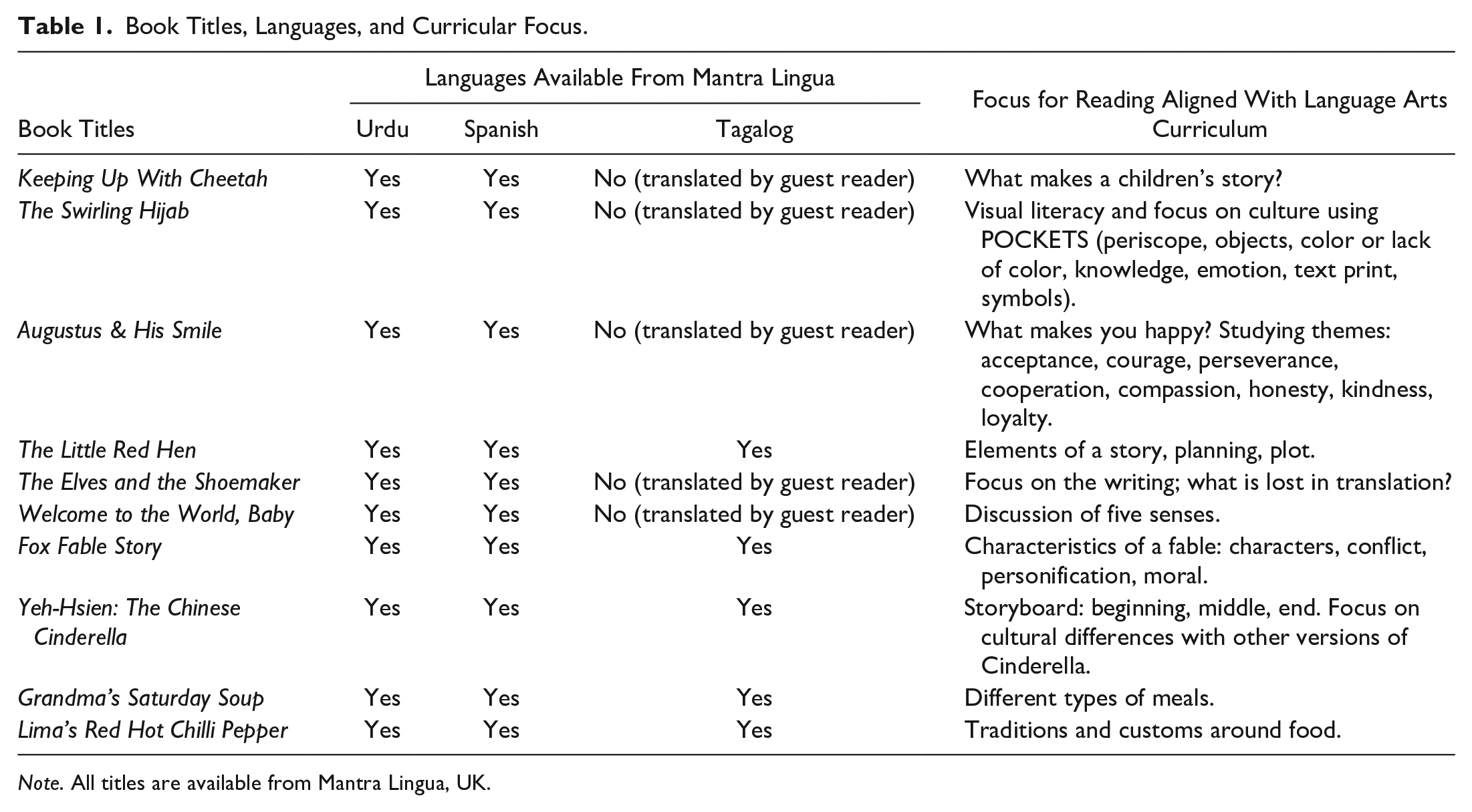
Note. All titles are available from Mantra Lingua, UK.
Participants included one classroom teacher, four guest readers, and two classes of Grade 5 students (ages 10–12; N = 44: 27 boys, 17 girls). Among the self-reported languages spoken in the classes were Albanian, Amharic, Chinese, French, Gujarati, Hungarian, Irish, Korean, Scottish, Spanish, Tagalog, and Urdu (see Supplemental Figures 4 and 5). Data were collected using (a) video recordings, capturing joint stakeholder discussions, teacher planning processes, DLB reading sessions, and interactions between guest readers and learners; (b) reflections on the experience by the teacher, guest readers, and learners; (c) instructional materials and lesson plans; and (d) student language portfolios and student-created DLBs. Surveys were completed by the teacher, guest readers, and learners to capture written impressions at the midpoint and after the initiative.
Overall, the DLB study involved two major components. First, guest readers shared native speaker linguistic and cultural insights from their experience, including personal stories of multilingualism and intercultural growth, and aspects of their geopolitical history. Second, the team used structured pre- and postlinguistic prompts every week, integrated with the students’ language portfolios. These components established a predictable pattern around the weekly DLB activities and allowed the teacher to incorporate an evolving understanding of the role of these instructional activities in meaning-making and support of curriculum goals and learner needs.
The teacher initiated the DLB project by introducing this genre through a unit on identity with a focus on languages and linguistic diversity. Among the activities, students participated in a poetry unit in which they explored identity, creating their own poems that described some salient features such as their country of origin, languages spoken, and family backgrounds. Students were provided with a modified version of the European language portfolio (Council of Europe, 2001) in which they noted their personal language profile and language learning experiences. Over the course of the 10-week initiative, they completed various meaning-making activities, made observations associated with their developing linguistic awareness, focused on their linguistic experiences, and thought about languages from different linguistic and cultural perspectives (see Figure 1). Ensuing discussions focused on linguistic diversity, affording the teacher the opportunity to show the students the DLBs and circulate them in the classroom.
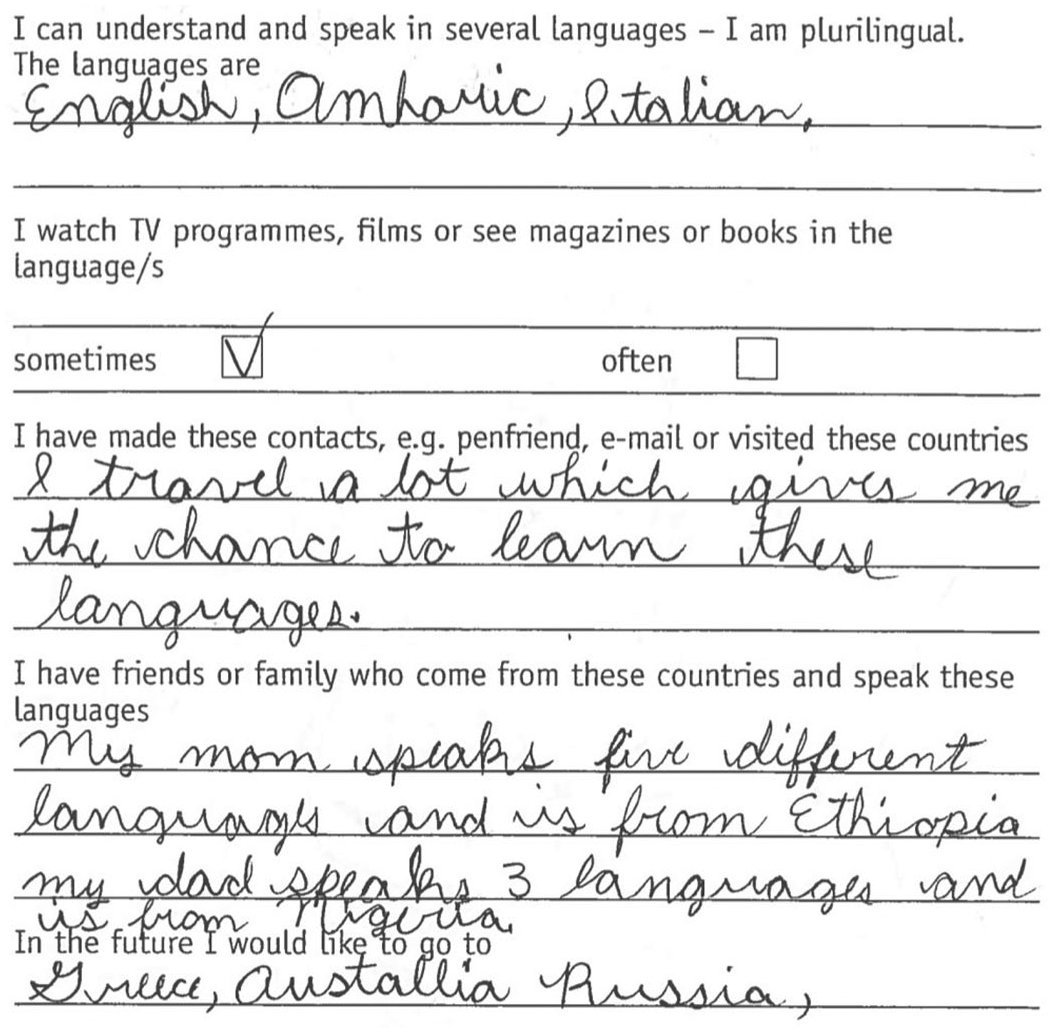
“My language biography” page—Example from student’s language portfolio.
The DLB reading process then followed a consistent pattern: Three reading sessions, each lasting approximately 30 min, were conducted weekly for the 10 weeks, using a different story each week. The DLB reading and listening activities were always initiated by prereading linguistic prompts and/or student task objectives. DLB prereading engagement and pre- and postreading prompt examples from Weeks 2 and 3 can be seen in Supplemental Figure 3.
The teacher then read the text in English, and the guest reader read it in one of the three chosen languages. The DLBs were projected on a SMART Board to indicate any unique characteristics of the respective language with reference to the written text. The teacher and the guest readers facilitated discussions after the reading grounded in previously prepared questions as well as those brought up by the students.
The DLB project culminated in a multilingual story-writing activity (see Supplemental Figure 6) in which the participant students were asked to write a story individually or with a partner and present it in front of the school. Student DLBs were to demonstrate or describe an experience that could be understood from multiple cultural perspectives, drawing upon teacher-identified themes from the Grade 5 curriculum. The students were asked to choose a selection of words from a language other than English, either one they had heard about or were familiar with, to include in the story. The students knew the objectives of the DLB project in advance of the reading sessions and understood that they would have to listen carefully, ask questions, and solicit the help of the guest readers as needed to collect information to incorporate into their own DLBs.
Each DLB reading session was video recorded and transcribed. The two researchers analyzed the transcripts using Braun and Clarke’s (2006) six-step process under the categories of teacher strategies, guest reader strategies, students’ reactions, highlights of language awareness activities, meaning-making activities, other observations, and debrief with the teacher after the reading session. After the initial coding, the research team met with the teacher to evaluate the results and discuss findings.
Results and Discussion
Three broad themes emerged through analysis of the DLB initiative data: (a) enhanced language and intercultural awareness among the students and teacher, (b) meaning-making strategies, and (c) enhanced language identities.
Enhanced Language and Intercultural Awareness
Possessing intimate sociocultural understandings of their native languages, the guest readers were uniquely positioned to share insights into how language could be linked to historical and social phenomena that shape it in the present. In the example that follows, the guest Filipino reader began the reading session by sharing the linguistic origins and history of Tagalog. He highlighted how Tagalog represents a mixture of Spanish, Japanese, Malay, and Chinese, all linguistic forces that played a role in the history and culture of the Philippines: [Tagalog] . . . is a mixture of languages because the Spanish colonized [the Philippines] 300 years ago . . . The Japanese fought them and took over, [and] World War II Americans liberated us from Japan. So, our language is a combination of all the languages that colonized our country. (Alkos, guest reader)
This contextualization gave students exposure to the social location and representations of power that are reflected in language (Cummins, 2009; Janks et al., 2014). Introduction to, and reinforcement of, distinct linguistic influences in Tagalog also offered a concrete example of how intercultural encounters have innovated and blended linguistic elements with specific geographic references. Similarly, the Urdu-speaking guest reader discussed the nature of Urdu as a combination of Arabic, Persian, Turkish, and Hindi. This explanation provided a tangible affirmation of the interconnectedness of people across languages and cultures, offering an opportunity to highlight how historical movements of people and interactions between groups who spoke different languages are linked to understandings of place and influence a sense of national, community, and individual understanding (Beacco et al., 2016).
The guest readers also accentuated the nature of the written form of their native languages, illustrating relationships between languages and comparisons with English. The Urdu-speaking guest reader explained that Urdu comprises 39 letters (shapes) and is written from the right to the left. (The students found this language to be the most challenging of the three.) As the guest reader explained, pointing out words written on the board, “That’s how the language was developed. We use smaller shapes of the same letters. In Urdu we call this choti ashkal. Choti means ‘small’ and ashkal means ‘shapes.’”
Importantly, exposure to Urdu in class presented students with a form of written language that challenged generally unquestioned ideas about the construction of words and representation of sounds in ELA. In response to the prompt, “Share one thing you have learned about language,” one student proclaimed, “It’s communication” (Grade 5 Student Questionnaire [SQ]).
In addition, having the DLBs projected on a SMART Board encouraged students to ask questions arising from curiosity and permitted the guest readers to indicate unique characteristics of the respective language or answer questions with reference to the written text: In English, if I have to write my name, I will write S-A-I-R-A. But in Urdu, I will have to shorten the letter . . . to give it a small shape and join two or three letters together. Like here I just showed you how to write the word lagar baga in Urdu, the name for hyena . . . Here I have joined three letters of the alphabet together, . . . and this over here is a symbol. The one that looks like a W is actually a symbol that tells us to pronounce the letter twice. (Saira, guest reader)
This explanation provoked interest and prompted discussion guided by student participants, including Shannon, a Grade 5 student originally from Mongolia. After hearing the story Augustus and His Smile in Urdu and English, Shannon commented on the Urdu language:
They roll their R’s and they read right to left; they have 39 letters. You know how they take parts of the letter and combine it, . . . and that’s how they make the words. But do they have vowels?
They are not mentioned as vowels. But we do have them.
At this point, the guest reader discussed how the pronunciation changes based on the Roman script versus the actual Urdu script. She discussed rolling the R’s to produce the sound of the letter reh, a sound that does not exist in English. She also made the distinction between Urdu and European languages such as Spanish, German, and French: In English you don’t use symbols, but in Spanish, German, and French you do. The B’s that you see on the alphabets [pointing to the accent in Urdu on the book title], these are not B’s; these are symbols that are used on top of the letters. (Saira, guest reader)
At this point, Eliza, a student of Ethiopian background, interjected and asked for clarification of how the accent in Urdu changes the pronunciation of words: If I don’t write the peish [accent] on this [word], it can be pronounced in three ways. [Demonstrates by writing the symbol on the letter alif in Urdu.] It can be is, aus, and us. The symbols tell us how to pronounce the word. (Saira, guest reader)
During the DLB readings, the students sometimes spontaneously drew from their own language awareness skills to build cross-linguistic ties between one another’s languages, and their collective linguistic repertoires were brought to the forefront. The following exchange is an illustrative example:
We speak Amharic, and we have the same letters, and some of the words sound similar. It’s a combination of . . . similar patterns.
For the second word for stepmother, you know how there are two ways you can say it. It’s like in Urdu you say madrasa and school.
Student participants also engaged in text-to-self discussions, making connections between words in the text and words in their own first language. For example, one of the students, Maya, reflected personally on her language (Amharic) and how it compared with the other languages being presented. Further text-to-text discussions compared the various languages presented in the DLBs and established their contribution to the participants’ literacy experiences.
Reflecting on the DLB reading activities and the final DLB writing experience, the teacher explained that “students with multilingual backgrounds were very engaged in hearing the stories and identifying similarities within their own home languages. The students who spoke the language of one of the readers were particularly excited and engaged” (Teacher Interview [TI]). By Week 6 of the DLB initiative, the teacher had noticed that the ELLs who were often quiet observers in the classroom were noticeably speaking up more, and by the end, they were commenting when they noticed similarities to their home language. They engaged actively with the projection of the story on the SMART Board, pointing out relevant aspects on the screen and wanting to share their own stories related to the themes and topics in the DLBs (TI).
Overall, the teacher found the DLBs to be versatile tools for developing language awareness, acting as a platform for students to consider linguistic elements through a lens that invited them to draw from “what is familiar and known” (TI) in their home languages. Students were able to “identify the similarities and differences among the three languages we studied” (TI) and apply their developing understanding of historical and geographic influences in these languages to cultural aspects of life such as food and celebrations. For example, one of the Tagalog-speaking guest readers commented that students wanted to know about food in the Philippines, which, much like the language, has been shaped by Spanish and Asian influences (Guest Reader Questionnaire [GRQ]). The guest readers remarked that students’ interest in aspects of culture, including typical greetings, celebrations, and pastimes, and the design of DLB extension activities enhanced this intercultural awareness.
Of note, one of the Tagalog guest readers observed that students “were amazed about how children respect their elders, like kissing their hand before leaving and returning [to] the house” (GRQ). “There is also the po and opo, which the children use when talking to elders” (GRQ). The class learned that mano po refers to the gesture of respect by kissing or bowing to an elder’s hand, and that adding the word po at the end of a sentence spoken to an elder is an important sign of respect. This attention to convergences in behavioral and linguistic practices helped to illustrate how language reflects societal values and practices.
Over the course of the DLB initiative, this spontaneous noticing and curiosity were increasingly coupled with interest in how to translate common English words and “certain conversational phrases” (GRQ). The Spanish guest reader noticed that although there are many similar-looking words in Spanish and English, they do not always have the same meaning. Consequently, students engaged in deeper cognitive processing of English in their ELA class “by comparing multiple languages . . . [and beginning] to question why certain words are written the way they are in English. Why are there certain rules? How come words sound the way they do?” (TI).
The students were also able to articulate aspects of their developing language awareness on the SQ. For example, when asked to share one thing learned about language, many students highlighted cross-language learning: “Basic words help you find out harder words”; “Some words sound the same”; “All languages sound different/same”; “Some words are similar”; and “Some words are same as English” (Grade 5 SQ). Similarly, when asked to share one thing learned about cultures, students articulated a broad appreciation of diversity and connections between language, culture, history, and tradition: “[Cultures can be] different than Canada”; “They do different things then [sic] we do”; “[In Tagalog,] they use same pronunciation if it is not native [e.g., animal words]”; “Most have different traditions different clothing”; “Thay [sic] have their own way of doing things” (Grade 5 SQ).
In response to these questions, some students also shared specific examples of new words and facts about languages and cultures that they learned: “I learned Urdu writes backwards”; “I think it was fun to learn some people speak bachwards [sic]”; “I learned how to say baby in any langwig [language]”; “How to say thank you in 3 languages”; “More/less letter than 26 [reference to alphabet]” (Grade 5 SQ). These statements reflect a personal awareness of expanded language repertoires and cognitive learning strategies. Students thought about the languages that were new to them with reference to the structures of their home language and other languages within their repertoires. For example, they often described Urdu as written “backwards” with reference to English and the two other languages in this study, and they noted that the alphabets of other languages can be longer or shorter than the English alphabet.
With regard to social goals of plurilingualism (Beacco et al., 2016) and multiliteracies (Cummins, 2009), students indicated a deeper level of engagement with the conceptual nature of language. In response to the question “What do you wonder about regarding languages?” students indicated curiosity about the etymology and sociocultural history of a language, that is, the “why” of a language: “How old is their [sic] language?”; “How was it made?”; “I wonder why they have so many things that mean the same thing”; “Why is Urdu a mixture of languages?”; “How history formed”; “How many possible languages make 1 [language]?”; and “Do other languages go like Urdu?” (Grade 5 SQ).
The students picked up on these elements through reflection, guest reader engagement, and teacher-planned extension activities, pointing to a recognition of similarities among languages in origins and influences, and an emerging awareness of sociocultural relationships. The pedagogical choice to emphasize connections and similarities as a point of departure echoed Beacco et al.’s (2016) research promoting “diversity and plurality by highlighting what is common” (p. 12). In addition, as a strategy for developing critical literacy and language awareness, it aligns with research suggesting that critical engagement and language learning should be implemented concurrently (Bacon, 2017).
The student participants gained much more than positive exposure to the sounds and written forms of the three target languages of the DLB initiative. They explored these languages on a deeper cognitive level with a lens to directionality, origins, and relationship to other languages and cultures. The comparative discussions facilitated by the guest readers accentuated the potential of enabling environments to encourage students to make explicit connections with language awareness.
Meaning-Making Strategies
Meaning-making activities within the study resulted in salient facts about interesting linguistic variations between students’ native languages and English. As the project continued, they were able to compare the DLBs in several ways:
Phonology and phonetics: What is the script? How is the language expressed?
Semantics: Do certain words exist in one language and not in another?
Prosody: Is there a natural rhythm with the speaker and the language?
Textual layout: Why are some translations on the top and others on the bottom?
After each reading, students were asked to reflect on how each speaker spoke using scaffolding questions, as follows:
What was the reader’s pace? Did one reader’s voice have a different sound than another’s?
Did students hear words that sounded familiar or strange? What were some words for which they would like to know the definitions?
Was there any particular rhythm?
Students were asked to reflect on words in their home language to derive conclusions about the meanings of words. What similarities and differences do they notice between the languages shared in class and their home language? What does one do if a concept does not exist in one’s language? For example, in Urdu, there was no equivalent for the word hippopotamus. The guest reader translated it as “water horse,” which was the only plausible way to make meaning of this word in that language. Following the reading of Welcome to the World, Baby, students explored the birth customs of different countries. As a lesson extension, they created a storyboard, interviewed their parents to discuss traditions around their own birthday, and investigated what their name meant. They often discovered their names originated in another cultural group.
In one DLB, Lima’s Red Hot Chilli Pepper, Lima comes home from school and wants to know what she can eat. She is warned against the hot pepper. In response, students were asked the following questions:
What is your favorite food from your heritage? Spell it out.
Who makes it best?
Where does it come from?
Why is it your favorite?
When do you eat it?
How is it special?
Students were asked to draw their favorite food and share their experiences. Answering the questions helped to develop expository writing skills as students thought about their everyday interactions with culturally authentic foods. They were encouraged to write in their home language and use resources (dictionaries, fellow students, internet resources) to translate their work into a multilingual piece.
Students worked in groups to take their knowledge of the Tagalog, Urdu, Spanish, and English texts, and their linguistic, plot, and media analyses, to create an Illustrated language journaling and metalinguistic analysis worksheet (see Figure 2). Thus, the DLBs allowed for meaning-making to occur through individual analysis of words and phrases and provided opportunities for the students to intensify their literacy acquisition and enrich their experience through the analysis of various languages. The meaning-making activities engaged students in language awareness and helped foster a sense of confidence in their reading and writing abilities through the validation that there are differences and similarities among languages.
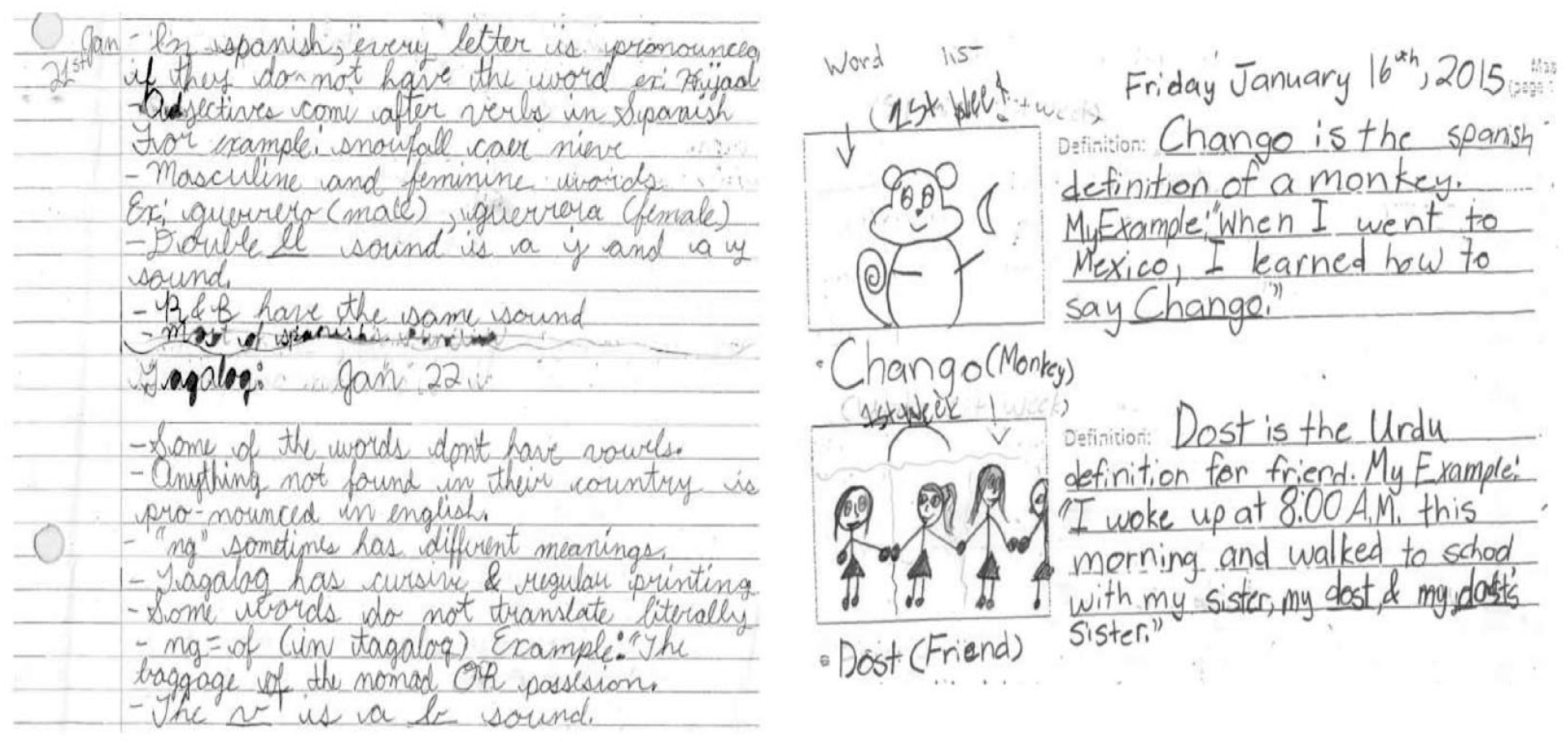
Illustrated language journaling and word list page—Example from student’s language portfolio.
The students used context-dependent strategies to complete linguistic and academic tasks, reminiscent of Vygotsky’s (1978) spontaneous concepts about language. Although these concepts were highly developed, they tended toward being unconscious and unarticulated, without much knowledge of the rules that governed these articulations (Valdés, 2003). This tacit knowledge (Lee, 2007) helped students make meaning and allowed teachers to focus on the understandings gleaned by the students as teachers moved toward a more explicit understanding of culturally responsive pedagogy. The argument is that students can use their linguistic and cultural understandings to augment the practices that schools value, not unlike translators do when they translate material (Jiménez et al., 2015).
Enhanced Language Identities
Throughout the project, the teacher and the guest readers each took on different roles in terms of language learning and literacy. They essentially became partners in the endeavor: The teacher learned alongside the students, and the guest readers discovered things about their language based on class feedback and questions. Stakeholders became collaborators in learning about the affordances of DLBs for language awareness and engagement with text in the classroom. The researchers, the teacher, and the guest readers also engaged in language learning and navigating their personal language identities.
The teacher described her own positioning as a learner, collaborator, and facilitator alongside the guest readers in joint stakeholder discussions and study questionnaires. Her participation in the pre- and postreading exercises precipitated clarification and curiosity for the three languages represented, enabling her to optimize the opportunities for connections to the ELA curriculum. By positioning herself as a learner, she recognized and leveraged students’ and guest readers’ existing linguistic knowledge and positioned them as legitimate classroom resources, effectively “recontextualising classroom interactions and managing power relationships” (Pacheco et al., 2019, p. 93).
As an example, one student might say, “That sounds just like Spanish!” As a result, the teacher would adapt her strategy for encouraging interest in vocabulary across the languages by focusing on certain curriculum-related words. Students could see how thematic vocabulary translated into Urdu, Tagalog, and Spanish. The teacher encouraged the process of spontaneous noticing and guided students to use their curiosity strategically, shifting from random interest to recognizing the words in the texts and requesting translations that were relevant to the DLBs they were writing themselves.
Similarly, some of the guest readers communicated that the DLB initiative was a learning opportunity for them. One of the Tagalog-speaking guest readers shared that he learned “that Tagalog has evolved [and] that it now accepts/uses more letters in its alphabet than what I was taught” (GRQ). The Urdu-speaking guest reader described an instance “where the students wanted to know the literal translation for the word ‘evil’ and [the university researcher], myself and even the Google translator were unable to figure it out” (GRQ).
The DLB initiative thus led to deep engagement within and across the four languages, including English, and exploration of the contours of one’s linguistic repertoire. The Urdu-speaking guest reader explained how the DLB initiative engaged her in appreciating her mother tongue and reconceptualizing her language identity: “I have always loved the language, and I think I love it more after this experience. I am an ESL [English as a second language] teacher, but after this experience I have realized that I can even teach Urdu” (GRQ).
The teacher and guest readers also highlighted instances when ELL students presented their home language expertise in the DLB context. The teacher explained, “It was wonderful to see so many of the ELL students, who are often quiet observers in the classroom, have moments to shine and use their expertise” (TI). The DLB writing process encouraged peer-to-peer collaboration that prioritized partnering with “students who spoke the language they were showcasing” (TI). Importantly, this led to pride in one’s home language; as the teacher explained, “Many students were very proud to use the language their parents speak” (TI). One of the Tagalog-speaking guest readers shared that a student whose native tongue is Tagalog “said he wants to practice speaking Tagalog with friends and family, so he doesn’t lose it” (GRQ).
The curiosity that was encouraged about languages and cultures in general through participation in this study also showed in the responses students offered about what they wonder regarding language: “[I wonder] how to say hi in every language”; “[I wonder] what is the hardest”; “[I wonder] how do you learn to speak languages”; “I wonder what Irish will be like”; and “I wonder how Chinese sounds like” (Grade 5 SQ). Students also made suggestions for improving the DLB study experience that indicate their curiosity had been sparked and linked with their growing self-awareness as dynamic language users: “Each of us [should] have our own copy of [the books]”; “See if I can understand and read”; “Desgosing [discussing] the words more”; “More languages to learn about”; “Watch a movie about the language”; “Instead of child book how about books for 10-year-olds” (Grade 5 SQ).
As a culminating celebration of the DLB initiative, the students presented their own DLBs. This activity showcased their language learning, generated learning artifacts that affirmed and embodied multilingual and cross-lingual competencies, and celebrated the collaboration of community volunteers in home language inclusion for language awareness using DLBs. It also provided evidence that the practice they had completed as learners had scaffolded the skills needed to thoughtfully share their own DLBs. Students were thus actively engaged as dynamic language users throughout the initiative and in the self-made DLB presentation (Prasad, 2018). These class–school–home–community connections fostered within the DLB initiative offer insight into the benefits of and possibilities for promoting an ecology of multilingualism within the school system (García & Menken, 2015).
An unexpected outcome of the study was a repositioning of stakeholder perspectives in relationship with one another. By experiencing their respective home languages as valued and represented in the classroom, guest readers (one of whom was a parent) and students gained confidence and a sense of pride in their culture and language. This finding aligns with research about multiliteracies in Canada indicating that ELLs’ academic achievement is enhanced “to the extent that instruction affirms their identities and enables them to invest their identities in learning” (Cummins, 2010, p. 7).
Conclusion
DLBs, in collaboration with native language guest readers, were explored as a literacy tool to realize the goals of the ELA curriculum in an English middle school. The findings suggest significant value in adopting DLBs as a learning tool and allocating time for language awareness activities, such as comparing and contrasting linguistic phenomena, in the context of DLB reading activities. Sierens et al. (2018) pointed to the value of language awareness activities in literacy achievement, and combining the DLBs within this context enhanced student engagement and abilities. The DLB initiative promoted an understanding of multiple dimensions of language, enhanced communicative and intercultural competence, and helped to develop reflective capacity for all learners—including the teacher and guest readers—while bolstering critical home–school–community connections (Beacco et al., 2016). From the perspective of Lewis et al. (2012), teacher-led dual-language reading strategies position multilingual students, by extension their family members, and in this case community volunteer native speakers, as competent and knowledgeable contributors in academic learning.
Guest readers expressed feeling honored to have participated and enthusiastically shared sociolinguistic histories and their own experiences and challenges in learning a language. By leveraging their funds of knowledge, the teacher created, in both practice and in presence, classroom conditions that capitalized upon her students’ linguistic competencies and their sociocultural histories as valued resources (Alvarez, 2018; Marshall & Toohey, 2010; Pacheco et al., 2019). Students became curious about one another’s linguistic repertoires and about possibilities for expanding their personal linguistic repertoires.
For the teacher, the DLB initiative represented an opportunity to learn and teach about different languages in a creative manner with attention to concepts outlined within the ELA curriculum. The guest readers played an essential role, embodying the culture and language and deepening intercultural awareness within the teacher’s overall literacy acquisition strategy. The pedagogical practices underpinning the DLB initiative offered numerous “contexts of empowerment” (Cummins, 2009, p. 38) within which culturally and linguistically diverse identities were affirmed and repertoires were valued and enhanced. The students’ self-made DLBs demonstrated dimensions of language awareness and promoted appreciation of language diversity among the audience when they were presented to the whole school.
Paramount throughout the project, linguistic diversity was framed as an asset, enriching the shared learning community of the classroom, building literacy practices that went beyond sound/symbol recognition, and structuring a language awareness mind-set that, it is hoped, will continue throughout the students’ schooling. The DLB initiative encouraged the use of these books as an instructional strategy beyond the promotion of cultural awareness, leading the classroom to a heightened literacy learning adventure and a positive experience with language awareness. In addition, the entire project gave the teacher a role as an agent of change, rather than as simply a deliverer of prepackaged curriculum (Cummins, 2019). It provided all stakeholders with a clearer picture of how the various languages represented in the classroom can be used to enhance literacy acquisition and engage students in interesting and creative activities to pursue this objective.
Overall, students who identified as monolingual English speakers enjoyed being challenged by the DLBs. However, students who were monolingual in another language and who struggled with English relied more on the pictures and less on linguistic cues than their peers. Future research could examine how these students could be supported with think-aloud study guides and a K-W-L (know, want to know, learned) chart revised to include “D” for “did” and “S” for “still want to know” (Aguilar et al., 2007; Ogle, 1986). Language awareness, an important aspect of this study and future research, is clearly linked to and concerned with linguistic diversity in education, focusing on how multilingualism is transforming how education is delivered and, further, the relationship between language and social justice (Hélot et al., 2018). How best to serve students who are new to any language, including English, is an important question in dual-language education.
Supplemental Material
Abstract.0087.Zaidi.AMM.5.27.Final – Supplemental material for Dual-Language Books: Enhancing Engagement and Language Awareness
Supplemental material, Abstract.0087.Zaidi.AMM.5.27.Final for Dual-Language Books: Enhancing Engagement and Language Awareness by Rahat Zaidi in Journal of Literacy Research
Supplemental Material
Abstract.0087.Zaidi.AMM.5.27.Final_Arabic_Final – Supplemental material for Dual-Language Books: Enhancing Engagement and Language Awareness
Supplemental material, Abstract.0087.Zaidi.AMM.5.27.Final_Arabic_Final for Dual-Language Books: Enhancing Engagement and Language Awareness by Rahat Zaidi in Journal of Literacy Research
Supplemental Material
Abstract.0087.Zaidi.AMM.5.27.Final_French_Final-REV – Supplemental material for Dual-Language Books: Enhancing Engagement and Language Awareness
Supplemental material, Abstract.0087.Zaidi.AMM.5.27.Final_French_Final-REV for Dual-Language Books: Enhancing Engagement and Language Awareness by Rahat Zaidi in Journal of Literacy Research
Supplemental Material
Abstract.0087.Zaidi.AMM.5.27.Final_Spanish_Final_REV – Supplemental material for Dual-Language Books: Enhancing Engagement and Language Awareness
Supplemental material, Abstract.0087.Zaidi.AMM.5.27.Final_Spanish_Final_REV for Dual-Language Books: Enhancing Engagement and Language Awareness by Rahat Zaidi in Journal of Literacy Research
Supplemental Material
Abstract.0087.Zaidi.AMM.5.27._German_Final – Supplemental material for Dual-Language Books: Enhancing Engagement and Language Awareness
Supplemental material, Abstract.0087.Zaidi.AMM.5.27._German_Final for Dual-Language Books: Enhancing Engagement and Language Awareness by Rahat Zaidi in Journal of Literacy Research
Supplemental Material
jp-Abstract.0087.Zaidi.AMM.5.27.Final_Chinese_Final – Supplemental material for Dual-Language Books: Enhancing Engagement and Language Awareness
Supplemental material, jp-Abstract.0087.Zaidi.AMM.5.27.Final_Chinese_Final for Dual-Language Books: Enhancing Engagement and Language Awareness by Rahat Zaidi in Journal of Literacy Research
Supplemental Material
Zaidi_Supplemental_Materials_Figure_3-4-5-6_RSB – Supplemental material for Dual-Language Books: Enhancing Engagement and Language Awareness
Supplemental material, Zaidi_Supplemental_Materials_Figure_3-4-5-6_RSB for Dual-Language Books: Enhancing Engagement and Language Awareness by Rahat Zaidi in Journal of Literacy Research
Footnotes
Declaration of Conflicting Interests
The author(s) declared no potential conflicts of interest with respect to the research, authorship, and/or publication of this article.
Funding
The author(s) disclosed receipt of the following financial support for the research, authorship, and/or publication of this article: PolicyWise for Children & Families (Alberta Centre for Child Family and Community Research).

References
Supplementary Material
Please find the following supplemental material available below.
For Open Access articles published under a Creative Commons License, all supplemental material carries the same license as the article it is associated with.
For non-Open Access articles published, all supplemental material carries a non-exclusive license, and permission requests for re-use of supplemental material or any part of supplemental material shall be sent directly to the copyright owner as specified in the copyright notice associated with the article.
