




Abstract
Recent literacy research has made substantial contributions to expanding definitions of literacies beyond stringent parameters of decoding print. These inquiries have intersected with topics such as multimodality and critical literacy in general education literacy classrooms. However, students in isolated special education settings labeled with dis/abilities such as autism or intellectual disability often only receive reading instruction emphasizing functional skills and sight words. The data for this study emerged from a secondary isolated special education classroom where students identified as significantly dis/abled responded to inclusive picturebooks. Analysis is framed by the scholarship on neurological queerness. Findings illustrate how students engage in literacy practices via neuroqueer asocial actions and embodied inventions when they are presumed as competent by teachers and staff. These findings challenge deficit orientations guiding special education literacy instruction and offer implications and openings for continuing to expand who counts as literate and what counts as literacy.
Keywords
For some time, the field of literacy research has been increasingly concerned with describing literacies in more expansive ways. Beyond just defining and examining literacy in technical terms that are independent of social contexts (Street, 1993), current literacy research has intersected with discussions of multifaceted topics such as embodiment (e.g., Enriquez, 2014), multimodality (e.g., Dalton & Grisham, 2013), and critical literacy and pedagogy (e.g., Labadie et al., 2012). This research has provided a path for those seeking to continue to disrupt and shift how we think of what counts as literacy and who counts as literate.
While classrooms included in current literacy research increasingly encompass more students with dis/ability labels in light of the inclusion movement in the United States (Smith, 2015), there are still approximately 1% of students with educationally sanctioned dis/ability labels (i.e., intellectual disability, autism spectrum disorder) who are actively isolated from general education settings because their dis/abilities are considered so significant that they would not benefit from a general education curriculum (National Center and State Collaborative, 2012). Historically, these students have not often appeared in literacy research seeking to locate and describe situated literacy practices (Barton et al., 2000).
Klienert et al. (2015) found that of students classified as having dis/abilities to this degree of significance, 93% received their education in either self-contained (i.e., isolated) classrooms, separate schools, or in-home settings. The literacy experiences of these students, especially secondary students, emphasize a focus on sight word instruction and functional skills, where the purpose of reading and writing is linked to operating in society (e.g., reading road and building signs, writing grocery lists, following vocational directions) (Browder et al., 2006; Ruppar, 2017). These placement and pedagogical decisions remove opportunities for students to engage with authentic literature or have their embodied interactions with texts seen as valid.
Through this article, I seek to extend the discussion of expansive literacies as socially situated practices by disrupting the idea that students who have been subjugated to isolated settings cannot and do not engage with authentic literature in the context of a literacy event (Barton et al., 2000). I do so by describing what emerged when students labeled with significant dis/abilities shared inclusive literature (i.e., humanizing texts featuring representations of lived dis/ability experiences) (Kleekamp & Zapata, 2018) and by examining how students neurologically queered literacy events while responding to texts featuring characters who potentially share dis/ability experiences like their own. Utilizing neurological queerness as a theoretical and analytical tool located inside a lens of literacy as a socially situated practice, I pose the following research questions: What is the teacher’s role during a literacy event in an isolated special educaiton secondary setting? Among secondary students labeled as significantly dis/abled, what literacy practices emerge in relation to an inclusive picturebook curriculum? What does a lens of neurological queerness offer the field of literacy research?
Throughout this article, I actively employ the use of the slash in the middle of the word dis/ability unless I am referring to specific labels or institutions (e.g., intellectual disability, disability studies). The term disability has long been associated with what people cannot do by emphasizing varying inabilities to perform in society. Utilizing the slash in the middle of dis/ability serves to interrupt the notion of dis/ability as a fixed phenomenon—one that lives inside individuals and presents itself in the exact same ways in all social contexts (Annamma et al., 2016). Dis/ability is fluid and shifting, changing based on the way people, things, and discourses circulate. The slash provides a visual reminder of the way dis/ability and ability are both constantly being constructed in social spaces.
Theoretical Framework: Neurologically Queering Literacy Events
Yergeau (2018) writes, “The autistic subject, queer in motion and action and being, has been clinically crafted as a subject in need of disciplining and normalization” (p. 26). The special education system relies heavily on medical definitions of autism and dis/ability, especially for those dis/abilities related to the mind (McGuire & Michalko, 2011). The multitude of ways students labeled or identifying as autistic come to know, learn, and interact are located as neurologically disordered and in need of remediation by interventionists and special educators (Brantlinger, 2006).
Neurological queerness (i.e., neuroqueerness) first emerged from the autistic online blogging community (e.g., Neurocosmopolitanism), but Yergeau (2018) offers this term as a potential framework for all individuals considered neurodivergent, including students who receive the majority of their education in self-contained settings with labels including intellectual disability and autism. Neuroqueerness unsettles deficit discourses of autism and dis/ability, which reduce the storying of varied individual experiences into a single clinical narrative. Yergeau (2018) writes, “How can we—in the classroom, in the clinic, in the pages of our scholarly annals—how can we transform social spaces in ways that enable those distant Others to speak back?” (p. 31). Layering a neuroqueer framing within situated literacy practices in a secondary classroom serves as an attempt to answer this call.
I describe a neuroqueer framing of situated literacy practices as a focus on the verb-formed actions (Muñoz, 2009) of students who have been positioned as neurodivergent (Yergeau, 2018). Specifically, in the presentation of findings that will follow, I am interested in how neuroqueer serves as a verb, not an additional descriptor that takes the place of other labels like autism or intellectual disability. Collectively, I define neuroqueer actions in the literacy classroom as flexible and shifting embodiments that resist what has been defined as acceptably social and appropriately communicative in the context of a literacy event. This definition draws on three major tenets described by neuroqueer blogger Nick Walker (2015).
First, paying attention to actions in literacy events produced by students identified as neurodivergent creates space to queer, shift, or turn something on its head and move toward idealizing and desiring in deliberate ways that honor and center the plurality of identities, embodiments, lived experiences, and affective stances individuals enact (Yergeau, 2018). Second, locating neuroqueer actions in literacy events considers how literacy practices resist or refuse to adhere to socially dominant cognitive and behavioral expectations and norms (Walker, 2015). Finally, centering neuroqueer actions in literacy events locates these practices as valid and legitimate in spite of autonomous definitions of literacy (Street, 1993).
Drawing on the theoretical framing of neuroqueerness as well as the scholarship in disability studies in education (DSE), this article blurs the lines of literacy normalization by centering the literacy practices of individuals who have been educationally represented as not knowing. To do so, I specifically draw on three conceptual tenets: presuming competence (Biklen & Burke, 2006), asociality as countersociality (Douglas et al., 2019; Yergeau, 2018), and embodied invention (Yergeau, 2018). Below, I describe each of these concepts more fully as context for expanding literacy research—a reimagining that seeks to include neuroqueer actions.
Presuming Competence as a Necessary Teacher Stance
Presuming competence in students has served an important role in more inclusive educational practices for students with dis/ability labels (Biklen & Burke, 2006). Drawing on existing scholarship in DSE, including the field of literacy research (e.g., Kasa-Hendrickson, 2005), I define presuming competence as the inherent belief that students bring many competencies into classrooms regardless of their accompanying dis/ability labels. Teachers demonstrating a presuming competence stance help to reenvision the multitude of ways student participation might be enacted. Though students may require significant support systems or respond in diverse and unexpected (i.e., neuroqueer) ways, teachers who presume competence position students as imaginative and meaningful contributors to the literacy community (Kliewer & Biklen, 2007).
Literacy researchers in early childhood settings utilizing a lens of presuming competence have made monumental strides in challenging deficit orientations to dis/ability (e.g., Kliewer et al., 2006). This shift required resisting the classification of students as either literate or nonliterate by acknowledging how students already contribute (perhaps in neuroqueer ways) to their diverse literacy communities. Presuming competence requires teachers to move away from school-based designations that have always positioned students with labels as delayed or incapable (Keefe & Copeland, 2011).
For example, Flewitt et al. (2009) share the literacy practices of Mandy, an early childhood student labeled with Angelman’s syndrome and global developmental delays who participated in an inclusive educational setting (i.e., a classroom that includes students with and without labels) several days per week. Mandy engaged in multimodal and embodied literacy activities through a combination of vocalizing, body positioning, eye gaze, the use of tools, and touch. During a class read aloud, when the topic of birthday cake arose, Mandy stopped sucking her thumb to lean forward and attend to the text. The teacher responded to Mandy’s vocalizations, gestures, and changes in movement as communicative intent, presuming competence in Mandy.
Similarly, Kliewer et al. (2006) describe Isaac’s literacy practices from a stance of presuming competence. Prior to his placement in an inclusive classroom, Isaac was clinically defined as a child with Down syndrome who possessed no literacy skills. Isaac’s new teacher demonstrated a stance of presuming competence. Having visited Isaac’s home prior to his arrival in his new school, the teacher learned that Isaac’s favorite book was Where the Wild Things Are (Sendak, 1963). On his first day in his new classroom, the teacher read aloud from this text as students listened from the carpet. Isaac responded by jumping up and beginning to dance in the middle of this read aloud. As he danced, students around him stood, too—and they began to dance—and then everyone began to dance.
Both Mandy’s and Isaac’s teachers opened their classrooms by presuming competence in students who have traditionally been positioned as incompetent. It is here, in these classrooms, that leaning in and dancing could be viewed as socially situated responses to literature (Barton et al., 2000). The role of teachers in welcoming neuroqueer ways of coming to share and respond to literature is a critical component of shifting educational spaces to occupy more inclusive practices. Presuming competence serves as a generative conceptual idea in naming this verbed form of teaching.
Asociality as an Opening for Countersocial Narratives
Students labeled as significantly dis/abled or autistic often demonstrate acts that have been sanctioned as nonsocial and in need of remediation (Wing & Gould, 1979). These might include avoiding eye contact, running away, or yelling. Normative interpretations of these acts result in identifying behaviors deemed inappropriate to eliminate them. Subsequent intervention targets might force students to make eye contact with conversation partners, sit in specific locations in classrooms, or engage in rote turn-taking conversation patterns (McGuire & Michalko, 2011). In stark contrast, Yergeau (2018) argues that to be autistic is to be asocial. Asocial acts may resist human engagement or be impulsive, repetitive, or compulsive, but these acts are socialities—in spite of their resistance to what is seen as socially acceptable. A neuroqueer reimagining of asociality serves as a countersocial mechanism for producing narratives.
Douglas et al. (2019) offer six examples of countersocial narratives that disrupt notions of autistic individuals as nonsocial. They do so through Re•Vision workshops, which serve as opportunities for autistic people to disrupt normative interpretations of communicating and storytelling. Participants, who include autistic persons and autism advocates, create short films that offer alternative, neuroqueer ways of communicating in an effort to restory their own lives. These asocial communicative acts include overlaying video with verbal tics, embedding rhythmic breathing, and positioning echolalia (i.e., repetitive spoken language) as communicative.
To take a countersocial stance to literacy practices, then, is to defy normative understandings of what it means to be and act as a social being in the context of a literacy event. Barton et al. (2000) describe the multitude of possible literacies as socially situated practices that connect people to one another in different spaces and contexts. In all classrooms, though, there are already dominant and normative understandings of being socially literate in place (Barton & Hamilton, 1998). These understandings have been built on conventional descriptions of literacy practices (e.g., responding to read alouds via oral or written language) (Street, 1993).
A countersocial stance unsettles valuing measurable, observable, and functional communicative acts like eye contact and turn-taking as the only acceptable contributions to a literacy event. Instead, asocial embodied inventions, or those actions that have historically been labeled as meaningless (e.g., stimming) or disruptive (e.g., yelling), are located as asocial literacy practices. In turn, asocial actions can come to shape the way literacy events are situated and formed in classrooms where students demonstrate countersocial ways of being literate.
Rhetorical Effects Produced Through Embodied Invention
Asocial acts such as rocking, flapping, and yelling are common observable neuroqueer embodied actions. From an educational remediation standpoint, these embodiments are considered undesirable. They are to be abolished for their failure to comply with normative expectations of classroom participation (e.g., sitting quietly and raising one’s hand). These students who rock, sway, or demonstrate echophenomena (e.g., repetitions of gestures, words) cannot and do not have intentionality behind these embodiments (McGuire & Michalko, 2011). Positioned this way, embodiments are rendered as unwelcome and meaningless.
However, as Yergeau (2018) argues from a neuroqueer perspective, intention need not be present for meaningful rhetorical effects to take place in the context of a literacy event. Yergeau writes, I have stimmy hands, hands that wave, and flap, and tussle rubber bands—hands that create and transform spaces as much as they occupy it. My hands story and proclaim, denounce and congratulate. My hands say both fuck you and thank you. (p. 13)
Yergeau offers an alternative lens through which to view these responses, describing any form of neuroqueer embodiment as inventive. Neuroqueer embodied literacy practices, such as tics, hand flapping, rocking, and echophenomena, shift a space, have rhetorical impacts, and offer possibilities. Instead of intervening, to read these actions queerly is to consider how these embodiments shift or change the in-between spaces—spaces between bodies and things. To allow students space to create their own narratives is to permit and encourage embodied invention.
Embodiments in a literacy event—which I define as an inventive response enacted via movement, vocalizations, or oral language—interrupt, add, and shift. For example, if a student responds to literature via rocking and vocalizing, a neuroqueer lens does not require that students have specific intent in this embodied response for these movements to have inventive effects. Instead, a neuroqueer theoretical lens casts an analytical gaze on the rhetorical effects of these embodied inventions within the context of a literacy event. A neuroqueer reading of yelling or stimming during a literacy event does not ask why a student enacted these specific embodiments but instead considers how the literacy space shifts or results in something new. Therefore, to view embodied inventions in the context of a literacy event is to recognize the neuroqueer actions taking place among students and texts as they interact together to uncover the circulating literacy practices that are valued in a specific classroom community (Barton & Hamilton, 1998).
Repositioning Neuroqueer Actions as Socially Situated Literacies
By nestling a neuroqueer framing within literacies as socially situated practices, I seek to extend literacy research in classrooms where teachers presume competence in students’ unique ways with texts. However, I also acknowledge that the field of literacy research already includes a rich exploration of expansive responses to literature, including multimodal literacies (e.g., Zapata & Van Horn, 2017), visual literacies (e.g., Cowan & Albers, 2006), and embodied literature response (Medina & Campano, 2006). I aim to build on these research contributions to transform the way we think and talk about literacies for students who have historically been primarily represented by deficit orientations to literacy. Neuroqueerness and its key conceptual tenets uniquely extend discussions of literacies beyond general education classrooms to those students whose embodied literacy inventions bristle against social norms.
Method
This research was designed as a teacher–researcher collaborative inquiry (Cochran-Smith & Lytle, 2009) and took place over a period of 4 weeks in the winter of 2018 in a secondary special education English classroom located in the Midwest. Over the course of the project, students, paraprofessionals, and the teacher participated in a unit of study exploring inclusive picturebooks. Data sources included over 200 pages of field notes documenting classroom observations, photographs of student-produced artifacts, and twice-weekly teacher audio-recorded memos (Genishi, 1992).
The Curriculum and Teacher–Researcher Partnership
Curricular decisions for this research grew from a 3-year professional partnership with Grace, the special education teacher in this secondary English classroom. Having formerly worked as a speech-language pathologist alongside Grace, our partnership grew out of an effort to unsettle the deficit orientations to students we, too, had perpetuated in our professional lives. During data production, Brandon (pseudonym), a paraprofessional in the classroom, also emerged as a collaborative partner during literacy events.
During this four-week curricular unit, we invited students to read and respond to a book flood (i.e., a collection of texts available on a large circular table in the classroom) of more than 40 inclusive picturebook titles, or texts featuring main characters with lived dis/ability experiences (Kleekamp & Zapata, 2018). Our title selection was guided by questions that focused on humanizing portrayals of dis/abled characters by interrogating texts for multidimensionality, voicing, reader positioning, and authentic relationships (Kleekamp & Zapata, 2018). Ongoing analysis for this research project occurred through unstructured and semistructured reviews of data between both Grace and me.
Room 124: Context and Focal Participants
Room 124 is a constantly shifting classroom space animated by bodies, materials, technologies, noises, vocalizations, verbalizations, and movements. It is housed on the lower level of a large secondary building. Above the classroom is a practice gymnasium on the main level, where basketballs often bounce, adding noise to the space. In the hallway, clanging spoons and mixers can be heard from nearby cooking classes, and humming woodworking tools are occasionally audible in the machinery classroom across the hall. These descriptions offer the soundscape and location of this classroom, tucked into the bowels of an aging building and located away from the “English wing” of the school—instead hidden far from the main office and potential eyeline of visitors.
Anthony and Micah
All students in Room 124 carry significant dis/ability labels (i.e., autism or intellectual disability), indicating that they require major adaptations to the literacy curriculum. Students spend nearly the entire day in this room or the room next door, leaving only to eat lunch in the cafeteria and to visit their Physical Education (PE) class every other day. For this analysis, I center the neuroqueer literacy practices of two focal students, Anthony and Micah (pseudonyms). Both young men are identified as autistic by the education and medical communities and typically participate in sustained academic activities for a maximum of 5 to 7 min. Both students often request a weighted vest as a mode of sensory support.
Anthony, a sophomore, prefers to read and write as his mode of communication. Therefore, a small whiteboard typically sits next to him, ready for staff to write messages and directions. The most common response Anthony provides when verbally asked a question is to strongly say, though often yell, “No!” regardless of the question. Anthony prefers to know, in precise order, what events will take place during a school day and a class period. We met this need by providing daily schedules and class outlines. Disruptions to this routine can be catastrophic to Anthony’s learning and result in screaming, punching inanimate objects, and eloping (i.e., escaping undesirable activities by walking or running away).
Micah, a senior, requires the most support of all students in Room 124. He communicates primarily through gesture (e.g., pointing) or embodied gross motor movements (e.g., rocking, walking away) rather than embodied oral speech (Cartwright, 2008). Micah accesses an augmentative and alternative communication system (AACS; i.e., a speech-generating device) with significant support from communication partners. Micah also carries a diagnosis of a progressive medical syndrome, resulting in the need for increasing physical and cognitive support as he ages. Around his middle rests a gait belt, a precaution should he begin to fall mid-seizure.
Though I provide mention of students’ dis/ability labels briefly as context for the specific location of this research, I resist providing normative descriptions of students’ literacy skills or cognitive abilities in terms of functioning (i.e., high or low) for the ways these clinical explanations seek to dehumanize the complex and varied lived experiences of people (Yergeau, 2018). I have also intentionally not made explicit claims regarding participants’ identities, nor do I consider it humanizing to layer yet another identity label (i.e., neuroqueer) atop a school-sanctioned label (i.e., autism, intellectual disability). While the term neuroqueer can serve as an adjective describing one’s identity in the neurodivergent community (Walker, 2015), Grace and I, as collaborators, were intentionally focused on the rhetorical effects of students’ actions rather than on holding their social identities still with an additional label.
Data Sources
Classroom observations and artifact documentation
All classroom observations were video recorded and documented daily via field notes crafted using thick description (Geertz, 1983) and utilized initial theoretical coding (Corsaro, 1985). Physical materials, supportive technologies (e.g., AACS), and student-produced artifacts were archived by photographing materials and projects.
Teacher reflections
Genishi (1992) describes the importance of offering opportunities for teachers to engage in teacher storytelling during the research process. Grace participated in at least two audio-recorded memos per week to respond to the curricular process, reflect on difficult or complex teaching moments, and speak to key moments during literacy events. These audio reflections guided ongoing analysis between teacher and researcher as data progressed.
In-the-moment interviews
In-the-moment student interviews (Rogers et al., 2005) were deliberately selected as a method of data production when considering methodologies informed by DSE in classrooms with students who demonstrate neuroqueer actions (Dowse, 2009). Snelgrove (2005) argued that formal interviews, even semistructured interviews, that are out of context, delayed, or take place in nonroutine ways with unfamiliar communication partners can be disruptive and offer little productive data.
Data Analysis
To identify salient themes emerging from the data, analysis drew on tenets of constant comparative analysis (Strauss & Corbin, 1998). I engaged in daily theoretical coding as field notes were produced (Corsaro, 1985). At the end of each week, I also produced analytic memos (Charmaz, 2010) to compare emerging themes and indicate points of future analysis. As part of this collaboration, Grace and I regularly engaged in conversations about emerging themes and further points of analysis. Upon conclusion of data production, analysis proceeded in three phases. At this point, I, as the researcher, began formally analyzing the data, with Grace providing feedback and input as key themes and findings were identified.
Phase one
After completing readings in neuroqueerness (Walker, 2015; Yergeau, 2018) and DSE (e.g., Biklen & Burke, 2006), I reread field notes, interview data, artifacts, and teacher audio-recorded memos to open code these data sources based on tenets of neuroqueerness (e.g., embodied invention, asociality, rhetorical effects) and DSE (e.g., resisting normalcy, presuming competence). From these open codes, I produced additional memos based on key themes related to students’ opportunities to participate in literacy events. These major themes came to include teachers or staff members presuming competence in students’ literacy practices, countersocial literacy practices, and embodied and inventive literacy practices (see Table 1).
Major Themes and Data Examples.
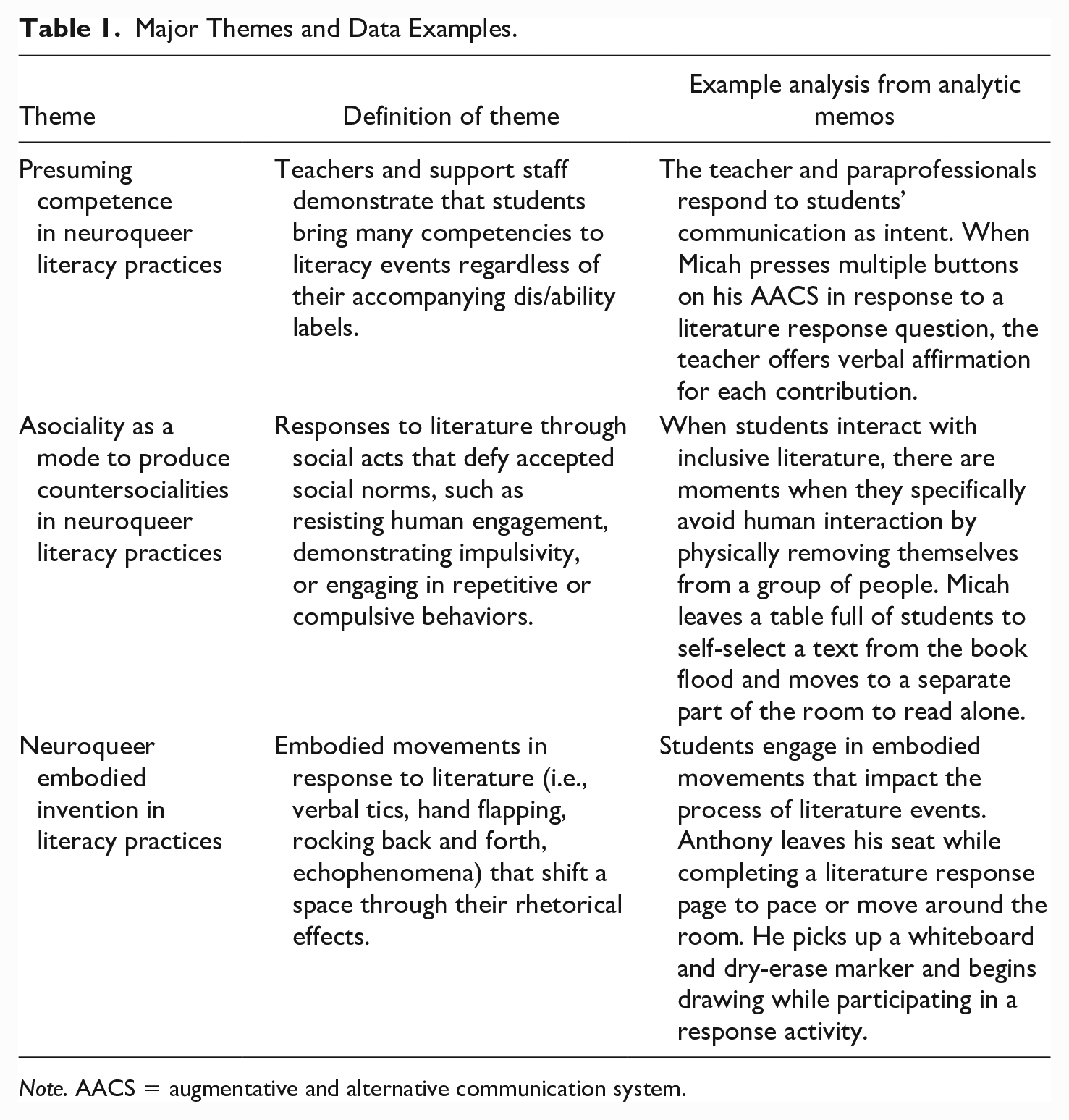
Note. AACS = augmentative and alternative communication system.
Phase two
After identifying major themes, I returned to the data to locate what I describe as “moments of invention,” or moments of neuroqueer literacy practices, for two focal students, Anthony and Micah. These moments occurred in one-to-one partnerships focused on a picturebook with either a paraprofessional or the teacher during which competence in students was presumed. Students engaged in acts of asocial communication (e.g., yelling, avoiding human interaction) through embodied neuroqueer actions (e.g., stimming, vocalizing, rocking).
After locating each student’s moments of invention across the data, I identified three moments per student to engage in close analysis. Each was selected as an illustrative example of all three themes emerging together (i.e., presuming competence, asociality, embodied invention). These selections were not made because they were irregular occurrences. Rather, across the larger corpus of data, each selection located a salient episodic instance in which consistently occurring embodied and inventive neuroqueer literacy practices were represented.
Phase three
Informed by microethnographic methods (Bloome et al., 2005), I analyzed six moments of invention in three rounds. Each round was guided by different analytic questions, framed specifically by a neuroqueer framework, informed by the themes of presuming competence, asociality, and embodied invention. During the first round of video analysis, I observed social interactions broadly, casting my analytic gaze on the outcomes of interactions to consider how presuming competence was enacted. During the second round, I analyzed how countersocialities extended opportunities for neuroqueer literacy practices. Finally, during a third viewing, I analyzed embodied interactions between individuals in the moment, locating specific instances of inventive and embodied neuroqueer literacy practices. For each moment of invention analyzed, all three themes were interwoven. However, for the purpose of presenting findings, I selected one example of each key theme per student to present as data that illustrate these major themes located within neuroqueer literacy events.
Findings
In what follows, I present illustrative findings from analysis related to the themes of presuming competence, countersociality, and embodied intervention from Anthony’s and Micah’s neuroqueer actions in response to inclusive picturebooks.
Presuming Competence in Neuroqueer Literacy Events
The data suggest that presuming competence in students’ embodied responses (i.e., vocalizations, rocking, yelling) was a necessary ideological teacher stance to support students’ neuroqueer actions during literacy events. Following read alouds, students responded in varied ways, including with gestures, vocalizations, and verbal language. Though these connections were initially offered through focused text-to-self, text-to-text, and text-to-world invitations (Keene & Zimmermann, 2007) via sentence-starter formats (e.g., “A time I’ve felt like my character was. . .”), students’ neuroqueer actions demanded that we adjust the literacy curriculum.
Providing space for Anthony’s preference for writing
We initially engaged students in oral discussions of their responses to texts. Anthony demonstrated a strong communicative preference for writing as opposed to speaking orally. During the early weeks of the study when staff probed him with oral questions, Anthony often screamed “No,” left his seat to pace around the room, or asked to go to the bathroom. In each of these moments, Anthony was not reprimanded or scolded for his behaviors.
During one particular moment of invention, after visiting the book flood table to select an inclusive picturebook, Anthony sat down next to Brandon, a paraprofessional, at one of three large circular tables in the classroom. Brandon began reading aloud from Anthony’s selection, Six Dots (Bryant, 2016), a biographical picturebook featuring the life of Louis Braille. The pair sat side by side as Brandon read. Anthony listened quietly, occasionally turning his head to watch Brandon’s face. A weighted vest, whiteboard, and marker rested on the table, but Anthony did not touch any of these materials. While he listened, Anthony consistently stroked the back of his skull where his buzzed haircut changed from shorter to slightly longer.
As Brandon read, he occasionally attempted to engage Anthony in brief oral responses to Six Dots. For example, Brandon asked if Anthony had ever felt like the character, Louis Braille. For most questions, Anthony did not respond and plugged his ears with his index fingers. Brandon presumed competence in Anthony’s embodied communication and did not continue to push Anthony to respond orally. Instead, he proceeded with the story.
Based on this interaction and many others like it, we chose to alter the design of the literature discussion to address Anthony’s preferences for communicating via writing. Anthony’s revised literature discussion guide allowed him to access paper and pencil without engaging in oral communication with his literature partner. The guide also deliberately offered Anthony sentence starters with several choices as opposed to questions, based on Anthony’s strong objections to or avoidance of open-ended questions in previous activities. After implementing this guide, Anthony engaged in literacy events for longer periods of time with fewer interruptions.
Brandon’s presumption of Anthony’s competence provided an opening for Anthony to engage in literacy events, just not necessarily in the way we had initially imagined. Once this change was made, Anthony’s participation in written-response portions of book flood activities increased. He shifted from not sitting at a table at all to completing full response pages. Presuming competence in students’ capacities to engage in literacy events entailed actively responding to students’ preferred methods of communicating, even when those modes were not mirrored in the ways teachers and staff communicated.
Responding to varied communicative acts from Micah
To support students’ responses to literature, we provided explicit opportunities for students to consider and record some of their own thoughts and ideas that elicited connections between characters’ and students’ interests, preferred activities, talents, and areas of support needs. These ideas then helped to foster discussions of character and reader connections when students engaged with texts from the book flood. For this work, the majority of students responded using a paper-and-pencil format.
Micah, though, did not access paper or pencil to write his thoughts, nor did he access embodied oral speech (Cartwright, 2008) to have a scribe record his ideas. Instead, Micah used gesture, embodied gross motor movements, and an AACS with significant support from a communication partner. On most days, we observed Micah primarily responding to questions with “yes” or “no” buttons on his device when interacting with various paraprofessionals. These were primarily in response to questions like, “Did you like this story?” This consistently shifted when Grace sat down to work next to Micah. She navigated to pages in his AACS that would be specifically relevant to their discussion—demonstrating her knowledge of the system as well as her awareness of Micah’s preferred topics.
On this particular day, Micah and Grace sat side by side at a large circular table. Grace assisted Micah in navigating to a page with various images of different sports’ balls to guide their discussion of Micah’s preferred activities. This conversation drew connections to Max, the main character in Max the Champion (Stockdale & Strick, 2013), a picturebook featuring a variety of athletes with varying physical and sensory (e.g., deafness) dis/abilities.
“What else is Micah good at?” Grace asked, removing her finger from the device. Micah leaned in immediately and selected “Football.” Grace began, “Football! I know you’re . . .” but before she could finish, Micah pressed “Soccer” and rocked back and forth in his seat twice. “Football and soccer. . .” Grace began again. “More,” Micah pressed. Grace paused briefly at this point, allowing Micah to select all the choices he desired. Micah scrolled through the page for a moment and selected “Baseball.” He immediately rocked back and forth, more quickly this time, and vocalized briefly—a communicative act he did not engage in for any other choices.
“I know you really like going to baseball games with your dad,” Grace responded. Micah continued rocking. “You said so many sports, so I think putting sports—playing and watching—does that work?” Grace asked. Micah nodded his head repeatedly and rocked back and forth once more.
In this literature invitation focused on making connections to the athletes featured, Grace did not stop Micah from selecting multiple sports as his preferred pastimes by either pushing his AACS out of reach or covering the screen with her hand. Instead, Grace waited as Micah shared. A normative analysis of this exchange focused on intent might ask whether or not Micah was looking for the “Baseball” button all along. From a neuroqueer stance, though, Micah’s intentionality is not necessarily the interest of our analytic gaze. Instead, the rhetorical effects of Grace presuming competence in Micah suggests something new. Grace received Micah’s responses as valid. As they interacted, Micah’s embodied actions increased—he rocked more and vocalized once. He participated, and his response selections were located as communicative acts.
Asociality as a Mode to Produce Countersocialities in Literacy Events
To engage in asocial behaviors, or interactions that resist normative descriptions of appropriate “social skills,” is to produce countersocialities. In Room 124, asociality, in the form of impulses, yelling, and resisting human engagement, became apparent as students participated in neuroqueer actions during literacy events. Providing space for these countersocialities to occur and interpreting them as legitimate forms of being social were critical components of fostering interactions with literature.
Anthony’s screaming as countersociality
As stated, Anthony’s preferences for written communication sparked adaptations to his curricular materials. Still, even with the addition of a response guide, following specific, multistep directions written down on a page could be challenging for Anthony. When interruptions to literacy events occurred as a result of confusion, Anthony often met these disturbances by yelling or screaming “No!” loudly—sometimes at the person interacting with him and other times at no one in particular.
In one such instance, Anthony demonstrated asocial actions in his response to a text he frequently selected, A Screaming Kind of Day (Gilmore, 1999). This picturebook portrays frustration vividly in the illustrated narrative as Scully, the main female character who accesses hearing aids, is stuck inside with her brother all day. She aches to be out in the pouring rain—an enjoyable sensory experience. Anthony and Brandon worked side by side as Anthony offered his responses. Brandon provided additional supports only when requested. Anthony picked up his literature response guide and completed his first two responses to this text quickly. He quietly read aloud to himself as he selected “I liked this story” from his guide. Anthony moved the tip of his pencil to the next line, which read, “This story makes me want to. . .” From a field of six choices, Anthony quickly circled the word “cry.”
As Anthony finished, Brandon lifted his hand and silently pointed to the next item on the response guide, which read, “One page I liked was . . .” Anthony paused. A list of three short directions offered step-by-step instructions for his response. They read: 1. Open the book. 2. Turn the pages. 3. STOP and POINT when you find a page you like. These lines were written purposefully so Anthony could self-select a page via prompts in written text rather than Brandon intervening through additional oral language.
Anthony read “Open the book” aloud. Brandon complied immediately, beginning to page through the text. “Open the book!” Anthony said louder. “It’s open,” Brandon responded. “I’m turning the pages.” A short pause lingered between the two men. “Can Anthony turn the pages?” Brandon asked. Anthony did not respond.
Brandon began again, “So, let’s read the directions. Open the book. Turn the pages . . .” Anthony yelled, “No!” He loudly repeated “Turn the pages!” as he leaned forward toward the table and flattened the palm of his hand onto the response page in front of him. Brandon finished, “. . . and stop and point when you find a page you like.” Anthony rocked his body back in his chair one time before yelling again, “No! Turn the pages!” Brandon continued turning. Though frustration was visible on his face, Brandon did not say anything back to Anthony.
After this tense exchange, Anthony did finish without abandoning the invitation to respond. He utilized embodied invention to select a page he enjoyed, which I offer in the final section of findings. However, for this moment, I emphasize the opportunities Anthony had to continue engaging in this literature activity through his frequent asocial actions. Anthony did not speak to Brandon directly. He yelled directions at Brandon rather than listening to the directions himself. This yelling occurred in close proximity to someone who was attempting to help him. By normative social standards, all of these agentic asocial moves are unacceptable, out of control, and rude. Still, Brandon did not reprimand Anthony. Instead, he exhibited patience, even as Anthony yelled loudly at him. These countersocial acts, which bristle against normative understandings of sociality, encapsulate an essential aspect of neuroqueer actions inside of literacy practices. Brandon responded to Anthony’s asocial actions as communicative acts, which, in turn, invited Anthony to continue engaging in this literature activity.
Micah’s resistance to human interaction as asociality
During most curricular activities, Micah paired with a paraprofessional to read a picturebook he self-selected. On some occasions, though, Micah did not prefer this social partnership and resisted human interaction. During these instances, Micah stood, pushed back his chair, and walked slowly away from the person. Typically, his destination was the same window in the classroom, where he could quickly pull up the blinds and look at the sky.
Prior to class beginning one day, Micah sat at a large circular table with the rest of his classmates. Some students talked. Others sat waiting quietly or listened to adult side conversations. In this moment, Micah stood, pushed back his chair, and walked over to the book flood table. He picked up The Girl Who Thought in Pictures (Mosca, 2017), a biographical picturebook featuring Dr. Temple Grandin, autism advocate and animal scientist. He turned slightly and walked to sit down in a large white rocking chair with the book upside down in his lap.
With the text still upside down, Micah began by turning several of the pages. Rather than turning the page on the right, Micah turned the page on the left, proceeding through the book in a backward direction. This was a novel interaction with the text. Micah had repeatedly demonstrated book directionality on previous days. After picture-reading the entire narrative backward and upside down, Micah closed the book. Then, he picked up the book again and turned it over—the front cover now facing him top-to-bottom. He again opened the book. He turned the pages with left-to-right directionality and one at a time.
While Micah sat, other students began to get up and select their own texts. No one interrupted Micah’s decision to remove himself from human interaction. No one pulled up a chair next to him to take the book out of his hands and turn it right side up. Micah and this text interacted in asocial ways—defying socially acceptable ways to read a picturebook. He neuroqueered his reading of this text by turning it upside down and backward. He was alone, separated from other humans in the space, but still participating. This being alone created opportunity for Micah to invent and interact with a text based on his preference, which did not include the presence of others.
Neuroqueer Embodied Invention in Literacy Events
Neuroqueer moments of embodied invention were evidenced repeatedly in Room 124. This included acts of stimming, vocalizing, gesturing, remaining silent, and producing echophenomena. These embodied inventions occurred in response to literature during read alouds and class discussions.
Anthony’s embodied response through gesture
Within the theme of countersociality, I discussed the moment in which Anthony and Brandon worked together through countersocial actions to locate a page Anthony enjoyed in the text, A Screaming Kind of Day (Gilmore, 1999). In what follows, I offer the moment of embodied invention that followed those interactions.
Anthony had just finished yelling, “No! Turn the pages!” for a third time at Brandon. Brandon again complied, slowing paging through the text. Brandon stated, “Point to the page you like.” As Brandon turned two pages, Anthony moved his hand toward the book in a small gesture for Brandon to stop. When Brandon missed this cue, Anthony said quietly, “Wait.” Brandon stopped. Anthony groaned and leaned in closer to his literature response guide, bringing his semiclosed fists to his brow. Brandon turned one more page, and Anthony looked up. Instead of motioning toward the book this time, Anthony put his right index finger on the bottom right corner of the two-page spread.
Brandon received Anthony’s message and removed his hand. Anthony turned the page himself. And then he turned the next page. And then another—then stopped. He paused quietly, resting his left hand on the page as he directed his gaze back and forth for 10 seconds between his response guide and the illustration of Scully, the main character, standing in the rain as it poured down around her. She wore a pink raincoat with the hood up, cinched around her chin. Her mother’s outstretched hands rested on her shoulders. Her face was tight and clenched. She was screaming. Anthony placed his pencil eraser lightly on the side of the spread that contained words. Brandon waited quietly as he did. Then, Anthony directed his gaze back toward the right side of the illustration.
Anthony said nothing aloud but instead tapped a choice on his response guide to communicate that he liked “the words and the picture.” He followed this action immediately with an exacerbated and defeated “No.” Anthony turned to look at Brandon’s face, but Brandon just looked back at him, offering no visible response. Anthony tapped his choice again and turned to look at Brandon’s face. This time, Brandon said, “Okay.” Anthony circled his choice quickly. As he finished, Anthony tossed the pencil onto the table and shook his head slowly once. He pulled both hands up to his head, using his index fingers to plug both of his ears. Brandon reached out his hand to offer Anthony a low-five accompanied by the message, “Great job, bud.” Anthony kept his left ear plugged with his index finger but reached out immediately with his right to slap Brandon’s hand in return.
In this exchange, Anthony’s embodied neuroqueer actions are inventive modes of both communication and participation. Given his preference for using written language, Anthony said only two words in this episode: “Wait,” when Brandon did not first interpret his gestural cue, and “No,” as he neared the end of the activity. Other than these two moments, Anthony was inventing his response in silence but with significant effort through his body. He used his finger, motioning, and his pencil as tools for working through this literacy event.
Anthony also added embodied inventions that communicated in unexpected ways and had rhetorical effects. As he neared the end of this activity, he selected “the words and the picture” to communicate a response and then immediately looked to Brandon’s face. When Brandon offered no response, he repeated his embodied communication by tapping the selection again—this time receiving affirmation from Brandon. It was only then that Brandon read Anthony’s act of plugging his ears and sitting quietly as an end to this activity.
In these moments, Anthony selected an image of a character that mirrors how he often looks in the classroom—hands clenched and screaming. An analytic lens of neuroqueerness does not attempt to interpret if Anthony made a meaningful identity connection to a character who feels and looks angry. Instead, a lens of neuroqueerness emphasizes the opportunity that Anthony had to work through this literacy event. The rhetorical effects of this exchange resulted in Anthony’s selection, which shifted the literacy space. Brandon paused and looked up at me as I recorded this interaction—his face looking surprised. Anthony’s selection interrupted Brandon’s attention to completing various steps of this task. His embodied invention had a rhetorical impact on Brandon—who reached out to give him a high-five.
Micah’s embodied response to textual features
Although students were often paired with paraprofessionals to engage in read alouds of their selected texts from the book flood, there were opportunities for students to read literature independently, without the presence of any other communication partners. During one of these instances, Micah walked over to the book flood and self-selected the picturebook Silent Days, Silent Dreams (Say, 2017)—a biographical account of deaf and autistic artist James Castle. This was the most complex picturebook, given its word count, denseness of narrative, and intricate display of visual text. Micah’s paraprofessional stood nearby but did not interject during this activity to suggest Micah select a simpler text.
No evidence in Micah’s educational documentation indicated that he decoded words or required academic goals in literacy. As a result, Micah did not have a history of self-selecting literature or engaging in reading independently. However, on this day, Micah began by opening the front cover of the text and turning the pages—sometimes one page after the next, other times skipping several pages in this 58-page picturebook. As Micah turned each page from a standing position, he used his index finger to push the current page up, so that he might use his full hand to get to the next page—evidence that this fine-motor page-turning task required his own invention.
Silent Days, Silent Dreams features a variety of visual displays, including illustrations of the storyline itself and re-created drawings of the artist’s original pieces by author Allen Say. Micah appeared to pause and linger over pages where the artwork re-creations were depicted in black and white before moving on to the next pages in full color. After several minutes, Micah came to the end of the text and closed the back cover.
Micah began the text again, but this time, he changed his approach. After turning several pages in the book, he leaned down toward the table, standing now at nearly a 90-degree angle, and positioned his ear right next to the book. He moved his hand underneath the most recent page and curled his index finger up. As he did, he began bouncing the page on his finger and nodding his head—forward and back—forward and back. The text had shifted to not only a visual experience but also a material one, with audible features.
In Micah’s individual read and embodied response, he produced a multitude of embodied inventions. He turned pages and demonstrated a variety of book-handling skills—though normative representations of Micah would suggest he knows nothing of book directionality or page-turning sequences. Micah’s first read served as a neuroqueer embodiment of a text that would be considered too complex and inappropriate for someone like Micah.
In Micah’s second reading of the text, though, he neuroqueered all conventional understandings of dominant literacy practices by responding via neuroqueer actions to the material effects of the picturebook he held in his hands (Do Rozario, 2012). In Room 124, the soundscape is constantly shifting, filled with any variety of scripts, stims, and vocalizations. This did not distract Micah, though, from the individual soundscape he created with the pages and his beating finger, pulling himself physically closer to it to experience the audible effects this material text produced. Micah neuroqueered what we know about responding to texts in a way that pleased him. His response embodies how literacy practices can extend to material effects given the new soundscapes picturebooks can afford.
Discussion
The neuroqueer actions visible in Anthony’s and Micah’s responses to inclusive picturebooks featuring portrayals of dis/ability offer openings for their embodied inventions to emerge. Locating embodied responses and creating space for agentic student decisions are not new ideas in the field of literacy research (e.g., Cowan & Albers, 2006; Medina & Campano, 2006). However, centering neuroqueer actions of students like Anthony and Micah as socially situated literacy practices offers an expansive turn. Through this research, I inquired into the role teachers play in neuroqueer literacy events. I also sought to discover how literacy practices from students like Anthony and Micah might be understood from a neuroqueer lens. Finally, I asked how a neuroqueer lens might contribute to the growing body of scholarship seeking to expand literacy research.
The findings presented here offer important implications for each of these inquiries. In what follows, I bring together theory and data to discuss the necessity of approaching isolated classroom literacy spaces as sites to presume competence in students. I argue that if we, as teachers and researchers, embed this ideology in literacy teaching and research, there are openings for neuroqueer asocial actions to lead to embodied inventions in literacy events—offering potentially transformative literacy opportunities. I conclude by describing the implications this research has for extending literacy research.
The Teacher’s Role: Presuming Competence in Asocial Actions
Students like Anthony and Micah have historically been positioned in classrooms as individuals who benefit minimally, if at all, from literacy instruction. The present approach to literacy teaching in these spaces overwhelmingly emphasizes surviving in normative environments (e.g., reading vocational directions, writing a grocery list) (Browder et al., 2006). I do not attempt to claim that functioning in society is an unimportant goal for Anthony and Micah. Rather, I argue that when literacy instruction only emphasizes these skills, ideologies of presumed incompetence are circulating in classrooms through teacher discourses and instruction (Ruppar, 2017). These beliefs lead to the absence of tangible authentic literature in classrooms like Room 124.
Repositioning students in isolated settings as competent and literate beings is imperative to shifting the narrative of literacy instruction to include opportunities for students to share authentic literature (Biklen & Burke, 2006). When this occurs, as became evident in the interactions both Grace and Brandon shared with Anthony and Micah, space for neuroqueer actions—flexible and shifting moments of invention that resist what is considered socially acceptable or communicatively normative—emerge (Walker, 2015; Yergeau, 2018). In many of these moments, Anthony and Micah demonstrated asocialities—neuroqueer actions where they resisted human engagement, performed repetitive or compulsive behaviors, or enacted responses that might be defined as lacking social awareness by normative standards (Yergeau, 2018).
Micah physically removed himself from human interactions to instead self-select and read picturebooks. He read a complex picturebook backward and upside down. Grace did not require Micah to read with someone next to him at all times, nor did she approach him to tell him he needed to select a simpler book. Anthony yelled loudly while seated right next to Brandon. He refused to respond to oral language and communicated almost exclusively in gesture. Rather than abandoning a task or providing critique when Anthony yelled loudly in his ear, Brandon waited for Anthony to continue during literacy events. These reactions by Grace and Brandon were necessary moments for Anthony and Micah to continue acting in the embodied ways they chose. It is only through teachers taking a stance of presuming competence in students that embodied inventions emerge.
Neuroqueer Literacy Practices as Embodied Inventions With Rhetorical Effects
From these moments where Anthony and Micah generated countersocial ways of being and interacting, neuroqueer literacy practices became visible, with rhetorical effects, whether these specific moments were driven by intentionality or not. Gesturing, stimming, bouncing, and pointing shifted the literacy space away from rote responses toward inventive ways of interacting with texts (Yergeau, 2018). Micah repositioned his entire body in response to text materiality to reveal its soundscape affordances while bouncing the page on his finger. This embodied invention produced new sound in the space. Micah demonstrated a novel way to respond to the materiality of picturebooks that had not occurred in Room 124 before this moment. A new classroom literacy practice emerged.
Anthony moved through challenging directions that asked him to identify a page in the text he enjoyed. He yelled. He gestured. He moved his eyes from illustration to narrative to response guide and back again. He offered no verbal confirmation of the page he selected but communicated once he had finished by plugging both of his ears with his index fingers. As Brandon observed Anthony’s selection, he paused and looked up to the camera near where I stood watching this moment. The face on the page looking back was screaming.
What does Anthony’s selection mean? Does it mean anything? Brandon and I cannot definitively answer these questions, but this moment shifted the classroom. Anthony’s embodied inventions changed Brandon’s response. These embodied inventions offered opportunities for neuroqueer literacy practices in ways that were new for this classroom community and new for literacy research. Anthony and Micah moved, shifted, and queered these in-between spaces. Students like Anthony and Micah can and do respond to literature. When these responses are positioned as valid and legitimate, embodied inventions offer new opportunities for literacy instruction and research to begin to shift deficit narratives that have always viewed Anthony and Micah as incompetent.
Implications for Future Literacy Research
Though there are an increasing number of students with dis/ability labels present in general education classrooms where literacy research has traditionally taken place, there remain students in faraway spaces. Perhaps there will come a time when students like Anthony and Micah have access to these classrooms, but the movement toward full inclusion continues to move at painstakingly slow rates (Smith, 2015). As a result, defining literacy for students like Anthony and Micah has been reduced to rote and measurable survival tasks. The findings from this research, though, taken from a neuroqueer theoretical framing, disrupt the idea that students in isolated settings cannot interact with literature. Anthony, Micah, and their classmates offer unique, diverse, and varied neuroqueer literacy practices that, when received as competent, are rich embodied, often asocial, inventions with rhetorical effects. A neuroqueer lens offers a generative framework for understanding these actions as socially situated literacies (Barton et al., 2000).
Yergeau (2018) writes, “When I make hand movements, even when those movements go unnarrated in all of their indecipherable nonverbal glory, I am still a participating body” (p. 173). This research provides a starting point in answering Yergeau’s call for transforming social spaces in classrooms and literacy research. Anthony and Micah are active participating bodies whose neuroqueer actions offer new possibilities. Therefore, this research serves as an invitation for future inquiries to more actively consider participants with diverse minds and bodies.
Though this kind of literacy research in classrooms like Room 124 might be new, students like Anthony and Micah are not. Their beautiful, sometimes indecipherable, and often unexpected ways of interacting with literature have always been available. Pursuing literacy research in classrooms like Room 124 does not give a voice to students who have never had one. Rather, these endeavors seek to center the neuroqueer embodied actions and inventions of those participating bodies who have been ever present but continuously subjugated to far corners—the far corners of our school buildings, the far corners of our minds, and the far corners of our research.
Supplemental Material
915531_Trnaslated_Abstracts_Adams – Supplemental material for “No! Turn the Pages!” Repositioning Neuroqueer Literacies
Supplemental material, 915531_Trnaslated_Abstracts_Adams for “No! Turn the Pages!” Repositioning Neuroqueer Literacies by Monica C. Kleekamp in Journal of Literacy Research
Footnotes
Acknowledgements
Thank you to Grace Higgins for engaging as a collaborator for this research project and to the students in Room 124 for disrupting and expanding what count as literacies.
Declaration of Conflicting Interests
The author(s) declared no potential conflicts of interest with respect to the research, authorship, and/or publication of this article.
Funding
The author(s) received no financial support for the research, authorship, and/or publication of this article.

References
Supplementary Material
Please find the following supplemental material available below.
For Open Access articles published under a Creative Commons License, all supplemental material carries the same license as the article it is associated with.
For non-Open Access articles published, all supplemental material carries a non-exclusive license, and permission requests for re-use of supplemental material or any part of supplemental material shall be sent directly to the copyright owner as specified in the copyright notice associated with the article.
