




Abstract
Through in-home ethnographic observations of three multilingual immigrant families’ shared book reading, we identified recurring literacy practices in the home in which mothers, older siblings, and younger children participated during the reading. We found that families engaged in context-sensitive and cooperative shared reading practices, wherein decoding tended to be the focus. This practice—which we call transcultural decoding—involved multidirectional language socialization practices and occurred across languages, and older family members contributed both expertise and restrictive conceptions of reading. This work suggests the importance of (a) acknowledging the major focus on decoding during shared reading in families, and reconceptualizing that work as complex and nuanced, particularly across languages and cultures, and (b) considering siblings as cultural and linguistic mediators in family literacy practices.
As multilingual children enter formal schooling, they bring with them complex and varied language and literacy repertoires shaped by a range of home and community factors. Although research has established the importance of literacy practices like shared (also known as joint) book reading among family members for children’s literacy development (e.g., Sénéchal et al., 2008) and the variability and dynamism of family literacy practices and beliefs in Latinx immigrant families (e.g., Delgado-Gaitan, 1992; Gallo, 2017; Ordoñez-Jasis & Ortiz, 2006; Reese & Gallimore, 2000), the nature of that book reading and the composition of “family” during shared reading in Latinx families remain less examined. We explore interactions within shared book reading that are unique and informative in at least two key regards. First, we focus on issues of decoding, an often-overlooked aspect of home literacy practices but one that dominated our families’ book-related interactions. Second, we focus on family literacy practices involving not only caretakers but also older siblings, whose expertise typically spans both home- and school-based literacy practices across multiple languages.
Shared book reading involves adults and children participating together in interactions around reading (Hamilton et al., 2016). These interactions can vary from focusing on sharing the story to teaching literacy concepts directly (Sénéchal & LeFevre, 1998). According to Bus et al. (1995), shared book reading benefits children because it orients them to literate practices, provides models of concepts of print, and familiarizes them with story structures. Furthermore, shared book reading provides access to written language registers, wherein syntax and vocabulary tend to differ from those in spoken registers. Finally, shared book reading provides opportunities for developing knowledge of the ideas, facts, and concepts presented in texts themselves. When shared book reading is taken together with other home literacy practices, the richness of home literacy environments is associated with literacy and language achievement at school entry (Sénéchal & LeFevre, 2002; see also Bus et al., 1995).
Earlier research has highlighted the need for additional studies exploring the aspects of shared book reading that are beneficial for children from a range of backgrounds (Bus et al., 1995; Cairney, 2003). More recently, Compton-Lilly et al. (2012) called for researchers developing family literacy interventions to “grapple explicitly with diversity [and] construct literacy experiences that not only build on rich local knowledge and practices but also prepare students for school success” (p. 54). Home literacy programs operating within the so-called achievement gap discourse as their primary motivation, and using shared reading as the sole mechanism for engaging families with children’s literacy, often disregard the wealth that families already offer (Whitehouse & Colvin, 2001). Our study is situated in a context where the school district’s primary grades literacy instruction had a strong (although not exclusive) focus on decoding, and the home literacy program at the time was limited to sending home books and “hoping parents would know what to do with them” (K. Cornett, personal communication, October 5, 2016). Our objective with this study, then, was to illuminate literacy practices multilingual Latinx immigrant families were already engaging with in their homes and communities rather than to view the impact of any particular home literacy program.
Building on the rich local knowledge that Compton-Lilly et al. (2012) call for requires in-depth study of families. We contribute to the existing literature exploring the assets visible in Latinx families’ literacy practices in general by focusing on the strengths they bring to shared reading, and specifically to decoding in those contexts. Doing so allows for a better scholarly understanding of the language and literacy strengths and experiences that young Latinx children from Spanish-dominant or Spanish/English bilingual immigrant homes bring into classrooms, which serves as an important foundation for pedagogical recommendations. This study uses ethnographic observations of children as they engaged with mothers and older siblings in book reading. Through analysis of audio/video-recorded interactions among younger (ages 4–5) and older (ages 8–10) siblings and their mothers in three families of Mexican or Honduran origin, we explore the following: What interactional moves and social practices do older siblings, mothers, and younger siblings engage in during shared book reading?
Theoretical Framework
We draw upon several interrelated theories to frame our analysis. First, we understand immigrant homes as spaces in which children are socialized both into and through language(s) (Schieffelin & Ochs, 1986; Watson-Gegeo, 2004). This process involves apprenticeships of younger members into language and literacy practices but also multidirectional learning, in which children in immigrant families—who often have greater exposure to dominant societal languages than parents—contribute unique expertise through social participation in shared activities. In this sense, individuals are socialized into a range of language and literacy practices, both implicitly and explicitly, that reflect the values and beliefs of members of that community. This process is dynamic and influenced by individuals’ positioning in social, political, and historical contexts, which for immigrant families are often multiple and multilingual (Duff & Talmy, 2011).
Second, in relation to literacy in particular, our study is situated within an orientation toward literacy as a social practice. We consider social practices of literacy to encompass immediate contexts (including verbal and physical participation in routinized activity and mediation by material objects, like books: see Schatzki et al., 2001) as well as the cultural, historical, political, and economic factors influencing these practices and available meaning-making resources (New London Group, 1996; Street, 2003, 2012). In relation to the role of culture in these social practices, we understand cultural models of literacy (Reese & Gallimore, 2000)—individuals’ understandings of “the way things are and should be” (p. 106)—as including both shared and idiosyncratic features. In this sense, families in our study have a particular national origin (Mexican or Honduran), but cultural models will vary both within and across any particular identity category, such as nationality. Reese and Gallimore (2000) also argue that cultural models are malleable over time, such that immigrant families’ cultural models of literacy may change as they interact with the expectations and influences of U.S. formal schooling. A second perspective on culture that is important to our study is that culture is not only variable and changeable over time: It is also better understood as being a process of “participating in practices” (Gutiérrez & Rogoff, 2003, p. 19) rather than as having cultural styles or traits (see also Duranti, 1997). Such ideas are consistent with Heath’s (1983) seminal study of the language and literacy practices of two cultural groups in one region of the United States, in which she found these practices to be negotiated, context-dependent, and culturally embedded. Such a perspective allows researchers to move away from deficit notions about particular communities and instead to conceptualize social practices as part of linguistic and cultural–historical “repertoires” (Gutiérrez & Rogoff, 2003, p. 22) that individuals select from and employ in different circumstances. In this sense, because language is a primary means of participating in the world and with others, it plays a powerful (though not exclusive) role in creating and mediating cultural practices.
Third, and within social practice perspectives of literacy, we focus on the unique skills and dispositions that children who belong to nondominant linguistic and cultural communities develop by navigating lives inside and outside of school. Literacy practices in these contexts are informed by transcultural
1
expertise (Orellana & D’warte, 2010) that is developed in and through language, including the breadth and flexibility of linguistic expertise: the ability to adapt how one speaks, reads, and writes in different contexts and relationships and for different purposes, as well as the critical language awareness that may come from grappling with this kind of decision making. (p. 297)
For example, in a previous analysis (Kibler et al., 2016), we saw siblings engage with each other in nonbook reading activities in ways that showed this broad and flexible expertise by (a) using knowledge of word relationships in English and Spanish to suggest and eliminate possible meanings of unknown words, (b) evaluating the appropriateness of using different languages in particular situations, (c) drawing upon events experienced in English to narrate them bilingually to others, and (d) engaging in conversations around English and Spanish spelling simultaneously. Such practices—enacted through navigation across languages—constitute important social practices in children’s homes.
Fourth, in line with Connor et al. (2004), we define decoding as the ability to read words (and pseudowords) aloud. Regardless of whether reading is viewed as a top-down process (e.g., Goodman, 1996), wherein readers use cues from the text to make sense of the words, or a bottom-up process (e.g., Gough et al., 1992), wherein graphemes are transformed into phonemes and then blended into familiar words (National Institute of Child Health and Human Development, 2000), the research on reading development depicts word-reading/decoding as an individual rather than a social process. Although aspects of reading development have been viewed as culturally embedded (Rosowsky, 2001), the social nature of decoding within the family context are yet to be fully explored in the literature.
In sum, we conceptualize shared family book reading as a home literacy practice that serves as both a means and a result of multidirectional socialization. Within the larger context of literacy as a social practice, we use the lens of transcultural skills and dispositions to reconceptualize traditional dimensions of literacy in bilingual immigrant homes. This perspective makes clear that social practices of decoding will necessarily vary across home and school spaces because they rely upon different (though not monolithic or static) cultural models, highlighting the value and importance of home language practices on their own terms, not simply in relation to their similarity to or difference from school-based literacy practices.
Literature Review
Parents’ Roles in Shared Book Reading
Family literacy is generally viewed as encompassing both school- and home-based social practices, with parents having many assets to offer children (Auerbach, 1989). A robust body of literature has emerged to challenge a deficit view of family literacy practices among Latinx families (e.g., Delgado-Gaitan, 1992; Gallo, 2017; Ordoñez-Jasis & Ortiz, 2006; Reese & Gallimore, 2000; Sonnenschein & Sawyer, 2018; Souto-Manning, 2009), finding, for example, that home learning and literacy environments included multiple physical, emotional, and interpersonal resources that demonstrated a strong valuing of education (Delgado-Gaitan, 1992).
Reading with parents or other adults at home is widely seen as supportive of multilingual children’s literacy development across languages, but how this occurs is likely to vary both across and within cultural groups (Reese & Gallimore, 2000). In a study of immigrants from different countries of origin to the Netherlands, Bus et al. (2000) found that shared book reading between parents and 4-year-olds was “sensitive to the cultural background of the family” (p. 71), particularly with regard to parents’ interest in and facility with reading as a family activity. When considering current research on Latinx families, studies have documented certain practices that differ from those of schools, like patterns of multiparty rather than dyadic parent–child book sharing and a lesser focus on question-asking (van Kleeck, 2006). They have also found varied book-sharing styles among Latinx mothers (Caspe, 2009; Melzi et al., 2011; Schick & Melzi, 2016).
Furthermore, researchers in Latinx homes have found that school-based tasks for children form an important part of family literacy practices, including shared reading of teacher-provided books and collaboration on homework (Delgado-Gaitan, 1992; Reese et al., 1995). In other words, school practices and materials, while imported from outside the home, are integral to—not separate from—home literacy practices. Such findings suggest that book-oriented interactions provide parents in immigrant Latinx families with opportunities to socialize children into literacy-related social practices that reflect individual and familial cultural models and language and literacy repertoires.
Older Siblings’ Roles in Shared Book Reading
Older siblings serve as important mediators of language and literacy socialization of younger siblings (Watson-Gegeo & Gegeo, 1989). Particularly in multilingual immigrant homes, practices like shared book reading serve as important sites for the synergistic interplay of school and home/community languages and literacies. Older siblings employ teaching strategies and literacy practices across languages that integrate aspects of formal schooling alongside those from community- and home-based settings, a pattern found across multiple ethnic/racial and linguistic groups (de la Piedra & Romo, 2003; Gregory, 1998, 2001, 2004, 2005; Kelly et al., 2001; Maynard, 2004; Volk, 1999; Williams & Gregory, 2001).
Older siblings in immigrant families from multiple backgrounds take on teaching roles during reading (e.g., Hirst et al., 2010; Kelly et al., 2001). Although such sibling interactions are not unique to Latinx families, they nonetheless align with practices found in some Latin American–background communities, such as helping with household tasks and sibling caretaking and teaching, which require attentiveness and sensitivity to family members’ needs, what López et al. (2015) have called being acomedido/a (see also Volk, 1999). 2 There is some evidence that older siblings’ involvement in shared reading and related literacy activities might be particularly prominent either when texts being read are in the dominant societal language(s) (Farver et al., 2013) or when siblings are considered to have stronger literacy skills than do parents in the language of the text (Stavans et al., 2009). However, such roles are always responsive to the dynamic “literacy ecosystem” of particular families, in which older siblings might also help younger children in home-language literacy activities (Kenner, 2005, p. 283) or parents in the context of English literacy events (Orellana, 2003, 2009). Furthermore, the literacy practices siblings employ with each other can vary both within and across families, as Volk and De Acosta (2000) found in a study of Puerto Rican families. What such findings share, however, is a reliance upon the breadth and flexibility of older siblings’ language and literacy expertise—what Orellana and D’warte (2010) refer to through the lens of transcultural skills and dispositions—to engage in reading practices with family members.
In relation to decoding specifically, Gregory (1998) found that children in England who attended both required schooling and voluntary Qur’anic and Bengali community school classes carefully followed older siblings’ guidance, for example, always repeating the phrasing or the corrections provided. These practices aligned more closely (although not entirely) to the Bengali and Qur’anic after-school classes than to their school-day experiences, the latter of which were characterized by limited opportunities to repeat and echo but multiple demands to answer phonics- and comprehension-related questions while attempting decoding. Although more general patterns around older siblings and decoding are difficult to ascertain given the lack of other research available on this topic, Gregory’s (1998) findings clearly highlight the potential importance of older siblings as “models” that younger children tend to emulate and who can provide valuable opportunities for younger children to engage in decoding literacy practices that span school-, home-, and community-based contexts.
Given these findings on families’ mediation of home literacy practices in Latinx and other immigrant multilingual settings and the lack of precise research on what shared book reading looks like in these families, this study aims to contribute to that literature by better understanding prominent literacy practices in which mothers siblings in Latinx homes engage during shared book reading. This work is important because discussions of Latinx students’ early literacy development—which frequently focuses on decoding—continue to overlook the strengths and richness of home literacy practices in Latinx families. By illuminating the particular processes through which families accomplish this work, we support efforts to disrupt deficit perspectives about Latinx families’ literacy practices in general and their expertise in decoding in particular.
Method
Participants
Participants were recruited as part of a larger study (N = 87) examining home language and literacy practices of Spanish and Spanish/English bilingual Latinx immigrant families whose children were 2 to 5 years old when the study began (see, for example, Kibler et al., 2014). Families lived in a suburban/rural area in a South Atlantic U.S. state with a small but growing Latinx immigrant population, but limited to no community- or school-based Spanish instruction for children. Families’ median annual income was US$10,000 to US$19,000 (data collected 2010–2014), and on average, mothers reported completing some (but not all) secondary education. Nine of the original 15 families had a focal child with at least one older sibling (see further information on this subgroup in Kibler et al., 2016). Because of our interest in family book reading that included siblings, we reread field notes for the nine families and isolated all instances of reading during defined book-reading portions of the observations (described below) in which young children, older siblings, and mothers were present (although mothers were at times nearby but not immediately sitting with children). As mentioned above, we found three families in which these arrangements were far more frequent than in others and selected them for analysis; their demographics and typical language-use patterns are presented in Table 1. All three mothers rated themselves as very comfortable reading in Spanish; maternal reports of comfort reading in English ranged from very comfortable to somewhat uncomfortable. Mothers also reported variability in the frequency of dyadic reading (mother to focal child) in English and Spanish. Maternal levels of education also varied across families.
Family Demographics.
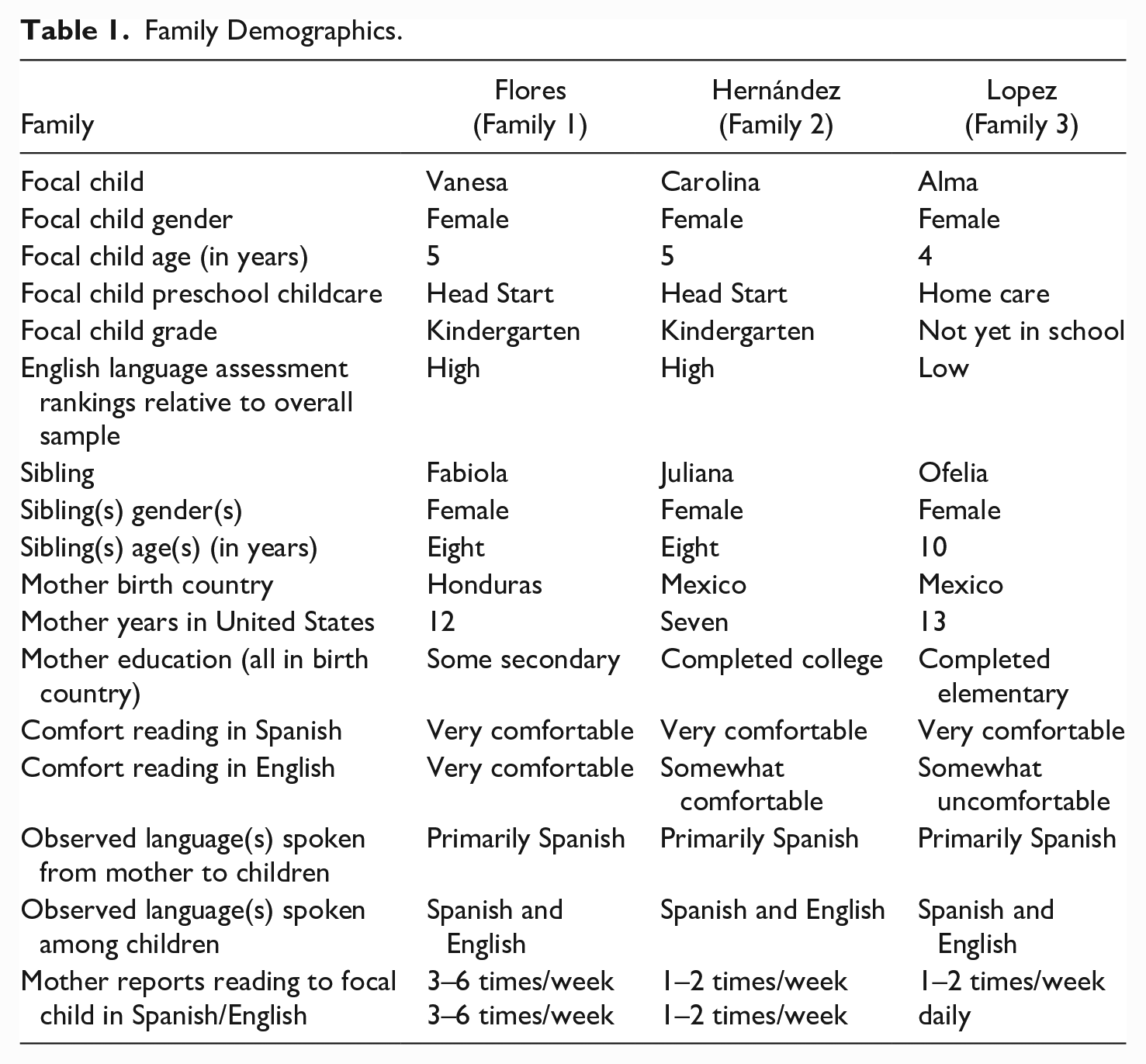
See section “Literacy Interactions and Focal Family Selection” in the Supplemental Material for additional details on family selection.
Data Collection
Data were collected during six in-home visits conducted with each family. Two-hour visits were conducted by bilingual and bicultural research assistants 3 and took place according to protocols established by the research team, including open observation, semistructured play, and book reading with researcher-provided books that the family used as they wished (see section “Family Interactions Before and After Reading” in the Supplemental Materials for details of interactions during nonbook reading portions of visits; see also Kibler et al., 2016).
For book reading, researchers provided three books during every visit. Age-appropriate books were selected based on their availability at the local library or bookstore, and to the extent possible, we matched English and Spanish books at different levels of difficulty for style and structure. Spanish-language texts were made available in odd-numbered visits, and English-language texts were presented in even-numbered visits:
Alphabet books: A to Z (Boynton, 1984; English); Chica Chica Bum Bum ABC (Martin & Archambault, 2000; Spanish)
Rhyming books: Panda Bear, Panda Bear, What Do You See (Martin & Carle, 2006; English); Oso Pardo, ¿Qué Ves Ahi? (Martin & Carle, 2002; Spanish)
Narrative picture books: Harold and the Purple Crayon (Johnson, 1955/1981; English); La Primera Luna Llena de Gatita (Henkes, 2006; Spanish)
A wordless book was also provided alongside the three books for both English and Spanish weeks (The Lion and the Mouse: Pinkney, 2009). Research assistants were instructed to take out the books, place them near the family members, and explain (in Spanish): I brought various books for you and [focal child] to use during this part of the project. I will be observing and taking notes while you use the books. You may choose whichever book and use it in whatever way that is most natural for you.
Because the focus of our larger study was on the younger focal children, older siblings’ presence varied depending on whether or not they were at home during observations and their interest in joining interactions. In the three focal families, siblings were present during shared book reading in the Flores family (Family 1) for a total of 83 min across four visits (14–24 min per visit), the Hernández family (Family 2) for a total of 69 min across five visits (9–19 min per visit), and the Lopez family (Family 3) for a total of 23 min across two visits (9–15 min per visit). 4
Research assistants took ethnographic field notes (Emerson et al., 2011) as passive participant observers (Spradley, 1980) and audio- and video-recorded the focal child (and any family members with the child) for the entirety of each 2-hr visit. We took several measures to build rapport and trust with participating families by having the same researcher complete all six observations. Research assistants typed up field notes after each visit, reviewing audio and video recordings in the creation and revision of their field notes to clarify or further describe actions, language use, and activities in addition to identifying potential researcher biases and how they may have influenced families’ actions or choices. (See section “Researcher Positionality” in the Supplemental Material for additional information.)
Data Analysis
As described above, we first transcribed shared book-reading interactions from the three families in which family-focused (rather than just mother–child) interactions were most prominent. We then coded interactions according to what are considered traditional dimensions of literacy: concepts of word and print, fluency, phonemic awareness, phonics, reading comprehension, and vocabulary (National Early Literacy Panel, 2008). We chose to focus on the most prominent dimension observed, fluency, and in particular the accuracy-focused aspects of fluency typically referred to as “decoding,” which were the sole aspect of fluency addressed, and the most frequent type of interactions in our entire data set. (See section “Literacy Interactions and Focal Family Selection” in the Supplemental Material for an explanation of all types of literacy interactions found in the data.) We then took an explicitly critical and social perspective, analyzing these decoding-related data through the lens of literacy as a social practice, emphasizing in particular the varied social roles played by family members as part of a multidirectional socialization process during decoding.
Following from studies of language socialization, we focused our analysis on instances during shared book reading where there was a “breach” (Garfinkel, 1967), or disruption, in the expected pattern of participation. In the case of decoding, we defined this as a moment of disruption in which family members paused in their shared reading to interact directly with each other. Our analysis focuses on these breaches—which we call “interactions” below—for three main reasons. First, breaches provided a concrete unit of analysis, whereas in an uninterrupted flow of reading aloud, readers are demonstrating or modeling decoding for others but not otherwise engaging in verbal social practices around decoding. However, the more nuanced social practices we discuss below—in which family members corrected each other, hinted, prompted, and changed ownership of the reading—were only visible during breaches. Second, breaches marked moments in which family members sought to support each other during the reading process, a valuable resource for language and literacy development in the home. Third, breaches and their resolutions are theorized to socialize participants into norms of a community (Baquedano-López et al., 2005), or in this case, a family—an important consideration when exploring the nature and potential of home literacy practices. Throughout our analysis below, breaches are described as “interactions” to highlight the interactive nature of these social practices.
As mentioned above, in analyzing which of the aspects of National Early Literacy Panel (NELP) literacy skills were present during shared book-reading interactions, we found that the overwhelming majority of interactions centered on decoding. This pattern was not surprising, given that early literacy instruction often focuses on this aspect of reading, in both the United States (e.g., Juel et al., 2003) and in families’ home countries of Mexico (Secretariá de Educación Pública, 2011, p. 87) and Honduras (Secretaría de Educación, República de Honduras, 2003, p. 41).
After this initial coding, we returned to each family’s audio/video recordings and transcribed all decoding-related interactions. Literacy event boundaries (Bloome et al., 2005) were determined by participants’ physical or verbal entrance into and exit out of the shared book reading. In our transcripts, we included, whenever possible, both verbal and embodied or multimodal nonverbal communication captured in audio/video recordings or field notes. Initial versions of transcripts were written by one team member and reviewed by the full research team. (See Kibler et al., 2016 for transcription conventions.)
We then pattern coded (Miles et al., 2014) within transcripts of decoding-focused interactions. Through this process, we identified four key interactional moves during decoding interactions: correcting, prompting repetition, hinting, and reading for another person (see section “Codebook” in the Supplemental Material). This led us to identify three key decoding social practices: (a) “helping,” through correcting—known as “word supply” (McCoy & Pany, 1986); (b) “teaching,” through prompting repetition and hinting; and (c) “taking over,” through assuming ownership of the reading. At this point, we also identified by family which participants (mother, older sibling, or focal child) were contributing expertise through these social practices, and with texts in which language(s). Findings aligned with these three social practices are presented in Figure 1. It should be noted, however, that we found variation by family in terms of how they enacted practices of helping, teaching, and taking over: These naturally varied by family according to the language and literacy repertoires of the participants as well as the availability of siblings to participate in these practices, issues that we address in the “findings” and “conclusion and implications” sections.
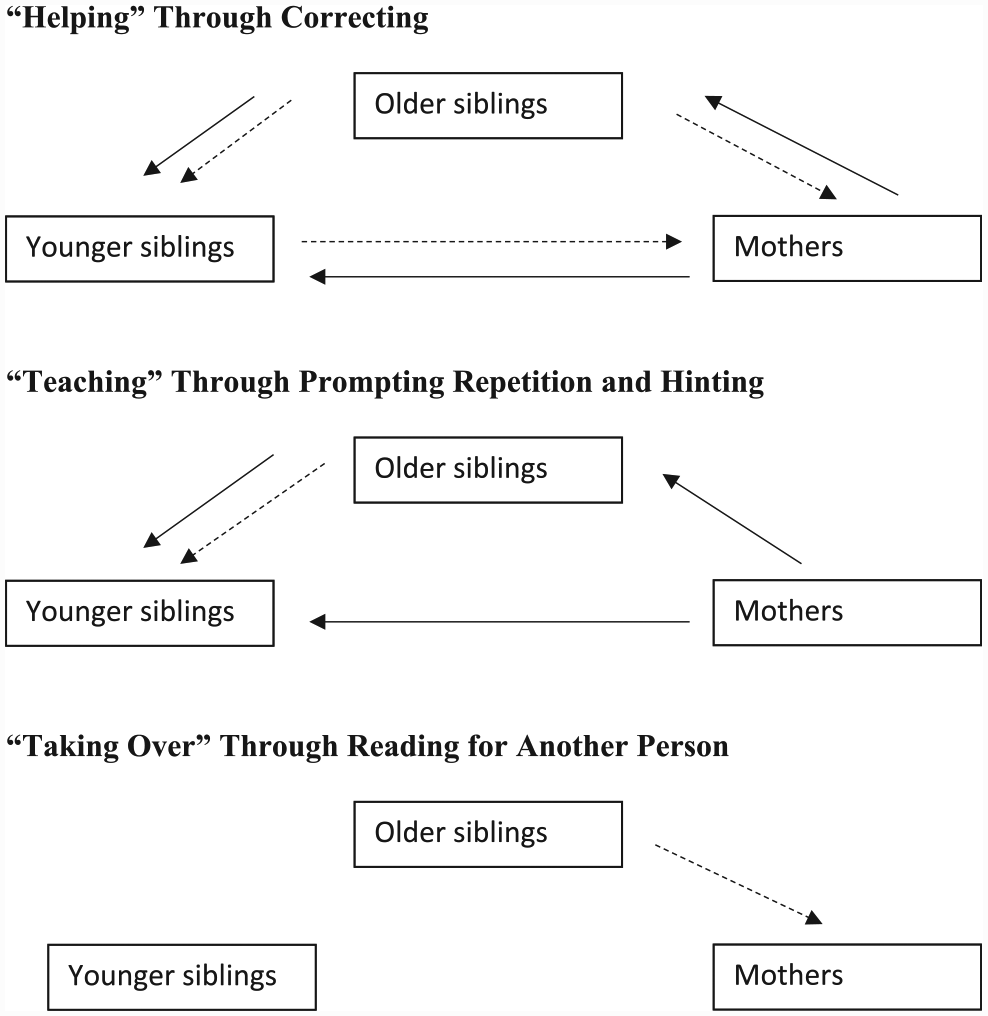
Social practices of decoding.
We used several measures to ensure trustworthiness. First, before entering the field, research assistants were trained on multiple topics, including how to help parents clearly understand the study and their rights in consenting to participate; how to respond when parents requested their help with translations, forms, and other issues (which happened regularly); and how to understand their own possible biases. Second, research assistants’ field notes and recordings of observations were reviewed by author Natalia Palacios, a Latinx bilingual immigrant. She discussed field notes with the research assistants in writing and in person to help them revise and improve the notes’ quality in terms of accuracy, as well as to identify and correct any instances of unwarranted interpretations or possible bias. Third, to ensure that the analysis reflected an accurate and shared understanding of the data, recordings of transcribed interactions were viewed multiple times by research team members and discussed at length as codes were being developed and defined. Fourth, all research team members coded the data, and we employed a consensus coding process (Hill et al., 2005), through which differences in coding were resolved through discussion. Fifth, we consistently engaged in self-reflexive conversations about our methodological process.
We acknowledge that our diverse backgrounds, explored in detail in section “Researcher Positionality” of the Supplemental Material, still positioned us as distinct from our participants in many ways, but the explicit acknowledgment of our own differences and our long-standing collaboration supported the critical introspection necessary to engage in this work. Our commitment to equity—shared by all researchers—led us to intensive reflection as well. Because we feared that this similarity might lead us to focus on the assets and strengths of children and families without acknowledging the tensions, challenges, injustices, and contradictions faced by members of nondominant communities, we consistently checked our data analysis and written accounts to ensure that we properly situated literacy practices in these complex contexts.
Findings
Interactions around decoding primarily consisted of providing (often unsolicited) assistance when readers encountered difficulties in reading a text aloud. These interactions reflect trends in the research on older immigrant-origin siblings providing support to younger children and parents in English (Farver et al., 2013; Gregory, 1998; Orellana, 2003; Stavans et al., 2009) and younger children in the home language (Kenner, 2005). Our data, however, suggest that this decoding assistance included distinct social practices, aligned with socialization patterns, which were shaped by multilingual immigrant families’ unique social and linguistic contexts. Specifically, we found that mothers and children engaged in “helping,” “teaching,” and “taking over” related to decoding in ways that demonstrated clear differences in family members’ language and literacy repertoires and social positions in the home and community (Figure 1).
As we describe below, these three patterns of social practices (Schatzki et al., 2001) indicate that decoding includes a true social dynamic. Each pattern reflected specific verbal and physical patterns of participation and was mediated by particular material objects, in this case books. Furthermore, the meaning-making resources brought to bear in these social practices (New London Group, 1996; Street, 2003, 2012) were influenced by a range of contextual factors, described below.
Decoding Social Practice 1: Helping Through Correcting
Correcting other family members’ decoding—typically just saying the word aloud—assisted in the reading of texts: This “correcting” was received positively by family members and supported rather than interfered with the decoding task at hand. 5 This helping differed from the other social practices in that it did not have as explicit a pedagogical purpose as “teaching” (Social Practice 2) and did not directly challenge or alter ownership of the reading as did “taking over” (Social Practice 3). Specifically, this “helping” by correcting did not require the other family member to repeat or otherwise show comprehension. (Without a check for understanding, the action offered a model for decoding but was less overtly pedagogical in nature.)
As Figure 1 indicates, both older siblings and mothers corrected each other and younger children when reading texts in the languages in which they had received more formal schooling (English for the former and Spanish for the latter), although some older siblings did so with younger children in Spanish as well. Younger siblings also attempted this helping practice with mothers while reading English texts, mirroring older siblings’ expertise and social role.
Decoding Social Practice 2: Teaching Through Prompting Repetition and Hinting
Decoding interactions pointed out a second social practice—which we call teaching—with a stronger pedagogical orientation, one that was enacted through prompting readers to repeat after them or providing hints or other clues about words to be decoded. It is significant to note that this social practice was initiated only by older siblings and mothers, not by younger siblings. Mothers engaged in these practices almost exclusively with Spanish texts, although at times they supported older siblings as they taught younger children using English texts. Furthermore, older siblings engaged in teaching social practices with younger children using both English and Spanish books, but they did not attempt these teaching moves with mothers. Such patterns suggest a distinction between helping and teaching practices: In this sense, older siblings’ expertise in decoding was valid as a helping tool with mothers, but this expertise did not allow them to assert “teacherly” identities with caretakers. Furthermore, younger children did not appear to have the social positioning or expertise to directly teach others in these contexts for English or Spanish texts. During these moments of negotiation, siblings tended to use both English and Spanish in conversation, but similar occurrences with mothers typically took place entirely or mostly in Spanish.
Decoding Social Practice 3: Taking Over Through Reading for Another Person
The third and final social practice we identified was taking over, in which a new reader assumed control of the activity. This can be seen as “helping” in an extreme form, but it is notable that this social practice occurred in only one direction—older siblings taking over for mothers—and through negotiations in both English and Spanish while reading English texts. This social practice demonstrates clearly the ways in which shared book reading in mothers’ nondominant languages exposed complicated power relationships between parents and older siblings. It is notable that in these cases, such interactions were dealt with delicately and responsively by older siblings. In our data, younger siblings did not play an active role in these social practices, although they were observers of them.
Social Practices in Action
During interactions, the multiple interactional moves related to decoding (correcting, prompting repetition, hinting, taking over) were often found within single excerpts, and as a result we integrate discussion of those trends throughout the findings—following patterns outlined in Figure 1—rather than exploring each in isolation. First, we briefly describe patterns of younger children’s engagement in the social practice of helping. Second, we look at an interaction to explore how mothers engaged in helping and teaching social practices with older and younger siblings in Spanish, patterns that are common to shared book reading more generally but have elements that are unique to multilingual immigrant families. Third, we present two examples of older siblings’ helping and teaching social practices, showing how expertise was employed in ways that were both similar to and different from those of mothers. Fourth, we analyze two interactions that demonstrate the context-sensitive ways in which older siblings managed the social practice of taking over decoding for mothers.
Younger children’s helping
Younger children engaged in helping as a social practice as mothers read aloud Harold and Panda Bear, using correction in support of their mothers’ reading aloud. We do not include examples of these practices due to space limitations, and because focal-child interactions closely mirrored those in which older siblings participated with mothers (see excerpts 4 and 5), in that focal children provided correct English pronunciations as mothers mispronounced words or paused in reading aloud. Although younger children did not engage in teaching or taking-over social practices as older siblings did, expertise in decoding—and a positioning as being able to apprentice mothers into English book reading—was shared across younger children and older siblings. It should be noted, however, that younger children never engaged in correction practices with Spanish-language texts.
Mothers’ helping and teaching
Mothers typically took active roles during interactions related to decoding in Spanish with both older siblings and younger children, using a range of helping and teaching practices. In the following example with the Flores family during our first visit, the mother assisted the older sibling with Gatita, the most advanced Spanish book. Younger sister Vanessa looked on at the book’s pages during the reading:
291. (‘kitten’s first full moon.’) 292. ((opens book)) 293. (‘I like this book.’) 294. ((reading inner cover of book)) (‘what a night?’) 294. (‘there is a full moon.) 295. (‘the full moon. kitten is hungry. she is very,’) 296. (‘is hungry. she is very,’) 298. (1) 299. (‘curious, and?’) 300. (1) 301. “ (‘what does it say here?) 302. 303. 304. 305. (‘brave. and stubborn. she has bad luck, and later good luck.’)
The mother and older sister engaged in a sophisticated overlapping of reading, in which Fabiola started to repeat what Ms. Flores had said (line 295) just an instant later. Fabiola then continued on her own, with her mother employing this same delayed repetition. Likely in response to moments of silence that occurred when it was Fabiola’s “turn” to initiate the overlapped reading (lines 298 and 300), Ms. Flores took over the interaction again. And in a more overt moment of hinting, she used several techniques to help Fabiola decode the word valiente (brave): providing and lengthening the first syllable, explicitly asking what it said, and then repeating that same syllable (line 301). As Fabiola repeated the syllable, using the same delayed repetition as above, Ms. Flores then provided the next two syllables with further syllabic elongation (line 303), which then elicited recognition from Fabiola, who provided the last syllable of the word (line 304). The book reading proceeded in a similar way for the remainder of the interaction, with Ms. Flores supporting Fabiola through moments of prompting repetition as the daughter attempted to read the book independently (as Gregory, 1998 found older siblings also did). Ms. Flores also provided several explicit “hints” for Fabiola, rather than simply corrections, in efforts to assist her in decoding.
Older siblings’ helping and teaching
Both on their own and in cooperation with mothers, older siblings engaged in correction moves associated with helping as well as the prompting for repetition and hinting we described as part of the decoding social practice of teaching. Unlike with mothers, however, these took place with English as well as Spanish books.
English
Older siblings assisted focal children with the range of English books they attempted to read aloud. In the Hernández family’s reading of A to Z, for example, the older sister worked with the mother to help the younger child participate:
312. 313. ((Carolina shrugs and smiles, gazing at her mother and Juliana)) 314. 315. 316. (1) 318. 319. 320. ((Juliana laughs)) 321. ((Mother points to letter and looks at Carolina, then covers eyes and smiles in anticipation)) 322. (2) 323. 324. 325. 326. ((Mother puts hand on forehead
6
)) 327. 328.
In this instance, younger child Carolina’s attempts at reading letters of the alphabet in A to Z were supported by helping and teaching during shared reading with the older sibling and Ms. Hernández, which included modeling the reading of the letter as well as text that followed it (lines 314–315, 318–319), a hint for Carolina to participate in reading the next letter (line 321), a correction from older sister Juliana indicating that Carolina’s guess at a letter was incorrect (line 324), and finally Juliana’s revoicing of Carolina’s correct answer (“V,” line 327) as the basis for continuing to read the text aloud. Such instances of older sibling and familial helping and teaching included the modeling, prompting, and feedback seen here as well as the patterns of repetition and echoing shown above with the mother and also documented in Gregory (1998). Notably, in these interactions mothers supported older siblings (and younger children), serving as active participants and complementary sources of assistance.
Spanish
Older siblings also contributed expertise during helping and teaching interactions with younger sisters around Spanish-language texts. Excerpt 3 shows a representative example of the patterns through which this occurred. In this instance, older sister Fabiola and younger child Vanessa were seated side by side on the couch, both gazing at the text as they read it. The mother was seated on the couch across from the girls reading a Spanish-language Bible and copying verses as the siblings read together: Excerpt 3: 80. Fabiola: “ (‘POor KItty.’) 81. Vanessa: ((smiling)) [ (‘no. NO. me. ME. POor kitty.’) 82. Fabiola: ((turns page)) “ (‘and the plate of milk’) 83. Vanessa: =“ (‘of milk,’) 84. Fabiola: “ (‘remained’) 85. Vanessa: (‘remained’) 86. Fabiola: “ (‘there waiting.’) 87. Vanessa: “ (‘there waiting.’) 88. Fabiola: ((turns page))89. “ (‘so gatita tried,’) 90. Vanessa: “ (‘so gatita tried,’) 91. Fabiola: “ (‘to rest.’) 92. (‘to rest.’) 93. Fabiola: “ (‘to calm herself.’) 94. ((points to book)) 95. (1) 96. (‘to calm herself.’) * Pa is a common shortened form of the word para, which in this case means “to”.
Notable throughout this excerpt are the ways in which the older sibling’s reading prompted active participation from Vanessa, who had only listened passively to her mother and older sister’s shared reading of the book in an earlier visit (see above). In fact, it was Vanessa, rather than Fabiola, who interrupted the reading to make a direct comment about her desired ownership of the text (“no. NO. yo. YO,” line 81).
Although Fabiola’s decoding was somewhat less surefooted than her mother’s earlier reading had been and included more miscues (e.g., “de cansarse” for “para calmarse,” line 91), she and her sister successfully managed this interaction through careful attentiveness to each other while reading, part of the cooperative nature of social practices related to decoding. Although such practices may be found in monolingual families as well, the unique positioning of multilingual immigrant families is highly relevant: Older siblings supported home language and literacy maintenance for younger children in a larger societal context that did not provide meaningful community- or school-based opportunities for Spanish literacy development.
Taking over
In all families, older and younger siblings assisted mothers in some way with decoding while reading English texts. Perhaps unsurprisingly, older siblings in particular appeared to play an important role in reading Harold and the Purple Crayon, the most difficult English book, when it was being read aloud by the mother to both older and younger siblings. In the following example, the unique pattern of older siblings taking over is seen in Family 2 during the second visit. Younger sibling Carolina, older sibling Juliana, and Ms. Hernández were sitting at their kitchen table, looking at the book together: Excerpt 4: 123. 125. (2) 126. 127. ((turns page)) 128. 130. 131. (1) 132. 133. 134. (1) 135. 136. 137. ((turns page)) 138. (1) 139. 140. 142. ((gives book to S)) 143. 144. 145. (1) 146. 147. ((turns page)) 148. 150. ((turns page)) 151.
In this excerpt, as Ms. Hernández read, Juliana offered whispered corrections (“escaped,” line 132) and provided words and phrases (“a shark,” line 135; “the sandy beach,” line 139), a pattern she enacted throughout the reading. Juliana’s quick insertions that modeled correct pronunciation resembled some of the strategies used in Gregory (1998) by older multilingual immigrant children engaging with younger siblings as they moved toward more independent decoding. What is different here, however, is that the older sibling’s assistance took place not simply after a mispronunciation but after pauses from the mother (lines 131, 134, and 138), which appeared to cue these moments of interaction. Ms. Hernández’s decision to hand over the book (line 143)—perhaps in frustration—led to Juliana’s takeover, which she maintained throughout reading the rest of the book and which demonstrated her expertise in English decoding and expressive reading.
In Visit 6, the Hernández family engaged with this book again at the kitchen table, with the mother seated between the two girls and all looking at the book together. (In Visit 4, the other week in which English texts were provided, older sibling Juliana was not present for the observation.) Excerpt 5: 210. 212. ((turns page)) 213. 215. 216. 217. ((Juliana and Mother smile, glancing at each other and then back at 218. the book)) 219. 220. 221. 222. 223. 224. 225. 226. 227. ((Juliana mouthing words silently with her)) 229. 230. =((whispers)) (‘what if I read?’) 231. (‘yes.’) 232. 234. ((turns page)) 235.
In this later visit, Juliana again offered corrections (“pine,” line 215; “hill,” line 220; “knew,” line 223; “the farther,” line 225) during the reading as she had done before, although these suggestions were somewhat more proactive, overlapping with or immediately following her mother’s reading. She then took on an even more active role, mouthing the words silently (line 227) and then reaching for the book before offering in a whisper to take over for her mother (lines 229-230). Juliana’s support in this visit suggests that she may have anticipated (or at least been quicker to recognize) some of the difficulties her mother first experienced in visit 2, and may have also perhaps had greater knowledge or confidence because this was a rereading of the same book. Notably, in line 217 the older sibling and Ms. Hernández smile at each other, suggesting this assistance was probably understood as supportive and cooperative in nature.
Such interactions are likely unique to the particular contexts in which many multilingual immigrant families find themselves, in which children’s language and literacy knowledge in the dominant societal language (English) may exceed their parents. In the excerpt above, the mother and daughter’s communication suggests that they developed sophisticated and intimate ways to share this expertise, and in so doing allowed the mother to participate in this family literacy—book reading—in ways that maintained her legitimacy as a reader and teacher even while the older sibling demonstrated more accurate decoding. In this sense, the social practice of literacy shifted in terms of the roles undertaken by various family members, and the older sibling’s knowledgeable but cooperative participation played a key role in this process. 7
Discussion
The interactional moves mothers and children made during decoding interactions were diverse and responsive to family members’ social roles and language and literacy repertoires. These moves ranged from offering subtle and responsive corrections and prompts/hints to taking over reading in its entirety, all of which were made possible by both mothers’ and children’s (varied) bilingualism. Interactions also provided opportunities for younger children to demonstrate expertise (Dixon & Wu, 2014), which in our data was seen in their support of mothers’ decoding in English, with a practice of helping through providing correction that mirrored that of older siblings but did not include more teacher-like roles or taking over of reading.
Such examples demonstrate the ways in which social practices of decoding interactions were an important part of family book reading—a particular enactment of family literacy—in the immigrant homes we observed, a focus that created multiple possibilities for helping practices, a more restricted set of opportunities for taking on explicit teaching practice moves depending on literacy expertise and position in the family, and a unique practice of taking over, restricted only to older siblings when mothers struggled with English decoding. This final practice represents a nuanced and thoughtful response to the situation many Spanish-speaking multilingual immigrant parents in the United States face when their children’s literacy expertise is better suited for certain literacy events than is their own. Although related in certain ways to literacy brokering (Orellana, 2003), taking over represents a distinct social practice, one navigated in home settings but in ways that have important implications for language socialization across settings.
From a broader social and cultural perspective, these practices—enabled through expertise across languages (Orellana & D’warte, 2010)—supported the development of the valued capital that accurate decoding brings young children. Such a consideration is particularly critical in the early years of formal schooling, when such skills are an indicator of academic success, especially for minoritized students who may be seen as “at risk” for not meeting standardized language or literacy benchmarks. Moreover, our findings highlight the cooperative social practices through which family members socialized each other into literacy practices in the home using multidirectional support responsive to each individual’s linguistic and literate strengths and role in the family. This responsiveness, care, and multidirectional support were itself a finding of this study. Laughter and physical closeness were pervasive across the observations, as were cooperation and sensitivity to each individual’s needs. Family members celebrated small victories and also chided each other playfully toward more accurate readings. Families were learning together with both care and joy, demonstrating a valuable cultural asset that schools can draw upon (González et al., 2005).
Conclusion and Implications
Contributions
These findings resonate with other research regarding family members’ roles during shared reading in multilingual immigrant and Latinx homes. For parents, our study confirms patterns of involvement in shared book reading (Bus et al., 1995), consistent with family literacy practices documented among other bilingual and immigrant-origin families (Caspe, 2009; Melzi et al., 2011; Schick & Melzi, 2016). For older siblings, our research resonates with previous findings regarding multiparty interactions around shared book reading (van Kleeck, 2006) and the ways in which expertise with the dominant societal language was brought into the home (Howard et al., 2014; Orellana, 2003, 2009; Rothman & Niño-Murcia, 2008). Also, we noted several of the same sibling decoding-related strategies documented in Gregory (1998).
This analysis also provides new insights, particularly into the benefits that a literacy-as-social-practice lens can bring to explorations of multilingual immigrant family literacy practices that socialize children into particular interactional moves while reading. We found unique trends related to helping, teaching, and taking-over social practices around decoding that took place in the context of multidirectional and multiparty teaching and learning events.
First, our study shows patterns of sibling interactions around decoding taking place in the context of mothers’ participation, rather than as part of siblings “playing school” among themselves (Gregory, 2001, 2004). This difference from previous research could be attributable to differences in data-collection procedures, because in our study, we prompted book reading. Such an insight is nonetheless valuable, however, in understanding how older siblings’ work to be acomedido/a (López et al., 2015) may be a cooperative familial accomplishment rather than simply an individual one. Furthermore, evidence of multidirectional teaching was visible when not only older but also younger siblings contributed expertise during interactions, an observation that is often underemphasized in literacy research. Such trends highlight the ways in which literate expertise can be fluid in multilingual immigrant homes.
Second, we found that family members’ support of decoding was carefully attuned to the social roles, needs, and language and literacy repertoires of others. These practices were consistent in being responsive, whether it was through helping or subtly taking over for mothers while reading English books, or working alone or with mothers to teach younger siblings by cueing their participation across languages and modalities. Such trends highlight the ways in which shared book reading is a complex and nuanced social practice in multilingual families, with older siblings playing key roles in this literate ecosystem (Kenner, 2005).
Third, and related to the previous point, like Hull and Schultz (2002), we found evidence that family literacy practices may diverge from what are often more individualistic, competitive practices in schools. Family members in our study tended to cooperate rather than compete with each other, with siblings offering developmentally appropriate 8 support rather than “showing each other up.” Family members also noticed when others were struggling and either stepped in to offer support or stepped back to allow readers to demonstrate their expertise. They were disposed to help each other, although social roles existed regarding who could engage in helping, teaching, and taking over in each language. These differences between home and school are important considerations when working to invite all students into the classroom literacy environment. If schools are to achieve some level of continuity between the home and school, honoring home cultures in the process (Ruiz, 1993; Trueba & Trueba, 1989), understanding the nuanced ways that care and responsiveness support learning in Latinx homes may help to inform school practices.
Based upon these findings, we contend that decoding should be given greater empirical and pedagogical attention as a social practice. Comprehension is widely accepted as a social practice, with recognition that there may be multiple rather than singular interpretations of a text, because these situated knowledge creation processes are influenced by readers’ unique sociocultural histories and varied language and literacy repertoires and experiences (New London Group, 1996). Such recognition is not typically extended to decoding. 9 In typical school settings, decoding is taught and assessed as an individual and autonomous skill rather than a socially embedded practice. However, decoding should be expected to vary across contexts in its use and the ways individuals support each other while engaging in decoding interactions. Our data suggest some of the multiple processes through which family members may socialize each other into accurate decoding across languages, drawing upon cultural knowledge of appropriate social roles for mothers and children during literacy events.
Cultural models of literacy in general and decoding in particular are dynamic, malleable, and practice-based rather than trait-based (Gutiérrez & Rogoff, 2003; Reese & Gallimore, 2000). To capture decoding as situated in the literacy-as-a-social practice literature, as well as Orellana and D’warte’s (2010) emphasis on multilingual children’s literacy practices, we suggest use of the term transcultural decoding practices to recognize the “breadth and flexibility” (p. 297) of linguistic expertise these social practices both require and develop. In this sense, social practices of helping, teaching, and taking over were a response to immigrant family members’ diverse language and literacy repertoires, as well as a venue for children (and particularly older siblings) to assume a range of social and literate roles across languages that both created and were created by the cultural models of cooperation present in these families. By examining the nuances of these practices, we respond to calls to study the practices of Latinx immigrant families on their own terms, not simply in relation to school-based expectations for engaging in these practices (Caspe, 2009; Schick & Melzi, 2016), but we also recognize that our own set of participants are members of a certain subgroup of Latinx immigrant families in the United States and cannot be held up as a representation of any monolithic community.
Limitations
There are certain limitations to this study that have important implications for what we are able to claim. First, any observational research has the potential to include some performance on the part of the families, even when researchers work to build rapport, be unobtrusive, and ask families to engage in literacy practices as they normally would. Our study design also required that families read books that we provided for a portion of each observation, and so we were not observing spontaneous book reading in families. However, given that literacy-related tasks like shared reading originating from school form part of the literacy practices that occur in Latinx homes more generally (Delgado-Gaitan, 1992; Reese & Gallimore, 2000) and in the families profiled in this study, we have documented home literacy practices that are already occurring. Nevertheless, future work could strive to observe shared book reading more naturalistically, perhaps as books are brought home from school, or with a greater selection of books than we provided.
Second, although there were robust patterns across families, such as all three older siblings engaging in bilingual interactions with younger children for both English and Spanish texts, and all three younger siblings assisting mothers with the decoding of English books, other patterns were less unified. For example, in only the Flores family did the mother use some of these shared book-reading events to actively engage only the older sibling. Furthermore, the Lopez family engaged more frequently when the older sibling was present with the optional wordless book than the English or Spanish text, leading to fewer interactions around the social practice of decoding written texts. Several possible reasons might exist for these differences, though we do not have the data to confirm any with certainty. As a result of these complexities, we are only able to present a range of practices rather than identify precise explanations for variation among families; deeper ethnographic studies with a larger set of participants would be necessary to make such claims. Furthermore, because this analysis focuses only on interactions in which siblings were present, we are also not able to compare siblings’ contributions to family literacy practices in relation to those of parents alone. Finally, we are not able to discern how these social practices of decoding might differ when using Latinx literature or bilingual books.
Implications for Research and Practice
This study nonetheless has important implications. In relation to theory, it highlights the complexity of shared book-reading practices and the sophisticated linguistic, social, and interactional expertise they require. In this sense, shared book reading in multilingual immigrant homes encompasses varied and nuanced practices across languages, particularly for older siblings and other family members serving as linguistic brokers. Views of reading, and decoding in particular, that do not account for the social practices in and through which they occur, and the rich local knowledge they require (Compton-Lilly et al., 2012), can limit how we view families. By examining the variety of mechanisms through which family members engage with and provide support for each other, we expand the notion of shared book reading into a broader understanding of literacy, and in particular decoding, as a social and transcultural practice. This in turn allows both researchers and educators to see the ways in which the teaching and learning of decoding manifest differently according to the social, linguistic, and cultural contexts in which it occurs. Furthermore, in terms of educational practice, our findings are helpful in better understanding how families might make use of books sent home from school, and how older siblings may serve as critical connections between parents and children, as well as between home and school contexts. Ignoring such practices and contexts comes at a considerable cost: Without time spent examining home language and literacy practices, neither educators nor researchers are able to fully respect or build upon children’s and their families’ linguistic, academic, and cultural assets.
Supplemental Material
915511_Translated_Abstracts_Paulick – Supplemental material for Shared Book Reading and Bilingual Decoding in Latinx Immigrant Homes
Supplemental material, 915511_Translated_Abstracts_Paulick for Shared Book Reading and Bilingual Decoding in Latinx Immigrant Homes by Amanda K. Kibler, Judy Paulick, Natalia Palacios and Tatiana Hill in Journal of Literacy Research
Supplemental Material
Supplemental_Materials.05_13_20AKJP – Supplemental material for Shared Book Reading and Bilingual Decoding in Latinx Immigrant Homes
Supplemental material, Supplemental_Materials.05_13_20AKJP for Shared Book Reading and Bilingual Decoding in Latinx Immigrant Homes by Amanda K. Kibler, Judy Paulick, Natalia Palacios and Tatiana Hill in Journal of Literacy Research
Footnotes
Acknowledgements
We would like to thank the families participating in this tudy for welcoming us into their homes, and anonymous reviewers for their insightful comments. Thank you also to the graduate and undergraduate research assistants who collected, transcribed, and coded data for this project.
Declaration of Conflicting Interests
The author(s) declared no potential conflicts of interest with respect to the research, authorship, and/or publication of this article.
Funding
The author(s) disclosed receipt of the following financial support for the research, authorship, and/or publication of this article: The data used in this study was collected with support by a grant from the Spencer Foundation (#201200085).

Supplemental Material
Notes
References
Supplementary Material
Please find the following supplemental material available below.
For Open Access articles published under a Creative Commons License, all supplemental material carries the same license as the article it is associated with.
For non-Open Access articles published, all supplemental material carries a non-exclusive license, and permission requests for re-use of supplemental material or any part of supplemental material shall be sent directly to the copyright owner as specified in the copyright notice associated with the article.
