




Abstract
This research sought to develop argument as a problem-solving process by adding debate to social studies instruction with three groups of fifth-grade students. This design-based research (DBR) reports on the ways that instruction was refined across three topical units to develop argumentative agency and a critical participatory literacy. Students addressed current issues extended from historical events and engaged in issues collaboratively through debates, then individually in their writing. DBR approaches afforded a description of the factors that enhanced and inhibited argument development across the debate cycles and chronicled the modifications that were put in place to refine the instruction. A retrospective analysis led to pedagogical assertions that illuminate what was learned about the interrelationship of oral and written argument and the instructional refinements that were required to support arguments as a means of solving problems.
The teacher looks across the classroom and poses a simple question: “Why do people argue?” The responses are quick: “To fight about something.” “To be right.” These students seem confident in their understanding of the reasons people argue. The teacher thoughtfully listens and then says, Sometimes we argue for those reasons, but a good argument is about more than fighting or being right. A well-structured argument, like the kind you have in a debate, can help you solve problems. The point of that kind of argument is to try to develop solutions, to share your voice, and to create change. You need to learn how to make your voice into something others listen to. (Field notes, November 18)
This conversation marked the start of our work with 40 fifth-graders across three sections of social studies on developing arguments during the 2015–2016 school year. Ehrenworth (2017), in discussing the significance of argumentation, states, “There has never been a more important time to teach young people to suspend judgment, weigh evidence, consider multiple perspectives, and speak up with wisdom and grace on behalf of themselves and others” (p. 35).
Understanding, engaging in, and analyzing argument are essential skills for students (Ferretti & Lewis, 2018; Newell et al., 2011). Hillocks (2011) asserts that argument is central to critical thinking but notes that while students may “intend to write an argument, they often see no need to present evidence or show why it is relevant; they merely express (usually vague) opinions” (p. 15). Unlike vague opinions, however, thoughtful arguments require an understanding and acknowledgment of a range of perspectives and a consideration of the logical evidence surrounding claims (Friedrich et al., 2018). In arguments, the complexity of issues is revealed in the process of offering and defending potential solutions and considering alternative perspectives.
Focusing on students’ oral argument skills can help develop students’ reasoning and logic, which may elevate their written arguments (e.g., Ehrenworth, 2017; Ferretti & Fan, 2016; McCann, 2014). In the current study, debates were selected as a means of developing arguments because of their potential to open students’ minds to other perspectives and create meaningful spaces for problem-solving and change. This is especially pertinent when integrated with social studies as the intent there is to “promote civic competence” (National Council for the Social Studies, n.d., para. 3), such as proposing solutions and advocating for change through oral and written argument (Standard 10). Therefore, the focus of this research was developing students’ oral and written arguments.
Perspectives
We draw primarily on a sociocultural perspective for understanding argument. In this view, arguments are seen as social acts where the interchange between people shapes ideas (Bazerman, 2015; Ferretti & Graham, 2019). In their discussion of argument, Ferretti and Lewis (2018) assert that “argumentation is an inherently social activity involving dialogue among people who may hold different perspectives about a controversial issue” (p. 137). When developing argumentation through discussion, the teacher facilitates students’ engagement with the issues and with each other. This discursive activity can help students understand the perspectives of others (Ferretti & Fan, 2016; Newell et al., 2011). As Bakhtin (1982) theorized, “the semantic structure of an internally persuasive discourse is not finite, it is open; in each of the new contexts that dialogize it, this discourse is able to reveal ever new ways to mean” (p. 346).
Grounded in these perspectives, we framed our operational definition of argument as a process for revealing and addressing issues. As such, arguments are necessarily a social activity in that solutions to societal issues, at least in a democratic society, are vetted in a discursive community that recognizes multiple perspectives and varying interpretations.
Argument in the Classroom
Hillocks (2011) contends that “argument is at the heart of critical thinking and academic discourse” (p. xvii). Clearly, argumentation is an important skill, but it is also a complicated one, and the teaching of argument is often limited (Newell et al., 2017). Previous research indicates that argumentation, particularly in content areas such as science and social studies, can enable deep thinking about topics (Monte-Sano & De La Paz, 2012; Washburn & Cavagnetto, 2013; Wissinger & De La Paz, 2016).
Several studies look at historical writing and the role of argument in the interpretation of history (see De La Paz et al., 2017; Monte-Sano & De La Paz, 2012; Nokes, 2017). In these studies, argument is seen as an important way to understand history and develop disciplinary literacy. This use of argumentative writing in social studies, where students have opportunities to interrogate historical accounts, is extended in the present study to include current ramifications of historical events. Nussbaum (2002) notes that “participation in a democracy requires that citizens be able to formulate persuasive arguments” (p. 79), including about current issues. The purpose of this study was to explore the ways that debate could support students in examining history to create well-reasoned arguments involving present-day issues that are grounded in a historical context.
Why Debate?
As a formalized structure for interactive arguments, debate can provide a framework for researching, discussing, and presenting ideas. Because speaking and listening are primary modes for introducing and interrogating ideas (Washburn & Cavagnetto, 2013), it follows that opportunities for oral exchanges in content areas would support learners in a deep engagement with that content. Cridland-Hughes (2017) suggests that a critical participatory literacy can be created when classroom discussions meaningfully integrate close readings of text with an eye toward enacting change. Similarly, Mitchell (1998) provides a perspective for using debate as a pedagogical practice that serves to develop argumentative agency: “In basic terms, the notion of argumentative agency involves the capacity to contextualize and employ the skills and strategies of argumentative discourse in the field of social action” (p. 45).
Considering a Debate Format
With a lens of critical participatory literacy (Cridland-Hughes, 2012), we sought a version of debate that had the potential to allow students to address relevant issues, ferret out alternative perspectives, and develop agency to create change. As such, policy debates (Bellon & Williams, 2006) seemed a natural fit based on the requirement to pose a resolution that would be defended and challenged. We designed a version of team policy debate that would allow for a period of research and preparation and provide a problem-solving space that would be accessible to fifth graders.
Method
This research used design-based approaches to refine oral and written arguments. Wang and Hannafin (2005) describe design-based research (DBR) as “a systematic but flexible methodology aimed to improve educational practices through iterative analysis, design, development, and implementation, based on collaboration among researchers and practitioners in real-world settings, and leading to contextually-sensitive design principles and theories” (p. 6).
Classroom Context and Participants
This study took place in three sections of a fifth-grade social studies classroom taught by one teacher, Kerri (pseudonym). Kerri teaches in a Title 1 school located in a rural mountain community in the southeastern United States. The school has just under 600 students in kindergarten through eighth grade, with about 62.5% of its students participating in the National School Lunch Program. The fifth-grade team departmentalized instruction, and Kerri taught three sections of social studies, as well as teaching language arts to her homeroom.
There were 61 students in Kerri’s sections overall, and 42 students had parental consent to participate in the study. Two students moved prior to the onset of the study, leaving 40 total student participants whose data were available. All students participated in the debates and written arguments as part of their regular class instruction. Of these participants, 23 were female and 17 were male. Thirty-two students identified as White, six as Hispanic, one as Asian American, and one as biracial, which reflects the overall school demographics.
Kerri, a veteran teacher, was purposefully selected for this study. She had participated in previous research and demonstrated a commitment to helping students develop agency. The current study was a strong match for Kerri’s classroom because she was invested in integrating social studies with the English language arts but was unfamiliar with oral debate. Her experience in teaching language arts meant she had some background in supporting written arguments, but she wanted to explore oral arguments as a means of helping students move from giving vague or uninformed opinions to making a case for a solution to a problem.
The university researchers’ role in the classroom was “participant-observers” (Creswell, 2002). While most of our time in the classroom was spent observing, we interacted with students when they worked in small groups and occasionally helped facilitate debate, particularly early in the study. To mitigate our influence, the teacher was the primary instructional decision-maker in the study. Although we recorded decisions and discussed the ongoing data analysis, we were mindful of being “respectful of the ecology of [the] classroom and of the professional knowledge and prerogative of [the teacher]” (Reinking & Bradley, 2008, p. 82).
Introducing Debate
Students were introduced to Spontaneous Argument (SpAr) debates during a social studies class prior to the first instructional cycle. SpAr debates (see Argument-Centered Education, n.d.) are based on topics that are pulled out of a hat with little time for preparation. In each 50-min class session, debates were presented as a way of posing resolutions that could be refined by presenting evidence for and against the proposed solution. By testing the resolution in this way, a better solution might emerge.
Students were introduced to the structure and terminology required to engage in the debate. This included agreement on a resolution based on a polling of issues that students felt were important. Topics included animal rights, free lunch for all students, and bullying. The resolution was then defended by an affirmative argument that was structured by three essential aspects: (a) harm—who is being harmed by a situation as it currently exists, (b) inherency—the idea that the harm will not resolve on its own, and (c) solvency—how the resolution would solve the problem.
The affirmative and negative arguments were presented by three to five speakers during a 90-s time period. The negative arguers could propose a counter-resolution that they felt was preferable to the affirmative resolution. A 90-s cross-examination followed each argument. In discussing how cross-examinations would work, students were instructed on aspects of civil discourse, such as standing to address their question to a speaker, thanking the speaker, and then yielding the floor. Students could ask multiple questions but could only ask one question at a time. Types of questions that would be suitable for cross-examination were discussed, such as requesting a definition, clarification, or elaboration. Then, each side had a few minutes to compose and present a 1-min final statement that summarized the strongest points of their arguments.
The Instructional Cycles
For this research in Kerri’s social studies classroom, debates were incorporated into three topical units. The pedagogical values of the research team that served to ground the development of the instructional frame were that the instruction would integrate the language arts in considering historical and current topics deeply and develop argumentative agency through critical participatory literacy. Therefore, the instructional frame included the following essential elements:
an examination of a social studies topic, such as explorers or industrialization;
an extension of the social studies content to present-day ramifications;
identifying a specific problem and developing a resolution;
preparation of affirmative and negative arguments to defend or challenge the resolution, which were then presented and cross-examined in an oral debate;
crafting a written argument related to the topic just debated, taking a position that could differ from the arguments that were orally presented.
As a means of supporting the development of arguments, the teacher implemented the instructional plan in three sections of fifth-grade social studies across three debate cycles: (a) Columbus Day, which grew out of a study of explorers; (b) Trash, a debate topic that began with a study of Henry Ford and the economic and environmental impact of accumulating “stuff”; and (c) Spying, a look at privacy versus security that related to spying in the American Revolution and Civil War. The three debate cycles occurred between November and June and each required about 2 to 3 weeks. These three debate cycles are described below.
Cycle 1: Columbus—Hero or villain?
The topic of whether Christopher Columbus was a hero or a villain is one that Kerri taught for several years in her social studies classes. She had accumulated and vetted numerous resources over time and introduced an alternative view of the “Columbus as hero” interpretation of history that led to the Columbus Day holiday. The counternarrative involved the Taino people who were native to the Caribbean when Columbus arrived there. The report of the interactions between Columbus, his sailors, and the Indigenous peoples of the Caribbean and South American continent are hard to defend as “heroic.”
Kerri traditionally followed her guided research into Columbus’s exploits with a “tug of war” activity that simply asked students to take a stand on one of two sides: Columbus—hero or villain? While she kept the activity, she also moved toward a resolution that “Columbus Day should be celebrated.” Kerri had multiple resources at the ready for this topic, and this was perhaps a comfortable first cycle for her. We expand on her use of various topical resources in the “Discussion” section.
Cycle 2: Trash
The topic of trash evolved from a discussion of Henry Ford and how industrialization influenced economic advancement at the turn of the previous century. In addition to the readings provided by the social studies textbook, students explored the Kids Discover magazine issue on inventions (Kids Discover, 2013) as well as online resources at The Henry Ford website (www.thehenryford.org). One quote by Ford (1922) was particularly compelling in bringing to relevance the longer term ramifications of mass production: We are entering an era when we shall create resources which shall be so constantly renewed that the only loss will be not to use them. There will be such a plenteous supply of heat, light and power, that it will be a sin not to use all we want. (p. 5)
As students considered the cumulative effects of mass production on the environment, the issue of what happens to all of our “stuff” interested students. They viewed The Story of Stuff (https://storyofstuff.org/) and made use of the interactive resources from the U.S. Department of Energy website (www.energy.gov). Kerri sparked debate by asking, “Where does this lead us today? [Each person] produces an average of 4.6 pounds of trash each day, so how do we stop that?” (field notes, March 17). Students considered multiple options for addressing the trash problem, finally settling on a plan to compel families to reduce this amount: “Households should be fined for producing more than 3.5 pounds of trash per person per day.”
Cycle 3: Spying
One of the aspects of the Revolutionary and Civil Wars was the important contributions of spies, and Kerri encouraged students to compare the reports of spying that occurred during these two time periods using the Ducksters™ Education websites (Nelson, 2019a, 2019b). They also did a close reading of the Declaration of Independence, the Preamble to the Constitution, and the Bill of Rights to understand how spying might be viewed legislatively. In the context of war, spies are valuable and viewed as loyal and important. Extending the use of spying into the present day, and outside of the immediate context of war, spying could be viewed as more intrusive than patriotic. Students were intrigued by Benedict Arnold and were eager to explore why we might have spies, how they benefit national interests, and what could go wrong. Groups compared and contrasted spying during wartime with contemporary texts about parents “spying” on their kids, using an article published in the Washington Post titled “IMs: What’s a Mother to Do?” (Marcus, 2006).
This led to a discussion of how much privacy students were willing to sacrifice for their security. Where do they draw the line in terms of government surveillance while still maintaining national safety? The students decided in their resolution that “government spying should be permitted for official business by trained agents but not by individuals or civilians.”
Data Sources and Analysis
The goal of this research was for students to progress in their development of oral and written arguments. Various data sources were collected to note the progress of argumentation by students and to refine the instruction across class sections and debate cycles. Videos of the class debates and individual writing samples were collected to evaluate the progress of making arguments. Other data sources were collected to understand the relationship between the instruction and the argumentation that was occurring in the classroom. In particular, field notes and classroom artifacts served as evidence of instructional moves that enhanced argumentative skills or inhibited them. When inhibiting factors were noted, the teacher and researchers conferred to determine modifications to ameliorate obstacles to developing well-reasoned arguments.
Writing samples
Samples of students’ writing were collected to evaluate progress in making arguments. In all, four sets of writing were collected. Prior to the introduction of debate, students were invited to write on a topic of their own choosing. This initial writing sample served as a baseline of their skill in developing argument. Then, following each of three debate cycles, students were asked to write an argument based on their own interpretation of the issue.
While we operationalized arguments as problem-solving processes that occur in discursive communities, we were sensitive to the state curriculum standards for developing arguments that include (a) a clearly stated position that is maintained, (b) points of evidence that are elaborated, (c) an organizational structure that proceeds in a logical manner, and (d) language that is effective in expressing ideas. Ideally, these elements of focus, organization, evidence, and language would be sufficient to “[convince] a reasonable critic of the acceptability of a standpoint” (van Eemeren & Grootendorst, 2004, p. 1).
Student writing was evaluated using the 4-point Smarter Balanced Assessment Consortium Grades 3–5 Opinion Writing Rubric (Smarter Balanced Assessment Consortium, n.d.). The Smarter Balanced rubrics for argumentation do not begin until the sixth-grade level; however, the opinion writing rubric designed for third through fifth graders assesses the same elements—focus, organization, elaboration of evidence, language, and conventions—but with less complexity than is expected of older students. Each of the elements on the rubric is rated on a scale of 1 to 4, with qualitative descriptors to guide the distinction between ratings. For this research, we excluded ratings for conventions as we did not consider them germane to developing arguments.
The researchers met to become familiar with the overall rubric before dividing the samples between two researchers for scoring, with the third researcher rating 16% of the samples (four random papers from each set). The original two scorers also double-scored approximately 10% of papers from the sets they had not scored previously. In total, approximately 38% (40 of 103 papers) were double-scored, with all participants having at least one of their papers scored twice. A comparison of the papers with two scores showed 95% agreement between scorers within one point across each individual criterion.
Field notes
In addition to the teacher, one or two university researchers were present for all of the oral debates and some of the debate-preparation classes.
Each researcher kept written field notes regarding the development of arguments and how instruction was adjusted within and across the three sections of students. Field notes were organized by date and analyzed qualitatively (Glaser & Strauss, 1967) to identify enhancing and inhibiting factors across classes within each debate topic and then across topics at the end of the study.
Analysis procedures included multiple readings and re-readings of field notes with memos inserted in the documents. Kerri’s instructional moves and students’ responses guided researchers in developing themes under the major categories of factors that enhance, factors that inhibit, and modifications and their effects. These data allowed us to track and record refinements of the instruction over time.
Debate videos
Three oral debates were video recorded for analysis. The first was the SpAr debate that occurred prior to the first debate unit, followed by affirmative and negative arguments for each of the first two unit-level cycles. Unfortunately, while a researcher was available to observe and take notes during the final academic debate, the recording of the debate was unusable due to difficulties with the equipment that were not detected until after the debate.
Videos were viewed, transcribed, and then analyzed qualitatively to evaluate aspects of the arguments that mirrored the targeted elements of the written arguments—focus, organization, use of evidence, and language—using the same rubric used to evaluate the written arguments. For each class section, a transcript was created that documented an affirmative argument and a negative argument. In this analysis, we were evaluating the argument made by affirmative and negative presentation groups rather than the statements of individual students. Two researchers read and rated each of the transcripts and rated each argument using the Smarter Balanced rubric. Ratings of 1 to 4 were individually determined for the elements of focus, organization, evidence, and language. Differences in ratings were discussed until agreement was reached.
Classroom artifacts
The researchers coordinated with Kerri to collect evidence of instructional moves, such as texts used to support the topic explorations (videos, trade books, poems, song lyrics), anchor charts (organization of debate, compare/contrast), and graphic organizers (argument frameworks, debate organization cue cards), as well as teacher-developed materials to explore topics and support arguments. Artifacts were collected by photographing each artifact. These were integrated with field notes to develop a chronology of the instruction and its refinements.
Retrospective Analysis
As the study concluded, a retrospective analysis led to the development of pedagogical assertions that could be derived from the findings. These assertions were based on a “systematic and thorough analysis of the entire data set collected during the experiment” (Gravemeijer & Cobb, 2006, p. 38). This involved a chronological review of data sources from all three cycles to describe the pedagogical elements that refined the instruction as the cycles progressed. In this final analysis, we looked holistically at the data sources collected from each cycle using constant comparison analysis (Corbin & Strauss, 2008) to develop assertions about the pedagogical practices that were refined as the cycles progressed.
Findings
With a goal of developing argumentation skills in a fifth-grade social studies classroom, we worked to refine an instructional frame that incorporated debate in addressing historically based but currently relevant issues. The debates were scheduled near the end of a unit of study and occurred as a whole-class activity. The unit closed with a written argument that could diverge from the group consensus. The findings that indicate progress in oral and written arguments are presented first. These are followed by a description of factors that were found to enhance or inhibit argumentative skills in both the oral debates and written forms. A retrospective analysis that describes the pedagogical assertions drawn from these findings is included in the discussion.
Progress in Oral Argument
The initial SpAr debate and the first two unit-based debates were successfully video recorded. Transcripts were analyzed to examine changes in argumentation across four elements: focus, organization, evidence, and language. These ratings represent the combined arguments of groups of student speakers, not individual speakers. As depicted in Figure 1, growth was observed when comparing the first to the third transcript, with a stepwise increase in the use of evidence across the three transcripts.
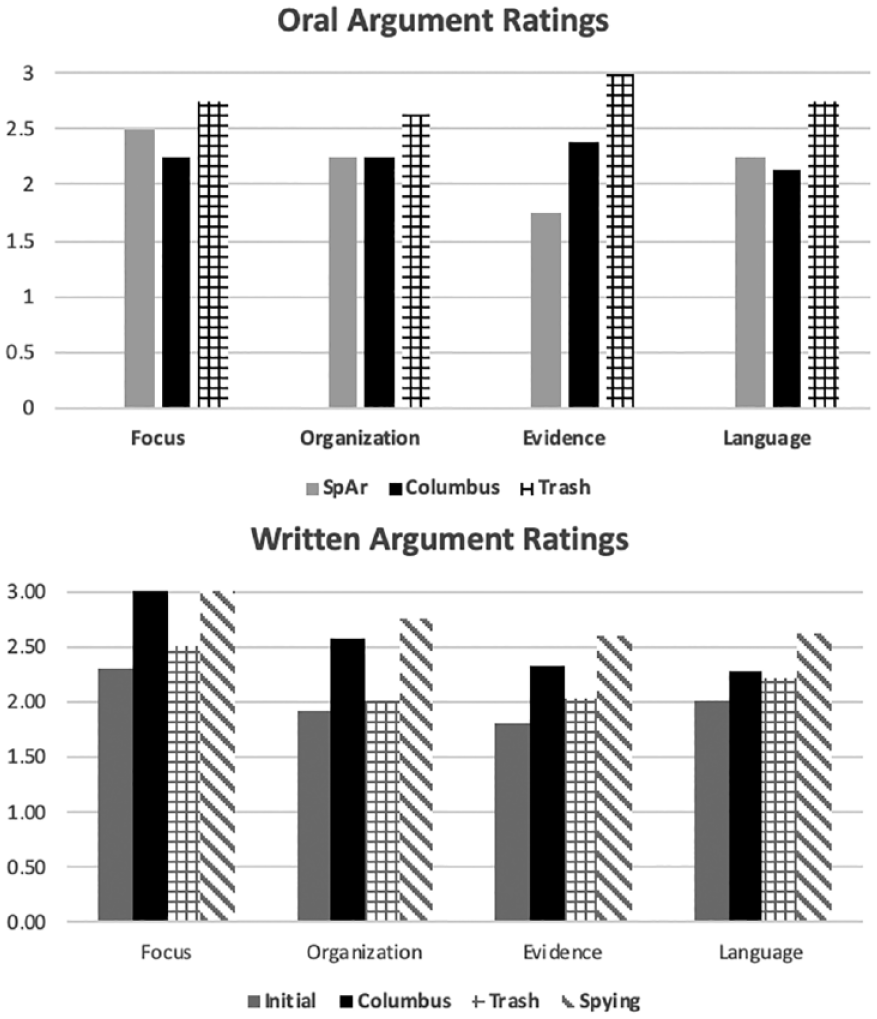
Comparison of oral and written argument ratings.
The SpAr debates included student-selected topics and focused on introducing debate terminology and structure. As students had only 20 min to prepare their arguments, the use of evidence was not expected to be well developed.
In the Columbus debate, the first of the unit-based debates, the students’ accurate use of evidence was variable. A student who was arguing that we should celebrate Columbus Day said, “People say that Columbus was the first to set foot on America. Well, that’s not necessarily true; he was the first American to set foot. Only the Taino people were there.” This inaccurate (and hegemonic) statement was countered by the first speaker of the negative argument, who opened with, “He came to what he thought was America but it was actually the Bahamas.” When the next affirmative arguer suggested, “He didn’t invade America, because he more, well I guess you could say that he just sort of visited,” the negative arguer countered with, “He wasn’t a visitor because he brought people back and then he also took their people” (Columbus/Affirmative/Speaker 2; Columbus/Negative/Speaker 1).
Interestingly, one of the affirmative arguers preemptively countered what she expected would be a claim made by the upcoming negative argument. In all of the debates, students prepared for both the affirmative and negative arguments and did not know which side they would present until the day of the debate. Voicing a counter perspective that is reminiscent of Bakhtin’s (1982) concept of “ventriloquation” (p. 293), the arguer states: And the way you look at it, you can see greed in two different ways: that he wasn’t greedy, that he was for trading unfairly. That’s the way you see it. The way we see it is that he traded for Spain. That he was not greedy. We see it two different ways. (Columbus/Affirmative/Speaker 1)
This statement nods to the counter perspectives that were developing, but in the end, provides more opinion than evidence.
In the Trash debate that occurred in the second instructional cycle, students demonstrated noticeable improvements in structuring their arguments using debate terms (the focus of many instructional modifications after the Columbus debates), as revealed in the opening lines of each of the first three speakers in the affirmative argument:
All right. . .well, the resolution “three pounds or less” will work because it’s going to cause less pollution in the earth.
The harm caused by all of the trash and everything all over the world will not go away on its own.
Harm is being done to animals. (Trash/Affirmative/Speakers 1, 2, and 3)
These first statements were a clear change from the less organized Columbus debate and demonstrate attention to showing solvency, inherency, and harm, respectively—debate terms that were consistently used to help students structure their arguments.
Beyond organizational improvements, the arguers in the Trash debate were more exacting in their use of evidence: One noted “that every, almost every, recycled water bottle ends up now in India. And that’s in ‘The Story of Water Bottles’” (Trash/Affirmative/Speaker 4). Students also used reasoning instead of opinion to present a counterargument, as demonstrated by the second speaker in the negative argument: And the resolution will not solve the problem, and the reason why is because if you do the math, in a year a person on average, if they do exactly three pounds a day, will end up wasting 1,080 pounds of trash a year. And that is a lot of trash. And there’s over 7.6, um, 7.3 billion people in the world and if everybody in the world does this, just multiply it. That’s a huge number. (Trash/Negative/Speaker 2)
Progress in Written Argument
An analysis of writing scores indicates progress in argument writing using the Smarter Balanced Assessment Consortium Grades 3–5 Opinion Writing Rubric. These scores were analyzed to determine changes and trends in the four elements of focus, organization, evidence, and language, and as rated across the three debate cycles.
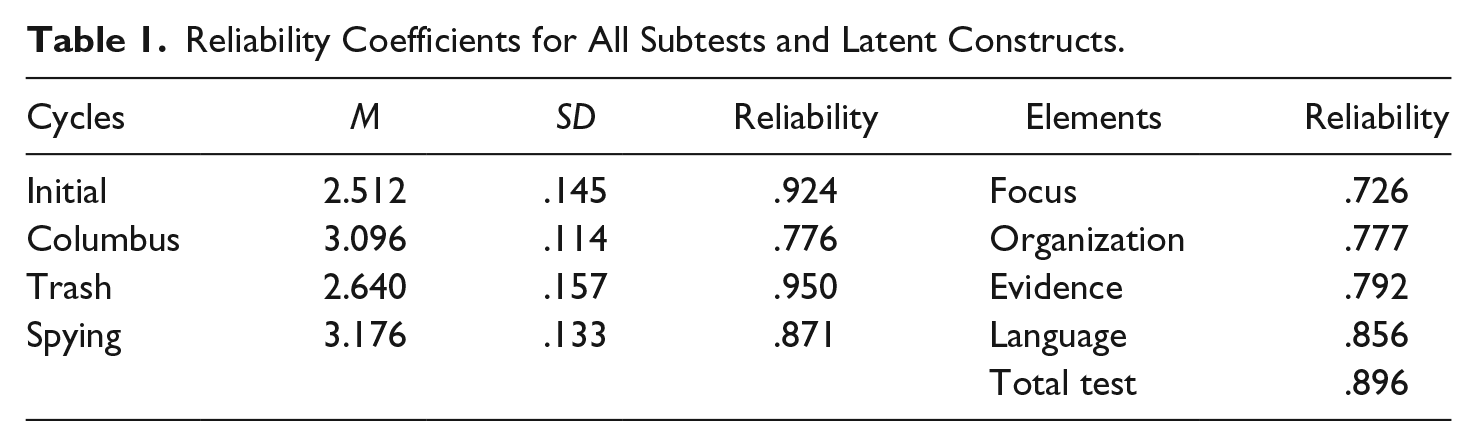
Student writing samples were analyzed using SPSS (version 23) using rubric scores for the 30 students who completed all four samples (Initial, Columbus, Trash, and Spying). Cronbach’s alpha (Cronbach, 1951) was used to determine the overall reliability of the scores, excluding the total scores for the four elements. Reliability coefficients over .8 are generally considered to be acceptable. The overall reliability for the entire set of writing scores was .946. Reliability coefficients for the four sets of writing are shown in Table 1. Three of the four cycles and one of the four latent constructs (writing elements) demonstrated adequate reliability. Of the four cycles, only Columbus fell short of the mark (alpha = .776). When considering the writing elements, the organization construct fell just shy of the standard (alpha = .777), as did evidence (alpha = .792), while the focus construct was clearly short (alpha = .726).
Reliability Coefficients for All Subtests and Latent Constructs.
A series of repeated-measures analyses of variance (ANOVAs) were conducted to investigate significant differences across the writing elements. For statistically significant results, eta-square (η²; Cohen, 1966) was calculated as the appropriate measure of effect size. General interpretation rules for η² state that values of 0.1 or less are small, values around 0.25 are considered moderate, and values at 0.4 or above are considered to show large practical effect. Mauchly’s (1940) test of sphericity was not significant for all ANOVAs, establishing compound symmetry. The results of the overall test were statistically significant, as were the results of the four latent constructs. The total test showed a strong effect size, as did the focus and organization elements. The evidence and language subtests showed a moderate effect size (Cohen, 1966). Observed power for all tests was at least .80, meeting the minimum acceptable level for statistical analysis (Cohen, 1988). The results of these ANOVAs are presented in Table 2.
Results of Repeated-Measures ANOVAs for All Subtests and Latent Constructs.
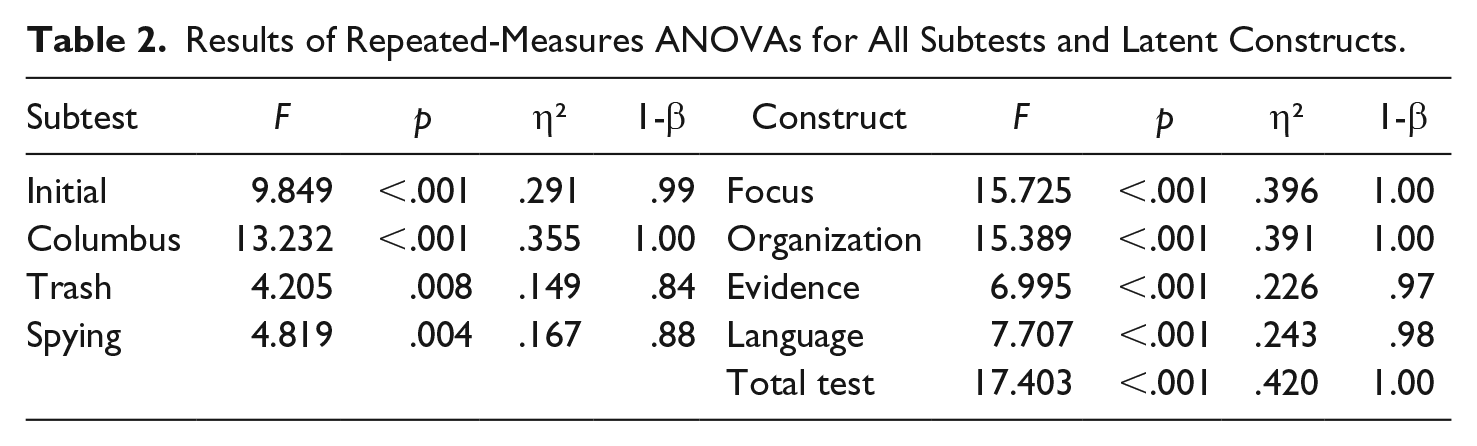
A second series of repeated-measures ANOVAs (Table 2) were conducted across the four cycles. As before, Mauchly’s (1940) test of sphericity was not significant for all ANOVAs. Tests on all four writing cycles were statistically significant, although the effect sizes were more widely varied than for the writing elements. The Columbus cycle showed a large effect size (η² = .355), and the Trash and Spying cycles showed small measures of practical effect (η² = .149 and η² = .167, respectively). A minimum acceptable level of power of .80 was observed for the three tests.
The means for the writing elements across cycles indicated a nonlinear pattern across all four writing elements, as depicted in Figure 1, suggesting greater increases between the Initial and Columbus paper than between Columbus and Trash. We reflect on the jaggedness of this trend line in the “Discussion” section.
Refining the Instruction
An iterative analysis of field notes and student artifacts identified factors that enhanced and inhibited the instruction as we supported students in crafting oral and written arguments. Based on the factors identified, adjustments to the instruction sometimes occurred between sections of students on a particular day. As a cycle ended, some of these refinements became integrated into the revised instructional frame that was implemented in the new cycle.
For example, after observing the first class period’s Trash debate and noting the lack of focus and organization of the oral presentation, we wrote in our field notes that the class should “spend more time rehearsing oral argument” (field notes, March 14). Kerri shared that she noted the same issue and immediately designed a modification for the second class period, primarily to help students improve their focus and organization: Modification for next period—use the sentence starters to help [students] craft their argument. They were struggling with making logical arguments, so they need to think more carefully about what they want to say. The teacher will offer more support in how they craft their statements. (field notes, March 14)
At the end of the second class period, Kerri considered another modification. She decided to “model how the debate might sound” (field notes, March 14). As Kerri ended the final Trash debate of the day, she was already thinking of supports for the next debate cycle. We noted the influence of modifications as we observed the final debate (Spying): “[The teacher] has really worked to give students scaffolds to help their presentation of ideas” (field notes, June 7). Our notes indicate that the “students were far more organized in presenting their position and attempting to be clear in their oral argument” (field notes, June 7).
Enhancing factors
An analysis of field notes and artifacts across the three cycles indicates two factors that appeared most frequently as enhancing factors: instructional scaffolds and the use of multiple and varied texts.
Instructional scaffolds
Kerri implemented several means of scaffolding students’ ability to craft arguments, both written and oral. She provided students with tools such as sentence starters (“My claim is ___ because . . .”), planning sheets with key debate terminology (“Inherency—The harm will not go away on its own because . . . evidence, citation”), note cards with prompts, and graphic organizers.
In addition, Kerri created anchor charts to help students refer to their development of ideas about a topic. For instance, charts were located in the room that delineated roles for debates: “Affirmative—your job is to make arguments supporting the resolution. Who is being harmed? How is it not going away on its own? What will our resolution be to solve the problem?” (classroom artifacts, Trash debate).
Multiple and varied texts
Kerri incorporated multiple texts of various formats into instruction, including picture books, videos, websites, comics, articles, and poems. The purposes for including each text differed, with some being used to introduce topics, some to compare perspectives, and others to provide evidence.
In one instance, prior to students debating whether Columbus was a hero or villain, Kerri shared Chimamanda Adichie’s (2009) TED talk, “The Danger of a Single Story.” She had students read a biography of Columbus (Biography.com Editors, 2014) and an article titled “Christopher Columbus: Hero or Villain?” (Myint, 2017). They explored the version of Christopher Columbus in their textbook, and she read aloud Jane Yolen’s (1996) Encounter. Kerri gave students a T-chart to collect evidence for both perspectives (hero and villain) and offered several resources for students to explore, which were used when collaborating on arguments. During the Columbus debate, for instance, one student stated: “One thing that our team came up with together is that the first thing people that Columbus saw, the first Taino people that he saw, he imprisoned them . . . on the ship and did not treat them fairly” (Columbus/Negative/Speaker 2).
Students referred to these multiple texts in their written arguments, sometimes countering the narrative with evidence from another source: “People also say that he traded with natives but they left out that the trades were very unfair and he actually stopped trading . . . and made [the Taino] dig for gold.” In response to the Spying debate, a student cited the fourth amendment, noting that “you have to have probable cause to go through your stuff” but that domestic spies “usually . . . don’t have a probable cause.”
Inhibiting factors
An analysis of data across the three cycles identified two factors that inhibited progress toward the pedagogical goal. The first was skills related to logic and rhetoric, and the second involved insufficient time to fully develop language arts skills during social studies.
Logical and rhetorical skill
Prior to their first debate, students had little to no experience with debates; indeed, they revealed minimal familiarity with any formal oral presentation. The lack of practice in organizing an oral argument meant that substantial assistance was needed to support the debates. One researcher noted the following in her field notes: Students still need work on crafting their oral argument. It would be helpful for them to think about all of the logistics of a resolution. What would this resolution require? This could help them craft their argument. (field notes, March 14)
Complex language and concepts such as harm and inherency were challenging for students. As a modification, Kerri implemented scaffolds during debate planning, consisting of index cards with starters that could be used to organize the points in a logical order and to suggest transitions. For instance, one starter was, “This resolution would solve by . . .”
Time
Time often became an issue. Field notes indicate class periods where students ran out of time to craft their resolutions. Kerri made comments such as, “I should have started the discussion earlier.” The National Council for the Social Studies (2010) position paper on Principles for Learning highlights the importance of dialogue and reflection when making sense of historical information and understanding current contexts. These principles involve attention to the speaking and listening modes required for effective discussion and public speaking as well as to accessing, evaluating, synthesizing, and critiquing information that can be textual or visual. While these are considered language arts concepts, disciplinary reading, the evaluation of evidence, and the ability to build arguments are social studies skills that serve as “principles for learning” social studies content—and take time to develop.
A complicated factor
There was one factor that presented both enhancing and inhibiting effects on the learning outcome: collaboration. Students worked in teams to develop and present arguments. The students’ ability to collaborate enhanced the building of arguments as they discussed issues with multiple voices. This contributed to the structure of their arguments, as the following discussion illuminates:
Well, the resolution says that we should fine people for trash, and we have to know why that will work.
I think we should go with this resolution because it will use less trash and maybe it will influence people to stop creating so much.
We’re making too much trash. Landfills are filling up.
It’s ruining the earth.
This problem has been going on for a really long time and if we don’t stop it now, it’s going to grow even more. It’s going to be a really big problem.
It hurts animals, too, because they are eating this trash. And then we might eat those animals and it hurts us. We need to stop the problem.
Nobody wants to have to pay for trash so this resolution would help with that. (Field notes, March 14)
Still, this same group demonstrated difficulty when it came to the actual debate. Each argument group selected three or four speakers to present. One student in particular who had contributed many ideas to the group conversation was clearly frustrated with who was selected to present the oral arguments. She asked, “Why are all the kids from [the gifted class] getting to speak?” (field notes, March 14). While she felt a part of her group in the discussion, she was now feeling marginalized. This inconsistency of collaboration and equal voice was a complicated factor, both revealing the potential of debate to promote critical participatory literacy while also highlighting the hegemony of power structures that exist in classrooms.
Discussion
This DBR sought to determine the ways that debate could provide space for developing arguments based on historical and current issues. The research took place in three sections of a fifth-grade social studies classroom. Although DBR methods do not determine causality, there is evidence that students were progressing in making oral and written arguments. The DBR approach afforded important insights about instruction that aimed to create an informed and agentive community in a fifth-grade classroom.
Field notes and observations, along with classroom artifacts, transcripts of the oral debates, and the writing samples, were instrumental in documenting the refinements of the instruction. A retrospective analysis of these findings led us to make the following pedagogical assertions that may be useful to educators and researchers interested in developing oral and written arguments. These assertions allow for a measure of analytical generalizability (Yin, 2009) wherein they may inform practice in a case-to-case transfer to other classrooms (Reinking & Bradley, 2008).
Assertion: Non-Dichotomous Arguments, While Challenging, Enable Students to Engage With the Complexity of Arguments
While growth in argument writing was observed, the journey was more jagged than linear, as depicted in Figure 1. The dip between the second and third cycles is interesting in that the structure of the debates was qualitatively different. In the second cycle, where the issue was whether Columbus Day should be celebrated, an either–or scenario served as the focus of the discussion leading to the debate. This was seen in the use of graphic organizers that were headed with “Columbus: Hero or Villain” and instructional activities such as the Columbus Tug of War (artifact file). The qualitative difference here is that students were asked to take one side or the other—an either–or dichotomy despite the posing of a resolution. Dascal (2008) states that “sticking uncompromisingly to a dichotomy may lead to sharp disagreement and paradox, but it can also sharpen the issues at stake” (p. 27). In the case of the Columbus written arguments, it appears that students demonstrated a strong focus by choosing one side or the other—almost overwhelmingly against the resolution that Columbus Day should be celebrated. Because there were multiple resources on the Taino people and their brutal interactions with Columbus and his crew, students had evidence at the ready to defend a stance that challenged observance of the holiday.
In the following Trash debate, the discussion was more complex due to the nature of the resolution posed and defended. The topic was not taken directly from the content, as with the Columbus debate in a unit on explorers. Rather, the students became interested in extrapolating the effects of pollution based on their study of industrialization. As Kerri noted to her students, “You must think about what new problems are created by the solutions you offer” (field notes, March 9). The complexities of the issue were challenging for students as they had to weigh evidence and determine a solution that would truly solve the problem.
Students came up with a resolution that would compel the public to reduce trash by legislating a fine for trash accumulations that exceed 3.5 pounds per person per week. Students became aware of the intricacies of carrying out and enforcing the resolution, exposing the real-world difficulties of solving problems. As students debated the issue of trash, the negative argument posed several drawbacks of the resolution, such as the possibility that some might circumvent the trash fine by dumping their trash in the woods or in streams, thus creating a worse environmental situation. The students noted that the burden of the fine would be disproportionately felt by those with less money than those who were wealthy. The complications of creating legislation that would solve a problem in society became simultaneously challenging and convoluted. Writing from this stance was decidedly more difficult than simply taking a stand of hero versus villain, particularly in terms of maintaining a focus, and therefore, organizing evidence to support it.
Assertion: Students Need Practice With and Instruction in Using Formal Speaking Registers
Students’ experiences with talk may be less formal than in debate; therefore, they need support in developing the speaking skills required, such as pacing and organization. Through our research, we discovered that we were making assumptions about students’ abilities to communicate orally, something that is not uncommon for teachers to do (Palmer, 2014). Our field notes consistently indicated that students were inarticulate or dysfluent in their oral presentations and that their line of reasoning was often difficult to follow. We reflect here, too, on Wertsch’s (1991) observation on formal instruction in elementary schools regarding the voices of teachers and students: “The former have mastered a fairly unified speech genre of formal instruction, whereas the latter have not” (p. 111). Mastering the speech genre of argument introduced a new register for students to adopt. This was in addition to an observed need for them to develop effective oral communication skills in the more general sense. Beyond rhetoric, time spent explicitly teaching students the conventions of speaking, such as volume and eye contact, is needed to strengthen students’ oral arguments.
Assertion: Oral Arguments Can Serve as a Valuable Tool to Expose Gaps in Students’ Understanding of Argument
The oral arguments served as windows into students’ thinking regarding the issue at hand in each debate cycle and were helpful in identifying elements of arguments that were lacking. As shown in the Columbus debate when a student claimed that Columbus was the first American to set foot in America, debates present opportunities for oral explanations that reveal misconceptions and inaccuracies. As such, the debates were ideal spaces to practice argumentative structures and to evaluate students’ understanding of the content.
Assertion: Connecting the Scaffolds Used to Support Oral Arguments May Help Students Transfer Their Skills to Written Arguments
As the debate instruction was shaped from the first cycle to the third, supports were added to guide students in organizing their arguments. Students were guided in developing affirmative arguments using graphic organizers that would structure their case to describe harm, inherency, and solvency. These same graphic organizers were then used as students crafted their written arguments, allowing for a direct connection between the organizational framing of both arguments. The influence of this support was noted in student writing, particularly in their language. For instance, a student stated in his spying essay, “Unofficial spying has hurt many people and the problem will not get better because people spy every day.” He was referring to both harm and inherency, which were part of the new vocabulary for debates.
Assertion: Integration of All Modes of the Language Arts Facilitates Students’ Ability to Understand Issues and Develop Arguments
Kerri was masterful in her integration of the language arts in her social studies classroom as students read, discussed, viewed, and wrote about the content. She used multimodal texts and resources that presented the historical context of each topic under study and then guided students to understand the current and real-world implications of each topic. Using trade books, online resources, videos, and song lyrics, students were challenged to think critically about history and to expand their perspectives on issues. This led to rich discussions that evoked new perspectives and inspired solutions to problems that affected and interested them.
Limitations
As with all classroom research, there are limitations to this study. First, the DBR approach does not support statements of causality nor imply that it was the addition of debate alone that led to changes in argumentation skill. Rather, it is likely that a synergy of the deep discussions of multimodal texts, the instructional moves that supported the development of arguments, and the opportunity to vet ideas out loud contributed to the observed growth. As such, these findings are particular to this teacher, these students, and this teaching context and are therefore not to be construed as generalizable to other classrooms. The teacher’s focus, her choice of materials and resources, and the students’ cultural and linguistic experiences all influenced the ways that oral and written arguments developed in this classroom. Further research that includes experimental approaches could explore possible causal connections between oral and written arguments. However, the description of the instruction and pedagogical assertions does permit other educators to adopt and customize practices to their own teaching contexts.
Another concern as we developed this research was finding ways to measure the sophistication of the type of argument we were trying to bring to these students. Framing argument as a problem-solving process differed in many ways from the more simplistic view of argument as recommended by the state standards and reflected in the Smarter Balanced rubric elements for the third through sixth grades. These standards and rubrics introduced a somewhat limiting bias regarding the nature of argument as we envisioned it, indicating a need to develop more sensitive rubrics.
The third potential limitation is the ordering of the debate cycles. Had the more dichotomized Columbus debate occurred after the Trash or Spying debates, a different stance toward developing a resolution might have occurred, which may have reflected a different trend line in individual student arguments. As it stands, the ordering of debate cycles as it occurred in this study afforded an opportunity to explore how the issue was framed as well as the instructional moves that were employed to prepare for the debate. We found these insights to be instructive.
Conclusion
The purpose of this research was to explore the ways that debate could be used to develop arguments in speaking and writing. Moving away from the either–or debates to the use of the policy debate structure was key to developing the critical participatory literacy that the research team valued. Determining and defending workable resolutions to complex issues can help students see the nuances of problems and solutions, while realizing that those solutions may also create new problems. Students practiced civil discourse and experienced the power of the resolution. This countered the original view of argument that students held: that arguments are about being right.
The instructional frame that developed as a result of this research might encourage educators to integrate meaningful speaking and writing instruction in their content areas. Kerri floods students with a variety of texts, and this research demonstrates the value of devoting time to exploring those texts through speaking and writing about the content they present.
While this study suggests progress toward the goal of supporting students in considering the complexity of issues and in preparing oral and written arguments about topics important to them, there is still much to be done. More research should be conducted to develop ways of integrating logic and rhetoric, ideally through collaborations between language and content-area teachers. In addition, the importance of the teacher as a co-researcher in DBR studies should not be understated. While we could help plan the instruction and map out its direction, it was Kerri who made the day-to-day decisions based on students’ needs and interests. This underscores the importance of empowering teachers to use their professional judgment rather than attempting to script their instruction or micromanage them.
In a political climate where facts are challenged and ideologies are paramount to evidence, it is more important than ever to provide our students with the discipline and disposition to view issues that arise in society, to collaborate on potential resolutions to those issues, and to debate the merits of proposed resolutions. As fifth graders grow into voting adults, a focus on oral debate and well-reasoned argument seems imperative to creating a citizenry that is prepared to tackle the complicated problems our multifaceted nation confronts.
Supplemental Material
Translated_Abstracts_Malloy – Supplemental material for It’s Not About Being Right: Developing Argument Through Debate
Supplemental material, Translated_Abstracts_Malloy for It’s Not About Being Right: Developing Argument Through Debate by Jacquelynn A. Malloy, Kelly N. Tracy, Roya Q. Scales, Kristin Menickelli and W. David Scales in Journal of Literacy Research
Footnotes
Declaration of Conflicting Interests
The author(s) declared no potential conflicts of interest with respect to the research, authorship, and/or publication of this article.
Funding
The author(s) received no financial support for the research, authorship, and/or publication of this article.

References
Supplementary Material
Please find the following supplemental material available below.
For Open Access articles published under a Creative Commons License, all supplemental material carries the same license as the article it is associated with.
For non-Open Access articles published, all supplemental material carries a non-exclusive license, and permission requests for re-use of supplemental material or any part of supplemental material shall be sent directly to the copyright owner as specified in the copyright notice associated with the article.
