




Abstract
Planning plays an important role in the production of written texts. Little is known about why children plan and the plans they create when they are not explicitly instructed. This study explores the plans that elementary school children in Years 1, 3, and 5 create before writing a text. We compared performance of children educated in Catalan and in English (the United Kingdom) and examined whether the plans were related to their language and literacy skills. Children of all ages produced plans before writing either by producing a draft or an organizer. The types of plan changed with age and were influenced by the educational context. Plans were not associated with either the text length or the text quality. Nor were language, literacy, and transcription skills associated with the plans. School instruction is important for producing plans but, at this stage, children’s self-generated plans do not impact on the texts produced.
Understanding the factors that underpin children’s writing development continues to raise challenges for researchers (Graham, 2018) and practitioners (Limpo & Alves, 2018). The complexity of the writing process and the diverse methods used to examine children’s writing products often lead to studies that focus on the written product and, at least in the initial stages of writing, transcription skills (Berninger et al., 1992; Graham, Berninger, Abbott, Abbott, & Whitaker, 1997). Transcription is the process of translating ideas into text (Fayol, Alamargot, & Berninger, 2012) and, as such, is only one component of the writing process. Cognitive models of writing capture three processes in the production of written text: planning, translating, and revising (Hayes, 2009). Planning that occurs before the commencement of text production—that is, prewriting planning—provides the writer with the opportunity, prior to composing, to generate and organize ideas.
A key question remains about the ways in which children organize their thoughts before engaging in the production of the text itself. Children could prepare for writing in a number of different ways, either individually or in groups. In this study, authors examine elementary school children’s prewriting planning for the production of a text. Children as young as 7 years produce plans for writing, and instruction in planning is reported to promote students’ writing performance (Graham, McKeown, Kiuhara, & Harris, 2012). Yet, little is known about the types of plans children produce spontaneously, without explicit guidance in how to plan for a specific piece of writing. Nor do we know whether these spontaneous plans contribute to the writing productivity and the quality of children’s written texts or the extent to which the creation of these plans is influenced by children’s language, reading, and transcription skills. To our knowledge, this is the first study to examine the prewriting plans of children in elementary school across school grades and educational contexts.
Background
Planning for Writing
Two types of planning for writing can be distinguished: planning that occurs before writing (prewriting planning) and online planning, which occurs during the production of the written text (Berninger & Swanson, 1994). Planning that occurs during the translation process—that is, online planning—arguably is not operational until adolescence, when young people are more competent and fluent writers and recursive planning and revising can occur online (Olive & Kellogg, 2002). Prewriting planning is promoted in elementary school classrooms (Alley & Peterson, 2017), although the nature and extent of instruction varies across country contexts (Parr & Jesson, 2016; Torrance et al., 2012), age (Dockrell, Marshall, & Wyse, 2016), and classrooms (De la Paz & Graham, 2002).
Skilled writing has been conceived as a sequence of recursive processes where planning initially informs translation, and ideas are then translated into written text, when reviewing and revising can occur (Hayes & Flower, 1980). Producing plans provides the writer with the opportunity to both generate ideas and structure them to develop the written product (Torrance, Thomas, & Robinson, 1999), although the central function of planning is argued to be generating content for the text to be written. To prepare to write, it is necessary to identify the information to include in the to-be-written texts. To do this, the writer uses both his or her own knowledge, stored in long-term memory, and the task requirements or environment. This material is then (re)organized in a writing plan that, in theory, structures the subsequent text production. These prewriting planning activities reduce demands on the writer’s working memory, thereby providing the writer with greater scope to devote time to translation and transcription, resulting in increased writing fluency and higher ratings of text quality (Kellogg, 2008). Prewriting planning in college students has been shown to consistently improve holistic writing quality (Kellogg, 1988, 1990), including both the fluency and the syntactic complexity of the texts produced (Limpo & Alves, 2018).
Early research on children’s prewriting planning indicated that children only plan prior to writing for a very short time (De la Paz, 1999), and when they do plan, it is typically a draft of the text to be produced (Bereiter & Scardamalia, 1987). More recent research has indicated that typically children do not use the plans they produce (Limpo & Alves, 2013). Nor do these preparatory activities appear to predict text quality (Olinghouse & Graham, 2009; Whitaker, Berninger, Johnston, & Swanson, 1994). However, by sixth grade, planning to write, defined as generating ideas and producing a first draft, has a direct effect on translation (Koutsoftas & Gray, 2013). Thus, though younger students are able to produce plans, only older students seem to use them to guide text production (Limpo, Alves, & Fidalgo, 2014). To use the produced plans often requires explicit instruction, especially for children who struggle to write (Graham & Harris, 2005). Teaching genre-related planning strategies is among the most effective ways to promote children’s writing (Graham & Perin, 2007). Of course, children may fail to use plans for a number of reasons. One possibility is that younger children may not differentiate the process of planning to write from the process of translating (Bereiter & Scardamalia, 1987). Koutsoftas and Gray (2013) found that while producing an outline had a direct effect on the production of a first draft, there were no subsequent effects on the production of a second, revised text. Thus, the type of plan that children produce prior to the production of the written text may be critical in terms of its impact on the writing product.
Preparing to Write
Despite the key role assigned to planning for writing in models of writing development (Bereiter & Scardamalia, 1987; Berninger, Whitaker, Feng, Swanson, & Abbott, 1996; Macarthur & Graham, 1987), there have been few attempts to examine the types of activities that children might engage in prior to writing their texts. Planning before writing can involve at least two distinct elements: idea generation and organization. Again, the development of these written artifacts may vary with development but also between children and across tasks. These initial written plans can be examined in a number of ways (see Hayes & Nash, 1996, for a review of planning measures). A number of studies researching planning at the primary school level have focused on organization. Outlines and graphic organizers have been considered the most advanced form of preplanning (Limpo & Alves, 2013; Olinghouse & Graham, 2009; Whitaker et al., 1994). The effect of content or idea generation in prewriting planning on text production has been less explored (but see Koutsoftas & Gray, 2013).
In sum, planning remains a recommended practice to support text production, but unless children receive explicit instruction, they appear not to plan. Planning without explicit guidance might occur if the child understands the task demands and uses the opportunity of planning to cognitively engage with the task at hand. As such, this likely depends on both children’s understanding of the demands of the writing process and their language, reading, and transcription skills. Transcription supports text production, and oral language can support idea generation (Arfe, Dockrell, & De Bernardi, 2016; Castillo & Tolchinsky, 2018), whereas reading skills could support children’s awareness of the type of structure and content that is relevant to the text that is to be produced (Ahmed, Wagner, & Lopez, 2014; Kent & Wanzek, 2016). These competencies should, in theory, support prewriting planning independent of the orthography in which children are learning to write.
By contrast, engagement in preplanning activities may be driven by instruction, independent of these skills and the language in which the child is learning to write (Torrance et al., 2012; Torrance & Galbraith, 2006). Currently, there is variation across educational contexts in what aspects of planning for writing, at which grade level, and with how much emphasis or regularity teachers instruct children in how to plan (Graham & Rijlaarsdam, 2016). As Gillespie and Graham (2014) found in their meta-analysis on writing interventions, not all practices are equally effective, and while explicit instruction on prewriting planning had a significant impact and large size effect on the quality of texts produced by children who struggle to write, the use of other prewriting activities, such as completing predetermined concept maps/organizers, was not effective.
Skills That Underpin the Production of Written Text
A number of frameworks or models exist to conceptualize the development of writing that focus on the interacting components necessary for writing (Berninger & Winn, 2006; Kim & Schatschneider, 2017) or other factors, such as working memory capacity limitations (McCutchen, 2012). Given the significant cognitive demands in text production, young writers may not have the capacity to create or use a plan (Vanderberg & Swanson, 2007). Young writers in the initial stages of learning to write lack efficient management of the cognitive load imposed by low- and high-level processes (Bereiter & Scardamalia, 1987). Thus, the demands of transcription skills likely impact translation, and this might be the reason that young writers do not plan before they write (Alves, Branco, Castro, & Olive, 2012; Grabowski, 2010; Olive & Kellogg, 2002).
The Current Study
Planning for writing is thought to be a key component in the process of text production. Plans can support both idea generation and the organization of the text. However, elementary school writers struggle with planning, and at this point in development, the production of plans appears not to contribute to text quality. It has also been argued that the increased production of drafts in younger students’ written plans and texts reflects their inability to differentiate planning from translation (Bereiter & Scardamalia, 1987). The structure of plans contributes to text quality in older children, but little is known regarding the contribution of prewriting idea generation across the elementary school years. Here, we examine the structure and content of the prewriting plans produced by children between the ages of 6 and 11 years to capture developmental changes. We consider whether the nature of the plans children create prior to producing written text is informed by transcription, linguistic, or reading skills and the extent to which prewriting planning affects writing products above and beyond established predictors of writing. Given the large and significant contribution of transcription skills to children’s written texts (Bourdin & Fayol, 1994; Graham et al., 1997), measures of spelling and handwriting were collected as control variables.
We collected the prewriting plans produced by children in England and Catalonia to address the hypotheses related to differences across languages and educational contexts. The countries differ in the ways in which prewriting planning is included in the curriculum. In England, children as young as 6 years are explicitly taught to produce plans for writing. The English national curriculum states that children should consider what they are going to write before beginning by planning what they are going to write about and writing down ideas and key words. From the age of 7 years, planning is considered a precursor to drafting. By contrast, the Catalan curriculum is much less specific and refers to prewriting planning in a very general fashion, stating that children must “think about what . . . [they are] going to write about.” Only in Years 5 and 6 does the curriculum become more specific and suggest that “when planning, children must think of the audience and set the goal and content of the written text to be produced” (Generality of Catalonia, Department of Education, 2009).
These data allowed us to explore the production of prewriting plans across ages and educational contexts and to examine the transcription, language, and reading skills that were associated with the writing plans produced. The extent to which the plans produced were related to the child’s skills was explored through multinomial logistic regression, and using multiple regressions, we examined whether the plans children produced contributed to their writing products in terms of the quality of the text and the quantity of text produced in response to a standard writing prompt. The prompt was chosen to encourage a narrative genre that would be familiar to the youngest children in the study, commensurate with the genre of writing typically produced in schools and used successfully in previous research studies in this age range (see, for example, Connelly, Dockrell, Walter, & Critten, 2012; Dunsmuir et al., 2015).
We anticipated that the youngest groups of children, independent of educational context and transcription, language, and reading skills, would produce skeletal drafts of the text they planned to write. By contrast, we anticipated that the older children would use the opportunity to create plans both to structure their texts and as a means of generating ideas for inclusion in the texts, but given the much greater emphasis within the English curriculum on a structured approach to writing, we anticipated that English children would demonstrate a greater use of preplanning activities at an earlier age than the Catalan children. We anticipated that idea generation would be associated with the child’s language skills (Savage, Kozakewich, Genesee, Erdos, & Haigh, 2017) and that prewriting plans that included content would significantly contribute to both the quality and the quantity of the text produced by the children.
Method
Participants
A total of 199 elementary school children from England (n = 88) and Catalonia (n = 113) participated in the study. Children were purposely selected to reflect three different mainstream school-year groups (1, 3, and 5). For the English cohort, mean age in months was M = 75, SD = 3.96 for the 31 children (15 boys) in Year 1; M = 99, SD = 5.63 for the 27 children (11 boys) in Year 3; and M = 123, SD = 3.48 for the 28 children (18 boys) in Year 5. For the Catalan cohort, mean age in months was M = 82, SD = 3.19 for the 37 children (22 boys) in Year 1; M = 105, SD = 4.65 for the 36 children (16 boys) in Year 3; and M = 128, SD = 3.88 for the 40 children (22 boys) in Year 5. The difference between the mean age of the Catalan and English participants is explained by different school entry dates (in England, September to August; in Catalonia, January to December).
Process
Children were assessed on a range of measures to examine their language, reading transcription, and writing skills. All children were assessed in their first language using measures appropriate for the population.
Language Measures
Receptive vocabulary
English: British Picture Vocabulary Scale (BPVS; Dunn et al., 1997). Children are shown four line drawings and asked to choose the one that best illustrates a word spoken by the assessor; reliability .89; validity with the Expressive One-word Vocabulary test .72.
Catalan: We adapted the Spanish Peabody (adapted by D. Arribas); reliability .91.
Grammar comprehension
English: Wechsler Individual Achievement Test Second Edition (WIAT-II) Sentence Comprehension Subscale. Children are asked to point out which picture in a set of four matches a sentence read aloud by the examiner; reliability .82.
Catalan: We adapted the PROLEC-R Grammatical Processes for Spanish. As with the English test, children are asked to point out which picture in a set of four matches a sentence read aloud by the examiner; reliability .84.
Transcription Measures
Handwriting fluency
Children are asked to write as many alphabet letters as possible in 1 min with accuracy (Wagner et al., 2011). Children are asked to write all the alphabet letters in order, using lowercase letters. If children finish writing all letters before a minute is up, they are asked to continue to write, starting with “a” again. This task assesses how well children access, retrieve, and write alphabet letter forms automatically.
Dictated spelling
English: British Abilities Scales II (BAS II); Spelling Scale. This scale provides a number of phonetically regular and irregular words to assess a child’s ability to produce correct spellings. Each item is first presented in isolation, then within the context of a sentence, and finally in isolation again. The child has to respond by writing the word; reliability .91, validity with Wechsler Objective Reading Dimension (WORD) spelling .63.
Catalan: We used a bespoke task created by Tolchinsky (in press). Participants are directed to write down the words dictated by the experimenter. Each word is repeated twice before proceeding to the next one. Participants have to write the dictated words on a blank paper handed out at the start of the dictation. Due to the lack of an updated Catalan word frequency dictionary, the target words we used were selected from the Corpus CesCa, a corpus of written Catalan produced by schoolchildren (Llauradó, Tolchinsky, & Martí, 2012), so as to warrant the ecological validity of the task. The selected words were from one same semantic field (food) and the same grammatical category (nouns), and they were controlled for frequency and orthographic difficulty. Each participant had to spell a total of 20 words, divided into four sets for frequency (high and low) and orthographic difficulty (high and low).
Reading Measures
Word-level reading
English: Test of Word Reading Efficiency (TOWRE; Torgensen, Wagner, & Rashotte 2011). This contains two subtests: The Sight Word Efficiency (SWE) subtest assesses the number of real printed words that can be accurately identified within 45 s, and the Phonetic Decoding Efficiency (PDE) subtest measures the number of pronounceable printed nonwords that can be accurately decoded within 45 s.
Catalan: We adapted the PROLEC-R Lexical Processes, word and pseudo-word reading for Spanish; reliability .79. This contains two subtests: The word reading subtest assesses the time a child takes to accurately read a set of 40 real printed words, and the nonword reading subtest measures the time it takes a child to accurately decode a list of 40 pronounceable printed nonwords.
Reading comprehension
English: The New Group Reading Test. This is a standardized assessment using a multiple-choice format to assess children’s ability to complete sentences and comprehend written passages. It can be administered to groups; reliability Cronbach’s alpha .90.
Catalan: ACL (Avaluació de la Comprensió Lectora). This test comprises a set of seven texts for each school year. For each text, children are requested to read individually and then answer a set of multiple-choice questions. ACL has been extensively used in studies on Catalan reading. It has a reliability of Kuder–Richardson Formula 20 (KR-20) .080 to .083. Its validity, assessed as the correlation between the results obtained by a child on ACL and the teacher’s assessment of the child’s reading comprehension skills, is .99.
Writing Measures
All children were asked to produce a written response to a prompt and were given 5 min to produce a prewriting plan. This task is based on the standardized assessment of writing in the Weschler Objective Language Dimensions (WOLD) test (Weschler, 2005).
Procedure
Children were assessed as a class group for the writing measures and individually in schools for the language and reading measures over a period of 3 days. The two first sessions lasted more than 50 min each and involved the group tasks. The third session took another 50 min and involved the individual tasks. The writing prompt used in the analyses was presented to the class on Day 2.
To ensure all children were familiar with the writing task on Day 1, children were provided with an opportunity to practice the writing task with a different narrative prompt that has been used in similar studies. These data were not included in the analyses. On Day 2, children were asked to produce a written response to the prompt, “What is your ideal house like and why?” The task was not time limited; the researcher had a 50-min class period to explain to the children the purpose of the task, hand out the necessary materials, and deliver the task prompts. On average, children wrote for 20 min, and no child requested extra time to finish the text once the session was over. The researcher instructed the children to take 5 min to “think and plan for your texts in any way they thought might help you produce a really good text.” To ensure that children’s individual approaches to prewriting planning were captured, neither the prompt nor the planning sheet contained additional information to assist with generating and structuring content (for a difference between self-directed and guided planning, see Whitaker et al., 1994). A second blank sheet was to be used to write down the text. For both cohorts, language teachers were present in the classroom during the task. Ethical approval was secured from the Institute of Education—University College. Informed consent from schools and parents was obtained prior to any testing.
Transcription of Plans and Texts
A literal copy of all written outlines and texts was transcribed and entered in a standard format using the Systematic Analysis of Language Transcript (SALT) conventions (Miller & Chapman, 2000). SALT allows for the automatic coding of certain text features and also for the creation of codes specifically created for the purpose of the study.
Coding of Prewriting Plans
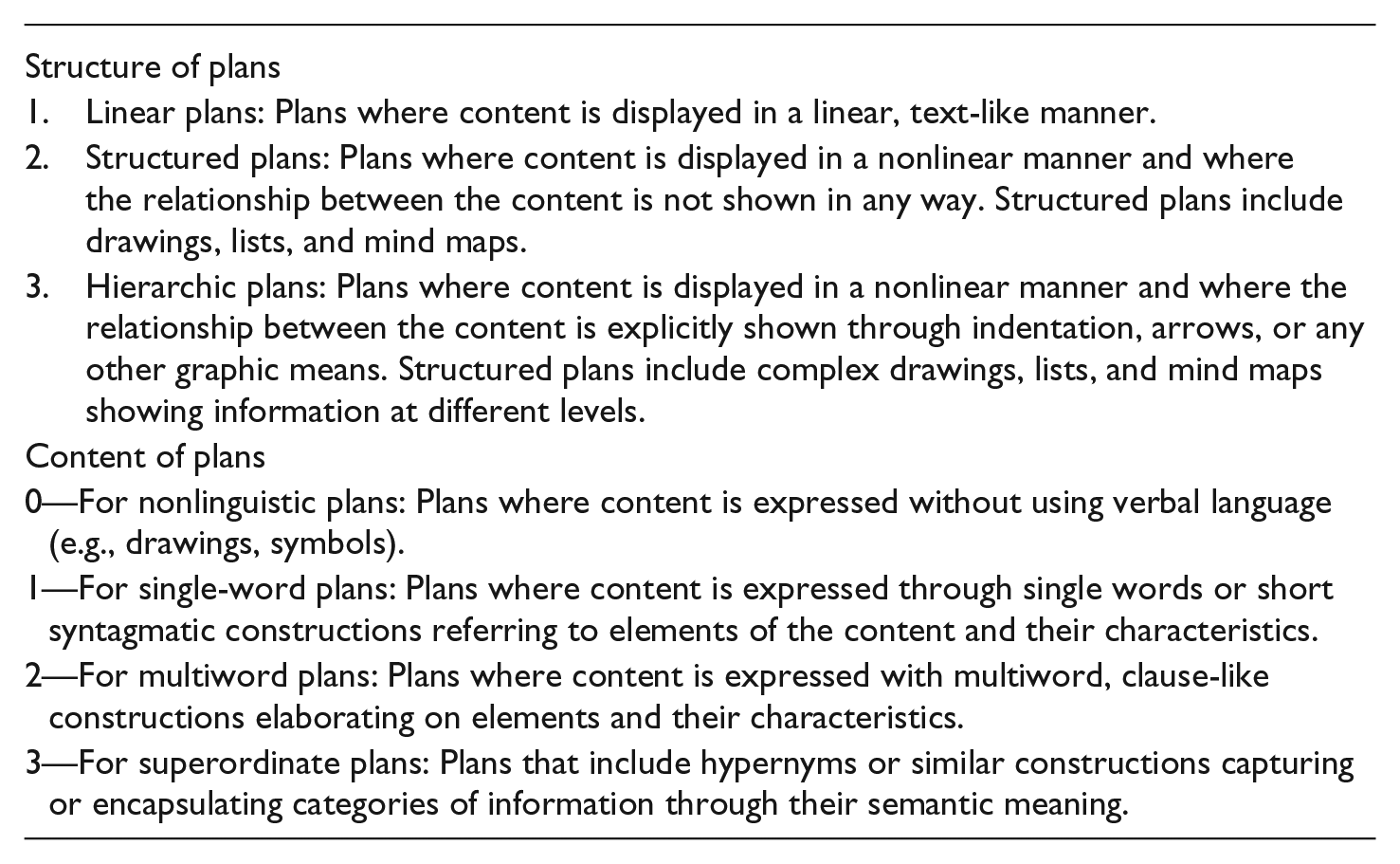
We established a first broad classification of the prewriting plans into drafts of the text to be produced and prewriting plans that were not drafts, which we categorized as organizers. Drafts were defined as a text, like outlines reflecting the final text. By contrast, organizers were defined as plans representing the content and structure of the future text in a way that was not text-like. All plans were categorized for structure and content.
Structure reflected the way in which content was displayed and organized on the paper sheet. Content reflected the type of linguistic units used to express ideas within the plans. We used the following rubric for coding the structure and content of plans. (See examples of each type of plan in Online Appendix A.)
Rubric for Coding the Structure and Content of Plans
Coding of Written Texts
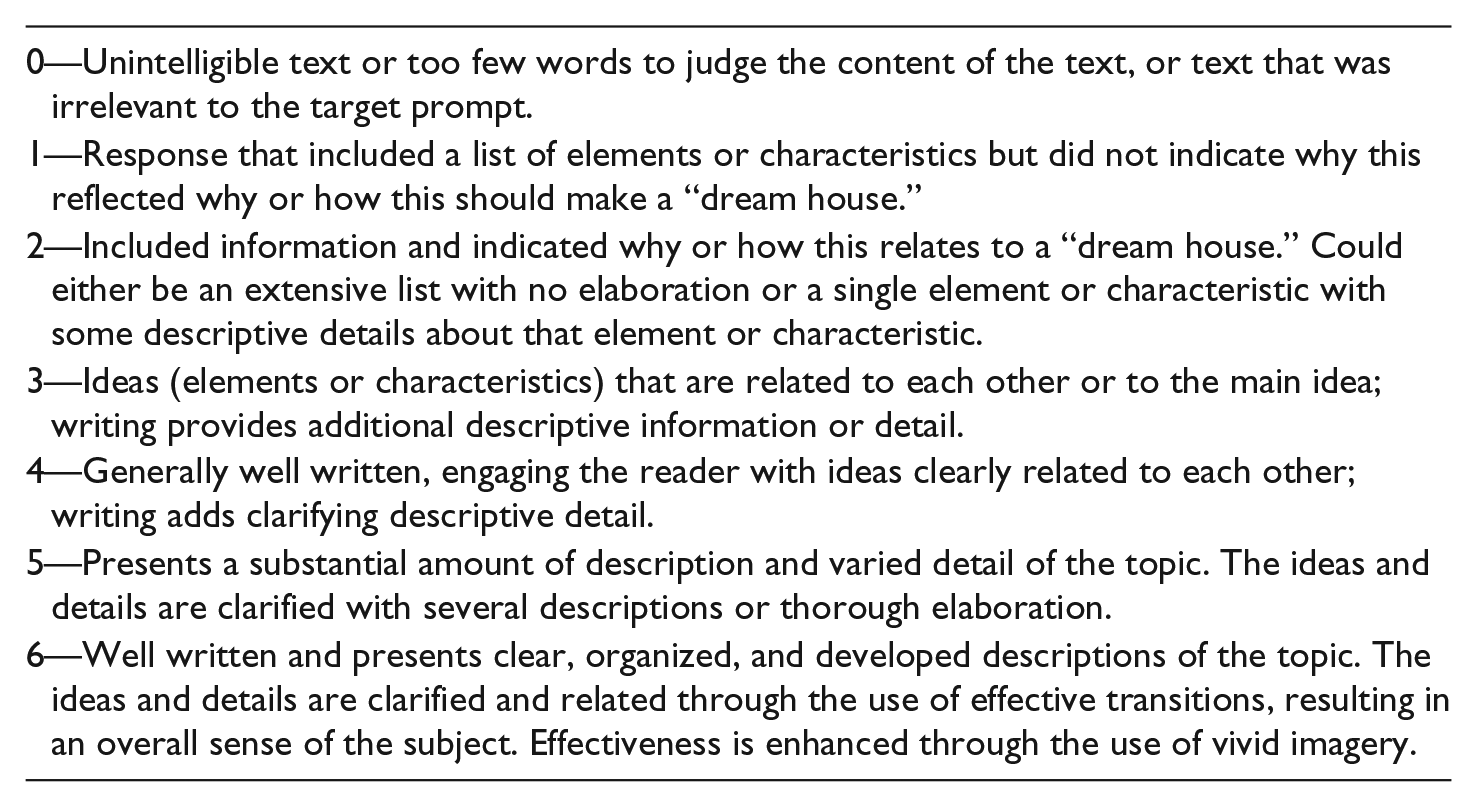
Written texts were coded for productivity and their overall quality. Productivity was computed as the total number of words in each text, a measure that has been widely used as an indicator of compositional length (Kim et al., 2011; Mackie & Dockrell, 2004). Words used in the title, when there was one, were included in the total. When a child made a word segmentation mistake, we counted the number of intended words. Any deleted or crossed-out words were not included in the final total. Quality was scored using a holistic scale derived from the WOLD.
Scale Used to Score Written Texts
Although plans included on occasion verbal language, drawings, or both, texts did not include the use of drawing.
Reliability of the Measures
For each language and school grade level, a second judge rescored the written products for 20% of the children. For plans, category, structure, and content, inter-rater reliability (Cohen’s Kappa) was .90, .87, .81 and .91 .89, .87, respectively, for the Catalan and English samples. For the quality score, inter-rater reliability was .82 and .80 for the Catalan and English samples.
Data Reduction
The Online Appendix B provides details of participants’ raw scores on all the language, reading, and transcription measures by age and language. Correlation analyses indicated that there were high correlations between the language variables (>.8), reading variables (>.92), and transcription variables (>.96), controlling for age. We therefore examined whether the measures of oral language, reading, and transcription reflected different components for English and Catalan or would best be conceptualized as the same factors. The language, reading, and transcription measures were factor analyzed using principal component analysis with Varimax (orthogonal) rotation for each language separately. Our three oral language measures all loaded on to a single factor for both English and Catalan, accounting for 67% and 71% of the variance, respectively. A single oral language measure was therefore computed for each language. Similarly, both reading decoding and reading comprehension loaded on a single factor accounting for 83% of the variance in English and 75% of the variance in Catalan. A single reading variable for each language was computed. Finally, we examined whether spelling and handwriting reflected a single measure of transcription. Both measures loaded on a single factor, accounting for 83% of the variance in English and 91% of the variance in Catalan. A single transcription variable for each language was computed. All subsequent analyses use language, reading, and transcription factors.
Results
The results are presented in three sections. In the first section, using chi-square analysis, we describe the plans produced and consider developmental differences and contextual differences. In the second section, we use logistic regression and multinomial logistic to consider whether the nature of children’s plans differs in terms of their linguistic, reading, or transcription skills, each measured by the corresponding factor score. In the final section, using analyses of variance (ANOVAs), we examine whether children’s productivity and text quality varied by the types of plans the children produced.
What Do Children Do When They Are Asked to Prepare for Writing?
Only one child (in Year 1, from Catalonia) failed to produce any plan. Figure 1 provides details of the children’s products in terms of the production of a draft or an organizer. As the figure shows, overall, younger children were more likely to produce drafts, and the difference was significant for both the English children, χ2(2, N = 86) = 19.05, p < .001, and the Catalan children, χ2(2, N = 112) = 32.38, p < .001. English children were more likely to use organizers at Year 3 and Catalan children at Year 5. Overall, 66% of the English children produced organizers, and 45% of the Catalan children did, χ2(2, N = 198) = 5.62, p = .02.
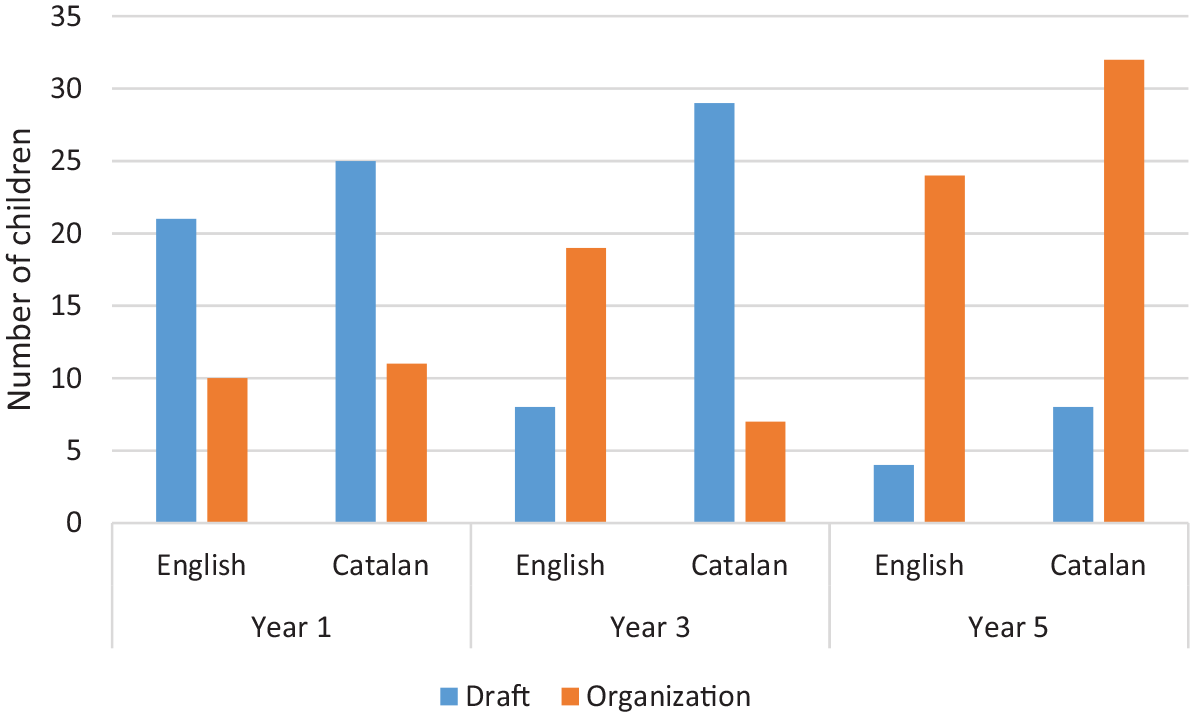
Type of plans produced by children.
Drafts were consistently characterized as linear multiword productions across school year and linguistic context; for this reason, they are not further examined here. By contrast, as shown in Table 1, there was greater diversity in the organizers produced, in terms of both their structure and their content. The structure of organizers gained complexity with school year. While younger writers produced as many linear as structured organizers, for children in Year 5, structured organization was more common, and hierarchical organizers, where different levels or information are explicitly displayed, appeared only in this age group. This increase in complexity by age was significant, χ2(4, N = 103) = 18.59, p = .001, and did not differ by linguistic context, χ2(2, N = 103) = 1.35, ns.
Types of Organizers Produced by Children.
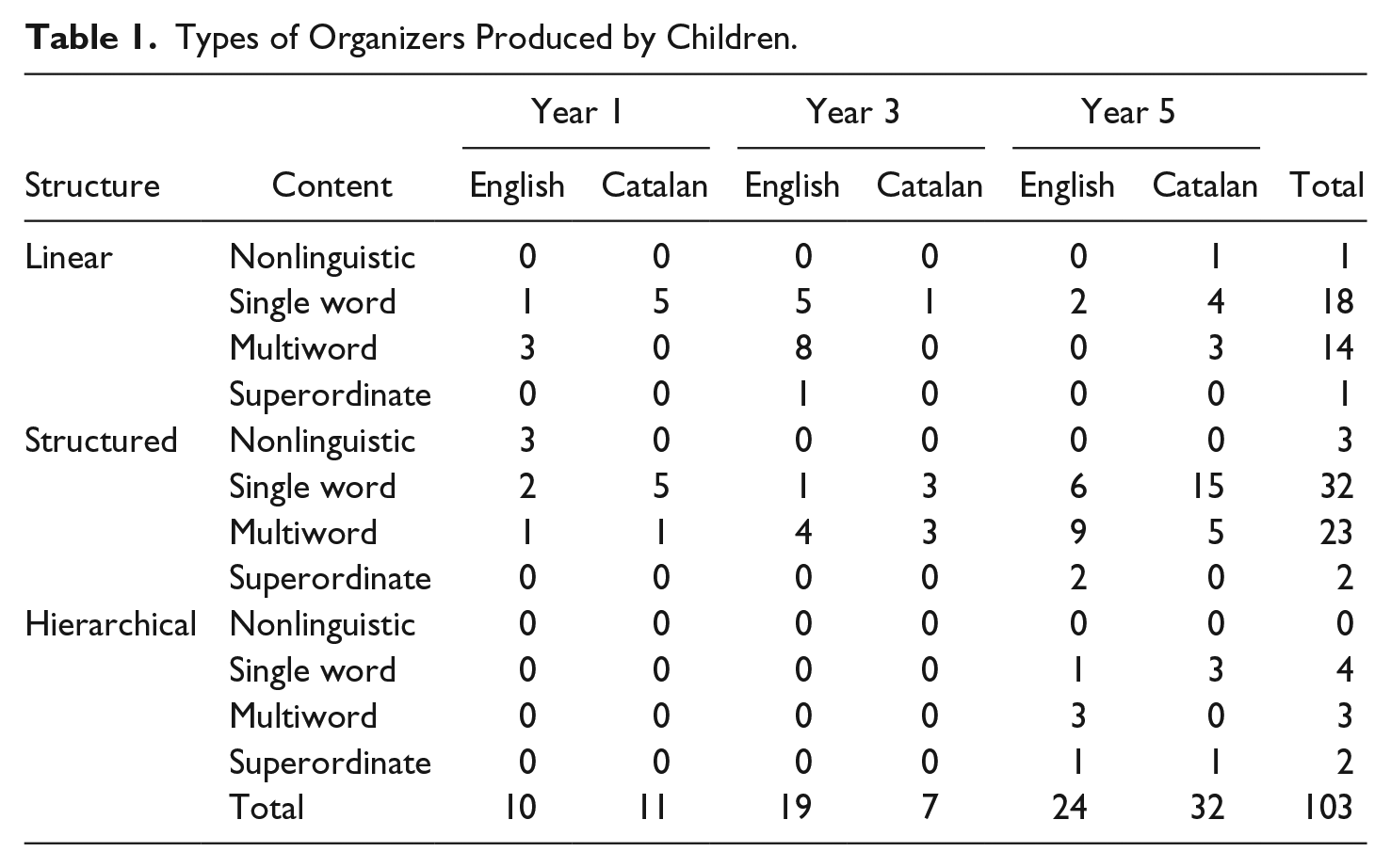
By contrast, the ways in which children expressed content in their organizers differed by context, χ2(3, N = 103) = 15.13, p = .002. In English, Year 1 children expressed content in different ways, ranging from nonlinguistic to multiword forms. After Year 1, children no longer produced organizers in which content was not displayed linguistically, and overall, the use of multiword, clause-like constructions to express content prevailed, χ2(6, N = 53) = 15.46, p = .017. In Catalan, we saw less variety and children used single-word or short syntagmatic constructions across all school years, χ2(6, N = 50) = 4.002, ns. The use of superordinate terms was rare even in the oldest children.
Are Prewriting Products Differentiated by Children’s Language Reading or Transcription Skills?
Logistic regression and multinominal logistic regression analyses were conducted to examine whether children’s linguistic context and developmental skills contributed to the type of prewriting activities. First, we examined regressions looking at drafting and organizing. Age in months was included as a covariate. The final model was significant, χ2(5, N = 199) = 49.69, p < .001, with the significant factors being age in months (p = .03) and language context (p = .002). None of the measures of the children’s skills were significant in the regression (language p = .72, reading p = .43, transcription p = .12).
Using multinominal logistic regression, we explored the contribution of our identified factors to the structure and content of the organizers produced. The model for structure was not significant, χ2(10, N = 103) = 16.87, p = .07. By contrast, the model for the content of the organizers was significant, χ2(15, N = 103) = 34.23, p = .003; context of instruction was the only significant factor in the regression (p = .002), not age (p = .20) or the children’s skills (language p = .41, reading p = .06, transcription p = .68).
Do Types of Plans Differentiate Writing Productivity and Quality?
We next examined whether children’s productivity and text quality varied by the types of plans the children produced. We first considered differences between drafts and organizers and then examined the impact of different types of organizers. Children whose prewriting activity was a draft produced fewer words (draft M = 54.27, SD = 35; organizer M = 74.26, SD = 40.1). However, ANOVAs controlling for school-year group revealed a significant effect of year group, F(1, 198) = 145.59, p < .001,
Examining children who produced organizers only, there were again differences in both the number of words produced and the text quality by structure and content. Means and SDs are presented in Table 2. As the table shows, there was an increase in both the number of words written and the text quality from linear, structured to hierarchical organization. However, ANOVAs examining text length controlling for school-year group revealed a significant effect of year group, F(1, 102) = 60.47, p < .001,
The Content and Structure of Organizers With Mean Text Length (SD) and Mean (SD) Text Quality Score.
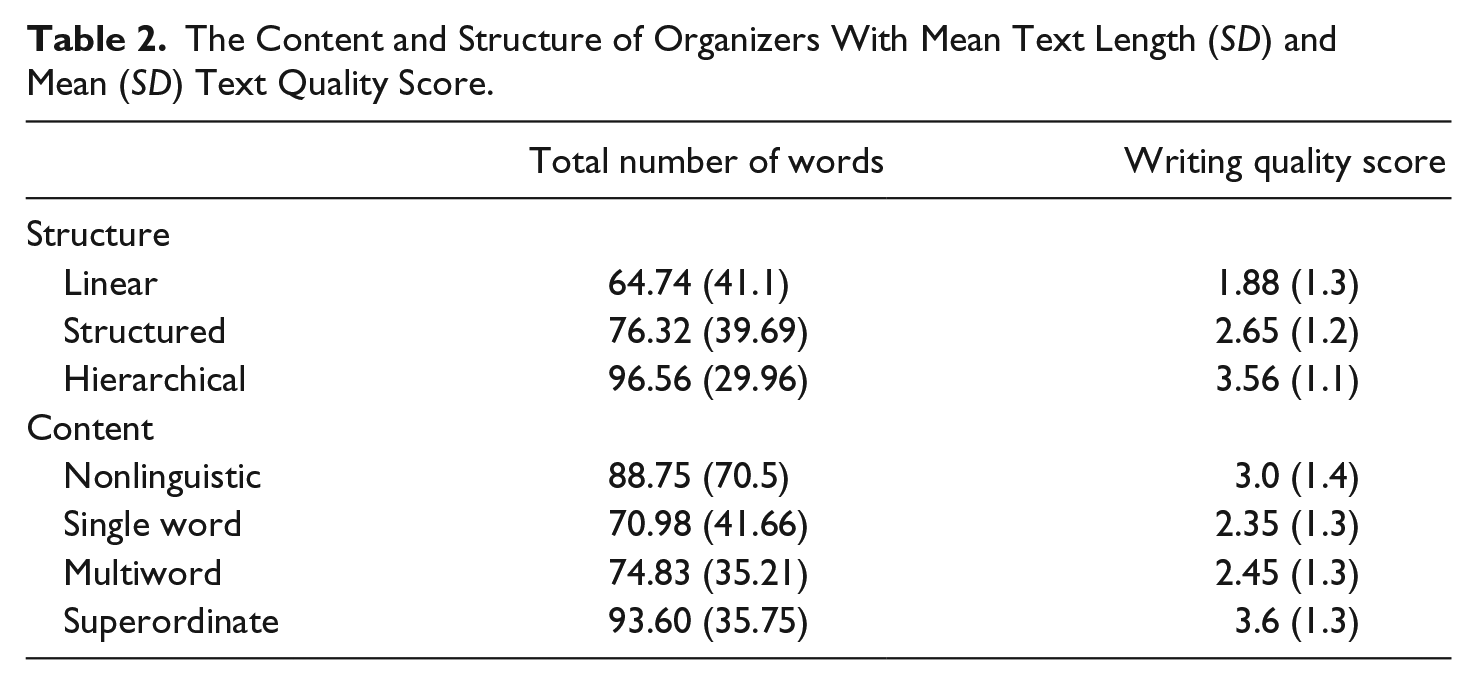
By contrast, both year group and organizational content had a significant impact on the quantity—year group F(1, 102) = 78.52, p < .001,
Discussion
Given the reported role of planning in children’s production of written texts, we explored what elementary school children did when they were asked to plan before producing a written text. To capture developmental differences, we examined performance in Years 1, 3, and 5. Furthermore, we examined the previously unexplored question of whether prewriting planning is underpinned by the child’s skills. We compared the performance of children educated in two different educational contexts, a school in Barcelona (Spain) and a school in London (UK), to capture whether children’s engagement in prewriting planning is driven by their context of instruction, independent of the child’s skills. Finally, we examined the contribution of prewriting planning activities to the characteristics of the written text.
Consistent with previous studies, we found that children can plan if asked to (Olinghouse & Graham, 2009). Virtually all children in our sample were able to produce some prewriting activity that was relevant to the task when prompted by a general instruction to think and plan in any way that would help them write a really good text. The products produced could be distinguished by either their draft-like quality or by the generation of non-text-like content and organization. Overall, children produced organizers slightly more than drafts, and this was more evident in English (66% of the sample) than in Catalan (45% of the sample). Typically, the youngest children produced drafts, as predicted, and the shift from drafting to organizing occurred in Year 3 for the English cohort and Year 5 for the Catalan cohort. This pattern likely reflects the differences in the two teaching systems and reinforces the view that creating prewriting activities to generate content and structure requires explicit instruction. In the English context, the teachers of the youngest pupils did little explicit instruction in planning, but by Year 3 this is reported to occur more (Dockrell et al., 2016). By contrast, in the Catalan context, Year 1 teachers reported that planning was not included in their writing teaching practices, and although children in Year 3 were encouraged to think before writing, explicit and systematic teaching of planning was not in place until Year 5 (Generality of Catalonia, Department of Education, 2009).
Children’s drafts followed a standard format: They were all text-like, linear products using multiword clauses. By contrast, children’s organizers varied more widely in terms of both structure and content. Change in structure followed a similar pattern across both contexts, with an increase of complexity by age. Older children produced more variety in the structure of their organizers, including drawings, lists, and simple mind maps. In addition, only in Year 5 did we find evidence of hierarchical organizers, where different levels of information were listed and the relationships between them were explicitly displayed through arrows or similar graphic mechanisms. Organizers presented variety also in relation to the expression of content. However, though differences were significant across educational contexts, there was only a trend by school year, indicating a need for further studies with larger samples. English children produced more multiword, clause-like constructions, whereas Catalan children produced more instances of organizers where content was expressed by single words or short syntagmatic constructions.
Whether children drafted or organized was not associated with the child’s language, reading, or transcription skills, further supporting the need for explicit instruction in prewriting planning. Such instruction should focus on teaching children to generate ideas and organize them in a plan. Our results provide preliminary evidence that explicit instruction on prewriting planning may be beneficial, irrespective of the children’s skills and the language they write in. This lack of relation stands in marked contrast to studies that focus on the amount and quality of children’s written products (see, for example, Abbott, Berninger, & Fayol, 2010). In contrast to studies examining which child’s skills underpin the production of written text, no previous attempt has been made to examine the skills underpinning the ability for children to plan. Thus, we further examined whether individual language, reading, and transcription skills explained the characteristics of children’s organizers. We had predicted that language and reading skills would be associated with idea generation—that is, content. Age but none of the linguistic factors explained significant differences in drafting or organizing. Of interest is the near significant (p = .06) effect of reading on the content of the children’s organizers. Poor reading comprehension impacts on text-level writing, where children with poorer reading comprehension, but age-appropriate spelling, produce texts that are more limited and less sophisticated in comparison to texts by their age-matched peers (Cragg & Nation, 2006). Bidirectional relations between reading and writing exist (Abbott et al., 2010), but recent evidence suggests that reading-to-writing conceptualizations are superior, especially for word and text levels of writing (Ahmed et al., 2014). Thus, it may be that more competent readers can generate and translate ideas more fluently to include in their prewriting activities.
Finally, we examined the relationship between children’s ability to plan and the length and holistic quality of their written texts. Our results show that children who produced organizers to prepare for writing produced longer and better texts. These results are consistent with previous research that demonstrated that primary school-age children make little use of the draft plans they produce. These data suggest that an organizer, as opposed to a draft, may reflect a more advanced ability to differentiate planning from translation. Such ability, however, would not be related to the child’s level skills and might instead be supported by explicit focus and instruction on this high-level process of writing. It is worth noting that the content of organizers made a significant contribution both to text productivity and quality and that it was precisely organizers where content was expressed nonlinguistically that were significantly different. Ideation—that is, access to content from long-term memory—can take multiple forms, involving language, images, or abstract thought (Graham, 2018). A positive effect of using nonlinguistic means to support the understanding and learning of linguistically encapsulated content has been shown by Ainsworth, Prain, and Tytler (2011; but see Jaeger, Velazques, Dawdanow, & Shipley, 2018).
In sum, our results contribute to the evidence that even though young writers have the capacity to plan for writing, the impact of this planning activity on the text is limited. This further highlights the importance of teaching children how to plan both in terms of structure and content generation. There is mounting evidence that teachers should be encouraged to include the teaching of planning activities even at the early stages of primary school (Graham & Harris, 2003, 2005). Explicit, systematic instruction to enable children to use planning strategies independently and in a consistent way across writing topics or genres can enhance writing performance even in young writers or children who struggle with writing.
The developmental pattern by which children progressively abandon drafting as prototypical planning in favor of organizers reflects the stages at which explicit instruction on planning is introduced at school. If, as shown in other studies, planning efficiently is a skill that is learned by the child, then it is important that we gain understanding of what types of plans and what aspects of content and structure in plans contribute effectively to the characteristics of the written text. Our results suggest that some ways of expressing the generated content are more beneficial than others. However, to date, the isolated effects of idea generation remain under-researched, in contrast to a number of studies examining the effect of outlining (Johnston, 2014).
Limitations of This Study
This is the first study to examine the products of prewriting planning across all stages of primary school in two different educational and linguistic contexts and the relation of these products to some of the child linguistic variables predicting compositional writing. There are a number of limitations that should inform future research. First, the sample is of a small size, which limits the power to detect significant differences between groups. And, the sample is limited to two urban schools and as such lacks generalizability and the potential to detect school effects (Smagorinsky, 2018).
Second, teachers were asked if planning was taught at all, and all teachers stated compliance with the curriculum guideline. However, no further data were collected about the planning and writing instruction in each educational context. Future research is needed that includes information at this level and examines the impact of the specific educational practices on the characteristics of children’s outputs. Third, despite our attempts to avoid explicit instruction in planning, children were nonetheless prompted by the researcher to plan to prepare to write good texts, and we cannot therefore assume from our results that children would show the same behavior without being explicitly prompted.
The role of children’s prewriting planning activities requires further exploration. Studies are needed that include a wider and deeper range of information regarding the characteristics of the classroom as a writing community to see in what conditions cognitive strategies become embedded as procedural knowledge and available for all writing tasks, rather than remaining as activities that are engaged in only in response to prompts administered by the teacher. In addition, further research is needed to see the different developmental patterns and contributions of prewriting and online planning.
Supplemental Material
OL_SUPP_APP_1_Llaurado – Supplemental material for Children’s Plans for Writing: Characteristics and Impact on Writing Performance
Supplemental material, OL_SUPP_APP_1_Llaurado for Children’s Plans for Writing: Characteristics and Impact on Writing Performance by Anna Llaurado and Julie E. Dockrell in Journal of Literacy Research
Supplemental Material
OL_SUPP_APP_2_Llaurado – Supplemental material for Children’s Plans for Writing: Characteristics and Impact on Writing Performance
Supplemental material, OL_SUPP_APP_2_Llaurado for Children’s Plans for Writing: Characteristics and Impact on Writing Performance by Anna Llaurado and Julie E. Dockrell in Journal of Literacy Research
Footnotes
Declaration of Conflicting Interests
The author(s) declared no potential conflicts of interest with respect to the research, authorship, and/or publication of this article.
Funding
The author(s) received no financial support for the research, authorship, and/or publication of this article.

Supplemental Material
The appendix referenced in this article and abstracts in languages other than English are available at online.
References
Supplementary Material
Please find the following supplemental material available below.
For Open Access articles published under a Creative Commons License, all supplemental material carries the same license as the article it is associated with.
For non-Open Access articles published, all supplemental material carries a non-exclusive license, and permission requests for re-use of supplemental material or any part of supplemental material shall be sent directly to the copyright owner as specified in the copyright notice associated with the article.
