




Abstract
Writing argumentative texts is a hallmark of literacy attainments with a long and laborious trajectory. The present study explored the incipient stages in argumentative texts written by 293 Hebrew-speaking Israeli children in second, third, fourth, and fifth grades. The literacy cognitive, transcriptional, linguistic, and reading abilities were analyzed, as well the different text structure quality of children’s argumentative texts. The results indicate that that both literacy ability and text structure quality increase with age. However, not all the increases in the different literacy abilities are significant. Text structure quality—a measure of text organization and ideation—becomes more sophisticated and complete with age, attaining high-quality text structure in fourth and fifth grades in the production of autonomous texts with genre-driven elaborate features. The predictive power of the different literacy abilities to sustain a better-structured text varies across ages.
In societies that value literacy, a paramount development in the life of humans is to become literate. In the United States as well as other schooling traditions drawing on the U.S. system, such as that of Israel (where this study takes place), until recently there has been a pronounced lack of emphasis across the scholastic span on writing (National Commission on Writing for America’s Families, Schools, and Colleges, 2003) in comparison with reading and math. Yet, today’s most desirable jobs need sophisticated writing skills to ensure success, as most paid positions require some writing responsibilities, promotion relies on good writing skills, and most social and economic interaction occurs via cyber communication that is based on writing. In the United States, in 2011, roughly 25% of secondary school children were reported as having had writing experience explaining or persuading (National Center for Education Statistics, 2012). Learning to write has become the currency to lifelong commodities such as education, professionalization, business, and well-being. This currency is predominantly acquired within the early years of schooling through the trajectory of literacy development.
In this study, we focus on how novice writers organize the rhetorical layout of argumentative texts, what rhetorical components they include, what abilities are summoned to construe a well-structured text, and how this structure develops throughout elementary school. To this end, the study aims to analyze the relations between cognitive, transcriptional, linguistic, and reading abilities and the structural quality of argumentative texts written by Israeli, Hebrew-speaking, and Hebrew-writing children from second to fifth grades. This study is focused on the early development of text writing quality, which draws on a complex web of knowledge and abilities historically understudied in the field. Second, it addresses the children’s production of argumentative texts, a specific, late-emergence genre, given its structural semantic and pragmatic complexity. Last, it provides a characterization of the developmental path of argumentative text quality in relation to indicators of literacy-related abilities.
Background
The Development of Writing Ability
Writing is a complex activity involving the integration of cognitive, linguistic, and discursive resources, constrained by content knowledge of the topic (Hayes, 1996; MacArthur, Graham, & Fitzgerald, 2006). Writing requires planning grounded in organizational structures of different text genres that were formulated from previous exposure and consequent expectations of a discourse community (van Dijk, 1980) and stored in memory for future access (Bruner, 1990). Writing is as much a matter of discovering or inventing the thought to be expressed in the text as it is a matter of expressing it in an appropriate and convincing way (Hayes & Flower, 1980), following organizational structures to guide the text production process (Hayes, 2012).
From a developmental perspective, children’s attention to the written forms of language begins earlier than formal instruction in reading and writing. Children experiment and hypothesize about writing before they can read or write, starting with what they deem to be writing that is readable (Ferreiro & Teberosky, 1979/1982; Stavans, 2015a, 2015b; Teubal, Dockrell, & Tolchinsky, 2007) or distinguish between modes and modalities of discourse (Lee, Torrance, & Olson, 2001). But as children grow older, their linguistic, cognitive, and textual abilities increase with experience with written language, and they contend with two pivotal aspects. The first is the “what” to write about—namely, content. The second consists of “how” to write about that content, monitoring the communicative goals, audience, language (both words and sentences and their proper ordering), and genre constraints (Deane et al., 2008).
The development of writing goes from emergence to mastery by children’s exploration of and inquiry into the superordinate graphic features of written texts and the linguistic activities these afford in improving text quality. Writing development involves continuity (i.e., the progression of writing ability on a continuum), complexity (i.e., the gradual improving of text quality), and sociality (i.e., writing as a tool to co-construct the self within society) that builds academic literacy (i.e., the gradual development of linguistic competences, content-dependent knowledge, and the understanding of oral and written differences) at school (Ravid & Tolchinsky, 2002). Text writing is guided by its different intended audiences, registers, genres, and modalities (Berman & Nir-Sagiv, 2009), which comply with cultural conventions for the overall text structure and the linguistic forms (Tolchinsky, 2016).
Text writing is an academic ability developed through formal instruction across school years (Graham, Berninger, & Abbott, 2012), but it emerges before schooling and continues throughout the life span. Studies of the development of written language have, a grosso modo, taken either a sequential or simultaneous approach. According to Tolchinsky (2016), “the great divide” in research on the development of writing is between (a) studies with a sequential approach (also known as “additive-cumulative views”), which relates to writing as the transcription or graphic representation of the spoken language, where written language is generated in sequence, starting with the sound to the word, sentence, and finally text (Berninger, Abbott, Abbott, Graham, & Richards, 2002; Berninger & Swanson, 1994; Berninger & Winn, 2006; Juel, Griffith, & Gough, 1986), and (b) studies with a simultaneous approach (also known as “mutually enhancing-interactive views”), which relates to writing as a discourse mode that is a systematic way of encoding meaning and representing language (Berman & Nir-Sagiv, 2007; Dyson, 1983; Ferreiro & Teberosky, 1979/1982; Ravid & Tolchinsky, 2002). The present study incorporates the sequential and the simultaneous approaches so as to view the evolution of the production of a well-structured argumentative text benefiting from both.
To date, there is much research on the development of writing in terms of the reading–writing connection, the linguistic prerequisites for text production transferring language to text, and the process and the product features and predictors involved in writing. There has been a growing emphasis on text quality, yielding inconclusive results in regard to what text quality is understood to be, how it is studied, the perspectives taken on what is a “good” text, and different disciplinary orientations toward writing (Berman, 2008).
Text Quality
The way to determine text quality is not straightforward and bears several interpretations and components whose relative contribution changes with age, modality, and genre (Berman, 2008; Ravid & Shalom, 2012). Text quality can be established by subjective holistic expert evaluation (Dockrell, Marshall, & Wyse, 2016; Olinghouse & Wilson, 2013) or the multiple dimensions of children’s text writing as sustained by different competencies that must be orchestrated effectively in real time and under the constraints of limited processing capacity (McCutchen, 2006). This multiple dimensionality and the inherent complexity of the competencies needed in text quality have been empirically supported by the simple (Berninger et al., 2002; Juel et al., 1986) and not-so-simple views of writing (Berninger & Winn, 2006). In the simple view of writing, ideation (i.e., text generation) and transcription are the two basic skills needed to produce a written text. Ideation or text generation includes thinking not only about the ideas, or the “what” to write, but also about the “how” to organize these ideas (Juel et al., 1986). Ideation, which is the preverbalized conceptualization of ideas and thoughts, is encoded in oral language, which then needs to be translated and transcribed into written language (Berninger et al., 2002; Kim et al., 2011; McCutchen, 2006). The not-so-simple view of writing adds the contribution of working memory (WM) and self-regulatory executive functions, suggesting that long-term memory is activated during planning, reviewing, and revising, and short-term memory is activated during reviewing and revising (Berninger & Winn, 2006).
A complex network of factors explains the difficulty in reaching a good written text quality, starting with how people define what “text quality” is and how to measure it in different languages, orthographies, and writing genres and across ages. Transcriptional, linguistic, and cognitive factors have been shown to contribute to text writing quality. Moreover, language typology, especially orthography, has been shown to affect good text writing (Babayiğit & Stainthorp, 2011). Although previous studies showed that these microstructural compositional (linguistic, cognitive, transcriptional, and reading) factors are at play, the gains in different languages and their developmental nature remain inconclusive (Tolchinsky, 2016). Similarly, macrostructure compositional factors—such as organization of the text, the proportion and presence of functional components of the text, overall coherence and content richness, and communicative efficacy—have been found to develop slowly, to be highly dependent on the discourse genre (Berman & Nir-Sagiv, 2007), and to be attained in early adolescence.
To the best of our knowledge, studies on the developmental staging of argumentative texts have been scarce and have primarily focused on these texts’ comprehension or on instructional practices used to teach writing (Horowitz & Wilburn, 2017). Text structure knowledge in younger children has been studied in terms of text structure characteristics (Yochum, 1991), readers’ age (Garner & Gillingham, 1987), and overall comprehension skill (Englert & Hiebert, 1984) leading to structure awareness. However, the construction of texts requires the integration of structural components (“events” in narrative texts, “topics” in informative texts, and “claims” in argumentative texts) into a unified piece of discourse supported by a genre-specific structure. In argumentative texts, the content is organized as the writers generate their arguments (Andriessen, Chanquoy, & Coirier, 1999; Ferretti & Fan, 2016). Awareness of text structure varies as a function of text type, from less structured (descriptions) to more structured (argumentative texts). Text structure knowledge together with text organization and reading comprehension are pivotal in primary school, not only for procedural text-processing knowledge but also for conceptual structural knowledge increments (Stavans, Seroussi, Rigbi, & Zadunaisky-Ehrlich, in press).
Extended discourses such as argumentative texts—oral and written—have been the focus of several studies for different reasons. First, argumentative writing is one of the pivotal genres for academic literacy and professional development that is targeted in formal education once the incipient microstructural compositional skills are attained. Second, the structure of argumentative texts is relatively more rigid, requiring an introduction, a body that includes claims, supports to the claim, an optional counterclaim, and an end (Ferretti, Lewis, Andrews-Weckerly, 2009). Third, exposure to this genre occurs in later stages of writing development and scholastic curricula than exposure to informative texts. Fourth, the pragmatic skills (i.e., the ability to understand the mind of the addressee) and linguistic skills (i.e., using the suitable connectors typical to this genre) contribute further to the relatively late mastery of argumentative texts (Toulmin, 2003). Last, from a sociocultural perspective, argumentative texts are socially situated among interlocutors who may have different opinions. Argumentative texts require that the interlocutors converge on a certain set of propositions and critical standards that, put together, affect and judge the acceptability of their standpoint (Ferretti & Fan, 2016; Walton, Reed, & Macagno, 2008).
Taking a developmental perspective, we examine different literacy-related abilities children recruit (i.e., the macrostructural composition skills) that impinge on the structural quality of their written argumentative text (i.e., microstructural compositional productions; Berman & Nir-Sagiv, 2009; Tolchinsky, 2016). Inspired by Rhetorical Structure Theory (RST; Mann & Thompson, 1987) and by the work of Bruner (1979), who saw the writer’s creative expression as the development of autonomous thinking that generates the writer’s own personal understanding, we espouse the functional stages in the text as concomitant with content, contextual motivations, and interlocutors, as proposed in the RST. Within the RST framework, rhetorical components are hierarchically structured with “core” and “peripheral” elements such as the claim and the support in argumentative texts (O’Hallaron, 2014; Voss & Van Dyke, 2001). Concordantly, the organization of these components follows the macrostructural compositional constraints inherent in the discursive aspect, which are socioculturally bound (Berman & Nir-Sagiv, 2007; Tolchinsky, 2016), arranging information for particular purposes (Kress, 1982/1994) and coherently weaving relationships among textual ideas in a cognitive representation to facilitate text comprehension (Kintsch, 2004), posing specific problem-solving challenges for the writer in the staging of argumentative texts.
In this study, we focus on a close analysis of the contribution of different cognitive, linguistic, transcription, and reading abilities as preambles to the production of text structure quality in argumentative texts. Motivated by the RST, we focus on a tiered structure borne out of the autonomous textual knowledge (an introduction, the body of the text, and a concluding end) as well as the genre-specific knowledge of the argumentative text (claim and support). These are indicators of the specific genre and need to be mastered and imparted to ensure quality of text writing (Tolchinsky, Johansson, & Zamora, 2002).
Abilities Related to Text Quality Writing
When children engage in writing, they must orchestrate not only the flow and order of the ideas they wish to express but also the ability to write them fluently—quickly and accurately (i.e., with correct spelling). Research has shown that transcription—namely, handwriting—skills contribute to spelling and that the number of words in a composition is considered a measure of compositional fluency. Writing fluency, a low-level transcription skill, has been reported to be highly correlated with higher-level aspects of writing, such as text organization (Bourdin & Fayol, 1994; Chanquoy & Alamargot, 2002; Olive, Alves, & Castro, 2009; Puranik & Al Otaiba, 2012). Wagner et al. (2011) claim that measures of handwriting fluency tap into richer language aspects in a bidirectional relation, where writing fluency not only forms the basis of well-organized texts but is the outcome of the development of higher-level writing and language skills. Writing fluency involves motor skills and plays a role in text productivity (Graham, Berninger, Abbott, Abbott, & Whitaker, 1997), but studies have shown that writing skills do not necessarily generalize across genres. High handwriting fluency and accuracy frees cognitive abilities such as WM and attention to sustain ideas and text organization.
The cognitive load in writing is notable, requiring writers’ attention to planning, problem-solving, short- and long-term memory, executive functions, and recruitment of meta-cognitive and metalinguistic knowledge to achieve a well-written text (Kim & Schatschneider, 2017). Among the cognitive skills (measured by Raven’s Progressive Matrices, rapid automatized naming [RAN], WM) related to writing development of text quality, Raven—a nonverbal cognitive measure—provides a cognitive basis for ideational organization grounded in the ability to reason and infer a point of view, state it clearly, and back it up in a logical manner, weaving educed relations between claims and support (Kim & Schatschneider, 2017). RAN, used for assessing reading and spelling, rendered inconclusive results borne out of different language typologies, reading dimensions measured (speed and accuracy), reading material, different analyses, and different RAN tasks (letters, words of specific semantic field, digits, etc.). Yet, RAN measures in writing are scarce and novel (Albuquerque, 2017), mostly used in relation to spelling accuracy within and across languages, indicate the writers’ progress with age as encoding becomes more automatized and less laborious (Berninger & Winn, 2006). WM relates to online production effect on processing overload, assuming that children’s writing develops within a limited working-memory capacity (Swanson & Berninger, 1996) that gradually automates components related to low-level processes (e.g., transcription skills) to free resources for other cognitive and linguistic demands while writing an argumentative text (Maggio, Lété, Chenu, Jisa, & Fayol, 2012).
Ideas must be translated into language by means of words and their proper sequencing into syntactically appropriate structures. Lexical richness constituting different vocabulary constructs has been reported to be a good predictor of writing quality in a given genre; it is often measured in terms of breadth (number of words) and depth (words that bear semantic complexity). Although both features have been shown to affect the quality of a written text, lexical breadth has been reported to be a better predictor in narrative and descriptive texts, whereas lexical depth is a better predictor in persuasive texts among fifth graders (Olinghouse & Wilson, 2013). Castillo and Tolchinsky (2017) have shown that lexical depth measured in a synonym/antonym task was related to text productivity, lexical richness, and text structure. The relation between syntactic knowledge and good text structure is inconclusive and depends on the methods used to measure it. Research on syntactic complexity has shown that students use increasingly complex syntactic structures as they gain familiarity and skill with school-related writing (Reilly, Zamora, & McGivern, 2005; Schleppegrell, 2004). However, few studies have reported on how this development occurs during early grade levels and in different text genres (Purcell-Gates, 1988; Tower, 2003). Grammaticality judgment ability administered on third graders predicted text quality ratings (Olinghouse, 2008), and receptive grammar and written productivity have been shown to be related in late kindergarten age children (Kim et al., 2011).
Reading ability has also been shown to be related to writing (Fitzgerald & Shanahan, 2000; Shanahan, MacArthur, Graham, & Fitzgerald, 2006), examining rather narrow aspects of reading (e.g., word reading) and its influences on writing (e.g., spelling). Broader aspects of reading–writing relations have been reported (Shanahan & Lomax, 1986), where reading-related skills (e.g., word analysis, vocabulary size, and comprehension) interactively influenced writing-related skills (e.g., spelling, vocabulary use, syntactic knowledge, and knowledge of story structure) among second through fifth graders. Similarly, high and low reading skills were related to composition quality and fluency among first to fourth graders (Abbott & Berninger, 1993; Stavans et al., in press), and third graders’ word-reading ability (i.e., word identification) was positively related to compositional quality, after accounting for gender, compositional fluency, IQ, and grammatical understanding (Olinghouse, 2008). Moreover, the relations found between the reading skills and the structure of the texts vary across ages, genres, and text components. This variability and the strength of the relations is evidence that writing in elementary school evolves slowly, and that some reading skills do not seem to be related to text structure production (Stavans et al., in press).
To our knowledge, quality text structure in argumentative texts has not been studied cross-sectionally throughout elementary school years in Hebrew-speaking and Hebrew-writing children. While there have been studies (surveyed above) on some of the abilities and the production of written texts, these have looked at text quality in terms of linguistic forms and functions, at some ages, with different tasks.
This Study
This study traces the relations between children’s age-dependent cognitive, transcriptional, linguistic, and reading abilities and the text structure quality of argumentative text, as evidenced in the structural components deployed in the written texts (i.e., the presence of both macro- and micro-components in the structure of an argumentative text to sustain both textual autonomy knowledge and genre-specific knowledge). To this end, we address the following research questions:
Method
Participants
The participants in this study were 291 Hebrew-speaking schoolchildren (151 boys and 140 girls) in Grades 2 (n = 69), 3 (n = 69), 4 (n = 68), and 5 (n = 85), from three public schools in middle to high socioeconomic status (SES) residence areas in central Israel. Participants’ age was defined by their grade level. Seven participants were not included because they were newcomers with less than 2 years of schooling in Israel, and six participants dropped from the sample because they left the school midyear. All participants included in the sample had signed parental permission to take part in the study. Participants attended schools that followed the National Literacy Curriculum, which adopted a phonics-based approach to literacy instruction in first grade, followed by a gradual engagement with texts through systematic teaching of linguistic structures and discourse patterns. The national curriculum promotes explicit instruction and meaningful context in the production and comprehension of texts in all oral and written modalities, connecting the sociocultural role of the text, the text content and components, and the discourse and language of the text.
Material and Procedures
This study examined the relations between transcription, linguistic, reading, and cognitive abilities and argumentative text structure quality.
Abilities (independent variables)
Cognitive ability was assessed by three different tests. The WM test was administered individually (Shany, Bahat, Lachman, Shalem, & Zeiger, 2006). The children heard sentences and were asked to complete the missing word in each sentence. Then, they repeated the missing words in the correct sequence. The number of items in each set increased from two to six. For scoring, a child received 1 point for each correctly repeated word and an extra point for repeating all the words in each set in the correct sequence. The final score was transformed into percentages.
The Raven’s Colored Progressive Matrices (Raven, Court, & Raven, 1990) were administered collectively. Children were asked to identify the missing element that completed a pattern in each one of the test items, which were presented in the form of 6 × 6 matrix. There are no Israeli standardized scores or percentiles for this measure, although it is widely used. The typical scoring of this measure is either by the raw number of correct answers (range = 0-36) or by a percentage of correct answers out of 36 points. Hence, scoring consisted of 1 point for each correct answer.
RAN, or rapid automatized (letter) naming (Shany et al., 2006) was administered individually and consisted of 50 printed letters that were presented, and the child had to read them aloud as fast as possible. The letters are five (nonfinal) Hebrew letters, each repeated randomly 10 times. Scores were calculated by the number of letters per minute read correctly and transformed into percentages.
Transcription ability was measured by handwriting fluency and spelling. A handwriting fluency task, measuring the number of letters written in a minute (Wagner et al., 2011), was administered individually. A score of the types to token ratio (TTR) was obtained by dividing the types of different letters written by their tokens (total number of letters). We deemed the TTR to be a better assessment of handwriting fluency quality as it distinguishes between fluency grounded in writing a single letter many times as opposed to fluency of writing many different letters.
Spelling was assessed collectively in class. The researcher dictated two different lists of 20 words in each list: one list of content words and one list of function words (Shany et al., 2006). A combined percentage score of correct spelling (out of 40 items) of both types of words was calculated.
Linguistic ability was measured in terms of lexical depth and syntactic receptive score. Lexical depth was measured by a synonym/antonym test (Glanz, 1989; Seroussi, 2011), where children were requested to provide synonyms and antonyms to 15 words in two different lists, respectively, and by an adjectives test, which checked morpho-lexical skills by asking children to complete 10 sentences with derivational adjectives (Avivi Ben-Zvi, 2010). Scores of each test were collapsed into the lexical depth score. The syntactic receptive score consisted of the average scores on two tasks—the syntax judgment and correction, in which the children heard incorrect sentences and were requested to say them correctly, and the sentence paraphrasing task, where the children heard sentences and were requested to paraphrase them by adding a word provided by the researcher.
Reading ability was measured by high- and low-level reading skills. High-level reading skills were measured by reading comprehension tests containing an informative and an argumentative text for each grade level; each test included 15 multiple-choice questions targeting different levels of understanding based on the accessibility of information in the text (Brandão & Oakhill, 2005). Tests were administrated in class. Low-level reading skills were assessed by two reading accuracy and fluency tests consisting of reading 38 isolated words and reading a whole narrative text (Shany et al., 2006), both administered individually. The phonological awareness test constituted a phoneme deletion test administered individually (Shany et al., 2006). Scores for the phonemic awareness test were the percentage of correct responses recorded; for the word- and text-reading fluency and accuracy, the percentages of correct reading were calculated; and for the reading comprehension test, percentages of correct answers were calculated. Low- and high-level scores constituted a weighted score of the relevant tests.
Text structure quality (dependent variable)
Two argumentative texts were produced by each child on one of the following topics: (a) shortening the school week in exchange for longer study days, (b) introducing vending machines in school, or (c) instituting a school uniform. One text was administered individually and the other was administered in class by a researcher. The topics of the texts were assigned randomly, ensuring that each child wrote on two of the three topics. The instructions for the text production (in class or individually) were (in free translation from Hebrew) as follows:
Now, I would like you to write me a text (essay) about:
. . . running a long school day in exchange for no school on Fridays at school. You probably know that there is disagreement as to whether it is right to run a long school day throughout the week in return for no school on Friday;
. . . introducing vending machines selling sweets, snacks, and drinks to schools. You probably know that there is a debate about whether or not to install candy, snacks, and sweetened drinks vending machines in schools; or
. . . instituting a school uniform. You probably know that there is a lot of talk about whether to institute a school uniform or not.
What do you think? Why? Explain as much as possible your position on the subject so that you can convince the school administration and the parents.
The time limit for the task was the class period (roughly 40 min). Texts were analyzed for length (the number of clauses per text) and text structure components (proportion calculated as number of clauses in the component divided by total number of clauses in the text). All texts were transcribed in orthographic transcription exactly as the children wrote them (including spelling and punctuation), segmented into clauses (Berman & Slobin, 1994), and coded for the text structure component, as illustrated below.
Following the genre and the rhetorical theoretical frames aforementioned, components were defined as rhetorical components (introduction and end plus components that constitute the body of the specific genre) and genre-specific components. Each component present in the text was counted. The minimal condition for inclusion of an argumentative text was that it contained at least a claim clause and one support clause. Only nine cases were omitted from the database because they did not meet the threshold condition. Texts containing all five components—introduction, claim, counterclaim, support, end—were ranked on a 1 to 4 scale as Rank 4, see Appendix A.
Data Analysis
To address our first question, we first conducted a nonparametric Kruskal–Wallis test because of the nonnormal distribution of the predictors, to determine differences in predictors between grades. To address our second question, we first built the text structure quality ranks, as described above, and the association between ranks and grade was analyzed using chi-square. To address our third question, at the univariate analysis, we performed the Kruskal–Wallis test in each grade separately to determine differences in predictors between ranks, and for the multivariate analysis, we ran a cumulative odds ordinal logistic regression with proportional odds to determine the effect of different cognitive tests (Raven, RAN, syntactic receptive score, lexical depth, reading high level, reading low level, WFTTR, and spelling) on the argumentative text structure quality. Data were analyzed using IBM SPSS statistics software (Version 25.0, for Windows), and p < .05 was considered to be significant for all analyses.
Results
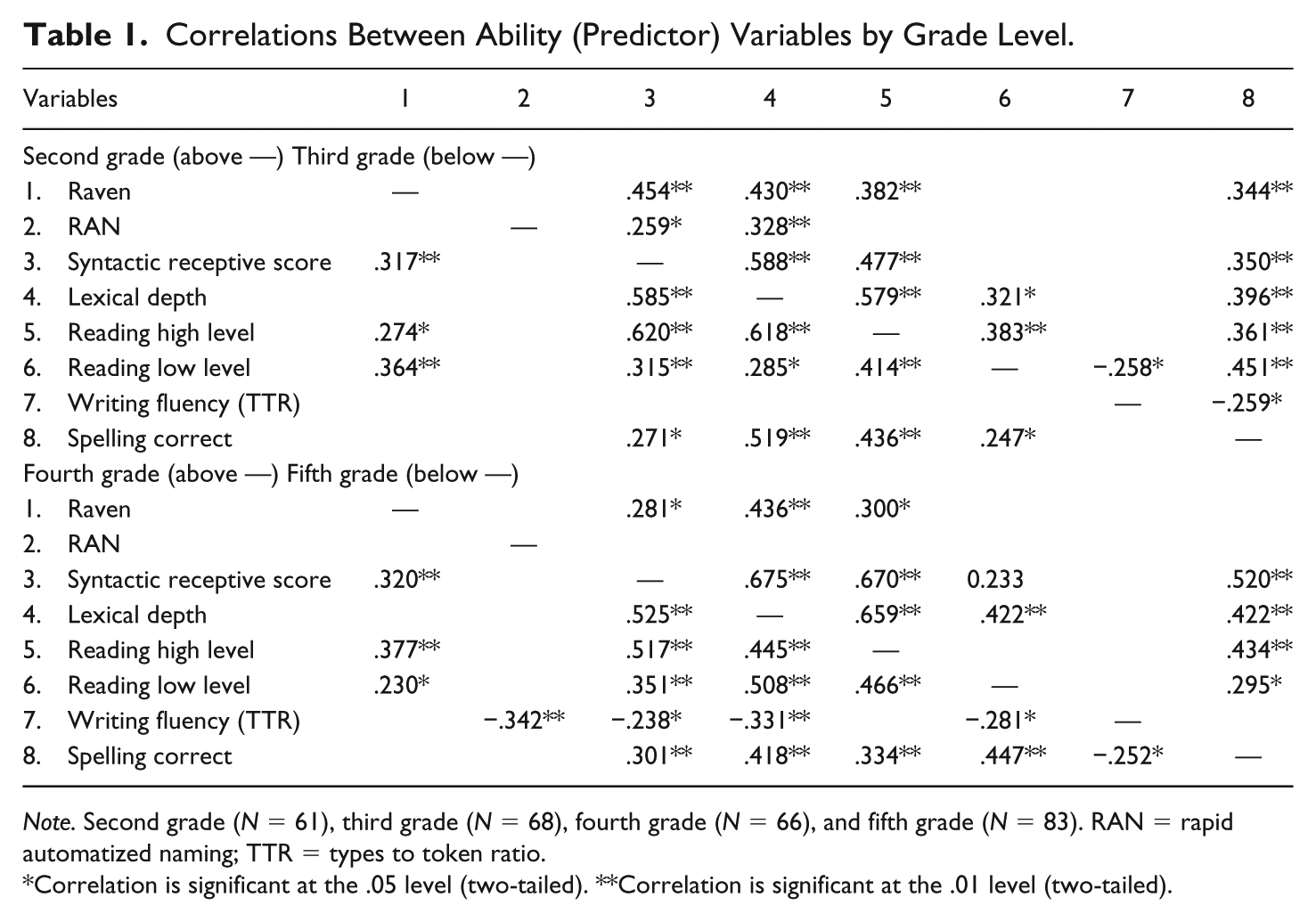
Addressing our first question, the results show there is a developmental difference across the cognitive, transcriptional, linguistic, and reading abilities (predictor indicators). As the distributions were nonnormal, we used the median for each predictor variable to show that each of the predictors develops with age, and we conducted a Kruskal–Wallis test to ascertain that these increments across ages are statistically significant. There were statistically significant differences in the predictors’ median across ages, with a continuous increase from Grade 2 to Grade 5 for most of the predictors (p < .0001) and a continuous decrease for writing fluency TTR (p < .0001). For example, Raven increased from a median of 88.9 in the second grade to 94.4 in the fifth grade, χ2(3) = 23.9, p < .001. Only the high-level reading score, with an increase from second to fourth grade and a sudden decrease in fifth grade, was not statistically significant. Spearman rho correlation between predictors is illustrated in Table 1.
Correlations Between Ability (Predictor) Variables by Grade Level.
Note. Second grade (N = 61), third grade (N = 68), fourth grade (N = 66), and fifth grade (N = 83). RAN = rapid automatized naming; TTR = types to token ratio.
Correlation is significant at the .05 level (two-tailed). **Correlation is significant at the .01 level (two-tailed).
Across all age groups, there was a statistically significant, positive correlation between nonverbal cognitive ability (Raven) and syntactic receptive ability, for example, in second grade, rs(61) = .454, p < .0001; in third grade, rs(68) = .317, p < .0001; in fourth grade, rs(66) = .281, p < .05; and in fifth grade, rs(83) = .320, p < .0001, and also between Raven and high-level reading ability. However, other cognitive abilities, such as RAN, are only positively correlated in second grade with syntax and lexical depth and are negatively correlated with writing fluency in fifth grade. At all ages, there was a positive correlation between the syntactic receptive ability and high reading ability, spelling, and lexical depth. Lexical depth shows a positive correlation with both high and low reading ability as well as spelling. Spelling has a positive correlation to both high and low reading skills. In all, across all ages, children with a good linguistic ability (syntactic, lexical) also have a good reading ability (high and low) and good transcription ability (spelling).
Our second question concerns the developmental difference between the productions of an argumentative text structure across the grade levels (predicted variable). The results show that there is a significant difference between the text structure quality across the ages. Figure 1 illustrates the percentage of children in each grade who produced a text structure at a different quality rank, as described above.
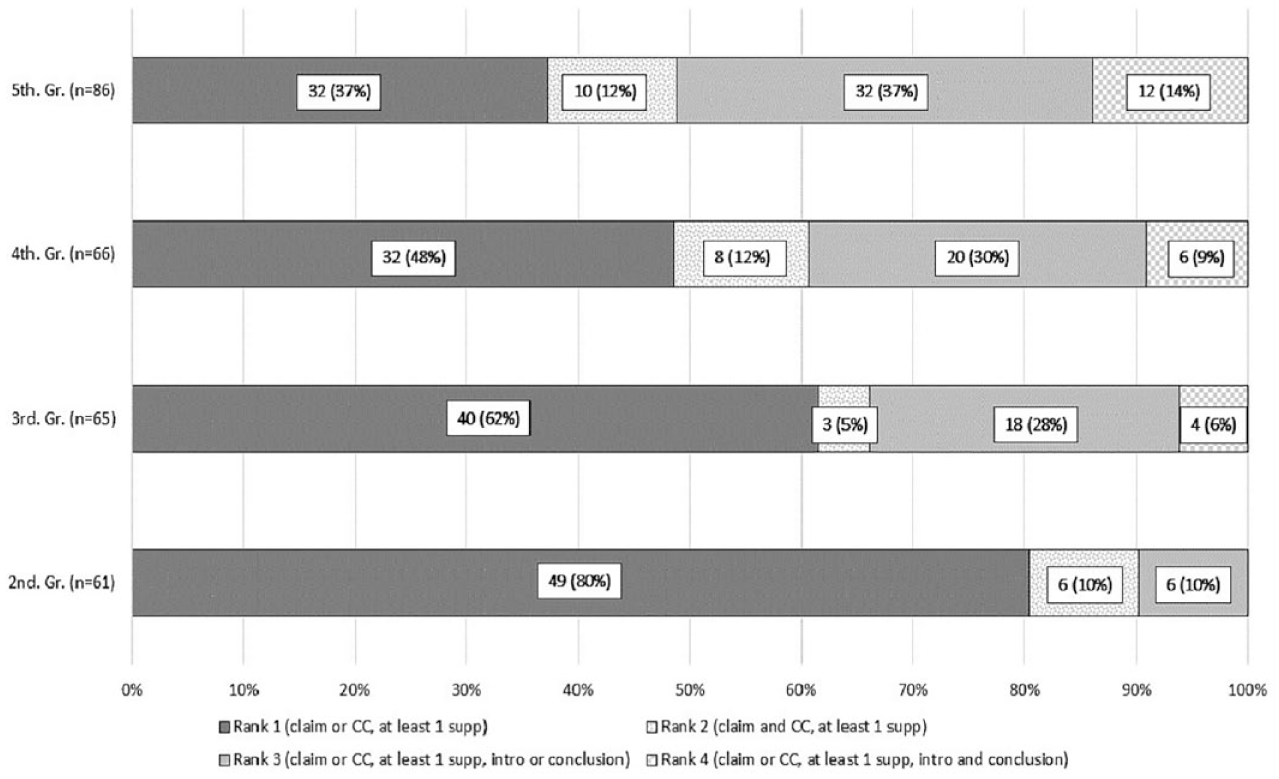
Percentage of children in each text structure rank by grade level.
Overall, the basic (minimal) structure (Rank 2), constituting a claim and support, indicates that across all ages, children are able to produce an argumentative text (micro-components) from second grade on. Moreover, our findings showed that with age, children expand their knowledge beyond the basic text to the more genre-driven autonomous text (represented in the higher Ranks 4 and 5), starting with third grade, with 26% of the texts (constituting both elements of micro- and macro-components) at the same rank, to the fifth grade, with 37% of the texts at the same rank. This developmental leap from the basic text to an autonomous genre-driven text that deploys specific discourse functions (e.g., an introduction, stating the topic of the argument rather than just stating the position taken by the writer), along with the definition of clear textual boundaries that set the text apart from the situational context (e.g., a multiple-component structure that introduces a counterargument, attesting to the fact that the writer is addressing a potential reader who might have a different opinion). Moreover, the findings further indicate that there was a statistically significant association between ranks and grade, χ2(9) = 34.8, p < .001.
The findings addressing our third question, regarding the contribution of the different abilities (predictors) to the argumentative text structure production, showed that at the univariate level, in second and fourth grades, only WFTTR appeared to show differences between the ranks (p < .05), and in second grade RAN was also different between the ranks (p < .05). No other significant differences were found.
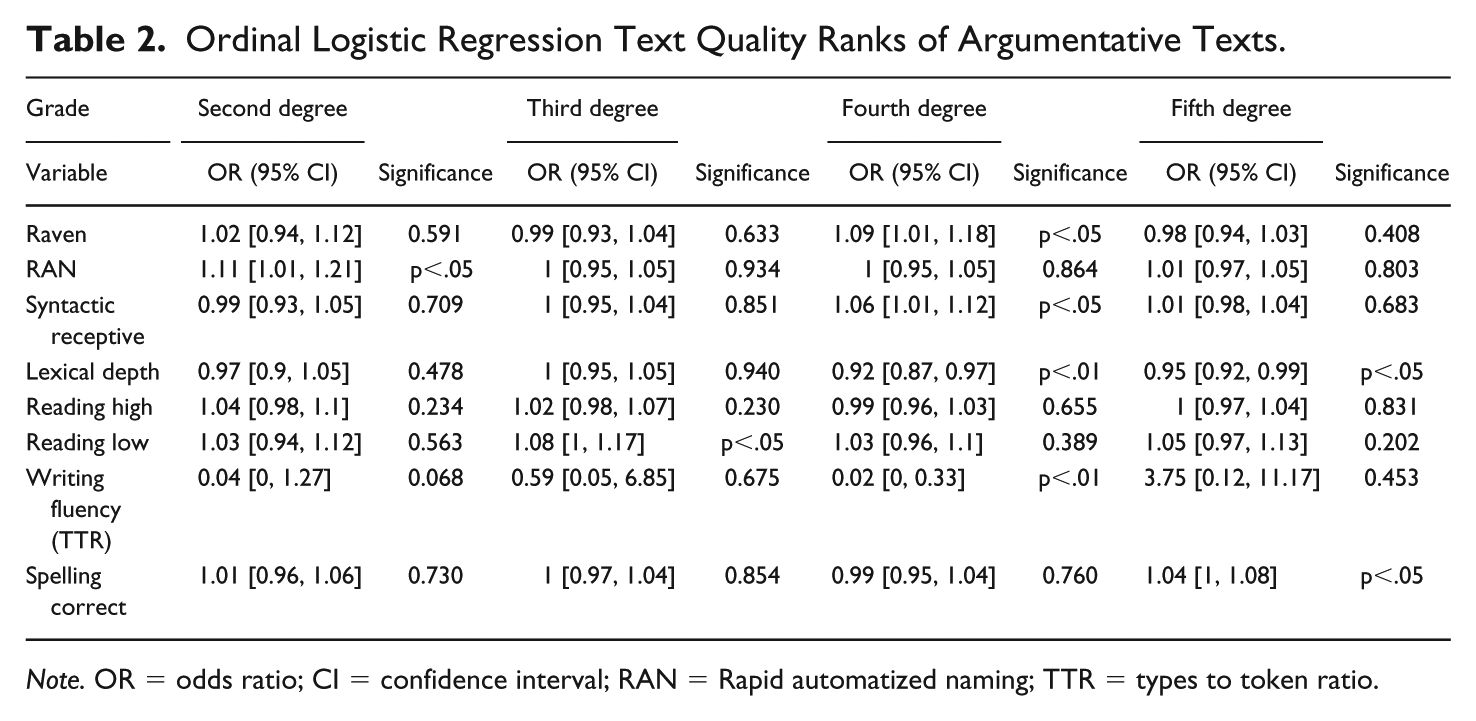
At the multivariate level, we entered all the predictors so that it would be possible to compare between the differential contributions of the predictors at each grade. There was no evidence of multicollinearity between predictors, as assessed by tolerance values greater than 0.1. Different predictors appeared to affect the likelihood of writing a high-quality text depending on grade, as illustrated in Table 2.
Ordinal Logistic Regression Text Quality Ranks of Argumentative Texts.
Note. OR = odds ratio; CI = confidence interval; RAN = Rapid automatized naming; TTR = types to token ratio.
In the second grade, an increase in RAN was associated with an increase in the odds of writing a high-quality text structure, with an odds ratio (OR) of 1.108 (95% confidence interval [CI] = [1.011, 1.214], p < .05), adjusting for all covariates. In the third grade, the only significant predictor was the low level of reading, based on phonological awareness and text and word-reading fluency, with an increase in the odds of writing a high text structure quality (OR = 1.082, 95% CI = [1.001, 1.169], p < .05). In the fourth grade, of the eight predictor variables, four were statistically significant: Raven, syntactic receptive score, lexical depth, and WFTTR, with an OR of 1.093 (95% CI = [1.010, 1.183], p < .05), 1.064 (95% CI = [1.015, 1.115], p < .01), 0.919 (95% CI = [0.868, 0.972], p < .005), and 0.020 (95% CI = [0.001, 0.332], p < .01), respectively. In the fifth grade, an increase in lexical depth was associated with a reduction in the likelihood of producing a written high-quality text structure, with an OR of 0.953 (95% CI = [0.918, 0.990], p < .05), and an increase in the percentage of words without spelling errors was associated with an increase in the odds of producing a written high-quality text structure, with an OR of 1.040 (95% CI = [1.002, 1.078], p < .05), adjusting for all covariates.
Discussion
The ability to write a well-structured argumentative text develops gradually and differentially across the elementary school years. Overall, the patterns of the scores follow a developmental increment as expected in terms of cognitive, transcriptional, linguistic, and reading abilities as well as text structure measures. Yet, not all increments turned out to be significant across the ages. Developmental leaps are more pronounced and significant between the young and old age groups (second and fifth).
We addressed three main issues to investigate what abilities are summoned to construe a well-structured text, how novice writers organize the rhetorical layout of argumentative texts and which rhetorical components they include to do so, and how this structure develops throughout elementary school. First, we sought to evaluate the cognitive, linguistic, reading, and transcriptional abilities children must convene to produce a written argumentative text. All measures increased with age in a significant manner except for writing fluency TTR. Moreover, across all ages, linguistic (syntactic receptive ability, lexical depth), reading (high and low ability), and transcriptional (spelling) abilities are closely related, so that when there is good syntactic receptive ability, there are also good reading comprehension, lexical depth, and spelling abilities.
Our second goal was to profile the ways by which novice writers organize their ideas into a well-staged argumentative rhetorical pattern in line with RST that states that an argumentative text constituting core and peripheral components and deploying a fuller understanding of an autonomous and genre-specific text. The results in this study showed that the number of text structure components increases with school grade. In second-grade texts, the basic argumentative units (claim and support) are the most likely structures to be produced; nevertheless, this same type of text structure probability is lower in third grade, even lower in fourth grade, and nearly a third of the texts in fifth grade are likely to be of the basic type. A text reflecting a greater sophistication in its core (genre-specific) component has a similar likelihood to be produced in the second, fourth, and fifth grades. Yet, the probability of finding argumentative texts with peripheral elements such as an introduction and an end increases with age from third to fourth to fifth grade, whereas the probability of finding basic core text structure decreases. Last, texts with the most comprehensive and canonical argumentative structure, containing all core (genre-specific) and peripheral (introduction and end—autonomous text) components, are likely to be found from third grade on and increase in fourth and also in fifth grade. Although the writing curriculum from second grade on includes teaching writing of different genres, among which is the argumentative text, the production of a more autonomous text that contains an introduction, a body (the genre-specific component of the text), and an end seems to develop from third grade but is more likely to appear in fourth and more so in fifth grade. Children in fourth and fifth grade are likely to include in their argumentative structure an introduction or an end but are less likely to have both.
The incremental development in literacy abilities as well as in the quality of the texts’ structure in Hebrew-speaking and Hebrew-writing elementary school children in Israel has been demonstrated. These increments are more pronounced at some ages and less so at others, indicating that literacy abilities and text structure quality are not “one size fits all” in their development, partly due to a statistical artifact that is a result of analyzing rank groups within grades that are small in size and uneven.
Our third goal was to explore the contributing power of literacy abilities to the text structure quality so as to profile which abilities seem to have a greater effect on the production of a well-structured text. Different literacy abilities predict better text structure at different grade levels. In second grade, children who are better at RAN and who have better letter-writing ability produce better-structured texts, albeit mostly of a basic and genre-specific type of text. At this age, children who master low-level writing transcription and have better knowledge of letters write better texts. In third grade, children who are better at low-level reading ability (i.e., have better phonemic awareness and accurately read words and texts) seem to be better at producing a well-structured text of predominantly genre-based structure but also better autonomous texts that include peripheral elements. Hence, third graders compared with second graders show a leap in text structure quality, and the lower-level reading abilities seem to be supporting it. That said, both second and third graders seem to produce better basic “core” component genre-specific texts as they are being sustained by the microstructural elements (Ferretti et al., 2009; Tolchinsky, 2016).
Children in fourth grade seem to make the biggest leap in producing well-structured argumentative texts. Those who have gained exposure to and experience with argumentative texts through written and oral language have shown an increasing ability to produce argumentative texts that contain more sophistication in the “core” elements (Rank 3 above) as well as greater performance in producing incipient and advanced use of peripheral elements (Rank 4) and the more mature structure (Rank 5). What seems to support these productions is the nonverbal cognitive task, which relates to the ability to organize information and hence support the planning of the texts so as to translate ideas into text, resulting in better-structured texts. Also, better linguistic abilities, both syntactic knowledge and lexical depth, provide fourth graders with means to translate their ideas in a richer text structure so as to include more elements and to organize them in accordance with textual conventions. In line with the findings of Berman and Nir-Sagiv (2007), who state that the macrostructure compositional factors—such as organization of the text, the proportion and presence of functional components of the text, and communicative efficacy—are highly dependent on the discourse genre, we found this to be attained in fourth grade, earlier than early adolescence. However, the transcriptional ability of writing fluency seems to also sustain the text structure quality in fourth grade, but differently than in second grade. Fourth graders have greater writing fluency, manifested in a higher TTR of quantity and variety of letters written in a minute, and they also have a greater spectrum of types of text structure quality production, which goes beyond the basic core components. The transition into better and more complete text structure of argumentative texts seems to occur when the relations between the content and the discursive structure assume prominence, resulting in an autonomous genre-driven text (Tolchinsky et al., 2002).
Good text structure quality beyond the basic core argumentative elements increases and seems to settle in fifth grade. There is above a 50% probability that a fifth grader will produce an autonomous, argumentative text with genre-specific loci. The leap from fourth to fifth grade in the text structure type is in proportion to texts that contain four and five elements. Again, this is not surprising, as the curricular program that de jure declares that from second grade on there should be a focus on genre, does not align with the de facto practices and requirements in the classrooms argumentative text writing. However, in fifth grade, practice and exposure—as in fourth grade—seem to enhance the structure of argumentative texts. What seems to sustain a good text structure quality in fifth grade (like in fourth grade) is the lexical depth, as measured by synonyms, antonyms, and adjectives, as also shown by Castillo and Tolchinsky (2017), suggesting the linguistic ability to retrieve different words attests to a metalinguistic awareness needed for a richer text structure. Also, spelling in fifth grade sustains better text structure quality, as shown by Graham, McKeown et al. (2012). A better command of spelling facilitates children’s attention to the rhetorical space, resulting in an improved quality of text structure.
To conclude, argumentative text structure quality consolidates in the first years of elementary school. The ultimate argumentative text quality structure and production are influenced by different literacy abilities, as documented in previous studies and supported in the present one. While cognitive, linguistic, transcriptional, and reading abilities are literacy-enhancing predictors that improve with children’s age, their contribution to text quality in general, and to text structure in particular, is dependent on both genre and age. This study’s results add another tier to the relatively sparse research on writing quality of argumentative texts and call for other studies in different languages, orthographies, and textual traditions to shed light on the complexity of text-quality development. In particular, studies that involve different ages, different educational practices, and multiple variables will help our understanding of the more universal factors contributing to text quality as well as shed light on other facets of text quality. Text quality clearly is not fully defined or understood in terms of its production development, although there may be didactic and pedagogic rubrics and practices that are informed by an end state of the writing process. There is still a need to go beyond the individual abilities, processes, and products, as these may be reshaped by our understanding of more sociocultural and participatory writing practices across languages and educational practices in different countries. The current study was motivated by theoretical and practical information on the development of writing in school-age children, and thus its findings may have educational implications. The multidimensionality of and interaction between the indicators that relate to a good quality argumentative text structure are highly relevant to delineate for educators the need for bottom-up and top-down instruction of argumentative text structure. On one hand, our findings show that children perceive the basic text structure and identify the essential elements required to make an argument, including an introduction, a claim with support as the body of the argument, and a conclusion affirming their point of view. On the other hand, what determines a high text quality of an argumentative text is the presence of more elaborate genre-specific components, such as counterclaims, which are less frequent, and the length of the different components, which are related to text content and ideas. The presence of these components prevails across all ages, but only the more experienced and instructed children produce richer and more balanced texts including more sophisticated components such as counterclaims. The introduction of counterclaims indicates some consideration for the recipient/reader of the text, acknowledging that there may be an opposing opinion/claim to the one taken by the writer. That is, a balanced text in terms of macrostructural components reflects a greater degree of text autonomy, leading to a multivoiced text that can invite dialogue with different potential readers (Leitão, 2003). This balanced text is not restricted quantitatively to the textual, genre, and discourse knowledge of the writer but relies on linguistic and transcriptional skills that enhance it. Thus, one of the implications for teaching writing of argumentative texts, in line with other scholars’ recommendations (see, for example, Cope & Kalantzis, 2014; Graham, McKeown, Kiuhara, & Harris, 2012), may necessitate a more systematic instruction and different assessment paradigms of the structure to convene both the macrostructural components (introduction, body, and end) as well as genre-specific components across all grade levels.
Supplemental Material
APPX_1_Stavans_R – Supplemental material for Literacy-Related Abilities’ Effects on Argumentative Text Quality Structure
Supplemental material, APPX_1_Stavans_R for Literacy-Related Abilities’ Effects on Argumentative Text Quality Structure by Anat Stavans, Batia Seroussi and Sara Zadunaisky Ehrlich in Journal of Literacy Research
Footnotes
Declaration of Conflicting Interests
The author(s) declared no potential conflicts of interest with respect to the research, authorship, and/or publication of this article.
Funding
The author(s) disclosed receipt of the following financial support for the research, authorship, and/or publication of this article: This research was supported by the Israel Science Foundation Grant #1105/14.

Supplemental material
The abstracts in languages other than English are available online.
References
Supplementary Material
Please find the following supplemental material available below.
For Open Access articles published under a Creative Commons License, all supplemental material carries the same license as the article it is associated with.
For non-Open Access articles published, all supplemental material carries a non-exclusive license, and permission requests for re-use of supplemental material or any part of supplemental material shall be sent directly to the copyright owner as specified in the copyright notice associated with the article.
