




Abstract
Learning to compose texts adequate for different purposes is crucial for becoming literate. We examined developmental changes in the rhetorical structure of written texts produced by Spanish children throughout the early years of elementary school in the light of descriptive writing purposes. Children had also performed tasks to test transcription, reading, cognitive skills, oral vocabulary, and discourse structure. Cross-sectional and longitudinal results show that the structure of the texts evolves from describing qualities to building a descriptive schema in which the described entity is introduced, qualities are justified, and a generalization is drawn from previously provided details. The ability to produce a self-sustained discourse, the ability to handle meaning relation among words, and a good working memory explained differences at a base level, whereas a higher command of spelling explained developmental changes in the structure of the text.
Whenever writers create a text, they generate ideas, cast them into language, and translate them into linguistic units that obey grammar and spelling. They also follow writing plans—organizational structures of text genres—stored in long-term memory (Hayes, 2012). Genres, often felt to be as compulsory as grammar, are a “staged, goal-oriented, purposeful activity in which speakers engage as members of our culture” (Martin, 1984, p.25). Genres create a horizon of expectations that guides writers in understanding situations (Bazerman, 2016). The general question we address in this study is how cultural conventions of descriptive genre constrain text structure (TS) and use of linguistic forms at the early stages of learning to write.
Developmental models of writing (Galbraith, 2009) maintain that novice writers cope with two problem spaces: the content space, where writers handle what specific information to include, and the rhetorical space, where writers handle how to say things by attending to communicative goals, audience, and genre constraints (Deane et al., 2014). In this study, we focus specifically on how novice writers organize the rhetorical space of descriptive text. The specific questions we tackle are (a) what rhetorical components novice writers include in their texts, (b) how does the rhetorical organization evolve through the early years of elementary school, and (c) what are the writer’s abilities that better explain changes in the texts’ rhetorical organization. We believe that a deeper understanding of TS development is fundamental for guiding pedagogical scaffolding because it would establish a baseline and detect the most challenging steps in learning descriptive text writing.
The descriptive genre is a basic mode of writing, together with the narrative, expository, and argumentative modes. While this mode can stand alone, featuring its unique structure, it is frequently integrated into the other aforementioned modes. Descriptive writing describes an entity—a person, animal, place, or thing—forming a picture in the reader’s mind. Thus, descriptive texts unfold in fragments of texts fulfilling distinct functions, including a general statement identifying the entity to be described, followed by a description stage (Martin, 1984) detailing the entity’s attributes. Optionally, descriptive texts close with conclusive statements that subsume the description.
There are two major approaches to the study of overall TSs: register and genre theory (R>), advanced by Eggins and Martin (1997), and rhetorical structure theory (RST), proposed by Mann and Thompson (1987). Whereas both contend that the functional stages in the text co-occur with the content, contextual motivations, and interlocutors, they differ in their conceptualization of the rhetorical components’ relationship. Gruber and Muntigl (2005) argued that R> regards texts as linearly progressing (albeit allowing for recursion), and that RST conceptualizes texts as hierarchically structured components in which certain elements are foregrounded (nuclei) and others are backgrounded (satellites). For example, in a narrative, initiating episode, conflict, and resolution are foregrounded elements, whereas setting and evaluation are backgrounded. This distinction proves pivotal for interpreting developmental trends in narrative as nuclei elements appear earlier in development than in satellite ones (Berman & Slobin, 1994). We assume that the development of descriptive texts will also progress from the core, foregrounded components to the more optional or backgrounded components.
Learners’ Sensitivity to Genre Differences
Developmental studies have found that preschoolers are aware of genre differences. They can distinguish between scripts and personal experience narratives (Hudson & Shapiro, 1991) and can differentiate a food recipe from a storybook or a typical fairy tale (Ferreiro & Teberosky, 1982). Also, in writing, children show a precocious sensibility to different modes of discourse. For example, adaptation to genre features was found in the writing, drawings, and speech of first graders in a writing workshop (Chapman, 1995). Moreover, observation of intermediate forms between the beginning of writing and mature forms (Newkirk, 1987) indicated not only a clear differentiation but also a progress in narrative and the macro-level organization of informative texts (Donovan, 2001; Donovan & Smolkin, 2002). Based on the analysis of kindergarten to fifth-grade texts gathered in class, the above cited authors claimed there was an increase in organizational complexity beyond labeling or statements. However, their analysis was more focused on the relationships between content in both narrative and informative texts than in their structural characterization.
It is only around 9 years of age that children include all the functional components in their narratives (Langer, 1985), whereas the integration of all nonnarrative components occurs in adolescence (Berman & Nir-Sagiv, 2007). In particular, the expository texts from first to ninth grade may showcase different ways for juxtaposing clauses about a topic, but they could not be considered a structured composition about a topic (Fuller, 1995; Hayes, 2012).
Unlike the aforementioned studies, which focused on the development of narrative and expository texts, Coker’s (2006) study on descriptive writing of first to third graders in communities that were underresourced identified predictors of early text quality such as text length, content elaboration, spelling, sentence conventions, and genre features (e.g., hierarchical order of information, use of modifiers). The results showed that both text length and total writing score increased with students’ age, background, and literacy skill as well as by teaching and classroom environment. Yet, this study did not include TS in the writing score.
Taking a developmental perspective, we examined the progression in the intermediate forms (Newkirk, 1987) that children produce when directed to write a description and looked for the abilities that might impinge on the rhetorical organization of these forms.
Learners’ Abilities Involved in Text Writing
Writing a text is sustained by different competencies that are orchestrated in real time, under limited processing capacity constraints (McCutchen, 2000). According to the Simple View of Writing (Juel, 1988), composing a text requires transcription skills, such as handwriting and spelling, linguistic discursive abilities for casting ideas into language and linking them together to form a structured semantic unit, and cognitive abilities, which are necessary for generating, organizing, and holding ideas in working memory (WM) while writing.
When children write fluently enough to keep up with their thoughts and spell words accurately, their WM and attention capacity are free to focus on ideas and text generation. Thus, handwriting fluency is among the best predictors of text quality (Graham, Berninger, Abbott, Abbott, & Whitaker, 1997). Moreover, spelling ability constrains text generation in early school years and impinges on writing quality (Graham, Harris, & Chorzempa, 2002). However, the effect of transcription does not seem to affect similarly every aspect of writing quality. Studies that have asked elementary school students to dictate their text to an adult who acts as a “scribe” found that eliminating transcription affected text length but not the quality of TS (Hildyard & Hidi, 1985; Scardamalia, Bereiter, & Goleman, 1982).
Moreover, the effect of spelling on writing quality proved to be less remarkable for transparent orthographies such as Finnish (Mäki, Voeten, Vauras, & Poskiparta, 2001), Turkish (Babayiğit & Stainthorp, 2010), and German (Landerl & Wimmer, 2008), but highly reliable for Italian (Arfé, Dockrell, & De Bernardi, 2016) and Portuguese (Limpo, Alves, & Connelly, 2018) orthographies.
Our study will allow to test for the contrasting results of the effect of transcription skills on writing quality because it is carried out in Spanish, a language with a transparent orthography according to the two criteria proposed by Seymour, Aro, and Erskine (2003): high spelling and sound predictability and a very simple syllabic structure.
Apart from transcription skills, children’s performance in the spoken modality is also viewed as an important predictor of individual differences in text production (Shanahan, 2006). Oral language facility is associated with written language proficiency (Silverman et al., 2015). Specifically, vocabulary proves pivotal not only for expressing the writer’s ideas but also for signaling genre and register (Berman & Nir-Sagiv, 2007). Writers must choose the appropriate words to ensure that they communicate the intended message. These choices underpin the overall writing quality (e.g., Ediger, 1999; Olinghouse & Wilson, 2013).
Vocabulary knowledge can be measured in terms of breadth (i.e., the number of lexical entries speakers can access in their lexicon) and depth (i.e., the speakers’ ability to ascertain semantic relations between the words in their lexicon). The breadth and particularly the depth of students’ vocabulary have a direct influence upon the descriptiveness, accuracy, and quality of writing (Corona, Spangenberger, & Venet, 1998). A study on Spanish/Catalan bilingual children from first to sixth grade showed that vocabulary depth, measured by a synonyms/antonyms task, was positively associated with text productivity, lexical richness, and TS, suggesting that establishing meaning relations among words facilitated written expression and sustained overall text organization (Castillo & Tolchinsky, 2017).
Unlike vocabulary, the contribution of syntactic knowledge to writing is inconclusive. Olinghouse (2008) reported that grammaticality judgments administered to English-speaking third graders predicted ratings of text quality, and in Italian, sentence generation skills and receptive grammar predicted text quality (Arfé et al., 2016). However, Berninger et al. (1992) found that repeating sentences of increasing structural complexity did not contribute to explaining the variance in the number of words or clauses in narrative and expository texts. Syntactic ability assessed for isolated sentences does not properly reflect the skills involved in producing a written text. When children produce a text, they must attempt to connect discourse, not just to sequence isolated sentences. Thus, we examined the contribution of syntactic ability in an oral task comparable with text composition by asking participants to dictate a prompted oral description, which is similar to a written one, because it is monologic and self-sustained. We assumed that the abilities required to produce an orally dictated text or a written description are similar. However, for dictation, participants are freed from transcribing. Unlike previous studies, ours aimed at exploring the contributions of oral skills to the quality of TS rather than the effect of transcription on writing quality.
Reading also plays a central role in writing. Studies have demonstrated a bidirectional relationship between reading comprehension and writing narratives (Shanahan & Lomax, 1986). With few exceptions, this pattern was found for children from third to seventh grade. Recent findings challenged this bidirectionality; Ahmed, Wagner, and Lopez (2014) found that reading exerted a relatively larger influence on writing than writing did on reading among first to fourth graders. However, aligned with Shanahan and Lomax’s (1986) findings, decoding–spelling connections appeared stronger at the early grades, whereas reading comprehension and TS were more connected in later years. WM has been linked closely to writing processes, such as translating fluency (McCutchen, Covill, Hoyne, & Mildes, 1994) and more coherent texts (Alloway et al., 2005).
To sum up, several studies have demonstrated the usefulness of looking at intermediate forms of writing for a deeper understanding of writing development and for guiding educational support. Most of these studies used narrative and informational texts, and when focusing on descriptive writing, TS was unattended. Although much research showcases the complexity of text writing—as well as the contribution of transcriptional, linguistic, literacy, and cognitive skills to writing quality—no specific attention has been given to the quality of descriptive TS. This study was designed to extend the inquiry of intermediate forms to descriptive writing and to examine anew different learners’ abilities by focusing on their contribution to the developmental changes in TS.
This Study
The goal of the study is twofold: first, to gauge the development of descriptive TS throughout the first years of elementary school and, second, to expand our understanding of learners’ abilities that may explain individual differences in TS. The study comprised a cross-sectional and a longitudinal approach and, given the differential impact that the choice of topic can have upon writers, TS was based on three texts at Time 1 (T1) and two at Time 2 (T2). We anticipated that both across grades and longitudinally, the probability for children to develop a complete descriptive schema—embracing the different types of rhetorical components—would increase.
For the second purpose, we proved the contribution of transcription, linguistic discursive, and cognitive abilities to TS quality. We predicted that the contribution of transcription abilities to TS quality would be more notable in the lower grades (first to second), whereas the contribution of linguistic discursive abilities would be more prominent in the higher grades (third to fourth).
Method
Participants
In this study, 367 native Spanish speakers attending public elementary schools with Spanish as the main language participated. According to their teachers, none had behavioral or language difficulties. Participants were from 16 classes, randomly selected from seven schools in three Spanish communities. Four classes were from one school in Cadiz and four were from two schools in Almeria, two cities in Andalusia, Spain; four classes were from two schools in Ciudad Real in Castile–La Mancha and four were from two schools in Valencia, Spain.
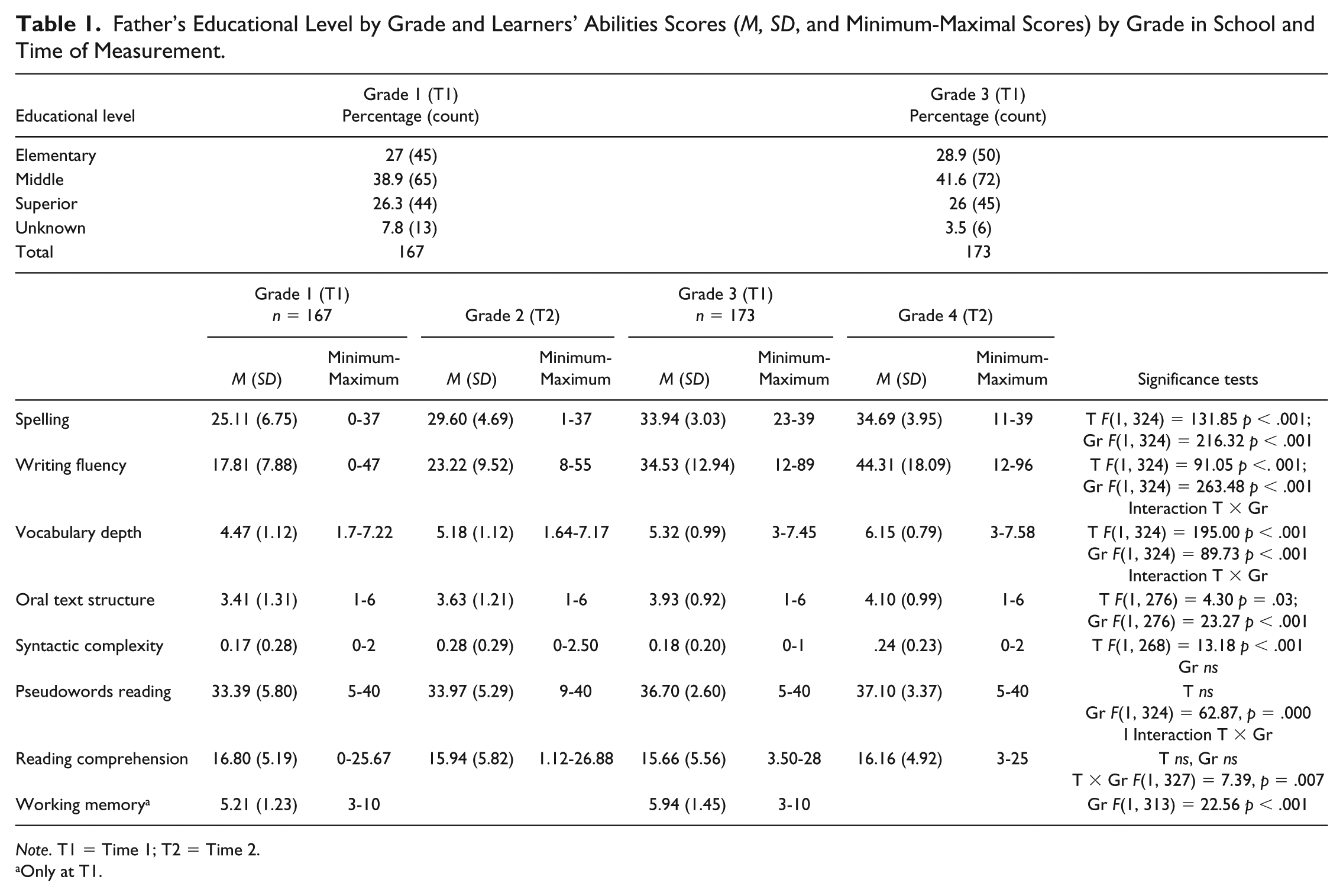
However, 27 children had incomplete data because they moved to other schools or were absent during certain tasks. Data analyses were performed on 340 children with full data sets: 167 (79 girls) were from first grade (M = 80.47 months; range = 11 m) and 173 (81 girls) were from third grade (M = 105.05 months; range = 18 m). All the participants were assessed at T1 in first and third grade and again 1 year later at T2, when they were in second and fourth grade, respectively. Written consent from parents was obtained for children to participate in the study. As a background variable, we considered the parents’ education level (see Table 1). We collected the level of education for both parents but only used the father’s education level, for which we had more complete data. When both parents’ education levels were available, correlations were strong (r = .696). Thus, in the few cases in which the father’s education was missing, we substituted the mother’s education.
Father’s Educational Level by Grade and Learners’ Abilities Scores (M, SD, and Minimum-Maximal Scores) by Grade in School and Time of Measurement.
Note. T1 = Time 1; T2 = Time 2.
Only at T1.
School Context
Spanish autonomous communities, similar to the ones in the current study, maintain full control in the area of education. However, the organic law of education (Ley Orgánica de Educación 2/2006) has defined a set of “basic competencies” that are prescriptive for every community. For preschool and first to third grade, code-centered abilities are secondary to the functional uses of literacy. Reading and writing are learned through a diversity of texts related to daily life. Alongside the functional approach, there is a serious concern for correct spelling (see Tolchinsky, Bigas, & Barragan, 2010, for details on the Spanish literacy learning environment).
Descriptions appear mainly in the context of narratives, and descriptions of animals, plants, and places are common in school texts from kindergarten onward. Nevertheless, to gain a direct account of how teaching descriptive texts is approached in the classrooms, we carried out 19 observations in classes that, according to the teachers, were devoted to teaching writing (see Alonso-Cortes Fradejas & Sanchez, submitted). Observations lasted 45 min (one class hour). The observation guide asked to specify which aspects of the text and the writing process the teacher focused on. We learned that children were asked to produce descriptions (e.g., Things that I like), but the bulk of teachers’ work was dedicated to clarifying the communicative goals of the text and monitoring the writing process (drafting and revising). Explicit reflection on TS was absent.
Tasks and Procedures
Writing quality
Children were directed to write three descriptive texts at T1: (a) What’s a good teacher like? (b) What’s your dream house like? and (c) What are dangerous situations like? They were asked to write two additional texts at T2: (a) What’s your best friend like? and (b) What’s your dream place for holidays like? The regular teachers carried out the writing task in their regular classes. Both T1 and T2 compositions were gathered with no more than 2 weeks elapsing between them. There was no time limit for the writing task, but children did not take more than 20 min to complete their texts.
All the texts were digitalized, segmented into clauses, and coded for their TS. Furthermore, we computed number of words in each text as a measure of productivity and number of subordinate clauses over total number of clauses as a measure of syntactic complexity. The same coding was applied to dictated and written texts.
For coding TS, we built a 1 to 6 qualitative scale on the basis of four components: (a) introductory clauses that consisted of a general statement that identified the described entity; (b) descriptive clauses that referred to the attributes or actions of the described entity by means of complete clauses; (c) justification clauses that provided reasons, circumstances, or the scope of the described attributes; and (d) conclusive clauses that subsumed the provided information in the form of a general statement. Texts with the four types of clauses, irrespective of the number of clauses of each type, were considered to include the four components and scored 6.
Previous studies on expository texts showed that for elementary school children, closing a text with a conclusion was harder than opening a text with an introduction (Tolchinsky, Johansson, & Zamora, 2002). Thus, texts with descriptive, justification, and conclusive clauses were scored 5, whereas texts with introductory, descriptive, and justification clauses but without conclusions were scored 4. Texts with descriptive and justification clauses but neither introductions nor conclusions were scored 3, and those that contained only descriptive clauses were scored 2. Enumeration of objects, qualities, or emplacements got the lowest score.
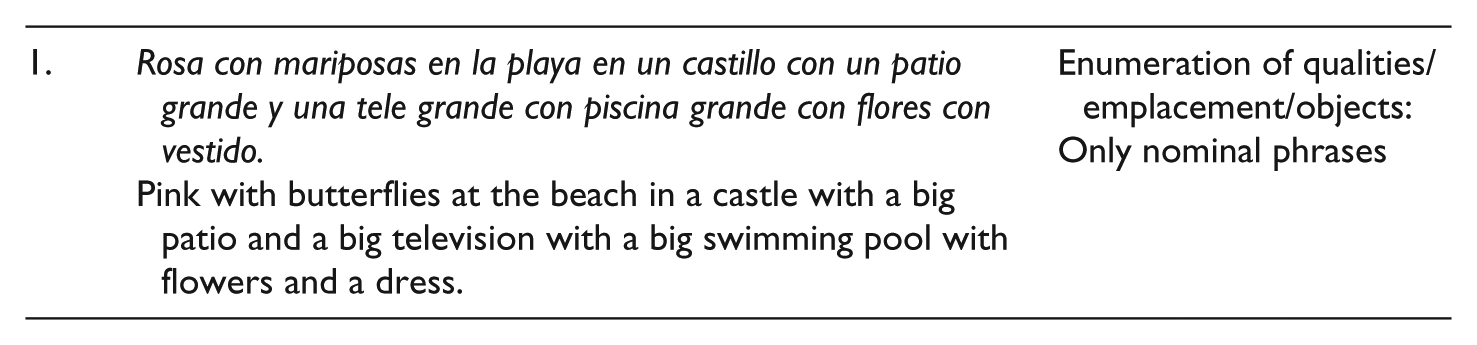
To illustrate the coding system, we present below three extracts of written texts with normalized orthography. The first (1) was produced by a first grader after the prompt What’s your dream house like? The text seems to be a direct answer to the prompt, the same as one would expect to find in oral conversation. The writer lists locations and objects the dream house contains expressed by nominal phrases (e.g., at the beach). The order of nominal phrases is free; it can be changed without affecting meaning. Without knowing the prompt and only looking at the written responses, it is not possible to know what entity is being described. Texts containing only enumeration of qualities were scored 1.
The second (2) was also produced by a first grader in response to the prompt What’s a good teacher like? The text opens with a rhetorical question that functions as a general statement for identifying the target entity. The introduction is followed by three descriptive clauses that point out the qualities of a good teacher.
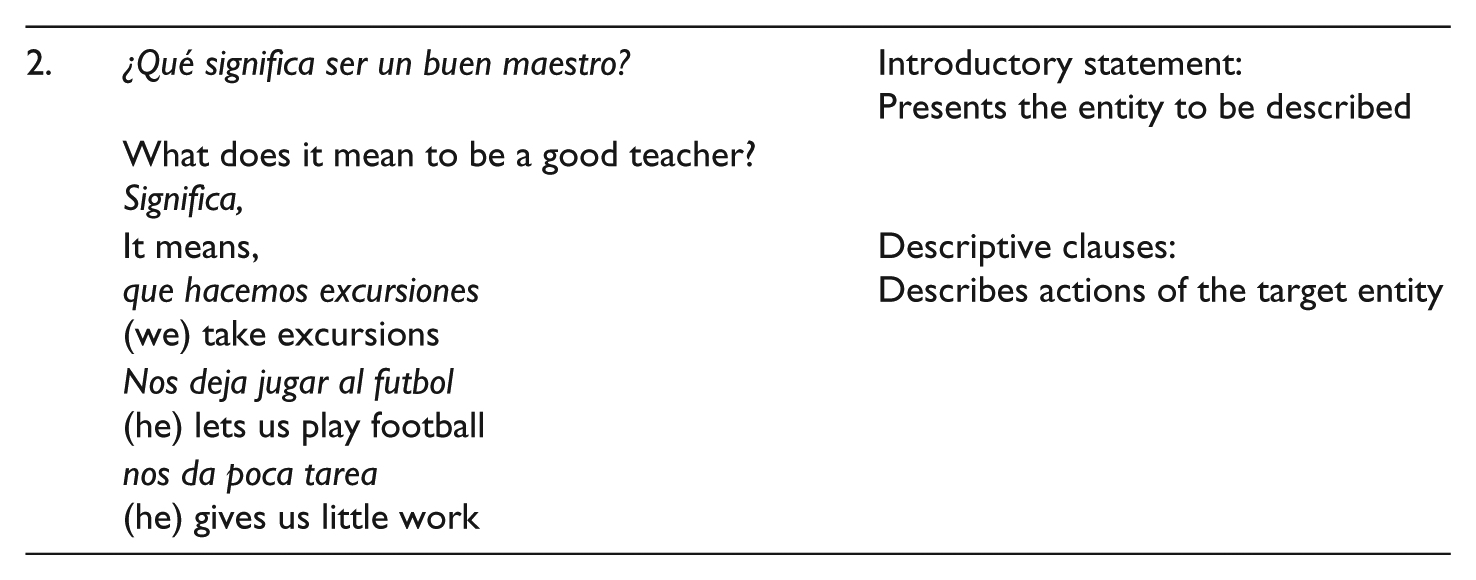
Texts like this one, with an introduction and descriptive clauses, were scored 3.
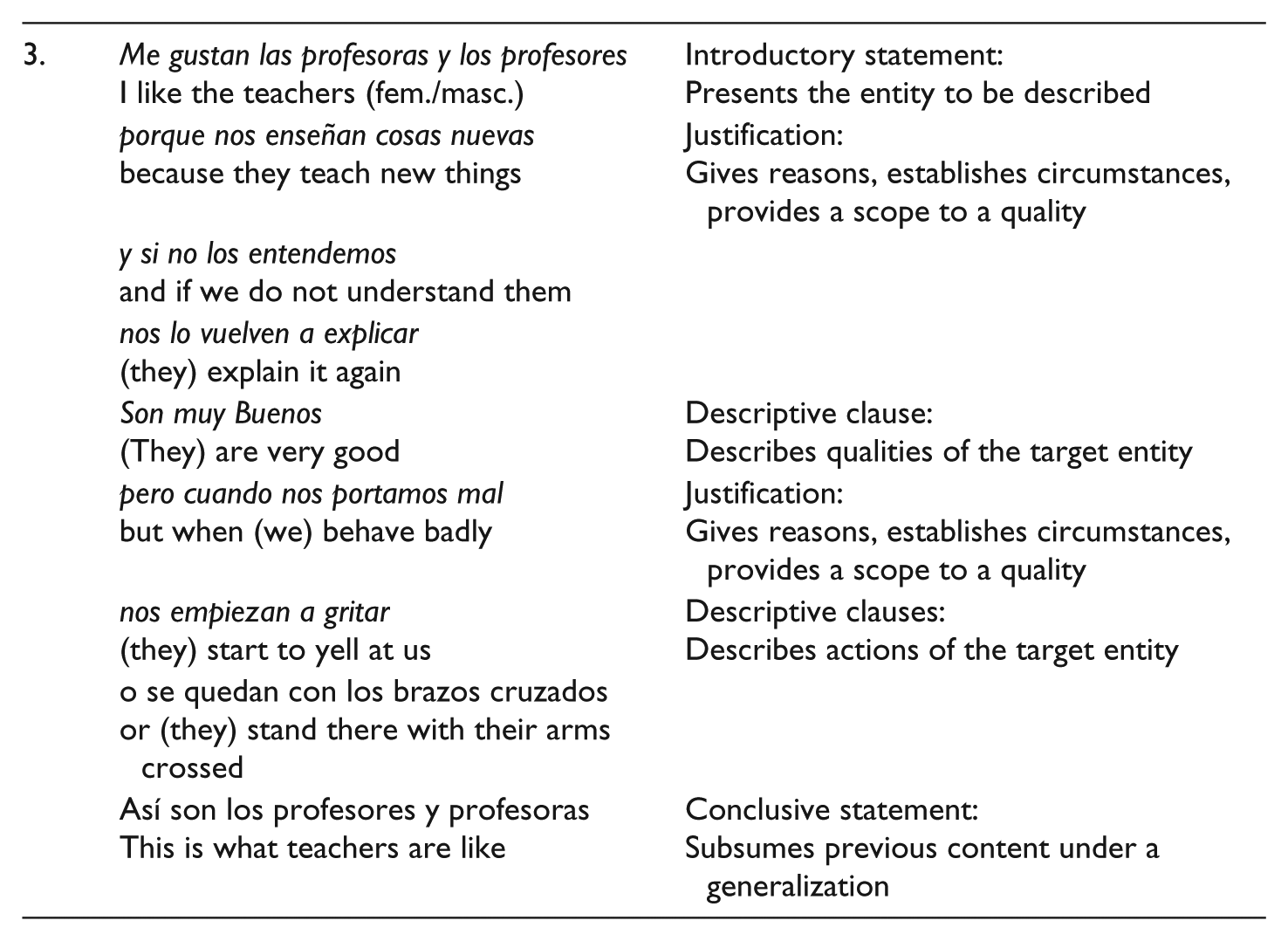
The third text (3), produced by a third grader in response to the same prompt as 2, opens with an introduction, followed by clauses that give reasons for the general statement, and closes with a conclusive statement. It was scored 6.
Initial coding of clause type of all the texts in T1 and T2 (n = 1,600) was carried out by a graduate student under supervision of the author. To follow, 20% of T1 texts (n = 184) and T2 texts (n = 136), randomly selected, were coded by two trained raters independently. Agreement on the coding of the texts was reached for 85% in T1 and 89% in T2.
Transcription abilities
For assessing fluent letter writing, we measured how fast children write letterforms automatically. The task was inspired by Berninger’s alphabetic task that was used with first- to sixth-grade students (e.g., Graham et al., 1997). Given that alphabetic order is not taught in Spanish schools and our focus was on motor fluency in letter tracing, children received a score for the number of correctly written letters irrespective of alphabetic order and repetition. The direction was “Write as many letters as you can in one minute.”
To assess spelling, participants wrote 40 real words selected according to their frequency and difficulty. Frequency was established based on Justicia’s (1985) frequency dictionary for the language of 6- to 10-year-olds. High-frequency words were selected among the 1,000 more frequent word types, whereas low-frequency words were selected among the 250 less frequent word types, from a total of 5,750 word types. Word selection was based on grammatical category (nouns) and number of syllables (three). Low-difficulty words had a consistent phoneme–grapheme correspondence and did not contain empty phonological segments. By contrast, high-difficulty words contained phoneme–grapheme ambiguities or empty phonological segments. There were four sets of 10 words each combined for frequency (high/low) and orthographic difficulty (high/low). Words were dictated to the class one by one after providing one example. Words with no spelling mistakes were scored 1 and misspelled words were scored 0 (Cronbach’s α = .91 for T1 and .86 for T2).
Vocabulary depth
We used a synonym/antonym task that was administrated individually. Each child was first asked to say a synonym for 28 adjectives and thereafter an antonym for another 28 adjectives. Children’s responses were analyzed by applying a scale based on four requirements that account for the differences in form and content in the answers given by the participants:
Meaning relation to the given word: Providing a word with an equivalent meaning for a synonym or a word with the opposite meaning for an antonym.
Conventionality: Giving a word that appears as a synonym/antonym in the dictionary.
Change in lexeme: Responding with a word that contains a different lexeme but preserves the same syntactic category of the given word.
Preserving syntactic category: Providing an adjective rather than any other grammatical category.
On the basis of these requirements, we created a 1 to 8 scoring scale. Suggesting silencioso (silent) as a synonym to callado (quiet) would get the maximal score (8) because the four requirements are met. The word keeps the required meaning relation, appears in the dictionary, and has a different lexeme but the same syntactic category of the given word. In contrast, quieto (still) would get a score of 7 because it fulfills criteria 2, 3, and 4 but not 1; saying que es muy delgado (who is very skinny) as a synonym of delgado (thin) would get 1 because it fulfills none of the requirements (Cronbach’s α = .94).
Oral discourse skills
Oral skills were assessed using a dictation task. The task and the topic were given 2 days prior to administration to have the children become familiar with a situation that, in contrast to text writing, was new to them. The directions were “Tell me about your favorite hero. . . I am going to write down exactly what you explain about your hero.” It was administrated individually and the interviewer remained silent until the child stopped dictating. After the first stop, the interviewer encouraged the child to continue, but after two prompts the task was ended. The goal was to compare children’s production with and without prompting, but for the current study we only analyzed children’s production before the first prompt. Verbatim transcripts of the dictation were coded for the number of clauses, syntactic complexity, and TS. Syntactic complexity was measured in terms of the proportion of subordinate clauses over total number of clauses, and oral TS was assessed with the same scale used for written texts.
Word reading
A standardized battery (PROLEC-R) for 6- to 12-year-olds, containing 40 words and pseudowords paired by number of syllables, syllabic structure, and initial letter, was individually applied for measuring reading accuracy and fluency (Cuetos, Rodríguez, Ruano, & Arribas, 2007). Preliminary analysis (see the “Data Analytic Strategy” section) showed that word reading was close to ceiling and not directly related to TS; it was thus removed from further analysis.
Reading comprehension
A standardized reading comprehension test called ACL (for Avaluació Comprensió Lectora, or Evaluation of Reading Comprehension; Catalá i Agràs, Catalá Argràs, Molina i Hita, & Monclús i Bareche, 2001) was administered in groups. The test contained brief passages on different topics and genres—narratives, expository, argumentative, and poetic. Each passage was followed by multiple-choice questions assessing literal understanding, reorganization of the information, inferential comprehension, and critical comprehension. There were 24 items for first and second grade, 25 items for third grade, and 28 items for fourth grade. Raw scores were standardized to the highest number of items (28).
WM
The Memory for Digit Span from Wechsler Intelligence Scale for Children–IV (WISC-IV; 2005) was administrated individually. The test included a digits forward task to test short-term memory and a digits backward task to measure the manipulation of information while in temporary storage. Preliminary analysis (see the “Data Analytic Strategy” section) showed that only the performance on the backward digit-span task was directly related to TS. Thus, the forward digit task was removed from further analysis. In the backward digit-span task, the child was instructed to repeat a series of numbers (with an increasing numbers of digits) in reverse order. Each correct response was worth 1 point, with a maximum of 16 points for this subscore.
A nonverbal intelligence British Ability Scales–II (BAS-II; Elliot, Smith, & McCulloch, 1997) was also administered individually. This is a nonverbal scale used to measure nonverbal reasoning. Preliminary analysis showed that it was not directly related to TS, and it was dropped from further analysis.
Data Analytic Strategy
To identify and follow up the rhetorical structure of texts, each text was indexed 1 to 6 on the TS ordinal quality scale. The index ranks TS quality across the written texts for both T1 and T2 and was defined as the dependent variable to enable modeling. We used an ordinal logistic model: a linear probability regression for ordinal dependent variables (Agresti, 2002). This is a special type of logistic model in which results can be transformed into probabilities. It ranks the probability of each category (each point in the scale) with respect to those categories below it. Thus, it was possible to determine the effect of grade level (first grade, third grade), time (T1 and T2) of data gathering, and their interaction (Grade × Time) on the probability of a text being in a higher category rather than in a lower one. The linear outcome of the model, beyond model coefficients, is a set of thresholds. Each threshold behaves as an independent intercept, as in a linear regression analysis. Transferring these thresholds into probabilities means that for each threshold, the probability of belonging to a certain category is the difference between the overall probabilities of that category less the probability of the category below it. We used the generalized estimating equations (GEEs) modeling framework for its simplicity and availability as well as its wide modeling options for nonlinear distribution of the dependent variable. The procedure allowed for the integration of the subject’s repeated measures, such as the repeatedly written texts in this study. It was thus a multilevel analysis in which texts were clustered into subjects. Not only could we estimate the effect of school grade and time, but we could also determine the relationships across texts.
To determine which of the learners’ abilities contributed to the quality of the TS (i.e., the second goal of this study), we applied a latent change score (LCS) modeling in which both the base level (assessments at T1) and the level of change (difference between T1 and T2 for each school grade) were determined within the framework of structural equation modeling (SEM).
In a preliminary analysis, we explored the dependent (latent) variable, TS, against several independent indicators, such as grade, parent education, and preliminary state of performance (base level, assessments at T1). This was done to define efficient model components. The forward digit task and word reading were excluded from the model due to the low correlation (r = .14) with TS and the ceiling effect, respectively. In the same preliminary analysis, we estimated the effect of parents’ education as this effect was highly expected to be positive (Tolchinsky, Liberman, & Alonso-Cortes Fradejas, 2015). Thus, to prevent it from overwhelming the other effects, we only tested its effect in the presence of grade, similar to all other tests, but did not keep it in the more integrative model.
For the dependent variable (TS), we repeatedly assessed three texts at T1 and two texts at T2, which comprised the two latent or unobserved factors. By contrast, the independent variables were related to the learners (e.g., spelling, reading comprehension) and thus did not vary as the text assessments did. For the LCS model, we placed those independent variables that showed a significant effect on the dependent variable side by side with the age (grade) effect (first graders vs. third graders at T1).
Results
Text Structure (TS)
Each text was coded 1 to 6 on the ordinal scale constructed on the basis of the structural profiles rendered by the qualitative analysis of the texts. Figure 1 displays the distribution of these profiles by grade level and time of data gathering.
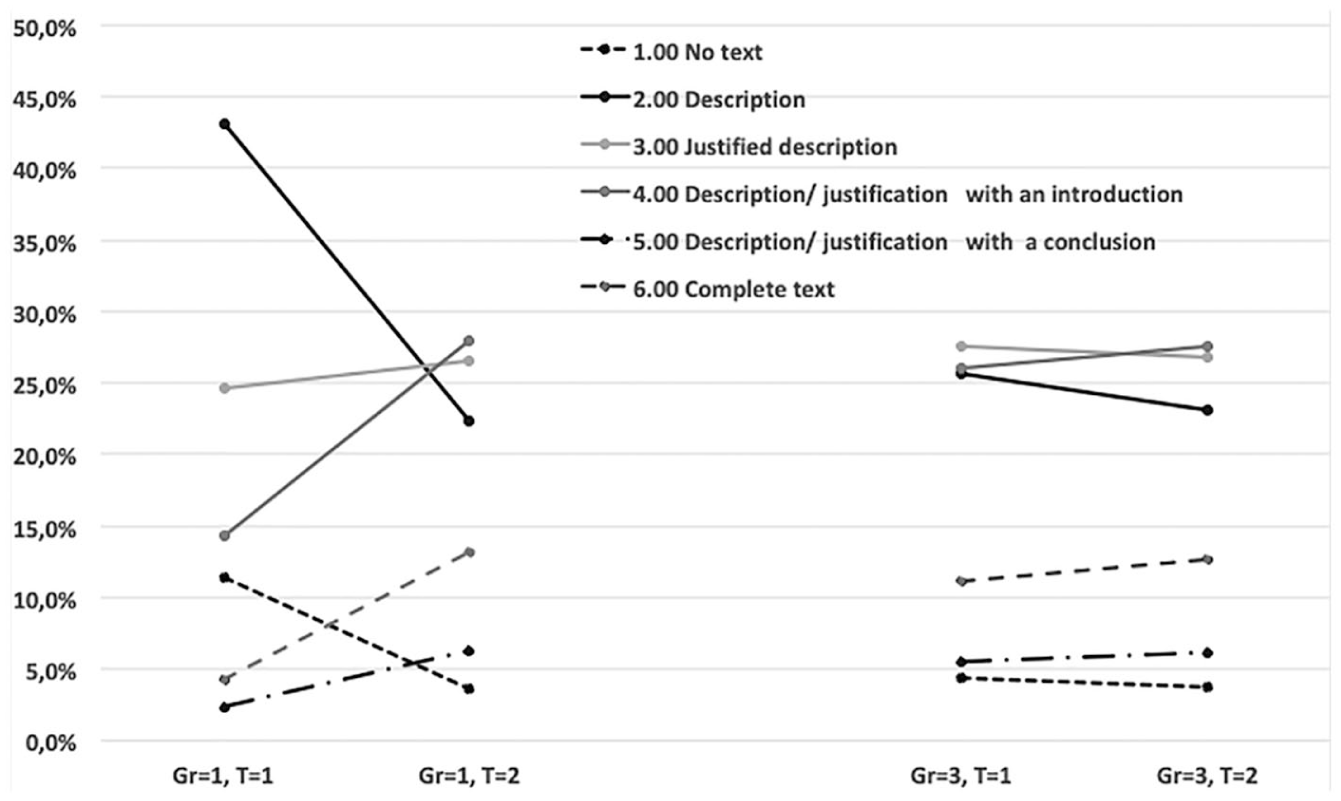
Distribution of categories in the ordinal quality scale of TS by school grade and time of measurement.
Because the logistic model ranks the probability of each point on the scale with respect to those categories below it, the percentages that are displayed on the y axis indicate the proportional probability for a certain text to be in a certain TS category. If a random text from a first grader at T1 is selected, the probability that it will be at the lowest TS category, containing just an enumeration of qualities, is around 11%, and the probability that the text will be in the highest category, including all the rhetorical text components, is less than 5%. The highest probability is for a first-grade text to contain just descriptive clauses (43%), with no justification and without an introduction or conclusion. The same random selection of a text from third grade (at T1) will have a much lower probability of being in the lowest category of TS (only 4% of probability against 11% in first grade) and a much higher probability of being a complete text in the highest category (11%). In contrast to what happened in first grade, the highest probabilities for a third grader’s texts are distributed among several categories that are all equally probable. The text can contain only descriptive clauses, justified descriptions, or an introduction preceding descriptive and justification clauses; there is even a 5% probability of having texts with a conclusion. Comparing first grade at T1 with T2, the probability for a second-grade text to be among the three highest categories of TS has improved. That is, at second grade, the probability of finding texts with an introduction and a conclusion apart from justified descriptions has increased, whereas the probability of finding texts in the lowest categories diminishes. Finally, the probability for a second-grade text to contain only justified descriptions is similar to the probability of finding such a TS in first grade. The longitudinal changes (from third to fourth grade) show a similar trend: The probability of finding a fourth-grade text in the three highest categories increases, whereas the probability of finding it among the three lowest categories diminishes. Nevertheless, the differences between third and fourth grade are not so marked as the differences between first and second grade or between first and third grade.
Learners’ Abilities
Table 1 shows father’s educational level by grade and mean scores, as well as SD and minimum-maximal scores in the tasks for assessing transcription, discourse, literacy, and cognitive skills by grade and time of measurement. The column farthest to the right displays the results of the generalized linear model (GLM) analyses to check the significance of the observed differences. The same analyses were applied to all the variables except for WM because it was measured only at T1.
Father’s educational level distributes normally and similarly in Grades 1 and 3. A lower proportion of fathers have completed elementary and superior education, whereas a higher proportion have completed a middle-level education. Across school grades at the same time of assessment, learners’ achievements improved significantly, with two exceptions. Reading comprehension did change significantly due to school level, and syntactic complexity did not improve from second to fourth grade, but only from first to third grade (see Table 1 for significance tests). Longitudinally, there was also a significant improvement in all the tasks except for reading comprehension and reading of pseudowords, probably due to a ceiling effect.
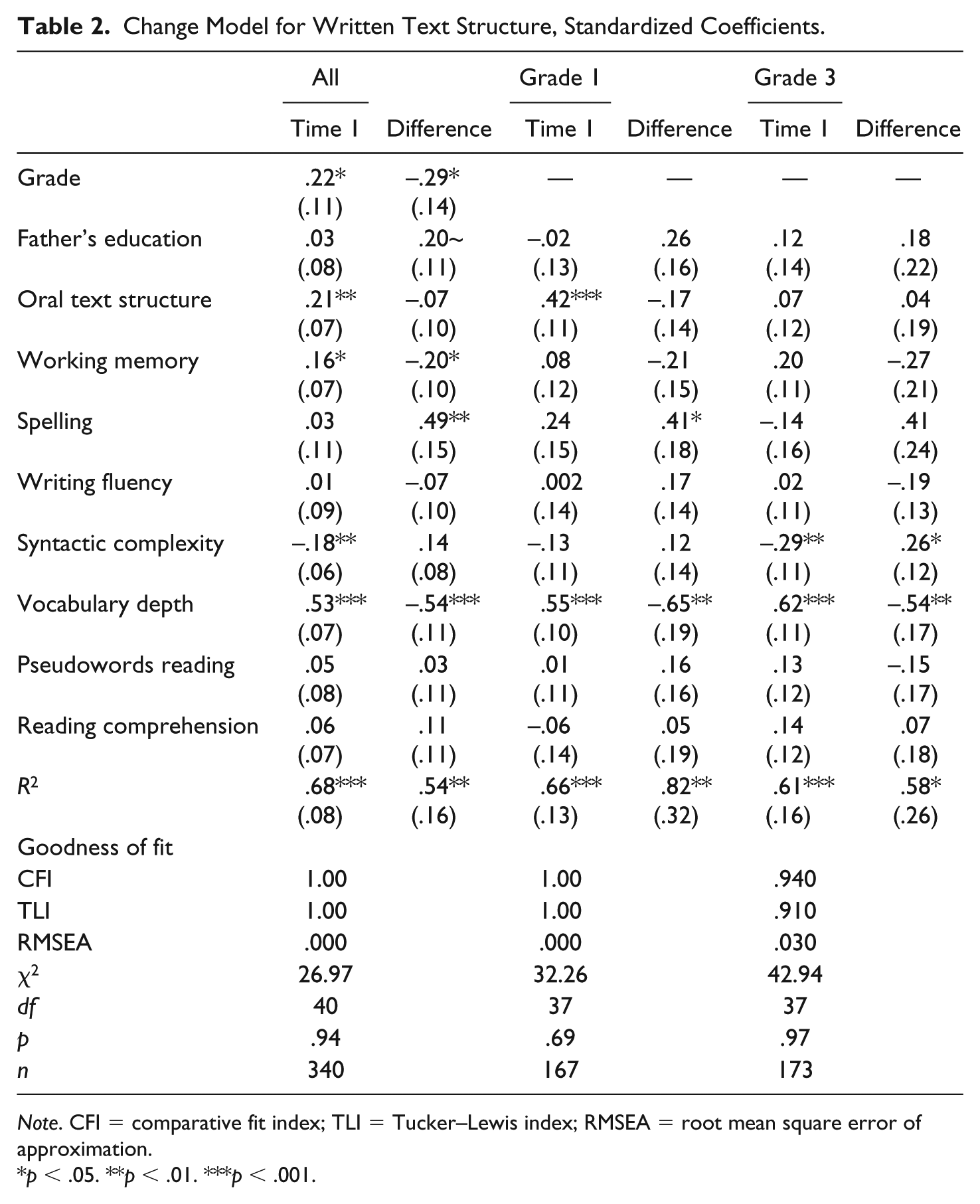
Furthermore, we identify the learners’ abilities that explain the observed changes in TS. Table 2 displays the results of the applied LCS model.
Change Model for Written Text Structure, Standardized Coefficients.
Note. CFI = comparative fit index; TLI = Tucker–Lewis index; RMSEA = root mean square error of approximation.
p < .05. **p < .01. ***p < .001.
The first column to the left shows the parameters included in the model. The columns from left to right show the standardized coefficients and the parameter estimates when the predictors and outcomes have been standardized to have variance = 1. They facilitate an assessment of the variables that have the greatest association with the outcome variable, in this case, the abilities with the greatest association to TS. The column to the far left side shows the parameters’ estimates for the initial state of performance (for both first and third grade) followed by the estimates of the difference between T1 and T2 across school grade. The other four columns show the same information by school grade. The first row lists the R2 value showing the percentage of the variation explained by the model. Below are indicators of the model fit, mainly, the χ2 values, which show nonsignificance at p < .05. This indicates that the expected model and the empirical data do not differ significantly. Other information criteria are very high (comparative fit index [CFI], Tucker–Lewis index [TLI] > .95, and root mean square error approximation [RMSEA] < .001) and reflect the fit of the hypothesized model to the data.
Specifically, in first grade, oral TS and vocabulary depth were the main explanatory factors, explaining 66% of the variance in TS quality. Spelling, however, was directly related to TS improvement from first grade at T1 to second grade at T2; children who started with higher scores in spelling showed the greatest improvement in the rhetorical organization of their texts. Vocabulary depth was also significantly related to the difference observed in TS from first grade at T1 to second grade at T2, but inversely so. Children who started with higher scores in vocabulary improved less in TS.
In third grade, vocabulary depth was still the main contributor to TS. Syntactic complexity was also significantly related to TS, but inversely so; children with more complex syntax at a sentential level produced a less complete TS. However, complexity was a main predictor of the observed differences in the quality of TS when moving from third to fourth grade. Children who had a higher score in syntactic complexity in third grade improved more in TS. Vocabulary depth was also explanatory of the difference in TS, but again, inversely so; children who started third grade with higher scores in vocabulary improved less in TS quality when moving from third to fourth grade.
Overall, grade, oral TS, WM, and vocabulary depth, together with syntactic complexity, explained 68% of the variance in TS at T1 (first and third grade). However, while the first four factors were directly related to TS quality, syntactic complexity was inversely related. Moreover, the higher the oral syntactic complexity, the lower the quality of the overall TS.
Children of a higher grade (third) who had a more complete oral TS, better WM, and deeper vocabulary got a higher score on TS at T1, whereas children of a higher grade (third) who had a more complex oral syntax got a lower score on TS at T1.
Grade, WM, spelling, and vocabulary depth explain the difference in TS between T1 (first and third grade) and T2 (second and fourth grade); however, only spelling was directly related (the higher the children’s scores in spelling at T1, the better the TS at T2). The other three factors were inversely related. Children who were in third grade at T1 got lower grades in TS when moving to fourth grade (T2) than children who were in first grade at T1 when moving to second grade (T2). Similarly, children who showed a deeper vocabulary in first grade at T1 produced a more complete TS when moving to second grade than children who were in third grade at T1 when moving to fourth grade. Improvement in TS—from T1 to T2—was more marked from first to second grade than from third to fourth grade.
Discussion
Our first goal was to trace the developmental path of descriptive TS in the written productions of first- to fourth-grade school children. The qualitative analysis of the written texts rendered six structural profiles. The ordinal logistic model was used to determine the probability of each profile’s occurrence by grade, whereas the RST (Mann & Thompson, 1987) guided the interpretation of the changing probabilities of occurrence.
The structural profiles were of increasing complexity and ranged from a list of attributes of the described entity to a complete descriptive schema including an introduction, justified descriptions, and a conclusion. The results of the model showed that across grade levels, the probability of finding texts with lists of attributes or with only descriptive clauses diminished notably, whereas the probability of finding texts with complete descriptive schemas increased. The decrease of basal structural profiles concomitant with the increase of more complex ones yielded an increase in the number of equally probable profiles of different levels of complexity with school grade. Still, texts with conclusions or complete descriptive schema had the lowest probability of being produced throughout early elementary school.
The developmental path in structural profiles might be explained in terms of the distinction between nuclei and satellite elements proposed by the RST. Deploying only descriptive clauses fulfills the core function of description, but only if the reader knows the prompt (as in Example 1 above). Adding justifications, and mainly an introduction, helps the reader to “visualize” the object described from the text, even without knowing the prompt. Using justified descriptions offers the interlocutor the rationale for the mentioned quality. Moreover, providing an introduction or a conclusion sets the text apart from the extra-text. While descriptions and justifications fulfill the primal communicative purposes of a description, the introduction and conclusion frame a descriptive text. Conclusions are not an essential function of descriptions; in fact, they keep the interlocutor away from the entity being described. In Example 3 above, when the writer concludes, “This is what teachers are like,” he moves readers away from his teacher into a broader category that can be represented by any teacher. Providing a conclusion for a descriptive text requires a detachment from the particular and an attachment to the general, resulting in a lower probability for this component to appear during the early years of elementary school.
The structural profiles that characterize the texts of the youngest children in our sample concur with those identified by Newkirk (1987) and Donovan (2001) for informational texts by English-speaking first graders. Furthermore, the evolving path from core to satellite elements, and from situational bounded to textual, which required components that take into account the reader’s needs, were also found in narratives and expository texts (Berman & Nir-Sagiv, 2007; Tolchinsky et al., 2002). The similarity that has been found in the initial stages—as well as the recurring progression in different languages—reflects general trends in the development of discourse abilities: an increasing consideration of context together with more decontextualized expressions and an awareness of the mental state of the interlocutor. Hence, the progression toward adopting the expected rhetorical structure of a particular genre is part of children’s acculturation to the written culture.
Our second goal was to identify learners’ abilities that better explain the evolving TS. We found a significant improvement in several abilities shown to predict changes in writing quality. Learners notably improved transcription, oral language, word reading, and WM. Despite the quick mastering of accurate and fluent word reading, learners showed no progress in reading comprehension. These results hint at a qualitative gap between word-level reading and text-level understanding. This gap may explain Spain’s disappointing results in international evaluations of literacy (Elinet report, 2016) and calls for revising teaching strategies in regular Spanish classes.
The LCS modeling rendered four explanatory factors: grade, oral TS, vocabulary depth, and WM. Together with syntactic complexity, these factors account for 68% of the variance in TS at the base level. First, children at a higher grade composed more complete texts; the approach to written language recommended in Spanish school curricula and developed in classrooms enables school grade to be a significant factor in TS quality.
Second, children who produced a more complete oral TS had a more complete structure in writing. Aligned with studies in different languages, this finding proves anew the influence of oral language on writing quality (Arfé et al., 2016; Silverman et al., 2015). Nevertheless, the specific task we used to test the contribution of oral language to writing (children dictating a description to an adult) provided a more specific mechanism to account for the positive relation between oral and written discourse structuring. Both oral dictation and written composition are devoid of online feedback during production and require the speaker’s/writer’s self-control of discourse. This commonality accounts for the link we found between oral and written text and explains the contribution of WM.
The production of a monologic piece of discourse requires more implicit planning and central control than oral interactions in ongoing communication. Recruiting the executive attention network that holds sensory information and also one’s ideas while writing is critical in this control. This explains why, in line with other studies (McCutchen et al., 1994), WM emerged as the third factor for accounting for differences in TS at a base level.
Aligned with previous studies (Castillo & Tolchinsky, 2017), vocabulary depth also contributed significantly to TS quality at a base level. Establishing the right meaning relations between words in a decontextualized situation requires higher metalinguistic awareness than using words in ongoing communication. Like in dictation, it is the use of oral language in ways that differ from the interactive, situationally bonded uses typical in conversational interchanges, that is involved in producing better structured texts.
Syntactic complexity, the fourth explanatory factor, stands inversely related to TS. Children who produced more subordination in oral discourse produced less complete structures in writing. This finding converges with previous ones (e.g., Berninger et al., 1992) showing an unreliable association between syntactic complexity and writing but differs from studies in Italian (Arfé et al., 2016) and English (Dockrell & Connelly, 2016), demonstrating a positive association between syntactic skills and linguistic features of texts. This divergence can be attributed to the different measures of syntactic ability that were used: the level of subordination in our study and sentence generation in the quoted studies. Most probably, during the early stages of text production, the ability to generate sentences, irrespective of their syntactic complexity, is more useful than the ability to create subordinate sentences and therefore contributes positively to writing quality.
Although grade, vocabulary depth, and WM are inversely related to increase in TS quality, only spelling is directly related to the observed changes. The inverse relation is a result of the greater improvement from first to second grade than from third to fourth grade, whereas the direct contribution of spelling provides further support to existing evidence on the contribution of spelling to writing quality even in transparent orthographies (Arfé et al., 2016; Limpo et al., 2018). A better command of spelling facilitates children’s improved performance in the rhetorical space; however, spelling is not enough to maintain this improvement at higher grade levels.
Limitations and Further Research
Our study depicts a developmental path that reflects a transition from children’s sensitivity to the core communicative function of description to the textual requirements of descriptive texts. When both foregrounded and backgrounded elements are integrated, a complete hierarchically organized descriptive schema is formed: Justifications depend on descriptive clauses and conclusions subsume descriptive and justification statements. The progression found in the structural profiles, which at the same time involves an increased awareness of the reader’s mind and the textual requirements of a description, illustrates the way in which a feature of discourse development is culturally shaped by genre constraints (Berman & Nir-Sagiv, 2007).
However, less than 13% of the students in our sample were able to produce a complete descriptive schema. Future research should clarify whether this finding indicates a baseline of descriptive text structuring at the mid-elementary school level or a pedagogical challenge. It would be useful to test whether a pedagogical intervention in reading comprehension—an ability that did not improve with school grade in our sample—as well as in vocabulary and oral discourse, would impinge on writing quality (Ahmed et al., 2014).
In this study, we only controlled for parents’ education as a contextual variable. Further investigation should explore the predictive value of other contextual variables to give a better account for the complexity of text writing (Coker, 2006). Finally, we have focused on TS as an indicator of developing knowledge of descriptive genre in the early grades. Given that descriptions are frequently part of other modes of writing, it is important to examine how children face the challenge of integrating descriptive structures and other textual features, such as content relationships, vocabulary, or stance in different text types, throughout their academic life.
Footnotes
Declaration of Conflicting Interests
The author(s) declared no potential conflicts of interest with respect to the research, authorship, and/or publication of this article.
Funding
The author(s) disclosed receipt of the following financial support for the research, authorship, and/or publication of this article: This work was supported by the Spanish Ministry of Economy and Competitiveness (MINECO) -[EDU2012-36577] and [EDU2015-65980-R]
