




Abstract
From literary canons all the way to the motion picture industry, the artistic and popular cultural experience of marginalized or nonmainstream groups has been one of being represented by the other. In this article, we explore how online fanfiction, as an audience-driven, interactive form of writing, may offer a way for members of nonmainstream groups to push back against and offer alternatives to stereotypical and normative discourses. We focus on how autistic people, family members, teachers, and advocates cast autistic characters in their fanfiction stories, how these stories represent autism and how, given the affordances of an online publishing platform, audience members respond to such representations. Findings suggest that these online narratives diversify available representations of autistic characters; moreover, the interactive nature of the online publishing forum allows readers to respond to and potentially disrupt stereotypical thinking and common fictional tropes surrounding autism.
Cultural Constructions of Autism
It is a surreal, validating experience to find oneself reproduced in the writing of another; this is doubly true when such a miraculous happening is rare. (Folsom, 2014)
This article explores how popular cultural constructions of autism—which are often simplistic and stereotypical—can shape normative discourses of ability, and how representations of autism in online fanfiction can serve to disrupt such normative discourses. Specifically, the study focuses on fanfiction stories that feature autistic characters, and how writing and reading such stories can provide an entry point for autistic people and their friends, family members, and advocates to reimagine mainstream representations of autistic identity and diversify social constructions of autism. To understand how fanfiction texts might serve to challenge popular cultural constructions of autism, the study centers on two primary research questions: How do representations of autism and autistic characters in fanfiction intersect with or depart from stereotypical representations of autism in literature and popular culture? and How might the online platform impact such representations?
According to the fifth edition of the Diagnostic and Statistical Manual of Mental Disorders, autism is a condition characterized by a variety of markers ranging from difficulty with normatively “appropriate” forms of communication to overdependence on routines and sensitivity to change (American Psychiatric Association, 2013). While some object to these diagnostic markers on the basis of their grounding in a “pathology paradigm” that constructs autism as something in need of treatment and cure (Loftis, 2015, p. 4), these criteria can be crucial for professionals, family members, and individuals in recognizing and receiving support for conditions that interfere with an autistic individual’s daily life activities. At issue, then, is not so much the lived realities of autism spectrum disorder (ASD)—which can vary greatly—but rather the ways in which society perceives and treats autistic individuals.
In recent years, there has been a groundswell movement in the autism community toward understanding autism as a form of neurodiversity, or the idea that “neurological differences like autism and ADHD [attention deficit hyperactivity disorder] are the result of normal, natural variation in the human genome” (Robison, 2013) and should be treated as a valuable part of human history (Silberman, 2015). Rather than focusing on a cure for autism, proponents of a neurodiversity paradigm emphasize understanding and accommodation for neurodiverse individuals living in a “neurotypical” society. Such a paradigm also recognizes the strengths that can be conferred by autism, such as attention to detail, high levels of concentration, forthrightness, dedication, and strong memory skills, to name just a few (Loftis, 2015; Silberman, 2015).
Autism has a rapidly expanding historical knowledge base (Donvan & Zucker, 2016), and there is an emerging body of first-person accounts that provide nuanced understandings of everyday life with autism (Bascom, 2012; Higashida, 2016). However, the general public’s perceptions of disability are often influenced by media portrayals of a range of conditions. For ASD in particular, many mainstream media representations rely on reductive representations (Rozema, 2014) and metaphorical concepts for autism that are tied to a pathology paradigm and grounded in a deficit mind-set (Gross, 2012; Loftis, 2015; Thibault, 2014). Gross (2012) outlines several of the most prevalent metaphors used in relation to autism: military (war against autism), kidnapping (autism stole my child), barriers (child is trapped behind a barrier of autism), and death (parents grieving over an autism diagnosis).
Similar metaphorical constructs for autism are prevalent in children’s and young adult literature. Bartmess (2015) groups such metaphors into three common and problematic tropes and suggests that the perpetuation of such tropes can have significant consequences for cultural constructions of autism and how neurotypicals (individuals without autism) and autistic people view autism. The first trope is that of autistic people “being described or treated as less real than non-autistic people” (Bartmess, 2015). According to Bartmess, this happens in two ways. The first is by autistic characters being included in a narrative for limited purposes: to show their impact on other characters (e.g., to garner sympathy for a parent or sibling) rather than as characters with whom the reader could identify, to provide entertainment (e.g., through awkward social interactions), or to impact the reader (e.g., to generate sympathy for a character who is kind to an autistic character). The second is by overlooking or minimizing autistic characters’ internal experiences and emotions, for example, by focusing on an autistic character’s behaviors rather than his or her interior struggles with things like sensory processing and social anxiety.
The second trope found in children’s and young adult literature is that of “autism being shown as a debt we have to repay to others around us” (Bartmess, 2015). According to Bartmess, this trope manifests in plot devices such as positive character development for an autistic person portrayed as movement toward neurotypical standards, or in autistic characters portrayed with special abilities to “make up for” perceived deficits (i.e., the savant), what Stuart Murray (2008) calls the “compensation cure” (p. 209).
In the third trope, autistic characters are “portrayed as only looking or acting certain ways.” This trope manifests through hegemonic representations that rely on labels (e.g., high- and low-functioning), limited demographic portrayals (e.g., White, middle-class, heterosexual, male”), and stereotypical “autistic” characteristics (e.g., socially isolated). Taken together, these tropes contribute to normative discourses about autism and obscure both the humanity and heterogeneity of autistic individuals’ lives.
Fanfiction as a Form of Cultural Production
In recent years, fanfiction—stories written by fans about their favorite books, movies, television, video games, and sports and music personalities—has garnered attention as a form of cultural production with implications for how we conceptualize literacy (R. W. Black, 2008; Chandler-Olcott & Mahar, 2003; Lankshear & Knobel, 2006), literate practices (Curwood, Magnifico, & Lammers, 2013), and the role of audience in contemporary mediascapes (Hellekson & Busse, 2006; Karpovich, 2006; Magnifico, 2010; E. E. Thomas & Stornaiuolo, 2016). Fanfiction has shifted over the years from print-based formats such as literary texts (e.g., Milton’s Paradise Lost; Atwood’s Penelopiad) and zines (volumes of fan stories and art shared at conferences, via mail, or in person) to online fan spaces such as archival websites or mobile-based authorship platforms (e.g., Wattpad) where authors post stories and the audience reads and often responds in the form of reviews. These online platforms add elements of immediacy, interactivity, and reach to fan-produced materials that both decentralize and blur the distinctions between sites of media production and distribution (Coppa, 2014; Hellekson & Busse, 2006). Moreover, as an audience-driven, production-focused form of writing, fanfiction offers a grassroots way for members of nonmainstream groups to contest stereotypical and normative discourses in mainstream media. Fanfiction also provides a much-needed window onto youth responses to literature and popular culture (Sciurba, 2017; E. E. Thomas & Stornaiuolo, 2016).
Through their writing, fanfiction authors reimagine the worlds and experiences of characters from their favorite media. Often, this reimagining is a significant departure from the original media narratives, and at times, such departures can offer a challenge to hegemonic forms of representation. For example, fanfiction authors may use their stories to create protagonists who challenge traditional assumptions of who a hero or heroine might be; they may develop character relationships that question heteronormative discourses of romance by exploring romantic relationships between same-sex characters. Or, as will be explored in this article, they may offer alternative perspectives on disability and difference by creating characters with a distinct embodied experience of the world (e.g., a Hunger Games tribute who is deaf).
A note about terminology: In keeping with the naming convention favored by many autistic autism advocates that “recognizes autism as an inherent part of an individual’s identity” (Brown, n.d.), we have chosen to use identity-first (autistic person) language in most of our writing. However, in our presentation and coding of data, we adhere to the terminology that fanfiction authors and reviewers use for describing themselves and their loved ones. We recognize that some of these naming conventions may include terms that are potentially problematic for historical (i.e., Asperger’s) or medical (e.g., outdated terms) reasons.
Theoretical Framework
In seeking to understand how online fanfiction might serve to disrupt normative discourses related to autism, this article is walking a well-trodden theoretical line between structure and agency. On one hand, the study attends to the ways in which meanings about autism and personhood are encoded in the discourses (Gee, 1999) of popular media (Fiske, 2017; Hall, 1997) and literary texts. From this perspective, words and other semiotic systems do not just reflect but rather serve to construct notions about the world. On the other hand, this study also attends to the “transactional” (Rosenblatt, 1994) nature of the relationship between audiences and texts. From this perspective, audiences are active and agentive as they use their own lived experiences to interpret, resist, and sometimes actively oppose the words and the worlds (Freire & Macedo, 2005) represented in texts.
With the advent of digital and social forms of media, the ways in which audiences actively participate in the construction of meaning have become highly visible, as new technologies allow for the easy creation and widespread dissemination of audience-created content. These technical changes, however, come in tandem with social and cultural changes. Work at the nexus of literacy and media studies suggests that there is a new “ethos” (Lankshear & Knobel, 2006) associated with digitally mediated literacy practices such as online fanfiction. According to Lankshear and Knobel (2006), such literacy practices are more distributed (across networked spaces) and participatory (with easy access to content creation) in nature. As a result, such literacy practices are more collaborative, and content creators can easily work together across time and space. We also see this ethos of new literacies reflected in what Jenkins, Puroshotma, Clinton, Weigel, and Robison (2006) call participatory culture.
Jenkins et al.’s (2006) notion of participatory culture pushes for an expansion of the vision for new and digital literacies beyond technical skills to include an array of social skills and dispositions when engaging in online literate practice. Fanfiction is a particularly robust example of such dispositions. For example, the typical activities of online fanfiction, such as engaging in collaborative or networked writing tasks, shifting between writerly/readerly and expert/novice roles, and accessing distributed sources of knowledge, require certain social skills and cultural competencies as well as technical knowledge of print-based literacy and digital devices. In addition, fanfiction authors are a clear instantiation of “prosumers” (a portmanteau of producer and consumer) who go beyond the structural constraints of consuming mass media to actively engage in the production of media content and the “diversification of cultural expression” (Jenkins et al., 2006).
Literature Review
It is a truism that mass media influences how we understand different groups and individuals, particularly those on the “margin” or who do not identify predominantly with mainstream culture. Although media do not determine attitudes and beliefs, media representations of diverse people can offer the culture at large glimpses into different life experiences, and they sometimes offer those on the margins opportunities to see themselves in relation to larger cultural, social, and even political structures. Scholars (Darke, 1998; Norden, 1994; Pointon & Davis, 1997) have noted how images of disabled individuals frequently relied on stereotypes depicting their relative helplessness in relation to the able-bodied, with some (Harnett, 2000) classifying a range of types of characters with disabilities who attempt to counter their perceived helplessness by acting out. Scholars have also paid growing attention to how such media representations may impact children’s school experiences (R. S. Black, 2004; Samsel & Perepa, 2013).
In recent decades, theorists and fans alike have explored the ways in which fannish cultural productions may offer alternatives to corporately sponsored, normative discourses. In his foundational work on fandom, Jenkins (1992) argues that many fans engage in a process of “refocalization,” which “shift[s] attention away from the programs’ central figures and onto secondary characters, often women and minorities, who receive limited screen time” (p. 169). Such refocalizations may provide more robust understandings of peripheral female characters, for example, as a means of pushing back against the patriarchal discourses of the original media. In this way, “fan writers reclaim female experiences from the margins of male-centered texts, offering readers the kinds of heroic women still rarely available elsewhere in popular culture” (Jenkins, 1992, p. 171). It is in these types of refocalized writing that fanfiction offers opportunities for fans to push back against mainstream media representations of disabled characters and offers challenges to normative discourses related to ability and difference.
A growing body of research explores the affordances of digital media for disabled individuals’ literate practices (Alper, 2017), and research into participation in fan communities can contribute to neurodiverse individuals’ development of a positive sense of self (Cook & Smagorinsky, 2014). However, there has been limited work on representations of differing abilities in fan communities, and no work of which the study team is aware that focuses on representations of ASD in fandom, although some related works can be brought to bear on this problem space. For example, in an exploration of disabled characters in Battlestar Galactica, Sasha_feather (2010), a fan who self-identifies as disabled, points out how the series initially showed “promise of diversity” in its depictions of disabled characters by presenting their daily lived experiences and avoiding common tropes. However, in spite of this initial promise, Sasha_feather argues that the series ultimately rendered these disabled characters disposable and reinforced mainstream discourses of ableism. Sasha_feather describes how fandom offered a way for her, as an avid fan, to “reclaim” and refocalize the Battlestar Galactica narrative.
I wrote fan fic about Felix Gaeta so that I could move his story, the story of a queer disabled person, from the edges to the center of the narrative. A friend and I wrote about Gaeta experiencing his disabled body, being fitted with a prosthetic made from Cylon Centurion technology, experiencing pain and isolation, and struggling with acceptance and relationships. (anna_bird and Sasha_feather, as cited in Sasha_feather, 2010)
The author goes on to describe this writing experience as an empowering one and argues that fandom can offer opportunities for refocalizing media narratives on disabled characters in robust, nuanced, and humanizing ways.
Similarly, Folsom (2014) posits the value of fanfiction written about autistic characters by autistic fans as a means of “destabilizing” normative discourses and stereotypical tropes of disability: For a society that views Autistic existence as something to be cured, or as a malevolent being that “steals” children and replaces them with changelings, any texts that challenge this dogma are the physical artifacts of a radical act of reimagining. Writing fanfiction from a perspective informed by autism on a personal, experiential level creates a weapon that combats not autism, but the dangerous and often deadly ideologies that tell us to combat autism.
At the same time, Folsom acknowledges that not all fanfiction representations serve to challenge normative discourses; some, in fact, can reinforce norms that limit characters to their differences, as opposed to depicting characters as full and complex human beings. Still, fanfiction offers unique opportunities to see how fans engage participatory cultures to reimagine identities, if not always radically, then at least differently from each other and how they may be depicted in the mainstream media.
Work in literacy and media studies has also turned its attention to the ways in which online spaces have made fannish activities more visible and have reconfigured the role of the audience for writers. In online fanfiction spaces, the notion of audience is tangible rather than abstract (Magnifico, 2010), as readers can post immediate feedback for stories, and authors can respond to this feedback in kind. This type of collaborative, networked interaction situates fanfiction authors among a dynamic audience of readers (Lammers & Marsh, 2015) and allows for bidirectional refocalization of fan texts based on interactions between fan authors and readers. In addition, digital forms of media facilitate refocalization because they allow for the remixing and sharing of multimodal forms of text (Lankshear & Knobel, 2006; Warner, 2016).
Research has found that fans utilize a range of remixable popular media (i.e., texts, images, blog posts, videos, and music) to explore aspects of their identities and issues from their daily lives (R. W. Black, 2008; A. Thomas, 2006), with the audience weighing in and commiserating with the fan creators through their reviews (R. W. Black, 2007; Lammers & Marsh, 2015; Magnifico, Curwood, & Lammers, 2015). Also, as evidenced in past research, these networked lines of communication bring the notion of an “active audience” to a new level by allowing fan audiences to directly communicate with fanfiction creators (R. W. Black, 2007, 2008; Magnifico et al., 2015) and push back against forms of representation and narrative trajectories that involve the characters and worlds from their shared and beloved media series.
Method
Data Collection
Because the study focused on the potential that online fanfiction might offer for reaching a broad audience of readers with varying levels of knowledge about ASD and involvement in fandom (i.e., sites that might have the broadest popular reach), we limited data collection to fictions posted on Fanfiction.net. Fanfiction.net is arguably the largest online fanfiction archive, is widely known and technically easy to join and navigate, and has a diverse community of members in terms of age, location, language, level of fandom involvement, and interests. We further narrowed the data set to fictions focused on J. K. Rowling’s Harry Potter series (approximately 770,000). Next, because the study team was interested in the potential that online fanfiction might offer to challenge mainstream representations of ASD by autistic people or those with close, personal experiences with autistic people, we focused on fictions archived in the “Neurodiverse and Differabilities” subsection of Fanfiction.net. These subsections are intended for stories that feature a character with some sort of neurological difference. This cull yielded 35 fictions. The data set was further bound to only those stories that made explicit claims about focusing on ASD and that were written by fans who self-identified as autistic or as family members, friends, or advocates of those with ASD. This left seven fanfiction texts, three complete and four incomplete (it is not uncommon for fanfictions to be abandoned due to lack of reader or shift of author interest).
We collected and analyzed all reader reviews (total = 178) associated with each fanfiction text. For these 178 reader reviews, 18 of the reviewers self-identify as an autistic individual, nine as family members, and one as a romantic partner of an autistic individual (Table 1 in the “Findings: Reimagining Representations of Autism” section provides more information about each of the fanfiction texts and reviews).
Table 1. Information About Fanfiction Texts and Reviews.
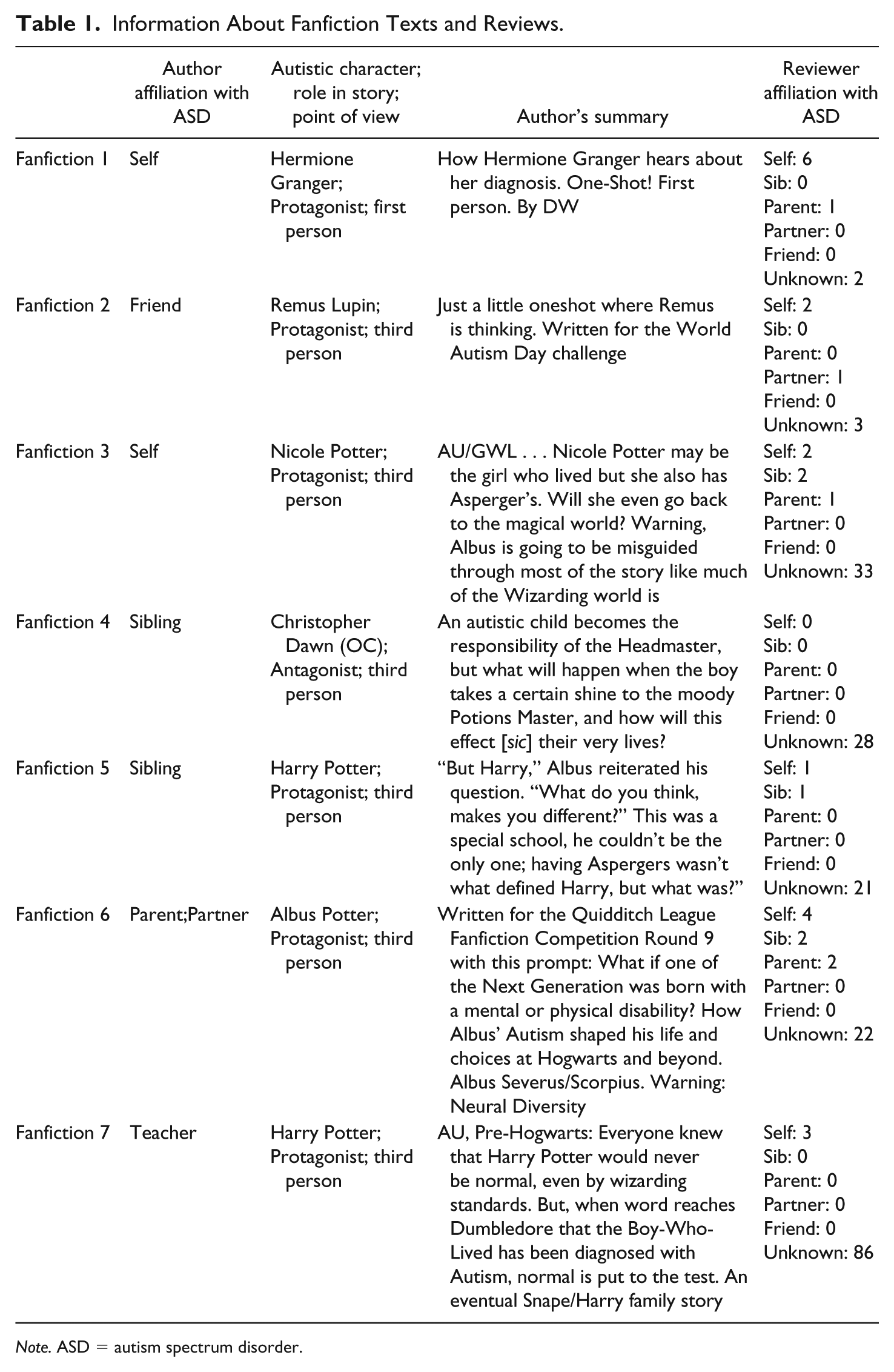
Note. ASD = autism spectrum disorder.
During the data selection process, the study team considered the ethical dimensions of selecting and sharing these fanfiction texts with an academic audience. We first reviewed the context in which the data were shared. Fanfiction.net is open to the public and does not require membership or a password to view content. In addition, the fanfictions selected were published under pseudonymous usernames, minimizing the risk of exposing authors’ identities. Perhaps most important, however, we considered the fact that these fictions were written and shared with a stated intention of raising awareness of or challenging pervasive misconceptions about autism and autistic people. Therefore, we viewed the analysis and sharing of these fictions with an academic audience to be aligned with the authors’ expectations for these texts.
The study team chose stories set in the Harry Potter universe for several reasons. First, the immense popularity of the series makes it a likely candidate for fanfiction authoring. Following the adventures of a group of friends through their middle and high school years attending Hogwarts, a school for witches and wizards, the action alternates between the real world and the wizarding school. Students with innate magical tendencies are recruited to attend Hogwarts, while “normal” non-magical people, called muggles, are often amazed or disconcerted by the powers of the wizarding world. In the series, much attention is focused on the various trials of growing up as “special,” as someone who does not quite fit in. As such, the series appeals as both a fantasy (kids developing special powers and abilities as they grow up) and as a story of the difficulties of being an outcast (a condition with which many teen readers can likely empathize). Thus, a fundamental interpersonal dynamic of the series—nonnormative wizards trying to find acceptance or at least tolerance among normative “muggles”—might appeal as a trope that could be played with by fanfiction writers interested in exploring autism in their stories. Indeed, fans have noted how “Harry’s feelings of relief after being ‘diagnosed’ as a wizard are similar” at times to “feelings of relief being diagnosed with autism” (Harrington-Kane, 2007). Thus, the overarching narrative and the Hogwarts school setting seem to call for a focus on how young people navigate their identities, confront a range of psychological and physical differences, face social pressures to conform, and identify opportunities for self-reflection, resistance, and agency.
Study Team
The research team consists of a professor of informatics and education who has extensively studied representations of identity in online fiction, a professor of English who studies digitally enabled literacy practices, a legally blind graduate student in education who is interested in creative and academic writing and is an active participant in the fanfiction community, and a high school student who participates in the fanfiction community. We also sought feedback from two external readers. One is a young adult who self-identifies as being on the spectrum and participates in the Harry Potter fanfiction community. The other is an associate professor who self-identifies as autistic and whose academic area of expertise is fictional representations of autism in the media. The first external reader provided feedback on an early draft of the manuscript in terms of our data collection and choice of media canon, as well as the overall focus of the article. The second external reader provided feedback on a later draft of the manuscript in terms of theoretical grounding, analysis, and specific language used in the article.
Data Analysis
The team began by conducting a literature review that explored elements of both structure (e.g., commonplace and stereotypical representations of individuals of varying ability in popular culture) and agency (e.g., fandom and participatory culture) in relation to popular media. Drawing from this literature review, the team developed a reading protocol to focus our attention on specific aspects of the fanfiction texts and facilitate comparison. For example, the protocol focused attention on narrative elements of the story, such as characterization, setting, conflict, catalyst, and resolution, to gain an overall sense of the plot. The protocol also focused attention on how autism and autistic characters were discursively positioned in the narrative by looking at story elements such as characterization, dialogue, and literary devices (e.g., metaphor, pathetic fallacy). The protocol also served as a reminder to attend to the research questions and how elements of the fanfiction texts might intersect with or depart from the cultural constructions of ASD identified in our literature review.
Next, all team members conducted close readings of all seven fanfiction texts that met our inclusion criteria, as well as reader reviews of these texts. While reading, each team member engaged in first-cycle coding that included descriptive and in vivo coding, and taking analytic memos (Saldaña, 2009). The first pass at coding yielded an overwhelming number of diverse codes, often clustered around the same brief segment of text. During the first post-coding meeting, the study team worked on defining codes based on relevance to the research questions and literature review. During this process, we decided to collapse initial descriptive, in vivo, and literary codes into more general conceptual codes that were applicable across texts, author’s notes (A/N), and reader reviews. Because the goal of this study was to understand the possibilities that fanfiction texts might offer for diverse representations of autism and autistic people, our goal was not to achieve any quantitative measures of consensus (i.e., interrater reliability) but rather to converge on possible readings of the texts. If several members of the team had markedly distinct readings of a textual element, then that element was not included in the coding scheme or subsequent thematic patterns. After refining the coding scheme, all members of the study team then returned to the data and began an iterative process of rereading, coding/recoding, and memoing.
To further understand how the online, interactive publishing platform might impact representations of ASD, the first and fourth authors also developed an a priori coding scheme to categorize readers’ responses to the seven fanfiction texts. (This is in addition to the descriptive coding of reader reviews that was completed by the entire research team.) This coding scheme was informed by R. W. Black’s (2007) discourse analytic approach to identifying “general ‘types’ of reviews and patterns of interaction between [fanfiction authors] and . . . readers to better understand the learning, social, and interactive aspects” (p. 121) of online fanfiction. Specifically, we were interested in what sort of linguistic “work” (R. W. Black, 2007) these reviews were doing in response to texts focused on ASD. We examined linguistic features such as mood (e.g., declarative, imperative, interrogative), thematic and topical foci (R. W. Black, 2007; Gee, 1999; Halliday & Matthiessen, 2004), and overall valence (positive, negative) of each review. We also looked at what is known as alignment in the reader-response literature, and what R. W. Black (2007) calls affiliation, as evidenced by reader commentary (suggestions for improvement, expressions of appreciation, etc.), and how the reader positioned himself or herself in relation to the fictional characters or ASD. We then categorized these reviews and used magnitude coding (Saldaña, 2009) to get a general sense of the ways in which readers responded to each text individually and across all seven stories.
In the final stage of analysis, the study team engaged in second-cycle coding of the fanfiction texts, reader reviews of the texts, and the study team’s analytic memos (Saldaña, 2009). This involved looking for and synthesizing patterns from first-cycle coding and memoing, as well as conducting a thematic analysis of the patterns identified across the data (Braun & Clarke, 2006).
Findings: Reimagining Representations of Autism
Just as each fan reimagines a canon in his or her own unique way, our analysis revealed that each fan author also constructed autistic characters and autism itself in a distinct fashion. Nonetheless, across these diverse narratives, we were able to identify some cross-cutting patterns and thematic points of overlap. These points of overlap illustrate that even in texts written by individuals with close lived experiences with autism, there is an ongoing tension between the structural constraints of stereotypical representations of ASD and the potential that fandom offers for agentive responses to such representation.
The Power to Speak
One of the first points of interest that emerged in our analysis relates to voice, point of view (POV), and who has the power to speak about autism in these narratives. Of the seven fanfictions analyzed, two were written by authors who self-identify as autistic, two by siblings of autistic people, one by someone who claims many friends with autism, one by a teacher of autistic children, and one by a fan who is mother of a “son with ASD” and significant other of “a proud Aspie” (a common abbreviation for Asperger’s). Although only one story was told in the first person from the autistic character’s POV, at least three of the narratives provide readers with a window onto autistic characters’ thoughts and feelings. For example, one author uses the first-person POV to highlight Hermione Granger’s initial reaction to her Asperger’s diagnosis: “I stared at my parents, blinking my eyes. I knew the results would be here today, but I didn’t think the outcome would be like this. Asperger, the paper said, and I stared at it, nearly unseeingly.”
Other authors use the third-person POV to illuminate their autistic characters’ thoughts. For example, in the following excerpt, the reader is introduced to a young, autistic Harry Potter and his use of self-stimulatory behaviors as a means of dealing with sensory overload when Hagrid becomes enraged that Harry has been socialized to think of himself as a “freak.” Another special school. For witchcraft and wizardry. He had asked Hagrid if that meant there were other freaks, different people, like his tutor taught him to say. It hadn’tt [sic] been taken well, that much he could tell from the shouting; so loud, disjointed and garbled he fled to the safety of his cupboard, rocking and humming a wordless, odd tune. His tune.
In a different story, the author uses the third-person POV to convey a young Harry Potter’s affinity for numbers and his anxiety about social interactions: There was a certain . . . consistency to be found in numbers that he was never able to find in people. Four would always be four—but a person smiling could be happy, or poking fun at you, or just being polite.
The uses of POV in these three stories are noteworthy in that they present a departure from the “autistic character as less real” trope described by Bartmess (2015); instead, they give voice to the autistic characters’ feelings about and interior struggles with a variety of social, physical, and personal issues (Table 1).
In terms of voice, the genre of online fanfiction is interesting in that it affords a hybrid perspective through the inclusion of A/N, which are notes to the audience that a fanfiction author inserts before, during, or after a narrative. According to R. W. Black (2007), A/Ns can be used to shape the online interactional space, to influence how readers interpret texts, and to establish and maintain relationships with the audience. To illustrate, one of the texts analyzed, a third-person account that centers on Nicole Potter, “the girl who lived,” and her first experiences at Hogwarts as the only autistic student, was written by a fan who uses an A/N to explain that “I am going to use my Aspergers symptoms that I have” when writing the story.
As part of this process, the author makes liberal use of A/Ns as a way to convey information about Nicole’s interior state. For example, the author begins the second chapter of her story by describing how Nicole “is friendly with the other kids in her Judo class but not friends. She just feels like she does not connect in with anyone and basically like she was born on the wrong planet.” Or, in another example, the author writes, Another part of my Asperger’s is I do not do well out in crowds because I do not like people getting too close to me. Secondly, the noise sends me into sensory overload. Being in Diagon Alley will be a test for Nicole because this is exactly what she hates the most.
Or in another example, a different fan author uses an A/N to offer to answer any questions that readers might have about living with ASD. Thus, while the A/Ns are not technically part of the narrative, they are an example of how online fanfiction can serve as a forum for the voices of autistic people and promote understanding of their lived experiences. In addition, they allow authors to illuminate the interaction between their own experiences and those of the characters within the narratives, thereby creating a multidimensional form of self-expression that both authors and readers can use to unpack the complexities of such life experiences.
Public reviews of stories, while not part of the story narrative, also represent a form of voice—the voices of those who have taken the time to read and respond to the stories. Analysis revealed that many readers who self-identified as autistic used their reviews to compliment, challenge, and commiserate about representations of ASD in the story narratives. Specifically, out of 178 reviews that were coded, 38.8% provided commentary on personal experiences with ASD, 32.5% complimented the author on his or her representation of ASD, 15% shared ideas for how ASD could be represented in the story, 7.5% thanked the author for his or her representation of ASD or the focus on an autistic character, and 5% offered a critique of how ASD was represented. For example, one reviewer wrote, I also have Asperger’s, and this is such an awesome way to create some kind of awareness . . . One things that has helped me with some issues is music, whether it’s listening to it or playing it. Maybe Nicole could use that as a way to calm herself down?
Such reviews, in which readers share their own experiences with ASD, were common for all seven stories, and it was not unusual for reviewers to thank authors for writing about ASD and for their portrayals of ASD.
Conversely, reviews also provide readers a space in which to express criticism toward representations of autism and autistic people. For example, in response to a story about Albus Potter, an original, fan-created character who is Harry and Ginny’s autistic son, one reviewer states, I cannot sympathize with Ginny. She cannot seem to deal with the fact that Albus is different, and does, in fact, want to believe that his “condition” can be “cured.” Albus is a fully-functioning wizard, and doesn’t need for his mother to say anything like that.
Or as another noteworthy example, in response to a fanfiction narrative in which magical families are said to “dispose of” children with autism, and the staff at Hogwarts considers removing Harry’s magical abilities because of his autism, one reviewer declared, If you’re going to tackle systemic murder and objectification of autistic people, u need to fight against it with education and reorientation toward a neurodiversity model—not just snape sees how cute harry is and decided oh, well, I guess this wizard deserves magic, whatever, and suddenly snape’s the hero.
The reviewer here draws the story into the sociopolitical realm, calling for more depth in the author’s representation of how autistic people are treated at a systemic level, as well as more complexity in the interpersonal dynamics between characters. Thus, through the review function, readers are able to bring their own understandings of and perspectives on ASD to bear on the story. They are also able to express approval or dissatisfaction and make suggestions for how a story may be improved. Moreover, because these reviews are posted in a public forum and are often read by other members of the audience, they also can shape others’ understandings of a particular fanfiction text. By reviewing, audience members are afforded a voice in shaping the cultural representations of ASD in this community and are able to actively participate in the refocalization of media narratives.
“What Makes You Different?” Points of Intersection
Another significant thematic pattern that emerged in our analysis was that of intersections. Across all seven narratives, autism was represented as intersecting with other forms of difference in ways that both reified and challenged existing stereotypes about autistic people. The most obvious and common point of intersection was between autism and magic, as all autistic characters from the stories analyzed were also wizards or witches. This coupling of autism and magic discursively aligns autism with a form of difference to which Harry Potter fans are positively predisposed and aspire. However, in several of the stories, this coupling was clearly in tension with a dim view of autism as a “muggle disease,” discussed in greater detail below.
Beyond connecting autism and magic, autism was also represented as intersecting with other forms of difference such as dual diagnoses (autism and obsessive compulsive disorder or being nonverbal) and personal attributes such as academic exceptionality and homosexuality. Some of these alignments clearly serve to reify existing stereotypes and metaphorical thinking about autism. For example, an autistic child who is unable to control his or her magic reifies the mass media’s “monster” stereotype of the emotionless, autistic killer. The autistic genius at math and science exemplifies the savant who can “make up” for his or her disability with special powers. And the young, nonverbal autistic is grounded in metaphorical constructs of autism as a barrier between the world and an otherwise normal child. However, as will be discussed in the next section of analysis, it also became clear that these points of intersection were being used as a way for autistic characters to construct and define difference on their own terms.
In a similar vein, several of the stories present autism and neurodiversity as potential strengths, akin to if not quite magic. The rhetoric of “impairment” or “challenge” has given way in these stories to empowerment through identification with a difference that’s often rendered as more a social difference, even as neurodiversity is acknowledged. In another story, autism is something that makes someone “special.” In still another, Albus Potter is just “different.” But in this case, Albus finds as much comfort and protection from characters associated with Slytherin (a house that is marginalized in the official canon through association with “the dark arts” and villainous characters) as he does from Gryffindor (a house that is associated with heroes and heroines in the official canon).
Similarly, in another story, Professor Severus Snape (house leader of Slytherin) is depicted as the sympathetic faculty member, while Albus Dumbledore (headmaster of Hogwarts and former house member at Gryffindor) is more villainous, and Draco Malfoy (an enemy of Harry Potter) helps to protect another original, fan-created character named Nicole. Such refocalization of the narrative to highlight experiences of characters who are othered in the main media canon—specifically, those associated with the dark arts—suggests a different kind of intersection and identification. On one hand, identification with these characters might signal a recognition of the challenges of dealing with ASD. On the other, it could also be a “queering” of the narrative, suggesting that what is often perceived as “difficult” or “damaged” (the “dark” characters, ASD) can be a powerful source of strength, even comfort.
“A Muggle Disease”: Promoting Empowerment, Understanding, and Agency
In all seven stories, the autistic characters are witches or wizards, which gives them an entrée into Hogwarts; however, this entrée often comes with a unique set of challenges for the autistic characters. In three of the seven stories, autism is primarily construed as a “muggle disease” and discursively constructed in terms of deficit and pathology. While these discursive constructions appear to reify autism as a disorder, some of the A/Ns indicate that this is a plot device being used to educate readers about the prejudice and mistreatment that autistic people often face. For example, one author with an autistic sibling explains in an introductory note, “ . . . before I begin, I want to say that some responses to autism will be highly insensitive and may offend but they will be realistic.” Or, another author who self-identifies as autistic introduces a chapter by explaining, “I am going to make some of the characters in the wizarding world ignorant, Autism/Asperger’s deniers, and so forth.” Because these particular stories are incomplete, it is impossible to speak to the viability of these plot devices or to get a clear fix on the ways that ASD would have been portrayed in a completed text, but the authors’ words indicate an intent to portray problematic responses to ASD and use them as a platform for promoting greater understanding of the challenges that autistic individuals face.
Fan authors also use the interior struggles and evolution of the characters themselves to challenge dominant cultural representations of difference in relation to ASD. For example, in the following excerpt, Harry Potter has just been admitted to Hogwarts and is engaged in a conversation with headmaster Albus Dumbledore and teacher Severus Snape about what makes him different. The excerpt begins with Harry’s thoughts on the notion of difference.
Different. He knew that word. Oh, he loathed that word. It was another way of saying special. A polite way of calling him a retard that seemed socially acceptable. Harry, however, did not think it was. A scowl twisted his face. “Aspergers, the doctor said.” He answered, deciding to watch Severus out of the corner of his eye. Why was the man’s mouth doing an upside-down smile? Severus knew that word. Years of dealing with young Slytherins had taken him to camping in muggle libraries once in a blue moon. He was damn sure he almost had a degree in psychology now. “Autism, Mr. Potter?” He clarified, exhaling upon Harry’s nod. “But Harry,” Albus reiterated his question. “What do you think, makes you different?” This was a special school, he thought. I can’t be the only one different. “I like writing and science. Mrs Greenwood said I was good at them, she did.”
Through this exchange, the reader is given a window onto Harry’s sense of frustration with the use of culturally sensitive language when it is not accompanied by a broader paradigm shift (i.e., a paradigm in which neurodiversity is viewed as a strength rather than a deficit). However, when asked to define difference on his own terms, Harry elects exceptional academic ability as a marker of one thing that sets him apart from others, relegating ASD to the background.
As another example, an author who self-identifies as the mother of a child with “ASD-NOS (Autism Spectrum Disorder Not Otherwise Specified)” and the significant other of “a proud Aspie” explains in an A/N that their family “subscribes to the belief that Autism is an expression of neural diversity.” In this story, the author uses the intersection of autism and sexuality to push back against heteronormative and ability-centric discourses. Specifically, she develops a romance between a teenaged Albus Potter and Scorpius Malfoy (son of Draco Malfoy, antagonist), a relationship that eventually catalyzes a discussion between Harry, Ginny, and Albus in which Albus confronts his mother’s fears about his autism and his romantic capabilities and choices.
“But Harry he can’t! He just . . . he’s not able to . . .” His mom’s voice rose in agitation and Albus made a distressed noise. “Albus can do a great many things that people have said he couldn’t,” his dad countered tightly. “But this! And with Malfoy, of all people,” his mum protested. “Scorpius seems like a nice enough boy,” his dad replied. “Scorpius is wonderful,” Albus said staunchly. “He keeps people away when I need him to, and he writes out schedules for everything for me. He loves me.” “But can . . . do you love him?” His mum was upset. Her flushed face and the tears on her cheeks were clear enough even for him. Albus nodded. “Yes,” he said simply. He looked at his dad for a moment and then turned back to his mum. “Just because it’s different doesn’t make it wrong, Mum.”
This excerpt highlights a pivotal moment for Albus’s character development in which he moves from allowing others (namely, his father and his romantic partner) to defend and speak for him the majority of the time, to defending and speaking for himself. This is an important element of Albus embracing aspects of difference in his identity as he “comes of age.”
Discussion
This article begins with a quotation that seems particularly apt in writing about the representation of autism in fanfiction: “It is a surreal, validating experience to find oneself reproduced in the writing of another; this is doubly true when such a miraculous happening is rare” (Folsom, 2014). However, in this study, analysis suggests that online fanfiction served not only as a way to find validation in the writing of others but also as a way for fans to demonstrate agency in refocalizing discourse around autism through writing and reviewing fictional texts. Fanfiction about ASD is just emerging as an important contribution to public considerations of autism, and this article is an initial attempt to help fill in the largely missing scholarly conversation about fanfiction and disability more broadly. More specifically, fanfiction offers writers and readers an opportunity to think about ASD and its representation. This analysis has painted a relatively positive picture of such representation, paralleling that of the fanfiction writers themselves, who see fanfiction as an opportunity to present ideas and affects about ASD that are missing in most popular media, except in unflattering and stereotypical ways. Moreover, through networked interactions with an active audience, fanfiction authors are able to establish a sense of “social validation and presence” (Magnifico et al., 2015) for themselves and their craft.
It would be remiss, however, not to note how some unfortunate tropes are reproduced. For instance, most of the stories analyzed here are lacking in representations of interiority, skimping on how the neurodiverse characters are experiencing internal states and relying instead on behaviors and the reactions of others to construct autistic characters. Such interiority might be difficult terrain to describe—challenging for novice writers, difficult for those who are writing as allies, and potentially scary for those writing about themselves and their own inner lives.
There is also the question of who gets to tell these stories. This study focuses on a mix of authorial sources, from those who identify as neurodiverse to those who claim to be writing in sympathy for loved ones. Findings from the study can draw attention to the potential that new media and fan culture offer for marginalized groups to define themselves on their own terms through writing, reading, and interacting in online participatory cultural spaces. The importance of ASD-identified individuals writing from the perspective of their own experiences and interactions in the world cannot be understated, particularly for those on the spectrum. Gross (2012) asserts that “as with all autism-as-separable [from personhood] metaphors, autistic people are not considered to have the agency to take up arms against their own condition—the war is fought by non-disabled relatives, professionals, and organizations” (p. 260).
The stories we analyzed here represent the multiple “fronts” on which “the war is fought,” in some cases not just by allies but by the neurodiverse themselves. Still, a marked limitation at this stage of the study is the lack of fanfiction texts authored by those who self-identify as neurodiverse. It is important to note that writing, reading, and otherwise participating in fanfiction is not available to all autistic individuals, some of whose conditions might make such participation impossible. Nonetheless, more work can be done to locate work by writers and readers who self-identify as autistic or neurodiverse. Data collection in future studies will extend to sites such as Archive of Our Own that, while having a more limited audience, may provide a richer data set of fictions authored by autistic individuals.
Stories written by self-identified autistic individuals have the potential to fill a gap in the representation of autism specifically and disability generally. Sasha_feather (2010) argues that from the perspective of some disabled writers, at least, we cannot rely on canon sources to provide these characters because they do not currently exist or are extremely rare in the sources we are engaged with. Instead, as writers and artists, and especially as people who understand what it is like to live at the margins of society, we must create such characters by putting more of ourselves and our own lived experiences into our fiction. Let us value ourselves and our identities; let us center our own experience.
Fanfictions, A/Ns, and reviews from the neurodiverse represent attempts to center the experiences of autistic people and create diverse representations of autistic lives. But the path is tough, and autism is clearly represented as a challenge. Autistic characters in these stories also face bullying because other characters often view them as “freakish.” This nuance of representation is important, however, particularly for those writing from an intimate experience of ASD. Price (2011) notes that a potential problem with the rhetoric of neurodiversity is that it can read as overly chipper (like a “Celebrate Diversity!” bumper sticker); its optimism can flatten individual difference. However, it also carries a complement, neurotypical (or NT), which destabilizes assumptions about “normal” minds and can be used to transgressive effect. (p. 16)
Far from chipper, several of these fanfiction stories offer a compelling and challenging portrait of navigating life with autism and inviting readers to learn more. But is such an invitation also, as Price puts it, part of the work of destabilizing assumptions about “normal” minds? Are the stories transgressive? Well, the study team’s conclusion is that it is kind of complicated. The fact that much of the fanfiction analyzed in this article was written by those who do not identify themselves as neurodiverse parallels how the larger public discourse about neurodiversity is still driven by descriptions about those on the spectrum as opposed to discourse by such individuals.
At the same time, however, the presence of the stories alone transgresses norms of popular representation, and they mobilize refocalization—one of the key characteristics of the genre—to creatively thicken the available representations of ASD, while the online platform makes them readily available to a broad audience. As Folsom (2014) argues, While there are political consequences to representation that go beyond the personal, one must always remember that the humanizing realization that one is not alone is more than an abstract societal benefit conjured up by academics—it is a matter of personal importance.
This personal importance clearly comes through via reviews in which readers who self-identify as autistic thank the authors for their stories and their nuanced representations of ASD. Thus, through this participatory cultural space, autistic people, their loved ones, and advocates have the opportunity to connect and engage in discussions of representation through a shared affinity for the magical world of Harry Potter.
In addition to offering unprecedented opportunities for individuals to engage in literate practices and shape contemporary mediascapes via digital platforms, participatory cultural spaces, such as online fanfiction websites, also offer literacy educators an entrée into considerations of media and representation in the classroom. In their discussion of “restorying” plots and “bending” characters through fanfiction, E. E. Thomas and Stornaiuolo (2016) offer practical suggestions for integrating fanfiction into the literacy curriculum in ways that encourage “young people to take ownership over texts, to engage in restorying processes that place them at the center of their literate worlds and that foster collaborative understandings which affirm their lived experiences and identities” (p. 332).
We recommend Thomas and Stornaiuolo’s piece as an excellent starting point for teachers who are interested in integrating fanfiction into classroom activities, and Rozema’s (2018) text for teaching English language arts to youth with ASD. We add the following recommendations for using participatory culture to tackle issues of representation and ability in formal and informal learning settings.
Identifying representations of disability: There are numerous representations of physical and neurological difference in participatory cultural spaces (e.g., Tumblr, Memebase, Wattpad, An Archive of Our Own). These representations range from callous and erroneous all the way to poignant and eye-opening. Having youth compare and contrast such representations of disability with popular media representations and their own prior knowledge can encourage critical thinking about the multiple fronts on which cultural constructions of difference take place.
Becoming an active audience: Nearly all participatory cultural spaces offer ways for audiences to communicate directly with content creators. Youth can compose responses that question, challenge, or commend content creators for their choices in representing difference and have the opportunity to engage in civic discourse with content creators and other audience members in a semipublic forum.
Contributing to cultural constructions of personhood: Youth can choose participatory cultural spaces and text types (e.g., fanfiction, memes, Tumblr posts, tweets) and specific characteristics (e.g., ability, gender, sexuality, race) or associated social issues (e.g., bullying, racism, sexism) of personal interest to them and publicly post texts that explore and contribute to public conversations on such topics.
Finding motivating and effective ways to engage with diversity and issues of representation can be difficult. Popular media and participatory cultural spaces can ease some of this burden by providing young people with familiar platforms, opportunities for connecting with peers, and diverse representations of human experience. Such activities, however, might be better suggested than required; many young people view these spaces as extracurricular and sometimes resent the intrusion of “authority” figures into them. But alerting young people to new participatory cultural spaces can open up new ways of engaging and writing about topics near and dear to their hearts.
Conclusion
Studying cultural constructions of diversity can greatly enhance critical and multicultural pedagogies that explore the value of diverse voices and experiences; fanfiction is just one platform to enable this kind of exploration. Students can—and should—be challenged with compelling questions about who has the authority to represent differences in ability. Such questions open up possibilities for considering how normative understandings of ability are socially constructed and change over time. Consideration of the construction of such norms may generatively lead to an analysis of who is “authorized” to speak about difference, as well as how marginalized individuals have often been the subjects of discourse as opposed to active generators of discourse and narratives about their lives. At the same time, nonmarginalized individuals imaginatively conceiving of what it might be like to be marginalized speaks to the cultivation of empathy for diversity, even as such conceptions require critique and interrogation. Along these lines, examining exchanges among online content creators and their audiences would seem an extremely useful pedagogical exercise in exploring how representations are made, received, critiqued, and modified over time to honor and respect the life experiences of different people.
Footnotes
Acknowledgements
The authors would like to thank Professor Sonja Freeman-Loftis for her invaluable feedback on this article.
Declaration of Conflicting Interests
The author(s) declared no potential conflicts of interest with respect to the research, authorship, and/or publication of this article.
Funding
The author(s) received no financial support for the research, authorship, and/or publication of this article.