




Abstract
This article emphasizes the importance of understanding local contexts to provide appropriate education for teachers about literacy instruction. The author reviews general problems that follow from extrapolating from unrepresentative research samples and the errors and deficit conceptions that follow from assuming that all cognition takes place within the human skull, irrespective of the contexts that shape human development and immediate textual exchanges. The author then demonstrates challenges to his own thinking when he used a book he coedited for U.S. educators in the context of a literacy education program at the Universidad de Guadalajara, Mexico. This narrative relates how the book was rewritten by the teachers in his seminar to have relevance, with extensive adaptations required. The author emphasizes the contextual facets of literacy development, and the need to think in terms of the settings of teaching and learning in university teacher education programs.
It’s the economy, stupid.
In this article, I adapt political advisor James Carville’s 1992 reminder to the Bill Clinton presidential campaign to reinforce to myself, and others, what ought to be foregrounded in teacher education. The address of “stupid” here is not intended to demean my readers. Rather, I use Carville’s provocative phrasing to remind myself to place the focus in teacher education on the settings of learning to teach, no matter how tempting it might be to promote pedagogies that worked well in the context of initial implementation, but that might not be easily adaptable to other school settings. I draw on what I have learned during my career in teacher education—dating to the early 1980s, when I worked with teacher candidates during graduate school—to reflect on why general “best practices” have limited possibilities for addressing local contingencies in learning to teach. I have made this point previously with regard to literacy teaching practices (Smagorinsky, 2009a)—inviting disagreement from, among others, my major professor for all my graduate studies (Hillocks, 2009)—and I believe that the same principles are at work in teacher education.
This article may violate the expectations of JLR readers who anticipate a conventional academic argument. I am well versed enough in social views of reading and writing (Nystrand, 1986) to know that a composition’s alignment with discursive expectations, developed within and understood among communities of practice, determines how readers evaluate its quality. As Nystrand (1986) phrases it in articulating a reciprocity principle, “In any collaborative activity the participants orient their actions on certain standards which are taken for granted as rules of conduct by the social group to which they belong,” such that a text is “in tune” with what readers anticipate for them to appreciate its qualities (p. 48, emphasis in original). For those who classify scholarship by genre, this article will be composed of several, including conventional citational persuasion, narrative inquiry (Daiute, 2013), and reflective practice (Schön, 1991). It thus blends genres rather than representing any one with strict fidelity.
A Brief, Inadequate Subjectivity Statement
This article is positioned as a “re-turning” piece. Hughes and Lury (2013) provide a useful view of Barad’s (2003) notion of “re-turning,” a construct they ground in feminism:
Returns are products of repetition, of coming back to persistent troublings; they are turnings over. In such re-turnings, there is no singular or unified progressive history or approach to discover. Rather, there is the intensity of multi-dimensional trajectories, as concepts are de- and re-contextualised. Within this intensity the long-standing feminist concerns with positionality, relationality and interdisciplinarity remain, with what can be known and who can be a knower, and with the centrality of ethical, transformative practices within relations of power, as well as a sometimes forgotten but nonetheless sustained acknowledgement that we live in, and are of, a more-and-other-than-human world. Such a re-turning allows us to re-think one of the most significant concepts in feminist epistemology, that of situated knowledge or situatedness in a way that takes account of how “‘the human’ is no less a subject of ongoing co-fabrication than any other sociomaterial assemblage” (Whatmore 2006, 603). (p. 787, emphasis in original)
Re-turning takes a temporal view of shifts in perspective to allow for new ways of looking at old questions. In claiming this perspective as a White, cisgender, heterosexual male of the sort undoubtedly implicated in the relations of power that re-turning deconstructs, I run some obvious risks, few of which I can explain myself out of. I was invited to write this article because of my place within the power structure of literacy teacher education, a status I have cultivated over many decades of work. My positioning includes conducting a study of English education methods course syllabi (Smagorinsky & Whiting, 1995); editing a volume updating that work in light of field-wide developments over the span of two decades (Pasternak, Caughlan, Hallman, Renzi, & Rush, 2018); studying a range of beginning teachers through the Center on Learning and Achievement (e.g., Smagorinsky & Barnes, 2014); producing materials for teaching pedagogical methods in teacher education courses (e.g., Smagorinsky, 2018a); conducting current longitudinal research following teachers since 2010 as their careers unfold across multiple contexts (e.g., Smagorinsky, 2018b);teaching initial certification courses for three decades; participating in a wide range of educational summits and the publications they produced (Dickson & Smagorinsky, 2006); developing and teaching in pedagogical programs in the United States and in Guadalajara, Mexico; and engaging in many more teacher education activities than space limitations make advisable to list any further.
For the most part, these experiences position me within the power structure that re-turning would call into question, suggesting that I should be the object of critique more than the critical inquirer. I do attempt to critique both my field and my own role in it, particularly in light of a shift in perspective that gave me an alarming view of my role in the production of scholarship in literacy teacher education. At the same time, I would understand if some readers would reject my temerity in writing in service of terms designed to deconstruct people like me.
An Emphasis on Contexts and Relationships
I attempt to view literacy teacher education from shifting contexts to contest the idea of universally effective teaching methods. These one-size-fits-all solutions include such notions as “high-leverage practices”—those that provide a “core set of fundamental capabilities” (TeachingWorks, 2013)—that are guaranteed to be effective at all times, in all places, and with all people. These methods are prized in colleges of education and current policies and teacher assessment programs. Yet, teaching and learning are always relational and situational, and I question whether any method is absolutely capable of moving all teachers and students in the same way. I would always ask, high leverage with whom, under what circumstances, at what point, and in what fashion?
Yet, the field is enamored of developing teaching methods of the “what works” variety. Indeed, my advocacy of the sort of inductive, collaborative, task-oriented approach championed by Hillocks (1986) has governed my own pedagogical writing. At the same time, I have always held back from the belief held by Hillocks (2009) that large-scale meta-analyses of experimental research, or research reviews of any sort, can conclusively identify those practices that are best, that will work on Monday or any other day of the week, or that are guaranteed to be effective in every possible situation.
In my view, promoting effective practices without emphasizing the contexts in which they are used overlooks the elephant in the room: the contextualized, relational, situated nature of all human commerce, an assumption available through the re-turning metaphor. Through narrative inquiry, I will relate my experiences being a stranger in a foreign land trying to develop an appropriate literacy education master’s degree program for teachers and students in Jalisco, Mexico, based on research conducted in the United States, especially that conducted with affluent populations featuring largely White, middle- and upper class participants.
Using an Ed Fry award–winning volume that I helped to edit (Christenbury, Bomer, & Smagorinsky, 2009), I realized while prepping for our seminars, and then when discussing the ideas with my Mexican graduate students, that what was clear and compelling in the United States did not cross the border easily. Many U.S. researchers, for instance, are currently swept up in a digital romance associated with multiliteracies, typically funded by large grants. Many of the rural students of the teachers in the Guadalajaran program, however, do not have electricity at home. Oops. What I have learned has made me even more cautious in applying what I know from here to what they need to do there, because the conditions elsewhere might call for something else. “It’s the context, stupid,” I continually remind myself, as I shift settings and unlearn what I think I already know.
Border Crossing With “Best Practices”
Midway through the 7-year editorial term that Michael W. Smith and I served with Research in the Teaching of English, we published an article by Clachar (2000), who studied the cross-cultural tensions in Western writing pedagogy when Western methods were attempted by Turkish teachers in both oppositional and accommodative ways. “Best practices” adopted from the West had a very uneven reception in Turkey, a nation that emerged from the Ottoman Empire and has historically served as a crossroads between East and West (Crowley, 2013). Constantinople, for instance, was founded by the Roman emperor Constantine I in 324 on the site of the already existing Greek city of Byzantium; it was conquered in 1453 by the Ottomans and now goes by Istanbul. Situated at the intersection between West (Greece, Bulgaria) and East (Syria, Iraq, Iran, and former Soviet republics), Turkey hosts competing cultures that do not easily accommodate single-source solutions to social problems.
To Clachar (2000), oppositional attitudes in Turkey toward Western approaches to writing instruction followed from cultural disjunctures. Western writing pedagogy, she found, is oriented to what Farr (1993) has called the essayist tradition that emphasizes students’ ability to criticize, analyze, question, and evaluate theories, data, assertions, and other Toulmin-oriented (1969) aspects of argumentation. Turkish literary practices, in contrast, value “appreciation over criticism, description over analysis, reproduction over questioning, and justification for differing interpretations over evaluation of them” (Clachar, 2000, p. 66), consistent with what Fish (2002) identifies as the authoritarian nature of Islamic societies.
At the same time, teachers more oriented to the West were able to accommodate U.S. writing pedagogies more easily, which Clachar (2000) attributes to Turkey’s geopolitics. Turkey is now a secular state with more than 70 years of republican history and a secular constitution, suggesting to some teachers the need to acculturate students to Western scholarly conventions. Yet, those teachers who resisted Western notions rejected process-centered, collaborative, and rhetorical approaches to writing pedagogy, instead maintaining control over the organization, distribution, and evolution of knowledge in writing conferences. Whether or not you prefer an authoritarian or a democratic social organization, I accept Clachar’s (2000) point that the sort of collaborative, inquiry-oriented processes rooted in Deweyan progressivism that drive U.S. teacher education fit poorly with cultures such as the Eastern strand of Turkish society, and cannot simply be exported as if all contexts are the same.
Other cross-cultural studies have suggested the need to be wary of monoculturally developed pedagogies and their promise of best practices. Wu and Rubin (2000) analyzed the writing features that followed from collectivist or individualist orientations among students from Taiwan and the United States. Students adopting a Confucian orientation wrote using indirectness, personal disclosure, proverbs and other canonical expressions, a collective sense of self, and assertiveness. U.S. students writing in English were direct and included personal anecdotes in their writing, whereas Taiwanese students writing in Chinese included more proverbs and were more likely to express humaneness and collective virtues. Taiwanese students writing in English included indirectness, humaneness, collective virtues, and limited use of personal anecdotes. They were also more likely to use first-person pronouns and less likely to use proverbs and be assertive.
The researchers attribute these differences to socialization to discourse conventions and caution readers to recognize that the variability they found within these broad trends suggests the need to avoid simplistic cultural essentialism. In other words, like Turkey, Taiwan exhibits conflicting, polycultural sensibilities that are reflected in writing practices and conventions, to which writing pedagogy must respond. Any “best practice” must take into account what is best for the people being taught, on the terms of their own acculturation and life trajectories. Any imperialistic notion that one society serves as the global model, as appears to be the case when Western pedagogies are imposed on Eastern and Middle Eastern cultures, assumes that what we do here is best for whatever they do over there, no matter how incommensurate the social practices motivating pedagogy and extant social practice might be.
One need not go overseas for such cultural disjunctures. In a book I wrote about teaching secondary school English (Smagorinsky, 2002), I share an incident from a master’s degree course in writing pedagogy I taught at the University of Oklahoma in the 1990s. Much of what I advocated involved personally motivated, process-oriented instruction consistent with what I found in syllabi aimed at initial teacher certification candidates (Smagorinsky & Whiting, 1995). One teacher in the class shook her head after a few weeks and said something like, “I could never do a single thing we talk about here in my classroom.” The next week she brought in a document circulated within her community by a parents’ group expressing their refusal to have their children taught according to any means that violated the security of their faith-based belief in the Word of God. By extension, this priority meant that established, parental, or faith-based values should not be challenged or questioned by secular teachers and their introspective methods (see Heath, 1983, for a similar account of literacy among Christian fundamentalist families). The letter appears in Figure 1 in its entirety.

Letter circulated by parent group.
This document represented the consensus of the dominant, faith-based population of the community, and its widespread endorsement, accompanied by the threat of legal action, effectively shut down progressive teaching in the schools. Personally, I am an atheist, so am working from well outside the community’s assumptions. Yet, I do not question the people, the administration, or the belief system itself. Rather, I recognize that, like Turkey and Taiwan, the United States is a nation of multiple cultures, not all of which embrace Deweyan progressivism, as evidenced by the high ranking of Dewey’s Democracy and Education in the list of the most harmful books–read most dangerously liberal–of the 19th and 20th centuries (Human Events, 2005), behind only Marx and Engels’s Communist Manifesto, Hitler’s Mein Kampf, Zedong’s Quotations From Chairman Mao, and Kinsey’s Kinsey Report (in sixth place: Marx’s Das Kapital.) “It’s the context, stupid,” and dismissing people whose cultures do not accommodate our pedagogies strikes me as being colonial and imperialistic in ways that our field rapidly critiques when such views are imposed on other subgroups who lack authority in how they are constructed by those in power.
Culture as the Driving Force in Teaching Within Settings
The illusion of best practices is also revealed through research conducted in the United States. “What works” research has typically been conducted with teachers and students who are remarkably similar to the researchers themselves. With those kids, teaching methods designed for students acculturated in the same ways as the researchers might indeed make it into the next “best practices” volume. And, when they do not work with other sorts of kids with other life experiences, it cannot be the method’s fault, and surely not the researcher’s. It must be bad teachers or deficient students, or perhaps communities with the wrong values.
A variety of researchers have turned racial assumptions on their head by looking at the same people in different settings. Kirkland’s (2014) comparison of how African American students perform during literacy events in and out of school is quite telling, both for how performance is measured and for how differently the students act when the context changes. School assessments, Kirkland finds, are definitive and discriminatory. They isolate students in one-off standardized tests of little interest to most youth and of questionable validity to many testing experts (FairTest, 2012). On these measures—which get all the national attention, have official status in determining literacy rates, and create the image of illiterate Black youth—the students do quite poorly.
However, shift the context and research method, and a diametrically opposed view emerges. In community settings, engaged in literacy activities from spoken word performances to online reading and writing, acting collaboratively (and at times competitively), studied through nuanced ethnographic means, these same youth are bright and energetic, embracing literacy practices as crucial means of identity development and critical means of engaging agentively with their surroundings. However, researchers’ documentation of these advanced abilities gets little attention in the public’s general view of African American literacy; only the alienating assessments conducted in school matter in the context of policy makers and the general public’s awareness and opinion.
But as literacy researchers—at least those working from Kirkland’s (2014) preferred ethnographic, community-oriented perspective—continue to argue for refined and context-sensitive understandings of literacy practices across social settings, policy responds by stepping on the throat of diversity efforts and reimposing standardization on educators according to White, middle-class norms. These policies are often enacted with the help of well-funded researchers who assert context-free claims about their assessment procedures and products (e.g., Pianta & Hamre, 2009; Rowan & Correnti, 2009), in spite of evidence and arguments that refute them (Smagorinsky, 2009b; Willis, 2009).
Literacy Teacher Education in the Guadalajaran Context
I have had the opportunity to explore my own assumptions about literacy teaching and learning by shifting them to a vastly different context from where I learned them as a lifelong U.S. resident and career-long teacher. This relocation of beliefs from the United States to Jalisco, Mexico, has produced a lot of reflection and re-turning to question my assumptions about literacy. Since 2016, I have been involved with colleagues, including Gerald Campano of the University of Pennsylvania and Maria Paula Ghiso of Teachers College–Columbia University, working with the Universidad de Guadalajara developing a literacy education master’s degree program to serve both the state of Jalisco and the Mexican national context.
I see value in looking at one setting as a way of making the case for the situated basis for all teacher education programs. As a case study researcher, I am inclined, in the words of poet William Blake, “to see a World in a Grain of Sand / And a Heaven in a Wild Flower / Hold Infinity in the palm of your hand / And Eternity in an hour.” Undoubtedly, being on the Asperger’s spectrum, a highly focused and microscopically detailed way of engaging with the world, has helped to create this disposition in me to look more deeply than broadly into the nature of things (see Smagorinsky, 2016b). My decades-long immersion in sociocultural theory has also emphasized the importance of attending to the settings of human development, including those of learning to teach (e.g., Barnes & Smagorinsky, 2016). Looking into a situated phenomenon, in spite of the confined area of inquiry, may illuminate how contexts shape performance, broadly speaking, if not in replicable ways or in ways that allow a practice to be “taken to scale,” a policy value that I reject as imperialistic and insensitive to context. I next look specifically at one setting far from my own worldly experiences that I have come to know lately, one that has reinforced quite dramatically the need to understand local contexts as a way of considering what is appropriate in offering a literacy education program for teachers.
I have been to Guadalajara 7 times and counting. On these trips, I have met with university administrators, faculty, and students in the literacy degree program I have helped to develop, and with a variety of other people in and out of the university. I have been surprised by many of the similarities between our educational systems and needs, and many of the differences. By contextualizing their program in the Jalisco state setting, I hope to show how even the similarities are different from what I know from having lived my life in widely ranging regions of the United States.
In a large curriculum meeting that included us U.S. visitors, the Guadalajaran faculty and administration, and other international scholars recruited to inform the development of the program, we were acquainted with the purpose of the literacy education program: to help forge a “new Mexico” out of its historically conflictual indigenous and colonial cultures. As did the area now known as the United States, what is now Mexico included a diverse set of ethnic natives in pre-Columbian times, with no distinction between, and much traffic among, those residing south of the current border and those from the north. The designation of this border was a political imposition on geography that has produced a barrier between people of common heritage that many in the United States hope will become fortified by a wall. The Spanish conquest has had lasting consequences for the Mexico that emerged from the colonial invasion in terms of the official language, the architecture, the dominant religion and accompanying value systems, the organization of government and economy, and all other aspects of culture.
The Context of the State of Jalisco
Guadalajara has all the complications of a major metropolitan concentration of people. It is a big place, the fourth biggest city and second largest metro area in Mexico, home to roughly 1.5 million residents, with a metro area including seven adjacent cities totaling nearly 4.5 million people. Mexico has the 16th most robust economy in the world and the second most important economy in Latin America, with a GDP of 1.151 trillion dollars (World Bank, 2018). Disparities in wealth characterize the Mexican socioeconomic landscape in general: The World Bank (2012) classifies half of all Mexicans as poor.
The colleagues I have met through the university consistently describe Mexico as a land of contrasts. Affluence is concentrated in a very small number of people and taxes are extremely low and thus of little help in building an infrastructure to help elevate those in poverty into a more stable economic situation. These cultural differences become amplified in areas such as literacy development and cultural practices. When the nation is rocked by earthquakes and floods, such as the quakes that recently affected 25% of the national population, recovering can be quite difficult, given the poor quality of the extant infrastructure and the low taxes, making funds challenging to raise on short notice, or on long notice. If intergenerational poverty is evident in U.S. society, it is a greater problem in a nation in which social movement is highly restricted by both tradition and opportunity.
My visits can experience jolting shifts in perspective. I often go in conjunction with conferences and literacy fairs that show the Mexican book publishing industry to be vital and dynamic, with a wide range of books across the available spectrum on display and discussed with great eagerness. I have attended sessions of the reading and writing program Letras para Volar (literally, “Letters to Fly”; figuratively, “Literacy to Soar”) in which panels of schoolchildren and youth talk about their great love of reading, primarily fiction, and how it informs and inspires them (Smagorinsky, 2016a). But Mexico also has a need for greater literacy, at least as defined by reading ability. Reading habits, by some measures, are extremely underdeveloped among Mexicans, with the United Nations Educational, Scientific and Cultural Organization (UNESCO) reporting that Mexico was ranked 107 of 108 countries in reading proficiency (Proceso, 2015). To illustrate, however, how difficult it can be to interpret such statistics, Statistica (2015) reports that Mexico has a 95% literacy rate (see Smagorinsky, 2017). I will accept the UNESCO report in conjunction with extensive testimony from my Guadalajaran colleagues to assume that the rates are low rather than high, and that disparities in wealth help account for them.
Indigenous People
Mexico’s indigenous population provides great cultural diversity, a powerful link to the heritages of the pre-Columbian world, and a complex challenge for educators. Native ethnic cultures remain intact throughout Mexico and Mesoamerica. Mexico’s population of more than 123 million people makes it the 10th largest country on Earth, and the most populous Spanish-speaking nation. Roughly 25 million residents identify as indigenous, distributed across scores of ethnic groups who speak 89 languages beyond Spanish, each recognized officially as a national language. About 6.5% of Mexicans speak an indigenous language (Instituto Nacional de Estradística y Geografía, 2015).
About 11% of residents of Jalisco identify as indigenous, a relatively low percentage among Mexican states. Oaxaca, in contrast, is 40% to 66% indigenous, depending on the source consulted. Unlike native societies in the United States, these autonomous heritage communities have the constitutional right to freedom of self-determination as distinct political and cultural entities, including the rights to determine their own forms of social, economic, political, and cultural organization; to apply their own systems of regulation, provided that human rights and gender equity are protected; and to preserve their languages and cultures. This effort to give ethnic groups complete control over their heritage and ways of living can come into conflict with the goal of developing widespread literacy when cultural groups have not historically relied on, or even trusted, the written word in their societal structures. Belgarde, LoRé, and Meyer (2009), for instance, describe how U.S. native people are often highly suspicious of written documents, and may reject writing as a semiotic system, because of the ways in which treaties were constructed to steal their lands and depress their culture and prospects in life. It is understandable how colonized people may resent and reject the tools of their oppressors, as strange as it might seem to Westerners to view writing and literacy as threats to security and cultural validation.
The “problem” of illiteracy is, thus, one grounded in Western assumptions about the supremacy of writing and reading as signs of advanced civilizations. For educators who believe that literacy is a valuable tool, who teach students who have the legal and historical right to their own cultural practices, the question of what constitutes a literacy education becomes monumental and tremendously challenging.
Literacy as Emotional and Expressive, Personal and Cultural, Multimodal and Material
The air in Guadalajara flows with sound and color. Music resounds from storefronts throughout the city center, and the streets are populated with all manner of musicians, playing for passersby who are encouraged to toss coins in a hat or instrument case (see, for example, Figure 2). The city is also an active center of street and building art, both that which is commissioned and that which is not. Street artists cover just about any flat vertical surface with what its proponents would describe as unsolicited art, produced and displayed without consent, outside the purview of the legislative city. To Young (2014), this unregulated conduct indicates the presence of “other cities and their inhabitants” within the physical boundaries of the city, yet operating outside its legal system (p. 48, emphasis in original). These forms of literacy provide the everyday context for how the different people of Mexico manifest their cultural heritages while making personal commentaries on their surroundings.
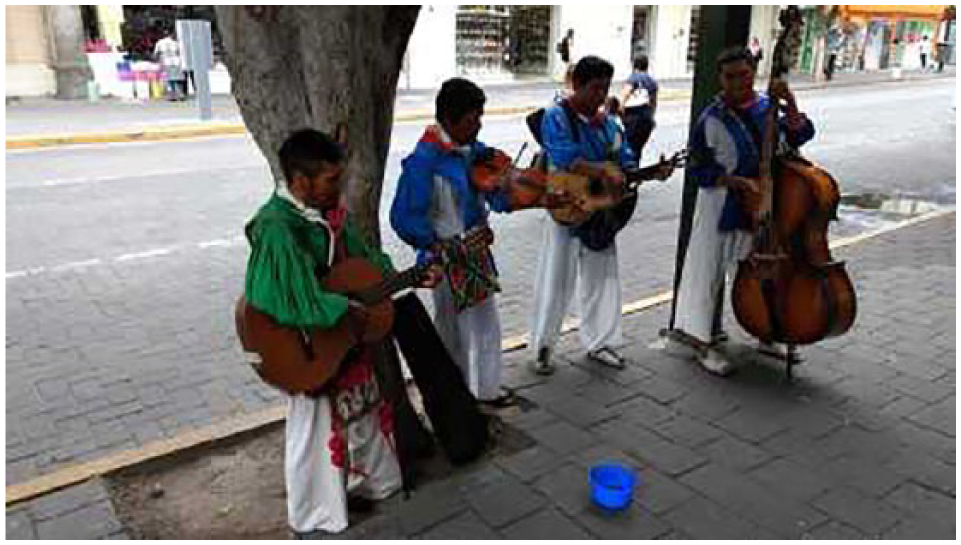
Indigenous band using both native and European instruments.
These forms of expression have a highly emotional content. Mexico is an emotional place. It can take quite a while to get out of a room because so many hugs are in order. Music and art that are only technically impressive, but not emotive, have short shelf lives. I next describe how the artistic and musical values evident in Guadalajara provide an important part of the context for literacy teaching and learning, and the education of teachers in universities to understand the contextualized nature of their teaching.
First Literacies
In societies in which many people cannot or do not read or write, stories are told through other means. Oral transmission has passed down histories since the earliest of human social organizations. Widespread literacy is a very recent demand, dating to the European Enlightenment and its emphasis on writing as the repository of scientific and logical thought (McCagg, 1989). Yet, such a luxury was typically the province of society’s elites, its wealthy and most powerful inhabitants. For the rest, literary and historical narratives were told through art and spoken word performances, both of which to refined Western tastes are of lower cultural value than the written text as a sign of societal advancement.
I learned in Europe how early churches told “sermons in stone” to illiterate masses (Smagorinsky, 2009c). In this fashion, churches such as the Cathedral of Notre Dame in Paris are elaborately decorated with sculptural depictions of scriptural narratives that allowed people who could not read the Holy Bible to know its stories. There is evidence of a similar practice in Mexico, where a great deal of Mexican history is told through statuary in public places for those who cannot read.
The statuary are not simply a European adaptation, however. The same sort of deification of historical figures was practiced among Mayan and Aztec people, who used physical structures to narrate their stories in pyramids, stelas (Mayan sculpted stone shafts), and murals of the sort that still bring life to many vertical surfaces in the Guadalajaran streetscape (Coe & Koontz, 2013). The figures themselves occupy the plazas that are present in virtually any Mexican community, serving as essential gathering spaces that encourage people to socialize, play, relax, buy and sell merchandise, and learn about culture and history through exposure to murals and sculptures.
Rockwell (2005), from an anthropological perspective based on her work in Chiapas, Mexico, argues that scholars “can no longer examine literacy along a single continuum that goes from orality (or the absence of the written language), to literacy as the elaborate use of alphabetic language” (p. 23). Rather, they need to account historically for the particular oral–written matrix of each cultural group:
The historical record shows instances of the Mayan’s use of written language, as well as use of oral language forms, to resist domination or the repression of their Native writing to prevent the spread of the written word among people at the margins of society. (p. 23)
This history of textual resistance remains evident in the street mural culture of Guadalajara, to which I will return.
I would situate this form of public expression adjacent to what is often called multimodality or multiliteracies in current educational and semiotic thought. I see those trendy constructs as celebrating and promoting digital texts as the sine qua non of literacy production (e.g., Cope & Kalantzis, 2000). Technology is quite hot and sexy in these expositions on the affordances of multimodal texts on computers and other devices. Schools and teachers are often scolded in these publications for lagging so far behind well-funded researchers in their technical facility, under the assumption that a superb infrastructure provided by tax dollars is surely in place in schools, leaving only dull teachers responsible for any shortcomings in applying what university scholars know is best.
I have always rejected this interpretation in the U.S. setting because I work in a state, Georgia, that annually underfunds its schools such that both technology and Internet capacity are in short supply. In other words, arguing for spiffy technology to promote literacy in my state, and many others, ignores a critical aspect of context: the refusal of taxpayers to support schools financially, emotionally, substantively, or rhetorically, and tax(non)payers then blaming teachers for schools’ struggles to teach kids the full range of knowledge and skills they will need to navigate society. Technology researchers then pile on, blaming teachers for not using electronic devices as prescribed in their publications.
Transporting the cutting-edge ideas of technology researchers from the United States, Australia, and elsewhere relies on the fragile assumption that Mexican communities have the resources to buy, support, and maintain the very latest in digital wizardry, until it goes out of date in 3 years and these resources are replenished through tax revenues. This assumption also appears to value virtual composition on digital devices over physical engagement with materials through which three-dimensional, corporeal texts can be constructed, a view I reject wholesale. As a garden landscaper of decidedly amateur qualifications, I place a great value on engaging directly with design materials to produce texts. Like many artists, builders, and designers, I feel a great satisfaction in getting my hands dirty working with real stuff and producing things that have a physical substance, a presence that I can walk around and appreciate in three physical dimensions. Although I do rely on a computer for writing, knowledge, and communication, I do not see the computer-based part of my day as having inherently greater value than the time I spend digging in the dirt and using hardscape and plants to create a beautiful, spiritual, ecologically responsible place that is in harmony with both nature and society.
Rather than all multimodal production comprising “New Literacies,” as they are termed in publications (e.g., New London Group, 1996), I see these handmade, material texts rendered artistically as products of Very Old Literacies, and indeed, as First Literacies. These compositional practices date to at least 40,000 years ago, when people began representing their worlds on cave walls, pottery, and other surfaces. Such textual productions remain central to much Mesoamerican culture, both in indigenous communities, where the arts remain a principal source of income and expression, and among people of other ethnicities who use physical tools to produce artistic works of the sort currently viewed as irrelevant in much U.S. educational policy (along with the rest of the humanities in general). Instead, the United States is locked in an impassioned romance with electronic devices and science, technology, engineering and mathematics (STEM) fields, blinded by what Latour (1996) refers to as aramis, the love of technology.
The Guadalajaran street explorer finds an endless gallery of murals throughout the city, a continuation of ancient traditions of public murals recovered by native Jalisco painter José Clemente Orozco, along with Diego Rivera and David Alfaro Siqueiros. 1 I came across the garage door depicted in Figure 3, which I photographed because I found the image compelling.

Images from Wikarikan culture on Guadalajaran garage door.
I shared this image with the teachers in my seminar, and several immediately identified it as a cultural text, saying, Ah, that’s an image from the Wikarika culture—the family must have left their village for the city, but commemorated their heritage with a painting in their traditional style. The Spanish at the top reads, “Tales that are not Tales,” which I assume refers to a mythical narrative depicted in the scene. This sort of text has great significance with Mexican heritage cultures, often far more so than anything in writing, the medium of their oppressors. Literacy researchers will smile at the multimodality of the form, a confirmation of the semiotic assumption that textuality is meaning laden, with no semiotic system inherently superior to any other, and written texts of lesser value in some contexts than others. It is, however, not a digital composition, but one undertaken with paint and the canvas provided by the garage door.
Another form of public art I observed was, I assume, uncommissioned and produced by street artists whose efforts fell outside the legal system and may not have been welcome, although the works’ ongoing presence suggests that nobody has found them odious enough to be painted over. Figure 4, for instance, shows a striking reformulation of the “smiley face” emoticon, torn open to reveal a less jovial inner life, one perhaps suffering beneath the smile’s façade. The message to the right of the smiley face reads in translation, “It’s a fucking joke . . . do not take it personally!!!” The artwork is surrounded by what might more commonly be considered graffiti, possibly gang slogans and symbols of the sort found in any U.S. city. I read this sort of art as resistant and offering a critical perspective on the lives of ordinary people who may be suffering more than it might appear, perhaps, in relation to the systemic inequities that characterize Mexican (and U.S.) society.

Presumably uncommissioned public art.
All this artistic expression is, I believe, highly emotive. Mexican nationalism is promoted through the historical depictions of revolutionary figures. Cultural pride and heritage are expressed through ethnic narratives. Political perspectives are asserted in ways designed to move people to challenge societal inequities. These affective aspects of public texts, and the literacy skills required to read them, merit attention in literacy efforts. Engaging readers’ emotions appears a central dimension of teaching for literacy in this context. Such an emphasis is in direct contrast to current U.S. values such as the Common Core State Standards’ antagonism toward emotional readings, which in the New Critical tradition are viewed as corrupting influences rather than as essential features of a reading experience (Coleman & Pimentel, 2012).
This fundamental value system cannot be overlooked if literacy education is to produce the sorts of readers of cultural texts that it is designed to promote. Mexico is a nation where the magical side of life remains in play, in contrast with the bloodless, dispassionate, pragmatic education currently imposed in the United States through its business accountability model. Mexican culture is infused with the spirit of Catholic virgins and indigenous shamans (see Jacobs, 1997), and belief in their powers remains alive among many people whose right to have faith in them is legally preserved. In this context, then, an education that proceeds with relationships, the supernatural, and emotions sacrificed to meet the needs of economic machinery alone will (and according to the teachers in my seminar, often does) alienate students from schoolwork and the forms of literacy it promotes.
A Literacy Education Program for Teachers in the Guadalajaran Context
With this very sketchy account of aspects of the Mexican context established, I next turn to the seminar I have taught, and how it required adaptations from the U.S. context to the Mexican setting. One thing that surprised me about the literacy program at the Universidad was its heavy emphasis on social justice and antidiscrimination education. Many of the course readings suggested during our planning sessions seemed to be straight out of a U.S. teacher education syllabus, with critical theory widely represented in Mexican, Central American, and South American authors and in staples from the U.S. critical field. Among Mexico’s many contrasts is the disparity in wealth. My colleagues, speaking on behalf of people of low socioeconomic status, constantly complain about government corruption, the hoarding of resources by the wealthy, discriminatory practices toward indigenous and poor people, racism, xenophobia, and other societal troubles that made me feel right at home. Many in the United States want to wall off Mexican immigration, but the Mexicans are concerned about refugees from Central America coming in and depleting their resources.
Racism in Mexico takes on an ethnic cast as immigrants from Honduras, El Salvador, and other southern nations are viewed as threats to societal stability. Racism is also practiced through the imposition of a “whiteness” standard, with lighter complexions favored over darker ones, Spanish features over indigenous. These matters become part of literacy education, given that literacy opportunities are often stifled because of assumptions based on lightness and darkness of complexion. These values are fiercely contested in art, literature, and social science research, as they are in the United States, yet here they require far greater subtlety, given that the United States is principally obsessed with presumed hierarchies pitting White versus Other colors. Mexican racism comes both in the Spanish colonial legacy and in the discrimination imposed even within racial groups depending on the relative lightness and darkness of skin tone.
The economic disparities emphasized by the university and school teachers I have worked with are manifested in how public education is funded. U.S. teachers rightly complain that schools get kneecapped at the funding level, with craven politicians and stingy taxpayers loath to support millages that benefit the greater good. But compared with Mexican schools, ours are rolling in money. During one seminar I taught, I modeled for the 12 teachers my ways of learning names quickly through charts and visual aids such as class galleries, because being called by name is a form of affirmation and inclusion. They agreed that knowing the students by name is important. But they had a question: How many students do you have in your classes? Well, let’s see, maybe a dozen for a doctoral seminar, and a couple dozen for undergrads, I replied. The classes I taught in high schools rarely enrolled more than 30. How about y’all? I asked. I have about 40 per class, said one. A particularly overloaded teacher said that she taught about 60 students in each class, and another reported having an enrollment total across eight classes of about 400.
Schools are so overcrowded that many, if not most, run on two shifts, with one ending in midafternoon and the other starting then and going through the evening. Some teachers teach a double shift with huge class sizes all day. If frequent writing and feedback are necessary to promote written literacy skills, then being a good writing teacher in this context sounds pretty hard to me. The teachers I work with are all smart and dedicated, and are trying to do a job that the social context makes very difficult because there are just too many pupils per teacher. Adapting any pedagogical ideas to this context requires that U.S. visitors must set aside some ideals and try to work within the constraints the economic support system provides.
Adventures in Adapting U.S. Literacy Research to the Jalisco Context
During a recent week-long seminar I ran, we used a book I helped to produce with Leila Christenbury, Randy Bomer and Peter Smagorinsky (2009), the Guilford Handbook of Adolescent Literacy Research. This edited volume seemed to be a logical choice, in that, it covers a wide range of literacy issues affecting adolescents.
Adolescents in the United States, at least. Using the book in Mexico was quite an eye-opener. The book’s contents had a difficult extrapolation to this new national context, just a border away. I will illustrate, using a couple of chapters that the program administrators recommended that we focus on, just how dramatic a change in context it was to use this research in Mexico, and what we had to do as scholars and teachers to get something out of the readings so that they made sense in Jalisco.
Workplace literacy
Given that one goal for the program is to prepare a literate workforce for the “new Mexico,” particularly Jalisco, the administrators recommended that we read and discuss Anne Beaufort’s “Preparing Adolescents for the Literacy Demands of the 21st-Century Workplace.” Beaufort (2009) lays out a set of assumptions about workplace writing, based on her experiences both working in and conducting research on business office environments. As a university college composition professor, she deals exclusively with college-enrolled people heading to the white-collar workplace. Research shows, she argues, that college-educated people have higher earnings than those not attending college. It thus makes sense to understand the forms of literacy that await such people in the sorts of business settings that they tend to enter, so as to provide college writing experiences that allow for a rapid adaptation to the demands and expectations of the office environment. Her review of workplace writing, thus, focuses on professions in which writing is used to produce memos, sales documents, and other artifacts of business relationships.
Reading this chapter with Mexican teachers enrolling 40 to 60 students per class, few from affluent homes, was quite sobering. These teachers’ students are not headed for jobs with IBM or the Goldman Sachs Group, Inc. Many of them will enter service professions where workplace writing involves taking customers’ orders at restaurant tables, or writing a receipt for a sale in a shop, or perhaps not writing at all. Mexico, in my experience, operates in many sectors according to a cash economy. Unless the shop has a robust tourist clientele, the transaction involves cash only, with no memos to submit up the corporate food chain for meetings, reports, accountability, or anything else. If there is a sales tax, it is universally ignored in these cash transactions—another potential income source for schools overlooked in the interest of cheaper day-to-day living.
The sorts of office spaces imagined by Beaufort require a familiarity with emerging digital technologies, although her 2009 chapter refers to such “current” media as MySpace, devices such as personal digital assistants (PDAs), and other quicksilver technologies that are already long gone. But the teachers in my seminar talked about students who do not have electricity at home, have little money for digital tools or phone-related services, live in areas where there is no connectivity even if they did have electricity, and are more interested in the sort of work that will sustain them during their lives—carpentry, fishing, and so on—than in learning academic literacies remote from their needs. To be sure, many Mexicans have cell phones and other devices; it is hardly a technology-free society. But those who live in electricity-free homes and communities are out of luck. And, if schools have limited bandwidth, like the schools I know of in Georgia, the possibilities for enacting that cutting-edge technology-driven literacy education are pretty slim.
One tactic that emerged for me pedagogically during the week was to take the chapters we read from the Guilford Handbook and say, OK, this is what this U.S. author thinks about this topic. Let us write our own chapter for your teaching context. How would it look? What literacies would you emphasize? What dispositions would you foster?
One consistent response from the teachers was that their own literacy teacher education should include a critical dimension of the sort lacking in the chapter on workplace literacy we read from our Handbook. Beaufort assumes the modern business office as the optimal place of commerce, rather than as a place of inequity, as a critical theorist would assume. She encourages the learning of the sorts of skills and dispositions that enable a smooth transition from university classes to the office environment, without noting its power inequities and other potential injustices. I recruited this chapter for the volume and served as her editor, so I name myself as complicit in perpetuating these assumptions.
The teachers I worked with felt that their students needed not just literacy skills but frames of mind that allowed them to use their literacy practices to produce changes in their environments, a tenet of a Freirean education that serves among the program’s backbone emphases. Not only, then, did the teachers believe that different sorts of workplaces awaited their students, each with its own literacy demands (or not, depending on the sort of work anticipated), but also they believed that different frames of mind were necessary if Mexico’s persistent, engrained inequities are ever to be challenged and overturned.
Awakening from the technology dream
Another chapter we read was David Bruce’s (2009) “Reading and Writing Video: Media Literacy and Adolescents,” in which the author reports on adolescents’ process of using sophisticated digital tools to produce films that embody their personal identities. Bruce gives the example of a remarkable film produced by his nephew, an avid skateboarder, on his hobby and how it helped shape his identity. As I was reviewing this chapter in anticipation of the class session for which it was assigned, I thought, Yikes. What on earth are we possibly going to talk about? These kids do not have a digital lab where they can take their films of personally meaningful avocations and edit them into professional-grade productions for shared viewing. The chapter’s suburban U.S. character made the literacy practices described seem out of place and out of reach for these teachers’ contexts.
Again, though, the class came through in our effort to rewrite the chapter for the Mexican context. There were several key differences in how Bruce presented his material and the settings in which the teachers from Jalisco worked: the levels of affluence required to engage in the filming and editing processes, and the purpose of constructing a text embodying a social practice (skateboarding) that leads to individual growth and understanding. For Bruce’s nephew, the film process was one of great personal expression and representation. The Mexican context, however, did not emphasize the development of personality. Rather, the teachers in the seminar took the critical view that the students needed to develop political power and agency through literacy as a way to change the society that oppressed their possibilities in life.
The seminar teachers agreed with me that the ideas presented by Bruce (2009) were unworkable in their school contexts. If we hoped to adapt his ideas, and if film and technical capabilities were not possible, what might serve that end? The teachers in the seminar shifted the emphasis from personally fulfilling texts about hobbies and passions to critical looks at their environments, with cell phones or cheap cameras; the vehicles for producing photo documentaries of their settings to serve as the basis of societal critique. I have not had the opportunity yet to see whether they have been able to include this pedagogy, but their experiences in their communities lead me to believe that this adaptation could indeed produce compelling literacy events through which the students both engage in an affordable, dramatic literacy process and create agency for themselves through their development of critical acumen and resulting activist work to change their communities for the better.
Discussion
Although the United States might be considered more homogeneous and not subject to quite so dramatic a reorientation as I have required working on this project, I remain convinced that the context is paramount in U.S. teacher education. Urban universities training teachers for urban settings enroll different teacher candidates headed for different sorts of classrooms than do programs in White, rural America. States with high taxation can do more with technology than states with shamefully low funding. Ignoring these realities will lead to useless education courses dedicated to ideals irrespective of context. I have known people who have touted their teacher education programs as “models” for others to follow (e.g., Hudson-Ross & Graham, 1997), in spite of the fact that nobody else is even trying to replicate them, because they only work in their setting of origination and its unique personnel, configuration, and environment. Any effort to export such “models” requires as much adaptation as taking Bruce’s (2009) ideas on personally fulfilling, high-end technologically driven film editing and shifting them to communities characterized by low income and limited or no technological resources.
Literacy teacher educators, then, can never act as though they are in a vacuum. Rather, they need to attend to the local demographics, resources, policies, school circumstances, personnel allocations, and other factors that constrain and enable their work, and teach responsively in relation to them. If they do, then they can match the imagination of the teachers I have worked with in Mexico and teach so that their teacher candidates emerge with the right blend of general and local knowledge to serve their communities and schools appropriately.
“Best practices,” then, are not universal, but those that are suitable to local contexts, cultures, and worldviews. Accepting this premise makes the work of teacher education more challenging than it is when the latest “best practices” and “high leverage” can be promoted, regardless of setting. Teacher education requires an understanding of who is teaching, who is learning, and what sorts of institutions they occupy. If teacher education ignores what I consider to be this reality, then it runs the risk of fulfilling its presumptive role of being too theoretical and out of touch with the real world, as asserted by a variety of scholars over time, from Prewett (1955) to Ünver (2014) to thousands of program graduates. Attending to the local requires adaptations, and learning how to adapt seems a valuable component of teacher education coursework, adapting not just methods, but to demographic variation and the demands it makes on decision making. That is a practice I think is pretty good and worth promoting in teacher education programs.
Supplemental Material
Supplemental_Material_784692 – Supplemental material for Literacy in Teacher Education: “It’s the Context, Stupid”
Supplemental material, Supplemental_Material_784692 for Literacy in Teacher Education: “It’s the Context, Stupid” by Peter Smagorinsky in Journal of Literacy Research
Footnotes
Declaration of Conflicting Interests
The author(s) declared no potential conflicts of interest with respect to the research, authorship, and/or publication of this article.
Funding
The author(s) received no financial support for the research, authorship, and/or publication of this article.
Notes

References
Supplementary Material
Please find the following supplemental material available below.
For Open Access articles published under a Creative Commons License, all supplemental material carries the same license as the article it is associated with.
For non-Open Access articles published, all supplemental material carries a non-exclusive license, and permission requests for re-use of supplemental material or any part of supplemental material shall be sent directly to the copyright owner as specified in the copyright notice associated with the article.
