




Abstract
Spurred by burgeoning racist and xenophobic immigration policy and rhetoric, we analyzed the writing of seven second-grade children about their experiences of living connections that span the United States–Mexico border. Informed by research on children’s testimonios in literacy classrooms and Anzaldúa’s concept of the border/lands, we drew on feminist and critical poststructuralist theories to examine how children’s writing rhetorically and aesthetically engaged with the affective, political, and ideological dimensions of borders and the rhetorical and material violence of hostile policies. Methodologically, we conducted close readings of children’s writing, tracing how they disrupted boundaries, including those constructed both physically and ideologically across nations and between concepts, identities, and feelings. This analysis underscores children’s keen insights into their political and personal worlds, the importance of writing pedagogies that invite children to engage with the personal and political, and the need for methods of analysis that attend to the poetics of children’s perspectives.
There is poetry to be found in all human endeavors to understand the world. The thing is to know how to see the poetry, how to hear the poetry, how to feel the poetry. More often, the thing is just to remember that it’s there.
Now, more than ever, borders between nations are ever-present in the social, cultural, and political fabric of the communities, state, and nation in which children engage school literacies. Our analysis of children’s writing began during a historical moment in the United States, when the news was full of images of Latinx children who had made perilous journeys across the U.S. border. The headlines often included the words “crisis” and “illegal” and “apprehended.” Then, as the 2016 U.S. presidential campaign gained momentum, virulently anti-immigrant and overtly racist rhetoric also explicitly implicated children, as some candidates advocated for revoking birthright citizenship for children of undocumented immigrants (Rappaport, 2015), vowed to construct a physical barrier to separate regions, and framed Mexicans and Mexican Americans as criminals. Donald Trump, the candidate spouting the most oppressive rhetoric, was elected U.S. president.
In the context of this social and political moment in the United States, we focus on the writing of seven second-grade children about their experiences of living in the “border/lands,” what Anzaldúa (1987) describes as “a vague and undetermined place created by the emotional residue of an unnatural boundary” and a space in a “constant state of transition” (p. 3). Given the prevalence of the border in the politics surrounding classrooms, some children of color in literacy classrooms are always navigating U.S. immigration policies that wreak material and symbolic violence on them and their families. Thus, it makes sense that such experiences would appear in children’s school writing. Classroom research on writing consistently conveys the richness of the writing children engage in response to pedagogies thatauthorize lived knowledge as a resource for school literacies (Ghiso & Low, 2013; Moll, González, & Amanti, 2005). In addition, researchers underscore the ethical and moral imperative of designing writing pedagogies that invite rather than foreclose the knowledge of students of color, emergent bilingual children, and those facing poverty (Handsfield & Valente, 2016; Pacheco, 2009). Such knowledge includes family, cultural, and community connections, including those that span nations. In addition, many children bring perspectives gleaned from lived experiences with racism, xenophobia, and economic inequality.
However, research reveals how high-stakes assessment, mandated curricula, and deficit views of experiences that do not conform to White, middle-class norms can function to foreclose opportunities for many children of color to draw on their lives as resources for school literacies (Hillocks, 2002; McCarthy, 2008; Stillman & Anderson, 2017). In response to this problem, literacy scholarship has focused on instructional practices and teacher stances that support Latinx children in bringing their lives to school literacies (e.g., Campano, Ghiso, & Sanchez, 2013; Sepúlveda, 2011; Skerrett & Bomer, 2013). Findings from these studies point to opportunities for children to demonstrate their cultural knowledge, linguistic repertoires, and keen political insights. We have found less emphasis, though, on close readings of Latinx children’s writing to consider what the writing itself is doing aesthetically and rhetorically related to identities, connections, and the sociopolitical landscapes of border-spanning lives.
We wanted to look closely at children’s writing to learn from both what children wrote and how they wrote as a way to inform and expand the field’s conceptualizations of the multiple planes of children’s writing and explore approaches to access and honor those layers. Toward those goals, two questions guided our analysis: Given writing pedagogies explicitly designed to invite children’s lives into school writing, in what ways do Latinx children address border-spanning identities? How does children’s writing rhetorically and aesthetically index and engage with borders and their political and ideological contexts?
The analysis we share is drawn from a larger classroom-based study in which Elizabeth, doctoral students, and the second-grade teacher collaborated to design and study pedagogies to invite children’s lives into the literacy classroom, including experiences often unsanctioned in schools (Dutro & Bien, 2014). Stories of experiences with immigration and family relationships spanning the United States and Mexican border were an important theme in our larger study, including children using school literacies to speak back to racist and xenophobic rhetoric. Given the recent increase in long-standing racialized rhetoric and material impacts aimed at immigrants of color in the United States, we felt an urgent need to turn centrally to that subset of writing to learn from the perspectives children share, as well as how they bring those experiences to the page. In what follows, we turn first to related research and the theoretical lenses we engaged in our analysis. Next, we describe the participants and context of our study and the inquiry methods we used to learn from children and their writing. We then share our findings, organized by three prevalent threads children wove into their stories that echo Anzaldúa’s emphasis of the border as a fluctuating space of multiplicity, one that defies static interpretations. We conclude with implications for theory, research, and practice.
Children Living and Disrupting Borders: Guiding Theories and Related Research
Anzaldúa (1987) approaches her exploration of life on the borders with the recognition of the “unique positionings consciousness takes at these confluent streams” (p. i). Furthermore, in weaving together Spanish and English language to speak to experiences across geographic and metaphoric borders, Anzaldúa theorizes the complex melding of richness of connection to place and history with the marginalization often central in how those in power engage the borderlands politically and ideologically. Chicana feminist scholars in literacy have drawn on Anzaldúa to unsettle dominant paradigms in educational research and foreground epistemologies grounded in the rich complexities Anzaldúa describes (Calderón, Bernal, Huber, Malagón, & Vélez, 2012; Cruz, 2012). Researchers across disciplines have argued against constructions of identities as divided by allegiances between present and origin communities, instead recognizing the complexity inherent in all projects of self-construction, including those that involve histories and relationships across nations (Calderón, 2014; Mignolo, 2017). This attention to disruption of binaries in how human lives are consequentially constructed and categorized speaks to the critical poststructuralist perspectives we bring to our study. In these lenses, meaning is discursive, constructed through both literal language in words and texts and in the array of social practices, institutions, and social structures encountered, negotiated, and resisted by individuals and groups. Thus, power is not only produced through language, but discourse also undermines and exposes power, “renders it fragile and makes it possible to thwart it” (Foucault, 1990, pp. 100-101).
Furthermore, language in these perspectives is never straightforwardly referential, but always evokes multiple possibilities. Accessing multiplicity of meaning requires deconstructing dominant narratives that attempt to sustain systems of dominance by controlling and constraining what can be known (e.g., Vasudevan, Kerr, Conley, & Riina-Ferrie, 2015). Border rhetoric and enforcement in the United States is an example of the necessity of deconstructive work, as the language surrounding border policies relentlessly defines human lives in binary categories such as citizen/alien, counted/discounted, and worthy/unworthy. The stakes are high in these constructions, for, as Butler (2006) argues, in positioning some bodies as less than fully human, such rhetoric constructs some lives as “less grievable” than others.
These perspectives help us consider how children’s writing complicates distinctions that arise in discussions of the impact of hostile immigration policies on children in classrooms, including those between sorrow and joy, personal and public, distance and proximity, and real and imagined. Our analysis emphasizes the interdependent, blurred meanings of descriptors of experience and the affective, embodied state of living in and through ordinary and extraordinary events (Cacho, 2012; Caruth, 1996; Stewart, 2007; Zembylas, 2008). Indeed, the writing pedagogies the children in our study experienced were designed to enact the premise that seemingly oppositional stances can and must be simultaneously present, particularly the need to embrace shared human experience while recognizing the very different ways lives are affected by systemic oppression.
Given the often hostile political climate and material hazards of border crossing, as well as the separations from loved people and places inherent in moves across nations (Capps, Castañeda, Chaudry, & Santos, 2007; Chaudry et al., 2010; Mares, Newman, Dudley, & Gale, 2002; Pumariega & Rothe, 2010), Latinx children’s narratives serve as testimonio to what Anzaldúa (1987) describes as “adversity and violation” (p. i). Testimonio, a practice of counterstorytelling (Handsfield & Valente, 2016) with roots in Latin American indigenous communities, illuminates power and inequity and functions as resistance to state violence and oppression (González, Plata, García, Torres, & Urrieta, 2003). Testimonio has been taken up in K-12 literacy contexts as well as teacher education as a practice that foregrounds both the knowledges children and youth bring to literacies and the violent consequences of oppression for communities of color (González et al., 2003). For example, studies demonstrate how testimonio surfaces the consequences of marginalization and deficit perspectives in schools (Fránquiz, Salazar, & DeNicolo, 2011), the potential for empathy among teacher candidates and K-12 students (González et al., 2003), and the emergence of political–historical knowledge (Pacheco, 2009). In addition to highlighting narrative as a conduit for calling out inequity and discrimination, literacy researchers also emphasize that young people often choose to use narrative genres as a way to represent and understand experiences of migration and membership within transnational communities (e.g., DeNicolo & Gonzalez, 2015; Dossa, 2002; Elbaz-Luwisch, 2007; Ghiso & Low, 2013; Noguerón-Liu & Hogan, 2017; Pandya, Pagdilao, Kim, & Marquez, 2015; Rousseau, Lacroix, Bagilishya, & Heusch, 2003; Skerrett & Bomer, 2013).
As Orellana, Thorne, Chee, and Lam (2001) argue, migration is never unidirectional, but involves the continual return, both literal and emotional, to communities across the border, and children play a central role in maintaining and nurturing relationships across these borders. As members of border-spanning communities, children from immigrant families do not oscillate between places they or their family members have lived, underscoring the need to consider the diversity within and among children’s experiences rather than rely on dualistic framings of language, community, or what counts as home (Behar, 2013; Campano, 2007; Campano et al., 2013; Karakayali, 2005; Sánchez, 2014). Researchers have argued the need to re-center the narrative of immigration to include children’s perspectives, voices, and experiences with the policies that affect them (Ghiso & Low, 2013; Noguerón-Liu & Hogan, 2017; Nugent, 2006; Sánchez, 2014; Thronson, 2010) and recognize children’s sophisticated political–historical knowledge in service of imagining potential alternatives (Pacheco, 2009).
For Latinx children, particularly those of Mexican descent, the history of schooling in the United States has often been exclusionary and unjust, marked by segregation and discrepancies in quality of facilities and supplies (Donato, 1997; Gonzales, Heredia, & Negron-Gonzales, 2015; Goodwin, 2002), as well as anti-immigration sentiment and bans on bilingual education (Gonzales et al., 2015; Ontiveros & Drexler, 2008; Rosenthal, 2016). Within these ongoing histories of discrimination, literacy research also emphasizes the potential of literacy classrooms for honor, value, connection, heart, and recognition as dyed into the fabric of school literacies (Campano et al., 2013; Delgado Bernal, 2001; Handsfield & Valente, 2016; Walqui, 2006).
Contexts and Methods of Learning From Children’s Writing
In this section, we introduce the children and describe the contexts and methods of our analysis.
Participants and Classroom Context
This article draws on data from a qualitative study of children’s literacy practices across 3 years in a second-grade classroom in one K-5 elementary school in a large district in the mountain west of the United States. The seven children who wrote the focal stories were each 7 or 8 years old during second grade and were participants in the larger study. As we describe further below, we focus on these seven children’s writing based on content analysis of writing notebooks across years and participants in the larger study. That study occurred from 2008 to 2011, during the first term of the Obama administration. At least in part due to policies implemented in former administrations, in 2008, the United States had a record high of nearly 360,000 deportations, with the majority occurring in the interior states. In short, children and families were facing the consequences of increasingly stringent enforcement policies, along with ongoing rhetoric criminalizing undocumented residents (Chishti, Pierce, & Bolter, 2017). As reported by the local newspaper, the state in which the children lived has experienced the highest increase in childhood poverty in the nation during the 2000s, with 23% of children living below the poverty line in these children’s home county during the time of the study. Yet, as we emphasized above, as oppressive as the previous administration’s policies felt as the children were writing, their stories speak even more centrally to the increased stakes of the Trump administration.
The children were familiar to Elizabeth from her frequent visits to the classroom throughout the school year. Along with the children’s self-descriptions of racial/ethnic identity, Table 1 provides a snapshot of the varied and dynamic interests and experiences of each child. Their teacher, a White woman in her 20s, was in her second through fourth years of teaching during the study. She grew up middle class in the Midwest and only spoke English. She was a central collaborator in the larger study, including presenting at conferences and coauthoring some manuscripts.
Snapshots of Child Authors. a
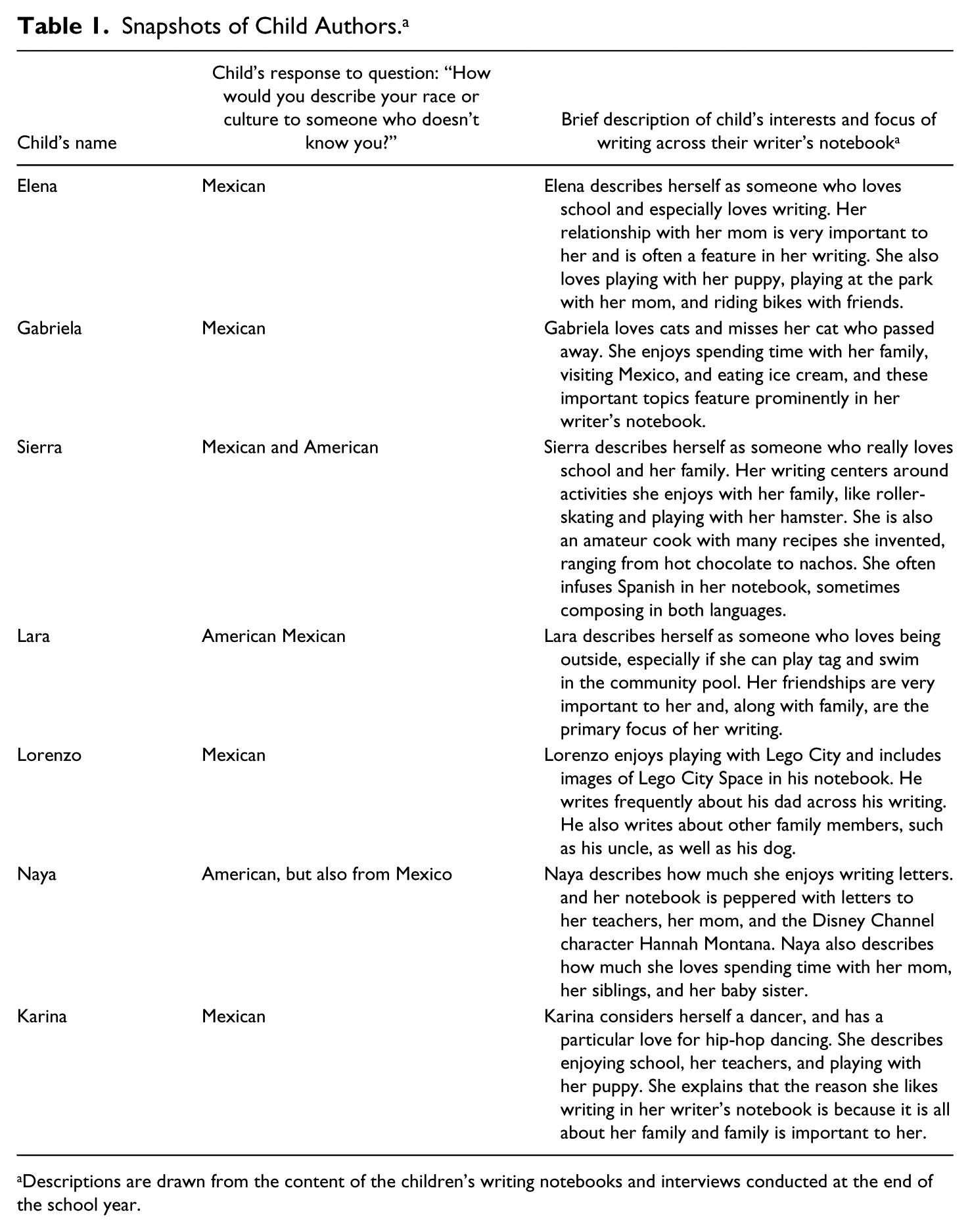
Descriptions are drawn from the content of the children’s writing notebooks and interviews conducted at the end of the school year.
Economically, the school district included families ranging from upper middle class to those facing poverty. This school was one of the Title I-designated schools in the district and more than 90% of the children qualified for free or reduced-price lunch. The school included a significant number of emergent bilingual and bilingual English/Spanish students. Of the 78 participating children, 45 were Latinx, five were African American, two were Asian American, and 26 were White. The study was embedded in a 3-year multisite teacher research partnership of five K-12 teachers; Elizabeth, who was a university professor and former elementary teacher; and graduate assistants. The project was centered on how stories of students’ lives are documented and interpreted in classrooms and schools and the role of teachers’ and students’ life stories in equity- and advocacy-oriented pedagogies.
Children wrote their narratives in the context of our design and study of pedagogies of testimony and critical witness, which explicitly invite students to draw on life experiences, including difficult life experiences and topics that risk being viewed as too political or personal for school literacies (Dutro, 2013). Because we want to make clear the classroom pedagogies within which the children were writing, we briefly turn here to describe specific moves involved in enacting those pedagogies in the writing classroom. For one, teachers model and engage first and regularly in the risk and vulnerability of bringing the personal into the public space of classrooms, vulnerabilities that too often fall only to students. Through this move, teachers do not just serve as witnesses to students, but allow students to serve as their witnesses by sharing life experiences, including difficult experiences. In addition, serving as a critical witness to students involves actively working to engage in critical analyses of power and privilege in how students are positioned in schools and society and taking steps to advocate for students and work toward justice. Finally, these pedagogies are viewed as integral to content and curricular goals and woven into the fabric of instruction in school literacies (Dutro, 2013). We found that opportunities to enact these pedagogies can occur regularly through purposeful use of familiar instructional routines, including the modeled writing and use of mentor texts that occur in mini-lessons.
One example of these pedagogies occurred in a personal narrative unit called the “Lemonade Unit,” in which children were invited to choose topics that represented challenging experiences (lemons) and those they would identify as positive (lemonade). The unit launched with a read aloud of The Lemonade Club, by Patricia Palocco, a story that connected to one child’s experience with cancer in the first year of the study. The teacher then modeled personal narrative writing with a narrative about her grandfather’s death, and built mini-lessons and independent writing around the two narratives children chose to pursue. Children took up these invitations on a range of topics, including Lorenzo’s story about his father that we share in our analysis below.
Data Collected and Process of Analysis
To address our research questions, we engaged several layers of analysis. First, we chose to focus on children’s writing across the 3 years of the study as represented in the notebooks in which they kept all of their writing during each school year. The notebooks were bound 9¾ × 7½-inch composition notebooks, elaborately decorated by each child. As the children used these notebooks for all classroom writing, the notebooks allowed access to an extensive collection of each child’s writing.
Next, we drew on analysis conducted for the larger project, in which we created a record of content across each school year by creating tables with rows for each child and columns for noting genres, topics, connections to central research focus, and initial codes. This process allowed us to identify writing that indexed identities and relationships across national borders or impacts of systems of authority and enforcement. For instance, although some stories, such as Lara’s, explicitly discuss experiences with deportation, we also included a story, such as Elena’s, about an experience with police that connected in tone and theme with some stories addressing the impact of immigration policy. Through this process, we identified the seven stories for this analysis in which these themes were at the center of a child’s narrative.
Given the focused number of narratives, we were able to engage all of them in a process of close reading, a method of analysis most commonly associated with literary criticism (Dobie, 2011). We both have disciplinary roots in English and cultural studies, in which literary criticism using close reading is a common method. As Bardzell (2009) writes, through close reading,
a critic often models the act of reading, not to reproduce a static understanding in the reader’s head of what is in the critic’s head, but rather to encourage the reader to use similar interpretive strategies both in the original text and in subsequent texts.
Importantly, although we use the term “close reading” as a descriptor of a method of textual analysis, our approach is different from its use in the Common Core State Standards that has been critiqued for being apolitical and inattentive to the social context of the reader (Hinchman & Moore, 2013). To the contrary, we employ methods of literary criticism that demand interpretive attention to affective and political dimensions of texts with the aim to illuminate and complicate meaning in ways that may open pathways to new understandings.
Our process involved multiple readings of children’s stories and notating the texts in ways that attended to elements such as imagery, symbolism, tropes, metaphor, temporality, and the linguistic, pictorial, and aesthetic echoes across children’s writing and drawing (see Image 1). As guided by our theoretical framework, we also specifically noted terms, phrases, metaphors, and images children used that challenged concepts often defined as oppositional (see Image 2). We conceptualized this as a deconstructive reading that “attends to the deconstructive processes always occurring in the texts and already there waiting to be read” (Payne, 1993, p. 121). For instance, for many children, explicit reference to distance from relatives due to national borders is rhetorically dependent on closeness of connection.
Our interpretations also reflect our goal to attend to issues of power, particularly structural inequities surrounding the children’s stories. We engaged critical approaches to textual analysis by situating children’s texts within larger ideologies and meta-narratives (Fairclough, 2013). Thus, we situated our close readings of each child’s writing in larger discourses of, for instance, immigration policy and its surrounding xenophobic rhetoric; the over-incarceration of people of color in the United States, particularly Black and Latinx communities; and the ongoing systemic issues of profiling and violence perpetrated on people of color by law enforcement. Finally, the themes organizing our findings arose from our close readings, as we found some stories foregrounded particular content or feeling. Consistent with our perspectives, these are permeable themes and are not intended to foreclose any number of ways these stories might be presented.
Throughout our analysis, we were mindful of the need to attend to children’s complex and varied identities and interests. In addition, although our goals and guiding theories challenge the notion that our interpretations should reflect the author’s intent, we wanted to ensure that our analyses were conducted within broader knowledge of the children as writers and members of the classroom community. We addressed this by, first, situating our analyses in Elizabeth’s relationships with the children, built from frequent visits to the classroom. Second, we were immersed in the writer’s notebook data for the larger project, so were familiar with each child’s full year of writing. Third, interviews with each child near the end of the school year served as member checking, providing another context for understanding children more holistically, including how they spoke about the writing in their notebooks, as well as their perspectives on writing and the pedagogies they encountered in their classroom.
In our work with children who identify as Latinx, we strive to be allies. However, we are highly aware of our own positioning as two White, middle-class women who do not live transnational identities and, thus, engage with children and their stories as outsiders to that experience. We tried to be highly intentional in immersing in children’s experiences with empathy and connection, while simultaneously engaging in critical reflection on the power we were exercising when interpreting children’s stories. In addition, there are methodological limitations in drawing so deeply from one data set from a larger study of one classroom. However, identifying this set of narratives afforded the opportunity to pursue our research questions through close readings of each child’s writing, analyze them in relation to one another, and engage children’s perspectives on critical issues that hold immense consequences for them.
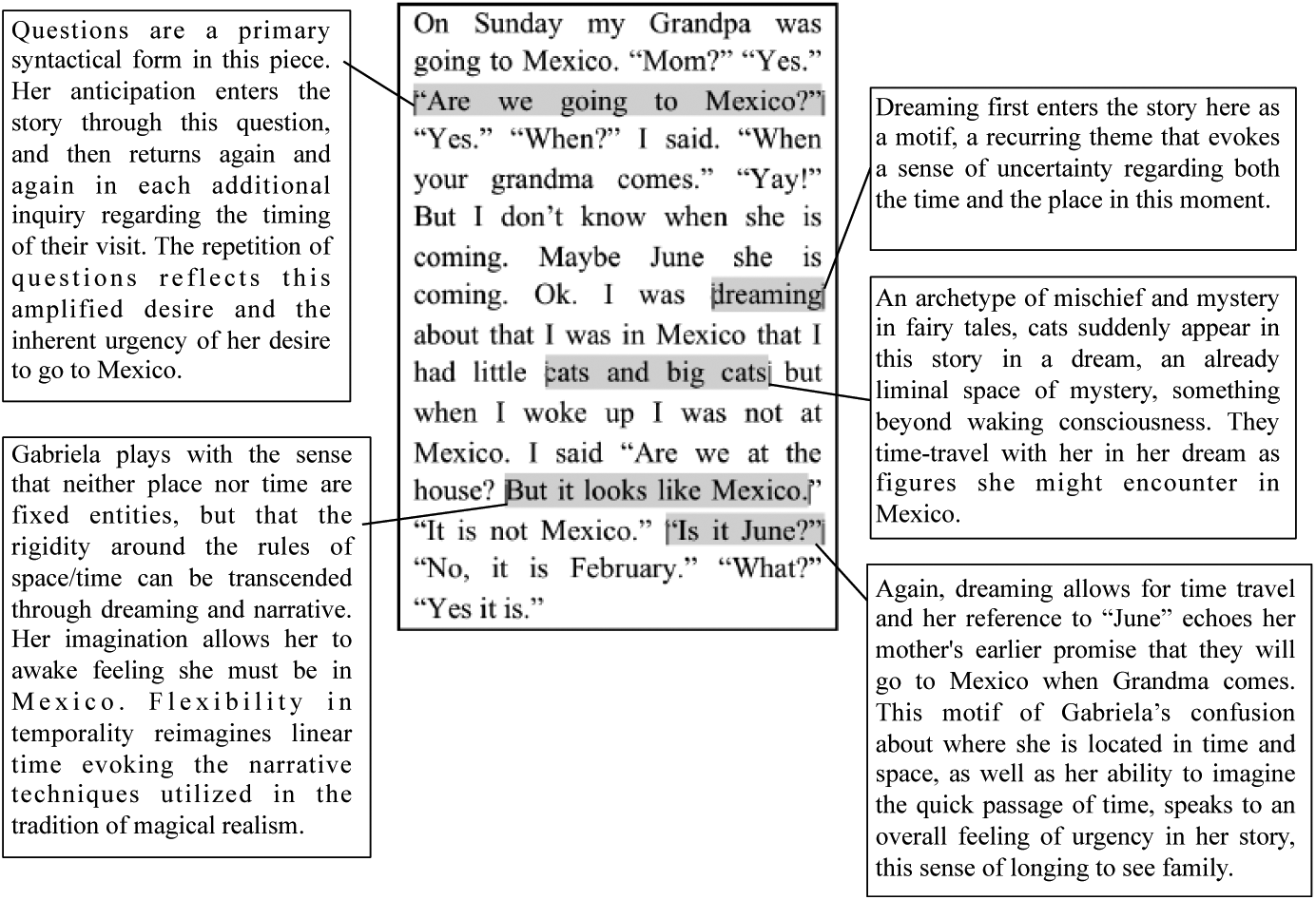
Illustration of close reading analysis
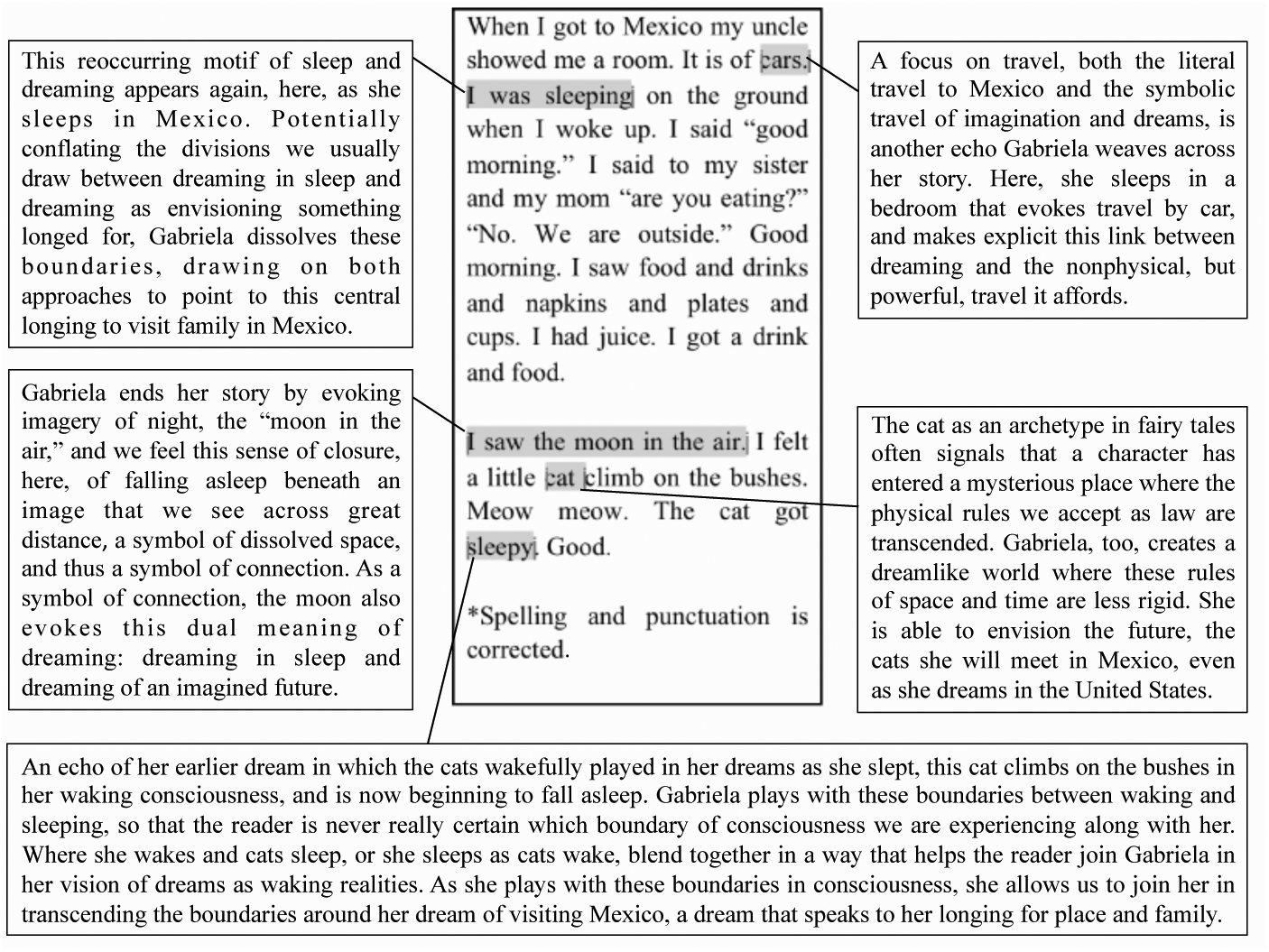
Sample analysis
Children Writing the Visceral Border
A central finding of our analysis is that children’s writing functioned to point to as well as blur borders—those constructed physically and ideologically across nations and discursively between concepts, identities, and feelings. We also found that one of the ways children’s texts index and speak back to racist and xenophobic discourse is through the rhetorically complex and aesthetically evocative ways they challenge those various borders. In this section, we integrate findings with discussion, weaving our close readings of children’s writing with how their narratives connect with and extend research and theory.
Holding on and Holding Together: Stories of Love, Longing, and Connection
Although great distance is often made greater by the material barriers established by immigration law, children’s stories tell of the rich connections they maintain with family in Mexico, the meaningful experiences that support them in preserving close ties to each other and their family’s cultural traditions, and the longing that distance from family often evokes. Far beyond simple description of the pragmatics of bridging physical distance, the aesthetics of children’s words and drawings speak to what is felt at the borderlands, arriving with joy, while holding the knowledge of a future departure. In stories of connections across great distances, children also describe a continual longing for their extended family. Feelings of love and loss were woven together, and in this blending, children narrate and theorize longing—an experience so challenging to articulate.
For instance, in several stories throughout the year, Gabriela draws on memories of visiting her grandparents in Mexico (see Image 3 in the online, supplementary archive). For Gabriela and other children, family visits across borders are tinged with emotions in tension. Gabriela’s journal describes her dream of visiting Mexico—both in the figurative sense of longing, and in the literal play of an imagined visit while she sleeps. Her narrative begins with this anticipatory question: “Are we going to Mexico?” When her mom answers, “Yes,” Gabriela asks, “When?” Her mom responds, “When your grandma comes.” Gabriela is excited by this answer, saying “Yay!” but the timing is uncertain and she wonders, “But I don’t know when she is coming. Maybe in June she is coming.” Gabriela’s dream, the next line of her story, is an imagined trip to Mexico before this expected date. When Gabriela awakens and notices that she is not in Mexico, she contests the sense of separation between each place, saying, “But it looks like Mexico,” to which her mom responds, “It is not Mexico.” But time has lost its rigidity in the early moments of just waking up from her dream trip and she feels, “It is June.” Again, Gabriela’s mom brings her back from the dream, “No, it is February.” In this opening story, Gabriela introduces this flexible way of considering time, and also weaves time and longing together, as the former becomes the reason for the latter, especially as it serves as a marker for distance between visits. Through dreaming, longing for family takes the form of time-travel, as the trip to Mexico in her dream becomes a trip through time as she awakens; waking up, she feels certain that it must be June—the time when her mother has promised they will travel to Mexico.
When Gabriela tells the story of the actual trip in a later narrative in her journal, details from her earlier dream appear again; the big cats of her dream are now “[the] little cats [that] climb on the bushes. Meow meow.” The boundaries of sleep and wakefulness are blurred again, as her dream of the trip becomes reality—she is in Mexico, but now here, she falls asleep on the ground and wakes up to greet her sister with, “Good morning.” Again, Gabriela describes a liminal space of freedom in movement across time, place, and waking/dreaming consciousness where she can travel in her dreams to be with the family she longs for, and awaken to find that she is already there.
Much of Gabriela’s story of her trip to Mexico centers on an abundant celebration, a joyful family party with “food and juice and plates and cups.” She “feels a cat climb out of the bushes.” The cat, an echo of her earlier dream, soon gets sleepy, and the cat, awake in Mexico as she dreamed in America, now sleeps in Mexico while she is awake. Gabriela continues to attend to her longing by moving flexibly across time and place, bending the limits of linearity and geography that impose separation. “I saw the moon in the air,” she writes, evoking the familiar symbol of the moon as visible, tangible connection across distance.
The cat, a curious and playful trope, often a cinematic and literary symbol of mischief, travels along with her across space and time, leaping over borders and inviting her readers to rethink rigidity and normativity. Gabriela’s blended timescape echoes Anzaldúa’s (1987) reflection that, in writing, “the almost finished product seems an assemblage, a montage, a beaded work with several leitmotifs with a central core, now appearing, now disappearing in a crazy dance” (p. 66). Anzaldúa and Gabriela explore their writing as a space for playing with boundaries around linearity in narrative, weaving moments together as an assemblage, transcending the boundaries that are enforced outside of the freedom of imagination.
Gabriela also explores challenging binaries of joy/sorrow and tragedy/celebration. Although she illustrates the excitement of the gathering in her writing, as we observe earlier, she also pairs the story with an image of saying good-bye to family at the bus stop, perhaps a moment that occurred much later than the celebration she describes in her prose (see Image 4 in the online, supplementary archive). Pictured together, her family stands smiling, whereas Gabriela wears a festive, celebratory crown. Yet, although smiling faces and playful costumes permeate the image, Gabriela’s writing at the bottom of the page speaks to the complexity of her joy, for it is here that she asks, in a kind of echo of her earlier question before the trip, “Can I go back?” This refrain, this persistent “When?” permeates Gabriela’s story. Her longing is so intense that even though she is able to challenge the inelasticity of time and distance by dreaming her way to Mexico, and dreaming once she is in Mexico, her longing can never fully be satiated. A trip offers only brief respite before she asks again, now a refrain: “Can I go back?”
Similarly, Karina tells the story of an emotional farewell as her grandmother prepares to leave after a visit to the United States (see Image 5 in the online, supplementary archive). “Gulp! Gulp! I try not to cry. My eyes look like shining stars over the sky. My grandmother’s eyes were full of tears. My grandmother said to me that I need to go back to Mexico.” When Karina looks at her family, she writes that she “cannot see their face,” she can “only see their shiny eyes.” Karina provides an image, a comparison of her eyes to stars, that serves as a fulcrum for her story. Her grandmother’s tearful eyes are like mirrors of her own. The image Karina offers is beautiful: “shining stars over the sky.” Although infused with the sadness of tear-glossed eyes, the beauty of Karina’s image underscores the complexities of transnational ties (see Image 6 in the online, supplementary archive). Love sustains between a grandmother and her granddaughter, reflected back to them in a shared night sky that disregards human-constructed barriers, and sorrow arises because of emotional connections that flourish despite separation.
Gabriela’s time-traveling cat and Karina’s use of the metaphor of shining stars reminds us of Anzaldúa’s (1987) description of aesthetic dimensions in her own writing:
An image is a bridge between evoked emotion and conscious knowledge; words are the cables that hold up the bridge. Picture language precedes thinking in words: the metaphorical mind precedes analytical consciousness. (p. 69)
Like Anzaldúa, these children’s narratives bridge the sadness of good-byes and the joys of arrivals, the presence of deep connections despite physical distance. In exploring the nature of transnational relationships, researchers have asked whether relationships exist in “imagination and memory” as opposed to being “real connections” (Falicov, 2005, p. 401). We notice the role played by narrative, in both content and form, in maintaining and evoking very real connections despite infrequent physical contact. Elbaz-Luwisch (2007), in her study of narratives shared by teachers emigrating to Israel, uses “holding on and holding together” to denote stories that describe maintaining connections across location. She argues that “the ‘holding’ is a ‘storied’ process—holding past and present together is one of the functions performed by the telling” (p. 395). Similarly, our work with second graders reflects the way sharing and writing stories allows children to express the closeness of transnational relationships through the power of imagination.
Yet, as Sierra’s writing illustrates, even when narrative was not the primary form of speaking to these important relationships, writing still offered a way of evoking these important ties. Her expressions of longing appear suddenly in her journal, a kind of affective presence threaded across her journal, untethered to plot, but captured in a word or phrase. Sierra’s narrative style speaks to the way longing stays with us, existing between moments at school or with friends, and cannot be separated in reality or in narration. In the midst of another story in her journal, Sierra composes a poem in both Spanish and English:
I am missing my family in Mexico. I wish I could visit them. I will, but I will have to wait until it’s safe in Mexico.
A few pages later Sierra writes another short poem: “Roses are red; violets are blue; I miss you.” A bit further, she writes “missing my family in Mexico” inside an image of a heart. In another spot, “misses uncle” completes the letter “M” in an acrostic poem of her name. The longing, seeming so central that she contains it in her identity, links it to her name.
Sierra’s refrain, like longing itself, is a kind of always-there sensation that challenges an event-based approach to thinking about affect. Hers is a longing that does not leave when family members do, cannot be bracketed by arrivals and departures. As Visser (2011) has argued, histories of colonial oppression evade closure and require a lens on trauma that is similarly extended across time. In considering transnational lives lived in a political context of aggressive anti-immigrant discourse, this lineage lens acknowledges the way the continuation of policy creates ripple effects that traverse time. This longing for family across the border, contextualized by hostile laws against crossing borders, also raises the stakes around visits, perpetuating a sense of uncertainty.
Although these stories of longing are marked by an ever-present absence and the sorrow that accompanies loss, we must reiterate the important truth at the heart of narratives of loss: Stories of longing are stories of love. When Sierra draws an illustration of a heart surrounding her declaration, “missing my family in Mexico,” she captures this sense of absence enclosed in bond (see Image 7 in the online, supplementary archive). Contextualized in hostile political policy, these stories also critique the rigidity of borders, illustrating both the inhumanity of attempts to bar physical connection with loved ones and the inability of institutions to build walls impermeable to love and history.
“Why Did It Happen?” Writing Threat and Fear
In our work with children and their stories, we often noticed that stories hold multiple, even conflicting emotions and core thematic ideas. The feeling of longing was also woven into stories about unexpected police presence and the sudden absence of family members that often results. The theme of fear and threat emerges alongside longing as children explore their family’s vulnerability at the hands of police authority and the traumatic and somatic imprints these moments leave. In communities with historically higher and disproportionate rates of negative interactions with police, especially African American and Latinx communities, memories of violence circulate within communities, and children’s stories speak to awareness of their community’s vulnerable position. Rather than safety, the presence of police evokes feelings of uneasiness, fear, or immediate threat (Stoudt, Fine, & Fox, 2011). In her description of the raid at her uncle’s workplace and her uncle’s resulting arrest, Lara draws an imagined picture of her uncle behind prison bars, the crossed lines stretching to cover the entire page, lines reaching edges, closing entrances and exits: absolute (see Image 8 in online, supplementary archive). Her uncle’s frown, a downward semicircle nearly stretching all the way to his chin, speaks not only of his sadness but also of a kind of wide-eyed surprise.
Although her drawing emphasizes the boundary that prison creates, Lara’s writing describes two scenes: the police raid at her uncle’s workplace and her family’s severely altered Christmas celebration, now that her uncle has been “left in Mexico” (see Image 9 in the online, supplementary archive). The symbolic and material boundary of the prison bars meets her recognition of the now-dangerous borderlands between the United States and Mexico and the consequences of this boundary on her family’s Christmas celebration.
Throughout her story, police are forces with the power to direct bodies—to stop her uncle and ask “who has identification,” to move his body across the border and “leave him there.” The narrative reflects an understanding of the mechanics of biopolitics and the role of police presence in enacting body regulation and control (Foucault, 1979). Lara knows, and feels, that police have the power to create an even deeper web of changes in the structure of her family. She writes of these emotional consequences as she describes her aunt’s move to Mexico following the raid. With her uncle and aunt in Mexico, Christmas “is not the same.” At the end of the story, we see that Lara’s bars—bars that fill the page and cover her uncle’s facial expression of shock and sadness—might also be a kind of mirror, a reflection of her own heartbreak.
Lorenzo writes of visiting his dad in prison, and in his story, the boundary between them is centered, much like Lara’s prison bars, though he describes a different kind of border: “I got to talk to him between a glass” (see Image 10 in the online, supplementary archive). Like Lara, Lorenzo tells the story of how this boundary came to be—first searching for his missing father in his neighborhood and then learning that his father is in prison. This newly gained clarity carries its own kind of weight, the heaviness of sadness when he visits his father. He shares his sadness for his father, writing “I started to cry because I felt so sad for him.” Once he is released, he “only got to stay with us for 2 weeks because he got in trouble again.” Lorenzo’s story traces the path in and out of prison, a path too common for men of color who endure the United States’s legacy of racist economic, political, and social practices through disproportionately high arrest and recidivism rates (Reisig, Bales, Hay, & Wang, 2007; Stoudt et al., 2011).
Lorenzo follows the entering, exiting, visiting, entering again, and near the ending of his narrative, his thoughts shift toward fear about the future: “I hope he does not go there again.” But, Lorenzo’s story is implicated in his father’s and he concludes with a feeling of potential threat, writing, “I don’t want to go to prison because it isn’t a good place to be.” This threat of his father’s return to prison and his imagined future there, this lurking potential, is the backdrop for his narrative. Prison, and his understandings of that institution, becomes a symbol of the government corrections apparatus as a whole, a presence he has little control over as he imagines the future. He “hopes” his father gets out soon. He “hopes” his father does not go there again. He says to himself, “I don’t want to go there.” Yet, there is an undercurrent of powerlessness over the result of these hopes. With the metanarrative of the disproportionate numbers of men of color in prison and the threat of police presence in his community, Lorenzo’s approach is to hope.
Elena’s image of her father in prison is eerily similar to Lara’s, vertical lines bifurcating the page; lines meet edges without margin. Elena offers a diptych image with a picture of jail on the right and her father standing outside of his car beside a police officer on the left (see Image 11 in the online, supplementary archive). Only one police figure stands beside both the car and the wall of prison bars, but her father is present in both images, like a side-by-side mirrored self. Elena’s images establish the linkage between police and loss; the officer stands between the image of the prison and the image of her father’s car pulled over on the road, a conduit to this new reality, a presence that signals the sudden boundary.
In her story “The Cops Day,” Naya also emphasizes the suddenness of police arrival, making her surprise the first line of her story: “In the middle of nowhere there were three cops at my door” (see Image 12 in the online, supplementary archive). It is “in the middle of nowhere” that they arrive, but it is often also in the middle of normalcy, safety, rest. She writes, “I went to see who, open the door and I saw three cops at the door and they said, ‘Where is your mom?’” Naya calls for her mom, but they move past the doorway. “The cops came in the door so I got so sad I ran to my room so that the cop she didn’t want me.” Naya runs to her room with the knowledge that police might want her, want to take her. The enormous power differential is a felt one for Naya, but also very real, as the police do follow her to her bedroom, asking if she wants to leave. Her story illustrates what researchers have emphasized about the potentially lasting emotional impact of home raids that rupture the sense of safety many children associate with home (Chaudry et al., 2010). Naya’s fear that the police have the ability to “want” and so to take is a threat that is materialized at the end of her story.
It is the temporal dimension of these moments of police arrival, their very suddenness, that is highlighted as a particular kind of intense threat in these children’s stories. This moment of sudden rupture speaks to a unique kind of affective moment, one Kathleen Stewart (2007) highlights when she draws on Roland Barthes’s description of the “punctum,” a kind of “a wounding that establishes direct contact” (p. 6). This is the story of the incredibly ordinary moment interrupted, a feature of police presence in children’s narratives. Lara’s uncle is eating lunch with his coworkers; she learns of this news while listening to her uncle share the story with her dad. Elena is in the backseat of her car when her father is pulled over. Naya is playing in her bedroom when she hears a knock on the door and opens it to find two police officers. The unexpected nature of these appearances ruptures the ordinary, tears the illusion of the home as a protected space and the car as medium for safe arrival. The moment of police entrance, the sudden piercing of normalcy and silence, shocks the body and interrupts continuity. The “errr errr” of the police car siren at the start of Elena’s story, and the “wow wow” in Lara’s narrative act as a kind of emotional onomatopoeia; the sirens are jarring and terrifying, able to cut into the silence of the normal moment with total control of both the auditory and bodily space. Children’s inclusion of these sirens in their stories speaks to the centrality of this moment of arrival, the way the sonic disruption of the ordinary moment makes a sensory, even somatic imprint, what Stewart (2007) describes as a kind of “still life, a static state filled with vibratory motion, or resonance . . . [that] can come as a shock or as some kind of wake-up call” (p. 19).
Children’s narratives reflect their deeply affective relationship with the stories of authority that they hear and stories that they live. Lara hears her uncle tell a story to her dad, but the affective moment becomes hers in the hearing; it is her “sad story I want to tell.” Lara’s relationship with police and power is affected by her hearing of the “not so good news” that is at once a child’s, family’s, and community’s experience. The deeply embedded structure of community relationships and the historical nature of police violence on certain communities points to reasons for children’s recognition of real threat in the presence of authority (Daiute & Fine, 2003), as well as the illusion of illegality they are forced to inhabit (Anzaldúa, 1987). Children’s testimonios are counternarratives to the “simplistic assumptions” about people from marginalized communities who are incarcerated, instead highlighting the ways in which oppressive systems structure unequal rates of incarceration (Handsfield & Valente, 2016).
“Do you have identification?” the police ask in Lara’s story, and as Lara relays the question in her narrative, she also acknowledges that the police have the power to question identity, require a certain kind of identification, and even grant or refuse legitimacy to stay in America based on this question. This question, alone, is a violent one and the threat implicit in its asking is also menacing.
Although Naya and Elena write of feelings of loss, anger was not explicitly turned toward the police officers, though police were sources of these threatening moments or sudden losses. Rather, children’s writing often captures complexities of trying to make sense of the adult actions and reactions that surround them (Fine et al., 2003). After her father is pulled over by the police, Elena wonders, “Why did it happen?” but her mom echoes bewilderment: “I don’t” (see Image 13 in the online, supplementary archive). Elena wonders again, her question now a refrain she uses to end her narrative: “How?” Earlier in the narrative, she answers her question, guessing that her dad was “driving fast on the highway.” Here, she attends to a story of police authority and an acceptance of assigned culpability. Offered as a fact, “He was driving fast on the highway,” Elena struggles to reconcile her question “How?” with a master narrative of police infallibility. When the traumatic moment resists answers, Elena’s narrative illustrates the evocative turn and return to questions.
Conclusions and Implications
As researchers have emphasized and our analysis underscores, children are sophisticated interpreters of their worlds, including the spaces they inhabit and the political and social policies and discourses they navigate (Campano & Ghiso, 2011; Pacheco, 2009). To conclude, we highlight key aspects of our learning related to each of our research questions and point to implications for theory, research, and practice.
Our first research question pointed us to the various threads in the content of Latinx children’s writing that included border-spanning identities. Children wrote of connections to both people and place, and the ever-present, sustained nature of those connections. Grandparents in Mexico are voices on the phone sharing both mundane and life-altering news and they are arms squeezing tight on visits on both sides of the border. Children also address the emotional and logistical challenges of maintaining connections across national borders imbued with bureaucratic complexities of crossing, as well as the rhetorical and physical threat of enforcement. They capture the anticipation of visits planned months in advance and the longing for deported loved ones suddenly ripped from physical presence in daily life. Children’s writing conveys the vast resources of border-spanning lives in ways that make the cruelty of the material and symbolic violence surrounding them—that they also capture in their stories—all the more starkly tangible.
These children’s stories remind us how central children’s knowing must be to literacy practice. Children’s narratives of their experiences are crucial to what it is possible to know about the experience of living connections that transcend national borders. Furthermore, they are keenly aware of injustice and its implications for them and their families. It is unsurprising to find richness in the array of knowledge children demonstrate in school writing when provided opportunity. As research has long and thoroughly documented, opportunities for testimonio offer a crucial way for children to bring personal, familial, and community knowledges to bear on school literacies and intervene in the often marginalizing policies and practices of schooling (e.g., Calderón et al., 2012; DeNicolo & Gonzalez, 2015; Saavedra, 2011). Accumulations of such evidence, however, must remain central to the field’s collective commitments, as policies continue to center instrumental views of literacy and actively undermine opportunities for children to bring their knowledge to the page in school-valued ways (Brass, 2014). This is all the more stark in historical–political moments that position children from immigrant families in particularly brutal ways.
The findings from our first research question add to the growing literature on the urgent need to invite and learn from the sociopolitical, historical, and emotional dimensions of Latinx and other historically marginalized children’s knowledge. The findings from our second question, though, highlighted a less studied dimension of children’s writing that points to particular questions and analytic methods necessary to access, value, and learn from multiple facets of children’s writing. That question asked how children rhetorically and aesthetically indexed and engaged with borders and the politics and ideologies that surround them. We found that approaching children’s writing through the literary analysis tools of close reading revealed the intricate ways the writing served to complicate geographic borders, as well as blur artificial borders of genre, space, time, and feeling. In this way, children’s narratives functioned as deconstructive texts, exposing the fallacy of border policies that relentlessly define human lives in binary categories, and producing “several texts at once” (Derrida, 1985, p. 135).
Children’s writing was ripe with metaphor, imagery, temporal creativity, and emotion. The children’s stories resonate with what Anzaldúa (1987) describes as her “awakened dreams,” spaces in which expected meanings are blurred and shifted: “Thought shifts, reality shifts, gender shifts: one person metamorphoses into another in a world where people fly through the air, heal from mortal wounds” (p. 70). Their writing points to what lies beyond the reach of straightforward conveyance and containment through language, including, in Caruth’s (1996) words, what is “not precisely grasped” (p. 6). Their images and forms, in both word and drawing, evoke more than they name, and trace as much as they fill. Their writing pushes us to pose questions and think in new ways about the forms children’s writing takes, particularly in response to open invitations to bring experiences to school writing that dwell in the depths of who one is, where one comes from, and what one has seen and felt in the world beyond what anyone could ever hope to fully comprehend. For instance, we urge questions focused as much on how children bring knowledge and experience to their composing as on what they compose, as much on what their writing does as what it means (Bazerman & Prior, 2003). What forms of disruption do children’s texts hold and how do they accomplish them? How do children employ elements of writing, such as metaphor, imagery, tropes, and temporality (and potentially well before those terms themselves hold any meaning for them)? In what pedagogical contexts do children turn to evocative, aesthetic dimensions of writing? These examples, of many we might pose, center children’s writing as sources of both novel rhetorical, generic, and affective forms of composition and expansive perspectives on the political, material, and emotional stakes of social policies and discourses.
For the children in our study, taking up explicit invitations to bring life experiences to their school writing seemed to require language and form that rebels from containment and revels in imagery, metaphor, and disruption of time and straightforward meaning. Although the evocative nature of the writing may be apparent in analyses centered on coding, critical discourse analysis, functional linguistics, or other forms of analysis, only when we approached the children’s narratives as literary texts could we fully access their aesthetic dimensions. Those facets lend power and poignancy to children’s engagements with border/lands and the ideologies of border politics, even as they also position children’s texts as literary texts requiring close readings. Our hope is that our analysis points to these affordances and models one approach to enacting such interpretations.
As our findings underscore, given children’s knowledge of the worlds they inhabit and the aesthetic beauty with which they represent their experiences, it is imperative for educators to invite and support such writing with intention. Attending closely to what children write, how they write, and what their writing does can inform and expand the field’s conceptualizations of the multiple planes of children’s writing and ways to access and honor those layers. As our analyses show, children are doing complex deconstructive work through the forms and poetics of their writing. This is the case, of course, for Latinx children, like those in our study, who are positioned within the complexities of the border/lands, but extends to other children who bring an abundance of familial and community knowledge to school literacies, along with the epistemic privilege arising from their positioning within systemic and systematic racial, gender, sexual, linguistic, and economic oppression. As Behar (2005) reminds us, children’s lyrical renderings of their worlds are there on the page, if only we will remember to see them, to hear them, to feel them.
Our findings and the questions and approaches they compel feel particularly urgent in a historical moment of escalating racist and xenophobic rhetoric and policies. Yet, even as the physical and rhetorical threat of barriers grows more imminent, we continue to see the way children’s writing offers a different vision for our future, one in which no walls are high enough, wide enough, barbed enough to restrict children’s relationships and the poetics of their perspectives.
Supplementary Material
OLSUPP_APP_1_Dutro – Supplemental material for Blurring Material and Rhetorical Walls: Children Writing the Border/Lands in a Second-Grade Classroom
Supplemental material, OLSUPP_APP_1_Dutro for Blurring Material and Rhetorical Walls: Children Writing the Border/Lands in a Second-Grade Classroom by Elizabeth Dutro and Ellie Haberl in Journal of Literacy Research
Supplementary Material
OLSUPP_APP_2_Dutro – Supplemental material for Blurring Material and Rhetorical Walls: Children Writing the Border/Lands in a Second-Grade Classroom
Supplemental material, OLSUPP_APP_2_Dutro for Blurring Material and Rhetorical Walls: Children Writing the Border/Lands in a Second-Grade Classroom by Elizabeth Dutro and Ellie Haberl in Journal of Literacy Research
Supplementary Material
OL_SUPP_APP_10_Dutro._pdf – Supplemental material for Blurring Material and Rhetorical Walls: Children Writing the Border/Lands in a Second-Grade Classroom
Supplemental material, OL_SUPP_APP_10_Dutro._pdf for Blurring Material and Rhetorical Walls: Children Writing the Border/Lands in a Second-Grade Classroom by Elizabeth Dutro and Ellie Haberl in Journal of Literacy Research
Supplementary Material
OL_SUPP_APP_11_Dutro._pdf – Supplemental material for Blurring Material and Rhetorical Walls: Children Writing the Border/Lands in a Second-Grade Classroom
Supplemental material, OL_SUPP_APP_11_Dutro._pdf for Blurring Material and Rhetorical Walls: Children Writing the Border/Lands in a Second-Grade Classroom by Elizabeth Dutro and Ellie Haberl in Journal of Literacy Research
Supplementary Material
OL_SUPP_APP_12_Dutro._pdf – Supplemental material for Blurring Material and Rhetorical Walls: Children Writing the Border/Lands in a Second-Grade Classroom
Supplemental material, OL_SUPP_APP_12_Dutro._pdf for Blurring Material and Rhetorical Walls: Children Writing the Border/Lands in a Second-Grade Classroom by Elizabeth Dutro and Ellie Haberl in Journal of Literacy Research
Supplementary Material
OL_SUPP_APP_13_Dutro._pdf – Supplemental material for Blurring Material and Rhetorical Walls: Children Writing the Border/Lands in a Second-Grade Classroom
Supplemental material, OL_SUPP_APP_13_Dutro._pdf for Blurring Material and Rhetorical Walls: Children Writing the Border/Lands in a Second-Grade Classroom by Elizabeth Dutro and Ellie Haberl in Journal of Literacy Research
Supplementary Material
OL_SUPP_APP_14_Dutro._pdf – Supplemental material for Blurring Material and Rhetorical Walls: Children Writing the Border/Lands in a Second-Grade Classroom
Supplemental material, OL_SUPP_APP_14_Dutro._pdf for Blurring Material and Rhetorical Walls: Children Writing the Border/Lands in a Second-Grade Classroom by Elizabeth Dutro and Ellie Haberl in Journal of Literacy Research
Supplementary Material
OL_SUPP_APP_3_Dutro – Supplemental material for Blurring Material and Rhetorical Walls: Children Writing the Border/Lands in a Second-Grade Classroom
Supplemental material, OL_SUPP_APP_3_Dutro for Blurring Material and Rhetorical Walls: Children Writing the Border/Lands in a Second-Grade Classroom by Elizabeth Dutro and Ellie Haberl in Journal of Literacy Research
Supplementary Material
OL_SUPP_APP_4_Dutro – Supplemental material for Blurring Material and Rhetorical Walls: Children Writing the Border/Lands in a Second-Grade Classroom
Supplemental material, OL_SUPP_APP_4_Dutro for Blurring Material and Rhetorical Walls: Children Writing the Border/Lands in a Second-Grade Classroom by Elizabeth Dutro and Ellie Haberl in Journal of Literacy Research
Supplementary Material
OL_SUPP_APP_5_Dutro – Supplemental material for Blurring Material and Rhetorical Walls: Children Writing the Border/Lands in a Second-Grade Classroom
Supplemental material, OL_SUPP_APP_5_Dutro for Blurring Material and Rhetorical Walls: Children Writing the Border/Lands in a Second-Grade Classroom by Elizabeth Dutro and Ellie Haberl in Journal of Literacy Research
Supplementary Material
OL_SUPP_APP_6_Dutro – Supplemental material for Blurring Material and Rhetorical Walls: Children Writing the Border/Lands in a Second-Grade Classroom
Supplemental material, OL_SUPP_APP_6_Dutro for Blurring Material and Rhetorical Walls: Children Writing the Border/Lands in a Second-Grade Classroom by Elizabeth Dutro and Ellie Haberl in Journal of Literacy Research
Supplementary Material
OL_SUPP_APP_7_Dutro – Supplemental material for Blurring Material and Rhetorical Walls: Children Writing the Border/Lands in a Second-Grade Classroom
Supplemental material, OL_SUPP_APP_7_Dutro for Blurring Material and Rhetorical Walls: Children Writing the Border/Lands in a Second-Grade Classroom by Elizabeth Dutro and Ellie Haberl in Journal of Literacy Research
Supplementary Material
OL_SUPP_APP_8_Dutro._pdf – Supplemental material for Blurring Material and Rhetorical Walls: Children Writing the Border/Lands in a Second-Grade Classroom
Supplemental material, OL_SUPP_APP_8_Dutro._pdf for Blurring Material and Rhetorical Walls: Children Writing the Border/Lands in a Second-Grade Classroom by Elizabeth Dutro and Ellie Haberl in Journal of Literacy Research
Supplementary Material
OL_SUPP_APP_9_Dutro._pdf – Supplemental material for Blurring Material and Rhetorical Walls: Children Writing the Border/Lands in a Second-Grade Classroom
Supplemental material, OL_SUPP_APP_9_Dutro._pdf for Blurring Material and Rhetorical Walls: Children Writing the Border/Lands in a Second-Grade Classroom by Elizabeth Dutro and Ellie Haberl in Journal of Literacy Research
Footnotes
Declaration of Conflicting Interests
The author(s) declared no potential conflicts of interest with respect to the research, authorship, and/or publication of this article.
Funding
The author(s) received no financial support for the research, authorship, and/or publication of this article.
References
Supplementary Material
Please find the following supplemental material available below.
For Open Access articles published under a Creative Commons License, all supplemental material carries the same license as the article it is associated with.
For non-Open Access articles published, all supplemental material carries a non-exclusive license, and permission requests for re-use of supplemental material or any part of supplemental material shall be sent directly to the copyright owner as specified in the copyright notice associated with the article.
