




Abstract
This case study tells the story of Geneva Wilson, an African American teacher of British literature. The study positions the entirely White male curriculum and Geneva’s Black female body as texts that embody oppositional dominant and nondominant Discourses. Findings reveal a contentious relationship between the categorical canonicity Geneva experienced, and was required to teach, and her body. Intertextual frictions complicated the culturally responsive practices she felt efficacious in actualizing. Geneva mitigated Discoursal incongruences by performing a secondary dominant Discourse and designing subversively culturally responsive experiences for her students. The study highlights the need to nuance and particularize the effects of canonicity and to situate investigations of White male curricula relative to literacy teachers’ storied existences and contextually specific teaching experiences.
Researchers have long been interested in the development of teachers’ identities. Agee (2004) noted that a teacher “brings a desire to construct a unique identity as a teacher . . . she [or he] negotiates and renegotiates that identity” (p. 749). These identities are complex and storied, affected by teachers’ sociocultural memberships, lived experiences, and dispositions (Curwood, 2014; Dyches, 2017; Dyches & Boyd, 2017; hooks, 1994; Miller, 2014). Given the historic and present ubiquitous Whiteness of the teaching force (Boser, 2014; Sleeter, 2001), the abundance of scholarship that investigates White English teachers’ identities (e.g., Alsup, 2006; Miller, 2014) garners little surprise.
Other “teacher texts” exist that are divergent from these stories of teachers from mainstream groups. Teachers from marginalized groups and their stories contribute important counternarratives to the scholarship that tends to dominate education. Mallozzi (2011) asserted that “a woman teacher’s body [i]s a text continuously read by herself and others” (p. 132). Yet, research shows that women of color often experience particularized forms of oppression when they enter into classrooms (Kohli, 2009), a manifestation of the intersectional ways (Crenshaw, 1991; Nash, 2008) in which hegemony shapes and affects their humanity and work. hooks (1994) theorized that Black female teachers have genderized, racialized experiences that have often been historically silenced and marginalized from conversations of teaching and learning. As Milner (2010) suggested,
Black teachers, similar to all teachers, are texts themselves—they are a form of the curriculum; however, these teachers’ pages are inundated with life experiences and histories of racism, sexism, and oppression, along with those of strength, perseverance, and success. Consequently, these teachers’ texts are rich and empowering—they have the potential to help students better understand the world (Freire, 1998; Wink, 2000) and some of the complexities of race and racism, for example, in meaningful ways. (p. 186)
These racialized experiences—ones that often involve histories of multidimensional marginalization—can act as a form of cultural capital (González, Moll, & Amanti, 2013) that uniquely positions teachers of color to create more socially just classrooms for their students (Kohli, 2014).
Important scholarship has investigated the links between canonical literature instruction in English classrooms and hegemonic pedagogies (e.g., Bissonnette, 2016a, 2016b; Borsheim-Black, 2015; S. P. Carter, 2007; Macaluso, 2016). Still other studies point to the uniquely gendered and racialized experiences teachers of color experience in classrooms (Foster, 1997; hooks, 1994) and in particular, the ways in which canonical literature marginalizes teachers of color (Agee, 1997, 2004; Milner, 2010). Yet, largely absent from scholarly discourse are investigations that examine the subtle frictions produced between categorical canonicity and its impact on teachers’ culturally responsive literacy practices. This study relies on theories of Discourses (Gee, 1996, 2015), bodily action as texts (Ricoeur, 1981, 2007), and culturally responsive and sustaining pedagogies (Cain, 2015; Gay, 2010; Ladson-Billings, 1995; Paris, 2012; Paris & Alim, 2014) to distill the ways in which Geneva, an African American teacher of British literature, negotiated the intertextual tensions between her body and the entirely White curriculum she was required to teach.
Theoretical Frameworks
Discourses
Gee’s (1996, 2015) theory of Discourses provides a prism through which to understand this study’s theoretical framework, analysis, and conclusions. Gee (2015) offered Discourses as “saying (writing)-doing-being-valuing-believing combinations” (p. 171). “Discourse” differs from “discourse,” with the latter signaling language in use, a more traditional understanding of the term. While Discourse subsumes discourse, the former is “always more than just language” (Gee, 2015, p. 171). Individuals are socialized into their primary Discourse in their domestic spheres; secondary Discourses, however, are largely learned through interactions with various organizations, social groups, and institutions. Moreover, an individual’s primary/secondary Discourse may be further understood as either dominant or nondominant in nature, a binary that depends on the contextually specific ways in which a particular Discourse grants or denies the individual access, privileges, or other social goods (Gee, 2001). Individuals belong to and navigate between multiple Discourses, which they shift between as the social realm requires, often unknowingly. Acquiring secondary dominant Discourses is particularly important for persons belonging to nondominant Discourse communities if they wish to obtain access to mainstream spaces, resources, and benefits (Gee, 1996).
But Discourses are not bound exclusively to performed behaviors. Discourses pulse deeply throughout educational spaces and legitimize certain experiences, histories, and knowledges (Dyches & Boyd, 2017; Gee, 1996). Indeed, disciplines function as their own Discourse communities. As Moje (2015) wrote, “Disciplines are highly specialized—and fairly exclusive—cultural groups, and just as one has to learn the conventions and practices of a new culture, so does one have to learn the conventions and practices of a discipline” (p. 258). These disciplinary Discourses, which act as “regimes of truth” (Dunkerly-Bean & Bean, 2016), at once affirm and dismiss various sociocultural groups (Dyches, 2017); they textually erase, omit, and ignore marginalized communities (Thomas & Stornaiuolo, 2016). Moreover, although disciplines and the texts at their cores reify and manifest beliefs, values, experiences, and other social mores, their power is so deeply ingrained, their presence so normalized, that many teachers and students never come to realize the curricular hegemony under which they work and learn (Dyches, 2017; King & Woodson, 2017).
Long have stakeholders in the field of secondary literature warred over the importance of teaching “traditional,” “classic” literature to equip students with essential “cultural literacy”—that is, knowledge students should obtain from having read certain canonical texts, to be “good” Americans (Hirsch, 1988). Bloom (1987) famously wrote that what he perceived as a movement away from teaching canonical literature had resulted in the “closing of the American mind.” This vehement allegiance to the selective tradition (Williams, 1989) stems from the fact that curricula represent particularized forms of intellectual property (Ladson-Billings & Tate, 1995) that maintains its power by acting as a politically imbued entity that at once privileges and marginalizes the histories, voices, and experiences of certain sociocultural groups (Anyon, 1981; Bissonnette & Glazier, 2016; Dyches, 2017; Sims Bishop, 1990).
Critical Whiteness Studies (Leonardo, 2009; Nayak, 2007) provides a lens through which to make sense of the particularized Discourse imbued throughout the British canon. The theory sees Whiteness as a contextually bound, ever-evolving social construct (Dyer, 2012; Nayak, 2007) that confers social, economic, and educational privileges to those persons who identify as White (Harris, 1993). Critical Whiteness studies seeks to dismantle the seemingly “neutral” realities of the social milieu by calling attention to the oppressive if often unnoticed qualities of racial oppression (Dyer, 2012; Nayak, 2007). I treat Geneva’s required British literature canon as a textual manifestation of discipline-specific Discoursal Whiteness: one that applies the title “classic” to perpetuate the stories, experiences, and voices of dominant Discourse groups while pushing other stories to the fringes. This dominant White male canonical Discourse stands in stark opposition to Geneva’s nondominant primary Discourse as a Black female.
Hermeneutic Interpretivist Theory: Bodily Action as Text
While canonical curricula represents a particular form of Discourse-laden text, bodies and the actions they realize also function as a type of text. Ricoeur (1981, 2007) offered bodies as texts read hermeneutically (or interpretatively) by first examining them up close and in relation to the reader’s experiences, then (re)read more closely by returning the bodies to the sociopolitical contexts from which they were derived to create broader, more expansive meanings. Because teachers and their storied lives function as rich texts themselves, their bodies act as visual texts (Hagood, 2005) that embody, generate, and carry meaning. In this way, the body—not merely language—serves as the medium for meaning and understanding (Mallozzi, 2011). Given that teachers’ bodies and positionalities are tightly bound to their instructional maneuvers (Alsup, 2006; Dyches, 2017; Hines & Johnson, 2007), pedagogy thusly reveals a certain textual existence that requires a particularized form of interpretation. As Macaluso (2016) attested, “pedagogy is discursively constructed and acts as a type of text imbued with its own narratives” (p. 16). Geneva’s Discourses are most clearly “read” through her instructional moves, a bodily analysis Geneva informed through extensive interviews detailing the motivations behind her observed behaviors. Here, I conceptualize the required canonical literature curriculum and Geneva’s nuanced existence as both a woman of color and a teacher of canonical literature as forms of storied texts that represent an array of dominant and nondominant Discourses—ones that speak to, across and against, each other.
Culturally Relevant, Responsive, and Sustaining Pedagogies
With roots in critical race theory (Bell, 1995; Ladson-Billings & Tate, 1995), culturally relevant teaching aligns with McGee Banks and Banks’s (1995) call for equity pedagogies—that is, “teaching strategies and classroom environments that help students from diverse racial, ethnic, and cultural groups attain the knowledge, skills, and attitudes needed to function effectively within, and create and perpetuate, a just, humane, and democratic society” (p. 152). Culturally relevant and responsive teachers see their students’ cultures as powerful vehicles through which to engage them in educative processes (Gay, 2010; Ladson-Billings, 1995; Villegas & Lucas, 2002) and seek to tap into students’ funds of knowledge (González et al., 2013). Buttressed by his theoretical forebears, Paris (2012) offered culturally sustaining pedagogy to “perpetuate and foster—to sustain—linguistic, literate, and cultural pluralism as part of the democratic project of schooling” (p. 93). Culturally sustaining pedagogy recognizes the plural, mutable nature of youth identities and cultural practices while also acknowledging the ways in which cultural practices can actually reinforce and reproduce systemic inequalities (Paris & Alim, 2014). Taken collectively, these pedagogical approaches honor and affirm students’ sociocultural backgrounds, lived experiences, and biographies; moreover, they position students to recognize and disrupt systems of oppression.
To understand the tensions between canonical and bodily Discourses, I rely on the Multicultural Teacher Capacity Scale (MTCS; Cain, 2015). The nationally validated self-assessment, which draws largely on culturally relevant (Ladson-Billings, 1994, 1995) and responsive teaching practices (Gay, 2010), delineates 11 characteristics of multicultural teachers, each categorized as either a disposition, a knowledge, or a skill. While in other studies I have used the MTCS to investigate the multicultural characteristics of teachers who teach canonical literature (Bissonnette, 2016a), including how those from dominant groups relate the material to students from marginalized communities (Dyches, 2017), this study examines how a teacher from an intersectionally marginalized identity teaches canonical material to her White students.
Method
This study uses the case study research design (Stake, 1995), an intensive, comprehensive description and analysis of a single functioning unit—in this case, Geneva. Ethnographic case studies attempt to elucidate and describe the beliefs, values, and attitudes that influence participant behavior (Taylor & Bogdan, 1998) and have proven to be useful for identifying dominant sociocultural Discourses (Gallant, 2008). This form of case study research proved suitable to the theoretical frameworks of this study, which recognize the interpretation of teachers’ bodies and their culturally responsive literacies as socioculturally influenced processes. In describing ethnographic practices, Parthasarathy (2008) maintained,
Ethnographers look for patterns, describe local relationships (formal and informal), understandings and meanings (tacit and explicit), and try to make sense of a place and a case in relation to the entire social setting and all social relationships. They also contextualize these in wider contexts (e.g., the wider economy, government policies, etc.). While a full-fledged ethnography typically demands long-term engagement in the field, ethnographic case studies can be conducted over shorter spans of time to explore narrower fields of interest to help generate hypotheses. But the critical feature of ethnography—seeking to contextualize the problem in wider contexts—also extends to ethnographic case studies. (para. 4)
Ethnographic case studies rely heavily on context to elucidate the embedded, and more inconspicuous, elements of the various sociocultural phenomena at play, and how they intersect, conflict, and otherwise complicate one another (Geertz, 1973). Thus, 5 months and multiple forms of data collection, coupled with my role as participant-observer (Brewer, 2000), serve to authenticate the research design and its attendant analysis.
Chosen as a participant because of the tensions between her sociocultural identity, her curriculum, and her contextual realities, Geneva offers generative, nuanced insights for literacy stakeholders interested in understanding the disparate realities teachers may experience while attempting to deliver their canonical literature curriculum in culturally responsive ways. Cases rely on boundaries to distinguish their scope and refine their findings. I observed Geneva teaching both of her British literature classes. Although Geneva talked frequently about her African American literature course (which she taught during the same semester I observed her) as a means by which to juxtapose her disparate curricular experiences, I did not observe her teaching the course as my aim was to understand the particular phenomenological frictions between her body and her required British literature curriculum. Time—a semester—likewise bound the case because I wanted to see Geneva teach the entire British literature curriculum to see how, if at all, her pedagogies shifted based on the various texts at hand.
Participant
I purposefully sampled teachers of British literature working in Williams County (all references to locations and people are pseudonyms), a large district located in the southeastern United States. Per state mandate, senior English, the final installment of English secondary students had to pass to graduate, was a British literature course. I asked stakeholders in the area (principals, department chairs, teachers, literacy coaches, and central office personnel) to submit the names of teachers who taught British literature in culturally responsive ways. Soon after their community nomination, I met three teachers, including Geneva, an African American female in her 14th year of teaching who is the focus of this study. My reasons behind selecting Geneva for this study were twofold: First, in my analysis of her ethnographic interview, Geneva demonstrated a sophisticated understanding and application of culturally responsive teaching in her canonical literature classroom. Second, that she identified as an African American woman meant that her story was one that would almost certainly offer a counter-perspective to the conventional teacher/canonical narratives often offered in the literature. Geneva’s perspective enabled me to move away from generalizing the experiences of teaching the canon to the teaching population and instead allowed me to offer nuanced theoretical propositions of these situationally framed experiences (Creswell, 2009; Stake, 1995).
Context
Geneva worked at Mountain Valley High School, a school serving roughly 2,300 students in Grades 9 to 12. At the time of the study, 67% of its students identified as White, 16% as Black, 11% as Hispanic, 2% as Asian, and 4% as two or more races. Mountain Valley’s affluent community was reflected by the relatively small percentage of its students who qualified for free and reduced-price lunch—only 18% at the time of the study, less than the state’s average of 54%. Geneva’s British literature courses reflected this demographic distribution.
Data Sources
Data collection (Phase 1 of the study) began when Geneva agreed to take part in an ethnographic interview (Ortiz, 2003; Spradley, 1979), a format that centralizes questions intentionally crafted to ascertain and understand a participant’s biographical experiences and perceived realities. This interview form is typical of research that centers and explores culturally responsive teaching realities and practices (e.g., Ladson-Billings, 1994). Folded into the ethnographic interview, Geneva completed the MTCS, which I detail in the “Analysis” section below.
Phase 2 of the study involved 18 weeks of classroom observations. During these weekly observations, I took extensive field notes on classroom activities and social interactions, specifically looking at the ways in which Geneva organized and facilitated her classroom and how she engaged with her students. To more completely understand the intent behind observed instructional decisions, I conducted a semistructured interview with Geneva following each observation. Each week, I asked Geneva how, and in what ways, her teaching aligned with her perceptions of culturally responsive teaching, and the successes and challenges she faced in delivering her instruction. During Phase 3 of the study, Geneva wrote a narrative sketch of the culturally responsive characteristics she applied in her British literature classrooms. This measure provided a more complex portrayal of Geneva’s work and ultimately helped me craft an interpretation of her experiences.
Analysis
Deductive analysis
To make sense of the ways and extent to which Geneva applied culturally responsive literacies in her British literature classroom, I first turned to the 11 a priori codes of the MTCS (Cain, 2015). I applied deductive qualitative analysis (Gilgun, 2010), a theory-guided approach to data analysis, because I wanted to understand how Geneva’s instructional maneuvers both intertwined with and built on previous scholarship. I selected the MTCS, a framework that examines and ultimately amalgamates germinal theories of culturally responsive, relevant, and sustaining pedagogies. The tool rejects the conventional binary often attached to multicultural teaching—that is, a teacher is or isn’t engaging in equity-aligned teaching practices—and instead offers five progressing distinctions (nascent, emerging, progressing, advancing, and transformational) reflecting a teacher’s orientation toward a particular culturally responsive characteristic. This differentiated feature of the MTCS proved essential as I worked to make sense of the depth of each of Geneva’s culturally responsive characteristics.
My first iteration of analysis involved coding for a singular characteristic across all data sources. I then reread the data, this time looking to code the data based on the continuum of the MTCS. For example, this meant that while the first iteration of analysis resulted in my coding salient all data for evidence of characteristic 10, fosters students’ sociopolitical consciousness, the subsequent cycles of coding involved my further teasing out the characteristic into its nascent, emerging, progressing, advancing, and transformational qualifiers. Because the levels are cumulative, data had to align with descriptors under a given level to progress to the next tier.
While these descriptors shifted somewhat based on the specific characteristic’s description, largely, they followed a particular pattern. Nascent comments and behaviors reflected that a teacher had not yet acquired a particular MTCS characteristic. Data emerging in nature reflected a teacher’s awareness of hegemonic realities or phenomena but lacked a sense of agency. Comments and actions that aligned with the third tier, progressing, saw a teacher moving from awareness to acknowledgment to create new social realities. Advancing orientations required social action, and often invited students’ contributions. To qualify for a transformational orientation, a teacher—often alongside her students—needed to develop and apply their collective sociopolitical consciousness to intentionally disrupt hegemonic conditions and effect change.
I focus on investigating the skills Geneva demonstrated as they are the actions most noticeable during an observation. In the MTCS, a teacher’s skills are manifestations of her dispositions and knowledges. Thus, Geneva’s skills (as defined by the MTCS) serve as the observable actions capable of being “read” and interpreted through the textual medium of her body. This focus applies to her ability to develop students’ sociopolitical consciousness—that is, their ability to recognize and disrupt oppressive structures and poise them to act as change agents—and to modify her curriculum pedagogy to confront issues of equity. These two skills are most connected to understanding the ways in which Geneva’s body and curriculum worked for, against, and across each other.
As is true with any deductive approach to analysis, I may have coded the data differently, or new findings might have emerged, if I had applied another set of deductive codes or if I had chosen to begin with an inductive approach to understand Geneva’s culturally responsive characteristics and enactments. In addition, because I focus on teacher data exclusively, certain voices—namely, Geneva’s students—are unrepresented. I made this choice because I wanted to understand Geneva’s beliefs and perceptions about her own teaching experiences as a Black woman teaching a White curriculum. While this focus on Geneva allows me to privilege and project her voice and honor her agency, the decision means that certain aspects of her experiences are absent from this analysis.
Inductive analysis
While deductive coding revealed Geneva’s culturally responsive skills and the depth of their implementation, it did not capture the complex totality of Geneva’s case. To investigate the factors that both inhibited and promoted Geneva’s ability to demonstrate her culturally responsive characteristics in her British literature classroom, I utilized inductive analysis.
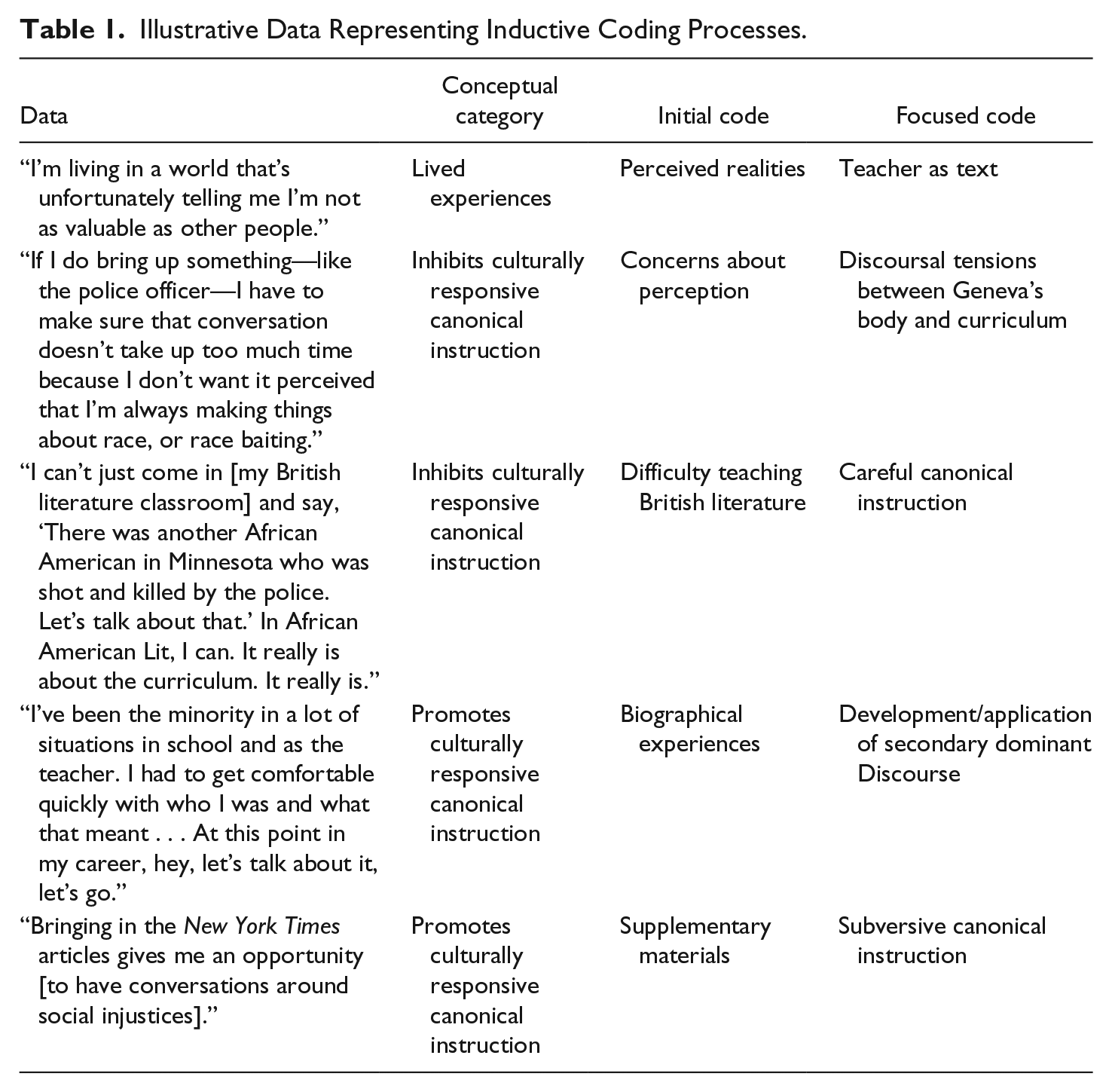
In the initial phase of coding, I openly coded the data (Glaser & Strauss, 1967) by reading across all data sources. During a second read, I created broad conceptual categories for data that reflected circumstances or perceptions that either inhibited or promoted Geneva’s ability and willingness to deliver her canonical British literature curriculum in culturally responsive ways. Having coded data for their inhibiting/promoting qualities, I returned to the data once again, looking specifically for particular factors that aligned with each conceptual category. From this reading, I produced initial codes. Using these newly formed codes, I then returned to the data, attempting to collapse, extend, and define relationships between codes (Charmaz, 2006). After several readings, analytic relationships crystallized, and I developed focused codes. I then determined both the frequency and significance of a particular focused code. Finally, I once again read across all data sources, applying newly formed theoretical codes (Marshall & Rossman, 2010) to ensure the data aligned with its categorization. Table 1 illustrates the movement between conceptual categories, initial codes, and focused codes.
Illustrative Data Representing Inductive Coding Processes.
Throughout the many stages of deductive and inductive data analysis, analytic memo writing (Charmaz, 2006) allowed me to develop categories, define their properties, refine relationships between codes, and ultimately identify gaps. Close readings and rereadings supported my constant comparison of the data (Boeije, 2002). Constant comparison of the data continued until the coding processes yielded interchangeability of indicators, meaning that no new dimensions emerged; at this point, theoretical saturation was accomplished (Holton, 2007). Taken comprehensively, this inductive approach allowed me to formulate an understanding of the tenuous relationship between culturally responsive teaching, canonicity, and teachers’ bodies, which research to date has incompletely problematized.
While I conducted the deductive and inductive analyses sequentially and separately, the findings from the two analytic approaches ultimately fused to construct an interpretation of Geneva’s experiences. For example, the factors inhibiting and promoting Geneva’s culturally responsive canonical instruction (inductive codes) affected both the skills and the depth of the culturally responsive characteristics Geneva was able to achieve (deductive codes). In fact, findings reveal that for Geneva, the two questions melded almost inextricably.
I coded 10% of the data with a team of researchers, one of them Dr. Cain, the creator of the MTCS. When instances arose in which the data were inconsistently assessed by coders, as a research collective, we discussed and ultimately agreed upon how to reconcile the disparities, a reconsideration I then extended across all coded data.
Ethnographic research values and affirms phenomena the participant deems important (Charmaz, 2006). Thus, I conducted periodic member checks to ensure that I was accurately representing Geneva’s beliefs about her realities (Yanow & Schwartz-Shea, 2013). Biweekly, I shared my findings with Geneva, reading back portions of her data to explain how I arrived at my emerging findings. I recorded these sessions with Geneva, taking notes as she responded to my findings. Reviewing the transcriptions of these recorded sessions, coupled with the notes I took during our member-checking sessions, helped me amend my findings based on Geneva’s elaborations. These member checks also helped me make sure I was not misinterpreting and presenting Geneva’s story in a way that was either disingenuous, inauthentic, or both. In addition, the many forms of data collection served as means by which to triangulate the data, further establishing the credibility of the study’s findings.
Although Geneva and I frequently discussed her reactions to my emerging findings, the study’s reliance on White male scholars’ research on lenses of D/discourse (Gee, 1996, 2015; Ricoeur, 1981, 2007) merits interrogation. That these theories rely on the thinking of scholars who belong to dominant groups may mean that certain D/discoursal aspects of Geneva’s case were left uncaptured or inaccurately represented. Interpretation that applied a different theoretical framework—particularly one designed to capture the obstructions to culturally responsive instruction teachers belonging to marginalized groups often must circumvent, negotiate, and subvert—might have gleaned different perspectives and findings.
Researcher Positionality
I pause here to acknowledge my positionality as a White, middle-class female and the benefits and privileges I enjoy as a result of this affiliation (McIntosh, 1988). Mine is an iterative and deliberate attempt to critically reflect on this positionality and to leverage my privilege to effect antiracist teaching and scholarship. My racial recognition (Frankenberg, 1997) allowed me to execute this study at once conscious and critical of how my own positionality affected my work. For 5 years, I worked as a British literature teacher to students from predominantly African American and Latinx backgrounds. The disconnect between the curriculum and my students became increasingly obvious to me throughout my teaching career. To continue to affirm the inherent “greatness” of canonical literature made me complicit in an enduring literacy narrative that operationalized literature as a mechanism through which to both marginalize and privilege. These experiences—and the notable lack of nuanced conversations around the capacious nature of “the canon” and how teachers from various sociocultural backgrounds might experience these tensions differently—have deeply compelled my scholarship.
Yet, it is imperative to note that my Whiteness, and its impact on my research design, implementation, analysis, and reporting, always shapes my scholarship. Despite my attempts to remain racially reflexive, in this study, I remain a White body reading a Black body. My own privileges, acknowledged or otherwise, may have resulted in my decision to probe certain issues while leaving other conversations underexplored or uninvestigated entirely. Indeed, my privileges may have obscured my ability to recognize a particular event or phenomena. In making sense of Geneva’s case, my own sociocultural identity cannot be untethered from the findings I present below.
Findings
In the following sections, I explore the ways in which the Discourse-laden texts of the study—the White male canonical British literature curriculum and Geneva’s Black female body—interacted, a conversation understood according to the culturally responsive characteristics Geneva felt efficacious and comfortable realizing. Findings focus more prominently on race because Geneva herself often foregrounded how her Blackness interacted with the institutional and systemic iterations of Whiteness she navigated. However, I offer intersectional analyses of Geneva’s case in the moments in which she discusses how her race and gender together affect her perceived teaching realities. Because they are actionable and interpretable in ways that her dispositions and knowledges are not, I focus specifically on the MTCS culturally responsive skills most central to Geneva’s work teaching canonical literature in culturally responsive ways—in particular, her ability to foster students’ sociopolitical consciousness and modify her curriculum and pedagogy to confront issues of equity.
Teacher as Text: Reading Geneva
“I’m living in a world that’s unfortunately telling me I’m not as valuable as other people.”
Geneva Wilson is thoughtful with her words, often pausing to consider her response before speaking. If the number of students who wait for her before the day’s first class has begun and flock to her room during lunch is any indicator, Geneva is a well-loved teacher. After teaching English for 14 years, 3 of which she had spent teaching at Mountain Valley High School, Geneva was in the final semester of graduate school to become a school administrator.
At the age of 39, Geneva had grown accustomed to being the only person of color in mainstream educational settings. Geneva shared,
As an African American woman in a predominantly White field, I have grown accustomed to being the minority. I attended a Catholic school my entire life and went to a predominantly White college in New Jersey. I understood what it meant to live separate lives. I was aware that there were two Americas—two realities that I had to master in order to be successful in my career and in my community.
Her sense of living “separate lives” recalls Du Bois’s (1903) theory of double consciousness, which he described as a “sense of always looking at one’s self through the eyes of others” (p. 351). Yet, although a marked sense of sociocultural pride marked Geneva’s case—she relished “finally feeling comfortable” with who she was—she also understood that hers was a deeply marginalized sociocultural station. When the realization of her compounded, intersectional oppression (Crenshaw, 1991; Nash, 2008) first dawned on her during her undergraduate coursework, Geneva remembered thinking, “I’m a double negative now, shoot, I’m not a Black woman, I’m Black and I’m a woman.” Consequently, she took care to resist behaviors that might be perceived as aggressive or combative, as she believed such reactions would be perceived as reflecting negatively not only on her race, but on Black women. On the matter, she voiced, “I feel like . . . I have to be ‘the Black woman,’ I have to be ‘the model.’ I have to dispel any kind of idea you have about ‘people like me.”‘ In this way, Geneva elucidated her understanding that her primary, or “lifeworld” (Habermas, 1984) Discourse—that is, her culturally distinctive ways of existing in the everyday world (Gee, 2015)—functioned simultaneously as a nondominant Discourse; because of this identity, she felt perpetually held to high(er) level of scrutiny. Geneva knew well that her body was under iterative, discursive scrutiny, and that this evaluation only intensified when teaching a White curriculum.
Discoursal Tensions: A Black Female Teacher, a White Male Curriculum
Intertextuality suggests that texts exist only in dialogic relation to one another—that is, texts at once derive, create, and sustain meaning from their relationship to each other (Bakhtin, 1981; Bazerman, 2004). Intertextuality provides persons with a “way-in” (Bintz, 2011, p. 34) to accessing texts—a way to connect lived experiences, itself a form of text, to other textual iterations. Geneva articulated feeling a particular type of intertextual oppression because of her canonical curriculum—one that she experienced more deeply with British literature than any other canonical body she had taught. Concern over how others might read her body and pedagogies against the canonical curriculum uniquely obstructed Geneva’s ability to fully develop her students’ sociopolitical consciousness. Intertextual incongruences between her body and her curriculum likewise hindered her ability to modify her curriculum and pedagogy to confront issues of equity in transformative ways.
The most frequently mentioned factor precluding Geneva’s ability to deliver her content in culturally responsive ways stemmed from what she perceived to be the British literature curriculum’s constraints related to its racial exclusivity, a concern she expressed dozens of times throughout the study. Across 14 years of teaching multiple literature-based courses, Geneva avowed that British literature was “definitely the hardest canon to teach.” But as her case unfolded, the tension proved more nuanced than merely curriculum-bound. That students and other stakeholders might interpret the text of Geneva’s body and its attendant pedagogies in ways seemingly antithetical—and challenging—to the Whiteness of her “traditional” curriculum reveals a deeply connected intertextual relationship between the two entities and the contrastive Discourses each embodied.
Although Geneva maintained the importance of bringing in multiple perspectives that contrasted with the students’ general experiences—a “windows, mirrors, and sliding doors” approach to instruction (Sims Bishop, 1990), she reflected,
I don’t think there’s much you can do with the [British] literature. If you’re going to change things up, it has to be those supplemental things that you pull in. Macbeth is Macbeth. Beowulf is just Beowulf. But it’s in making those outside connections.
Geneva attempted to do this by having students read about nontraditional heroes while studying Beowulf. For example, one news article depicted a homeless African American man who saved the life of a White woman he found unresponsive on the street. Despite her desire to incorporate enriching supplementary materials, Geneva fretted over the potential consequences she might face for modifying her curriculum to discuss issues of social injustices and inequalities. She expressed this concern after a lesson during which she had shared an infographic that represented the disproportionate incarceration rates among races to open up a conversation on legal corruption, a conversation she thematically linked to the day’s lesson on Macbeth. Her fear came from the fact that “[the infographic] wasn’t British literature, it wasn’t spelled out for me to do in the curriculum . . . I didn’t want it to blow up in my face.” Extending her point regarding the difficulties she encountered when attempting to weave sociopolitical conversations into her British literature instruction, Geneva lamented, “That’s the kind of conversation we need to have. There isn’t always the place for that in British literature.” Here, Geneva revealed that the racial homogeneity of her curriculum, a tenet of its Whiteness (Nayak, 2007), stymied her ability to push her students to critique the racialized cultural practices (Paris & Alim, 2014) of racialized mass incarceration. Geneva’s perceptions also nod to Kristeva’s (1980) advancement of intertextuality, which holds that cultural texts and individual texts—the canonical curriculum and Geneva’s body, respectively—are made from the same cultural substances and accordingly, can never be untethered. The two texts, one preserved and one oppressed by Whiteness, discursively interacted with, against, and through each other. Thus, although Geneva wanted to develop her students’ sociopolitical consciousness by modifying her content and pedagogy for equity, she had to execute these practices very cautiously.
Careful Canonical Instruction
That Geneva also taught African American literature during the duration of the study provided numerous contrastive insights into the curricular and Discoursal boundaries she negotiated. This dichotomy permeated the study as time and again, Geneva discussed how she could broach certain conversations more easily in her African American literature class because the content “just sorts of lends itself to those discussions.” Near the study’s conclusion, Geneva offered,
I can’t just come in [my British literature classroom] and say, “There was another African American in Minnesota who was shot and killed by the police. Let’s talk about that.” In African American Lit, I can. It really is about the curriculum. It really is. I guess I feel safer jumping off that cliff with [the students in the African American literature class].
Although she expressed numerous problematic factors the “old and White” British literature curriculum presented, its racial limitations emerged as perhaps the most difficult to overcome. Conversely, the content of her African American course provided Geneva with a buffer to foster the types of conversations desired; without this same textual protection in her British literature classroom, many conversations were left unintroduced. Geneva ruminated,
I have to be very careful about what I do address and how long the conversation goes on because I am in a predominantly White school, town, county . . . state, country. I don’t want someone to say that I’m trying to put forth my own agenda.
Her predominantly White context further intensified the intertextual incongruences between Geneva’s marginalized body and the hegemony honored in the textual body of her curriculum, a tension frequently experienced by teachers of color in predominantly White suburban settings (Milner, 2010). Mallozzi (2011) wrote, “Discourse shapes the meaning of the action so that only certain meanings are available” (p. 135). Indeed, Geneva understood well that the Discourses each text reified—both the White, male curriculum and her Black, female body—could result in students and other stakeholders reading her actions in ways that would be detrimental to her career. This awareness resulted in her strategic, circumspect approach to culturally responsive discussions. But even when students facilitated the conversations, Geneva admittedly felt hyperaware of the amount of time spent engaging sociopolitical issues. She reflected,
It’s never going to be just sitting around talking. I can’t do that because that’s not safe, for you to go home and say, “We were talking about this.” It has to be in relation to something. That’s why I pull the plug on them sometimes.
The notion of “safeness,” for Geneva, was inextricably bound to how others might read her culturally responsive literacies in light of the intertextual disconnects between the British literature curriculum driving her course and her identity as an African American woman. Drawing from Gee (1996), Mallozzi (2011) wrote that
using cultural models as emblems of what is idealised, typical and normal, one can see the beliefs, values and assumptions of a particular social group being upheld, and examples that deviate from those ideals being marginalised or excluded from social benefits, causing harm to individuals. (p. 138)
While Geneva wanted to open up conversations around current sociopolitical events relevant to the content, she fretted that her actions would be interpreted as “the Black teacher who’s always talking about Black issues.”
I asked Geneva to expound upon what my preliminary analysis found to be a prominent theme of her case: that tensions between her sociocultural identity, her role as a teacher of British literature, and her concern that her body might be read as politically aggressive stymied her culturally responsive characteristics. Geneva affirmed the finding, and candidly offered, “I’m afraid, I guess . . . I’m not doing anything that would draw attention to myself . . . I need to stay employed.” This vigilance stemmed from Geneva’s fears that the intertextual friction between her body and the curriculum could result in administrative pushback, and even losing her job, concerns that directly affected her willingness to deeply engage culturally responsive literacies—in particular, fostering her students’ sociopolitical consciousness and modifying her curriculum and pedagogy for equity—in her British literature classroom.
Across the data, I coded the vast majority of instances in which Geneva attempted to foster her students’ sociopolitical consciousness as emerging in nature. This meant that while Geneva worked to facilitate her students’ understanding of sociopolitical inequities, she did not create action-oriented projects for her students or ask them to develop and execute their own. Similarly, Geneva’s attempts to modify her curriculum and pedagogy to confront issues of inequity never advanced past emerging, either—she did not model critical analysis of content for her students, nor did she collaborate with students to restructure the curriculum and instruction to be more responsive to students’ varied perspectives. Fearful of the potential textual readings and interpretations students and other stakeholders might make between her body and her curriculum, Geneva felt that she couldn’t realize these culturally responsive practices. That she was prevented from explicitly articulating her goals hindered Geneva’s ability to actualize pedagogies transformational in nature, given that such work requires teachers and students to acknowledge and collaboratively dismantle oppressive conditions (Banks, 2004)—a conversation that, given the intertextual incongruences between her body and the curriculum, Geneva felt unable to forward. Thus, while Geneva was able to meet certain objectives of equitable teaching, particularly those objectives that involved her awareness of issues of equity and social (in)justice, she was unable to execute her culturally responsive teaching in more advanced and transformational ways.
Negotiating Intertextual Tensions
Although a myriad of factors hindered Geneva’s ability and willingness to instantiate culturally responsive literacies in her British literature class, certain factors supported her efforts. A history of biographical experiences that involved learning and working in predominantly White contexts positioned Geneva to seamlessly—and intentionally—vacillate between Discourses, a skill that profoundly influenced her ability to realize culturally responsive canonical instruction. Interestingly, the state-sanctioned standards Geneva was required to satisfy allowed her to apply culturally responsive literacies in a “protected,” subversive way.
Development/Application of Secondary Dominant Discourse
Geneva believed her lived experiences positioned her to cultivate and utilize her culturally responsive literacies in her British literature classroom. These experiences of intersectional marginalization helped her learn, as she phrased it, “to speak the language” necessary to gain access to the culture of power (Delpit, 2006) in her mostly White professional setting at Mountain Valley High School. As Gee (1996) wrote, Discourses involve “the appropriate costume and instructions on how to act, talk, and often write, so as to take on a particular social role that others will recognize” (p. 127). Because she had a lifetime of recognizing and negotiating multilayered White contexts (Borsheim-Black, 2015), Geneva’s ability to navigate multiple Discourses was, to her, a necessary leveraging tactic that provided a means through which she was able to manipulate the ways in which people in her predominantly White teaching context read and interpreted her body. Geneva was adept at Discourse negotiating—she acquired and intentionally applied a secondary dominant Discourse (Gee, 2001) to avoid stakeholders labeling her “an angry Black woman,” a caricature associated with her presumably because of her nondominant primary Discourse. Geneva recognized people were constantly reading her body in intersectionally oppressive ways—she knew others would read and make judgments about her body for both its femininity and Blackness, and ultimately compared against the curriculum she was required to teach. Geneva expressed that she was skilled at knowing not only how to talk (or not talk) so she might gain the approval of Mountain Valley’s students, parents, administrators, and colleagues, but also how to appear.
Geneva likewise maneuvered various Discourses to promote the achievement of her African American students. Geneva shared, “I want all kids to succeed, but darn it, if I can get more Black kids to succeed, that would make me feel really good.” In a private moment, Geneva cautioned two underperforming African American students in her British literature course: “You’re not going to fail. You’re the only two [African American males] in here. There’s already a stigma against you. You can’t fail. You could be my son.” Her heightened dedication to the success of her African American students exemplified Collins’s (2002) notion of the “other-mother,” a phenomenon in which African American teachers provide communal care out of a sense of accountability to support children of the Black community. This orientation connects to Beauboeuf-Lafontant’s (2002) theory of womanist caring, a form of care that Black women teachers provide to their students that embraces the maternal, reflects political clarity and consciousness, and demonstrates an ethic of risk. In a later interview, Geneva retold the story of how she called the primary caregiver of an African American student to alert her of the student’s lackluster academic performance and his sleeping in class. While reenacting the conversation, Geneva code-switched to African American Vernacular English. During the conversation, the aunt revealed the familial discord the student had recently experienced, and thanked Geneva for reaching out. Geneva ruminated, “I don’t think she would’ve talked to a White teacher like that.” Thus, in certain spaces, Geneva’s body—her textual medium—provided a powerful leverage for her efforts to support the academic success of her African American students in her British literature course. Her ability to tap into her nondominant cultural capital (P. L. Carter, 2003) positioned Geneva to “navigate the terrain of ethnic authenticity” (p. 138) in such a way that the student’s aunt felt able to confide in her. That Geneva intentionally vacillated between her primary nondominant Discourse and her secondary dominant Discourse allowed Geneva to navigate multiple social realms and consequently, participate more fully in culturally responsive literacies related to her British literature classroom.
Subversive Canonical Instruction
“Overt isn’t my MO,” Geneva laughed during one postobservation interview. Given this preference—and need—for subtlety, informational texts allowed a way for Geneva to teach in quietly culturally responsive ways. The Common Core State Standards (CCSS) privileges the role of informational texts in K-12 classrooms, suggesting that 70% of the curricula 12th-grade students engage across subjects should take the form of informational texts (National Governors Association Center for Best Practices & Council of Chief State School Officers, 2010). Although this approach has been widely critiqued (see, for example, Schieble, 2014), Geneva used the requirement to her advantage: This insistence on informational texts emerged as a factor that buttressed, rather than hindered, her work as a culturally responsive teacher. Incorporating informational texts allowed Geneva to broach controversial conversations without exposing her sociopolitically driven motivations. In this way, she was able to modify, albeit subversively, her content and pedagogy to confront issues of equity.
At the beginning of one class, Geneva’s students read an article on corruption in the police force and then drew connections between the informational text and Chaucer’s (2012) The Pardoner’s Tale. In a postobservation interview, Geneva shared, “I’m not stepping in [a discussion of police brutality] without something . . . The New York Times articles give me an opportunity to do that.” While Geneva understood the need to “say or write the right thing in the right way while playing the right social role and (appearing) to hold the right values, beliefs, and attitudes” (Gee, 2015, p. 171), connecting these supplementary texts to her canonical literature allowed Geneva to engage certain conversations she otherwise felt too “unprotected” to provoke. Moreover, the supplementary materials helped her appear to maintain a thematic allegiance to the canon, when in fact she worked actively to bring in sociopolitically charged topics intended to modify her curriculum to centralize issues of equity and social justice.
Discussion and Implications
Previous research reveals that canonical literature wields power to marginalize teachers (Agee, 1997, 2004; Dyches, 2017; Milner, 2010). But this study advances that teachers do not uniformly experience or navigate literature canons. Moreover, it suggests that the capaciousness of the word “canon”—from American to world to British literatures—may result in critical facets of oppression remaining unexplored. The culturally responsive and sustaining literacies Geneva felt able to perform were deeply affected by the category of textual canonicity she navigated; Geneva’s attempts to engage in culturally responsive British literature instruction left her feeling “unprotected,” exposed, and vulnerable. Thus, the intertextual relationship between canonicity and Geneva’s body inextricably fused to create Geneva’s culturally responsive canonical experiences, and left her grappling to understand: “I’m a Black teacher of British literature, whatever that is.” In these ways, the racial homogeneity of her canonical curricula marginalized Geneva, a tenet of its Whiteness (Nayak, 2007), thereby denying her access to certain conversations she wished to open up with her students—dialogue that would have allowed her to modify her instruction to encompass broader, deeper elements of culturally responsive and sustaining pedagogies.
Yet, despite these perspectives, Geneva refused to accept the boundaries of her curriculum. Indeed, she continuously located generative strategies that allowed her to facilitate critical conversations with her students in ways that were CCSS-aligned and therefore left her feeling insulated from the critiques of would-be dissenters. Geneva creatively worked to reimagine the boundaries between her body, her curriculum, and her context. In many ways, her subversive canonical teaching reveals a specialized form of agency that perhaps other teachers of color in similar situations employ as well.
Geneva’s case points to the need for canonically specific conversations during teacher education coursework and subsequent professional development: preparation that acknowledges the nuanced realities of canonicity that teachers must navigate, particularly as they realize culturally responsive and sustaining literacy practices. They should not treat all canons identically, nor should they assume all teachers experience them uniformly. Teacher educators should work alongside students to help them conceptualize curricula as an ideologically imbued, Discourse-laden text—each advancing its own disciplinary dogma (Dunkerly-Bean & Bean, 2016)—while likewise equipping them with the tools to deconstruct, and ultimately reconstruct, the curricula to ensure their future students receive a more equitable literature experience (Bissonnette, 2016b).
Moreover, teacher educators should marry canonical conversations with deep explorations of teacher candidates’ sociocultural identities and cultural models (Curwood, 2014) so that they, like Geneva, may begin to develop an understanding of the unique experiences they may—or may not—face when engaging the curricula they will likely be required to teach. For English teacher educators, these findings warrant careful consideration given that the teaching of literature in American schools has been grounded on “an almost total subservience to British literature” (Stotsky, 1991, p. 53), a time-honored allegiance that continues today (Bissonnette & Glazier, 2016; Schieble, 2014).
But implications for other disciplines exist. In thinking about how these findings translate to other disciplinary divisions and their attendant cultures (Moje, 2015), perhaps it is helpful to conceptualize “canons” metaphorically. Literacy researchers, secondary teachers, and other stakeholders in the field would do well to acknowledge that all disciplines comprise their own seemingly “neutral” canonical bodies, each of which has particular divisions and features—from U.S. history to earth science to music theory—that may likewise present particular difficulties as teachers attempt to relate their curriculum in culturally responsive ways. But this neutrality is often a thinly veiled iteration of Whiteness (Nayak, 2007). Indeed, each discipline perpetuates Whiteness differently and therefore requires nuanced approaches to dismantling its marginalizing cultural norms and practices (Paris, 2012; Paris & Alim, 2014). Future research should seek to understand the disparate and perhaps analogous experience teachers face in relating the “canons” of their particular discipline in culturally responsive and sustaining ways.
Conclusion
Agee (2000) asserted that “a focus on canonical literature . . . in high school English classrooms valorizes not just certain literature but also certain ways of thinking about the world” (p. 307). This case study extends this idea by suggesting that a focus on canonical literature may likewise privilege and oppress teachers’ bodies in unique ways. To meaningfully respond to the Discoursal complexities Geneva experienced as a woman of color negotiating a revered, sovereign curriculum, literacy researchers must open up critical conversations around the nuanced constraints canonical curricula place on teachers; they must examine how canons uniquely complicate the culturally responsive and sustaining practices teachers are able to actualize.
Footnotes
Declaration of Conflicting Interests
The author(s) declared no potential conflicts of interest with respect to the research, authorship, and/or publication of this article.
Funding
The author(s) received no financial support for the research, authorship, and/or publication of this article.
References
Supplementary Material
Please find the following supplemental material available below.
For Open Access articles published under a Creative Commons License, all supplemental material carries the same license as the article it is associated with.
For non-Open Access articles published, all supplemental material carries a non-exclusive license, and permission requests for re-use of supplemental material or any part of supplemental material shall be sent directly to the copyright owner as specified in the copyright notice associated with the article.
