




Abstract
In this essay, some of the 2015-2017 STAR mentors (mentors of authors in this special issue) illustrate the importance for policymakers, professional organizations, school administrators, and state and system administrators to foster bidirectional relationships with early career scholars of Color. This Insight Column provides the field of language and literacy education, administrators, and state and federal policymakers with recommendations and implications on how to better prepare, serve, retain, and humanize early career scholars of Color.
Diversifying the professoriate has become a pressing goal for higher education, especially in light of the wave of racist incidents sweeping across American college campuses. Faculty diversity is critical because it creates more inclusive campuses, enriches the curriculum and classroom learning, and promotes multiple perspectives and knowledge (Gasman, 2016). Yet faculty of Color remain an underrepresented group in the faculty ranks. Data from fall 2015 indicate that of the full-time professors in degree-granting postsecondary institutions, 83% were White, 9% were Asian/Pacific Islander, 4% were Black, less than 3% were Hispanic, and less than 1% were American Indian/Alaska Native (National Center for Education Statistics, 2017). Finkelstein, Conley, and Schuster (2016) report that while there has been a gradual growth in the proportionate presence of faculty of Color in the professoriate since 1993, the actual numbers of Black, Hispanic, Asian American and American Indian/Alaska Native tenured and tenure track faculty remain relatively small.
Significant barriers to diversifying the professoriate stem from the hegemonic nature of the tenure process. Faculty development experts Kerry Ann Rockquemore and Tracey Laszloffy (2008) contend that for Black early career faculty, “the challenge of winning tenure without losing your soul is situated against the backdrop of racial oppression” (p. 123). As faculty of Color and mentors in the Literacy Research Association (LRA) STAR Mentoring Program, we contend that this challenge is relevant to all faculty of Color working toward tenure in the academy. Based on racial stereotypes and cultural biases, early career faculty of Color are often presumed to be less competent, less qualified, less experienced, less collegial, and less tenurable than their White colleagues (Matthew, 2016; Rockquemore & Laszloffy, 2008). Early career faculty of Color are hired because of their unique positionality and diverse experiences, but their “fit” within the department is often questioned during closed tenure discussions (Matthew, 2016). Negotiating what counts toward tenure can be especially complicated for faculty of Color, because systemic racism sends the message that they need to be “twice as good as their White colleagues” while simultaneously limiting their access to social networks that impart “unwritten” tenure rules and knowledge (Matthew, 2016; Turner, Walker-Dalhouse, & McMillon, 2005). Early career faculty of Color are also unfairly burdened when asked to take on an overwhelming number of service commitments, student mentoring, and programmatic responsibilities—“invisible labor” that is not typically rewarded with tenure (Matthew, 2016; Turner et al., 2005). As the narratives of the pretenure scholars of Color included in this volume powerfully illustrate, striving to fulfill these tenure demands can take a devastating toll on relationships with family and friends, as well as on one’s physical, mental, and spiritual health (Matthew, 2016; Rockquemore & Laszloffy, 2008).
As STAR faculty mentors, we have witnessed firsthand the inhumanity that many early career faculty experience while pursuing tenure in colleges and universities across the country. Oftentimes, the marginalization and alienation that pretenure faculty of Color experience in the academy go unnoticed or unrecognized, even by well-intentioned colleagues. Thus, in this column, we illuminate the challenges that early career faculty of Color may experience on three key levels: individual, institutional, and organizational. In doing so, we offer vignettes that help to concretize the kinds of situations that early career faculty of Color encounter. We conclude with recommendations for faculty, administrators, and organizational leaders committed to facilitating more equitable treatment for early career faculty of Color pursuing tenure.
Vignette 1: Individual Level
As institutions of higher learning articulate a responsibility for fostering an inclusive atmosphere and commitment toward diversity, they expend resources on the recruitment and retention of faculty of Color. In addition to encouraging diverse representation among the student population, universities recognize the need to give attention to the diversity among their faculty. Hiring processes often require that the search committee identify explicit strategies for attracting a diverse applicant pool and demonstrate an earnest effort to hire a candidate of Color. While such efforts may be well-intended, they risk perpetuating the same inequities and injustices they purport to address when they result in the hiring of the lone candidate of Color. Such practices are more concerned with broader departmental and institutional goals and negate providing necessary supports for individual scholars of Color.
Brenda (pseudonym) was excited to begin her career as a tenure-track assistant professor in one of the top literacy programs in the country. She was a faculty person of Color, and her research and teaching agenda engaged critical race theories and methodologies and inclusive, equity-minded pedagogies. In multiple ways, she brought much-needed ideas and perspectives to her department that were both sought during the recruitment process and welcomed as she transitioned in her first year. She also instantly became a mentor and faculty support for the few students of Color in her department. Just as the recruitment and retention of faculty of Color persist as challenges in higher education, increasing the presence of students of Color in the field of education, including literacy education and research, remains a critical initiative (Haddix, 2016, 2017).
Brenda immediately became intimately aware of the experiences of the students of Color in her program, as she could relate to many of their shared narratives of being singled out in their classes, of being excluded from their cohorts, and of receiving additional scrutiny for reflecting their cultural and linguistic identities in their work and scholarship. One student shared with Brenda the kinds of racial aggressions she experienced from faculty throughout her program that were negatively impacting her academic performance. The student did not feel that she had an avenue to overcome the reputation that was being associated with her among the faculty and other students—that she was a low-performing student who wouldn’t “make it” in the program. Brenda wanted to advocate for the student, but doing so placed her in a situation to be the only faculty voice to call out racial injustices and to risk her own professional isolation from her new colleagues. Yet, Brenda made the decision to support the student as best she could because critical race theory, inclusion, and social justice are not just theories that she uses in her scholarship; these are commitments that she lives.
This scenario highlights the additional burden and risk that scholars of Color may face when working with students of Color, oftentimes being the primary support for those students. This is work that they take on as part of who they are—scholars deeply connected to their communities. Scholars of Color are spotlighted within their departments not only because of their racial and linguistic identities, but because they are doing critical work that impacts communities of Color in areas of research and specialization marginalized within the larger fields of literacy and educational research. Quickly, scholars of Color like Brenda become the sole faculty person most often associated with racial and social justice, and they reflect and represent diversity within an academic unit. Yet, when a department hires one faculty person of Color, a reality is that individual colleagues may not support the person once he or she is a part of the department, actually doing more harm than not hiring any faculty of Color at all. While the presence of a scholar of Color may serve to meet institutional goals toward diversity, on a more local and individual level, the scholar is left to navigate these kinds of everyday instances of racism and educational injustices alone.
Vignette 2: Institutional Level
One of the basic tenets often associated with meeting the needs of faculty of Color is achieving a critical mass to help support the early career faculty who subsequently join the institution (Ek, Cerecer, Alanís, & Rodríguez, 2010). In doing so, a community will be created. A strong community can also reduce microaggressions against faculty of Color because the diversity of the community does not support that kind of discourse. The question remains, how do universities create this critical mass of faculty of Color? In this section, we focus on institutional opportunities and challenges to creating a diverse faculty.
Some research studies have looked at the issue of faculty diversity at the university level and found that more of these efforts fail than succeed (e.g., Tierney & Sallee, 2010). These efforts fail in part because the taken-for-granted routines and mind-sets that must be disrupted are not critically examined (Moody, 2013; Sturm, 2006). According to Fraser and Hunt (2011), in order for change to take root across university campuses, the university leadership must set the tone and create the space for everyday structures to be reexamined.
To exemplify these issues, we present what happened within one department at a university we will call Huntsdowne (pseudonym). Huntsdowne University is a predominantly White Research I institution in the Midwest. One of the strategic efforts by the university to increase its faculty of Color was the use of a Target of Opportunity Program (TOP). TOP allowed departments to aggressively pursue outstanding faculty of Color in needed areas of research and instruction nationally and outside of a research line. For example, in the mid-80s, there were only two tenure-track faculty of Color (both Black—one female and one male) in the department of language and literacy studies, but the impact of this strategic hiring led to a truly diversified faculty. In Table 1, we see nearly half of the entire faculty represented by faculty of Color by 2010, although the clinical faculty remained predominantly White. The diversity of the faculty was unmatched at that time by other comparable departments in Research I institutions. There was less diversity among the clinical faculty because they were typically former local teachers who worked for the university. The only time a person of Color was part of the clinical faculty was when that position was advertised as part of a national search.
Number of Departmental Tenure Track and Clinical Faculty by Race, 2010-2017.
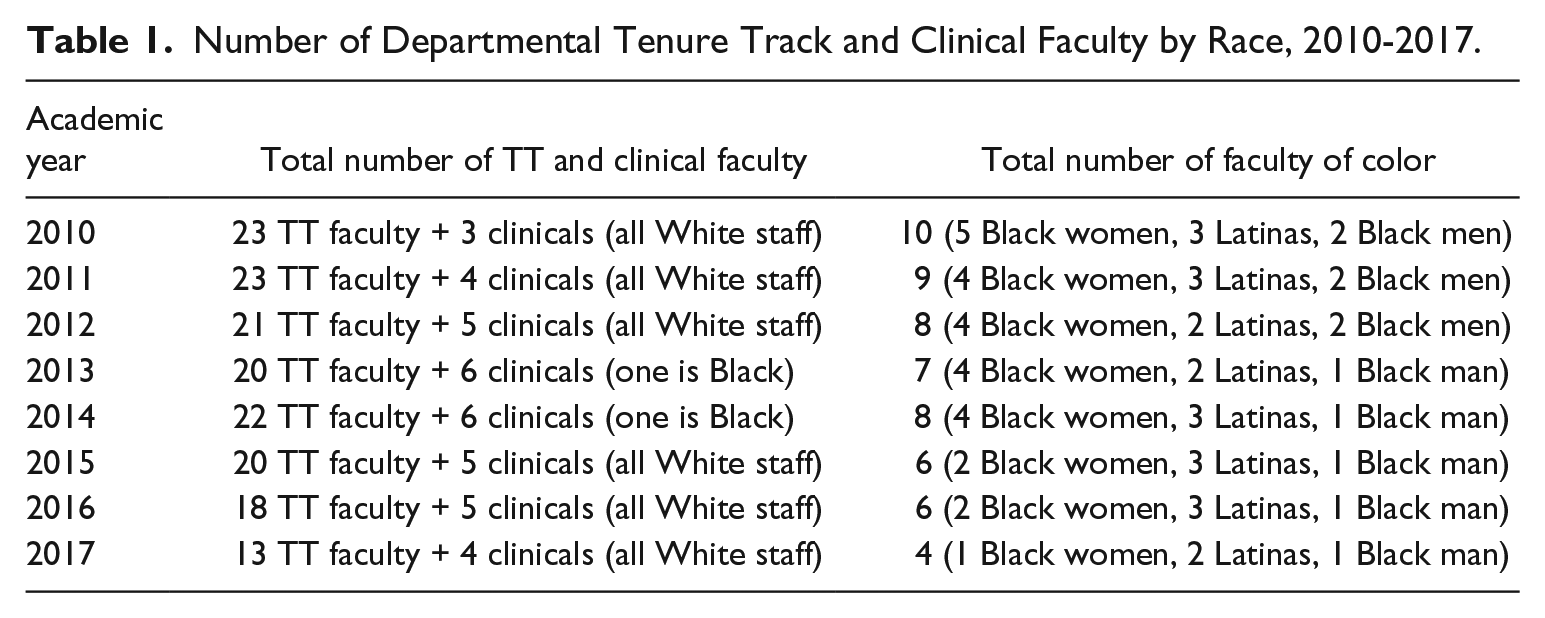
However, as the number of faculty of Color approached parity with the number of White faculty, many faculty of Color reported that they felt pushback from some of the White faculty, who seemed to believe enough gains had been made. The number of faculty of Color started decreasing after reaching a total of 10 faculty members. The retention of Black women was especially affected, plummeting from five people to one in a few years. In some ways, this department represents what can go wrong if previous efforts are not sustained and all faculty are not educated on the need for diversity.
In addition to the perception that recruitment of faculty of Color was no longer needed, several events impacted the reduction in the faculty of Color from 10 to four. The global economic crisis of 2008 caused major shifts on college campuses across the nation. A reduction of dollars to the department of language and literacy studies occurred just as the university’s focus shifted to areas that could garner available grants, such as science, technology, engineering, and math (STEM). To offset the lack of funding from the state, the university also shifted toward recruiting international students who could pay full tuition. All of these factors drew the focus away from the pursuit of diversity among the faculty, and TOP ceased to attract historically underrepresented faculty members to campus. These changes had a negative effect on the community in general and on faculty of Color in particular.
Vignette 3: Organizational Level
Camacho (2015) contends that “sometimes professional conferences can seem cliquish or intimidating” (p. 17). This can be especially true for early career faculty of Color. Professional organizations are the bedrock of networking, academic job opportunities, and faculty development. Like colleges and universities, professional organizations want to diversify their membership but often do not know how to do so. Consequently, early career faculty of Color may not feel welcomed into the intellectual community at professional conferences.
Juan (pseudonym) is a new member of a prestigious literacy and language organization. Juan’s dissertation chair was an active member of this organization, and Juan was very excited about making it his academic “home.” His initial excitement, however, gave way to frustration. When reviewing the conference program, Juan was dismayed by the lack of sessions related to his research interests, and few members seemed to be engaged in conversations about the intersections of race, culture, language, and literacy. Few leaders of the organization looked like him, and there only seemed to be a few scholars of Color in attendance at the conference. After attending the annual conference for a few years, Juan wanted to become more active in the organization. He volunteered to review conference proposals and served as a discussant in conference sessions each year, but he was never nominated for committees or other leadership positions. Professional networking was an unfamiliar cultural practice for him, and though he wanted to be mentored by one of the few Latina scholars at the conference, he was anxious about approaching her. Juan was very interested in serving as an area chair, but when he sent his contact information to the board, no one followed up with him. Discouraged, Juan stopped going to the annual conferences and eventually joined another literacy and language organization.
We Are the Change We Seek: Working Collectively to Humanize the Pretenure Experiences of Faculty of Color
As STAR faculty mentors, we join our LRA colleagues in collectively working to humanize the early career experiences of our STAR program fellows and of the faculty of Color who work alongside us in our department offices, our home institutions, and our professional organizations. We work to disrupt racist oppression in the academy so that early career scholars of Color can achieve tenure without losing their dignity, their integrity, and their souls. Humanizing the tenure process, particularly by reimagining academic structures, policies, and practices, can support early career scholars of Color like those whose stories are shared in this volume. There is much that we can do to make tenure a more equitable and humane process for early career scholars of Color in literacy and language. First, faculty must actively support access and equity for early career faculty of Color throughout the hiring and tenure processes. Faculty search committees should be mindful of conversations about “quality” and “excellence” (e.g., academic pedigree) and how these indicators are often used to dismiss scholars of Color who are otherwise highly competitive applicants (Gasman, 2016). Similar conversations related to “rigor” and “quality” take place in promotion and tenure committees, which often causes pretenure colleagues’ scholarship, teaching, and service to be dismissed or disparaged (Matthew, 2016; Rockquemore & Laszloffy, 2008).
Second, literacy and language programs and departments must take critical steps toward diversifying their faculty. As the second vignette illustrates, substantial resources are often spent on recruiting early career scholars of Color. However, initiatives that support and retain these faculty are limited, particularly when faculty perceive diversity to no longer be an issue. Department chairs and faculty need to have the hard conversations around diversity—ones that move beyond the “safety” of surface-level talk and empty platitudes (e.g., “We value diversity”) toward systems change and faculty action (Diggs, Garrison-Wade, Estrada, & Galindo, 2009).
Finally, literacy and language organizations must invest in inviting, mentoring, and sustaining diversity in their membership, and particularly in their leadership. Organizations can work to “grow their own pipelines” (Gasman, 2016) of scholars of Color who can build their capacity, help to enact their mission, and ultimately lead the organization. The STAR program, sponsored by LRA, and the Cultivating New Voices among Scholars of Color program, sponsored by the National Council of Teachers of English (NCTE), are two stellar examples of such efforts, but they are not the only models possible. It is paramount that the lived experiences and collective knowledges of early career scholars of Color, like the ones shared in this special issue, remain at the center of any efforts toward diversity, equity, and inclusion in literacy research and practice.
Footnotes
Declaration of Conflicting Interests
The author(s) declared no potential conflicts of interest with respect to the research, authorship, and/or publication of this article.
Funding
The author(s) received no financial support for the research, authorship, and/or publication of this article.
