




Abstract
This article combines interview data from a group of boys of color at an urban single-sex school and content analysis of The Autobiography of Malcolm X and Harry Potter and the Sorcerer’s Stone to demonstrate the complexities of readers’ responses to literature. Textual relevance, or the ability to construct personal meaning from literature, emerged in two principal forms: (a) empathetic textual relevance (a mirror approach) and (b) sympathetic textual relevance (a window approach). In addition, textual relevance took shape in forms beyond mirrors or windows. In building upon theories of intersectionality and reader response, I argue that acknowledging the multi-dimensionality of readers’ identities and their meaning-making processes can pave the way for youth empowerment. As such, this work aims to contribute to a more nuanced understanding of students’ experiences as readers and to enhance literacy practices designed to promote equity.
A “Midwestern hick” turned “Boston hipster” turned “alternative, resisting, black male leader” of the 1960s (Griffin, 1995, p. 135) seems upon first glance to have very little—if anything—in common with an 11-year-old White British wizard crafted in the late 1990s. Yet, a group of boys of color at an urban single-sex school who participated in a series of interviews about the ways in which they find—and do not find—texts relevant repeatedly named Malcolm X and Harry Potter as being the most interesting, relatable, or important figures they had read about. 1 Through Alex Haley’s telling of The Autobiography of Malcolm X and J. K. Rowling’s Harry Potter and the Sorcerer’s Stone (as well as the rest of her series), the boys found themselves able to, as one student put it, “feel what the character feels.”
Efforts to address the “reading achievement gap,” raised to awareness by Tatum (2005), have focused on providing young male readers of color—namely, Black boys—with texts that better reflect their racial, ethnic, and gender identities. Based largely on theoretical conceptions of how to best engage boys of color in literacy education practices, many such works have not sufficiently explored the “complexities of textual relevance” (Sciurba, 2014/2015). As Paris (2012) argues, researchers and practitioners tend “to assume unidirectional correspondence between race, ethnicity, language, and cultural ways of being” (p. 94), which impacts common ideas about what texts are or will become relevant to students of color. 2 While readers’ racial, ethnic, or gender affiliations may, in fact, influence their connections to certain texts and their subsequent motivations to read, it is imperative to consider the multidimensional and flexible nature of students’ identities (Dyson, 1994; Hall, 1996) as well as the personal and dynamic nature of reader response (Iser, 1978; Rosenblatt, 1995). As Kirkland’s (2011, 2013) work shows, multiple stories compose the panorama of young people’s literate lives. Learning about how boys of color situate themselves as individuals, as well as readers, within groups has the potential to transform educators’ understandings about how texts become relevant, or personally meaningful, to them.
While Paris (2012) proposes an amendment to the term relevant within discussions of educational programs and pedagogical stances (“teaching and research”), I use the word relevant in my work (Sciurba, 2014/2015) to describe the significance students construct as readers. Although Paris (2012) rightfully questions whether iterations of “relevance” (Ladson-Billings, 1995) and “responsiveness” (Gay, 2010) go “far enough in their orientation to the languages and literacies and other cultural practices of students and communities to ensure the valuing and maintenance of our increasingly multiethnic and multilingual society” (p. 94), I argue that to achieve Paris’s visionary “culturally sustaining pedagogy,” it is vital to first learn how students are making sense of the word and the world. Relevance, as articulated here, is connected to Freire and Macedo’s (1987) concept of reading, which “is preceded by and intertwined with knowledge of the world” (p. 29) and incorporates, “in a participatory way, all of those discourses that are presently suffocated by the dominant discourse” (p. 56). This study seeks to go beyond dominant presumptions about how to best reach students within literacy practices by hearing what they value, as individuals as well as readers, and how they transact with texts inside and outside of the classroom.
Boys in this study who were drawn to the stories of Malcolm X or Harry Potter both saw and did not see themselves reflected. Textual relevance took shape in what I call empathetic, or mirror-like, connections, and sympathetic, or window-like, connections (Sciurba, 2014/2015). These two categories are based on Bishop’s (1990) distinction between books that reflect readers’ lives and books that allow readers glimpses into others’ lives. These connections demonstrated the complexities of meaning making and reading engagement; texts could become relevant either by matching to readers’ personal experiences/identities or by capturing their interests in lives and narratives quite different from their own. In addition, the boys made connections to Malcolm X or Harry Potter that did not quite fit into either of these categories, finding relevance in the texts, for instance, because of a link to popular culture or because the books were introduced by peers or a favorite teacher. What emerged most saliently was the boys’ deep engagement with the similar life trajectories experienced by the two protagonists—trajectories that highlighted the promise of transformation. In building upon M. W. Smith and Wilhelm’s (2002) and Wilhelm’s (2008) works, which point to male readers’ various “dimensions” of reading response, as well as on Brozo’s (2010) approach to achieving “active literacy” among adolescent males, I explored the various dimensions of textual relevance with the following research question:
In what ways do Black, Latino, Asian, or racially “mixed” boys find relevance, or construct personal meaning, as readers?
Grounding this study in theories of intersectionality and anti-essentialism (Delgado & Stefancic, 2012), I begin by situating this article amid scholarship related to the identities of boys of color and reading, as well as to current iterations of relevance in K-12 educational practices. Next, I combine interview data with a content analysis of The Autobiography of Malcolm X and Harry Potter and the Sorcerer’s Stone to explore the types of textual connection—empathetic, sympathetic, and other—the boys made. I conclude this article with implications for the reading/language arts classroom, which I hope can promote literacy and equity for all groups of children, particularly those whose perspectives are pushed to the margins of mainstream conversations and for whom inadequately informed educational decisions are made each day.
Representation and Relevance: Meeting the Literacy Needs of (Male) Students of Color
In 2014, Walter Dean Myers published an opinion piece in The New York Times that begins with a question: “Where are the people of color in children’s books?” Beginning nearly one century prior to his call to recognize the “disparity of representation” in literature for young readers, figures such as Langston Hughes, W. E. B. Du Bois, Augusta Baker, Nancy Larrick, and Rudine Sims Bishop addressed the very same question (Bishop, 1990; Larrick, 1965; MacCann, 2001). The lack of representation of Black (and other nondominant) characters and figures in texts for young readers is, arguably, one of the most pervasive equity problems in language arts/literacy education in the United States. Although “we, as an education community have made some recent progress toward literary inclusivity by emphasizing the need for ‘multicultural’ books,” as I discuss in Sciurba (2014/2015, p. 309), and as reflected by the rise of the “We Need Diverse Books” campaign (diversebooks.org), the literary canon persists in its dominant representation of White characters, histories, and experiences.
In Playing in the Dark: Whiteness and the Literary Imagination, Toni Morrison (1992) argues that “the readers of virtually all of American fiction have been positioned as white” (p. xii) and that literature is shaped by “its encounter with racial ideology” (p. 16). Consequently, books for young readers have either perpetuated stereotypes about people of color or overemphasized the value of White European American lives and identities. Readers of color in K-12 classrooms, as well as their teachers, therefore, are inundated with texts that exacerbate the privilege of Whiteness.
Arguments for more diverse representation in literature, or what Gray (2009) terms “visibility,” suggest that students of color will “see themselves” in books featuring protagonists belonging to their same race or culture. For instance, Cai (2002) contends that multicultural literature “represents their world, reflecting their images and voices. When it is incorporated into the curriculum, children from these groups find characters with whom to identify in the books they read in school” (p. 11). All students should have multiple opportunities to “become an integral and valued part of the mosaic that [they] see around [them],” as Myers (2014) argues, with children’s literature as a vehicle to ensure that their lives and stories matter. In addition, equitable curricular representation of Black, Latino, Asian, and Native American characters and figures will expose young readers of all backgrounds to histories and experiences beyond their own, giving them opportunities to develop appreciation for—and connections with—people who do not look, talk, or live like them (Glenn, 2012). As we continue to move toward a broader collection of representative texts, it is equally critical to evaluate how students are responding to the literature that is currently available to them (Tatum, 2015). In what ways does relevance take shape?
Ladson-Billings’s (1995) landmark theory of “culturally relevant pedagogy” and subsequent studies based on her work intend to help “students to accept and affirm their cultural identity while developing critical perspectives that challenge inequities that schools (and other institutions) perpetuate” (p. 469). Similarly, Gay’s (2010) “culturally responsive” model calls upon educators to make their practices pertinent to students’ diverse backgrounds. While Paris (2012) offers “culturally sustaining pedagogy” as an alternative to “relevant” or “responsive” discourse in educational practices and research intended to promote equity, the original terminology and its conceptualization endures within educator circles and publications intended for a practitioner audience (see, for example, Alvermann, Gillis, & Phelps, 2013; National Council of Teachers of English, n.d.). Foci on students’ home and community experiences have amplified the need to make curricula meaningful to the lives of students of color, such that they become champions and beneficiaries of social justice. Yet, misinterpretations of cultural relevance or cultural responsiveness have led down such essentialist paths as the one taken by Dudley-Marling (2005), who confesses that, as a teacher, he “tried to match texts to the social and cultural identities [he] imagined for students,” thus exacerbating their feelings of otherness (p. 314). Without a nuanced understanding of relevance, and without a process for gathering students’ perspectives on which texts might authentically represent their lives or interests, many educators are left to grapple on their own with literary inequity in reverberating silos.
As Paris (2012) submits, and as Ladson-Billings (2014) agrees, a revised “stance” is needed to determine whether current practices and research are resulting in critical outlooks and actions against “unequal power” (pp. 94-95). Paris’s work echoes the argument made by Freire and Macedo (1987), which calls for educators to engage in “emancipatory literacy” practices that help students “transcend” domination (p. 47). Rather than assume a blanketed approach to achieving this type of literacy, it is important to recall works by researchers such as Brooks (2006) and Sleeter (2008), who have articulated the need to complicate understandings of students’ racial identities to determine how young people do—and do not—construct meaning from curricular materials. Sleeter, for instance, writes,
We cannot make assumptions about how salient race is to students. Some teachers claim that their students do not see race or care what their backgrounds are. Other teachers assume that racial identity is salient to all their students, or that race is salient to students of color but not to white students. All assumptions can be wrong. (p. 151)
Although my examination concentrates on a group of young men of color, it by no means intends to proliferate a singular exception to the habit of making assumptions about students and their identities. To promote emancipatory literacy, educators must provide space for all students to critique and contest representations of their lives and worlds—as well as shortages of such representations.
Relatedly, in conversations about textual relevance and gender, it is important that male readers not be reduced to singular conceptualizations of “masculinity” or assumptions about what they should or should not read as boys (Connell, 2005; Dutro, 2002; Martino & Kehler, 2007; Sciurba, 2014/2015). Despite popular rhetoric, like that espoused by Gurian and Trueman (2002) and Tyre (2008), engaging boys in reading is not “simply a matter of locating texts with a male protagonist in an action-oriented setting or stocking libraries with graphic novels” (Fisher & Frey, 2012, p. 578). As Wilhelm (2008) indicates, male students engage in “various purposes and ways of reading,” which can be classified by 10 types of response (pp. 67-69). Similarly, Brozo (2010), Ivey (1999), Ivey and Broaddus (2001), and Ivey and Johnston (2013) have pointed to the complexities of middle school (male) readers’ engagement with texts, highlighting the importance of identity-affirming, real-world, and self-selected readings. As Brozo (2010) indicates, male (and female) students benefit from texts that “offer a variety of masculine images” (p. 6). Depending upon the individual male reader’s interests, the degree to which he ascribes to “traditional” ideas of maleness or manhood, and the value he finds in certain texts, he may or may not gravitate toward books thought to attract a “boy” audience.
To reach male readers of color, in particular, Tatum (2005) argues that literacy instruction “must have value in [their] current time and space if it is to attract and sustain their attention. It must address their issues and concerns in a way that will lead them to examine their own lives” (p. 15). Here Tatum suggests that relevance is dependent upon how well texts are able to speak to the issues that have immediate importance to young men of color—or the degree to which young men of color can apply ideas from their readings to issues that (will) impact them. In other words, superficial understandings of race-, culture-, ethnicity-, or gender-based “visibility” do not adequately address the needs of male students of color—particularly Black male students.
Building upon this work by seeking the perspectives of students, Kirkland (2011) argues that effective literacy instruction of Black male (and other) students requires educators to ask, “Who are our students, and how do their histories and deep sociologies shape who they seek to be and how they read?” (p. 206). Kirkland explains that texts need to reflect “who Black men are,” ideologically speaking, and he argues that reading instruction should fit them like well-tailored clothes (p. 207). This line of thinking challenges essentialist and deficit misconceptions about male readers of color and provides evidence that literacy-based relevance work is only effective if it includes students’ perspectives on how texts are—and are not—valuable to them (see also Groenke et al., 2015).
Theoretical Framing
In seeking deeper understandings of textual relevance, this study incorporates theories related to the complexities of identity. Dyson (1994) and Hall (1996), for example, reveal how we, as individuals, situate ourselves amid the constellation of forces (race, ethnicity, sex, class, nationality, language, etc.) that make us who we are and how identities are fluid, shifting with us across time and context. With respect to male gender identities, my understanding is framed by theories of multiple “masculinities” and “boyhoods” (Chu, 2014; Connell, 2005; Corbett, 2009), which postulate that males perform their sex role in differing ways; in other words, there is no such thing as a singular “boy” behavior or “boy” book—despite the myths inscribed within popular culture, social norms, and colloquial conversations (including those within and around schools). These complexities of identity are prevalent in my application of intersectionality and anti-essentialism (Delgado & Stefancic, 2012), which account for how the young men’s various identities (race, ethnicity, gender, class, linguistic, etc.) overlap to influence their individual perspectives on relevant texts, as well as how they, as collective groups, are viewed and treated within literacy education practices. Without knowing an individual boy’s perspective, ideas about what is relevant to him should not be reduced to assumptions about one or more aspects of his identity.
Another theoretical body informing my work, and modeled by M. W. Smith and Wilhelm (2002) and Wilhelm (2008), reflects the dynamism and complexity of reader response theories. Rather than limit the process of reading and meaning making to essentialist understandings of readers’ identities, as addressed above, both Rosenblatt (1995) and Iser (1978) acknowledge the interplay between readers and their ideologies. Rosenblatt’s (1995) “transaction” theory is influenced by the “personal variations” that distinguish us (pp. 28-33). Similarly, Iser (1978) emphasizes the merging of text and reader “into a single situation” through which meaning is “an effect to be experienced” (pp. 9-10). As with Freire and Macedo (1987), Rosenblatt (1995) and Iser (1978) account for readers’ individual experiences, lives, and worlds, paving the way for the complexities of textual relevance discussed here.
In Pursuit of Students’ Views on Textual Relevance
Setting and Participants
This study took place at an urban all-boys academy (hereafter referred to as ABA) intended for young people from historically underresourced communities in Grades 4 through 8 who have demonstrated academic promise. Modeled after a prestigious private school in the same city, ABA was designed as an alternative to traditional public schools—which the school’s founders believed were limiting the scholastic and social opportunities available to “bright” male students of color. By providing young Black, Latino, and Asian boys with a private school education, funded largely through donations, and embedding ideals of brotherhood and leadership into the curriculum, ABA administrators and faculty believe they can transform the lives and futures of deserving students. ABA’s focus on just a small assemblage of boys shelters it from the challenges facing many urban public schools and gives it a degree of exclusivity. ABA also has a religious undertone, established by one of its Catholic founders. Its missionary semblance could be problematized as the attempt to save young men of color from what school leaders describe as “adversity.” Students’ and parents’ perceptions of the school, shared with me during formal interviews and informal conversations, however, are extremely positive, with critiques centered only on its absence of sports programming and its inability to admit more students.
The English teachers at ABA, who taught classes of 12 to 15 students in seminar-style sessions, were responsible for selecting course texts. While “relevance” was an explicit concern of each of the teachers I met, their understandings of textual relevance were varied. Some teachers made deliberate efforts to “represent” the students’ racial, ethnic, cultural, and gender backgrounds by introducing books such as Malcolm X, whereas other teachers believed they could make texts relevant to their students through discussions related to issues addressed in the stories (with themes like adulthood, struggle, and justice). The teachers at ABA spoke about being deeply committed to reaching their students, and their dedication was palpable to the boys. The students favored ABA English classes because of the teachers’ abilities to “challenge” them and engage them in thought-provoking conversation.
From 2006 to 2009, I collected data at ABA for a national study on schools for Black and Latino males, conducted by the research center where I worked as a graduate student. Although initial data for this study were collected approximately 9 years ago, the educational landscape has shifted very little with respect to the (literacy) needs of male students of color. In fact, the rise of the Black Lives Matter movement and the contentious 2016 presidential election have reignited the need to deepen awareness of how Black, Latino, and other marginalized young men experience the world—and, by extension, texts. While the Harry Potter series is not as prevalent as it was in the first decade of the 2000s, the boys’ discussions of these books—along with the (hi)story of Malcolm X—reflect the process by which students can construct meaning within and across different stories. In addition, neither Malcolm X nor Harry Potter has become extinct from the vernaculars of current fourth to eighth graders. (Both books can be found in most schools and libraries, and the related films still appear on television.) Furthermore, the data for this study can shed light onto the question of relevance, which continues to be an important topic of literacy education and teacher preparation (Ladson-Billings, 2014).
All students in the school (including the small number of White students) were invited to participate in the national study at a community meeting, during which I explained survey and interview procedures and distributed parental consent forms. I asked students to sign up if they were interested in being interviewed separately for my study. While 99% of students in the school returned consent forms to be included in the larger project, only 13 students across Grades 4 through 8 (two fourth graders, one fifth grader, two sixth graders, five seventh graders, and three eighth graders) signed up for my interviews and followed up by returning separate consent forms to me. I believe the lack of clarity about needing two separate consent forms partly explains the small number of participants in my study.
In total, I spent approximately 100 hr observing classes and community meetings; interviewing teachers, students, and administrators; meeting parents; and distributing teacher and student surveys at ABA. I attended school retreats and the graduation of ABA’s first class of eighth graders in 2008. School administrators, teachers, and support staff referred to me as part of the extended ABA “family,” given how often I visited the school. Several of the adults and several of my participants and I have remained in contact since the national study. Had I not relocated to California, I would have continued to work with ABA. Several of the young men I interviewed, now graduates from top colleges, have expressed vivid recollection of and fondness for the school.
Although I have incorporated some of the interview data collected for the larger national project to establish the school context, in addition to data from the two-part interviews I conducted with the 13 boys who participated in my study during the 2007-2008 school year, this article concentrates on the views of six of the 13 boys, all of whom mentioned Malcolm X or Harry Potter when prompted to name a text with which they felt especially engaged. While the 13 boys in my study mentioned many different books, four students named Malcolm X and three students named Harry Potter. 3 Multiples of students mentioned other books, such as Harper Lee’s To Kill a Mockingbird, but not all of the young men’s comments related to these texts were positive. Because the stories of Malcolm X and Harry Potter were the only ones that emerged as being unanimously appealing to the boys who mentioned them, I focus this study on the set of 12 interviews, conducted in two sessions each, with the students listed in Table 1 (who appear alongside their self- and school-identified racial/ethnic affiliations and grade levels).
Participants’ Grade Levels and Racial/Ethnic Identifications.
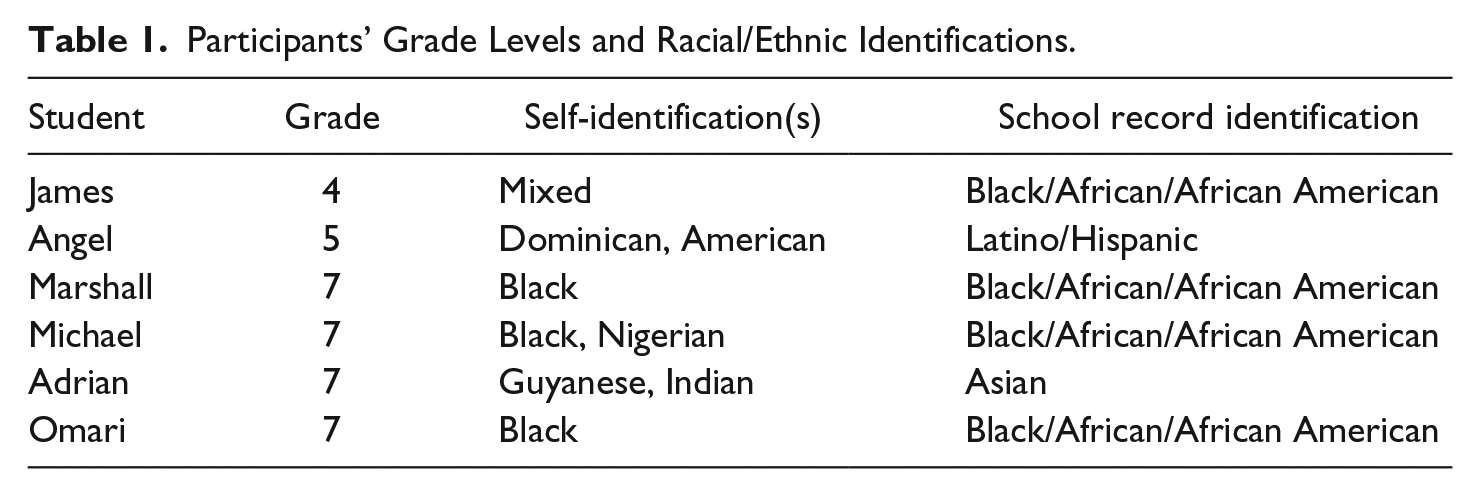
Data from interviews with Omari and Michael appear in my previous work (Sciurba, 2014/2015). The present study extends that work by examining other students’ perspectives and analyzing the larger group of young men’s comments in relationship to two specific works of literature.
Data Collection and Analysis
The data for this study comprise student interview transcripts and notes from analyses of Malcolm X and Harry Potter, which followed my conversations with the boys. The interviews were “semistructured” (Kvale, 1996, p. 2) and broken into two 20-min parts—the first designed to capture students’ general feelings about reading and relevance and the second directly focused on students’ conceptions of relevance in relation to race, ethnicity, and gender. The purpose of breaking the interviews into two sessions was to ask students unprompted and then prompted questions related to their own identities and their reading processes. The two interview sessions occurred within the same month for each participant—often in sequential weeks. I first invited students to discuss texts of any genre (“things” they “like to read” inside or outside of school). I then asked students to discuss the importance of reading about characters or figures that shared their racial/ethnic or gender backgrounds (i.e., “Is it important for you to read about characters or figures with the same racial [or ethnic] background as you? Why [not]?”; “Is it important for you to read about male characters? Why [not]?”).
I completed an initial “pattern level of analysis” of the interview data (LeCompte & Schensul, 1999), which consisted of sorting the boys’ positive and negative statements into a table divided into three categories, using words and phrases that emerged repeatedly during our interviews. For example, statements including the words hero, sacrifice, struggle, and growth were placed into a column labeled “Character Development.” The other two categories in my table were “Realistic” and “Action/Adventure”; however, a statement belonging in the Character Development column could also fall into the Realistic column, depending on what the student mentioned—for example, a hero’s realistic experiences. I crossed each of these three categories with another column, titled “(Un)Shared Experiences” to determine where the boys found relevance or interest based on explicit matches to their own lives (empathetic textual connections). In addition, I looked for instances in which the boys found relevance or interest by living through or constructing significance from stories without experiencing similar events firsthand (sympathetic textual connections). In some instances, the boys’ gravitations toward books were based on one of the three initial categories (i.e., Action/Adventure) but did not intersect with discussion related to (Un)Shared Experiences. In other words, textual relevance, at times, was not clearly connected to the student’s ability to see himself in the story or step into another person’s world but to an outside influence on his book interests. Because these data were collected in conjunction with a larger national project, I had multiple opportunities to confer with colleagues at my research center to establish concordance among our interpretations of students’ interview statements. Analysis related to students’ identities, their school’s theory of change, and their responses to curricula, published in Fergus, Noguera, and Martin (2014), complements the findings of this study.
Upon completing analysis of the interviews, I recorded a list of the boys’ names along with any specific book titles they mentioned favorably or negatively. As the two books standing out with favorable mention by the boys were Malcolm X and Harry Potter (neither of which I had read before this study), I then read and annotated the texts in accordance with how the boys discussed them. I searched the books for what Saldaña (2011) describes as “manifest” or “surface and apparent” meanings (p. 10) understood by the boys, especially as related to the themes of independence, transformation, triumph, and heroism. For instance, I paid particular attention to scenes that reminded the boys of personal experiences or enabled them to “live through” the drama of the story—such as when Harry Potter departs for Hogwarts. I marked the margins of these passages, flagged them with sticky notes (with phrases such as “Harry’s rebellion/independence” on page 35 of Harry Potter), and kept note of them, along with page numbers, in a Word document. This document included my notes related to how the boys understood or constructed meaning from each scene, as well as whether or not they related, personally, to this aspect of the story. I also examined the books for what Saldaña calls “latent” (“suggestive, connotative, and subtextual”) meaning (p. 10), ultimately coming to my own understandings of the texts based on how the boys had guided me to read them.
In essence, the content analysis of this study was a literary analysis stemming from case study. The literary analysis drew from the cultural studies tradition, as articulated by Storey (2003), which “takes a constructionist approach to representation . . . a practice through which we make reality meaningful and through which we share and contest meanings of ourselves, of each other, and of the world” (pp. 5-6). Storey’s conceptualization of meaning aligns with Freire and Macedo’s (1987) understanding of literacy, as well as Rosenblatt’s (1995) and Iser’s (1978) theories of reader response. Without learning how this particular group of students in this particular cultural context constructed and contested meaning from these two works of literature, I would not have been able to glean understanding from the texts as I did. Whether or not the boys “saw themselves” in the books, their overall connections to the stories of Malcolm X and Harry Potter revealed remarkable similarities between the heroic/transformative trajectories of each protagonist—similar to Brozo’s (2010) Warrior or Wildman archetypes.
My Role as Researcher: A Note on Positionality
In an effort to “be actively engaged, thoughtful, and forthright regarding tensions that can surface when conducting research where issues of race and culture are concerned” (Milner, 2007, p. 388), I must note my position as a White woman studying what is relevant to boys of color. While I have taken great efforts to focus on what Milner discusses as “counter-narratives” to dominant discourse on students of color, who are also male, I am aware that my presence in spaces like the single-sex school where I conducted this work is linked to a history rife with inferiority–superiority discourse and racist misrepresentations that have maintained power imbalances and inequity (see Pieterse, 1992). This history continues to affect education in the United States, as evident in the predominance of books featuring White characters and figures, and has the potential to affect my connection with students of color and to influence what they say to me during interviews, as well as how readers interpret my findings.
My objective as a literacy education researcher is to help disrupt some of the deficit thinking and incorrect assumptions about boys of color and relevance that surrounded me when I worked as a classroom teacher in the Bronx, New York, in the early 2000s. Messages about what “these kids” needed or could not do—transmitted by White, Latino, and Black administrators, teacher educators, providers of professional development, and veteran colleagues—did not accurately reflect my students’ needs or their potential. My students’ identities were significantly reduced to surface understandings about who they were.
I would be remiss if I did not also acknowledge that my work on relevance and identity stems in part from the urgency I feel personally, as the (step)mother of two mixed-race boys (one Black/Filipino, the other Black/White) and the wife of a Black man. As Black male bodies are vilified and subjected to violence, I am regularly reminded of privileges afforded to me that are not extended to them. Although my experiences are distinct from those of Black women, I empathize deeply with the mothers, wives, grandmothers, sisters, girlfriends, and others who have suffered tremendous loss at the hands of fellow citizens who do not agree that Black lives matter. The fears I have, related to assumptions made about my children and husband as well as the realities of how they experience the world, undoubtedly influence my political stance, which in turn influences my research.
Finding Relevance in the Stories of Malcolm X and Harry Potter
When I asked why Angel, a fifth grader with a portrait-ready smile, was so enthralled with J. K. Rowling’s Harry Potter and the Sorcerer’s Stone, his eyes lit up as he explained,
She introduced it as something you can relate to, or you feel sad about—a boy being left at a uncle or aunt’s house because his parents had been killed. You kind of feel a bit sad, and you want to keep reading to see what happens to that boy. And then, once you’re basically in the middle of the book, you feel so excited because he leaves. He leaves his house with Hagrid to go to Hogwarts! And—and it feels—you just feel excitement! And, “Oh my God! What’s gonna happen next?! What’s gonna happen next?!”
Like most of his peers at ABA, Angel identified himself as “someone who likes to read” and could easily pinpoint the reasons he did—or did not—enjoy or believe he could connect to certain books. In the case of Harry Potter, which he had read outside of school, Angel considered the book both a mirror of his own life and a window to another life, making what I term both empathetic and sympathetic connections. The book was “something you can relate to, or you feel sad about.” Relevance, for Angel, took shape in two ways, but seeing himself overtly reflected in the text was not the prime reason he became engaged with the story. He was entranced by the popular young wizard because, in the novel, Harry Potter “leaves” his “sad” conditions for an exciting new place—a place where he ultimately becomes a hero.
The six boys who were drawn to Harry Potter or Malcolm X discussed the books in similar ways—focusing on the trajectories of the stories’ protagonists. Whether or not they saw themselves in the books, as if using the narratives as mirrors, James, Angel, Marshall, Michael, Adrian, and Omari made character-driven connections to the stories, finding value in Harry Potter’s and Malcolm X’s journeys or becoming fascinated with their exhibited strength. Both Malcolm X and Harry Potter are subjected to disempowerment and hardships that prevent them from realizing their potential, yet they ultimately overcome their circumstances to become influential leaders—in distinct communities.
Upon closer examination of Haley’s and Rowling’s works, following my interviews with the boys at ABA, it became evident that the disparate lives of Malcolm X and Harry Potter very closely reflect Campbell’s (2003) “monomyth” theory of story, which is linked to the “universal quest for self-transformation” (p. xix). The monomyth story is described as follows:
A hero ventures forth from the world of common day into a region of supernatural wonder: fabulous forces are there encountered and a decisive victory is won: the hero comes back from this mysterious adventure with the power to bestow boons on his fellow man. (p. xix)
Despite the shortcomings of this “monomyth,” which postmodernists would critique on the basis that grand narratives of human experience do not exist (Docherty, 1993), Campbell’s (2003) theory, which connects to Brozo’s (2010) discussion of archetypes, offers a framework for demonstrating how the boys similarly discussed Malcolm X and Harry Potter. Table 2 shows a side-by-side comparison of the monomyth elements of each novel.
Monomyth Elements in the Autobiography of Malcolm X and Harry Potter and the Sorcerer’s Stone.
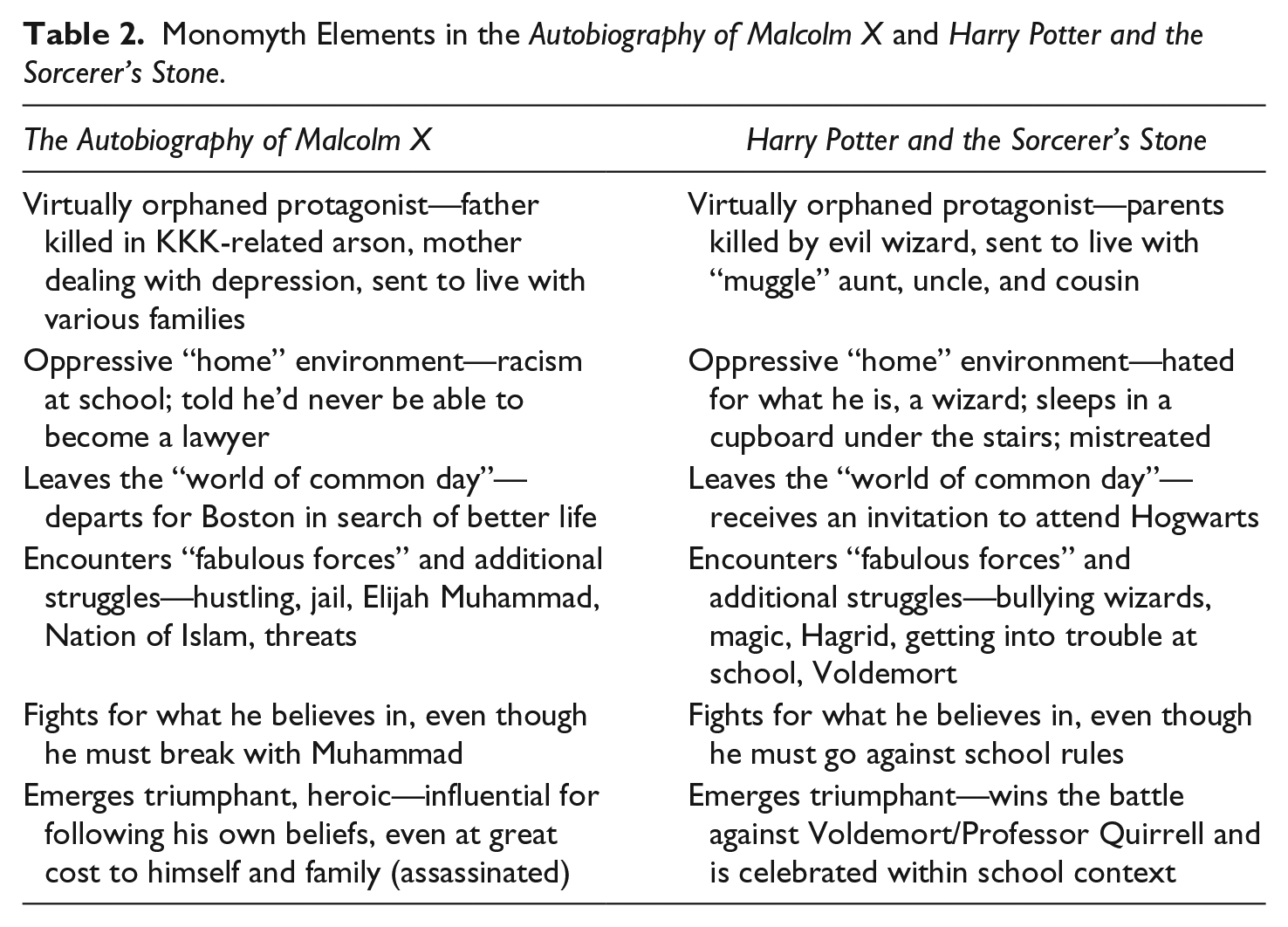
In accordance, the boys were drawn to these stories, in which the protagonists rise against oppressive forces, work toward “independence,” demonstrate growth, and overcome “struggle.” Whether or not the boys articulated direct connections between the heroes’ lives and their own, the narratives served as proof that “anything is possible,” as Michael stated. This message, many of the students believed, was particularly valuable to them as young men (of color), many of whom desired to become leaders (or heroes) in their own lifetimes. Essentially, the ways in which the students found relevance in Harry Potter and Malcolm X reflected Tatum’s (2005, 2015) call for books that speak to the immediate needs of young men of color—or provide them with ideas they are able to apply to themselves. Even if the boys did not empathize with or see themselves in the hero’s experiences, the majority of them sympathized with the hero to the extent that they could imagine walking “in his shoes” and learning from what he “went through.” Although the stories were initially relevant to several of the boys due to an introduction by a teacher or peer or because of a link to popular culture, James, Angel, Marshall, Michael, Adrian, and Omari were each drawn to Malcolm X or Harry Potter because the historical figure’s and fictional character’s lives and experiences appealed to them in their current time and space.
The first two iterations of relevance discussed in this study (empathetic and sympathetic) are similar to Bishop’s (1990) distinction between books that serve as “mirrors” of our own lives and “windows” to others’ lives. I, therefore, adapt her terminology in my work (Sciurba, 2014/2015).
Empathetic Relevance: Mirroring the Hero’s Journey
Only two of the students—Angel and Omari—found mirror-like relevance in the stories of either Harry Potter or Malcolm X; they connected to the stories with explicit links between their own worlds and the worlds of the protagonists. These two young men saw their lives reflected in the texts in very different ways, yet they both made connections to aspects of challenge faced by each of the protagonists. Key to Angel’s and Omari’s interests in Harry Potter and Malcolm X was the hero’s ability to use resources to overcome struggle and, ultimately, emerge triumphant and transformed.
In addition to feeling “sad” about Harry Potter’s dismal predicament at the beginning of Rowling’s work, Angel “relate[d]” to Harry because, throughout the series, the young wizard relies upon the positive guidance of figures like Hagrid. Angel made an explicit connection between the protagonist’s relationships and his own relationships. He stated, “[Harry Potter] has to be helped by other people, just like I’m helped by my teachers.” In Harry Potter, Harry is surprised to learn of his wizard status and, unlike many of his fellow young wizards, does not have parents to help guide him in understanding who he is or to help him navigate wizard school. Angel linked Harry Potter’s experience to his personal experience at home:
I can’t ask anybody questions at my house because I’m—I basically have to know everything with the homework. I have to know each and every question by myself because my mom doesn’t really know ’cause she isn’t from this country. So I have to learn all the things myself and help myself, and then ask for help and things like that from my teachers.
After Harry escapes number four, Privet Drive, where he lives in a cupboard with an abusive aunt and uncle who detest his wizard roots, he is thrust into the unfamiliar world of Hogwarts and needs a mentor to help him survive. Hagrid is the first to assist Harry with wizard essentials such as messenger owls, pewter cauldrons, magic wands, and flying brooms. For Angel, school was relatively new and required continual adjustment (to its rigorous curriculum, in particular), just as Hogwarts—with its ever-changing hallways and mysterious rules—requires Harry to adjust. Like Harry, Angel relied upon adult support to make it through the challenges of school. This commonality transcended the racial, ethnic, and additional differences that might otherwise have separated Angel and the fictive Harry Potter. Despite the distinct challenges Angel faced, as a child of immigrants, being a stranger in a strange educational land enabled him to see his world reflected in the story.
Omari’s experience with Malcolm X differed quite a bit from Angel’s experience with Harry Potter, reflecting the closest example of how race and gender—in addition to other factors—can influence a student’s ability to find relevance in what he reads. Omari, a soft-spoken Black (African American) student whose favorite class was English, is also featured in my previous work (Sciurba, 2014/2015). He gravitated generally toward books by Walter Dean Myers and books like Malcolm X, stating that he appreciated their “storylines,” which depict “young Black people and their struggles.” Out of the 13 boys interviewed for this study, Omari is the only student to mention race- and gender-based relevance during our first interview, before I prompted him to discuss his view of the importance of reading about characters or figures from his same background and of the same sex. This suggests that Omari would benefit from greater visibility in books, as suggested by Gray (2009). However, it is important to note Omari’s emphasis on “young” characters and “struggles.” Visibility was certainly important to him, but that visibility would need to reflect his “current time and space,” just as Tatum (2005, p. 15) states and Freire and Macedo (1987), Rosenblatt (1995), and Iser (1978) suggest.
For Omari, relating to a text had a very literal, mirror-like meaning. To explain his inability to connect to Harry Potter, he referenced his inability to “do magic.” In contrast, he connected to Walter Dean Myers’s books and Malcolm X because of the “struggles” he faced as a young Black man, similar to those experienced by the protagonists. Even though Malcolm X is an adult for the majority of his story, the novel traces back to his experiences as a boy growing up in a racist Midwest. At the time of this study, Omari was considered by school administrators to be an “at-risk” student and had several absences, which might have had something to do with difficulties he was having in his personal life (to which he only alluded). In addition to gravitating toward the struggles experienced by Malcolm X and Walter Dean Myers’s characters, Omari appreciated that the books were “really real—realistic,” elaborating by saying that each text “used a context that [he] can think of—the setting that [the author] was explaining.” The urban environment, as depicted in Malcolm X’s experiences in Boston, helped Omari envision and get into the story.
To Omari, Malcolm X was also “important” because he embodied the transformative power of education, a value instilled in him and other ABA students—beginning at their orientation retreat. Omari explained that Malcolm X’s emergence as a reader, involvement with “debates,” and eventual transformation into maker of history showed him there could be “something higher” for him, as well. In prison, Malcolm X becomes familiar with the “true knowledge of the black man” introduced to him through Elijah Muhammad’s teachings of the Nation of Islam. Malcolm then begins his movement toward Omari’s notion of “something higher.” Through education, Malcolm is able to reclaim his life as well as his identity as a Black man in America. As Omari pointed out, this serves as a turning point in the hero’s trajectory toward greatness. This aspect of Malcolm X’s story connected to Omari’s own increasing ability to read, study, and argue—reasons he loved ABA and his English class, in particular. As a result of reading Malcolm X, Omari made the connection that he, as a young Black male, could seek something “higher” and, possibly, transform his own life—just as his teachers were advising him to do, by “working harder.” Textual relevance, for Omari, stemmed from his desire to see an aspect of himself in this story of struggle and eventual empowerment.
Sympathetic Relevance: A Window to the Hero’s Journey
In contrast to Omari’s articulation of textual relevance, but similar in his understanding of needing a mirror-like experience to relate to a story, Adrian, a Guyanese student with an affinity for sci-fi, said he “couldn’t relate” to Malcolm X. He explained, “Because of all the things he did while he was a child and while growing up.” When I asked him to give me an example of those things, he continued,
Like, Malcolm X—he started in the ghetto. And his dad treated him better because he was light-skinned. But his mom treated him worse because he was light-skinned. But he was—he was still a little brown. So, like, I can’t relate to that because no one treats me different because of my skin tone.
Although considered a “boy of color”—with a skin tone darker than that of many of his Black classmates—Adrian did not believe he had ever experienced the type of race-based mistreatment Malcolm X experiences at the beginning of and throughout his story. However, his inability to use the text as a mirror did not prevent him from finding relevance in the autobiography.
Adrian was attracted to the way Malcolm X was able to “[work] his way up” to a better existence. Changing one’s socioeconomic status through “hard work” is how many ABA students—like Adrian—defined “success.” He discussed Malcolm’s introduction to the Nation of Islam and said, “After that, he’s . . . like day and night.” The transformation of Malcolm X, consistent with Campbell’s monomyth theory, led Adrian to consider him a “role model” and someone he desired to be like in the future. He said,
I would like to be someone like Malcolm X because of what he did for the African American and Muslim people. He, like, stepped it up to them—telling the Whites or the Caucasians that it’s not only about you. You have to share the respect between everyone.
This young man used the book as a window to the path of leadership, a path he hoped to take in his own life. The racial dissimilarity between Adrian and Malcolm X did not prevent him from naming this as one of the most important stories he had read. Textual relevance, for Adrian, consisted of stepping into another’s world and extracting an idea that he could possibly apply later in his own.
Michael, a Nigerian American student described without hesitation as a future leader by school administrators, was drawn to Malcolm X’s ability to persevere through challenging circumstances and stand out as someone who fought for his beliefs. Michael said that he liked Malcolm X because of the “morals” and “changes” demonstrated by Malcolm X in the story. In addition, Malcolm X’s dedication to his fight for “the plight of Blacks” really “inspired” him. Michael was intrigued by Malcolm’s moral growth as he became an adult, as well as his willingness to “sacrifice everything” for his cause. This is what made Malcolm X stand out as a leader. While some might (rightfully) argue that Black students are drawn to the nationalistic learnings of Malcolm X (Griffin, 1995), the students in this study were more affected by the leader’s tenacity in fighting for what he ultimately believed in: a racially united coalition against inequality. It is quite possible that Mr. Lorenzo, the teacher who introduced this book to the seventh-grade class, guided Michael, Adrian, and their classmates to focus on such elements of Malcolm X’s life story.
Despite feeling inspired by Malcolm X’s fight for “the plight of Blacks,” Michael did not feel that he related to the text in a mirror-like way. Michael believed that Malcolm X had “hit rock bottom” in a way that he, personally, had not. Although arguments such as Cai’s (2002) suggest that a text like Malcolm X “represents [his] world” (p. 11), Michael’s own experiences as a young Black male growing up in the United States in the 2000s were quite distinct from those of Malcolm X, so he was unable to see himself in the story. His engagement with the novel was less self-oriented, instead rooted in appreciation for what someone else had endured. By looking, as through a window, upon Malcolm X’s story, Michael also had an opportunity to learn “morals” or lessons without having to experience any of the protagonist’s hardships for himself. Malcolm X served as proof to Michael that “anything is possible”—a message he valued, which was similar to Angel’s gravitation toward the exciting possibilities depicted in Harry Potter.
Beyond Mirrors and Windows: Entertainment, Surprise, and Relevance
Even though Omari stated he was not able to “relate” to Harry Potter, he enjoyed the book because he liked to “compare it to the movies” and discuss it with his friends. At the time of this study, the books and films had spiked in popularity, so this could be expected. Similarly, James—the youngest student in this study—liked the book’s “cool spells” and “entertainment” value. James was especially drawn to Harry Potter’s venture from “the world of common day into a region of supernatural wonder” (Campbell, 2003, p. xix). He liked that Harry Potter was “in school,” where they had pencils and wands. J. K. Rowling’s construction of Hogwarts allowed James to have “fun,” as he described reading this book, in a fictive world revolving around education. Relevance in his case was determined by the intriguing and slightly strange elements of the story, which engaged him as a reader.
The four seventh-grade students who mentioned Malcolm X (Omari, Adrian, Michael, and Marshall) shared that the book was taught in class by Mr. Lorenzo, one of the boys’ favorite teachers—a young Black man who often shared stories from his personal history as a means of connecting with students. Interestingly, Marshall, Michael, and Adrian did not find mirror-like relevance in the novel, despite Mr. Lorenzo’s presumption that they would, as male students of color. Although he did not personally connect with the novel and was the only student in this study who admitted he was “absolutely not” someone who enjoyed reading, Marshall was pleasantly surprised by Mr. Lorenzo’s decision to teach Malcolm X:
[The] curriculum chooses books we wouldn’t expect to be in it, like Malcolm X. I wasn’t expecting that to be in in the curriculum . . . It basically gave no boundaries because the book was so extreme to me. In a way, the books I read outside of school are very similar.
Marshall added that he “would expect someone like Martin Luther King or someone like that,” as opposed to someone with a history like Malcolm’s. This novel was similar to the “history” books Marshall read outside of school for pleasure. While he could not recall specific titles of these books, he described them as having a level of “harshness” he attributed to characters that “go through a series of events such as getting beat up.” He thrived on books that present realistic and harsh scenarios, through which the protagonists persevere. An essentialist approach to textual relevance for Marshall, based on his Black identity, might overlook his desire to read beyond stories like those of Dr. King, which he viewed as existing within “boundaries” that made books “boring.” Likewise, even though he was attracted to violent material, which is viewed as “boy”-interest content (Gurian & Trueman, 2002)—characters “getting beat up”—he was more interested in seeing protagonists overcome such adversity.
Intriguingly, midway through Marshall’s and my discussion about Malcolm X, as he began to talk about Malcolm’s involvement with the Nation of Islam, he took a newly ambivalent stance on the text, stating that it was only “okay.” He believed that once Malcolm became a Muslim, “he became less and less interesting because he was working for the leader of this organization” and “became less independent.” He preferred reading about when he was “living in the streets.” Even though Malcolm X is essentially “working for” hustlers during the first part of the novel, Marshall perceived this lifestyle as “independent” and viewed him as more of a leader. His focus on independence was one shared by many of the boys in the study, which was not entirely surprising given ABA’s focus on leadership qualities. Marshall’s interest in the book was renewed once Malcolm X puts his life at risk by separating from the Nation of Islam and “establishes another organization which helps Blacks as well as Whites work together.” The momentary disconnect he felt with the text indicates that relevance can waver, despite the seemingly perfect recipe of features embedded in a single story.
Study Limitations and Future Research
This study’s limitations stem primarily from the uniqueness of ABA, an urban all-boys academy attended almost entirely by students of color. The boys who volunteered to be interviewed for this study were in a context quite distinct from that of their city’s public schools. For example, the small class sizes at ABA afforded teachers ample opportunities to interact with students on individual bases, which very well could have affected the young men’s experiences in their reading classrooms, their interpretations of the books, and their general feelings about literature.
In addition, my study design did not align English classroom observations with particular students. The observations occurred as scheduled for the larger national project on single-sex schools. Interviews with teachers were also conducted for the larger national study, prior to my interviews with students in many cases; therefore, I did not have the opportunity to ask the adults pointed questions related to classroom experiences or texts the students discussed with me. Finally, my interviews for this study were limited to 20-min sessions held before the start of the school day so as to not interrupt student learning. As most of the young men took long bus or train rides home, I could not interview them after school and had to work within the confines of 6:30 to 7:00 a.m. interview schedules, which did not always allow me to probe with follow-up questions as deeply as I would have liked during our conversations.
Another limitation related to data collection and analysis is that I did not engage in member checks with my participants. Providing the boys with opportunities to examine my preliminary analysis of their interview statements could have yielded more robust, co-constructed findings. Member checking will be a powerful step for me to take, particularly as I engage in additional studies with students whose racial/ethnic, gender, and other identities are distinct from my own. Soon, I will complete follow-up interviews with the young men who participated in this study, and I plan to share my analysis of their original interviews to elicit their retrospective feedback.
I view this project as an initial step in gaining understandings related to textual relevance. Future research in this area could investigate the reading experiences of students, including White male students and female students, in other contexts—thus strengthening empirical support for the complex ways in which students’ worlds intersect with their literacies.
Continuing the Journeys Toward Textual Relevance
One of the reasons cited for the deep chasm of literacy-based inequity in our K-12 schools is the inability to engage students of color, especially male students, and provide them with opportunities to construct relevance from the texts they read (see, for example, Tatum, 2005). However, understandings of “relevance”—stemming from the landmark work of Ladson-Billings (1995) and frequently conflated with Gay’s (2010) “responsiveness”—do not necessarily ensure that students’ “repertoires of practice,” as Paris (2012) argues, sustain their pluralistic identities while offering them “access to dominant cultural competence” (p. 95). I believe this has been the case largely because students’ racial/ethnic and gender identities have been essentialized rather than recognized for their complexities. Until we gain deeper understandings related to the “cultural and linguistic competence of [students’] communities” (Paris, 2012, p. 95) and how their worlds influence their readings of the word, it will remain difficult to determine how the word can impact their worlds.
In the introduction to Freire and Macedo’s (1987) Literacy: Reading the Word and the World, Henry A. Giroux, in discussing teacher–learner exchanges and the production of meaning and knowledge, writes,
At stake here is a notion of literacy that connects relations of power and knowledge not simply to what teachers teach but also to the productive meaning that students, in all of their cultural and social differences, bring to classrooms as part of the production of knowledge and the construction of personal and social identities. In this case, to define literacy in the Freireian sense as a critical reading of the world and the word is to lay the theoretical groundwork for more fully analyzing how knowledge is produced and subjectivities constructed within relations of interaction in which teachers and students attempt to make themselves present as active authors of their own worlds. (p. 17)
The young men featured in this article varied in their abilities to make matches between the texts and their own lives. Whether they used the books as mirrors or windows or found relevance in the texts for other reasons, their high levels of engagement with Malcolm X and Harry Potter demonstrate the complexity of readers’ meaning-making processes—just as theorized by Rosenblatt (1995) and Iser (1978). Even if the boys did not see their current worlds reflected while reading the stories, they became “active authors” of their own possible worlds or found value in learning about how their current and future worlds (might) evolve. Their “personal and social identities” proved to be multifaceted, too—influenced not only by race/ethnicity and gender but by popular culture and their specific ABA school context.
Teachers at ABA facilitated classroom discussions that guided students to consider parallels between the protagonists and their own lives—but also to question power and inequality and to learn from individuals like Malcolm X and their heroic trajectories. This very well could have affected the students’ similar understandings of Harry Potter, guiding them to read this popular work of fiction in a way with which they could identify. Given the prominence of White characters like Harry Potter, the students’ gravitation toward the wizard might also indicate their abilities to look beyond race or ethnicity to find relevance in a story. It would be worth investigating if White students, female students, or boys of color in other school contexts would make similar connections between protagonists as different as a Black revolutionary and a White wizard or gravitate toward texts reflective of Campbell’s (2003) “monomyth” theory, which links to Brozo’s (2010) discussion of positive male archetypes.
To continue along our journeys toward textual relevance for all students, it is imperative that we seek input from young people to find out more about the various dimensions of textual relevance and the degree to which they make—and do not make—matches between their own lives and the stories they read. Rather than make assumptions about students and perpetuate the cycle of inadequately informed literacy education decisions, teachers can adopt lines of inquiry similar to this in their own classrooms, asking students how they want us to see them as readers. As such, we can engage students in more critical readings of the word and the world and come closer to achieving Paris’s (2012) “culturally sustaining pedagogy.” Accordingly, we—as educators and researchers—can work with K-12 students to counter problematic narratives and open empowering new chapters.
Footnotes
Acknowledgements
The author wishes to thank David E. Kirkland, for going above and beyond his role as dissertation chair to provide feedback on numerous earlier drafts of this article, and Pedro Noguera, for offering the graduate assistantship that made this research possible.
Declaration of Conflicting Interests
The author(s) declared no potential conflicts of interest with respect to the research, authorship, and/or publication of this article.
Funding
The author(s) received no financial support for the research, authorship, and/or publication of this article.
