




Abstract
We conducted a formative experiment investigating how an intervention that engaged students in constructing multimodal arguments could be integrated into high school English instruction to improve students’ argumentative writing. The intervention entailed three essential components: (a) construction of arguments defined as claims, evidence, and warrants; (b) digital tools that enabled the construction of multimodal arguments; and (c) a process approach to writing. The intervention was implemented for 11 weeks in high school English classrooms. Data included classroom observations; interviews with the teacher, students, and administrators; student reflections; and the products students created. These data, analyzed using grounded-theory coding and constant-comparison analysis, informed iterative modifications of the intervention. A retrospective analysis led to several assertions contributing to an emerging pedagogical theory that may guide efforts to promote high school students’ ability to construct arguments using digital tools.
Professional organizations, such as the International Literacy Association (formerly the International Reading Association [IRA], 2009) and the National Council of Teachers of English (NCTE, 2005, 2008), have published position statements emphasizing literacy educators’ responsibility to prepare their students for literacy in the 21st century. However, those calls conflict with data, indicating literacy teachers rate the importance of integrating various digital tools and activities into their teaching well above their reported level of use (Hutchison & Reinking, 2010, 2011). Literacy teachers also view integration of digital literacy into their teaching in technological, rather than curricular, terms. That is, they define integration simply as using digital technologies to serve conventional instructional goals rather than engaging students with new genres of reading and writing, such as blogs and wikis (Hutchison & Reinking, 2011). That conclusion holds in studies conducted in the United States as well as in other countries (e.g., Canada—see Peterson & McClay, 2012—and South Korea—see Pang, Reinking, Hutchison, & Ramey, 2015).
Although there is an extensive literature aimed at understanding and contextualizing the changes in literacy that are occurring and why it is important that educators respond to those changes (e.g., Coiro, Knobel, Lankshear, & Leu, 2008; Jewitt & Kress, 2010; Kress, 2003), what is lacking, and what the present investigation aimed to address, is research investigating how instructional activities aimed at developing 21st-century literacy skills might be successfully and authentically integrated into conventional instruction (Graham & Benson, 2010; see also Pressley, Graham, & Harris, 2006).
We conducted a formative experiment investigating how an intervention aimed at developing high school students’ ability to construct multimodal arguments using digital tools might be integrated into conventional writing instruction. Specifically, we explored how a multiliteracies perspective promoted by the New London Group (NLG; 1996) could be instantiated through instruction aimed at enhancing students’ ability to construct conventional and multimodal arguments using online digital tools. We wanted to learn what pedagogical understandings would emerge from our collaboration with a teacher to design a workable intervention, thus generating what Gravemeijer and Cobb (2006) refer to as local theories grounded in, and authentically informing, practice.
Theoretical Perspectives
The NLG (1996) advocated expanding the concept of literacy to encompass what they called multiliteracies. Multiliteracies not only included traditional text-based forms of communication but also accommodated an increasingly globalized, diversified, and technological world that afforded new forms of text students need to both understand and create. This perspective defined texts as multimodal constructions that could include linguistic, audio, spatial, gestural, and visual modes. These modes are organized semiotic resources used to make meaning. NLG scholars such as Kress (2003, 2010; Bezemer & Kress, 2008; Jewitt & Kress, 2010), positioning their perspective within social semiotics, have argued that digital communication provides more modes and therefore more options for expressing meaning. Thus, competent construction of multimodal texts is necessary for equitable participation in an increasingly diverse, interconnected world.
However, a conventional view of literacy, based on printed texts, inherently excludes dimensions of multimodality (Dyson, 2003). Furthermore, teachers may not have adequate preparation (Ajayi, 2009) to integrate multimodality into their instruction, especially when they have little explicit guidance about how to achieve such integration (Graham & Benson, 2010; Sewell & Denton, 2011). Teachers may also perceive such integration to be incompatible with prescriptive demands placed upon their work, such as conforming to standards or to a test-centric school culture (Siegel, 2012). Miller (2013) concluded the field “urgently needs” further research on how teachers integrate multimodal communication into their instruction (p. 24). Yet, teachers must integrate digital tools and multimodality without neglecting conventional skills assessed on standardized tests (Siegel, 2012). Thus, teachers need more explicit pedagogical understandings and guidance to scaffold the integration of multimodal forms of reading and writing in everyday instruction (Mills, 2010).
Constructing Arguments as a Pedagogical Goal
Constructing conventional written arguments is a standard topic in the curricular standards guiding high school writing classes because it is essential for critical thinking and academic success (Hillocks, 2011). Some states assess teachers’ ability to construct arguments to achieve certification (Harris, 2014). Constructing arguments is also viewed as an element of active and effective citizenship (Hillocks, 2011; Smith, Wilhelm, & Fredricksen, 2012).
Yet, teaching students to construct effective conventional written arguments has been identified as an instructional challenge. For example, Hillocks (2010) suggested that argumentative writing requires complex logical reasoning beyond persuasive writing. Newell, Beach, Smith, and VanDerHeide (2011) found that teaching argumentative writing is challenging because (a) teaching argument is complex, (b) students rarely have an audience beyond a teacher, (c) argument does not lend itself to formulaic approaches, and (d) teachers may lack experience in dealing with its complexity. Furthermore, Applebee and Langer (2013) documented that only 19% of writing teachers’ assignments extended beyond a paragraph.
There have been repeated calls to expand argumentative writing to include digital forms of communication (Andrews, 1997; Birdsell & Groarke, 2004; Hocks, 2003; Howard, 2011). Capable citizenship includes constructing and evaluating arguments with digital tools (e.g., Jewitt & Kress, 2010; Kress, 2000). Adolescents’ lives in contemporary society are also increasingly digital and multimodal outside of school (Alvermann, 2008; Lenhart, Arafeh, Smith, & MacGill, 2008).
There is evidence that teachers are not responding adequately to these developments. For example, in a national study of 2,462 Advanced Placement (AP) and National Writing Project teachers who worked with middle and high school students, Purcell, Heaps, Buchanan, and Friedrich (2013) found that 95% of the teachers reported having students do research online. However, comparatively few engaged students in developing and posting their work on a website, wiki, or blog (40%). Teachers used the Internet as a source for students to obtain information, but less as a means for constructing and disseminating student writing.
However, integrating digital forms of communication into curriculum and instruction, which often means using technologies in new ways, requires thoughtful planning and represents pedagogical challenges. Specifically, there is a tension between the possibility of multimodal composing and what actually is applied in classrooms, as teachers try to integrate digital genres into their practice (Bowen & Whithaus, 2013; Graham & Benson, 2010). A fundamental challenge is that practitioners cannot simply abandon conventional approaches to writing, even if so inclined (e.g., Jenkins, Clinton, Purushotma, Robison, & Weigel, 2006; NLG, 1996). Instead, students need explicit instruction that connects composition in conventional and digital forms, and teachers need guidance on how to do so (see Bowen & Whithaus, 2013; Matthewman, Blight, & Davies, 2004). For example, Rowsell and Decoste (2012) conducted a 2-year ethnographic study within their 11th-grade English class finding that students did not inherently connect various modes of digital expression with conventional writing. They concluded that the affordances and uses of multimodal forms of expression need to be taught explicitly. Furthermore, McDermott and Hand (2013) argued that students need to understand how different modes work together coherently and effectively. Argument in digital texts must be more than a sequence of statements composing an Aristotelian syllogism. Instead, as Andrews (1997) noted, “it is the deploying of verbal, visual, and physical ‘moves’ to negotiate a new position or defend an existing one” (p. 267).
Given these perspectives, the purpose of this study was to investigate how an intervention aimed at addressing these shortcomings and challenges might be successfully integrated into high school writing instruction toward the goal of improving students’ argumentative writing. Our focus was on developing students’ ability to construct multimodal arguments using digital tools. However, we were also interested in whether engaging them in constructing multimodal arguments might improve their writing of more conventional arguments.
The Intervention and Its Justification
In a formative experiment, the intervention is defined by its essential components. Although these components can be implemented and adapted in infinite ways, they are the constants that identify an intervention as a distinct pedagogical entity (Reinking, Colwell, & Ramey, 2013). Fidelity in a formative experiment is not an inflexible implementation of instruction, but instead the expectation that all of an intervention’s essential components are integral to instruction (Reinking & Bradley, 2008). The essential components of the present intervention are (a) construction of arguments defined as claims, evidence, and warrants; (b) digital tools that enable the construction of multimodal arguments; and (c) a process approach to writing. Subsequently, here we justify each of these components that together represent an intervention with potential to achieve our pedagogical goal.
Constructing Written Arguments
Toulmin (1958/2003) introduced a framework for developing conventional written arguments in composition classes (Lunsford, 2002; Smith et al., 2012). That framework is a familiar heuristic to writing teachers although we have abbreviated it here to its fundamental elements: claims, evidence, and warrant. Claims are assertions that must be proven in the argument, evidence is given to support the claim, and warrants explain how the evidence supports the claim (Toulmin, 1958/2003). We also responded to recent concerns that Toulmin’s model has been conceived and implemented more from a cognitive than a social perspective. Newell et al. (2011; see also Lunsford, 2002) argued that more research is needed on writing arguments as a form of social practice. Incorporating a visual rhetoric into constructing arguments is one way to move in that direction (see Birdsell & Groarke, 2004), as is broadly considering how multimodal arguments might be constructed (see Demirbag & Gunel, 2014; Whithaus, 2012), which leads to the intervention’s second essential component.
Multimodal Arguments Using Digital Tools
Constructing multimodal arguments is a specific application of multimodal composing, defined by Bowen and Whithaus (2013) as “the conscious manipulation of the interaction among various sensory experiences—visual, textual, verbal, tactile, and aural—used in the processes of producing and reading texts” (p. 7). This component instantiates a bridge between the goals of constructing conventional written arguments and new goals grounded in the trend that digital forms and genres are increasingly central to academic and civic writing (Andrews, 1997; Birdsell & Groarke, 2004; Hocks, 2003; Howard, 2011).
A central concept distinguishing conventional writing from constructing multimodal texts is engagement in a conscious design perspective using the affordances of digital tools. Kress (2003) argued that students must be taught how to design textual communications across modes. The integration of conventional and new forms of argument was addressed in this study as a teacher implemented instruction that simultaneously addressed conventional components of argument (claims, evidence, and warrant), yet extended instruction to include the design of multimodal arguments using digital tools.
Two studies suggest that instructional models for creating multimodal arguments are needed. Whithaus (2012) analyzed science reports using Toulmin’s (1958/2003) model. However, that model did not work well because, although claims were typically made linguistically, evidence was often presented visually or numerically. He concluded a multimodal model for analyzing argument was needed because “such a model facilitates a more detailed, even mathematical, consideration of argumentative patterns” (Whithaus, 2012, p. 106). Demirbag and Gunel (2014) came to a similar conclusion in a quasi-experimental study in which students receiving instruction in developing multimodal arguments outperformed a control group in the quality of their arguments as well as content knowledge.
Other studies have demonstrated that multimodal composing may increase students’ engagement (Bruce, 2009; Jocius, 2013; Johnson & Smagorinsky, 2013; Vasudevan, Schultz, & Bateman, 2010; Walsh, 2008). However, these studies have not provided specific insights into how multiliteracies as a theoretical orientation translate into feasible and effective pedagogy. Jocius (2013) argued that studies involving multimodal writing examine engagement and meaning, but few document what and how academic learning occurs. In this study, the use of digital tools to engage students in writing multimodal arguments responds to that gap in the literature in a conventional instructional context.
Process Writing
A process approach is a well-researched, long-standing, and widely used orientation to writing instruction (Applebee & Langer, 2013; Hillocks, 1986). Most writing teachers are familiar with and committed to that orientation (Graham & Sandmel, 2011). However, its implementation has evolved over time. Pritchard and Honeycutt (2006) argued that early models of process writing instruction were too linear and did not emphasize direct instruction. Thus, our definition of a process approach to writing included the following: extended opportunities for student writing; writing for authentic audiences; peer interaction; a recursive process of writing including planning, drafting, and revising; and direct instruction in the form of conferencing or mini lessons (Applebee & Langer, 2013; Graham & Perin, 2007b; Graham & Sandmel, 2011; Hillocks, 1986). That definition has robust support in the literature for improving the quality of students’ writing (e.g., Graham & Perin, 2007a, 2007b; Graham & Sandmel, 2011). Furthermore, a process approach aligns with the perspective of multiliteracies, which emphasizes writing as a process of multimodal design (NLG, 1996). Finally, the process approach aims to provide students strategies for recursive writing, rather than simply assigning the construction of a final product (Applebee & Langer, 2013), which is consistent with research suggesting that students need explicit guidance in bridging conventional and multimodal writing (Rowsell & Decoste, 2012).
Method
Formative experiments aim to determine how an intervention can be implemented in an authentic instructional context to reach a valued pedagogical goal. Thus, the research question guiding the present study was as follows: How can using digital tools within a process orientation to writing be integrated into conventional instruction to help students construct effective multimodal and conventional arguments?
Consistent with the literature on formative experiments (Reinking & Bradley, 2008), we gathered data that informed iterative modifications of the intervention guided by questions, such as these: What factors enhance or inhibit progress toward achieving the goal? How can the intervention be modified in light of those factors? What unanticipated influences and outcomes occur? Is the teaching and learning environment being transformed? A retrospective analysis of our data was conducted after the intervention to formulate pedagogical assertions toward developing local, domain-specific theory to inform future research and offer useful guidance to practitioners (Gravemeijer & Cobb, 2006).
Participants
We worked with Ms. Malone, a teacher of third-year English classes in Hampton High School (all names are pseudonyms). Ms. Malone worked as a teacher consultant for the National Writing Project (nwp.org), and we knew her previously in that context. She was in her seventh year teaching English, all of which were at Hampton. When asked why she wanted to participate in this research involving digital tools, multimodality, and arguments, she replied, “Technology is a great way to get students invested in something. Some of them haven’t had much experience in that.” However, by her own account and confirmed by our subsequent observations, her use of technology could be characterized as more technological, rather than curricular, integration. That is, she used digital tools such as word processing, PowerPoint slides, and the Internet for researching topics, but she had not implemented new curricular goals aligned with 21st-century literacy skills, strategies, and dispositions. In that regard, she was representative of many literacy teachers in the United States (see Hutchison & Reinking, 2011).
Ms. Malone was a well-respected teacher who lived in the community Hampton served. She taught both AP English and third-year college-preparatory classes in English. We observed her to be conscientious in her teaching, devoting considerable attention to detailed planning, and confident in her content knowledge. However, she lacked confidence in her ability to integrate technology into her teaching, and we observed her becoming flustered by technological glitches, mostly, it seemed, because it disrupted her ability to implement her carefully planned lessons. During one class period in particular, she shared her feelings of “vulnerability” and “embarrassment” in front of her students (and us) when she had difficulty implementing a technology-based activity.
When we presented options for Ms. Malone to be involved in the research project, she opted for a role consistent with what Cole and Knowles (1993) referred to as teacher development partnership research, where researchers and teachers collaborate closely but where “[respective] strengths and available time commitments . . . are honored” (p. 486). We were participant observers in her class (Glesne, 2011). However, to mitigate our influence on the intervention, which is a frequently cited limitation of formative experiments (Reinking & Bradley, 2008), we consciously resisted imposing our interpretations, pedagogical views, solutions to pedagogical difficulties, and so forth. Instead, we deferred to her assessments, judgment, decisions, interpretations, and opinions, because in a formative experiment, teachers’ reactions, including discomfort with instructional options, are important data (Colwell, Hunt-Barron, & Reinking, 2013). However, we offered suggestions and ideas if she solicited our thoughts and advice.
Most of the students in the two classes in which we worked were in the 11th grade although a few students were in 10th and 12th grades. There were 26 students in one section and 13 in the second section, approximately evenly divided in each class by gender. The data presented here were collected in our work with both of these sections of an 11th-grade English class.
Instructional Setting
Ms. Malone’s classes met every other day for 90 min. She had established a sense of community with each class, as demonstrated by the students’ freedom of expression and their willingness to meet her expectations. Her students often collaborated with one another, but they were also comfortable working independently, as she gave students both the freedom and responsibility to work toward the goals she set for them.
At the time of this study, Hampton had 922 students and served a small town in a mostly rural area of a Southern state in the United States. The state in which Hampton is located ranks schools with letter grades based on state tests and graduation rates. Hampton received a grade of “B” the year prior to this study, indicating that their progress exceeded state expectations. Nonetheless, the annual dropout rate of 4% was higher than the median rate of high schools in the state. In an interview, an assistant principal described the makeup of the student body as socioeconomically polarized.
Technology was emphasized at the school, which had multiple technological resources, including a classroom set of iPads, two carts of Chromebooks (24 in each), two Dell laptop carts (24 in each), 34 student computers in the library, secured wireless access for teachers, unsecured wireless access for students, a computer for the teacher in each classroom, computer labs, and SmartBoards in most classrooms. An assistant principal stated that writing good arguments was a priority at the school, an assertion that was reinforced by another administrator during a separate interview. Administrators stated that most English classrooms followed the Common Core State Standards, although, because the school was transitioning to those standards, some still followed state standards geared to an End of Course exam.
Intervention
Prior to implementing the intervention, we met several times with Ms. Malone to discuss the intervention’s essential components and to plan how they might be integrated into her instruction. Again, our role was to follow her lead in determining how the first iteration of the intervention could be integrated into her existing instructional frames and goals, logistical routines and constraints, and so forth. For example, she decided to expand the elements of argument to include counterargument.
However, Ms. Malone was also interested in our suggestions. For example, at our suggestion, she decided to use digital tools in a unit where the students would each create a website that would serve as a public service announcement (PSA) for a self-selected social cause. The students would use this website to make a multimodal argument about their chosen topic. Because all students in the school district had a Google email address and thus had access to Google Applications, she agreed that it would be efficient to use Google Sites (gsuite.google.com/products/sites/) as the medium for the students’ culminating project of their PSA. She also adopted our suggestion to use Evernote (evernote.com) as a tool for taking notes and recording references as students assembled evidence for their selected causes and then established claims. Glogster EDU (edu.glogster.com) enabled students to brainstorm the overall concept of their PSA in a multimodal form. PowerPoint and Google Slides (google.com/slides/about/) allowed students to create a photo-essay of their argument, with the claim and warrant typically established by combining text and visual images for evidence.
We discussed with Ms. Malone how the students would write conventional text-based arguments on each of their topics in some form, potentially using Google Docs (google.com/docs/about/) to bridge conventional and multimodal approaches to developing arguments. The original intent was for students to decide how much of their conventional texts to include in the multimodal design of their final project, constructed using a Google Site. However, Ms. Malone eventually decided to require the students to write a conventional outline and five-page essay in addition to the multimodal aspects of the project, the significance of which we discuss in more detail in the “Results” section. The intent was also that students would present these sites to their classmates and share them on Ms. Malone’s school website page.
To instantiate process writing, Ms. Malone, at times with our support, conducted mini lessons about a digital tool, a multiliteracies element of design, an element of argument, and so forth. She began the intervention by introducing, defining, and providing examples of the elements of argument in models of writing. She also taught concepts of argument in relation to multimodality. For example, students analyzed advertisements and PSAs for how they conveyed arguments using not only the conventional elements of argument but also multimodal elements (e.g., moving or still images, words, music, sound effects, and how those elements related to one another). At several points, students discussed how multimodal elements could be used in their arguments.
These mini lessons were followed by extended time for recursive writing and revision. Students received feedback while constructing their multimodal arguments, often provided as Ms. Malone, and the researchers as participant observers, circulated around the room monitoring students’ work and progress. See Table 1 for a weekly description of how the essential components of the intervention were enacted in the classroom. Each week, members of the research team met with Ms. Malone to debrief and plan for subsequent instruction, ensuring that the intervention’s essential components were included.
Pedagogical Implementation of Essential Components.
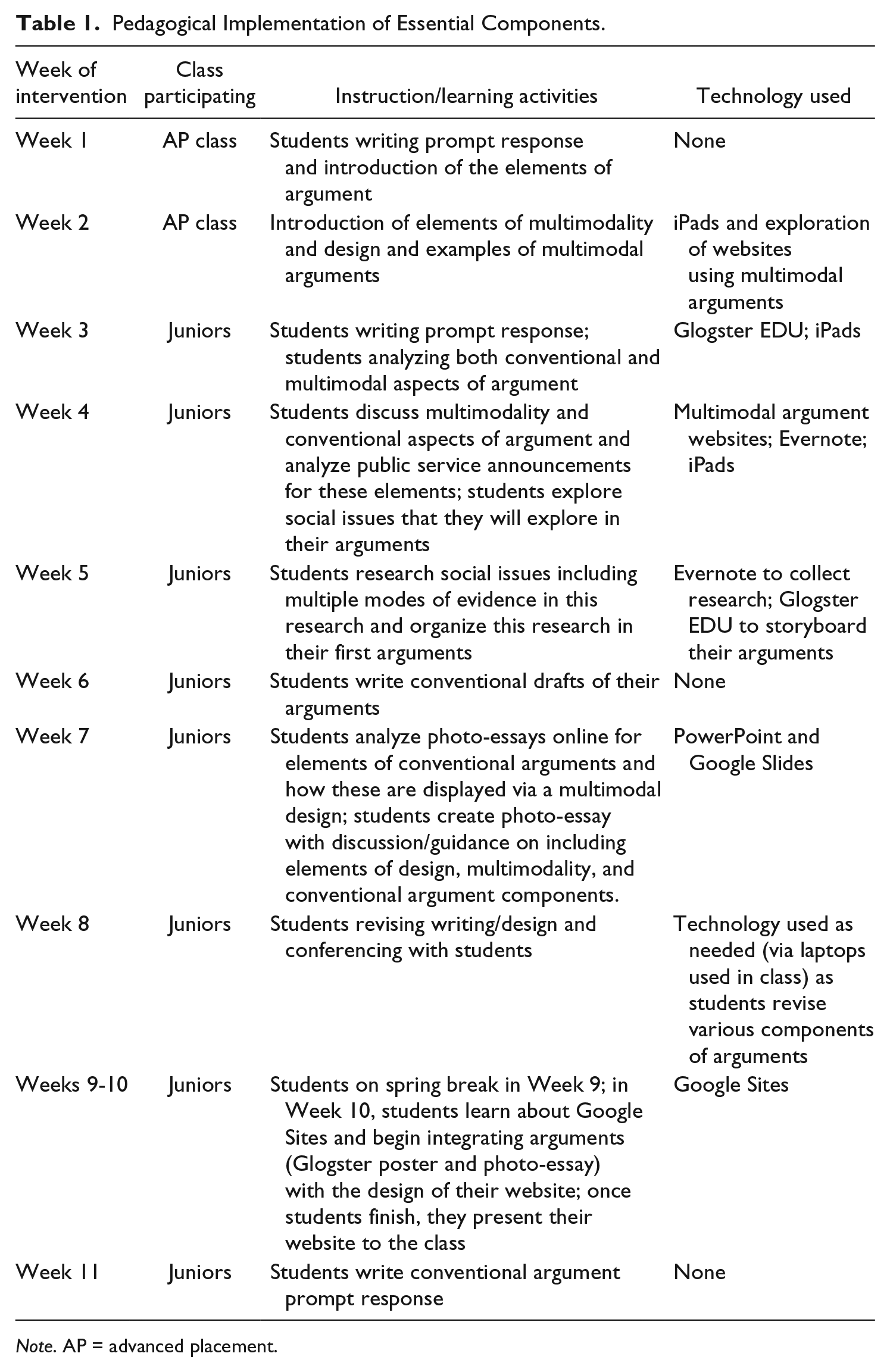
Note. AP = advanced placement.
Data Collection and Analysis
Data collection and analysis occurred in phases consistent with frameworks guiding formative experiments (Reinking & Bradley, 2008). We interviewed Ms. Malone and three administrative staff to gain understanding of the instructional setting of the school. To establish a baseline of students’ ability to construct conventional arguments before the intervention, we asked them to write arguments in response to several prompts adapted from draft assessments developed by Smarter Balanced Assessment Consortium (2013; see also Hess, 2011). We selected that assessment because the school was likely to adopt it later as a formal assessment, which was supported by our interview data. Thus, it was an appropriately authentic and realistic indicator of whether constructing multimodal arguments transferred to writing conventional arguments (see Matthewman et al., 2004). This assessment is consistent with Siegel’s (2012) argument that instruction in multimodal forms of literacy must confront the reality that educational environments are rife with standardized assessments of conventional literacy. One prompt asked students to write a letter to their local legislature arguing for or against legislation on biodiesel production. A parallel assessment using a different prompt was conducted immediately after the intervention. A team of trained teachers who taught adolescent writing used a rubric adapted from Smarter Balanced Assessment Consortium (2012) to score students’ pre- and post-intervention arguments written in response to these prompts.
Data during the intervention phase included formal interviews (conducted both before and after the intervention) and informal weekly interviews with Ms. Malone, 22 interviews with students, 20 field notes during weekly classroom observations of instruction, student reflections (pre- and post-intervention), and artifacts, such as the students’ Google Sites. The extent to which the instructional environment was evolving was considered in comparison with Ms. Malone’s description of her previous instruction aimed at developing conventional arguments. We also noted outcomes related to planned modifications and preliminary conjectures about emerging pedagogical theories.
The qualitative data were coded and analyzed using elements of grounded theory and constant comparison (Charmaz, 2014; Glaser, 1965) within the framework of formative experiments (Reinking & Bradley, 2008). We discussed emerging codes in weekly research briefings, gathered more data when necessary, and further developed coding during the retrospective analysis of all our data. After the intervention, we conducted a retrospective analysis (Gravemeijer & Cobb, 2006) aimed at deducing pedagogical assertions (or design principles; see McKenney & Reeves, 2012) as the basis for developing an emerging pedagogical theory.
Following Charmaz’s (2014) recommendations, for the retrospective analysis we first went line by line through our raw data, forming initial codes describing actions and events. These were also informed by codes that had previously emerged during the intervention. We coded data independently to establish first-level initial codes. Then, we shared with one another this first-level coding and did an initial round of check-coding on the data to establish agreed-upon initial codes (Miles & Huberman, 1994). We then coded the qualitative data independently again and repeated check-coding on a sample of student interviews until full interrater agreement was reached as a reliability check of the initial coding (Miles & Huberman, 1994). Table 2 shows representative examples of data that led from initial codes to focused codes.
Representative Data Examples for a Sample of Initial Codes.
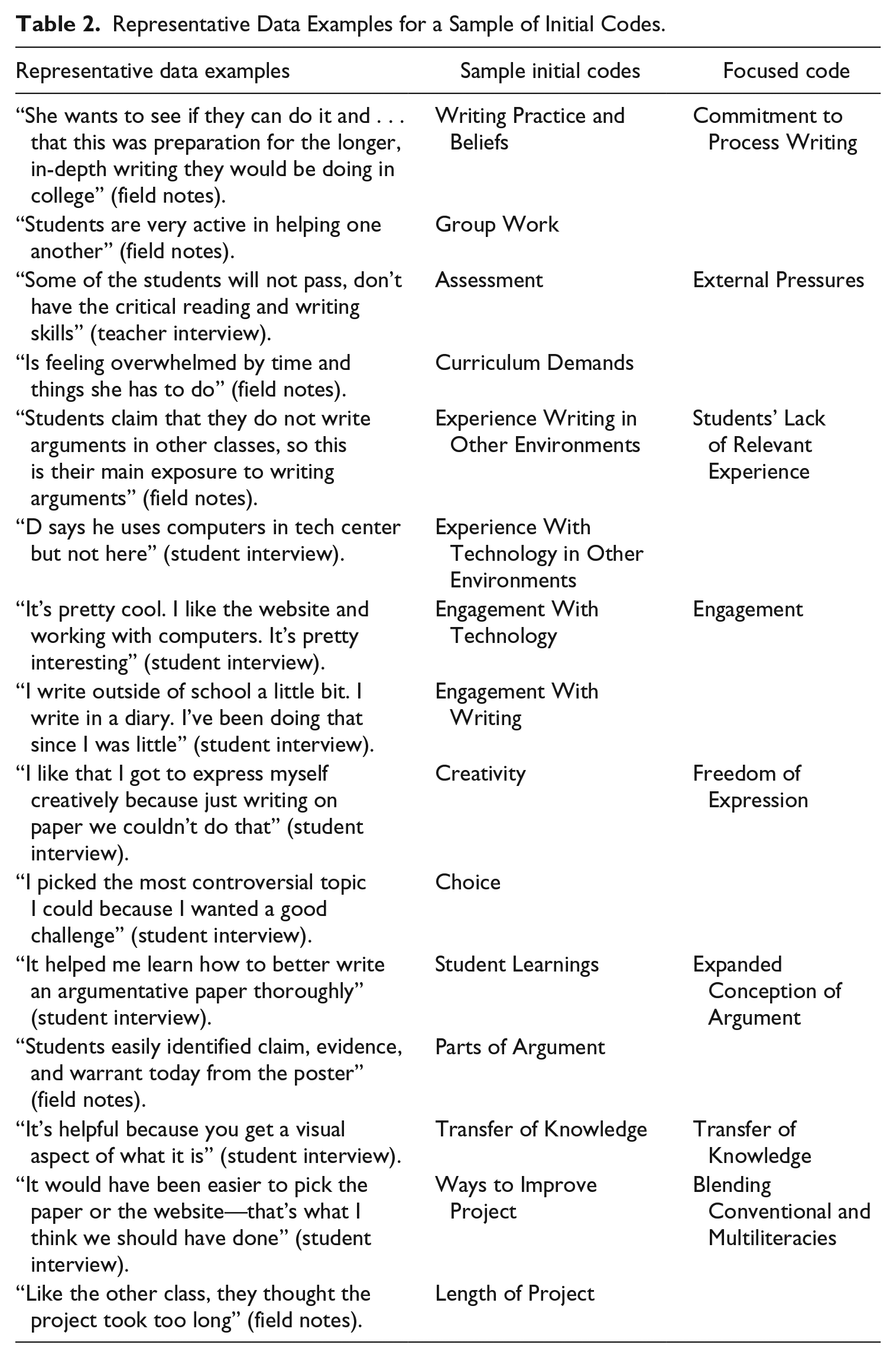
To move from initial to focused codes, we organized the initial codes by frequency and significance, organizing them into emerging conceptual categories. Finally, from the focused codes, we formed theoretical codes leading to several pedagogical assertions. These theoretical codes emerged from the relationships between focused codes in combination with other data, such as student artifacts and the quantitative data. Our intent was to develop pedagogical assertions that would inform, in the short term, modifications of the intervention, and to develop local pedagogical theory in the long term (Cobb, Confrey, diSessa, Lehrer, & Schauble, 2003).
Teacher and student interviews as well as field notes were analyzed using emerging codes; however, the student reflections and artifacts were coded for a priori questions. Specifically, the students were asked at the beginning and end of the study about the differences between conventional and digital arguments, and these responses were coded for evidence of changes in their views or understandings. In addition, the Google Sites were coded for the extent students included elements of argument.
Results
We organize results first by addressing the enhancing and inhibiting factors and modifications made during the intervention. We also discuss unanticipated outcomes that emerged due to the intervention. Then, we report the results of our retrospective analysis, addressing what overall progress was made toward accomplishing the pedagogical goal and what modifications to the intervention the results suggest for future iterations. See the online supplementary archive for a summary of the results reported in the subsequent sections.
Enhancing and Inhibiting Factors Affecting Modifications
In this section, we highlight one enhancing and two inhibiting factors that notably influenced the intervention and formative modifications: (a) Ms. Malone’s commitment to process writing; (b) external pressures related to covering the curriculum and preparing students for assessments, which inhibited her comfort with and flexibility in implementing the intervention; and (c) students’ lack of relevant experience.
Commitment to process writing
A process approach to writing was an essential component of the intervention, and Ms. Malone’s commitment to that approach was noted in our initial codes as a positive influence on the success of the intervention and its contribution to achieving the pedagogical goal. Specifically, Ms. Malone’s commitment to process writing translated into a sustained investment in the intervention, accompanied by a willingness to devote time and effort to integrating it into her instruction. That commitment seemed to enhance her willingness to accommodate modifications and her inclination to persevere in the face of obstacles. Her commitment to that approach seemed unwavering. For example, when asked how central process writing was to her investment in the intervention, Ms. Malone stated, “I don’t know how to teach writing any other way.”
Furthermore, a process approach provided an instructional space to allow students to experiment with new multimodal forms of writing in general and specifically enabled new ways of formulating arguments online. For instance, although Ms. Malone noted that this intervention “was a lot more to juggle” than her conventional teaching of argument (interview), a process approach accommodated her options to mix direct instruction, teacher–student conferencing, and peer-to-peer conferencing. Data from our observations noted how it allowed her to individualize instruction and address multiple variables of the intervention simultaneously. Students could work at their own pace, without pressure to be at the same point in developing their arguments. That flexibility meant, too, that students were amenable to and comfortable with the individual help from Ms. Malone, as well as to collaborative peer critique and feedback.
Similarly, a process approach accommodated introductory mini lessons focused on some aspect of multimodal arguments and the tools employed to develop them. It also provided an opportunity for group sharing, which worked well as a prelude to individual and small-group work. Likewise, it was an opportune time to discuss differences between developing conventional written arguments and new multimodal arguments.
A commitment to process writing meant that the intervention meshed well with Ms. Malone’s established perspectives and practices, and it seemed to provide a bedrock of familiarity that enabled more comfort in experimenting with new forms and ideas. It also inspired more flexibility in her schedule. Specifically, she decided to extend by one week the time allotted for completing the unit on multimodal arguments, allowing her more time for explicit instruction and for her students to refine and present their final products.
External pressures
Several inhibiting factors in our initial codes clustered under a focused code that we termed external pressures (see the online supplementary archive). These factors acted as a counterweight to the facilitative contribution of her commitment to process writing, thus lessening her tolerance for assimilating the intervention into her instruction. These factors became evident early in the intervention and led us to suggest moving the intervention from one of her AP classes for seniors, which was originally selected for the project, to her junior-level college-preparatory classes. Data leading to that modification emerged early in the project during our joint planning meetings, when Ms. Malone mentioned high-stakes testing and a concern that her students would be taking the AP exam later in the academic year. She explained in an interview the pressure she felt to cover the curricular material necessary to prepare her students for the exam: “[I’ve] always wanted to do a multimodal project, but it is a matter of time [taken away from such preparation].”
During the initial days of the intervention, our field notes recorded a sense of her unease about the time and effort the intervention required, particularly as it replaced literature discussions and standards that would specifically be addressed on the AP exam. For example, we recorded her comment, “[There is] so much to talk about. I have to condense my lesson to half a period.” Her discomfort became more apparent, which led us to suggest switching classes—a suggestion that was greeted with perceptible relief that she would now have more time and flexibility in implementing the intervention.
Students’ lack of relevant experience
Our data consistently revealed that students’ inexperience with (a) extended writing (e.g., initial codes labeled experience writing in other environments and most difficult item of project) and (b) relevant digital tools for academic purposes (e.g., experience with technology in other environments and most difficult item of project) inhibited the intervention’s effectiveness and appeal toward accomplishing its pedagogical goal. That lack of experience also limited the intervention’s integration into Ms. Malone’s instruction because it required more instructional time and effort than she had anticipated. Specifically, both these related inhibiting factors necessitated modifications allowing for more direct instruction related to conventional writing concepts, such as citing references, and to the use of technological tools related to designing a website. Consulting with Ms. Malone, a decision was made to add instructional time to accommodate students’ need to acquire the technical skills necessary to, for example, use Google Sites and to incorporate design elements into a multimodal, digital argument.
An example of the need for more conventional writing instruction, particularly argumentative writing, was student Bethany’s comment that this project was the first time she had been asked to write an argument in high school courses, indicating that, instead, she had mainly written only conventional research papers. Another student, Melinda, reported most of her academic writing was note-taking: “In my other classes we do a lot of note-taking, so I am constantly taking notes.” In discussing our findings with Ms. Malone, she explained that even in her own class, extended writing of arguments was infrequent: “We haven’t written a paper like this in a while” (interview). This explanation is consistent with Applebee and Langer (2013), who found that relatively few writing teachers ask students to write extended texts.
Students were also unfamiliar with and had few opportunities to use the technological tools used to design multimodal arguments in this project. When asked to identify difficult aspects of the project, students frequently cited mastering the technological tools, both the technical operation of the tools and using the tools for design aspects. We expected some focused instruction would be required to familiarize students with tools that most of them had not used before, specifically Evernote, Google Sites, and Glogster EDU. However, in our field notes we recorded several instances of students being unable to use more basic technological skills such as downloading and uploading files and logging onto their digital accounts. We discovered through interviews that students typically were not engaged regularly in using online technologies in their other classes, with several indicating that it was used more often in their English classes.
Consequently, we modified the intervention to make more time to familiarize students with the technological tools used in the project, including basic skills such as cutting and pasting. Relevant information and skills were presented as mini lessons followed by practice directly related to the task of developing an online multimodal argument. However, our observations of and interviews with students suggested that they found the mini lessons aimed at compensating for their lack of relevant experience to be unwelcome additions to an already complex and demanding project.
Unanticipated Outcomes
Our framework included gathering data pertaining to unanticipated positive or negative outcomes (Reinking & Bradley, 2008; Reinking et al., 2013). In that regard, two themes emerged from our data suggesting positive, unanticipated outcomes: increased engagement and support for freedom of expression.
Engagement
Increased engagement was associated with codes related to students’ preferences for tasks related to the intervention, their willingness to repeat those tasks, and their level of participation in completing them. For example, in an interview, Ms. Malone noted that students were more willing to complete the digital rather than the conventional writing assignments, which was substantiated by our observations and in student interviews. We also noted that students’ comments consistently referred to their enjoyment of the design of a multimodal argument rather than writing a more conventional one. When asked directly to compare the preference for constructing multimodal or traditional written arguments, the following student comment was typical during interviews: “I like it [the multimodal]. Yes, more than the traditional. It is more hands-on and up-to-date. People will look at it more, and it is available to more people.”
However, not all students agreed. Some students cited, for example, the difficulty in finding information online to support their multimodal arguments. Ms. Malone also observed, “All students are really engaged. Some students may turn in websites, but not [conventional] essays because they don’t like writing.” She noted that some students who had been reluctant writers, particularly one male student, were writing noticeably more than they had before the intervention.
Freedom of expression
Students discussed enjoying the topic they had chosen and being given an opportunity to choose it. Their reasons included not normally having freedom to choose topics, addressing topics that were often not addressed in school, and expressing their views on personally meaningful topics. They picked diverse contemporary topics that seemed to resonate with their own life experience. For example, of the 25 Google Sites that were analyzed, each representing an individual student’s final project, the students picked 19 different topics. Personal relevance seemed important to this choice of topic. For example, one student focused on domestic violence because he knew someone who had personally experienced it. Although choice of topic is relevant to both conventional and digital writing, the students expressed not only an appreciation of choosing their topic but also a belief that the digital tools allowed them to address and discuss those topics more freely.
Students expressed enthusiasm for more creativity linked to the expanded range of possibilities offered by multimedia tools and the freedom to explore them. For instance, one student described the creativity the website afforded: “On a website online, you can put pictures, and I feel more freely express yourself versus paper [is] a little more just writing.” The design of the students’ multimodal arguments on their Google Sites not only illustrated their freedom to design these sites, but it also revealed some limitations in which modes they could include.
When asked how they chose to design their websites, several students discussed colors, presentation themes, or multimodal elements of the project they included on the site, such as their Glogster EDU poster or their photo-essay. However, students often integrated only static visual (mainly photos, alternate fonts, and color schemes) and textual elements into their multimodal arguments. Only a few students used hyperlinks and audio files. However, it is possible that they were discouraged from a more expansive use of multiple modes (e.g., videos and songs) because of the school’s filters on Internet sites and content, as well as slow access speeds. For example, we recorded in field notes that when students tried to work with YouTube videos, school filters blocked their access, and Ms. Malone had to manually override the filter.
Expanded concept of argument
Our data suggested students expanded their conception of argument and how to construct one. Furthermore, they exhibited a greater awareness that constructing arguments is more than presenting factual information. As student Cathy stated in an interview,
I feel like it is different. We did argument stuff in middle school, but this is a different level of argument. Last year all I had to write about was why I like it and why others don’t. Now I have to give reasons and evidence and all that.
They indicated awareness that arguments are nuanced and described how to incorporate that nuance into the development of their multimodal constructions. They also exhibited a greater awareness that evidence is needed to support arguments and to address counterarguments or the multiple sides of an argument. For example, in our observations, we noted Ms. Malone’s praise of a student whose writing she had previously had trouble understanding: “This is the best work I have ever seen him do” (field notes). Some students also began to acknowledge multiple positions related to an argument. For example, even academically high-achieving students such as Rachel described that although she knew of two different opinions related to the topic of her argument, she “didn’t realize just how many opinions were out there” (student interview). Another student, Melinda, noted, “I didn’t know so many things could be argued over and have a valid point” (student interview).
We also found evidence that the students extended their conceptions of constructing arguments to include multimodal elements beyond a linguistic mode. Student interview data and the student reflections supported that finding. For example, in our interview data, students made statements such as “[Writing an argument] doesn’t have to be your traditional five-paragraph essay” and “[I now have] a different perspective of how to communicate with people.”
We also coded and compared students’ responses on the baseline student reflections before the intervention with similar reflections after the intervention. We were interested in determining if they identified differences between conventional and digital forms of writing before and after the intervention. Their initial responses suggested that they were aware of a difference between digital and conventional arguments. Specifically, they cited differences in audience (more public access), ease of writing (in favor of digital arguments), and helpful technological tools (e.g., automatic spell checking). However, after the intervention, students more often cited the multimodal dimensions of constructing digital arguments, specifically the capability of incorporating audiovisual elements into the development of an argument. Thus, although students were aware of differences between digital and conventional arguments prior to the intervention, it was only after the intervention that they considered the multimodality of digital writing.
Mixed Progress Toward the Goal
Despite an expanded awareness of the elements of arguments and an understanding of how they might be developed in a multimodal frame, there was little evidence that students were transferring that understanding to writing conventional arguments; thus, there was mixed progress toward the goal of improving conventional and digital, multimodal arguments. We reached that conclusion in our retrospective analysis based on the students’ responses to interview questions, analysis of the students’ Google Sites, and a quantitative comparison of students’ scores on writing a conventional argument before and after the intervention.
In interviews, students expressed a belief that their learning of multimodal arguments would benefit their conventional argument writing. For example, during interviews, eight students were asked, “Do you think creating multimodal arguments online will help in any way your ability to write conventional arguments?” All of the students replied that they thought this multimodal argument would help their conventional arguments to some extent although one student thought it would not help on standardized tests because such tests did not allow students the necessary freedom of creativity.
Figure 1 shows a typical screenshot portion from students’ multimodal arguments framed as a PSA that we analyzed to determine the extent to which students were including fundamental elements of argumentative writing. It is representative in that it contains a claim (the legitimacy of same-sex marriage) that incorporates pictures, symbols, and the use of color to support that claim. In analyzing the students’ Google Sites, we observed that the students could make claims and provide evidence for these claims in a multimodal design, although warrants were infrequent or only implicit.

Student example of multimodal argument.
Despite students’ expressed belief that their multimodal arguments would transfer to writing more conventional arguments, and despite their Google Sites’ inclusion of claims and evidence, we found no quantitative evidence of transfer when comparing their initial and post-intervention scores of responses with a prompt asking them to write a conventional argument. There were no statistically significant differences between scores (n = 25) across the categories on the rubric before and after the intervention (see Table 3) except that students’ written arguments were assessed to provide less evidence after the intervention. In addition, the median of the difference between Prompt 1 and 2 scores decreased for all categories other than organization, which remained the same; however, change was nonsignificant for all categories except for evidence. Those findings are at odds with our analysis of students’ multimodal products in which they not only acknowledged claims and evidence, but they also support the finding that whatever awareness and skills were acquired in their construction of multimodal arguments did not readily transfer to writing conventional arguments.
Quantitative Results of Pre- and Post-intervention Assessments of Conventional Written Arguments.
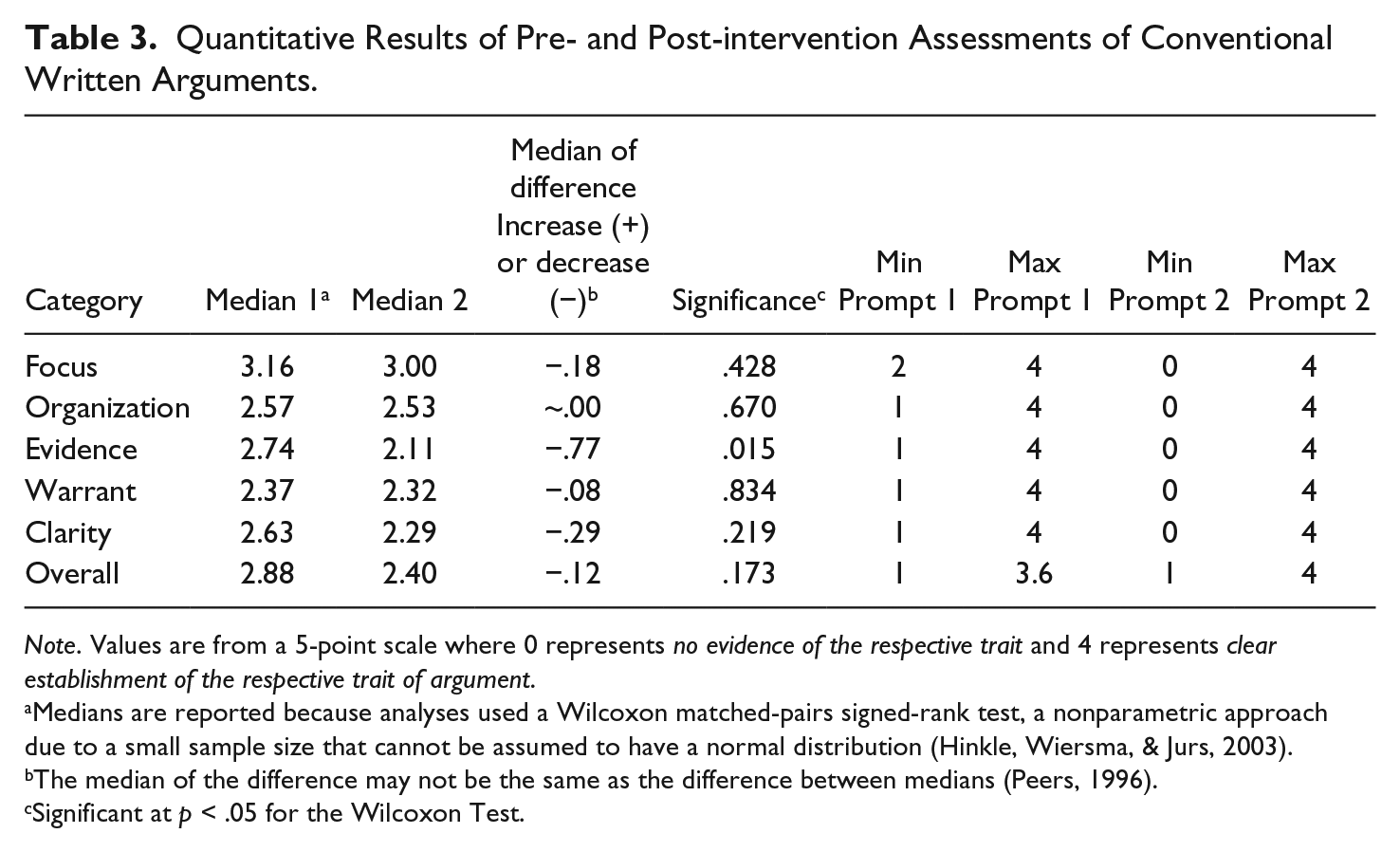
Note. Values are from a 5-point scale where 0 represents no evidence of the respective trait and 4 represents clear establishment of the respective trait of argument.
Medians are reported because analyses used a Wilcoxon matched-pairs signed-rank test, a nonparametric approach due to a small sample size that cannot be assumed to have a normal distribution (Hinkle, Wiersma, & Jurs, 2003).
The median of the difference may not be the same as the difference between medians (Peers, 1996).
Significant at p < .05 for the Wilcoxon Test.
Future Modifications
Our retrospective analysis suggested that Ms. Malone was conflicted about her commitment to engaging students in constructing multimodal arguments, with a sense that doing so might interfere with an obligation to help students write conventionally written arguments. This sentiment was seen in her need to assign a conventional outline and essay in addition to the planning and drafting students were already doing digitally. For example, she stated in an interview,
I guess I need to ask myself if the goal for this [project] is the writing. Maybe I’m trying to take a traditional assignment and force it into something new. Yeah, I do think some text was an important piece of the project.
This response exemplifies Ms. Malone’s struggle to blend conventional and multimodal arguments, in part because of her uncertainty concerning what academic skills were being developed in the multimodal arguments. Her struggle to assimilate both views into a compatible whole is a theme that has emerged consistently in the literature arguing the value of multimodal composing (cf. Adami, 2011; Skaar, 2009).
Despite this apparent conflict between conventional and multiliteracies, Ms. Malone did acknowledge the value of including multiliteracies for argument learning, and she did not waver from that commitment. When asked if her students may have understood argument better if she had done a more conventional text-based paper, she replied, “No, not at all, this made their research more tangible; they could see it, and it made them think about argument in a different way.”
Similarly, our retrospective analysis revealed that when writing conventional and multimodal arguments were considered separate instructional activities, the instruction was inefficient and not well received by students. For example, in a student interview, Rachel expressed her concern that she had already communicated her argument in the digital modes and that the conventional paper was unnecessary, thus acknowledging a perceived redundancy:
With the paper they are just going back and writing the same things they have already done with the Glogster EDU and photo essay . . . you could say what you needed to in the Glogster EDU, the photo essay, and everything else we are doing. (Student interview)
Thus, the students viewed treating conventional and digital, multimodal arguments as separate entities as an inefficient use of their time and energies. It may be more beneficial in future iterations to have students apply elements of arguments developed in their multimodal presentations to a parallel, or even different, topic, developed as a conventional written argument. Furthermore, the activities might be drawn closer together, perhaps by engaging students in a discussion of the similarities and differences in their parallel development.
Discussion
This formative experiment provides insights into how an instructional intervention that engages students in constructing multimodal arguments in two high school English classes can be implemented to enhance the quality of their argumentative writing. We found evidence that the intervention contributed to achieving that goal, at least in relation to students’ construction of multimodal arguments and in raising their awareness of the elements of good arguments. However, there was little evidence that constructing multimodal arguments transferred to their writing of conventional arguments. Nonetheless, students expressed a belief that their efforts to construct multimodal arguments would help them write better conventional written arguments. There was also evidence that most students, as well as their teacher, found the intervention to be appealing and motivational. Those positive outcomes were tempered, however, by concerns about the demands it placed on instructional time relative to addressing existing curricular goals, in the case of the teacher, and to engaging in an extended all-encompassing, and occasionally frustrating, activity, in the case of the students.
This formative experiment also suggests several pedagogical assertions, drawn specifically from our retrospective analysis, which may lay a foundation for an emerging pedagogical theory related to integrating multimedia arguments into conventional high school writing instruction. These assertions may be useful in similar instructional environments to practitioners, and those who work with them, who wish to integrate multimodal writing into instruction. Thus, this study offers findings that address what Messick (1992) referred to as consequential validity and contributes to what Firestone (1993) termed case-to-case generalization.
Assertion: Allowing students to select an argument that is personally meaningful enhances the intervention implementation and achieving its goal. Framing the intervention as creating a PSA of students’ choice was a design decision made during joint planning with Ms. Malone before the intervention was implemented. It was not an essential component of the intervention. Yet, that decision had an unanticipated positive influence on outcomes. Specifically, it increased students’ engagement in constructing multimodal arguments and the activities associated with developing them.
This assertion is consistent with Newell et al. (2011), who suggested the more students have an opportunity to invoke change through their writing, the more engaged they become. It also supports their call for further research in this area. Furthermore, it is consistent with Applebee and Langer (2013), who observed the negative effects of formulaic writing associated with assigned inquiry and who recommended that writing teachers grant students the opportunity to pursue their own topics and inquiry as a prelude to writing. A PSA also seemed well matched to students’ concept of digital tools as existing in a more public, social space and providing access to a more authentic audience. Nonetheless, instantiating such choice and using multimodal digital tools may be difficult, especially in an era of accountability centered in high-stakes testing (Siegel, 2012).
Assertion: A teacher’s concern that conventional writing is being neglected inhibits the intervention and achievement of its goal. High school English teachers, like Ms. Malone, may feel understandable discomfort when implementing instruction related to multimodal forms of writing. The root of that discomfort is also understandable and confirmed by our data grouped under the focused code external pressures. Those pressures were centered in the responsibility Ms. Malone felt to teach established curricular standards grounded in conventional writing and for which her students would be held accountable on standardized tests. Her sensitivity to that responsibility persisted in spite of, and set up a palpable tension with, her genuine commitment to engaging her students with multimodal forms of writing in general and multimodal arguments in particular.
This assertion suggests caution in accommodating multimodal forms of writing into high school English instruction in contexts where a commitment to or concern about the curricular standards centered in conventional writing (e.g., Council of Chief State School Officers & the National Governors Association Center [CCSSO & NGAC], 2010) is particularly strong. Future iterations of this and similar interventions may need to consider specific design features that address concerns associated with high-stakes assessments. In that sense, our findings are consistent with previous research. Many teachers share Ms. Malone’s commitment to integrating new digital forms of literacy into their instruction, but there are pressures and tensions that create obstacles to instantiate that commitment in their teaching (Hutchison & Reinking, 2011; Purcell et al., 2013; Siegel, 2012). Thus, the findings of this study support, for example, Moje’s (2009) call to investigate “the delineation among new, old, and multiple literacies” (p. 351). Furthermore, for teachers, incorporating multimodality into conventional classroom instruction entails new knowledge, for, in, and of practice, as suggested by Cochran-Smith and Lytle (1999). In other words, teachers may need not only knowledge of the rationale for multiliteracies and its practical application in classrooms but also multiple opportunities to interrogate such knowledge in the practice of their own classrooms before their pedagogy may be expected to change.
Assertion: An investment in the process approach to teaching writing enhances the intervention and the accomplishment of its goal. Ms. Malone’s investment in a process approach to writing figured prominently in our data as a factor that enhanced the intervention. On one hand, it enhanced the intervention as a practical matter, creating space for students to contend with the new elements and affordances of constructing multimodal arguments. On the other hand, it was also well matched to Ms. Malone’s previous instruction and created an anchor in the familiar (e.g., mini lessons, conferencing, and evolving drafts).
Although process writing, as an overall instructional frame, was an enhancing factor, we found evidence that it could be carried too far. Trying to overlay specific approaches to writing conventional texts over the construction of multimodal arguments was not effective, efficient, or appealing. Students were not only less engaged with Ms. Malone’s requirement that they carry out a conventional writing assignment with their multimodal constructions, but they also found that approach confusing, redundant, and unnecessary, particularly because the activities were decidedly disjointed, conceptually and instructionally. That requirement clearly reflected the tension Ms. Malone felt between her responsibility to address standards and goals related to conventional writing and her desire to expand her attention to multimodal forms. Nonetheless, it is encouraging that the common commitment many writing teachers have to a process approach to writing seems to enhance efforts to incorporate multimodal writing into their instruction, and it may represent a firm foundation for integrating multimodal writing into a conventional curriculum. However, it might be more appropriate to use a process approach as a general frame and to avoid injecting conventional writing activities and strategies into that frame when the focus is on creating multimodal texts. However, doing so risks exacerbating what seems to be a lack of explicit transfer of writing multimodal arguments to writing conventional arguments, which leads to the following assertion.
Assertion: Explicitly comparing and contrasting the elements of good arguments in conventional and multimodal texts may be necessary. Relevant discussions and activities consistent with this assertion occurred during the intervention, but they focused on the affordances and elements of each medium rather than a systematic comparison of the two. However, consistently in our focused codes labeled students’ lack of experience and expanded conception of argument, we noted students’ inexperience with both conventional and multimodal arguments. Thus, these students may have benefited from more explicit discussion comparing the two mediums. The lack of statistically significant improvement on the writing prompt before and after the intervention might be traced to this shortcoming.
However, drawing attention to the unique affordances, skills, strategies, and dispositions associated with multimodal writing may not be enough. Our results suggest the challenges of developing useful frames for constructing multimodal arguments, and they reinforce the challenges of developing and familiarizing students with frames they might internalize and implement.
Assertion: A lack of basic technological skills and/or relevant experience in conventional writing influences the effectiveness and appeal of the intervention. Teachers may need to consider the scope of multimodal projects, keeping in mind that students may need to simultaneously exercise fundamental skills in both conventional literacies and multiliteracies. In interviews with students, it became clear that they had little experience with multimodal composing in school. In addition, we had not anticipated how little argumentative writing, and extended writing overall, these students had been engaged with in their high school experience. This finding illustrates the suggestion that despite decades of research on writing, little is known about “contemporary writing classroom practices in high schools in the United States” (Kiuhara, Graham, & Hawken, 2009, p. 136). However, this study begins to fill that gap, providing needed research into high school students’ conventional and digital writing.
Because on multiple occasions these students also described their writing experience as limited to note-taking and responding to teacher-directed prompts, students were facing a perhaps unreasonable challenge in this project. They had to simultaneously learn principles of conventional arguments, the practice of extended writing, and both the technical aspects and elements of design afforded by the digital tools used. To address this challenge, we had to extend the project to account for additional instruction and time for students to implement these skills. We introduced multiple components and new tasks in one encompassing, although engaging, project. We discovered our unfounded assumptions about their prior writing in school, specifically argumentative writing, and about their technological savvy in using digital tools in service of an academic task. Students’ lack of technological skills confronts Prensky’s (2001) concept of digital natives, at least in relation to academic uses of digital tools, and aligns with Bennett, Maton, and Kervin’s (2008) suggestion that “there is as much variation within the digital native generation as between the generations” (p. 779, emphasis in original).
The students were able to create a Glogster EDU poster, a photo-essay, and a conventional argument and to use those elements to design a culminating project on their Google Site to convey a PSA. However, the students may have been better served if these components had been broken into smaller projects, on different topics, giving them more opportunity to acquire and to practice essentially new fundamental skills. That approach may have been more effective and appealing. It also would have provided time to focus on instruction without extending an already complex, multivariable project. And, it might have allowed for an opportunity to more closely integrate the development of conventionally written arguments and the creative design of newer multimodal ones.
Conclusion
The stated intervention was not a complete success, nor was it a complete failure, in achieving its pedagogical goal. Students learned that arguments could be expressed multimodally and were engaged in such a process. Yet, there is no evidence that this learning increased their conventional argumentative writing skills. We believe the present study furthers pedagogical understanding regardless of, and to some extent because of, its lack of complete success. It provides guidance for further iterations of the intervention in other contexts. We hope that it will also be useful to teachers, like Ms. Malone, who understand the importance of incorporating 21st-century literacy into their practice and who have good intentions in modifying their curriculum and instruction accordingly. Besides identifying some of the key elements of realizing those intentions, the present study reveals that they are taking on a complex and difficult task, especially in terms of satisfying a dual commitment to conventional writing and writing in a multimodal domain with digital tools.
Footnotes
Declaration of Conflicting Interests
The author(s) declared no potential conflicts of interest with respect to the research, authorship, and/or publication of this article.
Funding
The author(s) received no financial support for the research, authorship, and/or publication of this article.
Supplemental Material

Author Biographies
References
Supplementary Material
Please find the following supplemental material available below.
For Open Access articles published under a Creative Commons License, all supplemental material carries the same license as the article it is associated with.
For non-Open Access articles published, all supplemental material carries a non-exclusive license, and permission requests for re-use of supplemental material or any part of supplemental material shall be sent directly to the copyright owner as specified in the copyright notice associated with the article.
