




Abstract
This article analyzes data from a summer literacy program for intermediate and middle-level children of migrant farmworkers. The program was grounded in a sociocultural perspective on literacy, stressing the importance of interaction and collaboration within socioculturally responsive pedagogy, using enabling literature to empower students. Adaptations of readers’ and writers’ workshop methods, emphasizing the significance of valuing students’ individual responses, were used throughout. The students were presented with a documentary, young adult novels, and more than two dozen children’s picture storybooks representing the lives of migrant farmworkers. Then, using their own responses to these enabling mentor texts as scaffolding, the students collaborated to create illustrated narratives about growing up as migrants. The program provided a safe space that encouraged migrant students to express their experiences and concerns—normally silenced in classrooms—during literacy tasks and empowered them to ask for support. The program demonstrated the benefits of combining socioculturally responsive critical literacy pedagogy with enabling instructional materials in the development of emergent conscientization among the students. Finally, this article shows how the migrant students’ perspectives and experiences can inform and challenge teachers, citizens, and policy makers to address the systemic injustices in the lives of migrant children.
Keywords
It is not our role to speak to the people about our own view of the world, nor to attempt to impose that view on them, but rather to dialogue with the people about their view and ours. We must realize that their view of the world, manifested variously in their actions, reflects their situation in the world.
Migrancy’s Challenges and Challenging Migrancy
Our society relies heavily upon the labor of migrant farmworkers to facilitate our comfortable lifestyles and inexpensive food. As Rothenberg (1998) describes,
Our supermarkets are filled with glistening produce . . . fruits and vegetables appear before us as if by magic . . . Few people realize that virtually every vegetable or piece of fruit we eat was handpicked by a farmworker, a member of our nation’s poorest and most disadvantaged class of laborers. (p. xiii)
These disadvantages extend to their children. Nationally, the children of migrant farmworkers drop out of school at a higher rate than any other identifiable group (Human Rights Watch, 2010). This can be attributed, at least in part, to the challenges of nurturing migrant students’ literacy skills. Research has documented the strong relationship between literacy and school persistence (Hernandez, 2012), and migrant children regularly underperform on reading assessments (Alanís, 2004). Migrant children present multiple challenges for literacy educators, including their social isolation from and racist harassment by peers; their frequent mobility between schools and states with different curricula; their high numbers of English learners; their parents’—on average—low levels of formal education, especially in English; and their families’ vulnerability to deportation and unfair labor practices. If they are to succeed, migrant children and their literacy development require substantial and well-focused support to address gaps in their schooling.
For the most part, however, our schools fail to provide such support (Salinas & Fránquiz, 2004; Vocke, 2007). Public education, like most of American culture, generally ignores migrant farmworkers, making it difficult for their children to find connections between their lives and their classrooms (Beck, 2009; Purcell-Gates, 2013). In addition, teachers and administrators, who have the power to change classroom practices and improve migrant lives, are frequently uninformed about the lives of migrants (Beck & Bodur, 2015) or beholden to pressure from the employers of migrants (Beck, 2004). Thus, there is a need for the development of methods and materials that will connect with migrant children’s funds of knowledge (González, Moll, & Amanti, 2005) and facilitate the incorporation of their experiences into daily classroom curricula. Moreover, once such curricula bring honest discussions of the realities of migrant lives into the classroom, teachers must be prepared and willing to affirm social, economic, cultural, and political critical self-consciousness, or “conscientization” (Freire, 1970a), among migrant children. In this article, we illustrate how a socioculturally responsive critical literacy pedagogy not only led migrant students to academic success but was instrumental in cultivating the students’ emergent conscientization—a Freirean awareness of the socioeconomic and political contexts that affect their personal, familial, and community situations. Through a combination of curricula, materials, instruction, teachers, and peers, the students were provided with a safe space where they felt empowered to express their concerns regarding topics that are normally silenced in their school experience.
Context of the Study
In late 2013, we were asked by a nearby rural school district and our southern state’s migrant education program to design and teach, during the summer of 2014, a 3-week, half-day literacy program for intermediate and middle school migrant students of Mexican descent. Being familiar with the migrant population in the school district, we anticipated that most of our student participants would come from trilingual, tricultural households where Mexican Spanish, American English, and Tarascan Purépecha (an indigenous language of west-central Mexico) were all spoken. As longtime teachers and teacher educators with bilingual (Spanish–English) skills and experience in migrant and bilingual education, the prospect of a curricular blank slate and a classroom of multilingual, multicultural migrant students allowed us to bring to reality decades of ideas regarding how to engage children in literacy in ways that are valuable to them, their families, schools, and communities (Beck & Stevenson, 2015). In particular, we wanted to find out what could happen if migrant students systematically connected with and critiqued migrant-themed children’s and young adult literature, and then used those enabling mentor texts to springboard into writing and illustrating their own, new stories about migrancy.
Because of their short length, simple language, and engaging illustrations, children’s picture storybooks have long proven to be a fruitful genre for student writing (Harste, Short, & Burke, 1988). Migrant-written and illustrated picture books, in particular, may serve as “identity texts” (Cummins & Early, 2010), allowing students to use their linguistic and academic abilities to express their experiences. In turn, these texts can inform the beliefs of adult readers, including teachers (Lazar & Offenberg, 2011), because when picture books tell a challenging story with a critical edge, the juxtaposition of the seemingly innocent medium with a hard-hitting message can expose hidden experiences to audiences who would otherwise never know these stories (Dever, Sorenson, & Brodrick, 2005).
Migrant workers are systematically erased from our national discourse or, when represented, are frequently portrayed as a menacing “rising brown tide” threatening to overwhelm our nation (Beck, 2009; Santa Ana, 2002). These erasures and hateful misrepresentations affect most mainstream Americans, including the teachers of migrants. Therefore, we believed that facilitating the creation, publication, and distribution of migrant-written and illustrated picture books could carry the migrant experience to audiences, especially educators, who would otherwise never know the migrant “view of the world” (Freire, 1970/2000, p. 96).
Critical Socioculturally Responsive Literacy Pedagogy and Materials
We began our curriculum planning within a Vygotskian (Vygotsky, 1930-1934/1978) social constructivist paradigm. The entire project was built upon the following assumptions: learning is a social process, learners are co-constructors of knowledge, the interpretation of experiences within specific social and cultural environments is basic to the construction of knowledge, and focused conversation is necessary to students’ learning and cognitive development. Thus, the instructional elements of this study emphasized collaborative and cooperative group work and purposeful peer interaction to create a classroom community where students engaged in the educational process in a dialogical and dialectical manner (Stevenson, 2013). The assistance provided by peers and instructors during the project aligned well with the metaphor of scaffolding created by Wood, Bruner, and Ross (1976) and elaborated by others such as Belland (2014) to describe support—individual or group—that allows learners to fully participate and succeed in tasks beyond their individual capabilities.
Sociocultural perspectives in literacy education emphasize the importance of incorporating students’ linguistic resources, funds of knowledge, and home and community experiences into the classroom. Linguistic resources are understood as “the students’ linguistic skills (bilingual/multilingual) and their personal or everyday ways of expression that reflect their home and community culture” (Stevenson, 2013, p. 976). A central focus of our curriculum design was culturally responsive teaching that valued the students’ ethnic identities, culture, language, and experiential background with the purpose of empowering the students by engaging them in challenging, relevant activities (Gay, 2010). This requires educators to be aware of students’ various cultural traits, linguistic backgrounds, familial socioeconomic statuses, and lived experiences. In the same vein, educators need to create safe classroom spaces where students are provided with means and opportunities to explore new perspectives and express their thoughts—even commonly silenced ones—and know that their ideas are acknowledged and valued.
These spaces can be transformative because they increase the “potential for an expanded form of learning and the development of new knowledge” (Gutiérrez, 2008, p. 152). This can be facilitated through the use of instructional resources and approaches that align with the students’ cultural ways of learning (Gutiérrez & Rogoff, 2003) and cultivate cultural self-awareness (Ladson-Billings, 1995). Thus, during this project, much of the instruction was delivered bilingually (in English and Spanish) or included clarifications in Spanish to conform to the students’ linguistic backgrounds. At the same time, the students were encouraged and guided to reflect upon their readings, to make connections with personal experiences, and to express their opinions in either language without fear of silencing, reprimand, or mockery.
Curriculum and Materials
Grounded in a sociocultural perspective on literacy, our curriculum stressed the importance of integrating the students’ prior experiences into the curriculum. Our approach empowered students socially, emotionally, and politically by emphasizing interaction and collaboration (Gee, 2006; Street, 2003; Vygotsky, 1930-1934/1978), guided by Ladson-Billings’s (1995) conceptualization of culturally relevant pedagogy: “1) Students must experience academic success; 2) students must develop and/or maintain cultural competence; and 3) students must develop a critical consciousness through which they challenge the status quo of the current social order” (p. 160). Adaptations of readers’ and writers’ workshop methods (Atwell, 1998; Calkins, 1994), emphasizing the importance of valuing students’ individual responses (Rosenblatt, 1978/1994), were used throughout the program. These pedagogical approaches were implemented following the principles of culturally responsive literacy pedagogy, using enabling literature (Tatum, 2006) as mentor texts (Fletcher, 1993). The pedagogical approaches placed the students’ ethnic identities, experiences, and cultural and linguistic backgrounds at the center of the curriculum. They complemented each other, facilitating the creation of a learning community where students were able to interact, collaborate, and express their perspectives during the daily literacy tasks.
The program’s instructional materials (picture books, young adult novels, and a video documentary) focused primarily upon Mexican heritage protagonists and depicted a wide range of critical aspects of migrant life: economic class, working conditions, poverty housing, frequent movement, social isolation, racialized prejudice, and gender inequity. As “culturally relevant” does not fully encompass this range of connections with the students’ lived experiences, we will use the term “socioculturally relevant” (Beach, Thein, & Parks, 2006, p. 113). Presenting instructional materials like these validates students’ ethnic and sociocultural experiences, which generates pride that is “both psychologically and intellectually liberating” (Gay, 2010, p. 37).
These socioculturally relevant materials stimulated the students’ critical thinking skills and provided them with opportunities for the development of “emergent critical consciousness” (Huesca, 2002), or emergent conscientization. Thus, the sociopolitical focus of the project was compatible with Freire’s understanding of critical literacy as emancipatory education that helps students become aware of contemporary power relationships and issues that affect them, all as a prelude to action aimed at transforming their lives and communities (Freire, 1970/2000).
Research Questions, Participants, Data, and Analysis
We will address two research questions in this article:
Participants
The program was originally planned for a group of two to three dozen students from a wide range of ages, grade levels, and academic abilities. However, just as migrant farmworkers’ lives are beholden to the vagaries of climate and weather, so was our curriculum implementation. An unseasonably harsh winter and a resultant late harvest drove many migrant families to leave the area early to seek work elsewhere. In the end, the program was implemented with a dozen 10- to 12-year-old students (five females and seven males) who would be entering fifth, sixth, or seventh grade during the following fall (pseudonyms will be used to protect the students’ identities). All were members of Mexican-origin families that had multigenerational histories of movement seeking employment in agriculture within the United States. Most lived in an isolated set of trailer parks on a rural dirt road commonly referred to locally as “Little Mexico.” As part of a community of migrants with indigenous Tarascan roots in Michoacán, Mexico, most used English in school, spoke English and Spanish with friends, and heard Purépecha and Spanish at home. Most of the students were reading close to grade level and had previously tested out of English learner status but needed help in developing their English writing skills.
The one exception was a young boy who had recently arrived from Mexico, Juan Daniel. He was a 10-year-old fourth grader living with his grandparents in Michoacán, Mexico, before being sent alone to the United States, joining tens of thousands of Latino minors who controversially crossed, unaccompanied and undocumented, into the United States during 2014 (Olson, 2014). This passage has been demonstrated to be both extremely distressing and risky (Aitken, Swanson, & Kennedy, 2014). Like most unaccompanied minors below age 12 (López Castro, 2007), Juan Daniel came to reunite with his parents and U.S.-born younger siblings. He had navigated the journey mostly alone, except for some guidance from a paid coyote (smuggler) on the Mexican side of the border. Although Juan Daniel was the only recent arrival in our group of students, others had lived through comparable experiences.
Data and Analysis
The data from the project included in this article were derived from multiple qualitative sources:
responses to specific picture books documented in students’ journal entries and graphic organizers,
recorded and transcribed whole group discussions regarding each half of the documentary The Harvest (Romano, 2010),
drafts and final versions of the text and illustrations for student-created picture books,
a recorded and transcribed summative large group interview about the project guided by a semi-structured protocol of open-ended questions (Spradley, 1979), and
researchers’ field notes regarding daily events, including small group discussions.
The recorded data were transcribed verbatim, and these transcriptions were added to the other written data. These data were examined using an interpretive, naturalistic approach (Denzin & Lincoln, 2005). During the initial analysis, the data were coded recursively from multiple perspectives following the norms of grounded theory (Strauss & Corbin, 1994) to identify and classify developments in the students’ thoughts, verbal interactions, and writings. These codes were initially organized and classified into five larger themes: being bullied and laughed at, working in the fields, innocent awareness, wanting to be heard, and feeling empowered. With these themes in mind, we each individually returned to the various data sources and separately and recursively examined the data to identify other relevant findings. These results were then compared and triangulated to assure validity. The new codings were re-classified into a new set of themes—some labeled using the participants’ own words—that will be presented later in this article.
Migrant Students’ Emergent Conscientization
The students’ stories and critical consciousness did not emerge fully formed at the start of the project. Instead, their ideas evolved in spurts and starts and assembled piece by piece as the students came to new realizations during the implementation of the curriculum. What follows is a presentation of how the curriculum process allowed the development of emergent critical consciousness in the students. This development culminated in their perspectives, experiences, and concerns being articulated in the final products of the project, student-created picture books about migrancy (Literacy Enrichment Program, 2014; full text with illustrations available online). Thus, as we present our data, an outline of the curriculum’s pedagogy will serve as a chronological structure for the article’s focus upon the students’ words and evolving ideas. A full and detailed description of the project’s instructional methods and materials has been published in Beck and Stevenson (2015).
The first day of the project began with introductions, ice breakers, and pre-assessments. On that day, we explained to the students the overall trajectory for the 3-week project, emphasizing that the final goal was for them to collaboratively plan, write, and illustrate new picture books based upon their own life experiences. When we explained that we had funding for their creations to be professionally published so they could be shared with hundreds of readers, the students were incredulous. They protested that they did not know how to write and illustrate books that others would want to read. However, we assured them that they would be ready for that challenge in a couple of weeks.
For most of the next 2 weeks, the rhythm of the days was similar. Each morning we would present a short reading comprehension mini-lesson. These whole group mini-lessons addressed skills such as inferences and predictions, cause and effect, comparing and contrasting, summarizing, drawing conclusions, and identifying the author’s purpose and main idea. Emphasis was placed upon students articulating text-to-self connections as they practiced these different skills. The instruction would then transition to small homogeneously leveled literature circles, wherein the students applied the mini-lesson to that day’s reading in their circle’s migrancy-themed young adult novel, either The Circuit (Jiménez, 1997), Esperanza Rising (Muñoz Ryan, 2007), or La Línea (Jaramillo, 2008). On two occasions, the mini-lessons were applied to a segment of the documentary The Harvest. During these activities, the students were encouraged to draw upon their own lived experiences to better comprehend the materials. It is important to note that the use of enabling materials was pivotal to facilitating the students’ text-to-self connections because the stories presented in the different books and video were closely related to their own lives. These connections were conducive to discussions that enabled the students’ critical thinking skills, and thus the development of emergent conscientization.
Individual Journal Responses to Picture Books
We would then remix the students into heterogeneous small groups and present each table with four to six different migrancy-themed picture books. The groups would pass the books around and discuss them for about 30 min. Their discussions mostly focused upon their opinions about the characters, plotlines, and illustrations and their familiarity with the books’ themes and scenes. After approximately a half hour, each individual would choose a single picture book to read and write about alone. The students very often chose different books, but we had multiple copies of each book, just in case, to facilitate solo reading of particularly popular texts. Next, they were asked to respond in their journals to the following prompt:
Specifically and in detail, explain what you really liked or disliked about the book and the reasons for your opinion. Tell us what you think you would have done better or differently if you had been the author or illustrator.
This prompt was intentionally structured so as to remind the students that the project was preparing them to create their own picture books. Thus, they were continually aware that they would soon have an opportunity to publish their own stories.
At first, some of the students’ journal entries were nothing more than a list of elements of their book that they found either appealing or unappealing. For example, in writing about La Mariposa (Jiménez, 1998) on the second day of the project, Verónica stated,
What I liked about the pictures is that they are in a form that are [sic] not realistic . . . But what I disliked is the way the front cover is written and drawn, like the pictures should be more interested [sic]. (journal entry, June 10, 2014)
Each evening, we evaluated their journal writing samples for introductions, ideas, organization, voice, closing, and conventions and wrote individualized, qualitative narrative feedback highlighting what they did well and encouraging them to improve in other areas. The next day, we would sit down with each of the students individually to discuss our feedback. We consistently encouraged them to develop text-to-self connections in their journal entries, such as using personal memories as introductions, with feedback such as “Please connect the events from your life in your journal with the events in the books, describing how they are similar—or not” (journal response, June 10, 2014). As Routman (2000) suggests, the students’ personal connections were facilitated by the fact that the writing occurred in individual, private journals. Their daily journal entries provided the students with a safe space where they were able to express their opinions and concerns.
Although the literature circle discussions and students’ journal entries were tentative at first, with time, the students expressed more personal connections with and opinions about the books. Their increasingly expressive comments demonstrated that within a few days, they had recognized that our classroom was a safe space than they were used to in school. Most of the school year, they were used to being outsiders in classrooms dominated by non-Spanish-speaking, non-migrant peers and teachers who had very limited understandings of, and were often hostile toward, their families, culture, and language—reminiscent of the South Texas childhood experiences of Guerra (2008) a half century ago. The students had learned how to enact what Guerra (2008) describes as “transcultural repositioning” (p. 299) to survive in anti-migrant, mainstream classrooms that had not afforded them opportunities to bring their funds of knowledge into their academic work.
During this project, though, they were in a room filled with bilingual migrants and teachers with substantial knowledge of migrancy. They could expect comprehension and empathy when telling their stories. They could rely upon understanding and affirmation when they spoke Spanish to explain their thoughts. In this way, we functioned as “cultural mediators,” by establishing a norm of acceptance and validation of the “alternative discourses” (Guerra, 2008, p. 298) that the students brought with them from their lives outside of school, and by helping them transfer their knowledge into academic, classroom discourses.
The consistent classroom use of Spanish was particularly important, as it validated the students’ home and heritage language in a manner that they had never before experienced in local mainstream classrooms. During the first day of the program, when we found out that one of the students was a new arrival from Mexico and not able to speak or understand English, we asked the students whether it was all right for us to teach bilingually to include Juan Daniel. Although all of them agreed, they themselves were at first quite hesitant to use Spanish in the classroom. Over time, though, they began to increasingly speak Spanish, perhaps encouraged by multiple facts: a growing sense of community among a classroom of peers who shared similar experiences and cultural and linguistic backgrounds (Stevenson, 2015), a commitment to help Juan Daniel adjust to his new life, the presence of a Mexican heritage teacher/researcher, our repeated use of Spanish in the classroom, and the bilingual texts of many of the books they read.
Gloria was particularly ecstatic upon discovering that such books exist. A few Spanish words embedded in the English text of Going Home (Bunting, 1996) prompted her to say, “It’s mine [sic] favorite book, It’s wonderful. [It has] Spanish words, English words, and it’s from Mexico” (journal entry, June 12, 2014). A few days later, she fell in love again, this time with the fully parallel bilingual book The Upside Down Boy (El niño de cabeza; Herrera, 2000): “I think this book is now my favorite!!! . . . because [it] have [sic] English and Espanish [sic] sentence” (journal entry, June 17, 2014).
Most students purposely chose to write responses to books that depicted lives or experiences similar to theirs. When asked at the end of the program why they chose to write about certain picture books and not others, Ricardo stated, “Because the stories are similar to our lives . . . it made me think more and write about it.” Ismael said the books tell “what happened to me,” whereas Joaquín asserted, “It helps you understand more what was happening in the books and in your lives” (summative group interview, June 26, 2014). As these comments imply, the daily ritual of reviewing a handful of picture books about migrancy in a small group and then individually journaling about one book prompted the students to make connections and to ask questions of both the texts and themselves. They came to read and write about the books from dual perspectives: as outsiders empathizing with the struggles of a protagonist facing difficult socioeconomic constraints, and as insiders recognizing their own lives reflected in the “mirrors” (Bishop, 1990) provided by these books. Moving between these two perspectives sparked the students’ nascent awareness of the political context of their lives. In our analysis of their journal writings, three thematic building blocks of their emergent conscientization became evident: their desire to address a non-migrant audience, their efforts to call attention to bullying, and their focus upon writing about poverty and field work.
Implied non-migrant audience
The question of who should be the audience for information about migrancy would be crucial to the students’ emergent critical consciousness during the program. Early in the project, multiple students introduced their literature response journal entries by encouraging an implied non-migrant audience to read their chosen picture book. For example, writing about Going Home, Gloria opened with, “[Did] you ever imagen [sic] reading the book ‘Going Home?’ Let me tell you it’s have [sic] colorful picture[s] and reminded me of me and my family. Why? Because when my family moved to other places I felt sad” (journal entry, June 12, 2014). Other students delivered more direct admonitions to their implied non-migrant audience to read and learn about the lives of migrants. Verónica, for example, introduced her response to Krull’s (2003) biography of César Chávez, Harvesting Hope, with this statement: “You are going to see why I wrote and chose to write about this book . . . because it is about a Mexican’s life that you should learn about” (journal entry, June 12, 2014). This framing of their early journal entries demonstrated that a few of the students were already thinking about what others should learn about migrancy.
Bullying
Another element of their emergent conscientization was their repeated descriptions of being bullied in multiple places and ways. (We use the term bullying here because that was the word the students used. However, we agree with a reviewer of this article who described these acts as grounded in hate, prejudice, and racism. Nonetheless, those terms were not used by our participants.) Given their concerns about bullying, it is no surprise that the students were very interested in picture books that included depictions of such events, like The Adventures of Connie and Diego (García, 1978/1994). Regarding this story, Nancy wrote, “Why I liked the book was because the picture looked like two kids were laughed [at] by kids. I don’t like when people laugh at others because that is not a nice thing to do” (journal entry, June 17, 2014). Paco commented, “This book reminded me of when I went to play with my friends. A big kid named George called me ‘turkey neck’ . . . that was the worst nickname I had ever” (journal entry, June 17, 2014). Other reactions to the same picture book revealed that the students had understood this “self-consciously Chicano new folktale” (Beck, 2009, p. 113) as a call for racial/ethnic pride and a means to counter prejudice and bullying. Joaquín stated, “I also liked the way Connie and Diego learned [that] even though they got laughed at because of their skin color, they were people underneath” (journal entry, June 17, 2014), whereas Ricardo commented, “It is the best book I have ever read. It gives a lesson. To be proud no matter if they laugh at you because of your skin” (journal entry, June 17, 2014). As the project advanced, the students moved from identifying and objecting to bullying to a more critical stance by stating their consensus that their teachers were failing to protect them from these incidents.
Poverty and field work
Many Americans, including teachers, are not aware of the fact that our nation’s long-standing laws barring child labor contain exceptions and loopholes that permit shocking numbers of children to work in agriculture, one of the most dangerous jobs in our country (Human Rights Watch, 2010). It is financial necessity that forces migrant children to join their parents in the fields, thereby continually reminding them of their families’ economic realities. Our students repeatedly articulated their understanding of the direct relationship between the need for money and the hard labor of farmwork. In fact, in responding to the picture books, all of the students wrote at least once in their journal about their family’s socioeconomic situation and their own experiences working in the fields.
After reading A Day’s Work (Bunting, 1994), Joaquín wrote, “Have you ever had to work with your grandfather before? Well, I have . . . it took all day and . . . when we got home we had to go to sleep without eating a thing” (journal entry, June 10, 2014). In this statement, 11-year-old Joaquín shows an early awareness of the difficulties and significance of working to survive. He was not alone in having lived these experiences. Regarding Working Cotton (Williams, 1992), Gloria wrote about the young female narrator “wak[ing] up at six-o-clock in the morning, getting tired, wet, and hungry.” Gloria then connected to her own memories: “That, I remembered. I think [sic] myself, I was her in the field. The most [sic] I liked in this book was they work hard and never give up” (journal entry, June 10, 2014). Nancy, one of the youngest participants, used her personal knowledge of poverty and working in the fields to attribute motives to the characters in Working Cotton: “The family is tierd [sic] for working hard in the field. I think the family wanted to win [Spanish to English mistranslation] money to buy some food for them to eat” (journal entry, June 10, 2014).
Despite their general dislike for the work, the students consistently responded with special enthusiasm for the picture books depicting field work. This irony reveals the essential importance of presenting enabling literature that connects with students’ lived experiences, even when those experiences are unpleasant. For example, in his first written response, Ricardo expressed this desire: “When the title said First Day in Grapes, I thought it [the story] would take place in the field.” However, he was subsequently disappointed by King Pérez’s (2002) book: “I really hated [that] it took place in the school” (journal entry, June 10, 2014). Thus, several of the group’s favorite books, particularly Oranges (Rogow, 1988), depicted farmwork. Oranges explains in great detail the production of a single orange—from tilling the soil, through fertilizing the trees and plucking the fruit, to sorting, shipping, and sale in a corner store. Although to an outsider the book may seem unremarkable, to our migrant children, nearly all of whom had labored in the citrus orchards of Florida, the book documented powerful shared experiences and showed the value of their work and knowledge. As Verónica wrote, the book immediately evoked memories: “When I read the first page it started talking about the fields. So when I was like 9 my mom took me to go work with her” (journal entry, June 11, 2014). Gloria laughed when the book prompted her to remember a time when “my dad clime [sic] the tree to pick oranges. It was funny. Why [did] my dad clime the tree to pick oranges?” (journal entry, June 11, 2014).
Patricia was similarly excited to read Radio Man (Dorros, 1993):
They are migrate [sic] workers like we are because they go out in the field and work like my family . . . The other thing I like is that they are hard workers, because they work hard to raise money for the bills or more things they need. (journal entry, June 17, 2014)
Finally, they were seeing in print what Ricardo had asked for—documentation of what made them unique, their non-school, field work experiences, both good and bad. As suggested by Gay (2010), these readings validated their experiences and clearly sparked pride among the children.
However, their responses to depictions of field work were not all positive. In time, the students’ emergent conscientization regarding their socioeconomic situation went beyond their realization of being economically disadvantaged and extended to challenging the necessity to work at their young age to help their families. For example, the long last day of cucumber picking (a particularly unpleasant crop to harvest) is depicted in Lights on the River (Thomas, 1994). Nancy objected to the book, saying, “It was the worst book I read in the whole world. The picture on [sic] the book looked like people were working hard” (journal entry, June 16, 2014). Her classmate Consuela went further by articulating a personal protest regarding the specific work in the scene: “I remember my mom working cucumbers and my mom said let’s go work. I said no because I do not like working cucumbers” (journal entry, June 16, 2014).
Thus, during the first week and a half, the students articulated components of their emergent conscientization in small group discussions and individually in their picture book response journal entries. However, the stitching together of these elements into a more elaborated analysis and agenda for potential action would require large group discussions.
Social Construction of Emergent Conscientization: Discussions of The Harvest
Instrumental in providing a space and scaffolding for the students to collaboratively assemble these elements of critical consciousness into a more challenging analysis were viewings of and large group discussions about the first and second halves of the Eva Longoria–produced documentary The Harvest. This award-winning film focuses on the lives of three migrants aged 12 to 16 as they and their families struggle to survive by working in fields across the United States. These viewings and discussions occurred on Days 4 and 8 of the project.
During the large group discussion after viewing the first half of The Harvest, our students clearly described their empathy for and connection with the depicted migrant families’ need for the wages earned by child labor.
The kids . . . they don’t have a lot of money and they need to work hard.
What do you think about the movie?
It’s good . . . It’s like some people, they’re getting old and they can’t work so eventually they take their kids to work.
I would say that the movie is sad and I want to see it again.
Do you like sad movies? What’s sad about this movie?
The kids have to go to work . . . and they woke up at five.
My parents sometimes need to go to work to the onions like at 2 o’clock in the morning.
It’s sad. My family works like her family. (documentary discussion, June 12, 2014)
This exchange transitioned into a discussion of how the students help their own families by working in the fields on weekends or after school. The children agreed that it was acceptable for them to work outside of school hours. However, they also discussed feeling tired at school because of this labor. Ricardo spoke of babysitting his little brother: “I have to take care of him, like sometimes [my mom] goes to work like at 1 or 2 [a.m.] and then she comes back like at 5 so I can go to school” (documentary discussion, June 12, 2014). Ricardo’s classmates, who lived in the same trailer park, confirmed that he often had to stay awake much of the night. Nonetheless, he wrote that “the difference from all three [young people in The Harvest] was that I did not really have a problem like them that much. They missed school to go to work, and [I] didn’t do that” (compare and contrast activity, June 12, 2014).
Watching The Harvest and their subsequent discussion provided the students with an opening to collectively reflect upon and present their opinions about their economic status. The students discussed and evaluated their situations as compared with those of other migrant children close to their age. At the same time, they revealed an emergent conscientization regarding how the long-term importance of education conflicted with their family’s current financial necessities. Paco stated that the young people in The Harvest “cannot go to school because they were [sic] migrant” and then took a clear stand for change, asserting, “I think every kid should be going to school instead of just going to work all the time” (documentary discussion, June 12, 2014). His peers publicly agreed that missing school to work was not appropriate.
In negotiating this difficult terrain, the students sought to make it clear that skipping school for work was not their choice or desire, thereby challenging, as noted in a later comment by Joaquín, a common discourse among teachers and administrators blaming migrant students for missing too much school. However, their consensus was reached only because some of the students did not articulate how it conflicted with their own reality. Although none of them stated it aloud, at least three participants wrote privately that they had sometimes missed school to work in the fields. Thus, the students’ public conversation and taboo against migrant children missing school began to spur them toward perceiving the possible need for change in their own lives.
Toward a More Focused Emergent Conscientization
The students’ turn toward recognizing the challenging and potentially transformative power of migrant narratives surfaced most clearly in the middle of the second week of the program when the class finished viewing the second half of The Harvest. During their discussion afterward, it became clear that the socioculturally relevant content, combined with a safe context to reflect upon their lives, was allowing the students to assemble, through a collaborative and sometimes circuitous process, new knowledge that was “both personally and politically significant” (Guerra, 2004, p. 9).
During the whole group discussion, one of us asked, “Who has an idea of a specific person or group of people you would like to have see this film?” At first, the students suggested family and friends. Patricia then spoke more assertively of showing the documentary to her non-migrant peers:
I want them to know that the people that are working out in the field have suffered a lot for money . . . because they need money to pay for electricity, for the house, and buy food to eat. (documentary discussion, June 18, 2014)
Patricia’s statement showed a keen awareness of how migrants’ financial imperatives were unknown to her mainstream peers, but it did not state any explicit expectation that informing them would alter either her life or the lives of migrants, although she may have implicitly hoped to reduce bullying.
Alberto subsequently extended Patricia’s comment toward a call for action by others when he stated that the film
would inspire people to help other people that work in the fields . . . If I had the money I would, I would probably like give them some money so they could do stuff that they want to do. (documentary discussion, June 18, 2014)
Note that Alberto’s statement incorporates three parts of his emergent conscientization. First, he has recognized the poverty faced by the protagonists of The Harvest and by migrants generally. Second, he articulates that there are non-migrant people who need to be inspired or prompted to use their greater financial resources to address this reality. Third, he states that he is not a member of the second group. However, Alberto does not bring the hypothetical possibility of transformation to focus on his life or those of his local migrant peers.
Some days, Ms. Freeman (pseudonym), a monolingual local teacher, joined us for part of the instructional time. During this particular conversation, Ms. Freeman suggested, “I think teachers should see the movie.” In response, the students turned their focus toward the potential power of narratives to alter the conditions of their own lives. Joaquín agreed with Ms. Freeman, affirming, “So [teachers] can see why they have to accept migrant children, because most of them tell us that we migrant children leave and don’t go to school.” Paco elaborated, “Because every time we move to another town, I want them to see how it feels. I want them to watch so they can see how people suffer to work” (documentary discussion, June 18, 2014). Joaquín and Paco clearly manifested emergent critical consciousness by expressing their painful awareness of what their teachers do not know about their lives, how this affects how teachers treat migrant children, and the potential power of migrant narratives to alter this dynamic. As the conversation continued, the students co-constructed an increasingly complex analysis that included socioeconomic awareness, a desire for justice, and a nascent plan for action that, unprompted, included addressing political leaders.
I would like for the whole world to see it . . . because maybe some rich people would help . . . maybe the president?
Maybe the president would help. What do you think the president should do, Ricardo?
He should give them papers I think to stay here . . . and give them some better jobs.
Me!
What about you, Ismael? What do you want to say?
They have to go give them more money from the bank. [Laughter]
Give them bigger houses so they won’t have to live in little trailers.
Food! . . .
I was thinking we need to tell the president to change those laws so we can get different jobs and better pay. (documentary discussion, June 18, 2014)
Note that in this excerpt, the oldest participant, Ricardo, expressed a realistic doubt (“maybe”) about the probability of the president and rich people acting on the behalf of migrants. However, the rest of his younger peers seemed more confident of results. The students steadily moved toward both more personal and political applications of their emergent conscientization by referencing the familiar, daily difficulties of migrant life that they shared with the documentary protagonists: living in “little trailers,” struggles with immigration status, and a lack of money and, therefore, adequate food for family meals. Then, Joaquín and Paco made clear that the conversation was no longer just about the young people in the documentary by using the pronouns “us” and “we” and explicitly shifting the frame to include themselves, their families, and peers.
Seeing and talking about the young migrants in The Harvest had stimulated the students to demonstrate empathy and caring for other migrant children whom they perceived, at first, as being less fortunate than themselves. Then, they turned toward how authority figures (i.e., teachers, rich people, the president) could be prompted to address this situation if they only knew. This hopeful attribution of ameliorative power to the simple description of injustice is a common stage in the emergence of political understandings in preadolescent children (Hess & Torney-Purta, 1967/2005).
However, as the conversation progressed, they increasingly connected the documentary with their own experiences, concerns, and frustrations regarding the sociopolitical policies and economic constraints that fetter their own lives and community, a large step toward conscientization (Freire, 1970/2000). Robert Coles (1970), author of some of the first studies of migrant children, described how connecting the personal and the political leads to emergent critical consciousness among poor and disadvantaged youth, including migrants:
At some time a child begins to develop assumptions about his or her situation as an individual: The country beckons, or it doesn’t; the political order is just or fearful and harmful or crooked to the core; the people who hold office, near and far, can be counted upon, or are, quite definitely, enemies, or indifferent, if not contemptuous. (Coles, 1986/2000, p. 27)
With cynicism-free hope, our students expected results from informing “the political order” about injustice through true tales of migrant lives, and this expectation framed their efforts as they began to write their own narratives. Their hope that authority figures could be spurred to action by simply learning more about the realities of growing up migrant was later restated by the students as a reason why teachers should read the picture books they created during this project.
Preparing to Create New Picture Books
By the end of the second week, the students had seen 27 different migrancy-themed picture books, completed the reading of their young adult novel, viewed The Harvest, and written responses to these readings and activities in their journals. At this point, we guided the students in a discussion of their opinions of the picture books, which revealed the elements they valued the most. When the students’ favorite picture books and reasons for their preferences were tallied, depictions of field work and examples of migrant children dealing with bullying were their two strong thematic preferences. It is important to note that these elements echo themes in the students’ journal entries and their emergent conscientization regarding their social realities as child laborers in the fields and victims of prejudice and neglect in schools.
Extended Personal Narratives Enable Individual Perspectives
As an explicit transition from writing literature responses in their journals to writing narratives for their picture books, we set aside one morning for the students to each write an extended personal narrative based on a particularly strong memory from their lives. We prefaced this activity by reminding the students of their upcoming picture book creation task. The students thus used their personal narratives to create detailed descriptions of an event from their lives as migrant children, in preparation for writing stories for publication. Verónica wrote an hour-by-hour description of a day harvesting onions:
I remember when I would go working in the fields. [We] had to wake up at 5:00 [a.m.] and leave at 5:30 to be there at 6:30. We would get out at 7:00 or 8:00 p.m. . . . [We] put the onions in the sack and go take them to the tractor . . . then they [my parents] would get their check. (journal entry, June 19, 2014)
Nancy described a similar day of field work in detail:
I remember when I went with my mom, dad, and my brother to work . . . It was hot and we had to keep on working because . . . we had to do another line [row] . . . When we got done with all the field, we had to go home. Finally we earned our check. On Saturday we went to the store and buy [sic] food for us to eat. (journal entry, June 19, 2014)
Both girls, despite their young age, had worked longer and more difficult days than many Americans, and, of course, they knew the point of the labor was the wages at the end of the day. Nancy even made clear the “hand-to-mouth” finances of her family.
Verónica and Nancy both wrote their descriptions from within specific personal memories. In contrast, Patricia, one of the oldest students, explicitly wrote for a non-migrant audience, telling about migrancy in general, especially some of the most humiliating aspects of field work:
Me and my family work in the fields because we are migrate [sic] workers. We move [from] one place to another . . . I have lots of reasons [why] I don’t like going [to work in the fields]. One is that we have to wake up very early. Two, we have to move [from] one place to another to find work. Third, I don’t like to use the bathroom in the woods. Fourth is that we have to do big rows and it takes hours to finish a big row. If one day you go to work you will be burning and getting tired a lot. Believe it or not it is 100% hot out there. (journal entry, June 19, 2014)
Thus, the writing of these extended personal narratives made evident their emergent conscientization by enabling the individual students to express their increasingly critical understandings of their lives as migrants in more detailed and complete forms. Many of their previous journal entries included a few of these facts but without the larger narrative context and full articulation of their frustration and exhaustion. Moreover, their clear awareness in their narratives of the financial reality of their families likely was fostered in part by the previous large group discussions of economic themes in The Harvest.
Juan Daniel Tells His Story
Up until this point in the project, Juan Daniel, the recent arrival from Mexico, had spent much of the time observing and only occasionally responding to questions stated in Spanish. His early journal responses were limited to copying small paragraphs in Spanish from bilingual books. After written feedback and one-on-one conferences, his responses evolved into Spanish-language summaries of the stories. In time, he even began to express his opinions. For example, at the end of the first week he wrote, regarding the picture book Tomás and the Library Lady (Tomás y la señora de la biblioteca; Mora, 1997), “Me gustó cuando Tomás Rivera se metió en una biblioteca y leyó todos los libros [I liked when Tomás Rivera went to the library and read all the books]” (journal entry, June 13, 2014).
The extended personal narrative activity was the first occasion when Juan Daniel shared anything of substance about himself. He began by describing his perilous and lonely 4-day, 2,000-mile trip from central Mexico to South Carolina. Then, suddenly, the floodgates opened and he wrote in wistful detail of an apparently routine childhood day in Mexico. He evocatively dedicated a page to describing all the things he dearly missed about his life in Mexico:
Me faltan mis abuelos, mis amigos, mis tíos, mis juguetes, mis abuelas, mis parientes, mis vecinos . . . jugar con mis amigos [I miss my grandparents, my friends, my aunts and uncles, my toys, my grandmothers, my relatives, my neighbors . . . playing with my friends]. (personal narrative, June 19, 2014)
In this way, Juan Daniel accepted the invitation to write about something meaningful in his life as an opportunity to express his feelings about his experience of leaving Mexico to live in an unknown place among strangers speaking a foreign tongue. He knew this experience was entirely outside the knowledge of his non-migrant peers and teachers, and its immediacy set him apart from even his migrant classmates. The emotions he expressed were personal and painful, and given our explicit framing of the task as preparation for book creation, he knew that what he was writing would likely be read by a non-migrant audience. Thus, he seemed to have joined his peers in recognizing the potential power of migrant tales, an element of their emergent conscientization. In fact, his memories so impressed his peers that they formed the foundation for the plot of one of the student-created picture books, A Better Life: Salvador.
Emergent Conscientization in the Picture Books
After working with the students for 2 weeks, we had a clear sense of their strengths, weaknesses, and compatibilities. We used this knowledge to regroup them for the picture book creation process. We decided to create one all-female book creation team of five girls and two smaller male teams of three boys each (one boy had stopped attending). The smaller male teams were chosen to minimize conflicts and distractions. The single larger female team made sense because we had observed the girls falling silent when the boys spoke and because illness and family work schedules had caused some absenteeism among the girls.
Then, to feed their experiences back to the students in a structured fashion, one evening we systematically re-read all the students’ writings from the past 2 weeks, tagging, with sticky notes, any personal memories. We separated these memories by picture book creation team and organized them by theme. When all their personal memories were tallied, nearly half, 45%, of their memories focused on working in the fields. Another 29% addressed being the victims of bullying. The fact that these two sociopolitically critical themes match, as noted above, with two of the picture book elements that the students favored demonstrates the clear foci of their emergent conscientization.
Thus, at the start of the book creation process, we presented each team with a list of possible themes drawn from their own experiences described in their journals. The students collaboratively chose which themes they wanted to use in their group picture books and quickly mastered the process of combining and fictionalizing their own experiences in creative ways. Within a day and a half, all three picture book groups had complete drafts of their stories with preliminary texts and sketches. Next, the entire group spent much of a morning providing page-by-page editorial feedback to each other. After revisions, the final colored art was combined with their edited text. The trilingual story text in books not only validated the Spanish they spoke at home with their parents by placing it alongside English but also gave the same status to the Purépecha spoken between their parents and grandparents. Thus, the books functioned to honor their heritage languages, family cultures, and shared experiences. The resultant stories, summarized below, reflected the students’ emergent awareness and understanding of how their lives were part of the larger pattern of migrant experiences.
A Better Life: Salvador
Inspired by Juan Daniel’s journey, this tale follows a boy as he travels alone from his grandparents’ home in central Mexico to Florida to reunite with his parents. Along the way, he is aided by a coyote and a couple of “gringas” who help him overcome multiple obstacles, including the border fence and a frightening injury. In the end, he learns how difficult field work is (Figure 1) and is motivated to study hard and graduate from high school.
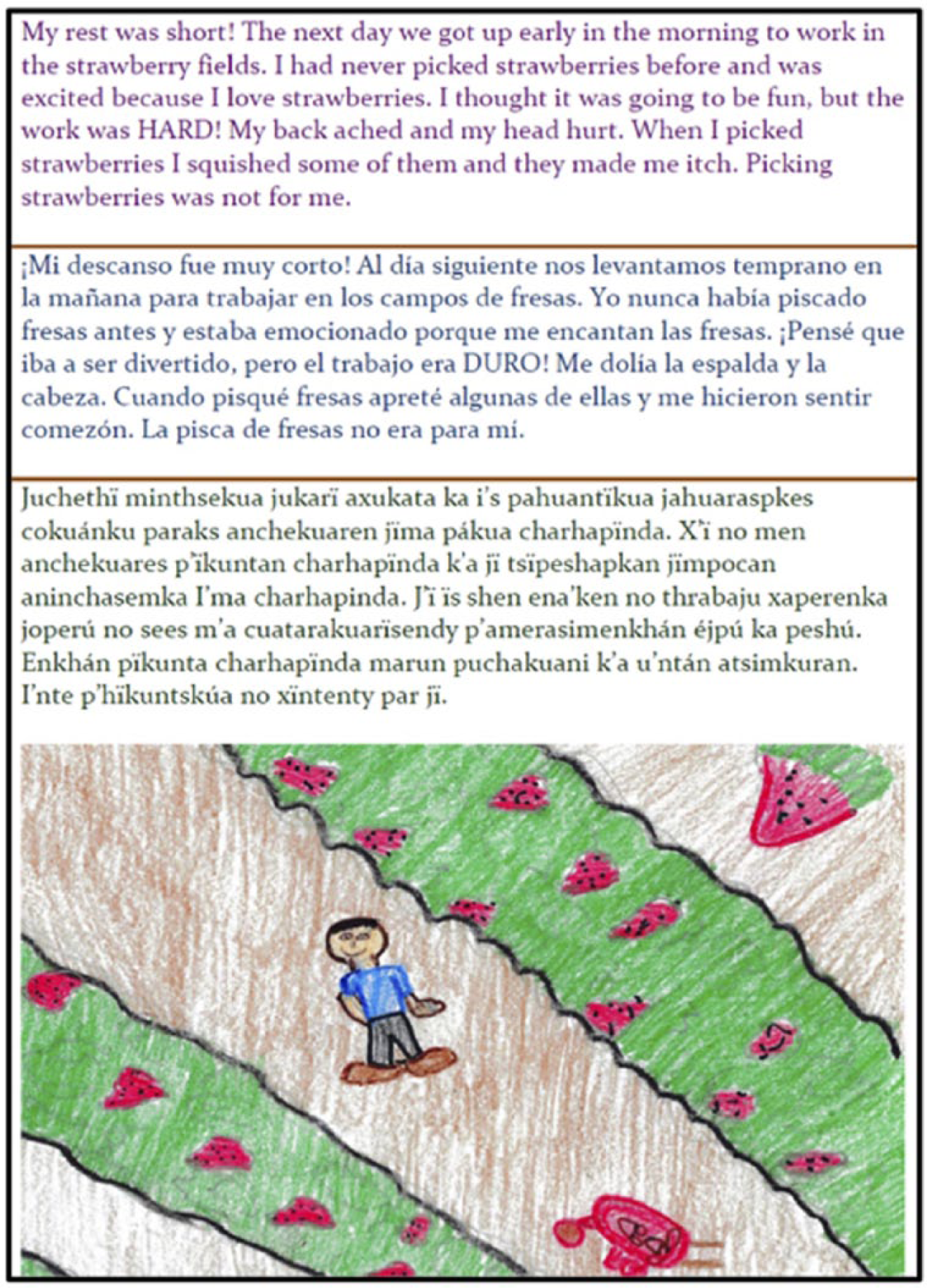
From A Better Life: Salvador.
Natalia: The Life of a Migrant Girl
Natalia is sad. Her parents told her that they are moving to Vidalia, Georgia. Natalia doesn’t like the idea because she has to leave her friends. Even though her parents try to convince her that it is going to be all right, she is still sad. (Literacy Enrichment Program, 2014, p. 17)
At first, it seems Natalia’s fears will be realized as she is ignored by her new classmates and is unhappy about having to get up early to work (Figure 2). However, working in the fields one morning, she meets another migrant girl her age who also attends her new school, and they become fast friends.
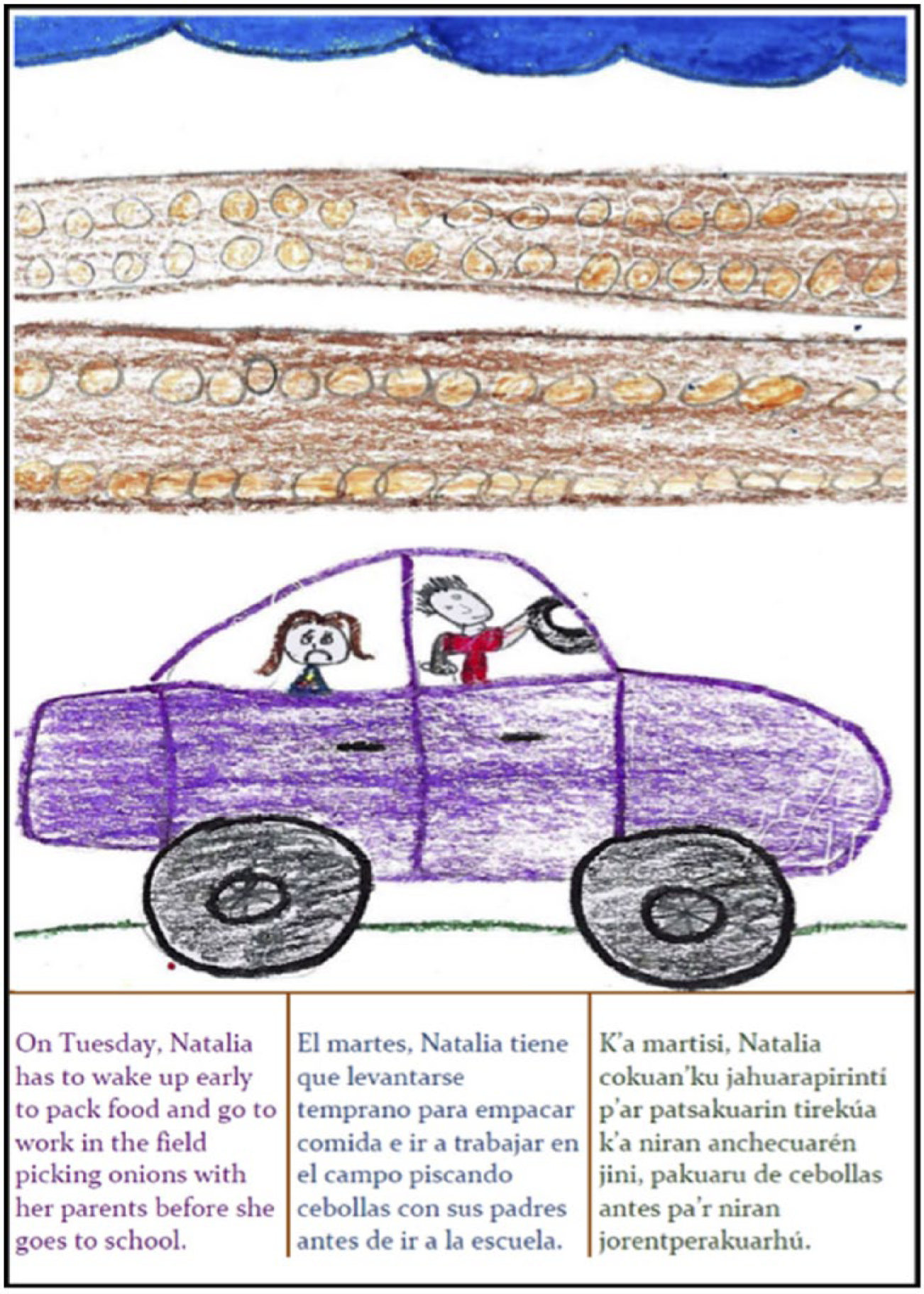
From Natalia: The Life of a Migrant Girl.
A Week in the Life of Pablo Pegado
Pablo travels from Mexico to Georgia with his mother to join his father. Once there, he starts a whole new life at a new school:
When the kids started talking, Pablo felt weird because he didn’t understand their language. He got into a lot of trouble because the grumpy teacher, Ms. Lindy, wanted everyone to speak only English. [However,] Ms. López . . . didn’t mind when Pablo spoke Spanish. He introduced himself and Ms. López translated his words. (Literacy Enrichment Program, 2014, p. 36)
As shown in Figure 3, Pablo becomes the favorite punching bag for the school bully, Max, but he is eventually rescued from the abuse by a priest.
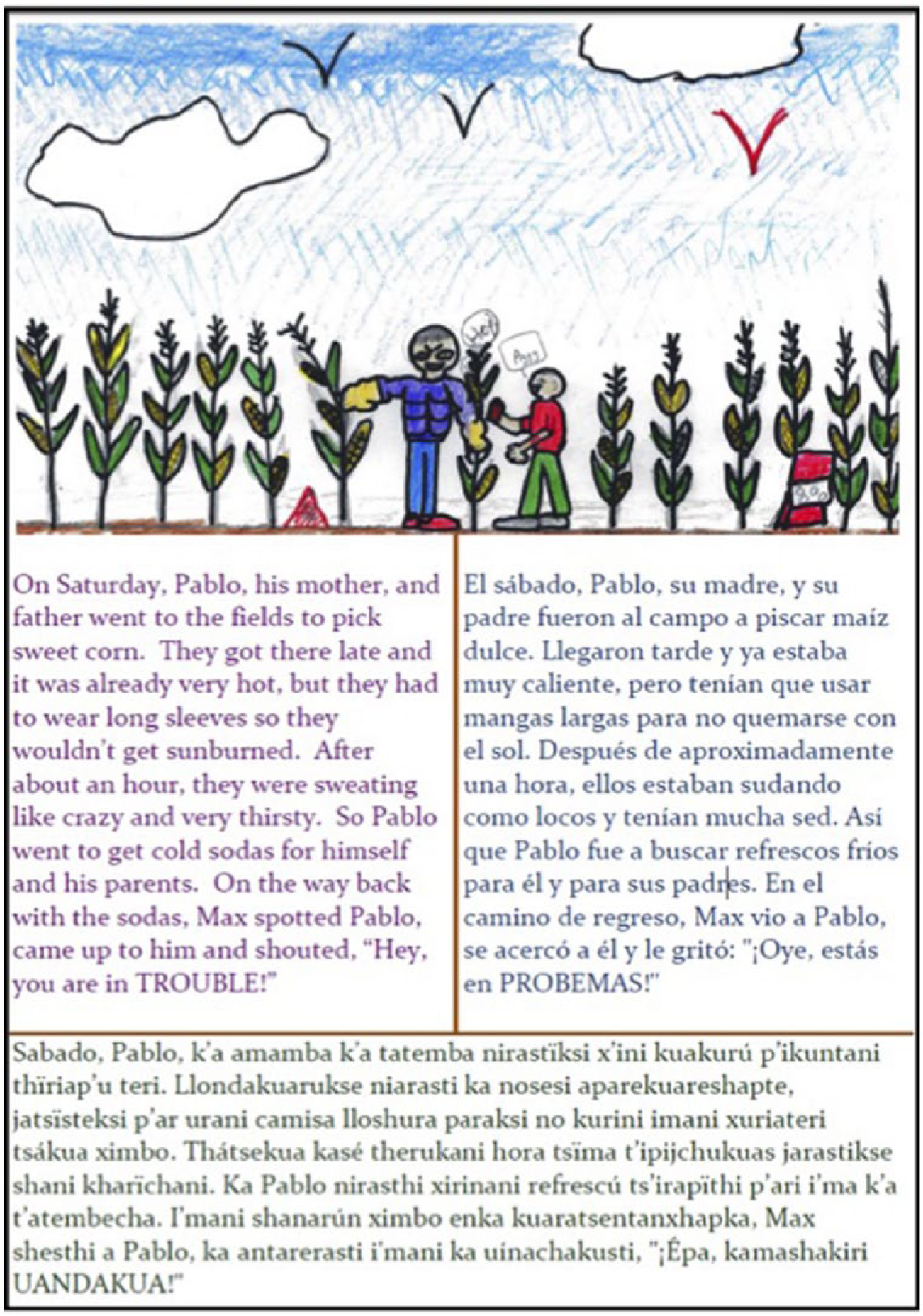
From A Week in the Life of Pablo Pegado.
Salient Themes in the Picture Books
As these tales show, our farmworking student authors’ funds of knowledge contain much that is unfamiliar to mainstream students, their predominantly middle-class White teachers, and the “powers that be” in our nation. It might be plausible that migrant students could write and illustrate such stories innocently unaware of the huge gaps between their lives and the knowledge of most Americans—and even less conscious of the potential power for advocacy their stories could transmit. However, given their documented process of emergent conscientization, such purely naïve innocence was not our student authors’ self-positioning. Rather, their writing, illustrations, and accompanying commentaries demonstrated that they hoped to “read and to write so [they could] change the world” (Freire, 1973/1998, p. 88).
The students had stated their concerns about bullying in their individual journals and showed their preference for picture books that addressed the issue, and this concern manifested itself in the stories the children created. Pablo’s struggle with the school bully, Max, was the primary plot conflict in his story. Pablo is called names, has his pants pulled down on the school soccer field, receives a black eye the next day while working, and is nearly beaten again at church. Moreover, the bullying is shown as starting at school, apparently ignored by teachers, and resolved only by a non-school authority figure, a priest. This echoed the children’s oft-expressed skepticism about their teachers’ sensitivity to bullying and seeming unwillingness to intervene. Natalia also faces mistreatment from her peers when, upon arriving at her new school, she is totally ignored by her classmates during recess and no one intervenes.
The issues of poverty, and especially child labor in the fields, had dominated the students’ journal responses and driven many of their choices of favorite picture books. Unsurprisingly, their stories all addressed these issues. In two of the stories, Natalia and Pablo, the characters live in rented trailers, the cheapest and most poorly maintained form of housing available locally, reflecting the authors’ poverty. Moreover, both stories realistically describe the necessity to clean the previous residents’ filth out of the trailers before settling in. None of the stories or illustrations shows the basic material possessions of mainstream, middle-class families and children: cell phones, computers, game consoles, or a closet full of clothing. In fact, in every story, when the characters moved to a new, temporary home, they were able to carry all their possessions in a single bag per person. In all three stories, the main characters work in the fields to help their families. None of the characters enjoy this work, but the authors took it for granted that migrant children like themselves all must work in the fields to help their families put food on the table. This was a reality shared by our participants but not by their non-migrant peers or teachers.
Finally, in light of their appeal for teachers and others to help improve their lives, it is especially important to note that in all their stories, the students purposely included outsiders modeling for their readers how to assist them in overcoming obstacles. In A Better Life, two Spanish-speaking “gringas” help Salvador negotiate his long trip from Texas to Florida. In Natalia, a nice teacher works to make her feel welcome, as does Ms. López in Pablo. Ms. López’s willingness to allow Pablo to speak Spanish made him feel safer after an English-only teacher had intimidated him. In the same story, the students also depicted a Latino priest intervening to stop the bullying of Pablo. They had written the stories for non-migrant readers—particularly for people with the power to make positive change for migrants. Thus, in the three stories, the students manifested their emergent conscientization of their situation in society and schools and suggested how the powerful could assist them in addressing their challenges. They not only described their lives to the larger mainstream society but affirmed their hope that figures in power would hear their concerns and act to help them navigate the difficult contexts that face them and their families.
Summative Group Discussion
This project presented a new form of literacy for the participants. Previously, school had not been a place where our students could talk about, explore, and examine their position in a multigenerational cycle of poverty, child and wage labor, and miseducation. However, this project allowed them to see that they were not alone, created a safe space for them to bare their hearts, and thereby validated and valorized their experiences and perspectives. The students’ feelings during the closing group interview made it clear that the project’s curriculum was quite different from and much preferable to their normal school experience. “It’s awesome!” “It is fun, and I learned, I talked!” “It’s not boring!” “We are writing our own books!” and “We are writing about what we feel!” were just some of their interjections (summative group interview, June 26, 2014). The students lauded the use of migrancy-themed picture books as reading materials, clearly stating that they wished their teachers would use such texts more often. They emphasized that they learned to connect reading and writing with their lives.
With their experiences validated and amplified, our preadolescent migrant students demonstrated an emergent critical awareness regarding their situation and a willingness to speak out in hope, or even expectation, that their concerns would be heard and acted upon. This intention was made evident during the summative interview when we told the students that a group of teachers had read their draft picture books, and the students responded with multiple, proud, surprised exclamations of “Wow!” When we immediately asked the students what they would want teachers to learn by reading their stories, they again returned to their focal themes of bullying, poverty, and field work. Jaime quickly interjected, “No bullying! We want them to learn about the bullying . . . because teachers sometimes don’t know.” Ricardo added,
Our lives. [For them] to see what other people’s lives is [sic]. Some are good lives and like some are worse lives. Some live really good and some live really bad. Like in the fields, working in the fields, they should know (summative group interview, June 26, 2014).
Paco interrupted, “Some live poor!” Ricardo then shifted to explicitly economic terms: “Yeah, some people live good and some people live worse, some are poor and some are rich, and that they should know that we are poor people.”
When we followed up by asking why teachers did not know this, Joaquín tellingly asserted, “Students are afraid to tell them” (summative group interview, June 26, 2014). Unlike their usual classroom experiences, during our program, the students had been provided with a safe space, where they could use the pronouns “our” and “we” to truly describe the living conditions of their families and community. In response, the students asserted their desire to be heard about these unfair situations and their hope for change in their teachers.
Migrant Students’ Perspectives and Experiences Find an Audience
There can be little doubt that teachers, even in regions with large migrant populations, do not know much about the lives of migrant children (Beck & Bodur, 2015) and are ill-prepared to reach out to them with socioculturally responsive pedagogy. This was confirmed by a comment from our local collaborating teacher, Ms. Freeman:
For me, it was an eye opener because I know sometimes I have gotten students that move, but understanding why they are moving and what they are doing when they are moving . . . There are a lot of things that were educational for me, a lot of things . . . I didn’t know that people picked up everything and went to a different place, and then they work really hard . . . I mean the little kids working, the big kids working, the grandparents, it is a whole family thing, and you know it, but you don’t know it. (documentary discussion, June 19, 2014)
This gap in local teacher knowledge and sensitivity has already been challenged by the picture books created by our students. Using the funds from a service grant from our university, we were able to professionally publish more than 50 books that include all three tales. The books were distributed among the families of the student authors, local teachers and administrators, the staff of the state migrant education program, and teacher educators at our institution and others.
Although we are not systematically collecting responses from readers of the students’ picture books, the anecdotal evidence from local educators and pre-service teachers has been very positive. One future teacher said,
I really loved the Literacy Enrichment Program Participants’ stories about the children and their experiences coming to America, but at the same time they made me really sad. It’s one thing to read a third person testament about how hard it is getting to America. However, hearing that same story told [and illustrated] from a child’s point of view provides an entirely new experience. Kids are much more honest and detailed than we would like them to be at times . . . When Salvador cut himself (and drew the picture in such detail) I actually took a break from reading. (Web log comment in online course discussion, October 20, 2014)
Another undergraduate future teacher wrote that her opinion about the physical challenges of farmwork had been transformed from dismissive to sympathetic by reading the description of harvesting strawberries in A Better Life (see Figure 1). The undergraduate explained that, for her, the power of the narrative came from the fact that it is based on
true stories of the kids who wrote the book. This child came to the United States alone looking for a better life. Parents and children work on the farms because it is the only thing that they know how to do. Farm owners do not understand the life of a migrant worker and work them harder than normal, with less pay. (reflective essay in online course dropbox, July 17, 2014)
These are political reflections that, given what we know about local teacher attitudes regarding migrancy (Beck & Bodur, 2015), these future teachers may have rejected outright before reading the words and viewing the illustrations elaborated by our program participants.
By creating a forum for the students to document their experiences and publish their stories in a picture book, this project provided a valuable tool for the training and sensitization of educational professionals who will be responsible for children like them. This is critically important for all migrants, particularly children like Juan Daniel, who has gained his mother, father, and siblings but only by losing everything else he has known. According to Chávez and Menjívar (2010), students like Juan Daniel often require an especially challenging collection of services to address their linguistic, academic, sociocultural, and emotional needs, but the fact that he chose to share his heartfelt tale with his teachers and peers makes it more likely that he will receive those services.
Discussion of Results
Although this program lasted for only 3 weeks, our efforts yielded both quantitatively significant results, documented in Beck and Stevenson (2015), and qualitatively tangible findings that address our research questions.
Clearly, a socioculturally responsive pedagogical approach to literacy, using enabling literature as mentor texts, demonstrated great potential on many fronts. The students’ enthusiastic attendance and participation spoke to the program’s success. In a population of students known for transience and absenteeism, most of the students attended every day, with nearly all their absences due to either illness or having to care for younger siblings while their parents were working. In fact, during the last few days, a number of students asked whether we could please extend the program into the next week!
Moreover, our pedagogy validated the students’ sociocultural and linguistic backgrounds and provided them with a safe space where new knowledge was created (Gutiérrez, 2008). Bringing the students together in an exclusively migrant-student classroom with informed, bilingual instructors to read, critique, reflect upon, and create stories that depict lives like their own allowed them to make significant connections with their experiential background. As they interacted, they did not have to worry about being rejected by their peers when they shared non-mainstream life experiences. In fact, they could rely upon comprehension and empathy instead. They did not have to face teacher reprimands if they used their linguistic resources to productively code-switch according to the demands of the context and interlocutors (Stevenson, 2013). They went beyond producing mere descriptions of and opinions regarding the enabling mentor texts and developed substantial text-to-self links in their writings. Reading stories that connected with their lives sparked the students’ interest and began to empower them to tell their own stories. During the project, the students’ willingness to engage in the tasks embedded within the curriculum grew. As the days passed, they produced longer and more elaborate writing responses that increasingly included their lived experiences. The challenging but sensitive curriculum provided them with the confidence to express their thoughts and inspire others to see migrant lives from authentic perspectives.
This short program validated our 10- to 12-year-old students’ experiences and allowed them to articulate their memories of injustice—displaying “a deepening awareness . . . of the sociocultural reality which shapes their lives,” an emergent “conscientization” (Freire, 1970b, p. 27). As previously stated, though, their conscientization did not appear fully formed at the beginning of the program. Rather, it became evident piece by piece as they read, critiqued, and responded to the enabling mentor texts individually and in small groups. Picture books depicting bullying prompted the participants to remember, share, and critique some of the most painful episodes of their young lives. Images and stories of poor families like their own, struggling to earn sub-poverty wages under difficult conditions, encouraged them to discuss their own experiences in the fields as young children and the conflicts between their schooling and work lives.
These understandings were collaboratively assembled into a deeper and broader analysis when the whole group participated in the discussions regarding The Harvest. At that point, the scaffolding provided by the video and subsequent conversation allowed them to reveal their individual concerns and socially construct a shared emergent conscientization, empowering them to express themselves in a more assertive communal manner. In their response journals, they had individually noted personal connections with the texts and described difficult scenes in the books; however, it was in the large group discussions where these were combined to allow clear articulation of how book and film characters were suffering systematic injustices just like themselves. Their individual journals had implicitly addressed a non-migrant audience and occasionally found hope in the empowering stories of former migrants like Tomás Rivera and César Chávez, but it was in talking as a group that they recognized the power of using their own stories to inspire understanding and encourage action by non-migrant readers.
Their picture books were created on the cusp of a crucial point in their awareness of the political aspects of their world. Their comments revealed their belief in the basic justice of “the political order” by asserting that “the owners of the world” (DuBois, 1973/2001, p. 104) only needed to be told the truth so they would act to change things for the better. This emergent conscientization enabled their writings and illustrations in their picture books and their shared desire for teachers, rich people, and even the president to read and respond. Unfortunately, progressive political, social, and economic change generally does not come so easily. With more time, experience, maturity, and education focused upon their lives and needs, it is reasonable to hope for our students to recognize the necessity for full conscientization—for them to enact “their capacity to transform [their own] reality” (Freire, 1970b, p. 27) rather than relying upon information to motivate the goodwill of the powerful.
Implications and Significance
Central to the significance of this study is its focus upon migrant farmworking children. Migrant children are one of our nation’s most consistently underserved student populations. As López (2001) documents, migrant parents and children alike both recognize the critical importance of education and make thoughtful choices to pursue academic goals. This was clear from the students’ agreement that migrant children should not miss school to work. Nonetheless, despite their recognition of the academic cost, migrant children’s education is regularly interrupted because of the dual necessities of movement to temporary, low-wage field work and child participation in that labor. This was especially true for the eldest siblings in each family, such as Ricardo and Patricia, whose repeated labor in the fields and as babysitters answers their families’ and younger siblings’ needs while “sacrificing” their own opportunities (Beck & Stevenson, 2016, p. 40). Compounding these issues is the fact that most contemporary migrant students are Latino, particularly of Mexican heritage, many of whom come from native Spanish-speaking backgrounds. Frequently, migrant students are quickly dismissed by schools and teachers who see them as transient English learner students who will not be counted in high-stakes test scores. Therefore, many teachers do not provide these students with the support they need to find acceptance and success in the classroom (Salinas & Fránquiz, 2004; Vocke, 2007). This professional failure is further compounded by the unfulfilled moral obligation to teach the children of the people who put food on our tables and whose agricultural labor underpins the funding of many rural school districts.
For all these reasons, it is important for educators, administrators, and policy makers to actively seek and implement ways to strengthen the education of migrant children. In this study, the benefits of using a socioculturally responsive literacy pedagogy to educate historically underserved students like our migrants were made evident. However, such an approach is neither simple to implement nor free of emotional, intellectual, and political challenges for both teachers and students. It clearly goes beyond developing basic literacy skills as practiced in many classrooms. Socioculturally responsive teaching requires teaching with care but not with pity; it is about “creating infrastructures to support the efforts of the students” toward academic achievement (Gay, 2010, p. 34). Students need to be guided into a safe space where they feel respected and acknowledged and can express their opinions openly. Students need to be exposed to instructional materials that echo their often difficult and disturbing personal experiences and illustrate examples of people similar to them who achieved what might seem impossible. When students’ language, culture, identities, and experiences are valued at school in these ways, students make an effort to excel. High-quality strategies and activities that connect the students’ cultures and experiences with the curriculum can provide learners from challenging backgrounds with what they need academically (Gay, 2010; Ladson-Billings, 1995), while empowering and guiding them toward emergent critical consciousness (Freire, 1970/2000).
A major significance of this study is found in our success in developing and documenting emergent conscientization among preadolescent migrant students. Although Freirean emergent conscientization has been explored in other populations, usually adults (Francisco, 2015), we know of no other mapping of this process among preadolescent migrant children. The curriculum, books, materials, and peer interactions opened a safe space for the students to explore and discuss controversial emotional and political questions that are too often silenced in a traditional classroom setting (Ladson-Billings, 1995). Over time, our students were able to connect their lives to the tales of other migrants, express their concerns, criticize the systemic injustices they and others face, and openly ask for help and respect from even the most powerful in our society. Our students became their own best advocates, rejecting the unfair prejudices and neglect of their teachers and non-migrant peers and articulating their own difficult balance of love and dedication to their families’ needs with their awareness of the importance of education as a means to escape a lifetime of field work.
Teachers need to present challenging texts to all students, migrant and otherwise—texts that connect with their lives and then encourage them to compare, contrast, and critique to cultivate conscientization regarding contemporary issues and inspire action aimed at positive transformation (Freire, 1970/2000). When such connections are encouraged and supported by educators, students’ nascent cultural and political self-awareness can make powerful things happen, and potentially lead toward emancipatory change.
Footnotes
Declaration of Conflicting Interests
The author(s) declared no potential conflicts of interest with respect to the research, authorship, and/or publication of this article.
Funding
The author(s) disclosed receipt of the following financial support for the research, authorship, and/or publication of this article: The authors received a Georgia Southern University Faculty Service grant of $2,700 to support the research project described in this article.

Author Biographies
References
Supplementary Material
Please find the following supplemental material available below.
For Open Access articles published under a Creative Commons License, all supplemental material carries the same license as the article it is associated with.
For non-Open Access articles published, all supplemental material carries a non-exclusive license, and permission requests for re-use of supplemental material or any part of supplemental material shall be sent directly to the copyright owner as specified in the copyright notice associated with the article.
