




Abstract
Graphic novels in the K-12 classroom are most often used to motivate marginalized readers because of the lower text load and assumption of easy reading. This assumption has thus far been unexplored by reading research. This qualitative multiple-case study utilized think-aloud protocols in a new attention-mapping activity to better understand how expert readers use intentional attention shifts to make meaning in graphic novels. Four expert graphic novel readers, and four expert print-dominant readers, between ages 16 and 20 were asked to trace their attention across the opening pages of five graphic novels and to predict what the story was about. Utilizing digital video recordings as the primary data source, analysis included creating a visual representation of each reader’s attention patterns, time used, as well as the complexity and accuracy of his or her predicted stories. Findings indicate that the expert graphic novel readers initially attended to visual elements to gain an understanding of genre, character, and possible plot points. Only after attending to the illustrations did they decode the written text, and finally synthesized the two. The expert print-dominant readers predominantly attended to written text effectively but did not use illustrations to support or extend their understanding or meaning making in the text. This study complicates current assumptions about the ease of reading graphic novels by observing expert-print dominant readers and expert graphic novel readers negotiate written text and illustrations.
Graphic novels have traditionally lain at the bottom of the literary heap, associated with their shorter and even less respected ancestors, comic books (Eisner, 1985; McCloud, 1994; Pyle & Cunningham, 2014). Despite (or perhaps because of) these negative connotations, graphic novels and comics continue to be part of the literary landscape for today’s students, both in and out of school (Chase, Son, & Steiner, 2014; J. S. Clark, 2013; Orbán, 2014). While graphic novels continue to be popular reading material for children and teens, they are simultaneously gaining traction in schools as free-choice reading material (Frey & Fisher, 2004), to support differentiation (Lu, 2010; Ross & Frey, 2009), and as whole class texts for both English language learners (ELLs; Monnin, 2010) and struggling readers (Carter, 2007a; Hibbing & Rankin-Erickson, 2003). While research on graphic novels clarifies how graphic novels are being incorporated in schools, research regarding comprehension and meaning making processes used to understand multimodal texts remains quite limited (Serafini, 2010). Because graphic novels require the reader to make meaning from visual images and the structures of sequential art as well as printed text, Serafini (2012b) recommends teachers expand their instructional approaches and move beyond comprehension strategies used with traditional print text. Yet, the research remains limited.
Serafini (2012b) notes, “Learning to read novels has changed from a singular focus on learning to decode and understand written language to include the navigating and interpretation of visual images, design elements, and graphic structures” (p. 30). This change in focus presupposes that readers understand how to modify their attention from that found in print-dominant novels to that required in graphic novels. We believe that much like the early scholars in reading comprehension, our work in graphic novel reading comprehension will help teachers effectively integrate comics and graphic novels into the classroom curriculum. As such, the current study provides new information about how expert readers attend to the multimodal nature of graphic novels and make meaning from these texts.
Educational Research With Graphic Novels
Research on the use of graphic novels in education has predominantly focused on examining motivational effects on reluctant readers’ attitudes, interests, and dispositions toward reading. This is likely because motivation (intrinsic, situational, and extrinsic) has a measurable, positive effect on reading comprehension (Boardman, Roberts, Vaughn, Wexler, Murray & Kosanovich, 2008; Guthrie, Hoa, Wigfield, Tonks, & Perencevich, 2006). In fact, bringing graphic novels into the classroom has been shown in multiple empirical studies to increase students’ motivation to read graphic novels (Conners, 2010; Griffith, 2010). Although many marginalized readers engage with graphic novels in the classroom, studies leave unanswered the question of the types of students best served by the format. Based on an assumption that graphic novels are easy to read, some expect the books to act as a scaffold to learning content for marginalized readers, including reluctant readers, struggling readers, unmotivated readers (Carter, 2007b; Connors, 2013; McTaggart, 2008), and ELLs who may or may not be literate in their first language (Cary, 2004). Others, however, consider these texts to be complex and require careful instruction so that the meaning is not lost (Bongco, 2000; Cohn, 2009; Goldsmith, 2010; Pantaleo, 2014; Serafini, 2012b).
Unfortunately, there have been few empirical studies focused on the detailed ways readers engage with these texts. One researcher, Pantaleo (2014, 2013), has investigated the visual aspects of reading and composing graphic novels in the classroom. In her 2014 study, Pantaleo investigated how teaching visual elements of art and design in a seventh-grade classroom heightened students’ awareness and analysis of the visual elements in graphic novels. Students engaged in the study demonstrated high-level thinking regarding the visual elements of the graphic novels. In an earlier study, Pantaleo (2013) examined how learning about the graphic conventions influenced fourth-grade students’ composition of multimodal texts. Pantaleo reports how understanding the graphic conventions helped students to intentionally use signs to convey a particular message.
In a different line of research, Dallacqua and colleagues (i.e., Dallacqua, 2012; Dallacqua, Kersten, & Rhoades, 2015) have explored whether graphic novels can be used to develop skills and literacies associated with traditional print-based texts as well as multimodal text. In the 2015 study, Dallacqua, Kersten, & Rhoades investigated how graphic novels can scaffold students’ understanding of literary devices. She reports that integration of graphics in a language arts classroom improves students’ understanding of a variety of literary devices such as but not limited to point of view and allusion. In her later study with Kersten and Rhodes ( 2015), Dallacqua and peers investigated how to use Shaun Tan’s (2000), The Lost Thing, to foster multiliteracies in the classroom. They assert the days of traditional print-based text have passed and the need to expand literacy to include multimodal text is critical. Unfortunately, no study specifically investigates the attention given to images and written text by different types of readers.
McCloud (1994) states, “It [comics] offers range and versatility with all the potential imagery of film and painting plus the intimacy of the written word” (p. 212). This theory of the additive properties of comics, and by extension graphic novels, is rarely addressed in research and may hold a key to understanding how readers make meaning from both the visual, verbal, and sequential elements offered within these texts. We suggest that education needs a fundamental understanding of meaning making using the semiotic resources to effectively use graphic novels in the classroom. This study responds to the gaps in the existing research by addressing the following questions:
Directing Attention in Multimodal Texts
There are two prevailing views about the specific manner in which readers direct attention across the pages of graphic novels. Both rely on theory and practice but neither have empirical data to ground their view on graphic novel reading. Scholars such as Rudiger (2006) and Thompson (2008) assert that reading graphic novels followed the print-dominant pattern of top-to-bottom and left-to-right. Alternatively, Bongco (2000) poses a theory for reading graphic novels, which places the reader on even footing with the author: “The comics artist must rely on a tacit agreement in reading competencies built up in reading comics so that readers will follow the pattern set up for the best presentation of the story” (p. 81). This idea that the reader must build a rather extensive schema for reading comics and graphic novels means that novice readers must simply persist within this new and difficult format until he or she builds a schema similar to that of an expert reader.
More recent empirical evidence by Heath and Bhagat (2011) used eye tracking to show that comics readers move between the words and images, and “neither the word nor the picture text remains linear in a left-to-right pattern” (p. 590). Eye tracking is not synonymous with attention; it is one component of making the invisible cognitive processes of directing attention visible to researchers. But, this kind of highly sensitive data requires carefully scripted texts to “control for the numerous irrelevant text differences that could influence eye movement behavior” (Rayner, Chace, Slattery, & Ashby, 2006, p. 54). One of the reasons for the current study design is to illustrate expert readers’ decision-making process in what visual and verbal elements to attend to and what to ignore.
Theoretical Framework
When exploring relatively new territory in reading research, it is important to be both “creative and cautious” (Locke, 2010, p. 179) in the research design process so the target phenomenon to be studied can be rigorously analyzed and reported. When analyzing how readers negotiate graphic novels, it is necessary to employ multiple frameworks, as comics are a distinctly different media from print-dominant texts and thus bring their own logic to reading (McCloud, 1994). Two different scholarly perspectives inform this work: semiotics, which provides a theory as to the ways visual, linguistic, and spatial sign symbols work together to communicate meaning, and the expanded four resources model (Serafini, 2012a), which categorizes the reader-viewer as navigator, interpreter, designer, and interrogator.
Traditionally, the focus in schools has been on printed words; however, texts are becoming increasingly multimodal (i.e., graphic novels). Semiotics provide an entry point to study multimodal texts and the analysis of these texts. In its simplest form, semiotics is the study of signs used to convey meaning (Chandler, 2007). According to social semiotic theories (Halliday, 1978; Hodge & Kress, 1988; Wilson, 2011), texts can be any instance of communication that convey meaning. Anstey and Bull (2006) identify five semiotic systems: (a) linguistic, (b), visual, (c) auditory, (d) gestural, and (e) spatial. But these systems are not presented or consumed in a vacuum. Semiotic resources are communicated and interpreted in historical and sociocultural contexts. As such, semiotic resources gain their meaning through interactions with cultural contexts. Researchers who use social semiotics recognize the situated nature of the sign-maker as well as that of the interprter (Chandler, 2007).
Graphic novels convey meaning using three semiotic systems: linguistic, visual, and spatial. The linguistic semiotic system includes letters, words, vocabulary, and so forth, and aligns with traditional print texts. The visual system includes images while the spatial system includes layout, use of proximity, direction, and position (Anstey & Bull, 2006). Subsequently, graphic novel readers must examine semiotic resources such as color, font, panel layout, point of view, line, printed text, and gutter space (Pantaleo, 2014). The reader must use skills and strategies that go beyond print-based comprehension strategies. As multimodal text, comics must be analyzed in new, interactive ways (Serafini, 2010):
As we move from a typographic era dominated by printed word to a post-typographic epoch dominated by the visual image and multimodal texts, the analytic tools and interpretive repertoires we draw upon need to expand to support readers in new times. (p. 101)
As such, we use Serafini’s (2012a) expanded four resources model as a guide to explore new processes used by readers to make meaning from graphic novels.Based on Freebody and Luke’s (1990) four resources model, Serafini (2012a) reconceptualizes the model to capture the social practices for reading-viewing multimodal text. “To expand upon the original concept of the four resources model, one must reconceptualize the reader as the reader-viewer attending to the visual images, structures, and designs of multimodal text along with printed text” (Serafini, 2012a, p. 152). The social practices include reader as (a) navigator, (b) interpreter, (c) designer, and (d) interrogator. According to Serafini, navigating multimodal texts requires the reader to attend to the grammar, structures, and typography of traditional print text as well as the grammars of visual design. Interpreting multimodal text requires the reader to construct meaning while responding to various texts and images. Designing, however, does not deal with the actual design of the text but rather the reader’s ability to design how the text should be read. Finally, interrogating the text requires the reader to critically analyze the sociocultural aspects of text.
Working in tandem, these theories, semiotics and the expanded four resources model, provide an interactive framework we utilize to better understand the textual and reader factors needed to comprehend graphic novels. Semiotics provide our understanding of what the text brings to the process while the expanded four resource model lays the groundwork of what the reader needs to do to make sense of these multimodal texts. Our study strives to specifically investigate how expert readers use the expanded four resources model to access the meaning of the semiotic resources found in the text to build an understanding of the comprehension process specific to comics and graphic novels.
Method
This qualitative study explored how four teenage readers attended to the linguistic, visual, and spatial resources to make meaning of graphic novels. In exploring these resources, the study focused on the observable attention shifts these readers made while reading the opening pages of five different graphic novels. This alternative method was created to observe and record readers’ mindful attention to the available resources on the page (van Gog & Scheiter, 2010). In addition, by using open-ended think-aloud protocols, we were able to elicit and record these readers’ thoughts and behaviors as they happened (Pressley & Afflerbach, 1995).
Participants
There has been a long tradition of using expert readers to observe reading comprehension (see Afflerbach, 1990; Shanahan, Shanahan, & Misischial, 2011). Our reasoning for opting to study expert graphic novel readers is twofold. First, expert readers tend to be more aware of their meaning making process and are able to note when they do not understand when they are reading. As such they slow and become more deliberate in their reading when they encounter difficult text (Palincsar & Brown, 1984). Second, these readers have the capacity, when reading in an area of expertise, to verbalize their thinking (Pressley & Afflerbach, 1995). While most empirical research with experts rely on adult participants, we instead opted for Chi’s (2006) concept of expertise in children in which children and teens can show expertise in a specific area by exhibiting an intrinsic drive to learn, demonstrating competence about, and being identified within a community of practice as a mentor. In this study, expertise was determined by proof of habit rather than by academic achievement.
A total of 27 people aged between 15 and 20 years responded to multiple calls for participants. There were 11 possible participants younger than the age of 20 (five females and six males) who also fell within the highest quartile of expertise as seen on the Reading Habit Survey (Appendix A) modeled after the 2003 National Assessment of Adult Literacy (Baldi, 2009). We selected the final four participants for a balance of gender, age, and level of expertise (Table 1).
Participants’ Expertise Results.
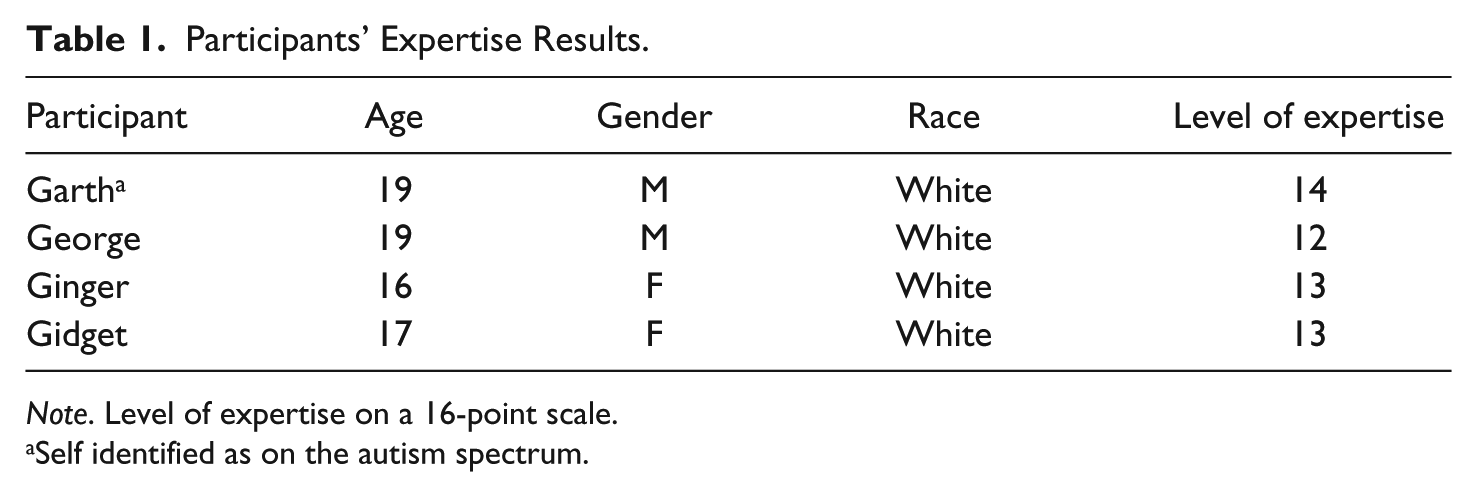
Note. Level of expertise on a 16-point scale.
Self identified as on the autism spectrum.
George was a 19-year-old White male with some college education. A successful mechanical engineering major, he was recently awarded an internship with a major sound engineering company. He was recommended for the study by a local comics and gaming shop owner who characterized him as “a stand-up guy. He knows tons and respects lots of work, like guys from Alan Moore (author of V for Vendetta) to Bob Kane (author of the original Batman series).” George reported he reads comics and graphic novels every day for “at least an hour, but probably more. I read in bed before going to sleep, and sometimes I end up awake at 2:00 in the morning because I’m rereading something I just finished.” He attended Comic-Con annually with his father and some of his close friends.
Garth was a 19-year-old White male who was finishing his undergraduate degree and was applying to master’s programs around the country. “I’d love to get into Berkeley. It is a top school. I’d like to see where the Freak Brothers were originally published.” He self-identified as on the autism spectrum with “classic Asperger’s.” His print-dominant reading is restricted to historical fiction, non-fiction, and what he terms school reading. Although he does not participate in face-to-face social groups that focus on comics, he spends time writing about comics in multiple online forums. In addition, he reads books by comics authors about the design process. At the time of this study, he did not aspire to write or create these works. He instead saw himself as “an informed consumer.”
Ginger was a 16-year-old White female. She was a senior in high school and planned to attend college and major in psychology. She was never interested in traditional comic books: “I mean, they are all so about Superman and all that Justice League stuff. Then someone showed me Hellboy 1 and that changed everything.” She read comics and graphic novels that she characterized as “indie/goth” and fantasy. She spent her free time at the local public library previewing graphic novels for the acquisitions librarian. She enjoyed her status as an expert among her peers and sees her role as a “book tester.”
Gidget was a 17-year-old White female recruited through the local Comics Forum. She worked as a tattoo apprentice, attended classes at the local city college in the comic arts program, and hoped to publish her own work someday. She read and listened to “everything [she] can find about comics,” especially interviews and blogs by comics artists. She preferred graphic novels because of the ability of “good artists to stretch and show a multitude of perspectives while telling a compelling story.” She took a feminist stance on comics and described herself as a “lone voice in a sea of idiots” when talking to other fans: “Let’s be honest, most comics readers and writers are boys and they, for some reason, need to see nipples all the time.” She discussed feminism in comics in face-to-face social groups, local comics shops, and various online forums, including a dedicated Facebook page and Goodreads.
Graphic Novel Selection
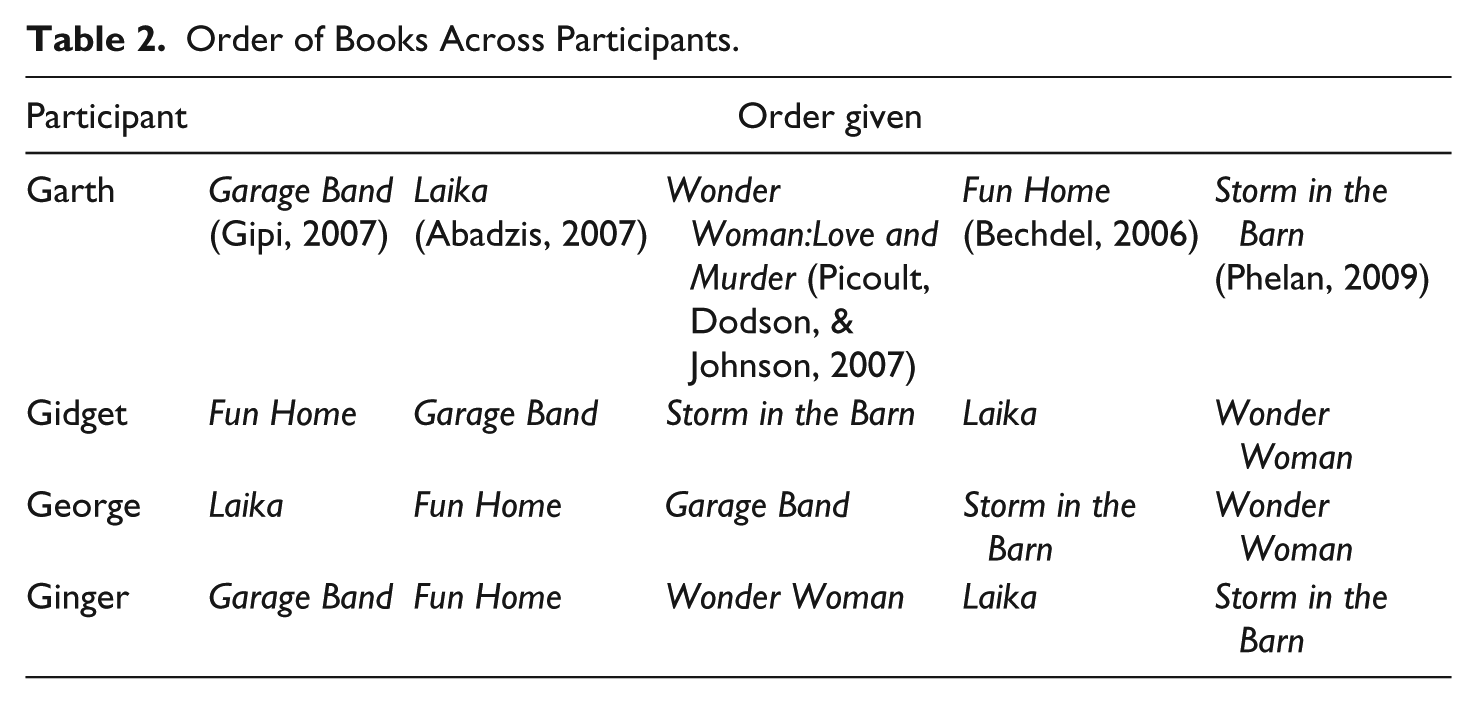
We sought guidance from various experts including local comics shop owners, online teacher resources, graphic novel scholars, librarians, readers, publishers, and bloggers. The books had to have an opening sequence that provided enough material for the readers to predict a story from the elements available to them on the page. A list of 15 graphic novels was vetted by two different local comics shop owners and a young adult librarian until five graphic novels were selected for the Attention Map activity: Fun Home: A Family Tragicomic (Bechdel, 2006), Garage Band (Gipi, 2007), Laika (Abadzis, 2007), Storm in the Barn (Phelan, 2009), Wonder Woman: Love and Murder (Picoult, Dodson, & Johnson, 2007). The book selections were counterbalanced across the readers (Table 2).
Order of Books Across Participants.
Procedures
There were several data sources in this study, each with a specific set of procedures and analysis. Each interaction with participants was video recorded and later transcribed.
Reading Habits Survey (RHS)
The survey was modeled after subsections of the 2003 National Assessment of Adult Literacy (Baldi, 2009) and provided a description of participants’ reading habits across several media (print-dominant, graphic-dominant, and online; Appendix A). The RHS included questions about how many and which genres were read (e.g., historical fiction, fantasy), how often reading was a selected pastime, and participation in social reading outlets (e.g., book clubs). This instrument was used to select individual participants based on their relative expertise. The survey was emailed as a Microsoft Word document to each of the 27 possible participants. All possible participants filled the document out and returned it via email.
Visual attention map (VAM) activity
The first author designed the VAM activity to provide evidence of the conscious ways readers attend to verbal and non-verbal elements in graphic novels. Each of the opening page(s) of the five graphic novels selected for this study were enlarged by 225% using a high quality, full color printer and mounted on form-core board. Enlarging the entire page to a poster size kept the integrity of the text intact while allowing observation of the participant’s hand movement across the page. This is similar to the method used by Norman (2012) to observe the ways second-grade readers used graphics in informational texts.
Prior to being shown the first poster, we instructed the participant to use his or her index finger to show where his or her attention was drawn across the page. The posters were kept out of sight until the beginning of the activity. They were then placed on an easel in front of the participant one at a time. After the participant had exhausted the page, they were asked to predict what the book was about. We opted to ask the participants to make a prediction to help illustrate the meaning making they accomplished given the verbal, visual, and sequential elements on the page (see Appendix B for prompt).
The VAMs were simultaneously recorded with two cameras: one oriented toward the participant’s upper body and face to best capture expressions and physical actions. The audio from this camera was transcribed for analysis. The second camera was placed behind the participant and oriented over the shoulder, toward the poster, to capture the participant’s motion as he or she indicated his or her attention across the enlarged page (see Figure 1). Each set of videos was synchronized and transcribed for later analysis. The video recordings also provided the start and stop times for each VAM for each participant.
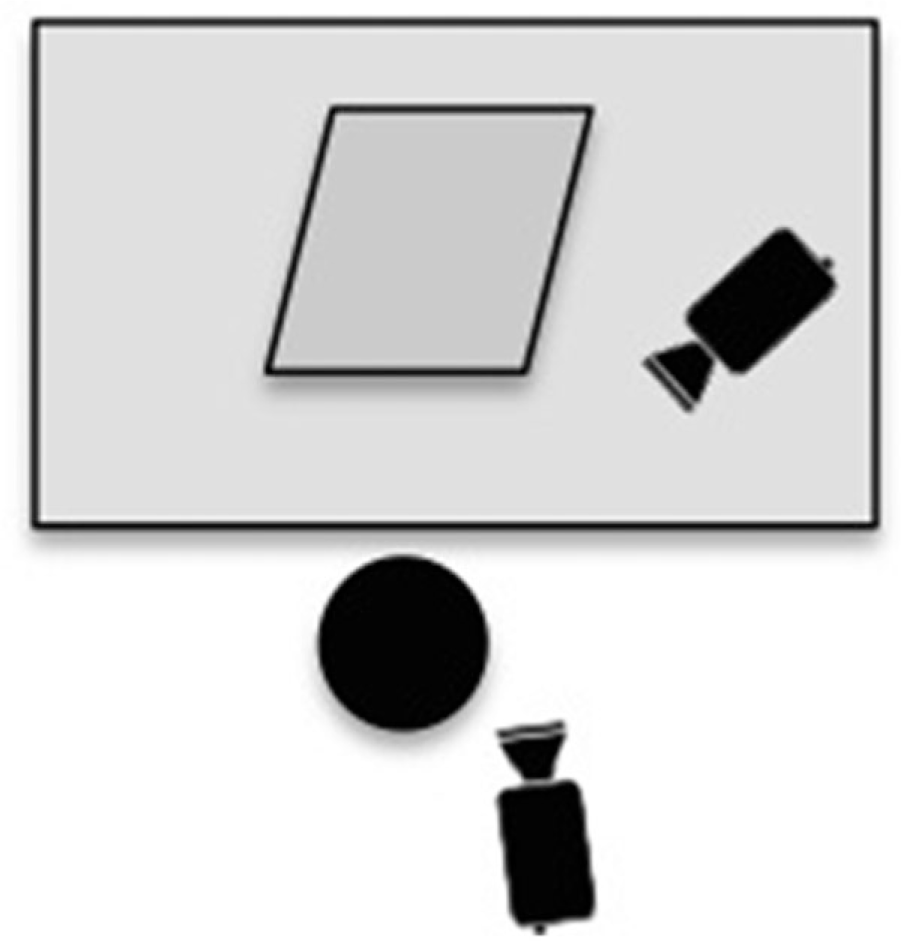
Camera orientations.
Before revealing the first of the enlarged pages, a short statement was read:
I’m going to show you an enlarged page for the beginning of six different graphic novels. Some are one page and some are two pages. As soon as you can, please point to the first thing that draws your attention. From there, please point out what draws your attention. Don’t try and make sense of what you see, simply move from one attention point to the next.
This was an untimed activity and each participant indicated when he or she was finished before we asked the participant to predict what the story was about. This predicted story was also untimed. When the reader shared his or her predicted story, we asked if there was anything more to add. If not, we revealed the title of the book and asked if he or she wanted to change anything about the prediction based on this new information. Any additions or changes were recorded for later analysis.
Analysis
This study investigated what and how expert readers use semiotic resources to make sense of graphic novels. One way to explore our question was to observe and report the ways expert readers utilized time and attention across the first pages of a variety of graphic novels. Grounded theory (GT; Glaser & Strauss, 1967) provided an analytic framework that was inherently open to discovery but still provided structures that encouraged rigor (Charmaz, 1990). GT provided a way to consider the existing research but avoided relying on our own biases. By allowing ourselves to “absorb and marinate in the data” (Tracy, 2013, p. 188), we can report on these readers’ interaction with these texts. Furthermore, as Charmaz (2008) states, “By adopting emergent methods, researchers can account for processes discovered in the empirical world and direct their methodological strategies accordingly” (p. 155). This study is served well by GT’s regard for discovery in uncharted territory.
VAM
As an exploratory study designed to observe the ways readers attend to the multiple semiotic resources to make meaning in graphic novels, it was important to be open to new ways of representing the data. Each participant created a set of VAMs of the opening page(s) of the five different graphic novels. Each set of participant VAMs (five for each) were coded by at least three different individuals, independent of each other.
During this first phase of coding, we focused on identifying utterances when participants referred to traditional literary elements during the VAM. These elements were
(C) Character: A reader pointed to or commented on an individual character or characters. (CR) Character Relationship: A reader pointed to or commented on the relationship between two or more characters. (PT) Plot-True: A reader commented on or predicted accurate plot points. (PF) Plot-False: A reader commented on or predicted inaccurate plot points. (S) Setting: A reader commented on elements that set the scene within a panel or across panels. (G) Genre: A reader commented on the genre of the story.
In addition, it was important to code for instances when a reader utilized information available only by reading an image (I), or the text (T), or both (B).
We met to discuss observations, new phenomena as they were discovered, and ways to clarify what was observed (Charmaz, 2008). This initial analysis proved to be too simplistic and, therefore, did not adequately capture the semiotic resources these readers were attending to, nor the synthesis and meaning making they were accomplishing during the VAMs. Initially, we expected to see smooth and fairly contiguous motions from the readers as they showed us their attention across the page, but instead, each reader surprised us with a halted, almost disjointed reading style that did not adhere to the typical left-to-right, top-to-bottom reading style. After observing multiple participants, we designed a new analytic with the synchronized video data from Cameras 1 and 2 with a master audio file using Transana© software. A second screen with Adobe PhotoShop© displayed the graphic novel page as a static, base layer. We first placed a black dot on the corresponding spot each time a reader started, paused, and stopped. Although they were not instructed to do so, all of these readers stopped, took their hand away from the poster, and then started anew. We referred to these lines as attention sweeps: The pattern the participant’s handmade across the page to indicate his or her attention. A different color was used for each new attention sweep. We also distinguished pauses as a lull in the attention sweep without taking a hand away from the page. This was different than a stop, which was marked when a participant took his or her hand away from the poster.
Reliability
Inter-rater reliability (IRR) was done with each set of 40 VAMs (eight participants created one VAM for each of the five graphic novels). The coded VAMs were printed on transparencies for comparison. Attention sweeps were within agreement if they lay within 2 mm for all raters. This was measured from the edge of the line or the dot for a 0.5% margin of error. If all raters were not in agreement, we discussed the differences, consulted the video, and attempted to come to consensus. We ultimately reached IRR 90% with little discussion for the attention sweeps, and an IRR for pauses was ultimately agreed upon at an 87% rate. We considered these acceptable rates of agreement for a new qualitative analysis.
Findings
To make sense of the codes and patterns that emerged through data analysis, we used a theoretical frame to guide our understandings. Specifically, we used Serafini’s (2012a) expanded four resource model to explore how the readers’ interacted with the semiotic resources found in the text. In the next section, we share what we learned.
Reader as Navigator
The notion of reader as navigator emerged as a way to conceptualize how consumers of hypertext and online resources traverse digital text (Lawless & Schrader, 2008), yet it is not often applied to reading multimodal text. Serafini (2012a) contends it is a useful metaphor for how readers of multimodal text meld the worlds of traditional print-based model of decoding with the ability to decipher the structures of visual cues. In other words, the readers as navigators must recognize the importance of both traditional print and visual components of the text. They must use this knowledge to determine when and why they must attend to the various resources (i.e., linguistic, visual, spatial). There were several instances in which the participants used “navigation” tools to help make sense of the graphic novel page. Prior to reading, many of the participants overviewed the text by taking in large chunks of visual and linguistic resources. George explained his role as navigator as “taking a big bite or a big whiff of the book. I have to take it all in or I can’t understand anything.” In other words, George as navigator, overviews the text to determine what is important, what needs his attention, and what will provide an in-depth understanding of the text.
While he read the first page of Fun Home (Bechdel, 2007), George used three separate attention sweeps that were punctuated by several pauses within each sweep. His first sweep began in Panel 1 where he pointed to a space that lies between two picture frames on the wall that makes up the background of the panel. He then progressed to the character’s faces, paused on each for a moment, and moved his attention to the second panel. Still keeping his hand on the enlarged poster, he traveled across the image and paused on the characters’ hands that were clasped together. He then moved downward in a curved arc toward Panel 3 (the last panel on the page), where he paused on the father’s face, slowly moving to the child’s head, outstretched hand, returning to the child’s head, and finally ending this first sweep on the father’s hand.
When asked about this initial attention sweep, George said, “Yeah, it’s important to get the gist, like, the ‘where’ of the story. Without that, I can’t even begin to read.” George’s exploration of the text exemplifies the importance of reader as navigator role in the meaning making process used to analyze graphic novels.
Reader as Interpreter
Graphic novels convey meaning using three semiotic resources: linguistic, visual, and spatial. The expert graphic novel readers in this study frequently demonstrated using the various semiotic systems to interpret the text. Gidget, in particular, illustrated the use of multiple semiotic resources in concert to build an understanding of the text.
When questioned about how she navigated the text, Gidget replied, “That way I am sure to see the page, to like, really notice all the pen work and the color. I don’t want to start by getting distracted by the words.” In other words, Gidget used both image and sequence when interpreting the text and as she was keenly aware of the written text, she saved it for last. Before the title was given, Gidget began her prediction of Bechdel’s memoir by saying, “It seems like it’s going to be the story of this kid’s [points to child in Panel 1], like, life. Like seeing the family through the child’s eyes.” While she pointed to the father’s face in the third panel, she said, “Probably due to the father’s generally dismissive demeanor evidenced by his lack of enthusiasm at playing with the author, but his closeness to Anna Karenina [the book title seen in Panel 3].” In this instance, Gidget clearly used the visual, verbal, and spatial semiotics systems to make sense of text. As a graphic novel reader, Gidget knows that each system conveyed meaning and unlike her print-based peers recognized that she could lose meaning if adequate attention is not paid to visual cues.
Reader as Interrogator
Reader as interrogator is an important but often not explicitly taught stance in which texts are read with a focus on critical and sociocultural analysis of power and privilege (Serafini, 2012a). “From this perspective, reading is re-conceptualized as a social practice that involves the construction of meaning in a socially mediated context, the power relationships inherent in any given setting and the readers’ identity and available means of social participation” (Serafini, 2012a, p. 159). Out of the four resources, all of the participants seemed to have less expertise with this aspect of multimodal reading. While not fully developed as interrogators, some readers used the semiotic resources from the text to self-reflect and integrate concepts of representation and privilege.
Again, we draw attention to Gidget’s and George’s read of the first page of Bechdel’s (2006) Fun Home. This graphic novel is a memoir of Alison Bechdel’s childhood and early adulthood in which she visits and revisits growing up with an emotionally distant, closeted father who eventually comes out as a gay man, the same year Bechdel comes out as a lesbian. She draws her 9-year-old self with short, dark hair, in a T-shirt with wide, horizontal stripes, jeans, and heavy socks. There is no indication of gender in the written text, nor is there any clear gender identification (ribbons in her hair, a dress, or earrings) that would provide a clearly defined image of a girl. But, there is also nothing in the text asserting that the child is a boy.
From the very beginning, Gidget and George differed from the other readers in the study by referring to Bechdel’s character in gender-neutral terms. Gidget said, “It seems like it’s going to be the story of this Well, it’s an indi-comic and well, there just wasn’t anything like in the writing or the drawing that said BOY or GIRL! So, I didn’t want to like put my own meaning on it and replace the author’s. Besides, that kind of stuff, like not boy and not girl, is something the author does. It doesn’t just, like, happen.
Her attention to the author’s purposeful use of gender-neutral language and images was one way she interrogated the page.
George had a very strong reaction to the title of the book,
So yeah, that’s like, never good. So yeah . . . this
George refused to assign a gender, even after being asked to identify the child’s gender in a subsequent interview,
Uhm, no. I don’t know really. My guess is I’m supposed to say “boy” but that’s just because I’m supposed to think everyone is a guy, right? See? (waving his hand over the page). There’s nothing girly or boyish here. So, I’d have to wait and see.
George was aware of the expectation of male-ness in characters that are not explicitly female because male is the normative image but he is actively refusing to make that assumption.
While neither example fully exemplifies Serafini’s concept of reader as interrogator, the participants demonstrate an awareness of the text, their own bias, and the necessity to ask questions of the authors/illustrators such as who is telling the story and why.
Reader as Designer
According to Serafini (2012a), reader as designer broadens the traditional social constructivist belief that the reader uses prior knowledge to create an understanding of the text. The reader as designer actually decides how the text is read, what is important, to create a unique experience with the text as the reading event happens.
George epitomized the role of reader as designer. He used all the semiotic resources to determine his reading path and analyze the text. He was an extremely careful and adept reader of illustrations and, by using the available visual resources, he determined a reading path that made sense to him and allowed him to make sense of the text.
One such VAM that illustrated how George used multiple semiotic resources was the two-page spread of Laika (Abadzis, 2007). He returned to a few areas repeatedly, and those images provided him with details he used to make clear and accurate work as reader as designer. He began his prediction with “This guy right here [points to page 1, Panel 3, a close up of the main character’s face]. He looks like the kind of guy . . . he’s got a serious background and stuff.” George focused his read of the page on the main character who has just been released from a Soviet gulag and is attempting to get out of Siberia and get back to the life he had before imprisonment. He continued, “I mean I’d put it [the story] in like, Russia or that area or something, based on the art and that kind of stuff [points to truck driver on page 2, Panel 3].” He continued, “Based on the artwork and stuff I think Russia and I think this guy [points to main character’s face on page 2, Panel 4] just got out of a camp, like Siberia maybe?”
After the title is given, George continued,
Umn, ok, yeah . . . I mean, if I was going to totally guess I’d say the book is going to follow this guy from here [points to main character on page 1, Panel 1 where he is trudging through snow on a deserted road] and not this guy [truck driver, a minor character, page 2, Panel 5].
He paused for more than 1 min. When prompted if there is anything else, he replied,
Laika. Laika? Ok, so Russian. I mean, look at that hat! [points again to the main character on page 2, Panel 4] And like the 1950s, ’cause that truck looks like, I don’t know, like old [points to page 2, Panels 1 and 2]. So, yeah, 1950s, Russia. Got to be the space program or something. Like Sputnik or something around that time, when Russia really showed us up.
George’s VAMs clearly illustrated his role as reader as designer. As an expert graphic novel reader, George confidently created his own reading path and used the available semiotic resources, as well as his background knowledge, to make sense of the text.
Discussion
This study represents an investigation into the ways a group of young adult readers utilized linguistic, visual, and spatial semiotic resources in the opening pages of five different graphic novels. We wanted to investigate a long held assumption that graphic novels are easier or instinctive or offer a more natural way to read (Eisner, 1985; Rudiger, 2006; Thompson, 2008), and thus take no specialized knowledge or specific strategies. In addition, we wanted to begin the process of exploring what and how readers attend to the semiotic resources (linguistic, visual, and spatial) used in graphic novels.
Currently, the predominant research on reading comprehension and graphic novels focuses on the motivational aspects of the media without a clear understanding of the cognitive processes at play. Utilizing McCloud’s (1994) concepts about comics design, social semiotics theories (Halliday, 1978; Hodge & Kress, 1988), and Serafini’s (2012a) expanded four resources model, we began to explore the comprehension strategies used by expert readers to make sense of comics.
The findings show 4 points worthy of further discussion: (a) These participants show the synthesis of linguistic, visual, and spatial resources is a cognitively complex activity; (b) To navigate this synthesis, some of these readers have developed systematic methods of reading graphic novels; (c) The complexity and accuracy of the predicted stories vary among these readers even though they all read the same pages; and (d) The time it takes to accomplish the work of reading graphic novels needs to be recognized as an important part of reading.
Synthesis of Resources
Effective reading of graphic novels requires cognitively intensive activity in which the reader attends to and synthesizes linguistic, visual, and spatial resources to co-create the story. At first glance, there is no difference between the ways research characterizes active reading in general; however, the specifics of how readers engage with and use the linguistic, visual, and spatial resources is a new area of research in graphic novel reading research. The four graphic novel readers in this study were exceptionally careful in the way they read and utilized the images. In fact, that is how Garth characterized his own activity with the pages:
Yeah, well, I read the images, the pen strokes, colors, all of it before adding the words. It isn’t that the drawing is more important, it is differently important and I get background information there [from the drawing]. I fill in gaps with the words.
This description holds true for Garth, but not for all readers. His explanation is a suggestion of the effort and care that may be needed to attend to images and words.
The readers in this study showed different ways of approaching, utilizing, and synthesizing the written text and illustrations. These findings indicate expert readers of graphic novels must assume the roles of both navigator and interpreter as described by Serafini (2012a) in the expanded four resources model. As navigators, the readers had to attend to the grammar and structures of the linguistic resources as well as the grammar and structures of the visual resources. Examples of this kind of reading were most apparent in pages with less written text, such as George’s Storm in the Barn (Phelan, 2009) reading. He commented directly on the lack of text, the muted color pallet, and delicate balance between pen and watercolor,
Yeah . . . it just kinda . . . drew my attention over here (Panel 1, page 1—wisps of dusty air coming around a building), before looking up here (motions to text “Kansas, 1937” in top of Panel 1) or over there (motions to page, 1 Panel 1). Also, it kind of stood out, with the lack . . . lack of almost everything. Color, print, even details. There is [sic] kind of minimal drawings and colors (motions across page 1) for everything. But, when there is so little to go on, every piece that I see matters. Each word. Every brush stroke you can see means there was huge chunks left out but left out on purpose.
His understanding of minimalist styles in comics and graphic novels cued George to pay careful attention to each and every detail with care. He struggled with so little information to make meaning, but he understood the struggle,
I don’t know, that is kind of confusing. I wish there was more words. I bet there are more words and I just want to turn the page to get to the words. I love the style though. It just looks exhausted.
As interpreter, the readers had to use the various linguistic, visual, and spatial resources to construct meaning of the text.
Individual Systematic Reading
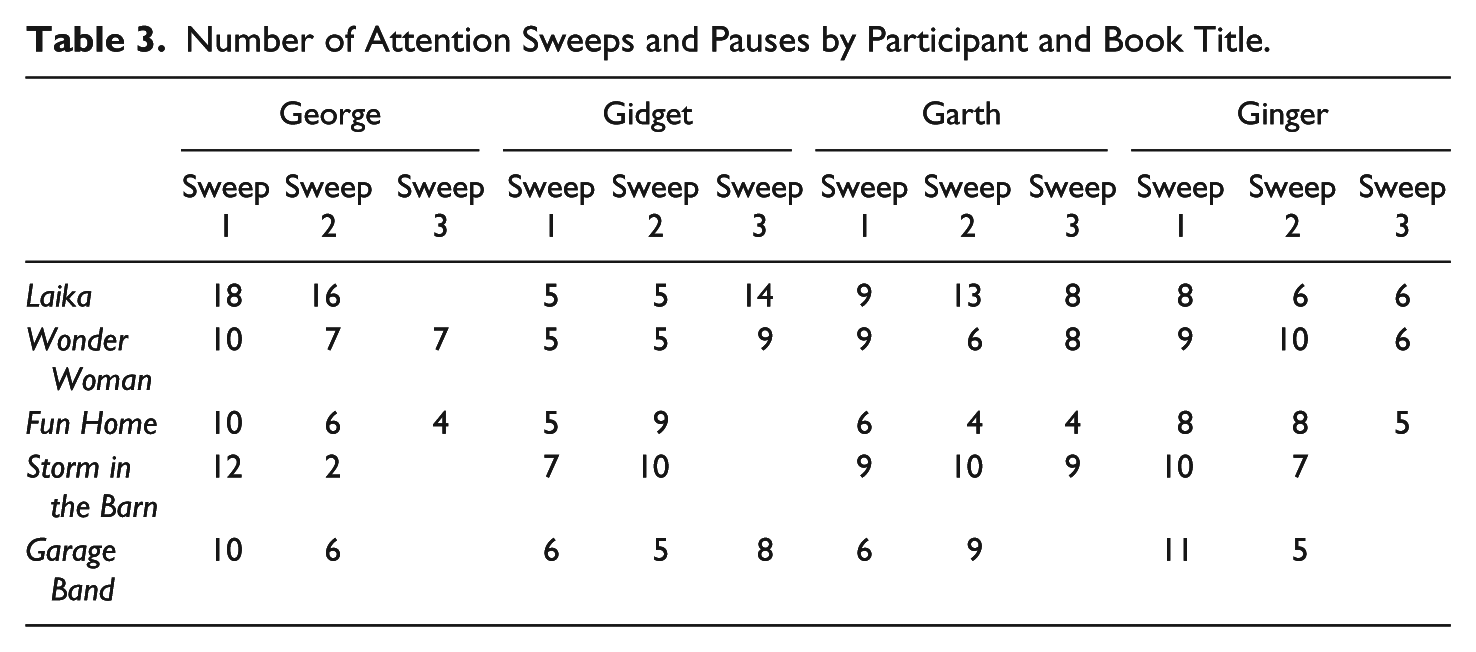
The analysis of the VAMs indicated a systematic but individualized method of entering into, isolating, and then synthesizing the separate resources on the page into a lucid story. This individualized method also aligns well with Serafini’s (2012a) expanded four resources model. In this case, the readers assumed the role of designer. As designer, the readers developed an approach for reading the text. A close look of the VAM analysis illustrated that each reader developed an individualized approach toward reading the texts. George and Gidget had the most attention sweeps and pauses, followed by Garth and Ginger (Table 3). Even given this general tendency, the ways these readers attended to each book was highly variable. There is no ideal number of sweeps or prescribed pauses to make. Instead, the generality that can be garnered from this study is that readers need to parse or chunk the pages in graphic novels in some way to use and make sense of the multiple modes of text.
Number of Attention Sweeps and Pauses by Participant and Book Title.
Limitations and Future Research
All research methods have affordances and constraints, and although this study was designed to minimize limitations, there were a few that could not be avoided. The use of think-aloud protocols is limited by the fact that the participants report upon their own thinking and the researcher is responsible for interpreting those utterances. Although think-alouds allow for an “as it happens” view of readers’ thoughts, the reports are in no doubt affected by the cognitive capacity of the readers, their individual demeanor around talking, and the researchers ability to make reasoned interpretations (Pressley & Afflerbach, 1995; Scott, 2008). To ameliorate these limitations, we sought participants who were already engaged in and able to talk about their own reading, for instance, all of the participants acted as mentors in formal and informal learning communities based on the practice of reading.
The most substantial limitation to the current study is the number of readers and the general homogeneity of the group. Although the expert graphic novel readers were not experts in print-dominant reading, and the print-dominant readers were not experts in graphic novel reading, all of the readers were successful readers. The readers were also racially and ethnically homogeneous—all self-identified as White. Two of the four participants are from middle or upper income level homes. Garth and Ginger self-identified as “working class.” Finally, the ages of the participants ranged from 16 to 20. Garth self-identified as being on the autism spectrum; he referred to himself as “classic Asperger’s.”
The next step would be to create a study using the VAMs with a larger number of younger participants. This would allow for the development of a set of statistical analyses focused on the number of attention sweeps and pauses used by a variety of readers. A larger number of participants would confirm if the patterns seen in the current study hold true across a wider range of readers. A range of readers across age levels such as 8, 10, 12, and 14 years would show a pattern of development across age.
Implications for Practice
Based on trends in recent research and scholarship, it seems likely that the interest in using graphic novels and comics in the classroom will continue to grow (Connors, 2013; Pantaleo, 2013). These texts may be an effective tool in differentiating literature used in the classroom, but to teach with these texts teachers need to know all they can about effective reading practices. The extant research in graphic novels in the classroom shows that teachers, as a group, are not graphic novel readers (Lapp, Wolsey, Fisher, & Frey, 2011-2012). They found most teachers in their study thought there was value in introducing graphic novels into the classroom, but they were hesitant for many reasons. One reason was the teachers’ lack of knowledge about how to read the texts. The teachers who responded were more familiar with research and practitioner articles about using graphic novels than with graphic novels.
The current study suggests that reading graphic novels does take specialized knowledge that must be developed over time. Therefore, teachers need support and time to learn how to read graphic novels if they hope to use them effectively in their own classrooms. Teachers need to understand the multiple ways these texts can be read, and most importantly, that reading visual and spatial cues is not easy, natural, or fast. A model of reading this medium, based on observations of readers reading the texts, would help inform teachers to begin their own apprenticeship with the art form (McCloud, 1994). A goal for future research in this area should include designing explicit instructional models for teachers to use with the diverse student populations in today’s classrooms.
Footnotes
Appendix A
Appendix B
Declaration of Conflicting Interests
The author(s) declared no potential conflicts of interest with respect to the research, authorship, and/or publication of this article.
Funding
The author(s) received no financial support for the research, authorship, and/or publication of this article.