




Abstract
This case study is part of a larger investigation of literacy practices at New Beginnings shelter, a long-term transitional homeless shelter for addicted mothers and their children. We asked, “What is the nature of writing in a homeless shelter committed to the rehabilitation and recovery of mothers from addiction?” At New Beginnings, mandated writing serves as a way to help women confront their addictions and develop necessary skills to live independently. The social nature of writing is partly determined through explicit norms and routines for purpose, format, and audience and includes regular feedback from shelter staff and/or peers. Of the various writing practices undertaken, we discuss (a) required letters addressed to one’s inner child, one’s body, and one’s disease; (b) “staff actions,” which is on-demand writing on a required topic due to a shelter infraction; and (c) daily journaling. Drawing upon complementary theories of literacy as a social practice, literacy events and practices, a community of practice, and Foucault’s concept of power as relations, we explore the social processes surrounding mandated writing among members of this shelter community. We note how writing can be a signal of legitimate participation in the rehabilitation process and how it serves as a form of dialogue between participants. Although these practices were sometimes filled with tension, their shared nature strengthened the shelter community through a productive process.
A lot of things that I write now, I feel like it’s for me because, in this program, we do a lot of writing [laughs]. Some is consequences; some of it is just to get [it] out. Not necessarily consequences; to address some of the hurts and things that we have. And we write to our problems, and it’s for me.
So even though they [shelter staff] expect it, it feels like it’s for you.
It’s for me (inaudible) . . . and I feel that, when it comes from the inside, then it is for me. No matter how you word it, it’s for me.
Shamika is a resident of New Beginnings, a family homeless shelter for mothers who are addicted to drugs and/or alcohol. As she works on her sobriety in this social context, she asserts ownership of various mandated writing assignments. This stance suggests her meaningful engagement with a literacy practice shared with a particular group of individuals who are working toward a common goal (Wenger, 1998). It also underscores how literacy offers ways to understand and make meaning of individual lives (Elbow, 1999; Smith, 2006; Sumara, 1996, 2002). For people in crisis, literacy can help anchor oneself, reaffirm relationships, and reestablish a sense of identity (MacGillivray, 2010; MacGillivray, Ardell, & Curwen, 2010a).
This study focuses on the purpose and process of writing practices at a homeless shelter. Homelessness is a significant nationwide social problem that affects both urban and suburban areas. It can be the result of many circumstances, including but not limited to financial difficulty, substance abuse, and physical and mental health complications. In 2014, families constituted 37% of the nation’s total homeless population (Henry, Cortes, Shivji, & Buck, 2014). These individuals are living on the edge of society and are often negatively stereotyped by mass media, courts, and political rhetoric (Billington, 2011; Twomey, 2007). In addition, because shelter residency is one means to address the problem of individuals without a home, it is important for social scientists to bring an understanding of this population into the “core of our conversations in educational research” (Finley & Barton, 2003, p. 48). Through exploring one group’s literacy practices during a pivotal point in their lives, we are afforded an intimate glimpse into these experiences.
Our research is part of a long-term investigation of the literacy practices at New Beginnings shelter (MacGillivray et al., 2010a) and extends our work on the reading and writing engagement of families who live in various shelters (MacGillivray, 2010; MacGillivray et al., 2010a; MacGillivray, Ardell, & Curwen, 2010b). For this study, we asked, “What is the nature of writing in a homeless shelter committed to the rehabilitation and recovery of mothers from addiction?” New Beginnings shelter is one context in which residents are learning simultaneously how to maintain sobriety, become more effective parents, and develop viable job skills to reenter mainstream society. We attend specifically to practices associated with three forms of writing that are designed to support residents’ moment-to-moment sobriety: required letters (part of the Alcoholics Anonymous [AA] coursework), “staff actions” (staff-assigned reflective responses in response to a client’s violation of the rules), and journaling. Each mandated writing activity is individually authored yet publicly shared. All contribute to the overall purpose of the shelter. Complementary theoretical frameworks enable us to explore literacy practices (Street, 1984) in relation to a specific social context (Wenger, 1998) and its inherent power relations (Foucault, 1982).
Literature Review
Within the field of education, social practices related to writing in classroom settings are concerned with how students and teachers work toward a variety of academic literacy goals (Moll, Saez, & Dworin, 2001; Whitney, Ridgeman, & Masquelier, 2011). Writing, however, serves purposes beyond scholarship; it is also a cultural practice that facilitates social connections and objectives (Dyson, 2003; Kendrick & Hissani, 2007; Street, 2004). Ethnographic literacy research on adults’ writing practices has noted the ways in which everyday literacy acts, such as women’s love-letter writing in Nepal (Ahearn, 2004), tagging among Latino adolescent youths in California (MacGillivray & Curwen, 2007), and the traditional and transformed storytelling practices of orphaned southern Sudanese refugees (Perry, 2008), help individuals achieve both personal and social aims.
Typically, studies of writing practices in homeless shelters have focused on functional aspects such as how shelter residents gain basic skills as a means to enhance their schooling and job readiness (Bridwell, 2013; Rivera, 2003, 2004). In contrast, studies that attend to cultural practices of writing in shelters are few (MacGillivray et al., 2010a, 2010b). Given writing’s potential to foster a sense of community, there is a need to examine the nature of assigned tasks as they relate to rehabilitation and their impact on the surrounding social context.
The act of writing has long been recognized as a useful tool for individuals during difficult times and stressful moments (Bastian, 2010; Evans, 2004; Pennebaker & Graybeal, 2000; Ragusa, 2010; Smyth, 1998). One purpose is psychoeducation, a type of learning that concentrates on achieving a healthier psychological outlook through intense personal reflection, supported by feedback and assigned topics. Writing as a form of therapy exists on a continuum, ranging from highly structured programmatic tasks to more open-ended forms in which the client determines the topic (Esterling, L’Abate, Murray, & Pennebaker, 1999; Pennebaker & Graybeal, 2000).
To gain the best understanding of the meaning of patients’ writing, the analysis of their composing efforts must consider process, content, and structure (Kerner & Fitzpatrick, 2007). Bloome and Clark (2006) call for a situated analysis of writing, stating, “The question to ask is who is using language and other semiotic tools to do what, with whom, to whom, to what consequence, when and where” (p. 238). Schultz (2006) also noted a research trend addressing sociocultural aspects of writing to make the ordinary visible. Bastian (2010) examined writing, specifically genre, in relation to participants, subjects, purposes, and settings. One example of how genre can shape engagement is seen in Jay and Brooke’s (2004) research in which they found that college psychology students, despite a belief in the benefits of diaries, self-censored their entries. This kind of strategic response speaks to potential issues surrounding writers’ agency as they complete mandatory tasks.
Oral and written communication related to recovery is also relevant, as these can be mechanisms that shelter case managers use to gauge residents’ progress. Caldwell (2005) detailed the benefits of therapists, family members, and patients creating narratives together in which they “remember and re-author stories of resilience” (p. 72). The power of illness narratives and conversion narratives in AA has been analyzed for over two decades (Arminen, 1998; Cain, 1991; Hagarty & Clark, 2009; Holland, Lachicotte, Skinner, & Cain, 1998; Swora, 2001a, 2001b). Although writing is not mandated in AA, Cocaine Anonymous (CA), or Narcotics Anonymous (NA) programs, many of the writing experiences in rehabilitation programs are associated with aspects of the 12 steps (see Hazelden Publishing for numerous examples). In a rare critique of writing for therapeutic purposes, Evans (2004) posited that mandatory writing reflects a dominating discourse and often serves to perpetuate the othering of an already marginalized population.
In rehabilitation programs, writing assignments are common; the content rather than the nature of the task tends to be the focus of therapists, program staff, and researchers alike. In contrast, we attend to the social processes of writing to provide insight into one particular community’s meaningful practices (Wenger, 1998). Specifically, we consider the nature and role of mandatory writing practices in the development and sustainability of a community of practice dedicated to women’s day-to-day sobriety, which has consequences for both their parenting and their future economic independence.
Theoretical Framework
A sociocultural framework served to understand the nature of writing within the relatively closed social setting of a homeless shelter for women who are seeking sobriety. To analyze participants’ mandatory writing both as cultural artifacts and with respect to women’s engagement as members of their shelter community, we drew upon complementary theories of literacy as a social practice (Street, 2001, 2004) with particular literacy events and practices (Barton, 2001) and a community of practice (Lave & Wenger, 1991; Wenger, 1998). The deployment of power in differential relationships was understood through a Foucauldian lens (Foucault, 1980, 1982).
Literacy Practices and Events
The theory of social literacy practices targets “general cultural ways of utilizing literacy in which people draw upon in particular situations” (Barton, 2001, p. 96). Nestled within sociocultural theory, this focus concerns literacy practices that “refer to the broader cultural conception of particular ways of thinking about and doing reading and writing in cultural contexts” (Street, 2001, p. 22). This perspective draws attention to reading and writing used meaningfully and purposefully in negotiating and solidifying relationships and interactions with others. Based on its fundamentally social nature, individual agency is assumed as participants may take up, modify, and push against the established practice as a means to meet their own requirements (Perry, 2012).
Within literacy practices are specific literacy events, which are the visible episodes of individuals’ experiences mediated through text (Street, 2001). By examining everyday literacy practices in different domains of life, it is possible to gain insight into their distinctive characteristics (Barton, 2001) and identify the understandings needed to fully participate in any given practice (Perry, 2012).
Community of Practice
A community of practice (Wenger, 1998) serves as a lens into individuals’ growth and development in the context of an intentionally designed, purposeful, and relatively closed environment, such as a classroom (Carbone & Orellana, 2010) or, in this case, a homeless shelter (MacGillivray, Curwen, & Ardell, 2011). At New Beginnings, learning is a shared endeavor among individuals. The clients’ ongoing participation in shelter life has the potential to assist them in sustaining their sobriety moment-to-moment and day-to-day. (It is common in this culture of recovery to continually consider oneself an addict, even in moments of sobriety, to maintain awareness of addiction’s psychological and biological challenges.)
From this perspective, learning is inevitable and happens regardless of intention. Wenger (1998) defines practice as both the explicit and tacit aspects of a reaction to a particular design for learning. The group becomes galvanized through three key elements: mutual engagement, joint enterprise, and shared repertoire. Mutual engagement shapes the community by providing opportunities for authentic participation in meaningful activity. Conflict is inherent and necessary, as multiple perspectives and levels of competence are critical to reaching a common goal. Joint enterprise is a negotiation among members as they respond to their given situation. Interactions are not always harmonious, yet, as the group moves forward, relationships of mutual accountability are created. Further, as group members work with particular resources and limits, members gain ownership over their situation. Shared repertoire refers to the resources that the community has at hand and can be explicit (e.g., tools, routines) or tacit (e.g., discourses, concepts). Due to its usefulness, a shared repertoire also may be produced by the community or appropriated from outside sources.
Through time, interest, and level of engagement, individuals develop competence and acceptance in the community. Lave and Wenger (1991) suggest that, while an individual’s involvement might initially be only partial, it is, nonetheless, legitimate. And, it is possible for a learner to quickly gain inclusion in a group. Over time, through increasing involvement, a learner acquires the requisite skills and habits required to play a role in group practices.
The uncertainty involved when a shared repertoire is put into action generates meaning through negotiation between group members. According to Lave and Wenger (1991), “For newcomers then the purpose is not to learn from talk as a substitute for legitimate peripheral participation; it is to learn to talk as a key to legitimate peripheral participation” (p. 109). As individuals make decisions, or have them made for them, about their participation level in various activities within the broader practice, they make complex choices about how they belong in the group. In turn, this can impact an imagined future trajectory (Norton, 2010; Sumara, 2002). The process of negotiating one’s place in a community is particularly relevant to homeless shelter residents seeking sobriety in a rehabilitation program.
Power Relations
A Foucauldian notion of power as relations (Lemke, 2002; Manias & Street, 2000; McHoul & Grace, 1993) was helpful in extending our understanding of the interactions among members of a community of practice. In this situation where clients must submit to what can be considered a rigid program with rules related to what they do, how they do it, when they do it, and with whom, it is easy to assume they are powerless. Foucault helps us understand this is not the case. He positions power as multidirectional, noting “how it links people; [and] how power circulates and creates individuals who are experiencing and exercising power rather than acting as inanimate objects or victims” (English, 2006, p. 91; cf. Townley, 1993). The emphasis on relations of power disrupts notions of power as something bestowed or earned; he depicts it instead as a “mode of action” (Foucault, 1982, p. 789).
Foucault (1980) recognizes power relations are productive because interactions promote “new forms of knowledge and practice” (Lemke, 2010, p. 33). Power relations do not always inhibit freedom; they can empower participants in particular fields of action (Lemke, 2010). Additionally, there is resistance when power is exercised (Foucault, 1982). For example, English and Irving (2008) found that learners in an adult education program utilized “silence, subtlety, or general noncompliance” (p. 270) when asked to participate in team building activities. Still, Foucault acknowledges societal limits frame individuals’ creative and resistant acts (Schaafsma, 1998). Institutions can exercise their power so that individuals take up certain practices, which they then internalize as their own. This process “actually ends up equipping those humans to become independent agents” (Gallagher, 2008, p. 14) and only occurs with an individual’s participation.
As we use social literacy practices (Barton, 2001; Street, 2001) and Wenger’s (1998) community of practice frames alongside Foucault (1982), we heed Luke’s (2004) call for delineating the “material consequences of literacy” (p. 331) in people’s lives. This means looking at both the local and the global implications of mandatory writing that takes place in this community of practice.
Method
New Beginnings Shelter Site
Located in a southern U.S. city, New Beginnings is a long-term faith-based (Christian) transitional homeless shelter and rehabilitation program. (All names are pseudonyms.) Shelters such as this one offer families the possibility of relative continuity and stability. There are three criteria for entry into the program: a woman must be homeless, have custody of at least one child under 10 years of age, and be addicted to drugs and/or alcohol. The goals of the rehabilitation program include (a) the mother’s sobriety, (b) an improvement of her parenting skills, (c) training for a marketable occupation, and (d) the development of life skills that will enable future independence.
Upon entering the program, each resident is assigned to one of two case managers. In consultation with the shelter director and the resident, the case manager designs the individualized recovery plan, which includes key decisions such as when the resident is ready to leave the shelter for external activities (e.g., General Educational Development [GED] classes, family occasions). In addition, the case manager acts as a therapist, meeting individually with the resident to discuss her overall progress and recovery status. She assigns recovery-related material and reads and responds to a client’s written work. The case manager facilitates the client’s support for mental and physical health and legal issues. The shelter director and the two case managers all self-identify as African American and Christian and are recovering addicts themselves.
There are often six to 10 families in the shelter, which has the capacity for a combined total of 45 mothers and children. During the 3 years of data collection for this study, we encountered 32 mothers. Some families stay for a few days, some a few weeks, and others the full 2 years. Inside the shelter, 12 bedrooms with attached private baths line one long hall. The families’ rooms contain double and twin beds (with cribs as needed), a large storage closet, a clock radio, and, usually, a television. Crates filled with toys, books, clothes, and schoolbooks line the walls. Children’s work, drawings, posters, and homemade signs adorn the space.
Community spaces include a large gathering room, “a library” that houses mostly novels for adults and a rarely-used stationary bicycle, a playroom filled with colorful educational toys, a kitchenette, and a spillover room where children play and adults watch recovery videos. Meals are prepared and served in a large cafeteria. With case manager approval, women take smoke breaks outside. There are strict rules to ensure safety and support sobriety; purses are searched for unauthorized items, such as cell phones, when women return to the residential floor. Despite the rules and structure, New Beginnings’ staff strives to create a nurturing environment in the form of a “home” for a family.
The shelter has strong ties to various social, health, religious, and academic support programs across the city. Children continue to attend school and are provided with ongoing academic tutoring from two contracted educators. They also have their own case manager. Attendance at other activities, such as Bible study, a shelter-sponsored book group, and Friday night family events are strongly encouraged and, at times, mandated. Physical and mental health programs are available for both adults and children.
The shelter director, Ms. Carpenter, in consultation with the agency’s social services director, has designed the New Beginnings’ program. Her vision for the residents’ success is grounded in the power of literacy as essential for familial bonding and personal, social, and educational success. Literacy practices in this shelter are viewed as tools supporting women to see themselves as the kind of people who read and write on a regular basis (MacGillivray et al., 2010a). Writing is integral to daily life, both as a routine, pragmatic endeavor (e.g., creating grocery lists, filling out legal documents) and as an enlightening practice (e.g., responding to Bible verses, engaging in the 12 recovery steps). Ms. Carpenter explained that when addicts arrive at New Beginnings, they are so out of touch with their emotions that they cannot even identify their favorite color. Reading and writing practices are therefore utilized to help women reconnect with their feelings.
Criteria for a community of practice include mutual engagement of members, joint enterprise, and shared repertoire (Wenger, 1998). At New Beginnings, residents and case managers share outcome goals and mutually agree that a restrictive environment, for example, shelter rules and regulations, is critical for a chance at success. Given the particulars of addiction recovery, the need to reestablish and rerehearse boundaries as sober people is important. This does not mean that every resident willingly complies with every rule or that every case manager consistently exercises perfect judgment.
Tensions and conflicts among members are consistent with the community of practice framework (Wenger, 1998). As clients and case managers move closer to a mutually understood goal through joint productive activity (Wenger, 1998), their viewpoints and experiences rub up against each other and with the shelter rules creating new understandings and actions (Foucault, 1982). For example, while the shelter staff ultimately decide who is ready to formally graduate and who is expelled from the program (if a serious enough rule is broken), clients understand that they can remain housed there as long as they maintain sobriety, follow the rules, and respond to staff directives. Residents may choose to leave the program at any time. It is not unusual for them to exercise that option, exemplifying the way power circulates in this space (Foucault, 1982). This shelter is, therefore, a place of dual agency in which, as a community of practice, members align, disrupt, comply, and disagree with practices (Perry, 2012; Wenger, 1998).
Shelter Residents’ Background
At New Beginnings shelter, all residents are Christian, although this is not a criterion for participation. Many shelter residents have friends and family in the area, but these relationships are often a negative influence, and/or the relationship has been stressed to the point of disrepair. In addition to the possibility of residents’ becoming sober, there is the hope that a mother might regain custody of a child from relatives and/or child protective services. As most women are the head of their household, they will be in the workforce in the near future.
Many of the women reported previous experiences with a range of rehabilitation programs. They did not describe participation in programs that targeted families or offered long-term residence. By all accounts, including their own, they have lost their ability to make sound lifestyle decisions for themselves and their children due to their addiction challenges. Although all women agree that they are in a recovery program, few consider themselves homeless, citing New Beginnings as their home.
Residents’ schedules vary depending on their rehabilitation plan. Days are filled with group therapy sessions with case managers, Bible study, a book club, and 12-step-related reading and writing. Initially, all of their activities occur at the shelter, and slowly, they begin to attend external programs, such as GED preparation, AA meetings, and parenting classes. In the months prior to graduation, residents work part-time. Residents may receive passes to leave the shelter for a couple hours at first and eventually overnight at the discretion of the case managers.
Clients arrive with a variety of addictions, histories of mothering, childhood memories, reading and writing abilities, literacy experiences, degrees of physical and mental health, and connections to violence (as witness or participant). They each have unique goals and interests. All have lived in multiple places, interacted with the court system, and have lost, or been threatened with loss of, custody of a child. Many have been sexually abused, had parents who were addicts, and are currently dealing with serious physical or mental illnesses.
All participants in this study have chosen to work on sobriety, economic independence, and parenting skills. Many residents find themselves at this shelter due to court orders that require graduation (successful rehabilitation) to avoid jail time or loss of child custody. The implications of this decision are notable in terms of the extreme difficulty involved in trying to reconcile their past, present, and future.
Data Collection and Analysis
This descriptive qualitative case study (Stake, 2000) is part of a 3-year, ongoing broader investigation of literacy in a homeless shelter. Data were gathered from May 2010 through June 2013. Writing during rehabilitation is sensitive and highly intimate in nature, and we considered that some residents would not feel comfortable participating in this aspect of the study. Out of the 32 potential client-participants, 15 residents were willing to share their experiences with us on this topic. Their ages ranged from 23 to 45 years. Eleven women self-identified as Black/African American, whereas the other four identified as White. Eight clients had one child with them in the shelter; the other seven had between two and four children with them. Eleven women had additional children staying with relatives due to age requirements and/or court orders. Five residents had some high school education. Of the 10 women who graduated from high school, five completed some college credit. One client graduated from a professional certification program.
Residents’ time availability to be in the study was related to rehabilitation program goals requiring clients to focus on gaining employment; attending doctor, therapist, and court date appointments; managing parental responsibilities; completing GED coursework, and so on. With the 15 participants, we conducted 12 individual interviews, five focus groups, and collected artifacts from eight individuals. Transcripts and field notes from selected weekly book club discussions and informal observations, both of which involved all shelter residents, were used as additional data sources, helping to inform us about writing in relation to this social context. Only data from the 15 participants in this aspect of the study was used to triangulate findings. We also conducted 13 interviews with seven staff members.
In terms of analysis, we began by reviewing initial staff interviews and existing book club transcripts for examples of shelter staff’s and residents’ discussion of writing. Using our unit of analysis—the shelter community—as a guide, we created initial categories that included “structured,” “informal,” and “narrative” forms of writing. We then used open coding (Strauss & Corbin, 1998) to gain insight into the role of writing within the shelter. Some early codes included “recalling memories,” “connecting with others,” “figuring out lives,” and “instilling an ‘I can do’ attitude necessary for survival in outside world.” Simultaneously, we identified three key writing practices: (a) required letters to self, body, and disease; (b) staff actions (in response to an infraction of shelter rules); and (c) daily journaling. We chose these activities because they had similarity in purpose and intention (Bastian, 2010). That is, all three tasks were considered useful by the shelter staff and residents in the support of residents’ day-to-day sobriety. They were all in narrative form and used as starting points for discussion by residents, case managers, and peers. Writing activities ranged along a continuum from highly programmed to open ended (Esterling et al., 1999).
In the next step, we gathered additional interview data from residents and staff, conducted focus groups, and collected writing artifacts. Sample interview questions with clients included “What kind of writing do you do?” “What is the purpose?” and “How does the staff respond?” Focus group sample questions included “How do you feel about the assignments?” “Does writing help you process things?” and “Have you ever had a conflict with a case manager over writing?” The semistructured interviews and focus groups ranged from 30 to 60 min and were professionally transcribed. Follow-up questions were used for clarification or to pursue a new thread of inquiry (Tierney, 1991).
Next, we engaged in recursive analytical coding to a specific theoretical orientation (Flyvbjerg, 2011; Yin, 2003). Using a contextual analysis (Bloome & Clark, 2006; Kerner & Fitzpatrick, 2007), we linked the shelter staff’s intentions for the three mandated writing practices to the ways that clients responded to them using a community of practice perspective (Wenger, 1998) for mutual engagement, shared repertoire (implicit and explicit), and joint enterprise (Table 1).
Writing Practices.
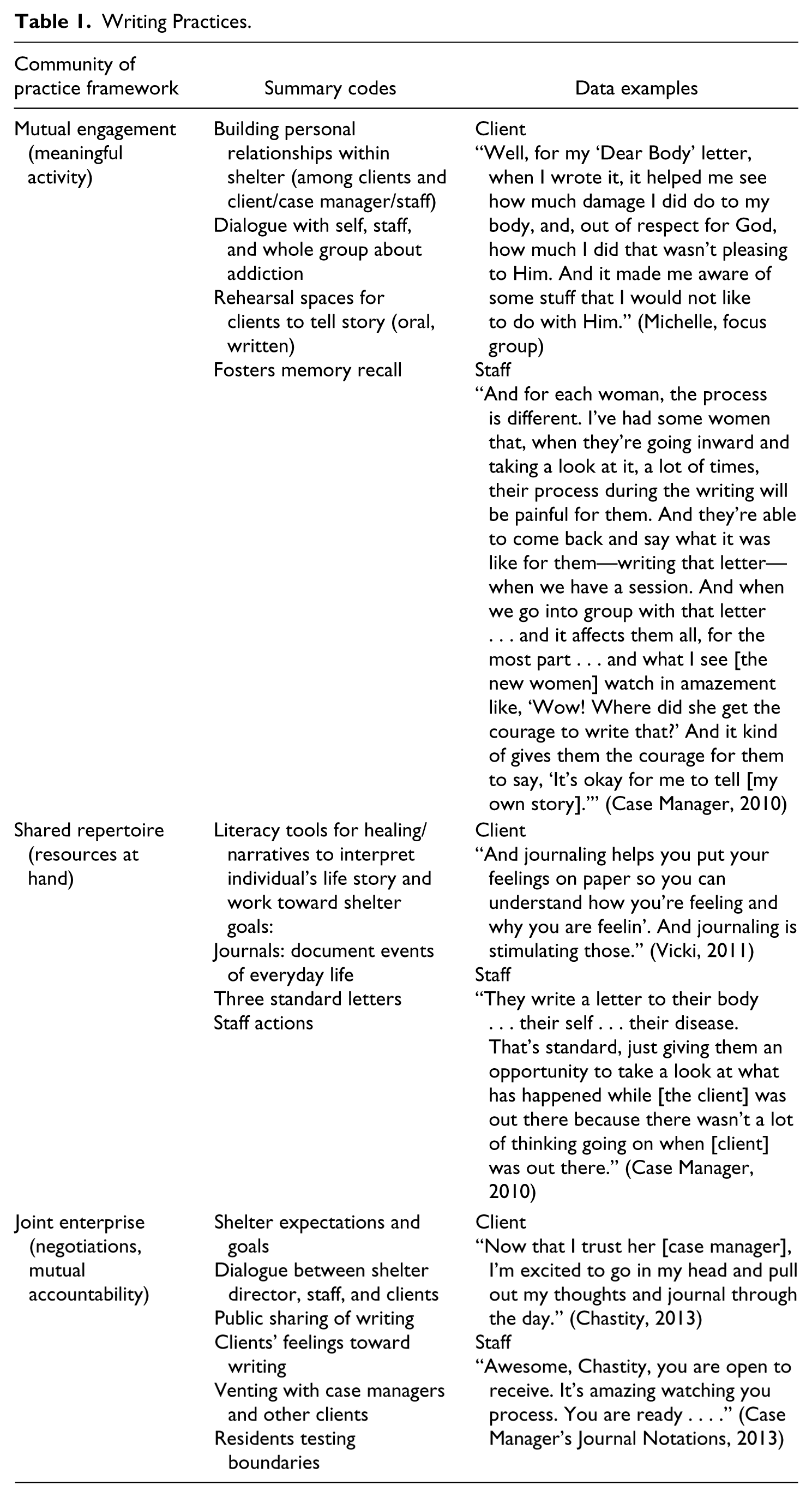
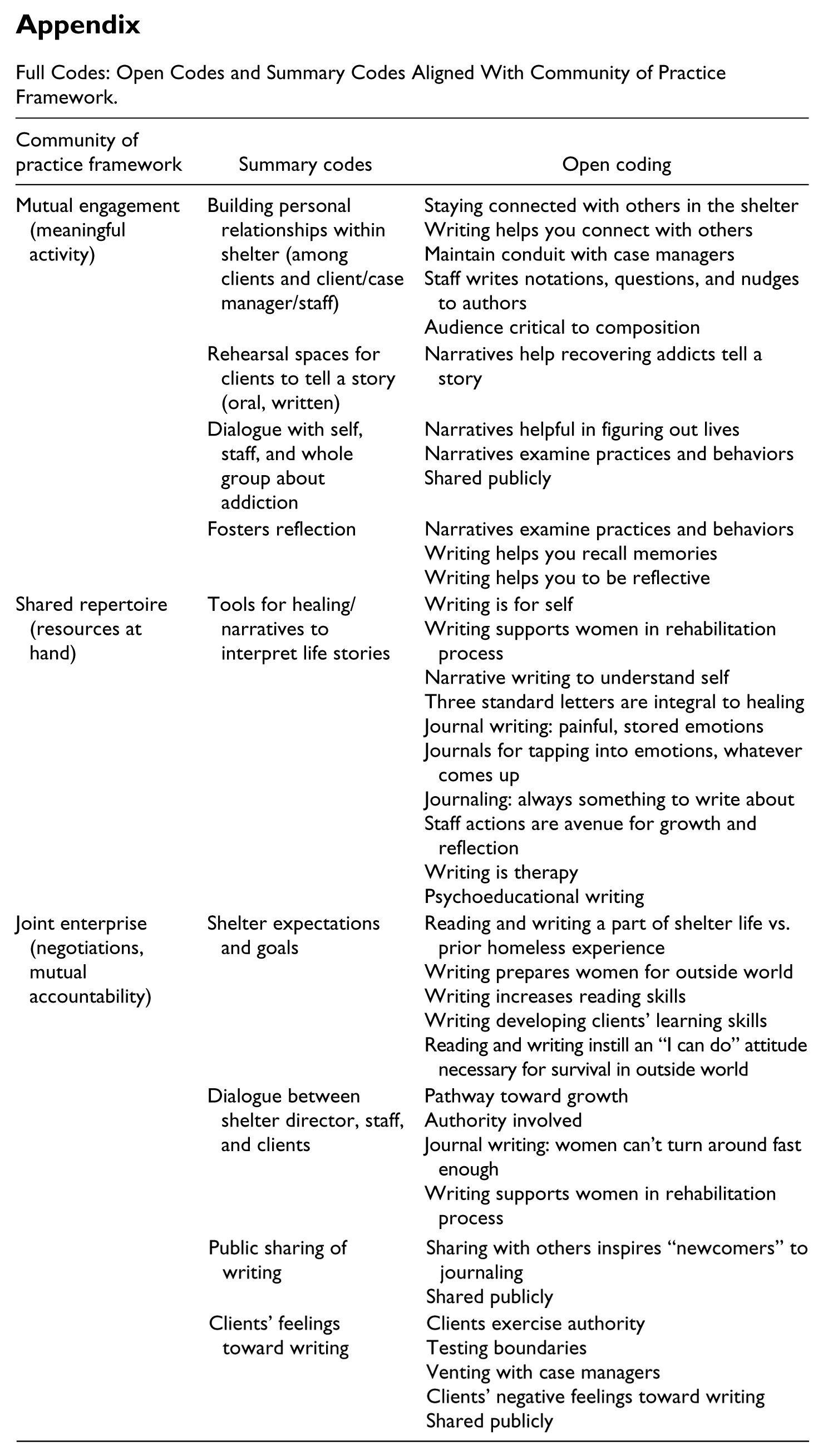
At this point, the initial open codes were collapsed into summary codes. For example, we found that, in this shelter setting, one form of shared repertoire included tools for healing (summary code), which included the use of journal writing for clients’ accessing “painful stored emotions” (open coding; Appendix A). Particular attention also was paid to how the meaning of the social literacy practice (Barton, 2001) served clients and shelter staff’s sobriety and parenting goals. From this process, we determined, for each mandated writing practice (i.e., literacy event), the following: (a) its role and contribution to the functioning of the shelter (Wenger, 1998), (b) the social processes of writing (Barton, 2001), (c) evidence of personal agency and the role of power (Foucault, 1982), and (d) any potential material consequences of writing (Luke, 2004).
The final step involved member-checking conversations with shelter residents to both confirm and disconfirm understandings. Most findings, such as the nuanced interaction between resident and client, as determined by an examination of journal sample artifacts and a case manager’s notations on staff actions, were confirmed. Our initial interpretation of the journal writing as burdensome, however, shifted to viewing it as both a space for a client’s self-exploration (Evans, 2004) and as a relationship-building tool with her case manager. Due to the first author’s long-term presence in the shelter, we have been able to sustain an ongoing exchange with the participants (Maloch, 2009) to assure trustworthiness of analysis (Lincoln & Guba, 1985).
Throughout this process, we kept reflective field notes and occasionally wrote memos in which we explored our assumptions, reactions, and judgments. We also spoke to colleagues with extensive knowledge about addiction and AA. Over time, we came to understand that mandated writing practices were considered supportive to clients’ personal goals, rather than disregarding of their agency and their privacy, as we had initially theorized. As we wrestled with issues of power in this setting, a final Foucauldian analysis enabled us to see power as a process exercised by both shelter staff and residents.
Researcher Positionality
Laurie, a university researcher, plays an active role in the New Beginnings’ shelter community by leading a weekly book club with the residents at the request of the shelter director. She also attends special events such as birthdays, observes tutoring, and regularly spends “downtime” with the mothers and children. The other two university researchers participated in two book club discussions and led two focus groups. Collectively, we analyzed data and wrote collaboratively.
We are all currently upper middle class. The first and third author self-identify as Caucasian; the second author self-identifies as Latina. None of us have yet to personally experience homelessness or addiction. Our lack of first-hand knowledge with addiction compelled us to listen deeply, engage in member checking, and ask frequent follow-up questions. We learned that the kind of transparency reflected in mandated, publicly shared writing practices was a valued part of this recovery program’s culture.
Finally, we were self-critical about how we selected examples to share in this manuscript, being mindful of the potential to perpetuate stereotypes of this population. The presentation of our findings is guided by our deep and profound respect for New Beginnings’ clients and staff in their collective journey to maintain sobriety and cultivate parenting and job skills to live independently outside the shelter.
Findings: Writing in This Community of Practice
A community of practice framework is useful in helping us to understand the nature of writing at New Beginnings for three reasons. First, it captures the way that the members of this community co-constructed notions of writing as part of their collective, shared repertoire. Second, it helps us to view each writing practice as a process of negotiation, with related expected tensions, between case manager and client. Because the goal of sobriety is shared among all members, conflicts between various community members are viewed as productive (Wenger, 1998). Foucault’s (1980, 1982) notions of power relations offer a critical examination of the way power was deployed among staff and residents.
Mandated Writing Practices
Multiple forms of writing served as a shared repertoire that was a part of the daily life at New Beginnings. These texts also served as examples of shelter residents’ mutual engagement. Structured tasks included brief AA program-related reflections and Bible study response booklets. Less-structured tasks included assigned essays with broad topics, such as, “Why am I here?” The most open-ended form was daily journaling. Typically, residents exercised autonomy in selecting journal topics, but occasionally the case manager recommended one.
Of all these various forms of shelter writing, we selected three types to discuss in this article: (a) required letters addressed to, for example, one’s body, one’s self, and one’s disease; (b) “staff actions,” which are on-demand, reflective writing assignments on a required topic due to an infraction; and (c) daily journaling. We chose these writing forms due to their similarity in purpose and intention (Bastian, 2010). That is, these were the mandated narratives that the women were expected to share with their case managers and, at times, with their peers. They are, therefore, representative of one kind of shared repertoire (Wenger, 1998) at New Beginnings.
Required letters: Writing connected to the AA program
As an integral part of their recovery program, all residents are required to compose narratives that encourage reflection about addiction and past actions early in treatment. The purpose of this “process” (Leslie, case manager) is to help the residents gain insight into themselves. Each letter attends to a specific facet of the clients’ lives that has been ignored or damaged during their period of addiction. At New Beginnings, letter writing involves a series in which the women “write a letter to their body. They write a letter to their ‘self,’ and they write a letter to their disease” (Leslie, case manager).
These assigned narratives are formatted as letters. However, the genre is appropriated, in the context of this recovery program, to provide its author with a focus that is potentially informative. Resident Michelle reflected,
Well, for my “Dear Body” letter, when I wrote it, it helped me see how much damage I did do to my body, and, out of respect for God, how much I did that wasn’t pleasing to Him. And it made me aware of some stuff that I would not like to do with Him.
Through letter writing, Michelle realizes the consequences of her former choices and projects the values she wants to have for the future, especially in terms of her relationship with God. The common format and content of required letters offered a shared repertoire for the residents to discuss their unique relationship with aspects of their disease.
As indicative of a community of practice, over time, group members display increasing competence with their sobriety as they work toward a common goal (Wenger, 1998). At New Beginnings, moment-to-moment living as a sober person is the stated objective. With required letters, residents directly address addiction. For example, Vicki described how she used the metaphor of a “wolf” in addressing her letter, in which she specified that she was “going to put it [the wolf, i.e., her addiction] in the cage, and God had the key.” Lynda opened her letters with, “Dear Self, I need to apologize to you. I treated you so bad. I treated you like you didn’t matter.” In another letter, composed in a similarly forthcoming manner, she spoke in the first person, to an aspect of herself. She began,
Dear Disease, I’m writing you a letter. In this letter, I’m going to tell you how I’m taking control back. I might always live with you [but] you will no longer hinder me. I’m learning how to deal with you.
The practice of letter writing allows residents to participate and recommit themselves to this lifestyle.
Although residents cited this practice as present in other treatment centers that they have experienced, they noted a specific approach at New Beginnings. For example, the case manager assigns letters based on her assessment that the resident is emotionally ready for the task. This subjective evaluation is based on a series of interactions with and observations of each client, both in individual and group therapy, including AA sessions.
As a joint enterprise, the writing process involves extended interaction between the case manager and the letter writer. Upon reading the first draft, the case manager offers feedback and may request revisions. The talk surrounding the writing is critical. Leslie stated,
And for each woman, the process is different. I’ve had some women that, when they’re going inward and taking a look at it, a lot of times, their process during the writing will be painful for them. And they’re able to come back and say what it was like for them—writing that letter—when we have a session.
Within this mutual accountability (Wenger, 1998), the case manager is responsible for drawing upon her personal and professional expertise to guide residents through the process of becoming sober.
As power circulates between client and case manager over the timing and topic (case manager-determined), the initial content (client-determined), and revisions (case manager–client negotiation), these interactions become the source of new knowledge and understandings that are reflected in the final product (Foucault, 1980). One resident elaborated on the interactive process with her case manager. Over time, she has learned to use language as a means of legitimate peripheral participation (Lave & Wenger, 1991):
I wrote my first letters a long time ago and she [my case manger] made me write them over. I cried forever with them first letters . . . [But] she said I didn’t show no feelings in them [sic] . . . Now, on the new letters I got my feelings words [for example] . . . “hurt,” “abandoned,” “scared,” “unloved,” “not wanted,” stuff like that. I guess [by crying], I was showing my feelings instead of writing them down and that’s how I got confused.
Through a process of negotiation, this client learns how to name her feelings through writing. This takes place first with her own physical emotional reaction as she creates an initial draft, and then with her learning to assign specific language to those feelings with the help of her case manager. A need to reconnect with how one feels is integral to addiction recovery.
Another distinct cultural practice at New Beginnings is the potential for a public reading of a client’s letter. When a case manager determines that sharing a letter would be good for the client and/or the community overall, writers read their work aloud during a group session. Healing then becomes a joint enterprise as shared letters create momentum for the community. Case manager Leslie explained the insight gained by residents as they witness this public sharing,
The beautiful part about it, especially for the newer women, and it affects them all, for the most part . . . what I see them do . . . is sit back and watch in amazement like, “Wow! Where did she get the courage to write that?” And it kind of gives them the courage for them to say, “It’s okay for me to tell [my own story].”
In this way, the reaction of newer clients, as legitimate peripheral participants (Wenger, 1998), to their peers’ words helps to signal when they, too, may be ready for this endeavor.
This public reading provides opportunities for mutual engagement by residents who participate together in practices that are important to the shelter goals (Wenger, 1998). Peers are responsible for listening and initiating their response using the phrase, “What I got in touch with when I heard you say . . . is . . .” (Ms. Carpenter, shelter director). One resident explained the purpose of this structure in terms of peer accountability: “So the focus stays on the woman [sharing her letter].” The emphasis is not on producing a perfect letter but, rather, creating and sharing the writing as a social practice (Barton, 2001). The sharing among clients attests to power’s multidirectionality in this setting. Case managers decide when a critical idea is shared through the letter. Residents employ the case manager–directed linguistic frame to connect cognitively, emotionally, and/or spiritually with her words. There is an assumption that when a letter-writer shares, she has the power to move the group forward while also supporting her own growth.
From the clients’ perspective, being the letter reader is where meaningful progress emanates. As Diana explains,
[We] come back in group [therapy] and process cause it’s like self-nourishment . . . self-healing. It helps. It really does. A lot of stuff that you probably haven’t been able to say to that person, or a lot of stuff that you did to that person, or vice versa and then whatever the case may be you get to write on paper and say how you really feel, and stuff like that. Sometimes it can get emotional, sometimes it’s not emotional. But there’s a lot of stuff in there.
Her peer Carol confirms:
She’ll [case manager] want you to stay with that and come back another day . . . It’s good for the soul. You don’t even get to get off of bringing all that stuff back up and here she is coming the next day with another one. It’s like, “Dang!
The case manager’s intention is for both the group and the individual to benefit from the public reading of a carefully crafted letter. Clients affirm that the person sharing her work in a deeply personal way values the process. In addition, the notion that these thoughts and feelings are not just dropped after the reading, but are instead revisited over and over supports both individual and group learning in this community.
Staff actions: Writing connected to disciplinary consequences
When shelter rules are broken, a staff member may assign essay writing as a consequence, referred to as “staff actions.” For example, if a resident gets into an argument, uses profanity in front of children, neglects to clean her room, and/or leaves the premises without permission, a staff action often occurs. A writing assignment directly related to the infraction often accompanies a loss of privilege, such as the loss of cigarette-smoking breaks or the denial of a weekend pass.
Members of this community of practice shared a nuanced understanding of staff actions in that they did not unequivocally view the exercising of this power as oppressive (Foucault, 1980). One case manager, Ann, asserted, “Staff actions are never punitive.” Resident Ellen tempered, “They’re not necessarily punitive. They are there to make you aware of your behavior and how it’s hurting you.” Her peer Chastity reinforced the perception that staff actions were part of their new life:
Consequences behind staff actions come from recovery. It’s to instill and to teach that there’s just certain things that you’ve got to do, certain things you’ve got to let go of, if you want to stay living a recovered life. At some point, you’ve got to follow rules. At some point, you’ve got to do what’s expected.
This mandated writing practice helped develop residents’ ability to begin to self-regulate (Gallagher, 2008) by offering an opportunity to analyze one’s own behavior in print.
Residents described how they learned from composing staff action essays. During a discussion about staff actions, Sylvia described one example of how, after initial confusion, she gained insight from the process. She had been asked to write about “pursuing authority figures.” Reading an AA-related pamphlet on specific personality types led her to understand her prior tendencies and patterns to manipulate those in charge to achieve her goals. She reflected on the value of her case worker providing relevant literature and realized that “doing that paper [staff action] brought up stuff for me . . . I mean, it took me back to a place . . . when I was younger . . . ”
Similarly, Ayla reflected on her actions and her reasoning in a staff action:
I had to do [one] because of boundaries. I crossed staff boundaries, which I was arguing with staff. And so then I had to write which boundaries I crossed with them and why did I cross their boundaries, because usually if you write something, you think about it . . . you’re retraining your brain.
Incorporating the vocabulary of recovery into their descriptive repertoire and the reflective process was meaningful for their sobriety work.
Once complete, most staff action essays were posted on a bulletin board. This led to residents’ common knowledge in these close quarters. Clients were also sometimes asked to share their writing in group therapy sessions when deemed appropriate by their case manager. Chastity described multiple purposes involved with the sharing of staff actions. Initially when written, the client was expected to learn from the experience. When shared, that is, “processed,” with the whole group, staff actions served another purpose. She explained that sharing is meant, “ . . . to show you how you’ve grown and how you’ve changed. You came through that. And sometimes in here we’re hopeless. We just don’t think change is going to happen.” In this context, staff action essays serve as a form of shared repertoire (Wenger, 1998).
Clients nevertheless described receiving staff actions as a potentially difficult emotional experience. Portia recalled, “When I first got my first one, I cried like a baby. And it’s just a piece of paper.” Ellen, a longtime resident, commented on how her response to staff actions has changed over time:
But I got one a couple of weeks ago, and I was able to not get as pissed off when I got it and see what I needed to learn from it, discuss it, and process it in therapy with a couple of the counselors, and then wrote my paper on it.
She described the nuances of the process. While she shared that she did not think that all staff actions were necessarily valid (e.g., being late to breakfast), they could still serve an important purpose:
But if it’s a behavior that really needs to be addressed and changed, then . . . [onetime] it was a situation in the middle of it that I actually did not see what I was doing wrong. And the way the staff handled it, the way I was receptive to it, it just all happened in a very okay manner I guess for lack of a better word. But when they presented it to me I spent time in session with [three case managers]—all three of them about it. And then my consequences [assigned staff action writing] were after that process. And so, I was able to go through pretty much most of the range of emotions during the process and when I got the consequences was able to be okay with it.
Staff actions, resulting from a particular behavior, indicate “how disciplinary practices operate to create order, knowledge, and ultimately power effects” (Townley, 1993, p. 522) for the shelter and for the client herself. In this way, an understanding of its role in the overall healing process ameliorates the unpleasant experience of a staff action.
At times, residents displayed a reenactment of power (Foucault, 1982) in seemingly playful retellings of staff action stories when shelter staff was beyond earshot. Women egged each other on with reminders of the behavior that instigated the required written response: “And then you . . . .” “And you yelled it down the hall . . . .” In this informal way, the reflection on the incident also was communal. Such teasing in retelling reflects the “collectively negotiated response” (Wenger, 1998, p. 78) to the infraction. Openly joking with one another about their writing also serves as a reminder of a resident’s need to adhere to New Beginnings’ rules and to remain a part of the group. In these instances, there is acknowledgment of their solidarity but not an acceptance of any disruptive behavior or permission to continue it. In other words, the group maintains mutual accountability (Wenger, 1998) as shelter participants engage in shelter practices embedded in daily efforts to maintain sobriety.
Wenger (1998) notes that a community of practice captures the wide range and complexity of human interaction, including “resistance and compliance” (p. 77). Similarly, Foucault suggests there is a “human capacity for resistance to domination and the capacity for self creation” (Schaafsma, 1998, p. 257), although there are limits defined by context. For example, Sylvia remarked that when she did not understand a staff action, she would employ a peer’s assistance to craft an adequate response. In another example, Erin perceived the writing length requirement as excessive for her infraction. She explained that the children’s case manager had assigned five pages instead of the usual one to three pages, on the topic, “Why do I think it is okay to slap my children?” Overwhelmed with the task, Erin padded her essay with two and a half pages from Scripture. She suspected that this approach “would backfire in some way” in that the case manager was not going to accept her liberal appropriation of Bible verses. This disruption resulted from the resident’s response to the case manager’s overreach in asserting her power, thus compromising Erin’s opportunity to learn from the experience of writing a staff action. Erin’s choices reflect how resistance can be, but is not always, productive.
Staff action essays and the associated processes of negotiation were a shared repertoire (Wenger, 1998) integral to New Beginnings. The sharing, particularly the residents’ capacity for cajoling one another, offered a concrete example of power as relations, in that it permeates throughout the community (McHoul & Grace, 1993). Similar to the AA letters, staff actions allowed clients to reflect on behaviors that detracted from the community’s goals of New Beginnings and had the potential to interfere with their commitment to sobriety.
Journaling: Writing connected to facilitating intra- and interpersonal relationships
Residents are required to keep a daily journal in which they are encouraged to write their thoughts, impressions, and feelings. Residents must turn in their journals to their case manager, in effect making what is traditionally a private process dialogic. The case managers offer accountability (Wenger, 1998) by providing some level of feedback. They read the journal approximately twice a week, put a check on the top of each page, and, occasionally, add comments, prompts, and/or questions. As indicative of participants’ agency (Perry, 2012), some clients carry their journal with them everywhere and write at spontaneous moments, while others might cram a week’s worth of entries into one long protracted sitting.
The ability to get in touch with one’s own everyday processing of events is a behavior seen as key to maintaining sobriety. As resident Vicki explains, journaling is a tool to reawaken and harness the complexity of her emotions:
Journaling is like drugs and alcohol; it sends out this drug dopamine and oxytocin. So when we stop drinkin’ and druggin’, we’re basically like zombies ‘cause we don’t know how to feel. And journaling helps you put your feelings on paper so you can understand how you’re feeling and why you are feelin’, and journaling is stimulating those.
As she spoke during a focus group, her peers nodded in agreement. As with other writing practices, journal writing also was part of the collective, shared repertoire (Wenger, 1998).
While the journal content, at times, mirrors the monotony of rigid schedules, it also provides glimpses into the raw reflections of addicts in the throes of recovery. Interspersed among handwritten recitations of the activities of the day (“When I woke up this morning . . . ”) are questions and dilemmas surrounding sober parenting, living closely with others in an institution, and wrestling with selfish behavior. One of the explicit norms of this genre of writing is to not consider audience when deciding what to say. As resident Ellen stated, “I think probably one of the main points they try to teach us is to not write what we think they want to hear.” Still, she notes,
[My case manager] tries to stay on me because journaling for some reason is an issue for me. I know in my head that there is a magic that happens between the pen and paper, but all I feel like I’m doing is writing a conversation to her that I’m getting ready to have.
Her experience is emblematic of the inherent difficulty of this practice.
Clients utilized a variety of strategies as they approached choosing what to write in their journals. Case manager Ann described her guidance to shelter residents on the process,
Basically, [I] tell them, “Just go through your day. Whatever goes through your day be able to write it down. If you’re able to tap into the feeling—how you felt about the situation—write it down . . . ”
Residents also found topics from the resources available at New Beginnings. They explained that they would sometimes use the language that they were acquiring through the 12-step curriculum in their journals (e.g., “alcohol was only a symptom . . . ”) as a prompt for their writing. Sylvia was sometimes inspired by the selections from the shelter’s book club. Drawing from the novel Suicide Notes (Ford, 2008), she credits the text as a springboard to reflective writing:
It really jogged a whole lot of feelings I had had about myself when I was younger and how I felt people perceived me when I was young . . . and brought up a lot I could journal about.
Since part of becoming independent is making one’s own choices, journaling is a safe place to rehearse that skill through the selection of writing topics.
Case managers’ reviewing of journals is one of the shared practices that functions as mutual engagement since it, “involves not only one’s own competence but also the competence of others” (Wenger, 1998, p. 76). A Foucauldian analysis provides insight into the way the case managers deployed power through, for example, their feedback, to develop the residents’ ability to govern themselves. Case manager Ann shared, “And what I do is read over it . . . And I encourage them if I see they’re on the right track [and am] honest with them if they’re not on the right track.” Case manager feedback varied from small margin notes that emphasized key points, such as “truth” and “insight,” to the circling of feeling words, such as “happy” and “thankful,” to more expansive notations. Chastity was eager to read aloud her case manager’s affirmation at the top of one entry: “Awesome, Chastity. You are open to receive. It’s amazing watching you process. You are ready. It’s evident you remain the student. Good insight about self.” Comments such as this helped the relationship between them to grow. Chastity stated, “Now that I trust her, I’m excited to go in my head and pull out my thoughts and journal through the day. And when I have to turn it in, I’m excited about getting it back.” Beyond helping the women to connect with their own feelings, journal writing serves as an indicator of their interpersonal connection with their case manager.
Even with these opportunities to build positive case manager–client relationships, some women confided that they wrote what they believed that the case manager wanted to read. During a focus group, when resident Cinnamon boasted how she repeatedly wrote, “I have the best case manager,” other women broke into peals of laughter. Resident Erin shared that, at times, she appropriated the journal to pursue personal goals. Prior to making a formal request to the case manager to visit her baby’s father before he entered jail, she wrote extensively about how much she was looking forward to seeing him. These examples demonstrate how women used their “inventive resourcefulness” (Wenger, 1998, p. 79) to make aspects of the assignment fit their needs. One case manager shared her awareness that there were times when the residents would concentrate on pleasing her. From her perspective, residents are more likely to write what they think that she wants to hear prior to recognizing that the process is “for them.” In this way, journals also function as a documented assessment of residents’ progress toward healing.
Journaling is an open-ended practice that encourages introspection. Bearing in mind that Wenger’s (1998) frame recognizes that a community of practice is not always a harmonious state, the shelter residents’ push and pull is expected. Journals capture the often-painful process of self-examination considered essential to recovery. In this way, it carries significance as something that is meaningful and as something that can be manipulated. Case managers deployed power in having residents practice exploring their emotions through journaling (a strategy for managing addiction) and assessing their recovery progress. Clients’ preoccupation with the case managers’ supervisory role led to a misinterpretation of the writing assignment. As a result, their approach tended to circumvent journal writing as a healing tool and appropriate the practice to suit different purposes. Thus, these power relations created knowledge grounded in specific interactions in the shelter space (Foucault, 1980). This shifting nature speaks to the complex role that writing plays in this community.
Discussion
New Beginnings as an institution has a clear purpose that is understood both by shelter staff and residents. The nature of the writing practices supported members of this community in their work on sobriety, and related to that, their economic independence and competent parenting. A community of practice theoretical framework has utility in describing what takes place in such a setting. In keeping with Wenger’s (1998) notion of community of practice, it is not just the accumulation of knowledge, but also the creation of new knowledge (Foucault, 1980, 1982) through social processes, that matters. The collective mutual engagement, with the help of a particular and shared repertoire of mandated writing practices, was accomplished to varying degrees through joint enterprise. That is, residents and staff negotiated responses and were accountable to one another.
Writing as a Social Practice That Strengthens Community
A perspective of literacy as a social practice highlights the ways that reading and writing fulfill personal and meaningful goals (Barton, 2001; Street, 2001, 2004). This frame has been used to explore the voluntary and purposeful nature of shared writing experiences (Ahearn, 2004; MacGillivray & Curwen, 2007; Perry, 2008) for cementing bonds and establishing relationships. In this article, we analyzed New Beginnings’ context-specific norms and routines (cf. Bloome & Clark, 2006) and identified three mandated tasks that were productive, workable, and even desirable for both individuals and the community.
Notably, these common writing tasks were integral to a well-articulated community’s broader meaningful purpose of sobriety (Wenger, 1998). As these tasks are shared interpersonally (between client and case manager) and publicly with the group as a whole, an environment of mutual trust and respect was created.
Through an exchange of the shared-genre repertoire, including letter writing, consequence accountability, and daily journal writing, all members in the New Beginnings’ community worked on individual and collective sobriety. These assignments also helped case managers gauge clients’ progress and willingness to affiliate with a sober lifestyle. The encouraging feedback to a client’s continual efforts to face challenges contributed to an environment where taking emotional risks was expected. When clients’ writing was made public—the timing judiciously selected by a case manager—residents could have confidence that their most intimate written reflections, epiphanies, and self-critiques would be received with empathy and compassion. By the same token, the client sharing the writing with her peers experienced the benefit of personal realization in revealing her writing. The interactions, which give meaning to social processes, are particular to New Beginnings. Associated power relations are understood when contextually analyzed (Foucault, 1980, 1982). That is, the ways in which people related to one another shaped and was shaped by shelter aspects such as the dominance of AA, the expectance of mandated writing practices, and the formation of resident–case manager and peer relationships.
As Wenger (1998) noted, “As a locus of engagement in action, interpersonal relations, shared knowledge, and negotiation of enterprises, such communities hold the key to real transformation—the kind that has real effects on people’s lives” (p. 85). A practice possibly deemed punitive from outside observers could, at New Beginnings, be perceived by insiders as generating new understandings. These contextual characteristics of mutually agreed-upon goals, a trusting environment, and clear expectations hold promise in understanding writing’s potential for individuals’ growth. These social aspects can be considered in contexts in which shared writing experiences are similarly required, such as in schools or rehabilitation settings (Bridwell, 2013; Rivera, 2003, 2004). Research into sociocultural processes of literacy practices reveals that learning takes place in everyday settings (Schultz, 2006) and provides glimpses into understanding how mandatory writing can be viewed less as oppressive (Evans, 2004) and more as potentially meaningful. It also reveals the tensions inherent in communities as an expected part of the process (Wenger, 1998).
Social Processes of Writing as a Signal of Legitimate Participation
Affiliating as a member in a community and gaining the skills valued by the community leads to full participation in the community (Lave, 1991). Through full-time shelter residency in New Beginnings, there are multiple ways in which the shelter’s residents participate. As they engage, clients acquire the language of recovery and the ability to document and articulate their growth as members of this community (Lave & Wenger, 1991). Attending substance recovery meetings, Bible study, GED preparation courses, or parenting classes were examples of authentic activities of legitimate participation as a member of this shelter.
By exploring writing practices as a shared repertoire (Wenger, 1998), we gain an understanding of how residents are given opportunities to move closer to creating a new identity as sober individuals. Letters to self, staff actions, and journaling are pathways for women to reflect on their actions and to imagine new ways of seeing themselves. The writing is a tool with explicit norms and routines for genre, format, audience, and feedback from shelter staff and peers in the program. It serves as a resource with which power is experienced and exercised (Lemke, 2002; Manias & Street, 2000; McHoul & Grace, 1993) during recovery. Through these writing tasks, meaning is created as power circulates (Foucault, 1980) among case manager, client, and peers. Through mandated writing, this shelter provides opportunities to practice sobriety, specifically through residents’ reflecting on past actions and the consequences of decisions and in reconnecting with their emotional selves. In this way, writing represents a form of legitimate peripheral participation in the construction of a sober identity.
Due to the severity of the issues with which residents are learning to cope, full participation in writing activities becomes more urgent than it might be in a different learning context. In addition, the material consequences (Luke, 2004) of participating in various social practices of writing in an intentional community like New Beginnings are significant. Every day a client is engaging with some degree of legitimate peripheral participation (Wenger, 1998), she and her children are safely housed, and she is sober. For this reason, the shared repertoire in this shelter, including writing practices, are crucial.
Social Processes of Writing as a Site of Tension and Documented Dialogue
Members of the New Beginnings community used a variety of strategies to deploy power. As in all communities of practice, there are fissures and ruptures as members strive to achieve their goals (Perry, 2012; Wenger, 1998). As Manias and Street (2000) state, “For Foucault, the struggles of resistance do not rest with those who authorise institutional power . . . resistance is an issue for all individuals (p. 54).” Both clients and case managers determined the “what” (content through writing and editing) and the “how” (process of drafts, feedback, revisions, and sharing work with the community). This recursive process involved continual negotiation, as the mandated writing practice became something to rebel against, engage in, and/or take up as one’s own when the client has recognized its value. These interactions reflect the mutually understood goals of shelter rehabilitation work, while also acknowledging that forward progress rarely has a straight-line trajectory but, instead, is full of potential setbacks.
Due to its social nature, writing in this context is what we term a “documented dialogue” of the shared history of the community of practice at a particular moment in time. By this we mean that the words that are on the page of any given assignment are reflective of the individual’s ideas as well as her daily experiences in the shelter, including the multiple conversations with her case managers and peers (cf. Street, 2001). The choice to share and process pieces of writing with the group as a whole at different points furthers its influence on the individual and the community. In this way, both case managers and residents collect evidence of their evolving relationship with each other and with sobriety, specifically as it relates to residents’ movement along individual trajectories.
Residents’ resistance seems to be a part of their learning and part of their uneven acceptance or willingness to comply with the shelter staff’s writing mandates. Case managers acknowledge that a resident’s writing may contain content to appease, mollify, or even vex them. They recognize, however, that a resident’s personal intent is part of the social process of building a trusting relationship with the case manager and developing the ability to reflect on their own life experiences. Still, “[p]ersuading people to participate in their own subjection . . . can be seen as the most cunningly efficient mechanism of power [that enables] those who govern to do so with the bare minimum of intervention” (Gallagher, 2008, p. 12). At New Beginnings, when the residents begin to write for themselves (and at times, for their case manager), the belief is that they are part of a community committed to sobriety.
Conclusion
In our exploration of the question, “What is the nature of writing in a homeless shelter committed to the rehabilitation and recovery of mothers from addiction?,” we assert that New Beginnings, as an entity, embodies Wenger’s (1998) notion of a community of practice. We suggest recognition of the social nature of writing is a key component in supporting residents’ sobriety. Furthermore, the circulatory aspect of power relations (Foucault, 1980, 1982) supports an institution charged with a critical societal task of stabilizing families.
Our work invites additional research about the role of writing, particularly mandated writing, in learning communities. While the examples here demonstrate that writing is a useful tool in this specific context, we question whether simply implementing these practices in similar recovery settings would merit comparable benefits. It is not the particular acts of letter writing, staff actions, and journaling that are critical but, instead, it is the social aspects of the writing community that support an individual’s day-to-day sobriety. In other words, who is participating in each task, their personal judgments about their approach to the task (i.e., how legitimate to make the exercise), what the expectations are for the performance of the task, and how participants work through related tensions and ultimately reflect on the event, must be foregrounded in writing activities.
Implications
Two implications for viewing learning contexts through the theoretical lenses of a community of practice (Wenger, 1998) and Foucault’s (1982) notions of power are key. First, literacy practices that may be deemed punitive from those outside of a community can be perceived as meaningful by the participants within. Second, while it is assumed that asymmetrical power relationships within organizations are unproductive, adversarial, and disengaging, this study showed that differentiated roles can serve important purposes in meeting the specific goals of a particular learning community. Therefore, attention to intention and process informs our understanding of the situated nature of literacy.
Footnotes
Appendix
Full Codes: Open Codes and Summary Codes Aligned With Community of Practice Framework.
| Community of practice framework | Summary codes | Open coding |
|---|---|---|
| Mutual engagement (meaningful activity) | Building personal relationships within shelter (among clients and client/case manager/staff) | Staying connected with others in the shelter Writing helps you connect with others Maintain conduit with case managers Staff writes notations, questions, and nudges to authors Audience critical to composition |
| Rehearsal spaces for clients to tell a story (oral, written) | Narratives help recovering addicts tell a story | |
| Dialogue with self, staff, and whole group about addiction | Narratives helpful in figuring out lives |
|
| Fosters reflection | Narratives examine practices and behaviors |
|
| Shared repertoire (resources at hand) | Tools for healing/narratives to interpret life stories | Writing is for self |
| Joint enterprise (negotiations, mutual accountability) | Shelter expectations and goals | Reading and writing a part of shelter life vs. prior homeless experience |
| Dialogue between shelter director, staff, and clients | Pathway toward growth |
|
| Public sharing of writing | Sharing with others inspires “newcomers” to journaling |
|
| Clients’ feelings toward writing | Clients exercise authority |
Authors’ Note
All authors contributed equally to this article.
Declaration of Conflicting Interests
The author(s) declared no potential conflicts of interest with respect to the research, authorship, and/or publication of this article.
Funding
The author(s) received no financial support for the research, authorship, and/or publication of this article.