




Abstract
Using participatory action research, the first researcher functioned as co-teacher in a fifth-grade class in a large northeastern city public school. The researcher and classroom teacher guided 28 students working in book clubs to compose digital stories in response to historical fiction. The research questions were: (a) What interpretations did students have of their historical fiction novels through the mediational tools of digital storytelling? (b) How did the dynamics of the book club structure contribute to the students’ interpretive work? Data sources included students’ process and product work, video and audio recordings of work sessions, reflective notes and journal, a semi-structured interview with the teacher, and stimulated recall interviews with three case study book clubs. Both researchers used multimodal analysis, particularly the concept transmediation, concepts of interpretation in reader response, and grounded theory, informed by activity theory, to analyze data. Findings show students’ expression of and limits to interpretation in the multimodal ensembles of their digital stories. The purposeful use of digital technology generated ongoing problem solving. Activity systems expanded students’ learning by generating collaborative zones of proximal development, a dialectic among mediational tools, and opportunities to take on roles that shaped students’ identities and repositioned who they could be in this learning community. The study shows the value of project-based multimodal responses using digital technologies in collaborative groups to develop students’ comprehension of literary texts. The study suggests an alternative to writing-to-learn practices that dominate the implementation of the Common Core State Standards, and that high-stakes tests reify.
Even in schools that have access to digital technologies, classroom teachers continue to face conditions that privilege verbocentric, paper-based responses to literature (Hassett, 2006; Shanahan, 2012, 2013; Siegel, 2012). The Common Core State Standards (CCSS) emphasize expository responses to literature, guiding students to make claims and use textual evidence in support of an argument (National Governors Association for Best Practices & Council of Chief State School Officers [CCSS], 2010). State standardized English Language Arts (ELA) exams, with the aim of testing whether students have achieved the standards, align with this narrow range of responses (Bustle, 2004; Kesler, 2013; Siegel, 2012). For example, on Day 3 of the 3-day New York State ELA (see http://www.engageny.org/resource/test-guides-for-english-language-arts-and-mathematics), students in Grades 3 to 8 write an extended response essay synthesizing textual evidence from two passages that are related thematically or topically. If the adage “what is tested is what is taught” is true, and teachers want students to score well on the state exam, then they will provide ample practice writing these kinds of essays throughout the year.
Classroom teachers have experienced students who are disengaged and unmotivated to write countless literary essays in response to reading. They have also experienced students who struggle to express their literary ideas in writing (Dutro, Selland, & Bien, 2013; Kesler, 2013). How might teachers provide conditions that guide students toward deep, interpretive readings of and responses to literature, as the CCSS specify, using a broader range of ways to express meaning? This article presents a study that built on the interpretive possibilities of multimodal responses to literature within a collaborative classroom context. In this study, fifth graders in a public school in a large northeastern city created responses to historical fiction in book clubs using digital storytelling. By analyzing their process and products, we address the following two research questions:
Theoretical Framework
To address our research questions, we began with a deep commitment to complex meanings and enactments of literacy in a classroom context. We also had to operationalize our conceptions of interpretation, multimodal composing as required in digital storytelling, and dynamics. We developed our framework by weaving concepts within three related theories: reader response theory, social semiotics, and activity theory.
Reader Response Theory
This study is based in transactional reading theory that views the interpretive process as transactions between a reader and a text in a specific context. Rosenblatt (1938/1995, 1978/1994) developed the concept of evocation to describe a reader’s work in the transaction as a lived-through experience of a text that crystallizes into a response. In the transaction, the signs of the text prompt associations with the reader, who in turn constructs meanings for the signs. The evocation—the text that the reader constructs—is an act of interpretation that transforms the reader and, as this article will show, generates further interpretation. Scholars (e.g., Dressman & Webster, 2001; Lewis, 2000; Sloan, 2002) cautioned that Rosenblatt’s term evocation privileges students’ initial uncritical and often naïve personal feelings, images, and associations to a text. They emphasized the need for “the reinfusion of social and cultural understandings into aesthetic experiences and the collective meanings those experiences produce” (Dressman & Webster, 2001, p. 142), calling for more studies that investigate “the troubled interface between reader-response theory and classroom practice” (Faust, 2000, p. 10). Lewis (2000) suggested a broader conception of aesthetic response that “addresses the social and political dimensions of texts and invites students to take pleasure in both the personal and the critical” (p. 264). A review of writing-to-learn studies from the 1980s and early 1990s, including the material texts of reader response, recognized the imperative to consider “contexts for learning as much as individual processes or attributes of writing” (Ackerman, 1993, p. 342). Smagorinsky (2001) used the term the transactional zone of meaning construction to emphasize how this response is constructed between a reader and a text, mediated by cultural norms and practices that are expressed in particular contexts of joint activity.
Salomon (1993) considered meaning in reading to be a function of distributed cognitions, in which “people . . . think in conjunction or partnership with others and with the help of culturally provided tools and implements” (p. xiii), including texts, even when the act of reading occurs in isolation. Thus, meaning construction is inherently relational, negotiated, and dialogic (Smagorinsky, 2001). In the transactional zone of meaning construction, evocations are not anything goes; rather, they are grounded in the inscribed codes of the author, composing within the culturally accepted conventions of particular genres. These kinds of evocations are what Rosenblatt (1938/1995) called “a warrantable interpretation” (p. xix) and what Faust (2000) termed responsible reading. A responsible reading uses textual evidence “as a means whereby readers speak up to account for their own reading and listen up to what others have to say about their experiences with literature” (Faust, 2000, p. 29), by creating conditions where students could produce, share, and revise literary experiences. Within a particular context, response is intertextual, orchestrating diverse texts, including the focal text, into a complex whole. In addition, “the material texts produced both respond to and serve as signs from which new sense may emerge with further reflection” (Smagorinsky, 2001, p. 150); thus, each response is provisional and generative, with the potential of producing further evocations. Faust (2000) stated that a responsible reading “acknowledges the literary work as temporal and situated in ways that rule out any conclusive determination of its meaning” (pp. 29-30). In our study, we aimed to establish classroom conditions for responsible reading that would enable transactional zones of meaning construction. From our literature review, we planned to analyze our data for negotiated, provisional, and intertextual conceptions of interpretation.
Transmediation and Multimodality
In our study, the material texts produced were digital stories. For analysis of each group’s digital story, we utilized the concept of transmediation (Suhor, 1984) across modes of expression. A mode is an organized set of resources, or a sign system, for meaning making, with historically, culturally, and socially based regularities, or a grammar system (Kress, 2003). Examples of modes are speech, movement, gesture, image, music, and increasingly, multimodal compositions that digital technologies make possible. Because each sign system expresses particular affordances and constraints, there is no direct correspondence between a linguistic text, such as the historical fiction novels in this study, and any sign system. Readers inevitably face anomalies, where there is no ready-made equivalent meaning in one mode to express the textual meaning that they intend. To problem solve, readers must think critically and be inventive as they use a sign system to represent meaning. Based in Peirce’s (2011) triadic system of semiotics, in transmediation, learners transform understanding by building connections that map the content of one sign system onto the expressive plane of another through metaphorical associations (Siegel, 1995, 2006; Suhor, 1984), which is deeply engaging work. As they work across sign systems, readers might generate new meanings and gain new interpretive levels.
Kress (2003) explained that every mode has constraints and affordances that both construct and compromise meaning. Composing and recomposing texts across modes is design work that Kress called “the sine qua non of informed, reflective and productive practice” (p. 37). By engaging in design work, the text “as interpreted by the reader is always a transformation of the maker’s meaning” (p. 39). The generative potential of sign making, because it exists for communication, only has power contextually (Kress). In multimodal ensembles, authors represent meanings in each mode based on aptness, or the meaning potentials that the resources in each mode are able to express. One mode might carry more of the information, or functional load, than others in any part of the multimodal ensemble. Each mode carries partial meaning, and the intermodal relations resonate to produce logical simultaneity and semiotic fullness greater than the sum of the parts. Multimodality then focuses on the orchestration of all modal resources to construct meaning (Kress). For our purposes, digital storytelling combined still images, music, sound effects, voiceovers (as narration or dialogue), and print to tell a story, in this case, in response to each book club’s historical fiction book. By generating metaphoric thinking, we reasoned that multimodal forms of expression, in the context of joint activity, would provide opportunities for transactional zones of meaning construction for the students in our study. We analyzed each group’s multimodal ensemble for evidence of students’ interpretive work by noting evidence of transmediation in the intermodal relations of their digital stories.
Several studies in multimodal reader response informed our conception of interpretation. McCormick (2011) studied transmediation as sixth-grade students expressed meanings about complex texts in poetry, dance, and visual arts that fostered their analytical conversations and their abilities to engage in complex language functions central to academic discourse. The act of transmediation gave them “the opportunity to look closely at the structure of a text and articulate the relationship between part and whole. This articulation is an academic language function, an analytical skill necessary for success in middle schools and beyond” (p. 587). McCormick’s study showed the need for more studies that explore analytical thinking of complex texts through multimodal engagement, as our study aimed to do.
Smagorinsky and colleagues studied high school students in both alternative (Smagorinsky & Coppock, 1994, 1995a, 1995b) and mainstream (Smagorinsky & O’Donnell-Allen, 1998, 2000) high school settings that established and encouraged collaborative, goal-oriented multimodal reader response. Their findings show “the dynamic interplay of reader, text, and context in the construction of meaning” (Smagorinsky & Coppock, 1995a, p. 294) and that multimodal “forms of response have similar potential for promoting learning to that generally ascribed exclusively to writing, depending on the extent to which the psychological tools are valued in the setting” (p. 295). Consistent with our sociocultural conception of reading, two aspects of “dynamic interplay” were particularly pertinent to our conception of interpretation. First, this set of studies shows the provisional nature of readers’ responses: “The richness of textual meaning, therefore, results from the generative quality of a transaction in producing new associations that, once provisionally articulated as a text, produce new iterations of sense and articulation” (Smagorinsky, 2001, p. 150). Second, this set of studies shows the dialogic role of reader response: “The process of reading is a mediating act with a dialogic function: The students’ thoughts both shaped and were shaped by the articulated texts they composed” (p. 152).
By using digital storytelling, our study especially focused on digital media for students’ multimodal engagement. Mills (2011) found digital media to be particularly powerful for transmediation work with Year 3 students (average age: 8 years old) in Australia as they interpreted The BFG (Dahl, 1982) because each software interface presented a discrete sign-making system “with an inherent logic that must be understood in order to mediate meaning” (Mills, 2011, p. 62). Thus, the children “engage[d] in a continual process of problem solving as they [sought] ways to work within the constraints and possibilities of the digital conventions to communicate meaning” (p. 62). Mills also pointed to the need for more studies, such as this one, that explore the possibilities of transmediation in digital media for students’ meaning making in response to literature in school settings.
Activity Theory
Activity theory addresses our attention to joint activity in a specific learning context. Activity theory develops the concept of expansive learning through sharing of collective expertise as a community of practice engages in purposeful activity (Engeström, 2001). What is to be learned in the activity is fluid and evolving, and may not yet be articulated before participants begin their participation (Engeström). Thus, “[e]xpansive learning activity produces culturally new patterns of activity” (p. 139). Activity theory posits that students play a major role in shaping the goals and outcomes of learning tasks that teachers establish for them. Although teachers might establish purposeful tasks, learning outcomes ultimately depend on how learners choose to engage with the tasks as activities (Smagorinsky & O’Donnell-Allen, 1998, 2000). This premise fits well with social semiotics that describes both learning and sign making as dynamic processes that change “those who do the work” and “that which is worked on” (Kress, 2003, p. 39). In our study, literacy development, then, was nondeterministic and contingent upon learning trajectories established within the community of practice (Smagorinsky, 1995).
Engeström and colleagues (1987) developed a dynamic conceptual model of activity systems containing the following six elements: subject, object, tools, rules, community, and division of labor (see http://tinyurl.com/pkdawqc for the visual display of this model). These elements occur as mutually exclusive category pairs—including individual–collective, subject–object, material–ideal—that express opposing tensions in the same category. These tensions are embodied in each participant, and are negotiated and resolved through the dialectic that arises in each activity system (Roth & Lee, 2007). In this study, the book club and each student in it were mutually constitutive and must be theorized as a unit. In activity systems, dialectics also occur in a hierarchy (Roth & Lee). Book clubs occurred within the activity setting of the classroom community that resided within a school, with established rules of interaction and engagement. Book clubs then generated dialectics of exchange, distribution, production, and consumption of sources of mediation and ideas. Furthermore, Roth and Lee asserted, “these entities appear in this configuration only because the activity is preexisting. That is, these entities and the activity they reference presuppose each other” (p. 199). Thus, the activity mediates learning.
In classrooms, learning activities lead to division of labor, a multi-voicedness of various social relations (Wertsch, 1991). As students engage in the subject–object dialectic, each role that students take on during the process utilizes a specific set of mediational tools and resources that students ultimately appropriate. Activity theory builds on Vygotsky’s (1978) theory of appropriation. In socially mediated goal-oriented activity, students appropriate the regulatory means of accomplishing the activity, infusing them with their own intentions. Thus, the development of inner control is the development of a culturally mediated mind (Wertsch, 1991). In activity theory, the Zone of Proximal Development (ZPD; Vygotsky, 1978) is conceived as the collaborative co-construction of opportunities for individuals to develop their mental abilities (Roth & Radford, 2010), which is the construct we used for this study.
Scholars have shown how activity theory also provides nuanced tools for analysis of students’ responses to literature by considering three key levels of analysis in an activity system: activity/objects or outcomes, acts/goals, operations/conditions (Roth & Lee, 2007; Wertsch, 1985). Similar to the dialectic between macrostructure themes and component ideas that comprises analytic thinking about texts (McCormick, 2011), Beach (2000) explained that students need to infer how specific acts, beliefs, and goals of characters in novels are driven by objects or motives in larger social and cultural activity systems. “Narrative conflicts occur when characters face competing allegiances to the objects or motives of different activity systems” (p. 241). Readers make subjective responses to characters’ commitments within these activity systems based in their knowledge of cultural and historical forces at work in the novel.
In her study of fifth graders’ participation in small group literature discussions, Aukerman (2007) argued that their interpretive work starts from joint activity for social purposes. “[S]tudents develop and appropriate additional ways of reading only when they have taken on intellectual, social roles in which they are evaluating the text, that is, when they are already doing the work of comprehension” (p. 90). Similarly, Galda and Beach (2001) emphasized that students learn response to literature not just from participation in interpretive communities of practice but also from taking on roles; competently using the tools of practice, including discourse; and ultimately, constructing literate identities. They called for more research of “how students acquire interpretive and social practices over time through participation in particular types of communities of practice” (p. 67), as our study aimed to do.
We applied this theoretical framework for planning and implementation of the curriculum and analysis of data. Our study also builds on this review of literature in a few ways. First, like some of the studies in this review, our study is a collaboration between a researcher (R1) and a classroom teacher (A1) to design and implement a curriculum—that was an intentionally dynamic element of the research. Moreover, many of these literacy studies using activity theory and action research were based in middle or high school contexts. Our study is with a fifth-grade class in an elementary school setting, mostly engaged in self-directed group work. Conversely, in Aukerman’s (2007) study, for example, the teacher was deliberately a prominent presence in the discussion groups. Second, while our literature review documents studies of multimodal responses, more studies are needed that explore multimodal responses using digital technologies in joint activity for reader response, particularly in elementary school classrooms.
Study Context
In the spring, 2010, Researcher 1 (R1) collaborated with Author 1 (A1), a fifth-grade teacher, to guide her 28 students in composing digital stories in response to historical fiction novels that they read in book clubs. A second researcher (R2) assisted with post-fieldwork data analysis. Both R1 and R2 are teacher educators at the same college. R2’s expertise in special education supported our data analysis of students with Individualized Education Programs (IEPs) in this study. R1 was a public elementary classroom teacher for 15 years, then a staff developer for 7 years, prior to becoming a teacher educator, and continues to provide in-service professional development. R1 brought this experience to the collaborative work with A1. A1 did her undergraduate studies at the same college where R1 and R2 work. She was in her fourth year of teaching. After completing graduate studies in teaching, A1 began her teaching career at the school as a fourth-grade teacher for 2 years. A1 was in her second year as a fifth-grade teacher.
R1 identified the school as a research site because it is a partnership school with the college. This means that the college administration gives access to campus facilities and programming to the school community, places student teachers in the school, and encourages collaborative projects such as the one in this study. The school accepts students from every district in the county, and the county is considered the most ethnically diverse in the United States (Kolko, 2012). The class represented the diversity of the school population. Table 1 provides description of the class population. Both a paraprofessional (para), who assisted two special education students during all academic work, and a student teacher supported the implementation of this work.
Class Demographics and Reading Levels.
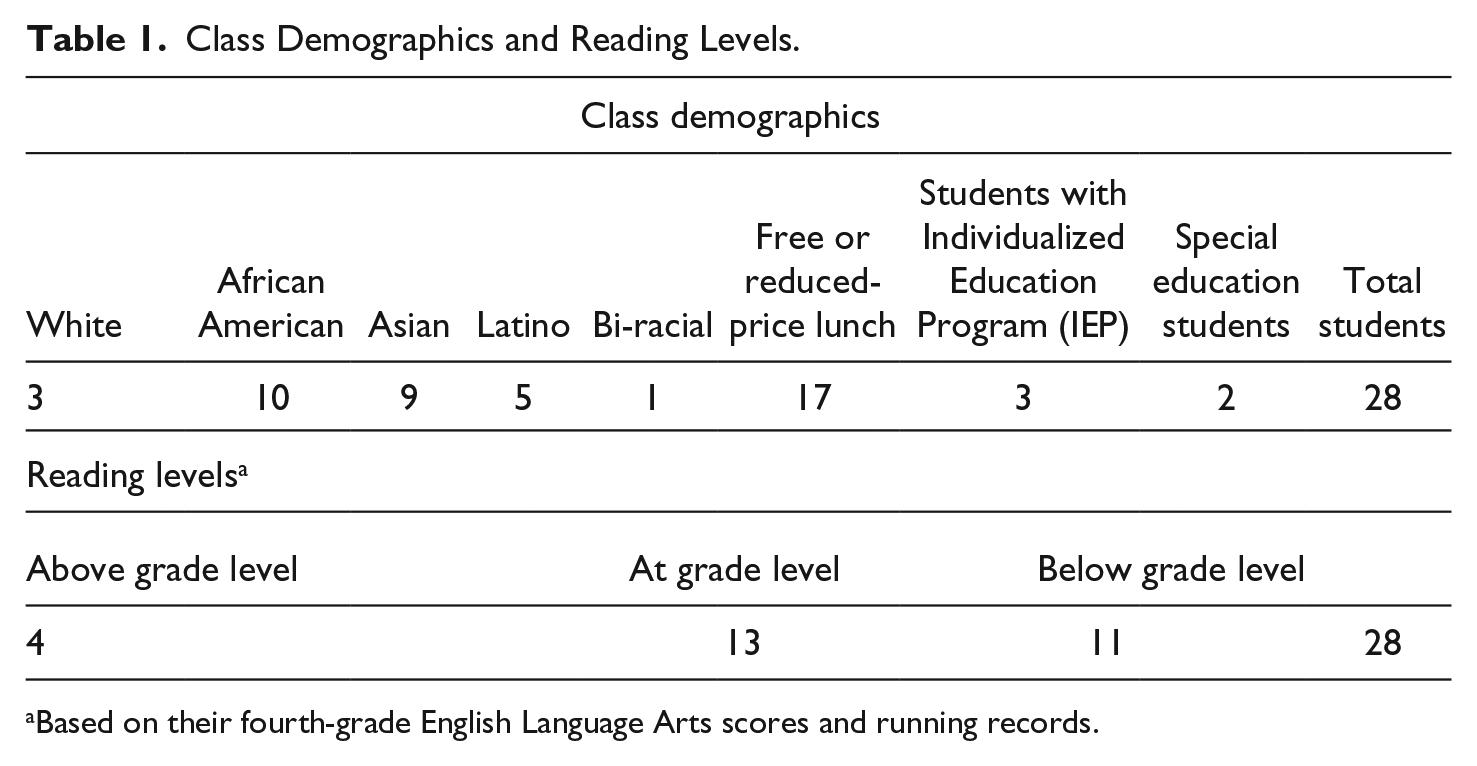
Based on their fourth-grade English Language Arts scores and running records.
The school administration hired a consulting group from a nearby university to serve as language arts providers for kindergarten through Grade 8. A1 and R1 had to carefully coordinate this study to fit the ELA curriculum calendar that the fifth-grade team was required to implement and obtain approval for our changes from the principal. The project coincided with the fifth-grade historical fiction unit of study in reading and replaced the literary essay unit of study in writing. Until R1’s proposal, digital forms of response, such as digital storytelling, were not school-sanctioned forms of reader response, so even though we believed that we would achieve many of the same learning goals, A1 compensated by having her students write literary essays in response to poetry during her poetry reading unit of study in the month following our study.
Book club groups were formed by A1 based on social dynamics and reading levels, as determined by running record assessments. Prior to forming book clubs, A1 had students in reading partnerships based on reading levels and how well both students worked together. She then combined partnerships, observed each group’s interactions, and adjusted a few groups’ membership accordingly. This book club selection process was encouraged and endorsed by the language arts providers and was the sanctioned process in the school. Book clubs had from three to five members, and averaged four members. Seven book clubs read the following novels: Roll of Thunder, Hear My Cry (Taylor, 1976; a sixth-grade CCSS exemplar text); The Gold Cadillac (Taylor, 1987); Shiloh (Naylor, 2000); Sounder (Armstrong, 1972; two groups); Snow Treasure (McSwigan, 1942/1995); and Our Strange New Land: Elizabeth’s Jamestown Colony Diary (Hermes, 2002), from the “Dear America” series. The reading unit for fifth grade focused on skills and strategies for reading historical fiction of any time period, not on historical fiction of one time period. Moreover, text sets for one historical time period that matched the reading levels of each book club group were not available in the school. These novels were selected by A1 because (a) text sets were readily available, (b) the book levels matched the reading levels of the groups, and (c) each book title and author achieved awards and honors for the quality of writing.
Study Design
A participatory action research design fit well with the theoretical framework of this study. In action research, “how teachers and students come to define each other and what educational environments are like becomes transactional” (Bogdan & Biklen, 2003, p. 231). Action research accommodates the shifting dynamics of social interactions and the complexity of codetermining factors in activity systems (van der Riet, 2008). Furthermore, action research enables “structured transformation . . . through effecting the empowerment of participants” (p. 550). R1 and A1 constantly reflected on and made adjustments to the enactment of this project, using a systematic process to strengthen teaching and learning in our local context (Tomal, 2003).
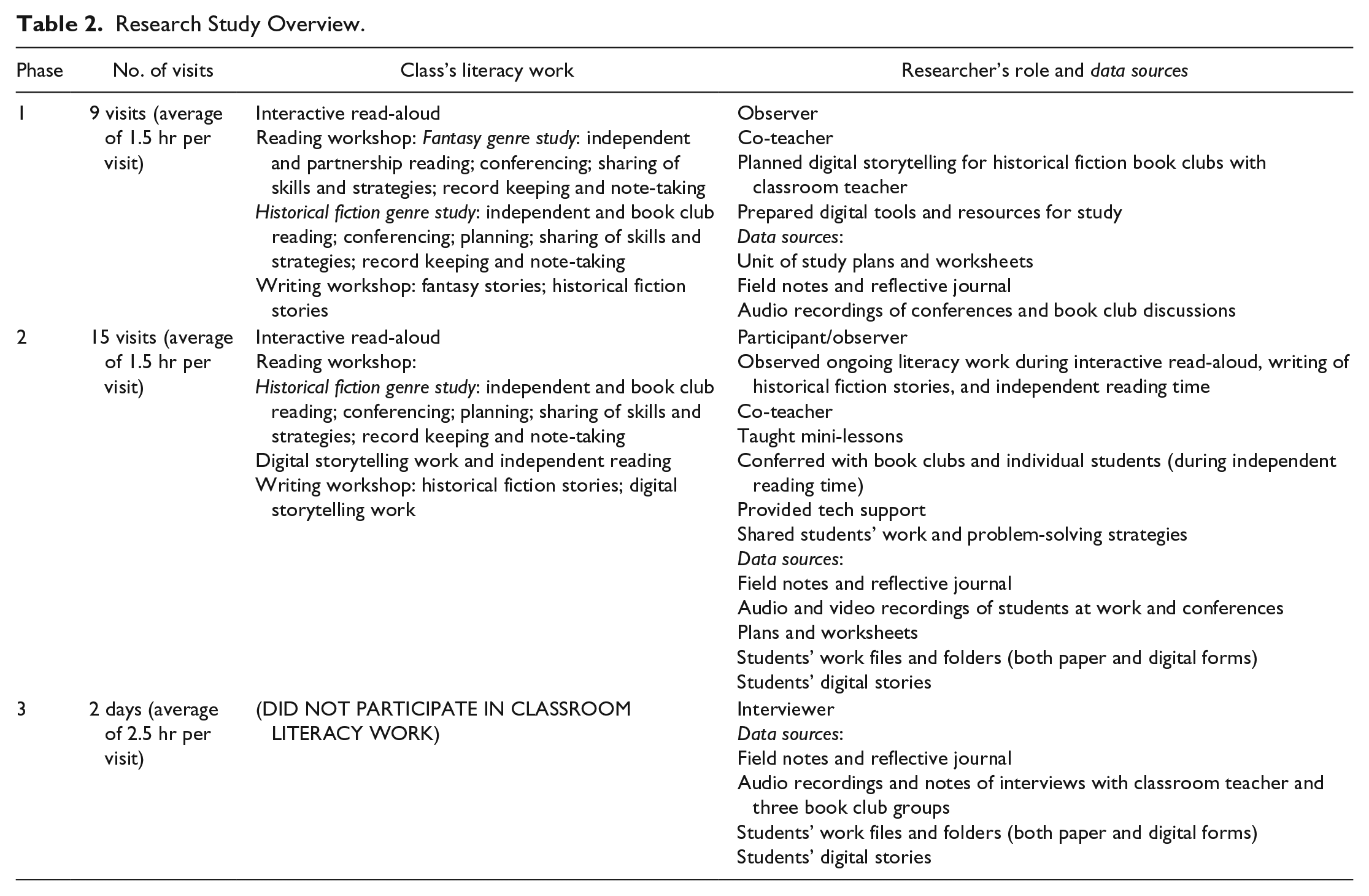
The study had three phases. In Phase 1, R1 began as an observer for nine visits during the class’s literacy block, which was 1.5 hr to 2 hr and 20 min, including the class’ final three historical fiction book club sessions. During this time, R1 took careful inventory of the digital tools and their accessibility. After R1 learned the culture of the class, he designed the project work in partnership with A1. In Phase 2, R1 then shifted roles and became a participant/observer during the class’s ongoing literacy work and a co-teacher for 15 visits in which we guided students to create group digital stories in response to their historical fiction books. A session was usually 45 min during reading or writing workshop, but on some days, the work was going so well that we extended across more of the literacy block time. In Phase 3, R1 conducted a semi-structured interview with A1 and a stimulated recall interview (Bloom, 1954) with three (of the seven) book club groups. Table 2 summarizes the research design.
Research Study Overview.
We were able to provide students with well-worn, 5-year-old laptops from two portable laptop carts. A1 was most comfortable with PowerPoint, and because she intended to occasionally teach students features of the software and might have to supervise their work after R1 left for the day, we chose to use PowerPoint for students’ digital storytelling.
We began by showing students two examples of digital stories in response to historical fiction books using PowerPoint by graduate students (see Kesler, 2011) and R1. We discussed how they might focus on a pivotal moment in their historical fiction texts, as both of these digital stories did. Alternatively, their digital story might present key moments in the text with a particular focus or theme as we saw in another digital story that R1 created for a book that A1 read aloud prior to their historical fiction study. These became mentor texts for their own digital stories. Each book club then filled out a proposal contract (see Figure 1). We conferred with groups to develop strong proposals, based in a warrantable interpretation (Rosenblatt, 1938/1995). In other words, the focus of their proposals had to have substantial textual evidence and the students had to realize reasons why this focus was important to the book.
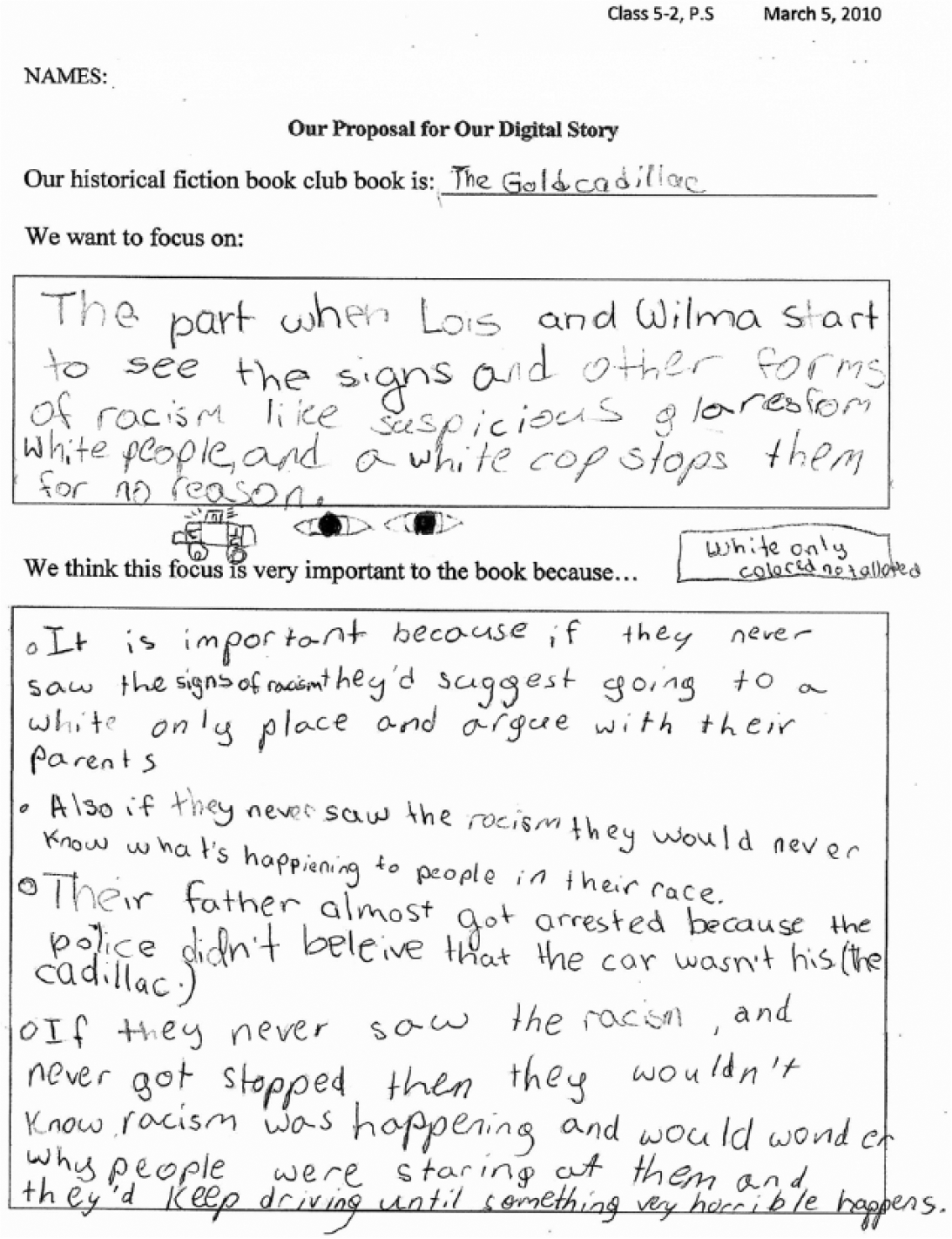
Proposal example.
We asked the students what they noticed that made our mentor digital stories strong responses to literature and to speculate what the process might have been to create these products. For example, we discussed all the modes and media that blended together to create the digital stories, such as music, voiceover, sound effects (audio), drawing, photos, animations (visual), labels, titles, excerpts from the book (language), and punctuation marks (icons). We discussed the affordances and constraints of each mode and medium. For example, students realized how music could create tension or establish mood, how sound effects enhance the action in the narrative event, how font might indicate theme, such as the “dripping” font of titles for scary movies. They had extensive experience as viewers of movies, videos, and TV shows to draw on. We discussed design features such as layout, fonts and color choices, foreground, background, centering, size, proportion, and how these choices might effect meaning. We discussed how the designers of these digital stories created coherence through their deliberate use of design choices.
Our analysis helped to generate criteria for their work, which eventually became our assessment form for group work (see http://tinyurl.com/l8wa5lb), and to introduce the storyboard worksheets. We discussed and provided copies of how graduate students and R1 used the storyboard worksheets to guide our digital story process. Book clubs then worked to complete their storyboard worksheets (see Figure 2), and we conferred with groups to develop and strengthen their plans, with the criteria for excellence in mind. We gave a pocket folder to each group to store their storyboard pages and other materials they would collect in the process of constructing their digital stories (e.g., drawings, notes, scripts).
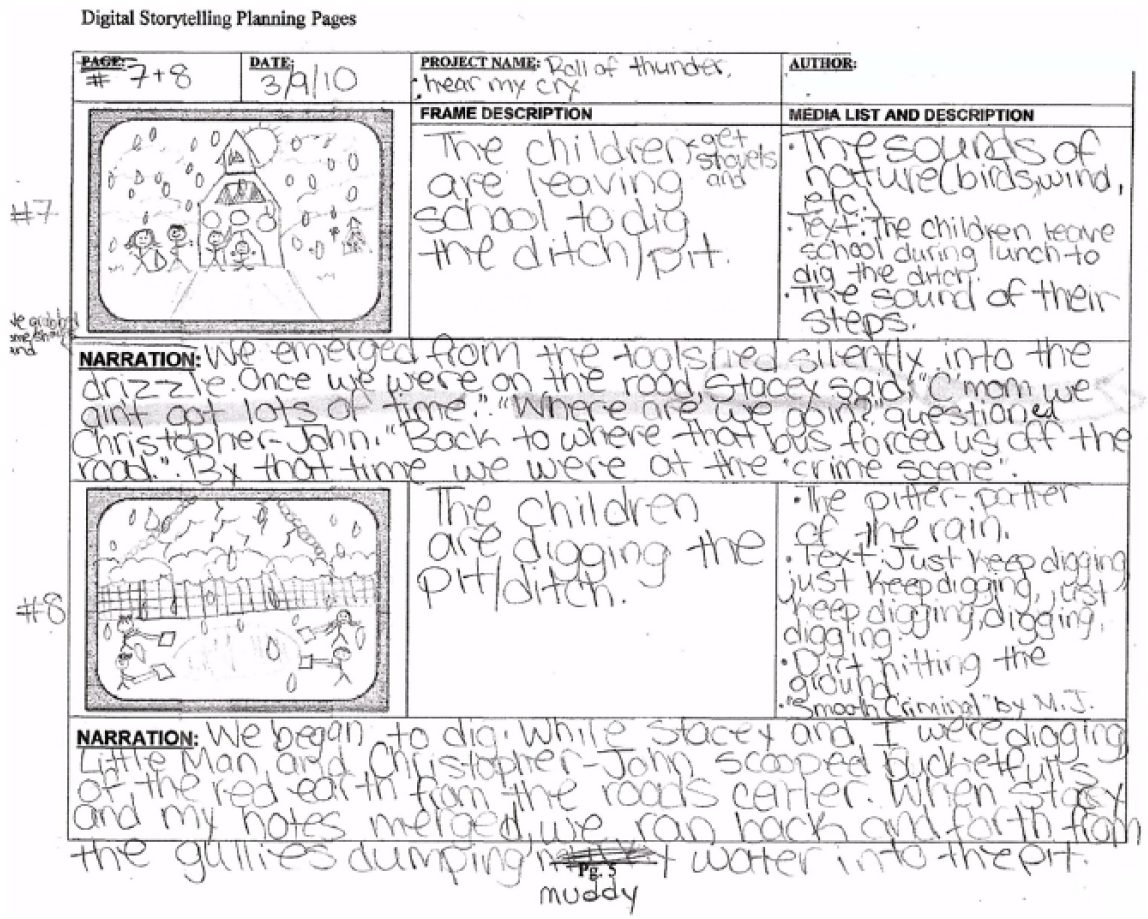
Storyboard example.
We showed students and kept a class chart of free sites for images, music, and sound effects. We provided hand-held digital recorders that each group was able to use to record their voiceovers. Most groups also used original drawings that we digitally photographed and uploaded. For audio mixing, we downloaded Audacity to each laptop and taught students how to create and edit audio files to insert into their PowerPoint slides. The project culminated with a presentation in the auditorium to the fourth-grade classes, parents, and administrators.
Data Collection
Even as R1 filled the role of co-teacher during digital storytelling work, once students were at work in their groups, and especially at times with the para and student teacher in the classroom, he was able to stand back and collect data. R1 jotted impressions during sessions that he used to write reflective notes immediately afterward in a field notebook, and also kept a digital reflective journal. R1 audio- and video-recorded whole class lessons, share sessions, groups at work, and some of the conferences with them. He also video-recorded groups when they recorded voiceover in the hallway or the adjacent teachers’ lounge. At other times, A1 or the student teacher took turns video recording students and teachers at work. These data sources enabled ongoing responsiveness and revision to the unfolding curriculum that is constitutive of action research. Other sources of data were the focal groups’ digital stories; their proposals, notes, and storyboards; their digital folders; the final reflective statement about the project for each student in these groups; and all our plans and materials for the unit.
Toward the end of fieldwork, R1 and A1 discussed how to narrow the breadth of data sources while still addressing our research questions. We decided to focus on three book club groups that represented the low, medium, and high range of readers and writers in A1’s class. Table 3 provides descriptions of these three groups. By focusing on them, we were confident, as a result of our ongoing work with all groups, that the analysis would show the full range of findings for a diverse, yet representative set of readers and writers. Thus, our three focal groups became telling cases (Mitchell, 1994).
Focal Group Book Clubs.
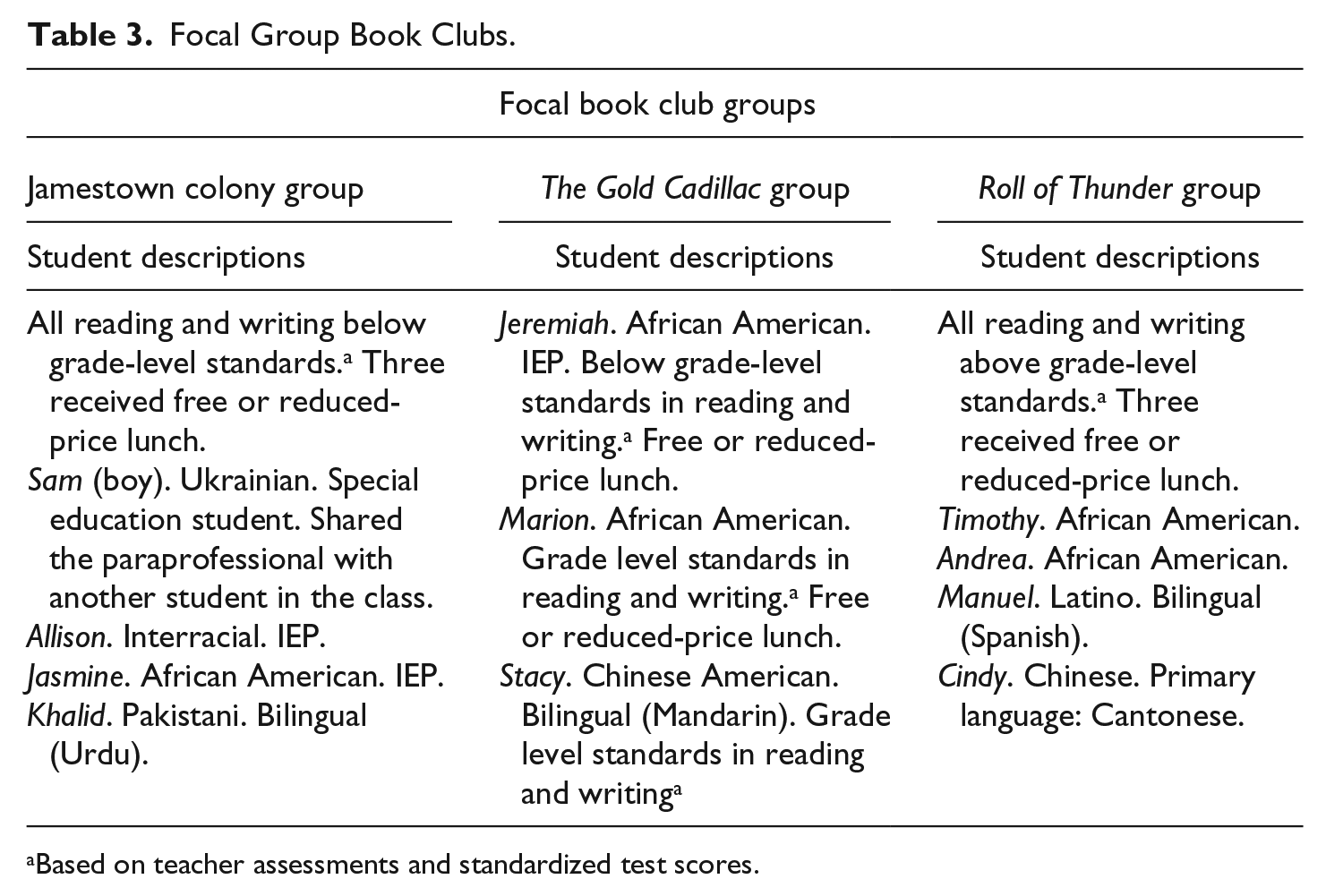
Based on teacher assessments and standardized test scores.
At the end of the study, R1 audio-recorded a semi-structured interview with A1 and a stimulated recall interview (Bloom, 1954) with the three groups. The interview with A1 articulated the social and cultural conditions in the classroom that enabled the work of this study and her perceptions of students’ learning. A1’s perceptions became another data source for verifying our analysis of students’ collaborative and interpretive work. In stimulated recall interviews, the students and R1 viewed and talked through the process of creating their digital story. We also reflected on their experiences working on this project. Importantly, R1 did not function as a neutral participant in this process. Rather, he was an active participant who prompted dialogic meaning construction and further development of their interpretations (Smagorinsky & Coppock, 1994, 1995a, 1995b). One benefit of PowerPoint was that the students and R1 were able to analyze their group’s digital story slide by slide for how various modes combined to generate meanings. Van der Riet (2008) explained that the process of critical reflection the three book clubs and A1 engaged in with R1 creates a dialectic distancing “between the participants’ knowledge and the more theoretical and academic knowledge of the researcher” (p. 555). Thus, participatory action research processes “enhance validity by enabling social science researchers to understand and interpret human action” (p. 559).
Data Analysis
Table 4 summarizes our data collection and analysis for both research questions. To address the first research question, R1 and R2 conducted multimodal analysis of the digital story process and product work of the three focal book clubs. Their digital stories were “multimodal ensembles” (Kress, 2003), or rich combinations of voiceovers, photographs and drawings, written texts, sound effects, and music—each mode expressing non-redundant meaning potentials—using the deliberate framing of PowerPoint and the temporal, sequential structure of narrative, that interacted to represent meaning within the context of this fifth-grade class. To perceive how language was transformed, R1 and R2 did intertextual analysis of the writing in the books, the students’ scripts, and their final voiceovers. An intertextual analysis assumes readers’ active participation in the decoding of texts and making connections beyond authors’ intentions with the potential of acting as an intertext that generates future texts (Nikolajeva, 2008, p. 32). We noted strong examples of transformation of the author’s writing and then viewed the sequence of slides in the students’ digital stories that corresponded to that passage. We called these sequences segments that could be one or a sequence of slides.
Summary of Data Collection and Analysis.
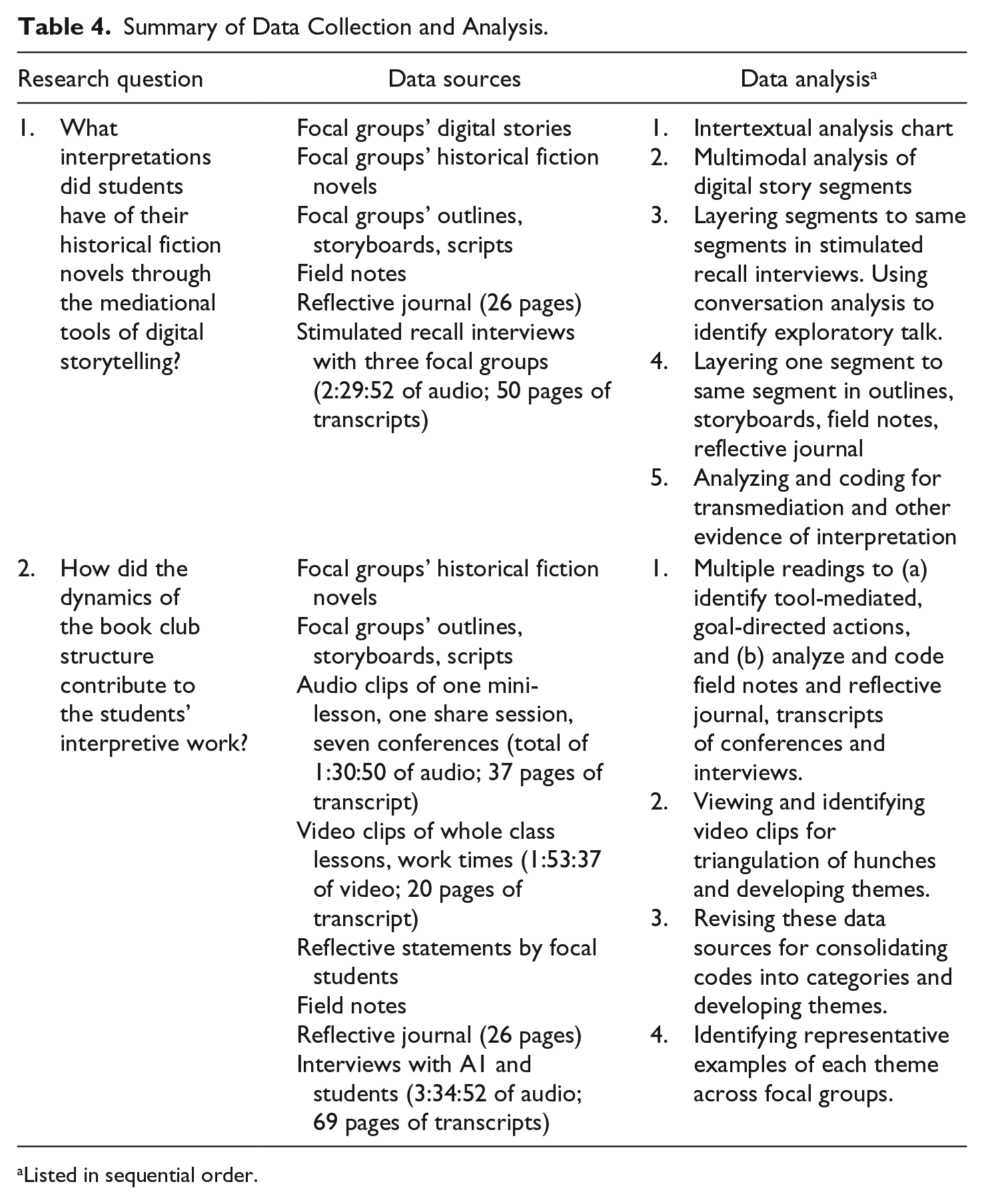
Listed in sequential order.
By also analyzing students’ design processes (Johnson, 2003; Kress & van Leeuwen, 2001), we were able to layer our analysis of their products with their design intentions, the impasses they faced, and their generative meaning making before, during, and after their products were complete. We had ample data sources for revealing students’ process work. R1 transcribed all interviews and audio recordings using transcription conventions based in conversation analysis (Markee, 2000) that honors the inherently dialogic, contextual nature of discourse (Aukerman, 2007). Looking across all data sources, we matched the segments with episodes in the data that revealed evidence of the students’ process work. This alignment enabled us to identify one segment of each group’s digital story for which all data sources converged to provide strong insights into the students’ interpretive work.
In a chart, R1 and R2 gave a description of the students’ work in each mode for the chosen segment of the multimodal ensemble. In a third column, we wrote analytic notes of the work each mode was doing to express meaning (transmediation). We analyzed audio modes using a system by Shanahan (2012) and analyzed images using Kress and van Leeuwen’s (2006) grammar of visual design. For sounds that convey information/mood, Shanahan (2012) explained that, at their most potent uses, sounds express a synergy with other modes that heightens the conceptual resonance of the multimodal ensemble. We layered analysis of these segments with process data. By aligning process and product work, we coded these data for additional dimensions of interpretation, based in our review of reader response studies. For example, we coded for evidence of responsible reading (Faust, 2000), a dialectic between macrostructure themes and component ideas (Beach, 2000; McCormick, 2011), exploratory speech (Barnes & Todd, 1995), “the dynamic interplay of reader, text, and context in the construction of meaning” (Smagorinsky & Coppock, 1995a, p. 294), and collaborative evaluation work (Aukerman, 2007). We again discussed our coding choices until we reached consensus.
For analysis of the visual modes, we used Kress and van Leeuwen’s (2006) grammar of visual design. Kress and van Leeuwen explained that, based in Halliday (1978), all visual design has three functions: an ideational function, or how the text represents the world outside and inside us; an interpersonal function, or how the text is constructed to enact social interactions and relations; and a textual function, or how the textual elements cohere to construct meaning. The textual function has three interrelated systems: information value (i.e., how the elements in a design relate to one another), salience (i.e., what is foregrounded, backgrounded, tone, color, relative sizes of images, etc.), and framing (i.e., the inclusion or exclusion of lines and other frames that divide space in the design). This grammar system gave nuanced analysis of students’ visual design work to elucidate instances of transmediation in their digital stories.
To address the second research question, we used a deductive/inductive coding process (Strauss & Corbin, 1994) informed by activity theory. In activity theory, the primary unit of analysis is tool-mediated goal-directed action in an integrated totality or an activity system (Roth & Lee, 2007; Wertsch, 1991). We considered each book club to be an activity system within this fifth-grade community of practice. For our three focal groups, we coded at the level of tool-mediated actions toward specific outcomes in the interview transcripts, field notes, reflective journal, or audio or video recordings, and actions often had multiple codes. Multiple readings across data sets for each book club enabled us to consolidate codes into categories. We also analyzed data pertaining to the whole class, such as video and audio recordings of whole class lessons and share sessions. Our cycling through the data suggested a number of ways to develop our codes and categories, motivated by activity theory. Particularly pertinent to our research questions were codes such as intentionality—that included evidence of students’ motivation, engagement, and persistence—or mediation—that expressed the dialectic that activity theorists describe among elements in an activity system. Final codes were developed to provide congruence between the data analysis and the theory that we saw as best accounting for the processes in question. Table 5 provides the frequency counts and categories for all our codes.
Categories and Frequencies of Codes.
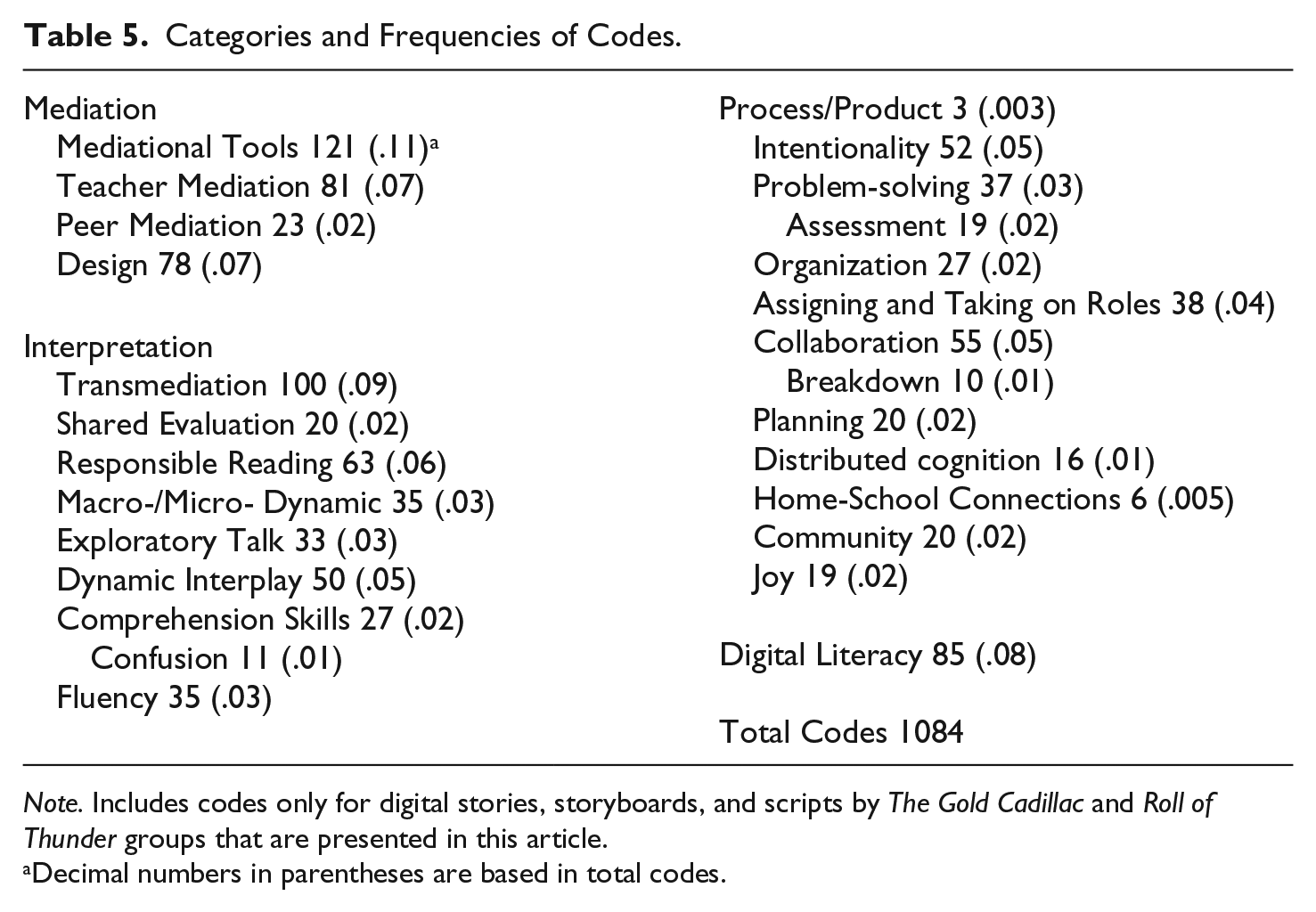
Note. Includes codes only for digital stories, storyboards, and scripts by The Gold Cadillac and Roll of Thunder groups that are presented in this article.
Decimal numbers in parentheses are based in total codes.
We coalesced codes into three encompassing, but distinct categories to generate salient themes. One theme was mediation that had four codes: (a) mediational tools, (b) mediation by teachers, (c) peer-to-peer mediation, (d) design. A second theme was process/product work, or the steps each book club took to achieve their outcomes. This theme encompassed the codes: intentionality, problem solving, organization, collaboration, assigning and taking on roles, distributed cognition, home-school connections, community, and joy. Paying attention to anomalies in the data (Engeström, 2001), such as breakdowns in students’ work process, division of labor, and digital mediational tools—which we explicate in the findings—enabled us to perceive the dialectic of students’ engagement in their process work. We also noted instances in the data that converged with our interpretation codes. A fourth theme, digital literacy, we address in this article only as it arises in the other three themes.
To establish reliability, R1 and R2 used a collaborative coding process (Smagorinsky, 2008) for the Jamestown Colony data set. Data were independently examined and coded, informed by the activity system framework and our operational conceptions of transmediation and interpretation that guided our analysis. We then discussed our coding and re-examined the data for categorical aggregation (Creswell, 1998). Through this recursive process we created “naturalistic generalizations” (p. 154) that grew into thematic groupings. Our negotiations then strengthened our coding of the other two data sets. For trustworthiness and credibility, we conducted member checks by sharing the data analyses, interpretations, and conclusions with A1. A1 also read preliminary findings and provided oral feedback on the interpretations.
Findings
To address the first research question, as a result of space limitations, we present the process and product analysis of one segment for two of the three case study book clubs that show the range and depth of interpretive work that all groups’ digital stories expressed. Then, to address the second research question, we provide revealing examples across all three cases and the larger data set that elaborate the codes within the two themes, informed by activity theory.
The Gold Cadillac Group
The Gold Cadillac Group deliberately chose country and Chicago blues music to express the mood of the characters, setting, action, and character traits in the story as ‘Lois and Wilma and their parents traveled in their brand-new 1950 gold Cadillac from their home in Ohio to their grandmother’s house in Mississippi. All the music was chosen by Jeremiah. It was music “that my parents grew up listening to” and that “they sometimes play at home” (Interview, May 21, 2010). In R1’s field notes (April 12, 2010), R1 noted how Jeremiah downloaded and sampled 12 songs that R1 saw in the download files. He kept a list of song titles, crossing out songs he rejected and circling three that he wanted to keep for his group’s digital story. The student teacher, who worked with Jeremiah to download the music, reported how deliberate and discriminating Jeremiah was in his music choices. “Way more than me. I was ready to choose a song, but he would protest: ‘No. It doesn’t fit with this scene’” (personal communication, April 15, 2010). The following excerpt from our stimulated recall interview (May 21, 2010) highlights Jeremiah’s evaluation process that generated interpretation of the text 1 :
How did you know if it [the music] fit?
It had to fit the mood of the story. And the mood of the words. Worried and scared. Like when the father gets arrested.
Yeah, and they were worried about their father, and the music fits that kind of feeling, really upset . . .
. . . anxious. Is that the word? [“Yeah.”]
For Jeremiah and his partners, music selection mediated their interpretation of the story. Their exploration of mood expresses their awareness of the serious issues that the family contends with in the story world.
He was equally discriminatory about sound effects. In R1’s reflective journal (March 24, 2010), he wrote,
Jeremiah was carefully evaluating each sound clip that [his group] sampled for the sound effects. For example, he listened to five different versions of car horns before settling on the right one to represent the gold Cadillac, even when [his group members] were satisfied with the first one they sampled.
In his group work, Jeremiah had the authority to construct and make claims about his meanings of the text that were mediated by his organizational list, discussion, and auditory modes of expression. In our stimulated recall interview, the group described their shared evaluation for the right horn sound. At the end of the exchange, Jeremiah stated, they searched for “an old type of horn sound that matched the car, like rich people were driving it” (May 21, 2010).
One upbeat country blues song had the title “Swagger” that they used for the title and credits and to “show off” (Interview, May 21, 2010) the first image of a gold Cadillac, and evoked the swagger of the proud father who bought and wanted to show off the Cadillac despite his wife’s strong objections. They used a second country blues song, “Time to Move On,” when they depicted the family preparing for their trip, traveling to and from down South, spending time in Mississippi, and returning home. Finally, they reserved the slow-tempo Chicago blues song, “Cruel World,” with its wailing slide guitar, for when the family is pulled over and the father is falsely accused of “stealing” the car and then arrested, and the aftermath of his arrest. The students used music for aesthetic purposes by conveying important information about setting and mood, and building thematic coherence between slide segments. Moreover, both the titles and musical style of each song served as metaphors that amplified what the students, and especially Jeremiah, perceived as key thematic elements in the story.
A central theme that this group explored in their digital story was the systemic segregation in the South in 1950. They depicted it in a series of four slides that, as in the book, preceded the father’s arrest in Mississippi. Figure 3 shows how they recomposed the first of these slides for their narration (see http://tinyurl.com/k8b3psd for the complete digital story). The fonts show what the students took from the book, what they changed, and what they omitted. As they did consistently throughout their digital story, they changed the narration and the consequent syntax from first person, in the voice and perspective of ‘Lois, to third person, because they alternated narration between the two girls and, as they expressed in their stimulated recall interview, they felt that a third person narration would be clearer to viewers. In other words, recreating the story in new modes generated a syntactical problem that the group solved creatively. Their awareness of audience also shows how community mediated production of their digital story and how production mediated their sense of audience. The narration also shows Stacy’s miscues, despite repeated practice prior to recording, saying Louis for ‘Lois, and anticipating foreign country instead of foreign land.
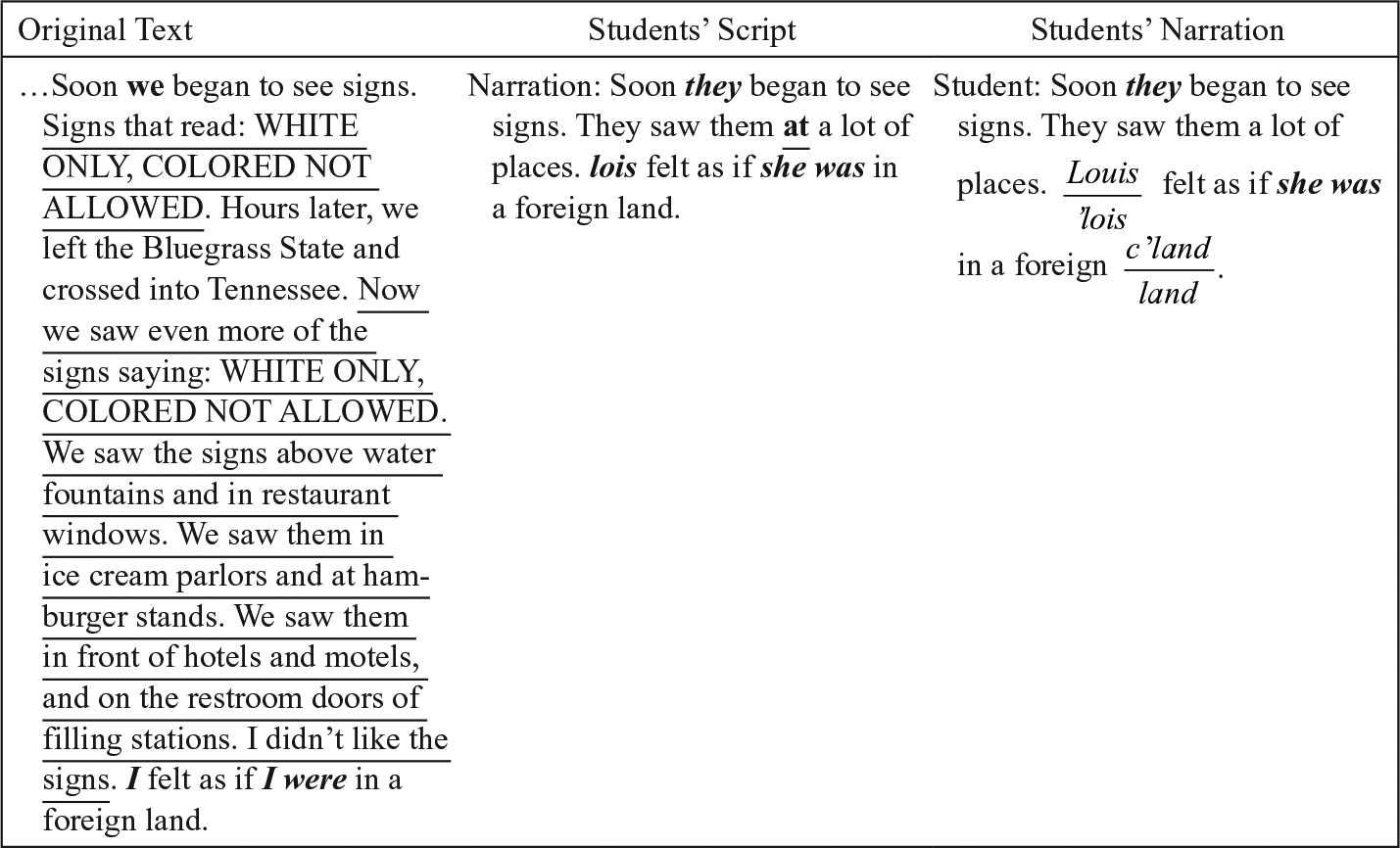
Example of The Gold Cadillac script and narration.
This slide continues “Time to Move On” as the soundtrack behind the narration. The song builds coherence with previous slides and carries the functional load of the family’s journey down South, thereby expressing the narrative structure of the story. The drawing, by Marion, shows the family from a medium distance and a high frontal angle, driving in the car, looking askance with frowns that are highlighted with black crayon at a sign in the upper left-hand corner that they just drove past on the side of the road, “Whites Only/COLORED Not Allowed,” that Wilma, in the rear passenger seat, is pointing to with her right arm. The family’s askance eyes and Wilma’s pointing form vectors, or invisible lines and connections, between them and the sign. We had the following exchange in our stimulated recall interview (May 21, 2010):
And she’s [Wilma’s] pointing to the sign to show that she notices it.
And their driving. It was hard drawing them driving like that.
Like what?
// All together, from above.
= like it’s [the message on the sign] starting to weigh down on them.
Whites only; colored not allowed?
Yeah.
Marion was challenged by the constraints of drawing the whole family inside the car from above. For example, she struggled with depicting the interior of the car. However, her use of a high frontal angle at a medium social distance enabled her to represent syntactically ideational and interpersonal functions. Through transmediation, her thinking shaped the drawing she produced, but the process of drawing also shaped her thinking. This exchange on the recording had a speculative tone, indicated by Marion’s pause and Jeremiah’s latching speech, suggesting a co-construction of meaning mediated by the stimulated recall interview. As Peirce’s (2011) triadic semiotic process predicts, the drawing served as an interpretant that mediated the students’ interpretation of this part of the story as the family is rendered powerless in the face of systemic segregation that they are now encountering.
The next three slides in this sequence show images and continue the “Time to Move On” theme music. The first slide shows a dark-skinned hand holding a “WHITES ONLY!” sign on a framed white board; the next slide shows a “COLORED WAITING ROOM” sign, with the waiting room words inside the arrow pointing the way. This sign is hanging from the side of a building. The third slide shows a blue roadside sign, “WELCOME TO MISSISSIPPI/IT’S LIKE COMING HOME,” with Mississippi in yellow and the state flower in the bottom right corner. The bold colors and the back of a van in the bottom left corner indicate that the sign might be from today. All three images put the viewer at the vantage point of the driver of a vehicle and, along with the traveling music, we now feel like the father as we drive the gold Cadillac past these sites. So, without writing, the images and music express complementary, non-redundant meanings equal to the descriptive passage that the students omitted in their script in the first slide. The multimodal ensemble guides viewers to empathize with the central characters as they face the double bind of being free to ride in a brand-new gold Cadillac while feeling oppressed in the South. The last slide in this sequence also lets us know that the family was now entering Mississippi, the southern-most state and their final destination.
In our stimulated recall interview, the group speculated as to why a Black person would be holding a “WHITES ONLY!” sign. They also added another dimension to their choice of the “WELCOME TO MISSISSIPPI” sign:
[talking about the sign] “It’s Like Coming Home” and we thought there was something weird about that. Some people can’t go home, like Black people can’t go there.
Maybe that’s [the sign’s]
But you’re thinking it’s kinda ironic that it says, “It’s like Coming Home,” but for this family=
= they’re not welcome there. (Interview, May 21, 2010)
Latching speech again indicates the speculative tone in this exchange that showed co-construction of knowledge. R1’s comment was stimulated by Stacy and Marion’s comments, and then Stacy completed his speculative thought. Discourse markers such as maybe and the speakers’ speculative tone are indicators of exploratory speech (Barnes & Todd, 1995) that expresses the provisional nature of the students’ digital story. Discourse markers such as can’t, they’re, now, and their emphasis on after all express the tension they perceived of Mississippi in the story world of 1950 and now that generated their critical awareness. To reach this interpretation, meaning was not derived from the focal text (The Gold Cadillac) alone; rather, the students orchestrated at least three texts: the image of the modern “Welcome to Mississippi” sign, the sign as embedded within their digital story, and The Gold Cadillac, and connected them to their prior knowledge of segregation. Our stimulated recall interview and their digital story mediated their exploratory talk, which in turn mediated their thinking about The Gold Cadillac, generating a more fully developed interpretation.
The Roll of Thunder Group
Whereas The Gold Cadillac group did thematic-based retellings, the Roll of Thunder group focused on a key episode in their digital story. As a group, they were able to agree upon two possible key episodes. One was the ending of the book, when T.J., a schoolmate of the Logan children, gets in trouble and then is beat up badly and imprisoned for his involvement in a crime in segregated, rural Mississippi in the 1930s. However, the students explained that this episode went across a few chapters, that instead of being narrated, some of T.J.’s plight was retold by characters in the book, and that it was overall too complicated to do in the time span that they had for their digital story. Instead, they agreed to focus on what they called “the second most important episode in the book”: how the Logan children contend with the school bus for White children as they walk the three and a half miles to and from their school.
So, outta all the other scenes, why did you choose the one with the
‘Cause outta the one where T.J. dies, this was the second most important, because it shows how
Yeah, and the
=and that they have another
That they have another side, instead of always letting
[“
In the book, the children face painful social and political issues and are guided by their caregivers to let them go, that a better world will come. The students chose this episode when the children were able to empower themselves to fight back against the unjust racist system that they endured. The students’ emphasis on angry, problems, and side express their intuitive realization that, out of all the episodes in the book, this episode had a complete narrative structure of a substantial problem, with rising action, mounting tension, then a satisfying resolution. The stimulated recall interview became a mediational tool for their co-construction of meaning as demonstrated by their latching speech and interjections. By choosing this episode, the students considered “how lives reflect social forces and how individuals can influence these taken-for-granted practices” (Galda & Beach, 2001, p. 67).
In one segment of their digital story, the students reformulate descriptive passages in Chapters 1 and 3 that describe how the school bus plagued the Logan children every school day, and one particularly awful morning, into a series of three slides. Because of space limitations, we will discuss the first two. In the first slide (see http://tinyurl.com/koo9hlp for the complete digital story), the drawing centers the yellow school bus and we are at eye level with the front grill, at a far enough distance to perhaps leap to the side, looking up past the upright wipers into the front windshield at the frowning bus driver, who is looking askance to the side of the road, as the bus goes barreling down the muddy dirt road under a stormy sky in the rain. The low angle from which we view the bus driver gives him power (Kress & van Leeuwen, 2006). The theme from Jaws pulsates loudly. To the left of the bus in bold white font is the following message: “The school bus approached!/Whites Only!”
Timothy had seen all the Jaws movies and chose the theme music for this scene.
So why did you choose that music?
Because the music fitted the mood, because the bus was coming up to them and, they weren’t
It’s like somethin’ bad is about to happen=
[“= and you’re just waiting for it”]
Like in Jaws, the shark comes, but they don’t know.
Next thing you know, your leg is bit off. (Interview, May 13, 2010)
Timothy used cultural knowledge to appropriate Jaws theme music to represent his understanding of the mood of this episode. Our dialogue mediated their co-construction of meaning as indicated by their interjections and latching speech. Their generation of the metaphor of the approaching school bus as a menacing great white shark was likely mediated by the dialogue of the stimulated recall interview. Indeed, in the drawing, the two beaming headlights look like eyes and the grill looks like the gaping mouth with sharp teeth of an approaching monster. Here, the music and the image modes function synergistically, generating “conceptual resonance” or a “multiplicative” impact: The music enhances our perception of image (Shanahan, 2012, p. 269). The intermodal relations create a metaphor for thinking about the mean White bus driver and the “Whites only!” school bus from the perspective of the Logan children.
The students joked that Andrea made the bus look too modern and explained that she drew it before they had access to the laptops to look up images of a 1930’s bus—a constraint of their mediational tools. Also interesting is the students’ explanation of why Andrea drew the bus driver frowning and looking askance. They explained that he was looking for the Black children on the side of the road, but did not see them yet.
It doesn’t say what the bus driver’s
[To Andrea] What did
Well, I didn’t think he was that satisfied because, they were
=not wet enough=
=yeah, I don’t think he was satisfied with his work that day, so he wanted to take it out on the kids . . . (Interview, May 13, 2010)
The mean White bus driver’s expression then was intended to also convey his motivation: He wanted to take out on the kids his frustrations with his work circumstances. In our co-construction of meaning, the students realized a social dimension of the text. Andrea’s drawing shows the dialectic function of composing in the reading process: Her understanding of the White bus driver’s intentions both shaped her drawing and was constructed in the process of drawing it. Timothy’s comment that begins this exchange emphasizes the provisional nature of their digital story. Looking at Andrea’s drawing during the interview stimulated Timothy’s reconsideration of the absence of an important detail in the book, which was an expression of responsible reading. Andrea’s speculative tone also indicates exploratory talk that reveals the ways in which the discussion allowed for and built on tentative efforts to construct meaning. Our stimulated recall interview, the latching and overlapping speech, and the digital story engendered additional interpretation of her drawing, generating further transmediation.
Intermodal relations continue to generate transmediation in the second slide. The Jaws theme music builds coherence with the previous slide and anticipates the splash of mud that soaks the children. We hear the revving of the bus engine and two startling honks of the horn. The depiction of the bus driver in the school bus carries the same associated meanings. In addition, we have a full-frontal view of Cassie and one of the younger Logan boys on the left side of the road that establishes equality. Their direct gaze makes a demand to engage with this scene, but they are positioned at a social distance that allows us to view this scene with detachment (Kress & van Leeuwen, 2006). They are dressed in contemporary clothing. The brown mound that the children stand on signifies muddy water (Interview, May 13, 2010). The word SPLASH! appears in the same bold white font as the previous slide, creating more coherence, in the upper left corner against the stormy sky. As the Jaws theme music continues to pulsate, we hear loud splashing sounds that culminate, at the end of the audio, with the voices of the children shouting, “Ahhh!” For the students, the constraints of drawing prevented them from showing all six children scrambling in the muddy gully to get away from the bus in this scene. “Animation would’ve worked better,” Timothy said (Interview, May 13, 2010), except, at the time of this project, none of us had the technical know-how to produce animation. Instead, this humiliating event is accentuated by intermodal layering of the theme music, sound effects, and voiceover, the SPLASH! sign, the positioning of the figures, and the spray of mud from the bus hovering over the heads of the two children.
These two slides do the work of extensive descriptive passages of this event up to page 36 in the book (Taylor, 1976) that the students had to synthesize, re-sequence, and choose selectively as they transmediated from the print-based mode of the book to the multiple modes of digital storytelling, demonstrating responsible reading. In the first slide in this segment, they re-presented descriptive passages from Chapter 1 and page 32 of Chapter 3 in all the ways we showed above. For example, in Chapter 1, Cassie, the narrator, describes her little brother’s first encounter with the school bus:
Little Man turned around and watched saucer-eyed as a bus bore down on him spewing clouds of red dust like a huge yellow dragon breathing fire. Little Man headed toward the bank, but it was too steep. He ran frantically along the road looking for a foothold and, finding one, hopped onto the bank, but not before the bus had sped past enveloping him in a scarlet haze while laughing white faces pressed against the bus windows. (p. 8)
By choosing Jaws theme music to express the tone of mounting tension that the students perceived during these instances in the book, they transposed the school bus from a huge, yellow fire-breathing dragon into a great white shark. We learn in chapter 1 of the segregated schools and the gross disparities between them. In the bottom paragraph of page 32 in Chapter 3, Cassie informs us “that the county did not provide buses for its Black students.” The “Whites only!” written text in this first slide, coupled with all the semiotic meanings of the multimodal ensemble that we explained above, carries the functional load of this unjust situation.
This segment of slides also shows the students’ misconceptions. For example, they pictured an electric outlet, when the book makes clear that they had no indoor plumbing or electricity at that time. In addition, they depicted Cassie in contemporary clothing, even though the book describes the simple school dress she wore. Third, they thought that Uncle Hammer was staying with them when this scene took place, when he does not arrive in the book until a few chapters later. In addition, they misconceived T.J. as dying at the end.
The Dynamics of Book Clubs’ Interpretive Work
Coding the data informed by activity theory showed how the dynamics of the book club structure significantly contributed to the students’ interpretive work. Here we discuss two pertinent themes that emerged from our analysis: mediation and working on process/product.
Mediation
There were four significant sources of mediation in this project: mediational tools, teacher mediation, peer mediation, and design. Coding for design included students’ design of each slide for font, color, transitions, layout, and animations, but also affordances and constraints of modes and tools that in dialectic tension mediated students’ interpretive work. For example, in our stimulated recall interview, The Gold Cadillac group and R1 discussed the slide when the family spent the night in the car after the father’s arrest, and ‘Lois fell asleep holding a knife for protection. R1 asked about an image insert of an actual knife in the upper right corner.
’Cause I felt that it was important to bring attention to the knife. When I found the image, I tilted it so it would look like the way ‘Lois would actually be holding it.
And then the knife [in the drawing], I kinda drew her like she was going to kill herself. I drew it wrong. She shoulda been holding it like this [she gestures holding the knife like she was protecting herself]. (May 21, 2010)
Marion and Stacy articulated deliberate design decisions that mediated their interpretation of this pivotal scene in the story world. Moreover, the prompt and exchange in this interview and re-viewing this slide became provisional resources that stimulated Stacy’s comment, “I drew it wrong,” toward a more warrantable interpretation.
Mediational tools included the historical fiction novels; the mentor digital stories; the students’ proposal and storyboard worksheets (see Figures 1 and 2); the grading criteria (see http://tinyurl.com/l8wa5lb); the class chart of free access websites for images, sound effects, and music; and digital tools—such as Audacity and PowerPoint, the voice recorder, the digital camera—that provided affordances and constraints on the students’ composing process. Most groups created outlines to guide their work through their storyboard pages or wrote out their script for each scene. Consistent with activity theory, mediational tools strongly guided what learning occurred. For example, the proposal worksheet emphasized finding a focus or theme that is strongly represented in their books for their digital stories (or what Rosenblatt [1938/1995] called a warrantable interpretation). Storyboards guided students to determine which key story events to include and what modes they would use in their modal ensembles to generate meaning.
Both teachers and students relied on these mediational tools. Groups’ outlines, proposals, and storyboards became sources of formative assessment for supporting their progress in this project. For example, we actively conferred with book clubs to strengthen their proposals and develop their storyboard plans. One focus of these conferences was guiding students to develop warrantable interpretations. In a conference with R1, the Jamestown Colony group realized that the book does not support a focus on the relationship between Captain Smith and Pocahontas—their initial proposal focus. The children then expressed that the book mostly focused on Elizabeth and that she was a helpful and caring person to her family and friends.
. . . helpful and caring . . . Is that something you guys would want to // make a digital story about? [They nod affirmatively.]
How do you make a digital story about somebody caring?
I dunno. That’s what we’re gonna have to
R1’s comment was a genuine expression of the inquiry stance that the community was valuing. After more negotiation, the following exchange occurred:
. . . maybe what’s it like to um, to live with her family and friends?
What? How it’s like to what?
How it’s like to live
You mean, what life is
Yeah . . . maybe . . .
Like, um // the different
. . . Well, then maybe you’ll
In this conference, the proposal contract and focal text functioned as mediational tools. Transcript conventions show our negotiation. The transcript is laden with false starts; latching and overlapping speech; pauses; speculative markers such as maybe, might, and could; and questions that show our co-construction toward a central theme in the book. The transcript also shows R1’s mediation, in the role of teacher. R1’s use of directives, in the form of questions and declarative statements, mediated the students’ use of textual evidence for developing warrantable interpretations, which we were valuing in this sociocultural context. For example, R1 overlapped Allison’s utterance at the point that she tentatively expressed a warrantable interpretation, as noted by her use of “Like, um” and pauses, with “Oh, wait, so you’re thinking . . .” So was a discourse marker for revoicing and emphasizing Allison’s claim. R1’s utterance emphasized key words for articulating the central theme. R1’s gestures also suggested and supported the students’ actions, such as recording this focus on their proposal worksheet.
The roles of students and teachers sometimes shifted, especially in the use of digital technologies. An example is when R1 unsuccessfully tried demonstrating searching for and downloading free sound effects for the students’ digital stories, which was captured on video. However, within minutes, the students themselves succeeded. In R1’s reflective journal, he wrote how the room soon filled with sounds of gunshots, sirens, and hurricanes: “The students delighted in the sounds they found, and were quickly teaching each other how to download the sounds to their files” (March 14, 2010). This outcome is now a common finding for digital reading responses (e.g., Kesler, 2011; Larson, 2008; McVee, Bailey, & Shanahan, 2008; Mills, 2011; Whitin, 2009). It is also expected in a community engaged in authentic joint activity. In an activity setting, “[w]ho is in the know and who learns is a product interactionally and contingently achieved as participants engage with each other” (Roth & Radford, 2010, p. 304).
The data also showed that peer mediation created collaborative zones of proximal development (Roth & Radford, 2010) that were co-constitutive among students of varying competencies as they engaged in purposeful activity. In one sequence, an audio recording of a conference R1 had with Marion and Stacy in The Gold Cadillac group shows how R1 mediated their use of Audacity to upload and edit the audio recordings for their digital story. Jeremiah was absent that day, so they had to take on the work that Jeremiah was slated to do to move their project along. Later that morning, a video recording shows these girls now guiding each other, independent of any teachers. In R1’s reflections (April 12, 2010), he wrote,
I showed them the time scale in Audacity. Within a manner of minutes, they were reading the time scale, keeping track of how much of the “Moving On” song they used, adding up the time, so they could figure out where in the song to begin for the next slide . . . They were able to read the 5 second intervals even though these markers were not labeled. So, they were applying all these math skills as they acted like sound engineers.
This entry shows expansive literacy learning that occurred as students engaged in this project. They both enacted and exceeded operations that R1 showed, such as zooming in to expand the time scale, keeping track of their work by creating a chart of time intervals for each slide, splicing the soundtrack to match the duration of each slide, saving each clip as .aup and .wav files, and inserting the clip into their PowerPoint. In R1’s field notes, he noted, “They’re also now carefully saving their files to the proper folders!”—an issue the whole class struggled with just 2 days prior. In dialectic tension, the project pushed them to take on roles of sound engineers, and by taking on roles of sound engineers, the project work was able to be accomplished. R1 noted how their bodies and gestures showed their negotiation: sitting side-by-side while looking at the screen, pointing, paper and pencil by Marion’s side. In collaboration, Marion and Stacy performed at a higher level of competence than either could perform alone. For these students, learning was occurring “through participation in a joint, collective activity mediated by cultural tools” (Galda & Beach, 2001, p. 66).
Similarly, video recordings show students negotiating just the right voices to use as they recorded and re-recorded their scripts to convey the meanings they wanted to portray. Repeated readings of limited amounts of text is a particularly effective practice for developing fluency, especially for special needs students (Samuels, 1979). The Jamestown Colony group, comprised of students who often experienced frustration and dis-fluency in their independent reading, was driven to practice their parts until they felt completely ready to record (March 26, 2010). When someone miscued during recording, the video shows them smiling and laughing, calling it a “mess up, no big deal.” Then they rehearsed some more and re-recorded. They coached each other on finding the right voice for each scene. For example, how would Elizabeth sound when she writes that her best friend Claire died? They wanted Allison, the narrator for this scene, to express more emotion in her voice. Intuitively, Allison’s face took on a mournful expression, to match the weeping sound effects they planned to use with this scene, and her hand went to her heart as she re-read the script, embodying her interpretation. When they completed their recordings, they negotiated: Do we want this clip, or is this a “mess up,” or which one of these two versions do we like better? The students exhibited shared evaluation of each other’s ideas for purposes that mattered to them, a practice that improved their comprehension.
Process
Codes in this theme included intentionality, planning, collaboration, problem solving, organization, taking on roles, distributed cognition, home-school connections, community, and joy. A key element of an activity system is the outcome, which is the source of motivation and in a dialectic with the subjects. The outcome, which was creating the digital story, motivated the students. Work sessions often went for more than 1.5 hr, and when it was time to stop, students actually groaned, “Do we have to?” Data sources show students continuing their project work at lunch, sometimes back up in the classroom. In our post-study interview, A1 expressed the influence of goal-directed joint activity on students’ intentionality:
I think because they were all involved in a
=There was more at stake.
Yes! It was very rare—and of course, they’re
R1’s journal entries concurred.
I’m amazed by the children’s enthusiasm and engagement with this project. Each work session, even when we extend it to close to two hours, the children are never at a loss for what to do and how to fill their time. They are resourceful and able to plan and designate roles and delegate. They are also hardly ever off task. (March 29, 2010)
However, each new mediational tool created new challenges. Book clubs’ proposal worksheets and their story maps became two imperative mediational tools that guided their joint activity toward collaborative outcomes. Their work on these tools were sources of formative assessment for R1 and A1, and our assessments led to teacher mediation for students’ work with these tools. For example, on March 8, 2010, after assessing each group’s storyboards, R1 wrote in his R1’s reflective journal:
I’m seeing some common difficulties that the students are having with the storyboarding. First, they need guidance with writing narration. Currently, they are summarizing at the expense of losing the actual language of the narrator. For example, Marty [in Shiloh] would never use a word like cute. How does Marty describe Shiloh when he first encounters him? Use that language. Second, they are not realizing that the narration may include dialogue between two or more protagonists. Third, they are not writing out the actual words the narrator will speak. Fourth, they are not realizing when to summarize and when to use exact wording from their books. A second issue is a few groups are putting the entire sequence of events into their first storyboard slide.
This assessment then guided our instruction with groups during the next two sessions to prepare them for their digital storytelling work. We found that groups with lower performing students, such as The Jamestown Colony group, needed more ongoing teacher mediation to develop these worksheets toward warrantable interpretations and plans. But, once these groups achieved these standards of community practice, these tools became road maps that directed them toward their outcomes. They were positioned to experience intentionality in their actions.
Digital tools especially demanded new problem solving, organization, and division of labor. For example, after students completed their storyboards, they were ready to use laptops to begin assembling all the parts they needed. We guided students to set up a clear division of labor: a music/sound editing team and a visual team. We created a class chart that summarized these jobs. Five days and two sessions later, R1 reported in his field notes (March 17, 2010) how smoothly students were working in these roles, demonstrating distributed agency. Then, when we introduced PowerPoint, we advised each group to now work with one laptop. This shift in technology required a new division of labor with new problems to be solved that took a few days to work through, as R1 noted in his field journal:
The room gets noisy and full of distractions. It’s not their fault. The sound teams did finish collecting their sound clips—sound effects and music—and we now told each group to build their PowerPoint on one laptop and to save it on their group’s flashdrive. Now the image people did need to manage this work. During the workshop time, I wondered what work we might give the students to keep them all engaged as we moved forward on this project before we get to sound editing using Audacity. (March 22, 2010)
When we introduced Audacity, another shift in division of labor occurred with new problems to solve. This cycle continued right up to the end. These shifts showed that what was to be learned could not be defined or understood ahead of time, and necessarily influenced our instruction.
We discovered that these shifts in work cycles demanded keeping well-organized paper and digital folders, a skill set the students did not innately have. Many excerpts of R1’s field notes and journal are coded for organizational issues in the process theme as he noted that their flashdrive files, for example, were in disarray, and groups were “stuck in the mud” because they were often re-doing work that they lost or saved in an unworkable format. R1 also reported many technical glitches in the process: laptops having the dreaded blue screen or “freezing up” as we tried downloading files, audio files not playing after we uploaded them to PowerPoint, or not knowing how to upload certain file types into PowerPoint. R1’s field notes and journal often describe the ups and downs of constantly facing and solving what at times seemed like insurmountable problems. Moreover, each software interface (i.e., PowerPoint and Audacity) contained icons and internal logic, and students had to learn this new digital language before they could manipulate its mediating potential for representing their intended meanings.
R1’s notes and video footage also showed students overcoming these impasses and becoming proficient after we showed them how to read and manipulate software, recognize file types, and save and organize files into folders on their flashdrives. Multiple data sources show students readily helping each other with digital problem solving, again enacting distributed cognition. For example, in R1’s journal, he wrote, “I’m also impressed with how the students are supporting each other, showing each other what they themselves may have recently learned regarding locating and downloading sound clips or music or images, or storing their work safely” (March 21, 2010). They were enacting the dialectic of production, exchange, distribution, and consumption of digital skills and practices.
With each new division of labor, we witnessed students growing into new roles. Sam, the special education student in The Jamestown Colony group, became known as the person who could find the passages in the book for textual evidence. Jeremiah became known as the music and sound man for his group. Timothy and Manuel became proficient at sound editing in Audacity. Students brought up this awareness of each other’s capacities in our process interviews, as the following excerpt with The Gold Cadillac group depicts (May 13, 2010):
What did you learn from each other that you wouldn’t have known on your own?
That Jeremiah was good at looking at sounds and music
=and Marion was good at getting
’cause I’m
Yeah.
Multiple data sources show students learning how to collaborate, building on each other’s strengths and holding each other accountable, to get their work done. In this excerpt, Marion and Jeremiah co-constructed identities by ascribing roles to each other; their latching and overlapping speech establishes concurrence. Group members, including Marion, smiled about her bossiness. They recognized the value of this quality for achieving their outcomes, and their outcomes, which were concrete representations of their actions, reciprocally constructed this quality of Marion’s identity. This exchange also implies the group’s negotiation of rules of engagement, generating conditions for learning in the context of their activity. In our process interviews and students’ reflections, they were clear that they would not have been able to complete these projects without their group members, because there were too many parts to do on their own. They relied on divisions of labor. They were also emphatic that group members brought new insights into their historical fiction novels that they did not consider on their own.
The students’ role-making expanded beyond their own groups as they supported each other in the learning community, enacting distributed cognition (Salomon, 1993; Wertsch, 1991). Peer mediation became pervasive in this learning community. In one of R1’s first observational visits (January 28, 2010), he reported Timothy, who sat at a separate desk from all the other students, confronting Khalid, “You liar! You liar!” because Khalid told A1 that Timothy had shot him with a rubber band before A1 intervened. After A1 walked away, R1 then observed Timothy bumping Khalid and whispering in his ear, “You liar!” During the digital storytelling work, a video recording (April 7, 2010) showed Timothy guiding and supporting Khalid as he worked on sound editing on a laptop for The Jamestown Colony digital story. Khalid reported about the influence of this exchange in our process interview (May 13, 2010):
Okay. Anyone want to say anything else you learned from each other?
[“Ummmm . . .”]
I also learned, like Timothy, Timothy was in a different group, but he also taught me how to, instead of mixing sounds all over again, he taught me how to cut parts, an easier way to mix the sounds.
Timothy was also no longer sitting at an isolated desk in the classroom; he now literally had a seat at the table.
Discussion
Students were able to express strong interpretations of their historical fiction novels in their digital stories. Their multimodal ensembles showed inferences, metaphorical thinking, critical understandings, character motivation, and connections that expressed cultural and historical insights, using the non-redundant semiotic resources that each mode provided. The students represented component ideas multimodally that translated the macrostructure of their historical fiction novels, providing opportunities to develop their analytic thinking and deepen their understanding of complex texts (McCormick, 2011). Their search for commonalities across modes to match their intentions of “staying true to the text” created anomalies that they imaginatively solved by applying the generative thinking of transmediation (Siegel, 1995, 2006).
The digital story work proved equally beneficial for both reluctant and proficient readers and writers, as all groups expressed significant understandings intermodally, in addition to writing, such as the gaze of characters in a drawing, the choice of a song, the sound of a revving engine, or the voiceover of children yelling. They made permeable boundaries between home and school-based literacy practices (Dyson, 2003) by co-opting their experiences with popular culture texts for interpretation of school-based texts, such as using blues music to build themes about segregation in the 1950’s South or the theme music from Jaws to express tension as the school bus approached. They showed deliberate recomposing of text as they constructed their scripts and interpretive work in the performance of their narrations.
The students’ process and products also showed limits to their understandings: words and concepts that challenged them, instances of dis-fluency, confusions with plot sequence, misconceptions of details in the book, or limits of background knowledge for the historical context that they were reading about. Although A1 and R1 regularly consulted about and conferred into book clubs’ miscomprehensions, we did not always perceive them right away, nor were we able to always find time to confer with groups when we did. The thorough descriptions of our action research design and findings also show how we developed explicit, shared understandings of learning trajectories that enabled us to monitor their development toward culturally established levels of proficiency, such as for responsible readings of historical fiction, design of digital stories, and application of digital tools. The learning trajectory for students’ design work included articulating and valuing the distinct grammar system of each mode in the students’ multimodal ensembles (Kress, 2003). Our shared understandings in turn enabled us to negotiate and monitor students’ appropriation of mediational tools in our classroom context (Smagorinsky, 1995). Overall, the project work was a strong resource for formative assessment, with the possibilities of then teaching into each book club’s learning needs.
While multimodal ensemble work showed students’ development of interpretation, the activity systems created by this project enabled interpretive reading. As Ackerman (1993) and Smagorinsky and Coppock (1994, 1995a, 1995b) reported, the variety of mediational tools that the students’ multimodal ensemble work afforded was valuable only because the instructional environment that A1 and R1 established encouraged their use as tools for meaning construction. Findings show the collective nature of development (Cole & Gajdamashko, 2009) through collaborative use of mediational tools. As we saw with Jeremiah and Marion, each student (the individual) acted in ways that defined him or her as a student in terms of his or her book club’s (the collective) dynamics. Conversely, the dynamics of each book club were determined by the actions of each student in it. The tensions that arose as students worked out their roles in their book club dynamics generated the dialectic that constituted learning (Roth & Lee, 2007). Expansive workshop times gave students opportunities to generate collaborative zones of proximal development as they constantly faced new problems to solve (Roth & Radford, 2010). Like Marion and Stacy, students developed in these roles from peripheral to competent participants. Like Khalid and Timothy, they took on roles as they engaged in tasks, sometimes beyond their own groups, that shaped their identities and repositioned who they could be in this learning community. Division of labor resulted in differential appropriation of mediational tools, and thus differences in each student’s learning trajectories (Cole & Gajdamashko, 2009), as with Jeremiah, the sound man of his group, and Andrea, her group’s illustrator. As the learning community developed, who was in the know could not always be established by our institutional positions of students and teachers (Roth & Radford, 2010).
In joint activity, students made and evaluated claims and thereby assigned value and meaning to the texts they both read and constructed (Aukerman, 2007). The dialectic between mediational tools and especially historical fiction novels provided conditions for analytic reading of complex texts and deeply thoughtful responses (McCormick, 2011). Similar to findings by Smagorinsky and Coppock (1994, 1995a, 1995b) and Smagorinsky and O’Donnell-Allen (1998), in our stimulated recall interviews, the students’ exploratory talk (Barnes & Todd, 1995) indicated how their digital stories, in turn, became provisional and generative mediational resources, producing further evocations.
By constantly facing and solving problems that demanded division of labor and persistence, students were challenged and generated imaginative thinking to reach their goals (Engeström, 1987). Working through this process and achieving their goals are reasons why each group, including the groups with special needs students (i.e., The Jamestown Colony and The Gold Cadillac groups), described the work as challenging and fun at the same time. Each group worked through a messy, often unwieldy process that was much more consistent with lifework they will face outside of school than the usual school work they do. By working through a process that integrated the use of digital tools, students also had to develop expansive learning in digital literacy, such as how to use a digital camera and voice recorder, identify file types, search for digital sources, download, upload, save, organize, and retrieve files in folders, and manipulate challenging software programs such as PowerPoint and Audacity. They solved these digital challenges “not as technical skills they must learn for the sake of ‘learning technology’ but as mediators that helped them create signs for communicative purposes” (McVee et al., 2008, p. 132). Project work pushed the limits of the students’ understandings, and challenged them to develop proficiency in these skills to achieve their goal-directed outcomes (Mills, 2011). They used distributed cognition (Salomon, 1993; Wertsch, 1991) for the dialectic production, exchange, distribution, and consumption of these literacy practices.
Rather than staying only within the boundaries of the text for close, analytic, authoritative reading, as the CCSS specify (see, for example, Coleman & Pimentel, 2011), findings show the co-constructed, dialogic nature of reading (Witte, 1992). Students consistently made deep social, cultural, and historical connections, through negotiation with group members, as scholars such as Lewis (2000), McCormick (2011), and Smagorinsky and Coppock (1994, 1995a, 1995b) describe. Our study valued multimodal response within activity systems, creating conditions for transactional evocations of texts. Findings show that “[b]y creating opportunities for students to read and respond in the company of others, teachers foster their students’ ability to make sense of text worlds and lived worlds” (Galda & Beach, 2001, p. 71). Students perceived characters’ actions in terms of beliefs, roles, rules, purposes, and histories operating in conflicting systems within story worlds.
Limitations
While this article shows positive outcomes for each group’s interactions, we also coded breakdowns in collaboration (see Table 5): moments when interactions were difficult and conflicting. The students’ social histories and interactions were one factor in A1’s grouping decisions. For example, A1 felt that Andrea, a goal-directed student with a strong presence, could reign in Timothy’s contrarian demeanor and disorganized work habits. Indeed, during our stimulated recall interview, Timothy expressed this demeanor: contradicting comments that others said and criticizing some of Andrea and Cindy’s drawings on the PowerPoint slides. The group acknowledged that he and Cindy switched roles for images and audio because he and Andrea kept arguing. Other groups also had conflicts. Sam needed support with engaging socially with others, and Khalid was new to the school and had trouble being liked. Two video clips of The Jamestown Colony group show them standing behind Allison and Jasmine as they manipulate the laptop. Each group had its own social dynamics, and as noted with The Gold Cadillac group, the social dynamics determined the actions each group member engaged in, and therefore, the interpretive work that occurred.
This study’s design did not enable us to monitor the moment-to-moment interactions of each group as they worked toward productive joint activity. In the role of co-teacher, R1 noted in his field notes and reflective journal that the activity of all seven book clubs at once during work sessions was too much to document, especially when R1 was also needed to support each group’s work. We were also aware of the influence our presence had on group interactions, whether we were mediating their activity or observing, that masked group dynamics on their own. Furthermore, R1 noted how the level of activity in the classroom sometimes drowned out voices of groups recorded on recording devices. This is part of the messy reality of action research in actual classroom conditions. We therefore realize the need for further research of group dynamics during tool-mediated, goal-directed joint activity in classrooms that builds on research at the high school level (see, for example, Smagorinsky & Coppock, 1995b; Smagorinsky & O’Donnell-Allen, 1998, 2000) and in peer-led literature discussion groups at the elementary school level (see Lewis, 1997). Nevertheless, the multiple data sources of this study enabled in-depth analysis that showed a pedagogy that made new roles available to students to take up, new ways of constructing self in the classroom, as well as growth within the classroom culture.
Implications
This article challenged some of the limitations of what counted as thoughtful reading and writing in the school, which was further limited by pedagogy under the regime of high-stakes tests (see Dutro et al., 2013; Kesler, 2013)—practices that are often incompatible with the complex demands of 21st century literacies. Just prior to the start of the digital storytelling project, R1 noted a hurried literacy curriculum in A1’s class:
I’m not observing sustained stretches of time for students to become immersed in their work, with uninterrupted opportunities to practice and improve in their group conversations or in the writing of their [historical fiction] stories. Instead, the periods are all rush, rush, rush, from one activity to the next. A hurried curriculum, instead of a thoughtful one. (Reflective Journal, February 22, 2010)
In their interviews, A1 and the students had similar perceptions. This project showed A1, “there are a lot of different options for reading and writing than just what we’ve been doing as a school in general” that privileges “paper and pencil” responses (Interview, May 19, 2010). A1 realized “a larger set of values that focuses on the students’ construction of meaning rather than the particular forms that meaning construction may take” (Smagorinsky & Coppock, 1995a, p. 295).
And yet, since this study, A1 has had limited opportunities in her school context to implement multimodal responses using digital technologies. Emphasis is placed exclusively on essays in response to texts. One reason, we believe, is that, while the CCSS might encourage digital and multimedia forms of writing, and analysis and creation of “a high volume and extensive range of print and nonprint texts in media forms old and new” (CCSS, 2010, p. 4), much more work is needed to establish what counts as both the process and product of writing and reader response, and to assess students’ work for quality in these alternative forms (Johnson, 2003; Witte, 1992). A good first step would be to share learning outcomes like the ones in this study with school and district administrators that demonstrate ways this work converges with and enhances the CCSS. One particularly pertinent demonstration is “warrantable interpretations” (Rosenblatt, 1938/1995) and “responsible reading” (Faust, 2000) that students produced in the transactional zone of meaning construction. As students pursued this way of reading and responding, they engaged in analytic reading for text evidence (McCormick, 2011). Highlighting these outcomes might propel administrators to support classroom teachers such as A1 to plan for more balance between authoritative essay and more dialogic responses using digital and other multimodal forms, particularly in joint activity. We believe both are necessary (Wells, 2007).
The ongoing technology problems that we report in this study are another reason that teachers such as A1 might be reluctant to pursue technology-based projects with their students. We were fortunate that our college–school partnership enabled a technology support system to solve many of the problems we faced. Another implication that arose from our project then is the need for schoolwide planning for technology-based projects that includes providing a technology support system for classroom teachers (Kesler, 2010).
Our detailed description of pedagogy in our “Study Design” section shows how we provided explicit instruction in the codes and conventions of various digital storytelling modes that enabled students to be strategic in intermodal layering of their constructed meanings (Shanahan, 2013). We agree with Shanahan that explicit instruction is imperative to enable the interpretive work that students did in this study. From previous work with multimodal design, both R1 and A1 had explicit knowledge to guide students’ development toward intermodal layering of meaning. Therefore, we reiterate Shanahan’s implication for professional development of pre- and in-service teachers that provides knowledge of and experience with the codes and conventions of various modes and their integration in digital design work, as expressed in studies by Kesler (2011), Larson (2008), McVee et al. (2008), and Whitin (2009).
A1 explained that although students enjoyed working in book clubs, discussion alone was not enough. Here, A1 echoed the concerns of Galda and Beach (2001): “having discussions for their own intrinsic sake may not engage all students” (p. 69). Instead, they posited, “Embedding discussion within larger contexts of inquiry about topics, themes, or issues of concern to students and teachers as co-inquirers provides some larger purpose for the discussion” (p. 69). This project gave A1’s students “something
You know, I heard a lot of, “I don’t think we should use this part,” and “No, I think we
Footnotes
Declaration of Conflicting Interests
The author(s) declared no potential conflicts of interest with respect to the research, authorship, and/or publication of this article.
Funding
The author(s) received financial support for the research, authorship, and/or publication of this article: The authors would like to thank the Research Foundation of the City University of New York (CUNY) for a generous PSC/CUNY grant (Award #63137-00 41) that made this study possible.