




Abstract
Consensus exists that effective teaching includes capacity to adapt instruction to respond to student learning challenges as they arise. Adaptive teachers may keep pace with rapidly evolving youth literacies and students’ increasing cultural and linguistic diversity. Teachers are challenged to critically examine pedagogy when some contexts expect compliance with scripts and testing regimens and impede innovation. Recent research is building cumulative knowledge on adaptive teaching in literacy—its forms, purposes, and values. For preservice teachers (PSTs) still developing curriculum and routines, developing adaptive expertise is particularly challenging. The present study examined how, if at all, a data- based model of teacher inquiry in one teacher education program fostered adaptive teaching in grades 7-12 English language arts placements in mostly high poverty, highly diverse schools. The study examined 96 inquiries collected over seven years, plus PST questionnaires, memos, and discussions. PSTs overall worked with classroom data in ways that discerned patterns in student work and used findings to change the means by which their objectives could be met, through adapting literacy routines, materials, strategies, and activities. Adaptations were complex, not always effective, often challenging as PSTs weighed alternatives, tried to align adaptations with data, and worked to develop data-based rationales for instructional adaptations. Inquiry processes that supported PSTs in adaptive teaching included close examination of data, discovery and reflection, alignment of adaptations with data, and critique of adaptations. A disposition of flexibility supported the work. Findings contribute to literatures on adaptive literacy teaching and preservice teacher inquiry in English language arts.
Keywords
The notion that effective teachers adapt instruction to meet varied learners’ needs has roots in ancient texts and remains with us to this day (Corno, 2008). A fairly strong consensus exists in the teaching literature that adapting instruction thoughtfully is a feature of successful teaching. Effective teachers adjust, modify, adapt, and invent in response to instructional results (Duffy, 2002). They know how to learn about learners and how to adapt lessons to individuals and groups (Athanases, 1993; Shulman, 1987). Effective teachers recognize variation in situations, imagine multiple possibilities, and apply professional knowledge differentially (Fairbanks et al., 2010). They are metacognitive about practice, problem-solvers as challenges arise, prepared to adapt as needed (Duffy, Miller, Parsons, & Meloth, 2009; Hammerness et al., 2005). Adaptations in teaching include diversified scaffolding, tweaking lessons, tailoring to learners’ needs, testing new strategies, and redesigning curriculum. Some such adaptations occur in planning. Others occur in response to emerging needs, as a teacher flexibly adapts a lesson in the midst of its delivery. Another kind of adaptation, focus of the study we report here, occurs as a teacher collects and analyzes classroom data about learning and responds with new directions and pedagogical actions.
Despite the importance of adaptive instruction in models of teaching and in arguments for meeting the needs of a diverse student population in the United States, research on adaptive teaching is still in its infancy (Duffy et al., 2009; Parsons, Davis, Scales, Williams, & Kear, 2010; Soslau, 2012). Adaptive teaching may in fact be less common as curricula grow constrained, posing problems for preservice teachers (PSTs; focal population for the present study), as they apprentice with teachers who may need to comply with scripted programs, tight timelines, and testing regimens. Such contexts can leave little space for adaptation and invention. Conformity to structures and efficiency with routines may get valued more highly than responsiveness to emerging student learning patterns and innovation in instruction (Behrent, 2009; Menken, 2006; Valli & Buese, 2007). How, in such contexts, shall teacher educators prepare responsive teachers to use and adapt strategies and tools to meet diverse students’ needs in the 21st century?
Among various approaches to achieve such work, teacher inquiry holds promise. Inquiry, or systematic, intentional work to examine questions of teaching, learning, and schooling (Cochran-Smith & Lytle, 2009), holds potential to help PSTs learn to inquire about their students’ learning, gather and analyze classroom data, and thoughtfully adapt instruction as needed. One may ask if such responsive adaptations are possible for teachers entering their careers, learning a vast array of things about teaching. Developing professionals may not wish to risk innovating when being evaluated for teacher credentialing and recommendations for future employment, when they may be under pressure to comply with mandated practices rather than alter them (Costigan, 2008; Stillman, 2011).
This is the area we explored in a study of 96 PST inquiries collected over 7 years in one teacher education (TE) program. The program model featured careful collection of data and appropriate tools to analyze student learning, find patterns, and adapt instruction as needed. We examined literacy adaptations in secondary English language arts (ELA) teaching that included three features: documented change in practice, informed by inquiry, and responsive to student need. We asked this research question: How, if at all, did teacher inquiry in an inquiry-based TE program foster literacy adaptation and innovation in preservice ELA teachers’ work? We asked three sub-questions: (a) How did PSTs work with ELA data through inquiry? (b) What was the nature of literacy-related teaching adaptations PSTs documented through inquiry? (c) What inquiry features appeared to promote adaptive teaching in ELA?
Theoretical Framework
Adaptive Expertise
In their conception of adaptive expertise, Hatano and Inagaki (1986) clarified that there are two courses of expertise in cognitive development. The first involves development of procedural knowledge, which generally develops through repeatedly engaging in routines and eventually developing efficient procedures for carrying out particular tasks. Efficiency enables well-managed task completion, and more routine experts develop increasingly efficient routines for their work. The second course of expertise involves development of conceptual knowledge. Here the learner encounters varied versions of a task, in various contexts, with shifting variables; the learner reflects on the effectiveness of particular procedures and how they need to be adapted for fit as contexts and variables shift. Unlike with routine expertise, with adaptive expertise, learners use experimentation, data, models, and reflection to stretch their competencies as needed, losing efficiency in the short term but gaining deeper and broader expertise over time (Hatano & Oura, 2003; Martin & Schwartz, 2009; Schwartz, Bransford, & Sears, 2005).
Given the demands and risks of experimenting with procedures, what prompts individuals to step outside normal practice to innovate? Hatano and Inagaki (1986) identified several factors. First is a built-in randomness and variability in the practice of interest. Whereas scripts and recipes do not foster experimentation with procedures, open-ended tasks and situations that invite experimentation may promote adaptive expertise. Second is a context to support adaptation. When the goal is garnering external rewards, learners “play it safe” to ensure success. However, if the goal is exploring possibilities or examining alternative solutions, opportunities arise to develop adaptive expertise. The third factor is a culture that holds a larger goal of understanding the system and that values experimentation. While these factors concern tasks, goals, and contexts, Martin and Schwartz (2009) identified two factors within the individual. These include recognition of a problem in practice or a realization that usual routines are flawed or inadequate to the task. This catalyst can yield fault-driven adaptations. An individual also may be invested in longer term improvements, which may be prompted by prior experiences with benefits and values of the adaptive pattern, catalyzing prospective adaptations (Martin & Schwartz, 2009).
Adaptive Expertise and Teaching
In teaching, both courses of expertise (procedural/routine and conceptual/adaptive) are needed. Procedural knowledge is needed to manage routines efficiently. However, teaching is a profession marked by engagement with diverse human actors, in contexts shaped and reshaped by an unlimited number of variables. Frequently, teachers’ routinized beliefs prevent them from seeing and being receptive to new ideas (Lin, Schwartz, & Hatano, 2005). However, merely learning automatized routines does not enable a teacher to solve classroom-based problems as they arise (Hammerness et al., 2005). Here is where adaptive expertise is needed. Drawing on a review of several works, Duffy et al. (2009) summarized that recent work on teaching highlights ways teachers engage in conscious action, well beyond technical or procedural routines. As for all learners, the two courses of expertise are not mutually exclusive. Responsive teachers capable of innovating to meet diverse students’ needs possess elements of both efficiency and innovation (Bransford, Dery, Berliner, Hammerness, & Beckett, 2005).
Several practices share features of adaptive expertise. Differentiated instruction includes a responsive stance to gauge varied student needs and plan accordingly. Data-driven instruction uses data gathered from standards-based assessments including which standards posed problems for students so teachers can reteach for improvement on future assessments (Fenton & Murphy, 2008). Universal design for learning, a learning sciences-based approach, addresses individual differences in what is learned, how that learning is best accomplished, and why motivations differ among learners (Hall, Meyer, & Rose, 2012). While such practices target individual needs, adaptive teaching has additional features. Adaptations are ongoing and responsive to data generated in a particular classroom, rather than at predetermined intervals with standardized materials. Adaptive teaching responds to formal and informal data, including multiple forms of student work and interactions. Adaptive teaching highlights responsive actions teachers take through planning, data-responsive instruction, and in-the-moment redirecting, with high-quality rationales for adaptations (Parsons, 2012). Adaptive teaching may be informed by close analysis of student work in one class session or across multiple lessons or units, requiring responsiveness and reflection on action—often, in action (Schön, 1983). Adaptive teaching fosters teacher agency by utilizing teacher expertise in making informed decisions about curriculum and instruction.
Adaptive Teaching, Literacy, and ELA
ELA presents particular challenges for adaptive teaching. First, the capacity to adapt to meet varied learners’ needs is essential in language-focused ELA classes with increasing diversity of first languages, English language proficiency, immigration history, ethnicity, socioeconomic status, life circumstances, and academic proficiencies. No matter how well texts, unit plans, and lessons consider such diversity, a teacher with expertise in adaptive instruction may be able to make in-the-moment adjustments to literacy lessons, inserting analogies, adding and fading scaffolds—to foster equitable participation in classroom literacy activity and to promote success for all students. As ELA teachers work with English learners (ELs), students developing English language proficiency while also learning subject matter content, they may need to gauge, in an ongoing manner, the ways they can use culture and language as vital resources, including use of students’ native language as support for language development (Faltis, Arias, & Ramirez-Marin, 2010). Also, with advances in technology, youth engage literacy with social media and tools that even younger teachers could not have envisioned a few years earlier, with implications for ELA. Out-of-school literacy practices call for a more generative view of literacies and how they can be supported and taught in ELA (Hull & Schultz, 2002; Kress, 2008; Leander & Lovvorn, 2006; Lewis, 2008). Teachers may need to adapt instruction to tap into ways students use social media in technology to communicate information and ideas.
Another challenge to adapt teaching in ELA is the accountability climate with tight controls and testing regimens, where standards-based devolves into standardized curriculum, externally controlled, routinized, and tightly paced. Teachers often get asked to decide less about curriculum, comply more with scripted lessons, and relinquish agency as subject matter experts and reflective practitioners (Stillman, 2011; Valli & Buese, 2007). This minimizes potential for disciplined improvisation where outcomes are unpredictable, where topic and flow of a class emerge from teacher and students together (Sawyer, 2004). Consequences are great if language activity is less amenable to standardized assessment. Test-taking gets emphasized over learning (Murphy, 2003), yielding loss of freedom for teachers and students (Behrent, 2009). Teachers in low-income settings feel greater pressure to teach scripted curricula, leaving them less able to develop best practices in literacy and writing in particular and unequipped to teach diverse students effectively (Costigan, 2008; McCarthey, 2008; Menken, 2006). A view of teacher as technician, where adopting trumps adapting, sharply contrasts with those characterizing effective teachers as highly responsive to students’ needs, able to “critically examine their practice on a regular basis to deepen knowledge, expand their repertoire of skills, and incorporate new findings into their practice” (National Board for Professional Teaching Standards, 2012).
Despite challenges, teachers make many adaptations (Randi & Corno, 2005), including microadaptations, moment-to-moment responses to learners and emerging issues (Corno, 2008). Literacy researchers have found relatively few high-quality adaptations, however, and few high-quality rationales, with most of each rated minimally thoughtful (Duffy et al., 2008; Parsons et al., 2010). Among PSTs, Duffy et al. (2008) found just one rationale rated “considerable in metacognitive thought.” In contrast, Parsons (2012) selected two teachers he had reason to believe would make many microadaptations in their literacy instruction and with strong rationales. The teachers, in their fourth and eighth years of teaching, had reputations for excellence and had pursued National Board Certification or graduate study. Both teachers engaged in thoughtful microadaptations, particularly in less scripted literacy activities. Both experience and professional advancement appear to be factors in the frequency, diversity, and quality of adaptations.
Adaptive Teaching and PSTs as a Special Population
Emerging issues may go unnoticed by novice teachers, minimizing adaptive teaching that Corno (2008) and others associated with experience. Duffy et al. (2009) noted of veteran teachers and their literacy instruction: “They had mentally documented a repertoire of academic problems, presented by (often) hundreds of previous students that had now become telltale signs for adjustment” (p. 168). This pattern recognition may require development, as it is seldom a natural process for teachers (Korthagen, 2010). For novices, school constraints also make adaptations challenging, requiring practice that moves past routines that inhibit creativity and responsiveness to diverse student need (Schultz & Mandzuk, 2005). Many new ELA teachers adopt materials as prepackaged to minimize challenges and may grow attached to curricular materials in uncritical ways before later finding ways to adapt them for use (Grossman & Thompson, 2008).
TE can counter this trend by developing interrelated courses of routine and adaptive expertise. General pedagogy, classroom management, and methods courses may support development of procedural knowledge but may not foster conceptual knowledge about practice or provide contexts of experimentation to develop adaptive expertise. Such classes sometimes do little more than provide direction to resources (Hochstetler, 2007; Totten, 2005). Overreliance on methods in work with bilingual students, in particular, can foster a methods fetish, minimizing capacity-building for in-the-moment adaptations to student needs (Bartolomé, 1994). Supervision conferences may help develop conceptual knowledge. However, conferences for ELA PSTs often miss opportunities to advance subject matter knowledge development (Valencia, Martin, Place, & Grossman, 2009) or to promote adaptive teaching, often directing supervisees to comply with resident teachers’ practices without discussion of purpose (Soslau, 2012). Also, critical feedback from resident teachers may be minimal and often redirects efforts from student-centered, adaptive teaching to mandated curricula and scripts (Anderson & Stillman, 2010). New teachers need varied opportunities to develop adaptive expertise, especially in contexts requiring strategic uses of content and pedagogy within constrained professionalism (Wills & Sandholtz, 2009).
PST Inquiry and Adaptive Expertise
Among sites with potential to develop adaptive expertise is teacher inquiry, a practice used worldwide. Though models vary widely, inquiry frequently includes positioning practitioner as researcher rather than object of study, collaboration of participants in inquiry communities, and systematicity in gathering and analyzing data (Cochran-Smith & Lytle, 2009; Gore & Zeichner, 1991; Goswami, Lewis, Rutherford, & Waff, 2009; Valli et al., 2006). Some models foreground social justice (Fecho & Allen, 2003) or a critical stance (Scherff, 2012). TE has worked to initiate even PSTs into inquiry, occurring in many TE programs in the United States (Borko, Whitcomb, & Byrnes, 2008; Cochran-Smith & Lytle, 2009).
Adaptive expertise research supports teacher inquiry use for developing adaptive teaching. Decision making may deepen if PSTs make personal choices about instructional situations (Lin et al., 2005), as they must with inquiry results. Adaptive teaching benefits from a questioning stance toward procedures (Hatano & Inagaki, 1986), which aligns with an inquiry stance, where teachers raise questions and think critically about how teaching, learning, schooling, and society function (Cochran-Smith & Lytle, 2009). Also important is data derived from experimentation (Hatano & Inagaki, 1986). In teacher inquiry, data include student work, artifacts, questionnaires, surveys, field notes—constructed as data with analytic tools (Erickson, 2004). These data provide a means to document phenomena, prompting pattern finding, analyses, and plans for adaptation. Even in a first inquiry, PSTs can generate multiple data sources in response to original questions and can learn to analyze such data with some degree of depth (Athanases, Bennett, & Wahleithner, 2013).
Also supporting adaptive expertise is a model or preconceptual image of how components of a task or problem interrelate (Hatano & Inagaki, 1986), again aligned with inquiry. This conception of inquiry is rooted in a Dewey-inspired paradigm of reflective practice (Schön, 1983). It also draws on the work of Aristotle and that of Freire (1998) and holds that inquiry promotes praxis, practice that is part of a system of critical reflection on action, generating new knowledge and theory to shape transformed action (Athanases, 2011). Praxis in inquiry yields a dialectical union of reflection and action (Hoffman-Kipp, Artiles, & Lopez-Torres, 2003). Development of such praxis with clearer models of problems and solutions may require a collaborative culture and safety to reveal unsuccessful inquiry outcomes (Loughran, 2003). This culture for inquiry also needs attention to analytic tools to evaluate and adapt strategies that get used and refined (Bransford et al., 2005).
Summary of Framework Issues Salient to the Present Study
Without a bank of experience to understand emerging learning issues in their placement classes, PSTs may not see “telltale signs for adjustment” (Duffy et al., 2009, p. 168) and may benefit from formal data collection and analysis to discern ways in which adaptations are needed. Analyses may reveal how actions have been insufficient to the task, prompting fault-driven innovations (Martin & Schwartz, 2009). Tapping learning theories, Bransford et al. (2005) stated it simply: “A major way to prepare teachers for innovation is to help them develop inquiry skills that support ways to look at student learning and adapt accordingly” (p. 77). Drawing on principles of adaptive teaching (Randi & Corno, 2005) and a coding system for adaptations in literacy teaching and rationales for using them (Duffy et al., 2008), our study examined data-based inquiry and adaptations in preservice placement sites.
Method
Context for the Study
This study was set in the secondary English strand of a university-based TE program in California. The 10-month, postbaccalaureate program credentials 150+ teachers annually. The TE program fostered advocacy for equity for culturally and linguistically diverse students (Athanases & de Oliveira, 2008), especially for ELs (de Oliveira & Athanases, 2007). Graduates reported how supervisors reinforced equity in diverse, mostly high poverty placements (Athanases & Martin, 2006). A program goal was to use inquiry to adapt instruction as needed to meet diverse learners’ needs. In addition to methods and foundations courses, English PSTs enrolled in two inquiry courses, with a second inquiry series offered for an optional second-year MA. The first inquiry course introduced inquiry to all secondary-level PSTs, with practice in data collection and analysis methods, including questionnaire, survey, field notes, coding, and scoring rubrics. PSTs then moved to a second 10-week subject-specific course, which guided their first inquiries. Supervised field experiences in ELA occurred across an academic year, with a spring semester placement class serving as site for the inquiry. The present study features that inquiry and the English inquiry course guiding it.
The ELA Inquiry Course: Responsive Teacher Inquiry
A model of inquiry as responsive to content, context, and professional community guided the English course. For content, the instructor noted that while group work, management, and other general pedagogical concerns warrant attention, inquiry needed to focus on English and literacy issues to support teacher preparation in English. PSTs chose foci, guided by evidence justifying teaching and learning needs. They mapped plans of action they would document and study through data collection and analysis. PSTs explored issues in full and small-group work, guided by instructor, teaching assistants (TAs), and guests who were or had been English and literacy teachers.
Inquiries also needed to respond to particular contexts of students and their diverse cultures, languages, and communities. The model guided use of student work, from which PSTs could document patterns, clarifying that responsive instruction and inquiry respond to and tap adolescents’ cultures, languages, and literacies as resources. Inquiry also needed to respond to professional community including student teaching peers, professor and TAs, and resident teachers. The English inquiry course included PST collaboration in topic-alike groups of 3 to 5 who provided ongoing mutual support, feedback on emerging foci, and critical scrutiny to minimize questionable analyses. Teacher guests presented inquiry models and resources, lessons, and ways to reflect on student progress. The model also guided PSTs to enter into a larger community of researchers, collapsing hierarchical structures of knowledge generation. The course clarified that teacher inquiry knowledge benefits from more than academic research, but print and online sources provide ideas and tools to shape practice, inform inquiry, and frame issues theoretically.
The focus was inquiry, not report writing, yielding memos and a PowerPoint presentation with elaborated Notes. Scaffolds included a template guiding creation of a research presentation, inquiry scoring rubrics, and critical feedback for ongoing presentation installments. PSTs’ Powerpoint slides and Notes documented their inquiry focus; community, school, and class contexts; research questions; and evidence justifying need for a study focus and plan of action. Also documented were literature sources and how they informed the inquiry and helped explain results, a visual representation of the inquiry, methods for data collection and analysis, results and commentary, synthesis of learning through inquiry, and next steps for follow-on studies.
Links Between Program Model and Theoretical Framework
Several features of the inquiry course align with our framework elements about a learning culture that may support development of adaptive expertise. First is a culture of experimentation and peer support for innovation. The cohort structure in data analysis workshops facilitated this focus. Second, the model included strong focus on data, a key in fostering adaptive expertise (Hatano & Inagaki, 1986). This focus began with PSTs’ memo-writing on hunches about students’ needs and problems in students’ work. PSTs then collected baseline data in their area of interest and analyzed this dataset for patterns and meanings. This process involved repeated review of student work samples to understand where a class was in terms of particular knowledge or skills. The process also involved analyzing elements of performance using scoring rubrics to capture specific trends in the data. PSTs then used preliminary findings to justify actions to take, adaptations to their unit or lesson plans, or innovations they would explore, map, and study. In this way, the inquiry class scaffolded data use to prompt adaptive teaching and fostered a culture of experimentation, essential components in developing adaptive expertise.
Also supporting a data focus were Memos From the Field that invited reflection on observations and themes emerging from data (see Appendix). Memos pushed thinking, noted areas of instruction needing adaptation, enabled recording of fresh insights, and fostered detailed analyses. Data analysis scaffolds included pattern-finding workshops for qualitative and quantitative data, as well as mentoring conferences. Another feature of the model that links to our framework was use of professional resources to support moving from routines and procedural knowledge to conceptual understanding for critically examining routines and designing adaptations. Finally, the history of attention to diversity and equity in the program highlights ways inquiry was situated in a model that called on teachers to plan and adapt their instruction to meet the needs of diverse learners.
PST Participants and Their K-12 Students
The 96 ELA PSTs who agreed to participate (average 13.7 per year for 7 years) were 77% female. Overall, just less than 25% were people of color, mostly Asian American and Latina/o. Many PSTs were bilingual. PSTs conducted inquiries in Grades 7 to 12, all but one (99%) in classes of majority students of color, with more than half in classes of 80% or more students of color, and 29% in classes of 90% or more. Classes and schools were extremely diverse, often with nearly equal numbers of Latino/a, African American, and Asian American students. Just less than a third of focal classes had 100% ELs and just less than half were high-density EL classes of 33% to 100% ELs. First languages were varied, with Spanish the dominant; others included Hmong, Vietnamese, Cantonese, Mien (Yao), and Russian. All but one PST conducted inquiry in a school with a percentage of students in poverty above the national average of 19% in 2008 (Child Trends Data Bank [CTDB], 2010), 73% at schools with 40% or more students in poverty, more than double the national average. Also, nearly half conducted inquiry at schools with triple the national average of students in poverty, and 15% at schools with more than 4 times the average. Poverty alone is associated with greater risk for adolescents of lower attendance, lower academic outcomes, and higher drop-out rates (CTDB, 2010). Taken together, these data offer a portrait of teacher inquiry contexts as majority students of color, racially and ethnically diverse, high EL, and high poverty.
Roles of the Researchers
The team had three researchers, including the English inquiry course instructor. The study fits a TE research tradition of instructors’ studies of their students’ learning and program processes as the modal study (Grossman, 2005). With poor funding to study TE processes and outcomes, faculty can contribute to knowledge production by focusing on their contexts for empirical study. Second, faculty researching their students’ learning can provide rich insider perspectives on PSTs’ work, often more fully than outsiders can (Grossman, 2005). Third, personnel involved as faculty and researcher increase the possibility that data can be collected and archived, especially for multi-year projects such as the present study. Collecting such data challenges an outsider, with much qualitative data seldom accessible retroactively in databases that store test scores or survey data.
That an instructor can have deeper knowledge of what occurs is a strength and a challenge in researching practice: There is the chance to uncover “invisible, relational aspects of the work that have not been recognized by others” (Lampert, 2000, p. 91). However, classroom contexts need descriptions of processes and dynamics, with TE students’ voices included (Clift & Brady, 2005). We therefore describe course processes and amply sample PST voices. Also, accounts of data collection and analysis need attention to dual roles of researcher/instructor (Grossman, 2005). This includes added data, analysis, or critique of course processes and PSTs’ work by outsiders “to interrogate findings and challenge the possibilities of self-fulfilling findings” (Clift & Brady, 2005, p. 333). Following this principle, team members who were not program insiders at the time of the study conducted data collection and analyses independent of the instructor to check biases.
Guba and Lincoln (1982) advised that validity and generalizablity often sought in positivist research should be substituted with credibility and transferability in the interpretivist paradigm. We sought credibility in several ways. First, the project includes prolonged engagement in a study context—7 years and including 96 PSTs. Second, research meetings, field notes, and memos enabled ongoing debriefing between instructor/researcher and non-teaching team members. Third, we collected multiple data sources and triangulated to represent participants’ knowledge and practice, and constructed cases from review across sources for individuals. Finally, we made data collection and analysis methods transparent by generating Tables to document inquiry elements, clarifying templates for constructing cases and coding for emerging themes, and clarifying the role of a priori categories. These procedures strengthened credibility and transferability.
Stability and Evolution of Inquiry Process and Pedagogy Over 7 Years
In 7 years of data collection, the inquiry process, course assignments, data workshops, and instructor remained stable. Later, as a result of research findings, some reframing and adding of inquiry elements occurred. A focus on adaptive teaching emerged only after deep data analysis; thus, the language and framing of adaptive teaching was not evident during the 7 years of the study. More significant was how inquiry contexts evolved. As testing regimens grew, PSTs had less time for inquiry, so the inquiry duration lessened somewhat. Freedom to follow the path of data without constraint depended in part on the resident teacher and school culture, with most resident teachers supporting inquiry. Despite constraints, coursework still supported a full inquiry, with workshops increasingly vital and instructor feedback loops intensifying. Finally, in 7 years of data collection, the number of ELs in California rose, and needs of ELs in schools grew more salient. The TE program had featured preparing teachers for effective instruction with ELs, and this was evident in inquiries conducted by program participants (Athanases, Wahleithner, & Bennett, 2012, 2013). ELA PSTs also typically had one placement in a class of all ELs. For these reasons, the need for greater attention to ELs in schools did not alter the focus of inquiry over the course of the 7 years, but the number of ELs as focal students in inquiries grew.
Data Collection
Data included 96 teacher inquiries (collected over 7 years, 2004-2010). PSTs submitted paper and digitized versions of products (slides and notes ranging from 18 to 35 pages) to be archived for review and study by future PSTs and program staff. Other data included data analysis field memos completed during inquiry, questionnaires in which PSTs reflected on their inquiry processes and products, taped discussions from the inquiry class and individual and group conferences, and annual final-day reflections in taped discussion. Although multiple forms of data were collected, observations of PSTs’ instruction were unavailable.
Data Analysis
In a database, we entered inquiry context demographics, research questions, coded data on inquiry topics, teaching strategies and assessment modes used in inquiry, and data collected and analyzed. Questionnaire and discussion data were transcribed. Data use is important in developing adaptive expertise (Hatano & Inagaki, 1986). To answer our sub-question “How were PSTs working with data through inquiry?” we examined how PSTs collected and used baseline data to uncover learning issues, justify an inquiry focus, and frame an action plan and any teaching adaptations. With a rubric derived from a model of collecting and analyzing data in a cycle of plan, act, reflect (Cochran-Smith & Lytle, 2009), we assessed PSTs’ baseline data work. The high score (1-3 scale) indicated “careful observations of patterns of student performance are described and used to warrant inquiry focus and plans of action.” Scores were derived annually, with interrater reliability scoring conducted by instructor and TA. This involved scoring a sub-set of inquiries and reviewing scores for agreement, with discrepant scores reviewed until agreement was reached. Double scoring followed with several inquiries, until agreement was reached on all rubric items. Single scoring proceeded for remaining inquiries, with double scoring of difficult cases. Table 1 shows rubric language and examples of baseline data performance at three score levels.
PSTs’ Inquiry Baseline Data: Examples From Each Rubric Scoring Level.
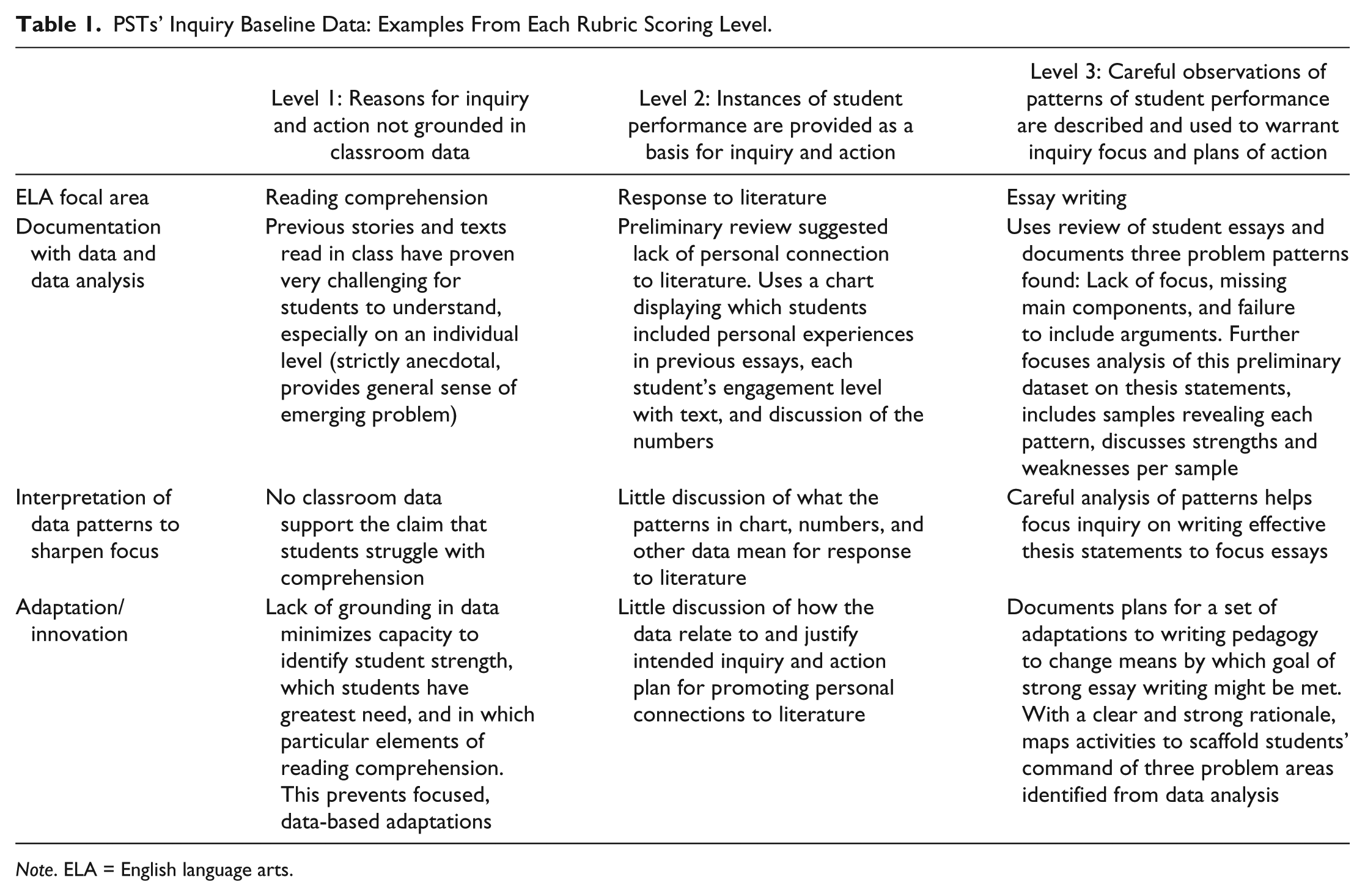
Note. ELA = English language arts.
To gauge quality of PSTs’ data analyses, we used scores for three required analysis events beyond baseline, all derived through the same interrater process conducted on baseline data. For each event, a top score of 3 indicated a PST thoroughly explained how data connected to a research question; included a clear example of data collection tool and response; and demonstrated analysis that showed depth and complexity of interpretation. A score of 2 indicated connections to research question were unclear or tool and response were unclear or analysis needed greater depth. A score of 1 included problems in two or more areas. As with baseline, ongoing data analysis scores were derived annually and the same process was used for interrater scoring. For three data analysis events, scores of 1 to 3 were averaged for a data analysis average score.
To answer our second sub-question about the nature of teaching adaptations PSTs documented through inquiry, we used prior studies to guide inquiry review. Codes included: modifies a lesson objective, changes means by which objectives are met, invents an example or analogy, inserts a mini-lesson, suggests different ways students could deal with a situation or problem, omits certain planned activities or assignments, and changes the planned order of instruction (Duffy et al., 2008; Parsons, 2012; Parsons et al., 2010). However, that coding scheme was used for observations, capturing microadaptations while teaching. As our database used documented practice and inquiry, as well as reflections, some codes were less relevant: We did not expect to learn without observations, for example, if a teacher invented an example or analogy, or suggested other ways students could deal with a problem. As we examined data, we found a dominant code for data-based and documented teaching adaptations: “The teacher changes the means by which objectives are met (e.g., materials, strategy, activity, assignment, procedures, or routines.” Beyond this code, we used sub-codes (e.g., materials, strategy, etc.) to discern particular ways PSTs changed the means by which objectives were met. We used these sub-codes to analyze trends in the data.
Adaptations were documented in lengthy reports including plans, data collection tools, student work samples, data displays, accounts of data patterns, interpretations of findings, and rationales for adaptations. Other relevant data were PSTs’ inquiry memos with student work, findings, and reflections and some video records of instruction. Adaptations reported in these varied, complex data sources were not readily quantifiable. Our focus became not a frequency count of which forms of adaptive teaching occurred but (a) the most prominent forms emerging from repeated data review, and (b) the nature of engagements with these adaptations, including how inquiry and data figured into PSTs’ processes and reasoning behind rationales for adaptations.
To answer our third sub-question about inquiry features that appeared to promote adaptive teaching in ELA, we reviewed inquiry process data (memos, questionnaires, discussion transcripts, and field notes) across the years for emerging themes. PSTs’ language was typed verbatim into files. We reviewed data for patterns of response from a preponderance of data, using the constant comparative method, yielding categories and themes (Merriam, 1998). The research team reviewed categories and data for fit and recoded as needed, before conducting a triangulation check to see ways these themes emerged in PSTs’ actual inquiry work.
To deepen analyses and reporting, we constructed cases to illustrate literacy adaptations and the inquiry processes supporting them. All case contexts matched overall database trends of majority students of color, high poverty, and a number of ELs, with two cases illustrating all-EL classes, one in middle school and one in high school. To sample the range in the database, we selected diverse grade levels, 7 to 12; gender of PSTs (5 female, 3 male); ethnicity of PSTs (4 White, 3 Asian American, 1 Latina/White mixed); and inquiry topics. For each of four kinds of adaptation, we selected a pair of cases that provided contrasts in topic, in acts of adaptive teaching, and in ways PSTs engaged inquiry processes. Both similarities and differences in practices enabled us to understand the challenges and complexity of adapting literacy instruction for PSTs.
Results
From analyses of 96 inquiries, we report how PSTs worked with data. We then report how PSTs used data to guide teaching adaptations and offered high-quality rationales for them. Adaptations changed the means by which instructional objectives could be met. PSTs used four main forms of adaptation to meet literacy objectives: routines, materials, strategies, and actions.
Working With Classroom Data Through Inquiry
Baseline data grounding for inquiry and innovation
Given our focus on data-based adaptive teaching, we examined rubric scores on how PSTs used baseline data to map inquiry foci and teaching adaptations they might develop and study, using rubric criteria identified and illustrated in Table 1. Table 2 shows a mean score for 96 inquiries of 2.49 on the 3-point scale. Table 2 also shows 55 inquiries (57.3%) earned a score of 3, indicating careful observations of patterns of student performance were described and used to warrant an inquiry focus and action plans. A score of 2 (15 PSTs, 15.6%; Table 2) indicated that PSTs provided student work samples as the basis for inquiry, but without adequate analytic treatment of data to identify patterns in student performance that might help focus an inquiry and specific plans of action or innovation. A rubric score of 1 (5 PSTs, 5.2%) indicated reasons for inquiry and action were not grounded in classroom data. In these cases, reports were strictly anecdotal, providing a general sense of an emerging problem, but not prompted by data justifying a particular need for inquiry, action, and innovation.
PSTs’ Scores on Using Classroom-Generated Data to Justify and Frame Inquiry.
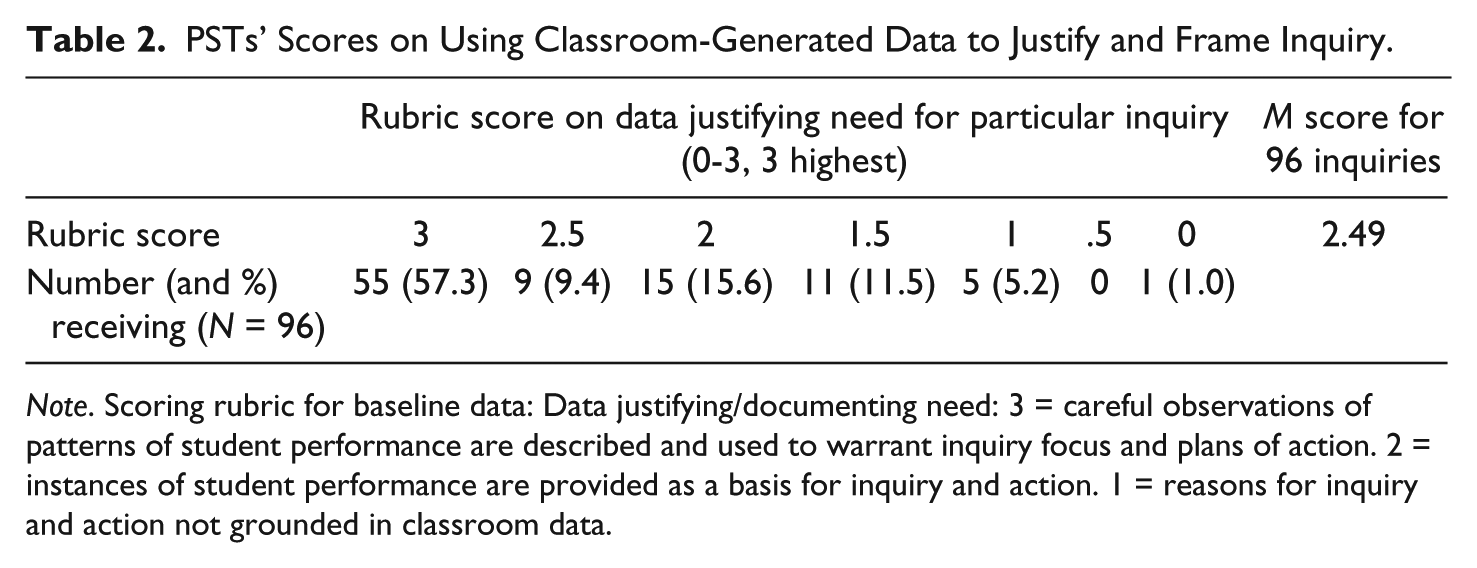
Note. Scoring rubric for baseline data: Data justifying/documenting need: 3 = careful observations of patterns of student performance are described and used to warrant inquiry focus and plans of action. 2 = instances of student performance are provided as a basis for inquiry and action. 1 = reasons for inquiry and action not grounded in classroom data.
When average scores at the higher levels (2.5 and above) are combined, 64 (66.7%) of PSTs fall into this upper group, indicating two thirds of PSTs used data and analytic care to articulate rationales for inquiry focus and action plans, often including plans for innovation. Cast slightly more broadly, 79 (82.3%) PSTs received a baseline data analysis average score between 2 and 3, indicating PSTs overall demonstrated, at minimum, how to use student work as a basis for inquiry and action. Several PSTs who successfully engaged the baseline data activity reported its value. One PST shared, “The more research you do with baseline data collection . . . the more honed in you will be.” This issue of being honed in, or focused, helped guide data analyses to move inquiries along in generative ways, with potential also to guide adaptive teaching.
Ongoing data analyses to guide adaptations
Averaged across three analysis events, the mean score for data analyses was 2.54 (Figure 1), indicating PSTs overall conducted analyses effectively demonstrating two or more rubric features, including the following: thoroughly explains how data connect to question, includes a clear example of data collection tool and student response to a task, and analysis shows depth and complexity of interpretation. With average scores at higher levels (2.5 and up) combined, 58 (68.8%) PSTs fall into this upper group; cast slightly more broadly, 72 (75%) earned a data analysis average score between 2 and 3, approaching depth. While this leaves 25% below an average data analysis score of 2, it suggests that overall, PSTs attended carefully to conducting and documenting data analyses sustained over several analysis events.
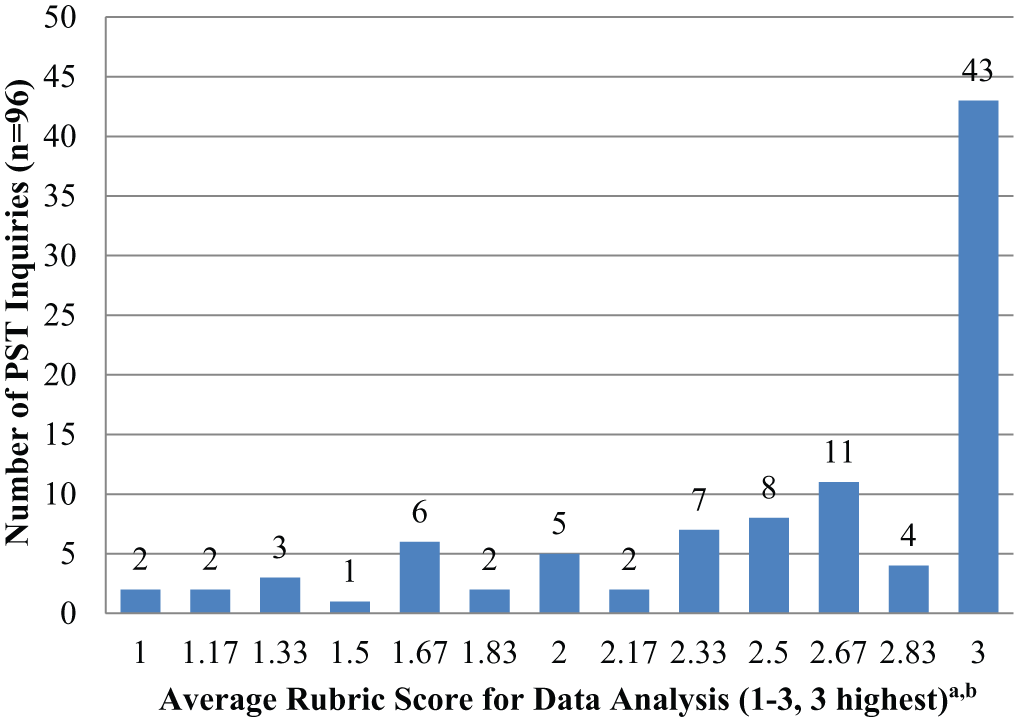
Preservice teachers’ scores for ongoing data analysis.
Forms and Nature of Adaptive Teaching in Response to Classroom Data
Our analyses found that conducting data-based, responsive inquiry fostered four main forms of adaptive teaching to change the means by which objectives were met: adaptations to literacy routines, materials, strategies, and activities. We report these forms of adaptation in PSTs’ documented teaching, highlighting rationales for adaptations and complexities of enacting them.
Adaptations to literacy routines
Martha: Adapting the routine of sustained silent reading (SSR)
Martha, in a middle school class of advanced ELs, found her male readers did not engage the SSR routine she had adopted. They barely sustained reading for an expected 15 min twice weekly and did not care about or recall what they read. Martha selected six focal males of diverse cultural origins and first languages. She surveyed, observed, and interviewed them about interests and habits, and based on findings from these data sources, adapted her SSR routine. First, she found their initially high motivation with a text waned, and they needed a motivator to sustain interest in reading. She adapted her routine of reporting in text logs after reading to include book talks for more interactive engagement. Second, Martha was surprised to learn through survey and interview analyses that her focal male ELs wanted longer and more frequent periods to get into and stay with texts. In response to this finding, Martha adapted by lengthening SSR to 20 min and adding a third day weekly for this routine. Third, asking students to read what they brought in from library visits was not working as students were forgetting library cards or were unable to renew books for as long as they needed them. Martha adapted text choice by learning in interviews about her male ELs’ interests, so she could partner with them in text selection to ensure they had high interest books with them for SSR. With these adaptations to her routines, Martha documented through observation notes, surveys, and work samples how engagement rose and reading grew more sustained across SSR sessions. She offered high-quality rationales for adaptations, all grounded in data analyses, and monitored adaptations with a critical eye through the duration of her inquiry.
Leslie: Adapting the routine of literature logs
Leslie found the routine of literature logs problematic. Her middle school students’ responses to texts were “very surface level. The students had become so accustomed to completing the entries that they hardly thought about what they were writing about for their entry.” Leslie asked, “Why should the students push themselves to change when the teacher does not change?” She reflected on her own course of routine expertise and the need to innovate. Leslie sought formats to promote engagement, consulting sources to follow a course of adaptive expertise: “I wanted to see if providing an audience (in letter format) helped change the students’ indifferent responses.” With a coding system to evaluate responses for knowledge sources and depth of response, Leslie’s analysis of this literacy routine adaptation revealed students made many more textual references. However, Leslie found the letter format reduced the number of personal connections made to the text and minimized questioning that the literature log routine promoted. Leslie’s care in ongoing analyses highlighted that thoughtful adaptations aligned with data analyses involve more than innovation for innovation’s sake. By comparing data of letter formats with literature log routines and assessing pros and cons of each, Leslie realized she needed a hybrid version of the routine. Through inquiry, she brought the same analytic care to other literacy activities she explored, helping her maintain a critical eye on whether adaptations helped her achieve literacy instruction objectives.
Close examination of data to guide adaptations of routines
New teachers need routines to establish curriculum. PSTs had adopted literacy routines learned from resident teachers, schools, literacy programs, supervisors, or methods texts. Teacher inquiry became a forum to inspect routines for whom they served and whether they helped meet objectives. Using data analysis based on experimentation, PSTs learned why some routines were ineffective. In such cases, if they used data thoughtfully as Hatano and Inagaki (1986) suggested, they uncovered strengths and problems in routines and could test adaptations to make routines fit their goals more effectively. As Leslie noted, “On my own I would not have integrated these other types of student responses into my teaching practices.” She added, “It is a useful lesson to learn one should look at student work analytically; otherwise we allow personal opinion to supply our views.” Leslie reported the value of experimentation, adapting routines in service of learning, and careful analyses of student data for ongoing thoughtful judgment about what best suits student learning needs.
Adaptations to literacy materials
Ethan: Adapting texts to promote engagement
Ethan documented how students’ written analyses of literature were weak. He kept literary analysis activities stable and rigorous but adapted by selecting texts closer to students’ worlds. Students first had to analyze a pop song: What I realized after analyzing the data is that students have more of an ability to analyze, summarize, and define aspects of texts than I think I was giving them credit for. Too often I would think that students can’t make that connection, see that relationship, define that idea, identify the significance of that line of text. But the reality is that they can. Students do it all the time with music and television and movies and skater magazines and Cosmo.
With his data analysis results and a solid rationale, Ethan planned to layer in literacy materials that gradually moved further from students’ communities and that added complexity. He had time to track only some of this adaptation in his inquiry. Still, his adapting of literacy materials provided him with a catalyst for prospective adaptations, an investment in longer term improvements, prompted by experience with benefits of the adaptive pattern (Martin & Schwartz, 2009).
Kerry: Adaptations to materials for ELs
Learning to adapt literacy materials benefits from student input, as Kerry learned through inquiry. Kerry taught an early advanced to advanced EL class of 18 students who spoke seven different first languages, mostly Spanish and Hmong. In the past semester, a third of Kerry’s class received a failing grade. She was expected to use standards-based activities on response to literature to develop English proficiency in speaking, reading, and writing. Students completed activities, but literacy materials posed problems. Kerry found students challenged by academic language in literature. She was bewildered about how to scaffold meaningful engagements with text. To learn more of students’ challenges and interests that might guide adaptation, Kerry used tools to ask and listen beneath the surface of activity (Athanases et al., 2013), to collect students’ perspectives, attitudes, preferences, and reasoning. She kept field notes during group work and conducted a class survey and short interviews with four focal students. Through analysis of data trends, Kerry learned students were hooked on graphic novels. This discovery surprised her and unlocked possibilities. She introduced an innovation of teaching academic language through review and construction of graphic novels. She reported engagement with the materials, finding students focused on academic language work more fully once embedded in accessible, engaging materials. Kerry used student work and other data to document how adapting literacy materials proved essential. She changed the means by which her goals of response to literature and development of academic language might be met. Introducing readings and drawings to illustrate narrative actions proved engaging for students and powerful for Kerry.
Literacy materials adaptations made through discovery and reflection
Using inquiry to uncover students’ learning preferences and out of school reading habits enabled Ethan and Kerry to use adaptive teaching to change the means by which objectives of response to literature and academic language development could be met. Ethan’s and Kerry’s adaptations responded to their students’ lived experiences and interests and used more accessible materials to develop students’ literary concepts. Through inquiry, the trend toward adopting curriculum uncritically (Grossman & Thompson, 2008) was disrupted as these PSTs examined the efficacy of materials and adapted them in response to their particular students’ interests and needs. In turn, cycles of reflection and action promoted praxis (Athanases, 2011).
Adaptations to literacy strategies
Henry: Adapting reading strategies
Henry learned his students needed strategy support to read literature. Reviewing reciprocal teaching (RT; Palinscar & Brown, 1984), Henry found summarizing, clarifying, questioning, and predicting held potential for his work. He adapted plans to include RT to deepen literary understanding. He administered a pre/postreading survey to learn what strategies students used when reading. In the interim, he introduced a strategy per week with texts his class was reading. He used questioning when students read Robert Frost’s “Nothing Gold Can Stay” and predicting for Emerson’s “Self-Reliance.” Henry reflected on use of expository texts in the original RT work, noting his time frame was tight and his target texts were not the best fit for students’ acquisition of the strategies. Still, this adaptation to his teaching had value. Analysis of focal students’ work and exit surveys showed students using the strategies: “I saw firsthand how these strategies broke down the complex texts into more manageable and even ‘easy’ parts. I believe reciprocal teaching is most useful with struggling readers and those students who have ‘given up’ on reading.” Henry learned the value of introducing adaptations to meet his learners’ needs. By adapting his instruction of reading, his students learned new ways to approach text. Had Henry had more flexibility in planning, he may have made further adaptations, which may have benefited him as a developing teacher and his students as developing readers. Consequently, although Henry illustrates how PSTs adapted literacy strategies as a result of inquiry, he also illustrates what happens when PSTs lacked flexibility in their instructional routines.
Tara: Critiquing adaptation of strategies for reading and response to literature
In contrast to Henry’s adaptation of importing a set of strategies taught sequentially, Tara’s inquiry shows value in ongoing critique of adaptations to literacy strategies. Teaching a very diverse class, Tara focused her inquiry on eighth graders’ study of The House on Mango Street (Cisneros, 1984). She sought to strengthen comprehension by tapping personal experiences and prior knowledge while reading. Tara noted students’ struggles to analyze texts deeply: My students seem to view reading as an activity that has no relationship to their lives outside of school. It is my hope that this study will help students link their own reading to their own personal experiences and to other media and literature.
Tara also suspected students struggled with reading, so she administered a baseline reading diagnostic asking students to summarize, analyze, support analyses with evidence, and link a passage of Mango Street to personal experience, media, or other literature. With a rubric she generated, Tara confirmed that 16 of 20 students insufficiently connected reading to prior knowledge and experiences. Drawing on research on the role of such connections in reading comprehension (e.g., Beach, 1998; Langer, 1995), she offered a high-quality rationale for adapting strategies to scaffold links to Mango Street. She asked students to select vignettes from the text, link them to songs, movies, other books, and personal experiences, and to explain connections.
Tara critiqued her adaptation. She noted that her rubric to evaluate connections considered counts but not quality. She included quality in her next adaptation to learn reasons for connections. At the end of her unit, students wrote an interpretive essay on a recurring theme from the novel, including connections from their theme to personal experiences: “The students not only needed to explain the experience, but also relate that experience to the theme and/or to the characters involved.” Aligned with her critical perspective on this work, Tara revised her essay rubric to evaluate students’ reasoning behind their text connections: “I used a modified version of the rubric from my linking exercises dataset to evaluate the links created in each personal experience paragraph.” Tara now could determine if students’ described experiences clearly related to textual events or lacked logical explanation. Tara’s focus on qualitative aspects of connections enabled her to understand not only if students made links between text and lived experiences, but also how deeply related connections were, in hopes of fostering comprehension. She reflected that a 23% improvement (as reflected in baseline and exit data) was something to be proud of: Based on Langer’s (1995) conclusions that linking and literary envisionment are indicative of higher reading skills, I can deduce that my students’ improvement in linking, however small, is also an improvement in reading skills and literary response and analysis skills.
Tara created a scaffolded approach to comprehension strategy instruction. She grounded her need in data, adapted strategy instruction and related rubrics as a result of data, and critiqued her adaptations to both instruction and assessment to further direct her instruction and adaptations.
Aligning adaptations with data and using critique
These were PSTs’ first inquiries, and not all teaching adaptations were aligned with data. When Henry adapted literacy strategies by introducing RT, he developed awareness of the tools and interest in experimenting. However, by strictly adhering to his plan to teach the four strategies sequentially, Henry limited his chance to respond to data analyses about students’ uptake of each strategy. He became caught up in strictly adopting the activity sequence, a common problem for new teachers (Schultz & Mandzuk, 2005). This in turn prevented him from aligning his teaching of each strategy with data he collected. In her adaptations of her literacy strategies to foster text connections and literature response, Tara’s thoughtful critiques of her own adaptations led to new discoveries that in turn led to ongoing and refined adaptations (Parsons, 2012). She looked hard at data and learned how counting knowledge sources students tapped for sensemaking was inadequate. This critique of her own innovation enabled her to see how she needed to adapt her literacy activity further, asking students to offer reasoning behind their text connections. Her critiques also enabled her to see how she needed to adapt her rubrics to capture this richer account of students’ literacy practice. Tara also illustrated how being flexible helps commit oneself to the continual adaptations that inquiry demands.
Adaptations to literacy activities
Frank and Mandy adapt with multi-modal activities
Working in different diverse high schools, Frank and Mandy partnered to study student engagement with literary themes. Mandy launched a unit for 12th graders on In the Time of the Butterflies (Alvarez, 1994), a nonfiction novel set during the Rafael Trujillo dictatorship in the Dominican Republic. Frank taught a unit for “a rowdy group of 9th graders” on The Stone Goddess (Ho, 2003), dealing with a Cambodian family after the Khmer Rouge takeover and the family’s subsequent immigration to the United States.
The pair chose six themes to explore in their respective sites that cut across the two literary works: obedience, loss, family, courage, innocence, and change. Finding students struggled to abstract and articulate themes, they administered a baseline data questionnaire asking students to think about the core themes and to identify where they had seen these themes arise in life experiences, books, media, and history. They coded students’ responses, tabulated by knowledge source (e.g., books, movies), and listed examples that students generated for sources and themes. They found students generated few book examples, many media examples (especially from films), and offered primarily broad references to history (wars, battles) with few specifics.
The pair focused a research question on whether use of multi-modal activities would engage students more fully in exploring the depth and far-reaching nature of themes. Beyond exclusively written prose, they created innovations that adapted modes and media for expression of theme. Frank described his adaptations to activities: They began by comparing the book thematically to a series of songs; they then moved on to finding commonalities with poetry, which they also conveyed through a drawing; and most recently they connected it with a short story. Making these connections proves to be a little more demanding with each new form of media, so the students have actually been able to analyze the themes of the book more deeply with each successive checkpoint.
The major challenge for this pair was developing assessments to keep abreast of their creative adaptations to literacy activities. They needed to generate work samples to code and assess. As students practiced drawing links between visuals and themes, Mandy developed a rubric to code writing for the degree to which it clearly explains connection between visual and theme, includes in-depth analysis of why visual is an effective example, goes beyond obvious connections, and includes insightful comments (about their own lives, the world, media, the novel, etc.). For their adaptation of using dramatic enactments of theme, Frank used a thoughtful rationale and reflections: In this activity, students had to act out scenes, and also themes, from the text that they were reading, without using any words. What was great about this particular activity was that it showed how the students were able to draw from prior knowledge, as well as from other genres, in their interpretation of each scene, or theme . . . This was a clear indication of their ability to bridge themes across various media resources.
He videotaped drama activities and created tools to assess students’ command of displaying knowledge of theme in the context of their dramatic performances and visual representations.
Through documenting student learning, both Frank and Mandy reported how these instructional adaptations helped engage students more fully in work on literary themes. However, ongoing analysis of student work was essential, and adaptations to literacy assessments had to keep pace.
Flexibility and ongoing adaptations
Frank and Mandy illustrate how following the pathway of data can lead to a snowballing effect. The more they experimented with modes and media for response—and followed the path of data—the more enthused they became about committing to innovation to achieve their literacy goals. However, each innovation to literacy activities required adaptation to assessment. To understand how their students engaged with visual representations of theme, thematic links across text genres, and dramatic enactments of theme, they had to be flexible in realizing the need for innovative methods for capturing the unfolding learning, discerning what counts as data in, for example, performative student responses, and analyzing what is working and not working, and for whom. Without this flexibility and commitment to understanding, adaptations to teaching may result in mere novelty.
Discussion
Adaptive teaching is essential to meeting the needs of students in 21st-century schools, particularly in the realm of literacy. Acquiring the ability to adapt or innovate to meet learning preferences, challenges, and needs of culturally and linguistically diverse learners can take years of trial and error as teachers build a bank of knowledge about pedagogy, content, and student learning through experience and practice. In this study, we asked, “How, if at all, did teacher inquiry in an inquiry-based TE program foster literacy adaptation and innovation in preservice ELA teachers’ work?” We found the responsive model of data-based PST inquiry studied here holds potential to speed that learning. Our first sub-question asked, “How did PSTs work with ELA data through inquiry?” We found PSTs overall demonstrated using student work as baseline data to uncover areas that warranted adaptation and overall attended carefully to conducting and documenting data analyses sustained over several data analysis events.
Our second sub-question asked, “What was the nature of literacy-related teaching adaptations PSTs documented through inquiry?” We found PSTs made a rich array of adaptations to their teaching as they studied which instructional innovations yielded best results for their various learners. Adaptations included changes to literacy routines, materials, strategies, and activities, with many clear and strong rationales provided because PSTs’ decisions were grounded in data of their students’ learning, performance, experiences, and perspectives, and articulated in data analysis workshops, conceptual memos, class discussions, and conferences.
Our third sub-question asked, “What inquiry features appeared to promote adaptive teaching in ELA?” Learners need randomness and variability to test solutions and adapt. Classroom contexts provided PSTs with real populations of learners in their diversity and variability. Also, the inquiry model was data based, with PSTs required to collect ongoing data, analyze carefully, and make decisions based on findings. The program scaffolded such elements. Coursework introduced and fostered practice with inquiry tools and processes, then moved PSTs into a first inquiry in content area cohorts. The content area inquiry course scaffolded work with data, using memos from the field to concretize data gathering and analysis and foster reflection and distillation of themes. Other scaffolds included workshops on representing data numerically and graphically and moving from student work and other qualitative data from surveys and questionnaires to coded data and tabulation of themes. Instructor, TAs, and peers provided feedback to prompt reflection, revision, and high-quality rationales for adaptations. Also, inquiries were not evaluated on success of individual adaptations, so PSTs were allowed space for trial and error without penalty, in the context of scrutiny for any risk of denying students the literacy instruction they needed. In short, a culture of scaffolded and mindful experimentation in the company of an inquiry community created opportunities for PSTs to explore adaptive teaching and to learn from their explorations.
Following the Pathway of Data to Guide Adaptive Teaching in ELA
Data-based inquiry guided adaptations in PSTs’ instruction. Data use is key to adaptive expertise (Hatano & Inagaki, 1986). PSTs reported and exhibited trust that examining data for patterns of success and need can catalyze adaptations responsive to themes. Four recursive inquiry processes (Figure 2) describe how PSTs followed the pathway of data to guide adaptive teaching, in a classroom culture of flexibility, data-based experimentation, and innovation.
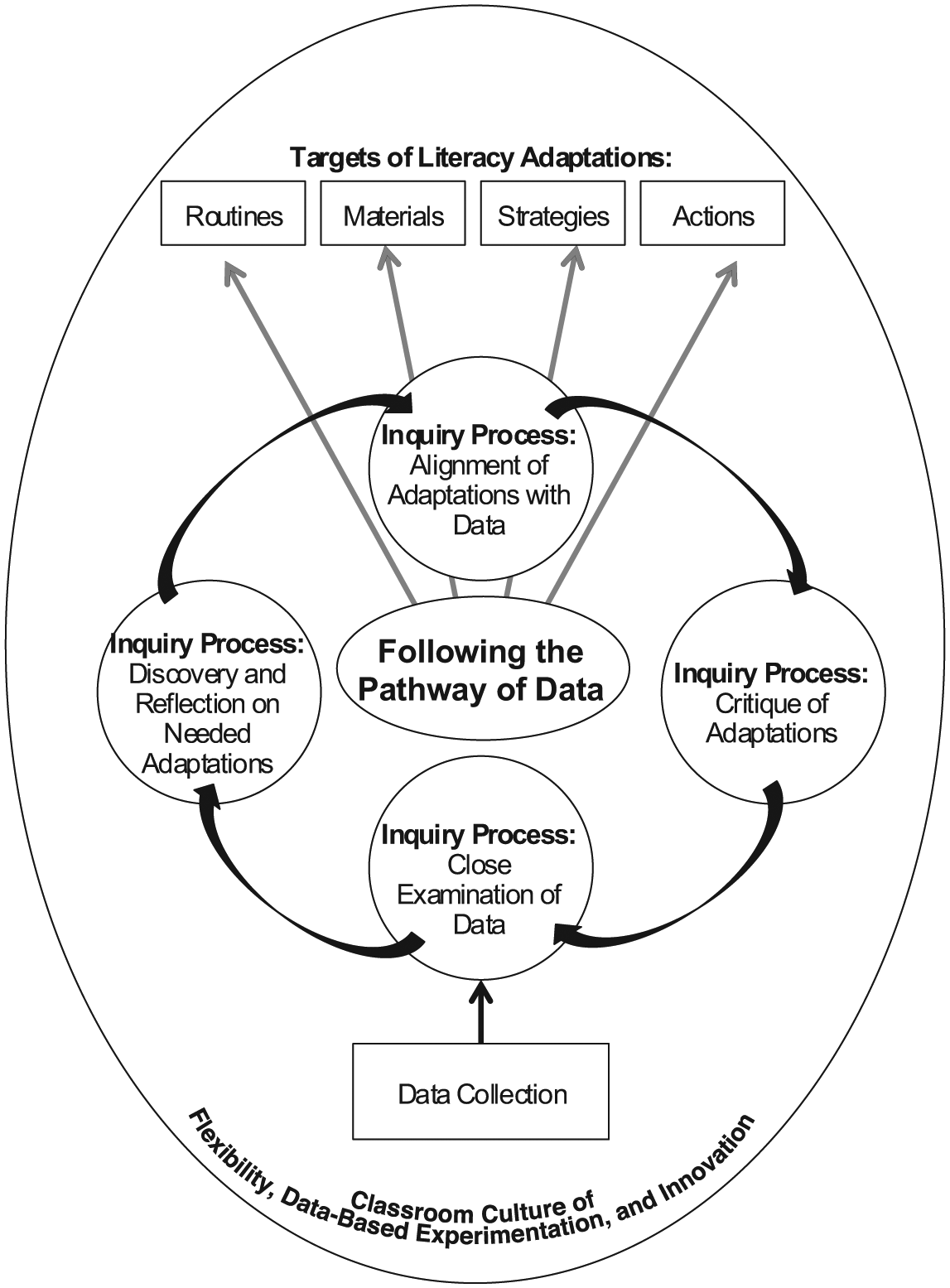
Following the pathway of data to guide adaptive teaching in ELA.
Close examination of data
Without grounded attention to data, teaching adaptations may be random or shaped merely by teacher preference. The process took time and repeated attention. Aiding close examination of data were displays (tables, figures, charts, thematic annotations on student work) to guide pattern finding, uncovering surprises, and prompting reflection on ways to adapt to meet student need. As Leslie noted, she needed to do analysis of student work, which prompted experimentation with the literacy routine that was not working well for her students.
Discovery and reflection for adaptations
Analyses led to discoveries and reflection, as PSTs uncovered things they needed to know to adapt instruction for more equitable learning opportunities. Kerry’s adaptation of literacy materials to include graphic novels highlights this discovery and surprise through data collection and analysis. Using inquiry to uncover students’ learning preferences and out-of-school reading habits enabled Kerry to adapt the means by which her objectives of response to literature and academic language development could be met.
Alignment of adaptations with data
Adaptations PSTs documented through inquiry typically focused on issues emerging from data analyses. This alignment (Figure 2) helped target student need. When PSTs were able to draw a clear line from data to action, the focus of instructional adaptations and discoveries about student learning and teaching were sharper. In addition, keeping that line evident made possible the continuous nature of data analysis and adaptation—following the pathway of data in service of responsive teaching.
Critique of adaptations
Looking critically at adaptations was important. Inquiries that fostered thoughtful adaptations did not end with innovation. There was ongoing data analysis, reflection, and critique, in an effort to gauge effectiveness of adaptations. Tara’s thoughtful critiques of her own adaptations to literacy strategies led her to new discoveries that in turn led to ongoing and refined adaptations. Her critiques also enabled her to see how she needed to adapt her rubrics to capture a richer account of students’ literacy practice.
Need for flexibility
In addition to the four inquiry processes, a disposition of flexibility was a major theme in supporting adaptive teaching. This involved relinquishing some control over a unit or inquiry plan and trusting the path of data as guide. One PST noted, “The questions you start out with are a springboard . . . After that, you find yourself following the results of the research in pursuit of things you realize are root concerns or new, more challenging problems.” As Tara illustrated, flexibility helps one commit to continual adaptations that inquiry demands. Following the pathway of data for Frank and Mandy, who adapted activities with multi-modal approaches to explore themes, also required flexibility as they examined results of each piece of their innovation.
Limitations and Contributions of the Study
Our study is limited by a lack of observational data to examine ways teaching adaptations occurred in real time and ways PSTs may have used microadaptations to instruction during teaching. Nonetheless, the study makes several contributions to the research literature, in particular to two lines of research associated in this study, both still in their nascent stages.
Our study contributes to the literature on adaptive teaching. Though not new, this field only recently began developing cumulative knowledge of what forms adaptive teaching takes and what conditions may foster its development. In the field of literacy, the knowledge base is even smaller but developing. Our study, set in the context of ELA instruction, analyzes forms of adaptation, builds on work of Duffy et al. (2008) and Parsons (2012), and adds three features. First, in contrast to studies of smaller numbers of practicing teachers, we examined work of a relatively large group of PSTs, novices at pedagogy even as they explored adaptive teaching. This enabled us to learn how these novices were beginning a course of adaptive expertise even while developing routine expertise related to planning and procedures. Second, in contrast to a focus on observation data in prior studies, we utilized multiple data forms, including conceptual memos, questionnaires, discussions, conferences, slide presentations, and notes documenting practice. Multiple data forms enabled us to learn about complexities of adapting teaching as PSTs took it on for the first time to this degree. Though strong arguments exist in the literature about ways TE can foster adaptive expertise (e.g., Bransford et al., 2005; Hammerness et al., 2005), our study provides evidence of ways such work can occur and challenges of doing it.
A third addition to adaptive teaching literature from our study is that contexts for adaptations were 96 classrooms of mostly students of color, just under half of which were comprised of 33% to 100% ELs, and nearly all of which were in schools with a majority of students in poverty. The many ways PSTs worked to adapt teaching to meet the needs of these student populations warrants attention. Using data to learn to adapt teaching to meet ELs’ needs is especially notable, highlighting that even PSTs can recognize how ELs can serve as informants, through various forms of data collection, on how to move instruction ahead to serve all learners. As PSTs move into teaching positions, many forces will constrain their teaching and capacity to innovate, especially in schools serving lower income youth of color. Having preservice experience of closely examining student work as data and exploring alternative teaching approaches may provide them with a sense of benefits and values of the adaptive pattern, prompting prospective adaptations (Martin & Schwartz, 2009).
Our study also contributes to research on PST inquiry. Lauded widely as professional practice, inquiry now occurs in many U.S. TE programs (Borko et al., 2008; Cochran-Smith & Lytle, 2009). However, evidence of values and outcomes of teacher inquiry in TE remains slim (Grossman, 2005) and at best exploratory (Darling-Hammond & Bransford, 2005). Again, set in the context of literacy TE, the evidence base is slimmer still. Our study contributes to this line of work. In the context of one responsive teacher inquiry model in one program, the study examined nearly 100 inquiries to understand how a particular model of inquiry may have supported development of adaptive expertise in teaching ELA. The inquiry processes we described, as well as a disposition of flexibility—embodied in PSTs’ practice and reported in their language—help to characterize ways teacher inquiry can provide opportunities to explore the adaptive pattern of teaching.
Conclusion
Stepping out of conventional practice to explore and innovate requires a culture that holds a larger goal of understanding the system and that values experimentation (Hatano & Inagaki, 1986). Many new ELA teachers will enter school cultures that work in the opposite direction, resisting challenging discussion of larger purposes for routines, scripts, and tests, and expecting compliance and not experimentation. For new ELA teachers, explorations with adaptive expertise are right on time, as the Common Core Standards encourage teachers to consider flexibility to meet student needs. With adaptive expertise, teachers may be able to make good decisions on how best to meet diverse learners’ needs. We do not know for certain the trajectories of participants in our study who entered the profession and whether these early adaptive teaching explorations prompt continued efforts to use inquiry tools to guide innovations. An important area for future study will be to understand how teachers with scaffolded preservice encounters with inquiry and innovation sustain these practices if and when they enter school cultures that do not support them.
Footnotes
Appendix
Preservice Inquiry Course Scaffold to Guide Reflections From Data and Cohort-Group Workshop
Declaration of Conflicting Interests
The author(s) declared no potential conflicts of interest with respect to the research, authorship, and/or publication of this article.
Funding
This study was funded, in part, by a grant from the Spencer Foundation.