




Abstract
This paper examines why communicative language teaching (CLT) fails to improve student learning in certain contexts by assessing two adult educators’ communicative and noncommunicative practices through qualitative case studies, interviews, and participant observations. Results show no inherent CLT problems that prevent teachers from grasping CLT theory and transforming it into classroom practices. Communicative classroom practices lead to significant improvements in student communicative competence and four skills, whereas noncommunicative practices bring about poor student learning outcomes. Moreover, noncommunicative teaching incurs negative consequences for teachers and students more than traditional pattern-drill instruction. The study points to the teachers for CLT failures in certain contexts and recommends CLT to underpin English as a foreign language/English as a second language (EFL/ESL) curriculum and instruction, alongside changes in adult educator preparation programs and in-service teacher training. To avoid noncommunicative instruction, policymakers and initial and in-service teacher training programs should offer communicative training that mixes and balances theory and practice, and should monitor teacher cognition and behavior in actual classrooms.
Keywords
Despite remaining popular, opponents and traditional communicative language teaching (CLT) proponents have recently questioned the differences between communicative and pattern-drills curriculum and instruction in learning outcomes (Kumaravadivelu, 2006; Nunan, 2004; Widdowson, 2003). Recent research findings also seem to consolidate this rising skepticism about CLT ability to improve student communicative competence across various contexts (Chowdhury & Ha, 2008; De Segovia & Hardison, 2009; Kirkgoz, 2008). In contrast, CLT proponents blame teachers for CLT failure because they fail to transform communicative theory into classroom practice (Savignon, 2001, 2005; Savignon & Wang, 2003). Prior research also seems to support the proponents’ case, because negative learning outcomes result from noncommunicative rather than communicative teaching (e.g., Feryok, 2008; Nunan, 1987; Orafi & Borg, 2009; Savignon, 1991). Moreover, student communicative competence improves when teachers transform communicative theory into practice (e.g., Meskill & Anthony, 2007; Nobuyoshi & Ellis, 1993; Safar & Kormos, 2008; Savignon & Wang, 2003).
The debate over CLT failure echoes the situation across many contexts because the so-called communicative teachers continue to deliver language forms (Kumaravadivelu, 2006). “It is difficult for teachers who themselves have learnt English through the traditional approaches to suddenly turn their backs on familiar classroom methods in favour of newer ones . . . which provide an easy excuse to dismiss the communicative-based methods” (Kamhi-Stein & Galvan, 1997, pp. 12-13). This study, therefore, examined why CLT fails to improve student learning outcomes in two similar English as a second language (ESL) contexts. By learning outcomes, the researcher meant teacher and student self-reporting of improvement in student communicative competence and language skills (listening, reading, writing, and speaking). No ability measures (e.g., tests) were used. The two ESL contexts involved two colleges in Cambridge, UK, where students who come from different parts of the world use English as the medium of communication inside and outside the classroom. These students used to learn in English as a foreign language (EFL) contexts before coming to Cambridge. They used to use English as the medium of communication inside the classroom while using their mother tongues as the medium of communication outside the classroom. All the students completed secondary education and were preparing to pursue university education in different academic fields.
CLT
This study draws differences between noncommunicative and CLT. Noncommunicative teaching involves incoherent and defaced CLT versions created by teachers who either do not understand CLT or fail to put it into classroom practice. Such teachers use uninformed ad hoc procedures and confuse them with CLT. Teachers who consistently follow coherent methods, even old-fashioned pattern-drills instruction, are more likely to help students achieve some kind of learning, while the so-called communicative teachers do not (Shawer, 2010b). On the other hand, CLT relies on the communicative competence model that comprises four competences. Grammatical competence concerns development of student-language knowledge, including, for example, vocabulary, word and sentence formation, and spelling. Sociolinguistic competence involves use of appropriate spoken and written discourse at different genres. Discourse competence means that students have the ability to combine language form and meaning to produce appropriate and cohesive discourse, whereas strategic competence means that students develop learning and communication strategies so that they can process learning and overcome communication problems (Canale, 1983; Canale & Swain, 1980).
A number of principles underlie communicative classroom instruction. These include negotiation of meaning, genuine classroom communication, communication through the target language, and extensive use of collaborative activities and authentic materials. Communicative teaching also involves integration of the four skills, inductive and functional grammar instruction, tolerance with mistakes (Grenfell & Harris, 1999; Shawer, 2010b), and addressing student needs and differences (Finocchiaro & Brumfit, 1983). As such, CLT reflects sound educational, psychological, and linguistic assumptions and teaching and learning theories (Munby, 1978; Savignon, 1991). Savignon (1991) notes that CLT represents “a context that attracts researchers and curriculum developers, offering a study framework for integrating linguistic theory, research and teaching practice” (p. 263).
Canale and Swain’s (1980) CLT framework, however, has been dramatically refined and broadened over the past decades. For example, the marginal look at grammar as something to be taught minimally and inductively has changed. Factors, such as teachers’ perceptions, policies, exam requirements, and curriculum developments, reinstate grammar as a fundamental component of the language curriculum and demand new teaching approaches other than those envisioned by the classic model (Meiring & Norman, 2001). So does a debate arise in favor of a sociocultural competence (McConachy, 2009). It is the strategic competence that has witnessed dramatic developments in terms of cognitive processing through cognitive styles and learning strategy use (Holliday, 2005).
Curriculum-as-Syllabus
Curriculum is a written plan for action of four main elements: aims, content (syllabus), instruction (pedagogy/ teaching), and evaluation (Richards, 2001; Shawer, 2011). As a result, syllabus and pedagogy are components of any curriculum. Either component unfortunately stands for curriculum in many contexts (Shawer, 2011). Syllabus and content may mean different things. A syllabus concerns the selection of instructional topics, whereas content concerns the selection as well as organization of instructional topics into materials. A syllabus is thus part of content. One the other hand, syllabus and content may mean the same thing, being the selection and sequencing of instructional topics into materials (Richards, 1990). In addition, a course book may represent both. A course book provides the core materials for a course “in one book and is designed so that it could serve as the only book which the learners necessarily use during a course” (Tomlinson, 1998, p. ix). Several syllabus types are discussed below to mark their differences from communicative syllabi and their influence on classroom instruction.
Grammatical syllabi follow a closed system of language rules comprising structural aspects selected and graded from simple to complex round grammatical, phonological, and lexical elements. Selection includes “sentence structures or patterns … the noun and verb phrase and inflections of both nouns and verbs” (White, 1988, pp. 50-51). Being so, they embrace a narrow perspective because language is not confined to just one aspect (grammar). Language, for example, has sociolinguistic and pragmatic aspects, alongside cognitive and social functions (Munby, 1978). Prior research showed that grammatical syllabi did not improve student learning and motivation (Shawer, 2010b).
Task-based syllabi emphasize information processing than language learning and successful task completion as the process and outcome of language instruction (Nunan, 2004; Willis, 1998). They increase student motivation and acknowledge their motives for language learning. Prahbu designed task-based syllabi in India, which, although enable conscious exchange of meaning, involve unconscious acquisition of structures. The syllabus was organized around information-gap activities so that students, who know a piece of information transfer it to others who do not know it and around reasoning-gap activities to encourage students to use received data to produce new information (deduction) and discover relationships. Moreover, the syllabus was further sequenced around opinion-gap activities where students respond to a piece of information to express personal reactions, including opinions, attitudes, and preferences (Nunan, 1988; Prabhu, 1987). Although prior research showed a positive influence of task-based syllabi on developing student communicative abilities (Carless, 2007; Park, 2010), neither was this confirmed on a large scale, nor were many task-based syllabi developed.
Content-based syllabi use the contents of other subjects as the language content. Learners, for example, learn geography or science through the target language with focus placed on processing geographical or scientific information than language elements. These syllabi do not suit general language courses. Moreover, students who benefit from them are those interested in the subject. Students may prefer to study new and different topics (Nunan, 1988). Skill-based syllabi are built around receptive language skills (listening or reading) and productive skills (speaking or writing). As such, they do not suit generic-language courses, where the four skills receive equal weights. However, language instruction for specific purposes raised the need for more specialized syllabi built around a particular skill (White, 1988). Situational syllabi organize content around specific situations, such as shopping and banking, and link actions and locations together so that students carry out activities rather than learning about the language (Nunan, 1988). Although situational syllabi could be useful to general courses, the situations may be too general or too limited to predict most communicative functions. Topic-based syllabi involve content organization around topics of interest, such as food, health, or clothing. The topics are graded from general to more specific ones (Richards, 1990; White, 1988).
Communicative (also notional-functional) syllabi organize content around notions and functions rather than structures. A notion is a particular context in which people communicate, whereas a function involves the purposes for which people use language. Functional aspects deal with purposes, such as giving directions and advice. Notional aspects deal with concepts, such as time, movement, and cause and effect (White, 1988). For example, the notion or context of shopping demands use of several language functions, including asking about prices and enquiring about product information. Similarly, the notion party requires use of functions, such as introductions and greetings. Proponents of communicative syllabi claim that they address the deficiencies of grammatical and other syllabi by helping students develop the ability to communicate in a variety of real-life contexts (Nunan, 1988; Richards, 1990).
Although sound psychological, pedagogical, sociological, and linguistic principles underpin communicative syllabi (Finocchiaro & Brumfit, 1983; Munby, 1978; Shawer, 2010b) and although communicative syllabi underpin most modern EFL and ESL national curricula across the world (Grenfell & Harris, 1999), they did not improve student learning in many contexts (Omusonga, Kazadi, & Indoshi, 2009; Shawer, 2010b). Communicative syllabi did not improve student writing and reading abilities. They did not even have a significant impact on student listening and speaking abilities in, for example, Bangladesh (Chowdhury & Ha, 2008), China (Deng & Carless, 2009), Thailand (De Segovia & Hardison, 2009), Egypt (Gahin, 2001), Turkey (Kirkgoz, 2008), and Libya (Orafi & Borg, 2009). What is common in these different contexts is that when teachers deliver CLT, student learning dramatically improves. This suggests that well-designed communicative syllabi cannot succeed without teachers’ ability to deliver communicative classroom practice. This apparent correlation between syllabi (curriculum-as-syllabus) and teaching (curriculum-as-instruction) is the focus of the following section.
Curriculum-as-Instruction
A syllabus is translated into actual classroom practice through instruction (also teaching or pedagogy). Instruction refers to “any conscious activity by one person [or more] designed to enhance learning in another [others]” (Watkins & Mortimore, 1999, p. 3). In particular, instruction involves the favorable cognitive, affective, and psychomotor changes that teachers seek to make in students. Therefore, teaching is not confined to cognitive elements. In a similar vein, learning involves any favorable cognitive, affective, and psychomotor changes learners experience as a result of formal and independent experiences. This conceptualization of learning contradicts the traditional view that confines learning to cognitive changes that result solely from formal instruction. As such, teaching and learning mean changes. Mind-related changes refer to learning as a cognitive change, heart-related changes indicate learning as an affective change, while body-related changes refer to learning as a psychomotor change. If target changes are not achieved, a course, teacher, or curriculum fails. Teachers are, therefore, changers rather than information sources or deliverers (Shawer, 2010a).
Initial Teacher Education
Initial teacher education involves “programs at the baccalaureate or post-baccalaureate levels that prepare candidates for the first license to teach” (National Council for Accreditation of Teacher Education [NCATE], 2008, p. 87). Although many teachers grasp CLT principles, they rarely put them into practice because some teacher-education programs emphasize mastery of content knowledge and dispositions while paying less attention to the skills that enable teacher candidates to translate content knowledge into practice (Orafi & Borg, 2009; Shawer, 2010b). While this causes some candidates to facilitate student learning less than others (Nixon, Dam, & Packard, 2010), it casts doubts on the quality of teacher training by some institutions (Shawer, 2010a). As a result, attention has recently been directed at the quality of preservice training by assessing whether candidates put their knowledge, skills, and dispositions into action (Darling-Hammond, 2010).
The six NCATE (2008) standards in the United States provide a framework that adult educator training programs can use to help teachers put program knowledge into practice. In particular, the first standard (knowledge, skills, and professional dispositions [KSD]) describes how training programs prepare candidates to bridge the gap between theory and practice. Applying the KSD framework means that candidates not only know but also “demonstrate the content knowledge, pedagogical content knowledge (PCK) and skills, pedagogical and professional knowledge and skills, and professional dispositions necessary to help all students learn” (NCATE, 2008, p. 16). Mastery of these knowledge types, alongside the ability and disposition to put them into practice, form the cornerstone in teacher preparation. For example, content knowledge involves “the subject matter or discipline that teachers are being prepared to teach . . . [as well as the knowledge of] the professional field of study (e.g., special education . . . [or] reading)” (NCATE, 2008, p. 86). Content knowledge is, therefore, necessary for subsequent teaching and learning.
Likewise, PCK enables teachers to communicate content knowledge and facilitate learning through “the interaction of the subject matter and effective teaching strategies . . . in multiple ways, drawing on the cultural backgrounds and prior knowledge and experiences of students.” On the other hand, pedagogical knowledge is also necessary to address student differences because it indicates that teachers must know “the general concepts, theories, and research about effective teaching, regardless of content areas” (NCATE, 2008, p. 89). In addition, professional knowledge enhances teachers’ skills by ensuring that candidates have “the historical, economic, sociological, philosophical, and psychological understandings of schooling and education,” and the knowledge about “learning, diversity, technology, professional ethics, legal and policy issues, pedagogy, and the roles and responsibilities of the profession of teaching” (NCATE, 2008, p. 89). Professional dispositions ensure that teachers not only have “professional attitudes, values, and beliefs,” but also demonstrate them “through both verbal and nonverbal behaviors” (NCATE, 2008, p. 90).
The KSD framework is particularly useful because it uses performance assessments to ensure that candidates meet specific standards (Masunaga & Lewis, 2011). These assessments check whether candidates have adequate content knowledge, understand the relationship between content and pedagogy, and use a range of teaching strategies to communicate content through multiple representations and use of technology (NCATE, 2008). Assessments further check whether candidates reflect on practice and know major education, teaching, and learning philosophies. In addition, they guarantee candidates’ ability to analyze and make use of research findings to improve their practice and demonstrate that students learn by assessing and analyzing their cognitive, affective, and psychomotor changes (learning). Based on reflections on their teaching and monitoring of student learning, assessments ensure that candidates make appropriate adjustments to instruction. Finally, assessments ensure that candidates demonstrate observable behaviors of and familiarity with professional dispositions (NCATE, 2008). The KSD framework, therefore, can be a useful strategy for adult educator training programs to achieve quality teaching and put program theory into practice (Masunaga & Lewis, 2011).
Prior Research
Some studies (Fox, 1993; Gahin & Myhill, 2003; Savignon, 1991; Shawer, 2010b) indicated that many teachers who allege that they understand CLT were neither familiar with CLT nor able to teach communicatively. Their noncommunicative teaching rarely brought about improvements in student language learning. These studies, therefore, recommended teacher training in CLT theory and practice. Other studies (Chowdhury & Ha, 2008; Feryok, 2008; Karavas-Doukas, 1996; Kumaravadivelu, 1993; Orafi & Borg, 2009; Sato & Kleinsasser, 1999) found teachers familiar with CLT but unable to put its principles into practice. The gap between what these teachers knew and did in their classrooms did not improve student learning either. As a result, these researchers recommended teacher training on how to put CLT principles into practice so that this category of teachers can bridge the gap between their communicative cognition and classroom behavior. Some other studies (Green, 1993; Meskill & Anthony, 2007; Nobuyoshi & Ellis, 1993; Safar & Kormos, 2008; Savignon & Wang, 2003; Shawer, 2010b) found a third category of teachers who understood CLT and put it into classroom practice to help students improve communicative competence. This study, therefore, examined why CLT fails to improve student communicative competence in two similar contexts by answering this main research question: Why does CLT fail to improve student learning outcomes in certain contexts? To address the main research question and purpose, these specific questions were also answered:
Did the teachers grasp CLT theory?
Did the teachers put their communicative cognition into classroom practice?
How did classroom instruction have an impact on student communicative competence?
By addressing the research’s main and specific questions, the present study would probably provide one piece of evidence about CLT effectiveness to help policymakers take informed decisions on communicative curriculum, instruction, and teacher training. Examining teachers’ CLT cognition was not a main concern to this study because several investigators addressed this issue (e.g., Fox, 1993; Gahin & Myhill, 2003; Shawer, 2010b). Nor was examining teacher ability to put CLT into classroom practice a main concern to the current study because, again, several prior studies examined it (e.g., Meskill & Anthony, 2007; Nobuyoshi & Ellis, 1993). Also, this study was not even concerned with the CLT impact on student learning, because prior researchers did it (e.g., Safar & Kormos, 2008; Savignon & Wang, 2003). This study was concerned with the reasons behind CLT failure to improve student learning in certain contexts.
Method and Participants
This study used qualitative case studies to examine communicative teaching in the teachers’ settings with an emphasis on natural observations (Cohen, Manion, & Morrison, 2011; Stake, 1995; Yin, 1994). Because case studies require selection of respondents who can only serve the research purpose, the researcher followed a nonprobability sampling strategy (Denscombe, 1998). This involved observations and interviews with several teachers to find teachers who not only understand CLT principles but can also put them into practice, as well as other teachers who also understand CLT principles but fail to put them into practice. Despite seeking several cases, the researcher selected only two teachers because they matched this study’s criteria and shared almost all characteristics. A teacher who understood the aforementioned CLT principles and was able to put them into practice met the first-case criteria, whereas the one who also understood the same CLT principles but was unable to put them into practice met the second-case criteria.
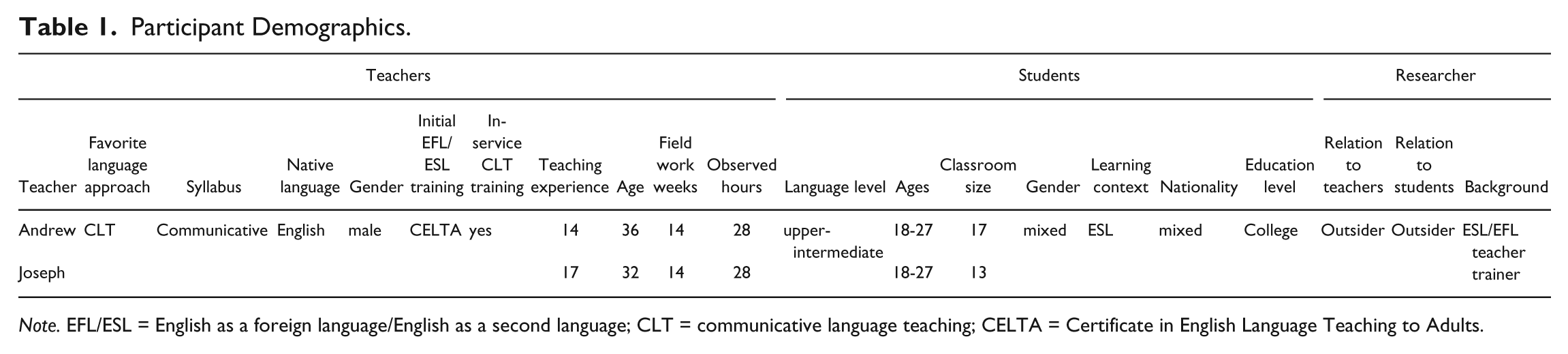
As summarized in Table 1, Andrew and Joseph (pseudonyms) favored a communicative methodology, used a communicative syllabus, and were native English speakers. Despite teaching in two different colleges, both teachers obtained initial EFL/ESL qualification (Certificate in English Language Teaching to Adults [CELTA]) and attended the same in-service communicative training. Both attended the first part of the training course for a whole week, 2 hr a day, where different lecturers presented CLT theory through handouts, booklets, journal articles, and PowerPoint presentations. The trainees had to submit an individual and group assignment by the end of that week. The two teachers then attended a workshop for 15 days, 4 hr a day, where they watched short videos about communicative lessons. They prepared communicative lesson plans and taught, discussed, and analyzed them. Both teachers had similar teaching experience (14 and 17 years) and age (36 and 32). Table 1 also shows that the researcher observed Andrew (first case) and Joseph (second case) for 28 hr for 14 weeks (2 hr a week). Moreover, both teachers taught mixed sex, ability and nationality college ESL students at the upper-intermediate level. Students in both classrooms had a similar age (18-27 years) and classroom size (17 and 13 students). Table 1 further shows that the researcher who is an ESL/EFL language teacher educator was an outsider to the respondents whom they did not know before the study.
Participant Demographics.
Note. EFL/ESL = English as a foreign language/English as a second language; CLT = communicative language teaching; CELTA = Certificate in English Language Teaching to Adults.
The researcher conducted an interview with Andrew for 87 min, while he group-interviewed two male and four female students for 93 min. Joseph was interviewed for 124 min, while three female and three male students were group-interviewed for 98 min. Students who were available for interviewing (convenience sampling) were selected (Cohen et al., 2011). Both colleges gave the teachers freedom to use assigned communicative textbooks in their own ways and their own teaching strategies.
One-to-one semistructured interviews were used with teachers to allow them to respond in their own terms (Burns, 2000; Shawer, 2013; Stake, 1995). Moreover, group interviews were used to encourage the students to comment on, extend, and respond to each other’s statements about classroom practices. This enabled the researcher to draw conclusions about the research issues in their presence (Cohen et al., 2011). Participant observation was used to capture how the teachers translate CLT into classroom practice and check the extent to which interview responses match onsite teaching (Yin, 1994).
Interview data were checked for reliability by transcribing tapes verbatim, asking same questions, and following up the responses (Kvale, 1996). Interview content was validated by six experienced EFL/ESL teachers who agreed that the interview questions meet the research purpose (Bloom, Fischer, & Orme, 2009). Observational data were checked for dependability through full description of classroom events as they occurred (Stake, 1995) and through tape recordings. Because researchers have no control over variables in qualitative research except in the natural manner, observation and interview data validated one another through methodological triangulation (Burns, 2000; Cohen et al., 2011).
To analyze interview data, the researcher used the constant comparative method through open, axial, and selective coding. In open coding, the researcher conducted line-by-line, whole-paragraph and whole-document analyses. This resulted in naming concepts, assigning categories, and developing properties. By reading the data several times, the researcher developed 140 codes (Appendix 1) by abstracting and borrowing from the literature. Abstracting involved naming events based on what I understood from the data, as in code 38, whereas borrowing from the literature occurred when the data matched a concept that previous researchers have identified, as in code 112 (Strauss & Corbin, 1998). Two independent raters then entered the relevant data under the relevant codes in a very lengthy and exhausting process. In case the raters found different data apply to the same code, they entered them as instance 1, 2, 3, and so on regardless of the number of instances that may apply to the same code (see Appendix 2). For example, Rater 1 entered 16 instances of the same data under code 24, whereas the second rater found that 13 data instances apply to the same code.
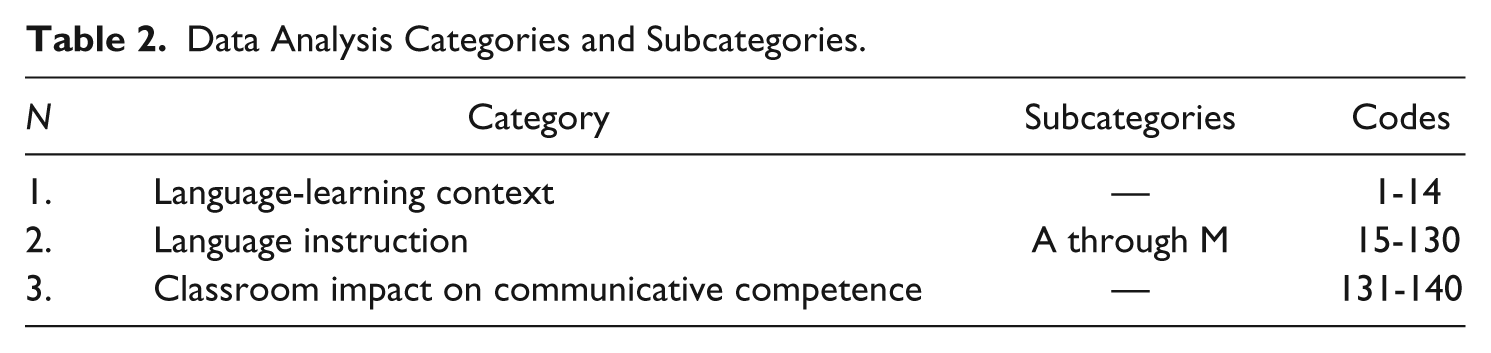
The researcher then used interrater reliability to assess error variance that may have resulted from the two raters’ subjectivity or differences for each case. Using SPSS (Version 18), the researcher calculated alpha correlation coefficient (known as coefficient of objectivity). The coefficient value for the first case (Andrew) was 0.99 and 0.999 for the second (Joseph), which indicates accuracy of the data-coding process (Coakes & Steed, 2007; Shawer, 2012). Category development involved connecting related concepts/codes under a wider concept, such as grouping Codes 1 through 14 under Category 1 (see Table 2). Properties involved all concepts under one category. In axial coding, the researcher grouped categories and subcategories around one axis, such as grouping subcategories A through M under Category 2 (Table 2). In selective coding, I integrated categories into a coherent narrative that reflected all elements of analysis as in reducing codes and subcategories under three categories that fell under the findings’ subsections (Shawer, 2010a; Strauss & Corbin, 1998).
Data Analysis Categories and Subcategories.
Results
Andrew: Did Andrew Grasp CLT Theory?
Andrew was a communicative language teacher: “I use a communicative methodology in my classrooms.” He taught grammar “in the context of the four language skills and language functions.” Despite teaching grammar inductively, explicit grammar teaching was not excluded: “I usually introduce the grammar in ten minutes because they will have exams and I have to address this important need.” Andrew always made sure that his students know how to use the language they learn: “It’s no use teaching something they won’t be able to use in real life. Language is communication. I introduce the vocabulary in context so that the students recognize formal, informal, rude and polite vocabulary.” Part of appropriate language use involves learning “collocations and fixed and semi-fixed lexical items that form the building blocks of any language development.” Not only did Andrew teach learning and communication strategies but he also tolerated student mistakes: “Communicative teaching is to help students get their meaning across. Even if they make mistakes, it wouldn’t be a problem so long as communication doesn’t fail.” This made Andrew help his students “guess new vocabulary, ask for repetition and describe difficult words to get their message across.”
Andrew was aware that his students needed learning strategies to facilitate language processing: All native, foreign and second language students need learning strategies to process information. For example, I often ask them to preview, skim and scan reading passages. In writing activities, they learn how to organize and draft ideas and address issues of writing style and tone. I train them on similar strategies in listening and speaking.
Andrew created a context where students communicate about genuine topics: “I always plan my lessons to get students to discuss topics relevant to them and real life. We read about events that happened a week ago or so. Students communicate to convey meaning rather than rehearsing artificial situations.” Genuine communication also involved extensive use of authentic materials: “You’ve seen for yourself we’ve been using news bulletins, movies, newspapers and internet articles.” Andrew integrates the four skills: I try to pay similar attention to the four language arts in almost each activity. It’s true the main activity might be about one skill, but I can use it to develop the other four skills. I think this is important for developing their overall communicative abilities.
Andrew allowed classroom communication in English only: “I insist on using English for their own benefit. They’ve to practice English in the classroom so that they can use it outside.” Andrew used collaborative activities in most lessons: “I always ask them to work in small groups and pairs and also use peer tutoring.” Andrew was aware of student needs: Although this class is made up of students who should have similar language proficiency levels, everybody has different needs. I ask good students to help weaker ones. I also group students who have similar needs together and provide different tasks for each group. When a student finishes a task before other students, I either ask her to assist another student or give her another task to complete. I usually have extra materials for this purpose.
The findings in this section show that Andrew understands CLT according to Canale and Swain (1980) and Grenfell and Harris (1999). The next section provides evidence on Andrew’s ability to translate his communicative cognition (theory) into actual classroom practice through classroom observation and student interview data.
Andrew: Did Andrew Put His Communicative Cognition Into Classroom Practice?
The students agreed that Andrew taught grammar in context: “I don’t think we learn grammar in this classroom. Umm, I mean we use English. We write, listen, read and speak about interesting topics.” Another student added, “Although I agree with you, we learn grammar. For example, today the two students in the dialogue used phrases such as ‘the bus is too late. Shall we go on foot? What about taking a taxi?’” At the end of the lesson, Andrew asked, “What did you notice about let’s, how about and what about?” We learned, for example, “let’s take a taxi,” “what about taking a taxi,” and “how about taking a taxi.” From the discussion we knew we can use both to make suggestions. We also knew an infinitive follows let’s and ing follows what about.” The students also agreed learning about genuine topics: I feel this class is informal. I mean we talk about Tsunami, climate change and elections. It’s like chatting with friends. The class is formal in the final fifteen minutes. I see Andrew focus on some grammar points and vocabulary we have used. We are very interested in the chats we have in this class. Everyone has an interesting story and we enjoy listening to this.
Another student commented and pointed to use of English as the medium of classroom communication: I totally agree with Kim. I remember I was learning English with another teacher. He was teaching the book, just the book. We were talking about very old things. They were not interesting at all. We always knew what she would teach next. I never liked the class because we could read the book at home. Students were also talking in their language. It’s really bad. Andrew’s class is different. We love this class. We use English.
The students learned how to use English appropriately and used authentic materials: I thought I was speaking English. I knew the word drink. I thought I could use it with anything. For example, I used to say “I drink cigarettes” because we used to learn words separately. Now, we watch movies, news and read newspapers. I can know the meaning of words and when to use it without asking for help.
Another student added, “we did parts of lessons on slang language and formal language. We also learned collocations. For example, we learned to ‘moor a boat’ and ‘park a car.’” The students also referred to Andrew’s policy of correcting mistakes: One student said to his friend you look thin. I want to be like you. Andrew said “people like to call them slim, on the short side and other useful phrases.” Andrew never embarrassed anyone. He always said “you are here to make mistakes. Don’t feel shy. Everyone makes mistakes and we learn from our mistakes.” I hope all teachers teach like Andrew. I’m sure he is well-educated.
Andrew’s students learned communication strategies: Andrew taught us how to guess vocabulary in reading without using the dictionary. For example, we learned to read the word before and after the new vocabulary . . . to look at the suffixes and prefixes in the word . . . and describe the words we don’t know in a conversation.
They have been also introduced to learning strategies: “I never completed a reading test because I tried to understand every word. Now I preview the text, read to get topic sentences, skim the text first and scan to answer specific questions. I now get higher scores.” Andrew’s students further agreed on learning through collaborative activities: We always do tasks first on our own and then discuss them in pairs and small groups. Andrew says “you’re good at this, help Jack and says the same to Jack another time.” I enjoy teaching other friends. I learn better when I do that.
Classroom observation generated data that concurred with Andrew and his students’ interview data. As shown in Table 3, Andrew taught 20 of 28 course book lessons, added eight lessons from outside, and supplemented authentic materials 24 times. Although he taught no whole grammar lessons, he taught grammar points and vocabulary in context in the 28 observed lessons. Andrew taught learning strategies 15 times and communication strategies 13 times. Classroom learning involved genuine communication in 26 lessons, students negotiated meaning in the 28 lessons, while 98% of classroom communication was through English. Andrew interrupted his students to correct their mistakes two times, while he taught 71% of the course-book content. He engaged students in small groups, pair work, and peer tutoring in 84 activities and conducted 21 reading activities, 15 writing activities, 24 listening activities, and 40 speaking activities. Students showed interest in classroom instruction in 80 of the observed 84 activities.
Communicative Classroom Practice (Observations).

Andrew almost translated all CLT principles in two lessons. He started a reading activity by asking students to read about one of five Internet articles, covering topics about tsunami, climate change, fast food, arranged marriage, and fashion. He asked students to read about one article then asked those who chose to read the same article to form a group. A group of students chose to read about Tsunami, another group about fast food, a third about arranged marriage, and fourth about fashion. Only one student chose to read about climate change. Andrew asked her to choose another article to join a group. Then he asked each group to read saliently and individually to answer questions about the content, vocabulary, and grammar of each article. For example, the students had to answer these questions: Why were many countries alarmed by the Japanese Tsunami in particular? How does fast food affect health? In which parts of the world is arranged marriage common? What capitals are most famous of fashion design? Nuclear (plants- planes- plains) generate clean energy. Many people prefer fast food (because- because of- owing to) they do not want to cook.
Andrew set 15 min for students to do a silent reading and answer the questions, then asked members of each group to compare answers to provide agreed answers in 10 min. He then collected individual and group answers and asked one student in each group to come and form a new group so that every student shares the information of his or her article with the new group. This way, every student knew about the five articles. Andrew started a grammar and vocabulary activity based on the four articles. For example, he asked students to rewrite this sentence using because of: “Many people still accept arranged marriage because it is a tradition.” He also asked the students to underline all past tense verbs, suggestions, and conjunctions of reason. As for vocabulary, he asked the students to work out, for example, the meaning of plant from context. In another lesson, Andrew taught a speaking activity by asking students to discuss in pairs whether they are with or against arranged marriage and nuclear reactors. He also asked the students to do a writing activity by writing a short paragraph of six sentences about one of these topics: “Do you agree with arranged marriage? Do you agree that countries shut down nuclear reactors?” Finally, Andrew played part of a TV interview about arranged marriage in India. While the students were listening, they were answering some questions in a worksheet.
Looking at these two sentences, Andrew integrated the four language skills, taught grammar in context and used authentic materials. The students were exchanging information in genuine communication, whereas classroom communication was all through English. The students used communication strategies when asked to work out the meaning from context. Appropriate language use was also in place through the vocabulary activity and the four skills activities. Andrew also paid attention to student motivation by asking them to read about a text of interest and made extensive use of small group and pair work during the reading and speaking activities. Even in the writing activity, each group had to cooperate in writing the six-sentence paragraph. During the silent reading, a couple of students asked for assistance. Andrew went to help one of them, while he asked another student who answered the questions before the others to go and help the other student. This way, Andrew addressed student differences. He did not interrupt students to correct mistakes. For example, one student confused the pronunciation of marriage with mirage. Andrew approached the student’s group and asked, “Do you have arranged marriage in your culture? The students said “yes.” Then Andrew asked again, “Would you describe this marriage?” It was clear that he was repeating marriage on purpose. Then he asked that student: “Which type of marriage do you prefer?” The student provided the correct pronunciation in his reply.
Teaching reading and listening strategies was present in many of Andrew’s lessons. For example, Andrew introduced reading, listening, speaking, and writing skills through another article about the Japanese tsunami. First, he introduced his students to the skill of identifying the topic by writing this question: “What is this article about?” Not only did Andrew seek to develop this skill but also showed the students what reading strategies to use by asking them to do a quick reading (skimming) to get the topic. He also briefed his students about another reading skill (identifying the main ideas). He explained: “There is a difference between the topic and main idea. The topic is the most general idea that all paragraphs in a text revolve around. A main idea discusses a very important aspect about the topic. Usually, each paragraph discusses only one main idea. We call it the topic sentence.” He added, “You need to read quickly through a text to get the topic and main ideas.” One of the questions he asked was, “What is the main idea of the first paragraph?” One student said that the topic sentence is, “When the earthquake struck off the coast of Japan, it churned up a devastating tsunami that swept over cities and farmland in the northern part of the country.” Andrew asked why she thought so; the student replied “all the following sentences talk about the earthquake that came before the tsunami.”
Andrew briefed his students about a third reading skill (identifying supporting ideas/ details): “Each detail provides a specific piece of information about one aspect of the main idea…The supporting ideas together develop the main idea . . . To identify the details, you need to scan the text.” He asked questions about the details that included “according to the passage, in which Nuclear Power Station did explosions and leaks of radioactive gas take place? How many reactors suffered explosions and leaks of radioactive gas?” Andrew briefed his students about a fourth reading skill (locating referents) by explaining, We use referent words to refer to other words . . . Usually, pronouns are referents that replace nouns. Referents help you understand the text. In order to make sure of locating the referents, just replace the referent with the noun it refers to, if it fits in meaning and form, then it is correct.
One of the questions he wrote about referents was, “What does it in line 13 refer to?” Andrew was referring to this sentence: “. . . but it is the nuclear accident at Fukushima Daiichi that looks likely to have a more lasting impact, even though it has yet to claim a single life?”
Andrew also introduced his students to a fifth reading skill (understanding vocabulary in context). He explained: “Use the sentence or paragraph where the vocabulary appears. Since an English word could have different meanings, you need to get the exact meaning in context.” He went on explaining: You can use several clues to get the precise meaning. For example, punctuation may tell you a word is simply a name. You can use the words and phrases you know in the sentence to figure out the meaning of a new vocabulary. You can also read the words before and after to get the meaning but you may also need to read the sentence before and after and perhaps the whole paragraph.
An example of the questions Andrew wrote to have his students get the meaning from context involved, “The word groping in the nation is also groping to find effective ways to monitor . . . (Line 19) means ….” Andrew introduced a sixth reading skill (making inferences): “You always have to make inferences from the explicit information in the text. Some inferences can be made from a single sentence, a whole paragraph or the whole text.” Andrew also explained: “Since inferences are not explicit statements, you have to connect several ideas together. Make use of key vocabulary and sentences, your common sense and use logic.” An example of the questions Andrew wrote to have his students make inferences is, “What can be concluded from the second paragraph about the Japanese authorities?”
Having completed the Japanese tsunami article, Andrew played short clips on the same topic. Before listening, Andrew introduced his students to some listening skills and strategies. He told his students to pay attention to key words, phrasal verbs, idioms and expressions, conditionals, causatives, modal verbs, negative expressions, dates, quantity, comparisons, and intonation and make inferences about people and context in short conversations. For longer conversations, he asked them to identify the topic, main ideas, and details, pay attention to the sequence of events, and make inferences and predications. The students, for example, identified tsunami, engulfed, Northeastern Japan, and major earthquake as key words.
Again, Andrew used the same reading topic to conduct an oral activity in another lesson. He asked the students to form small groups of four and discuss the tsunami disaster through these questions: “Do you think this tsunami would affect use of nuclear energy? Should people live away from the seaside? How would people and governments prepare for a tsunami?” In another lesson, he asked his students to write 15 sentences about how smart phones changed our lives. Before the students started to write, he asked them to draft the main ideas and develop minor ideas to address each main idea. Then he asked them to choose the right tense and put their ideas into the correct form, alongside paying attention to punctuation, cohesion, and transition of ideas. He also asked them to consider an objective tone of writing. Andrew also asked them to decide whether to follow formal or informal style of writing and choose a descriptive, narrative, or expository discourse type. They were asked to write an introductory paragraph, put main ideas in the main paragraphs (body of writing), and write a conclusion. He also reminded them to edit their writing to remove redundancies, repetitions, and refine the language.
The findings in this section show that Andrew was able to put CLT into actual classroom practice according to Canale and Swain (1980) and Grenfell and Harris (1999). The next section provides self-reporting evidence about the impact of CLT on student communicative competence through classroom observation and student interview data.
Andrew: How Did Andrew’s Teaching Impact Student Communicative Competence?
Andrew noted that his classroom teaching helped students develop their overall language ability: “The students have been doing well. The IELTS (International English Language Testing System) results indicate significant improvements in many students’ language proficiency. This group has not yet taken the IELTS. However, I see improvement in their overall language proficiency.” Andrew added, “I also note a difference in their scores between the initial test I gave them and the quizzes they’ve taken. I’ve seen a lot of progress and I’m very pleased with that . . . It tells me my approach is working.” Andrew provided comments that show improvement in students’ grammar knowledge and ability to use English: “Part of my quizzes measures their structural knowledge and appropriate use of vocabulary. They have made a lot of progress on that.” Similar comments were made about the four skills: “I do look at the students’ overall performance on grammar, listening, reading and writing so that I know which areas in particular need development.” He monitored performance through ongoing assessment: “I have to assess them regularly because they will also sit for the IELTS. Their scores on the quizzes show progress in grammar and vocabulary as well as reading and listening comprehension.”
Andrew added, “They also did well on writing which indicates they employ grammar in the written discourse. I don’t formally test their oral skills. However, I see a lot of progress in their speaking skills on daily basis.” As for communication and learning strategies, Andrew confirmed: Of course they use communication strategies in classroom communication. For example, one student wrote a good paragraph but had to describe several words that he didn’t know their exact meaning. For example, he used the place where trains stop instead of the railway station.
Andrew also noted improvement in learning strategies: “Reading comprehension was a problem for many of them. They used to run out of time before attempting all the questions. Now they attempt all the questions thanks to their use of, for example, skimming and scanning.”
The students in Andrew’s class made comments that indicate improvements in their communicative competence: “I feel my English improved a lot. I’m now confident to speak with the British people. Three months ago, I did not dare.” The students agreed: “I had no problem with grammar and maybe writing. My problem was listening and speaking. This class puts me in real situations like a bank or bus stop. We discuss everything here.” Another added, All day, we listen and discuss about very interesting things. At the beginning, I didn’t understand Andrew. I asked him to speak slowly but he said don’t worry, you will be okay. He was right. Little by little I could understand.
One student had a point to make: I thought I write English well because I knew grammar. I discovered even my writing was not good. I always used the wrong words. I could not choose the right tense although I know the twelve tenses. Now I pay attention to the style and tone of writing. For example, in formal writing, I no longer use slang language or contractions. I use full sentences and collocation. Collocation is very, very important.
Classroom observations concurred with Andrew and his students’ comments about the impact of Andrew’s teaching on student communicative competence: I saw the students gain confidence day-by-day. The students agreed their listening and speaking skills were poor before joining Andrew’s class but my interviews with them that I minimally edited indicate improvement in these two skills. During observations, I saw them understand their teacher and classmates and initiate, maintain and end conversations successfully. They understood reading and listening texts since they often answered most of the comprehension questions. For example, they listened to a conversation between a cashier and a customer at the bank. They could answer questions about where the conversation took place and identified what the cashier and customer said. The students gave the correct meaning of balance, account alongside other words.
The students’ reading comprehension seemed to have also improved as shown from the reading that Andrew did about diabetes. Andrew first asked his students to read silently to locate the topic sentence in each paragraph and answer seven questions, alongside providing the synonyms and antonyms of four words. He collected their answers and asked them in pairs to discuss their answers to agree or revise individual answers. In a whole-class activity, Andrew discussed and answered each question with the students. Andrew handed out his corrections the next lesson. Individual and pair answers were correct apart from a couple of questions by two students (of 17). Although the two students missed the two questions, they revised their answers on discussing them with a classmate. Student writing ability also seemed to have improved as the two pieces of classroom writing for one student show. The first writing was written in the 1st week, whereas the second was written in the 11th week:
A comparison between the two writings shows a significant improvement in ideas’ development and organization, punctuation, tense, sentence formation, length, and word choice and inflection in favor of the second writing sample. The underlined words in the second writing, however, indicate minor word choice and tense issues.
The findings in this section show that Andrew’s communicative classroom practice seemed to have significantly improved student communicative competence and the four skills. The next section presents the second-case (Joseph) findings.
Joseph: Did Joseph Grasp CLT Theory?
Joseph made statements about CLT that almost matched those of Andrew: “Definitely I believe in communicative language teaching.” Not only does Joseph teach grammar but also he teaches it in context and inductively: “Grammar must be taught in context so that the students can use it naturally.” Joseph taught students how to use different language genres: “Vocabulary must be also taught in context. An English word has different meanings and the students wouldn’t be able to get the exact meaning without seeing or hearing it in context.” Joseph went on explaining: “What is okay in informal contexts wouldn’t be so in formal contexts. The students should also pay attention to collocation.” He believed collaborative activities must be part of any communicative lesson. Communication involves more than one person to share ideas. If students sit and listen to the teacher, they won’t have enough time to practice the language. Working in pairs or small groups is, therefore, necessary for every student.
Communication through English and genuine communication in the classroom are necessary: “Life is not rehearsal. The students should have the opportunity to communicate about real issues of relevance to them. They must use English. Their native language shouldn’t be allowed in the classroom.” Joseph also made use of authentic materials: “Using the materials that are available for native speakers is important for students to communicate outside the classroom. They go outside watch movies, the news and read newspapers. If they are not exposed to the same materials in the classroom, they wouldn’t be able to communicate outside the classroom.” He tolerated student mistakes: “I never say you’re wrong because they would never speak again.” Joseph taught communication strategies: “All second and foreign language learners experience difficulty in different forms of communication. They need to overcome communication problems particularly in speaking. Since they wouldn’t know each vocabulary in reading texts, they must guess.” Like Andrew, he addressed student needs and integrated the four skills: I try to have a sense of their needs. For example, some students need listening more than reading activities. Although I provide listening, speaking, writing and reading activities in every lesson, I provide extra activities to address their needs in listening and speaking.
The findings in this section show that Joseph also understands CLT according to Canale and Swain (1980) and Grenfell and Harris (1999). The next section provides evidence of Joseph’s ability to translate his communicative cognition (theory) into actual classroom practice through classroom observation and student interview data.
Joseph: Did Joseph Put His Communicative Cognition Into Classroom Practice?
Students in Joseph’s classroom provided statements that contradicted those of their teacher about communicative teaching. Joseph taught grammar only and that was out of context and in a didactic fashion: “Joseph is believer in grammar only. He enjoys teaching grammar and nothing but grammar. In this classroom, we study only grammar.” One student added, “Although grammar was not a problem for me, I do not mind learning grammar once a week, not every single lesson and throughout the lesson.” The students were asked how he taught grammar: “Today we did the passive, last time we did the past perfect continuous. Joseph writes the grammar rule, explains it and gives examples. We then solve the exercise.” I asked if the students discuss current affairs and real life. One student burst out of laughter and said “Real life!! He just said to you grammar, grammar! The book includes interesting things and little stories but he searches for grammar.” I also asked whether other languages were used in the classroom: “We come from different countries. When we do exercises, students from the same country discuss in their first language. He doesn’t know our language, he just smiles.”
The students agreed that he taught vocabulary out of context: “When we ask about a word, he explains the meaning or says use a dictionary.” Joseph’s students agreed that he taught them communication strategies and that was confined to guessing: “He always said guess.” Contrary to what Joseph said he always did, the students agreed that he embarrassed them by his ongoing correction of mistakes: “Joseph always corrects the mistakes. It’s not good. He is native speaker but he is not a good teacher. In my country, the problem is that teachers are not good at speaking. We learn when Joseph speaks but his style of teaching is not okay. He is friendly but I am sorry I have to say that.” When asked whether they worked in groups and pairs, the students answered in positive about pair work but were unhappy about the way he did it: “We never worked in small groups, only in pairs. Every time he says ‘discuss it with a partner,’ but the class becomes noisy. Many students discuss other things in their language. It is not useful.” They rarely used authentic materials: “You have been with us for a long time. We use the course book and the workbook.” One student added, “He also played nice tapes for listening in the book. This part is nice.”
Classroom observation concurred with the comments made by the students but disagreed with those of Joseph. Table 3 above shows that Joseph taught 28 of 28 lessons and neither added lessons from outside the course book nor supplemented authentic materials. Joseph taught 26 grammar lessons, taught grammar in context in 2 lessons, and taught vocabulary in context in 6 of the 28 lessons. He did not teach learning strategies while teaching communication strategies eight times. Classroom instruction involved neither genuine communication nor negotiation of meaning in the 28 lessons, whereas about 80% of the students’ communication was through English. He interrupted his students to correct their mistakes about 64 times while teaching 100% of the course-book content. He engaged students in pair work 30 times and taught six reading activities, three writing activities, eight listening activities, and seven speaking activities. Students showed interest in classroom instruction in 40 of the 87 observed activities.
Joseph always taught grammar out of context. In one lesson, although the course-book lesson was about how students can make suggestions and respond to them, Joseph turned it into a grammar lesson. He first wrote these on the board: “What about + ing (gerund), how about + ing (gerund), Shall we + infinitive, and let’s + infinitive.” Although he gave enough examples about each structure, the purpose for which the course-book lesson was written changed. For example, the activity in the book had an accompanying audio text that involves a conversation between some students who made suggestions using the above structures. The audio also involved agreeing and declining replies to the suggestions, such as “It’s a good idea, I’d love to . . . but.” These important language functions have been lost. Moreover, the students did not practice these structures orally. It has been all an accuracy-based activity.
Joseph did other lessons, for example, on adverbs of reason, compound sentences, and adjectives. It was clear that deductive grammar instruction was a pattern in Joseph’s classroom. Although grammar teaching should be encouraged and lessons on these topics certainly need to be done, Joseph taught grammar for the sake of grammar. He did not use grammar to achieve certain functions (such as making introductions or suggestions) or help students use it naturally as people use it in real life. He also taught vocabulary by writing a list of words on the board and providing their meaning out of context. For example, he wrote global warming, chemicals, and green energy on the board and asked the students whether they knew the meaning. Communication in his classroom was all about textbook topics. Joseph even did injustice to the communicative course book. Neither did Joseph cover appropriate language use nor did he explain techniques to help students overcome their communication problems. He only asked students to guess and occasionally interrupted to correct students’ mistakes. Despite asking students to work in pairs, the activities were disorganized. The students frequently switched to their native language. They worked either individually or did not work at all. Joseph never used authentic materials.
The findings in this section show that Joseph was unable to put CLT into actual classroom practice according to Canale and Swain (1980) and Grenfell and Harris (1999). The next section provides self-reporting evidence about the impact of noncommunicative teaching on student communicative competence through classroom observation and student interview data.
Joseph: How Did Joseph’s Teaching Impact on Student Communicative Competence?
Joseph indicated that his classroom teaching helped his students develop their overall language ability: “Umm, I think they’ve made some progress, why not? They do the activities and exercises.” Students’ vocabulary, grammar and use of appropriate language also improved: “Hopefully, they’ve developed their vocabulary. Certainly they’ve developed their knowledge of grammar. I think also they use appropriate language but I’m not saying they’re perfect. They’re okay I guess.” Joseph also indicated similar improvements in the four skills: “They’ve made progress in speaking and listening abilities but writing and reading skills have improved a lot.”
The students made statements that contradicted those of their teacher: “I expected to learn much more than this. I have wasted my time and money. My colleagues who joined the same college with another teacher improved a lot. They now understand native speakers without much difficulty. They can also speak with them. For me, I didn’t learn more than grammar. Actually I didn’t need it. I hate grammar.” The students endorsed this strong statement: “I am sure they will fire Joseph. I met other students who were in his class. They said, ‘we quitted his classroom.’ I think he was not trained well.” A third student added, “I agree with Tom. Although Joseph is nice, he needs training. I warned my friends who are coming here not to join his classroom.”
I did not observe significant improvement across the three months. For example, Joseph taught a course-book listening lesson about a museum. He played the cassette and the students listened to answer seven questions that he wrote on the board. Joseph conducted a very traditional lesson. He first explained some difficult vocabulary out of context, wrote comprehension questions on the board, played the cassette, and finally asked the students to provide their answers. Every time he was prepared to receive students’ answers, the students asked him to replay the tape. After six requests to replay the listening, Joseph, at last, received their answers. The students failed to answer simple questions about who were talking and what they were talking about. Joseph almost answered the questions. During that activity, the students hardly expressed themselves. They frequently used body language to communicate ideas. In a reading lesson about the English language, the students answered five out of nine questions. As for the writing skill, observations did not indicate improvement. Although the course book was full of writing activities, Joseph often ignored them. Most writing activities were dictations. Although the dictations were simple, the students made various mistakes.
The findings in this section show that Joseph’s noncommunicative teaching did not improve student communicative competence and the four skills. Now, we turn to discuss the results.
Discussion and Cross-Case Comparison
This study examined why CLT fails to improve student communicative competence in certain contexts. The results indicate that both cases conceptualized CLT in line with Canale and Swain’s (1980) model. Both teachers indicated that CLT involves development of student grammatical, sociolinguistic, discourse, and strategic competences. The two teachers were also familiar with CLT principles as stated by Grenfell and Harris (1999). The two teachers confirmed that communicative teaching comprises genuine communication, collaborative activities, negotiation of meaning, communication through target language, tolerance with student mistakes, learning communication and learning strategies, integration of the four skills, and use of authentic materials. These findings disagreed in part with those of Fox (1993), Gahin and Myhill (2003), Savignon (1991), and Shawer (2010b), who found teachers unfamiliar with CLT theory.
The findings show that not all teachers put CLT cognition into classroom practice. Although both cases understood CLT theory, only Andrew translated his CLT cognition into classroom practice. Andrew’s findings, therefore, disagreed with those of Feryok (2008), Karavas-Doukas (1996), Kumaravadivelu (1993), Sato and Kleinsasser (1999), and Savignon (1991), who found that teachers understand CLT theory but fail to put it into classroom practices. Joseph’s findings, however, concurred with these findings, because he understood CLT but never translated it into classroom practices. Moreover, Joseph’s findings agreed with Chowdhury and Ha (2008), De Segovia and Hardison (2009), Kirkgoz (2008), and Orafi and Borg (2009), who recommended practical CLT teacher training so that teachers can translate CLT into classroom practice.
The first teacher’s findings indicate that actual communicative classroom practices bring about significant improvements in student grammatical, sociolinguistic, discourse, and strategic competences, as well as the four skills. These results concur with prior studies that conclude that actual communicative classroom practices contribute to improving student communicative competence (Green, 1993; Meskill & Anthony, 2007; Nobuyoshi & Ellis, 1993; Safar & Kormos, 2008; Savignon & Wang, 2003). In contrast, Joseph’s noncommunicative classroom practices improved neither student communicative competences nor the four skills. On the contrary, the students complained about his didactic grammar instruction. These findings confirmed rather than contradicted Meskill and Anthony (2007), Nobuyoshi and Ellis (1993), Savignon (1991), and Safar and Kormos (2008), who indicated that communicative classroom practices improve student communicative competence more than mechanical pattern-drills instruction.
These findings, therefore, answer this study’s main research question by pointing to the teachers for CLT failure in certain contexts. Although Andrew and Joseph understood CLT theory, only Andrew managed to deliver communicative classroom practices. While these findings reveal no inherent CLT problems that prevent teachers from grasping CLT principles and transforming them into classroom practice (Andrew’s findings), they put the blame on teachers (Joseph’s findings) for failing to improve student communicative competence. Although it was noncommunicative teaching that failed (Joseph), researchers mistakenly accuse CLT. Indeed, CLT did not fail. It was the teachers (Joseph) who made it fail and it was the teachers who actually failed. When Andrew, for example, was able to deliver communicative practices, student communicative competence improved.
It is worth noting that teachers may use other approaches and teaching strategies and still help improve student learning. The problem arises when teachers allege that they deliver CLT in their classrooms, while they actually use a defaced CLT version (noncommunicative teaching). Finally, if Andrew could put CLT into practice, we have evidence that we can train other teachers to deliver CLT classroom practices. Again, if Andrew’s CLT practice improved student learning, we also have evidence that CLT succeeds rather than fails and that CLT is suitable to underlie curriculum and teacher-training programs. Even Joseph complicates the skepticism expressed by CLT opponents because he did not deliver CLT in practice.
I should, however, indicate that the CLT impact on students was based on subjective assessments of just two teachers and their students. Thus, researchers are encouraged to use ability measures to assess student learning (e.g., standardized tests) and performance measures (e.g. systematic observations) to assess the impact of CLT on student learning. A case-study design of just two teachers is fraught with limitations; therefore, caution should be taken with regard to generalizing this study’s findings into other contexts.
Implications for Preparing Adult Educators and Teacher Development
The findings clearly point to quality challenges that face preservice adult educator training programs. The present findings reveal that although some graduates (such as Joseph) have developed “content knowledge” and “professional dispositions,” they are unable to put their cognition into practice. In other words, despite having the “knowledge” (knowing what to do) and “dispositions” (talking about what to do), Joseph lacked the “pedagogical skills” to implement what he knew and was able to talk about. Applying the K-12 KSD framework to adult educator training programs, the problem seems to lie in the “skills” component because candidates fail to put theory into classroom practices. Unlike the K-12 teacher-preparation programs, which use ongoing and multiple performance assessments to ensure that candidates apply the knowledge, skills, and dispositions in action (Masunaga & Lewis, 2011), Joseph’s practices indicate that some adult educator training programs do not use such mechanisms.
Because CLT forms a main component in all preservice and in-service adult educator training programs (Shawer, 2010b), they need to offer communicative training that mixes and balances theory and practice and to monitor teacher cognition and behavior in real classrooms. This means that adult educator training programs should check two things. First, candidates demonstrate ability to put program knowledge into practice to determine whether they are ready to have sole charge of their own classrooms. Second and more important, candidates must not only demonstrate evidence that they deliver communicative teaching, but also include, as a part of that work, evidence that their students learn. The researcher believes that the KSD framework can help adult educator programs achieve both jobs. Had Joseph been graduated from a program that applies the KSD framework, he might have delivered CLT and improved student learning.
This confirms what Darling-Hammond (2010) and Masunaga and Lewis (2011) indicated about the importance of candidate evaluation in teacher-preparation programs through ongoing and multiple performance assessments to ensure that candidates translate their knowledge, skills, and dispositions into action, address student needs, and reflect on and improve their work. Likewise, assessing in-service teacher performance is more likely to help improve their practice and guarantee that they continue their professional development. However, any assessment system that uses only examinations and mastery of content is unlikely to bridge the gap between teacher knowledge and practice. Multiple and ongoing performance assessments that assess teacher application of the knowledge and skills are, therefore, necessary to check whether candidates and in-service teachers need further support.
Conclusion and Recommendations
The findings suggest that in this case, CLT has no inherent problems that prevent teachers from grasping it in theory and transforming it into classroom practice. Communicative classroom practices help students develop their communicative competence and four skills; whereas noncommunicative classroom practices hardly help students develop them. This study points to the teachers for CLT failures and recommends CLT to underpin EFL/ESL curriculum and instruction and teacher training to improve student learning. Noncommunicative teaching involves incoherent classroom procedures and results in negative consequences for teachers and students more than pattern-drill instruction. Moreover, adult educator training programs should apply the KSD framework to enable teachers to put program theory into classroom practice. Although one teacher in this study was able to put CLT into action, not all teachers, even experienced and trained ones, can. Why some teachers translate their CLT cognition into reality while others do not is worth investigation. Researchers may also examine the quality of teacher training and professional development in addition to teaching styles.
Footnotes
Appendix 1
Appendix 2
Qualitative Data Analysis Codes.
| First-case data (Andrew) |
Second-case data (Joseph) |
||||||||||||||||
|---|---|---|---|---|---|---|---|---|---|---|---|---|---|---|---|---|---|
|
|
Rater 1 entries | Rater 2 entries |
|
Rater 1 entries | Rater 2 entries |
|
Rater 1 entries | Rater 2 entries |
|
Rater 1 entries | Rater 2 entries |
|
Rater 1 entries | Rater 2 entries |
|
Rater 1 entries | Rater 2 entries |
|
|
1 | 1 |
|
2 | 3 |
|
12 | 14 |
|
1 | 1 |
|
0 | 0 |
|
0 | 0 |
|
|
1 | 1 |
|
2 | 2 |
|
28 | 28 |
|
1 | 1 |
|
0 | 0 |
|
28 | 28 |
|
|
1 | 1 |
|
1 | 1 |
|
0 | 0 |
|
1 | 1 |
|
0 | 0 |
|
0 | 0 |
|
|
1 | 1 |
|
1 | 1 |
|
3 | 3 |
|
1 | 1 |
|
0 | 0 |
|
64 | 64 |
|
|
1 | 1 |
|
19 | 17 |
|
2 | 2 |
|
1 | 1 |
|
0 | 0 |
|
31 | 33 |
|
|
1 | 1 |
|
11 | 11 |
|
17 | 20 |
|
1 | 1 |
|
0 | 0 |
|
0 | 0 |
|
|
1 | 1 |
|
17 | 14 |
|
3 | 1 |
|
1 | 1 |
|
0 | 0 |
|
4 | 4 |
|
|
1 | 1 |
|
3 | 3 |
|
0 | 0 |
|
1 | 1 |
|
0 | 0 |
|
0 | 0 |
|
|
1 | 1 |
|
8 | 7 |
|
30 | 27 |
|
1 | 1 |
|
0 | 0 |
|
9 | 9 |
|
|
1 | 1 |
|
4 | 5 |
|
39 | 36 |
|
1 | 1 |
|
0 | 0 |
|
30 | 30 |
|
|
1 | 1 |
|
6 | 6 |
|
5 | 5 |
|
1 | 1 |
|
0 | 0 |
|
0 | 0 |
|
|
1 | 1 |
|
5 | 5 |
|
24 | 24 |
|
1 | 1 |
|
0 | 0 |
|
0 | 0 |
|
|
1 | 1 |
|
6 | 7 |
|
2 | 3 |
|
1 | 1 |
|
0 | 0 |
|
0 | 0 |
|
|
1 | 1 |
|
11 | 9 |
|
10 | 10 |
|
1 | 1 |
|
0 | 0 |
|
28 | 28 |
|
|
2 | 3 |
|
7 | 7 |
|
22 | 22 |
|
1 | 1 |
|
0 | 0 |
|
0 | 0 |
|
|
1 | 1 |
|
6 | 7 |
|
11 | 11 |
|
70 | 67 |
|
0 | 0 |
|
0 | 0 |
|
|
3 | 2 |
|
13 | 16 |
|
2 | 1 |
|
4 | 4 |
|
0 | 0 |
|
3 | 4 |
|
|
17 | 17 |
|
18 | 17 |
|
21 | 21 |
|
2 | 3 |
|
0 | 0 |
|
6 | 6 |
|
|
2 | 2 |
|
18 | 18 |
|
24 | 24 |
|
0 | 0 |
|
0 | 0 |
|
8 | 9 |
|
|
40 | 42 |
|
18 | 18 |
|
40 | 40 |
|
3 | 3 |
|
0 | 0 |
|
7 | 7 |
|
|
16 | 15 |
|
5 | 2 |
|
15 | 15 |
|
2 | 2 |
|
0 | 0 |
|
3 | 3 |
|
|
18 | 17 |
|
8 | 11 |
|
11 | 11 |
|
55 | 58 |
|
0 | 0 |
|
0 | 0 |
|
|
22 | 22 |
|
6 | 5 |
|
21 | 21 |
|
0 | 0 |
|
0 | 0 |
|
6 | 6 |
|
|
16 | 13 |
|
6 | 5 |
|
24 | 24 |
|
2 | 2 |
|
0 | 0 |
|
8 | 8 |
|
|
3 | 5 |
|
13 | 13 |
|
40 | 40 |
|
1 | 1 |
|
0 | 0 |
|
7 | 7 |
|
|
3 | 3 |
|
13 | 13 |
|
15 | 15 |
|
0 | 0 |
|
0 | 0 |
|
3 | 3 |
|
|
16 | 17 |
|
10 | 9 |
|
11 | 12 |
|
0 | 0 |
|
0 | 0 |
|
0 | 0 |
|
|
16 | 16 |
|
13 | 13 |
|
5 | 3 |
|
1 | 1 |
|
0 | 0 |
|
0 | 0 |
|
|
16 | 14 |
|
7 | 8 |
|
4 | 4 |
|
0 | 0 |
|
0 | 0 |
|
2 | 2 |
|
|
7 | 9 |
|
7 | 7 |
|
80 | 80 |
|
0 | 0 |
|
0 | 0 |
|
11 | 11 |
|
|
30 | 32 |
|
7 | 7 |
|
18 | 15 |
|
0 | 0 |
|
0 | 0 |
|
1 | 1 |
|
|
8 | 5 |
|
6 | 5 |
|
16 | 16 |
|
0 | 0 |
|
0 | 0 |
|
1 | 1 |
|
|
11 | 11 |
|
5 | 5 |
|
16 | 16 |
|
0 | 0 |
|
0 | 0 |
|
1 | 1 |
|
|
11 | 11 |
|
5 | 5 |
|
9 | 7 |
|
0 | 0 |
|
0 | 0 |
|
1 | 1 |
|
|
15 | 17 |
|
4 | 4 |
|
19 | 18 |
|
1 | 1 |
|
0 | 0 |
|
1 | 1 |
|
|
8 | 8 |
|
2 | 2 |
|
15 | 15 |
|
1 | 1 |
|
0 | 0 |
|
1 | 1 |
|
|
6 | 7 |
|
2 | 2 |
|
15 | 16 |
|
0 | 0 |
|
0 | 0 |
|
1 | 1 |
|
|
6 | 6 |
|
2 | 3 |
|
17 | 14 |
|
0 | 0 |
|
0 | 0 |
|
1 | 1 |
|
|
6 | 6 |
|
6 | 6 |
|
10 | 13 |
|
0 | 0 |
|
0 | 0 |
|
1 | 1 |
|
|
6 | 7 |
|
5 | 3 |
|
56 | 55 |
|
0 | 0 |
|
0 | 0 |
|
1 | 1 |
|
|
3 | 3 |
|
7 | 6 |
|
0 | 0 |
|
0 | 0 | ||||||
|
|
18 | 20 |
|
13 | 13 |
|
0 | 0 |
|
0 | 0 | ||||||
|
|
11 | 11 |
|
11 | 12 |
|
0 | 0 |
|
0 | 0 | ||||||
|
|
11 | 11 |
|
13 | 13 |
|
0 | 0 |
|
0 | 0 | ||||||
|
|
6 | 7 |
|
5 | 6 |
|
0 | 0 |
|
0 | 0 | ||||||
|
|
1 | 1 |
|
5 | 5 |
|
0 | 0 |
|
0 | 0 | ||||||
|
|
3 | 3 |
|
5 | 5 |
|
0 | 0 |
|
0 | 0 | ||||||
|
|
3 | 3 |
|
5 | 5 |
|
0 | 0 |
|
0 | 0 | ||||||
|
|
9 | 13 |
|
30 | 30 |
|
0 | 0 |
|
0 | 0 | ||||||
|
|
8 | 8 |
|
17 | 17 |
|
0 | 0 |
|
0 | 0 | ||||||

Acknowledgements
The author extends his appreciation to the Deanship of Scientific Research at King Saud University for funding this work through the research group grant number RGP-VPP-113. The author feels indebted to the Journal of Literacy Research dedicated editors and anonymous reviewers for their invaluable feedback that made a significant contribution to this work.
Declaration of Conflicting Interests
The author(s) declared no potential conflicts of interest with respect to the research, authorship, and/or publication of this article.
Funding
The author(s) disclosed receipt of the following financial support for the research, authorship, and/or publication of this article: The author extends his appreciation to the Deanship of Scientific Research at King Saud University for funding this work through the research group grant RGP-VPP-113.
Author Biography
References
Supplementary Material
Please find the following supplemental material available below.
For Open Access articles published under a Creative Commons License, all supplemental material carries the same license as the article it is associated with.
For non-Open Access articles published, all supplemental material carries a non-exclusive license, and permission requests for re-use of supplemental material or any part of supplemental material shall be sent directly to the copyright owner as specified in the copyright notice associated with the article.
