




Abstract
Transnational youth represent an increasing demographic in societies around the world. This circumstance has amplified the need to understand how youths’ language and literacy repertoires are shaped by transnational life. In response, this article presents a case study of a Mexican adolescent girl who immigrated to the United States and continued to participate in life in Mexico. It examines shifts in her multiple language and literacy practices that she attributed to transnational life and the knowledge she acquired from transnational engagements with languages and literacies. Data include interviews of the young woman, observations of her in a variety of social contexts, and literacy artifacts that she produced. Research on transnational youths’ language and literacy practices and theories of multiliteracies and border crossing facilitate analysis. Findings include that language and multiliteracy practices shift in interconnected ways in response to transnational life and engagements with multiple languages and literacies foster transnational understandings. Accordingly, attending to transnational youths’ multilingual as well as multiliterate practices can deepen understandings of how people recruit multiple languages, literacies, and lifeworlds for meaning making. Implications of this work are offered concerning the features of a transnational curriculum that can both draw from and build up the language and literacy reservoirs of transnational youth.
Keywords
Youth who lead active lives in both their host nations and countries of origin create a continuous flow of languages, ethnocultural knowledge and sensibilities, and literacy practices through societies across the globe. Called transnational youth, these are young people who maintain significant ties to two or more nation states and, consequently, acquire experiences, understandings, networks, and deep attachments—spanning personal, familial, economic, religious, and other domains—across multiple societies (Hamann, Zúñiga, & Sánchez García, 2006; Sánchez, 2007a, 2009; Zúñiga & Hamann, 2009). There are growing numbers of transnational youth in the United States as well as in other English-dominant nations that receive large numbers of immigrants (Ball, Skerrett, & Martínez, 2010; National Center for Education Statistics, 2006; Suarez-Orozco & Suarez-Orozco, 2001). This situation has amplified the need to counter entrenched deficit perspectives about the language and literacy capabilities of immigrant and transnational students, particularly those who are learning English (Fu & Graff, 2009; Martínez-Roldán & Fránquiz, 2009).
In response, several important studies have identified the rich language repertoires of immigrant, transnational, and multilingual youth and suggested how these resources may be productively recruited for academic learning (Canagarajah, 2006, 2009; Compton-Lilly, 2008; García Sánchez & Orellana, 2006; Martínez, 2010; Orellana & Reynolds, 2008; Sánchez, 2007a, 2007b). Yet less attention has been paid to the multiple literacy practices of transnational youth. For example, a few scholars, drawing on theories of multiliteracies (e.g., New London Group, 1996), have established that immigrant and transnational youth engage digital literacies to learn English, develop their writing abilities, and access transcultural and other social identities (e.g., Black, 2005, 2009; Lam, 2004, 2006; Lam & Rosario-Ramos, 2009; Yi, 2008). Overall, however, the changing language and literacy repertoires of transnational youth are an understudied phenomenon in multiliteracies-informed research. Similarly, scholars interested in transnational youth have identified valuable intercultural understandings, skills, and dispositions afforded by a transnational lifestyle (Canagarajah, 2006, 2009; Hamann et al., 2006; Sánchez, 2007a, 2007b; Zúñiga & Hamann, 2009). But the ways in which experiences with multiple languages and multiple literacies come to bear on the development of these transnational literacies have not been substantively detailed.
Insights into these processes can add to the existing knowledge base from which come arguments to approach transnational youths’ language and literacy repertoires and learning capabilities from a strength-based perspective. Such knowledge can further inform efforts to assist transnational youth in generating understandings and capabilities in language and literacy that are advantageous to navigating transnational existences that include educational settings. Toward such a contribution, this article analyzes how a 15-year-old Mexican girl, Vanesa (all names are pseudonyms), described shifts in her language and multiliteracies practices arising from transnational life and the outcomes of these transactions.
Review of the Literature
An abundance of research drawing on multiliteracies thinking has established that adolescents deliberatively develop and deploy multiple literacies in their out-of-school lives to achieve personal, social, civic, and other goals (Alvermann & Hinchman, 2011; Christenbury, Bomer, & Smagorinsky, 2009; Vadeboncoeur & Stevens, 2005). This significant body of scholarship has enabled the repositioning of young people as skillful and purposeful users of literacy and beckoned considerations of how youths’ out-of-school multiliteracies practices may be productively harnessed to the literacy work of school. But as some scholars have charged, immigrant youth—particularly those of color and who are learning English—have been largely left outside the borders of these investigations (Fu & Graff, 2009; Martínez-Roldán & Fránquiz, 2009; Skerrett & Bomer, 2011). Researchers who hold a multiliteracies orientation seek to understand how literacy practices multiply and shift forms, functions, and outcomes across social contexts and circumstances. Given the nature of transnational life that demands continuous negotiations with language and literacy across distinctive social contexts, the limited attention paid to transnational youth in multiliteracies-informed research is surprising. This oversight has narrowed opportunities for literacy researchers to understand the reasons for which youth engage in multilingual and multiliteracies practices, the processes through which they develop and deploy their language and literacy repertoires, and the outcomes of such transactions.
A few studies following the multiliteracies tradition have attended to how transnational or immigrant students employ digital literacies in learning English and with what results on their academic and social identities. Black (2005, 2009) and Yi (2008), whose participants were culled from public online sites, found that the digital medium of fan fiction writing scaffolded English language learners’ acquisition of English and was integral in their meaning-making processes. These youth composed and interacted in multiple genres and social registers, they offered sophisticated reviews and meta-analyses of fictions, they found opportunities for rhetorically conducting themselves as successful authors, and they enjoyed high levels of interactions with their online community.
The finding of multiliteracies scholars of how digital literacies help build the multilingual repertoires of immigrant and transnational youth (Hawisher, Selfe, Kisa, & Ahmed, 2009; Lam, 2004, 2006; Lam & Rosario-Ramos, 2009) has also been observed in the scholarship on transnationalism. Suresh Canagarajah (2006) described code meshing—a linguistic move in which “students bring in their preferred varieties” of a language into a conventional text in “rhetorically strategic ways resulting in a hybrid text” (p. 598). He conceptualized code meshing as part of the tradition of contact zone literacies in which non-Western communities produced multilingual, multimodal texts. According to Canagarajah, the Internet and digital media provide a contemporary and exemplary view of code meshing: Participants use different varieties of English and different languages requiring competence in different modalities of communication and registers, discourses, and languages. It is understandable how multimodal composition, which takes advantage of multiple semiotic systems in meaning making (Kress & Van Leeuwen, 2001), would be particularly inviting of the multilingual knowledge and skills of transnational youth.
Canagarajah’s (2006, 2009) findings further complement those of multiliteracies scholars that digital literacies and online communities are increasingly taken up by transnational youth. Digital literacies and virtual spaces enable transnational youth to participate in globally inclusive lives and build transnational social identities (Black, 2005, 2009; Lam, 2004, 2006; Lam & Rosario-Ramos, 2009; Yi, 2008). These transnational identities include multilingual repertoires and transcultural understandings (Canagarajah, 2006, 2009). As such, multiliteracies practices have been implicated in the development of transcultural knowledge. Yet the particularities of the processes through which transnational youth engage multiliteracies to develop these transnational capacities and the varying outcomes of these transactions need detailed exploration. This article takes on such an examination.
Related research suggests the importance of other multiliteracies practices, beyond digital literacies, in transnational youths’ building of transcultural identities and understandings. Studying transnational, immigrant, refugee, and bilingual youth within visual arts and dance community programs, Shirley Brice Heath (2001) found that the youths’ literacy work offered them opportunities to develop cross-cultural relationships and practices that “confuse[d] categories of societal assignment” (p. 13) and that created “public bonding across racial and ethnic divides” (p. 14). These communities as described by Heath bear similarities to the online communities depicted by the multiliteracies scholars above. They ascribe to Gee’s (2007) definition of affinity groups—communities in which members are affiliated by shared passions and goals that cut across social markers such as race, language, gender, and culture. This finding suggests the need to examine how youths’ transcultural capacities are developed through their engagements with multiple languages and literacies. Heath further discovered that the art these youth produced “display[ed] ways their families sustain a sense of achievement in the face of almost-constant movement between cultures, places, jobs, and dwellings here and travel there” (p. 13). That these youth produced artifacts displaying their transnational experiences points to the need to describe how transnational youth recruit multiliteracies to develop and present these understandings. This analysis pursues such an investigation.
Other scholars have identified that transnationalism introduces special reading and writing practices and literacy artifacts (Bruna, 2007; de la Piedra, 2011; Jiménez, Smith, & Teague, 2009; Rubinstein-Ávila, 2007; Viera, 2011). Religious, travel, financial, and other activities encompassing two or more nations and cultures necessitate unique reading, writing, and other literacy practices often involving two or more languages. Bruna (2007), for instance, examined how newcomer Mexican students to a U.S. high school used tagging, branding (drawing attention to clothing or other items on their bodies), and shout-outs (spontaneous shouts of the names of their home states or regions) as informal literacies of display of their communities of origin and emergent transnational identities. Rubinstein-Ávila (2007) painted a portrait of how a Dominican girl’s notions of literacy, particularly as embedded in reading and writing practices in and out of school, changed as a consequence of immigration to the United States. García and Gaddes (2012) and Sánchez (2007a) showed that Latina youth drew on their transnational experiences to compose transnational literature. Across these studies, important insights have been made into particular language or literacy practices of different transnational youth. These various insights beg close study of how the whole range of a transnational youth’s language and literacy practices is affected by transnational life. A multiliteracies lens can capture both the range and depth of the process through which transnational youth bring to bear and further develop their full repertoire of languages and literacies in response to transnational life. Such analyses can build understandings of how people use language and literacy to make meaning and achieve wide-ranging goals across myriad social contexts. This article moves the field toward such knowledge.
Theoretical Framework
Transnational youths’ engagements with many languages and literacy practices across varied social contexts align with a sociocultural view of literacy as a constellation of multimodal practices situated within multiple social contexts and activities (Barton, Hamilton, & Ivanic, 2000; New London Group, 1996). From this perspective, what it means to be literate depends on the contexts, purposes, tools, and skill sets available for making meaning. The New London Group (1996) stressed that people engage in literate activity for wide-ranging purposes: to construct or design meaning to achieve private, civic, social, and cultural goals. Situating transnational youth within such an orientation can promote understandings of how literacy practices shift forms, purposes, processes, and outcomes as a consequence of people’s participation in numerous social contexts. Indeed, the transnational student is well positioned to inform educational scholarship and practice about how literacy practices develop and change as individuals simultaneously interact with new and more familiar contexts, tools, and circumstances. This analysis demonstrates this phenomenon.
The multilingual characteristic of transnational life and those who undertake it (Canagarajah, 2006, 2009) is also in theoretical synergy with a view of multiple literacies. The New London Group (1996, p. 64) challenged the concept of “mere literacy,” arguing that its primary failing was that it centered only on language, and often a stable form of one language. In place of mere literacy, they proposed “multiliteracies” (p. 64) that acknowledged other modes of representation that were culture and context specific and broader than language alone. 1 The transnational youth is theoretically at home within the New London Group’s stated imperative for replacing mere literacy with multiliteracies: mounting cultural and linguistic diversity in societies, an increasingly globalized world, rapidly advancing technologies, and proliferating subcultural diversity in which individuals create subcommunities according to shared interests and world views. Certainly, research on transnational youth confirms their attraction to multimodal literacy work in culturally and linguistically diverse affinity groups that allow them to maintain both global and local connections (Black, 2005; Heath, 2001; Lam, 2004, 2006; Lam & Rosario-Ramos, 2009). Yet the field has not adequately described the processes wherein transnational youth develop and deploy multiple literacies and languages across the international contexts of their lives, for what purposes, and with what results.
Multimodal literacies are part of the representational resources of a multiliteracies framework (Kress & Van Leeuwen, 2001; New London Group, 1996). These resources include Linguistic, Visual, Audio, Gestural, Spatial, and Multimodal patterns of meaning—this last being most important as it entails combinations of two or more of the preceding elements (New London Group, 1996, terms capitalized for emphasis in the original). In their unique combinations of various modes of representation, individuals redesign ways of making meaning. Representational resources also include lifeworlds—structured spaces, contexts, or discourse communities that possess cultural, historical, ideological, spatial, and other dimensions. An important tenet of the multiliteracies framework is that people transform their literacy practices by imbuing them with their own goals and values and transferring their literacy learning across contexts.
This notice of transformation across contexts invokes a line of scholarship on border crossing that is also interested in language and literacy shifts in transnational life (Guerra, 2007; Orellana, 2007). Guerra, a scholar in this tradition, placed multiple literacies into relation with transnationalism, asserting “an abundance of literacies demand a reconsideration of the world-at-large and a nomadic consciousness that travels well across . . . intersecting boundaries” (Guerra, 2004, as cited in Guerra, 2007, p. 137). Hence, he posited that studies of multiple literacies should consider the conditions of transnational life that require individuals to develop frames of understanding and capabilities that can be applied across wide-ranging contexts. This analysis responds to this charge.
What Guerra (2007) called intersecting boundaries are defined by Rosaldo (1989) as borderlands—those spaces not just along national boundaries, but also “at less formal intersections, such as those of gender, age, status, and distinctive life experiences” (p. 29). His conception of borderlands emphasizes the uniqueness of each transnational experience and invites in-depth study of how transnational individuals experience language and literacy shift in transnational life. Following the logic of Rosaldo (1989), transnational youth not only navigate boundaries separating national contexts but also contend with the myriad, complex ways gender, age, socioeconomic status, linguistic and cultural heritage, and other societal assignments (Heath, 2001) interact and mediate access to and participation in various social worlds and literacy practices. Yet for transnational individuals, such border crossing work is multilayered: It is undertaken within and across two or more national contexts each containing particular cultural, social, and historical dimensions.
Given multiple languages, multiliteracies, and active participation in personal, family, social, religious, and political life across multinational lifeworlds, transnational youth have at their disposal a wide range of tools to design meanings about transnational life. Their frequent border crossings introduce the need to transport literacy practices across contexts that are not only physically divided but also culturally and ideologically distinct. Certainly, they engage in literate activity to achieve the diverse goals (e.g., personal, economic, political, social, and cultural) for which individuals undertake a transnational lifestyle (Zúñiga & Hamann, 2009). Their interactions with the cultural, ideological, spatial, and other dimensions of the transnational contexts they inhabit can produce sophisticated local and global understandings bearing social, cultural, economic, and political import. These kinds of meaning-making capabilities and transnational understandings have been defined as transnational literacies (Canagarajah, 2006, 2009; Sánchez, 2009). Much can be learned from studying how transnational youth develop such transnational languages, literacies, and perspectives. Such knowledge, as pursued in my analysis, can inform theoretical understandings about how people make meaning through using myriad representational resources to achieve a broad range of goals.
Guided by a conceptual framework that attended to the multiliteracies of transnational youth, the study posed three central questions:
What changes in language and literacy practices did a Mexican adolescent attribute to her transnational experience?
How did she describe the processes of language and literacy shift in transnational life?
How did transnational engagements with language and literacy influence the generation of transnational perspectives?
Studying these questions holds promise for repositioning transnational youth as multilingual as well as multiliterate, and for shedding light on the processes through which they develop their language and literacy repertoires. Such understandings may further suggest how teachers can recruit students’ transnational language and literacy capabilities for continued language and literacy development both in and out of school, thus informing the development of educational practices that are responsive to the resources and needs of transnational youth.
Method
My analysis derives from a larger study of how a ninth grade reading teacher and her culturally and linguistically diverse students learned about their language and literacy practices and used that knowledge to inform teaching and learning of the official literacy curriculum.
Study Design
I selected a case study approach (Dyson & Genishi, 2007; Yin, 2003) for this analysis because it allowed in-depth examination of the “abstract social phenomenon” (Dyson & Genishi, 2007, p. 3) of transnationalism’s influences on youths’ language and literacy practices. Following the interpretive tradition (Erickson, 2002), the study examined the whole range of multilingual and multiliterate understandings brought to bear on, and emanating from, Vanesa’s transnational lifestyle, attempting to draw out the meanings that Vanesa generated from her experiences.
Setting
The study took place in one ninth grade reading classroom in a diverse urban high school, “Southwest High School,” and in the surrounding community in a southwestern state in the United States. Located about 12 miles from one of the state’s major metropolises, the community was culturally, linguistically, and socioeconomically diverse. Students placed in the focal reading class were identified as reading below their grade level and had failed, or were thought to be in jeopardy of failing (e.g., if they were English language learners), the state’s standardized test in reading. This class was offered as an opportunity to improve students’ reading skills; completing the class was required but did not count toward students’ high school graduation credits. Because of how the class was positioned within the official schoolwide curriculum, the teacher was not required to follow a prescribed curriculum. The curricular freedom offered by the class provided a space for the teacher to design and implement a reading and writing curriculum that connected to her students’ out-of-school experiences and language and literacy practices.
Participants
The teacher
The teacher, “Molly,” was a White, middle-class woman who had been teaching for 17 years, 3 of those at Southwest High. Molly was trained and certified as a reading teacher and also held master reading teacher and English language arts teaching certifications from an alternative teacher certification program. She had taught reading almost exclusively for all of her career, except for an occasional English language arts or writing course. At Southwest High, Molly taught only reading. In addition, Molly had recently completed a master’s degree and for her thesis had conducted an extensive literature review of adolescent literacy practices. Consequently, she was unusually informed about multiliteracies practices and understood their value in the research community, though she had not previously attempted to build official curriculum on them. I came to know Molly when I served as a reader for her thesis. We developed a strong professional relationship, and we were mutually interested in exploring how a teacher could apply knowledge of adolescent literacy in her classroom to support students’ literacy development.
The focal participant
Vanesa, who was 15 years old at the time of the study, immigrated to the United States at 12 years of age with her mother, Luce, and younger sister, Isa. They migrated from a town about a 30-minute drive from Mexico City to the suburban community in which the study took place. In the year prior to the study, the family had received their newest family member, a baby boy, who was born in the United States, thus deepening the family’s transnational identity. The children’s father had stayed behind in Mexico to run a family-owned business, but he visited them regularly—at least every few months. During school vacations and for important events in Mexico, Vanesa’s mother and the children were the ones to cross the U.S.–Mexico border to participate in the lives they still had there. The family relocated permanently to Mexico at the end of the 2009–2010 academic school year. The pull back toward Mexico was strong, as Vanesa’s father wanted to maintain the family’s profitable business there. In addition, because they did not have many relatives in the United States in comparison with Mexico, her mother felt isolated. Vanesa was conflicted about this decision. She looked forward to reuniting with family and friends in Mexico, but as she had been enjoying her school and social life in the United States, she cried over the prospect of leaving. She hoped to return to the United States someday to attend college, a goal her mother supported. Vanesa was an ideal participant for exploring my focal questions because she was a recent immigrant to the United States who maintained active ties to Mexico. She was also a user of multiple languages and someone with sustained engagement in self-sponsored multiliteracies practices.
Researchers
In the larger project, the research team included two university faculty members (Randy Bomer and myself) and six graduate students who assisted with data collection and analysis. As the researcher who collected all classroom data, and all out-of-school data related to Vanesa, the focal participant of the present analysis, I came to know Vanesa and her family well. Part of my interest in Vanesa’s case stemmed from some similarities in our life experiences that I believe provide me with distinct insights into her experiences of transnationalism and language and literacy shift. I, like Vanesa, was a teenage immigrant of color to the United States, although she and I were born in different parts of the world. I was 15 years old when my family left Dominica, a Caribbean island, to settle in the States. Vanesa and I landed in similar urban communities. Like her, I assimilated into a culturally and linguistically diverse urban high school and surrounding community, and I eagerly appropriated African American English, music, and styles of dress.
Yet I also recognize distinctive differences between Vanesa and me that impose limits on how much I can understand or infer from the experiences she shared with me. For example, English is my first language, and so I do not have firsthand experiences of acquiring the dominant language of a society. Nonetheless, I felt, and responded to, the pressure to add Standard American English to my linguistic repertoire to maximize my social and academic success in the United States. Like Vanesa, I am a transnational individual in that my family maintains significant ties to our homeland. We have kept our home there and visit frequently; talk often with aunts, cousins, and close family friends who still live there and those who have immigrated to other parts of the world; and regularly exchange money, goods, stories, and love through virtual and physical transnational contacts. Although my retelling of Vanesa’s story is admittedly partial, my life experiences as a transnational person combined with my year spent getting to know Vanesa position me to offer a trustworthy account of her transnational life.
Data Collection
Data collection occurred from mid-September 2009 to mid-August 2010 and included qualitative methods of semistructured interviews, observations, and artifacts (Miles & Huberman, 1994).
Interviews
Interviews were important for learning from Vanesa how she used multiple languages and literacies across different contexts of her life and the understandings that both undergirded and stemmed from these experiences. In three semistructured interviews that were audio recorded and transcribed, Vanesa provided biographical information and talked about her uses of language in various social spaces, reading and writing life, and outside school activities (see Appendices A, B, and C for interview protocols). The first interview occurred in mid-December, the second in mid-March, and the third in mid-May. Each interview lasted an average of 90 minutes. Interview questions encompassed descriptive, structural, and contrast ethnographic questions (Spradley, 1979). The majority of questions were descriptive, “grand tour” and “experience” questions (Spradley, 1979, p. 88) intended to encourage Vanesa to describe in detail her uses of language and literacy in the varied contexts of her life. However, I also posed structured questions, for example, to solicit biographical information. Contrast questions were also important to aid Vanesa in comparing and contrasting, for instance, her uses of different languages at home and school. Each successive interview elicited from Vanesa additional details about how she used and thought about different languages and multiple literacy practices across various contexts of her life. Interviews were spaced several months apart to allow Vanesa time to acquire new experiences with language, reading, writing, and other literacy practices, both in Molly’s class and in out-of-school spaces, and to deepen her perspectives on her uses of languages and literacies across lifeworlds.
Observations of Vanesa’s reading class
Classroom observational data shed light on how Vanesa engaged in school literacy work, to what extent and in what ways she incorporated her out-of-school lifeworlds and language and literacy practices into school, and the nature of her interactions with her teacher and peers. Class periods ranged from 75 to 90 minutes depending on the school’s calendar (a rotating schedule with classes typically beginning at 9 a.m. except on “late start” days). The focal class typically met during the first or second period of the day. I observed the class one or two days a week depending on how the rotating schedule aligned with my own university work schedule. Furthermore, because I was aware of how the curriculum was unfolding, I selected days when Vanesa, her peers, and her teacher would be engaging in literacy work that invited out-of-school languages and literacies into the classroom. I conducted a total of 26 classroom observations between mid-September 2009 and mid-May 2010. I audiotaped these visits and recorded detailed observational notes.
For the first month of observations, I handwrote notes in a notebook, focusing on my general impressions of the classroom—the physical environment, participants and their interactions, and instructional activities—and summarized key classroom conversations and events. In Dyson and Genishi’s (2007) words, I “situated [myself] on the edge of local action . . . slowly but deliberately amass[ing] information about the configuration of time and space, of people, and of activity in their physical sites” (p. 19). For that first month, I purposefully used just a notebook, rather than a laptop and audio recorder, to give students time to get used to my presence and to “attune [myself] to the rhythms of daily activity” (p. 29) in that space.
Thereafter, I switched to taking notes on a laptop and using an audio recorder in an attempt to capture as much classroom conversation as possible and to describe events more fully. I typically spent about one hour of each class observing and taking notes. For the remaining 15 to 30 minutes, I interacted with Vanesa and other students, talking with them about the reading or writing they were doing. In these instances, I took my digital recorder with me to students’ desks and, when I returned to mine, typed in notes summarizing our interactions. Beyond these interactions with students, I participated in class only when the teacher or a student invited me into a whole-class discussion by asking me a question or soliciting my opinion on a topic being discussed. Because I arrived in the classroom a few minutes before each class began and remained for anywhere from 5 minutes to 45 minutes after class talking with Molly, I regularly enjoyed informal social interactions with students and observed them interacting informally with peers and with Molly. I therefore incorporated summaries of informal relations outside class time into my field notes. My field notes were typically expanded within 2 hours of leaving the classroom (Emerson, Fretz, & Shaw, 1995).
Out-of-school observations
I also observed Vanesa participating in three school-sponsored dance events and a school play, audio and video recording as well as writing field notes about these events. Following the work of Gonzalez, Moll, and Amanti (2005), I also paid a home visit to learn more about Vanesa and her family’s uses of language, reading, writing, and other literacy practices at home. This visit occurred at an opportune time, when Vanesa’s father was visiting and when an uncle and aunt had also stopped in for a visit. I spent two and a half hours with Vanesa and her family on that day, observing their interactions with each other in English, Spanish, and Spanglish and examining and discussing with Vanesa numerous literacy artifacts that she kept in her bedroom. Field notes based on the home visit, the dance events, and school play were handwritten in a notebook while in the field and then typed up within 24 hours of the event.
Literacy artifacts
In the broader study, youth were positioned as ethnographic partners (Farrell, 1990). We wanted students to teach educational researchers about their literate practices and subjectivities. Accordingly, based on Farrell’s (1990) work, we provided disposable cameras (with 27 exposures) to Vanesa and other focal students and asked them to take photographs of people, places, things, and events that they felt represented their literate lives and submit those for analysis. Vanesa completed this project. She also provided two drawings, a collage, a composition notebook, and a folder from her reading class and two stories that she composed for the reading class’s magazines.
In addition, during the home visit and in interviews, Vanesa showed me other artifacts that remained in her possession such as a bracelet she made; a jacket that she decorated; a scrapbook she created containing photographs, signatures, and notes from friends and her teachers; a collage she created for her mother as a Mother’s Day gift; several videos, saved on her laptop, of her dance group practices and performances; and a video recorded by her mother of one of these performances. To address the purposes for which she created particular products, and the meanings she ascribed to them, I invited Vanesa to discuss these artifacts in detail.
Data Analysis
Data analysis involved iterative reading of interview transcripts and field notes and examination of documents and other artifacts produced by Vanesa. I read each piece of data (e.g., an interview transcript or story Vanesa had composed) straight through three times. A process of progressive focusing (Glaser & Strauss, 2006) was then undertaken to limit analysis to the specific research questions related to Vanesa’s case. Accordingly, the final reading of each data source served to reduce the data by identifying portions of transcripts, field notes, and documents specifically related to Vanesa’s experiences with language and literacies as a transnational youth. These relevant data were highlighted with extensive notes taken in the margins of text.
Using open coding and then more focused coding (Dyson & Genishi, 2007; Miles & Huberman, 1994), I identified significant shifts that occurred in Vanesa’s language and multiliteracies practices as a consequence of transnational life and particular transnational understandings that Vanesa held. I wrote analytic memos (Charmaz, 2000; Yin, 2003) to think through the relationships among these data, to develop first case-bound propositions, and then more general assertions about the phenomenon studied (Dyson & Genishi, 2007). That process entailed considering the data in relation to the research questions, theoretical frameworks on border crossing and literacy as social practice, and the literature on transnational youths’ multilingual and multiliteracies practices. The findings and discussion offered below are framed in terms of the outcome of this analysis, detailing interconnected shifts in languages and multiliteracies practices of reading, writing, dance, and art and explaining how these shifts engendered a particular range and quality of transnational understandings in Vanesa.
Findings and Discussion
Two central findings are explored in this section. The first is that languages and multiliteracies shift in interconnected ways to meet the demands of transnational life. The second is that these interconnected shifts in languages and multiliteracies practices help generate transnational understandings. To demonstrate the findings, I describe interconnected shifts in Vanesa’s multiple language and literacy practices in relation to four activities—reading, writing, dance, and art—that helped her meet particular needs of transnational life. I further establish connections among Vanesa’s engagement with these multilingual and multiliterate practices and the range and nature of her developing perspectives on transnational life.
Reading
Changes in Vanesa’s reading practices brought about by transnational life revealed how shifting literacy practices generate transnational perspectives. Vanesa’s transnational experiences with reading also illuminated how a particular lived experience of literacy shift affects the nature of transnational understandings that an individual develops.
According to her early literacy memories, which her mother confirmed, Vanesa did not own books as a child, and neither her parents nor any other adults read to her, or read independently, at home. Her mother, Luce, reflected,
We don’t have that culture. It’s very different. We never read books to the kids. Never. I don’t know why. . . . In Mexico, we don’t do what they do here. Like [here in the United States] in the night you get a book and you read to the kids.
Adding to her mother’s cultural observation, Vanesa identified a broader socioeconomic or structural difference between the two contexts that she perceived constrained her Mexican community’s reading practices: the quality of public access to a wide variety of books. “Here [in the United States], I think they have more access to libraries and they have like more books. And over there in Mexico they do have like libraries but I don’t know. They just like . . . don’t pull you to read.” Vanesa’s transnational understanding was that economic conditions could influence the literacy practices of a given community and, by extension, the literacy practices within the home.
Luce contrasted Vanesa’s early home literacy practices in Mexico with that of her 5-year-old daughter, Isa, whose early literacy acquisition was occurring in the United States. A significant difference, according to Luce, was that Isa was already reading books on her own: “ . . . [N]ow that we are here in the States . . . she’s reading now. And she’s only five.” Luce was regularly reading to her as well. Luce perceived her younger daughter’s early print literacy as a benefit of what she called the “culture” of reading in the United States. She commented, “And now I’m getting this culture because I see that it’s good for the kids to read since [they’re] little and then they keep reading, reading, reading, growing up, and they get a lot of stuff.”
Vanesa had strengthened her own home reading practices on immigrating to the United States. She credited this change to being introduced to “good books” in her reading class and to her teacher encouraging students to read: “Ms. Molly is always telling us to read.” Nonetheless, she displayed a weak disposition toward reading books for pleasure. “I just read sometimes when I’m bored or I don’t have anything to do. I just like grab a book and I start reading it.” A home visit revealed that her books were kept in her bedroom closet and there were just a few of these—a dictionary and two novels she had borrowed from her reading classroom’s library.
Discussion
With Luce and her family taking up what she called the “culture” of reading in the United States, Vanesa and her family displayed the cultural flexibility that has been identified as part of the toolkit of transnational people (Hamann et al., 2006; Sánchez, 2007a; Zúñiga & Hamann, 2009). As these scholars have commented, this cultural flexibility was connected to the family’s broader transnational sociocultural experiences. More specifically, however, a shift in literacy practice—in this case Vanesa’s personal and family reading practices—fostered this cultural flexibility. Moreover, this shift in literacy practice facilitated Vanesa’s generation of sociocritical and socioeconomic transnational perspectives and the qualities of these insights were uniquely tied to Vanesa’s lived experience of reading across transnational life.
Writing
Vanesa’s writing life enjoyed greater nourishment from the transnational experience than did her reading life. Consequently her writing lifeworld was a rich site for learning about language and literacy shift leading to the production of transnational knowledge. Emergent writing practices in Vanesa’s literate life demonstrated how languages and literacies jointly shift in response to transnational life. New writing activities further illustrated how transnational youth mutually recruit multiple languages and multiple literacies to design meanings about transnational life. Vanesa’s writing life further made evident how an individual’s transnational perspectives are uniquely shaded by her lived experience of transnationalism.
Vanesa kept a diary, a literacy practice that was a direct consequence of immigrating to the United States. This diary was a gift from her mother who understood that the immigrant experience would be transformative for her daughter, and worth remembering.
I just started my diary when I came. My mom gave me a diary, a notebook. . . . And then she was like, “What happen[s] to you here is going to be a new experience for you. And you can write it down so you can remember whatever happened to you here.”
Suggesting the salience of chronicling and reflecting on her transnational experience, Vanesa faithfully wrote in her diary. “I started writing in it when I came. And I still write everything that happens still now. Like every weekend . . . if like something happened in the school like important, I just wr[ite] it down.”
Language variation was a prominent feature of this literacy work. Vanesa’s diary was itself a material artifact of shifting language practices. “Like in my diary, I just started like writing in it and it was in Spanish and then it’s like mixed with the Spanish and English and then it’s all English.” When asked if she ever reverted to English or Spanish–English mixing, she replied, “Not really. I just write in English.”
Language shift was also evident in Vanesa’s text messaging practices. Friendships with Mexican American friends also engendered Spanish–English code-switching practices, with Vanesa describing how “I text in Spanish with some of my friends but it’s weird because we mix the Spanish and English. . . . It’s mostly English.” When I probed further about language shift in her diary, and more generally, in her writing practices, Vanesa expressed uncertainty about the reasons underlying her changing language practices. When I asked why she thought she was only writing in English now she replied, “I think because I got the language I guess. I don’t know. That’s weird.” In answering whether she was “more comfortable now writing in English than Spanish,” she wavered, saying, “Yeah, I think so. I guess. Yeah.”
Beyond her diary, Vanesa used other genres of writing in other literacy spaces to process and publish her experiences and perspectives on transnational life. Language variation was also present in these composing practices. In each of the two semesters in the reading class, Molly and her students created a class magazine to which everyone contributed an original story. In the first semester, Vanesa wrote a story about the special relationship she shared with her dad across the U.S.–Mexico border. Figure 1 provides the full text of Vanesa’s story. In this composition, Vanesa recounted an experience in the United States when she had been ill. Her mom’s efforts to comfort Vanesa, in bed and crying, bring her little consolation. It is a call from her father, in Mexico, that finally reassures Vanesa that she will recover and that encourages her to be strong.
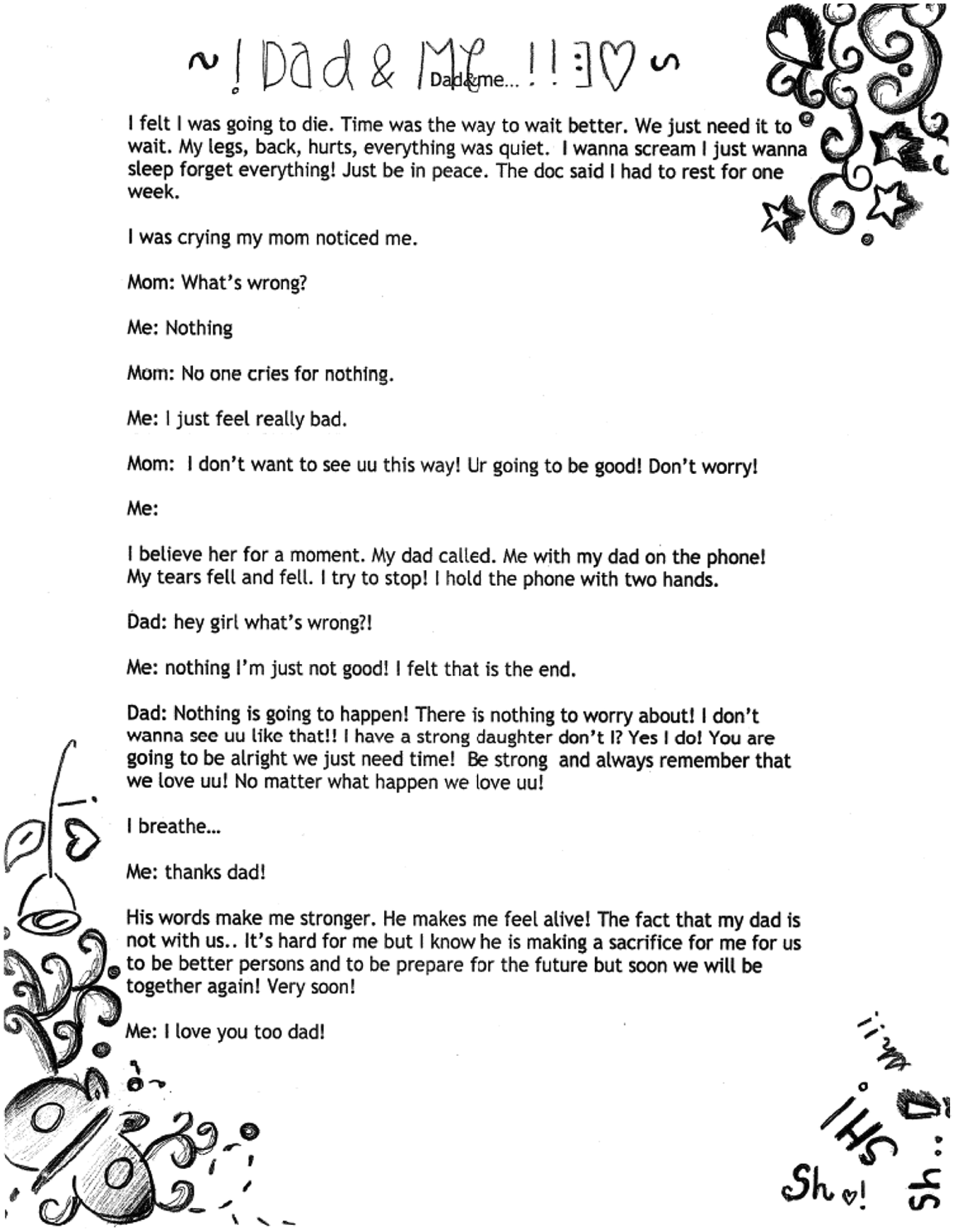
Vanesa’s story: Dad & Me
In the second semester, Vanesa selected a topic that was “something important to me and I want to share it. . . . My grandma.” This story, shown in Figure 2, was about Vanesa’s Mexican grandmother taking a pilgrimage to Spain to visit a beautiful church. There, she found her mission in life: to present ribbons that held healing power to the sick. A woman she met in Spain became a lifelong friend and supplied the ribbons to support this life’s work. The story concluded with Vanesa’s poetic description of her grandmother’s last moments alive and her assertion of an eternal bond between them.
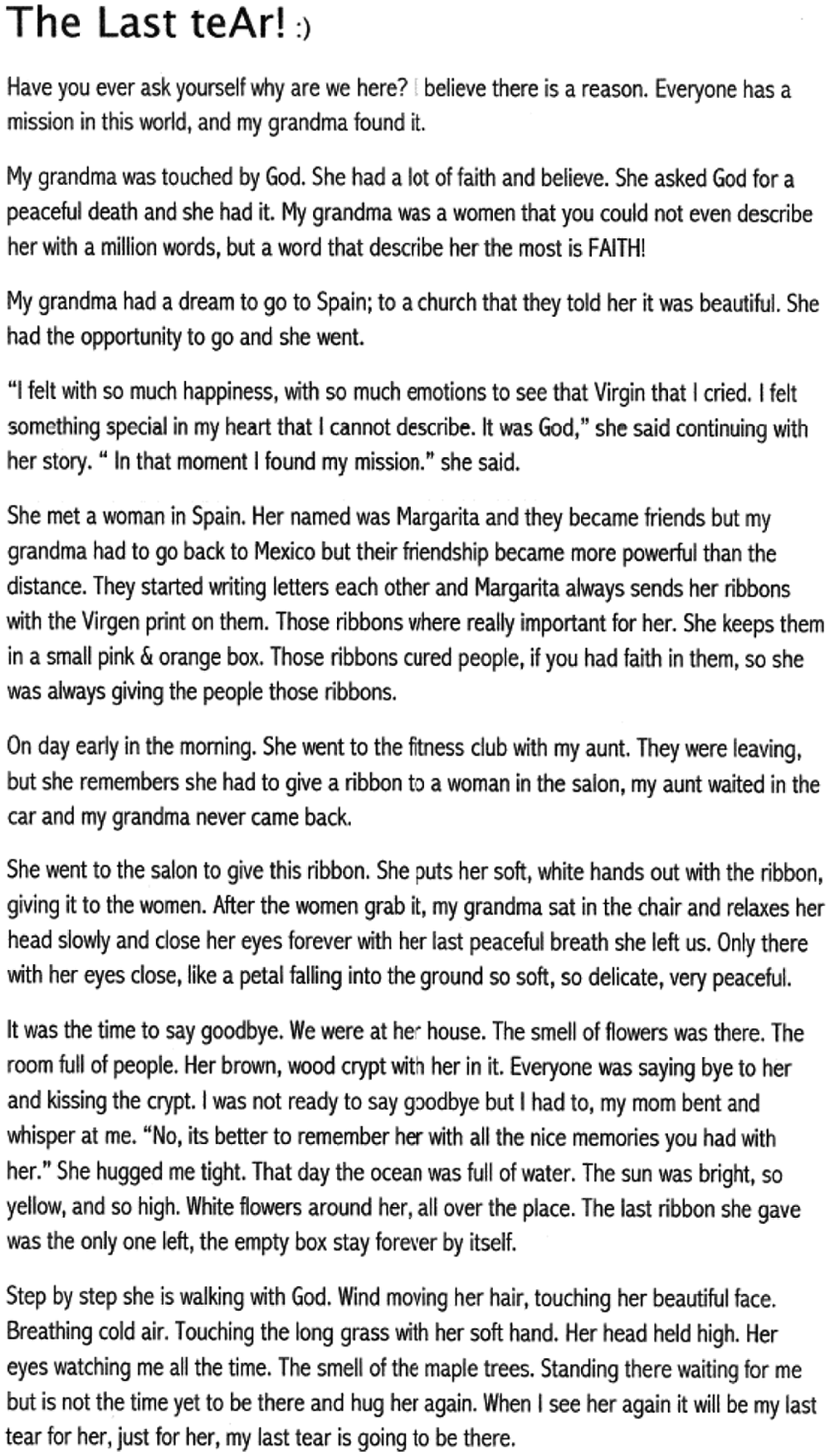
Vanesa’s story: The Last tear! :)
Vanesa employed an academic literacy practice, written composition in school, to generate economic and sociopolitical perspectives on transnationalism. In “Dad & Me,” Vanesa determined that when families undertake border crossings they continuously weigh the economic benefits of transnational life against its significant emotional costs. “The fact that my dad is not with us . . . it’s hard for me but I know he is making a sacrifice for me, for us to be better persons and to be prepare[d] for the future. . . .” She further produced a sociopolitical perspective on transnationals’ agency in crossing borders if not always physically, then emotionally and spiritually. “Dad & Me” ends with the hope of a physical family reunion, “. . . but soon we will be together again! Very soon!” Yet in that narrative, Vanesa also implied that relationships could be powerfully effective despite physical separation. Consider that it is the call from her father in Mexico that serves as the turning point of her story. Thereafter, she marshals her willpower to stop crying so that she can participate in a conversation with him. Similarly, in “The Last tear! :),” Vanesa wrote of her grandmother’s friendship with Margarita: “. . . [M]y grandma had to go back to Mexico but their friendship became more powerful than the distance.” That story also concluded with the trope of reunion across the metaphysical borders separating the spiritual universe from earthly life. With her grandmother’s “eyes watching me all the time,” the worlds of heaven and earth move into each other through Vanesa’s beliefs and literacy practice (Orellana, 2007).
Vanesa also employed her expansive linguistic repertoire in forming and communicating these transnational perspectives. For example, in relating the encouraging words her father speaks to her across the borderlands, she attributed to his speech a small token of the texting social language that is hers. “Be strong and always remember that we love uu!” Vanesa’s assignation of her texting language to her father closes the distance between them by her sharing a special youth language with an adult whom she loves. In “The Last tear! :)” as well, Vanesa strategically deployed her linguistic tools to create and share transnational perspectives. For example, she used the word Virgin twice in the text, first with the English spelling and then with the Spanish spelling, Virgen. She selected the English spelling for translating into English her Spanish-speaking grandmother’s words of joy as she beheld a statute of the Virgin Mary in the church. In the second instance, Vanesa chose the word Virgen to explain that the ribbons that possessed healing power displayed a picture of the Virgin Mary. This use of the Spanish word Virgen could be understood as an instance of not just code switching but the code meshing that Canagarajah (2006) described. By using the word Virgen, Vanesa integrated not just a new language or code into her text but also her religious and cultural values and beliefs. She further reiterated her religious and cultural beliefs in her concluding remarks that her grandmother’s eyes are constantly watching her from heaven. As Canagarajah asserted, integration of new languages and codes is accompanied by the insertion of the values and beliefs of a writer into her text.
Vanesa’s recruitment of other semiotics within her compositions more clearly showcased her impressive orchestration of languages and literacies in forming and publicizing transnational understandings. The sketch that she imposed over the typed title of her story “Dad & Me” contained, in order, an ampersand, exclamation point, the words “Dad & Me,” two exclamation points, a bracket with two points to represent a smile, a heart image, and finally, another ampersand. Hearts, stars, and the curlicue pattern; and the various renderings of the word “shush,” itself carrying onomatopoeic meaning, all convey emotions of love, sadness, and solace that are key themes in her text. In her title, “The Last tear! :),” she used emoticons, punctuation, and bold font to emphasize and foreshadow the dual feelings of sorrow and joy represented in her story. As another example, in that story, she described her grandmother as a woman of “FAITH!” a point she emphasized with capitalization and punctuation. These multimodal designs of meaning emphasized the goals and values of Vanesa’s texts (New London Group, 1996)—to make powerful statements about her agency in navigating “around seemingly fixed and solid obstacles” (Orellana, 2007, p. 126) among the transnational contexts of her life.
Discussion
Researchers who examined the writing of transnational youth found they drew on transnational experiences and understandings, and multiple languages, in composing their texts (García & Gaddes, 2012; Sánchez, 2007a). In addition to representational resources of transnational lifeworlds and multilingual capabilities, Vanesa recruited a multiliterate repertoire of semiotic systems (Kress & Van Leeuwen, 2001; New London Group, 1996) to create stories of border crossing. Furthermore, her composing not only displayed previously acquired transnational perspectives. It can further be understood as a process for forming and articulating these transnational views.
A multiliteracies lens also expansively portrayed this transnational youth employing a range of writing practices (keeping a diary, texting, and writing stories) in a variety of literacy spaces (home, school, informal physical and digital social worlds). These writing activities satisfied several transnational needs such as building relationships with linguistically and culturally diverse groups, chronicling and reflecting on transnational life, and generating transnational perspectives. Scholars of multiliteracies have looked at the online writing practices of transnational and immigrant youth that allow them to develop their multilingual repertoire or transcultural identities (Black, 2005; Lam & Rosario-Ramos, 2009; Yi, 2008). Vanesa’s writing practices broaden the purposes, spaces, and genres for writing in transnational youths’ lives. Furthermore, in multiliteracies-informed research, transnational youth expressed eagerness toward and satisfaction with their online writing practices that helped them learn English (Black, 2005; Yi, 2008). Vanesa’s ruminations about language shift enlarge the scope of transnational youths’ thoughts and feelings toward changing multilingual and multiliteracy practices. Vanesa considered the social, emotional, and cognitive dimensions of language variation in her writing, sifted through potential reasons for these shifts, and apprehended a need for a stance toward her changing linguistic repertoires.
Dance
As with her writing lifeworld, Vanesa’s involvement in dance illuminated how languages and literacies shift in an interconnected fashion in transnational life and how these mutually occurring shifts foster transnational understandings. Vanesa’s dancing further illustrated how the lived experience of language and literacy shift influences the quality of an individual’s transnational perspectives.
Dance and art (to be discussed in the next section) were the literacy practices that brought Vanesa greatest joy. She professed, “I discovered too much here [in the United States] . . . like I didn’t know I would draw or dance.” Vanesa discovered dance in seventh grade. “Like dancing, I started in seventh grade too when I came here. . . . It was an elective.” She chose dance “because I started watching movies of dancing and I started to really think, ‘That’s really cool.’ And whenever they danced I wanted to do those movements so I get involved and I started dancing.” In her ninth grade year, Vanesa joined one of her high school’s dance teams; during that year, the team won several districtwide competitions. She attended dance practice twice daily, before and after school, for several months of the school year. Vanesa also participated in fund-raisers in her community to raise money for team trips and dance outfits. Furthermore, dance had facilitated involvement in theatre, and Vanesa had played a supporting role (as part of a troupe of dancing and singing young ladies and men) in Beauty and the Beast, one of her school’s two major productions in her ninth grade year.
Language shift accompanied this new literacy practice. For Vanesa, learning to dance entailed learning African American English (AAE). She explained that she came from a predominantly White U.S. middle school to Southwest High School, which served primarily Mexican American and African American students. African American students’ AAE seemed to Vanesa a different language.
[My middle school] was a school [with] like very White people and [at Southwest High School] it’s like different people and stuff and they speak like another language. Well, not another language but a slang language and I didn’t know those words. And like, well people in my other school, like White kids and stuff, they didn’t speak like that.
But then, immersed in a community where AAE and rap music maintained a thriving affinity group (Gee, 2007), Vanesa displayed cultural flexibility (Sánchez, 2007b), acknowledging how:
I started liking it. I don’t know why. . . . Some words that I just like. And also, like the rappers and stuff, they usually write about their life so I think that’s kind of cool, like [to] put what you had happen in your life or something like issues they have, they put it in their song.
Indeed, Vanesa had appropriated hip-hop as her favorite dance form. In one observation of a school dance event, Vanesa was the focal dancer (backed up by two Mexican American girls) in the only hip-hop dance routine of the night. Moreover, in keeping with theories of how individuals act on and reconstitute the contexts they inhabit (Orellana, 2007), in talking about her return to Mexico, Vanesa commented that she was “going to look at a school over there” to continue her dancing practice. This intention was also suggestive of the transformed practice of the multiliteracies framework in which individuals transport their literacy learning across contexts (New London Group, 1996).
This opportunity to dance in the United States, while generating tandem shifts in her language and literacy repertoires, also served Vanesa in generating sociocultural perspectives on transnational life. In discussing taking up dance, Vanesa explained,
It’s just like in Mexico, like what your parents teach you and what is at home is just like, whatever they like tell you, you have to do it. . . . For example, I was in swimming classes and my grandma always went for me and picked me up and stuff like that but it was because she wanted to. And I like[d] it. I enjoy[ed] it. I don’t blame her for that. But it’s like sometimes you have to discover things and I think here [the United States] is like the best place . . . [for] stuff like that.
Here, Vanesa proposed that U.S. youth enjoyed more freedom than their Mexican peers in choosing their social activities. Within their families, she maintained, Mexican children were expected to participate in extraschool activities that adults selected for them. In describing her personal experience, she claimed to understand her grandmother choosing for her an activity that she felt was beneficial and admitted to having enjoyed it. Yet she also submitted the importance of young people having opportunities to discover things for themselves. Based on her transnational experience, she proposed the viewpoint that U.S. culture is more conducive to youth choice than Mexican culture.
Discussion
Previous research drawing on sociocultural views of literacy found that literacy practices such as dance offered spaces for transnational youth to transgress socially constructed borderlands of race, ethnicity, culture, and language (Heath, 2001). Vanesa’s dance practice shed light on the process through which multilingual and multiliteracy practices emerge and converge to overcome these social barriers. Vanesa had to learn AAE to understand and develop an appreciation for hip-hop lyrics, music styles, and dance forms. Language shift was critical to her ability to enter that affinity group and appropriate new multilingual and multiliteracy practices.
Furthermore, studies taking a social view of literacy noted that the literacy artifacts produced by transnational youth conveyed their transnational understandings. These transnational views were linked to the youths’ transcultural experiences (García & Gaddes, 2012; Heath, 2001; Sánchez, 2007a). More particularly, though, experiences with language and literacy in transnational life—in Vanesa’s case, as mediated through the activity of dance—bring to fruition such transnational perspectives. Vanesa’s dancing lifeworld provided a space to identify and consider social and cultural differences in youths’ positioning in Mexican and U.S. families. Her perspective that U.S. culture is more supportive of youth choice than Mexican culture is directly connected to her lived experiences with literate activity in her family, first in Mexico, and then within that social unit in the United States.
Art
Art closely followed dance as the second of Vanesa’s newly beloved multiliteracy practices. Analyzing Vanesa’s art making from a multiliteracies perspective allowed me to expansively view transnational youth as not only multilingual but multiliterate as well. Art was another of Vanesa’s electives in the seventh grade. Her art teacher taught students to draw faces, dancing shoes, and soccer balls, and then freed the students to create “whatever comes to mind” with paints that she provided. Vanesa’s affinity for art grew from that experience. “I just started liking it and then I went to Hobby Lobby [an arts and crafts store]. I discovered there are so much things to do if you are creative . . . I love that. I can stay there for so long.” Vanesa’s mother and sister also enjoyed art. Her mother, Vanesa reported, “enjoys going to Hobby Lobby too. . . . Yesterday I went to Hobby Lobby and we took so long because my mom liked it too because they have these flowers and she likes a lot of stuff for decorating the house and everything like that.” Vanesa also employed her mother as an art critic and collaborator. “I sometimes ask my mom about what she thinks looks good or what doesn’t and stuff like that . . . she’s really creative too.” Moreover, Vanesa’s younger sister was also being apprenticed into this affinity group.
My sister, she’s really creative. She has a notebook and it’s really fat and she has a lot of drawings. She likes to draw a lot and I think she looks at me because I think I’m creative . . . so my mom said that I’m an example for her. So whatever I do, she wants to do it.
In an example of her artistic creativity, Vanesa described how, for Mother’s Day, she found inspiration in the family’s recycle bin to create her mother’s gift.
Okay for the Mother’s Day. My mom had all these recycle bins like it was full of paper, of JC Penney. You know those magazines? I was like “Mom, I want to keep that.” And she was like, “It’s just paper honey. We don’t need it.” I was like, “Mom, I just want to keep it.” I had an idea to make her a poster. I made this poster for her. And I started cutting all of this stuff like clothes, jewelry, earrings, from the magazines, and I put them all in a huge paper and I put, “Happy Mother’s Day. Everything for the Best Mom.” And it’s all things that she likes.
But although transnational life had brightened the family’s economic landscape, Vanesa’s art endeavors were still subject to economic constraints. For the Mother’s Day project, Vanesa transformed materials from the family’s recycle bin into a distinctive multimodal piece of art. In another example, on one trip to Hobby Lobby, Vanesa “was looking and I saw these flip-flops. You know those that you can put like the stuff and decorate in? . . . I told my mom that I really wanted those.” When asked, “Did you get them?” she replied, “No, I didn’t because I had money for paper.” Because most of her money went toward the costly paper, instead of the flip-flops, Vanesa bought “markers, I got feathers, I got stars.” Hence, Vanesa adapted her design choices, choosing representational resources (New London Group, 1996) that she could afford—both on the trip to Hobby Lobby and in creating her Mother’s Day gift.
Vanesa’s lived experiences with multiliteracies practices generated a particular quality and range of transnational insights of economic and sociocultural import. For example, Vanesa contrasted the opportunity to choose from electives like art in her U.S. school with the curriculum in her Mexican school that, she reported, contained a limited number of electives and no student choice.
In Mexico they don’t have too much sports . . . you don’t choose your classes. You have to take certain classes and whatever it is, you have to take it. If you don’t like it, it’s not your choice. Right? Here [in the United States] you have electives and whatever you like, you take.
Accessing art (and dance) as literacy practices in school generated in Vanesa a sociocultural critique of not only differences in how youth were positioned in Mexican and U.S. families but also in schools across the two contexts. Vanesa perceived that different cultural norms governed education in Mexico and the United States. As she understood it, it was because U.S. schools valued student choice that they offered pupils curricular electives. This perspective did not address the greater availability of material resources in U.S. schools that allowed faculty to propose and act on this value. Victor Zúñiga and his colleagues, for instance (Hamann et al., 2006; Zúñiga & Hamann, 2009), in comparing data of some U.S. and Mexican schools, found that Mexican schools, particularly public secondary schools and schools outside large cities, possess fewer resources than U.S. schools. Although Vanesa had raised such socioeconomic critiques about the availability of books in libraries in Mexico, this connection went unnoticed in her remarks on school curricula and student choice.
Further consideration can be given to the quality of the transnational socioeconomic perspectives that Vanesa’s artwork inspired. The family’s access to a measure of disposable income and material resources in the United States bolstered her mother’s love for decorating, spurred and supported (to the extent that family finances could allow) Vanesa’s own art making, and apprenticed her little sister into that affinity group. Accordingly, Vanesa’s work as an artist illustrated a transnational understanding she held (in relation to reading practices)—that economic resources can affect social and cultural practices and dispositions of individuals and groups. Yet in contrast to her critical insights about reading practices in her Mexican community, Vanesa did not credit the greater availability of material resources in the United States with her development as an artist. Instead, she asserted that a U.S. cultural value of youth choice admitted her into these practices.
Discussion
Vanesa’s works of art showcased the astounding multiliterate capacity of transnational youth that is too often rendered invisible in multiliteracies-informed research. Her artwork involved design and transformation of available designs (Kress & Van Leeuwen, 2001; New London Group, 1996) in her selection and interrelating of an array of representational resources—an assortment of images from different magazines; paper, pencils, and crayons of different thicknesses; feathers; string and wire; plastic and glass baubles; glitter and stars, and so on—to achieve personal and social goals. Her family’s relationship around art emphasized the processes of affinity groups in which there is a shared enterprise based on design, long-term planning, attention to detail, collaboration, flexible roles, distributed knowledge and leadership, and a strong sense of pleasure (Gee, 2007; Heath, 2001). Vanesa’s multimodal composing demonstrates the fertility of undertaking multiliteracies-inspired research with transnational youth to build deeper understandings of how people produce and deliver meanings by drawing from a range of social contexts and semiotic resources.
Studies tell of the transnational understandings and capacities that transnational youth possess as a consequence of living life across such distinctive social worlds (Canagarajah, 2006, 2009; Hamann et al., 2006; Sánchez, 2007a; Zúñiga & Hamann, 2009). But as these scholars themselves admit, the transnational experience is fraught with social, cultural, and economic dilemmas. These admonitions suggest that a range of perspectives is available for adopting from transnational life. Fulfilling this expectation, Vanesa derived a particular range and quality of transnational perspectives from her unique lived experiences with multiliteracies practices.
Summative Discussion of Findings
Three research questions guided my analysis: What changes in language and literacy practices did a Mexican adolescent attribute to her transnational experience? How did she describe the processes of language and literacy shift in transnational life? And how did transnational engagements with language and literacy influence her generation of transnational perspectives? In examining changes in Vanesa’s language and literacy practices brought about by transnational life, I observed significant shifts in reading, writing, dance, and art. This range of literacies included the forms of literacy that are most privileged by school (reading and writing) as well as those (dance and art) that youth sometimes find only as avenues to develop in contexts outside school (Heath, 2001). I also depicted the interrelations among these multiliteracies practices, portraying, for example, how Vanesa’s written compositions were themselves multimodal designs that incorporated her drawing and other art skills. My analysis thus exposes the multiliterate capacities of transnational youth like Vanesa, abilities that have heretofore gone largely unnoticed in multiliteracies-informed research.
In unveiling Vanesa’s multiliterate repertoire, I further traced the interconnections among multiple language and literacy shifts in transnational life. Language shift is not usually studied in tandem with multiliteracies shift even though theories of multiliteracies and border crossing demand this simultaneous awareness (Guerra, 2007; New London Group, 1996). I detailed, for instance, how Vanesa’s multiliteracies practices of writing and dance were attended by changes in her language repertoires. Furthermore, in answering how Vanesa described the processes of language and literacy shift, I captured her in the midst of sorting through a complex of emotions and theories about her changing linguistic repertoire and developing a stance toward these shifts. This portrait deepens the limited available insights into how transnational youth are responding emotionally and attitudinally toward transformations in their languages and multiliterate lives.
In exploring the question of how shifts in language and literacy were implicated in Vanesa’s generation of transnational understandings, I showed how, for Vanesa, changing language and literacy practices were experienced as transnational knowledge-building transactions. I accounted for how unique lived experiences with languages and multiliteracies engendered in Vanesa a particular range and quality of perspectives on transnational life. By detailing the specific ways in which multilingual and multiliteracies practices are implicated in the formation of specific kinds of transnational understandings, I added nuance to the more general phenomenon of how transnational sociocultural experiences foster transnational knowledge. Theories of multiliteracies have enabled me to prioritize the role of lived experiences with multiple languages and multiple literacies in the development of transnational perspectives.
Implications
The findings of my analysis make possible the proposal of some features of a transnational curriculum, the development of which scholars of transnational education have identified as an urgent need (Canagarajah, 2006, 2009; Hamann et al., 2006; Sánchez, 2007a, 2009; Zúñiga & Hamann, 2009).
A transnational curriculum should involve the study of students’ evolving language and multiliteracy practices across multiple contexts and over time. As Rosaldo (1989) observed, all individuals pass through a variety of borderlands in everyday life. As such, inquiry into the values, goals, tools, processes and outcomes attending their negotiations with languages and multiple literacies across myriad social worlds is a relevant literacy education for all students. Indeed, classrooms can be viewed as lying at the intersecting boundaries (Rosaldo, 1989) of languages, literacies, status, and cultural experiences. The knowledge produced from such investigations can become a set of available designs for teachers and students as they make more permeable the borders separating languages and literacies across transnational contexts. Furthermore, a transnational curriculum must, by its very nature, be fluid and flexible in terms of curriculum leadership—students are best positioned to teach their teachers and peers about their language and literacy repertoires and undertake directed study of their language and literacy development across contexts and over time.
The literacy work that Vanesa dedicated herself to outside school provides additional direction as to the design of a transnational curriculum. Vanesa read, wrote, danced, and made art to achieve personal, social, cultural, and political goals. Much of her literacy work occurred in culturally and linguistically diverse affinity groups and involved a long-term enterprise, multimodal and multilingual design, distributed knowledge, and flexible roles. Broad dissemination of this work with authentic audiences was another key feature. The finding suggests that a transnational curriculum would consider how the literacy work students undertake in school facilitates actualization of a wide range of meaningful goals and encourages collaboration, creativity, and multilingual as well as multimodal design.
A transnational curriculum would furthermore attend to the development of the transnational languages and literacies that scholars have identified (Canagarajah, 2006, 2009; Guerra, 2007; Sánchez, 2007a). These proficiencies include multilingual repertoires and consciousness, cultural flexibility, a sense of global citizenship, and nomadic awareness. For Vanesa, for instance, reintegration into school, social, and family life in Mexico means that she would have to bolster and deploy these literacies to transact fruitfully with life there, while maintaining affiliations with, and aspirations toward, the United States, where she hoped to return (Hamann et al., 2006; Zúñiga & Hamann, 2009). A transnational curriculum would foster such transnational literacies by investigating the transnational experiences and concerns of students (that span personal, social, political, economic, and cultural domains). Such a curriculum would help build local as well as global understandings among transnational students and their mono-national peers. It would make available transnational literacies such as cultural flexibility and global understandings not only to transnational students, but also to their peers who live in only one country. Development of knowledge and critical perspectives on a host of issues related to transnationalism, as Sánchez (2007a, 2007b) proposed, represents an in-depth form of world learning, a transnational literacy, not typically available, but ripe for recruitment, in schools.
In pursuing a deeper and more global understanding of the development of language and literacy repertoires in a transnational youth, this study has generated insights into the processes through which these repertoires are formed, with an eye toward imagining features of a transnational curriculum. Such a curriculum has potential to both enhance and be informed by the multilingual and multiliterate knowledge and capabilities of transnational youth.
Footnotes
Appendix A
Appendix B
Appendix C
Declaration of Conflicting Interests
The author(s) declared no potential conflicts of interest with respect to the research, authorship, and/or publication of this article.
Funding
The author(s) received no financial support for the research, authorship, and/or publication of this article.
Notes
Bio
References
Supplementary Material
Please find the following supplemental material available below.
For Open Access articles published under a Creative Commons License, all supplemental material carries the same license as the article it is associated with.
For non-Open Access articles published, all supplemental material carries a non-exclusive license, and permission requests for re-use of supplemental material or any part of supplemental material shall be sent directly to the copyright owner as specified in the copyright notice associated with the article.
