




Abstract
Studies on multi-stakeholder partnerships (MSPs) have highlighted the potential for conflict in MSPs, and particularly at the global–local interface has been identified as a key source of tension for partnerships in global value chains. This article uncovers the nature of global–local conflicts, how these conflicts can play out in global MSPs, and how this can lead to the emergence of local competing initiatives. Based on three cases of global MSPs (on palm oil, soy, and ethical trade), the article identifies a set of four global–local tensions, which led to repeated disagreement and contestation in the studied MSPs. As the responses by MSPs to these tensions were insufficient to resolve conflict, local rival initiatives were created in all cases by previously participating Southern actors. These were driven by a combination of strong disagreement over time, coalition-building among Southern actors along national lines, and increased legitimacy of solutions outside the established MSPs.
Keywords
Introduction
Multi-stakeholder partnerships (MSPs) aiming to set global standards and make agricultural commodity production more sustainable have become commonplace in global value chains (Bitzer & Glasbergen, 2015; Fransen & Kolk, 2007). However, MSPs are faced with the challenge of achieving alignment between the individual interests of parties involved and the objectives of the MSPs. “Coordinating a common policy means a common language and a set of shared values” (Castells, 2008, p. 88)—and more often than not, participants of MSPs do not share the same principles or interpretation thereof. As a result, tensions are considered “inevitable in processes involving civil society actors, companies, governments, and inter-governmental organisations, with contrasting or disputed discourses, values, and beliefs” (Arenas et al., 2020, p. 170). Contestation frequently emerges on how MSPs are governed, who participates, what discourses are heard, what objectives are pursued, and what benefits accrue to participants (Arenas et al., 2020).
Various studies have attributed such conflicts to the institutional and organisational differences between MSP participants (e.g., Ashraf et al., 2017; Hahn & Pinkse, 2014; Le Ber & Branzei, 2010). Therefore, studies have largely focused on explanatory factors within the MSPs themselves. This ignores how tensions can emerge through the interplay between the global policies of MSPs and local practises in producing countries (Gilbert et al., 2011; Rasche, 2012). MSPs in global value chains have an inherent “spatial” character, as they operate through a vertical North-South model by seeking to change Southern production destined for Northern consumption (Bitzer & Glasbergen, 2015). The better MSPs interact with locally embedded practises, rules, and institutions, the higher their capacity to promote sustainable change in value chains (Schouten et al., 2016). Herein lies a fundamental challenge, as the “global–local nexus” creates a constant, yet dynamic tension—between whether to “globalise” (pursuing a global strategy) or to “localise” (greater autonomy of local levels) or whether and how to combine the two (Dicken, 2004).
Elements of global–local tensions are well recognised in the literature on MSPs, particularly the dominance of Northern actors in MSP participation and decision-making (Ponte & Cheyns, 2013) and the lagging adoption of MSP standards in producing countries (Moog et al., 2015). Some studies even connect the emergence of local rival sustainability initiatives in producing countries to the existence of global–local tensions in MSPs (Hidayat et al., 2018; Hospes 2014; Schouten & Bitzer, 2015).
However, much uncertainty remains. First, there is no understanding of what types of global–local tensions actually exist in MSPs. Second, the reaction of MSPs to such tensions is not adequately studied. Finally, there is no clear link between global–local tensions and the rise of local rival initiatives. These knowledge gaps are indicative of the way that MSPs are commonly approached: Studies tend to take the global level of MSPs as their primary point of reference, which neglects the importance of how such MSPs connect to and interact with local levels (Marques & Eberlein, 2020; Rasche, 2012). This article therefore investigates the critical global–local tensions in MSPs, how they are addressed by MSPs, and how they may drive the emergence of local rival initiatives.
In this article, tensions are understood as contradictory yet co-existing demands that tend to pull organisations and individuals in opposing directions (Andriopoulos & Lewis, 2010). As each side of a tension resides within distinct organisations or individuals, tensions can lead to conflict when each side defends its own interests and needs (Hargraves & Van de Ven, 2017).
We draw on empirical research on three global MSPs: the Roundtable on Sustainable Palm Oil, the Roundtable on Responsible Soy and the Ethical Trading Initiative (specifically its local pilot project in South Africa). Our analysis reveals that four main global–local tensions emerged in all three MSPs: tensions (1) between globally applicable and context-specific standards and audit mechanisms; (2) between global, technical knowledge and local experiences and emotions; (3) between producers’ economic interests and buyers’ demands for sustainable production; and (4) between reaping the benefits and bearing the costs of sustainable production. In all three cases, MSPs did not manage to effectively address these tensions, which caused growing frustration and resistance among southern stakeholders to many of the elements of global MSPs. Ultimately, this led to the launch of local initiatives which address similar sustainability issues as the MSPs, but in a ‘localised’ version.
These insights make two distinctive contributions to the literature on MSPs. First, we show the importance of global–local tensions for studying and understanding MSPs. We specifically carve out the nature of these tensions, analyse MSPs’ reactions to the tensions, and assess the implications of the tensions. This contributes to a deeper understanding of MSPs as sites of interest-based struggles (Levy et al., 2016) and counters the Northern bias prevailing in much of the MSP literature (Marques & Eberlein, 2020). Second, our cases suggest that the way that MSPs deal with these tensions is a distinctive factor contributing to the emergence of local rival initiatives. This positions global–local tensions as a driver for the increasing array of (co-existing) MSPs observed in many sectors and adds explanatory value to the literature theorising on MSP multiplicity (Fransen, 2011; Reinecke et al., 2012; Smith & Fischlein, 2010).
Literature Review
MSPs as Contested Arenas
MSPs have been defined as “initiatives governing social and/or environmental standards of production that have participants from both business and society interest groups as members and governance structures allowing for an equal possibility of input among the different partners in steering the initiative” (Fransen, 2012, p. 166). While increasing numbers of MSPs bear testimony to their widespread popularity, they are far from undisputed, both among participating organisations and in their relationship with wider stakeholders. Grounded in differences in institutional logics between partners, MSPs often struggle with suspicion and mistrust among partner organisations (Ashraf et al., 2017), and differing value frames and expectations (Le Ber & Branzei, 2010). One of the most pertinent sources of complexity in MSPs lies in the potential clash between addressing a social or environmental problem and accommodating partners’ private interests to appropriate part of the value created in a partnership (Ashraf et al., 2017). This is not only a matter of organisations being driven by domain-specific goals and values, but equally reveals conflicting material interests between partners (Powell et al., 2018). Many social or environmental issues addressed by partnerships entail distributional consequences that may help the material interests of some partners more than—or even at the expense of—others.
A common theme thus emerges that MSPs are prone to conflict, which can destabilise and threaten their survival (Ashraf et al., 2017). Yet, studies indicate that resolving tensions is extraordinarily challenging, especially in the face of deeply rooted power imbalances between partnership actors. Accommodation of dominant interests seems to be more commonplace to create temporary relief from tensions (e.g., Banerjee, 2018; Levy et al., 2016; Moog et al., 2015). This bears its own risks: when MSPs prove unable to deal with tensions, disruptive dynamics can emerge, leading to institutional paralysis, and other crises (Moog et al., 2015).
Tensions can also create openings for competitor initiatives to establish themselves and challenge the legitimacy of established MSPs. Smith and Fischlein (2010) observed how organisations that feel excluded from decision-making or perceive an unequal distribution of costs and benefits may exit the partnership and create a rival initiative that corresponds more closely to their own interests. This connects tensions with the multiplicity of MSPs evident in many sectors, which is typically associated with increased competition, fragmentation, and complexity (Fransen, 2011; Reinecke et al., 2012). More recently, the emergence of “local” MSPs has added to MSP multiplicity. These local initiatives seem to have a pronounced competitive character, as they reject the global character of many established MSPs and instead focus on locally embedded solutions (Marques & Eberlein, 2020; Schouten & Bitzer, 2015; Wijaya & Glasbergen, 2016). The explicit positioning of (new) local initiatives vis-à-vis (existing) global MSPs points towards the existence of severe “global–local” tensions, as one of the potential causes for their emergence.
MSPs and Global–Local Tensions
“Global-local tensions” describe tensions emerging at the nexus where global norms, knowledge, and policy goals meet local knowledge, practises, and policy goals of a particular territory (Kusumawati et al., 2013). Global–local tensions are inherent to standardisation processes, as these will erase certain local rules and practises through the introduction of uniform regulation (Gilbert et al., 2011). This is directly related to the effectiveness of MSPs, as such uniformization is often at odds with the context contingency of the sustainability challenges which standards aim to address (Wijen, 2014). The “global-local” nexus is not only a question of crossing geographic, institutional, and cultural boundaries, but it is fundamentally a question of where power lies (Dicken, 2004). Neither “global” nor “local” represent fixed scales or spaces but are rather the extreme points of a dialectical continuum (Dicken, 2004). In MSPs, “global” is often associated with actors, knowledge, ideas, and norms from “Northern” consuming countries, whereas “local” represents those coming from “Southern” producing countries.
Bringing these two together has been a recognised challenge for many MSPs (Gilbert et al., 2011). An important source of tensions in global MSPs can be found in the dominance of Northern actors to the detriment of active participation by Southern stakeholders, especially smallholder farmers and local communities (Dentoni et al., 2018; Schouten & Bitzer, 2015; Wijaya & Glasbergen, 2016). As a result, the efforts of MSPs to address sustainability issues in countries of production are often understood as being led by “external” actors, values, and norms (Kusumawati et al., 2013).
This relates to another tension inherent in global MSPs. Effectively addressing sustainability challenges through MSPs requires that global regulation be adapted to local circumstances (Gilbert et al., 2011). However, in their quest to establish globalised norms of sustainable production processes, MSPs leave little room for local interpretation and adaptation (Schouten & Bitzer, 2015), which has created problems of acceptance at local levels (Raynolds, 2014; Wijaya & Glasbergen, 2016). Southern actors have also explicitly criticised the fact that sustainability standards place high costs on producers, while large multinational companies seemingly capture all the benefits (Higgins & Richards, 2019; Schouten & Bitzer, 2015).
Studies suggest that the success of MSPs therefore depends on how well they are able to neutralise tensions at the global–local nexus by finding an “institutional fit” between their global standards and local organisational fields (Schouten et al., 2016; Timmermans & Epstein, 2010). Such a balancing act can be downright dilemmatic, as choices need to be made which satisfy both Northern and Southern actors (Wijaya et al., 2018). Research indicates that many MSPs struggle with this balance, which may drive a search for alternatives outside of established MSPs and their respective sustainability standards (Schouten & Bitzer, 2015).
Previous studies thus clearly point to the importance of global–local tensions and they recognise that these tensions can potentially disrupt global MSPs. Yet, despite this significance—after all, the effectiveness of MSPs is evidently at stake—there has been no systematic attempt to study these tensions in-depth and to capture them in their entirety. This is what this article aims at: analysing how global–local tensions emerge, how they are addressed in MSPs and how they may lead to the development of local initiatives. To do so, it is important to not only analyse MSPs from a Northern perspective, but to problematize and unravel the North-South logic of partnerships (Marques & Eberlein, 2020).
Methods and Data Sources
Research Approach
This article follows a qualitative case study approach (e.g., Eisenhardt & Graebner, 2007; Yin, 2009). We chose a comparative case study design to replicate findings across cases (Yin, 2009) with regard to how global–local tensions in MSPs arise, how these tensions are handled, and how they contribute to the emergence of local rival initiatives.
We selected three empirical cases of global MSPs and local rival initiative(s) (Table 1), based on purposeful sampling to include information-rich cases (Patton, 1990). The cases vary with regard to their geographies and the commodities addressed (palm oil, soy, fruit/wine), and they are also slightly different in the specific setup of the global MSPs and of the local rival initiatives. However, important similarities can be observed: (1) the global MSPs have displayed similar ambitions for connecting global initiatives to local production sites; (2) the global MSPs have witnessed internal contestation due to the variety of actors involved, their interests and priorities, and their different geographical setting; and (3) all three MSPs have seen the emergence of local rival initiatives. We therefore assumed that insights into tensions arising at the global–local interface and their implications for MSPs are likely to be “transparently observable” (Pettigrew, 1990, p. 275). This makes the cases suitable for an in-depth understanding of global–local tensions by means of within-case and cross-case analysis.
Overview of Empirical Cases.
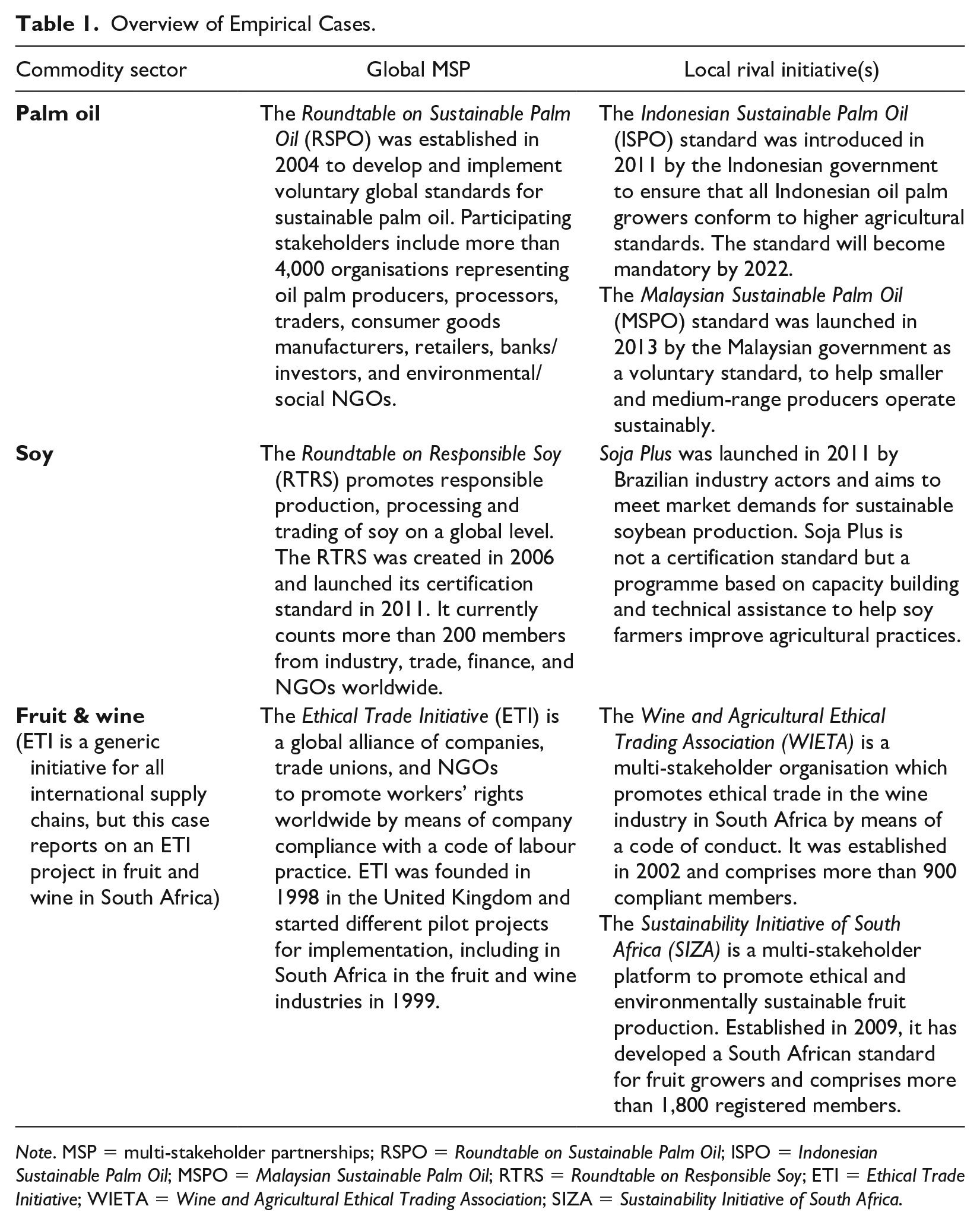
Note. MSP = multi-stakeholder partnerships; RSPO = Roundtable on Sustainable Palm Oil; ISPO = Indonesian Sustainable Palm Oil; MSPO = Malaysian Sustainable Palm Oil; RTRS = Roundtable on Responsible Soy; ETI = Ethical Trade Initiative; WIETA = Wine and Agricultural Ethical Trading Association; SIZA = Sustainability Initiative of South Africa.
Data collection
Data collection was confined to the period of the MSP launch to the establishment of local rival initiatives. This implies that we traced global–local tensions up until rival initiatives were created but not afterwards. For each case, we drew on (1) semi-structured interviews; (2) desk research, such as reports and academic literature on the cases; and/or (3) observational data to allow for data triangulation (Table 2). In total, we conducted 40 interviews with a variety of stakeholders involved in the relevant global or local initiatives, including NGOs, government agencies, companies, producers, unions, and sector associations. This served to reflect the cross-sector character of the different initiatives.
Overview of Data Sources Per Case.
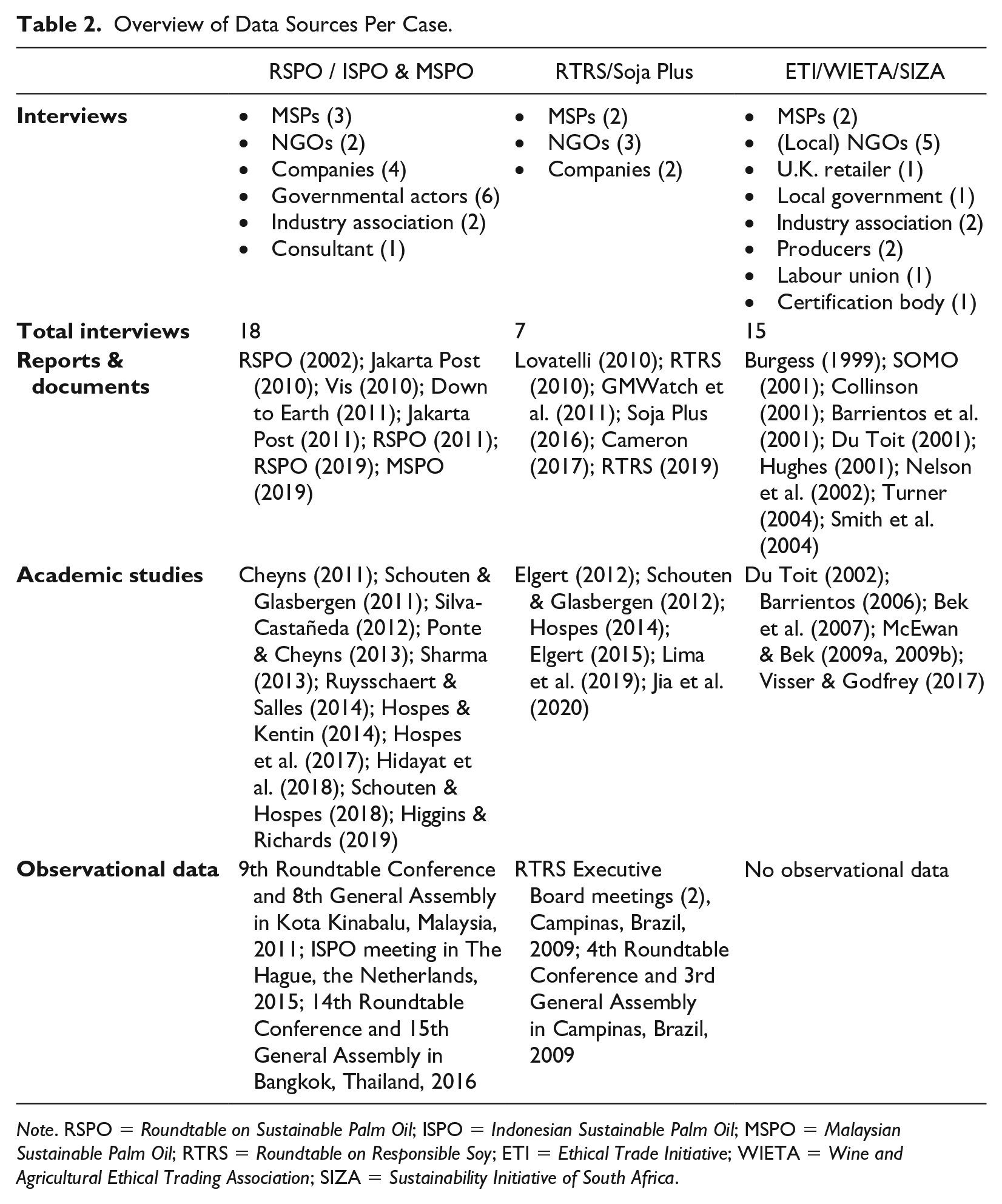
Note. RSPO = Roundtable on Sustainable Palm Oil; ISPO = Indonesian Sustainable Palm Oil; MSPO = Malaysian Sustainable Palm Oil; RTRS = Roundtable on Responsible Soy; ETI = Ethical Trade Initiative; WIETA = Wine and Agricultural Ethical Trading Association; SIZA = Sustainability Initiative of South Africa.
The amount of data and balance between different sources of evidence varies per case. For RSPO/ISPO/MSPO, we relied on interviews with RSPO members and stakeholders involved in ISPO and MSPO, observational data from RSPO meetings, and a multiplicity of existing (academic) studies. For RTRS/Soja Plus, observational data from RTRS meetings and documentation/academic studies were our main data sources, complemented by interviews with RTRS members. For ETI pilot/WIETA/SIZA, our data comprises interviews with stakeholders involved in any of these initiatives, interviews with sector stakeholders, reports, and academic studies.
Data Analysis
In the analysis of the collected data, we followed an abductive analysis approach as outlined by Timmermans and Tavory (2012). They understand abduction to fall in between inductive and deductive approaches, as it emphasises both the interpretative resources of existing literature and the value of sustained analysis of data. Abduction starts with empirically observed consequences (here: three global MSPs, each with local rival initiatives) and then constructing reasons (here: global–local tensions). These reasons do not need to be novel, such as, but can be “hidden from view” (Timmermans and Tavory, 2012, p. 171). This approach thus conformed well to our prior familiarity with existing theories on MSPs, which enabled us to use existing “positional knowledge” for theory construction.
In coding the data, we followed Timmermans and Tavory’s (2012) suggestion to use methodological heuristics from grounded theory. During initial coding, we first identified key “stages” per case: global MSP formation, MSP processes, and implementation and the emergence of local initiatives. This resulted in case narratives and a chronological timeline for each case. During the second stage of analysis, we looked for data indicating the presence of tension (including adversarial relations, contestation, conflict, disagreement, frustration). We also attempted to identify how the tensions were dealt with (e.g., through actions, events, processes) We then engaged in focused coding, selecting what we considered the most important codes, identifying the relationship between them and grouping them into larger families of codes. Based on the research questions, we developed key categories to help organise the results per case: (1) emergence of global MSPs, including MSP-launch, public justification, and founding members; (2) attempts of local rooting, that is, how the MSPs positioned themselves vis-à-vis local production areas; (3) emergence of global–local tensions, including the content of tensions, divergent perspectives of different stakeholder categories, and North-South differences; (4) MSP reactions to tensions, including MSP contestation or accommodation and contextualisation efforts; and (5) local rival formation. Following this structure of key categories, we then searched for patterns and relationships between the empirical concepts guided by a cross-case replication logic (Eisenhardt & Graebner, 2007; Yin, 2009), with the aim of finding general empirical practises among the four case studies. Through this approach, we identified four main global–local tensions that came to the fore in all three global MSPs (although to different degrees). We then re-engaged with the data to identify further, possibly overlooked, phenomena, and concepts. This supported our theorising on the conditions that support the emergence of local rival initiatives, where we found three underlying factors visible in all three cases. As our data collection focused particularly on global–local tensions, we also recognise the limitations of our theorising, which needs to be substantiated by further research.
Findings
Case 1. From a Global MSP to Public Sustainability Standards in the Palm Oil Industry
The Roundtable on Sustainable Palm Oil (RSPO)
The RSPO is a multi-stakeholder partnership initiated in response to sustainability challenges related to the rapid expansion of global palm oil production and consumption. The roundtable spent several years developing a standard for sustainable palm oil production, a verification and certification process, and mechanisms for supply chain traceability. The RSPO counts more than 4,000 members and has around 19% of global palm oil production certified under its standard (RSPO, 2019).
Attempts of Local Rooting
In 2002, the World Wide Fund for Nature (WWF) gathered a group of European stakeholders—retailers, food manufacturers, processors, and traders—who agreed on the objective of promoting sustainable palm oil (interview, consultant). However, these actors soon realised that the influence of a purely European initiative would be limited, considering that palm oil production was concentrated in Malaysia and Indonesia (interview, company; interview, consultant). To get Asian stakeholders involved, WWF contacted the Malaysian Palm Oil Association (MPOA), which joined in early 2003. Although MPOA was very hesitant to collaborate with NGOs, they joined the RSPO to prevent NGO campaigns against the palm oil industry and strengthen the link with the European market (interview, MSP advisor). MPOA, in turn, contacted GAPKI, the Indonesian Palm Oil Association, who joined the RSPO in 2004 (Schouten & Glasbergen, 2011). Throughout its history, the RSPO has reached out to actors from producing countries to become members (interview, company). This led to the inclusion of several national palm oil associations, many individual producers, processers, and traders. Moreover, the RSPO tried to actively connect with the governments of producing countries. For example, Indonesian and Malaysian state actors participated as observers or speakers at annual conferences of the RSPO and took part in several RSPO working groups (RSPO, 2011). Government actors also had indirect ties to the RSPO: “Both MPOA and GAPKI report to their ministers. MPOA to the minister of plantations and GAPKI to the minister of agriculture” (interview, multinational company).
Emergence of Global–Local Tensions
Despite the attempts to secure the involvement of a wide range of stakeholders, criticism by local stakeholders has been present throughout the existence of the RSPO (interview, consultant). First, a tension emerged between economic self-determination on the one hand and the demand for sustainable palm oil on the other. Local stakeholders considered the RSPO to put the interests of consumer countries above those of producer countries and viewed the RSPO standard as a trade barrier for their commodity exports and thus as an impediment to their ambitions for economic growth (Down to Earth, 2011; interview, MSP advisor). As representatives of the Indonesian and Malaysian governments stated: “Where there is NGO pressure, it seems there apply no rules of play under WTO” (interview, Indonesian government actor).
“The RSPO has severe criteria and high costs, and how to cope with this when export value is decreasing? Malaysian people are not interested in sustainability issues, because they first need their means of living to be in order before caring about sustainability” (Interview, Malaysian government actor).
Local stakeholders stressed the economic importance of the palm oil sector in providing income to smallholder farmers and revenues from exports instead of framing palm oil as an unsustainable crop (Hospes et al., 2017; interview, industry association; interview, government actor). “If you want to save our orang-utans, you have to pay for it yourself, we cannot even feed our people. (. . .) They want us to cut the palm oil trees and regrow the forest, but how shall we feed our farmers?” (interview, government actor).
A second tension centred on what counted as legitimate knowledge within the roundtable. RSPO meetings favoured “a technical and smooth way of speaking that avoids major confrontations and promotes indirect formulations and a cautionary approach” over more emotional communication styles (Cheyns, 2011, p. 442). This bias towards technical discussions within the roundtable led to the exclusion of smaller producers who wanted to discuss their lived experiences (Ponte & Cheyns, 2013).
A third tension arose on the division of costs and benefits of sustainable palm oil production. Palm oil producers contested the fact that they had to implement high standards of production and had to bear the costs of certification (Silva-Castañeda, 2012, p. 365), while the economic benefits of certification for producers were not well articulated (Ruysschaert & Salles, 2014; Down to Earth, 2011). Having only a minority vote, producers experienced that their suggestions at (preparations for) annual meetings were often overruled (Hospes & Kentin, 2014). During interviews, representatives of GAPKI indicated that they felt the organisational structure of the RSPO was biased in favour of manufacturers and retailers, putting producers at a disadvantage.
“We are disappointed with the RSPO [. . .] There is an inequality among the members: the producers are outnumbered by retailers, processors, and consumers. [. . .] Most of the burden of adopting the practices lies with us, the new plantation practices, for example, while there is no commitment on the other side” (interview, industry association).
Finally, a tension emerged over the applicability of the global standard to dissimilar local contexts. Many local stakeholders did not consider the generic RSPO standard appropriate for the diverse local realities of production sites in which it should be implemented (Down to Earth, 2011). “Crops are being produced by smallholders for their own survival and livelihood. Sustainability dictates ‘do this, do that’ without knowing what is going on in practice” (interview, industry association). “The RSPO should not tell us what to do and how to do it. We know what to do.” (interview, company).
Reactions to Tensions
Already in the early phase of the RSPO, the division of seats in the Executive Board generated extensive discussion and strong disagreement (interview, consultant). While the initial idea was to have equal representation from each group, the MPOA argued for more seats for producers. The negotiations resulted in two seats being assigned to each stakeholder group, except for producers, who received four seats (interview, company). However, this was not enough to reassure producers that their interests were taken seriously. This was also because the RSPO did not accommodate the tensions around the technical nature of the negotiations. Producers’ demands were not considered and were disqualified by “portraying them as ‘activists’ or as being ‘off topic’” (Ponte & Cheyns, 2013, p. 14).
Yet, on the upside, the RSPO did react to two specific concerns of producers. First, the RSPO approved a resolution at the general assembly in 2008, which addressed concerns by producers related to the development of a market for RSPO certified palm oil by demanding members to publish their plans for sourcing as well as producing sustainable palm oil (interview, company; RSPO, 2008). While this did not lead to a better balance in the division of costs and benefits of sustainable palm oil production, it acknowledged the responsibility of large buyers to create a market for sustainable palm oil.
Another attempt to accommodate the concerns of producers was the start of so-called “national interpretation processes” in 2008 (Schouten & Hospes, 2018) to ensure that the implementation of the global RSPO standard was “congruent or compatible with the norms, laws and values of countries, or sovereign states” (RSPO, 2012). National implementation and interpretation teams were organised in seven palm oil producing countries “to use knowledge about national laws to determine how to adapt the global RSPO principles into the national context” (Hospes & Kentin, 2014, p. 208).
Finally, the RSPO established a number of working groups to deliberate on contentious issues in a smaller setting to have a better chance of reconciling different perspectives. However, attempts at conflict resolution were limited. Instead, high-conflict issues in the RSPO were either depoliticised and turned into technical issues, or simply postponed until a later date (Dentoni et al., 2018). This did not only hold for global–local tensions but applied to other contentious issues as well (Schouten et al., 2012).
Local Rivalry Responses
Around 2010, the Indonesian and Malaysian governments and their national palm oil associations began to openly contest the RSPO (Hospes & Kentin, 2014; Schouten & Hospes, 2018). In the opening address at the 2010 RSPO conference in Jakarta, the Indonesian government announced the launch of the Indonesian Sustainable Palm Oil (ISPO) standard (Jakarta Post, 2010). As a result, several Indonesian stakeholders left the RSPO (Vis, 2010), including GAPKI, which declared its full support for the newly announced sustainability standard (Jakarta Post, 2011).
The ISPO standard was developed by Indonesian ministries in close consultation with the palm oil industry and national NGOs (interview, Indonesian government actor), whereas the MSPO standard resulted from a strong coalition of the Malaysian palm oil industry and government institutions (MSPO, 2019). “The critique on the RSPO and the limited role of growers in the RSPO prompted the Malaysian government to develop the MSPO” (interview, MSP advisor). To overcome growers’ concerns about increasingly stricter demands and costly certification charges (Sharma, 2013), both standards have emphasised that they fully align with national laws and regulations (e.g., Higgins & Richards, 2019). As a result, the standards of ISPO and MSPO are less strict and less concrete than the RSPO’s (Hidayat et al., 2018; Hospes, 2014). At the same time, “the ISPO and MSPO enable a reframing of sustainability that bypasses the perceived challenges and limitations associated with RSPO certification—such as high costs, and the meeting of more stringent and detailed criteria,” thereby aligning more closely with the requirements of the Chinese and Indian markets (Higgins & Richards, 2019, p. 132). “For some people the MSPO standard is a watered-down version of the RSPO. That is not true. It is the Malaysian version of what sustainability is” (interview, Malaysian company).
Case 2. Conflicting Values and Disruptive Dynamics in the Soy Sector
The Roundtable for Responsible Soy (RTRS)
The production of soy in South America, particularly in Brazil and Argentina, is frequently associated with deforestation, loss of biodiversity and human rights violations. Modelled after the RSPO, WWF initiated the RTRS to promote sustainable soy production. Officially launched in 2006, the RTRS approved its standard for responsible soy production and the accompanying verification system in 2010, and the first shipment of RTRS-certified soy arrived in Europe in 2011.
Attempts of Local Rooting
In 2004, WWF invited 25 potential stakeholders to discuss the idea of addressing sustainability issues in mainstream soy production through a multi-stakeholder process, including producers, actors from industry, trade and finance, and civil society (RTRS, 2010). The RTRS encountered difficulties in including soy producers from the United States, but also producers from Latin America were reluctant to join the RTRS, as the MSP—like the RSPO—faced problems in creating a sense of a fair distribution of costs and benefits (Schouten & Glasbergen, 2012), which is visible in a relatively low membership rate of around 200 organisations (RTRS, 2019).
Emergence of Global–Local Tensions
Since its inception, the RTRS has faced opposition from local stakeholders. First, a tension arose between the producing countries’ emphasis on economic growth and the demand for sustainable soy coming from large international buyers and northern NGOs. The most contentious issue in this regard was the inclusion of criteria on forest conservation. “It is not up to the RTRS who can deforest and who not” (representative of the association of soy processors during the RTRS Executive Board meeting, 2009). APROSOJA (Mato Grosso’s State Association of Soybean Producers), a member of the RTRS Executive Board, demanded a compensation programme for any avoided deforestation to recognise producers’ interests and maintain a competitive balance among producer countries (observational data, Brazil 2009). They argued that Brazil would be unfairly hit by the criteria on deforestation because of the presence of large areas of virgin rainforest.
A second related tension emerged over whether it was appropriate and feasible to have a single global standard for sustainable soy production. While producers argued in favour of differentiated standards adapted to national conditions, this was not considered a viable solution. “There are very large differences in soy production in different countries, and the problems in each are different. However, the RTRS wants to create a mainstream product, not like Fair Trade, etc., and therefore is developing a global standard” (interview, MSP).
Third, the division of costs and benefits of sustainable soy production generated tensions. Producers explicitly wanted to determine who was going to pay for the avoided deforestation (observational data, Brazil 2009). “The demand is increasing and so we are increasing production. We need money for this protection of the environment” (representative of the processor association during RTRS EB meeting, 2009). APROSOJA and ABIOVE (the Brazilian Oilseed Processors Association) wrote in a joint letter to the Executive Board: “The impasse regarding environmental conservation is not due to a lack of awareness of its importance; rather, it is based on a sense of economic financial feasibility.” Producers sent a clear message that a compensation scheme for avoided deforestation was necessary, as price premiums would possibly cover the costs of certification but not the costs incurred by farmers unable to clear land that was purchased in anticipation of growing soy. During the establishment of the RTRS, producers argued that if soy farms were going to be certified, it would also be fair to measure and certify other operations in the value chain, such as greenhouse gas emissions of food manufacturers (observational data, Brazil 2009). However, such suggestions were never seriously taken up (Schouten & Glasbergen, 2012).
A fourth tension arose due to the technical nature of the discussions and negotiations within the RTRS. Sustainability problems were often framed as technical concerns, and solutions were presented as uncontroversial and rational (Elgert, 2012, 2015). The development of a sustainability standard was thus conceived as a rather straightforward process requiring technical knowledge (Elgert, 2015). However, the concept of sustainable soy was inherently political, and many stakeholders opposed the RTRS. This opposition was not addressed by the RTRS, because “the rationality of those who oppose the RTRS is questioned—particularly as their challenges to the criteria development process are not based on direct critique of technical knowledge” (Elgert, 2015, p. 302).
Reaction to Tensions
Like the RSPO, the RTRS also opted for a national interpretation process. “Once this [the generic soy standard] is complete, pilot projects in different countries will determine national interpretations for each producing country” (interview, MSP). However, the majority of RTRS Executive Board members, including Brazilian environmental NGOs, felt very strongly about including criteria to halt deforestation and were not willing to agree on a compensation mechanism (observational data, Brazil 2009). They only agreed to investigate the possibilities for compensation during the field-testing period of the standard. The vice president of APROSOJA West voiced his concerns during the General Assembly of 2009 and argued that investigating these possibilities was not enough: “The farmers need compensation now and it has to go hand in hand with the RTRS Principles & Criteria. We don’t need the RTRS, we don’t need you. We were already the bad guys. We have other ways to certify, this is not the only way. We have other forums. The world does not end if the RTRS is gone. If we don’t get a reward for participating, we will not attract farmers.”
Without seeing direct prospects for financial compensation, APROSOJA was not willing to accept the RTRS standard and abruptly terminated its membership during the General Assembly of the RTRS in 2009, followed by ABIOVE 1 year later (Cameron, 2017). “We tried to find a reason to stay in the RTRS. We have invested 250.000 R$. [. . .] But we think the RTRS is very imbalanced, so we are going to look for another forum. Success to you all” (representative of APROSOJA at the General Assembly in 2009). This paved the way for the RTRS to adopt its standard, including criteria on deforestation, without much further internal resistance. However, according to some stakeholders, the credibility of the RTRS process was severely damaged by the resignation of these two major Brazilian organisations in the soy industry (GMWatch et al., 2011).
Local Rivalry Responses
One day after ABIOVE left the RTRS in 2010, it launched its own voluntary sustainability standard called “Soja Plus,” together with its long-time ally APROSOJA, the National Grain Exporters Association and the Responsible Agribusiness Institute (Hospes, 2014). This was a serious setback for the RTRS, as the nine members of ABIOVE together processed 72% of Brazil’s soybeans (Jia et al., 2020). Similar to the RTRS, Soja Plus adopted a multi-stakeholder approach to address the legal, environmental, social, and agricultural dimensions of soy cultivation (Jia et al., 2020). Specifically, it aims to “reconcile agricultural production with the conservation of natural resources, and improve the health and safety of rural workers” (Soja Plus, 2016). Its standard refers to existing Brazilian legislation to position itself as a solution for the Brazilian context (Schouten & Bitzer, 2015). At the same time, Soja Plus imitates the RTRS standard: “in terms of principles and criteria, Soja Plus looks like a copy of the RTRS” (Hospes, 2014, p. 433). With important differences, however: it lacks criteria on avoiding conflicting land uses, reducing GHG emissions, and responsible expansion of soy cultivation (Hospes, 2014, p. 434). This reflects Soja Plus’ attempt to avoid nonessential costs and focus on the economic motivations of soy producers (Jia et al., 2020). After a few years, Soja Plus shifted from certifying farmers’ operations to pursuing capacity development of farmers to improve sustainability in the sector (Soja Plus, 2016). Nevertheless, uptake of Soja Plus in Brazil has been limited because of its voluntary character, reaching only “a small portion of properties within the soy universe” (Lima et al., 2019, p. 349).
Case 3. South African Fruit and Wine: From a Global MSP to the Successive Emergence of Local MSPs
The Ethical Trading Initiative (ETI)
The ETI was founded in 1998 in the United Kingdom as an MSP between companies, trade unions, and NGOs in response to growing concerns about labour rights’ violations in many international supply chains. Its aim is to promote responsible corporate practices and strengthen workers’ rights, based on the ETI Base Code that all corporate members have to comply with (ETI, 2020).
Attempts of Local Rooting
After its launch, the ETI quickly realised the need to test its Base Code in different production locations. Therefore, it set up pilot projects in early 1999, including in South Africa, as a key supplier country for fresh produce and wine to U.K. retailers (ETI, 2020). At that time, the post-Apartheid South African fruit and wine sectors were under heavy pressure for exploitative working conditions, which also reflected poorly on U.K. retailers (Bek et al., 2007). Three U.K. retailers decided to join the pilot project, which was initially welcomed by South African stakeholders. Although they rejected accusations of worker exploitation, market access to these retailers was so important that “some producers in the wine industry considered it a good idea to partner with UK supermarkets on ETI” (interview, WIETA). Over the next three years, the pilot project focused on testing different methods of auditing and verification of labour standards (ETI, 2020; Nelson et al., 2002). This led to the development of an improved audit method, which was communicated back to the U.K.-headquarters of ETI.
Emergence of Global–Local Tensions
While the ETI pilot reads like a success story, criticism by local stakeholders has accompanied its duration. First, local NGOs and unions claimed that technical audit experts were able to dominate the project, whereas their own participation and opportunity to bring in perspectives from fieldworkers was limited (interviews, local NGOs 1, 2 and labour union). They criticised that the ETI approach reduced farm workers to “objects of auditing” rather than aiming at their empowerment (Barrientos, 2006; Bek et al., 2007; Du Toit, 2001). Fault was also found with the type of auditors and how workers were interviewed (Burgess, 1999): “The auditors were white and the interviews were done in the office of the producer. So it was a very intimidating process. Women workers won’t open up” (interview, local NGO 2).
Second, local stakeholders questioned the relevance of the ETI Base Code for South African agriculture. “ETI was a British organisation, but you need to understand our farms first if you want to get involved here” (interview, wine producer). NGOs and unions specifically argued that the Base Code ignored prevailing gender relations and the needs of seasonal workers (Barrientos, 2006; Barrientos et al., 2001; Burgess, 1999). “Why is it [the Base Code] geared towards health and safety? Why isn’t it more geared towards women? It only looks at permanent workers [. . .] but the majority of the labour force are women in temporary jobs” (interview, local NGO 1). These gaps fuelled the concern that local needs were subordinated to retailers’ needs for a globalised standard (Turner, 2004).
Third, producers objected that worker welfare was largely framed as the responsibility of producers. Sourcing practices of powerful retailers and how these placed downwards cost pressures on suppliers, contributing to creating an environment for worker exploitation, were not discussed (Bek et al., 2007; Du Toit, 2002; Smith et al., 2004). Producers felt that “there is increasing cost pressure in the supply chain” (interview, wine industry association). At the same time, suppliers had to bear the full costs of compliance without receiving higher prices for their produce or obtaining a preferred supplier status (Barrientos, 2006; Collinson, 2001). This created considerable resistance among suppliers. “What’s the value add there? We do all the work, we do all the assessment, we bear all the costs” (interview, fruit producer).
Finally, producers voiced concern that the Base Code would curtail their ability to compete with other supplier countries (interview, wine industry association). “It was often seen as a barrier to trade” (interview, WIETA), unfairly singling out South Africa while turning a blind eye to the conditions on supplier farms in other parts of the world (Nelson et al., 2002). The ETI project, however, argued that compliance with the Base Code would help the South African wine sector to become a “world-class industry” by supplying a combination of quality products and worker empowerment (Du Toit, 2002).
Reactions to Tensions
Although the ETI project offered opportunities for local involvement, participating South African stakeholders quickly realised that they were not able to influence the decision-making of the project (Du Toit, 2001). Interviewees added that this was also due to the divisions among local stakeholders, especially among producers and civil society organisations, which prevented them from coordinating their input to the project (interviews, wine industry association and WIETA). The lack of decision-making power became a growing source of frustration for South African stakeholders, which even temporarily bridged the deep gulf of mistrust among them (Du Toit, 2001). The ETI therefore supported South African stakeholders in forming the Ethical Trade Forum in 1999, comprising local NGOs, trade unions, government officials, and academics, with the aim of representing and coordinating South African input to the ETI pilot project (Barrientos et al., 2001). This was the first time of coalition-building by South African stakeholders in the fruit and wine industry in spite of their bitter antagonism (McEwan & Bek, 2009a). Having the Ethical Trade Forum improved the participation of South African stakeholders in the pilot and also led to a revised audit methodology (Ascoly et al., 2001). At the same time, local stakeholders observed that their participation remained limited to the original scope of the project and final decisions “still had a tendency to be made—sometimes unilaterally—from the UK” (Du Toit, 2002, p. 360). A serious discussion on the content of the ETI Base Code and underlying pressures for poor working conditions on farms did not take place (Du Toit, 2001). This also mirrored the initial setup of the ETI as an MSP dominated by U.K. actors, who were preoccupied with finding agreement among themselves (Hughes, 2001). Any discussion about the distribution of value in global supply chains is therefore avoided (Du Toit, 2002). “If I can be honest, that’s where you start looking at this standard and you start thinking from a South African perspective, what does this actually give you?” (interview, certification body).
Local Rivalry Responses
In 2001, South African actors organised a multi-stakeholder conference to discuss the way forward. Because of the negativity that had evolved from the cost of audits and the perceived pressure by U.K. retailers (interviews, certification body, fruit industry association, and fruit producer), stakeholders argued to “take the lessons learned through the ETI pilot for local action” (interview, NGO 1) and “develop a code that was specific to South Africa” (interview, wine industry association). Shortly after, in 2002, local stakeholders founded the Wine and Agricultural Ethical Trade Association (WIETA) to promote ethical trade in the wine industry (WIETA, 2020). They emphasised the need for a “South African” approach to “start asking the right questions on how to measure that levels of working conditions, the quality of work and the level of fair work” (interview, labour union). Therefore, “we developed more refined indicators that were very relevant to South Africa and its labour law [. . .] but also based on the ETI Base Code and ILO conventions” (interview, WIETA). Critically, because of their participation in the pilot project, stakeholders were sufficiently united and felt capable of self-regulation, even though trust between producers, NGOs and labour unions was still very fragile (Smith et al., 2004). The local character of WIETA also facilitated initial uptake in the wine sector (McEwan & Bek, 2009b). However, membership stalled after a few years, as mistrust between stakeholders erupted once more over disputes about poor working conditions in vineyards (Visser & Godfrey, 2017). NGOs and producers were quick to blame each other (interviews, NGOs 1, 2, 3, and wine industry association). Large parts of the wine industry also perceived WIETA to be driven by the agenda of overseas retailers who kept on pressuring for improved working conditions on farms and who continued to ask for ETI compliance regardless of WIETA (Bek et al., 2007).
Soon after, these pressures also reached the South African fruit industry, which led to the development of the Sustainability Initiative of South Africa (SIZA) in 2009, as the local ethical programme for the fruit sector (Schouten & Bitzer, 2015). The fruit industry argued that the audit approach by WIETA had created a lot of negativity in the industry, so they chose a lighter approach based on verification, with fewer farm visits and lower costs (interview, fruit industry association). Yet, similar to WIETA, SIZA emphasised its bottom-up character based on South African laws while equally aiming to satisfy international requirements by European and U.K. retailers (interview, SIZA).
Analysis
Global–Local Tensions and MSP Responses
Our cases show that global–local tensions emerged in all three MSPs around four issues (Table 3). First, in all MSPs, producers contested the local applicability and relevance of global standards and audit mechanisms, which they considered to place an inadequate focus on selected sustainability issues and therefore required local adaptation. Second, producers and local civil society organisations criticised that MSP processes and standards were based on technical knowledge and measurement systems, and ignored the importance of local knowledge and evidence of rural communities. Third, local actors feared that MSP standards acted as trade barriers for their commodity exports while serving global buyers’ needs to present sustainable products to their customers. Finally, producers, processors, and traders criticised that they had to bear the costs of certification and auditing, whereas large buyers pressuring for certification did not shoulder any costs. They considered this an unfair burden, adding to growing downwards supply chain pressures due to the power of global buyers.
Types of Global–Local Tensions in MSPs.
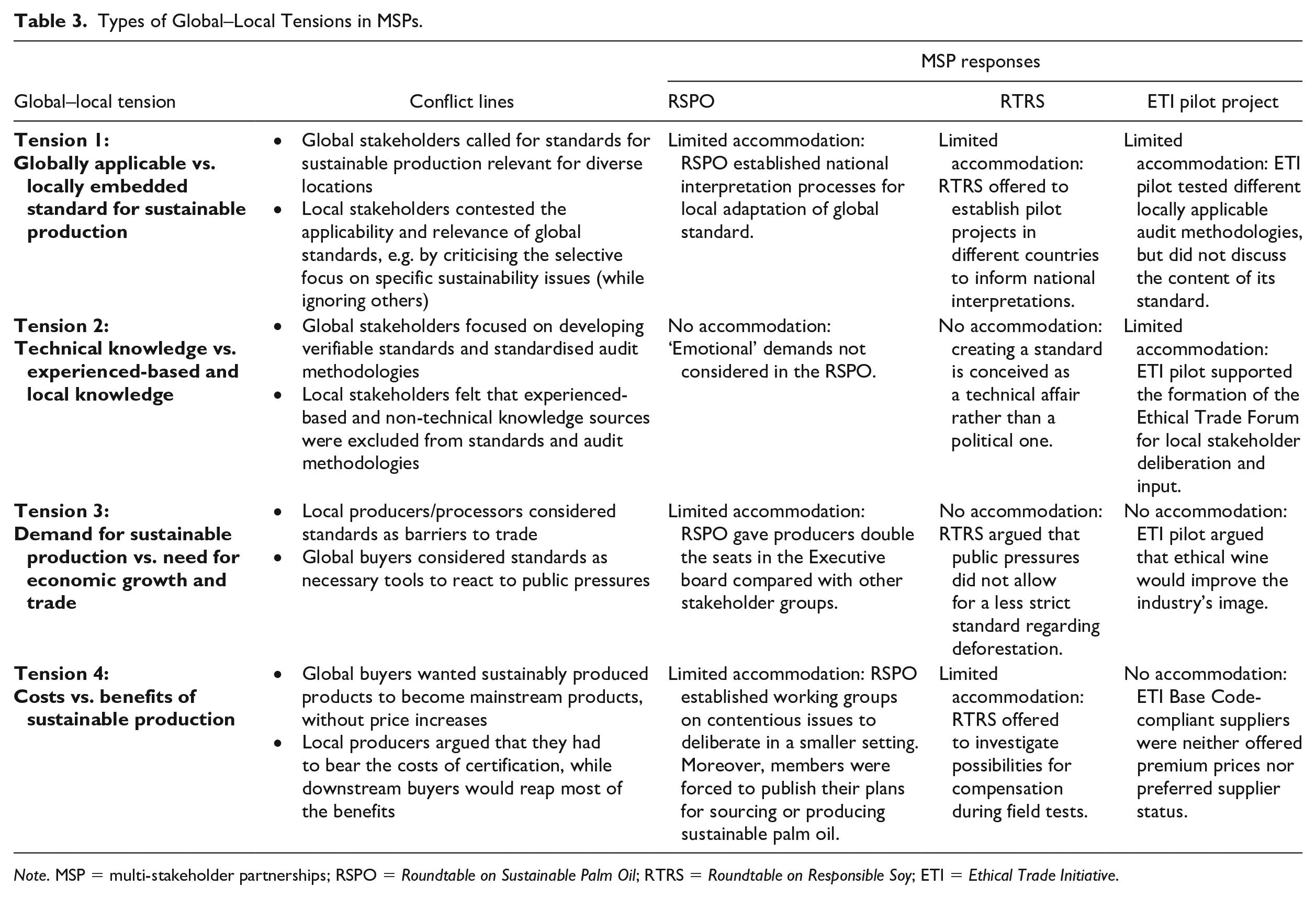
Note. MSP = multi-stakeholder partnerships; RSPO = Roundtable on Sustainable Palm Oil; RTRS = Roundtable on Responsible Soy; ETI = Ethical Trade Initiative.
None of the four tensions were fully resolved in any of the studied MSPs—at least not before the local rival initiatives were created. While there were some differences between the MSPs, the main response was to find ways to increase local participation; for example, by supporting structures to channel the input of Southern stakeholders. Moreover, MSPs tried to reduce the severity of conflicts, for example, by allowing for limited contextualisation of their proposed standards or audit methodologies. However, fundamental changes demanded by Southern stakeholders—for instance, regarding the content of standards or setting premium prices for compliant producers—were not adopted.
Our cases point to two main factors explaining the response to small adjustments by MSPs. First, the internal processes of the MSPs were geared towards internal stabilisation and were not able to sufficiently deal with conflictual issues. We specifically found that the consensus-orientation of MSPs and the focus on specific topics prevented space for discussion and conflict. As such, conflict avoidance rather than conflict resolution prevailed (Dentoni et al., 2018; Du Toit, 2002; Schouten et al., 2012).
Second, all three MSPs have seen an inherent power imbalance between Northern and Southern actors. Northern actors, mostly multinational corporations and NGOs, had initiated the MSPs and were able to strongly influence the overall agenda of the MSPs. In the ETI, for example, U.K. retailers were able to push for a focus on improving production conditions instead of a larger focus on supply chain responsibilities, as advocated by producers in South Africa. This would have increased the pressure on retailers who were seen to benefit from exploitative working conditions on fruit and wine farms dependent on cheap labour. The same focus on the production level could be seen in the RSPO and RTRS.
Contrasting the dominance of Northern stakeholders was the fragmentation of Southern stakeholders, particularly at the time when the MSPs were established. None of the relevant agricultural sectors seemed prepared for the emergence of the MSPs and the discussions on sustainable or ethical production initiated by them. In post-Apartheid South Africa, the agricultural industry had been confronted with increasing criticism on its legacy of racialised labour exploitation, but had thus far rejected any efforts for transformative change. In Malaysia and Indonesia, the importance of palm oil production for economic growth was such that any other concerns were simply considered negligible, or as an unfortunate but unavoidable by-product. Similar perceptions dominated the public discourse in Brazil, where soy production generated increasing revenues and contributed to economic growth. This unpreparedness at sector level made it difficult for local actors to actively engage in the MSPs. Finally, the Southern stakeholders were highly diverse, comprising producers (both large-scale and small-scale), processors, traders, NGOs and other actors. They often had differing and partially conflicting views, which prevented them from speaking with a unified voice.
From Tensions to Local Rival Initiatives
As a result of limited conflict resolution in MSPs, local actors grew increasingly frustrated at their inability to significantly influence the content of MSP processes. This led to mounting calls for the establishment of local alternative initiatives. In the case of the RSPO, critical stakeholders exited the MSP in 2010 and soon created rival standards for sustainable palm oil—first in Indonesia, then in Malaysia. Similarly, in Brazil, important stakeholder groups left the RTRS in 2010 and established an initiative to support producers in their own idea of sustainable production. Finally, in South Africa, the end of the ETI pilot project in 2002 was used to launch a multi-stakeholder initiative to make the ETI standard redundant for wine producers.
Our cases expose three distinct conditions which facilitated the emergence of local rival initiatives. First, in all three MSPs, tensions accumulated over time until open disruption was triggered when the MSPs were not able or willing to find a solution to a shift in benefits and costs associated with sustainable or ethical modes of production. These tensions played out between large Northern multinational companies on the one hand and larger Southern industry actors, such as large producers, processors, and traders, on the other. For example, in the RTRS, Northern actors were not willing to establish a compensation mechanism for zero-deforestation, which Brazilian producers considered a denial of their right to benefit from their land. In the case of the RSPO, producers had to pay the costs of certification, while uptake of certified palm oil was low and many farmers did not receive a price premium for their extra efforts. Finally, in South Africa, producers were not willing to unilaterally carry the costs of ethical production while ignoring retailers’ supply chain pressures that produce exploitative practices.
Second, the involvement of Southern actors in global MSPs facilitated unexpected coalition-building among them. Prior to the arrival of global MSPs, stakeholder relationships in the Indonesian and Malaysian palm oil sectors, the Brazilian soy industry and the South African fruit and wine sectors were poor, marked by distance or even deep divides and mistrust (Elgert, 2012; McEwen & Bek, 2009a). The global MSPs, however, stimulated Southern actors’ engagement, often bringing them together for the first time and prompting them to pay attention to diverse sustainability issues. Initially, much of their engagement remained fragmented and driven by individual interests. However, as many Southern stakeholders became increasingly perceived to be unfairly singled out for a whole range of issues that went wrong in global supply chains, they started discovering common ground among them. They also realised that they would not be able to have their grievances resolved in the global MSP settings, seeing the dominance of Northern actors and their concerns. This led to increasing interaction at national sector level, including between government bodies, industry associations and civil society organisations, and temporary coalition-building on specific sustainability-related issues.
Finally, participation in global MSPs led to increasing confidence by Southern actors in their own capacities to develop initiatives which could counter the wide-ranging sustainability concerns voiced by key market destinations for their products (e.g., Wijaya & Glasbergen, 2016). Rather than focusing on buy-in from large international buyers and international NGOs, as global MSPs did, Southern actors proposed solutions that centred on producer buy-in and appropriateness to the conditions of their national agricultural sectors (Schouten & Bitzer, 2015). This entailed developing standards with similar, but less onerous, requirements than global MSPs and a pronounced emphasis on compliance with national rules and regulations. This was the case in Indonesia, Malaysia and South Africa. Brazilian stakeholders opted against a standard and designed a capacity-building programme to train farmers on diverse environmental and social indicators as a context-appropriate solution to sustainability.
The dynamics and factors at play, from the emergence of global–local tensions to the creation of local rival initiatives, are visualised in a process model in Figure 1. In line with our case findings, the model only shows the response of “limited accommodation” by global MSPs, excluding alternative (hypothetical) response options by MSPs, which may have different outcomes for the resolution of global–local tensions.
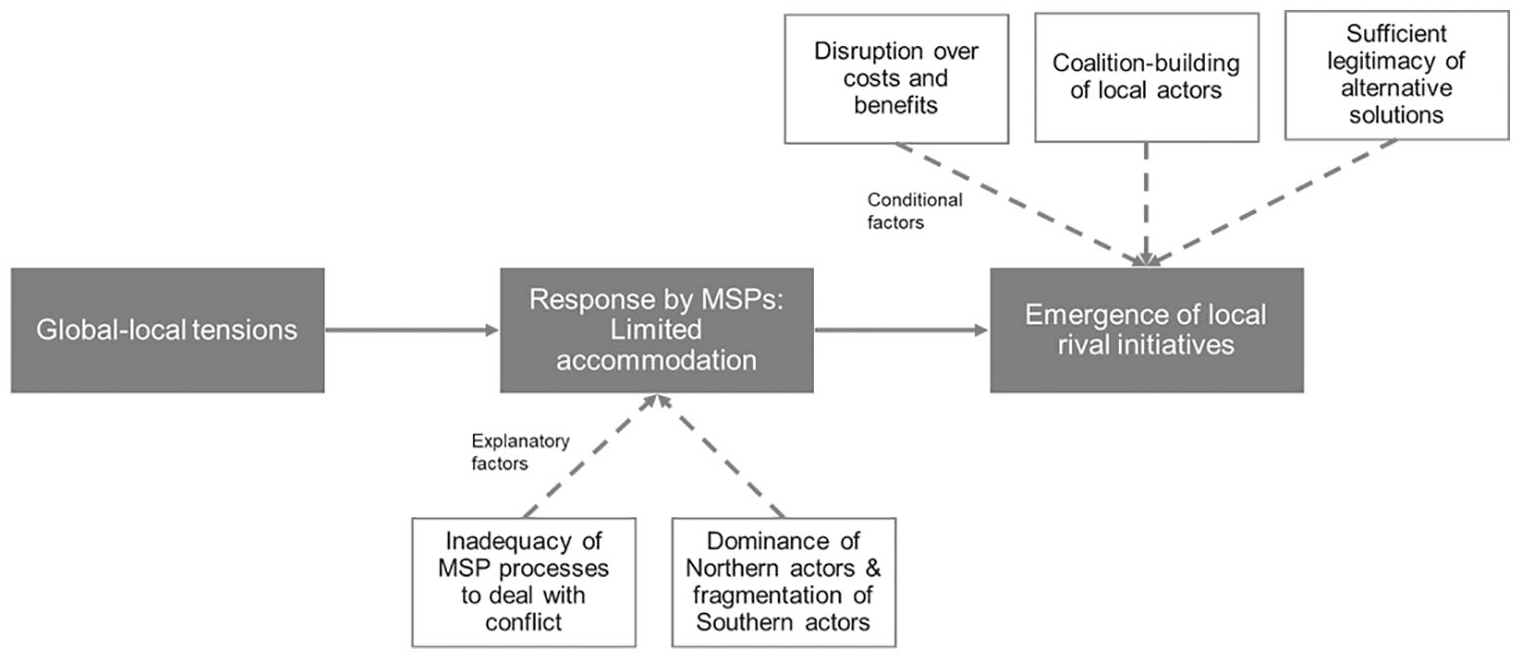
Process Model of Global–Local Tensions in MSPs and the Emergence of Competing Initiatives in Emerging Economies.
Discussion
Our results build on and expand the literature on MSPs in two important ways. First, this article fleshed out the dimensions along which conflict originating in the global–local interface may materialise, then analysed MSPs’ reactions to tensions arising as a result, and assessed the implications of these. Our cases brought to light a set of four global–local tensions which centre on (1) the context-specific applicability and relevance of MSP standards and audit mechanisms, (2) the weight and integration of different types of knowledge and experiences in MSP standards and processes, (3) the reconciliation of producers’ economic concerns with global buyers’ demands for sustainable production and (4) the costs and benefits of sustainable production. Previous studies recognised the global–local interface as a source of tensions in global MSPs, critically influencing MSPs’ effectiveness (Raynolds, 2014; Schouten & Bitzer, 2015; Wijaya & Glasbergen, 2016). Wijen (2014), for example, characterised the trade-off that exists between the rigidity required by MSPs to enforce local compliance with their regulations and the flexibility needed to actually achieve sustainability goals as “means-ends decoupling.” However, so far there are no in-depth analyses on the precise nature of such global–local tensions and the implications in terms of local rival initiatives.
We also analysed how these global–local tensions are being “managed” by MSPs. In the cases studied in this article, the global MSPs partially tried to ease these tensions, for example, by increasing the scope for local consultation. However, deeper engagement with mounting tensions was hindered by two key aspects. On one hand, the perspectives of Southern stakeholders did not carry enough weight in light of their internal fragmentation and the dominance of Northern actors. This mirrors the power imbalances along global value chains, which were already highlighted by prior research (e.g., Bitzer & Glasbergen, 2015; Cheyns, 2011). On the other hand, MSP processes have proved largely inapt to deal with contentious issues. Shortcomings of MSPs to deal with contentious issues have already been documented (e.g., Dentoni et al., 2018), but have not been connected to global–local tensions. As a result of power imbalances and a lack of conflict resolution in our cases, global–local tensions did not vanish and accumulated over time.
Moreover, we looked at the implications of global–local tensions, as tensions within MSPs are known to have potentially detrimental consequences, including fragility and reduced effectiveness of MSPs (Hahn & Pinkse, 2014; Moog et al., 2015). Here we found that, as a consequence of unresolved tensions, important groups of Southern stakeholders started rejecting the global MSPs and ultimately created local initiatives that embodied their own visions of sustainable production. Schouten and Bitzer (2015) posit the development of local rival initiatives as a clear challenge to the legitimacy and effectiveness of established MSPs, which indicates the potential severity and weight of global–local tensions. In this article, we precisely document and analyse these tensions, and by doing this, paint a more accurate picture of MSPs as sites of struggles. This counters the Northern bias which prevails in many studies on global MSPs, including a preoccupation with conflicts between (Northern) NGOs and businesses (Marques & Eberlein, 2020).
The second contribution of this article lies in positioning global–local tensions as a key driver for the increasing array of MSPs and related initiatives in the same sector. This contributes to the literature that investigates and theorises on MSP multiplicity (Fransen, 2011; Reinecke et al., 2012; Smith & Fischlein, 2010). Prior research has already observed that the growing number of Southern sustainability initiatives adds to MSP multiplicity (Hospes, 2014; Schouten & Bitzer, 2015; Wijaya & Glasbergen, 2016). However, studies have not clearly demonstrated why such local initiatives emerge in the first place. Here we have delved into the reasons behind the need to create local “counter-strategies” to global MSPs (Marques & Eberlein, 2020). In our cases, local rival initiatives were founded to generate relief from the global–local tensions that played out, but were not adequately resolved, in global MSPs. “Relief” can be understood as the extent to which local initiatives offer a platform to make “visible those claims, objects, actors, and issues that would otherwise be marginalised or excluded” in global MSPs (Higgins & Richards, 2019, p. 129). For example, local initiatives claim to be more context-specific, based on contextualised knowledge and experience, and seek to limit additional (financial) burdens on producers. Prerequisites for this development were the following three conditional factors: the accumulation of strong disagreements in existing MSPs to the point of disruption (notably on the costs and benefits), coalition-building among local actors, and sufficient legitimacy of alternative solutions outside of the established MSPs.
This also shows why local rival initiatives are positioned as “counter-strategies” to global MSPs, generating competitive dynamics between local and globally-oriented initiatives (Schouten & Bitzer, 2015). While competition between sustainability is considered to have negative consequences for their effectiveness (Fransen, 2011), it can also be positive, as local initiatives expose inherent weaknesses in existing MSPs (e.g., lacking conflict resolution mechanisms) and constitute new outlets for actors with limited power in MSPs. Whether or not local rival initiatives succeed as counter-strategies in the long term exceeds the scope of this article, although prior studies seem to be rather sceptical about this (Schouten & Bitzer, 2015; Wijaya et al., 2018).
Our findings also have implications for practice—specifically for the multitude of MSPs operating in global value chains. Global–local tensions seem unavoidable when transposing globally set standards to specific areas of production—even in the presence of clear attempts to create local rooting and local legitimacy. These tensions threaten to turn MSPs into sites of contestation, with possibly detrimental consequences. First, unresolved conflicts can drive (groups of) local stakeholders to leave the MSP. This happened in the cases of the RSPO and RTRS, both of which lost influential local stakeholders. Previous studies underscore how important such partners are for creating acceptance of MSPs’ standards as a basis for widespread adoption among producers (Hahn & Pinkse, 2014; Wijaya et al., 2018). Losing critical local stakeholders thus affects the effectiveness and legitimacy of global MSPs. Second, unresolved conflicts create openings for the emergence of local rival initiatives, which increases the number of standards in specific sectors and further challenges the legitimacy of established global MSPs (Schouten & Bitzer, 2015). This suggests that more attention by MSPs is needed to manage the global–local interface to keep local actors on board. The four types of global–local tensions identified in the article offer a helpful starting point for such “interface management,” as they are likely to be present in other global MSPs. Our cases specifically highlight the importance of adequate MSP responses to such tensions. On one hand, this requires the balanced representation of global and local actors, which may need to be further facilitated by creating specific platforms for local actors to channel their input. Such input needs to inform MSP processes and decision-making. On the other hand, adequate conflict resolution mechanisms are needed, including acknowledgement of tensions, sufficient attention to local stakeholders’ perspectives and space for dissent.
Conclusion
Various previous studies have highlighted the potential for conflict in MSPs, and particularly at the global–local interface, which has been identified as a key source of tensions. However, the dimensions along which conflict in MSPs may materialise and the consequences for these MPs have received less attention. On the basis of three empirical cases, this article therefore (1) revealed and categorised the types of global–local tensions that exist in global MSPs; (2) analysed the reactions of the MSPs to these tensions; and (3) created a causal link between global–local tensions, and the emergence of local rival initiatives.
Our study exposes three distinct areas for further research. First, more research is needed to elaborate on the conditions behind local rival initiatives and compare cases like ours with cases of global MSPs where local initiatives have not (yet) emerged. Could the absence of local initiatives be linked to different responses to global–local tensions by global MSPs? This would need to be studied and could further develop the process model introduced in this article. A second area for future research lies in studying the effectiveness of local initiatives. As suggested in our case descriptions, local initiatives may struggle to institutionalise or succeed only for a short period of time. While there are a number of studies on the ISPO, most other local initiatives require further research into their effectiveness. This includes the question of whether and how local initiatives create longer-term relief from global–local tensions that exist in global value chains. Finally, it would be interesting to analyse how global–local tensions played out and were addressed by global MSPs after the establishment of local initiatives. In this article, we only included MSPs’ reactions to tensions before local initiatives emerged, but it is possible that tensions changed (e.g., became less intense or acute) or that MSPs found different responses to them as the new rivals appeared. This calls for a closer look at the dynamics of global–local tensions over a longer period of time.
Footnotes
Declaration of Conflicting Interests
The author(s) declared no potential conflicts of interest with respect to the research, authorship, and/or publication of this article.
Funding
The author(s) received no financial support for the research, authorship, and/or publication of this article.
