




Abstract
Implementing a substantial environmental strategy that addresses all phases of the product lifecycle is a complex and demanding challenge that most organizations fail to convincingly overcome. Based on a case study of five frontrunner companies located in Italy and Norway, this study explores the factors that promote, or hinder, the learning process underlying the implementation of substantial measures for lifecycle management and how this can contribute to further internalizing environmental sustainability throughout the organization. The article contributes to the literature on organizational learning and environmental sustainability by showing, from a dynamic perspective, the enablers of organizational learning required for internalizing lifecycle management in organizations. A new framework for environmental sustainability based on the 4Is (intuiting, interpreting, integrating, and institutionalizing) organizational learning model is put forward in line with the concept of lifecycle management. Managerial implications are also discussed.
Keywords
Introduction
In 2019, while two thirds of the United Nations Global Compact signatories had confirmed their commitment to sustainability at the CEO level, only half claimed to have successfully implemented sustainability practices into their operations (United Nations Global Compact & Accenture Strategy, 2019). The complexity of implementing sustainability initiatives is further exacerbated as institutions require businesses to go beyond their organizational boundaries and improve their performance where environmental impacts really matter (Jones et al., 2016; Whitehead, 2017). Addressing demands for environmental sustainability (ES), which can be defined as “the situation in which vital environmental functions are safeguarded for future generations” (Hueting, 2010, p. 526), is increasingly necessary in order to compete in global markets. Nevertheless, most organizations face competing but interconnected demands to adopt environmental strategies (Cramer et al., 2006; Greenwood et al., 2011; Wijen, 2014; Zyglidopoulos et al., 2012) stemming from an increasingly complex organizational field (Hoffman, 2001; Testa et al., 2015). Satisfying such demands substantively has proven to be quite challenging for organizations, which may be constrained by their dominant logics and existing structures that prioritize economic motives over environmental efforts (Bettis & Prahalad, 1995; Fortis et al., 2018; Zietsma et al., 2002). Internalizing the new ES mandate while satisfying internal financial objectives can generate extra pressures on management (Hahn et al., 2010), who may only make symbolic changes, failing to enhance their environmental performance (Boxenbaum & Jonsson, 2008; Bromley & Powell, 2012; Delmas & Burbano, 2011; Graafland & Smid, 2019; Lyon & Maxwell, 2011).
However, adoption is not synonymous with implementation (Testa et al., 2018a), and top management cannot expect to adopt an environmental strategy without making changes to current organizational routines and practices (Fortis et al., 2018; Waddock & McIntosh, 2009; Zietsma et al., 2002). In addition, the role played by individual attitudes and behavior in internalizing institutional demands for ES is often neglected. In fact, calls to adopt a micro-level approach to neo-institutional theory (Boxenbaum & Jonsson, 2008; Deephouse & Suchman, 2008) and the internalization of environmental practices (Barley, 2008; Dahlmann & Grosvold, 2017; Hine & Preuss, 2009) have remained largely unanswered. In our study, we focus on the mediating role of organizational learning to disentangle the micro-foundations of institutional theory and broaden the understanding of substantive practice implementation.
In the literature, organizational learning has been conceived as a means to achieve strategic change (Benn et al., 2013; Crossan et al., 1999; Laszlo & Laszlo, 2002). By focusing on organizational members as catalysts of change, organizational learning is described as an experience-driven change process in the organizational knowledge base (Argote & Miron-Spektor, 2011). Through the lens of organizational learning, our research question is as follows: How organizations internalize demands for ES, by looking at factors that promote (hinder) a substantive internalization of ES among organizational actors who do the “real work” (Cook & Brown, 1999, p. 387).
From a conceptual perspective, we direct our attention to the seminal work on organizational learning, the 4Is (intuiting, interpreting, integrating, and institutionalizing) framework, by Crossan et al. (1999) to guide our interview protocol and study the internalization of ES, thus avoiding decoupling. We then look at lifecycle management (LCM) as a proxy for the global and inclusive perspective of the ES concept (Buxel et al., 2015; Nilsson-Lindén et al., 2019). Although LCM has existed since the 1980s, this approach has gained global attention, given the recognition that sustainability challenges need to be addressed by taking into account the environmental impact of a product throughout its entire lifecycle (Nilsson-Lindén et al., 2018; Nilsson-Lindén et al., 2019).
From a methodological viewpoint, we undertook a qualitative multiple case study with a developmental process-based view (Langley & Tsoukas, 2016), as we interpret organizational learning as a process rather than a set of capabilities (Pettit et al., 2016).
In answering our research question, this article makes three main contributions. First, we explored how firms internalize institutional calls for ES through the mediating role of organizational learning based on its 4Is phases. We thus identified the enablers (i.e., visionary leadership, interdisciplinary collaboration and communication, collaborative environment, etc.) and constraints (i.e., resistance to change, lack of skills) that facilitate or hinder the progression of learning processes from one phase to the next (e.g., from brainstorming to interpreting). Second, we inductively developed a framework of organizational learning for ES to study how organizations can substantially internalize calls for ES by updating the original 4Is framework from Crossan et al. (1999). This framework jointly answers the calls from neo-institutional scholars to investigate the internal dynamics of organizations, and from organizational learning scholars to consider the external environment in which firms operate. By focusing on firms operating on polluting sectors subject to extensive external pressures, we clarified how organizational learning micro-processes can explain different reaction from organizations operating in a similar institutional environment. Finally, by discussing the implications of LCM implementation, we provide managerial implications for practitioners who aim to address calls for ES and avoid decoupling.
In the next section, we present a review of the literature on organizational learning and decoupling in ES. We then introduce our methodological approach, before presenting our findings. Our last section is devoted to the discussion of our results, contributions, and limitations and avenues for future research.
Internalizing Environmental Sustainability Through Organizational Learning
Decoupling in Environmental Sustainability
Institutional pressures play a key role as drivers of corporate sustainability (Bansal & Roth, 2000; Buysse & Verbeke, 2003; Hart & Sharma, 2004). As various stakeholders can exert potentially conflicting pressures depending on their roles (Diouf & Boiral, 2017; Lülfs & Hahn, 2013), organizations have to navigate among such rival logics to find a balance (Greenwood et al., 2011; Hahn et al., 2018).
Several studies based on neo-institutional theory have shown that organizations may symbolically adopt environmental practices simply to satisfy institutional demands and receive external legitimacy while continuing to operate as usual (e.g., Boiral et al., 2017; Boxenbaum & Jonsson, 2008; Bromley & Powell, 2012; Greenwood et al., 2011; Kassinis & Panayiotou, 2018; Scherer & Palazzo, 2011; Testa et al., 2018a). This type of response generates a misalignment between the organization’s external image projected to stakeholders and the internal efforts necessary to implement substantive practices (Boiral et al., 2017; Boxenbaum & Jonsson, 2008; Ramus & Montiel, 2005; Testa et al., 2018b). A firm can also deliberately disclose misleading information on its environmental performance, a practice known as greenwashing (Bansal & Clelland, 2004; Du, 2015; Lyon & Montgomery, 2015; Seele & Gatti, 2017).
The drivers and outcomes of decoupling processes and greenwashing practices have attracted considerable attention (e.g., Delmas & Burbano, 2011; Lyon & Montgomery, 2015; Roulet & Touboul, 2015; Tashman et al., 2019). Among other things, scholars have explored whether pressures from external stakeholders can lead to sustainability implementation or to organizational decoupling (Boiral et al. 2017; Leonidou & Skarmeas, 2017; Seele & Gatti, 2017; Ting & Yin, 2018). However, external stakeholders are not always able to distinguish between substantive and symbolic environmental commitments (Diouf & Boiral, 2017; Talbot & Boiral, 2018; Testa et al. 2018a), and institutional pressures do not necessarily generate isomorphic behaviors (H. Yin & Schmeidler, 2009), since they are filtered by the organizational structure and the frameworks of decision makers (Delmas & Toffel, 2004).
Consequently, exploring how organizations can avoid decoupling and understanding how environmental principles are fully embedded into an organizational structure necessitate further investigating the internal dynamics of organizations (Aguinis & Glavas, 2013). To do this, we suggested organizational learning as an appropriate lens to explore the internalization of corporate sustainability that requires operational, cultural, and strategic changes within the organization (Lock & Seele, 2016; Fortis et al., 2018). From this perspective, it is necessary to shift the focus to the micro-level, by giving voice to the actions, processes, and views of people involved in daily organizational practices (Dahlmann & Grosvold, 2017; Godfrey & Hatch, 2007; Maguire et al., 2004).
Due to its global importance for corporate sustainability (e.g., Nilsson-Lindén et al., 2018; Nilsson-Lindén et al., 2019), LCM provides an appropriate context to study the internalization of environmental concerns beyond organizational boundaries. Furthermore, as the literature on organizational learning clearly shows, internalizing environmental concerns requires substantial changes and a learning process involving different actors (e.g., Roome & Wijen, 2006; Van Hoof, 2014). The 4Is framework in particular is best suited to explore how organizational members and structures adapt to internalize LCM, as it provides the conceptual lens to explore internalizing as the transformation of the organization at multiple levels, that is, individual, group, and organizational.
Therefore, the next section illustrates how organizational learning as a process of change can meet this challenge by showing how learning processes can embed institutional demands for ES and avoid decoupling behaviors.
Internalizing Environmental Sustainability Through Organizational Learning
Organizations that decide to exploit environmental strategies may have troubles integrating them into their existing structures based on a traditional business logic that prioritizes profits over the planet (Fortis et al., 2018; Zietsma et al., 2002). The internalization of environmental issues into daily activities instead stems from a learning process based on the acquisition of new knowledge and skills (Haugh & Talwar, 2010; Kabongo & Boiral, 2017; Müller & Siebenhüner, 2007; Siebenhüner & Arnold, 2007). Inflows of new information alone are not sufficient, if they do not elicit an actual change in organizational member behaviors, which are then reflected in future organizational practices. In this respect, organizational learning is a process that “links cognition and action” (Crossan et al., 1999, p. 524), and is therefore a fundamental framework to study change in organizations (e.g., Benn et al., 2013; Crossan et al., 1999; Laszlo & Laszlo, 2002). Some studies view learning as a set of capabilities to process environmental knowledge (Hart, 1995; Lee & Klassen, 2016). Instead, we focus on organizational learning as a means to internalize ES, that is, an ongoing process of strategic change as defined by Crossan et al. (1999).
For this reason, to explore how this change process unfolds, we initially relied on the 4Is framework proposed by Crossan et al. (1999). The seminal 4Is framework has been widely used as an integrative model of organizational learning in the literature (Crossan et al., 2011; Lawrence et al., 2005) and was awarded with the Academy of Management Review Decade Award in 2009.
In this study, the 4Is framework is adopted to investigate the strategic change that organizations go through at multiple levels when internalizing ES. The 4Is is characterized by four main processes: intuiting, interpreting, integrating, and institutionalizing, which span over three levels; namely, individual, group, and organizational.
The main stages of the 4Is framework can be used to study how ES is entrenched in organizations, starting from individual daily activities to the overall business strategy. Intuiting deals with individuals who develop novel ideas (e.g., pollution prevention solutions, possible initiatives for waste reduction), either rooted in their past experiences or by identifying new opportunities. Interpreting reflects the translation of these ideas into words. This phase moves from the individual to the group level. Idea originators discuss their ideas with their peers and start making sense of the environmental logic by means of dialogue. In integrating, groups develop a shared understanding that provides a common direction. This is particularly important, as the concept of ES may be new to organizational actors, which need to deal with new knowledge and implications. Conversely, the lack of a common direction in the organization may generate a symbolic implementation of the strategy, whereby the chosen structure will be decoupled from daily practices (Crilly et al., 2012). Institutionalizing entails embedding new learnings that took place at the individual and group levels in organizational practices and strategy.
In our research based on a case study of polluting firms that adopted LCM practices, we analyze, through an extension of the 4Is framework, the factors that promote (or hinder) the learning processes underlying the implementation of substantial measures for ES throughout the organization. These processes are described and sequentially shown in Figure 1 for simplicity’s sake, but as noted by Crossan et al. (1999), they are interlinked by feedback and feedforward mechanisms. When ES moves forward from individual ideas to group understanding and to organizational strategy, the exploration of new organizational avenues for ES takes place, enabling their internalization (Crossan et al., 1999). When ES feeds back from strategic commitment to daily operations, exploitation helps avoiding a decoupling from top managerial commitment to what gets really implemented. To investigate this aspect, we explored the factors that enable organizational learning processes to move forward, favoring a substantive implementation of environmental demands; and those that could instead obstruct the evolution of learning processes, thus generating a symbolic implementation where decoupling takes place. Figure 1 shows our preliminary model.
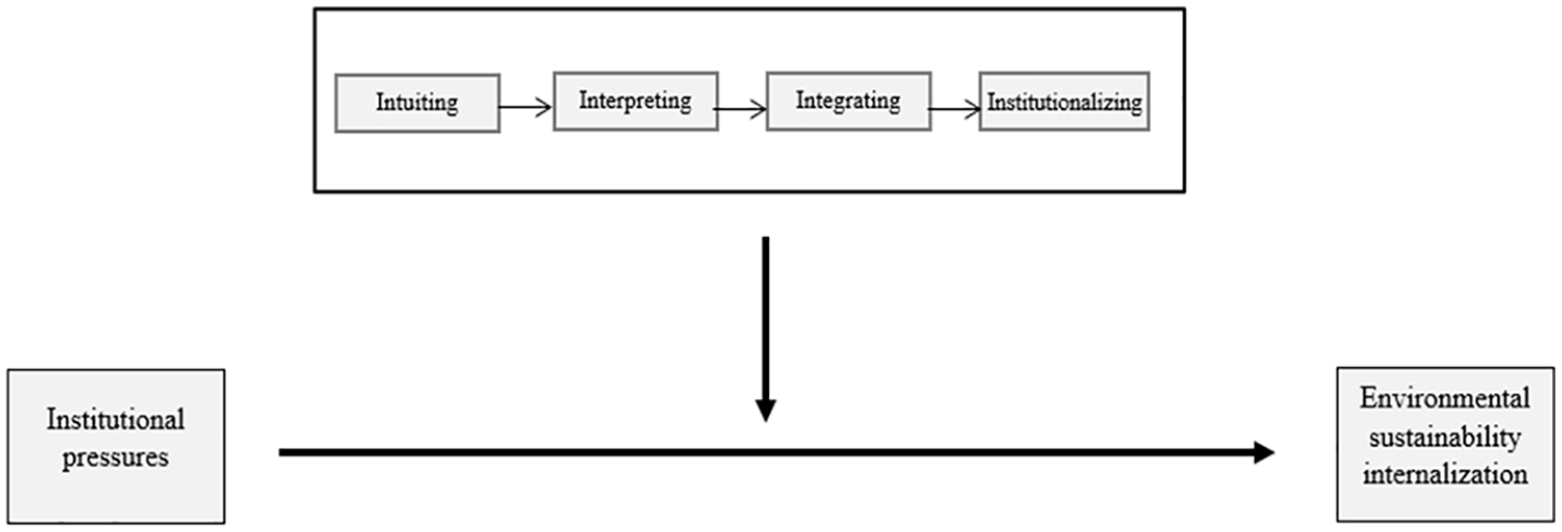
Preliminary model.
Method
To answer our research question, a multiple case study design was chosen to analyze how and why our cases have successfully implemented a new strategy based on LCM (Eisenhardt, 1989). Our study answers the call from Bansal et al. (2018) to tap into the vast array of qualitative genres, such as process studies. Adopting a process-based view resonates with the stream of research that interprets organizational learning as an ongoing process of change (Langley et al., 2013; Pettit et al., 2016). More precisely, ours is best described as a “developmental” process study, because we approach process “from outside” as we are interested in the hows and whys of a strategic change; and “after the fact” as we go back to understand how and why such changes have (been) unfold(-ing; Langley & Tsoukas, 2016).
Sampling Approach
For our multiple case study, we deemed a purposeful sampling approach appropriate for our research aims (A. Strauss & Corbin, 1998). This sampling technique involves the selection of participants, that is, individuals interviewed in the chosen organizations, whose experiences and characteristics match the goal of the study (Bradshaw et al., 2017). Given our research question, we targeted firms that applied a thorough lifecycle perspective in their practices and strategies, for example, by conducting lifecycle assessments (LCAs) on their products and consequently either changed their products, processes, or strategy. LCAs are studies based on a lifecycle perspective, which take into consideration the environmental performance of a product throughout its lifecycle.
We reviewed academic articles, nonacademic literature, European and national reports, and technical studies to identify firms that conducted LCAs. We targeted three industries; namely, agri-food (including catering services), foundry, and construction materials and furniture. The choice of these industries was derived from the combination of two criteria: (a) food, house buildings (including heating), and cars are the most impactful product groups taking into consideration their entire environmental lifecycle (Tukker et al., 2008); and (b) food, construction, machinery, and furniture are the sectors with the highest number of Environmental Product Declaration® (EPD; statistics available at www.environdec.com). The combination of these criteria suggests that firms operating in these industries are subject to extensive pressures to improve the lifecycle of their products. Then, the foundry industry was chosen because: (a) the main suppliers of automotive and machinery sectors are from the foundry industry and (b) the foundry industry is an energy intensive sector with some key characteristics from the other selected industries such as the production phase accounts for the majority of impacts and the production activities are quite homogeneous (Mitterpach et al., 2017).
Based on official databases of LCA adopters (such as the International EPD System) and web searches using a combination of keywords related to LCA methods (such as carbon footprint, PEF, ISO 14067, etc.) and selected industries, we initially identified 102 firms that had conducted at least one LCA. We used the following criteria, drawn from our literature review, as a baseline to identify “best performers” of lifecycle thinking: (a) continuity in performing LCA studies; (b) introduction of eco-design principles for products in order to reduce their environmental impacts; (c) adoption of new technologies for reducing the environmental impacts in the identified hotspots; and (d) adoption of marketing strategies based on the results of LCAs. To check this information, we collected data from organization websites, academic articles, and reports carried out by research institutions or trade associations, when available.
Based on this preliminary list, we identified six firms, or best performers, where most substantive changes were generated at operational and strategic levels based on LCM. In drawing up our list, we mainly focused on Italian firms for convenience and accessibility reasons. Organizations were contacted by email and phone calls, however two of them declined the invitation due to time constraints, giving us a preliminary sample of four firms. Following a replication strategy (R. K. Yin, 2003), the expectation was that each case could point to similar or contrasting results but for predictable reasons. To make our study more robust, we included one additional firm, as a critical case (Firm #5), to explore whether and which differences would emerge (Miles et al., 2014). Unlike the other firms, Firm #5 is a small-sized family-owned business. Our final sample was composed of four firms based in Italy and one in Norway.
As our research highlights changes in individual attitudes and group activities, we identified ex-ante five types of managers from the following units: top management, environment or corporate responsibility, the supply chain and operations, marketing, and research and development. When firms did not formally have those specific positions, we asked them to identify managers who would be most appropriate to fulfill our goals, as suggested by Bansal and Roth (2000). Overall, our final sample consisted of five firms and 19 managers (see Table 1).
Case Profiles and Interview Details.
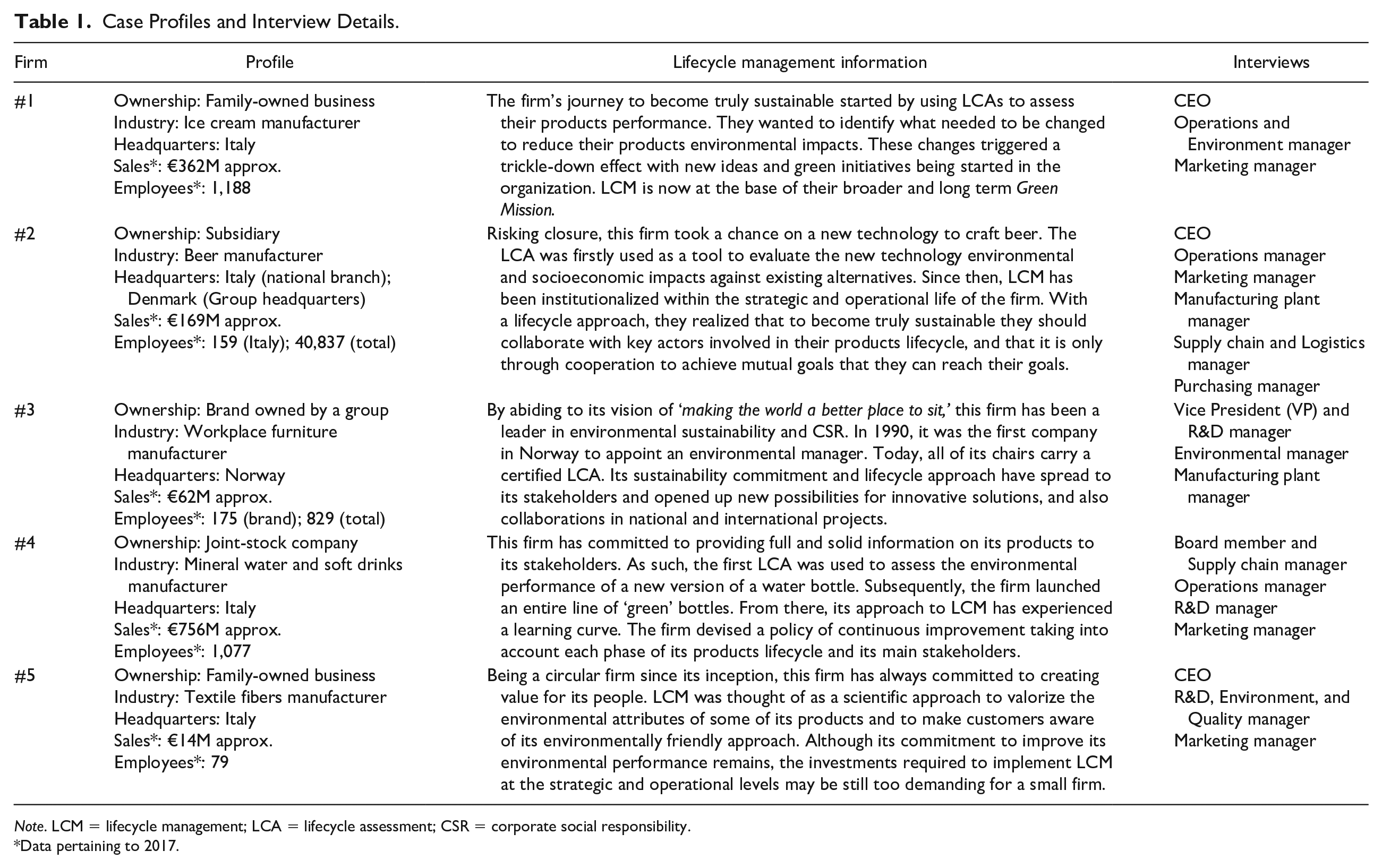
Note. LCM = lifecycle management; LCA = lifecycle assessment; CSR = corporate social responsibility.
*Data pertaining to 2017.
Data Collection
Data collection included secondary data sources, semistructured interviews, and site visits. We used different types of sources to triangulate our findings by means of cross-checks (Eisenhardt, 1989; R. K. Yin, 2003). We started by collecting information through desk research based on various sources, either directly related to the organization or indirectly related when they had to do with their industrial field or macro-economic setting. Among other things, these sources included the organization website; financial and sustainability reports; technical documents, such as EPDs, or ISO 14001 or EMAS documents; information found on the web about the company; online databases, such as Orbis; and other repositories of national or international projects to which these firms may have participated. Accessing this information prior to the interviews was necessary to devise an “identification file” for each case and ask firms for additional documents, when necessary. Overall, we consulted 2,221 pages of documents (excluding online material), producing 119 pages of identification files.
Interviews and site visits were conducted by two researchers. All interviews were held face-to-face, either in Italian or in English, from April to October 2018. Interviews were audiotape recorded and transcribed verbatim. In total, we performed nineteen interviews, ranging from 40 to 100 minutes, and obtained approximately 190 pages of transcripts. We also took extensive notes during site visits and in other informal settings, such as the cafeteria or the canteen, as participants were willing to share relevant information (Gioia et al., 2013). After this, we asked for any material mentioned in the interviews or that might be useful. We then compiled a case study report, following a predefined format, which we sent to each firm for transparency purposes (Bansal & Corley, 2011; Gioia et al., 2013). In total, the five-case study report represented 38 pages.
Data Analysis
Interview transcripts served as a primary source for our qualitative analysis process, while secondary data and relevant materials served to supplement and cross-check our findings.
First, after identifying the literature, we familiarized ourselves with previous findings, as indicated by Elliott and Timulak (2005). In our analysis, we followed the thesis advanced by Hennink et al. (2011) by adopting deductive and inductive approaches in a cyclical manner. In fact, our first coding cycle consisted of identifying deductive codes that were a priori defined based on our literature review. This approach is also referred to as provisional coding (Dey, 1993; Miles et al., 2014; Saldaña, 2009). In addition, we made note of data-driven inductive codes. In our second coding cycle, we refined our codes, which represent a combination of deductive and inductive coding that emerged from our data. We then aggregated our codes into constructs that satisfied our research question, by means of grouping and comparing information in an iterative manner (Gioia et al., 2013). The categorization of information was facilitated by the use of QSR NVivo software for qualitative data analysis. Following Slawinski and Bansal (2015), we analyzed each case independently, cross-compared our cases, and then we started to build our theory (Miles & Huberman, 1994). Two researchers involved in the analysis defined a strategy to follow. One researcher was in charge of identifying codes relevant to our analysis. Together with another researcher, they discussed and agreed on identification and definition issues.
During the first coding cycle, we identified approximately 75 codes. We then performed a second cycle of coding, looking for similarities and overlaps in the conceptualization—a process labeled as axial coding (A. Strauss & Corbin, 1998)—and reduced the number of codes to 45. This allowed us to group similar codes into concepts. Furthermore, in our analysis, while using the 4Is framework (Crossan et al., 1999) as a starting point, we inductively developed a new framework of organizational learning for ES. As a result, we grouped our codes into constructs and presented them according to the respective phase of organizational learning (see Tables 2 to 6). To prevent reliability issues, multiple researchers were involved in the coding and categorization process. In addition to the two main researchers in charge of this process, a third researcher performed a blind coding on the interview extracts. The minor changes resulting from the discussion among researchers contributed to reinforcing the coherence of our analysis and refining the definitions of our categorization. Our final constructs are shown in the tables and the codes are explained in the following Results section.
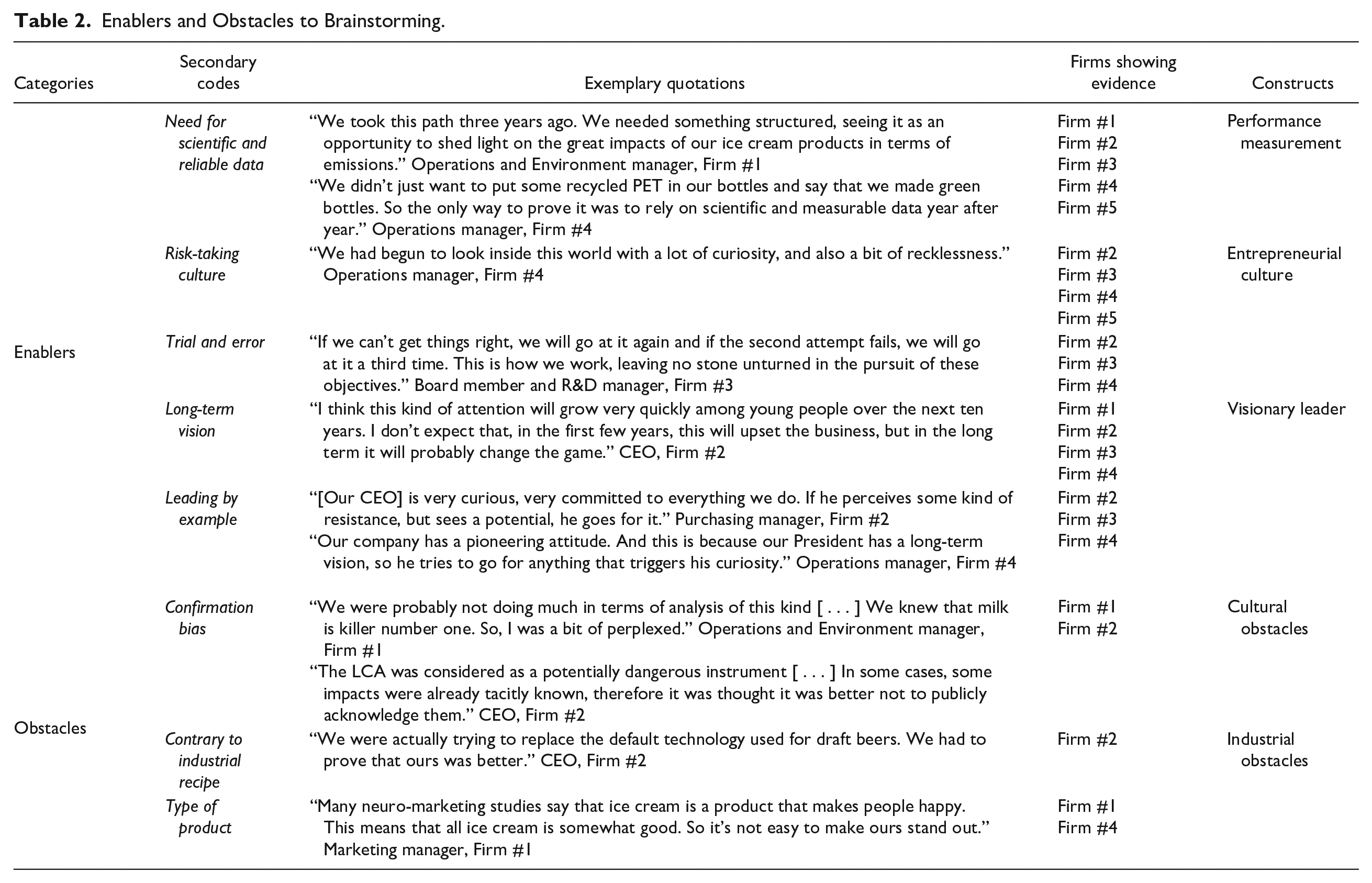
Enablers and Obstacles to Brainstorming.
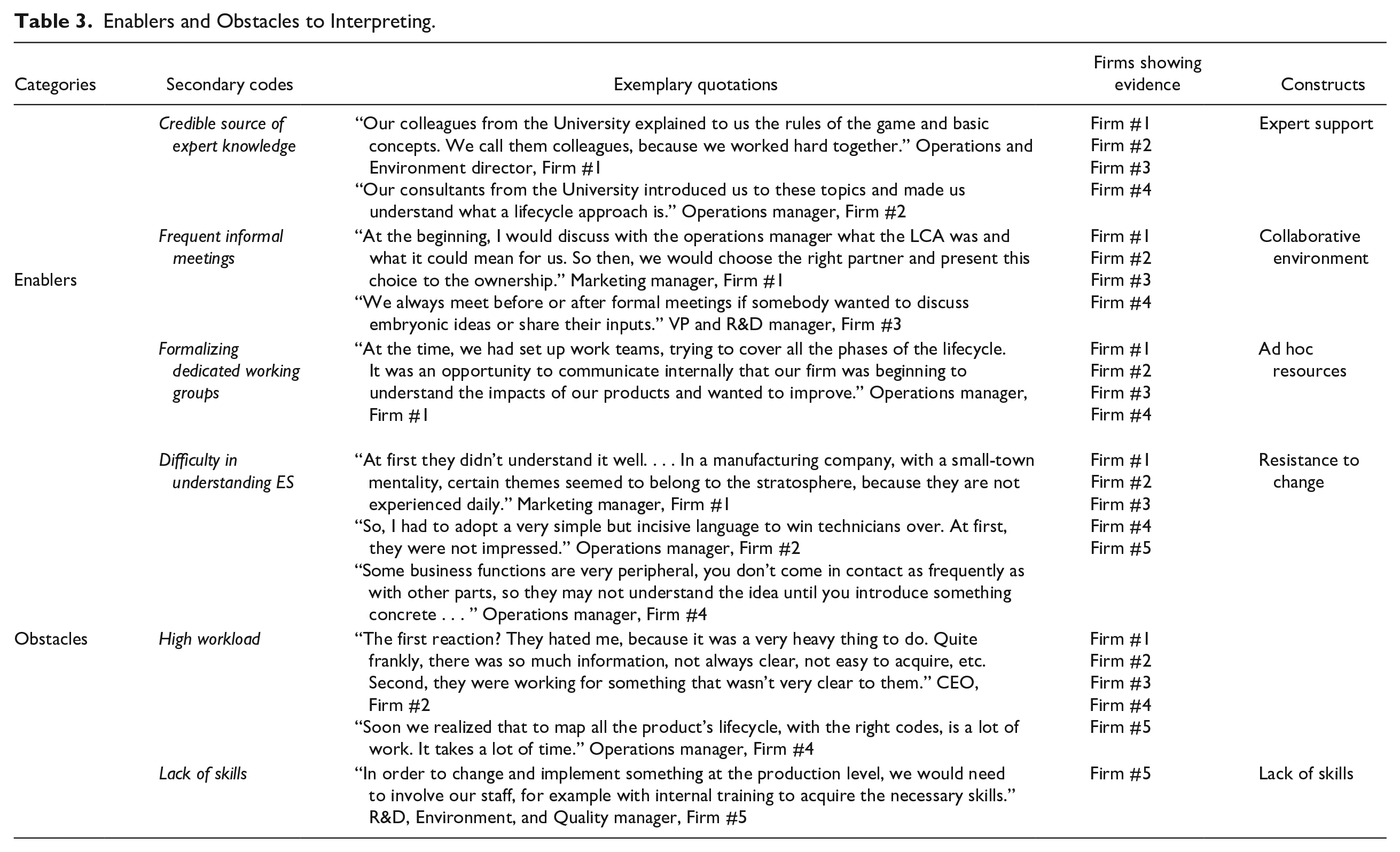
Enablers and Obstacles to Interpreting.
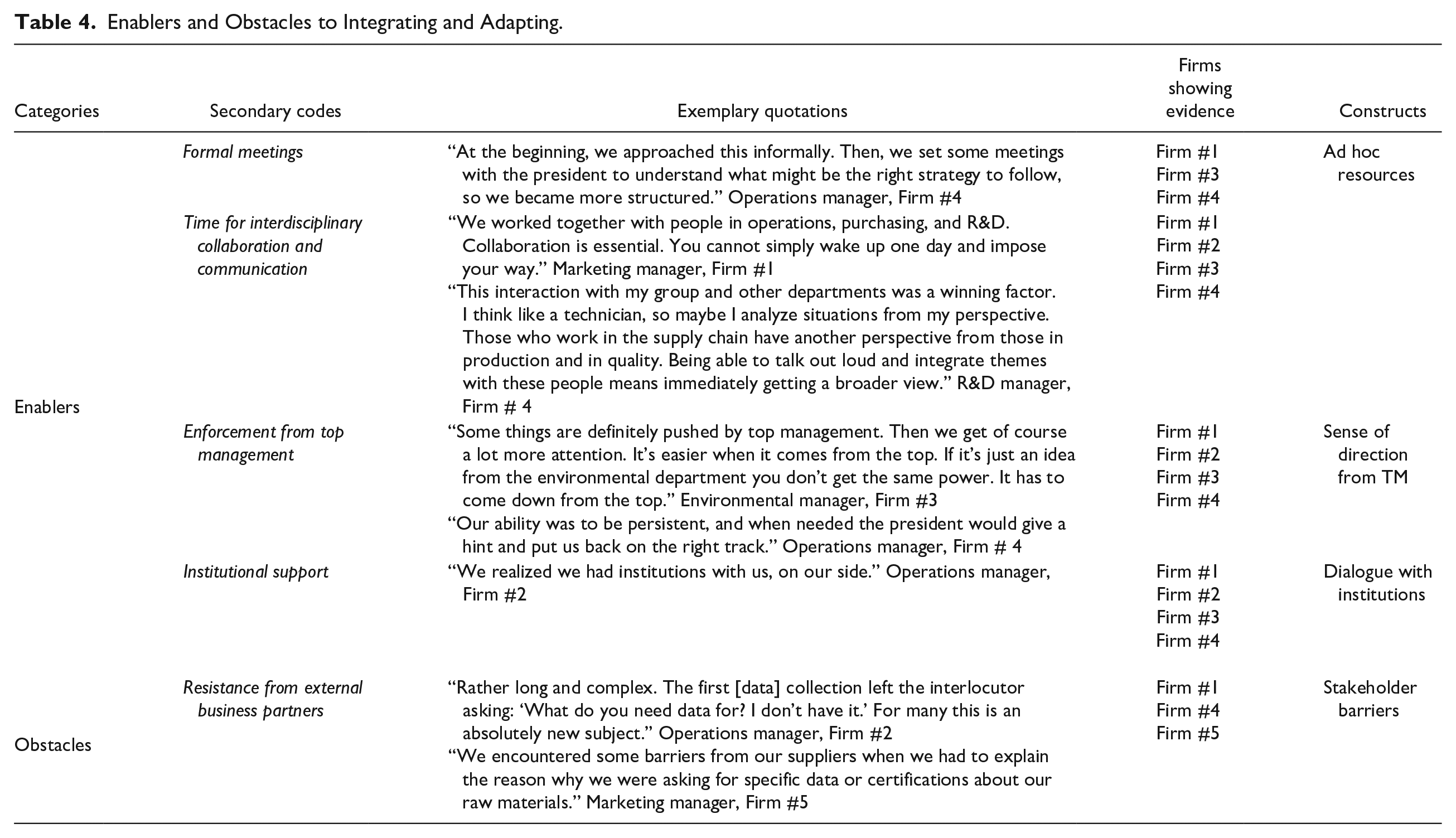
Enablers and Obstacles to Integrating and Adapting.
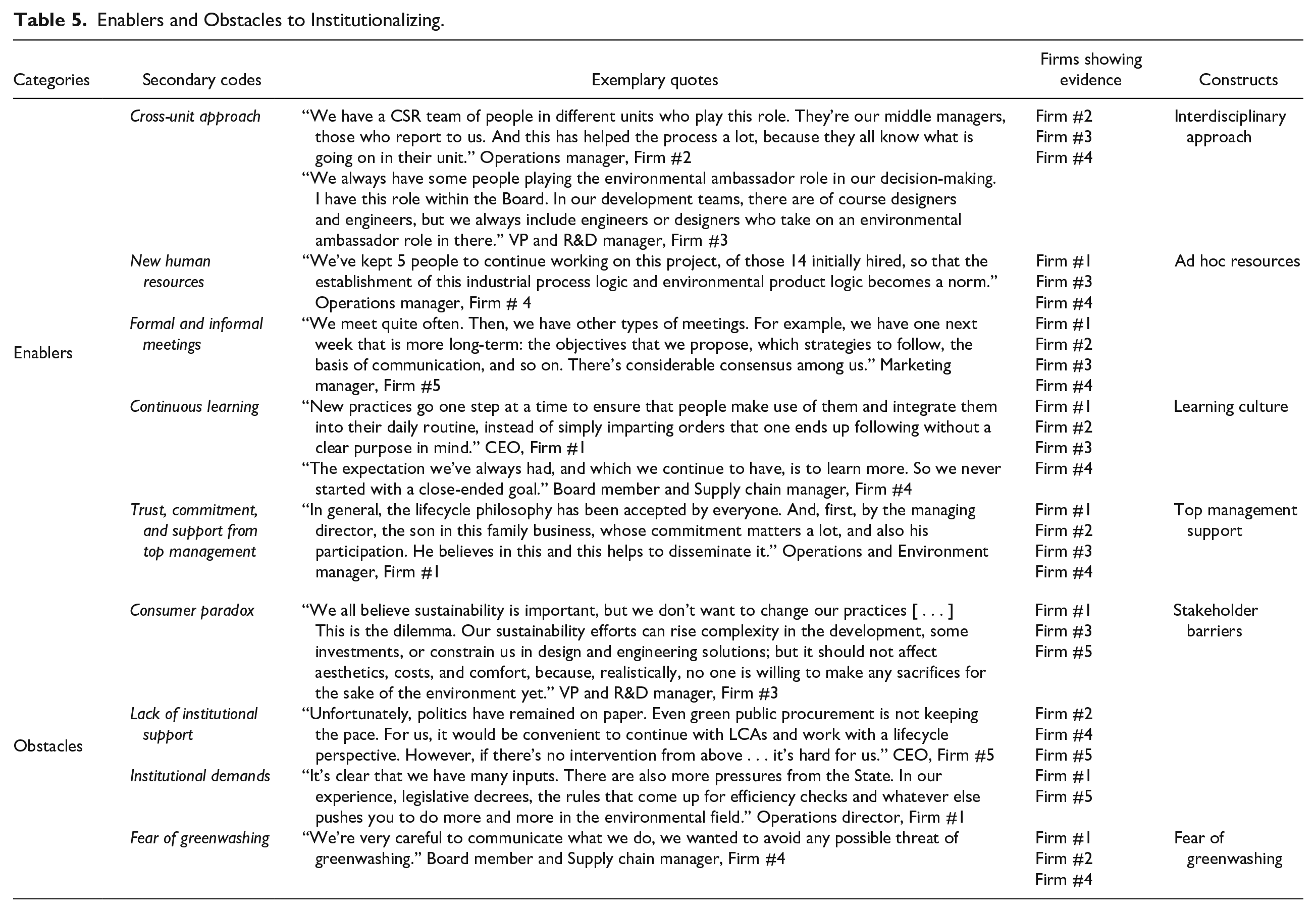
Enablers and Obstacles to Institutionalizing.
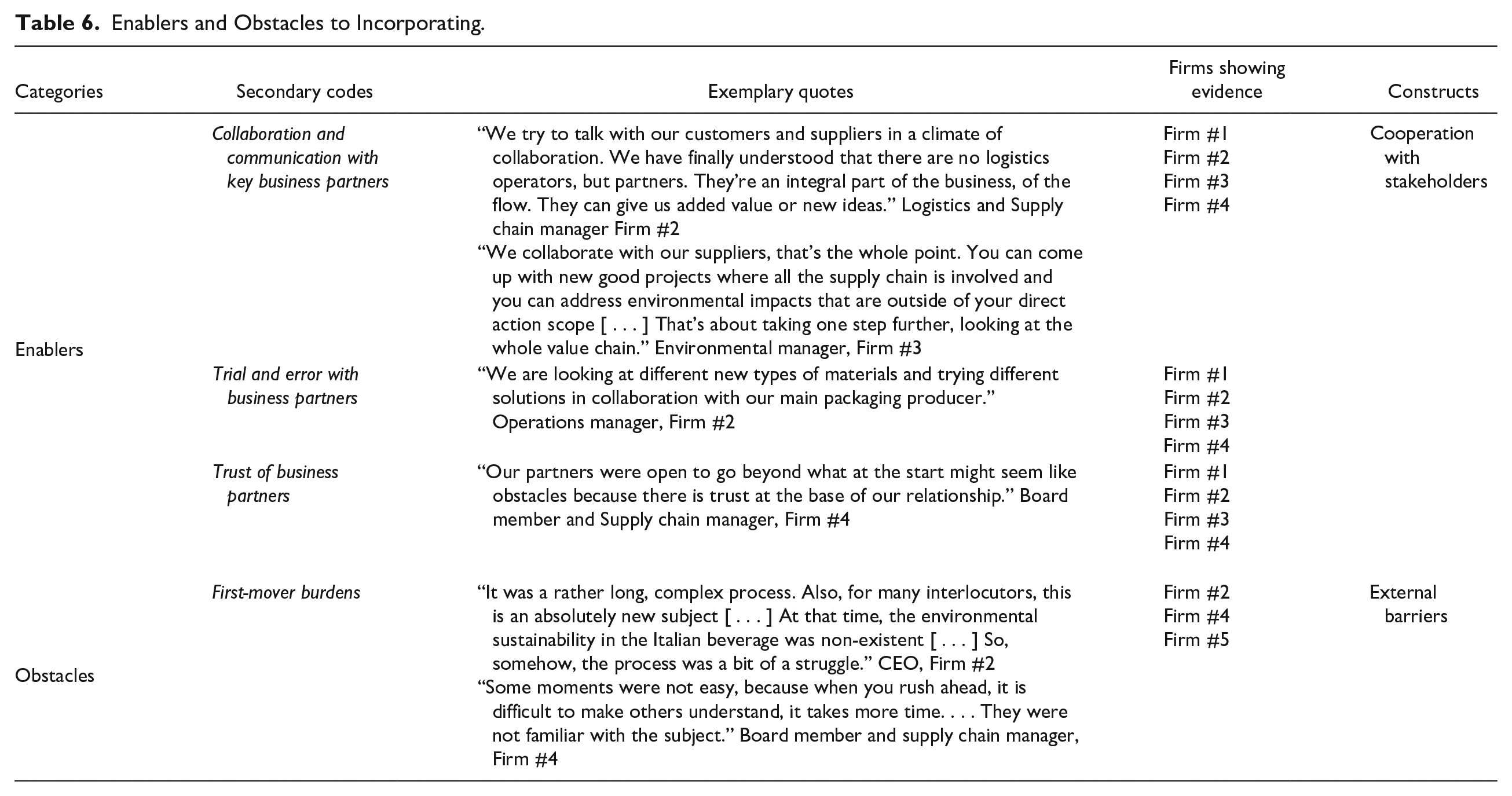
Enablers and Obstacles to Incorporating.
Results
Our data analysis suggested critical factors that characterize LCM implementation. Enablers are those factors that allow the progression of learning from one process to the next, while obstacles may prevent such progression. These factors are provided in Tables 2 to 6. In addition, from our data analysis, we found key processes that favor ES internalization within firms, both strategically and operationally. Our results are therefore presented according to how these processes took place in the firms studied.
Brainstorming
We noted that the organizational field influenced the generation and direction of ideas for strategic change. Institutional pressures paired with strategic motivations were the main drivers to firms’ environmental proactivity. In fact, the salience of institutional demands (#1, #2, #4, and #5), employee environmental commitment (#3), and the opportunity to differentiate their products as green vis-à-vis competition (all firms) led managers in leading positions to undertake decisions to address ES.
To meet demands to go beyond organizational boundaries and to address ES, managers in all firms worked in small teams with their consultants to come up with ideas that would satisfy such demands. As such, they perceived the need to assess their output environmental performance by “taking a detailed picture of what the lifecycle of our product was” (Operations manager, Firm #4). As a result, the need for scientific and reliable data on this matter was a major enabler to trigger the idea of LCM in all firms as shown in Table 2. Brainstorming for ES was especially encouraged, where a risk-taking culture was in place that would allow managers to pursue new projects even if the outcomes were uncertain. Similarly, trial and error was promoted in order to be able to experiment with new challenges (Huber, 1991). In some firms, top management was leading by example and the organizational culture was mirrored in the leaders’ endeavors, which reinforce the organizational climate of learning. Finally, all firms, except one (#5), share a long-term vision that enables managers to pursue ideas that might have potential benefits in the future, but with few immediate rewards. This firm (#5) lacked the ability and resources to invest in projects with little or no return in the short to medium term, possibly due to its size.
Obstacles that can prevent brainstorming for ES included confirmation bias, which is the tendency to look for information confirming one’s view or way of doing things (Schilling & Kluge, 2009). In light of this, LCM could have potentially undermined the current modus operandi of these firms by highlighting and disclosing environmental impacts, which perhaps were known internally but ignored externally. In relation to this, one team (#2) thought about measuring the environmental performance of its radical innovation, which is a new technology to craft beer contrary to industrial recipe (Spender, 1989). Another obstacle was the type of product (#1 and #4), that is, a homogeneous product can be difficult to differentiate from competitors and simultaneously maintain its core essence that matches their consumer criteria for selecting their products.
Interpreting
In progressing toward interpreting, LCM was operationalized by conducting LCAs aimed at understanding the environmental performance of products and to address the need for scientific data. To do this, the initial strategic team became more operational in focus by including key organizational members and shifting learning to a wider group level. This was crucial to interpreting as different organizational members had access to critical data to assess products’ environmental performance and brought their professional cognitive frames to the table. Groups could better progress with the operationalization of LCM by organizing informal meetings among managers, where members could collectively understand the new idea by discussing the opportunities and implications of LCM. Having experts as a source of information and skills was not only necessary when organizational members lacked environmental expertise, but it also proved to be a source of credible information, thus enabling organizational learning to move forward. Another critical factor was the possibility of formalizing the working group dedicated to this particular initiative by allowing time and resources devoted to interpreting LCM. This was also crucial to signal the new commitment to LCM within the organization (see Table 3).
Among the obstacles that could hinder organizational learning progressing to interpreting, all respondents reported a difficulty in understanding by employees who did not know what LCM was, why the organization would commit to an environmental initiative and what this would imply for their jobs. The prospect of an additional high workload could be another deterrent to enabling organizational learning feedforward which was mentioned by all firms in our sample. Finally, the lack of technical and expert skills was a general concern, which was especially felt in firms (#5) that did not have consultants for this operational phase.
Integrating and Adapting
In order to begin the process of integrating LCM into the organization, formal meetings involving top management were organized. These were necessary to discuss what LCM was and what it could strategically mean for these firms. Therefore, interdisciplinary coordination and communication, in which managers from different units worked together to achieve joint action by sharing different perspectives, was an essential enabler to foster integration. Joint action also helped members understand the direct link between environmental impacts and organizational choices, that is, the whys, which in turn helped the acceptance of LCM at a wider level. In this phase, organizational members perceived that as individuals they were necessary to contribute to the operationalization and strategic integration of LCM, and would thus need to adapt their daily routines for ES. This involvement was key to avoid decoupling, as members could feel that they were directly important for the new strategic endeavor. Enforcement was another important enabler exerted by top management, that ultimately decides what progresses and how, by restricting alternative options both for integrating and adapting. Enforcement is partly in line with the description of force given by Lawrence et al. (2005, p. 186). Managers also acknowledged that institutional support acted as a confirmation of taking a successful direction, thus helping LCM integrating to progress.
The major obstacle felt by respondents was resistance to change from external business partners contributing to their output, such as suppliers or distributors, for several reasons, such as feeling uncomfortable disclosing data, the assumption of having to bear a higher workload, and the lack of knowledge about why their data was needed.
Institutionalizing
Various enablers and obstacles were involved in the institutionalizing stage, that is, formalizing the new learning at an organizational level (see Table 5). A cross-unit approach was exploited to spread information and skills about LCM among organizational members. Furthermore, three firms hired new employees with technical expertise to facilitate LCM institutionalization. Both formal and informal meetings were held inside the organization. According to the respondents, informal meetings helped foster a collective learning and make sense of the new environmental logic, whereas formal meetings helped top management embed the new environmental strategic direction into the organizational discourse. Firms with a long-term mindset are also focused on continuous learning, thereby acknowledging that ES is not an end in itself, but a continuous process of change and learning to operate in a new domain. Finally, trust and commitment from top management further enabled the progression toward institutionalizing LCM inside the organization.
Conversely, the consumer paradox is an obstacle to foster the production of environmentally friendly products. This paradox refers to consumers wanting green alternatives, while not being ready to forgo any other characteristics, such as aesthetics (#3), price (#1), or technical aspects (#5). For one firm (#5), producing an intermediate product was felt to be a key impediment to institutionalizing, as it noted that it may be “useless” to produce a green intermediate product, if there is no demand for it from their clients, that is, the manufacturers of final products. As for institutional demands, one firm (#5) aims to satisfy the requests made by its main clients. Therefore, the type of requests received, especially from important clients, determines what is produced and how. Another firm (#1) also perceived legislative pressures from the State. In relation to this, this firm and a few others (#1, #2, and #4) reported fear of greenwashing as an obstacle to committing to ES and thus having their image being associated with environmental causes. Finally, the lack of institutional support can be detrimental to the institutionalization of a lengthy and costly process, for which returns are not immediate.
Incorporating
Our interviewees suggested that implementing LCM in a substantive manner was only possible through the engagement of firms’ business partners that were involved in the lifecycle of their products. Firms acted as environmental champions by explaining to their key business partners about new environmental commitment and the reasons behind LCM (Formentini & Taticchi, 2016). This gave rise to a new environmental awareness among their key business partners, which generated increased interest and new joint environmental projects (Dyer & Singh, 1998). Firms started collaborations with key business partners to come up with innovative solutions to reduce environmental impacts based on LCA studies. These changes involved either products, that is, eco-innovation (#1, #2, and #3), and/or processes, that is, eco-efficiency (#2 and #4). The development of new tools based on lifecycle calculations helped identify where most impacts were. The communicative power of LCAs, or “wow effect” (#1, #2, #3, and #4), as some interviewees referred to it was also essential to highlight the mutual strategic benefits that could accrue from such collaborations: “through the study [LCA], we could identify an advantage for customers, for our clients, and also for the environment. This advantage was not based on a sensation, but on numbers. In this value chain, all stakeholders are involved” (Operations manager, Firm #2). These conditions enabled a trial and error approach with environmental initiatives involving business partners, thus promoting a culture of open and mutual efforts for ES. Trust among these actors was essential to foster collaboration (see Table 6).
First-mover burdens describe the difficulties experienced by three firms (#2, #4, and #5) in being the first in their local setting to internalize LCM. By definition, LCM involves the collaboration of key external partners that contribute to the output. Consequently, the lack of knowledge about environmental issues and LCM requirements, such as data and skills, may be a hindrance to these firms, which may require additional time and resources to collaborate with their external partners.
Discussion
In our study, we investigated enablers (obstacles) that favor (hinder) firms to substantively address institutional demands to internalize a holistic approach to ES, in a way that ES gets gradually embedded into daily business activities, so that it is difficult to separate it from other activities (Porter & Kramer, 2011). Furthermore, as shown in our results, the presence of enablers allows learning processes to unfold from one phase to the next, until LCM is embraced at the organizational level and among business partners.
Differing from the original 4Is framework, we noted the importance of several additional subprocesses that characterize organizational learning for ES, notably team brainstorming at the start of the learning process, the fundamental and parallel roles of group integrating and individual adapting to the new idea, that is, LCM, and the process of incorporating external business partners in the operations and strategy to internalize ES. Future research in ES could test our framework in different industrial sectors.
First, we found that the presence of an entrepreneurial culture and a visionary leader greatly influenced the initial phase of team brainstorming for ES. Initially, teams were encouraged by the risk-taking culture to introduce new environmental initiatives, such as conducting an LCA, as an opportunity to advertise their products as green, and increase revenues by differentiating their products, while addressing institutional concerns with scientific data. Then, in line with the existing literature on LCM implementation (e.g., Hunkeler et al., 2003; Remmen, 2007), we found that the identification of top management with the organizational culture was key to enabling brainstorming for ES. This identification also signaled organizational values to all employees and provided direction when experimenting with new ideas. Instead, we found that cultural and industrial obstacles could pose serious threats at this stage. For example, a confirmation bias may impede team members to look for novel ideas that could disrupt their learnt behavior or current routines, which in turn could trigger decoupling behaviors.
Second, individual adaptation, which unfolded in parallel to group integrating, strongly depended on important enablers such as devoting ad hoc resources and support from top management and institutions. Dedicating ad hoc resources helped to gradually interpret and integrate environmental concepts that were collectively understood in their daily routines, subsequently developing individual environmental awareness. Furthermore, introducing new practices and structures helped integrating the (new) environmental logic within strategic and institutional logics (Dahlmann & Grosvold, 2017). In the long term, this has given rise to a new organizational culture centered around ES (Galpin et al., 2015; Van Marrewijk & Werre, 2003). Furthermore, management shared the rationale for internalizing ES, that is, the whys, instead of simply telling employees what or how to do it. By doing this, employees could better adapt to the new environmental mandate and feel part of a bigger and challenging goal. In line with the goal setting theory (Locke & Latham, 2002), failing to align individual or group goals with those of the organization can have detrimental effects on the overall performance. For this reason, constant communication among group members first, and then at the organizational level, provided a mechanism for knowledge sharing (Remmen, 2007; Siebenhüner & Arnold, 2007). In addition, sharing organizational stories is a way to store knowledge and build organizational memory (Huber, 1991; Mena & Chabowski, 2015) and what Pitsakis et al. (2012) refer to as sense-giving practices. How institutional pressures, and internal drivers and values intertwine in organizational stories to accept new organizational strategic avenues deserves more attention.
Third, the phase of interorganizational incorporating greatly depended on a strong sense of cooperation with external stakeholders. For example, sharing the reasoning behind their strategy in a cooperative manner was beneficial for the acceptance of LCM implementation by external partners. While they were initially resistant, once they understood the goal behind lifecycle practices, and the opportunity to benefit from them, for example, waste reduction and improved environmental performance, they were more motivated to participate.
Finally, maintaining an ongoing dialogue with main institutional actors throughout the internalization process was decisive to prevent decoupling. Institutional demands are not static over time (Campbell, 2007; Marano & Kostova, 2016) and by sharing internalization efforts, firms update institutions on how they are tackling their demands.
Theoretical Implications
First, our study contributes to the current debate on the micro-foundations of sustainable practices implementation by uncovering a set of organizational practices that support individual and organizational capabilities for embedding sustainability into an organization. Shedding light on how performance measurement, collaborative environment, visionary leadership, and management support enable the institutionalization of practices provides an organizational perspective which complements previous studies mainly based on psychological and individual factors (Demers & Gond, 2020; Gond et al., 2017; Xing & Starik, 2017). “Change is difficult at individual, organizational, and systemic levels, with different sources of inertia requiring different solutions” (K. Strauss et al., 2017, p. 1350). Implementing ES practices also according to a dynamic set of institutional pressures requires an internal change that needs to be supported by multiple forces. The literature on entrepreneurship stresses the role of cognitive and creative capacity of individuals (Teece, 2007), but embedding innovative solutions within an organization also needs to be sustained by an organizational process (K. Strauss et al., 2017). Previous studies emphasized the role of individual abilities, behaviors, and values (Demers & Gond, 2020; Gond et al., 2017; Xing & Starik, 2017) as well as dynamic capabilities at an organizational level (Mousavi et al., 2019). We believe that this organizational learning process will contribute to the final challenge described by Gond et al. (2017) on incorporating individual-level dynamics and learning processes. Our study emphasizes how soft and hard factors can enhance the individual and organizational learning processes of an ES logic based on a lifecycle perspective and explains the different organizational reactions to environmental issues.
Second, our study contributes to the academic debate by extending institutional theory with organizational learning theory to shed light on the micro-foundations of substantive practice implementation (Boiral, 2016; Christmann & Taylor, 2006; Testa et al., 2018b). Recently, institutional scholars started to deconstruct the top–down view of institutional perspectives by stressing the role of micro-processes based on the interactions of actors at micro-level (Gray et al., 2015; Purdy et al., 2019). Moving deeper, Huerter et al. (2020) explore the translation process of transferring practices and logics from headquarters to foreign branches. Starting from the same assumption that scholars need to explore the micro-processes to understand business responses, we focused on a further angle of analysis. In detail, sustainability scholars recognized that business responses to institutional pressures are not isomorphic but vary according to their ability to find an equilibrium between environmental and economic logics (Bowen & Aragon-Correa, 2014; Hahn et al., 2018). Even if it is undisputed that a different business approach to ES explains why organizations move from substantive to symbolic implementation of sustainable practices (Testa et al., 2018b), the underlying organizational internal dynamics are understudied. Scholars may erroneously think that a decision to adopt symbolic or substantive sustainable practices is intentional and derives from a rational process. On the contrary, our findings tend to indicate that organizational micro-processes such as organizational learning play a key role in explaining organizational reactions to external demands. In their seminal work, Delmas and Toffel (2004) had highlighted the moderating role of organization characteristics in the relationship between institutional pressures and business response. In our study, we clarified this process stressing that organizational change based on learning mechanism moderates how organizations respond to external demands while avoiding unintentional decoupling.
Third, starting from our research question and based on our findings, we inductively developed a new framework to study how organizations can substantially internalize calls for ES by updating the original 4Is framework from Crossan et al. (1999; see Figure 2). This framework jointly satisfies calls in neo-institutional theory for “the need to dig deep into the inner workings of organizations, not just the overall shell” (Greenwood et al., 2014, p. 1211) together with the acknowledgement of organizational learning scholars to “recognize that the organization operates in an open system” (Crossan et al., 1999, p. 522) and this system needs to be taken into account. For instance, in the 4Is framework (Crossan et al., 1999), intuiting is an individual exercise, whereby the individual develops ideas based on pattern recognition (expert view) or on new opportunities (entrepreneurial view). Because ES was a novel field for all firms in our sample, we found that intuiting is better described by an exercise of brainstorming where a strategic small team of managers, together with an external consultant, try to develop ideas that address institutional demands to be more environmentally sustainable. As ideas move on, more organizational members are involved with LCM and in interpreting what it could entail operationally, and progressing to a wider group level. Consequently, integrating involves collective actions to integrate LCM and understand its strategic implications inside the firm, therefore it happens at the group level. We noted that in parallel to integrating, organizational members need to make sense of new (environmental) knowledge and what it implies for them in their individual daily job. This subphase, adapting, is essential for organizational members to absorb ES as a new concept to them. Learning progresses then to institutionalizing at the organizational level, where the role of top management is to embed the new learning in structures and practices. In addition, firms that successfully institutionalized LCM in their strategy and operations now incorporate their business partners in their activities, for example, new product design or developing new logistics options. For this reason, we expanded our model to include incorporating, which is aligned with the very concept of lifecycle thinking and reinforces the notion that the substantive implementation of ES needs to go beyond organizational boundaries.
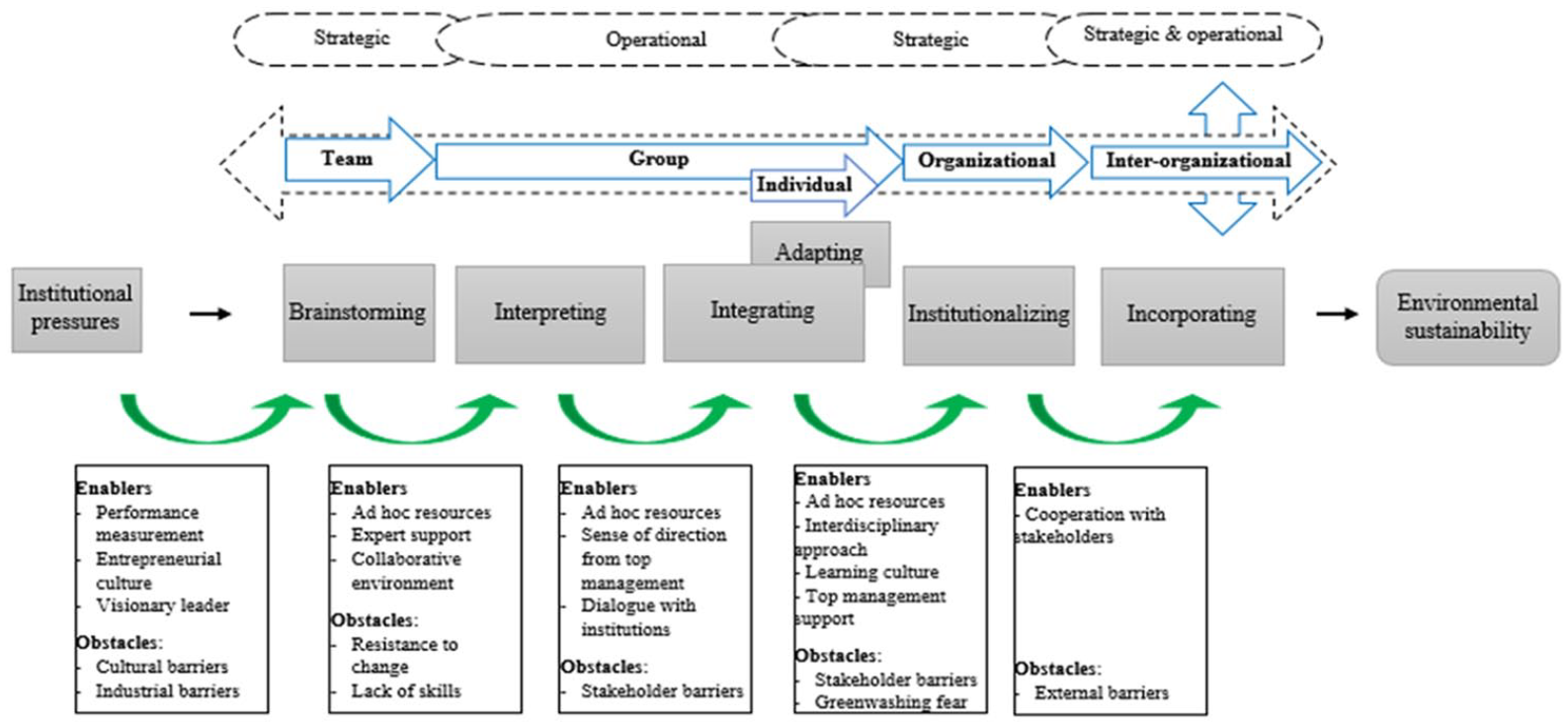
New organizational learning framework for environmental sustainability.
The organizational learning framework for ES developed in this article (see Figure 2) goes beyond the traditional and quite binary opposition between the symbolic vs substantial implementation of environmental practices that prevails in the neo-institutional approaches in this area (e.g., Boxenbaum & Jonsson, 2008; Bromley & Powell, 2012) by shedding more light on the dynamic organizational processes, enablers, obstacles and learning phases underlying the internalization of LCM practices.
Managerial Implications
Organizations that are serious about becoming more environmentally friendly should consider LCM to further internalize ES into their daily activities. As highlighted by the United Nations (United Nations Environment Programme, 2012) and in line with our findings, one of the strengths of LCM is to operationalize ES by translating this multifaceted concept into practical initiatives. This translation contributes to bridge the gap between the commitment to sustainability and corporate operations (United Nations Global Compact & Accenture Strategy, 2019). As an organization is forced to rethink its entire lifecycle, LCM reaches out to its main business partners, such as suppliers and distributors. For example, by identifying and addressing environmental hotspots along their product lifecycle, suppliers, and distributors are inevitably involved in this exercise. As a result, they will also have to become more environmentally friendly, for example, by providing cardboard packaging (supplier of Firm #1) or by switching to recycled plastics (supplier of Firm #3), in order to increase the overall environmental performance of a product.
Overall, the results of the study and the proposed model on organizational learning (see Figure 2) can help leaders to better plan and manage the change process by anticipating the steps, enablers, and barriers to the internalization of ES. Since organizational learning plays a crucial role for the internalization of a LCM logic, several practical implications emerge on how managers can enable this process. First of all, the role of top management support emerges as crucial in several phases of the 4Is model. Besides a generic support, it is important to build a visionary leadership which is able to increase employee empowerment and trigger the proactive behavior that is fundamental for making effective the transition from an I-phase to another (Testa et al., 2020). The role of employees is determinant in this process. On the one hand, LCM is beneficial for employees, who can then relate the effects of behaving more sustainably to their daily job. This helps preventing decoupling at various levels since the new environmental strategy gets embedded by employees who better understand its implications for their daily routines. On the other hand, employees do not appear as passive recipient of the new environmental strategy, but they rather gain environmental awareness through LCM internalization, and their participation and involvement allow the assimilation of sustainability concepts (#2, #4, and #5). For supporting this positive effect, managers should incentivize informal collaboration and information sharing among different units also by developing areas where informal meeting may be held. This cross-unit collaboration tends to generate a feel-good attitude and culture throughout the organization and facilitates the embeddedness of sustainability principles (Gusmerotti et al., 2020). Moreover, managers should invest in building the necessary skills among units for reducing their resistance to change and fear for uncertainty. These skills embrace both technical knowledge related to LCA (for instance for production or supply chain units) or to green marketing (for marketing and communication units) and soft skills related to entrepreneurship attitude, which reduces the defense of the status quo.
Limitations and Future Research
The limitations of this article offer avenues for future research. First, in line with our research question, we targeted firms that successfully internalized ES through LCM. Future studies could investigate organizations that tried to implement LCM but either failed to do so or only partially implemented it. In doing so, researchers should focus on drivers as well as mechanisms that prevent implementation.
Second, our multiple case study was limited to five firms that are not necessarily representative of the entire population of organizations that implement LCM initiatives. Results may be biased by the particular geographical and sectoral context of the study (Italian and Norwegian organizations operating in selected industries). Future studies could analyze LCM initiatives from larger samples of firms located in different countries and operating in different industries. Such studies could help either replicate or question our findings in relation to the internalization of LCM practices within various organizational and geographical contexts. However, the analysis of these practices requires in-depth case studies that cannot easily be conducted on large samples.
Third, the study was based on a collection of information focused on specific companies and their internal practices. Future research could use interviews with various stakeholders (including customers and suppliers) to analyze their perceptions of LCM. This would be especially beneficial to study their viewpoints on the incorporating phase and assess whether this phase is a stepping-stone for their own ES internalization. Learning processes and the role of specific actors could certainly be highlighted from a more holistic perspective.
Finally, our focus on the internalization of LCM practices in specific cases meant that we did not take into account the role of regulatory pressures in this area to be taken into account. Various countries have put in place incentives or regulations to encourage companies to better manage their environmental impacts from cradle to grave in their product’s lifecycle. For example, over the past 20 years, the European Union set up regulatory measures to promote extended producer responsibility. These measures have had a significant impact in some sectors of activity, including the automotive sector and the production of electrical and electronic equipment (Atasu & Subramanian, 2012; Huang et al., 2019). Future research could analyze in more detail how these pressures are internalized in companies and the various learning processes involved, including from companies that are not necessarily ahead of the curve in LCM.
Footnotes
Declaration of Conflicting Interests
The author(s) declared no potential conflicts of interest with respect to the research, authorship, and/or publication of this article.
Funding
The author(s) disclosed receipt of the following financial support for the research, authorship, and/or publication of this article: This study was supported by the European Union's LIFE 2014-2020 Programme and was part of the ongoing project LIFE EFFIGE, under Grant Agreement nr. LIFE16 ENV/IT/000172.
