



Abstract
The institutional frameworks that Indigenous groups put in place to govern economic processes within their communities are critical to the advancement of their diverse cultural-ecological, social, and economic development goals. Through the lens of institutional logics, this article examines the ways in which First Nations community sawmill enterprises in British Columbia, Canada, navigate the sectoral demands brought by a productivist paradigm of forestry. We find that First Nations community sawmill enterprises represent spaces of both logical tension and innovation where conflicts that arise between dominant “commercial” logics and culturally legitimate “Indigenous” logics can be reconciled. Through this analysis, this article offers an empirical example of the emergence of Indigenous institutional frameworks, as well as a contribution to the growing body of literature that addresses the ways in which hybrid organizations can and do navigate and overcome conflicting institutional logics.
Keywords
Introduction
Settler-colonialism and the pressures of extractivist models of resource development have resulted in conflicting institutional logics within First Nations communities in British Columbia, Canada. Such tensions are particularly salient within First Nations–led forestry enterprises that have been created to generate value for communities. These enterprises face regulatory, cultural, and normative influences at the local level that are often in conflict with provincial, national, and global rules, values, and practices. This is particularly the case as forestry enterprises become increasingly homogenized within an industrial, productivist paradigm (Pache & Santos, 2010).
Influences at the local level are particularly attuned to culturally legitimate forms of governance over extractive and productive processes (Nikolakis et al., 2019). Yet many such examples, which are often characterized as social enterprises or “hybrid” economic models within First Nations communities (Anderson et al., 2005), are typically forced to justify their activities in reference to financial viability or market standards only (see, Curry et al., 2016; Sengupta et al., 2015; Wallace, 1999). The result is that many First Nations organizations and enterprises must continually respond to multiple institutional demands, often resulting in operational, organizational, and motivational uncertainty. At the same time, First Nations enterprises have access to a broad array of institutional possibilities from which they can draw, making them important focal points for understanding and enacting the institutional innovations that First Nations communities and hybrid organizations require.
In this article, we utilize the lens of institutional logics to explore how hybrid strategies unfold within the context of small-scale First Nations community sawmill enterprises in British Columbia (hereby referred to as FNCSEs). By institutional logics we mean the practices, beliefs, assumptions, and values that are derivative of the regulatory, social, and cultural contexts in which individuals and organizations exist (Doherty et al., 2014; Thornton & Ocasio, 2008). We ask: What do FNCSEs reveal as concerns how Indigenous social enterprises can and do manage conflicting missions, demands, and modes of operation? This is particularly pertinent given that the demand for economic alternatives to the status quo is high within Indigenous territories in Canada and globally. In the sections that follow we provide an exploratory, qualitative empirical analysis of FNCSEs in British Columbia, utilizing semistructured interviews as the primary source of information. We begin with an overview of the literature related to institutional logics and social enterprises, followed by a description of the BC First Nations context, particularly, as concerns forestry and socioeconomic well-being. Through our methods, findings, and conclusions we demonstrate that although FNCSEs face logical tensions as hybrid organizations, they represent Indigenous institutional frameworks in action, where logics are reconciled and innovative strategies and organizational configurations unfold.
Institutional Logics and First Nations Social Enterprises
Organizational scholars seeking to understand how multiple institutional demands influence organizations often draw on the concept of institutional logics (Besharov & Smith, 2014; Reay & Hinings, 2009). Institutional logics are cognitive constructs which shape behavior by providing frames of reference and evaluation for actors and organizations (Herrera, 2016), and by providing guidance as to what constitutes legitimate goals and legitimate means to achieve those goals (Haveman & Gualtieri, 2017; Pache & Santos, 2010, 2013). In addition to the geographic, historical, and cultural contexts in which organizations operate, institutional logics are shaped by the dependencies of organizations on external institutional referents (Besharov & Smith, 2014). These often dominant external institutional logics that come to bear upon First Nations organizations in particular, are the product of higher order forces representing a mix of interests, identities, and assumptions (Thornton & Ocasio, 2008). They often represent the values and beliefs of powerful actors (Reay & Hinings, 2009), and systemic forms of power and practices that are routine and ongoing and which are often taken for granted. These tend to be commercially oriented and embedded in broader market logics that are structured around the goal of “selling products and services on the market to produce an economic surplus that can ultimately be legitimately appropriated by owners” (Pache & Santos, 2013, p. 980).
Powerful logics of this kind are also characterized as a form of governmentality which recruit First Nations leaders and members alike into contributing to processes and activities that enable the free flow of the capitalist market economy (Blackburn, 2005; Foucault, 1991). These dominant institutional logics presume operational and organizational measures that are thought to create the conditions for economic success. For example, by increasing efficiency and productivity, and by reducing investment uncertainty (North, 2005; Ritchie, 2016), economic surpluses are created which can then be redistributed or “trickled-down” throughout communities and economies (Rosser, 2005). This claim lies at the heart of neoliberal and other institutional prescriptions for Indigenous approaches to economic development, an approach that has taken hold in many First Nations communities, and which tends to limit experimentation with alternative and more direct pathways toward well-being (Graham & Healy, 2008; Kuokkanen, 2011). At issue however is not only that such approaches have largely failed to ameliorate socioeconomic conditions within First Nations communities (Palmater, 2011), but that they also tend to neglect important dimensions of economic life that are particularly important to Indigenous peoples including social relationships, cultural and spiritual values, and place-based priorities (Breslow et al., 2016; Prout, 2012; Satterfield et al., 2013). Embedded in these dimensions are what might best be described as Indigenous logics, which unlike commercial logics are structured around outcomes related to social, cultural, and ecological well-being.
Thus, there is an identified need for the emergence of new Indigenous institutional frameworks that allow Indigenous logics to surface and tame dominant commercial logics, thereby affecting the strategic decision making of First Nations enterprises (Nikolakis & Nelson, 2015; Reay & Hinings, 2009; Wyatt, 2008a). One of the ways in which this is occurring within the First Nations context is through the creation of social enterprises. Social enterprises, or social purpose enterprises, have emerged as the predominant organizational form that crosses between the private, public, and nonprofit sectors, often acting as a link between government and free market enterprise in order to facilitate social goals (Doherty et al., 2014; Wallace, 1999). They have risen in popularity as a type of “middle path” vehicle to address problems of poverty, social marginalization, and environmental degradation, given the inability of government and traditional businesses to do so (Dacin et al., 2011). Unlike profit-oriented businesses, social enterprises are considered to be more concerned with ethical questions about needs and surplus uses (Cameron, 2008), rendering them a seemingly suitable vehicle for the interests of many First Nations who are seeking to find ways to improve their material well-being without losing fundamental principles at the core of their worldview (Hernandez, 2013).
First Nations social enterprises therefore appear to offer space for the emergence of Indigenous institutional frameworks that operate at the intersection of what are often conflicting logics, that is, commercial logics (enacted primarily through business principles) and Indigenous logics (manifest dominantly as community principles). Yet the paucity of studies in relation to First Nations social enterprises raises questions about whether such institutional configurations have been able to reinforce Indigenous logics, or simply emulate commercial ones. Sengupta et al. (2015) contend that the distinguishing feature between Indigenous social enterprises and non-Indigenous ones is the role of culture, and there is often an assumption that because Indigenous businesses are for the most part band (collectively)-owned, rather than individually owned, they will operate for the benefit of the community. For example, Anderson et al. (2006) argue that Indigenous entrepreneurship is inherently “social” because it includes economic self-sufficiency, protecting land ownership and use, strengthening economic circumstances, and revitalizing traditional culture. Dana (2015) also provides examples from around the world which demonstrates that Indigenous entrepreneurship tends to include noneconomic variables such as environmental sustainability and the strengthening of kinship ties.
The challenge that such formations face due to their often dual mission and hybrid nature is the potential for “mission drift,” particularly, as the social objectives of a social enterprise (and the logics driving them) are sacrificed to achieve financial viability (Doherty et al., 2014; Graham & Healy, 2008). Economic value in the form of financial resources is considered critical to the sustainability of social enterprises and to the achievement of socially oriented missions (Cunha & Benneworth, 2014; Dacin et al., 2011). Indeed, Young (2012) reminds us that the stability of social enterprises is based on their ability to survive in the long run while also maintaining a balance between social value and market success. This does not necessarily mean that commercial logics and associated attributes such as profit making, workforce productivity, and efficiency must be prioritized, but rather that some return is considered necessary in order to allow other social goals to be realized (Peredo & Chrisman, 2006).
The literature points toward multiple ways in which social enterprises are able to balance and reconcile seemingly conflicting logics. This includes finding the right balance of utilizing commercial revenue to advance social value creation, and by using the social mission as a force for strategic direction, including using the social mission as a source of legitimacy in order to secure financial support to make the enterprise more financially viable (Doherty et al., 2014). Hotte et al. (2018), working within the First Nations context, also highlight different formal communication and reporting mechanisms utilized to maintain accountability between First Nations economic development corporations (EDCs) and their community constituents. Smith and Besharov (2019) similarly point toward the utilization of “guardrails” to ensure that social and business missions never drift too far in one direction. Other ways in which organizations have been able to manage conflicting institutional logics include simply suppressing or compromising lesser priority logics, by loosely or selectively coupling organizational units that practice alternative logics (e.g., First Nations bands and EDCs), by incorporating a majority of elements from a dominant logic that is different from the founding one in order to gain legitimacy (e.g., by decoupling economic efficiency and the social mission), and by forging a completely new identity for an organization such that it embraces both logics in a novel way (Hasenfeld & Gidron, 2012; Kraatz & Block, 2008; Pache & Santos, 2013). In what follows, we demonstrate how First Nations in British Columbia are engaging such strategies in diverse and nuanced ways to achieve their missions. In doing so, we offer a novel empirical contribution to institutional and organizational theory that builds upon our understanding of how institutional adaptation and innovation can and does unfold within the everyday activities of First Nations communities and social enterprises at large.
Context
This article explores institutional logics with a number of First Nations primarily within the context of what is now referred to as the Province of British Columbia (BC), Canada. Within BC there are roughly 60 First Nations, which include the 198 bands that Indigenous and Northern Affairs Canada (2010) lists as the unit of record. Many First Nations groups and people (including the aforementioned 60) also or otherwise identify with national and hereditary governance structures which are not necessarily recognized by the Canadian state. First Nations people in BC and Canada continue to have shorter life expectancy, higher incarceration rates, lower educational attainment, and lower average annual incomes than other Canadians (Cooke et al., 2004; Diochon, 2013; Perreault, 2009; Turpel-Lafond, 2020). The contributing factors to this situation are rooted in historical and contemporary colonial struggles that leave First Nations communities at a huge disadvantage in spite of various strategies to ameliorate the situation. One such strategy that continues to guide economic development efforts in BC is to increase First Nations participation in natural resource development, and in particular forestry, within their territories.
Efforts to increase First Nations involvement in forestry-related economic development have yet to result in broad participation. Where involvement has occurred, some question the extent to which it has actually contributed to the economic and social well-being of communities (Beaudoin, 2012). Today, First Nations that enter into economic relationships with forest companies in an attempt to limit and recover economic losses are often forced to accept existing forest management systems and the constrained institutional logics of commercial efficiency which drive them (Wyatt, 2008b). Reconciling the social, cultural, and ecological values of First Nations with commercial forestry operations has proved elusive, particularly, because the multifaceted demands of such value systems produce challenges for First Nations forestry operations that go well beyond the profitability and efficiency of commercial operations (Booth, 1998; Booth & Skelton, 2011; Krcmar et al., 2005). For example, current allowable annual cut (AAC) levels for the most part are discordant with traditional First Nations enterprises which instead often seek to balance conservation and social wealth by limiting extraction (Booth & Skelton, 2011). This has led some to call for a redesigning of the tenure system and associated “cut it or lose it” rules related to AAC allocations. This would ensure that First Nations are able to benefit economically from forests while not being beholden to a high-volume, short-term-profit-driven industrial model (Passelac-Ross & Smith, 2002).
Compounding this problem is the continued reliance of the forestry industry on manufacturing commodity products using a capital-intensive, high-volume, low-cost production strategy that is deemed necessary to remain competitive in global markets. The consequence of such firm strategies is that British Columbia produces fewer jobs per unit of wood than other industrial forest economies (Hayter, 2000; Markey et al., 2005). Although alternative forestry business models do exist, the predominant commodity-export model itself requires high harvest levels to sustain the levels of available logs (known as throughput) to gain economies of scale. One consequence has been a tendency for large forest companies to build “super” mills that require less people to operate and tremendous amounts of throughput to keep operable. Invariably, long-term sustainability of these plants is jeopardized due to shortages of fiber, with the average lifespan of an industrial plant for wood being less than 8 years (Baldwin, 2005).
An overall decline and consolidation in industrial forestry over the last 30 years has followed, with the number of large and medium size sawmills in BC declining by 47% between 1990 and 2015, including 27 sawmills on the BC Coast closing since 2005 (Williams, 2018). As large mills continue to shut down as a result of policy changes, lower harvest levels and rationalized production, there exist new opportunities for First Nations in British Columbia to not only participate in but also transform the way forestry is carried out within their territories. One way in which many First Nations have sought to achieve this is through the creation of forestry-based social enterprises. FNCSEs in particular have proliferated of late as a seemingly practical and intuitive economic strategy for First Nations seeking to extract multiple values from local forests (Wyatt et al., 2013), while creating more jobs per cubic meters of logs (Grace et al., 2018; Hayter, 2000). The smaller mills so associated are also pursued for a combination of social, cultural, ecological, and economic goals, offering opportunities to directly connect forestry-related activities with community needs and well-being (Bull et al., 2014).
Method
The ideas and materials discussed in this article are based on findings from 18 semistructured interviews with experts and leaders involved in FNCSEs primarily in British Columbia. This work was conducted as a part of a collaborative research partnership between the lead author, Ecotrust Canada (a not-for-profit organization), and Yunesit’in First Nation in the central interior of British Columbia. In maintaining and strengthening this ongoing relationship the authors of this article strive to make this work relevant, reciprocal, respectful, and responsible (Peltier, 2018). In doing so, this work also recognizes the continuous struggle of Indigenous peoples broadly, and seeks to advance alternative ways of knowing and being through an Indigenous, postcolonial research paradigm (Chilisa, 2011).
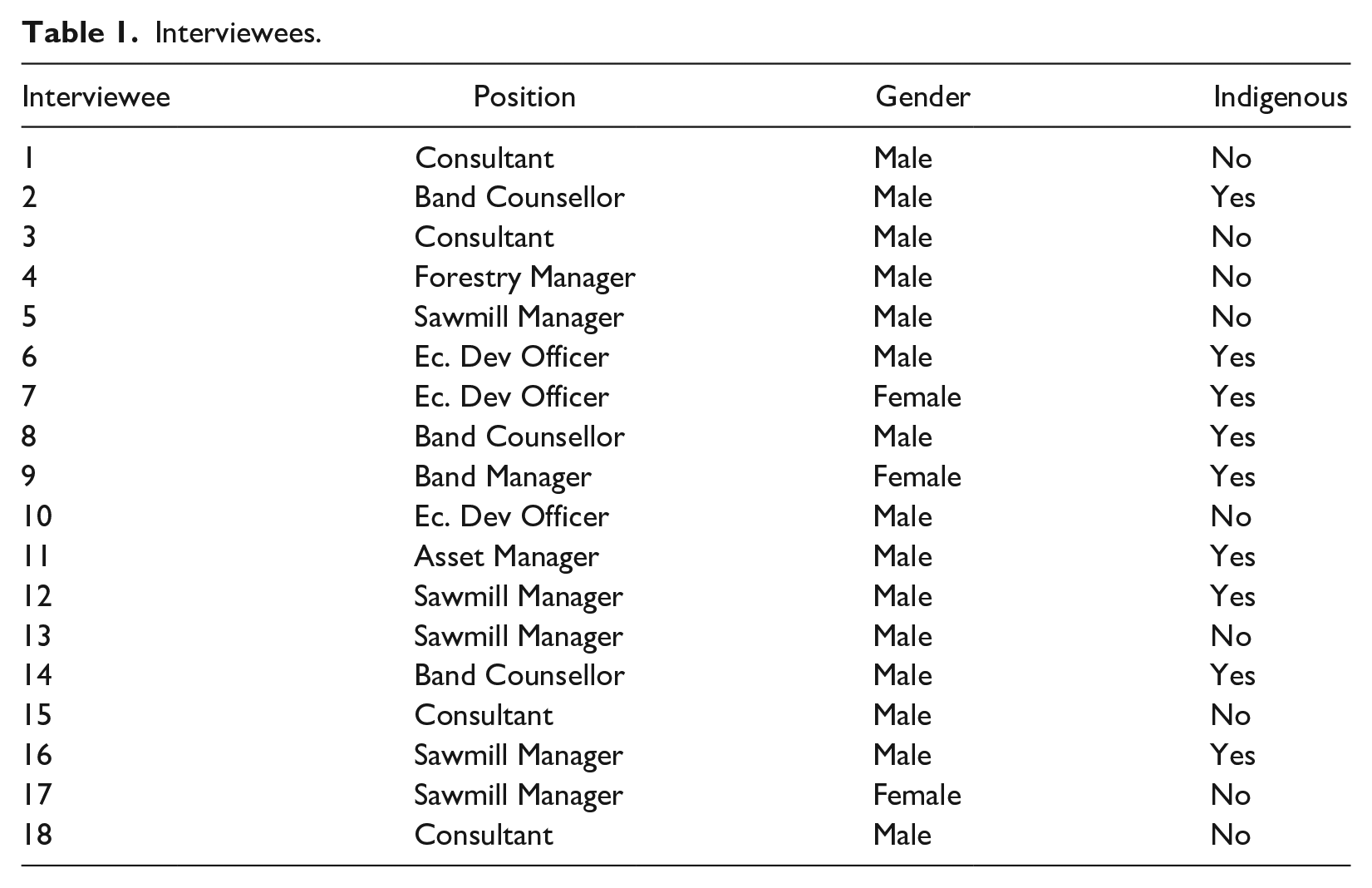
Interviews include those conducted with sawmill managers, First Nations staff, and sawmill and forestry professionals and consultants, nine of which identified as Indigenous people (see Table 1). Twelve of the interviewees were associated with particular and distinct FNCSEs, while the other six spoke toward their experiences supporting numerous different First Nations sawmills in BC.
Interviewees.
Given that many FNCSEs operate informally, are discontinued, or otherwise are not part of the public record, there does not exist any official inventory or list of enterprises within this category. Roughly speaking, but not fully verified, the aforementioned 60 BC First Nations including 198 bands, have operated small sawmills at some point over the last century. 1 Generally accepted criteria for small forestry operations (including sawmills) are operations with fewer than 100 employees and consuming no more than 20,000 m³ of timber annually (Nelson et al., 2016). Some examples of what are considered “small” sawmill operations in Canada range in log consumption of between 700 and 14,000 m³ per year and employing four to five full-time staff (Houdek & Baumeister, 2007). Most of the community sawmills researched as a part of this study fell within a similar range, with one exception of a mill which employed 20 people.
Purposive and opportunistic sampling (Bradshaw & Stratford, 2010) was used to identify interviewees within the first author’s network of existing community partners and practitioners. This included FNCSEs and First Nations with whom the first author had preexisting relationships, and those identified through a comprehensive review of communities and specialist knowledge holders represented in both the academic and gray literature on Indigenous forestry and the value-added forestry sector in British Columbia and Canada. A web-based search for news stories or other announcements related to FNCSEs was also used to identify potential interviewees. Together these sources provided an initial list of 29 forestry and sawmill experts. Particular focus was paid to any First Nations leaders or experts with experience in FNCSEs able to participate, and primary contact was made via e-mail requesting their participation in the study.
The interview schedule employed here was a modified qualitative expert elicitation design, suitable for revealing a diversity of views including the professional and personal opinions of community sawmill experts and leaders (Nikolakis & Nelson, 2015). The goal of the study was to develop an understanding of best practices, objectives, and the characteristics and perceptions of success and/or failure with regard to those objectives. The interviews queried the main motivations for starting sawmill enterprises, operational and organizational practices and structures, supply chain dynamics including material sourcing and product destinations, and factors and definitions of success. They were conducted sequentially over a period of 3 months, and were predominantly completed by phone due to the COVID-19 pandemic, with only three face-to-face interviews conducted before lockdown began. Interviews were recorded with consent, with two relying on extensive note taking only.
Analysis
As non-Indigenous researchers working with First Nations communities, we have relied on our experience, deep knowledge of the context, and ongoing relationships in order to confidently interpret the meanings of the stories and ideas shared with us (Kuokkanen, 2019). Also contributing to this research as a source for triangulation were our many conversations and informal meetings outside of the formal interview process—a well-accepted method within Indigenous research (Sylvester et al., 2020). We recognize however the inherent limitation and the potential shortcomings in our ability to appropriately represent the voices that we heard. We thus continued to seek validation of the findings of this study through ongoing engagement with First Nations community partners, including through the implementation of projects relevant to the findings of this article. We have also benefitted throughout this process by engaging with several of our interviewees with whom we maintain professional relationships, in order to verify and validate the codes that we have surfaced. Additionally we have sought feedback from several of our colleagues on the emergent themes to increase confidence in the reliability and validity of our interpretations (Smith, 2014).
Analysis was carried out in overlapping phases throughout the interviewing period, primarily as a means of eliminating redundant or irrelevant lines of inquiry and to improve subsequent interviews. Once complete, all of the interviews were transcribed before undergoing a manual open coding process which involved an initial review of the transcripts in order to become refamiliarized with each discussion, followed by a second analysis of the transcripts in order to begin to identify recurring themes for the building of a codebook (Basit, 2003; Rubin & Rubin, 2020). This involved reading through the raw data to identify critical passages and phrases which we clustered into meaningful groups and labelled as first-order concepts (Smith, 2014). We then carried out a subsequent axial coding process which involved rereading the transcripts and utilizing a triangulation of sources in order to develop and organize first-order concepts into second-order themes. These we classified as “logics,” which we define as the practices, beliefs, assumptions, and values driving actors’ and enterprise’s missions, demands, and modes of operation (Doherty et al., 2014; Herrera, 2016; Thornton & Ocasio, 2008). Once these first-order concepts and second-order themes were established, a third analysis/review of the transcripts was undertaken to ensure that nothing was missed in the coding and analysis process. Following Gioia et al. (2013), we then organized the first-order concepts and second-order themes into aggregate dimensions or “spaces of logical tension and innovation.” These we categorized for analytical purposes as “operational” (the activities and processes established to satisfy multiple institutional demands), “organizational” (the governance structures established to satisfy multiple institutional demands), and “motivational” (the multiple implicit and explicit rationales, goals, and purposes driving FNCSEs; Figure 1).
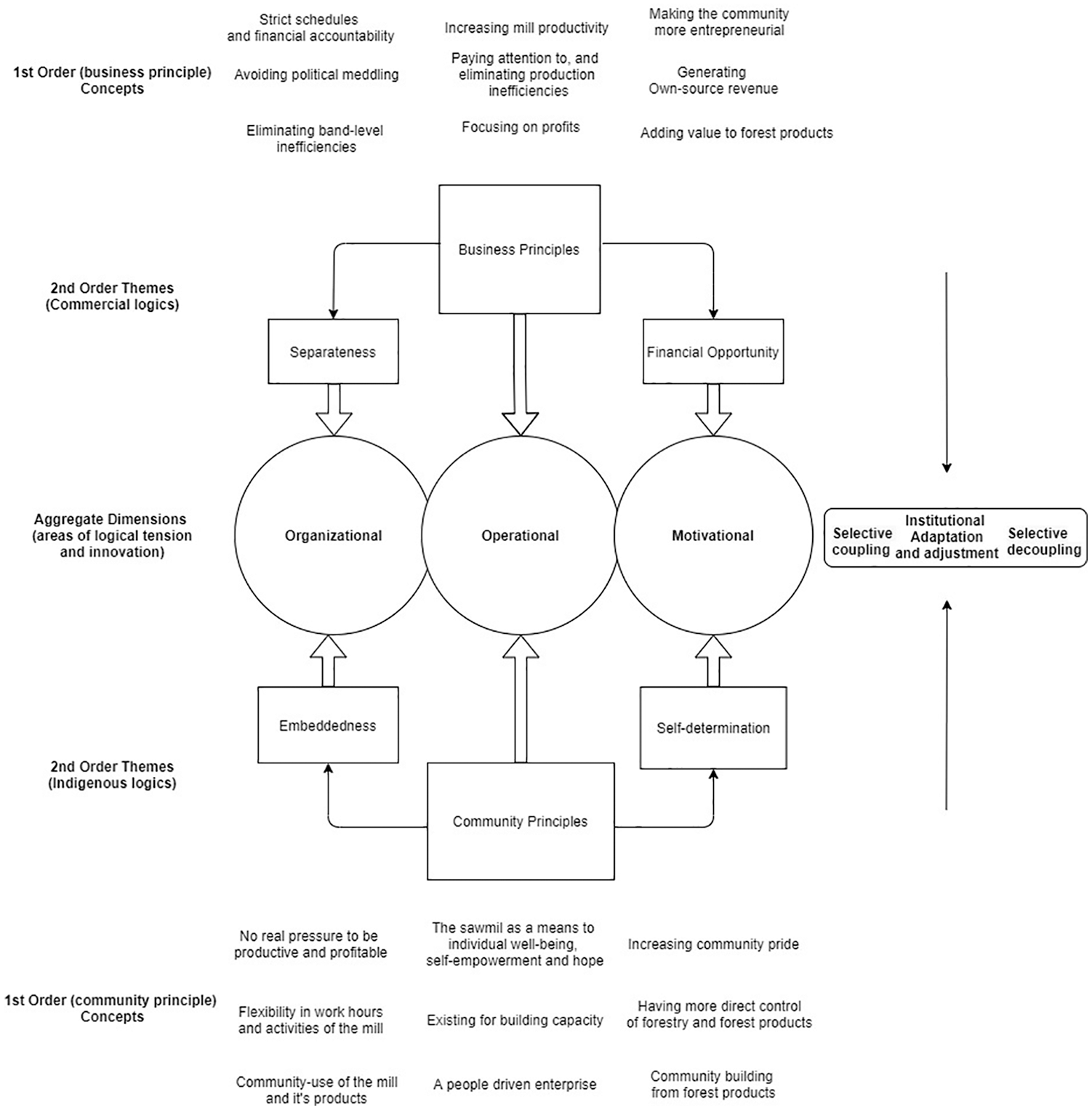
Areas of logical tension and innovation.
After fully categorizing concepts, themes and dimensions, we then cross-referenced our findings with the literature on managing conflicting institutional logics within hybrid organizations. We demonstrate how, within and across these areas of logical tension, innovation can and does occur through processes of selective decoupling, selective coupling, and institutional adaptation and adjustment.
Findings
In this section, we explore the ways which institutional logics reveal themselves within the operational, organizational, and motivational dimensions of FNCSEs. Within the central operational area, we demonstrate what were the most obvious logical tensions between “business principles” and “community principles” that affect the ways in which FNCSEs approach their operations, and how these also combine to lead to institutional innovations. We then present the organizational area, which is predominantly influenced by logics of “embeddedness” that are prevalent within First Nations communities and which compete with, and potentially complement, logics of political and financial “separateness.” Finally, within the motivational area, we show how logics of “self-determination” and “financial opportunity” both contribute in valuable ways to hybrid enterprise success. Importantly, though we draw distinctions between these aggregate dimensions, we recognize this also as a limitation of our exploratory analysis. On the ground within the everyday activities of FNCSEs, operational, organizational, and motivational dimensions overlap with one another often in dynamic and disorganized ways, and the logics which feed them can also often be cross-cutting. Nevertheless, we believe that the logical relationships that we have presented here—dominated by the primary challenge of business versus community principles—demonstrate many of the critical institutional challenges facing FNCSEs, and the innovations achieved to overcome them.
Reconciling Institutional Logics in the Operational Area
The operational area refers to the activities and processes established by FNCSEs in order to satisfy multiple institutional demands. It is well understood today that the historical trauma and cultural dislocation associated with the settler-colonial project continues to perpetuate mental and physical ill health within First Nations communities (Alfred, 2009). It is not surprising then that the operational strategies of enterprises focus on results related to community principles (Indigenous logics), often over and above results derived from business principles (commercial logics). As one interviewee explained: Well, I mean economic development is the goal, but I mean, it’s to get them active and working and giving them hope is the biggest reason because without hope when you think about the suicide rate on these reserves that’s obviously lacking right, hope. (Interviewee 16)
FNCSEs appear to offer not just jobs for First Nations individuals but also a way to fulfill other aspects of well-being that are relative to individual needs: So then I had to go back to the individual, what type of values what type of goals and so at one point, especially with this one woman, the only woman in the business, and she was in the office with me and we’d sit down, like what are the goals that you want? And so it’s really like, how am I working with each person to get to really support them as people and kind of shifting the business around that? Instead of going in with this idea of like, this is how a sawmill business operates. Now it’s like we’re going to make this very people driven. We want these people involved, how do we keep them involved and interested. (Interviewee 17)
Here the interviewee refers to the idea of how a business is supposed to operate, and then to behavior which contradicts this presupposition. This is indicative of the “decoupling” of institutional logics (A.-C. Pache & Santos, 2013), wherein there exists a symbolic endorsement of practices prescribed by one institutional logic (i.e., eliminating inefficiencies) while implementing other practices more closely aligned with the operational realities and needs of FNCSEs (individual capacity building and well-being). The challenge is that as FNCSEs appear to shift their operational focus toward community principles, they often appear to sacrifice business principles and therefore financial viability: For the understood mandate of developing capacity, creating employment, and locally moving up the value chain in the industry the mill was a success on that front. There should have been greater attention paid to the mill inefficiencies however. From a business perspective then, it didn’t necessarily succeed. (Interviewee 11)
Business principles, strictly speaking, understand production as the process of efficiently through-putting materials toward a tangible output or commodity to be sold for profit. Through such logics, labor is treated as an inanimate and impersonal factor of production in the pursuit of profits, where the enterprise does not give value to work itself, but only to the output of work and the associated wage (Ross & Usher, 1986). This logic was apparent in the response of another interviewee who understood productivity as critical to the financial viability of the enterprise: It’s just gotten to where there’s no you know, the productivity is the last thing that means anything right? So like if it’s me I’ve got a real concern if I was expected to manage it. . . . Now can I turn that productivity around? Because, to my estimation, the productivity levels that are mentioned in this mill are nowhere near the productivity levels that I’ve talked to different people that have owned the same mill. (Interviewee 4)
Indeed, challenges in productivity mean that for the most part, FNCSEs appear to provide little in terms of own-source revenue for First Nations, and many interviewees with whom we spoke struggled to even see how most FNCSEs can break-even financially. For some mills still operating today, there appears to be a greater flexibility to adapt, adjust, or even compromise (Kraatz & Block, 2008); understanding that strict adherence to business principle logics that have been set within a productivist development paradigm is simply unrealistic: I mean, you have people coming in, you know, saying, well, you guys could be producing so much and you could be making so much money but realistically, until you have the proper industrial size sawmill, I mean, it’s not going to happen. Yeah. So I mean, I think I’d be happy that you’re able to provide employment for a few people and you know, maybe even make a little bit on it would be nice, but it doesn’t happen . . . ” (Interviewee 9)
Although profits often seem to be elusive for most FNCSEs, it appears that through a process of selective coupling, enterprises are able to focus on the social mission as the driving operational force. This occurs while still maintaining critical business operational principles, and so enterprises stand to succeed in one way or another. In order for this to work, it requires that FNCSES “broaden our scope of measurement and subsidize it, for lack of another word, but recognize that it’s not profitable within the paradigms of what, you know, a profit driven business is in Canada” (Interviewee 1). In other words, FNCSEs may in fact be able to successfully integrate community principles into their operations by using the social mission as a force for strategic direction which then allows for the securing of alternative sources of financial support (Doherty et al., 2014). We found that financial shortcomings of socially oriented FNCSEs were often being compensated by way of subsidization in various forms including from government grants, in-kind support, and also in the form of timber from community forestry operations or other forestry operators in the territory. Yet obtaining such subsidies often requires not only a driving social strategy to increase social mission legitimacy in the eyes of external funders but also a healthy reconciliation of these logics with business principles. As Newth and Woods (2014) remind us, regardless of whether social enterprises pursue revenues from market or nonmarket sources, either way there must be a strong value proposition to extract those funds. In this sense, selective coupling of business principles with community principles within the operational area can likely contribute to the viability of even the most socially driven FNCSEs who seek out subsidies as a strategy.
Reconciling Institutional Logics in the Organizational Area
Also evident throughout the interviews were organizational tensions and innovations surfacing around logics of separateness and embeddedness. The organizational area refers to the structures established and developed within FNCSEs in order to satisfy multiple institutional demands. FNCSEs are predominantly band-owned businesses or First Nations economic development corporation (EDC)–owned, though the distinction is not often clear-cut and there does tend to exist a blurriness between the two. The organizational tensions surrounding FNCSEs can primarily be attributed to this blurriness and to dominant institutional prescriptions (also business principles) which emphasize the depoliticization (structural separation) of community and economic processes in First Nation communities as a contingent factor for economic success (Eggertsson, 2013; Grant & Taylor, 2007; Hotte et al., 2018; Trosper et al., 2008). The influence of such prescriptions on First Nations is demonstrated as follows: Most of the time its band owned. Occasionally it’s been an entrepreneur, but vast majority are band or economic development corporation owned. I think it’s probably better if it was entrepreneur owned. I think it has much more likelihood of succeeding. Part of the challenges I’ve had and we still have is politics. And when its band owned or economic corporation owned, even though the economic corporations are supposed to be arm’s length from politics, none of them are arm’s length from politics. . . . So that’s one of the big frustrations with all of this is the level of politics.” (Interviewee 18)
Political separation is often expressed as critical to the success of FNCSEs. Such logic assumes that disruptions caused by political meddling creates inefficiencies which impact productivity and therefore financial viability. These assumptions emerged throughout several of the interviews and appears to have become widespread across First Nations communities and forestry-based enterprises in British Columbia. One interviewee for example explained, Yeah. I mean, I wouldn’t recommend any sort of enterprise go directly through the band. It’s my observation that those are inefficient and get mixed up with politics and just don’t work well, but maybe I’m limited to my understanding. (Interviewee 15)
Another interviewee explained with regard to the powers of redistribution over the products of the mill: It was losing money but the band offices are running it and I couldn’t believe them because we’re cutting a lot of wood and they donated all that cedar siding for the high school. So we went way in the hole there which was their fault, not the sawmill’s fault. Which I don’t think was right. But they wanted to put I guess their part into the new school and that was using the sawmill. Yeah so the money never went back into the, you know the sawmill’s bank. (Interviewee 12)
In this instance, the band resorted to a logic of embeddedness by ensuring support of a community development project, and in doing so obstructed what would otherwise be a separate and socially disinterested market mechanism. From the perspective of contributions to community well-being however, there is the possibility that such trade-offs, despite the costs, produce net positive benefits in social value by having the local high school built with siding from local forest products manufactured on a local mill, by local people.
Logics of embeddedness that emerged appeared to view full political separation as potentially inimical to the type of organizational structures considered culturally legitimate within First Nations communities (Cornell, 2019; Nikolakis & Nelson, 2015). For example, in the case of FNCSEs, there often appear to be social benefits attached to more embedded forms of ownership (i.e., band-ownership) as opposed to separated economic development corporations: I guess there’s no real pressure. If there’s nothing to do, to not be able to run that sort of thing. . . . There’s always multiple things that can be done. If they’re not milling, they could be doing something else. They could be building the timber frame or whatever. . . . This here, you know, maybe we only want to work five hours a day and stuff like that. Makes it a lot easier. There’s no big pressure, you know, if there’s a funeral and stuff like that and shuts down when the community shuts down. (Interviewee 14)
Indeed, from the perspective of community and individual well-being, there is evidence that the socially embedded nature of band-owned FNCSEs, characterized by a certain social capital and relationality as a result of close-knit networks and families, are not necessarily inimical to success, but potentially socially and materially valuable. For example, one interviewee spoke to the flexibility that being a band-owned sawmill offered to the community in terms of both local materials and jobs: You know, we had talked about possibly switching out the mill, like taking it right out of the band and putting it into our corporation and have them run it. But then it kind of takes away the uses that a lot of people are, you know, I mean, they’re just used to being able to go up there with a box and get a box of kindling and stuff like that, and we hand it over to a corporation, that’s all going to change. . . . And if you’re handing it over to be a profitable business, they’re going to want somebody that you know shows up for work at 730 in the morning and goes home at 430. (Interviewee 9)
Here the embeddedness logics of band ownership contributes to social value creation. And, even if the benefits that accrue from such a culturally legitimate structure appear to be in tension with financial viability, it is within this organizational space of tension and reconciliation that selective coupling and institutional adjustment can potentially lead to innovation and ultimately enterprise success.
Reconciling Institutional Logics in the Motivational Area
The motivational area refers to the multiple rationales, goals, and purposes driving FNCSEs. Over the last two decades, First Nations communities in British Columbia have become increasingly involved in acquiring woodlot licenses, community forests, and other primary forestry activities such as small Forest Licenses to Cut (FLTCs). Increased direct involvement in primary forestry operations coupled with the establishment of FNCSEs appears to be driven by motivational logics related to both financial opportunity and self-determination. One interview explained the reasoning as follows: The reason we had entered into the idea was because we also have a community forest woodlot so we had the opportunity to, you know, cut our own trees down. And we felt that if those trees were brought into the community that we would be able to, you know, mill them up and use that lumber for community projects within the village. There’s a need for it. (Interviewee 9)
Here we see another form of selective coupling, where motivations relate to increasing value along the entire timber supply chain and producing outputs that can be used locally while creating social value. Similarly, one interviewee spoke about increasing local control over forest products, shifting away from inequitable relations with the forest industry, and therefore, becoming more self-determining and entrepreneurial: Sounds cliché but it was an entity that we owned rather than working for someone else rather than selling all of our resources and just being grateful and beholden to the Canfors or Galloways of the world who were, yeah, buying our resources and seeing that they were making more from them than we were by making a finished product. So that piece, and it’s laid a foundation within the community, it seems to me to want to be more self-determining and more entrepreneurial. (Interviewee 6)
The model of resource development referred to by this interviewee is one that has become common place within First Nation territories, where communities take a “low-risk approach” of selling their harvest quota by the stump to large forestry companies thereby obtaining secure own-source revenues (Nikolakis & Nelson, 2015). In doing so, communities become “beholden” to these enterprises—a classic example of the now famous “staples trap” of rural development (Watkins, 1963). Through simple financial metrics and the goal of short-run benefits, it is very difficult for First Nations to turn away from this model. This creates a dilemma for First Nations who face the opportunity costs of immediate revenues at the expense of the social or value-added benefits that come from utilizing their own fiber through FNCSEs.
Another interviewee expressed frustration with this model, while also indicating an opportunity for FNCSEs: At least one First Nation that I know of finally wrote up an agreement, where they were allowed to have access to 10% of the annual cut that these guys were doing for them. Now, this is the First Nation’s fiber supply, but they were only allowed to have access to 10% of it. There’s something wrong with that. Yeah, there’s something really wrong with that. And that model is all over British Columbia. . . . Now, the reality is First Nations could not cut all of the logs that are coming out, but they need to have better agreements that they can take out what they want and what they need to sustain their own operations in their own communities. First Nations need to have the ability to lock down agreements and fiber agreements and lock it down and build into it flexibility for them to do what they want to do not be dictated to by government or industry. (Interviewee 18)
Hence, there appears to be a strategic advantage in the establishment of FNCSEs as they enable a rationalization of the “right” to utilize fiber for community building. In fact, for First Nations who were not involved in primary forestry operations, the establishment of FNCSEs often served as a valuable tool for engagement with industry and asserting rights over timber within their territory: And so then from there, we negotiated, I think the value of what they were going to contribute was around $40,000. And it was going to be more like their staff time to do this writing. And I said, No, like, let’s change this. And so we got $40,000 worth of log supply instead. . . . We decided, hey, like it’s your land. You should ask for the best logs you should get the best logs. (Interviewee 17)
Indeed, the value of FNCSEs for several of the interviewees was that it offered an appropriate avenue for involvement in forestry-related activities within their territories, either directly or indirectly, thereby diminishing the opportunity costs of log exports.
Community buildings produced from forest products also appeared to be an important motivational factor connected to a logic of self-determination, one seemingly in tension with a logic of financial opportunity. Housing is now recognized as one of the most pressing needs facing First Nations communities, with current estimates of housing shortages being anywhere between 35,000 to 85,000 units across Canada (Senate of Canada, 2015). For more than a century First Nations housing and building processes have been controlled by the Federal government of Canada, largely to the detriment of housing quality and quantity and the socioeconomic and mental health that adequate homes provide (Monk, 2013; Olsen, 2016). This entrenched system also typically relies on the importing of low-cost housing goods and construction services into First Nations communities. For most FNCSEs (with the exception of very remote ones) it is typically difficult to compete from a production perspective with large commodity mills producing dimensional lumber for housing at a very low cost. Despite this, local product manufacturing and utilization for housing was identified as a high priority if not a primary motivation for FNCSEs by several interviewees. As such, the local use of forest products in community projects was not always a financial decision related to cost savings but rather considered a strategy for satisfying less tangible community goals: It’s not for earning profit. But it’s got a lot of value. It’s got a lot of social kind of benefits, I guess to say. I mean, yeah, we built four new duplexes in the community this year. And I guess it makes [name omitted] proud that all of the Cedar work that was done on the houses, the post and beams and facia boards and everything was milled in our community. So it gives us that more social morale I guess you could say. Pride in our homes. (Interviewee 2)
Manufacturing for local construction processes are seen to contribute to pride and social morale. Through a logic of self-determination, FNCSEs that contribute to local construction processes utilizing locally milled products as opposed to cheaper imported industrial products appear to be worth any financial sacrifices that may occur. For remote communities however, eliminating the costs and dependencies of importing housing materials can offer financial benefits as well as independence and cultural-institutional self-determination via increased control over the local economy: We decided to do the sawmill. We ordered one from Williams Lake in BC. We also had another sawmill sitting here and slowly we’re going to get into everything all the other parts and mill the wood out. But we did see that having our own supply and rather than ordering all the boards and everything from out of basically a thousand kilometers away or more. . . . You’re wasting all that money on freight. So we decided we needed to start cutting that off. When we started going down the road and we’re looking at the climate change our winter roads are starting to shorten out. So we’re having a feeling if we have a supply and we get everything from around our community then we’ll be more independent.” (Interviewee 8)
Even where communities must compete with commodity mills, the selective coupling of ideas, values, and practices incorporating both logics of self-determination and financial opportunity within the motivational area can allow for innovation and the reconciliation of logics. Manufacturing certain niche products related to exterior construction applications such as siding, sheds, decking, and beams, for example, can be a good social enterprise strategy within the context of value-added forestry production. Several interviewees identified this as a strategy of FNCSEs, where attention was paid to the advantages that those enterprises have over larger and more automatized operations. Potentially, they provide customized, niche products for local and regional markets, while maintaining the social value and self-determination that comes with supply chain control and local use.
Discussion and Conclusion
Our findings demonstrate how FNCSEs in British Columbia are often the site of institutional diversity, tension, and innovation. Within FNCSEs, seemingly conflicting institutional logics appear to both collide and combine within and across operational, organizational, and motivational areas. What emerges are locally nuanced and novel examples of Indigenous social enterprises attempting to satisfy multiple institutional pressures—with varying levels and perceptions of success. We found that simply suppressing one order of logics (business principles), in order to satisfy another order of logics (community principles), does not appear to be an appropriate or necessary strategy for First Nations. Rather, our findings point toward the ability of FNCSEs to enact innovative operational strategies and novel organizational configurations driven by the reconciliation of otherwise conflicting institutional logics. It is within these areas of tension and innovation that we can begin to conceptualize the emergence of an Indigenous institutional framework.
Within the operational area, we found that FNCSEs often decoupled their practices from previously established business principles in order to focus on the social mission. In doing so FNCSEs strategically highlight and advance the social mission as a means to obtain alternative financial support (or subsidization) in order to remain viable. Within the organizational area, there also appears to be a strong tension between logics of embeddedness and logics of separateness. What we found is that although logics of embeddedness can be considered detrimental to organizational (and operational) viability, with the right balance it can serve as a critical backstop against mission drift and ensure that social goals are meaningfully pursued. In this sense, FNCSEs appear to challenge conventional assumptions about the drifting nature of social enterprises toward financial viability imperatives (Doherty et al., 2014; Graham & Healy, 2008). Instead, FNCSEs often are able to maintain if not strengthen logics related to community principles, including by enacting accountability measures to ensure that socially embedded organizations remain financially viable businesses. Finally, within the motivational area, we found that although logics of self-determination and financial opportunity often exist in tension with one another, for the most part FNCSEs are able to reconcile them through selective coupling to advance practical strategies for success.
FNCSEs appear to have become one of the primary vehicles by which First Nation communities in British Columbia, Canada have sought to advance social, cultural-ecological, and economic goals in tandem. Although in this article we have attempted to be generative by highlighting the strategies that “tensely”’ coexist and the innovation that follows, we also believe that our analysis serves to challenge ideas about the complete economic colonization of First Nations–led enterprises and communities. Indeed, many of the logics which emerged in our study appeared to have been drawn from not one settler-colonial or capitalist institutional framework but also from a more socially appropriate and culturally legitimate Indigenous institutional framework. It is fair to question whether First Nations social enterprises will ever be able to “succeed” so long as they exist within a dominant commercial and productivist paradigm which imposes certain goals, values, and metrics of success. Yet this study has demonstrated that the logical tensions facing FNCSEs are not necessarily “paradoxical” in nature, and that opportunities for reconciliation do exist.
Although FNCSEs appear to offer an important example of how conflicting institutional logics can be reconciled within Indigenous forestry-based social enterprises, further research is required to understand how the interaction of conflicting logics manifests in other complex organizational and natural resource extraction settings. Certainly it is at this interface of logics where the most pressing and complex institutional and economic challenges within postcolonial contexts emerge. It is also then perhaps, the space where meaningful success in settler-colonial and Indigenous reconciliation can be achieved if only in small, tangible pieces. By bringing to light further examples of Indigenous institutional frameworks we can only hope that these will serve as templates for much needed strategies and institutional innovations which appropriately advance the economic futures of First Nations in British Columbia, and Indigenous peoples broadly.
Footnotes
Declaration of Conflicting Interests
The authors declared no potential conflicts of interest with respect to the research, authorship, and/or publication of this article.
Funding
The authors received no financial support for the research, authorship, and/or publication of this article.
