




Abstract
Risk communication is important for a sustainable management of natural resources. Even though risk management is ideally ongoing, studies of long-term risk communication from the perspective of the communicator are lacking. This case study examined the preparation and implementation of forest risk communication in Sweden. Interviews were conducted with advisors at the Swedish Forest Agency, responsible for providing information to forest owners and professional foresters dealing with risks damaging the forest (e.g., storms and forest management damaging ecological values). The communicator’s perspective was analyzed based on a conceptual framework describing risk communication by means of the components: within-communicator, relational, and content. Potential drivers of the preparation and implementation of risk communication in this context, intersecting the three components, included the policy and regulatory framework, the management of the agency, the location of the agency, and the balancing of different interests.
Keywords
Introduction
Forest is an important natural resource valued for environmental reasons such as biodiversity, for recreation and restoration, and also for generating revenues for forest owners and the national economy (e.g., Food and Agriculture Organization of the United Nations, 2010). Because different natural hazards, such as storm and climate change, and also forest management practices, may damage the forest, they can be considered potential forest risks (cf. Eriksson, 2014). A sustainable forest risk management thus requires the consideration of a multitude of values. In several countries, where the forest is an important natural resource, such as the United States, Finland, and Sweden, many individual private forest owners are furthermore involved in the management of forest risks (Finnish Ministry of Agriculture and Forestry, 2011; Swedish Forest Agency [SFA], 2014d; U.S. Department of Agriculture, Northern Research Station, 2008). Since risk communication (RC) can help prepare people for different hazards by increasing awareness, providing knowledge and motivating action, and also by building trust in the communicator and reaching agreement (Höppner, Whittle, Bründl, & Buchecker, 2012; Rowan, 1991), it is an important tool for governing agencies managing natural resources (Tavares & Santos, 2014; Walker, Tweed, & Whittle, 2014).
The management of risks involves both dealing with the immediate crises after a hazardous event and also long-term proactive risk management to avoid or minimize future damage. RC is thus often needed over an extended period of time (e.g., Höppner et al., 2012; Steelman & McCaffrey, 2013). In current research, RC may furthermore not only encompass one-way communication from communicator to target group but also a two-way exchange of information concerning risk and risk management strategies (cf. Guidotti, 2013; Leiss, 1996). Previous research of the communicator have been based on the sender–receiver model (Shannon & Weaver, 1949), the mental model approach (Morgan, Fischhoff, Bostrom, & Atman, 2002), and integrated within an organizational theoretical framework (e.g., Chess, 2001). Despite the recent emphasis on risk management as ongoing, and of the benefits associated with two-way RC (cf. Höppner et al., 2012), the communicator’s perspective on long-term, potentially two-way RC, have not been given much attention.
To provide insights on key issues for the preparation and implementation of long-term RC in the field of natural resource management, this case study examined how a governmental agency, the SFA, uses advice and information in their contact with forest owners and forest professionals responsible for dealing with forest damage. This case is useful because there is a strong societal interest in managing forest risk and information has long played a significant role in this context (Johansson & Keskitalo, 2014; SFA, 2014d). Since different risks, not a single risk, were examined, the study can furthermore suggest ways in which more general risk frameworks are used in RC.
Conceptual Framework
To examine forest RC in Sweden, a conceptual framework based on theories and research on RC was developed. The framework stipulates that RC occurs within a physical, social, and societal context where there is mutual interaction between actors over time. The importance of the social context is in line with previous RC research (cf. Kasperson et al., 1988), and the need to regard RC as a process over time is consistent with current research on risk and crisis communication (Sellnow, Ulmer, Seeger, & Littlefield, 2009; Steelman & McCaffrey, 2013). The following distinctive but interrelated components are suggested to be key to understanding the preparation and implementation of long-term RC from the perspective of the communicator: within-communicator, relational, and content. Actors relevant for RC in practice include not only the communicator and target groups (i.e., parties involved in RC, e.g., landowners threatened by natural hazards) but also more peripheral actors with at least some interest in the issue. Although several of the concerns addressed within this framework have been highlighted in previous research, its novelty lies in the aim to conceptually outline issues important for understanding long-term, potentially two-way RC from the communicator’s perspective.
The first component concerns the role of RC within the communicator’s organization, including the basis for and involvement in RC. This component is significant in revealing the rationale for RC (Wardman, 2008) and the broader organizational processes relevant for it (Chess, Burger, & McDermott, 2005). Although this component can be influenced by external actors and processes, at its core are intraorganizational processes.
The rationale for conducting RC can be considered a key element of the within-communicator component. Wardman (2008) differentiates between the normative and instrumental imperatives of RC. With a normative imperative, its goal is to inform and how the target groups respond has no greater importance. People should thus make decisions regarding risks on their own, and RC is mainly meant to raise awareness and prepare people for making these decisions. In contrast, with an instrumental imperative, RC is used as a means to achieve a specific aim, such as changing attitudes and/or behaviors. The instrumental imperative is often employed by companies to support their specific aims, and can also be aligned with a substantial imperative and favor general rather than self-interests within, for example, government agencies. Although it is important to evaluate RC in relation to its aim (Blennow, Persson, Wallin, Vareman, & Persson, 2014; Demeritt & Nobert, 2014; Wardman, 2008), empirical studies in the field of natural hazards have commonly considered more tangible objectives (e.g., raising awareness, informing to prepare people for action, building trust; Höppner et al., 2012) rather than underlying conceptual imperatives.
Organizational studies have had a more practical focus, exploring how the role of RC within an organization has implications on the RC in practice, for example, the relation between RC and risk management within the organization, the extent to which RC is institutionalized, the status of the communicator practitioners, and the degree of support for RC from within the organization in terms of both attitudinal and operational resources (Chess, Saville, Tamuz, & Greenberg, 1992; Clarke, Chess, Holmes, & O’Neill, 2006; Johnson & Chess, 2006). In addition, the need to consider internal conflicts within the agency, as well as interagency conflicts, has been emphasized as important for RC (Chess et al., 2005; O’Neill, Calia, Chess, & Clarke, 2007). Overall, linking underlying conceptual rationales to ongoing organizational processes may further our understanding of the communicator’s involvement in RC.
In line with current research emphasizing the interactive dimension of RC (Boholm, 2008; Wardman, 2008), relational issues comprising both interactions between actors and their perceptions of each other are emphasized and thus constitute a separate component within the proposed framework. Although it is explored from the communicator’s perspective in this study, the relational component is considered separate from the within-communicator component as it is dependent on the actions of different actors. Notably, though, interactions with others are also likely to influence the work conducted within the communicator’s organization (Stern, Predmore, Morse, & Seesholtz, 2013).
The coinvolvement of different actors is key to understanding the underlying logic of RC, according to the conceptual analysis proposed by Wardman (2008). More specifically, a one-way communication from sender to receiver is often differentiated from a two-way communication, that is, an interactive dialogue between actors (e.g., stakeholder involvement). In one-way communication, the target groups are generally considered deficient in their knowledge about the risk. In contrast, the two-way dialogue can be collaborative and occur between equal partners, although it can also be used to address the concerns of the target group with the goal of coercion and social influence rather than mutual intersubjectivity.
Another aspect that is important for understanding the relations between actors is the perceptions they have of each other. Studies of how target groups perceive the communicator have largely focused on trust. Building trust is often an explicit goal of RC, since it is considered a prerequisite if the target group is to engage in a dialogue or change attitudes and/or behaviors (Rowan, 1991; Wardman, 2008). The communicator’s perceptions of the target groups and reasoning regarding trust have implications on interactions as the communicator may, for example, intensify or adjust their RC to build or maintain trust (Chess, 2001; Höppner et al., 2012).
To understand RC in practice, the content of the RC message is important (Höppner et al., 2012). When RC is defined as a potentially two-way interaction, content is considered a separate component in the framework since both the coinvolvement of different actors and organizational processes within the communicator may influence the content in various ways. When considering content from the perspective of the communicator, issues such as the transparency of information and uncertainty (e.g., regarding future events and which risk management strategies to implement) have been identified as important (Frewer, 2004; Palenchar & Heath, 2007). In addition, the underlying rationale for including different content, closely linked to whether the communication occurs before, during, or between hazardous events, is also important (Bier, 2001; Höppner et al., 2012; Steelman & McCaffrey, 2013). Whereas the focus in RC research has generally been on proactive advice, crisis communication research has largely considered the communication during an event (Seeger, 2006; Steelman & McCaffrey, 2013). RC over time thus likely involves different types of content, depending on the rationale and when in time it is conducted.
The Present Study
The aim of this case study was to examine the preparation and implementation of long-term forest RC in Sweden. Since it is the responsibility of advisors at the SFA to carry out RC in practice, their perceptions of RC were captured through interviews. Because forest damages are diverse and RC can be done in so many different ways, a quantitative methodology with for example standardized survey questions was deemed less suitable for this study. Instead, a qualitative approach was chosen allowing for novel matters to emerge during data collection and ultimately providing a rich description of long-term RC in this context. The conceptual framework was used to guide the analysis and intersecting themes important for the preparation and implementation of RC in this context were identified. This study can thus improve the conceptual understanding of the implementation of long-term RC with significant practical implications.
The Study Setting
Forest covers almost 70% of the total land area in Sweden and is dominated by coniferous trees, mainly Norway Spruce and Scots Pine (SFA, 2014d). Historically, storms have caused the greatest economic damage in the Swedish forestry. Other main causes of damage include insects, fungi, browsing animals, and heavy wet snow. Climate change is furthermore expected to lead to increased risk of damage from fungi, insects, spring frost, and wind (SOU, 2007). Forest management practices such as clear-cutting cause damage to ecological and cultural values (SFA, 2014a, 2014c). Notably, though, the risk of forest damage can be reduced by using different silviculture measures (e.g., site-adapted forestry) and sustainable forest management practices (e.g., Fuhrer et al., 2006). More than 80% of the forest in Sweden is privately owned and around 50% of the forest is owned by almost 330,000 individual private forest owners (SFA, 2014d). It is thus often the private owner, the company, or the individual, who ultimately decides how to deal with forest risk.
According to the current Swedish forest policy, established in 1993 and largely confirmed in 2008, the environmental and production objectives are equally important (Swedish Gov. Bill 2007/08:108). The policy and regulatory framework (the Swedish Forestry Act) offers forest owners a large degree of freedom, although the forestry sector has a responsibility to do even more than the regulations demand (called “freedom under responsibility”). Both regulations and financial instruments are used by the SFA to fulfil the goals of the forest policy, but the most important instruments are information and advice, which has been the case throughout the 20th century, even during the years when the policy was more highly regulated (1979-1993; Eriksson, Högvall Nordin, & Olsson, 2010; Johansson & Keskitalo, 2014; SFA, 2014a; Swedish Gov. Bill 2007/08:108). Regional forest agencies were created as early as 1905, and a national SFA in 1941. After a centralization process, these agencies merged into one authority in 2006 (SFA, 2014b). Organizationally, though, the SFA is divided into different geographical regions, previously five but since 2014 three (north, middle, and south). The regions are further divided into 30 districts, with offices in more than a hundred communities.
Method
Sample
To examine the RC at the SFA, telephone interviews were conducted with forest advisors in the spring of 2014. At the end of 2013, just under a thousand people were working at the SFA (excluding those assigned by the Swedish Public Employment Service), and about half of these were working as forest advisors (SFA, 2014b). To reflect the diversity at the SFA regarding gender and geographic location, a stratified random sample was selected with the aim to include approximately one-third women, and an equal number of participants from the three regions. To reach theoretical saturation (Guest, Bunce, & Johnson, 2006), data were collected until no new information concerning the main topics was revealed. Whereas the initial interviews provided a lot of novel information in relation to all topics, interviews conducted later on increasingly overlapped with the already uncovered results. During the final interviews, no new core perspectives appeared, thus indicating that saturation had been reached.
A total of 44 forest advisors were contacted, although among these five were on either parental leave or leave of absence and six stated that they did not have tasks involving any kind of contact with target groups concerning forest risk. Of the remaining 33 forest advisors, six did not want to participate in the study because of lack of time, resulting in a total of 27 interviews (with 22 of the 30 districts represented). The mean age was 47, and a majority of the participants had a forest and/or biology education. On average they had been working at the SFA for 15.5 years (mean). Their main tasks included advice, information, regulation, inventories, notification of regeneration felling, environmental considerations, coordination of forest damage, and contract services (e.g., forest management plans, projects for the Swedish Public Employment Service).
Interviews
Semistructured interviews were conducted using an interview guide designed to introduce the topic and reflect different aspects of the three components defined in the conceptual framework. In the interviews, risk was defined as events and actions with the potential to damage the forest (including natural events, societal processes, and individuals’ actions). The question order did not follow the three components, instead the starting point was the risks and damages the individual advisor worked on (e.g., storm damage, rutting) to allow the advisors to describe their RC. Only later in the interviews, questions regarding more general issues were introduced. The interviews included questions about the participant’s background (e.g., gender, age, education, and information concerning their work at the SFA), forest risk perceptions, and the advisor’s practical work with RC including, for example, risk topics (e.g., “When you work with information and advice, which forest risks do you spend most time on? Why?”) and contact with target groups (e.g., “How do you come into contact with forest owners and others within forestry to provide information/advice related to forest risks?”). Also included were questions concerning the rationale for RC at the SFA (e.g., “What would you say is the main reason for the SFA to give risk advice to forest owners and others in the forestry sector?”), the basis for the information, perceived external influences on RC, changes over time, and self-evaluations of RC at the SFA (e.g., potential effects and difficulties). Finally, the role of the SFA in risk management more generally was discussed. Throughout the interviews, follow-up questions were asked to validate interpretations. Each interview lasted 40 to 70 minutes, on average 50 minutes. All interviews were recorded and subsequently transcribed, except for one in which the author took notes at the request of the respondent.
Analysis
A thematic analysis of the interviews was conducted based on the respondents’ description of RC using MAXQDA 11. The aim with thematic analysis is to identify and analyze themes (Braun & Clarke, 2006). Using a top-down approach, the three components identified in the conceptual framework were used as overarching themes and the subthemes were extracted from the data to clarify the content of the components in relation to RC at the SFA. In addition, themes intersecting the different components were extracted from the advisors description of RC to clarify potential drivers of the preparation and implementation of long-term RC. Hence, whereas the themes and subthemes are descriptive, the intersecting themes are explanatory. To conduct a systematic analysis of the data, the six phases in thematic analysis identified by Braun and Clarke (2006) were followed (i.e., familiarizing oneself with data, generating initial codes, searching for themes [in this study subthemes], reviewing themes, defining and naming themes, and reporting results). Whereas the first three phases were characterized by an open mind-set, the following phases focused on questioning and validating the initial themes. To ensure that interpretations are valid, the themes were further corroborated using SFA reports, information at the official homepage, and most important, previous research.
Results and Discussion
Advice and information were either offered free of charge (e.g., as part of different projects at the SFA) or provided for a fee (e.g., within contract services) to target groups within the forestry sector, including forest owners, forestry agents, and the forest industry. In addition, the SFA collaborated with and provided information to other governmental and nongovernmental agencies. Written RC was included not only in, for example, brochures, press releases, ads, and the SFA’s own magazine Skogseko, official webpage and Facebook page but also in personal letters and e-mails. Oral messages regarding risk were provided to groups at courses and meetings, and along with individual advice in the field and over the phone.
Overall, the interviews suggest that information concerning forest risk was conveyed both in response to forest damage as well as in other contexts, indicating that RC was not part of a coherent risk framework at the SFA. The distinctions between risk frameworks were particularly evident in the within-communicator and content components, whereas the relational component was described more generally. Quotations from the interviews reflecting the different subthemes were inserted and described in terms of participant (P) number, gender, and age category (younger = 34 years or younger, middle-aged = 35-54 years, older = 55 years or older).
Within-Communicator
The Role of Risk Communication Within the Communicator
The SFA was perceived to play a central role in forest risk management overall, specifically since the agency is nonbiased, with no economic interest. Although the SFA is involved in all aspects of risk management (e.g., inventories, helping when damage has occurred, collaborating with different actors, and carrying out inspections), their role was predominantly described as disseminating information and this tool was generally perceived to be superior.
. . . I think information and knowledge is the most important, more important than financial instruments or regulations; information and knowledge is more important, awareness. (P 18, man, older)
More experience of risk events was perceived to have influenced the risk management at the agency. For example, Hurricane Gudrun from 2005 and other storms 1 were perceived to have raised the issue and led to changes, such as more risk analyses, surveillance of forest damage, more formalized storm damage management, and information (cf. Svensson et al., 2006). RC in response to forest damage was closely linked to the general risk management at the SFA, comparable to what has previously been noted in companies (Chess et al., 1992).
. . . with Hurricane Gudrun the issue’s been raised, we’ve begun with risk analysis for forests. Before we didn’t work on the issue but took it as it came; if something happened we dealt with it. Now there’s much more that we’re trying to work proactively and create an organization that can deal with these issues if something happens. (P 8, man, middle-aged)
In contrast, RC in other contexts was generally not explicitly described as RC, thus making it less visible as a way of managing risks.
. . . I usually bring it [damage] up even if I’m out offering advice on a different topic; if I discover it for the particular forest owner so to speak, when I provide individual advice. (P 22, man, older) . . . when we speak to the forestry sector it’s something we bring with us without actively thinking about it as risk or damage or . . . so it’s probably in the back of our minds the whole time without us thinking about it. (P 12, woman, younger)
Despite the central role of information (and in recent years also forest damage) at the SFA, the limited amount of available resources (time and money) was mentioned as a barrier to thorough RC.
Rationale for Risk Communication
The striving toward the production and environmental goals in the forest policy was the dominating rationale for providing target groups with information about risks. The advantages of good risk management for Swedish society and forest owners, now and in the future, were highlighted, most evidently regarding economic aspects described in terms of sustainable production. More specifically, RC aimed to meet the need to increase knowledge and create an awareness of risks or agreement between actors, but most important to achieve real changes in the forest through changes in management. This instrumental rationale for RC is reasonable, given that information is considered a fundamental instrument for achieving the goals of the forest policy (Eriksson et al., 2010).
. . . we have our role as an authority and our mission from the government and parliament . . . even if we, as I say, may be situated towards forest owners and the forestry sector we’re an authority working on behalf of the general public so we sort of work for all citizens. (P 20, woman, middle-aged)
Notably, though, normative reasons were also discerned when participants described that it was their role as a government agency to provide the owners with a foundation for making decisions, and that it was ultimately up to the owners to decide how they wanted to manage risks. The normative rationale is in accordance with the forest policy since the owners, with their “freedom under responsibility,” can decide a great deal for themselves and information from the SFA could help them with these decisions within the regulatory framework.
. . . if these climate changes occur, that you’re then prepared for them and can maybe deal with the risks associated with them with your forest management by doing things a certain way. But it’s up to the forest owner him- or herself to assess, we don’t say that he should do this, or that this will happen for sure; he has to make that risk assessment himself. (P 15, man, older)
Preparation of the Risk Communication Message
The RC message was described as stemming from the Forestry Act and being based on what is known today. The advisors predominately used preprepared material from specialists at the SFA to be used internally at the agency (e.g., reports), and also communicated externally (e.g., brochures and PowerPoint presentations). Formal discussions through, for example, calibration exercises and in-service training, as well as informal communication between colleagues, were also important. The message was adjusted to the target group (e.g., forest owner or professional forester) and location, although the core message was considered to be the same overall. In addition, personal education and experience, as well as other sources (e.g., research and technical literature) were mentioned as important for the preparation of RC messages. Hence, the regulative frame and top-down processes within the SFA were evident regarding preparing a uniform RC message.
Well we have a central unit, the forest department, preparing a lot of material for us working in the field, and there are forest experts within different areas, and the material we receive is often very prepared so that we can use it as course material or lectures, and we adjust it depending on our needs in the field. (P 21, man, younger) . . . we’re calibrated in different areas so we can give as uniform answers as possible. (P 14, woman, middle-aged)
Although it had not yet been implemented as material in advice and information, a qualitatively different way of preparing material was through the dialogue process with different actors (see the Coinvolvement With Target Groups section).
Relational
Perceptions of Target Groups
The heterogeneity among individual private forest owners was described in terms of gender, age, and resident versus nonresident owner, but more often in terms of whether or not the owner worked in the forest himself or herself, and varying levels of knowledge, risk awareness, experience, interests, and habits (cf. Ingemarson, Lindhagen, & Eriksson, 2006). To deal with this heterogeneity, the need to consider each forest owner as an individual was emphasized. Distinctive features of professional foresters included not only their formal forestry education, resulting in a high level of knowledge, but also their strong economic interest in the forest.
. . . those living on the property and non-resident owners only visiting in the summer and who hardly know where their forest is, and those very active in their forest, being out every day or every other day. . . . So there’s a large difference between forest owners. (P 11, man, older) . . . that’s an educated forester, but there’s a strong pressure on him to collect cubic meters. (P 16, man, older)
Although RC was described as easy, problems associated with reaching those within the target group who needed information the most and changing target groups’ behaviors were mentioned. It was generally considered hard to know how the target groups responded to the RC, as effects in the forest are delayed and the SFA is not the only actor involved in these issues. On the whole, though, the advisors were cautiously optimistic even though the RC was predominantly perceived to have resulted in an increased awareness or knowledge about risks and only some changes in the forest were noted (e.g., reduced damage from rutting).
Coinvolvement With Target Groups
When it comes to individual advice, it was most often members of the target groups who contacted the advisors. In contrast, the advisors sought contact mainly regarding regulatory matters and areas prioritized at the SFA (e.g., rutting). In addition, the SFA called group meetings about damage that had occurred (e.g., storm damage), and encouraged target groups to contact them for individual advice during courses and through different media. A two-way interaction over time was generally strived for, but economic constraints made this challenging. Repeated communication between advisors and individual private forest owners occurred, however, particularly among some advisors (e.g., those with a great deal of local contacts). Overall, the described coinvolvement mainly involved addressing the concerns of the target group or trying to fill a knowledge gap identified by the SFA, rather than reaching intersubjectivity on a matter (cf. Wardman, 2008).
. . . it’s different but often it’s one matter, a specific issue that we solve and then it’s not certain that there’s any more contact for some time. (P 10, man, older) I think we always seek a dialogue [with target groups in the field], but then it’s also somewhat dependent on what, what year it is and what we have money for. . . . But when there’s less money for advice, the information might be put on the web page and there are brochures to read; then maybe there’s a different one-way information. (P 12, woman, younger) . . . many times they’ve been in contact with the SFA for a long time and trust us and our co-workers, and they may want advice and it could be that they bought a forest management plan from us 15 years ago but have thought of something now and seek our advice. (P 21, man, younger)
A qualitatively different type of involvement, however, was evident in the continuous dialogue regarding prioritized areas (e.g., rutting, browsing damage by moose), mainly with the forestry industry and to a lesser extent individual private forest owners. In addition, since 2011, the forestry sector and different agencies involved in forest issues have engaged in a dialogue process regarding how to consider ecological and social values in forestry (cf. Andersson et al., 2013), corresponding to a general shift toward cooperation rather than regulative control to protect ecological values in Sweden (Appelstrand, 2012). These dialogue projects show more evidence of a striving toward intersubjectivity, although since these are relatively new initiatives their actual outcomes remain to be seen.
Well we work with a dialogue with the forestry industry, that’s what we do; with feedback, that’s what we do. I wouldn’t say so much with private forest owners, someone who owns five hectares, but we work more with a dialogue with the large-scale forestry. (P 13, man, middle-aged) . . . now we’re attempting to work with the moose issue to create a dialogue between different parties; we’ll have recurring get-togethers and meetings about how to deal with the problems, but in other cases there’s not much dialogue or recurring meetings and those kinds of things. (P 8, man, middle-aged)
Quality of Relations (e.g., Reputation and Trust)
The advisors generally considered the SFA to have a positive reputation, while being anonymous to those with no interest in forest issues. Both the interests promoted by the actor as well as previous actions by the SFA were perceived to be important for their reputation. The forestry sector was perceived to either trust the SFA or regard the agency as interfering too much concerning ecological values. In contrast, environmental organizations generally wanted the SFA to consider ecological values to a greater extent. Being an independent actor was considered important for the SFA’s reputation.
We ourselves think we’ve succeeded relatively well if everybody is a little angry with us, because we’re not meant to satisfy somebody’s request; instead we should satisfy everybody. (P 18, man, older)
Mixing roles, such as carrying out inspections and being involved in contract services, was perceived to have a potential negative influence on the SFA’s reputation. However, since the SFA no longer offers some of the more controversial contract services (e.g., selling plant material), the possibility to retain a high competence level there because of the contract services were instead noted. In comparison, the regional County Administrative Board (Länsstyrelsen) was described as an agency with a poorer reputation within the forestry sector, perceived to be more bureaucratic, to involve more red tape, and as more distant from the owners.
Trust in the SFA was generally perceived to be important in order to get the attention of members of the target groups and achieve actual changes in the forest. In addition, being trusted was perceived to lead to more confident advisors and facilitate contact with the target groups. Notably, though, a good relationship did not mean that the SFA and target groups never disagreed about details. Being not only competent and independent but also well-mannered, encouraging a dialogue, treating everyone in the target group the same, and more generally doing a good job and being visible were considered important for achieving trust. In general, trust was described as being produced over time through continuity and relations with local contacts. In fact, the use of advice and not only regulatory tools was in itself perceived to build trust. Hence, although similarities with target groups regarding interests were considered in relation to the SFA’s reputation more generally, to build trust a great emphasis was placed on its abilities. Notably, though, previous studies of target groups in other contexts show that they tend to consider similarities with the communicator regarding future intentions to be more important than the communicator’s abilities (cf. Earle, 2010).
. . . so it’s very important that we maintain good competence and are unbiased and offer good advice because, well, we should be there as a support and to answer questions. (P 4, woman, younger) . . . being local is very important I think, there’s so much centralization these days and such, but I think it’s very important that we be where the forest owners are. (P 14, woman, middle-aged)
In the future, the SFA may however develop a more distant relationship with small-scale individual private forest owners (cf. Jönsson & Gerger Swartling, 2014) and a closer one with large-scale owners and forestry professionals. Less contact with individual private forest owners, for example, in the field, was evident as a result of both changes at the agency (e.g., being less available to target groups) and changes in the target group (e.g., more nonresident owners and more owners allowing professional agents to manage their forest). Instead, the SFA tends to put more emphasis on reaching forest owners with large forest property and forestry professionals. In addition, dialogue projects engage representatives of different interests rather than individual forest owners (SFA, 2014a).
External Influences on Risk Communication
In descriptions of external influences on RC, two perspectives were evident. The most dominate perspective stressed the SFA as part of society at large with influence on RC coming not only from within the forestry sector but also from environmental organizations, the media, and to a lesser extent, the general public. This influence was generally perceived to occur unconsciously and over time.
. . . we listen to the world around us; we listen to everything from of course research and other larger interest groups to forest owners’ associations and in general, but at the same time we also listen to forest owners because they possess a certain kind of knowledge or experience based on their forest management or their view. . . . Because we don’t assume that we hold the monopoly on the truth or everything as an authority or individual advisor. (P 9, man, middle-aged)
The contrasting perspective, on the other hand, stressed that advice came centrally from the SFA and was not directly influenced by others. Advocates of the latter, however, may primarily have considered external influences within a short time perspective.
At least I think that as an authority we take our orders from parliament and the government and we work on their mandate, and it’s on the basis of those rules of the game that we’re allowed to act; so in that sense I’m very much a bureaucrat, so it’s a very clear predetermined arrangement. (P 19, woman, middle-aged)
Content
Risk Topics
Risk topics covered by the advisors were mainly damage from wind, insects, browsing by wild animals (mainly moose), rutting, damage to ecological and cultural values, climate change, forestry, and water. Consistent with the top-down processes evident in the preparation of the message, the descriptions of risk topics were rather similar among the advisors. They emphasized the use of practical terms and examples in the field to convey the message to the target groups, and strived to make the message simple and legible. Balancing different interests was an important part of the RC. For example, although it was reasonable to the advisor that dead wood should be removed from production forests but was often left untouched in protected forests, it was described as a pedagogical challenge to justify this to target groups.
The most evident change over time in the RC of the SFA was a stronger focus on climate change. In addition, more emphasis on ecological values and rutting was mentioned. In line with this development, new management advice included risk spreading, site-adapted forestry, and the promotion of deciduous trees. Previous studies have shown that the communicator may be distrusted if evidence later suggests that the message was wrong (Norgaard, 2007). Changing management advice may thus have a negative impact on the quality of relations with target groups, even if it is in response to new research findings.
. . . I think there’s been a tremendous change overall among forest advisors realizing that Norway Spruce is not the only tree species but that there are others and that we have to also have other tree species in the landscape, so there’s that. Before it was sort of Norway Spruce everywhere regardless of the site qualities, whereas today there’s more acceptance for using the right tree species on the right site and that maybe it shouldn’t always be Norway Spruce. (P 24, woman, older)
Although uncertainty was predominantly described as natural in forestry and thus generally accepted, acknowledging at least larger uncertainties associated with future risks and advice provided by the SFA was highlighted. However, a systematic way of handling uncertainties associated with risks was not evident in this study.
Rationale for Content
Since the target groups also sought contact with the SFA, both communicator and target groups can have a say when it comes to the topics included in RC. The most important rationale for working on specific risk topics was that there had been a problem in a particular area, and also that the topic was part of the advisor’s responsibility or a prioritized area at the SFA (i.e., related to resources at the SFA). It was suggested that RC may to a greater extent involve obvious risks, and those that may occur within a short time frame rather than in the more distant future.
Right now we’re talking a lot about the European spruce bark beetle, and that’s what’s a little hot right now. There have been storms and there’s storm-damaged wood left, and we try to take it out the best we can, the best we can; thus there’s an increased risk right now. But later it may be forgotten, if a few years pass, so maybe it’s sort of, there’s not as much conspicuous storm-damaged wood everywhere like there is now, maybe you mention it but now a lot of forest owners can also see what it looks like. (P 25, man, middle-aged)
Earmarked money was considered important for the RC related to climate change, 2 triggered by changes in forest policy, public opinion, and new knowledge. When there are no more funds to focus explicitly on climate change risks, it is likely that this topic will no longer be a significant part of the RC. In comparison, storm damage was perceived to have been present for a long time in the RC at the SFA, and the reason for its more prominent place now was the large amount of storm damage in recent years (with the accompanying increased risk for insect damage), rather than being response to societal pressure as in the case of climate change.
Risk Topics in Different Contexts
Risk topics were incorporated in different contexts, or risk frameworks, at the SFA. When forest damage was the starting point (e.g., on a specific forest property, locally, or as part of an ongoing problem in that area), the message concerned an evaluation of the extent of the damage and information on how to deal with it in relation to the Forestry Act, thus largely focusing on reactive RC. However, it also included the regulative demand to deal with storm-damaged wood because of the risk for insect damage in the future.
But so far it’s advice on risks/damage to a relatively small extent. . . . There’s a lot of now it’s happened and now you can do this or that. It’s very seldom proactive. (P 8, man, middle-aged)
In addition, risk information was included in other contexts, often, part of management advice more generally highlighting the pros and cons of different management options or how a forest stand can be managed to minimize the impact of different risks (such as climate change), thus largely focusing on proactive advice.
Concerning the proactive work, we try to include it in different types of advice or occasions when you have, then it’s mainly advice on what forest management strategies, alternative strategies, everything from cutting to choice of tree species, when to cut, when to thin. Informing and offering advice on the pros and cons or what it can lead to if you thin too late in a somewhat older stand, what are the risks involved with that, and a little prevention. (P 9, man, middle-aged)
Although reactive and proactive risk information was generally described separately, the recent work to reduce rutting in dialogue projects with feedback to the forestry sector seems to integrate different types of risk information to a greater extent (i.e., when and how to deal with already damaged forestland, and how to avoid rutting in the future).
Intersecting Themes
Based on the description of RC provided by the advisors, potential drivers of RC at the SFA were identified: the policy and regulatory framework, the management of the agency, the location of the agency, and the balancing of different interests. The themes intersect the three components of RC pointing toward processes, issues, actors, and contexts relevant for long-term RC. The themes were further validated using previous research.
The importance of considering legal requirements and institutional policies has been described in models of risk governance (Tavares & Santos, 2014; Walker et al., 2014) and highlighted in practical guides for RC (Bier, 2001; Lundgren & McMakin, 1998). This study demonstrates how the regulatory framework influences the specifics of RC, for example, determining some of the risk topics it addresses (e.g., the removal of dead wood) and on a more general level contributing to the perception of information as a high-status issue within the communicator’s organization, both historically and today. Risk management has been emphasized at the SFA in more recent years (though particularly regarding responses to damage), and the policy and regulatory framework is likely to have pushed this work forward (SFA, 2012, 2014a; Swedish Gov. Bill, 2007/08:108). Notably, though, despite the importance of risk evident at the agency and in the policy, financial constraints were considered influential in how much and in what way RC can be conducted, which is comparable to results of previous research (Johnson & Chess, 2006).
In addition to the policy and regulatory framework, the management of the agency is important for natural resource management (Brown, Harris, & Squirrell, 2010; Stern et al., 2013; Stern & Predmore, 2012). A bureaucratic ethos emphasizing efficiency, effectiveness, and top-down control can be contrasted with a democratic ethos stressing inclusiveness and bottom-up influences (Nabatchi, 2010; Neshkova, 2014). Top-down steering of the SFA’s RC is evident in the instrumental rationales provided for giving RC, and the centralized preparation of RC messages. However, both top-down and bottom-up influences were evident in the selection of risk topics (prioritized areas vs. local damage) and the coinvolvement of target groups (one-way vs. two-way). Hence, the study suggests a top-down steering of the agency (i.e., within-communicator), while at the same time, bottom-up influences are important in relation to relational issues and content.
The SFA, organizationally divided into regions, is located in different parts of the country. The agency’s location was, for example, relevant for understanding the relational component (e.g., being present at the local level was perceived to be important for maintaining good relations with target groups). This theme may have been particularly salient because of the centralization processes at the SFA, although the local scale has previously been considered important in natural resource management more generally and in risk governance (Owens & Zimmerman, 2013; Tavares & Santos, 2014), thus underlining the importance of the physical dimension of RC when it comes to natural resources such as forests.
Within natural resource management, there is often a need to balance different interests, for example, production, ecological, and social (Food and Agriculture Organization of the United Nations, 2010; United Nations, 1992). In relation to forest RC, different interests were important for understanding the rationale of RC, not only when selecting risk topics but also when categorizing target groups and external actors, thus with implications on the within-communicator, relational, and content components. Since transparency has been identified as important, for example, for a trusting relationship in RC (Palenchar & Heath, 2007), to what extent the communicator explicitly acknowledge how different interests are balanced in their RC is a key issue in RC about natural resources.
Conclusions
RC needs to be examined from different perspectives and the communicator’s perspective is particularly important for an understanding of the preparation and implementation of RC. An overview of the conceptual framework, including the subthemes, and the tentative explanations of RC is displayed in Figure 1. In contrast to previous conceptual frameworks of the communicator (e.g., the mental model approach proposed by Morgan et al. [2002] and the organizational theoretical framework used by Chess [2001]), the framework employed in this study emphasizes the within-communicator, relational, and content components to an equal extent. As a result of recent changes in RC (also involving two-way interactions), this framework thus avoids fragmentation and provides a more comprehensive view of ongoing RC. Even though the components in this framework are distinct, changes in one component may lead to shifts in the others. For example, organizational changes within the communicator is likely to influence relations, particularly over time. Although, because the components are not hierarchically ordered, it is entirely possible that changes in, for example, coinvolvement with target groups lead to modifications in how RC is prepared and the role of RC more generally within the communicator. Running like a common thread through all components is the importance of top-down versus bottom-up processes. If, for example, RC involves a two-way interaction, bottom-up processes becomes more prominent within all components. The RC process over time likely involves a balancing of top-down and bottom-up processes in order for RC to both be in line with the goals of the communicator and to meet the needs of the target groups.
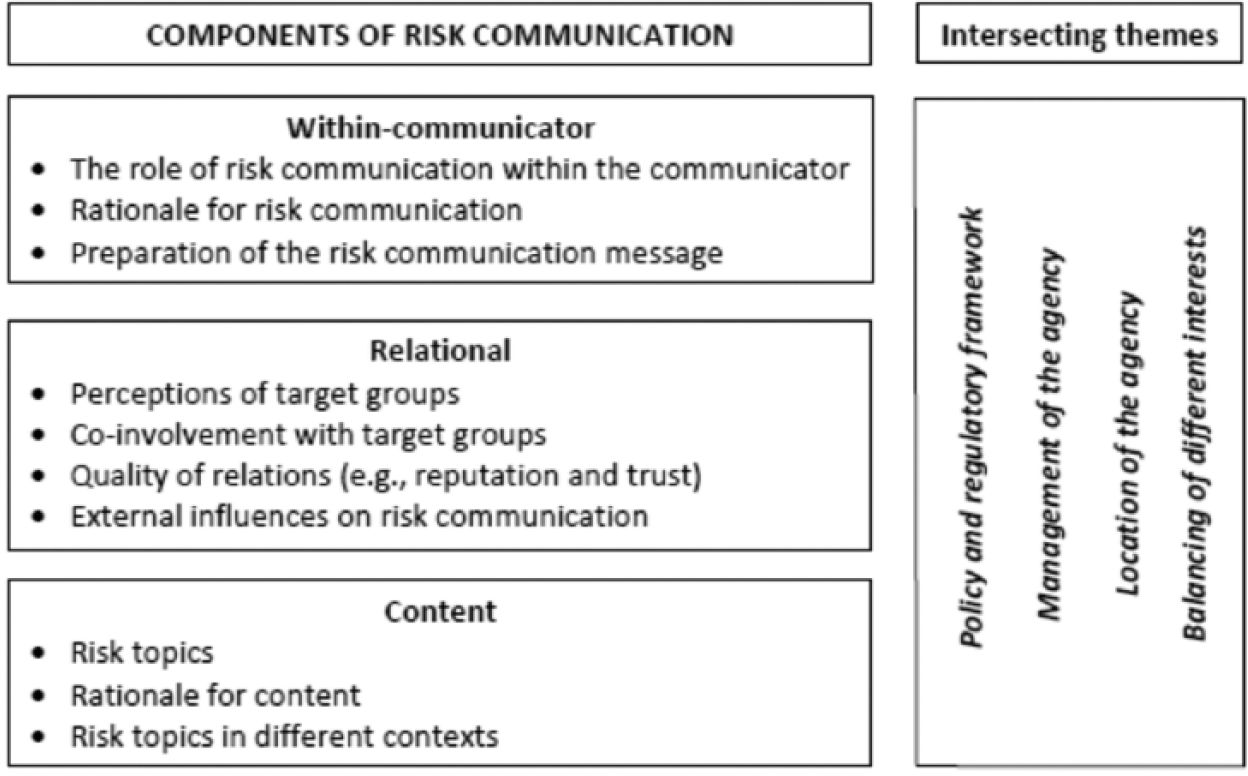
Components of risk communication and intersecting themes in the context of long-term forest risk communication in Sweden.
The conceptual framework can furthermore point to issues of importance for long-term RC. For example, relational issues, including the coinvolvement of target groups and the quality of relations, were particularly emphasized by the communicator when describing the implementation of RC. Although relational issues, for example, trust, have long been essential in the RC literature (e.g., Bier, 2001), the focus has generally been on target groups. Adding to this literature, this study reveals how relations play a role in RC from the perspective of the communicator. Consideration of relational issues, from both the communicator and target groups, is likely to be particularly important in long-term RC.
Overall, the study suggests that both conceptual rationales relevant for RC as well as its organizational and societal context are important for better understanding the drivers of and barriers to effective RC in this context. Building on previous conceptual analyses of RC (Wardman, 2008), the present study shows how underlying reasons (instrumental and normative) are part of the drivers of RC, closely linked to the policy and regulatory framework and the management of the agency. In addition, however, processes external to RC, involving interactions with target groups regarding other matters (e.g., regulations) and processes within the communicator’s organization as a whole, may facilitate, constrain, or in other ways influence RC. When RC involves several units and many coworkers at the agency external processes may be particularly influential. Even though the present study highlights several barriers to carry out RC over an extended period of time, the organization also has the opportunity to incorporate what they have learned when subsequently preparing and implementing RC. A comprehensive view of RC as ongoing with a history in a changing physical, societal, and organizational context is likely to improve long-term RC in different natural management settings.
When evaluating this study, certain limitations should be noted. For example, the analysis concerns the implementation of RC, thus excluding other levels such as the broader organizational (Chess, 2001) and managerial levels (Stern & Predmore, 2011). Since a qualitative approach was used, generalization on statistical grounds is furthermore not possible. However, the systematic data collection and analysis, as well as the diversity in the sample, indicate that representational generalization (to the advisors at the SFA) may still be possible (cf. Lewis, Ritchie, Ormson, & Morrell, 2014). In addition, conceptual issues derived from this study can be used to guide future research in similar contexts (cf. inferential generalization). The framework is likely to be most valuable in contexts where RC is politically governed, with a similar organizational setup within the communicator, and when RC is ongoing over time. Notably, though, as always in exploratory research, the conceptual framework needs to be validated in future empirical studies (cf. theoretical generalization; Lewis et al., 2014).
More specifically, future studies can draw on and further develop the conceptual framework outlined here. The broad definition of risk used in this study helped reveal hidden aspects of RC in this study context. Since RC is not always transparent, this is a way to capture parts of the process that are not readily apparent, even for those involved in RC. However, the framework can also be used to derive research questions with the aim to confirm relations between the intersecting themes and components (e.g., how location of the agency influences coinvolvement with target groups). A more comprehensive view of RC in a specific context can furthermore be achieved by examining the relational and content components from both the communicator’s and the target groups’ perspectives. In addition, mirroring the within-communicator component, drivers of RC, and perceptions of the RC message, for example, can be explored from the perspective of the individuals’ in the target groups. Finally, the output of the RC, for example, in terms of risk perceptions and relevant behavioral outcomes, will be important for a thorough understanding of RC.
Practical Implications
The planning and implementation of RC in the realm of natural resource management may furthermore benefit from considering the key issues raised in this study, for example, with regard to how RC is organized, and also content. Even when risk topics are very different (including both natural and human-induced), it is beneficial for the communicator to consider the context in which their RC is conducted. In the case of the SFA, proactive risk management advice was clearly part of their RC although it was not always categorized as such, which may be one reason why some have called for more proactive risk management at the SFA (Keskitalo, Klenk, Bullock, Smith, & Bazely, 2011). Deliberately placing proactive management advice within the broader work on risk management would make it more visible within as well as outside the agency. This way, advice on, for example, how to deal with storm damages would become more closely linked to management advice on how to avoid storm damage in the future. Furthermore, categorizing risk management advice as a risk issue would cause the risk assessment to be associated with the advice more explicitly, and the communicator could handle uncertainty in a more deliberate way (cf. Frewer, 2004).
This study furthermore suggests that the quality of relations with target groups may change not only as a result of organizational changes within the communicator and changes in the target group but also because of new ways of communicating with target groups (e.g., more dialogue projects). Considering these processes simultaneously makes it possible for the communicator to adjust RC to ongoing changes and perhaps avoid serious pitfalls. For example, although there are short-term advantages associated with concentrating limited resources allocated to RC on the professional forestry and large-scale owners, excluding small-scale owners may in the long term lead to a mutual understanding of risks on higher hierarchical levels but a distancing of risk perceptions between the agency and those not included in the dialogue. Hence, the framework may be used to pinpoint factors that should be considered simultaneously when making changes in ongoing RC.
Previous studies indicate that target groups tend to stress similarities with the communicator for a trustful relationship (Earle, 2010). For this reason, it may be important to identify common joint goals, for example, in terms of environmental and production goals. In line with the forest policy, a majority of individual private forest owners consider a variety of forest values to be important (Eriksson, 2012). To ensure transparency however, the communicator needs to reveal their goals for the future explicitly regarding the level of the goal (e.g., on an individual forest property, in a specific region or in the whole country) and its timescale (e.g., short or long-term). Even though this may at times highlight oppositional viewpoints between the communicator and target groups, the quality of relations are likely to be improved in the long run if underlying assumptions are revealed.
Footnotes
Acknowledgements
The author would like to sincerely thank the advisors participating in the interviews and two anonymous reviewers that together with the editor provided constructive advice on how to improve the article.
Declaration of Conflicting Interests
The author(s) declared no potential conflicts of interest with respect to the research, authorship, and/or publication of this article.
Funding
The author(s) disclosed receipt of the following financial support for the research, authorship, and/or publication of this article: This research was part of the research project Social perspectives on forest risks funded by The Swedish Research Council Formas (grant number: 2012-370).