



Abstract
The number and proportion of older adults in the United States population is increasing, and more clinical audiologists will be called upon to deliver hearing care to the approximately 35% to 50% of them who experience hearing difficulties. In recent years, the characteristics and sources of receptive communication difficulties in older individuals have been investigated by hearing scientists, cognitive psychologists, and audiologists. It is becoming increasingly apparent that cognitive compromises and psychoacoustic auditory processing disorders associated with aging may contribute to communication difficulties in this population. This paper presents an overview of best practices, based on our current knowledge base, for clinical management of older individuals with limitations in cognitive or psychoacoustic auditory processing capabilities, or both, that accompany aging.
1. Introduction
Within the next three decades, the percentage of Americans 65 years and older is expected to increase from 12.4% to 20%, with the fastest growing age group being individuals 85 years and older (US Department of Health and Human Services, 2003). In the decade between 1990 and 2000, the number of Americans ages 85 years plus, referred to by gerontologists as the “oldest-old,” grew at a rate that was 20 times higher than that of individuals in the age range of 15 to 44 years old (Hooyman and Kiyak, 2005). The predicted increase in the number of elders, many of whom will have significant hearing impairments, will undoubtedly have a pronounced impact on the profession of audiology and its service delivery models.
Not only is the caseload of audiologists being reshaped by the rising demographic tide, but because we will see considerably more patients who are 85 years and older, the type of older adults that will seek our services will be different also. Never before have so many American citizens segued into their later years so healthily and productively. In particular, the generation born between 1946 and 1964, well known already as the “baby boomers,” will represent an aging group unlike any we have seen before. Increasingly, we will be serving older adults who want to stay in the work force, volunteer their time, be proactive in their communities, take up new hobbies and learning experiences, and even return to school or be active politically (APA Working Group on the Older Adult, 1998). Audiologists will be in the unique position of enabling this type of clientele to reach their goals and achieve their dreams. The ability to hear and communicate will be essential to enhance the social, emotional, vocational, and intellectual well being of the new generation of older citizens.
The older adult population typically has characteristics, needs, and predicaments that are quite different from younger populations. To provide the highest level of audiologic services to elders who are hearing impaired, the audiologist must be prepared to address their unique needs. The purpose of this paper will be to present a practical, comprehensive, and viable model of audiologic management to meet the needs of elders with cognitive or auditory processing components, or both, to their hearing difficulties.
Numerous studies have documented the effects of untreated hearing loss on elders. These include communication difficulties (Arlinger, 2003), well-being and quality of life for individuals with hearing loss as well as their spouses (Mulrow et al., 1992; Carabellese et al., 1993; Seniors Research Group, 1999; Wallhagen et al., 2004), cognitive function (Cacciatore et al., 1999), social interactions (Resnick et al., 1997; Jang et al., 2003), and deterioration of speech perception skills in unaided ears owing to auditory deprivation (Silman et al., 1984; Gelfand, 1995; Arlinger, 2003). Audiologic management such as dispensing of hearing aids and provision of counseling is critical to avoid the deleterious effects of untreated hearing loss. Most new hearing aid users are older adults (Kochkin, 2000, 2005), and researchers have steadily been addressing the unique characteristics of hearing loss associated with aging.
2. Hearing Loss in Older Adults
How, generally, do older individuals with hearing loss differ from younger individuals with hearing loss? Researchers have documented the unique challenges faced by older adults with hearing impairment, beyond peripheral hearing loss, noting that higher level auditory processing of sounds may be compromised by changes in the central auditory system and by cognitive declines (Willott et al., 2001; Larsby et al., 2005). Further, the hearing loss experienced by older adults may involve not only elevated hearing thresholds, but also supra-threshold compromises in auditory processing at the central level (Baran, 2002). These processes include temporal processing, defined as the ability to process rapidly changing auditory information, and frequency resolution (Fitzgibbons and Gordon-Salant, 1996; Kiessling et al., 2003; Pichora-Fuller and Souza, 2003). Age effects on temporal processing appear more consistently and strongly when measures are made with complex stimuli in difficult listening conditions (Fitzgibbons and Gordon-Salant, 1996).
These additional sources of difficulty often lead to greater auditory speech perception challenges in older adults than in younger adults with similar audiometric findings. Further light was shed on the relationship between temporal processing and speech recognition in research conducted by Gordon-Salant and Fitzgibbons (2001). These investigators determined that the difficulties of older listeners in recognizing time-compressed speech are associated with difficulty in processing brief acoustic cues rather than with cognitive decline in speed of processing. Specifically, they found that the brief, limited acoustic cues for consonants, inherent in rapid speech, severely compromised the abilities of older adults to understand time-compressed speech. Further, the results of this investigation showed that older participants were particularly disadvantaged when low-context stimuli were used, underscoring the importance of contextual information on recognition of rapid speech by older listeners. More recent research by Humes and Humes (2004) implicated auditory temporal processing as a factor in successful use of hearing aids by older adults.
An overview of the possible complex contributors to the severe listening difficulties experienced by many elders is briefly explained below, and in more detail in the Pichora-Fuller and Singh paper (this issue). To plan appropriate testing and intervention for older adults, it is critical for audiologists to understand not only that older adults typically have greater speech perception difficulties than younger adults with hearing loss but also the potential sources and nature of the older adult's difficulties. The main focus in this paper is the presentation of relatively simple and straightforward guidance for management of older adults with severe difficulties in understanding speech. Suggestions for identifying the sources of listening difficulties and for implementing appropriate interventions will follow this brief overview of the sources of listening difficulties in older adults.
3. Sources of Listening Difficulties in Older Adults
Older adults often have considerably greater difficulties in understanding or recalling spoken language than do younger adults. This is particularly true in acoustically hostile listening environments, even when participants are matched for pure-tone hearing acuity and for the ability to hear words spoken in quiet (Souza, 2000; Tun et al., 2002; Pichora-Fuller and Souza, 2003). Additionally, when listening in challenging environments, auditory information may be adversely affected owing to central cognitive resources being reallocated to support auditory processing. This reallocation could lessen the availability of cognitive resources for storage and retrieval functions of working memory (Tun et al., 2002; Larsby et al., 2005). For example, when the listening task involves trying to understand a talker while concomitantly attempting to ignore a competing voice in the background, an increased load on attentional control can occur because of the circumstances of divided attention at the cognitive level (Tun et al., 2002). The result is a significant demand on executive function, the working memory component responsible for scheduling, organizing, and allocating resources for attending to ongoing activities. For an excellent discussion of the effects of noise on working-memory resources see Pichora et al. (1995).
Researchers have offered a number of explanations for age differences in speech perception. The difficulties experienced by many older individuals may be due to central auditory effects of peripheral pathology (Kiessling et al., 2003). As age differences in the comprehension of speech began emerging in the scientific literature, Jerger and Hayes (1977) proposed that in addition to peripheral impairment associated with aging, typically evidenced by audiometric hearing loss, the higher auditory pathways might also be involved. A number of studies since then have shown that older adults may show substantially greater compromises with speech perception in noise compared with younger adults matched in hearing loss characteristics (e.g., Plomp, 1986; Cheesman, 1997). Because of different populations, testing protocols, and criteria, researchers have reported a large range for the prevalence of central auditory processing disorders in older adults (Kricos et al., 1987; Kricos, 1995; Lesner, 2003). Auditory processing disorders in older listeners may be evident from tests using degraded, competing, or altered speech (Kricos et al., 1987; Kricos and Lesner, 1995), as well as evaluation of temporal resolution and frequency resolution skills (Phillips et al., 2000).
Age differences in auditory processing may manifest as pronounced difficulties in understanding speech in acoustically hostile environments, such as noisy, reverberant rooms, difficulties understanding speakers with dialects or foreign accents, problems with rapid speaking rates, decreased working memory capacity owing to complex linguistic structure, and difficulties communicating when the speaker is not nearby (Wingfield and Tun, 2001). Larsby et al. (2005) found that older subjects were more distracted by noise with temporal variations, and especially noise with meaningful content. Further, clinical audiologists have observed age effects in auditory processing in everyday listening even for older adults who show little if any pure-tone threshold loss (Jerger et al., 1990; Pichora-Fuller et al., 1995; Humes, 1996; Kiessling et al., 2003; Tremblay et al., 2003). These observations in the clinical setting are not surprising, given the results of Tremblay et al. (2003), who found age related changes in the central auditory system even in older adults with normal hearing.
The difficulties experienced by many older individuals may be due to central auditory effects of peripheral pathology (Kiessling et al., 2003). Other factors contributing to age differences in everyday listening have been suggested: age-related differences in visual speech perception (Erber, 2003); biologically-based age-related changes in auditory speech processing (Chisolm et al., 2003); and age-related changes in cognitive processing (Pichora-Fuller, 2003; Humes, 2005; Larsby et al., 2005). The role of the latter, in particular, has received increasing attention in recent years.
Some cognitive changes are associated with normal aging, although only a small percentage of older adults decline in cognitive abilities to the extent that it causes problems in daily living (APA Working Group on the Older Adult, 1998). Some intellectual abilities such as vocabulary and social coping mechanisms are well preserved and, in fact, may continue to improve with age (Kart and Kinney, 2001). Other intellectual abilities, however, may decline with age. These include information processing speed, divided attention skills, the ability to switch rapidly between multiple auditory inputs (visual switching is not as affected by age), sustained attention, selective attention, and working memory (APA Working Group on the Older Adult, 1998; Kart and Kinney, 2001; Hooyman and Kiyak, 2005).
Wingfield and Tun (2001) outlined a number of age-related changes in cognitive factors that may affect speech perception by older adults, including reduced processing speed, less efficiency for tasks involving divided attention, and limitations in working memory capacity. The latter involves processing and storing information. A compromise of these cognitive factors may contribute substantially to discourse difficulties in everyday situations, in which information is often presented quickly and under adverse conditions (Larsby et al., 2005).
Tun et al. (2002) showed that older adults’ increased susceptibility to distraction by background speech involves more than simply peripheral hearing difficulties or acoustic masking. Their research provided evidence that higher level cognitive abilities also may contribute substantially to the older adults’ ability to process spoken language in the presence of competing speech (Tun and Wingfield, 1999; Tun et al., 2002). In particular, they have noted that older adults, but not younger adults, were impaired more by meaningful distracters than by non-meaningful distracters when involved in a recall task (Tun et al., 2002). Further, their research has shown that older adults performed significantly more poorly than younger adults in a listening task with just one background speaker. Presumably this difference occurs because the competing talker's speech would have considerably more meaningful content than that of multi-talker babble. Thus, conversing with one communication partner when a television is on may actually be more difficult than communicating when a noisy fan is nearby.
The results of research by Bellis and Wilber (2001) implicated aging effects on inter-hemispheric function as a possible source of auditory and communication difficulties in older adults. Interestingly, inter-hemispheric integrity, determined by dichotic listening, auditory temporal processing, and visuomotor inter-hemispheric transfer tasks, showed compromises as a result of aging as early as 40 to 55 years, with no significant decrease after age 60. Bellis and Wilber (2001) speculated that age-related, as well as some gender-related declines in inter-hemispheric processing, may result in binaural processing difficulties such as speech discrimination in noise that is so commonly seen in the population addressed in this article.
Clearly, more research is needed to tease out the contributors to speech perception difficulties in older adults. Thus far, it is apparent that age-related hearing loss is associated not only with peripheral auditory changes but also with central auditory compromises that may interact with diminished cognitive support of auditory perception (Chisolm et al., 2003; Larsby et al., 2005). These layers of contributors to hearing difficulties in older adults lead not only to elevated thresholds but also to reduced speech understanding in noisy and reverberant environments, interference with the perception of rapid changes in speech, impaired sound source localization, and suprathreshold compromises in frequency and temporal resolution (Chisolm et al., 2003). For older adults with compromised cognitive or psychoacoustic auditory processing capabilities, in addition to peripheral hearing impairments, audiologic management will be particularly important as well as considerably challenging.
As stated earlier, a comprehensive model of audiologic management for older adults with cognitive or auditory processing components, or both, to their listening difficulties will be presented in this paper. In particular, collaborative problem solving will be emphasized.
4. Amplification: Prefitting Considerations
Because of the unique problems of older adults who may have not only hearing difficulties but also compromised cognitive/psychoacoustic auditory processing capabilities, a number of considerations and assessments must be made before hearing aids are fitted. The usual factors that are considered in the prefitting process include degree of loss, word recognition abilities, loudness discomfort levels, and listening needs and lifestyle. Attention must also be given to other aspects of the patient's auditory status, such as supra-threshold discrimination of temporal cues and frequency resolution, speech recognition in varying signal-to-noise ratios (SNRs), and higher-level auditory processing competencies.
Further, a number of psychologic variables should be assessed, including the patient's motivation, self-efficacy, and cognitive status, such as working memory, speed of processing, and attentional skills. Indeed, Humes (2003) analyzed the results of three studies of hearing aid outcomes in older adults to determine predictors of hearing aid success. For speech recognition performance, the best predictors were the degree of hearing loss, cognitive performance, and age of the subject. Finally, it is helpful to have information regarding the patient's medical status, mental status, and available social supports. For optimal performance and information accuracy, it is essential for interviews, testing, and counseling to be conducted in quiet environments with minimal distractions.
4.1 Audiologic Status
The first component of an audiologic evaluation with older adults should be to obtain their input regarding the nature of the communication problems that they are experiencing. This typically is handled by a written case history, an interview, or both, and ideally, by the administration of a self-assessment inventory to determine the older adult's perception of activity limitations or participation restrictions related to their complaints. The Hearing Handicap Inventory for the Elderly (HHIE) (Ventry and Weinstein, 1982) is a popular instrument for use with older adults because of its well-established psychometric characteristics and its brevity (Lesner and Kricos, 1995). If the HHIE is to be used as a measure of treatment effectiveness, it is highly recommended that it be administered in a face-to-face interview (generally requiring 10 minutes or less) rather than as a paper-and-pencil test. To show a significant improvement in the HHIE score from pre- to post-treatment, the patient's score must decrease by at least 36% when the paper-and-pencil format is used, in contrast to the critical difference score of only about 19% when the interview format is used (Kricos and Lesner, 2000). Because of the increasing movement toward documenting treatment outcomes, it is highly recommended that the HHIE be routinely administered to audiology patients. A version of the HHIE for significant others is also available and provides useful information regarding the perspectives of family members (Weinstein, 2000).
In addition to the HHIE, a number of other measures of communication function can be used with older adults. These include the Communication Scale for Older Adults (Kaplan et al., 1997), the Abbreviated Profile of Hearing Aid Benefit (Cox and Alexander, 1995), the Communication Profile for the Hearing Impaired (Demorest and Erdman, 1987), the Client-Oriented Scale of Improvement (Dillon et al., 1997), and the Glasgow Hearing Aid Benefit Profile (Gatehouse, 1999). The latter are particularly useful tools for delineating the perceived hearing and listening difficulties of older adults because their open-ended interview formats allow for a conversation between the older patient and the audiologist about everyday listening experiences.
Older adults may come to the audiology clinic because of increasing difficulties understanding speech, particularly in group situations and when there is noise in the background, and may report that they are having difficulties hearing. Simply testing their peripheral hearing is not sufficient, because it is possible that the source of their communication problems may be a combination of cognitive and auditory processing impairments. Beyond establishing the degree of loss (if any), testing word recognition, and administering other traditional measures routinely made in audiology clinics, the audiologist should attempt to assess or predict speech understanding in everyday situations. As Pichora-Fuller et al. (1995) point out, to fully understand the consequences of auditory processing and cognitive compromises on everyday speech understanding, more complex discourse materials and tasks are needed than word lists, sentence repetition, and even connected speech tasks that do not involve dialogue.
Even beyond using connected speech stimuli along with the traditional audiologic test battery, audiologists need to consider the degree of effort expended by older adults when trying to understand discourse. Several authors have pointed out that the greater speech recognition problems, slower speed of processing, and declining cognitive abilities in many older adults increase the effort that must be expended to engage in meaningful discourse (Pichora-Fuller, 2003; Larsby et al., 2005). The Speech, Spatial and Qualities of Hearing Scale (SSQ) (Gatehouse and Noble, 2004), a relatively new and promising tool, has a question regarding the degree of effort that respondents perceive when they are communicating, as well as items dealing with issues that would also bear on effort such as self-rated abilities to ignore competing sounds and degree of concentration needed when listening. Gatehouse and Noble (2004) obtained data on their new instrument by administering it to more than 150 individuals with hearing loss and an average age of 71 years (SD, 8.1). The mean better-ear average of this population was 38.8 dB, and the worse-ear average was 52.7 dB. Noble and Gatehouse (2004) also reported data for older individuals with asymmetrical hearing losses with a mean better-ear average of 38.7 dB and a mean worse-ear average of 74.2 dB.
Should measures of auditory processing abilities, such as discrimination of duration, temporal order, dichotic syllables, or time-compressed speech recognition routinely be administered to older adults seen in the clinic? Baran (2002) recommends that an auditory processing assessment should be administered as part of the hearing aid selection and fitting procedure for elderly patients with severe auditory comprehension difficulties. The assessment battery might consist of dichotic speech testing, comparison of aided right-ear, left-ear, and binaural speech recognition scores, and additional behavioral and electrophysiological tests as needed. Bellis (2003) emphasizes the helpfulness of the Dichotic Digits test for identifying auditory processing disorders in adults, noting that it can be administered within a few minutes and is relatively impervious to peripheral hearing loss (Bellis, 2003).
However, Humes (2005) found that performances of older listeners on measures of auditory processing were systematically related to differences in cognitive function rather than to auditory function. The SSQ (Gatehouse and Noble, 2004) is a potentially useful tool for discovering whether there may be an auditory processing component to the hearing loss. Auditory processing disorders typically manifest as pronounced difficulties in understanding speech in unfavorable listening conditions. Although speech perception measures in noise are helpful for determining the presence of auditory processing disorders, several items on the SSQ could provide useful feedback to the audiologist about the older individual's real-world communication dilemmas. For example, SSQ items on conversing in noise and echoic environments, dual-streaming monitoring of conversations, and rapidly switching conversational exchanges could help the audiologist understand the challenges encountered by individual patients. The SSQ might not define whether difficulties with these communication situations are due to central auditory processing or cognitive components, or both, but the information regarding the individual's perceptions of their everyday communication experiences could provide useful information to the audiologist for hearing aid fitting decisions and for counseling.
4.2 Cognitive Status
The observant audiologist can gain at least some information about the patient's overall alertness and speed of processing during the initial intake interview. Does the patient appear to need extra time to process questions posed by the audiologist? Does she seem alert and able to pay attention? Do extraneous room noises or conversations seem overly distracting to her? The SSQ (Gatehouse and Noble, 2004), as noted, could also be helpful, and assuming candid responses from the older listener, at least indirectly tap into cognitive abilities such as attention, working memory, and speed of processing.
Beyond these informal and formal appraisals, screening measures are available that may provide insights into the patient's cognitive status:
The backward digit span portion of the Digit Span subtest Wechsler Scale of Adult Intelligence (The Psychological Corporation, 1997) is one of the simplest measures for assessing working memory, with published norms based on age and educational level.
One of the most commonly administered clinical screening tests of cognitive function is the Mini-Mental State Exam (MMSE) (Folstein et al., 1975). A total score of less than 23 on this 30-item test suggests impairment in cognitive function. The MMSE has been shown to have high sensitivity and specificity (Folstein et al., 1975). The test is normed according to education level and age (Crum et al., 1993). It should be noted that although it is useful as a clinical screening tool to detect impairment, it is not sensitive to individual differences in a healthy older population (K. Pichora-Fuller, personal communication, August 1, 2005).
The Saint Louis University Mental Status Examination (SLUMS) (Banks and Morley, 2003), an 11-item scale with good reliability and validity, is a fairly new and easy-to-use screening tool (Table 1). It was developed to identify mild cognitive impairment and to differentiate it from dementia. SLUMS scores may range from 0 to 30, with lower scores indicating increasing levels of cognitive impairments within the cognitive domains of orientation, memory, attention, and executive functions.
Some cognitive screeners can be administered via telephone, such as the Telephone Interview for Cognitive Status (Brandt et al., 1988), but these would not likely be suitable for older adults who may have hearing problems.
Saint Louis University Mental Status (SLUMS) Examination
It is of critical importance that professionals ensure that hearing impairment is not a confounding factor in cognitive test results. Weinstein and Amsel (1986) showed that hearing loss could present symptoms similar to those of dementia. When an older patient with a hearing loss responds inappropriately to an item on a cognitive measure, it might be due to hearing loss, cognitive compromises, or a combination of both. Weinstein and Amsel (1986) compared the performance of institutionalized elders on the Short Portable Mental Status Questionnaire (Pfeiffer, 1975), with and without use of an auditory trainer. Close to half of the patients with moderate hearing losses and all of the patients with severe losses showed clinically significant improvements in cognitive test results when test questions were presented with amplification. Thus, it would be prudent that any older adult suspected of having a hearing loss be tested in an amplified condition during cognitive measures. In the author's experience, sound devices such as the Pocket-Talker® or Sound Wizard® can be quite useful in this regard.
5. Hearing Aid Considerations for Older Adults With Cognitive/APD Components
It will be particularly important, until more data-based information is available to clinical audiologists, to consider each older potential hearing aid candidate individually as far as selection of appropriate amplification. As Souza (2004) points out, there is no single solution for what amplification processing strategies and considerations should be recommended for older adults. Hearing aid choices must be made on a case-by-case basis. Consideration should be given to the older listener's communication needs and perceived barriers, possible cognitive contributions to listening difficulties, audiologic status from the peripheral through the central auditory systems, and physical limitations.
The unique challenges faced by many older adults with hearing loss have compelled the hearing aid industry to capitalize on the flexibility of today's technology to meet their special needs (Cienkowski, 2003). One of the most exciting areas of hearing aid technology research is determination of optimal hearing aid signal-processing strategies for various subgroups of older adults with hearing loss, including those with cognitive or auditory processing disorders, or both. Hearing aid technology now offers the audiologist considerable flexibility in selecting processing strategies for a “best fit” for older adults with various listening needs and capabilities. Clearly more research is needed to enhance the hearing aid selection process that formerly was relatively simple and straightforward and based almost exclusively on the listener's hearing loss. Although a number of researchers have documented the pronounced effects of cognitive capabilities on a listeners’ ability to benefit from cochlear implantations, there has been relatively little research on how a person's cognitive strengths and weaknesses may affect success with using hearing aids.
Some initial explorative studies in this area offer tantalizing evidence that a person's cognitive competencies may influence the hearing aid processing strategy that should be selected. For example, in an exploratory study, Gatehouse et al. (2003) found that the cognitive abilities of listeners with hearing loss influence the capacity for speech understanding and interact significantly with both the benefits delivered by different hearing aid regimens as well as with the temporal characteristics of test environments. Gatehouse et al. (2003) found that listeners with greater cognitive ability derive greater benefit from temporal structure in background noise when listening via fast time constants. In contrast, their results showed that older listeners with reduced cognitive abilities obtained greater benefits from hearing aids when slow-acting compression is used.
This concept is being embraced by several hearing aid manufacturers, who are offering programming defaults for slower release times in their fitting software for older hearing aid candidates (Souza, 2004). The rationale for slower release times for older listeners is that cognitive compromises may limit the listener's ability to extract the fast components of speech, particularly in noisy situations, when a faster speech-processing algorithm is used (Cienkowski, 2003). In the Gatehouse et al. study, only two release times were compared: fast release (40 msec) and slow release (640 msec). It is hoped that further research in this area will emerge to guide the hearing aid industry and clinical audiologists toward appropriate release times for older adults with cognitive components to their speech recognition difficulties.
Based upon their results, Gatehouse et al. (2003) advise future researchers to document the cognitive characteristics of listeners who are hearing impaired in addition to evaluating traditional audiologic domains. Although they acknowledged that their line of research needs more attention, they state “It is … possible to contend that, as the listening test environments and tasks become more representative of real world listening, the complexity of the listening environment, the complexity of the listening task and the complexity of the signal processing in the hearing aids under test will interact yet more heavily with the cognitive and other abilities of the hearing-impaired listeners” (Gatehouse et al., 2003, pp. S84–S85).
Similarly, research by Lunner (2003) suggested that older adults who had high-level working memory skills were able to identify differences in signal-processing strategies (fast-acting vs slow-acting compression ratios). Conversely, older adults with poor cognitive function could not identify the effects of different signal-processing strategies. Thus, Lunner's tentative results suggest that older listeners with compromised cognition may be less likely to report the advantages of fast-acting compression. Jenstad et al. (2003) suggest that when patients have difficulties describing their aided listening experiences, it may be helpful to provide a vocabulary list to them, using descriptors frequently reported by hearing aid patients, such as “the hearing aid cuts in and out,” “can't hear well in noise,” or “the hearing aid is pumping.”
McCoy et al. (2005) emphasized the pronounced effects that even a mild-to-moderate hearing loss can have on the ability of older adults to complete a memory-for-speech task. These authors compared older adults with normal hearing with older adults with mild-to-moderate hearing loss on a working memory task. The compromised performance of the group with hearing loss supports the “effortfulness hypothesis”: the extra effort expended by a listener with hearing loss results in less availability of processing resources for the complex task.
Davis (2003) hypothesized that older adults with better cognitive function (i.e., cognitive factors related to phonologic memory) might obtain greater benefit from amplification, particularly nonlinear amplification. However, these results indicated that those with good memory skills actually benefited less from amplification. Davis concluded that a more sensitive task is needed because performance on the memory task used in the study was very poor in most participants. He concluded that tests of other specific cognitive functions, such as memory, attention (including switching attention), and effort might be more sensitive to cognitive differences in elderly people. Further, Davis suggested that continued study of cognitive function and amplification benefits may reveal whether different hearing aids and fitting strategies are more appropriate for people with different performance levels on cognitive tasks.
Humes (2005) recently pointed out that in terms of practical consequences, it may not matter if the source of an elder's communication difficulties is due to cognitive deteriorations or to auditory processing disorders. Research conducted by Humes et al. (2003) found no link between factors affecting hearing aid use and several measures of auditory processing.
The primary consideration in the selection of hearing aid features should be improvement in the understanding of speech in noise, a substantial problem for the older individuals addressed in this paper. Beyond signal-processing strategies, the use of directional microphones should be encouraged. Bentler et al. (2004) tested adults who were a mean age of 62 years and had mild-to-moderate sensorineural hearing loss to determine their speech recognition. When tested using hearing aids with directional microphones, their performance on the Hearing in Noise Test (HINT) (Nilsson et al., 1994) was similar to that of considerably younger normal-hearing individuals, at least when the noise source was stationary. When tested in the moving noise condition, 94% of the subjects with hearing loss performed similarly to the normal subjects with a three-microphone, adaptive directional system. These results are encouraging, although the sample of individuals with hearing loss crossed a large age range, 27 to 85 years. Data regarding the performance specifically of the oldest subjects in the Bentler et al. study are not presented, nor do we know of the cognitive and auditory processing intactness of this sample. Thus, we must be cautious that the same results with a three-microphone, adaptive directional system would be available for older adults with compromises in cognitive or auditory processing abilities.
The audiologist should also consider possible effects of the individual's cognitive, sensory, and physical abilities on other hearing aid fitting aspects. For example, the ability to adjust and manipulate multiple memories, directional microphone switches, and telecoil options may be affected by compromises in cognition, vision, or manual dexterity. The industry's move toward completely automatic hearing aids may be particularly beneficial for individuals with additional challenges beyond hearing loss.
6. Beyond Hearing Aids: Other Interventions for Older Adults with Hearing Loss
6.1 Other Assistive Technologies
Because of pronounced difficulties with understanding speech in acoustically challenging listening environments, older adults with cognitive or auditory processing compromises may benefit from the use of assistive technology. Assistive technology in the form of an FM device may indeed be the only option for older adults whose hearing is in the normal range but who experience difficulties with speech recognition owing to central auditory processing or cognitive disorders, or both. Listening in noisy public places such as airports, or in reverberant areas such as reception halls, or even on the telephone can be challenging for any adult with hearing loss but particularly so for the older adults addressed in this article.
Compton Conley (2004) points out that based on the research literature for directional-microphone hearing aids, the audiologist could predict a 4- to 5-dB improvement in the SNR in ordinary acoustic settings for the individual who has a typical mild-to-moderate loss of hearing. With FM technology, on the other hand, one can expect at least a 20-dB improvement in the SNR, regardless of how difficult the listening situation is, how near to the speaker the listener is positioned, or where the noise is located (Compton Conley, 2004).
Has any research documented the benefits of FM technology for older adults? The answer is a qualified yes. For example, Boothroyd (2004) examined benefits and limitations of a remote FM microphone as a hearing aid accessory. He found significant improvements in phoneme recognition in noise, under laboratory conditions, when 12 adults with mild-to-severe hearing loss, aged 52 to 85, were fit with behind-the-ear hearing aids that had FM receivers. In fact, their phoneme recognition in noise, when using the FM hearing aid, was equivalent to their phoneme recognition in quiet. Although many participants were positive about the benefits of the FM microphone, none of them expressed interest in obtaining a hearing aid with an FM receiver. To do so, many of the participants would have had to buy new hearing aids. Some already wore in-the-ear models, and others wore behind-the-ear aids without either the requisite telecoil or option for a shoe that could accept a plug-in FM receiver.
Boothroyd further surmised that the brief period of explanation, instruction, and demonstration provided at the start of the study, even though accompanied by illustrated written instructions, was not enough for many of the participants. It was apparent that some of the participants, despite at least 2 weeks of experience with the FM system, did not fully understand the need for the remote microphone to be held only a few inches from the talker's mouth for optimum benefit, nor could they distinguish situations in which an FM system might be helpful from those in which it would not. It was also evident that the number of switches and controls was problematic for some of the older participants. When dispensing hearing aids to be coupled with remote FM microphones, the audiologist will need to provide ample counseling, instruction, and coaching, probably over several sessions (Chisolm et al., 2004).
Interestingly, speech perception among participants in Boothroyd's (2004) study was not significantly associated with age; however, older participants and participants with poorer aided performance in noise tended to report less perceived benefit from the FM system. Thus, it should not be assumed that older individuals with central auditory processing or cognitive compromises would receive significant benefit from FM devices, as their speech processing difficulties occur primarily in noisy listening situations. Regardless of aided speech perception in noise abilities, Boothroyd (2004) cautions that the relative gains via FM and hearing aid microphones must be carefully adjusted to ensure maximum possible benefit.
As with any decision regarding appropriate assistive technology, the audiologist needs to consider the unique listening needs of the patient and how best to couple the patient's hearing aids to the assistive technology. It will be important for the dispensing audiologist to recommend that hearing aids have telecoils, not only for telephone use but also for the aids to be compatible with inductance-loop assistive technology (Ross, 2005). However, less than 50% of hearing aids dispensed in the United States have telecoils (Myers and Ross, 2003; Ross, 2005), whereas in Great Britain, more than 90% of hearing aids have telecoils. Not surprisingly, more induction loops are used in Great Britain. The Let's Loop America organization (www.hearingloop.org) has initiated a well-thought-out campaign to increase the number of public facilities such as churches, schools, government offices, banks (see Figure 1), and other businesses, that have induction loops in place for individuals with hearing loss. Both large spaces, such as auditoriums, and smaller spaces, such as movie theater ticket windows, have been successfully looped, providing excellent access for hearing aid users who have telecoils.

Looped drive-through bank window in Holland MI. Courtesy Kathryn Brownson, Let's Loop America, www.hearingloop.org.
A device known as the Link-It™, a highly directional array microphone, can be used in conjunction with hearing aids to provide tremendous help to hearing aid users who must contend with understanding speech in noisy environments. To take advantage of looped facilities and the Link-It™, however, the hearing aids people wear must have induction coils (Ross, 2005). Ross (2005) emphasizes the convenience and success of using telecoils for improved speech understanding in noise and urges audiologists to use the term audiocoils, rather than telecoils, which connotes usefulness with telephones only.
According to Compton Conley (2004), there generally is a negative correlation between an individual's speech recognition abilities and his need for an assistive listening device. Additionally, lifestyle (e.g., home, workplace, traveling, recreational pursuits, school) is a paramount consideration. Compton Conley suggests that the candidate for assistive technology should receive a thorough evaluation of speech recognition and a communication needs assessment. One way to evaluate speech recognition preliminary to the fitting of FM devices would be to calculate the SNR hearing loss (Etymotic Research, 2001; Compton Conley, 2004). An adaptive testing approach is used to compare the SNR for speech recognition in noise with speech recognition in quiet. According to Compton Conley, individuals with normal hearing typically will require approximately a +2 SNR to correctly repeat 50% of words on tests such as the Speech-in-Noise Test (SIN) (Killion and Villchur, 1993), the Quick Speech-in-Noise Test (Quick SIN) (Killion et al., 2004), or the HINT (Nilsson et al., 1994). Thus, a person who requires that the speech signal be at least 14 dB higher than the noise in order to achieve 50% correct speech recognition would have a 12 dB SNR loss (14 −2 = +12). Table 2 shows guidelines provided by Etymotic Research (2001) for determining what type of technology may be best for patients with various degrees of SNR loss. For additional information on candidacy and management of assistive listening devices for older individuals, see Lesner (2003).
Expected Improvements in Hearing Ability from Directional Hearing Aids and FM Devices as a Function of Signal-to-Noise Ratio (SNR) Loss

Etymotic Research (2001). Reprinted by permission.
Several authors have encouraged audiologists to make the provision of information about assistive technology options a priority when working with their patients, including use of formal questionnaires to determine communication needs and outcomes (Chisolm et al., 2004; Ross, 2004). According to the results of a consumer survey conducted by Stika et al. (2002), only an estimated 30% of dispensing audiologists inform their patients of assistive listening devices. Part of their reluctance may be due to difficulties in incorporating the dispensing of assistive devices in busy practices. The dispensing audiologist may be challenged to keep up with the rapid advances being made in hearing aid technology and may find it difficult to stay abreast of other assistive technology. Additionally, fitting and troubleshooting assistive technology can be daunting. For example, problems with impedance matches between telephones and assistive devices may be encountered, requiring lengthy troubleshooting by the audiologist. Rather than abandon the practice's assistive technology offerings, dispensing audiologists may consider working with companies that serve as an interface between the patient and the assistive technology. Appendix 1 shows a list of companies that offer a variety of assistive devices and levels of support.
Finally, a cautionary note must be appended to this section on assistive technology. Although a considerable body of data suggests the efficacy of FM technology for improving speech understanding, the issue of consumer acceptance of this technology must be addressed by the hearing aid industries and audiologists. As noted earlier with Boothroyd's (2004) study participants, although many adults reported benefits of the technology, none of them were interested in obtaining hearing aids for use with an FM receiver. Most of the research participants in an earlier study by Jerger et al. (1996) also showed reluctance to use assistive listening devices in everyday situations, despite perceiving significant benefits from their use. Comments made by these older individuals typically implicated the cumbersome wires, prominence of the device, and difficulties setting the device up as reasons for rejecting the devices. Similar results were found in a recent study by Lewis et al. (2005), whose research participants received speech perception benefits from using an FM transmitter with a hearing aid coupled to a plug-in FM receiver. Despite their improved abilities to listen in noise, none of the participants purchased the FM technology for their personal use, citing a number of reasons, such as the expense and the inconvenience of carrying and charging the FM transmitter. Chisolm et al. (2004) urged audiologists to use a systematic approach to hearing assistive technology, one that includes counseling, coaching, and instruction. Changes in the technology, as well as in our counseling strategies, may change this situation so that a greater number of older individuals will avail themselves of advances in assistive technology.
6.2 Counseling Older Adults and Their Family Members
One of the most critical tools for helping older adults cope with hearing problems that involve auditory processing or cognitive compromises is to carefully explain the nature of the problem and to provide realistic expectations. A brief, simple explanation might include the following:
At least 1 out of 5 adults over 60 years have difficulties not only with their ears being able to hear sounds, but also with being able to actually process sounds that the ear delivers to the brain. As a result, these adults may have additional difficulties that other hard-of-hearing people do not have. For example, in everyday situations, they may have greater problems with:
Understanding someone who talks very quickly or with an accent
Knowing where sound is coming from
Identifying who is talking in a group conversation
Understanding quickly what a person is saying
Figuring out what people are saying when listening conditions are poor, such as in noisy rooms
Making sense of what people are saying when conversing with several people at the same time
Keeping up with quick changes in conversational topics
Becoming very tired during conversations because of the extra effort needed to understand what the talker is saying
Even in relatively good listening conditions with a familiar conversational partner, the adult with a processing problem in addition to hearing difficulties may need more time to process what the talker is saying. Because of these special difficulties, it is very important for family members to understand the special challenges that you will have in everyday conversations. Research has shown that many older individuals with hearing difficulties must put much greater effort into understanding conversations, especially when other people are having conversations in the same room. Meetings, grocery shopping, family dinners, parties, and other social settings may be very tiring. Although it is important in many ways to continue social interactions, family and friends need to understand that briefer visits may be much easier for the individual to enjoy than long, drawn out interactions. With understanding, patience, and awareness of helpful communication strategies, difficulties can be significantly lessened.
The importance of helping the patient and the family to have realistic expectations for treatment outcomes cannot be overstated. Older adults typically have at least one friend or cohort who successfully uses hearing aids and reports tremendous benefit from doing so. The patient, and the patient's family, must clearly understand that the nature of the communication problems they are experiencing may require different courses of treatment as well as different expectations for outcomes. The Client Oriented Scale of Improvement (COSI) (Dillon et al., 1997) provides an approach to goal setting that would be ideal for the types of patients addressed in this article. The COSI can be used to select realistic treatment goals, goals that are driven by the patient's unique needs and desires, as well as by the audiologist's perspectives on the nature of the problem. It may be helpful to offer written materials to patients and their families regarding realistic expectations, such as Ulrich's (2000) piece in Hearing Health, written from her perspective as both an audiologist and a hearing aid user.
As on-going research emerges, our understanding of the sources and nature of the listening difficulties of this population will increase. As a result, we will be better positioned to provide useful strategies to patients and their families to lessen communication difficulties. For example, the research of Gordon-Salant and Fitzgibbon (2001) showed that linguistic and contextual cues may help the older adult compensate, at least to some degree, for compromised temporal processing. Thus, families should be advised of the importance of these cues during conversations. It may be helpful to individuals with combined auditory and cognitive/auditory processing disorders if family members alert them to the topic of conversation and to topic changes. Further, they may be instructed in how to use meaningful gestures and facial expression when speaking to the individual with cognitive/auditory processing difficulties. These small changes in communication style may result in significant improvements in the success of conversations.
6.3 Collaborative Problem Solving
Kiessling et al. (2003) defined audiologic rehabilitation as a problem-solving process designed to optimize the individual's auditory activities and avoid or minimize participation restrictions. Most typically, collaborative relationships occur during individual counseling sessions between audiologists and their patients, with involvement of family members if they are present. An even more effective means of engaging in collaborative problem solving may occur via organized group sessions, which the older adult may attend before and after the fitting of hearing aids. In this venue, the audiologist and group members work together to identify problems encountered in daily living and discover solutions to these problems.
Although this problem-solving approach can be used with individual patients, the group format has a number of advantages, including peer support and the inclusion of significant other persons (Kricos, 1997). Preminger (2003) compared group audiologic rehabilitation classes for older adults and found that the greatest reduction in hearing handicap occurred when classes were attended not only by the person with the hearing loss but also with the person's significant other. As Ross (1997) so fittingly states, “… although X may have the hearing loss, the entire family has the hearing problem.”
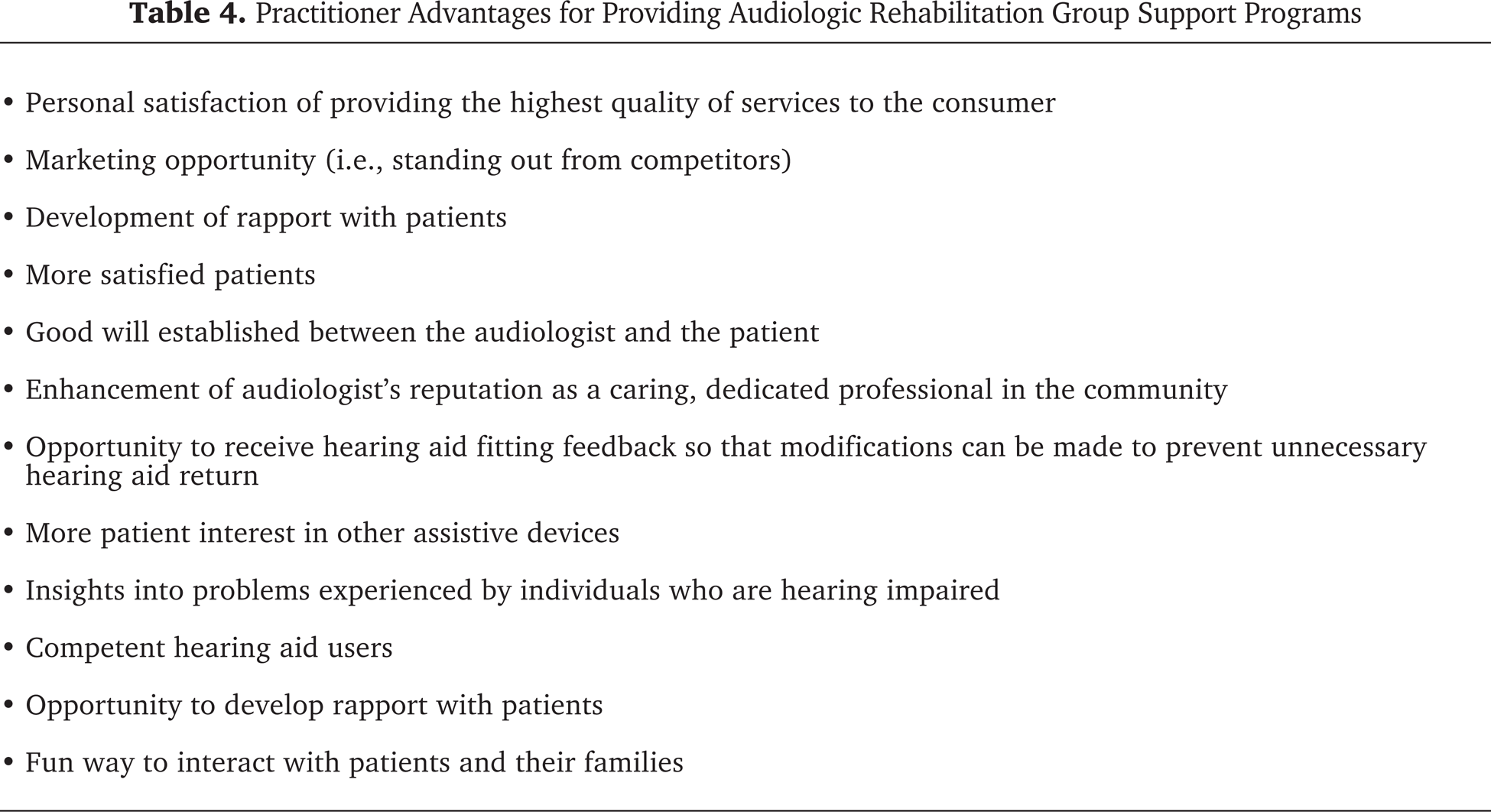
Hearing aids can provide considerable benefit to older listeners who are hearing impaired, but the unique challenges faced by many older listeners beyond peripheral hearing loss may mean that residual difficulties will remain even after the older adult is fit with appropriate amplification. As researchers have pointed out, people with hearing impairment live in an acoustically hostile world (Pichora-Fuller and Kirson, 1994). A number of authors have described group support programs for adults with hearing loss that focus not only on orientation to hearing aids but also on the psychosocial aspects of living with hearing loss, collaborative problem solving, and use of facilitative and repair strategies to overcome communication difficulties (Lesner, 1995; Kricos, 1997, 2000a, 2001, 2003; Abrahamson, 2000; Beyer and Northern, 2000; Warner-Czyz, 2000; Wayner and Abrahamson, 2000; Hickson and Worrall, 2003; Clark and English, 2004). These types of support programs may be particularly helpful for the older adults who are addressed in this article. There are a number of benefits of support groups for new hearing aid users, their significant others, and for practitioners. Tables 3 and 4 highlight some of these advantages.
Benefits of Audiologic Rehabilitation Group Support Programs to New Hearing Aid Users and Their Significant Others

Practitioner Advantages for Providing Audiologic Rehabilitation Group Support Programs
The effects of background noise; rapid, unclear speech; talkers with dialects and accents; and numerous distractions may compromise the ability of the older listener to obtain sufficient benefit from hearing aids to reduce activity limitations and participation restrictions. Consider some of the situations in which older adults find themselves, often on a daily basis: watching television, conversing on the telephone with young grandchildren, attending social events such as noisy parties, participating in coffee hour after religious services, and grocery shopping, among others.
Several researchers have identified a significant relationship between availability of social support and adjustment to hearing loss and hearing aids (see Kricos, 2000b, for a review). Why would social support have such a marked effect on the new hearing aid user? The answer lies in the myriad of ways that hearing loss affects family functioning, intimacy, and social interaction. Because families, friends, and social contacts are affected by hearing loss, they too may have a vested interest in encouraging the new hearing aid user to persevere in adjusting to hearing aid amplification. In turn, the availability of social contacts, may in itself, provide powerful motivation for the new hearing aid user. Clearly a reciprocal relationship exists between new hearing aid users and their social milieus. In view of this relationship between adaptation to hearing loss and availability of social support, it seems extremely important for audiologists to utilize the patient's social networks in a systematic manner.
Hallberg (1999) suggests three ways that audiologic rehabilitation can enhance the magnitude and quality of social support. First, significant others can be provided with knowledge about hearing impairment and its consequences, as well as technical information regarding amplification via hearing aids and other assistive devices. Second, the audiologic rehabilitation program can provide psychosocial support for mutual acceptance of the hearing impairment by both the new hearing aid user and his or her significant other. Third, both the significant other and the new hearing aid user can be taught effective coping strategies.
Collaborative problem solving with audiologists may better prepare older listeners to manage their listening difficulties in acoustically hostile environments. Together, older listeners, significant others, and audiologists can identify and prioritize difficulties experienced, such as attending family dinners. Possible solutions or relief can be explored, implemented, and then evaluated. These solutions likely include communication strategies such as anticipating difficulties, repairing communication breakdowns, active listening guidelines, and improving the listening environment. Inclusion of significant others, who may also be affected by their family member's hearing difficulties, is an important component to ensure the older adult's successful management of hearing loss.
Kricos (2003) provides guidelines for successful collaborative problem solving and group facilitation for audiologists whose postfitting support programs may have focused more on orientation to the care and use of hearing aids. The obvious purpose of a support group is to provide support, and thus the facilitator's role is to enable group members both to obtain and to give support to each other. The focus of the facilitator's effort should be:
to facilitate the expression of feelings among group members,
to foster open communications among the group,
to encourage a focus on successful coping strategies,
to enable group members to provide useful information to each other,
to help establish supportive networks among group members, and
to provide opportunities for each group member to assume a sense of self-empowerment in facing many of the problems and dilemmas that may accompany hearing loss.
With these goals and objectives as a framework, the audiologist will be more effective in assisting families in their quest to learn how to better live with and manage hearing loss.
For a variety of reasons, group programs may not be feasible in some audiology programs. Kramer et al. (2005) point out that especially for older individuals, group meetings may not be appealing because of health problems, transportation difficulties, and scheduling difficulties. Instead, these authors found that a postfitting home education program for older adults and their significant others was an effective means of improving hearing aid satisfaction and quality of life. Further, Kramer et al. (2005) indicated that home education programs are probably more economically advantageous than group programs, which typically are attended by relatively small groups of participants. Finally, it may be hard for many older adults who are experiencing substantial difficulties communicating, particularly in group situations, to participate freely in collaborative problem-solving groups.
Beyond group and home education programs, there are a number of other ways to provide knowledge, support, and coping strategies to older adults with hearing loss and their significant others. Audiologic rehabilitation support programs can be incorporated into individual counseling at the time of the hearing aid fitting, or offered in organized, well-planned printed materials that are given to the patient at the time of the fitting. Older patients and their significant others can be referred to consumer groups such as Self Help for Hard of Hearing (www.shhh.org), the Association for Late Deafened Adults (www.alda.org), or the Internet group known as the Say What Club (www.saywhatclub.com). These groups focus on positive coping strategies for dealing with hearing loss.
6.4 Environmental Control Training
A frequently overlooked intervention is teaching older adults with hearing loss to analyze sources of difficulty in their daily listening environments. Because background noise is one of the complaints most frequently voiced by older adult hearing aid users, it is an issue that should be candidly addressed by the audiologist (Van Vliet, 1996). In a few minutes, the older adult can be asked to describe three or four of their most troublesome listening situations. Then the audiologist can probe for further detail and offer suggestions for avoiding, reducing, or working around the noise sources:
Can the adult convince his place of worship, with the help of the audiologist, to invest in ceiling treatment for the church hall, so that all can better enjoy religious classes, social gatherings, and meetings?
Perhaps the audiologist could have patients rate the quietness of various local restaurants, after which a list could be provided to all new hearing aid patients.
Can the weekly poker game seating be changed so that the new hearing aid user has the most advantageous seating arrangement?
It only takes a few minutes to converse with patients about the issue of environmental control, and the payoff might be more satisfied consumers and more empowered older adult hearing aid users. An investment of a modest amount of time addressing each patient's unique listening challenges can help the audiologist to be a hero in the eyes of his or her patients.
6.5 Active Listening Training
As described earlier, some of the auditory processing and cognitive challenges experienced by older adults may manifest as attentional and speed of processing difficulties during verbal exchanges, as well as problems with divided attention tasks and listening in noise. Thus, this population may benefit from formal listening training. Several studies have documented the efficacy of conducting listening training with adults who are hearing impaired (Walden et al., 1987; Rubinstein and Boothroyd, 1987; Kricos et al., 1992; Kricos and Holmes, 1996). In general, these studies have provided adults with structured lessons and practice at identifying speech stimuli ranging from nonsense syllables through connected speech, and yielded significant, albeit modest, improvements in speech recognition in quiet and in noise.
Kricos and Holmes (1996) documented that active listening training is an effective treatment for helping older individuals (52 to 85 years, × = 70.1 yrs) with hearing impairment to improve their auditory-visual recognition of speech in noise as well as to improve certain aspects of their psychosocial functioning. The active listening program was designed to provide guided practice in recognition of messages in quiet and in noise. The training emphasized coping strategies to help participants obtain the meaning of what was said, even when only part of it was actually understood. The goals of training were to develop good listening habits to increase the participants’ confidence and to help them concentrate more on the meaning of the spoken message rather than on individual speech sounds. Nonverbal and situational cues were stressed, as well as information regarding modifications of the daily home environment to facilitate listening abilities.
Speech tracking, a procedure in which individuals are presented with spoken materials, such as prose, and asked to repeat verbatim what they hear, was also used. This procedure provided the opportunity for participants to practice listening in noise and to use the coping strategies they had been taught. The following guidelines were used during the listening training:
Listen intently to the speaker, with concentration and focus.
Show interest in what the speaker is saying, using eye contact and body language.
If you miss part of what was said, try to use context to figure out the words not understood.
Summarize, out loud or to yourself, what the speaker has said.
Use coping strategies to resolve communication breakdowns, such as asking for repetitions, rephrasing, and confirming.
As much as possible, keep your focus on the speaker, not on the background noise.
Don't give up—listening takes practice!
When communication has been difficult, try to analyze what might have been a better listening strategy.
Bellis (2002) describes the development of deficit-specific intervention plans for children and adults with auditory processing disorders. Her three-pronged intervention format includes the following components: environmental modifications to enhance listening; compensatory strategies to strengthen higher-order, top-down processing skills; and direct remediation techniques. For the latter, her suggestion of using listening exercises requiring temporal resolution or integration may be particularly relevant for the older adults focused upon in this article.
Many of the suggestions made by Bellis (2002) are being used in a promising training protocol undergoing validation at the University of San Francisco (Sweetow and Henderson-Sabes, 2004; Sweetow, 2005). According to Sweetow (2005), the Listening and Communication Enhancement (LACE) is designed to be a cost-effective home-based program to provide listening strategies, to build self-confidence during communication, and to address some of the cognitive changes that compound the listening abilities of many older adults, as discussed earlier in this article. Through interactive and adaptive tasks, the LACE program provides exercises that involve listening to degraded speech, in the form of time-compressed speech to simulate rapid speech, or speech in noise, using either babble or a single competing speaker. Additionally, there are adaptive training activities for cognitive tasks such as auditory memory and speed of processing, as well as interactive communication strategies, all of which are important for conversational fluency. Although this training approach seems promising, at the time this article was prepared, efficacy data were still being collected (Sweetow, 2005).
Recent research by Tobey et al. (2005) may also have exciting applications for improving listening skills in older adults with combined cognitive/auditory processing listening difficulties. Their research showed that auditory-only speech-tracking abilities of adult cochlear implant users were dramatically enhanced as a result of auditory training combined with administration of D-amphetamine. Further, the extent and magnitude of primary and associative auditory cortex activations, as measured by regional cerebral blood flow, was significantly increased in the participant group receiving pharmacologic treatment. Applicability of these findings to the older adults addressed in this article must be determined through continued research in this exciting area.
6.6 Self-efficacy
One area that has received little research regarding its possible effects on audiologic rehabilitation outcomes is self-efficacy. Albert Bandura, a social psychologist, was the originator of self-efficacy theory, the major premise of which is that “what people think, believe, and feel affects how they behave” (Bandura, 1986, p. 25). Bandura suggested that people's behavior may often be better predicted by what they believe about their capabilities rather than by what their capabilities actually are. Self-efficacy is the domain-specific belief that one can successfully complete a particular activity (Bandura 1986, 1989), i.e., self-confidence specific to a certain task. According to Bandura (1986), a person's self-efficacy is the belief that he can organize and use the sources of action needed to manage forthcoming situations (Bandura, 1986). And what are the situations we might anticipate for the older adult with auditory processing/cognitive disorders? As emphasized throughout this article, we might anticipate difficulty with understanding young grandchildren with immature speech, teenage grandchildren who seem temporarily capable of speaking in vowels only, friends who speak too quickly and who forget to enunciate clearly, store clerks and physicians with foreign accents, and innumerable situations in which communication must be carried out in acoustically hostile listening environments.
Rather than representing overall self-confidence, self-efficacy relates to specific tasks. One could have high self-efficacy for learning how to sail but extremely low self-efficacy for public speaking. Self-efficacy for social interaction, hearing aid use, and other forms of audiologic rehabilitation may be perilously low for individuals who have experienced excruciating difficulties in even simple dialogue exchange because of listening difficulties secondary to auditory processing/cognitive difficulties. Self-efficacy may be especially low for older individuals who have waited a considerable amount of time to seek assistance and who, in the meantime, have severely curtailed previously enjoyed social activities. Beyond the fitting of hearing aids and other forms of audiologic rehabilitation recommended in this section, the audiologist must include the nurturing of self-efficacy for hearing aid use, for success with other forms of audiologic rehabilitation, and possibly for gradual re-entry into social interactions.
Numerous studies in both the adult and child psychology literature have demonstrated that increased self-efficacy is predictive of mastery of and successful coping with difficult situations (Bandura, 1986). To date, little research evidence is available to document the effectiveness of self-efficacy promotion in older adults with hearing loss. However, several authors have suggested that self-efficacy is an important consideration, and that the low uptake and continued use of hearing aids by older adults may be partly due to their low self-efficacy for learning how to use and take care of hearing aids (Carson and Pichora-Fuller, 1997; Kricos, 2000b; Weinstein, 2000; Tsuroka et al., 2001).
How can self-efficacy be nurtured in older adults whose daily communication exchanges are often laborious, tiring, and discouraging? According to self-efficacy theory, the following techniques can be tried, listed in order of effectiveness:
First, strive to help the patient achieve mastery without first experiencing failure. For example, if the individual has just been fit with hearing aids, encourage her to begin use of the new hearing aids with familiar communication partners in relatively quiet listening settings. Then gradually, the individual can be encouraged to use the hearing aids in more challenging settings.
Second, offer or enable vicarious experiences such as the opportunity for social observations of individuals with similar listening challenges. In my experience over the years, I have found peer mentoring, support, and role modeling, such as that offered by local SHHH chapters, to provide immeasurable assistance with building self-efficacy in older adults.
Third, use the concept of social persuasion, that is, encouragement of the individual. Ideally the audiologist will provide families with concrete, manageable ways to encourage older adults to think positively yet realistically about their new hearing aids. Families must understand what an important role they can play in encouraging and reinforcing hearing aid use and adjustment.
Fourth, as much as possible, reduce stress associated with the task. Many new hearing aid users become nervous about the way their voices sound, or how hard it is to put the aids in, or how background noises are so much more apparent. Before these inevitable stressors occur, encourage the new hearing aid user to identify any concerns she encounters, remind her that it usually takes a period of time to get used to how things sound, and reassure her that almost all hearing aid users experience this. Perhaps the audiologist may provide some affirmations, such as “It will take me several weeks to get used to my voice and background sounds, but the longer I wear these new hearing aids, the more natural things will sound.” Patients who are reluctant to use affirmations may be encouraged to know that even the great actor Laurence Olivier combated stage fright by going out on the open stage before the audience came in and affirming that he could and would speak clearly and passionately.
6.7 Clear Speech
In recent years, speech and hearing scientists as well as audiologists have recognized the tremendous benefits that production of clear, precise speech can have for individuals with hearing loss and for their frequent communication partners. Talkers are a key variable affecting speech recognition and successful dialogue, and they differ considerably in their rate of speech, precision of articulation, loudness, and use of pauses. Talkers who are relatively easy to lipread speak more clearly and differentiate many speech sounds that tend to look similar on the lips, such as /t/ and /l/ (Lesner and Kricos, 1981; Kricos and Lesner, 1982; Kricos, 1996). Clear speech is a method in which the speaker talks slightly slower and louder, uses frequent pauses, and enunciates speech sounds more clearly. It is not exaggerated speech, but rather a style of speaking that is adopted naturally by many talkers in difficult communication situations, such as conversing in noisy or reverberant environments, or when speaking to foreigners or to listeners who are hearing impaired.
Several research studies have demonstrated that speech produced in a deliberately clear manner is easier to understand than conversational speech for listeners with hearing impairment (Gagné, et al., 1994; Helfer, 1997, 1998; Payton et al., 1994; Picheny, et al., 1986; Schum, 1996; Krause and Braida, 2002, 2004; Liu et al., 2004). Helfer (1998) found that the older the research participant, the more compromised their audiovisual speech recognition and the greater their clear speech benefit. Further, Helfer (1998) found that the degree of hearing loss in older adults was not correlated with their clear-speech benefit. In general, results of studies of clear speech have indicated an increase of approximately 17% to 20% in speech intelligibility when speakers’ clear speech productions are compared with their conversational speech (Krause and Braida, 2005).
Most of these studies have focused on delineating the prominent acoustic characteristics of clear vs conversational speech. Clear speech is characterized by specific acoustic changes, including a slower rate, more frequent pauses, increased duration of phonemes, and fuller differentiation between phonemes. Clinicians who work with individuals who are hearing impaired have suggested the possibility of talker training for the friends and family members of persons who are hearing impaired so that they can learn to speak more clearly (Erber, 1993; Tye-Murray and Schum, 1994). Many individuals with hearing loss are abundantly aware that a substantial number of people with whom they must communicate do not inherently know how to produce clear, visible speech and may benefit from instruction on how to improve auditory and visual speech intelligibility (Kricos, 1996).
A body of research evidence is emerging to show that individuals who speak quickly, run their words together, and drop the endings of words can be taught to speak in a fashion that would enable hard-of-hearing individuals to better understand them. Kricos et al. (2003) trained six talkers to produce clear speech and then compared the duration and number of pauses per sentence they used in their pre- and post-training sentence productions. All six talkers showed substantial increases in sentence duration in the trained clear speech condition. The increased sentence duration evident for five of the talkers was related to the increased number of pauses they used during sentence production in the trained clear speech condition. For the sixth speaker, the increased sentence duration appeared to be due to increased word duration as a result of more precise phoneme and word production, rather than due to pauses. Results of this exploratory study support the systematic training of communication partners of individuals with hearing impairment. The acoustic data suggest that the temporal characteristics of speech are altered in a manner that will benefit the person with a hearing loss when a conversational partner is using trained clear speech.
Schum (2001) found benefits of training both younger and older inexperienced talkers to speak clearly and distinctly, even after only 5 to 10 minutes of practice. Further, he noted that the ability to produce clear speech in most of his participants carried over to conversation, and the benefits lasted about one month if a specific request for clear speech was made to the talker. He noted, however, individual variability in the degree to which participants could learn to produce clear speech, which Kricos et al. (2003) also found.
The first published study to document the benefits of training talkers to speak clearly was conducted by Caissie et al. (2005). These investigators compared a spouse who received approximately 45 minutes of instruction on how to produce clear speech to a spouse who did not receive instruction but who instead was simply asked to speak clearly. Sentence productions for each talker were recorded for conversational speech conditions at 1-week postintervention (intervention being provided for only one of the talkers) and for 1-month postintervention. The recordings were played back for identification by research participants, half of whom were hearing impaired and half were normal hearing. Interestingly, research participants who were hearing impaired had improved results of 33% in the 1-week and 18% in the 1-month postintervention sentence perception testing when the talker was simply asked to use clear speech. Even more impressive, however, were the 42% and 40% improvements, respectively, in the postintervention 1-week and 1-month sentence perception results for the listeners with hearing impairment for the talker who had received clear speech training.
Recently, Krause et al. (Krause and Braida, 2005; Panagiotopoulos and Krause, 2005) have been studying whether it is possible to train individuals to produce clear speech at normal rates, rather than having to slow speech down to what would probably be a somewhat awkward speed for normal conversational purposes. Their results have been encouraging, although training efforts to date have not resulted in the level of improved speech recognition that can be achieved when a slower rate is used (Krause and Braida, 2002; 2004). It is encouraging that the results of research by Panagiotopoulos and Krause (2005) indicate that although older subjects obtained greatest benefit from clear speech produced using a slow rate, they also obtained significant benefit from clear speech produced at normal rates.
So how is clear speech achieved? All sounds are precisely and accurately articulated, the speech rate is slowed a bit, slight pauses are used between phrases and thoughts, and there is a modest increase in vocal volume. Despite these adjustments, however, the talker still strives to maintain a lively voice. The likely results for older adults are more accurate and relaxed communication with their frequent communication partners. The frequent communication partners also benefit. In all likelihood, they will have less need to repeat things, experience less frustration, and avoid misunderstandings. Oticon™ has a brochure available that helps communication partners learn how to produce clear speech for their family or friends who are hearing impaired (Oticon™, 2005). Additional guidelines for speaking clearly can be found in Clark and English (2004).
7. Outcomes Measurement for Intervention with Older Adults with Hearing Loss and Compromised Cognitive/Psychoacoustic Auditory Processing Capabilities
As emphasized throughout this article, hearing scientists and clinical audiologists are on the cusp of being able to precisely and accurately explain and account for the unique challenges that transpire when an older adult's hearing loss is accompanied by cognitive/psychoacoustic auditory processing disorder components. As our information base on these disorders increases, we will be in a better position to design efficacy-based treatment programs that are relevant and helpful to the older listener. Until then, it is critical for the clinical audiologist to establish patient-centered goals to improve communication effectiveness and to document the effectiveness of their audiologic rehabilitation program with older listeners.
Self-assessment measures should be incorporated into the entire rehabilitation process, from planning the treatment program to measuring the outcomes of intervention (Erdman, 2001). Kricos and Lesner (2000) outlined a number of methods of evaluating the effectiveness of audiologic rehabilitation for adults with hearing loss, many of which would be appropriate for the population addressed in this article. Particularly relevant for the older listeners addressed in this article would be measures of hearing aid benefit, use, and satisfaction, as well as patient-satisfaction surveys, measures of activity limitations and participation restrictions, and objective communication performance.
An assessment tool that provides information across several of these domains is the International Outcomes Inventory-Hearing Aids (IOI-HA) (Cox et al., 2000). The IOI-HA has seven items that the patient rates at some designated point of time (e.g., 2 weeks) after the fitting of hearing aids. The items relate to hours of use, activity limitation change, degree of residual activity limitations, satisfaction, degree of participation restrictions, and effects on quality of life. Noble (2002) describes simple modifications that can be made to the original IOI-HA so that it can be used to obtain input from significant others and evaluate alternative interventions, such as assistive technology beyond hearing aids, and listening strategies, among others.
Throughout this paper, the deleterious effects of noise on speech recognition by older adults have been emphasized. Thus, it is essential that their listening difficulties in noise should be carefully evaluated, before and after the intervention. Speech-in-noise tests such as the SIN (Killion and Villchur, 1993), Quick SIN (Etymotic Research, 2001), and HINT (Nilsson et al., 1994), mentioned earlier, should be routinely administered to adults with cognitive/psychoacoustic auditory processing difficulties.
Because of the extraordinary challenges faced by older adults whose communicative success is threatened by cognitive/auditory processing disorders, special considerations must be addressed to verify the effectiveness of the audiologic intervention program designed for them. As indicated several times in this article, the construct of the SSQ (Gatehouse and Noble, 2004) lends itself to potential use as an outcomes measure for audiologic management of older adults with compromised cognitive/psychoacoustic auditory processing capabilities. With appropriate fitting of amplification, realistic counseling, and educational support programs, the situations reported as problems by older listeners may show improvement as indicated by more favorable SSQ results.
Several references have been made in this article to the greater speech recognition problems, slower speed of processing, and declining cognitive abilities in many older adults. These in turn may increase the effort that must be expended to engage in dialogue in typical conversational environments. Thus, consideration to how successful the program of audiologic rehabilitation has been in reducing listening effort should be documented. Listening effort is included on the SSQ (Gatehouse and Noble, 2004). Additionally, Humes (1999), in a principal-components factor analysis of outcomes measures used in several studies, cites evidence that subjective estimates of listening effort, such as use of an “ease of listening” scale from 0 to 100 (with 100 representing very easy listening), represent an aspect of hearing aid outcomes that is separate from measures of aided speech recognition.
Pichora-Fuller (2003) suggests that benefits from various signal-processing schemes might be documented by the hearing aid user's improved cognitive abilities. As mentioned earlier in this article, when there is a hearing loss at the peripheral level, processing of auditory information may be adversely affected because central cognitive resources may have been reallocated to support auditory processing when listening in challenging environments. Thus, these resources may be less available for the storage and retrieval functions of working memory (Larsby et al., 2005). An improved working-memory span may serve as evidence that the effort to understand speech has been reduced by the signal-processing strategy.
Evidence-based practice and outcomes research have gained broad acceptance among practicing audiologists, hearing scientists, policy makers, consumer groups, and patients alike over the past several years. Future research is essential to determine best practices with older adults who have listening challenges that are due at least in part to cognitive/psychoacoustic auditory processing disorders. Ideally, research will involve collaboration between hearing scientists and clinical audiologists. Although several clinical management suggestions have been presented in this article, new approaches to diagnosis and treatment of the unique listening challenges of many older adults will ultimately depend on continued research developments in this area.
8. Summary of Recommendations for Intervention
Clearly, we need considerably more information about the nature of communication difficulties experienced by older adults with cognitive/auditory processing components to their listening difficulties. However, as mentioned in the opening paragraphs of this paper, we can expect to see a significant increase in the number of older individuals who seek our assistance for hearing difficulties, many of whom will be experiencing profound communication problems. Thus, we will not serve them well if we wait for definitive answers about how best to assist them. A summary of interventions we should consider, based on the current knowledge base we have, is presented as follows:
Understanding the older adult's perspectives on communication problems. When evaluating older patients suspected of having cognitive/auditory processing disorders, go beyond consideration of pure-tone and speech thresholds, and speech recognition measured via word lists presented in quiet to include facets of communication that are actually encountered in everyday communication. What type of situations does the patient find most troubling? Does the patient have difficulties separating out and attending to voices from multiple talkers? How much effort is required in difficult vs easy listening conditions, and what effect does this have on the patient? Does the patient seem to have difficulties attending to the talker, or switching attention between talkers? The SSQ (Gatehouse and Noble, 2004) may be a helpful tool in this regard. Use other self-assessment measures such as the HHIE (Ventry and Weinstein, 1982) to obtain the older adult's perception of communication difficulties.
Auditory processing status. Use a battery of measures to assess the contributions of the central auditory system to the patient's auditory comprehension difficulties. Because auditory processing disorders typically result in difficulties understanding speech in noisy settings, use additional speech-in-noise tests such as the HINT (Nilsson et al., 1994), SIN (Killion and Villchur, 1993), and Quick SIN (Killion et al., 2004) as pre- and postintervention measures.
Cognitive status. With the 85-year-old and older group being the fastest growing segment of the population, audiologists will increasingly see an older caseload. To meet the special needs that many adults in this age group may have, it is essential to have a cognitive screening tool available, such as the MMSE (Folstein et al., 1975) or SLUMS (Banks and Morley, 2003), or to secure a psychology referral source for older individuals whose problems may be due to cognitive decline.
Hearing aid considerations. When choosing amplification options, consider the unique audiologic, cognitive, and lifestyle characteristics of patients who have cognitive or psychoacoustic auditory processing contributors to their listening difficulties. Initial research results into appropriate signal-processing strategies suggest that slower speech-processing algorithms may be most beneficial for this population. Further, one of the primary considerations should be reducing the deleterious effects of background noise by using adaptive directional microphones.
Assistive technology beyond hearing aids. Audiologists need to be proactive in considering assistive devices beyond hearing aids when the older adult exhibits the need for maximum improvement in the SNR. This is particularly important, because for many older adults, central cognitive resources may be redistributed to support auditory processing when listening occurs in noise. Thus, the older adult's speech understanding may deteriorate in noisy settings owing to compromised attention, speed of processing, and working memory.
The importance of counseling. In view of the relatively sparse evidence documenting effective treatment strategies for older adults with cognitive or psychoacoustic auditory processing contributors to their listening difficulties, counseling the adult as well as family members is critical. At least at a basic level, older adults need to understand the complexity of their hearing difficulties and its effects on their daily communication interactions. Strategies such as environmental modifications, communication tips, and treatment options need to be presented to the patient and when appropriate, the family. Although audiologists do not at present have all of the explanations of and solutions to the everyday dilemmas encountered by the older adult with special communication challenges, effort must be made to engage in helpful exchanges of information with the patient and the family.
Collaborative problem solving. A collaborative problem-solving approach to helping older adults cope with their listening difficulties is likely to be far more successful than a monologue on the part of the audiologist, in which a one-size-fits-all approach to audiologic management is used. Hearing care professionals and patients can identify the everyday listening challenges that are experienced and then work together to find solutions. As emphasized in this article, offering a collaborative problem-solving approach via group programs that are attended by patients and their frequent communication partners has a number of advantages.
Other interventions. Additional management considerations discussed in this article include controlling the communication environment to reduce listening difficulties, formal listening training, attention to the patient's self-efficacy for managing communication challenges, and clear speech training for frequent communication partners. These interventions may provide significant help to older adults with hearing loss as well as to their families and friends.
9. Final Thoughts
Beyond helping individual patients and their families to manage their communication difficulties, audiologists have another important role to play, and that is to advocate for social justice on behalf of their patients. Worrall and Hickson (2003) define social justice advocacy as the attempt to influence society to be more inclusive of people with communication disability. This approach takes audiologists out of their clinical offices, testing rooms, and hearing aid fitting environments and into the context of the society in which their patients live. In this arena of service, audiologists can work toward barrier-free communication environments through educational programs, such as lecturing to service organizations in the community on topics such as hearing loss, audiological diagnosis, and treatment options; through advocating for public policy to enable older individuals with hearing loss to continue active participation in community activities, and through research to identify and document effective audiologic treatment outcomes. Advocacy may come in the form of educating our professional nonaudiology colleagues about the effects of untreated hearing loss and intervention alternatives. Spitzer (2000), for example, points out that if we were successful in educating our colleagues, every health-care provider's office (e.g., otolaryngologist, podiatrist, and geriatrician) would have assistive listening devices for use with an older-aged caseload that likely has some hearing difficulties.
As the age demographics of the world shift upward, audiologists are in the position to help a substantial portion of adults in the later years of their lives to cope with the challenges they will face, as well as to participate as fully as possible in intellectual, social, and family activities. Key components have been described in this article to increase the clinical service provider's understanding of the unique needs of older adults with cognitive/psychoacoustic auditory processing components to their listening difficulties. Armed with this information, fully understanding the diversity of the older adult population with hearing difficulties, and dedicated to keeping pace with new research as it emerges, audiologists will be positioned to offer maximum assistance to their older clientele.
Footnotes
Appendix 1: Sources for Assistive Technology and Consumer/Professional Support
| Beyond Hearing Aids |
| http://www.beyondhearingaids.com/ |
| 1-800-838-1649 |
| HARC Mercantile, Ltd. |
| http://www.harc.com |
| 1-800-445-9968 |
| Harris Communications |
| http://www.harriscomm.com |
| 1-800-825-6758 |
