




Abstract
Due to the rapid growth of new technologies available in the hearing aid industry, hearing aid testing has become a more complicated issue, and the companies that produce hearing aid analyzers have had to adapt their instruments to meet new needs. Though some in the industry continue to debate the effectiveness of real ear testing, many organizations, such as ASHA, continue to advocate real ear fitting as an important procedure (ASHA ad hoc committee, 1998). However, the increasing number of new technologies can complicate real ear verification. For instance, digital hearing aids with background noise filters don't test well with pure tones or with a continuous noise signal (Frye, 2000).
Inevitably the increase in hearing aid technology has led to the development of the means to test those technologies. New test formats and new test signals have been introduced over the past few years. The FONIX line of hearing aid analyzers has several signals available beyond the simple pure tone sweep.
Pure Tone Burst/Short Sweep—
Many instruments use a short, fast pure tone sweep to measure an aid's response to loud sounds. On the FONIX 6500-CX, this signal is called “PT Burst,” and it takes less than two seconds to complete. Short sweep signals became important when the DSL method of SPL testing became widely used (Martin, 1997). In an SPL test the client's threshold levels, target levels, and uncomfortable levels are converted from dB HL and gain to dB SPL. They are then all displayed on a single graph, showing the client's dynamic hearing range. Aided measurements are made at a soft level (50 dB), a mid-range level (65–70 dB), and a loud level (85–90 dB). Running a full pure tone sweep, or even using a complex noise single for an aided measurement with an 85–90 dB input risks causing the client some discomfort. Since one goal is to not cause the client discomfort, a new signal was devised to make meeting this goal practical. The Short Sweep gives a quick burst of energy at each audiometric frequency, and it's all over and done with in about two seconds. You get a good comparison between the client's uncomfortable levels and how the hearing aid is handling loud sounds. If the client's uncomfortable levels are breached, he'll hardly notice, but you'll see immediately and know to make the proper adjustments.
Digital Speech-in-Noise—
The digital speech-in-noise signal is the result of new hearing aid technologies rather than new testing procedures. Some digital hearing aids on the market have filters that reduce background noise. The Widex Senso and Senso Plus and the Siemens Prisma are some examples of aids that will reduce the gain of continuous noise. Though clearly such a feature has benefits for the user, it does present testing problems using conventional signals. A pure tone sweep will show accurate results for the first two or three frequencies in each band, but then the gain will start to degrade as the noise filters kick in (Frye, 2000). Using a composite noise signal works a little better, but you can't present the signal for more than a couple of seconds, limiting the things you can do while testing. One solution to this problem is to use an interrupted signal. An example is the digital speech-in-noise signal available on FONIX instruments. The digital speech-in-noise signal is actually two signals: one based on the spectrum suggested by the International Collegium of Rehabilitative Audiologists (ICRA) and one is based on the ANSI S3.42–1992 noise signal. The ICRA signal spectrum is derived from the long-term average speech spectrum and has a steep roll-off in the high frequencies. The ANSI signal has a higher signal-to-noise ratio. The feature these two signals share, which gives them the name digital speech-in-noise, is that they are both interrupted at variable intervals rather than being presented continuously. The interruptions trick the hearing aid into treating the signal like speech rather than filtering it out as background noise, giving you an accurate picture of how the hearing aid will work in a real world situation. You can see in Figure 1 the difference between testing a Siemens Prisma with the digital speech-in-noise ANSI signal and the composite noise signal. The differences between a pure tone sweep and the digital speech-in-noise signal are more difficult to show because of inherent differences in the dynamics of pure tones and noise when using a dB SPL scale, and therefore no pure tone curve is pictured.

Curve 1 shows a Siemens Prisma hearing aid tested with the Composite Noise signal. Curve 2 shows the same aid tested under the same conditions but with the Digital Speech-in-Noise signal using the ANSI S3.42–1992 spectrum.
Composite Noise: an Old Standby—
Though not new, composite noise signals continue to be important. Using a composite signal to verify a hearing aid fit affords four benefits. First, it provides a more realistic signal than a pure tone sweep. Pure tones in day-to-day life are rare; mostly we hear different combinations of many frequencies best simulated by a noise signal. Second, the composite signal on FONIX analyzers is speech-weighted making it an even better simulation of what a hearing aid will encounter day-to-day. Third, the composite signal updates two to eight times a second depending on the instrument and test mode, so you can immediately see how adjustments to the hearing aid or to the source input level affect the hearing aid response. Finally, for some aids, particularly AGC aids, pure tones can cause higher-than-actual returns for lower frequencies, an effect referred to as the “artificial blooming of the lows.” (Heide, 1987). Less common, but sometimes problematic, is a similar occurrence in the very high frequencies. Figure 2 shows an example of both types of blooming. The bold curve is an aided response using a composite signal at 70 dB; the thin curve is a test of the same aid using a pure tone signal at 70 dB. The upper graph shows the difference—the pure tone signal gives anywhere from 5 to 15 dB more output below 500 Hz and nearly 10 dB more output above 6000 Hz. The composite signal used on FONIX instruments is based on the ANSI S3.42 spectrum. It is comprised of 80 different frequencies on the 6500-CX and 79 different frequencies on FONIX portable units. Its knee point is at 900 Hz where it is down 3 dB, and it rolls off at a rate of 6 dB per octave.
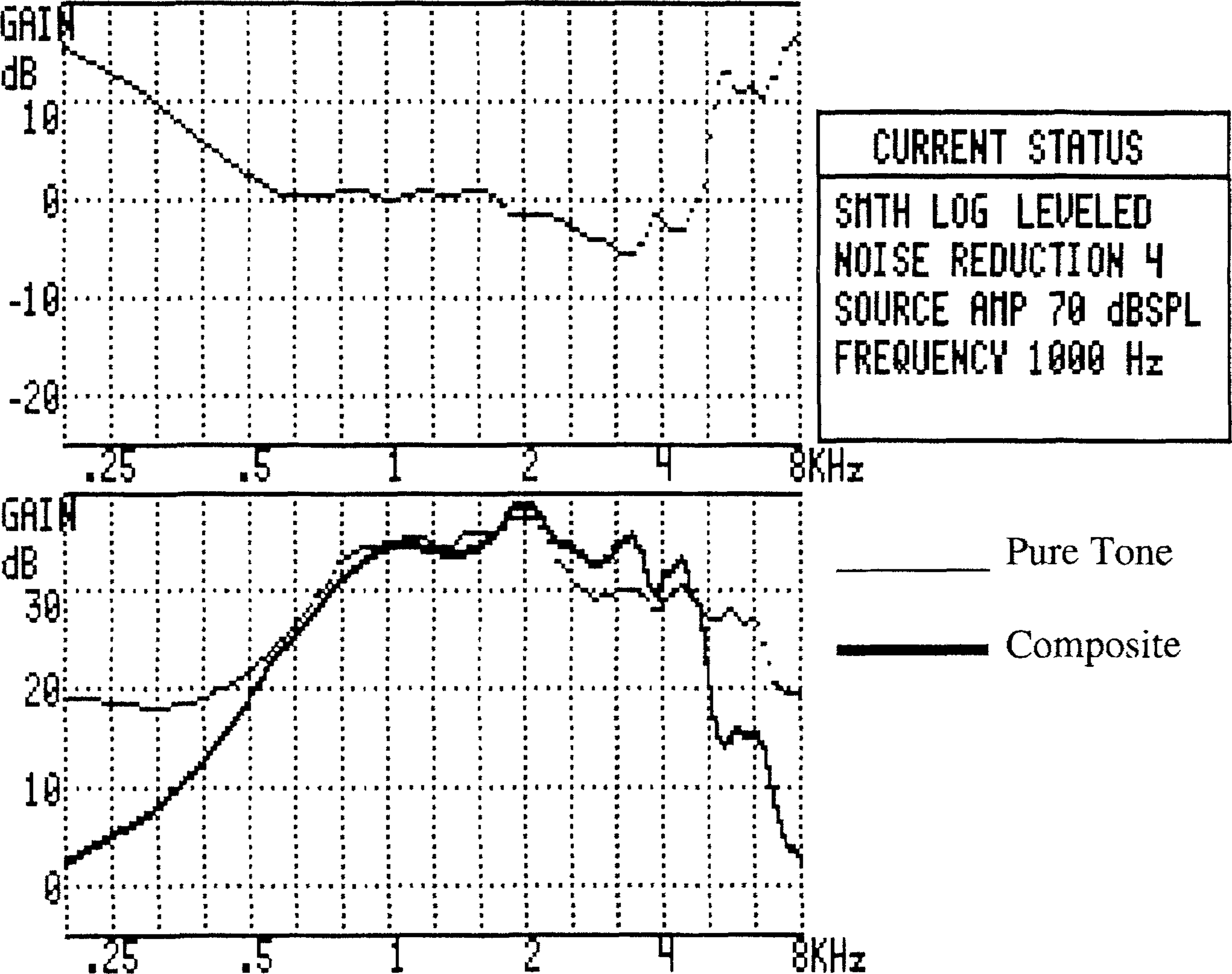
The bold response shows an AGC hearing aid's response to the composite signal with a 70 dB source input. The thin Curve shows the same aid under the same conditions but with a 70 dB pure tone input. The upper graph shows the difference curve—pure tones return 5 to 15 dB more gain below 500 Hz and 10 dB more gain above 6000 Hz.
The advent of new hearing aid technologies provides hearing aid users with more choices than ever before. The industry has moved quickly to keep up, devising new testing procedures and signals to verify the function of such hearing aids. Putting these new procedures and signals into practice can improve hearing aid fittings and hopefully improve customer satisfaction.