




Abstract
The relationship between balance laws and the Principle of Virtual Work as well as the structure of contact interactions in continua remain foundational issues in Mechanics. In this work, we revisit these issues within the distributional framework emphasized by Paul Germain. We show that while the Principle of Virtual Work implies balance of forces and moments for nth-gradient continua, balance laws alone do not suffice to characterize equilibrium for
Keywords
1. Introduction
From its earliest foundations, two central postulations have been considered in Mechanics: the Principle of Virtual Work, and balance of forces and moments. Often attributed to Archytas of Tarentum [1], the Principle of Virtual Work may be regarded as the more fundamental principle in Mechanics, since all of the balance laws of Mechanics can be derived from it. This viewpoint was forcefully advanced by d’Alembert and Lagrange, who developed a unified analytical framework for finite dimensional constrained systems and for hydrodynamics. In the final note of the last edition of Lagrange’s Mécanique Analytique, the first formulation of the Principle of Virtual Work applicable to general continua was presented. This formulation was subsequently taken up and significantly extended by Piola, who developed a theory of continua whose internal interactions depend on gradients of deformation of arbitrary order [2,3]. Piola also proved that, for the most general class of continua in which the placement is an admissible kinematical variable, equilibrium necessarily requires the balance of forces and the balance of moments of forces, a result later referred to as “Piola’s theorem” by Truesdell [4].
Higher-gradient continuum theories have become necessary for accurately modeling the unusual mechanics of pantographic sheets and related metamaterials. In woven pantographic fabrics, consisting of two orthogonal fiber networks with pivot connections, homogenization leads to a second-gradient elastic surface exhibiting anisotropy and even subcoercive energy characterized by vanishing stiffness under uniform modes. Such models successfully reproduce experimentally observed uncommon behaviors [5–8]. Likewise, detailed mesoscale models of pantographic cells demonstrate that hinge compliance produces dramatically different strain-energy distributions under compression versus tension [9,10], a nonlocal and curvature-sensitive effect that cannot be captured by a classical first-gradient continuum.
One- and three-dimensional pantographic architectures further provide compelling evidence for both the necessity and the predictive power of higher-gradient continuum theories. The work [11] reports that three-dimensional micro-scale pantographs combine the in-plane resilience of two-dimensional pantographs with additional features such as pronounced softening in low loading regimes, phenomena that fall outside the predictive capacity of first-gradient models. Similarly, engineered bar-and-hinge lattices such as the recently proposed ZAPAB metamaterials exhibit peculiar floppy modes and bending responses governed by curvature gradients. The works [12,13] show that a one-dimensional continuum with energy depending solely on the spatial derivative of curvature is required to reproduce ZAPAB simulations. The work [14] design a Hart’s-antiparallelogram lattice whose homogenized limit is a third-gradient rod, with elastic energy vanishing under constant-curvature deformations so that only the spatial derivative of curvature contributes. More generally, consistency and positive definiteness in discrete-to-continuum homogenization often necessitate generalized gradient theories, since Cauchy models may be incompatible with the underlying microstructure [15]. Even duoskelion beam arrays, exhibiting axial-flexural coupling, require enriched descriptions [16].
Variational formulations are particularly well suited to the modeling of pantographic sheets and ZAPAB-type metamaterials, since their intrinsically higher-gradient mechanical response manifested through curvature-dependent stiffness, nonlocal interactions, and edge forces, can be incorporated by postulating an energy functional whose first variation yields both the bulk equilibrium equations and the associated higher-order boundary interactions [17–20]. These formulations are directly amenable to numerical implementation and can be extended to account for dissipation through Hamilton-Rayleigh structures [21,22].
Taken together, these examples show that curvature-dependent contact surface interactions, nonlocal coupling across microstructural cells, and wedge and edge contact forces are intrinsic to these metamaterials, and that higher-gradient continua provide the natural framework for capturing their multi-scale elastic response [23–26].
However, the conclusion of Noll’s theorem, see [27,28], asserts that the surface contact force density associated with a system of forces depends only on position, time, and the unit normal to the oriented surface over which it is integrated to produce the resultant surface contact force, see the following Section 4 for a precise formulation. Immediately following the statement of the theorem, Noll comments on the scope of this conclusion in a footnote on page 41 of Noll [27], where he writes:
The assertion of this theorem appears in all of the past literature as an assumption. It has been proposed occasionally that one should weaken this assumption and allow the stress to depend not only on the tangent plane at
This statement has led some researchers to conclude that higher-gradient continua, in which surface contact forces may depend on curvature, must contain an internal inconsistency.
In this paper, we demonstrate the following:
Within the distributional framework formulated in Section 2, the Principle of Virtual Work implies balance of forces and moments for nth-gradient continua. However, the converse implication holds only for first-gradient continua, that is, continua whose internal work functional depends solely on first-order gradients of the placement. In higher-gradient theories, balance laws alone do not suffice to characterize equilibrium configurations.
We show that the conclusion of Noll’s theorem rests essentially on implicit additional assumptions, namely the absence of wedge and edge interactions and the boundedness of the surface contact force density on the space of oriented surfaces. Since these hypotheses are not satisfied by general higher-gradient continua, the curvature-dependent surface forces and edge interactions arising in such theories lie outside the scope of the theorem and do not signal any logical inconsistency.
Our exposition makes systematic use of the Schwartz theory of distributions, a framework whose importance in Continuum Mechanics has long been underappreciated, despite Paul Germain’s sustained emphasis on its foundational character [29,30]. The essential point may be stated succinctly. The internal work functional must be linear and continuous with respect to a class of admissible virtual displacements containing smooth vector fields defined on the current configuration
A celebrated theorem of Laurent Schwartz [31] states that for every distribution

An internal work functional given by the right-hand side of (1) is of order n and models an nth-gradient continuum when
When the deformation energy is written as an integral with respect to Lebesgue measure with density function W that depends on the gradients of the placement up to order n, its first variation yields the internal work functional, which is itself of order n.
As done by Lagrange, Piola, and then Cauchy, it is natural to start the analysis with first-gradient continua.
Objectivity, or material frame indifference, requires that for an internal work functional we must have
This representation reveals the natural emergence of potential higher-order contact interactions, including surface, wedge and edge forces, as intrinsic features of internal work functionals when one regards them as distributions.
1.1. Outline
In Section 2, we formulate the Principle of Virtual Work within the functional analytic framework introduced by Paul Germain. Internal and external interactions are modeled via distributions acting on admissible virtual displacements, and we briefly discuss how internal work functionals constrain the class of admissible external work functionals.
In Section 3, we investigate the relationship between balance laws and the Principle of Virtual Work. We first reestablish, within our functional analytic setting, Piola’s result that for nth-gradient continua the Principle of Virtual Work implies balance of forces and balance of moments for every sub-body. We then demonstrate that the converse holds only for first-gradient continua. More precisely, for higher-gradient continua, a postulation scheme based solely on balance of forces and moments does not uniquely determine equilibrium configurations, and a formulation based on the Principle of Virtual Work is therefore unavoidable.
In Section 4, we revisit Noll’s argument that the surface contact force density depends only on the unit normal to the oriented surface over which the resultant interaction is evaluated. We identify precisely where implicit assumptions, namely, the absence of edge and wedge contact forces and the boundedness of the surface density, enter the proof, and we show that these hypotheses fail for general higher-gradient continua. Consequently, the surface density may depend nontrivially on curvature, notwithstanding Noll’s comment regarding the scope of his theorem.
In our concluding Section 5, we discuss the structural conditions under which Noll’s theorem extends to higher-gradient continua, emphasizing the role of wedge and edge interactions and outlining directions for further investigation.
2. Preliminaries
2.1. The Principle of Virtual Work
We formulate the Principle of Virtual Work following the presentation of Paul Germain; for a more detailed development in its modern functional analytic form, we refer to his foundational works [29,30]. We consider a deformable body whose current configuration at a fixed time is given by the closure of a bounded domain
The assumptions of the Principle of Virtual Work can be split into the following parts:
Internal interactions in a sub-body
For each sub-body
The internal work associated with a sub-body
If
The internal work functional for any sub-body
External interactions acting on a sub-body
For every admissible virtual displacement

We comment that a persistent source of misunderstanding in the literature concerns the status of the internal work functional within approaches based exclusively on balance laws. Critics have claimed that the Principle of Virtual Work is applicable only to linear constitutive relations, but this assertion rests on a fundamental conceptual confusion. The Principle of Virtual Work may be understood as a natural extension of the Principle of Minimum Energy to a broader class of mechanical systems. The Principle of Minimum Energy states that equilibrium configurations correspond to minimizers of the total energy functional. Euler and Lagrange established how to compute the first variation of this functional in order to enforce a stationarity condition. In modern terms, this procedure corresponds to evaluating the Fr chet derivative of the energy functional and requiring that it vanishes for all admissible infinitesimal variations about an equilibrium configuration. Crucially, even when the energy functional is non quadratic and leads to nonlinear equilibrium equations, its Fr chet derivative remains a linear functional of the admissible variations, and this linearity underlies the general validity of the Principle of Virtual Work.
The origin of the concept of virtual displacement is most naturally understood from the above variational perspective in which they correspond to small variations of the equilibrium configuration. We remark that both Lagrange and Piola devoted considerable effort to justifying the formal identity
2.2. Constraints on external work functionals
As a direct consequence of (2), once an internal work functional has been specified for a deformable body, the class of admissible external work functionals is determined. This conclusion has sometimes been regarded as difficult to understand; we briefly present the argument originally articulated by Piola in modern terminology.
Consider, for example, a compressible Eulerian fluid whose deformation energy depends on the spatial mass density ρ. In this case, the internal work functional has a highly specific form, since it is given by the Fr chet derivative of the corresponding deformation energy functional. It then follows that the external work functional for a sub-body
It should therefore be expected that, once the structure of the internal work functional has been specified, the class of admissible external work functionals applicable to the body is correspondingly restricted. In particular, if the internal work functional is of order n, then the external work functional cannot be of higher order than n, although it may be of lower order.
3. The Principle of Virtual Work and balance laws
In this section, we demonstrate that while the Principle of Virtual Work implies balance of forces and moments for nth-gradient continua, the converse holds only for first-gradient continua, so that balance laws alone are insufficient to characterize equilibrium in higher-gradient theories.
3.1. Piola’s theorem in the distributional framework
As recognized by Truesdell, see [4,28], and demonstrated in [2,3], Gabrio Piola proved that for every nth-gradient continuum, a necessary condition for equilibrium is that the balance of forces and the balance of moments hold for every sub-body
By Section 1.1 and Section 2.1, the external work functional associated to a sub-body

The external work functional must vanish when

by (2) and objectivity of the internal work functional. Above,

By choosing

Introducing the resultant of external forces

we conclude that equation (4) implies the balance of forces equation

In the variationally inspired mechanics literature, this relation is commonly referred to as the equation of equilibrium under translation.
From (3) and (4), we conclude that for every skew tensor

and thus, we have the vanishing of the skew part:

Introducing the resultant moment of external forces

we see that (7) is equivalent to the balance of moments equation

The second term on the left-hand side of (9) represents a resultant couple applied to
Together, (5) and (9) constitute Piola’s theorem for nth-gradient continua, i.e., the Principle of Virtual Work implies balance of forces and moments for every sub-body of
3.2. Indeterminacy of balance laws in higher-gradient continua
It is well known that for first-gradient continua satisfying
We consider a homogeneous and isotropic linear dilatation strain-gradient elastic body with stored energy


where

and the class of admissible external work functions (see the discussion in Section 2.2) takes the form

where
For an equilibrium configuration, it is straightforward to see that (5) and (9) are given, respectively, by


for every sub-body
This conclusion is, however, incorrect. As shown in Section 4 of [34], once

which does not appear in the balance laws. It follows that a postulation scheme based solely on the two basic balance laws is insufficient to determine the response of linearly elastic dilatational strain gradient continua, and more generally of higher-gradient continua, and a formulation grounded in the Principle of Virtual Work is essential.
4. The scope of Noll’s theorem
In this section, we examine Noll’s theorem and proof and show that its conclusion relies essentially on assumptions that fail for higher-gradient continua.
4.1. Preliminary set-up and hypotheses
In this section, we consider a family of vector-valued measures
A measure
A measure supported on the wedges of
A measure supported on the edges of
A measure supported on the faces,
We denote by
We first assume the existence of a constant

a uniform boundedness condition that is natural for standard body force densities

Finally, we assume locality with respect to the surface, in the sense that if

Similar to Section 3, we define the resultant of external forces on

and we assume balance of forces: for every sub-body

4.2. Noll’s additional assumptions and theorem
In addition to the preliminary assumptions introduced in the previous section, Noll’s theorem relies on the following fundamental hypotheses, see [27,36]:
The body does not support wedge or edge interactions; that is, for every sub-body

The surface density

Under the assumptions of Section 4.1 together with (21) and (22), Noll’s theorem, in a form essentially identical to Theorem IV of Noll [27] (see also Section III.3 of Truesdell [36]), may be stated as follows.

whenever the oriented surface
4.3. Noll’s argument
We pinpoint the stages in Noll’s proof of Theorem 4.1 [27] at which the additional assumptions (21) and (22) are utilized for points

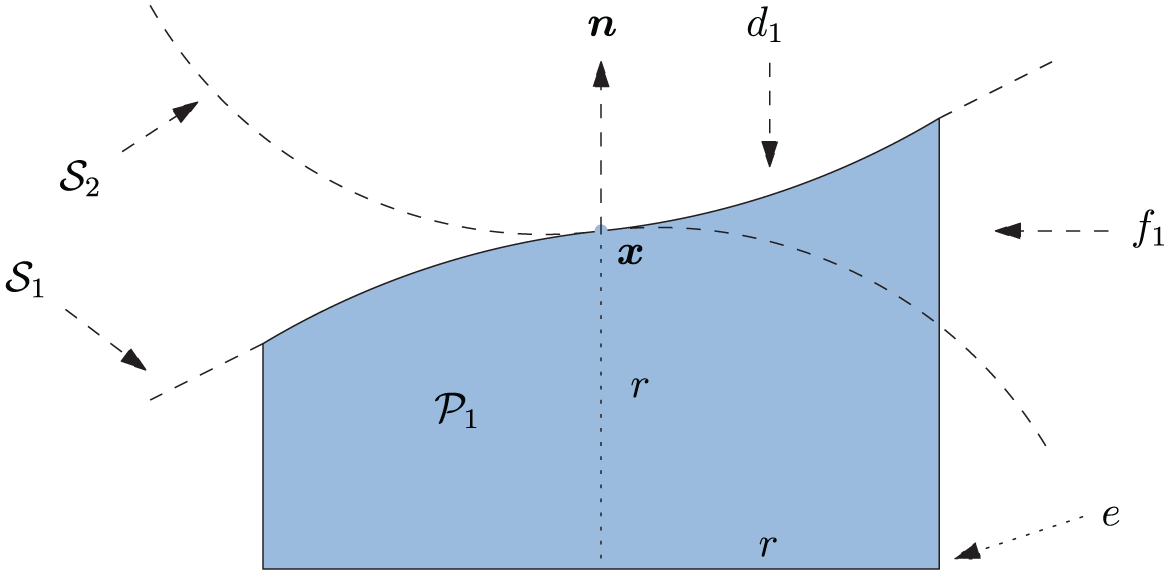
Noll’s shrinking cylindrical sub-bodies.
Since

For

Subtracting the two equations yields

Assuming that

It is at this stage of the argument that Noll’s additional assumptions (21) and (22) play crucial roles in showing that the right-hand side of (27) vanishes as

By (25), it then follows that for

Then (27), (30), and (28) imply that

Combining (19), (20), (16), the assumption of absence of wedge and edge forces (21), and the area estimate (25), we deduce that for

It then follows from (31) and (32) that

proving Theorem 4.1 for the case that
4.4. Non-applicability of Noll’s theorem to higher-gradient continua
The conclusion of Noll’s theorem, Theorem 4.1, together with his accompanying remark quoted in the Introduction, appears to conflict with what is well known for nth-gradient materials. In particular, for general second-gradient materials, which form a subclass of nth-gradient materials with
To see that the assumption (22) does not hold for general second-gradient continua, consider a second-gradient elastic material with stored energy

where

with


Let

each of equal height along the

Thus, (22) does not hold for general second-gradient materials. We emphasize that the blow up behavior described in (39) renders the crucial identity (29) unattainable in Noll’s proof, since the surfaces
Moreover, it is well established that general higher-gradient continua possess edge and wedge contact interactions and therefore do not satisfy Noll’s additional assumption (21), see [38,39]. In particular, the results of Eremeyev and dell’Isola [40] show that, given a sub-body
5. Conclusion
By formulating internal and external interactions within the distributional framework emphasized by Paul Germain, we have revisited foundational questions in Continuum Mechanics from a functional analytic standpoint. In the spirit of Piola, we have argued that the Principle of Virtual Work provides the appropriate structural foundation for higher-gradient continuum theories. Although balance of forces and moments remain necessary conditions for equilibrium, they are no longer sufficient beyond the first-gradient setting. In addition, our reexamination of Noll’s theorem reveals that its conclusion relies on additional assumptions that are not satisfied in general higher-gradient continua. Thus, curvature-dependent surface interactions in such materials do not conflict with Noll’s result, but fall outside the range of its applicability.
A natural direction for further investigation is the classification of higher-gradient materials for which the conclusion of Noll’s theorem remains valid. It is therefore appropriate to begin with second-gradient continua, which do not admit wedge interactions. Results from dell’Isola and Seppecher [38] establish that, for second-gradient continua equipped with natural forms of internal and external work functionals from dell’Isola et al. [39] and satisfying the Principle of Virtual Work, the absence of edge contact interactions as defined in Section 4.1 suffices to recover the conclusion of Noll’s theorem. Indeed, Theorem 9 of dell’Isola and Seppecher [38] shows that there exist a second-order tensor field

where
More broadly, the structural representations of wedge, edge, and surface contact forces derived in dell’Isola et al. [39] suggest a systematic route for determining the admissible form of surface contact forces under the assumption that wedge and edge contact interactions are excluded. Advancing this program would work toward establishing the structural boundary that defines the true scope of Noll’s theorem in higher-gradient continua.
Footnotes
Acknowledgements
This paper was suggested by Professor Giampiero Del Piero to the second author many years ago. Only with the efforts of the first author could it be written.

Funding
C. R. gratefully acknowledges support from NSF DMS-2307562.
Declaration of conflicting interests
The authors declared no potential conflicts of interest with respect to the research, authorship, and/or publication of this article.