




Abstract
VAM (velocità ascensionale media) is a measurement that quantifies a cyclist’s climbing ability. We show that to minimize the time to attain a given height gain—which is tantamount to maximizing VAM—a cyclist should climb as steep a constant-grade hill as possible. Apart from the power-to-weight ratio, the limit of steepness is imposed by such factors as the efficiency of pedalling, which is related to feasible cadence, maintaining balance, preventing lifting of the front, and skidding of the rear, wheel. This article is focused on consequences of the power available to the cyclist, which can be viewed as a necessary condition to examine other aspects of climbing strategy. We show that—for given start and end points, and for any fixed average-power constraint—the brachistochrone, which is the trajectory of minimum ascent time, is the straight line connecting these points, covered with a constant speed, which along such a line is equivalent to a constant power. This is in contrast to the classical solution of a descent brachistochrone under gravity, which is a cycloid along which the speed is not constant.
Keywords
1. Introduction
VAM (velocità ascensionale media) is the average ascent velocity. It is a measurement of the rate of ascent that quantifies a cyclist’s climbing ability.
In this article, we solve an optimization problem motivated by and applied to cycling. Specifically, we find the hill-climbing trajectory that minimizes the ascent time. While this problem is not directly concerned with the mechanics of continuous media, there are interesting parallels between it and the problem of wave propagation in layered media. In particular, in the geometrical approximation to wave propagation, the trajectory of a ray can be found from Fermat’s principle. This is a variational problem whose solution, the ray trajectory, extremizes—typically minimizes—the travel time, in a close mathematical analogy to the problem considered here.
This article is a direct follow-up of Bos et al. [1]; therein, the authors reach the same conclusions but with an argument where the imposed assumptions overly reduce the candidate ascents; hence, this follow-up. Ascent optimizations are also examined by Bos et al. [2–5], and the results of these four articles are used herein. There is, however, an important distinction between Bos et al. [1] and Bos et al. [2–5]. In the 2024 and 2025 articles, we optimize the ascent strategy for a given uphill; in other words, the ascent profile is known. In the 2021 article—as well as in the present article—we seek the profile to maximize the ascent rate for a given average power. In other words, we seek the corresponding brachistochrone. Notably, brachistochrone problems in relation to cycling are discussed also in other contexts [e.g., 6].
We begin this article by examining the expression relating power and speed as a function of steepness. We prove two lemmas that lead us to conclude that to minimize the time to attain a given height gain, a cyclist should ride as steep a climb as possible. We conclude the article with numerical insights and a brief discussion, where we comment on certain qualifiers of this conclusion.
2. Formulation
Following our previous work [2–5], we let

where P is the power, V is the ground speed, m is the mass of the bicycle-cyclist system, g is the acceleration due to gravity, θ is the slope of the hill,
Bos et al. [3, Section 3] prove that, given an average-power constraint, the ascent time is minimized if a cyclist maintains a constant ground speed, regardless of the slope. In particular, if the average power,

then the optimal constant ground speed, V, can be found by solving

where H is the height gain, D is the horizontal distance, and L is the arclength of the ascent curve [3, Appendix G].
The work done in reaching any speed—before starting the ascent—is not included in the average power for the ascent. In any case, such an effect is negligible for longer ascents, which are required to quantify the cyclist’s climbing ability using VAM.
The ascent time is

Given H and D, the optimal speed,
Let us state the following proposition, whose proof follows from Lemma 1.


where

Let us write equation (2) as

where

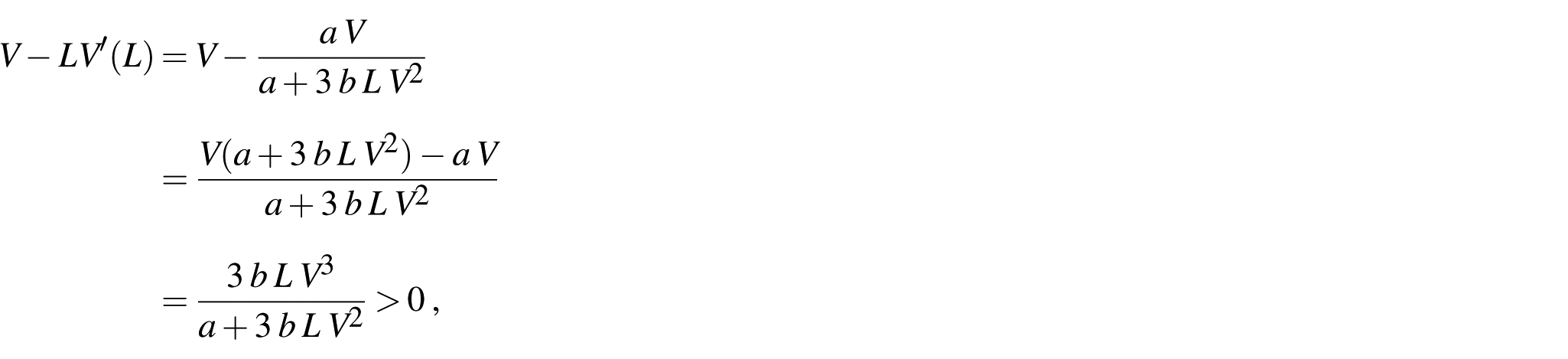
Differentiating implicitly with respect to L, we obtain

and, hence,

Substituting this expression into
as claimed. □
In other words, the time of ascent is an increasing function of the length of the ascent path. Since

which is an interesting relation.
We now consider the question of finding, among straight lines with a given height gain, H, the one that gives the shortest ascent time. The answer, as we show, is—in the limit—a vertical climb.


where

we write equation (2) as

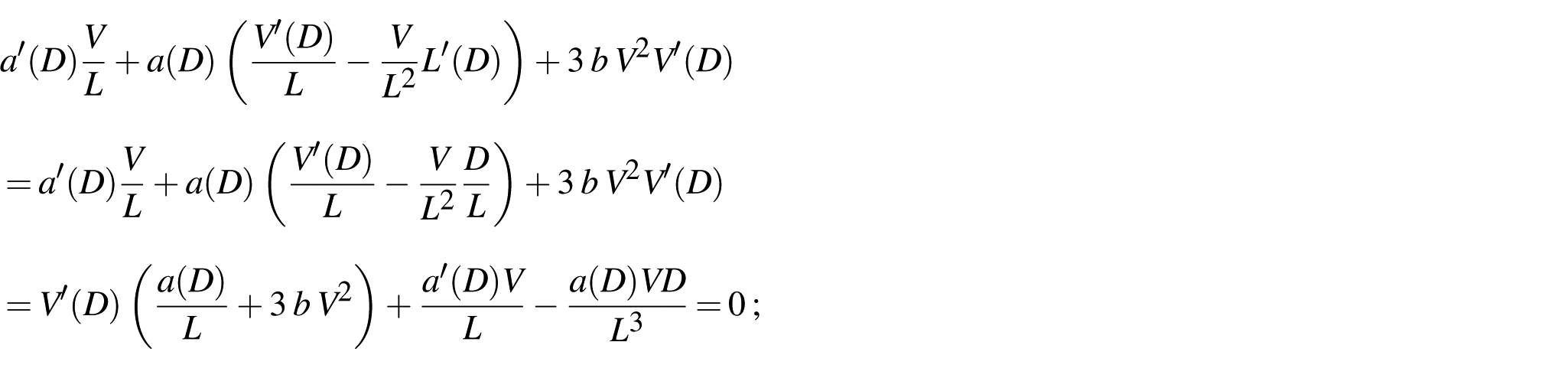
Differentiating implicitly with respect to D, we obtain
hence,

But

Consequently,

so that
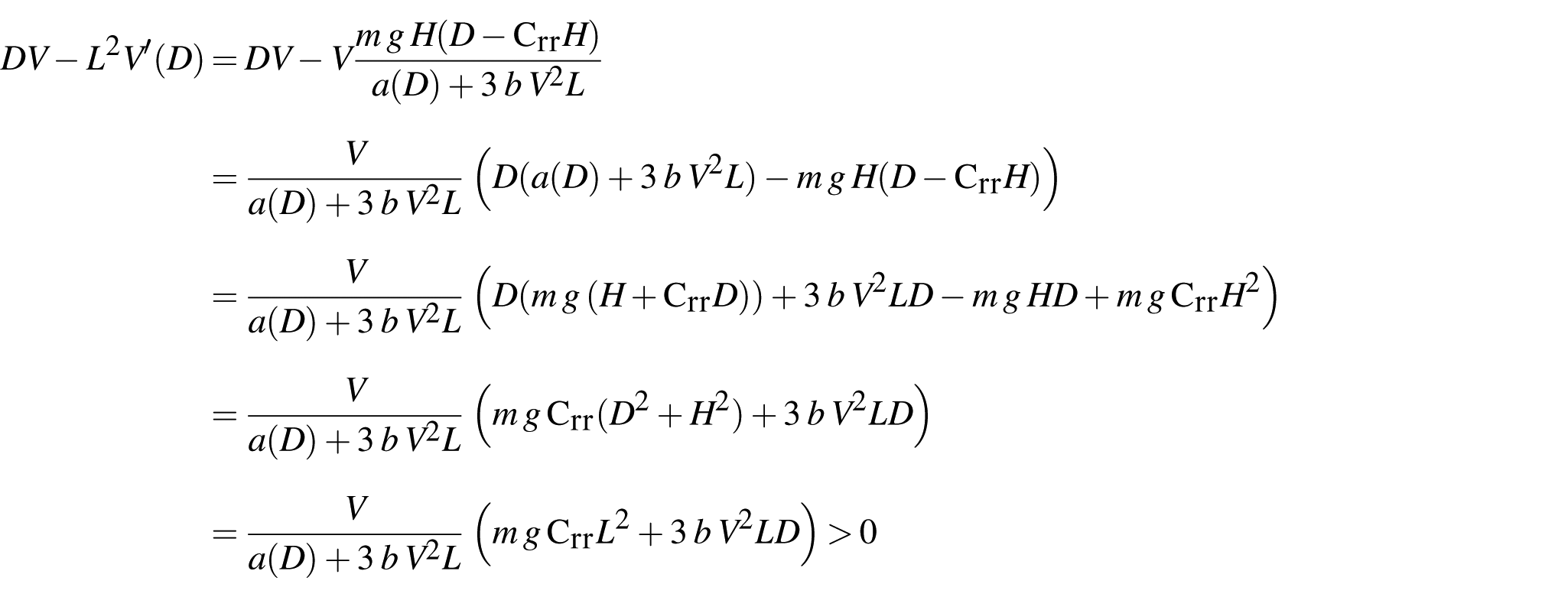
and thus—by equation (4)—
Consequently, a cyclist wishing to minimize the time to attain a given height gain should ride as steep a constant-grade climb as possible.
3. Numerical insights
3.1. Speed, its vertical component and ascent time as functions of slope
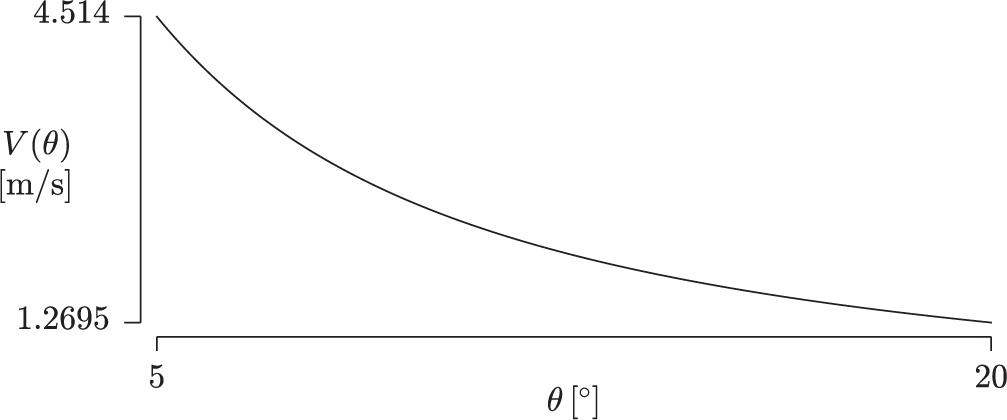
In this section, we present numerical insights into the ground speed, V, its vertical component and the ascent time, as a function of the slope, θ. To do so, we return to model (1) with
The ground speed is shown in Figure 1. As expected—given the power constraint—it decreases with the increase of steepness.
The vertical component of that speed is
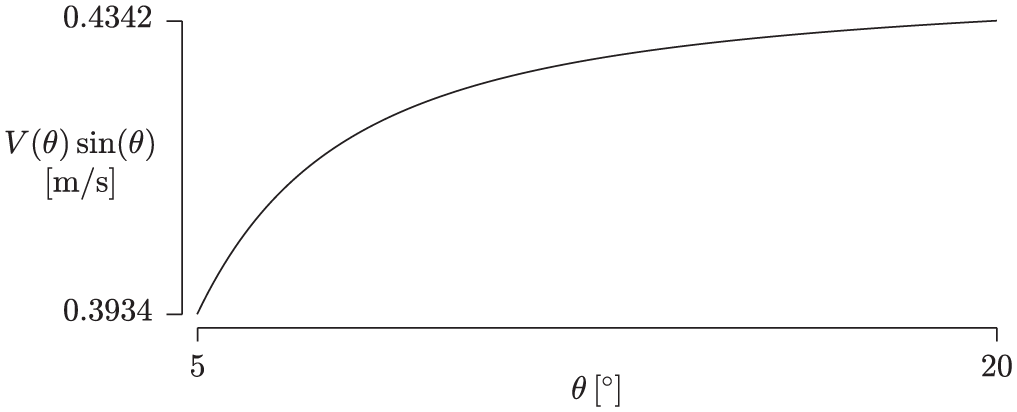
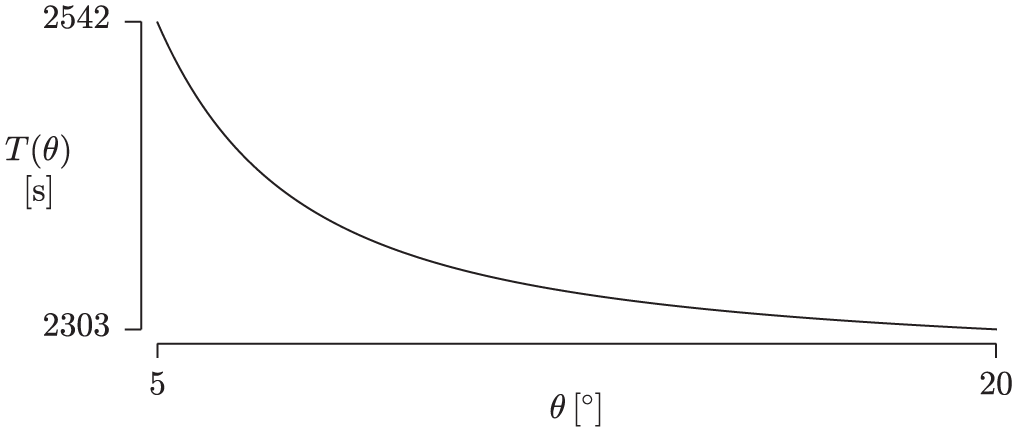
The ascent time for the elevation gain of
3.2. Relations between power, mass and optimal slopes
In this section, we present numerical insights into relations between power, mass and optimal slopes. Figures 1–3 examine ascents under the fixed power constraint,
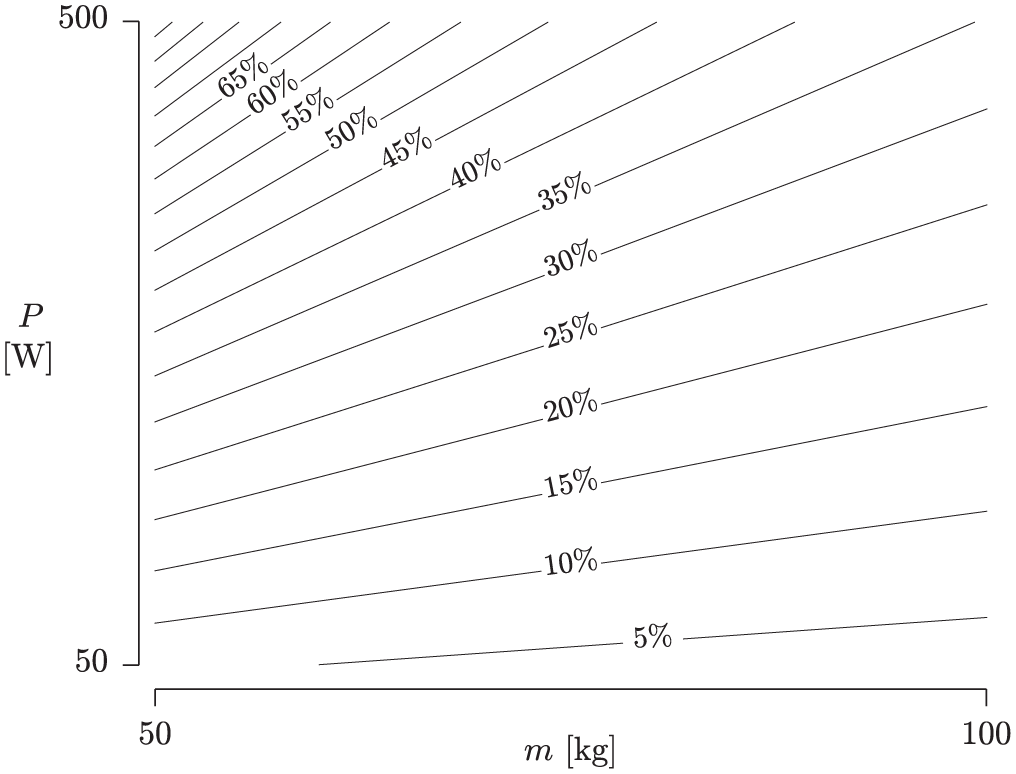
Contour lines showing maximum slope climbable with
We assume
We also need to consider pragmatic limitations in handling a bicycle, such as lifting of the front wheel and skidding of the rear wheel due to steepness of a climb. From empirical studies, we infer that the steepest ascents achievable in cycling are about
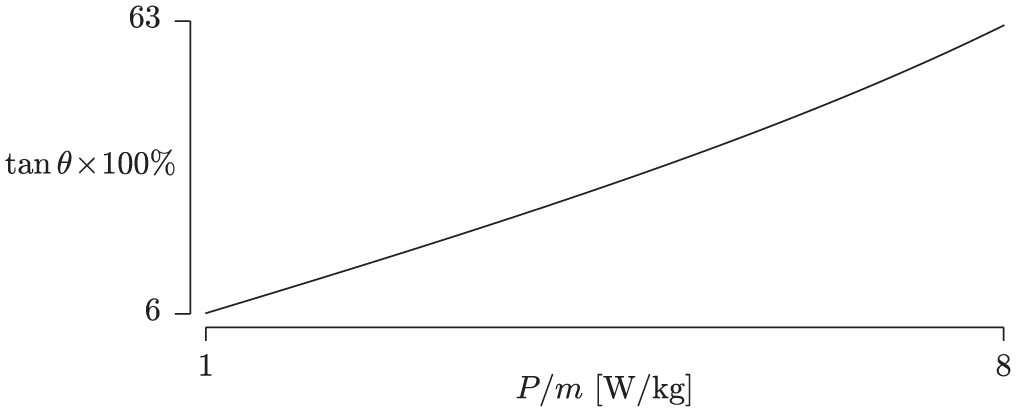
Slope as a function of power-to-weight ratio for
For instance, letting
4. Discussion and conclusion
As stated by Lemmas 1 and 2, respectively, the optimal ascent to maximize the VAM—for a given average power—is a constant-grade hill with the highest grade. As proven by Bos et al. [3, Section 3]—for a given average power—the ascent time is minimized by a constant ground speed, regardless of slope’s steepness and shape. Hence, constancy of grade and speed imply a constancy of instantaneous power.
In other words, for given start and end points as well as a fixed average-power constraint, the brachistochrone is the straight line connecting these points. VAM is maximized by the shortest distance covered with a constant speed corresponding to that average power, which is also the instantaneous power. This is in contrast to the classical solution of a descent brachistochrone under gravity, which is a cycloid along which the speed is not constant. Herein, the shortness of the straight line, which is tantamount to its steepness, is subject to the power-to-weight ratio and to pragmatic issues of pedalling efficiency and bicycle handling.
Footnotes
Acknowledgements
We wish to acknowledge insightful comments of Scott Anderson, Mikhail Kochetov, Andrea Oliveri and an anonymous reviewer, as well as proofreading of David Dalton.
Authors’ note
There is no supplementary material. Interested readers might contact the corresponding author for computations with a variety of input parameters.

Funding
The authors disclosed receipt of the following financial support for the research, authorship and/or publication of this article: The research is partially supported by the NSERC Discovery Grant RGPIN-2018-05158 of M.A.S.
Declaration of conflicting interests
The authors declared no potential conflicts of interest with respect to the research authorship and/or publication of this article.