We employ Muskhelishvili’s complex variable method to derive a closed-form solution to the two-dimensional Eshelby’s problem associated with an epitrochoidal thermal inclusion undergoing uniform in-plane dilatational eigenstrains concentrically embedded in a coated circular domain with a rigidly clamped or traction-free boundary. In general, the mean stress within the epitrochoidal inclusion and its supplement to the circular domain is non-uniform. However, when the ratio of the shear modulus of the coating to that of the circular domain is analytically determined for given geometric and material parameters, the mean stress within the epitrochoidal inclusion and its supplement to the circular domain can indeed remain uniform. In order to accomplish this uniformity property, a thin coating with a rigidly clamped boundary can be replaced by a spring-type interface, and a thin coating with a traction-free boundary can be replaced by a membrane-type interface.
Eshelby’s problem of a subdomain (the Eshelby inclusion) undergoing uniform stress-free eigenstrains embedded in a finite domain has attracted considerable interest in the last two decades largely due to its significance in the development of micromechanics and in engineering applications [1–11]. In previous studies, the corresponding finite domain has been assumed to have homogeneous elastic properties. On the other hand, coated finite domains (e.g. coated fibers) have found widespread applications in theory and in practice [12–14].
In this paper, we study the two-dimensional Eshelby’s problem of an epitrochoidal thermal inclusion undergoing uniform in-plane volumetric eigenstrains concentrically embedded in a coated circular domain with either a rigidly clamped boundary (the Dirichlet problem) or a traction-free boundary (the Neumann problem). Both the circular domain and the surrounding annular coating are isotropic elastic. A closed-form exact solution to the problem is derived using Muskhelishvili’s complex variable method [15]. The original boundary value problem is reduced to a single linear algebraic equation and two coupled linear algebraic equations, which determine the three real coefficients appearing in the three pairs of analytic functions characterizing the elastic fields in all three phases of the composite. In general, the mean stress within the epitrochoidal inclusion and its supplement to the circular domain is non-uniform. In particular, when the ratio of the shear modulus of the coating to that of the circular domain is analytically and uniquely determined for given geometric and material parameters of the composite, the mean stress within the epitrochoidal inclusion and its supplement to the circular domain becomes uniform. In order to achieve this uniformity, a thin coating with a rigidly clamped boundary can be replaced by a spring-type interface with vanishing thickness [16], and a thin coating with a traction-free boundary can be replaced by a membrane-type interface with vanishing thickness [16]. This membrane-type interface remains valid for a thermal inclusion of arbitrary shape concentrically embedded in a thin and stiff coated circular domain with a traction-free surface.
2. Muskhelishvili’s complex variable method for plane elasticity
A fixed rectangular coordinate system is established. For the in-plane deformations of an isotropic elastic material, the three in-plane stresses , two in-plane displacements and two stress functions can be concisely expressed in terms of two analytic functions and of the complex variable as [15]
and
where the Kolosov constant for plane strain and for plane stress, μ and are the shear modulus and Poisson’s ratio, respectively. In addition, the stresses are related to the two stress functions through [17]
3. Closed-form solution
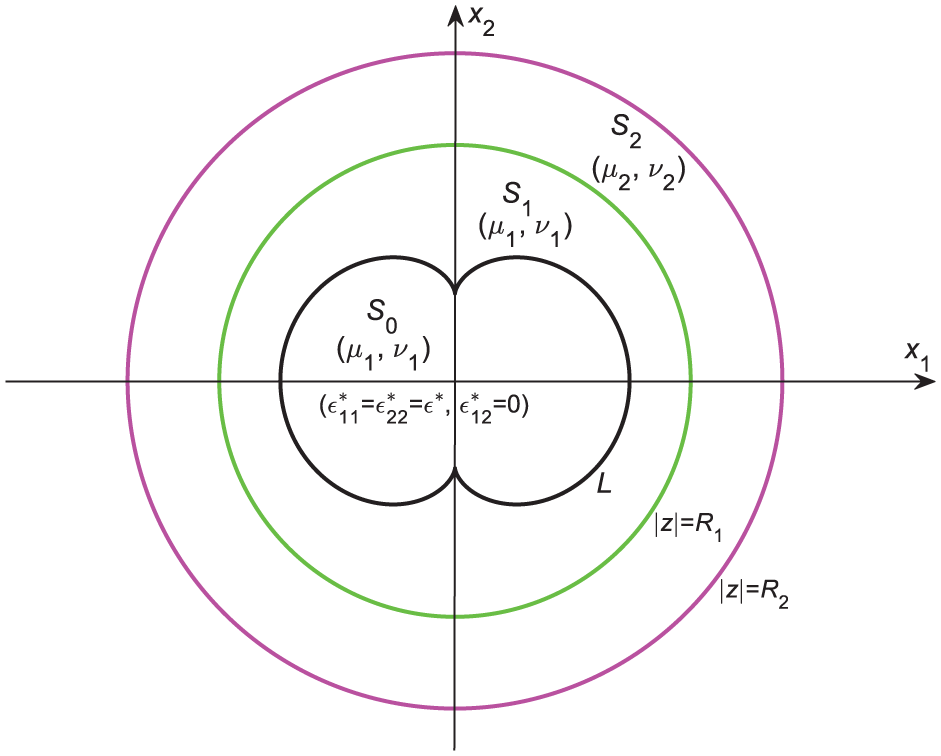
As shown in Figure 1, we consider a concentrically coated circular domain. An epitrochoidal subdomain within the circular domain undergoes uniform in-plane hydrostatic eigenstrains: . Let and denote the epitrochoidal subdomain (the thermal inclusion), its supplement to the circular domain and the annular coating, all of which are perfectly bonded across the inner epitrochoidal interface L described by [15]
in which n is an integer greater than 1, and the outer circular interface given by . Thus, the center of the epitrochoidal inclusion and that of the concentrically coated circular domain are both located at the origin. We require that there is no intersection between the epitrochoidal interface L and the circular interface . The outermost circular boundary of the coating is either rigidly clamped (the Dirichlet problem) or traction-free (the Neumann problem). The two phases and have the same elastic constants, a common assumption in studying Eshelby’s problem [18,19]. More specifically, as shown in Figure 1, the entire circular domain has shear modulus and Poisson’s ratio (or the Kolosov constant ), the coating has shear modulus and Poisson’s ratio (or the Kolosov constant ). In what follows, the subscripts 0, 1, and 2 are used to identify the respective quantities in , and .
An epitrochoidal thermal inclusion concentrically embedded in a coated circular domain with a rigidly clamped or traction-free boundary.
The boundary value problem of the Eshelby’s problem has the following form in the z-plane:
where and the constant β is defined by
The continuity conditions of tractions and displacements in equation (5a) along the perfect epitrochoidal interface L can be written in the following equivalent form:
where is analytic within the inclusion except at the origin where [20]
It follows from equation (7) that the two analytic functions and can be extended to the entire circular domain in such a way that
Through the analytic continuations in equations (9) and (10), and are now analytic in the entire circular domain except at the origin where they behave as
Considering equation (11), the pair of analytic functions and defined in is assumed to take the following form:
where , and are three unknown real constants to be determined. It will be proved that the assumption in equation (12) is indeed valid.
Using the analytic continuations in equations (9) and (10) and the expressions for and in equation (12), we arrive at the pair of analytic functions and defined in the epitrochoidal inclusion as follows
Considering equation (8), and given by equation (13) are indeed analytic everywhere in including the origin.
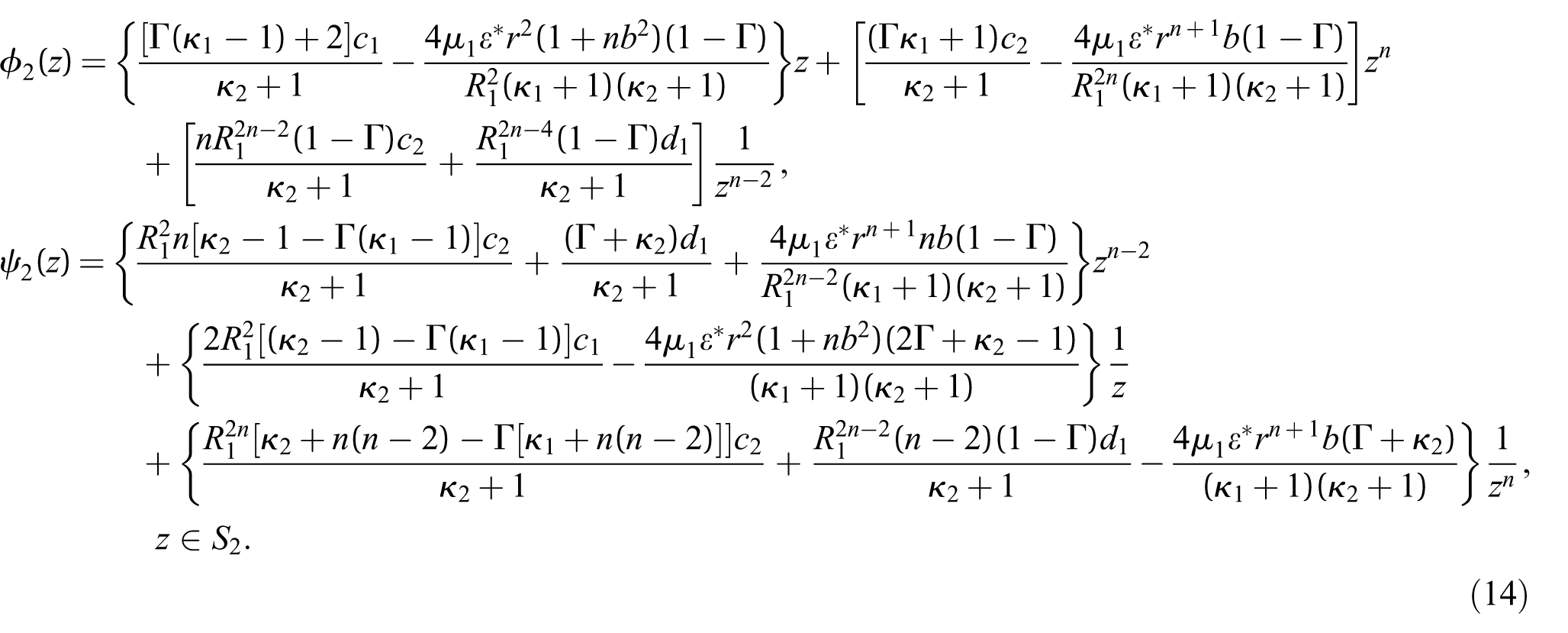
Using and in equation (12) to enforce the interface conditions along the circular interface in equation (5b), we arrive at the following expressions for and defined in the annular coating
Using and in equation (14) to enforce the rigidly clamped or traction-free boundary condition along in equation (5c), we arrive at the following single linear algebraic equation in :
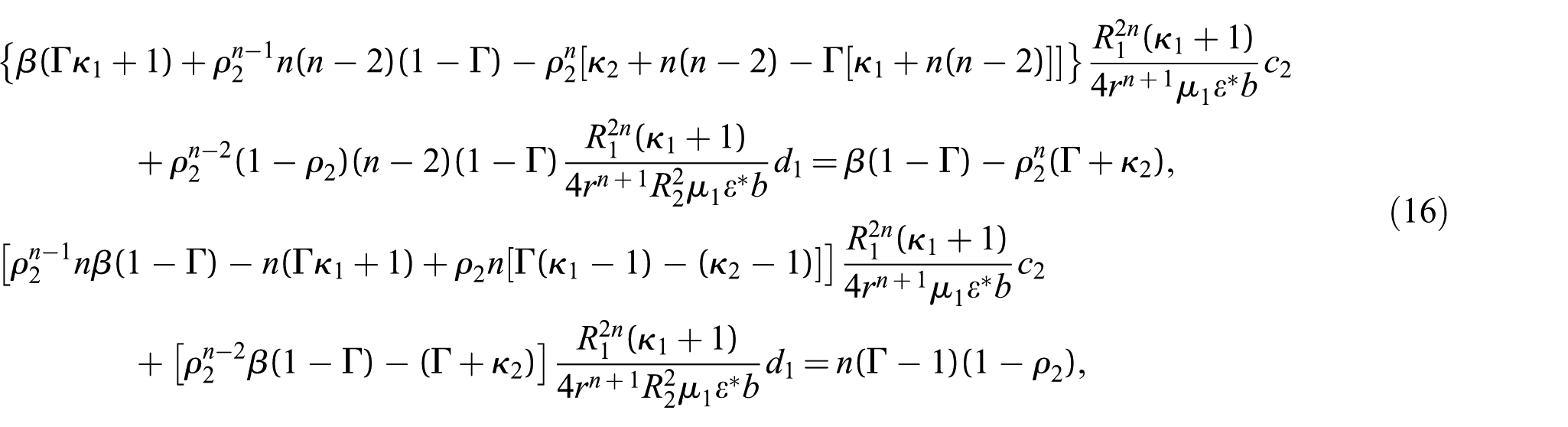
and the following two coupled linear algebraic equations in and :
where
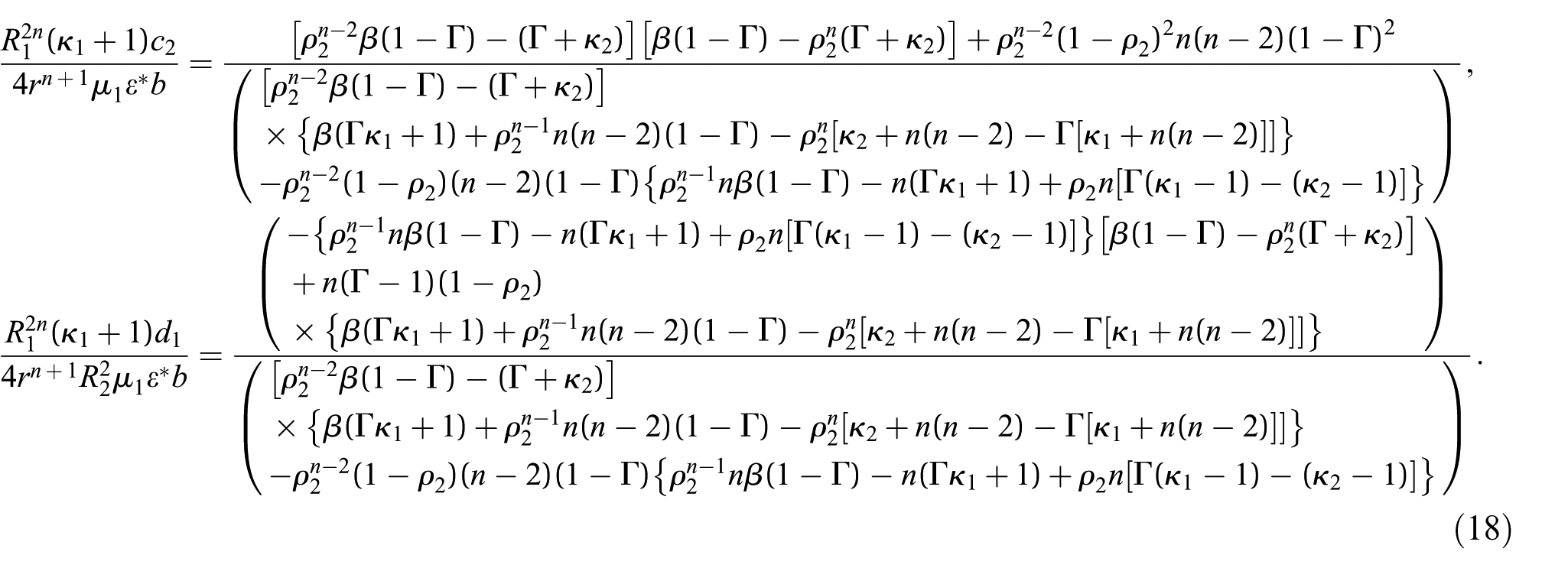
The two constants and can then be uniquely determined from the set of the two linear algebraic equations in equation (16) as
Thus, the assumption in equation (12) has been validated. Now the three pairs of analytic functions characterizing the elastic fields in all three phases and of the composite have been completely determined. It is seen from equations (12) and (13) that the mean stress in and is non-uniform when . In the next section, we will examine the possibility of uniform mean stress in and .
4. Uniformity of mean stress in and
It is seen from equations (12) and (13) that the mean stress in and will become uniform when the following condition is met:
Equation (20) has at least one real root of within the interval . The condition in equation (22) is equivalent to
The above implies that in order to achieve uniform mean stress in and , the coating should be softer than the circular domain when the boundary is rigidly clamped, and the coating should be stiffer than the circular domain when the boundary is traction-free. Equation (20) can be rewritten as the following quadratic equation in Γ when :
where
A unique solution can be obtained from the quadratic equation in equation (24) for given values of the geometric and material parameters as
which is unaffected by the three geometric and material parameters , and .
When (the interface L becomes a Pascal’s limaçon), we obtain from equation (20) that
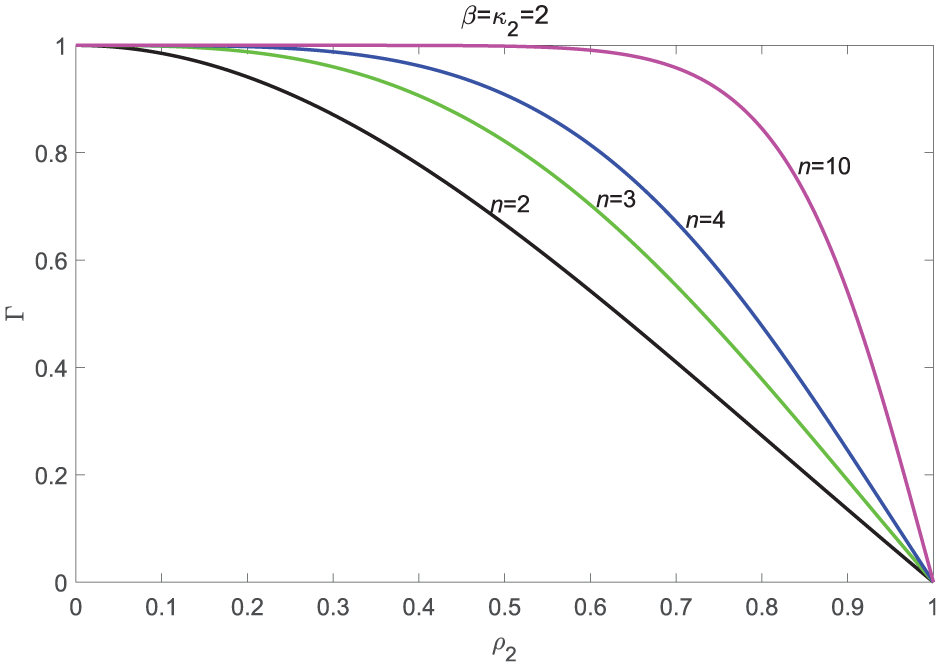
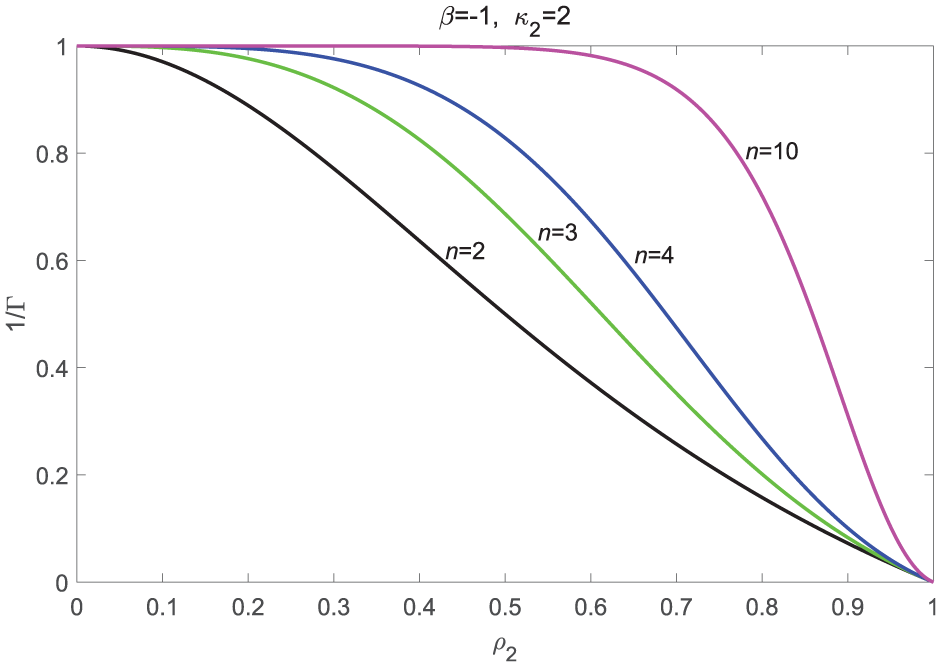
We illustrate in Figure 2 variations of Γ as a function of and n for a rigidly clamped boundary and in Figure 3 variations of as a function of and n for a traction-free boundary. It is seen from Figure 2 that , which is in agreement with the first condition in equation (23). From Figure 3, we see that , which is in agreement with the second condition in equation (23).
Variations of Γ as a function of for different values of n with .
Variations of as a function of for different values of n with .
Once Γ is chosen according to equations (26) and (27), the uniform mean stress in and is given by
where is given by equation (15). Although the condition in equation (26) for and that in equation (27) for are unaffected by the three parameters , and , the uniform mean stress in equation (28) expressed in terms of is reliant on these three parameters. When , we have from equations (15) and (18)1 that . In this case, the result of uniform mean stress in and zero mean stress in obtained from equation (28) simply recovers that of a thermal inclusion of arbitrary shape embedded in an infinite homogeneous elastic plane [19]. The phenomenon of uniform mean stress within a thermal inclusion of any shape and zero mean stress in its exterior can also be observed when the inclusion is embedded in an elastic half-plane with an inextensible surface coating [21].
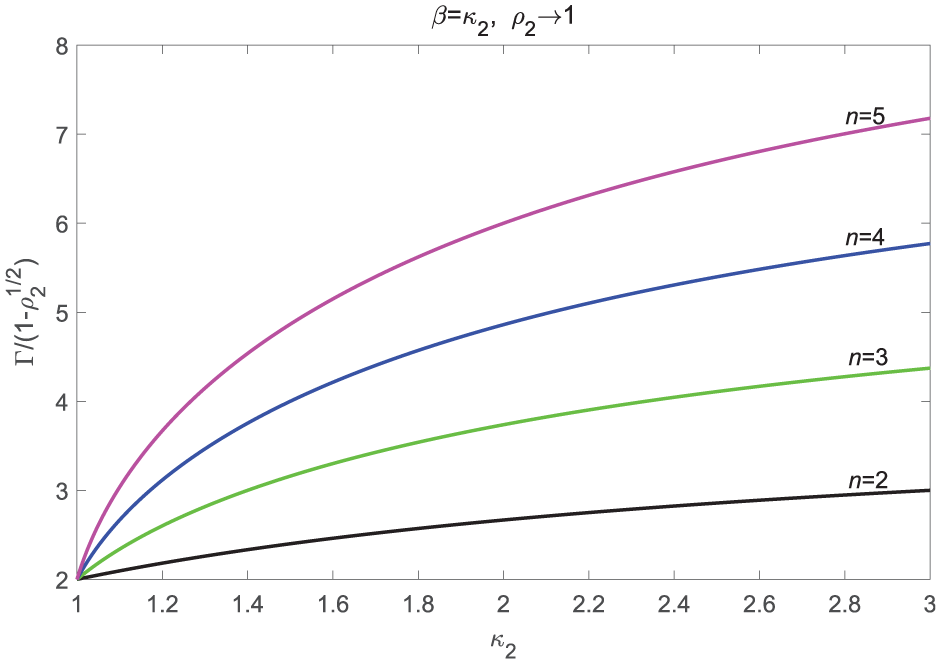
Furthermore, it is derived from equations (24) and (27) that the quantity becomes finitely valued as for a rigidly clamped boundary, and this finitely valued quantity is explicitly given by
which is illustrated in Figure 4. This fact implies that in order to achieve the uniform mean stress in and , a thin coating with a rigidly clamped boundary can be replaced by a spring-type imperfect interface with vanishing thickness [16].
The finitely valued quantity as for different values of and n with .
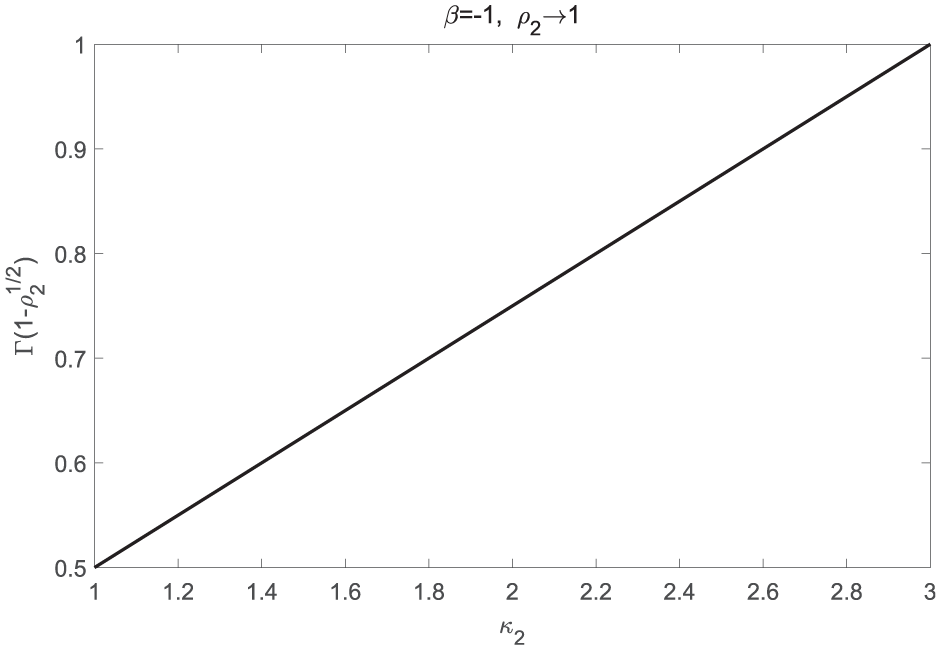
It is also derived from equations (24) and (27) that the quantity becomes finitely valued as for a traction-free boundary, and this finitely valued quantity is given explicitly by
which is illustrated in Figure 5. This fact implies that in order to achieve the uniform mean stress in and , a thin coating with a traction-free boundary can be replaced by a membrane-type imperfect interface with vanishing thickness [16]. In addition, given by equation (30) is independent of the integer n. This fact suggests that the mean stress within an arbitrarily shaped thermal inclusion with its interface L described by
(in which are complex constants) and its supplement to the circular domain is uniform once is chosen according to equation (30) for a thin and stiff coating () with a traction-free boundary.
The finitely valued quantity as for different values of with .
5. Conclusions
We derive a closed-form solution to the Eshelby’s problem of an epitrochoidal thermal inclusion concentrically embedded in a coated circular domain with a rigidly clamped or traction-free boundary. The three pairs of analytic functions are derived in equations (12)–(14) with the real constant given by equation (15) and the two real constants and given by equation (18). In particular, when the parameter Γ is analytically determined by equations (26) and (27) for given values of the four geometric and material parameters , the mean stress within the epitrochoidal inclusion and its supplement to the circular domain is still uniform. A spring-type interface or a membrane-type interface can replace a thin coating to achieve this uniformity property of mean stress.
Footnotes
ORCID iD
Peter Schiavone
Funding
The authors disclosed receipt of the following financial support for the research, authorship, and/or publication of this article: This work was supported by a Discovery Grant from the Natural Sciences and Engineering Research Council of Canada (grant no. RGPIN-2023-03227 Schiavo).
Declaration of conflicting interests
The authors declared no potential conflicts of interest with respect to the research, authorship, and/or publication of this article.
References
1.
LiSSauerRAWangG. A circular inclusion in a finite domain I. The Dirichlet–Eshelby problem. Acta Mech2005; 179: 6790.
2.
WangGLiSSauerR. A circular inclusion in a finite domain II. The Neumann–Eshelby problem. Acta Mech2005; 179: 91110.
3.
LiSSauerRAWangG. The Eshelby tensors in a finite spherical domain–part I: theoretical formulations. ASME J Appl Mech2007; 74: 770781.
4.
LiSWangGSauerRA. The Eshelby tensors in a finite spherical domain—part II: applications to homogenization. ASME J Appl Mech2007; 74: 784797.
5.
ZouWNHeQCZhengQS. Inclusions in a finite elastic body. Int J Solids Struct2012; 49(13): 16271636.
6.
ZouWNHeQC. Eshelby’s problem of a spherical inclusion eccentrically embedded in a finite spherical body. Proc R Soc A2017; 473: 2198.
7.
ZouWLeeY. Completely explicit solutions of Eshelby’s problems of smooth inclusions embedded in a circular disk, full-and half-planes. Acta Mech2018; 229(5): 19111926.
8.
ZouWNLeeYGHeQC. Inclusions inside a bounded elastic body undergoing anti-plane shear. Math Mech Solids2018; 23(4): 588605.
9.
PanCYuQ. Inclusion problem of a two-dimensional finite domain: the shape effect of matrix. Mech Mater2014; 77: 8697.
10.
PanCYuQ. Investigation of an arbitrarily shaped inclusion embedded in a two-dimensional finite domain. Int J Mech Sci2017; 126: 142150.
11.
KrasnitckiiSASmirnovAMGutkinMY. Misfit stress and energy in composite nanowire with polygonal core. Int J Eng Sci2023; 193: 103959.
12.
GaibottiMBigoniDMogilevskayaSG. Elastic disk with isoperimetric cosserat coating. Euro J Mech A Solids2023; 100: 104568.
13.
GaibottiMMogilevskayaSPiccolroazA, et al. Effects of prestress in the coating of an elastic disk. Int J Solids & Struct2024; 295: 112796.
14.
BigoniDMogilevskayaSGPiccolroazA, et al. The circular disc made of linear elastic incompressible material and the “bathyscaphe lesson.” Int J Solids Struct2025; 321: 113548.
15.
MuskhelishviliNI. Some basic problems of the mathematical theory of elasticity. Groningen: P. Noordhoff Ltd, 1953.
16.
BenvenisteYMilohT. Imperfect soft and stiff interfaces in two-dimensional elasticity. Mech Mater2001; 33: 309323.
17.
TingTCT. Anisotropic elasticity: theory and applications. New York: Oxford University Press, 1996.
18.
MuraT. Micromechanics of defects in solids. 2nd rev. ed. Dordrecht, Netherlands: Martinus Nijhoff, 1987.
19.
RuCQ. Analytic solution for Eshelby’s problem of an inclusion of arbitrary shape in a plane or half-plane. ASME J Appl Mech1999; 66: 315–322.
20.
WangXSchiavoneP. New solutions for an Eshelby inclusion of arbitrary shape in a plane or two jointed half-planes. Z Angew Math Mech2022; 102(1): e202100297.
21.
YoonJRuCQMioduchowskiA. Effect of a thin surface coating layer on thermal stresses within an elastic half-plane. Acta Mech2006; 185: 227243.