



Abstract
A widely adopted formulation of the incompressible elastic incremental deformation and the Steigmann–Ogden model of surface elasticity are used to study the effects of surface elasticity and an applied surface pressure on the gravity-driven instability of incompressible elastic layers. An explicit gravity parameter–wavenumber relation is derived to determine the critical condition for the gravity-driven instability, which reduces to the known formula in the absence of the surface elasticity and the applied surface pressure. Detailed results are shown to illustrate the effects of an applied surface pressure and various surface elasticity parameters on the critical value for instability and the associated wavenumber of unstable mode. Our results show that the applied surface pressure has a crucial effect on the critical value for the instability, and the effects of surface elasticity on the critical value of instability heavily depend on the magnitudes of various surface elasticity parameters.
1. Introduction
Gravity-driven Rayleigh–Taylor (RT) instability of the interface between two fluids of different mass densities, in a heavy-over-light configuration, is a key research topic in fluid dynamics with practical relevance in many technical and industrial areas [1–4]. Beyond the earliest studies on RT instability in fluids, the role of RT instability in various areas of solid bodies has been studied extensively, including RT instability in geophysics [5,6] and elastic solids [7–9]. Recently, significant research interest has been raised in the gravity-driven instability of soft elastic bodies [10–18]. To mention a few, for instance, Mora et al. [10] and Chakrabarti et al. [13] showed experimentally that the originally flat surface of a soft gel elastic layer put in a dish becomes undulated when it is turned upside down, Liang and Cai [11] studied the effect of horizontal stretching on the gravity-induced crease-to-wrinkle transition of soft elastic layers, Riccobelli and Ciarletta [12] studied the influence of various related parameters on the gravity-driven RT instability of two bounded elastic layers fixed on the top or bottom surface, Zheng et al. [14] studied the influence of geometrical constraint in the horizontal direction on the gravity-driven instability of a soft elastic cylinder, Tamim and Bostwick [15] conducted a dynamic analysis of RT instability in a soft viscoelastic body confined in a rigid cylinder when it is turned upside down, Liang et al. [16] proposed a surface Green function of a soft elastic body based on the neo-Hookean model, Piriz et al. [18] studied the quasi-irrotational approximation for RT instability of a solid bounded by a rigid wall, and Lu et al. [17] have given a recent literature review on the gravity-driven instability of soft materials.
The present work focuses on the effects of the surface elasticity and an applied surface pressure on the critical value for the gravity-driven instability of soft elastic layers. The adopted formulation of the incremental deformation is illustrated in section 2. An explicit gravity parameter–wavenumber relation for the gravity-driven instability is derived for two bonded elastic half-planes in section 3, and for a single horizontal elastic layer fixed on its upper surface in section 4, respectively, with detailed discussions on the effects of an applied surface pressure and the surface elasticity on the critical value for gravity-driven instability. Finally, the main results are summarized in section 5.
2. Formulation of the incremental deformation
Let us consider the plane-strain problem of two linear isotropic incompressible elastic layers of infinite extent perfectly bonded along the horizontal planar interface y = 0, and the upper and lower half-planes have the mass densities (ρ1, ρ2) and shear moduli (G1, G2), respectively, as shown in Figure 1.
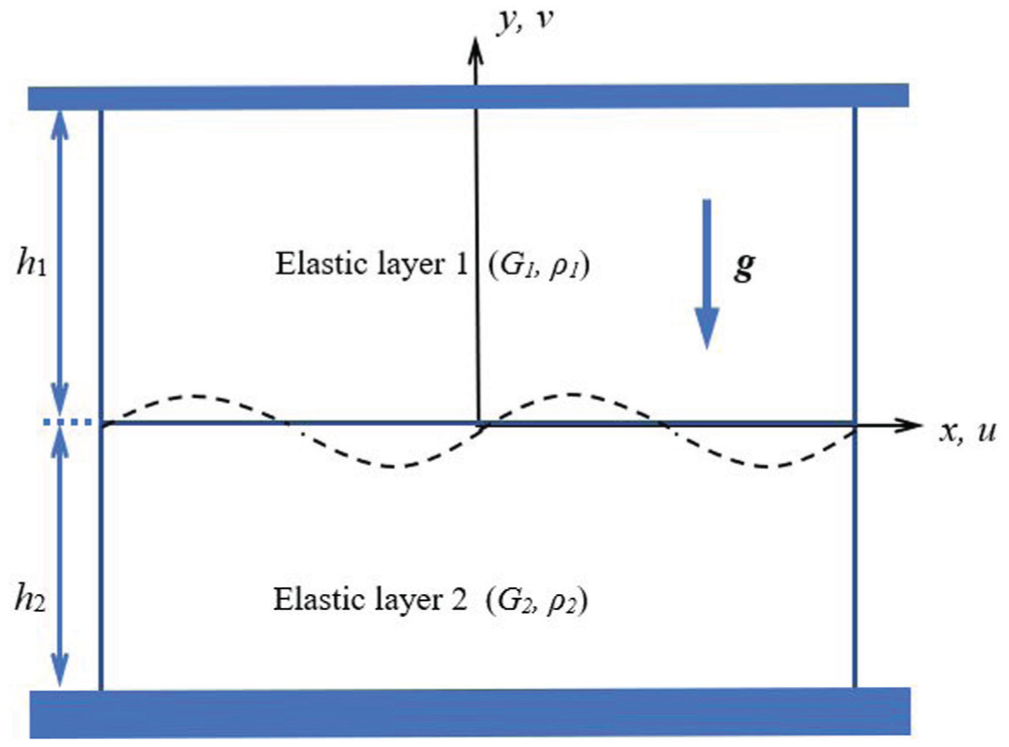
Gravity-driven instability of two bonded incompressible elastic layers of infinite extent in the horizontal direction, with the shear moduli, mass densities, and thicknesses (G1, G2), (ρ1, ρ2), and (h1, h2), respectively.
Under the downward gravity shown in Figure 1, with the assumed displacement constraint in the horizontal direction, the initial stress (

here, p0 is the common pressure at the interface y = 0, ρ is the respective mass density, y is the upward vertical coordinate as shown in Figure 1, and g > 0 is the gravitational constant. Taking the advantage of the zero-displacement in the initial hydrostatic stress state (1), we shall not distinguish the coordinates (x, y) in the non-deformed state and the initial stress state. Here, (G-σ*(y)) plays the role of the Lagrangian multiplier commonly adopted in the related literature (see, e.g., [12,14]).
The present work studies the effects of surface conditions on the critical condition for gravity-driven stability of the elastic layers. For this purpose, we study the existence of stable infinitesimal incremental equilibrium states of the elastic layers around the hydrostatic initial stress state (1).
2.1. A formulation of the incremental equations
Within the framework of linear elasticity, the initial stress (

where

where
2.2. Another version of the incremental equations
Alternatively, for an incompressible elastic body with a hydrostatic initial stress

where p is the incremental pressure, and G is the (constant) instantaneous shear modulus for the incremental deformation. Since the first P-K stress

The version (4, 5) of incremental equations, or its equivalent form, is widely adopted in recent works on the gravity-driven instability of incompressible elastic solids based on the nonlinear neo-Hookean model [11,12,14,16], and the related surface elasticity formulation is developed in the literature [29,30]. Instead of the version (2, 3), the version (4, 5) of incremental equations will be adopted for the present problem of an incompressible elastic body with the initial stress
3. The gravity-driven instability of elastic layers
For the present plane-strain problem with the two-dimensional (2D) incremental displacements (u, v), as shown in Figure 1, it follows from (4, 5) that

where the comma denotes the partial derivative with the coordinates. Two equilibrium equations for the incremental displacements (u, v) are given by


Eliminating the pressure field p and using the incompressibility condition (u,x + v,y) = 0, it follows from (7a, 7b) that

Remarkably, with the version (4, 5), the pre-stress σ*(y) does not appear in equation (8) (see, e.g., equation (7) with the zero growth rate in Terrones [8] or equation (3.12) in Riccobelli and Ciarletta [12]). For the present problem, it can be verified that the version (2, 3) will lead to a different equation for v(x, y) with σ*(y)–dependent variable coefficients. In the present work, for the analytical simplicity, the version (4, 5) with the Steigmann–Ogden model of surface elasticity [31,32] (which is widely adopted in recent literature, see, e.g., [33–38]) will be used to study the effects of the surface elasticity and an applied surface pressure on the gravity-driven instability of elastic layers.
With the version (4, 5) and the Steigmann–Ogden model, the conditions for the incremental displacements (u, v) and tractions (Syx, Sy) at the interface between the bonded elastic bodies shown in Figure 1 give



where γ, γs, and γb are the surface tension, the surface stretching modulus, and the surface bending rigidity, respectively. For example, for the surface of a stiff incompressible elastic thin film with a residual surface (positive or negative) strain ε*, γ = 4Gstε*, γs = 4Gst, and γb = Gst3/3, where (Gs, t) are the shear modulus and thickness of the surface thin film [35,36].
3.1. The general solution
Assume that

where m is the (non-negative) wavenumber. Let h(y) = e−λy, it is readily seen from (8) that h(y) has one positive double root (λ = m) and one negative double root (λ =-m).
It is verified from the incompressibility condition (u,x + v,y) = 0 and equation (7a) that the general solution corresponding to the double root (λ =−m) is given by



And the general solution corresponding to the double root (λ = m) is given by



Thus, the general solution is given by expressions (11–13) plus (14–16), and the four real constants A, B, C, and D are determined by the boundary conditions.
3.2. Two bonded elastic half-planes
Let us first study the gravity-driven instability of two bonded half-planes, as shown in Figure 1 with h1 = h2 = infinity. The gravity-induced hydrostatic initial stress is given by (1) with the common pressure p0 at y = 0 and the respective densities ρ1 and ρ2.
In this case, assuming the incremental displacement due to the interface instability approaches zero at infinity, the solution in the upper half-plane (y ≥ 0) is given by (14–16) with (G1, ρ1) and the two coefficients C and D, while the solution in the lower half-plane (y ≤ 0) is given by (11–13) with (G2, ρ2) and the two coefficients A and B, and γ, γs, and γb in (9b and 9c) are the interface tension, interface stretching modulus, and interface bending rigidity, respectively.
Thus, the two displacement conditions (9a) at the interface y = 0 give A = C and B = (D-2mC), and the two traction conditions (9b, 9c) at y = 0 give


Assuming p0 to be finite, it follows from equation (17) that D = mC, and therefore, equation (18) gives

When the parameters γ and γb are non-negative, it is seen from equation (19) that the gravity-induced instability of two bonded half-planes happens only if the upper half-plane is heavier than the lower half-plane (ρ1 > ρ2). This result is consistent with the RT instability of two infinite fluid half-spaces, where the RT instability happens only if the upper fluid is heavier than the lower fluid. In the absence of the surface pressure (p0 = 0) and surface elasticity (γ = 0, γb = 0), for example, when the lower half-plane is empty (ρ2 = 0, G2 = 0), the wavelength (2π/m) given by equation (19) is of the order 1 m with ρ1≈103 kg/m3 and G1≈103 Pa. As expected, it is seen from equation (19) that the positive interface tension γ and interface bending rigidity γb have an effect to increase the wavelength of the unstable mode. Actual wavelength selection may request dynamic analysis of the growth rate of infinitesimal disturbances.
4. An elastic layer fixed on its upper surface
Let us now focus on the gravity-driven instability of an infinitely extended horizontal elastic layer fixed on its upper surface, as the upper layer 1 shown in Figure 1, in the absence of the lower layer 2. This is the case of major interest in the literature [10–16].
Setting G1 = G and ρ1 = ρ, the incremental displacement and pressure fields are given by expressions (11–13) plus (14–16) with four constants A, B, C, and D. The incremental traction conditions (9b and 9c) at y = 0 give


The zero-incremental displacement conditions at y = (h) give


It is verified from conditions (21a, 21b) that (B, D) can be expressed in terms of (A, C)


Thus, substituting (22a, 22b) to the first relation (20a), we have

Similarly, substituting (22a, 22b) to the second relation (20b), we have

Thus, for the existence of non-zero coefficient (A, B, C, D), we have the (ρgh/G)–mh relation
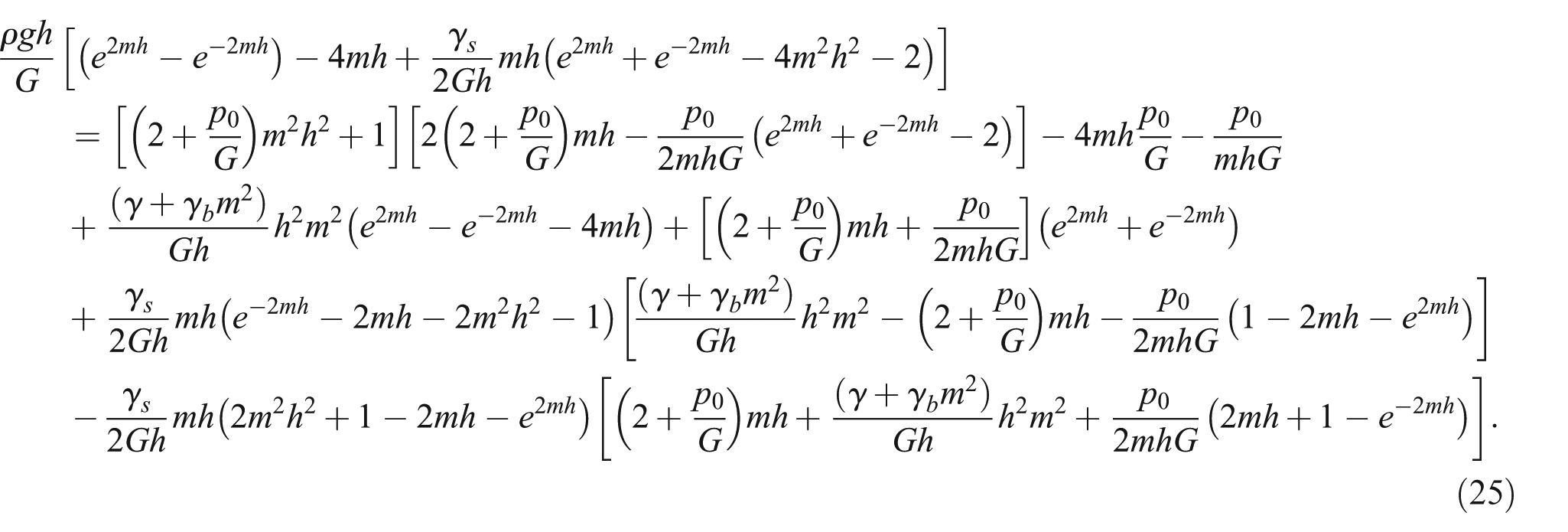
In the absence of the surface pressure (p0 = 0) and surface elasticity (γ = 0, γs = 0, γb = 0), equation (25) gives

Equation (26) is identical to the known (ρgh/G)–mh relation for an incompressible elastic layer fixed on its upper surface (see, e.g., Riccobelli and Ciarletta [12] and Zheng et al. [14]). In particular, in the limiting case h = infinity, equation (26) gives
Let us now discuss the implications of the derived relation (25) to the gravity-driven instability of a single elastic layer fixed on its upper surface, with specific interest in the effects of an applied surface pressure and the surface elasticity on the critical value for the instability. For conciseness, we shall study these effects separately, without considering their combined effects.
4.1. Effect of an applied surface pressure
First, in the absence of surface elasticity (γ = 0, γs = 0, γb = 0), equation (25) gives the (ρgh/G)–(mh) relation

It is seen from equation (27) that the (ρgh/G)–(mh) relation depends on the pressure (p0/G) non-linearly and non-monotonically.
The dimensionless parameter (ρgh/G) vs. the dimensionless wavenumber (mh) is shown in Figure 2 for several values of (p0/G). It is seen from Figure 2 that there exists a critical value (p0/G)≈0.842, and the applied surface pressure slightly increases the critical value of (ρgh/G) for instability when (p0/G) < 0.842, while the applied surface pressure substantially decreases the critical value of (ρgh/G) for instability when (p0/G) > 0.842. Specifically, it is seen from Figure 2 that the critical value (ρgh/G) for instability is about 6.223 with (p0/G) =0.842 which is very close to the critical value 6.2229 with p0 = 0, and the critical value (ρgh/G) for instability drops to about 4.04 when the applied pressure increases to (p0/G) = 1.5. In particular, the critical value (ρgh/G) for instability tends to zero with much shorter wavelength of the unstable mode when the applied pressure (p0/G) approaches 2. To the best of our current knowledge, the effect of an applied surface pressure on the gravity-driven instability of elastic layers seems not specifically addressed in existing literature [10–16].
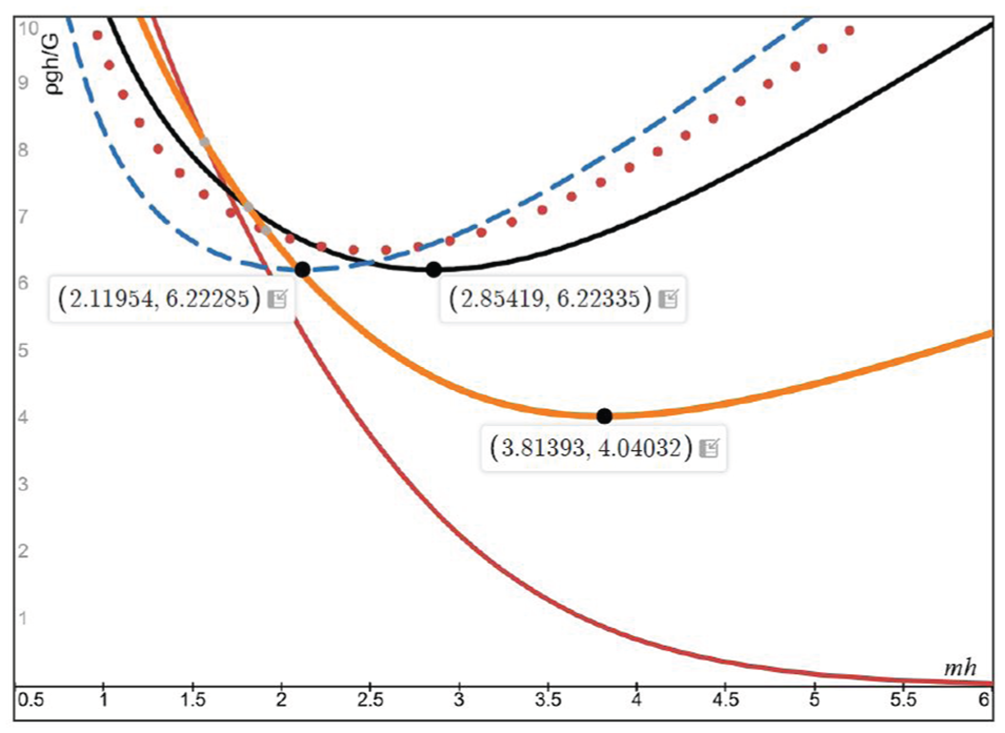
The dimensionless parameter (ρgh/G) vs. the dimensionless wavenumber (mh) for fiver values (0, 0.5, 0.842, 1.5, 2.0) of the ratio (p0/G), where the dashed curve for (p0/G) = 0 (with the critical value (ρgh/G)≈6.2229), the dotted curve for (p0/G) = 0.5, and the three solid curves in the order from highest to lowest for (p0/G) = 0.842, 1.5, and 2, respectively.
4.2. Effect of the surface tension
Next, let us discuss the surface tension effect with (γs = 0, γb = 0) and p0 = 0. Thus, equation (25) gives the (ρgh/G)–(mh) relation

The parameter (ρgh/G) vs. the wavenumber (mh) is shown in Figure 3 for several positive values of (γ/Gh). It is seen that the positive surface tension increases the critical value of (ρgh/G) for the initiation of instability and also increases the wavelength of the unstable mode. For example, the critical value of (ρgh/G) for instability increases from 6.223 for γ = 0 to about 8.77 for (γ/Gh = 1) in good agreement with the results of Tamim & Bostwick [15] (see their Fig.3(c)). In particular, there is a necessary condition
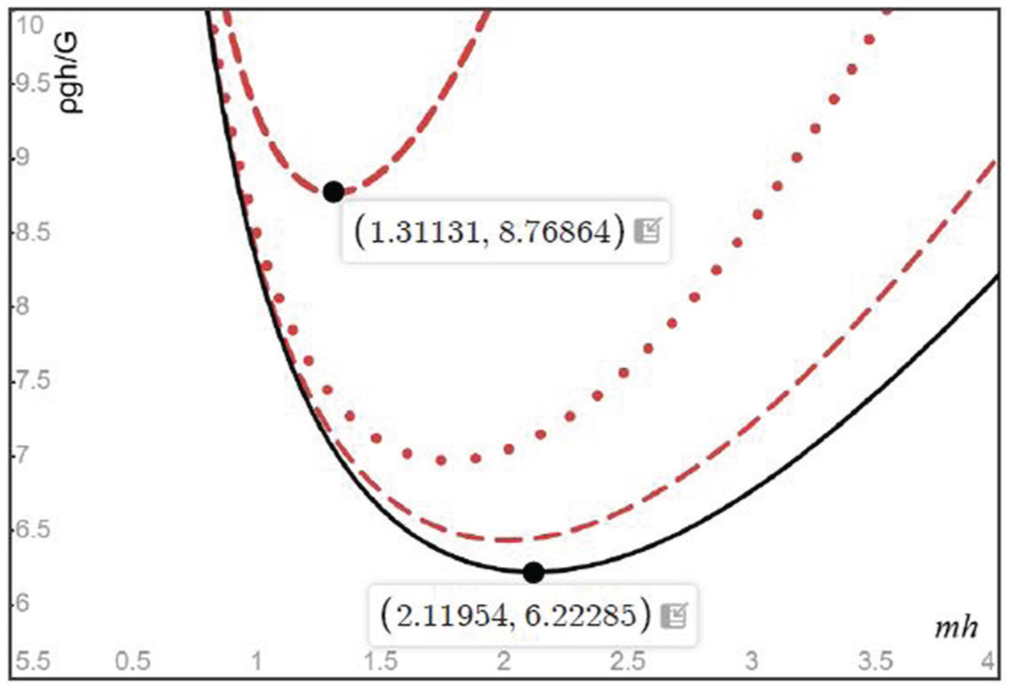
The parameter (ρgh/G) vs. the wavenumber (mh) for four positive values (0, 0.05, 0.2, 1.0) of the ratio (γ/Gh), shown by the curves in the order from lowest (γ/Gh = 0) to highest (γ/Gh = 1).
On the contrary, negative surface/interfacial tension in soft solids and liquids has been reported in the literature [39–41]. For instance, the physical ground of negative interface energy was discussed in Mathur et al. [39] for multicomponent materials in which the chemical interaction between the newly created surface and the surrounding could lead to a negative surface energy, and negative interfacial tension and its role in interfacial instability were studied in reacting liquids [40]. Therefore, the parameter (ρgh/G) vs. the wavenumber (mh) is shown in Figure 4 for several negative values of (γ/Gh).
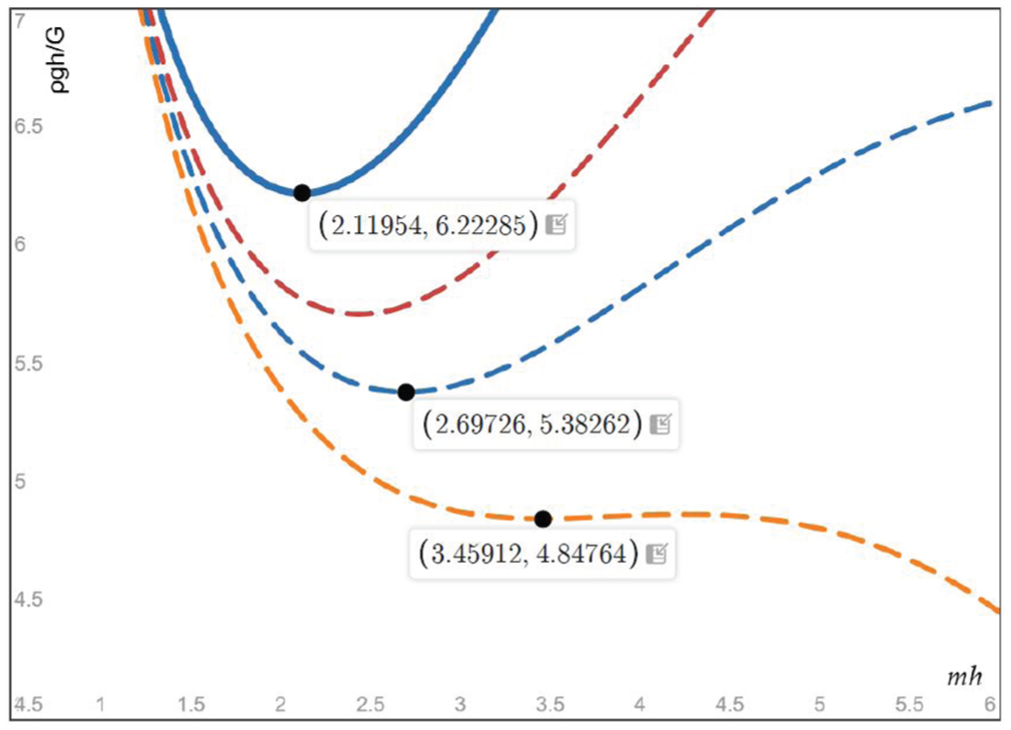
The parameter (ρgh/G) vs. the wavenumber (mh) for four negative values (0, −0.1, −0.15, −0.21) of the ratio (γ/Gh), shown by the curves in the order from highest (γ/Gh = 0) to lowest (γ/Gh =−0.21).
It is seen from Figure 4 that the negative surface tension decreases the critical value of (ρgh/G) for instability and also decreases the wavelength of the unstable mode. For example, the critical value of (ρgh/G) for instability drops from 6.223 for γ = 0 to about 5.38 for (γ/Gh =−0.15), and further drops to about 4.85 for (γ/Gh =−0.21). For larger negative values of (ρgh/G) <−0.21, stable incremental equilibrium states will no longer exist, which implies that nonlinear post-bifurcation or dynamic analysis is required to study the gravity-driven instability of the elastic layer.
4.3. Effect of the surface bending rigidity
In order to study the effect of the surface bending rigidity, let us consider the case (γ = 0, γs = 0) and p0 = 0. Thus, the relation (25) gives the (ρgh/G)–(mh) relation

The parameter (ρgh/G) vs. the wavenumber (mh) is shown in Figure 5 for various values of (γb/Gh3). It is seen from Figure 5 that, similar to the effect of the positive surface tension, the surface bending rigidity increases the critical value of (ρgh/G) for the initiation of instability and also increases the wavelength of unstable mode. For example, the critical value of (ρgh/G) for instability increases from 6.223 for γb = 0 to about 9.24 with (γb/Gh3) = 1. In particular, there is a necessary condition
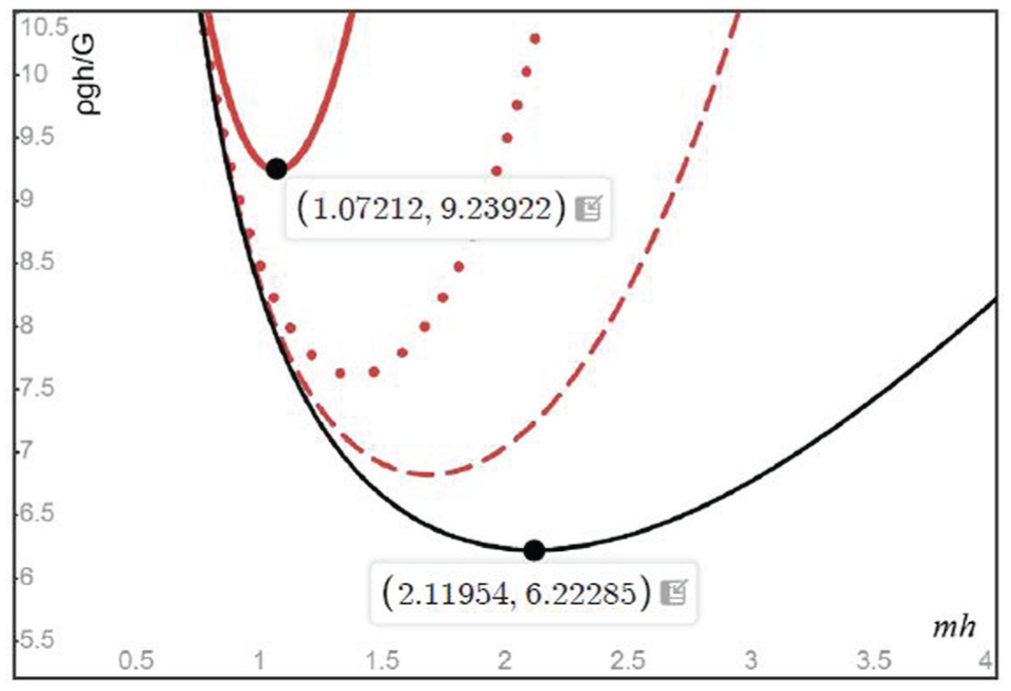
The parameter (ρgh/G) vs. the wavenumber (mh) for four values (0, 0.05, 0.2, 1.0) of the ratio (γb/Gh3), shown by the curves in the order from lowest (γb/Gh3 = 0) to highest (γb/Gh3 = 1).
4.4. Effect of the surface stretching modulus
To study the effect of the surface stretching modulus with (γ = 0, γb = 0) and p0 = 0, equation (25) gives the (ρgh/G)–(mh) relation

The parameter (ρgh/G) vs. the wavenumber (mh) is shown in Figure 6 for various values of (γs/Gh). It is seen from Figure 6 that compared to the effects of the surface tension and the surface bending rigidity discussed in sections 4.2 and 4.3, the surface stretching modulus has a relatively minor effect to increase the critical value of (ρgh/G) for the initiation of instability of the elastic layer.
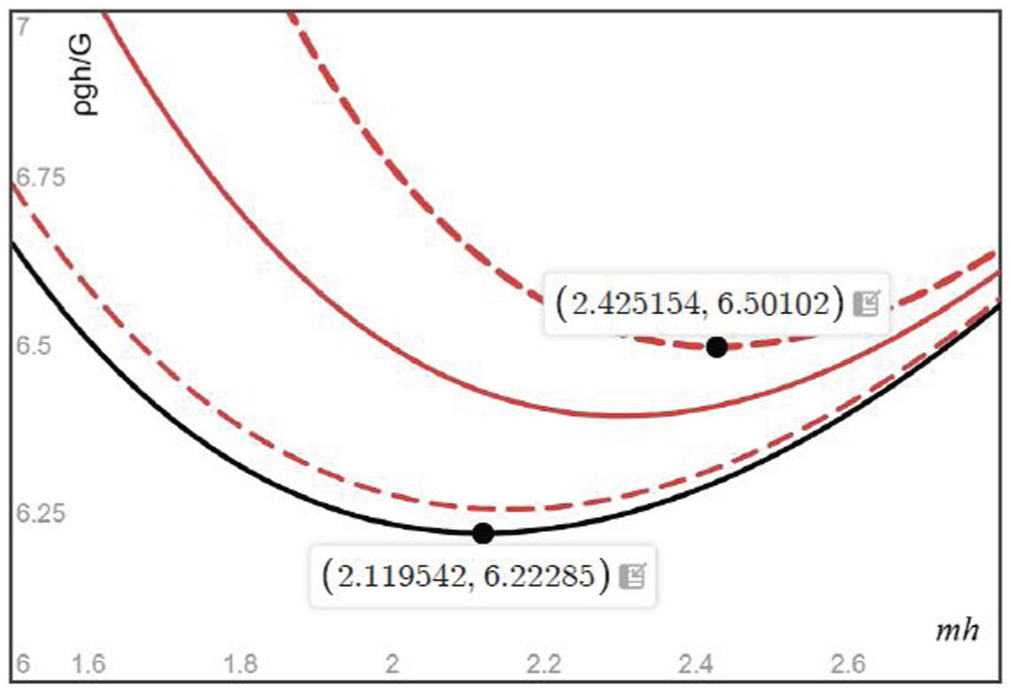
The parameter (ρgh/G) vs. the wavenumber (mh), for four values (0, 0.1, 1.0, 10) of the ratio (γs/Gh), shown by the curves in the order from lowest (γs/Gh = 0) to highest (γs/Gh = 10).
4.5. Remark on an elastic layer fixed on its lower surface
Finally, for an elastic layer fixed on its lower surface, as the lower layer shown in Figure 1 in the absence of the upper layer, the analysis given previously for the elastic layer fixed on its upper surface remains valid provided h is replaced by (−h) and all surface elasticity terms in equation (9b and 9c) switch the side. In this case, in the absence of surface elasticity (γ = 0, γs = 0, γb = 0), the (ρgh/G)–(mh) relation is given by

Clearly, in the absence of the applied pressure (p0 = 0), equation (31) does not admit any positive solution for (ρgh/G), and therefore, the gravity-driven instability will not appear, consistent with known results reported in the literature [10–16]. When (p0/G) > 2, although equation (31) does admit a positive solution (ρgh/G), it does not imply the stable incremental equilibrium state because the curve (ρgh/G) vs. (mh) given by equation (31) with (p0/G) > 2 does not show a local minimum, and therefore, it is expected to not correspond to a stable incremental equilibrium state. In such a case, nonlinear post-bifurcation or dynamic analysis is required to study the gravity-driven instability of the elastic layer.
5. Conclusion
The present paper studies the effects of surface elasticity and an applied surface pressure on the critical condition for gravity-driven instability of incompressible elastic layers. An explicit formula is derived to determine the critical parameter for instability and the associated wavelength of unstable mode, which reduces to the known formula in the absence of the applied surface pressure and the surface elasticity. Detailed results are demonstrated to illustrate the effects of the applied surface pressure and surface elasticity on the critical value for instability. Specifically, our results show that:
The gravity-driven instability of two bonded elastic half-planes can happen only if the density of the upper half-plane is larger than the density of the lower half-plane, qualitatively consistent with the known result on RT instability of two fluid half-spaces.
For an elastic layer fixed on its upper surface, there exists a critical value of the applied surface pressure; the applied surface pressure below this critical value slightly increases the critical value for instability, while the applied surface pressure beyond this critical value can significantly decrease the critical value for instability, and particularly, the critical value for the gravity-driven instability approaches zero when the applied surface pressure reaches twice of the shear modulus of the elastic layer.
The effects of surface elasticity on the gravity-driven instability can be significant when the surface of elastic layer is covered by a stiff elastic film with higher surface elasticity parameters, and particularly, the critical value for the gravity-driven instability approaches zero for a negative surface tension when its absolute value approaches about 0.2 times the shear modulus multiplied by thickness of the elastic layer.
For an elastic layer fixed on its lower surface, stable incremental equilibrium states do not exist within the infinitesimal incremental deformation without or with an applied surface pressure.
The derived explicit formulas and results demonstrated here could be useful to quantify the effects of an applied surface pressure and the surface elasticity parameters on the critical value for the gravity-driven instability of elastic layers and the associated wavelength of unstable mode.
Footnotes

Ethical considerations
This article does not contain any studies with human participants or animals performed by any of the authors.
Funding
The author received no financial support for the research, authorship, and/or publication of this article.
Declaration of conflicting interests
The author declared no potential conflicts of interest with respect to the research, authorship, and/or publication of this article.
Data availability statement
The data that supports the findings of this study are available within the article.