




Abstract
Based on micropolar theory, we develop a novel mathematical framework for modeling finite elastoplastic deformations. The proposed formulation accommodates both large strains and finite rotations while exploiting the ability of micropolar theory to represent underlying material microstructure. The balance equations are obtained from an invariance principle with respect to general observer transformations. Within the setting of material uniformity, the plastic evolution laws are expressed as first-order differential equations for a set of material transplants, subject to the formal restrictions dictated by micropolar material symmetries and the constraints of the second law of thermodynamics. In addition, we identify the micropolar Mandel stress tensors as the energetic driving forces governing the local rearrangement of material inhomogeneities.
Keywords
1. Introduction
Formulating material evolution laws, whether in plasticity or in growth and remodeling, is challenging even for first-order materials, and becomes considerably more complex in non-classical continua, particularly in the micropolar continuum [1–3], due to the influence of internal microstructure. The foundations of theories describing materials with internal structure trace back to the seminal work of the Cosserat brothers [4]. In their formulation, a continuum is endowed with additional kinematic degrees of freedom by attaching a triad of rigid directors to each material point. In Eringen’s terminology, such a medium is known as a “micropolar” continuum.
To analyze finite-strain plasticity, the multiplicative decomposition of the deformation gradient into elastic and plastic parts,
Within this framework, it is necessary to introduce an intermediate configuration representing a stress-free or natural state of the material. This intermediate configuration is constructed by distorting material elements, either in the reference or current tangent spaces, in a generally incompatible manner. Importantly, the intermediate configuration is not a genuine configuration of the body; as such, no true plastic mapping can be defined between the reference configuration and this intermediate state. Rather, it should be viewed as a collection of natural states associated with individual material elements. Consequently, neither
Developing material evolution laws is essential for understanding inelastic behavior, such as plastic deformation. In this regard, a correct geometric description of the underlying theory is crucial for formulating appropriate evolution laws. A comprehensive geometric treatment of both classical and non-classical continuum theories is presented in Epstein and Elzanowski [22]. In this approach, the concept of material isomorphism is extended to the entire body, allowing one to study material inhomogeneities and their evolution within the framework of uniform materials. One of the major advantages of this viewpoint is that it removes the unnecessary reliance on an intermediate configuration. Instead, the notions of a reference crystal or material archetype naturally emerge, objects that do not correspond to actual configuration spaces. In this framework, the uniformity maps are given by the inverse of the plastic deformation tensor [23, 24]. Many studies have employed these approaches to model inelastic deformation within non-classical continuum theories. For example, Javadi et al. [25] developed growth and remodeling evolution laws for uniform bodies within the framework of micromorphic theory and subsequently proposed related evolution laws based on finite couple stress theory [26]. More recently, Steigmann et al. [27] formulated a plastic evolution law for hemitropic Cosserat solids in uniform bodies.
The aim of this study is to develop a formulation for the elastoplastic behavior of micropolar materials that accounts for the effects of microstructure. A key advantage of the micropolar theory, compared with other non-classical continuum frameworks, lies in its additional degrees of freedom and the role of microinertia in describing microstructural rearrangements. To this end, we first present the geometrical foundations of finite micropolar kinematics. We then derive the balance equations of mass, microinertia, linear and angular momenta, and internal energy, together with the entropy inequality, from an invariance principle under general observer transformations. Within the framework of material uniformity, and by enforcing the derived entropy inequality, we obtain the hyperelastic constitutive relations with respect to the reference configuration. Subsequently, we develop evolution laws for micropolar materials by applying the Principle of Maximum Dissipation to the micropolar dissipation equation. We further show that these evolution laws depend on the Mandel stress tensors, which serve as driving forces for local microstructural rearrangements. Finally, we establish a mathematical restriction on the plastic evolution laws that ensures consistency with changes in the reference configuration and preservation of material symmetry.
2. Micropolar media
In Eringen’s terminology [1], a micropolar continuum is defined as an ordinary body
2.1. Kinematics
Following standard notational conventions, an element in the reference configuration of a micropolar medium is characterized by six parameters: the coordinates

where

which belongs to the Lie algebra

Then, it can be written as

where

The linear operator
Accordingly, the energy density per unit volume of a micropolar medium can be expressed as

where ∇ denotes the gradient operator with respect to the reference configuration. Assuming the strain energy to be Galilean-invariant, we can then write

where

where

where (,) denotes the differential derivative.
Let us now consider the effect of a change in the reference configuration on the quantities

and

The referential directors are related by

Consequently, in view of equation (4), the functions of the present configuration with respect to the two reference configurations are related by

The deformation gradients corresponding to the two reference configurations are related through

where

Consequently, although both the macroscopic deformation gradient and the microdeformation are conventional tensors, the gradient of the microdeformation transforms more intricately under a change of reference configuration, and this behavior will be crucial in formulating potential evolution laws for plasticity in micropolar media. Following the previous notation, we can establish the relation between the strain tensors

and

3. Balance equations
3.1. The master energy balance
In formulating the balance equations for a micropolar medium, we follow the general approach of Green [31]. This approach, as originally formulated in Noll [32] and Green and Rivlin [33], is based on the postulate that the energy balance remains invariant under arbitrary changes of observer. Consequently, the total kinetic energy of the micropolar medium occupying a spatial volume ω is expressed as

where

where a superposed dot indicates the material time derivative. The internal energy content U in the same spatial volume ω can be expressed in terms of energy per unit mass ϵ as follows

The rate of increase of energy in the volume ω with boundary ∂ω and exterior unit normal

The remaining contributions to the energy balance stem from non-mechanical (thermal) sources and external forces, with the former expressed as

here, r and h denote the radiation heat source and the conductive heat flux, respectively, with the heat flux vector

Accounting for all of the above contributions, the energy balance requires that

3.2. Translation invariance
Under a translational change of observer with relative velocity

By collecting all terms multiplying

The terms linear in

In deriving the above equation, we employed the mass balance (26) and invoked Cauchy’s tetrahedron argument,

where
3.3. Rotation invariance
For an observer undergoing a rigid rotation with constant angular velocity





Collecting all terms that contribute to the coefficients of

Likewise, by equating the coefficients of the terms linear in

where

By substituting equations (18), (20)–(23) into equation (24), the energy balance equation takes the form

3.4. The Clausius–Duhem inequality
Within the micropolar framework, defining the entropy per unit mass as

where θ denotes the absolute temperature. Consequently, the local form of the inequality can be expressed as

By defining the Helmholtz free energy per unit mass as

Equation (40) represents the thermodynamic consistency condition for energy dissipation in a micropolar hyperelastic continuum. Similarly, the Lagrangian form of the second law of thermodynamics can be written as

where




4. A micropolar theory for plasticity processes in uniform media
4.1. The theory of uniformity and the micropolar archetype
According to the work of Epstein and Elzanowski [22], Noll [35], a simple body is said to be materially uniform if, at every point within the body, the constituent material is the same. The concept of uniformity is here extended to the framework of micropolar media. Considering the Helmholtz free energy density at a given point in a micropolar medium, for any point throughout the body, the energy content per unit volume can be expressed as

where the energy density depends explicitly on the point

where


where
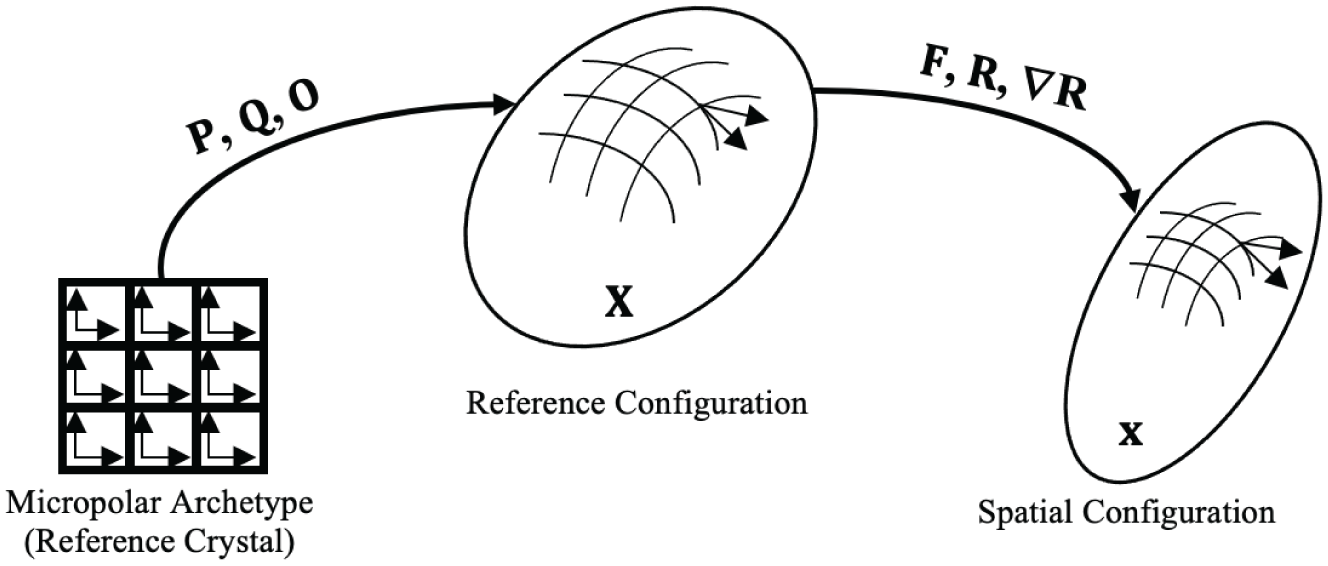
Uniformity fields associated with reference configuration.
It should also be noted that in Steinmann [21], the inverse of the independent third-order tensor
4.2. Thermodynamics consideration of the micropolar theory
We assume that the Helmholtz free energy per unit volume is given by

For notational simplicity, the explicit dependence of the tensor fields on

where the stress tensor at the level of the micropolar archetype is defined as

Here,
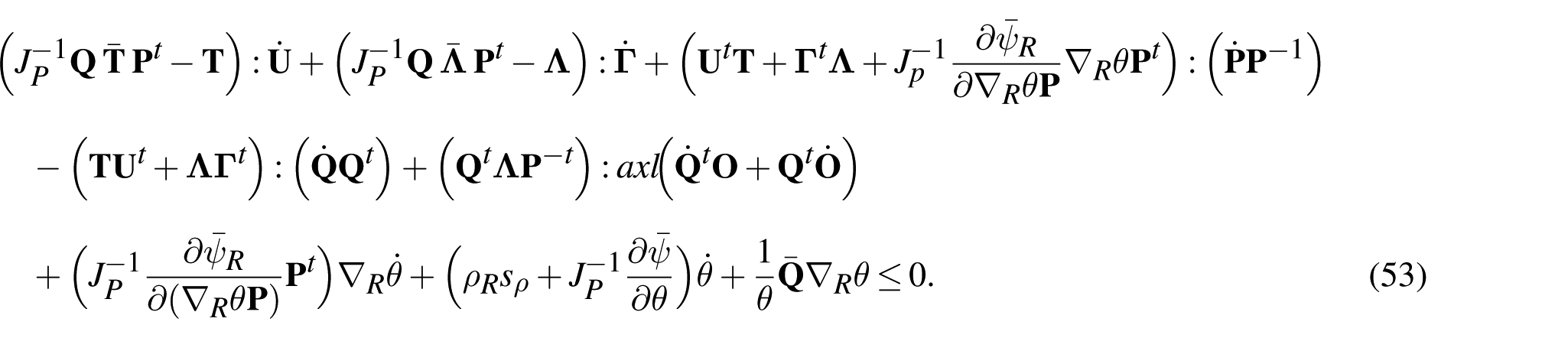
It is apparent that equation (53) is linear in




These conditions coincide with the constitutive restrictions of classical thermoelasticity. The remaining terms yield a residual inequality, which can be interpreted as the dissipation

where we define

4.3. The principle of maximum plastic dissipation
To derive the plastic evolution law compatible with the uniform micropolar media, we use the principle of maximum plastic dissipation. In other words, the loading/unloading conditions and the form of associative flow rule is in agreement with principle of maximum plastic dissipation and can be shown as the Kuhn–Tucker optimality conditions [36]. To move further we consider following form of micropolar yield function in stress, couple stress, and hyperstress space by

Denoting by

The maximum dissipation problem can be recast into a minimum problem as

Following the work done by Simo et al. [37], we define the Lagrangian functional associated with equation (62) as

We assume that the plastic consistency parameter

The Kuhn–Tucker optimality conditions and the associated plastic flow rules can then be derived as




By using equations (65)–(67), it can be inferred that



where
4.4. Micropolar evolution laws
In this section, we focus on establishing general principles governing the evolution laws of micropolar materials. Following the framework presented by Epstein and Maugin [38] and Epstein and Elzanowski [22], these evolution laws are required to satisfy several fundamental formal constraints. First, the evolution laws must not explicitly depend on the material point
4.4.1. Reduction to the archetype
As noted above, the specific mathematical forms of the evolution laws equations (69)–(71) still depend on the choice of a micropolar archetype as well as the reference configuration. By fixing the archetype, we focus on examining how changes in the reference configuration affect the form of the evolution laws. Figure 2 illustrates the basic scheme, where quantities associated with the second reference configuration are denoted by “



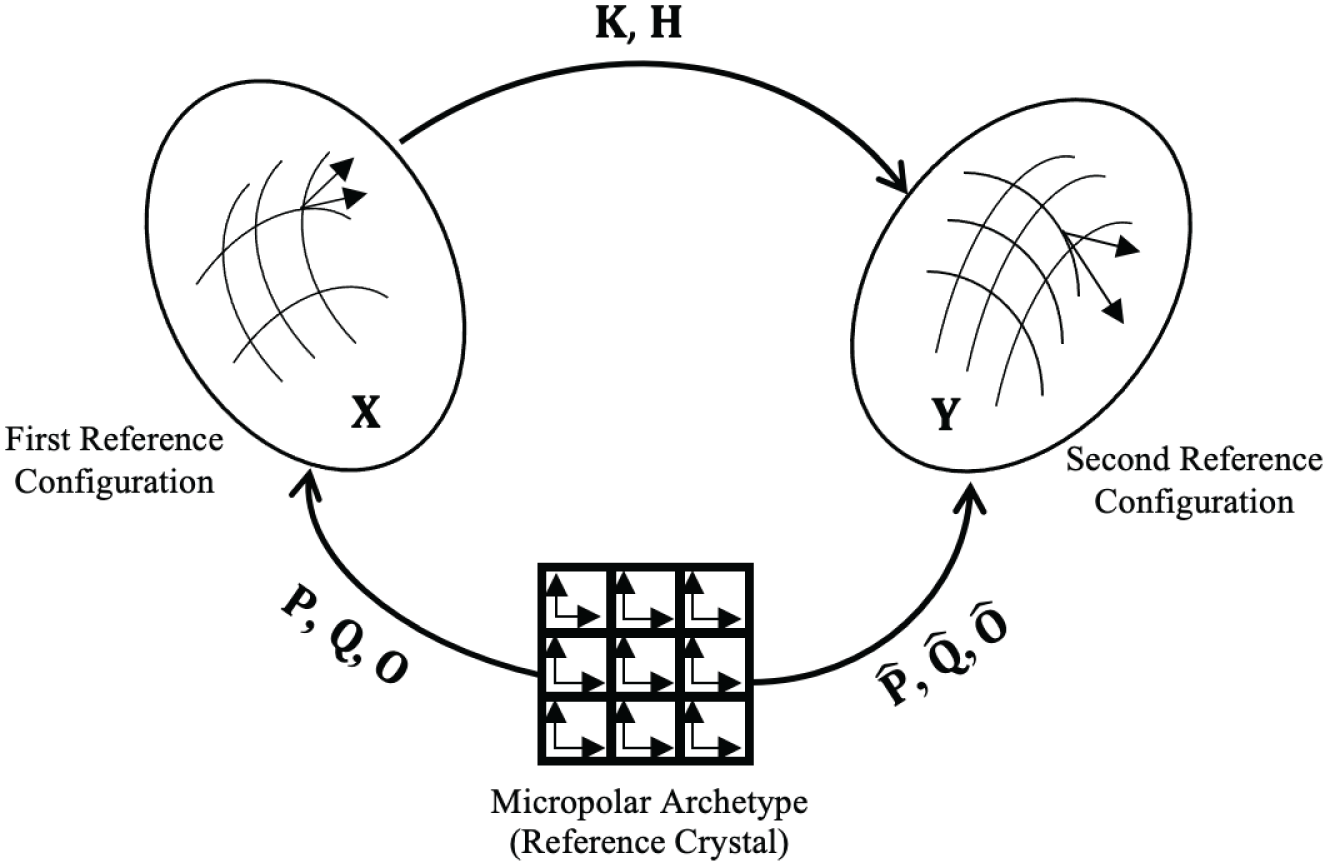
Uniformity fields associated with two different reference configurations.
Within the framework of micropolar theory, a change of reference configuration is fully described by the following mappings:


We further define the derivative of equation (75) with respect to the first reference configuration as

The relationship between the material implants



where



Here,



By substituting equations (84)–(86) into equations (81)–(83), we obtain the following expressions for the pull-back of the Mandel stress, Mandel couple stress, and Mandel hyperstress to the archetype:



To distinguish the transformed quantities, we place a “



These quantities can be interpreted as the “inhomogeneity velocity gradient” of micropolar materials at the archetype level. Accordingly, the evolution laws can be expressed as



Using equations (93)–(95), the micropolar evolution laws can be reformulated as




It is evident that the micropolar evolution laws depend linearly on the material implants. Equations (96)–(98) represent the evolution equations reduced to the archetype. A key aspect in this context is the careful evaluation of the contributions arising from changes in the reference configuration, specifically the pullback of the Mandel stresses to the archetype. This is inherently a constitutive property which, once determined, enables the prediction of how any point in the reference configuration responds to the Mandel stresses. Consequently, the problem of evaluating the evolution laws reduces to determining the functions
4.4.2. Material symmetry consistency and actual evolution in a micropolar evolution law
In this section, we investigate the consistency of material symmetry during material evolution. It is demonstrated that the proposed evolution laws equations (96)–(98) must satisfy additional constraints to ensure the preservation of micropolar material symmetry. Specifically, in a micropolar medium, the evolution laws at each material point remain invariant under the action of the material symmetry group. A similar principle has been applied in the theories of first- and second-grade materials [22, 39] as well as in the micromorphic theory [25].
Two approaches are typically considered for incorporating material symmetry into the treatment of evolution laws. First, the material symmetry is regarded as an element of the symmetry group of the reference crystal, which remains fixed throughout material evolution. Second, the material symmetry is treated as a time-dependent quantity. In the first case, the transformation laws for the implant maps under a change of archetype



where
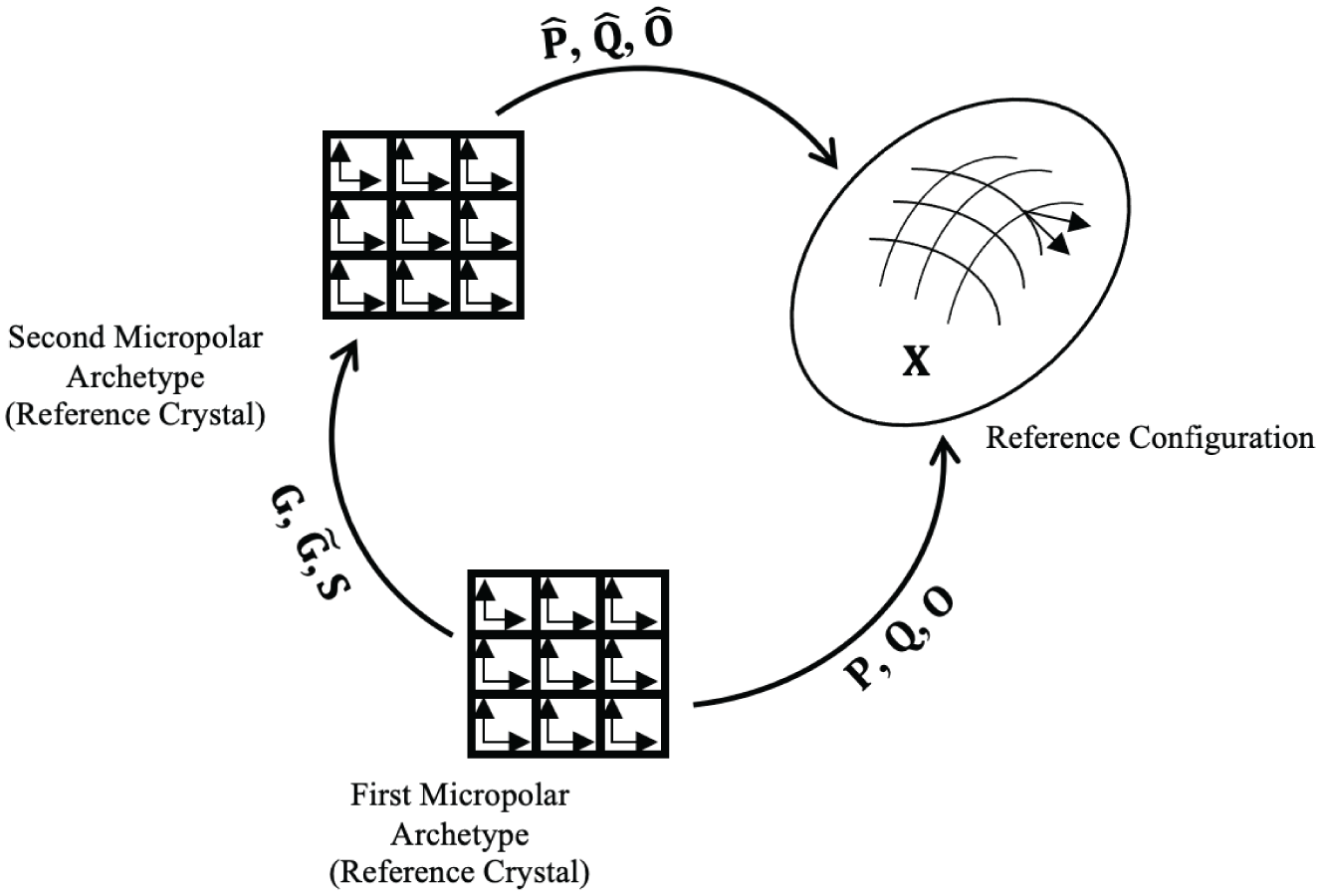
Uniformity fields associated with two different micropolar archtype.



where



where



To establish the relationships between the original evolution functions (



Equations (112)–(114) illustrate the principle of material symmetry consistency for micropolar materials. Accordingly, by applying the transformation set
As previously noted, in the first scenario, the material symmetry group is assumed to remain fixed throughout the material evolution. In contrast, in the second scenario, the two sets of evolution functions



where



In these expressions, the quantities
The physical meaning of actual evolution is tied to the notion of a material G-structure. Because the material transplants
For further discussion on this important point, the reader is referred to Epstein and Elzanowski [22].
5. Conclusion
In this work, we have developed a comprehensive framework for finite elastoplastic deformations within the context of micropolar theory. The formulation consistently accounts for large strains and finite rotations while capturing the influence of material microstructure. By deriving the balance equations from an invariance principle under general observer transformations, we ensure a physically consistent description of the system. The proposed evolution laws, expressed as first-order differential equations for material transplants, respect the constraints imposed by micropolar symmetries and the second law of thermodynamics. Furthermore, the identification of the micropolar Mandel stress tensors as the driving forces for local material rearrangements provides a clear energetic interpretation of plastic flow at the microscale. Overall, this framework offers a robust and thermodynamically consistent approach for modeling complex elastoplastic behavior in micropolar media and lays the foundation for future computational and experimental investigations.
Footnotes

Funding
The authors received no financial support for the research, authorship, and/or publication of this article.
Declaration of conflicting interests
The authors declared no potential conflicts of interest with respect to the research, authorship, and/or publication of this article.