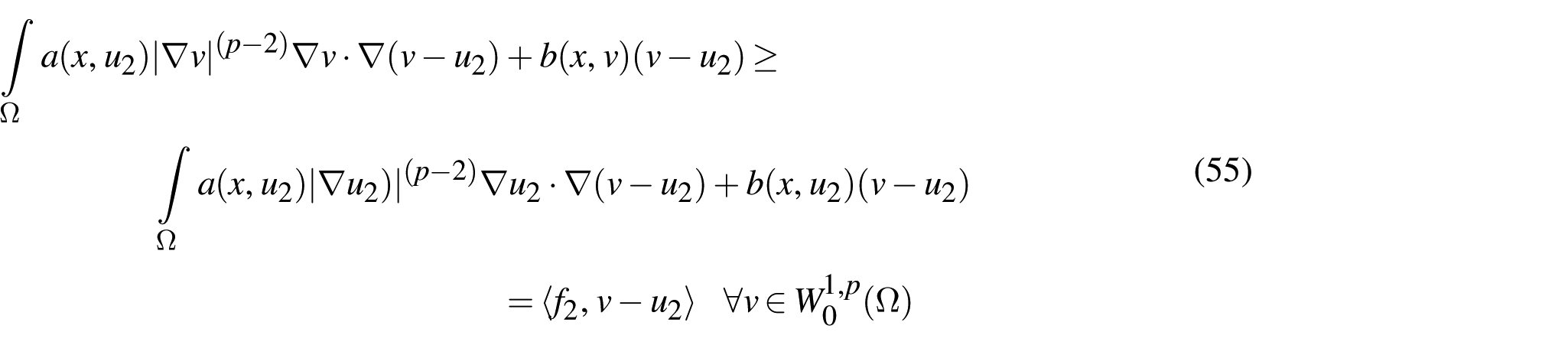
The goal of this note is to present different uniqueness results for problems associated with pseudo-monotone operators having the structure of the p-Laplace operator. The results are quite different when the equations at hand have a strictly monotone lower order term. The topic uses different test functions depending on the assumptions of the coefficients of the operators. Some of them are used in the references mentioned below but most of the time we simplify them and compare their strength. At the end of the note, we introduce some new type of such operators for which uniqueness can be proved roughly speaking the same way.
We will denote by Ω a bounded open subset of , . We would like to consider problems of the following type:
Here are Carathéodory functions, p is a real number such that , , is the conjugate of p. We refer to [1–3] for the definition of the spaces used in this paper. We will assume that for some positive constants
For b we will assume that
and defines a continuous mapping from into . An important case will be when this mapping is increasing, i.e., satisfies
As a canonical example for b, one could think to
where β denotes some nonnegative function.
Note that we will consider (1) under its weak form which is
This model problem will help us to stress out the ideas and address more involved issues. Our goal is mainly to give simple proofs of results spread in the literature, not always in their strongest form (cf. [4–11]), and when several proofs are available to compare their strength.
The paper is divided as follows. In the next section, we address the case of operators with a lower order term strictly monotone. In section 3, this strict monotonicity is removed which surprisingly makes the problems more involved. Finally, in the last section, we use our knowledge acquired previously to extend our results to some other operators, some of them new, with structures close the p-Laplacian.
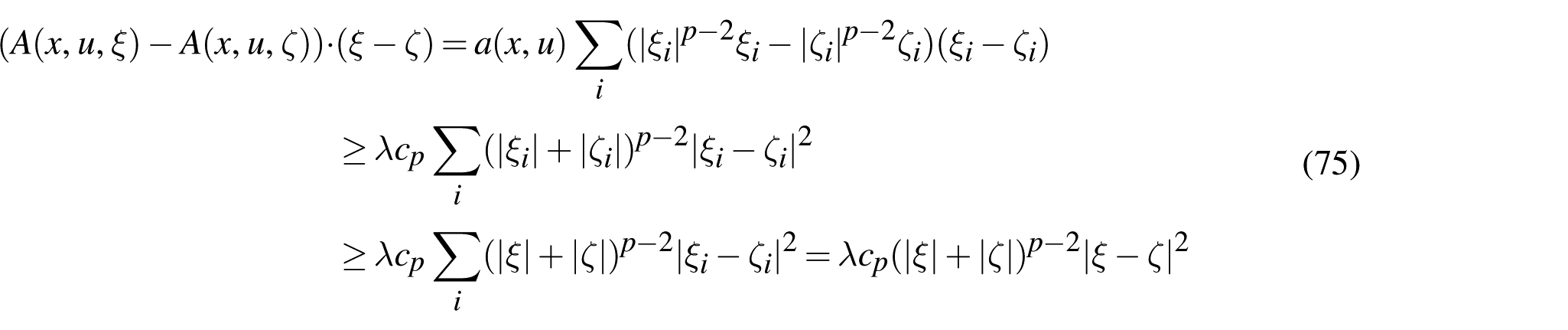
Let us first recall an important inequality when dealing with operators close to the p-Laplacian (see, for instance, [2] for a proof). For any , there exists a constant such that
Here, like in equation (5), the scalar product in is denoted by a dot.
2. The case with lower order term strictly monotone
The first uniqueness result that we can establish is the following.
Theorem 1.Suppose thatare Carathéodory functions satisfying (2)–(4). In addition, suppose thatis Hölder continuous of exponent, i.e., that for some constant A one has
Then, ifare solutions to equation (5) corresponding, respectively, to,one has
(Note that in particular problem (5) admits at most one solution.stands for
for all,).
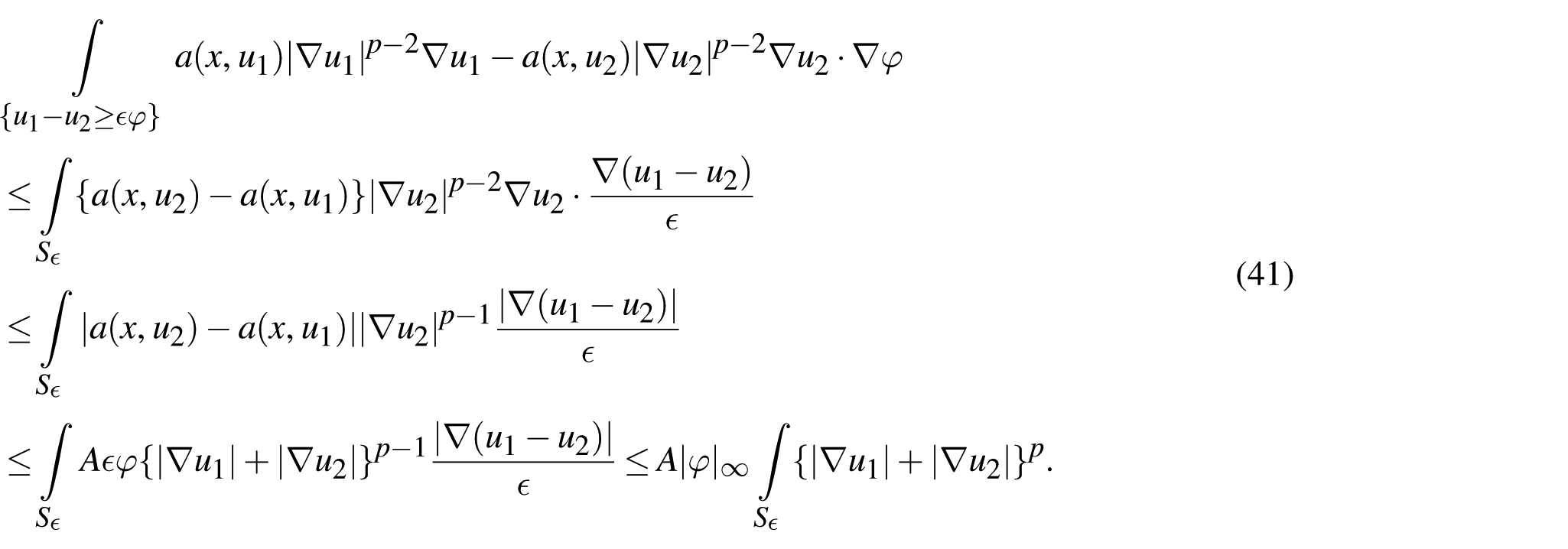
Proof. One has
for all , .
This implies easily subtracting to both sides of the inequality
Then, for one chooses as test function (cf. [6,12]) where ∧ denotes the minimum of two numbers. One has
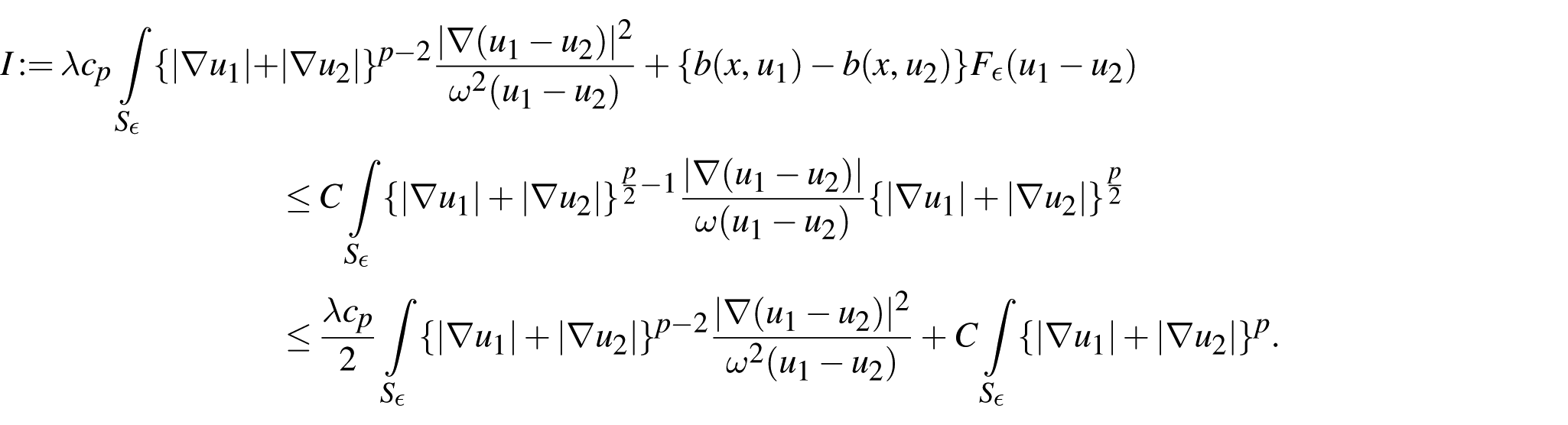
Taking into account (2), (7) one derives easily from equation (10) dropping the measures of integration
Using the inequality (6) this implies
Applying the Young inequality
in the right-hand side of the inequality we get for some constant
Thus, it comes
where, by the Lebesgue theorem, when . Then, one deduces that
when . Since a.e. where denotes the characteristic function of the set one deduces that
If equation (4) holds, one has necessarily . This completes the proof of the theorem. □
Remark 1. In case when is not strictly monotone increasing one gets only that equation (18) holds.
It is clear from the above that the modulus of continuity of is playing a crucial role here. Working with this in mind one can produce a slightly better version than Theorem 2.1. Indeed, let us suppose that there is a continuous function ω such that
(ω could be the modulus of continuity of . Note that if a is Hölder continuous in u, i.e., if
then satisfies the assumptions above when , thus our assumptions are slightly better than in Theorem 2.1.)
Then, we have
Theorem 2.Suppose that we are under the conditions of Theorem 1 and that equations (19)–(21) hold. Then, ifare solutions to equation (5) corresponding, respectively, to,one has
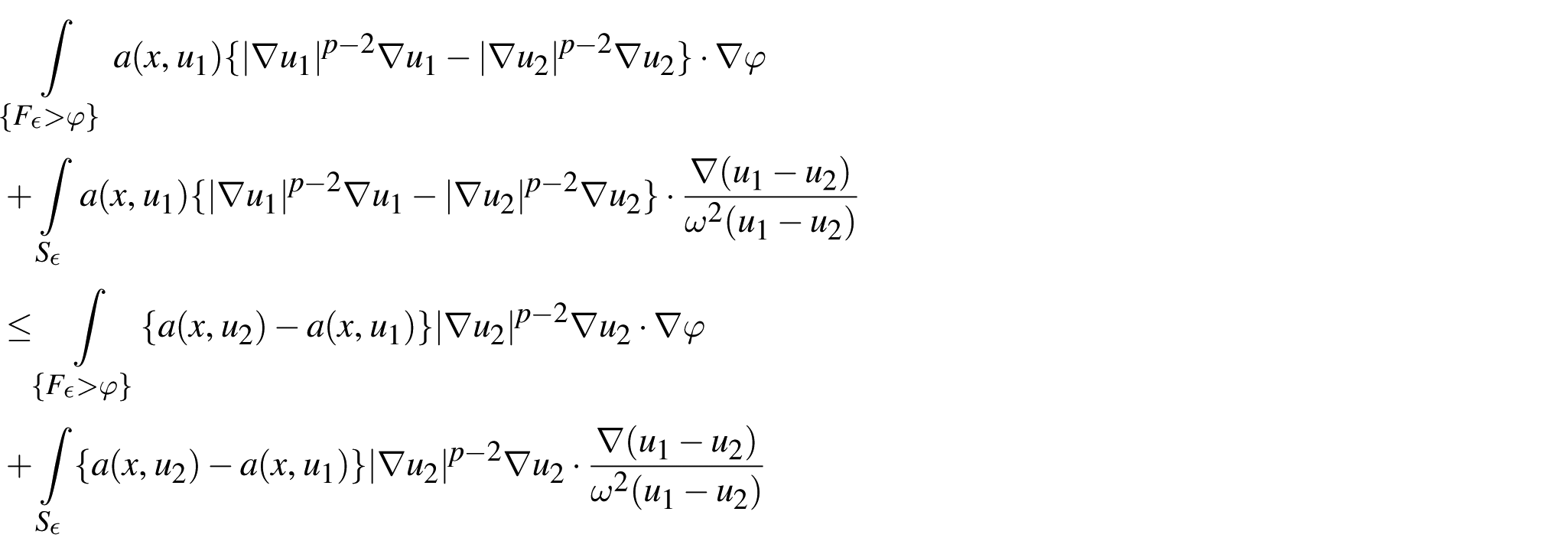
Proof. Since a is bounded (see equation (2)), there is no restriction in assuming ω bounded, replacing it if necessary by . Then, for set
Clearly is a piecewise -function with bounded derivative and
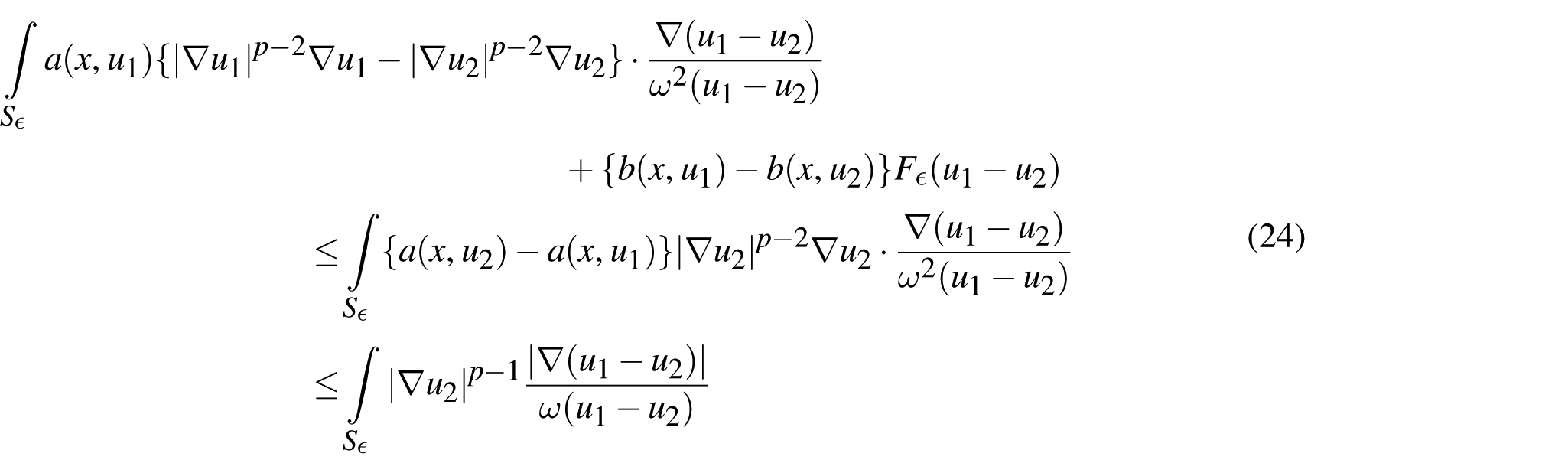
is a suitable test function for equation (10). Since
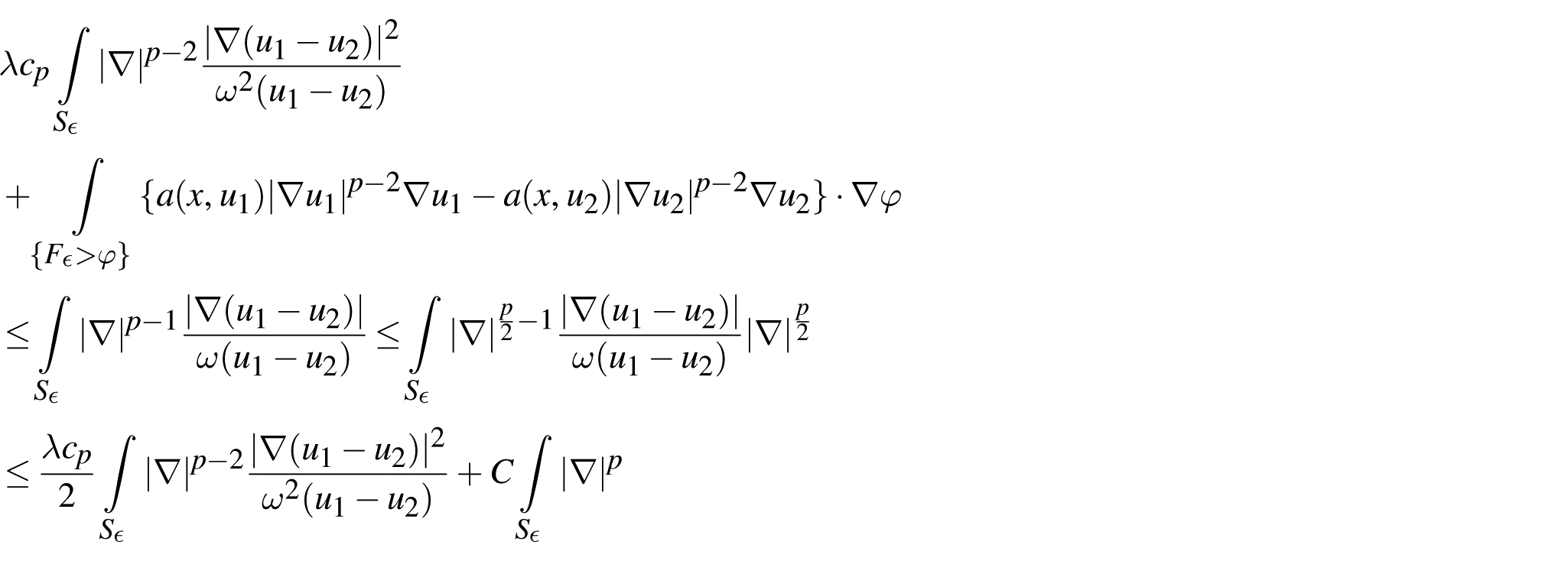
Using the Young inequality (14), we deduce like in equation (15)
and thus
The left-hand side of equation (27) is bounded independently of ϵ and on the set one has . Due to equation (4), this implies that this set is of measure 0 and this completes the proof of the theorem. □
Remark 2. In the above theorems, the assumptions on the continuity of a are independent of p. Note that uniqueness might fail under just a continuity assumption of a in u (cf. [10]).
3. The case with no strict monotonicity of the lower order term
In this section, we address the case of a lower order term which is not strictly monotone or even vanishing identically. First, let us show
Theorem 3.Suppose that under the conditions of Theorem 2,and equations (19) and (20) hold with
Then, ifare solutions to equation (5) corresponding, respectively, to,one has
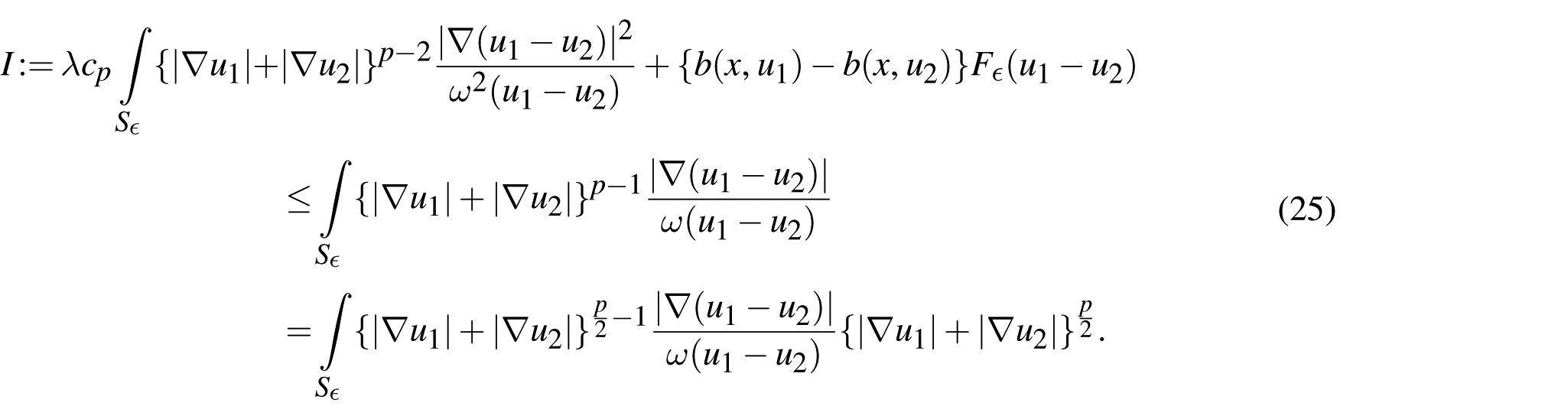
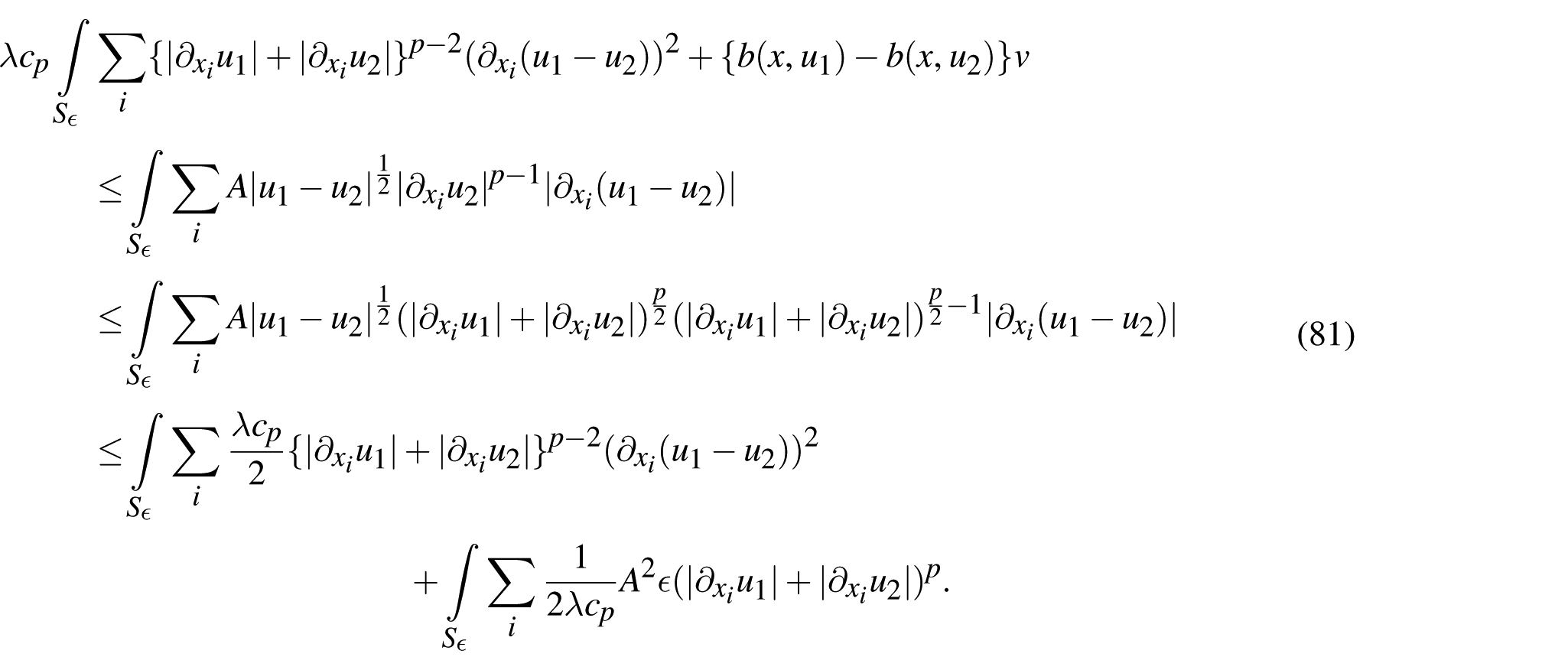
Proof. One proceeds as in Theorem 2. From equation (26), due to the monotonicity of , one deduces for some other constant C
To simplify our notation, let us set
Then, by the Young inequality
we get
for some constant C independent of ϵ (cf. equation (30)). Setting
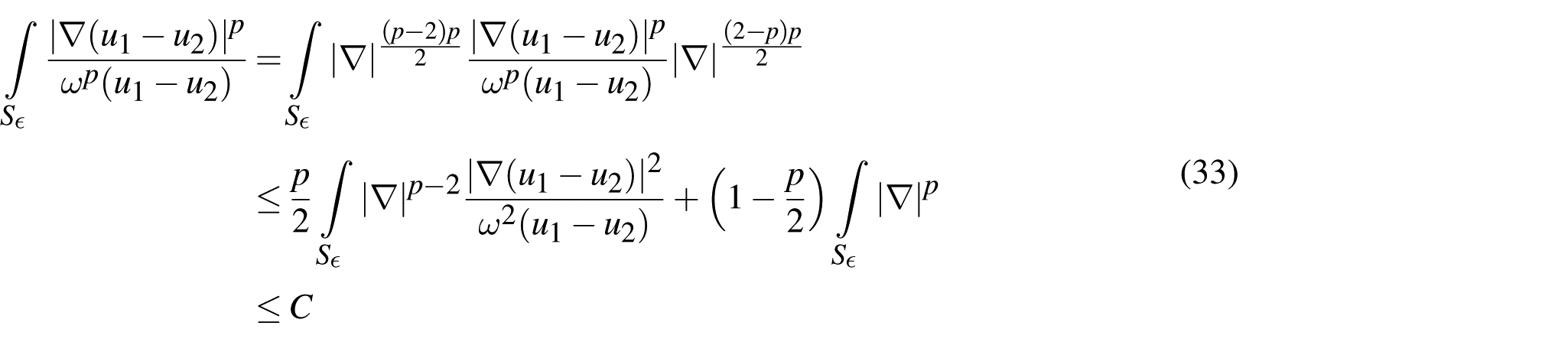
one has due to Poincaré’s inequality
denoting the Poincaré constant. Combining this with equation (33), we get for some new constant C independent of ϵ
Letting since on the set we see that this set has measure 0. This completes the proof of the theorem. □
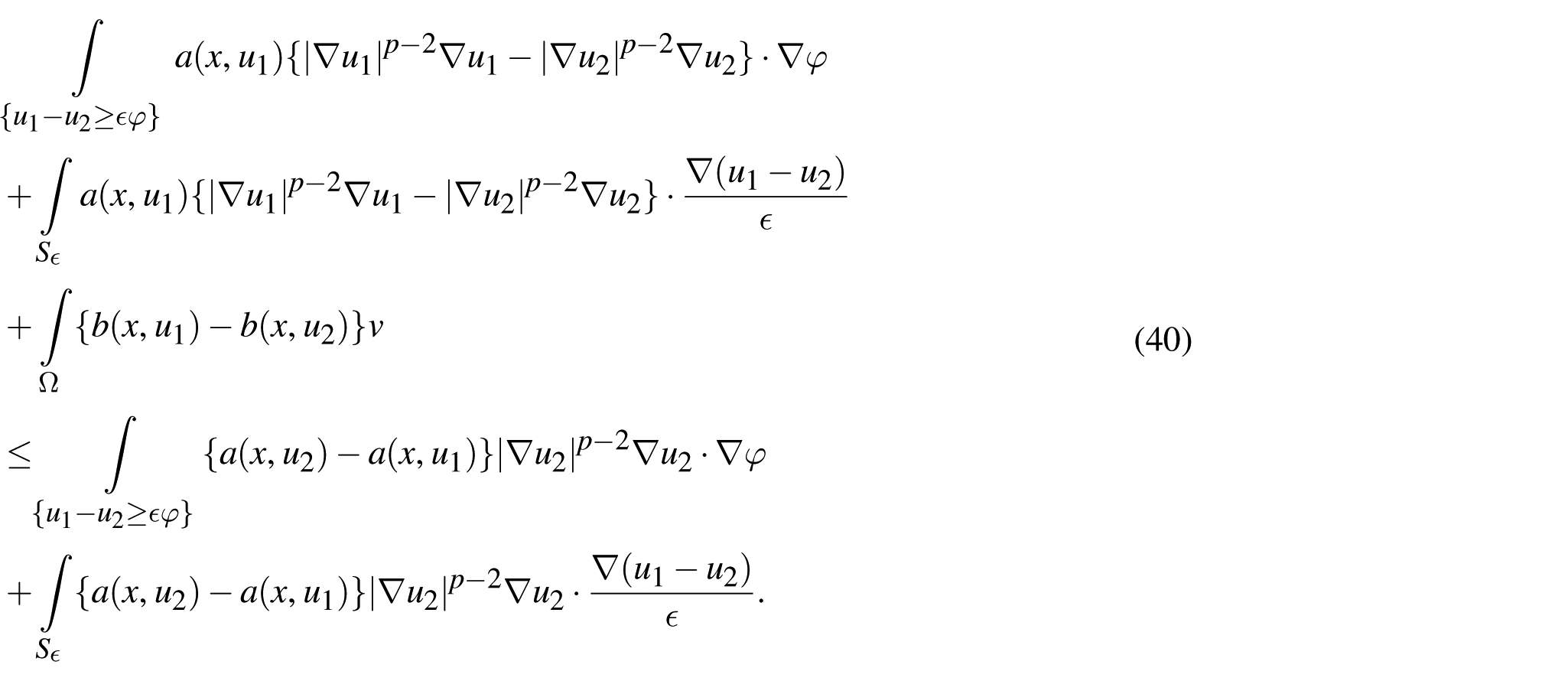
Using the monotonicity of b (since one integrates on ) and equation (6), we are ending up with ( denotes the -norm of φ)
Letting it follows by the Lebesgue theorem that, when
Changing then φ into , equation (37) follows. This completes the proof of the theorem. □
The assumption (36) can be improved. Indeed, one has as previously:
Theorem 5.Suppose that equations (2) and (3) hold and in addition that equations (19)–(21) hold. Letbe solutions to equation (5) corresponding, respectively, to,. Ifthen equation (37) holds, i.e.,
for all,.
Proof. Let us suppose defined as in equation (23). For consider
in equation (10). Since one integrates on the term in b is nonnegative and one derives
where
Using the same arguments as before one derives
and then
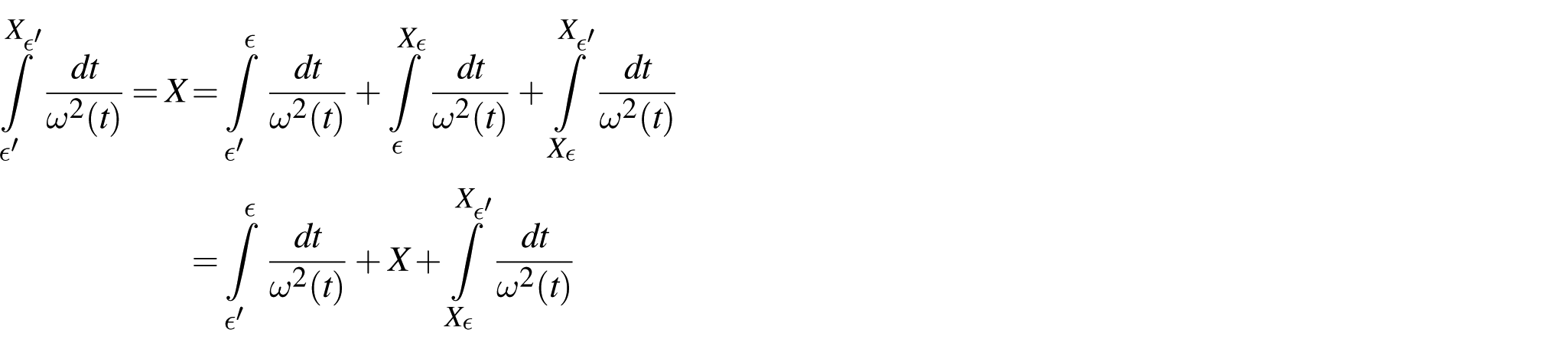
The function is increasing with . For any one denotes by the real number defined as
For one has . Indeed, this follows from
since then
implies clearly . Then, when , has a limit which can only be 0 due to equation (21). Since
the measure of tends to 0 when . One has also
and thus
Passing to the limit in equations (43) and (37) is deduced as in the preceding theorem. This completes the proof of the theorem. □
We are now going to draw consequences of equation (37). For that let us suppose that
Dividing by t and letting , equation (54) follows easily. Since is bounded independently of ϵ one can find a subsequence—still labelled by ϵ—such that for some u, in ,
Then, one can pass to the limit in equation (53) to obtain, recall that
i.e., u is solution to equation (50). This completes the proof of the proposition. □
since the function is increasing. It is now clear that the function is on and thus if is Lipschitz continuous in u so is . Thus, from equation (65), we get easily
for some constant C. It follows that
This can be written
and thus
This implies that and . This completes the proof of uniqueness in this case.
To show the monotonicity in term of f, i.e., that implies , one uses (37). Then, in the method developed above, one replaces by any connected component of and shows that on such a component , which means it is empty. This completes the proof of the theorem. We refer to [6] for another proof. □
4. Variants, generalizations, existence
Let us set
Noting the useful structure assumptions of this function used in Theorem 1, one can extend our result to solution to
for all , provided that A has suitable properties.
Indeed, suppose that is a Carathéodory function such that for some function and some constants
then the integral (67) is well defined, recall that denotes the euclidean norm in .
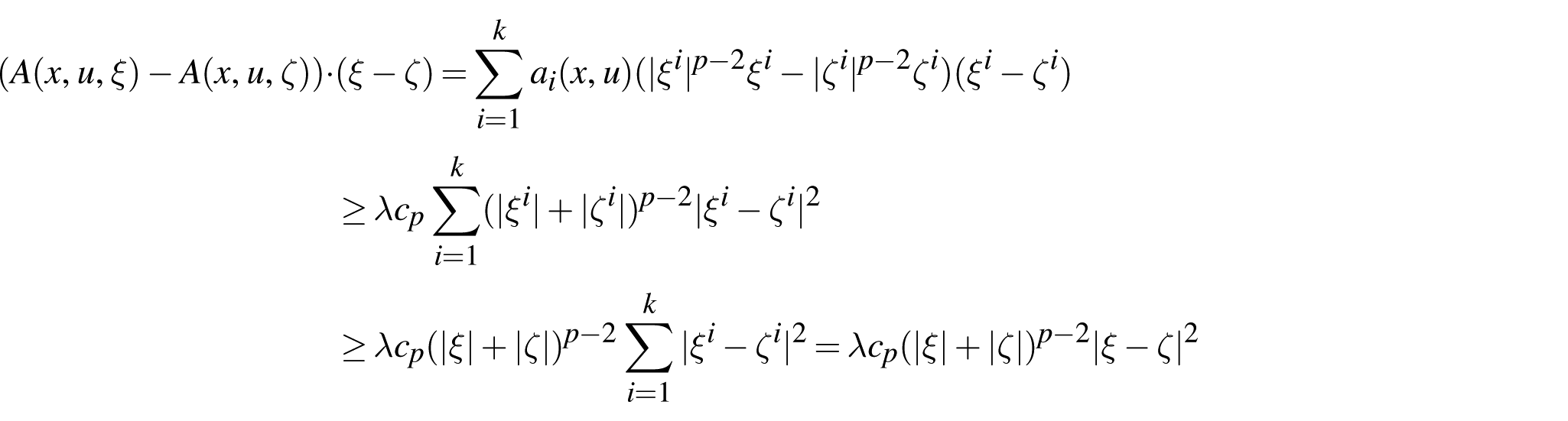
To get equation (13), it is enough to follow the steps (11), (12), assuming in addition that for some constant
for every . This extends Theorem 1 in this more general case and also some result in [7]. The extension of Theorems 2, 3, 4, and 5 follows the same way as well as the arguments until theorem 6.
Instead of (66), one can also consider
the index i running from . Consider first the case when
Then, the end of the proof follows exactly the proof of Theorem 3 starting from equation (30).
On the other hand, (70) fails when , a satisfying (2). Indeed, consider the case when . Then, to verify the inequality (70), one will have to prove that for some constant C
i.e., that
In the case when , , one has and the inequality reduces to
Having fixed, it is clear that we get a contradiction when .
Thus, in the case, one has to proceed differently. We will consider the slightly more general case when
We suppose that each satisfies (2) and (7). Then if are solution to equation (67) one has in place of equation (10) for , ,
Choosing as before , we get easily by equation (6) and the Young inequality, being defined in equation (11),
Then, it follows that
and one concludes as in the end of Theorem 1. We left to the reader the proofs of the analogue of theorems of section 2 or 3.
Remark 3. When assumption (70) can thus be replaced by the weaker one below
To end this section, we would like to come up with an existence result for almost all the problems investigated above. If ξ is a vector of we suppose it split in k different sets of components in such a way it can be written
Then, if are k Carathéodory functions satisfying (2) we set
Note that if , and if , (cf. equation (72)). We can now consider the problem of finding u solution to
Suppose that satisfies (3) and defines a continuous mapping from into . Then, we have
Theorem 7.Under the assumptions above, suppose in addition that, then for, there exists at least one solution to equation (86).
Proof. Consider . Then, we claim that there exists a unique solution to
First we note that
defines a linear form of . Indeed, the components of are all of the type and thus are all bounded by . It follows that
Thus, is an operator from into its dual. We claim that it is coercive. To prove this, if we denote by
the p-norms in we are going to use the equivalence of these norms in different finite-dimensional spaces . Indeed, for different constants, we have then
i.e.,
Thus, taking in equation (88), it comes (recall that )
and the coerciveness follows.
Remark 4. It is clear that could also be a vector built with certain components of ξ provided that at the end they are all used at least once, i.e., the operator at hand could be an operator sum of operators involving p-Laplace operators in dimension less than n.
It is clear that is in addition monotone, continuous on finite-dimensional subspaces. Thus, the existence of a unique solution to equation (87) follows from classical arguments (cf. for instance, [2,3,13,14]). Next, if we show that S has a fixed point, we will have obtained a solution to equation (86). For that we consider S as a mapping from into itself. From equations (93) and (87), if , we have ( denotes the strong dual norm in
i.e., is bounded independently of w. If S is continuous, it will be compact and the existence of a fixed point will be just a consequence of the Schauder fixed point theorem. Thus, we just have now to prove the continuity of S. To do that one follows the lines of Proposition 3.1. Indeed, first one shows easily that equation (87) is equivalent to
Then, one considers such that . One sets . Since by equation (94) is bounded independently of n one can extract a subsequence still labeled such that for some , in and
Then, passing in the limit in
one sees that u is the unique solution to equation (95) i.e. . By uniqueness of the limit, the whole sequence converges toward u and S is continuous. This completes the proof of the theorem. □
Remark 5. Of course, for the operators introduced in Theorem 7, some uniqueness results or monotonicity with respect to f are available. They follow the lines developed above and their proofs are left to the reader. To be convinced of these possibilities note that if is given by equation (85) it holds, for instance, when satisfies (2) and
Part of this work was performed when I was visiting the mathematics department of Fudan University. I would like to thank especially Professor Hao Wu for his kind invitation and his hospitality during my stay there. This paper is intended for the P. G. Ciarlet’s Special Issue.
Declaration of conflicting interests
The authors declared no potential conflicts of interest with respect to the research, authorship, and/or publication of this article.
Funding
The authors received no financial support for the research, authorship, and/or publication of this article.
ORCID iD
Michel Chipot
References
1.
BrezisH. Functional analysis, Sobolev spaces and partial differential equations. Universitext. New York: Springer, 2011.
EvansLC. Partial differential equations, Graduate Studies in Mathematics, vol. 19. Providence, RI: American Mathematical Society, 1998.
4.
AntonsevSChipotM. Anisotropic equations: uniqueness and existence results. Differ Integral Equ2008; 21(5–6): 401–419.
5.
ArtolaM. Sur une classe de problèmes paraboliques quasilinéaires. Boll Un Mat Ital1986; 5: 51–70.
6.
Casado-DìazJMuratFPorrettaA. Uniqueness results for pseudomonotone problems with p > 2. C R Acad Sci Paris, Ser I2007; 344: 487–492.
7.
BoccardoLGallouëtTMuratF. Unicité de la solution de certaines équations elliptiques non linéaires. C R Acad Sci Paris1992; 315(I): 1159–1164.
8.
Casado-DìazJPorrettaA. Existence and comparison of maximal and minimal solutions for pseudo monotone elliptic problems in l1. Nonlinear Anal2003; 53: 351–373.
9.
CarrilloJChipotM. On nonlinear elliptic equations involving derivative of the nonlinearity. Proc R Soc Edinb1985; 100A: 281–294.
10.
ChipotM. On the sum of operators of p-Laplacian types. Commun Math Anal Appl2025; 4(1): 1–16.
11.
ChipotMMichailleG. Uniqueness results and monotonicity properties for strongly nonlinear elliptic variational inequalities. Annali della Scuola Norm Sup Pisa, Serie IV1989; 16(1): 137–166.
12.
ChipotM. On the diffusion of a population partly driven by its preferences. Arch Rat Mech Anal2000; 155: 237–259.
13.
LionsJL. Quelques méthodes de résolution des problèmes aux limites non linéaires. Paris: Dunod, 1969.
14.
KinderlehrerDStampacchiaG. An introduction to variational inequalities and their applications, vol. 31. Philadelphia, PA: SIAM, 2000.