




Abstract
We study the design of a double-coated neutral epitrochoidal elastic inhomogeneity that does not disturb the prescribed uniform hydrostatic stress field in the surrounding elastic matrix. The two coatings have a common shear modulus but distinct Poisson’s ratios. In order to achieve the neutrality condition in the matrix, the plane-strain bulk modulus of the matrix and the Poisson’s ratio of the inner coating can be uniquely determined for given elastic properties of the outer coating and the inhomogeneity and given geometry of the composite by iteratively solving two coupled non-linear equations.
Keywords
1. Introduction
A neutral elastic inhomogeneity when inserted into a uniformly stressed elastic matrix does not disturb the prescribed field in the matrix [1,2]. The study of neutral inhomogeneities (with neutral holes as a special case) can be dated back to Mansfield [3]. Typical and simple examples of neutral elastic inhomogeneities are a coated sphere and a coated cylinder [4,5]. A coated sphere (or a coated cylinder) does not disturb the uniform hydrostatic stress field (or the uniform in-plane hydrostatic stress field) in an isotropic elastic matrix when the bulk modulus (or the plane-strain bulk modulus) of the matrix is chosen appropriately [4–6]. In Hashin and Rosen [5], the two-dimensional neutral inhomogeneity is of circular shape. It is then quite natural to ask if a non-circular inhomogeneity can be made neutral to a uniform hydrostatic stress field. This study endeavors to answer this question.
In this paper, we solve the inverse problem associated with a double-coated epitrochoidal elastic inhomogeneity neutral to a prescribed uniform hydrostatic stress field in the elastic matrix. The two coatings have the same shear modulus and distinct Poisson’s ratios. Using a two-term mapping function [7] for the simply connected domain occupied by the double-coated epitrochoidal inhomogeneity, the three interfaces of the composite are mapped onto three concentric circles in the image plane. Through satisfaction of the neutrality condition in the matrix, the continuity conditions of displacements and tractions across the three perfect interfaces of the composite, and the boundedness condition of stresses and displacements everywhere within the inhomogeneity, a set of two coupled non-linear equations is finally derived. By iteratively solving this set of non-linear equations, the plane-strain bulk modulus of the matrix and the Poisson’s ratio of the inner coating can be uniquely determined for given elastic properties of the outer coating and the inhomogeneity and given geometry of the composite. In addition, the mean stress within each coating is uniform and the hoop stress is uniformly distributed along the entire coating-matrix interface on the side of the outer coating. The numerical result validates the proposed theory.
2. Muskhelishvili’s complex variable formulation
We first establish a fixed rectangular coordinate system

and

where

3. A double-coated neutral epitrochoidal inhomogeneity
As shown in Figure 1, we consider an epitrochoidal elastic inhomogeneity bonded to an elastic matrix (finite or infinite in extent) through two coatings. Let

where
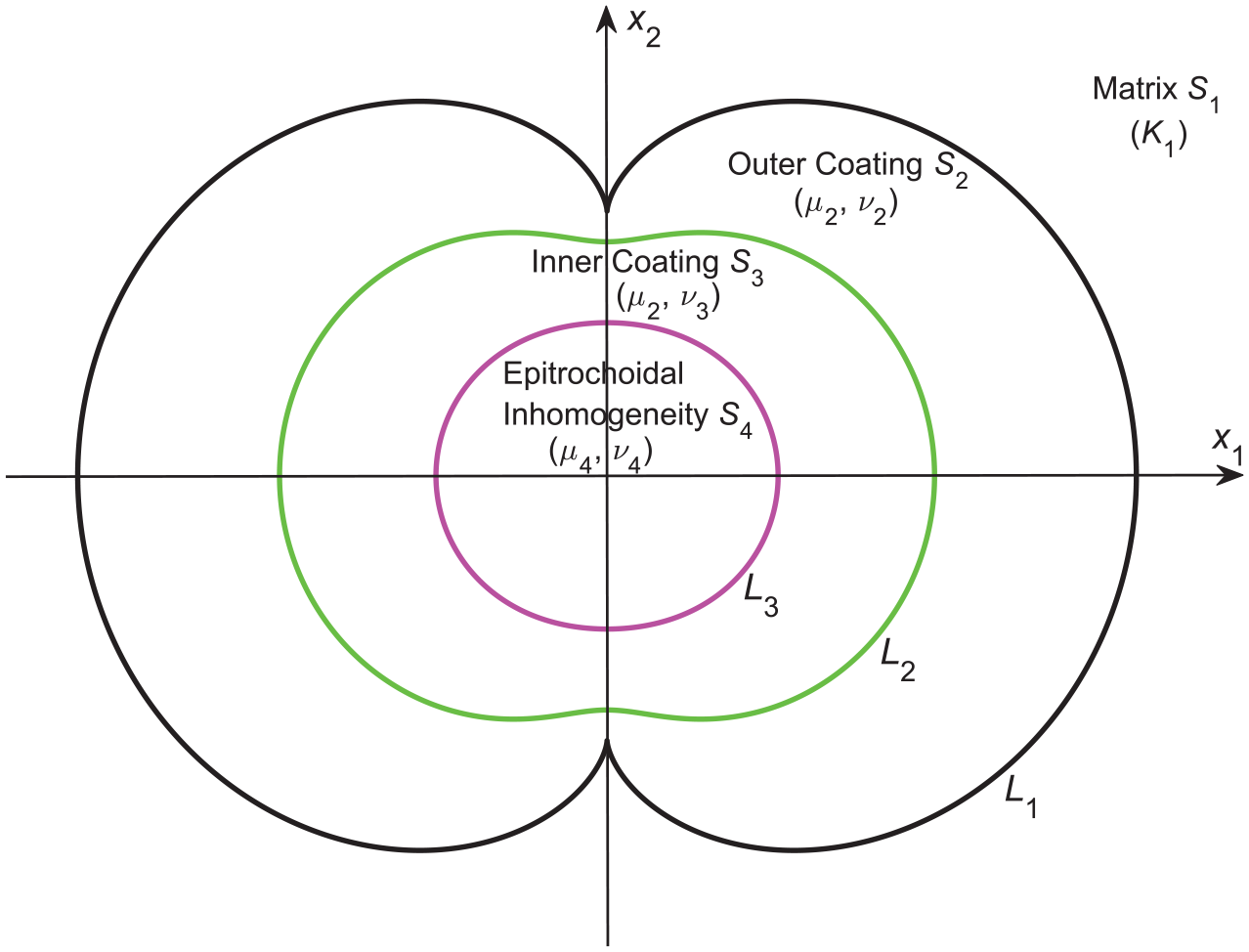
A double-coated epitrochoidal elastic inhomogeneity neutral to a prescribed uniform hydrostatic stress field in the matrix.
In order to satisfy the neutrality condition in the matrix in equation (4), the pair of analytic functions

The continuity conditions of tractions and displacements across the three perfect interfaces



We now introduce the following conformal mapping function for the simply connected domain occupied by the double-coated epitrochoidal inhomogeneity [7]

where n is an integer equal to or greater than 2.
As shown in Figure 2, using the mapping function in equation (7), the outer coating
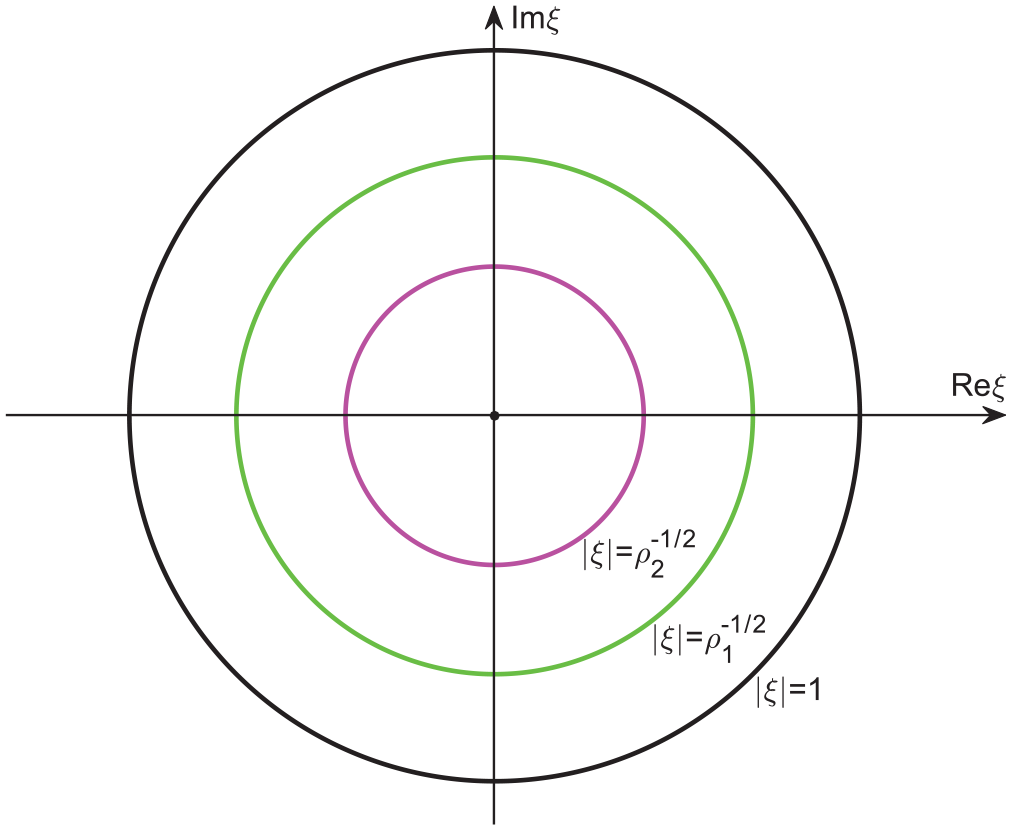
The ξ-plane.
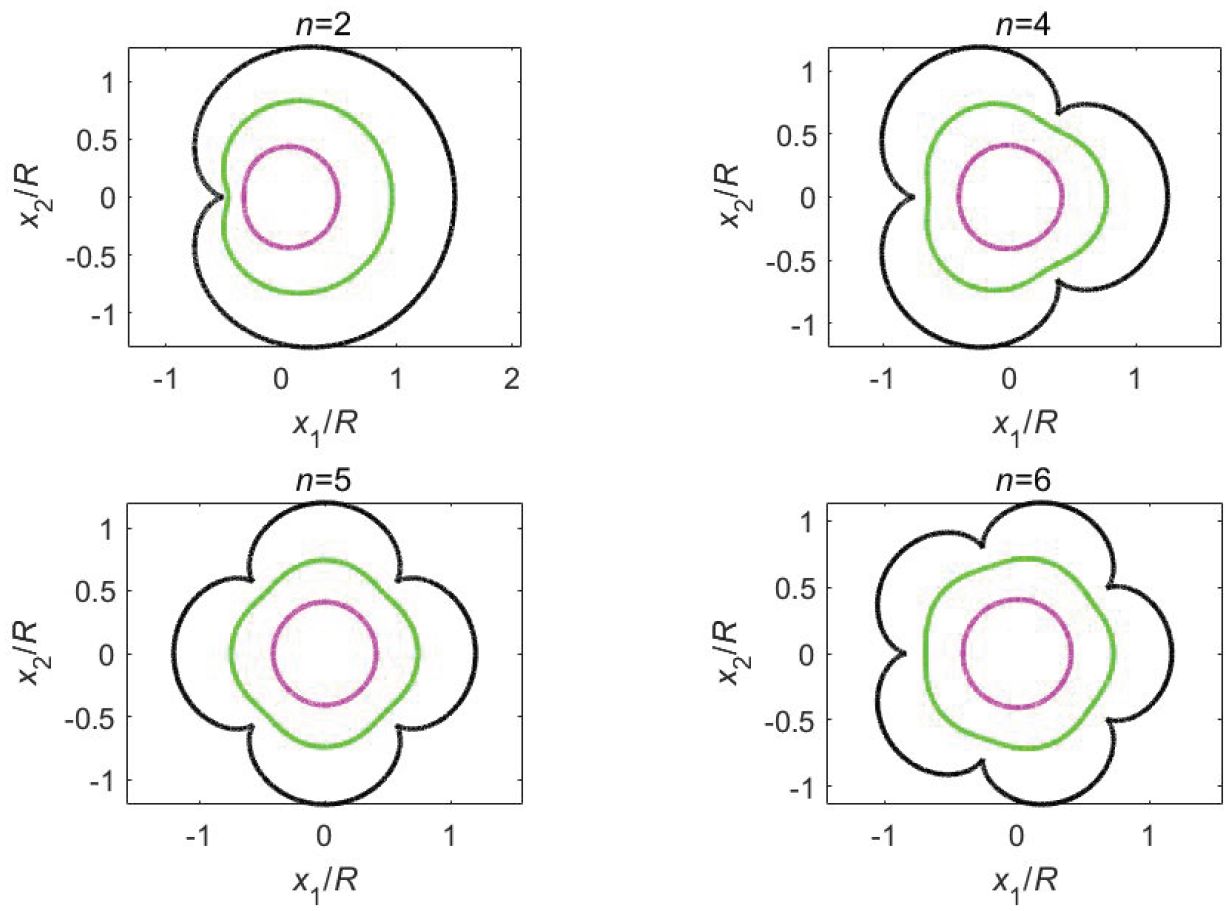
The three interfaces
By enforcing the continuity conditions in equation (6a–c) with the use of equation (5), we find that


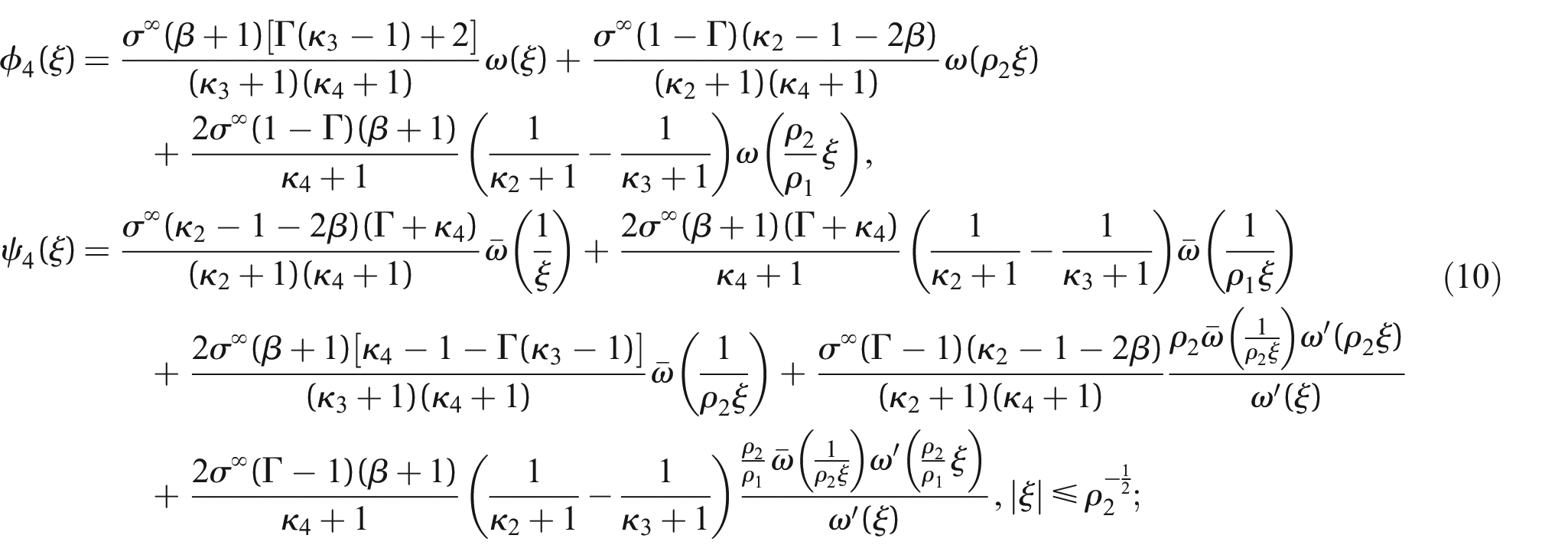
where

in which
It follows from equations (7) and (10) that: (1)
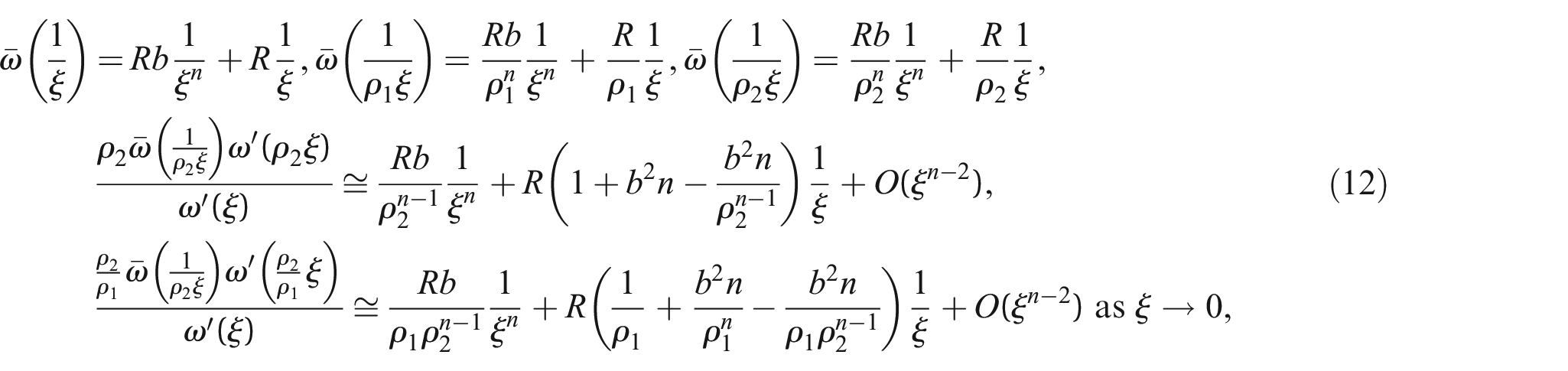
and imposing the condition that
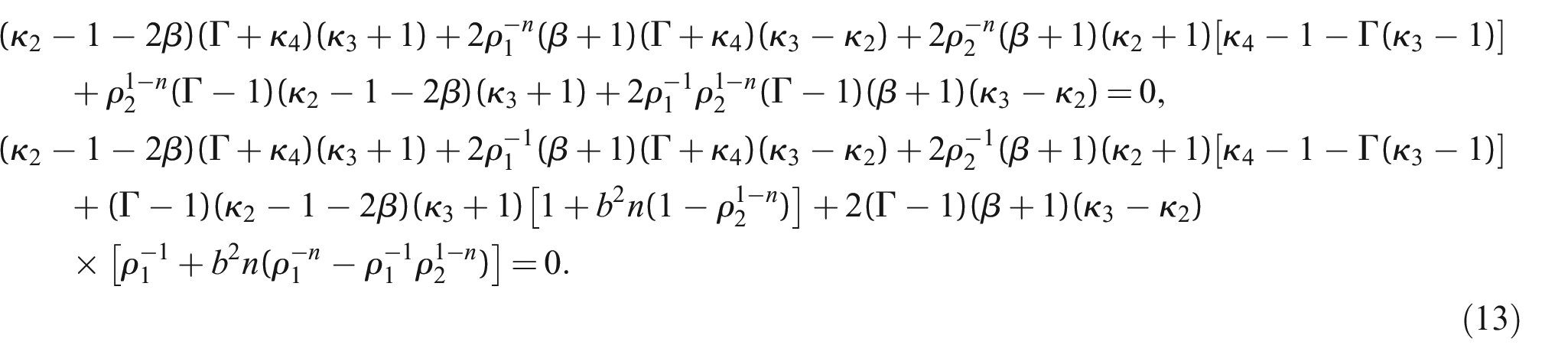
As a check, when

where
Equation (13) can be considered as two coupled non-linear equations in β and
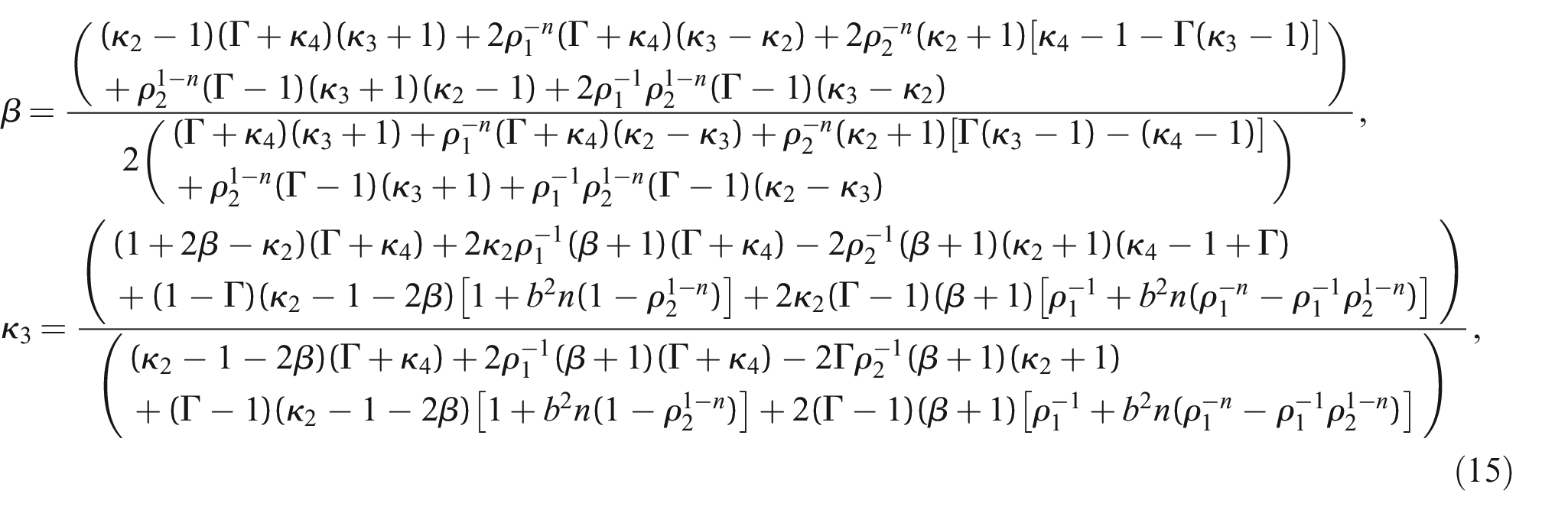
which serves to iteratively solve for β and
The calculated β and
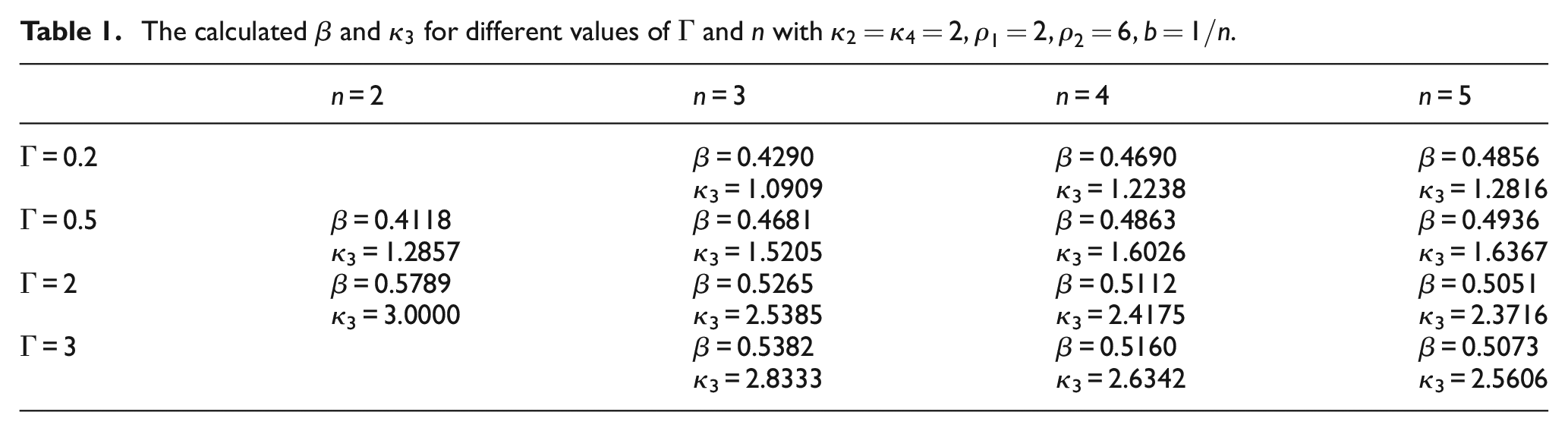
The result in Table 1 indicates that: (1) the plane-strain bulk modulus of the matrix (
In addition, the mean stress is uniform in each coating and is given by

Moreover, the hoop stress is uniformly distributed along the coating-matrix interface

Equation (17) suggests that the stresses in the outer coating are still bounded at the possible sharp corners of
It is seen from equation (10) that the bounded stresses are non-uniform within the epitrochoidal inhomogeneity. For example, the mean stress is non-uniformly and regularly distributed within the epitrochoidal inhomogeneity as

Recall that the internal stress field within a coated circular inhomogeneity neutral to a prescribed uniform hydrostatic stress field is uniform and hydrostatic. When

where

We illustrate in Figure 4 the ratio
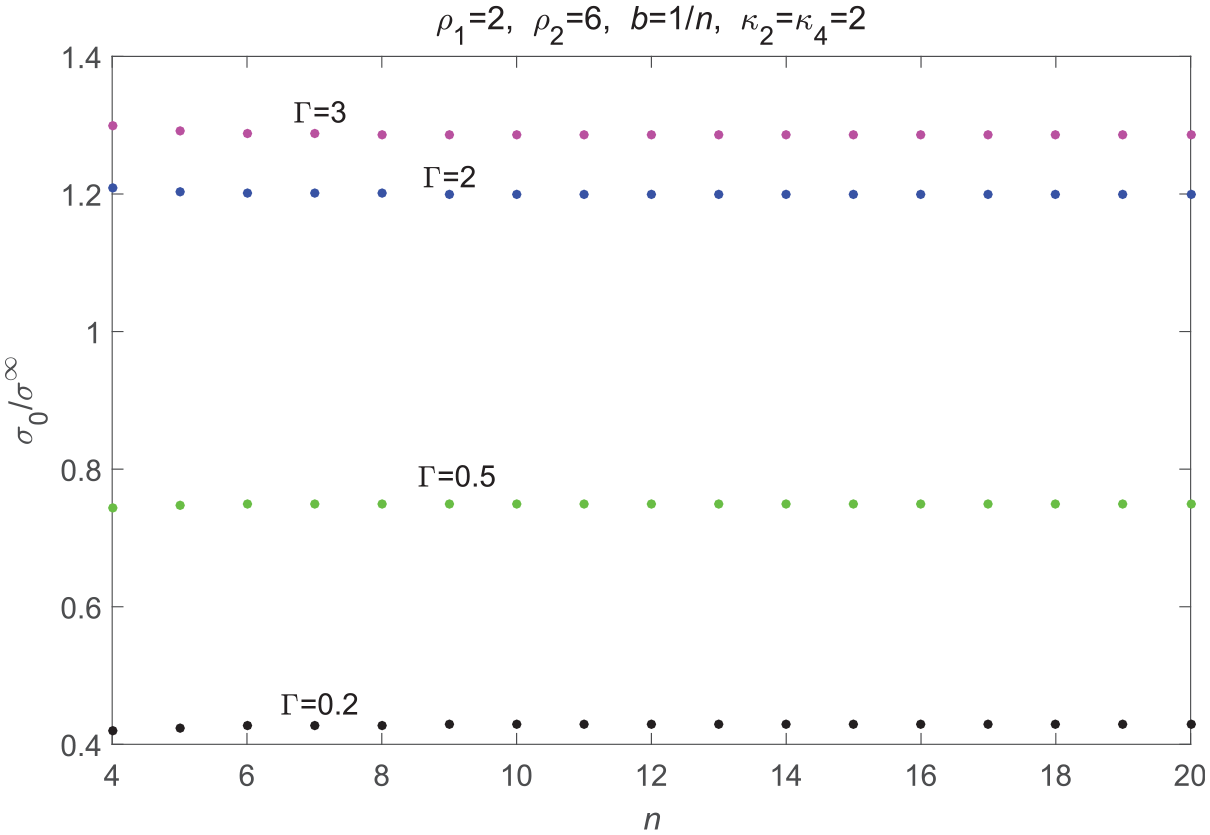
Variations of
4. Conclusion
We have achieved the neutrality of a double-coated epitrochoidal elastic inhomogeneity to a prescribed uniform hydrostatic stress field. In order to satisfy the neutrality condition in equation (4) or (5), a set of two coupled non-linear equations in equation (13) or (15) is derived and is solved iteratively to arrive at the two parameters β and
Footnotes
Declaration of conflicting interests
The authors declared no potential conflicts of interest with respect to the research, authorship, and/or publication of this article.
Funding
The authors disclosed receipt of the following financial support for the research, authorship, and/or publication of this article: This work was supported by a Discovery Grant from the Natural Sciences and Engineering Research Council of Canada (Grant No: RGPIN-2023-03227 Schiavo).
