




Abstract
For some time, it has been known that, under appropriate loading conditions, porous elastomers may develop instabilities in their macroscopic response. More recent theoretical work has shown that these composites may undergo ‘twinning’ or ‘domain formation,’ beyond the onset of such macroscopic instabilities. Here, motivated by interest in the possibility of using such porous elastomers for actuation purposes, we generalize this earlier work to account for pore pressure. For this purpose, we consider a class of two-dimensional (2D) porous elastomers consisting of random, isotropic distributions of aligned cylindrical pores in the elastomer. Exploiting the incompressibility of the elastomeric matrix, estimates are generated for the ‘principal’ or ‘mesoscopic’ and ‘relaxed’ or ‘macroscopic’ stored-energy functions of the porous elastomers with pressurized pores, by means of the earlier estimates for the unpressurized porous elastomers. Two specific cases are considered in detail: closed pores containing an ideal gas and open pores with direct pressure control. In the first case, it is found that, while the pressure generally stiffens the response, the onset of the instabilities and the associated twinned microstructures are insensitive to the pore pressure. In the second case, it is found that negative gauge pressures in the pores can be used to trigger the twinning instabilities, even at zero externally applied tractions. In either case, as previously found for the case of unpressurized pores, the response of the porous composite after twinning is perfectly soft in shear, which could prove extremely useful for actuation purposes. In addition, highly unusual behaviors, such as huge changes in shape, are predicted, even before the onset of twinning, by combining direct pressure control with appropriately selected (fixed) traction boundary conditions.
1. Introduction
Interest in soft materials has burgeoned in recent years, especially for applications in soft robotics [1], often as soft actuators [2]. In these applications, it is often desirable to create a material with some type of structure, for example, by fashioning a continuous elastomeric matrix with inclusions of some other phase: rigid metallic particles in magnetorheological elastomers (MREs) [3], liquid metal for flexible conductors [4], open channels into which gas or another fluid may be pumped [5], and so on. Such structure may be at the length scale of the body itself, but may often be on a much smaller scale, lending these materials to analysis using homogenization techniques [6–11]. The effective, or macroscopic behavior of these materials may then be determined, including the effects of the coupled physics that are often important in these systems: magnetic, electrical, chemical, and so on. Indeed, such analyses have been performed in the literature, in particular, for MREs (e.g., Ponte Castañeda and Galipeau [12], Danas et al. [13], Galipeau and Ponte Castañeda [14] and Lefèvre et al. [15]) and dielectric elastomeric composites (e.g., Tian et al. [16], Ponte Castañeda and Siboni [17] and Siboni and Ponte Castañeda [18]).
While the use of homogenization for these material systems has the usual benefit that their overall properties may be estimated without resorting to either simulations or experiments which may be time-intensive and expensive, and yields parameterized models which may be used to explore the design space very efficiently, there is a particular benefit when the materials are soft. In such cases, the behavior is inherently highly nonlinear due to the possibility of large deformations, and such nonlinearity may give rise to bifurcation instabilities for certain loading scenarios—that is, the solution of the governing elastostatics equations may lose uniqueness. These instabilities are often specifically sought after, proving extremely useful for various applications (see, for example, the review of Kochmann and Bertoldi [19]), but may be difficult to design for or analyze in general. Here, too, homogenization may play an important role: once a continuum model for the material behavior is obtained, use can be made of rigorous methods both to predict the presence of instabilities and to estimate the ‘relaxed’ response after their onset, describing the physical changes in the microstructure which result and the new macroscopic behavior (see the review of Ponte Castañeda [20]). It is these instabilities which are the focus of the present work, in the particular context of porous elastomeric composites.
There are several results in the literature aimed at understanding the effective mechanical response of porous elastomers. For the case of a periodic arrangement of pores, an early investigation was given by Abeyaratne and Triantafyllidis [7] (see also Triantafyllidis et al. [21] and Michel et al. [22]), while for the case of a random, isotropic arrangement of pores, explicit models were given for spherical pores under general loading by Lopez-Pamies and Ponte Castañeda [23] and for cylindrical pores under plane strain by Lopez-Pamies and Ponte Castañeda [24]. While all these models consider the pore phase to be vacuous and therefore to sustain no pressure, Idiart and Lopez-Pamies [25] and Lopez-Pamies et al. [26] made use of the incompressibility of the elastomer phase and of a clever change of variables in the governing elastostatics problem to express the effective behavior of a material with pressurized pores in a simple manner in terms of the corresponding behavior of an unpressurized material with the same microstructure. With this, the ‘principal’ or ‘mesoscopic’ response of pressurized porous elastomers may be understood in the absence of instabilities. However, in each of the above works, the material behavior was found to lose stability for sufficiently severe deformations. Abeyaratne and Triantafyllidis [7] noted in the periodic case that the incremental macroscopic response of the composite lost strong ellipticity (SE) under sufficient compression (even when the solid elastic material could not). In the context of elastomeric laminates, Triantafyllidis and Maker [27] compared the onset of such ‘macroscopic’ instabilities, signaled by loss of strong ellipticity (LOSE) of the macroscopic response, with the onset of ‘microscopic’ instabilities, driven by bifurcations at the microstructural level. The relation between microscopic and macroscopic instabilities was again considered by Geymonat et al. [28], who showed that in the periodic case, microscopic instabilities generally occur before macroscopic, and that LOSE corresponds to the limit as the wavelength of the microscopic instability becomes infinite. These instabilities were explored for porous elastomers with a particular set of microstructures and material properties by Triantafyllidis et al. [21] and Michel et al. [22], who gave the eigenmodes of the microscopic instabilities in the periodic case. The post-bifurcation response was considered later by Bertoldi et al. [29].
For random (aperiodic) microstructures such as those under consideration in this work, only macroscopic instabilities are possible. After the onset of such instabilities, it has been found by Avazmohammadi and Ponte Castañeda [30] and Furer and Ponte Castañeda [31,32], in the context of fiber-reinforced and laminated elastomer composites, respectively, that the initially macroscopically uniform deformation of the material may become non-uniform at a scale much larger than that of the microstructure, though still much smaller than that of the specimen. Thus, the ‘macroscopic’ or ‘relaxed’ response (after the onset of such macroscopic instabilities) of the composite is associated with the formation of ‘domains’ or ‘twinning,’ and can lead to ‘soft modes’ of deformation. Motivated by the fact that, in each of the aforementioned works for porous elastomers with random distributions of vacuous pores [7,11,23–25], LOSE was found to occur for sufficiently severe deformations, Caulfield and Ponte Castañeda [33] demonstrated recently that twinning is also predicted to take place in these porous elastomers and determined the relaxed response for a special class of porous elastomers with random distributions of aligned, cylindrical, vacuous pores. In general, however, LOSE will be affected by pore pressure (as observed by Lopez-Pamies et al. [26] in the context of porous elastomers with spherical pores), as will the subsequent relaxed response. Hence, the difficult work of computing the relaxed solution would in general need to be performed independently for any pore pressure and evolution law.
In this paper, we generalize the work of Caulfield and Ponte Castañeda [33], who characterized the macroscopic response of porous elastomers with vacuous pores beyond the onset of instabilities, to include materials with arbitrary pore pressure. We show that, for the same class of porous elastomers undergoing plane strain deformations, the relaxation is in fact independent of pore pressure, such that the relaxed behavior of the pressurized composites may be written in terms of that of the unpressurized composite in a manner completely analogous to the pre-relaxation behavior. This argument holds for isotropic porous elastomers with incompressible matrix phases being loaded in plane strain, provided the energy potential governing the pore pressure is convex (in the determinant of the deformation gradient). Thus, once the pre- and post-instability behavior under plane strain of a porous elastomer with vacuous pores is known, these results may be extended trivially to arbitrary pore pressurization protocols.
The paper is organized as follows. In Section 2, we summarize the general framework by which the principal and relaxed solutions for the behavior of porous elastomers are defined and show how to give the principal solution of the pressurized system in terms of that of the unpressurized. Then, in Section 3, we recall a particular estimate for the effective behavior of a material consisting of an incompressible Neo-Hookean matrix containing aligned, cylindrical pores and undergoing plane strain deformations, for which both the principal and relaxed solutions are already known, and use the results of Section 2 to give the pre-bifurcation behavior of pressurized composites with this microstructure using two representative pressurization schemes. In Section 4, we show that the onset of LOSE is unaffected by the presence of pressure in these materials, and therefore Section 5 argues that the relaxed microstructure is also unaffected. We conclude in Section 6 by giving a sampling of results for these pressurized composites including the effects of relaxation, and remark on notable features pointing toward promising future work in these systems.
2. Theoretical framework for effective behavior of pressurized porous elastomers
In this section, we outline the framework used to define the effective response of porous elastomers and give a simple method, adapted from prior work, to incorporate the effect of pore pressure into the homogenized response. Thus, we consider a general elastomeric composite body occupying reference volume
The response of the matrix phase is given by the stored-energy density function

with the local first Piola–Kirchhoff (PK) stress given by

and the local tangent modulus tensor by

Then, following Hill [6], the homogenized or mesoscopically averaged response of the composite under an affine deformation boundary condition

where

are the kinematically admissible deformations satisfying the imposed boundary condition. The average PK stress

and

Herein, we term (4) the ‘principal’ or ‘mesoscopic’ solution for the effective stored-energy density.
For many composites, it has been found that, even when the constituent phases have polyconvex energy densities, the resulting homogenized energy

such that the presence of minimizing sequences must also be considered; indeed, a twinned microstructure corresponds to just such a solution (see Ball and James [34]). While the solution of the above is in general difficult, a method for at least generating an estimate has been developed based on computation of the quasiconvex envelope

and is postulated [30] to correspond to the solution of equation (8).
To this end, we will make use of an algorithm developed by Kohn and Strang [36] for determining the rank-one convexification by a sequential lamination procedure, which proceeds by computing

where
Such a procedure has been used for several types of elastomeric composites to demonstrate that they can relax via domain formation after the onset of a macroscopic instability as signaled by LOSE. This was first done by Avazmohammadi and Ponte Castañeda [30] for fiber-reinforced elastomers and subsequently for elastomeric laminates [31,32], magnetoelastic laminates [37], and most recently for porous elastomers [33].
2.1. Internal pore pressure
According to the aforementioned framework, the homogenized response of a porous material with pore pressures evolving according to some arbitrary constitutive model may be estimated using the various techniques available in the literature; see Ponte Castañeda [20] for a recent review of these methods for soft materials. However, such estimates will depend on the specific model chosen for the pore phase and therefore the difficult homogenization process would need to be performed for each possible case. To alleviate this difficulty, Idiart and Lopez-Pamies [25], building on work from Vincent et al. [38] and Julien et al. [39], have given a method whereby, if the matrix phase is taken to be incompressible (often a reasonable assumption for elastomers), the effective response of the pressurized composite may be given in terms of the response of the unpressurized composite, i.e., a porous material with vacuous pores. This allows the complex homogenization to be performed only for the vacuous case, while the effects of various types of pore pressure may be subsequently investigated with relative facility. As here we desire the result in a somewhat different form than that given by the above authors, their procedure, which makes use of a change of variables in the relevant boundary value problem, is suitably adapted in Appendix 1; for generality, we also include the effect of a constant external pressure (such as atmospheric pressure) on the composite. The resulting expression for the stored-energy density of the composite with initial pore pressure

where

Here,

where the average pore deformation

with

In what follows, we will make use of both the absolute pressure
A few comments are in order to ensure proper interpretation of the result (11). First, in all the above, we measure the deformation
In particular, the reference configuration from which

and is shown schematically in Figure 1. In particular, note that when
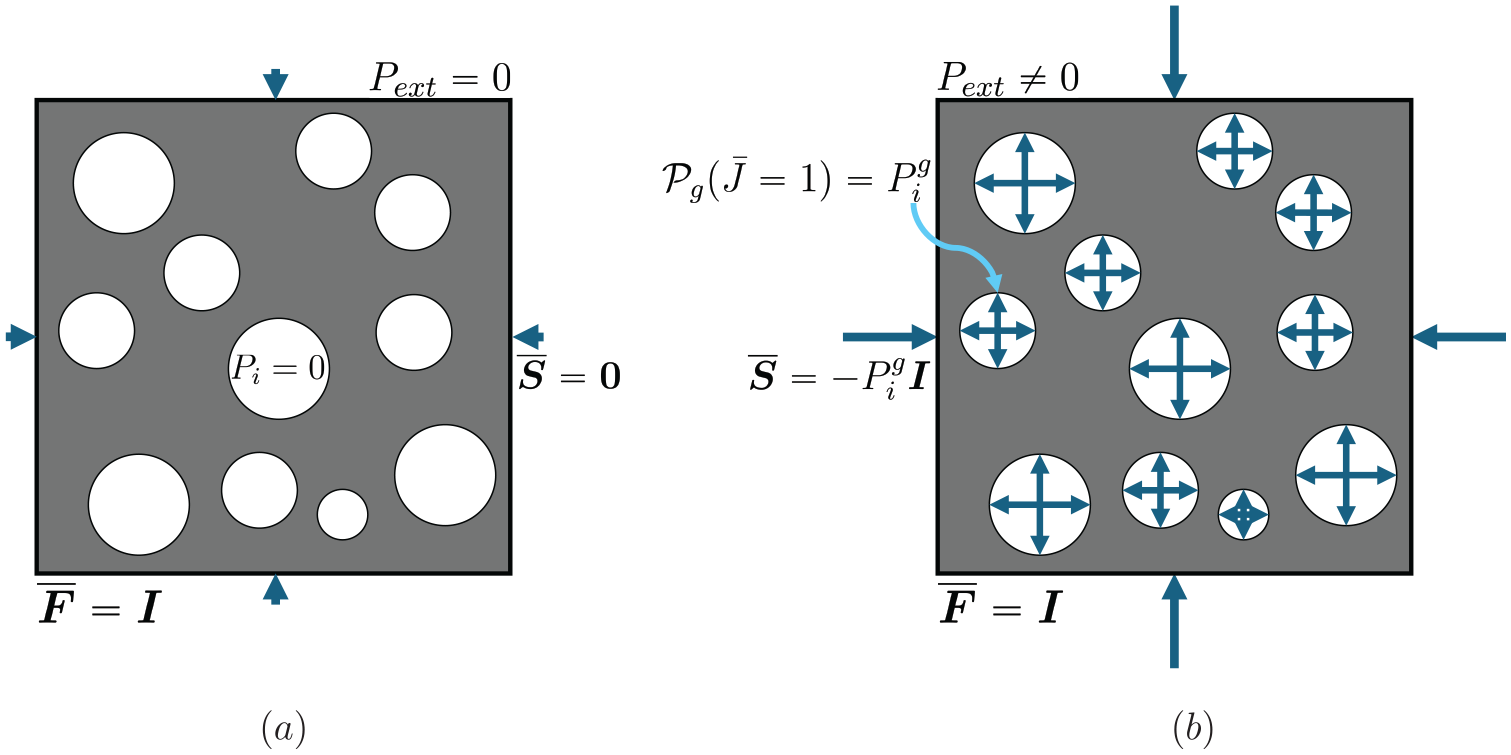
Schematic of reference configuration
Second, it must be emphasized that the stress corresponding to the energy (11) via
Additionally, the relation (11) should be understood to give only the mesoscopic, pre-relaxation response of the pressurized material, and therefore, in it, the unpressurized energy
Finally, observe that the additional term in equation (11) is a function only of
3. Estimates for the mesoscopic response of 2D porous elastomers under plane strain loading
Here, we first summarize previous results providing an estimate for the mesoscopic response of a class of 2D porous elastomers with vacuous pores. Then, using the results of Section 2.1, we extend the results to pressurized pores, considering two possible pressurization schemes: an ideal gas model, corresponding to closed, gas-filled pores, and prescribed pore pressure, corresponding to open pores with direct pressure control. These estimates describe elastomers containing an isotropic distribution of aligned cylindrical pores of circular cross-section which are subjected to plane strain conditions in the transverse plane. An estimate for the mesoscopic stored-energy of such a material with vacuous pores, corresponding to the principal solution of the associated variational problem (4), was given by Lopez-Pamies and Ponte Castañeda [24]. These authors specialized their results for the simple case where the elastomeric matrix is a generalized neo-Hookean material, giving explicit predictions for the pre-bifurcation response. They noted, however, the eventual LOSE of these estimates, signaling the possible development of instabilities, which will be considered in the following section.
Thus, considering the mesoscopic stored-energy of such 2D porous elastomers with an incompressible neo-Hookean matrix, Lopez-Pamies and Ponte Castañeda [24] provided the expression

in terms of the initial porosity

The expressions for the coefficients

such that pore closure will occur at
3.1. Gas-filled pores
A simple experiment to incorporate the effects of pore pressure would be to allow gas to flood the pores at some pressure (say, e.g., air at atmospheric pressure), then close the pores and deform the material. Now, for an ideal gas, the constitutive relation (assuming isothermal conditions) is

However, we are particularly interested in cases for which the initial internal pressure is equal to the external,

Thus the mesoscopic energy for the composite with closed pores containing an ideal gas is

3.2. Prescribed pore pressure
Our interest in the behavior of pressurized porous elastomers is driven by interest in possible applications in actuation. A large class of these applications would involve direct control of the internal pore pressure by, e.g., maintaining open pores connected to a pump or pressure vessel. Because of this control, the internal pressure is independent of

such that the mesoscopic energy of the composite is

Thus, the energy is dependent only on the gauge pressure

where

Here,
4. LOSE under plane strain
The above estimates characterize the behavior of the pressurized composite in the absence of instabilities. However, Lopez-Pamies and Ponte Castañeda [24] noted that the stored energy given by expression (17) loses SE for certain loading conditions. Therefore, in this section, we recall the conditions for SE, then specialize them for plane strain of isotropic materials and summarize the results for LOSE in the unpressurized case. (It should be noted that void collapse instabilities [40] are not expected for porous neo-Hookean elastomers.) Finally, we consider the effects of pressurization on LOSE, in particular for the cases described in Section 3.
In general, the homogenized behavior of a heterogenous material is said to be strongly elliptic [28] at a deformation

is satisfied, where

For plane strain of an isotropic material, this general condition reduces [41,42] to five scalar conditions on the components of

where the expressions for the
4.1. LOSE of the unpressurized elastomer
Lopez-Pamies and Ponte Castañeda [24] found that the conditions (29) fail to be met in the unpressurized case for certain overall compressive loadings. Caulfield and Ponte Castañeda [33] noted that LOSE first occurs when

where
Making use of the invariants
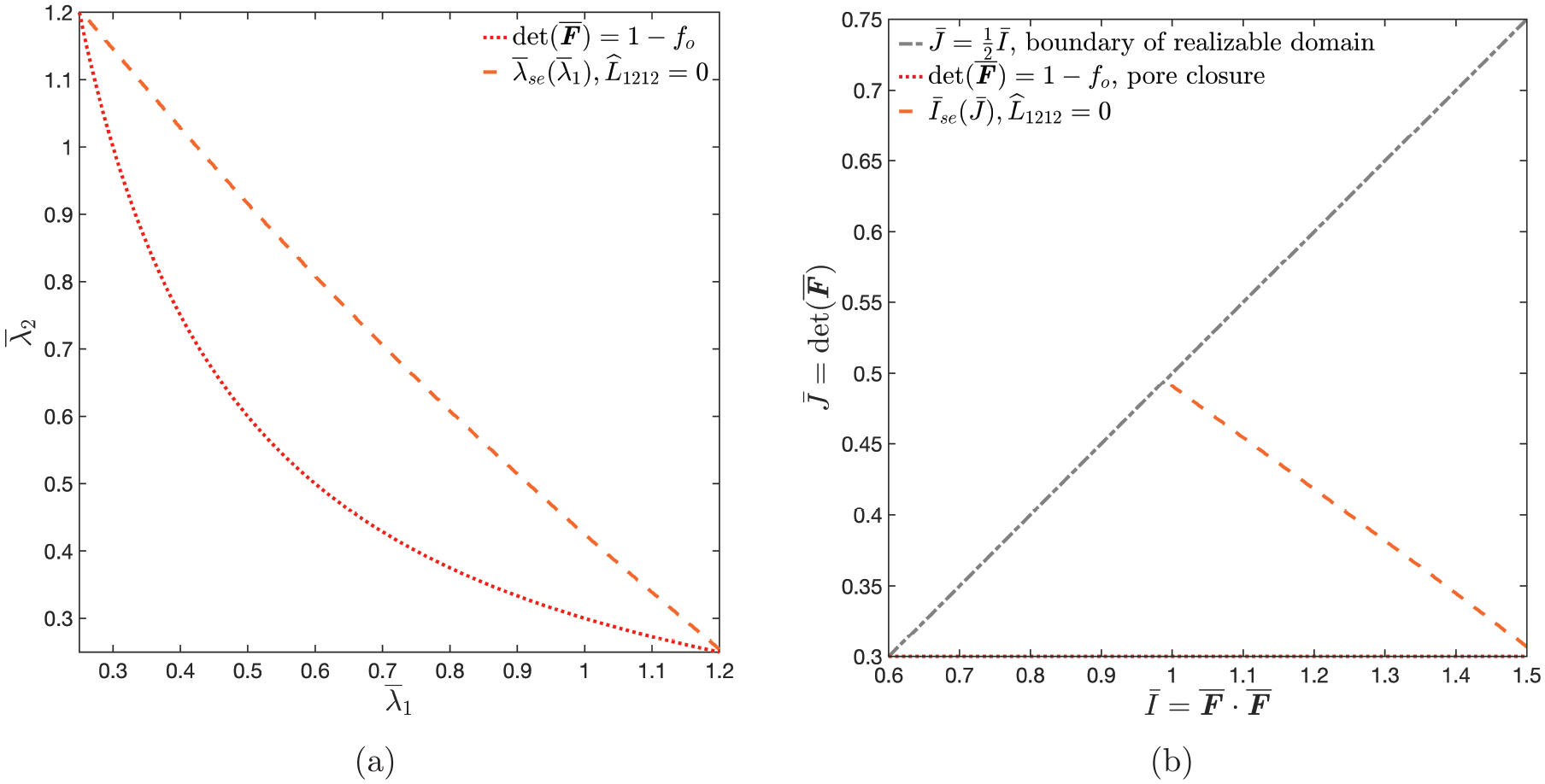
(a) LOSE and pore closure in the porous elastomer in terms of the macroscopic principal stretches
4.2. LOSE under general pore pressure
We now consider LOSE of the pressurized composite and compare it to the unpressurized. It is recalled that Idiart and Lopez-Pamies [25] found that pressurizing the pores generally tends to stabilize the porous elastomer. More precisely, if the behavior is strongly elliptic for a certain deformation in the absence of pore pressure, it must also be strongly elliptic for that deformation when the pores are pressurized. This is because, using the expression (11) giving the pressurized stored energy in terms of the unpressurized energy

Under our assumption of convex
Here, we go beyond this result to examine the particular ‘mode’ which drives LOSE, making use of the specialized conditions (29) for plane strain. We are interested in whether the addition of pore pressure could affect which condition of equation (29) first fails on the LOSE boundary. To this end, using expression (11) for the mesoscopic energy of the pressurized composite, and the expressions (64) for the components of
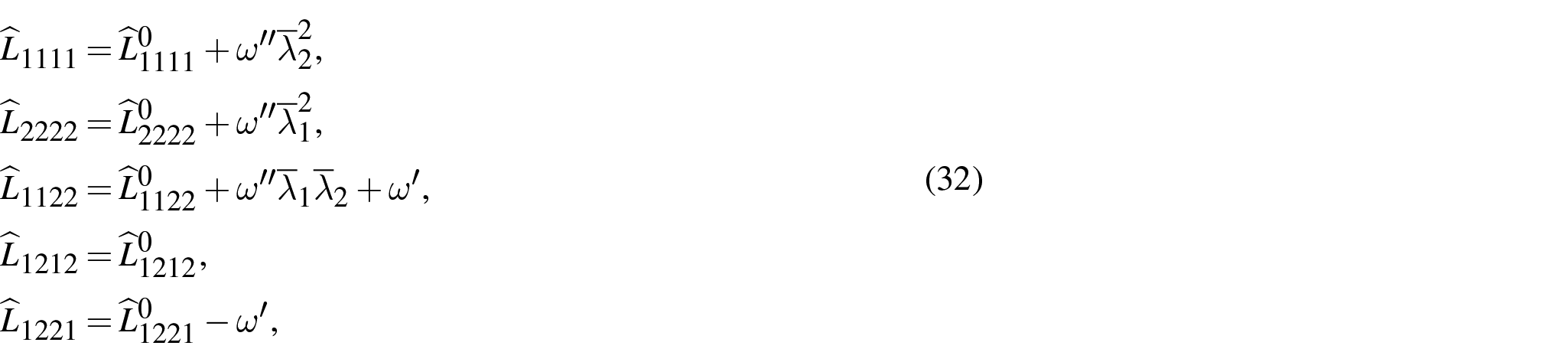
in terms of the components

Note this depends on
Recall that in the material here under consideration, with unpressurized stored energy (17), LOSE is driven by
For the particular case of prescribed pore pressure, we may go further to say that all five of the LOSE conditions fail in precisely the same domains regardless of the pressure or lack thereof, because each of the conditions depends only on
5. Twinning under plane strain
Once it is known under what conditions stability is lost, the next question becomes in what way the material relaxes from the principal solution so as to recover stability in the ‘macroscopic’ solution. Caulfield and Ponte Castañeda [33] explored the possibility of relaxation via domain formation, using the lamination procedure discussed in Section 2 to demonstrate the existence of a singly twinned microstructure which yields a macroscopically stable response according to the Legendre–Hadamard condition (66) (that is, equation (29) without the strict inequality). As will be demonstrated below, the same arguments hold for the pressurized composites discussed herein, as a consequence of the fact that the behavior of the pressurized composite is still isotropic and that LOSE is still driven by
Hence, we here summarize the analysis of Caulfield and Ponte Castañeda [33], applying it to the pressurized porous elastomer with mesoscopic energy

where we have used the fact that

in corresponding volume fractions

where
Now, to aid in determining a solution to the above, recall [43] that any twinned microstructure must satisfy the condition that the right-stretch tensors in each layer are related to one another simply by a rotation—i.e., denoting the deformation in one phase by

for some proper orthogonal

Note that this also implies that both twinned deformations have the same principal stretches and, due to isotropy, the same mesoscopic energy.
Using the expression (35) for

with

such that the volumetric deformation in the twins is equal to the macroscopically applied

This allows for explicit definition of the first invariant in the twins via

with
Using these observations, we may write the stresses

This condition defining
Finally, noting that for all the material models considered above,

At this point, it should be recalled that the corresponding result for the rank-one laminate in the unpressurized case takes the analogous form [33]

In particular, note that the function
It then remains to determine whether the stored energy (44) is rank-one convex and polyconvex. To this end, note that equations (11), (44), and (45) allow us to write

as a result of the fact that the volumetric deformation within the layers is equal to the macroscopic
Recalling the set of inequalities (9),

or, equivalently,

Thus, the macroscopic energy
6. Results and discussion
In this section, we present representative results for the two types of pressurization protocols described above: first closed pores containing an ideal gas in Section 6.1, then open pores with prescribed pressure in Section 6.2. All pressures and stresses are normalized by the ground shear modulus μ of the matrix elastomer. The initial porosity of each material is chosen to be
6.1. Gas-filled pores
We begin by considering porous elastomers with closed pores which are filled with an ideal gas. The material is simultaneously subjected to a constant exterior pressure
Thus, Figure 3 shows the level curves of the stored-energy density when
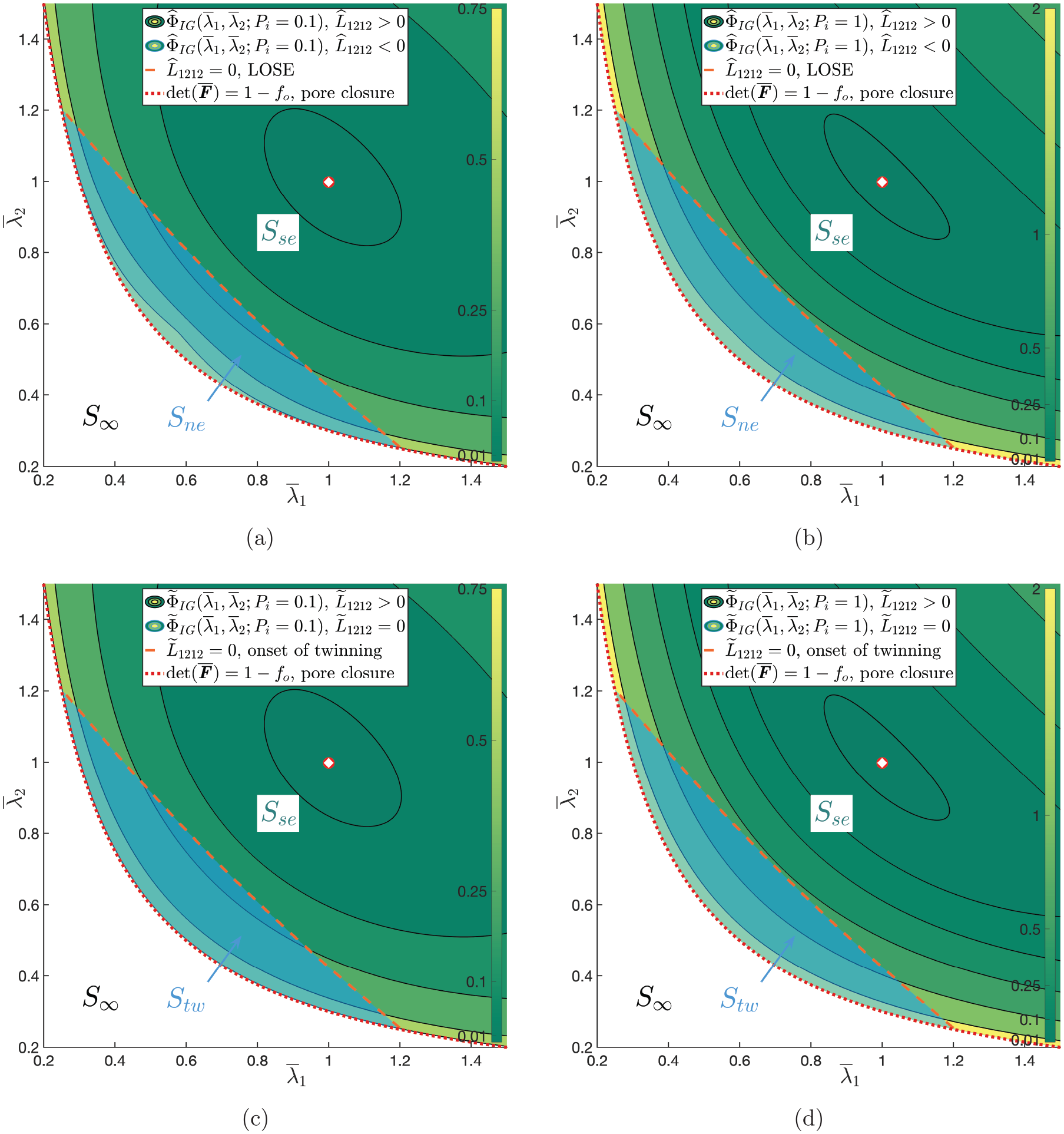
Level curves of the principal
It is clear in Figure 3 that, the values of
Figure 4 gives the nonvanishing components of the average PK stress
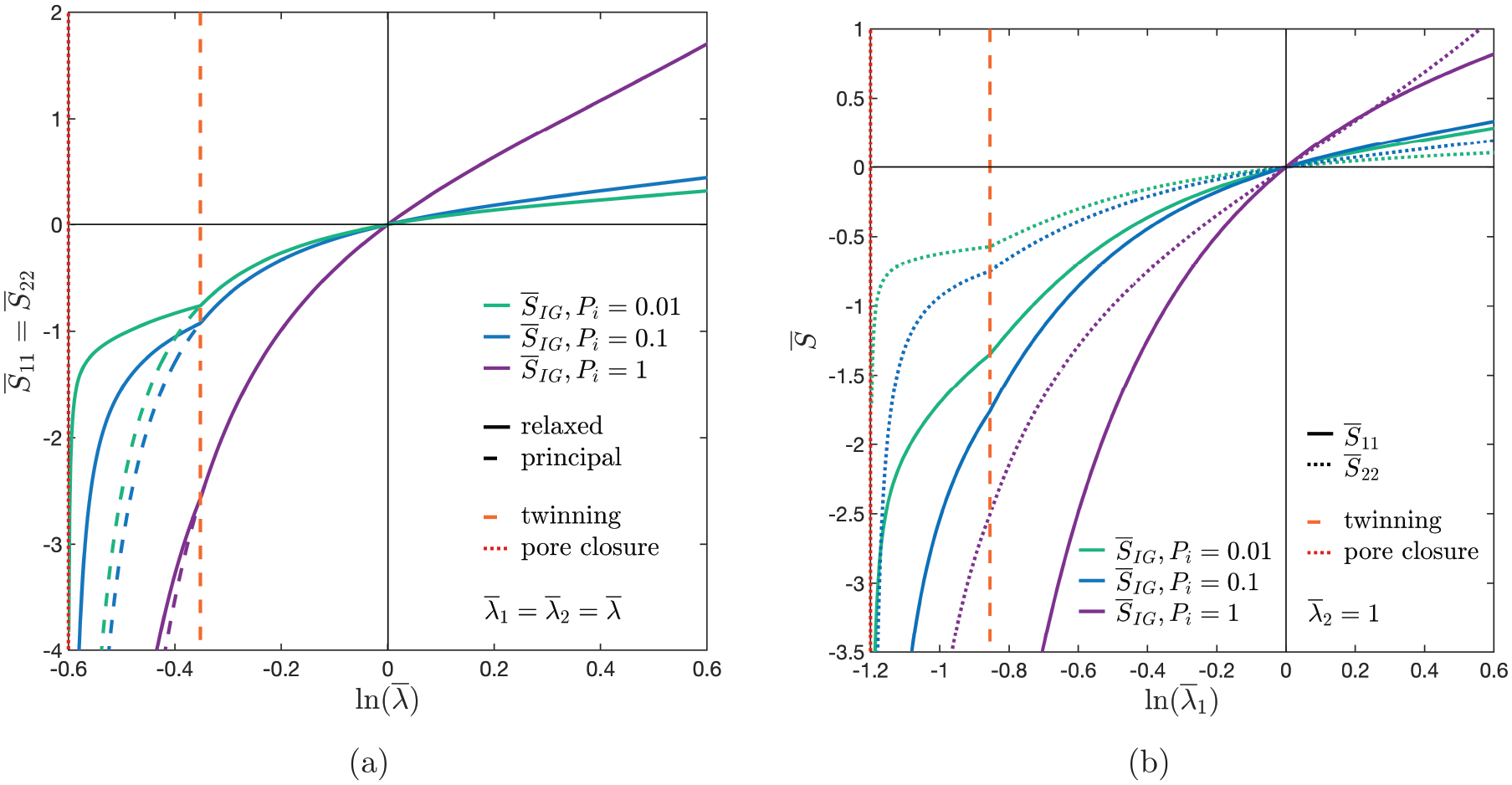
PK stresses for the composite with gas-filled pores, normalized by the matrix ground shear modulus μ, for (a) hydrostatic deformation and (b) uniaxial compaction, plotted in terms of the logarithmic strain. Sample curves are given for initial internal pressures of
The most notable feature in Figure 4 is the kink in the relaxed stress at the onset of twinning, resulting in abrupt softening followed by continued stiffening under further compression. In contrast, Figure 4 shows that the principal solution for the stress stiffens smoothly, and hence the relaxed behavior is much softer than the principal in the twinned domain. Observe also that the stress approaches
Figure 5 shows the response of the material to uniaxial stress. Figure 5(a) plots the PK stress
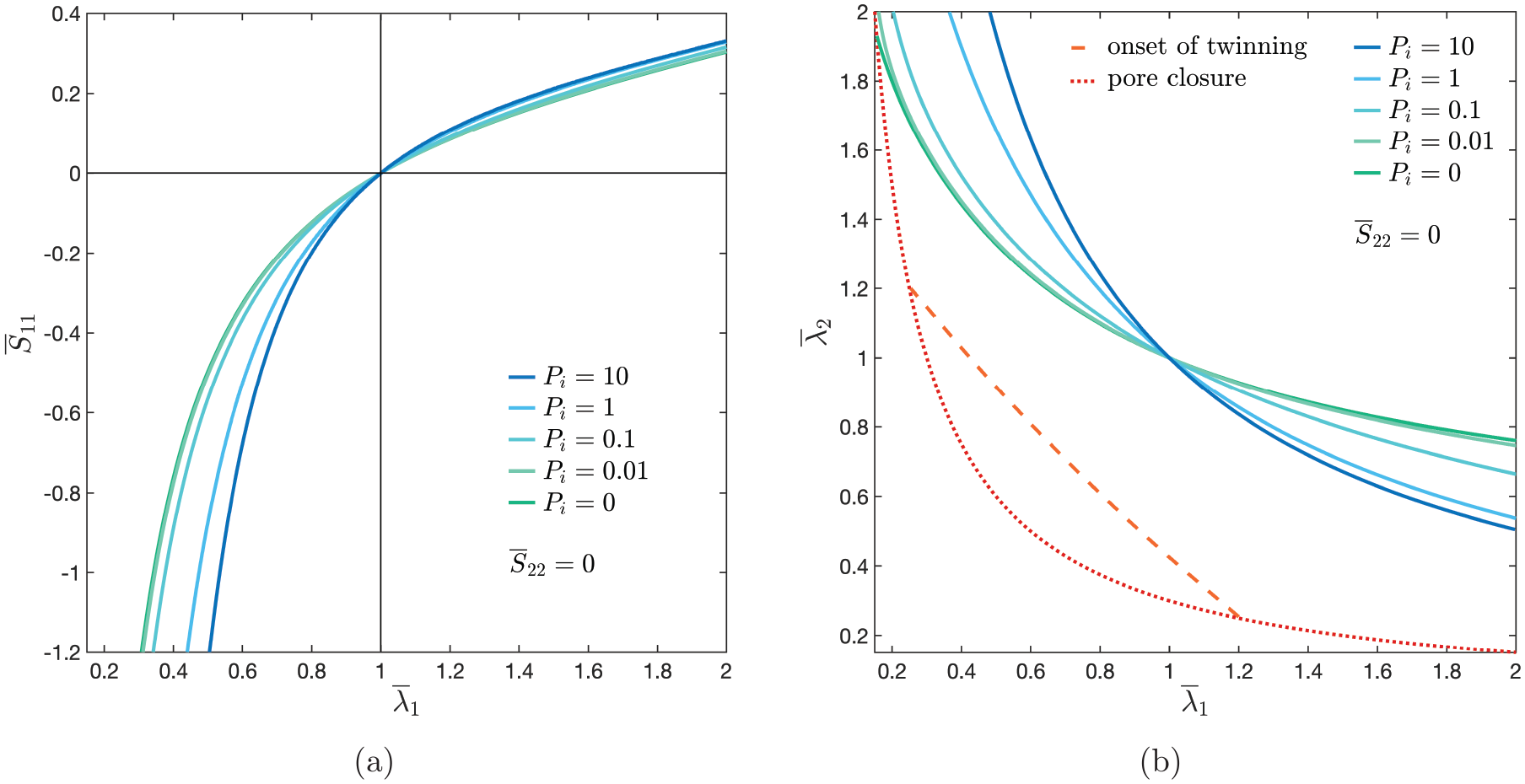
Uniaxial stress applied to pressurized elastomers with gas-filled pores. (a) shows standard stress-stretch curves, with
Note in Figure 5(b) that for uniaxial states of stress the material does not undergo twinning for any of the pore pressures shown. Observe also in Figure 5(a) that, particularly in tension, the uniaxial stress required to produce a given stretch is very similar between cases despite the initial pore pressures spanning several orders of magnitude. This is partly explained by recalling an ambient external pressure is also applied to the material equal in magnitude to the initial internal pressure, tending to counteract the effect of the internal pressure. Moreover, note in Figure 5(b) that the lateral stretch
6.2. Prescribed pore pressure
We now present results for the case of prescribed pore pressure. Here an external mechanism controls the pore pressure
Figure 6 shows the level curves of the stored energy of the porous elastomer with prescribed pressure in terms of the principal stretches
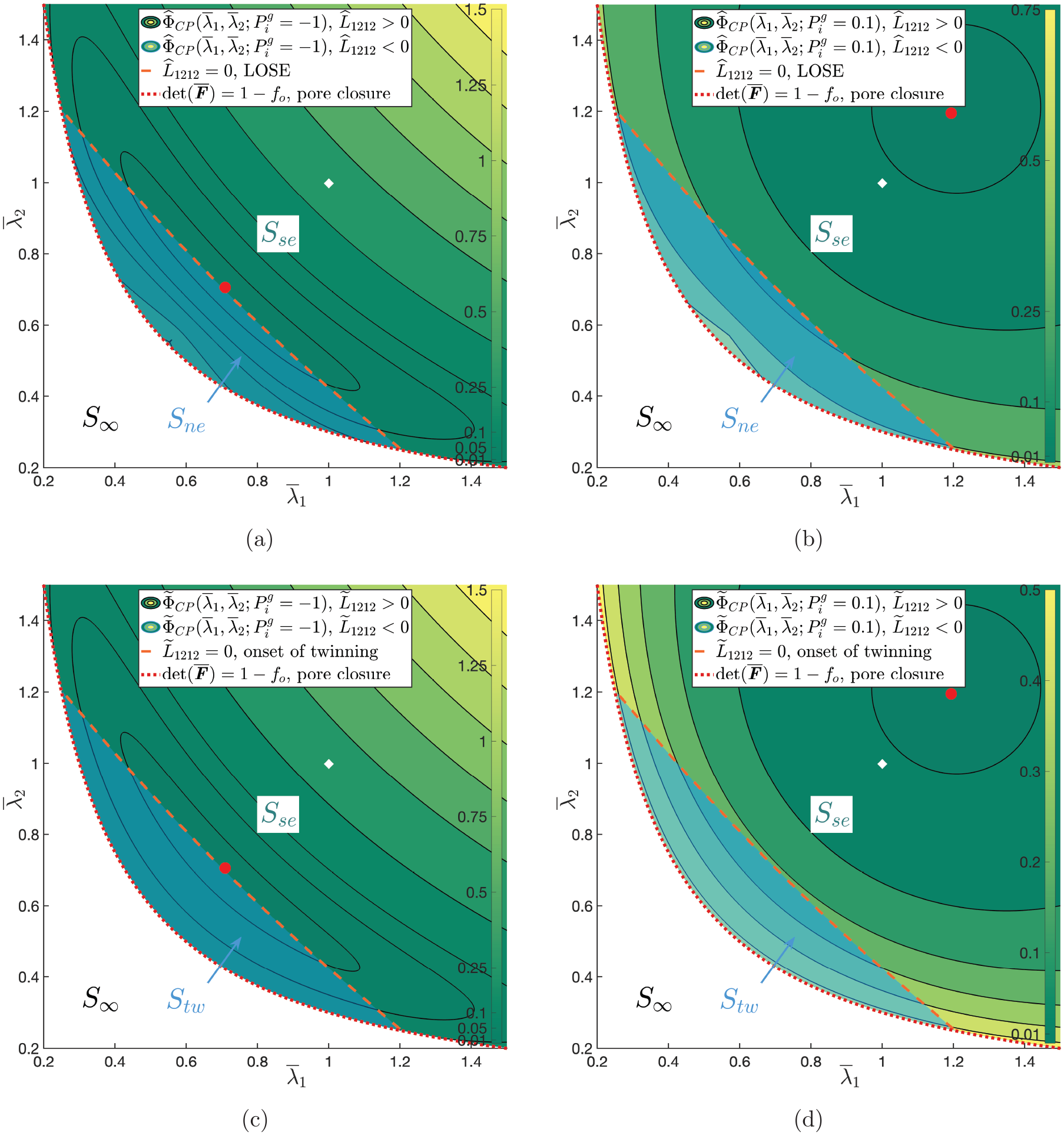
Level curves of the principal
Observe in Figure 6(a) and (b) that the principal solution for the energy loses joint convexity in
The stress-free configuration, corresponding to the minimum energy, is seen in Figure 6 to be different from the reference configuration. It may correspond to either an expansion or contraction compared to the reference configuration (the stress-free state of the unpressurized elastomer), depending on whether the pore gauge pressure is positive or negative, respectively. Because of this dependence of the traction-free configuration on the prescribed pressure, by varying the pore pressure the material could be made to deform, consistent with physical intuition. This possibility will be explored explicitly below. Note also in Figure 6(a) and (c) that the traction-free configuration for
Next, Figure 7 gives the response of the material to applied deformations for three prescribed internal pressures. Figure 7(a) shows hydrostatic compaction, and plots both the principal and relaxed values for the hydrostatic PK stress against the logarithmic strain
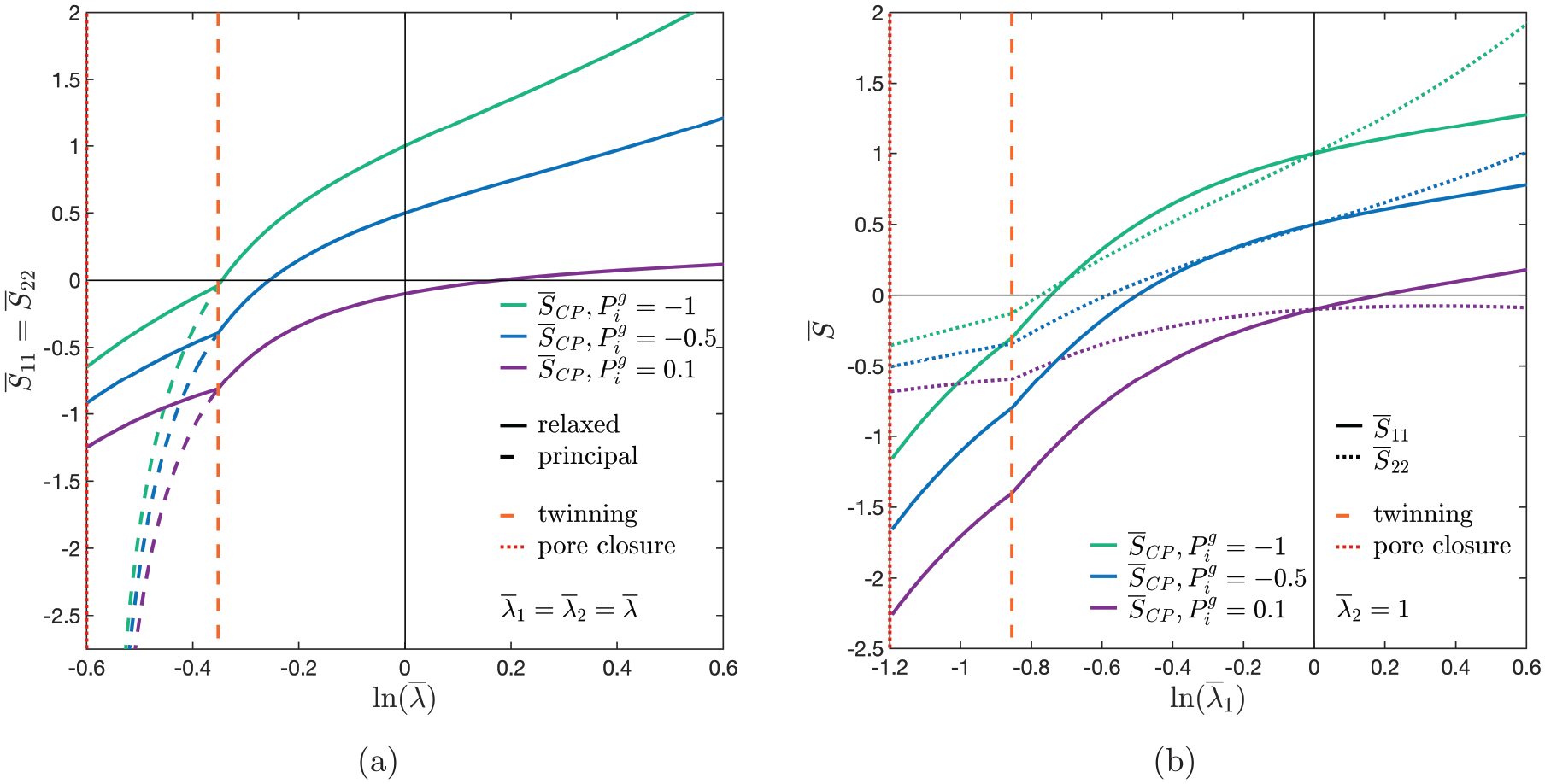
PK stresses for the composite with constant prescribed pore pressure, normalized by the matrix linearized shear modulus μ, for (a) hydrostatic deformation and (b) uniaxial compaction, plotted in terms of the logarithmic strain. Sample curves are given for pore gauge pressures of
Observe in Figure 7 that when
In Figure 8, we give results for uniaxial tension and compression. Figure 8(a) shows
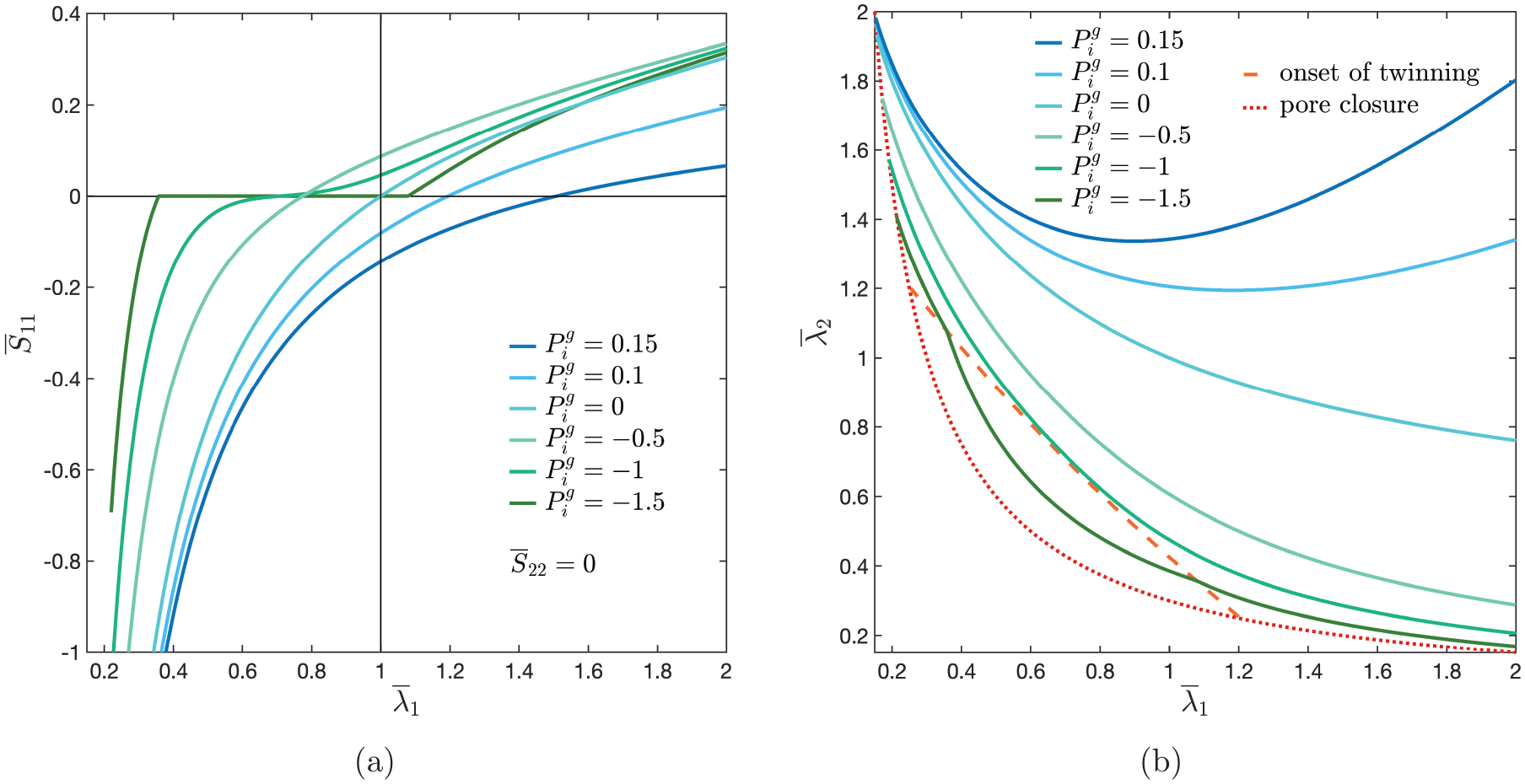
Uniaxial stress applied to pressurized elastomers with prescribed pore pressure. (a) shows standard stress-deformation curves, with
As noted regarding Figure 7, in Figure 8(a) none of the curves with
Finally, observe in Figure 8(b) that the deformation paths with
Figure 9 gives results in which the pore pressure is directly varied while the external traction boundary conditions are fixed. The deformation path through
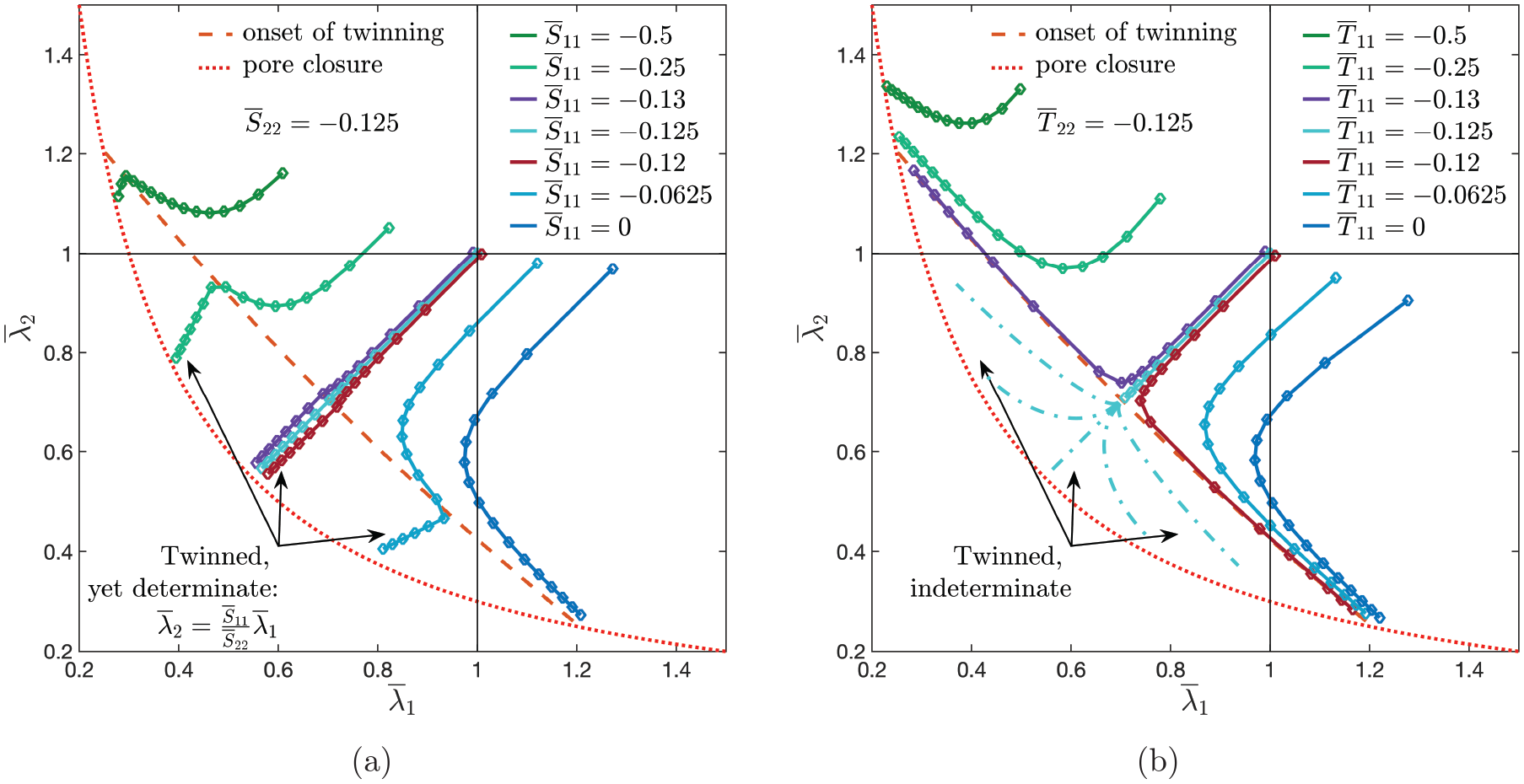
Deformation paths caused by direct control of pressure while maintaining various biaxial stress boundary conditions. The curves begin at
Each curve in Figure 9(a) begins as physical intuition would suggest, with the material contracting in both directions as the pore pressure is decreased. As the twinned regime is approached, however, the softening of the material bends the curves away from the hydrostatic axis, with only the curve

in terms of the PK stress for symmetric
In Figure 9(b), likewise, the material contracts biaxially as the depressurization begins. As in Figure 9(a), the deformation paths bend away from the hydrostatic axis near to the onset of twinning, ultimately expanding in one direction while continuing to contract in the other. Because the Cauchy stress is applied, only the curve with
Note the sensitivity to the loading conditions which is displayed in Figure 9. First, observe the purple and red curves in Figure 9(b), corresponding to
7. Concluding remarks
In previous work, Caulfield and Ponte Castañeda [33] demonstrated that a certain class of porous elastomers with vacuous pores which were known [24] to lose SE in plane strain may recover macroscopic stability by twinning, taking on a rank-one laminate microstructure at a length scale large compared to the pores, but still small compared to the specimen. Here, we extend this work to consider the effect of internal pore pressure, motivated by interest in using this pressure as a control parameter for actuation purposes. Interestingly, we have seen that the presence of pore pressure does not eliminate the instabilities which were observed in the vacuous elastomer. Rather, provided that the unpressurized state is used as the reference configuration, neither the deformations at which the instabilities occur nor the mechanism of relaxation are changed by the presence of pore pressure. Thus, the pressurized material also enters a twinned configuration after being compressed sufficiently and moreover takes on the associated perfectly soft modes of deformation noted by Caulfield and Ponte Castañeda [33] in the vacuous case.
We have also seen that, in the case of prescribed pore pressure, the material response depends only on the pore gauge pressure, i.e., the difference between the pressure within the pores and the external pressure. An important implication of this is that, both prior and subsequent to twinning, applying a negative pressure within the pores is exactly equivalent to applying a positive pressure of the same magnitude on the boundary of the material, and vice-versa. Hence, because twinning may be achieved in the vacuous composite by application of sufficient compressive pressure as an external traction, twinning may also be achieved by applying a negative (gauge) pressure within the pores. By combining control of this internal pressure with the external traction or displacement boundary conditions, we expect that corresponding deformations or tractions may be produced which are useful for actuation, in particular because within the twinned regime the composite is perfectly soft in shear. Large changes in shape, therefore, could in theory be achieved by the application of minimal tractions. Moreover, because both the energy and the Cauchy stress within the twinned material are functions only of the volumetric deformation, the mapping from an applied deformation to the corresponding state of stress is not one-to-one—rather, a continuum of deformations exist all yielding the same stress. Thus, the twinning transformation can have significant implications on the macroscopic response of the material which could prove useful for actuation purposes.
It should be emphasized that the simplifications in the computation of the LOSE condition and the associated relaxation of the energy for the pressurized porous elastomers considered in this work are not expected to hold for more general classes of porous elastomers and loading conditions. Indeed, both problems are simplified by our restriction here to a transversely isotropic material undergoing plane strain in the transverse plane. This reduces the complexity of the conditions of SE and the dimensionality of the minimization problem giving the rank-one convexification. The result may, therefore, be different if either the assumption of isotropy or the restriction to plane strain deformations are relaxed. In fact, Lopez-Pamies et al. [26] have considered instabilities in 3D isotropic composites consisting of spherical pores distributed randomly within an incompressible elastomeric matrix. They examined the effect of an ideal gas within the pores and indeed found that LOSE is changed by the presence of pore pressure in comparison to the vacuous case, with the result being that pore pressure delays the onset of instabilities in the pressurized elastomer as compared to the unpressurized elastomer. Finally, note that here LOSE in the unpressurized material is driven by the transverse shear modulus vanishing; the fact that the shear modulus of the composite is independent of the pore pressure is a critical reason for LOSE being unchanged when pore pressure is added. Of course, this pressure does directly affect other components of the tangent modulus, and thus in a material for which LOSE is driven, say, by the vanishing of one of the normal moduli, we would again expect LOSE to be affected by the pore pressure.
More generally, the results of this work provide further evidence that relaxation via twinning may be a prevalent feature of elastomeric composites undergoing finite deformations. Twinning has now been shown to occur in fiber-reinforced elastomers [30], elastomeric laminates [31,32,37], and porous elastomers with both vacuous [33] and, now, pressurized pores. Additionally, while in this work the case of ideal gas inclusions was specifically considered, the arguments given here are general enough to include any elastic fluid within the pores. Thus, across a broad range of microstructures (both particulate and layered) and phase constitutive behaviors (soft, stiff, and even gaseous), domain formation has been found occur beyond the onset of macroscopic instabilities, with important and interesting implications for the macroscopic behavior of such composites and their numerous potential applications.
Footnotes
Appendix 1
Appendix 2
Appendix 3
Declaration of conflicting interests
The authors declared no potential conflicts of interest with respect to the research, authorship, and/or publication of this article.
Funding
The authors disclosed receipt of the following financial support for the research, authorship, and/or publication of this article: This work was supported by the Office of Naval Research, United States (grant no. N00014-21-1-2772).
