



Abstract
This paper is a continuation with certain modifications of a previous work by this author involving a new theory for the continuum-mechanical entropy in non-equilibrium states. Treating internal energy as an essential coordinate in the thermomechanical state space, the theory provides a nominal calorimetric theory of materials with memory as an alternative to the widely accepted thermometric theory of Coleman which treats both entropy and temperature as ” primitives” without a compelling connection to experimental measurement. Following a brief review of the previous work, involving a generally defined topology of state space for higher-gradient continua, a revision of Coleman’s theory is proposed that specifies non-equilibrium entropy as the variational extremum of a functional of the forces that define the relevant cotangent bundle of the underlying state space. As a conjecture, the optimal cycle in state space is assumed to be a non-equilibrium generalization of the classical Carnot cycle.
Keywords
1. Introduction
The goal of this work is to provide an extension to thermomechanics of the standard geometry of continuum mechanics, the subject of impressive expositions by Segev and Epstein [5, 6]. Among the benefits of such an extension is the possibility of an enhanced treatment of the thermodynamics of defects. As a rough outline, we begin with a brief review of a previous work by Goddard [1], denoted by JG in the following, where a definition was given of the non-equilibrium entropy for continuum thermomechanics as an extension of the equilibrium entropy and temperature defined by the landmark work of Carathéodory [2], hereinafter denoted by CC.
We then consider the differential geometry of the relevant finite-dimensional thermomechanical state space and the application to graded (higher-gradient) materials. Following this, we lay down what we shall call a calorimetric theory for the thermomechanics of materials with memory to be contrasted with what may be called the thermometric theory of Coleman [15] hereinafter denoted by BC.
After a brief recapitulation of the definition of nonequilibrium entropy given previously by JG, a brief treatment is give of the special case of linear viscoelasticity which has received considerable attention by others.
2. Review and extension of prior work
2.1. Generalization of CC
As generalization of the equilibrium situation where entropy is constructed from calorimetry and the equilibrium equations of state for the configurational forces that define work, the non-equilibrium entropy is derived from the history of the same configurational forces and an appropriate equilibrium temperature. Following CC, we focus on what he calls simple systems involving a finite set of configurational variables. This suffices to provide a pointwise description of graded or higher-gradient continua defined by a finite set of higher-spatial gradients of configurational variables. Following a recapitulation of JG with elaboration on the geometric underpinnings, a revision is proposed of Coleman’s thermomechanics of materials with memory given in BC. The treatise of Day [4] provides a thorough mathematical exposition.
As synopsis of JG in a somewhat different notation, we extend Carathéodory’s ”simple” system at equilibrium to non-equilibrium systems determined by the past history of a finite set of variables:

which, with notation for dependence on time
As in JG, we identify Carathéodory’s abstract
2.2. Differential geometry
The standard continuum-mechanical map or ” placement” of material points
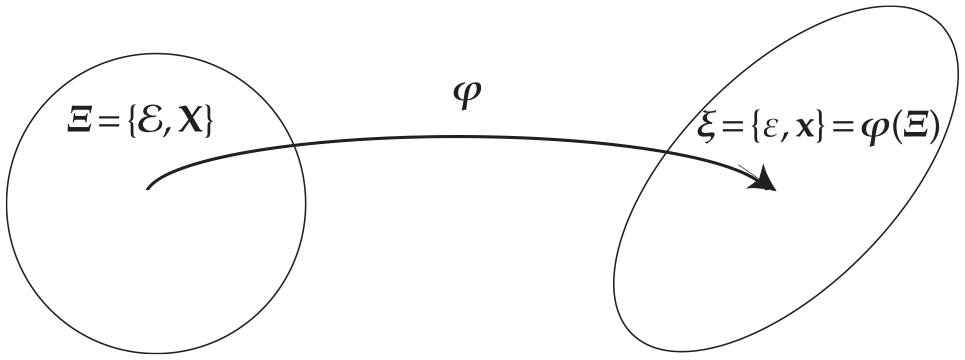
Thermomechanical map.
It seems plausible to interpret time-dependent
As for the first law of thermodynamics, the incremental heat

where we adopt the conventional active definition of incremental work
Thus, the first law of thermodynamics is tantamount to the definition of incremental heat in terms of the cotangent vector
We recall that CC interprets the condition
Taking

Here as in the following, we employ the common notation
Referring the reader to JG for a discussion of the various extremum principles that serve to establish equilibrium and the associated stability for discrete thermomechanical systems, we turn next to the case of continuous systems. We note in passing that the above relations give the equilibrium temperature
3. Graded continua
The adjective graded
1
is employed here as alternative to ” higher-gradient” often used to denote thermomechanical continua in which the constitutive equations involve a finite number
3.1. The simple continuum
With reference to Figure 1, the infinitesimal generalised displacement field

where

at each spatial point
Generalizing the simple material, the full 16-dimensional tangent space is represented by abstract vector

Roughly speaking, the terms
The corresponding element
We focus here on effects associated with spatial gradients arising from material gradients

represents the energetics of the conventional (Coleman-Noll) simple continuum. We assume translation invariance, neglecting external body forces, so that the leading component
3.2. Higher gradients
Here, the relevant independent coordinates are obtained by replacing

and this presumably covers higher-gradient effects in heat flux and stress.
The configurational power or working is once more given by equation (4) with

where
3.3. Remark on approximation
While the graded material may be regarded as arising from a local polynomial approximation to a smooth map

where the finite set of coefficients
4. Non-equilibrium entropy
We recall that the postulate of JG, based on the notion of extremal recoverable work, takes on the general form for a system of given mass:
For a given energy and configuration, the difference between equilibrium entropy
This leads to a variational principle for the determination of
4.1. Discrete systems
As a simplified and amended version of that in JG,
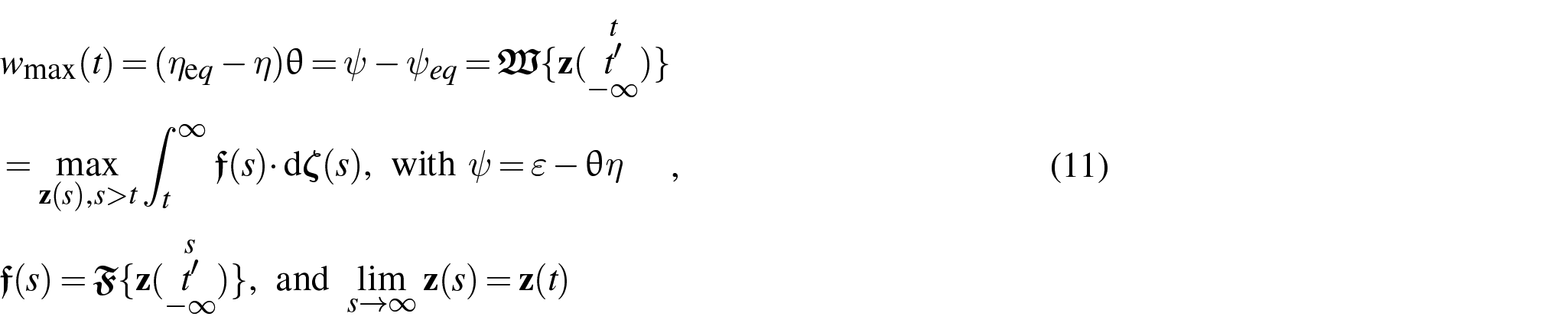
where the last relation corresponds to the closed connection of Day [4], whose definition of non-equilibrium entropy of the standare simple material with memory is presumably subsumed by the present treatment.
As pointed out in JG equation (11) provides a constructive definition of entropy and dissipation, which as pointed out above we denote as calorimetric, to distinguish it from the celebrated thermometric version of BC in which
5. Thermometric theory
We recall that Coleman recognizes in BC the possibility of theories involving various independent variables based on certain assumptions as to the invertibility of transformations between histories. Thus, unburdened by the present concerns for observability, he proposes in §12 of BC our
Hence, with the above in mind for a discrete system representing a material point in a graded continuum, we take:

such that the variational problem for determination of nonequilibrium entropy becomes

6. Linear viscoelasticity
We consider a general version of the classical Boltzmann–Volterra form employed in modern treatments of linear viscoelasticity [4, 18–21], for which Del Piero and Deseri [20] offer a comprehensive analysis of various free energies. For easier interpretation, and in order to connect to the existing literature, we restrict ourselves to energetically simple materials, i.e., materials without dependence of force on gradients of energy. Thus, we take

where
Hence, the work to be maximized is given by the quadratic form
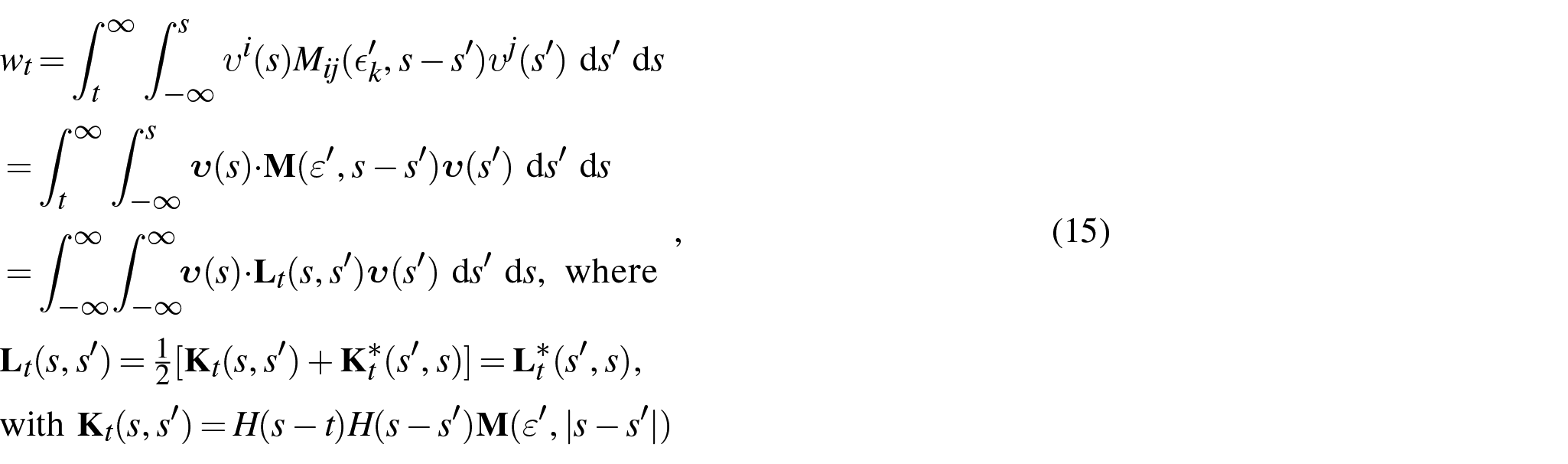
where asterisk denotes the adjoint or matrix transpose and
Noting that

and that

These relations lead to the further conditions for

and

The relations (18) and (19) can be cast into forms involving the null space of linear differential operators in
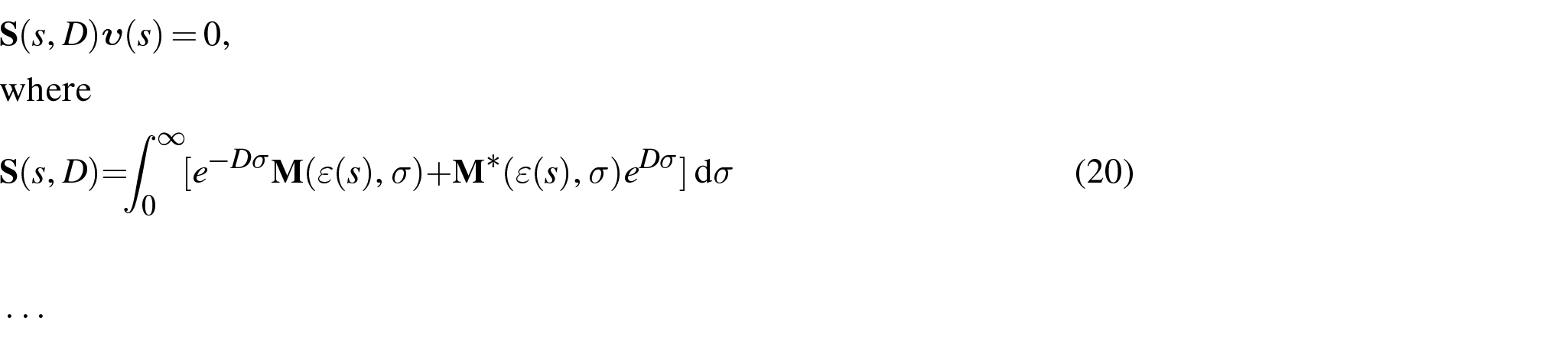
while equation (19) can be written as

6.1. Constant energy or temperature
Whenever internal energy is constant, such that heating is balanced by working, the relation (20) with

where we suppress notation for dependence on the constant
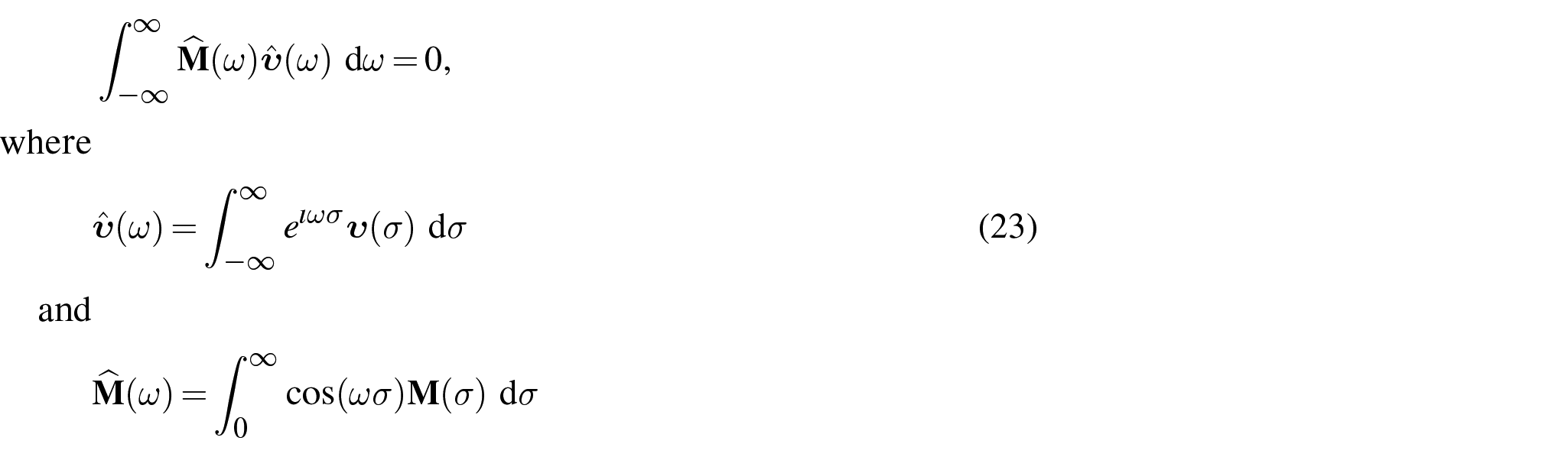
Under rather mild restrictions on
A similar result applies to isothermal processes in the thermometric theory, since the restriction to constant temperature generally implies that work must be compensated by heating, once again ruling out adiabatic paths.
It is worth noting that the above findings are compatible with various phenomenological models of rubber-like ” entropic” viscoelasticity based on equilibrium entropy. By the same token the free energies associated with various mathematical theories [18–20, 22, 23], should be regarded as equilibrium quantities based on equilibrium entropy.
The present treatment suggests that the extremum of recoverable work defining non-equilibrium entropy is achieved by a sort of non-equilibrium Carnot cycle or approximate cycle involving both diabatic and adiabatic paths. At the time of this writing, the author is unable to provide a more conclusive argument.
Footnotes
Acknowledgements
It is both privilege and pleasure to offer this article as tribute to a distinguished colleague, Professor Marcelo Epstein, whose work on the geometry of continuum mechanics, much of it done in collaboration with Professor Reuven Segev, stands as a monument in the field. To a certain extent it lays a modern groundwork for the classical ”geometric thermodynamics” [9] of Carathédory that inspires the present paper. At the same time, I also add my overdue tribute to the late B.D. Coleman who paved the way to a modern thermomechanical theory of materials with memory, providing not only a mathematical foundation for the classical Boltzmann-Volterra ideas but also the mathematical lingua franca reflected in the present article.
Funding
The author(s) received no financial support for the research, authorship, and/or publication of this article.
