




Abstract
We use an effective medium model to study the problem of reflection of plane waves from the free surface of a half-space occupied by an elastic particulate metacomposite. This problem has received little attention in the recent literature despite its significance from both practical and theoretical points of view. Classical formulas for the reflection angles and amplitudes of the reflected waves for a homogeneous elastic half-space with no wave attenuation are extended to a particulate metacomposite half-space with wave attenuation. We also include a detailed discussion concerning the reflected plane shear wave and surface compressional wave in the case of an incident shear wave propagating at an incident angle smaller than the critical angle. The efficiency and accuracy of the model are demonstrated via detailed comparisons between the predicted phase velocity and attenuation coefficient of plane waves in an (infinite) entire space and the corresponding results available in the literature. The implications of our results on the reflection of plane waves from the free surface of a hard sphere-filled elastic metacomposite are discussed. We mention that a quantitative validation of our results cannot be made here as a result of the lack of availability of established data in the existing literature.
1. Introduction
Studying the dynamic characteristics of different elastic solids is a key in a number of practical applications including structural vibrations in engineering, ultrasonic material inspection, seismology, and numerous other domains. Typically, such solids can be described effectively using classical dynamic equations from linear isotropic elasticity [1]. However, certain materials with complex microstructure (e.g., certain composite materials [2,3], metacomposites [4–7], and granular materials [8,9]) exhibit a distinctively characteristic reaction to an applied load. Numerous studies have examined the phenomenon of wave reflection from free surfaces across various materials, considering different boundaries and initial conditions. For example, Singh and Singh [10] studied the reflection of quasi-P and quasi-S waves at the free surface of a fiber-reinforced, anisotropic elastic half-space media and examined how the amplitude ratios change with incident wave angle. Their results showed that reinforcement significantly impacts both the amplitude ratios and the critical angle of the wave. Graff and Pao [11] investigated the plane wave reflection at a stress-free surface of an elastic half-space solid in the presence of couple stresses. They illustrated that by considering couple stresses, three different kinds of waves are reflected from a stress-free surface when the incident waves are either plane pressure or plane shear waves. The additional reflected wave, referred to as the SS wave (represents surface disturbance), quickly decays from the surface for any viable value of the couple stress material constant. Dey and Addy [12] performed an analytical study of plane wave reflection at a free surface of an initially stressed medium. In this study, several results are presented to illustrate how the reflected P and SV waves change with different initial stresses. Guha and Singh [13] examined how the initial stresses affected the reflection properties of plane waves at the free surface of a half-space rotating piezo thermoelastic fiber-reinforced composite. They employed three thermoelasticity theories, namely Green–Lindsay, Lord–Shulman, and classical dynamical coupled theories, to investigate the issue. They demonstrated how the amplitude ratios of reflected waves depend on the angle of incidence, the characteristics of the rotating medium, and different levels of initial stresses. Sidhu and Singh [14] examined the reflection of plane waves at the free surface of an initially stressed elastic medium directly without using potentials. In this research, they demonstrated that the velocities of quasi-P and quasi-S waves vary based on the propagation angle. In addition, the model of the initially stressed medium employed in this particular study is more comprehensive than the one used by Dey and Addy [12]. Singh and Yadav [15] examined how plane waves reflect from the stress-free surface of an electrically conductive and rotating fiber-reinforced elastic solid half-space in the presence of a magnetic field. They numerically calculated the energy ratios of reflected waves and the velocities of plane waves for a specific material. In addition, they showcased the impacts of anisotropy, rotation, and magnetic fields on the velocities and energy ratios of waves. Deswal et al. [16] studied plane wave reflection at the boundary surface of a magneto-thermoelastic medium, considering the impacts of changing thermal conductivity and mass diffusivity. They presented the phase velocity, energy ratio, and amplitude ratio of waves for a specific material. Their findings indicate that the results vary based on the angle of incidence, frequency, and the thermoelastic attributes of the half-space. Yadav [17] investigated the reflection of four types of quasi-planar waves from a thermally insulated stress-free surface of a rotating orthotropic magneto-thermoelastic half-space medium. They calculated energy ratio and reflection coefficients of reflected waves for specific materials and illustrated the influence of rotation angular frequency, diffusion, angle of incidence, and magnetic parameters on the energy ratio and reflection coefficients. Singh and Guha [18] employed the classical dynamic couple theory, Green–Lindsay theory, and Lord–Shulman theory to analyze reflection of plane waves from a free surface of a piezothermoelastic fiber-reinforced composite half-space solid. They illustrated the existence of four different types of waves in the two-dimensional model of the composite medium and computed the amplitude ratio of reflected waves by employing the corresponding boundary condition. Selim [19] studied how the initial stresses influence the reflection coefficients of plane waves in a dissipative medium. They employed Biot’s incremental deformation theory to obtain reflection coefficients of reflected waves. Their research demonstrates that the presence of compressive initial stresses amplifies the speed of P waves while decreasing that of SV waves. Singh et al. [20] examined the propagation of time-harmonic plane waves in an infinite nonlocal elastic solid material containing voids. They demonstrated the impact of voids and nonlocality parameters on the dispersion and attenuation of compressional and transverse waves in the medium. Moreover, they explored the reflection phenomenon of incident coupled compressional waves from the stress-free boundary surface of a nonlocal elastic solid half-space containing voids. By employing suitable boundary conditions, they derived formulas for various reflection coefficients and their corresponding energy ratios. In addition, they visually depicted the impact of nonlocality on reflection coefficients through graphical representations. Furthermore, several studies [21,22] have investigated wave reflection from rough surfaces and examined the effects of multiple scattering on acoustic reflection from rough surfaces. The aforementioned review clearly indicates the intensive and continuing research dedicated to the study of wave reflection phenomena from a free surface in different kinds of materials. However, none of these studies have addressed the phenomenon of wave reflection in particulate elastic metacomposites which represent a new type of composite material displaying remarkable dynamic characteristics, including wave attenuation and vibration isolation. To the best of our knowledge, the study of the problem concerning the reflection of plane waves from the free surface of a particulate composite half-space remains absent from the existing literature. The main contribution of the present research in contrast to other related papers is to study the reflection of plane waves (both compressional and shear) when they are incident at an angle
Our paper is organized as follows. In section 2, we present the governing equations of wave reflection at the boundary of a metacomposite for two different incident waves. Subsequently, in section 3, we first verify the effectiveness and precision of the wave propagation model presented here by comparing its predicted outcomes to existing, known data in the literature. Next, we use the model to make a comprehensive analysis of the reflection behavior of two different incident waves from the free surface of metacomposites. In section 4, we offer an overview of our findings together with some concluding remarks.
2. Wave reflection on the free surface of a metacomposite half-space
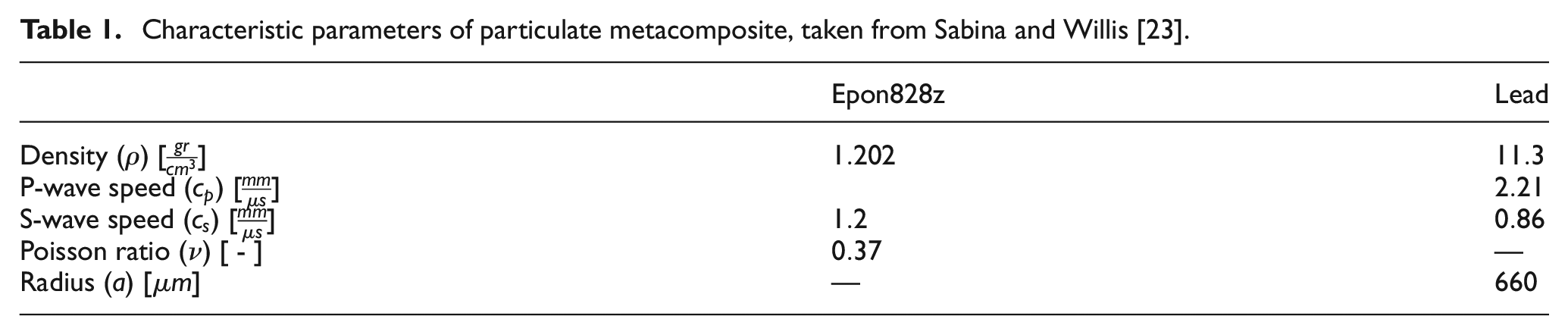
An effective medium model (details given in Appendix 1) is used to investigate the wave reflection of an incident compressional or shear plane wave on the free surface of a hard sphere-filled metacomposite half-space under the conditions of plane strain. In comparison with existing related models, the present model enjoys mathematical simplicity although restricted to heavy hard sphere-filled elastic composites in which the elastic moduli and mass density of embedded spheres are much greater than that of the softer and lighter matrix (such as those listed in Tables 1 and 2).
Characteristic parameters of particulate metacomposite, taken from Sabina and Willis [23].
Characteristic parameters of particulate metacomposite, taken from Luppé et al [24].

We first establish a fixed rectangular coordinate system
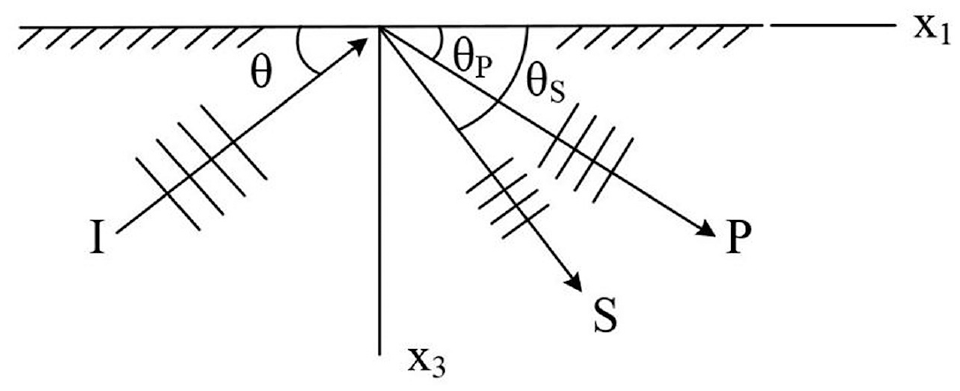
The reflected compressional and shear plane waves of an incident (compressional or shear) plane wave.
At the free boundary of the half-space, the imposed boundary condition requires the traction to be zero, resulting in both the normal stress and the two components of shear stress on the boundary also being zero:

In consideration of the two-dimensional motion, the stress component is zero. In addition, the two remaining boundary conditions provide two requirements that the displacement field must satisfy:


here,
2.1. An incident compressional plane wave
We first consider the reflected compressional and shear waves of an incident compressional plane wave as shown in Figure 1. For an incident compressional wave shown in Figure 1 with the displacement in the direction (

where


Therefore, the total displacements of the incident compressional wave and the reflected compressional and shear plane waves in the
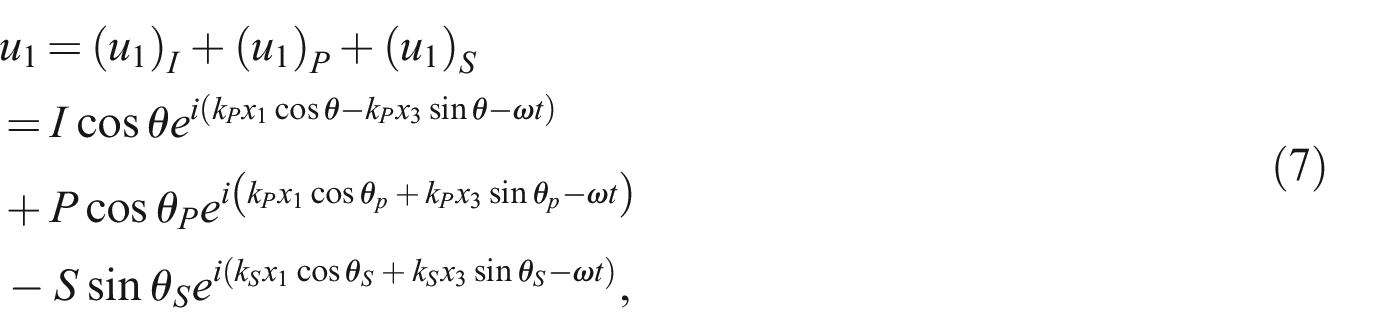
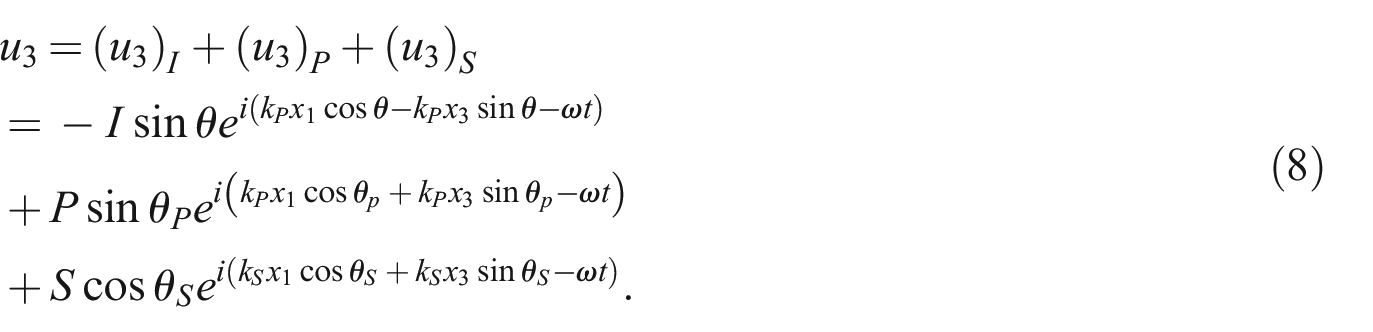
where
By substituting the displacement field (Equations (7) and (8)) into the given boundary condition (Equations(2) and (3)), we obtain:


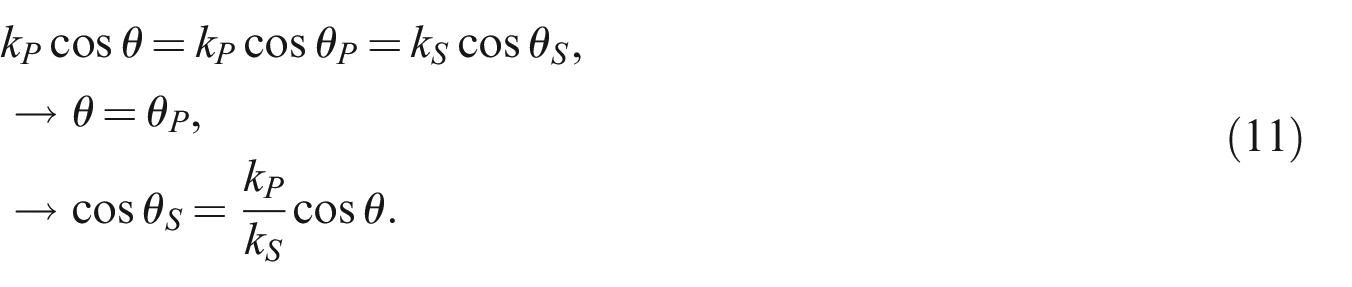
The exponential terms in these equations are linearly independent functions of
where


Thus, the reflection angles
2.2. An incident shear wave
We now consider a plane shear wave with known frequency and amplitude incident upon the free boundary of the half-space of a particulate metacomposite in the indicated direction

where


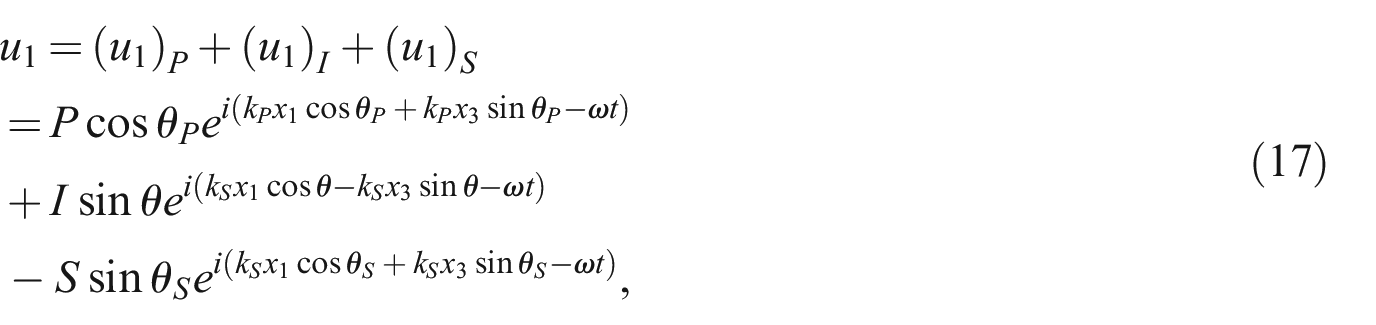
Therefore, the total displacements of the incident shear wave and the reflected compressional and shear waves in the
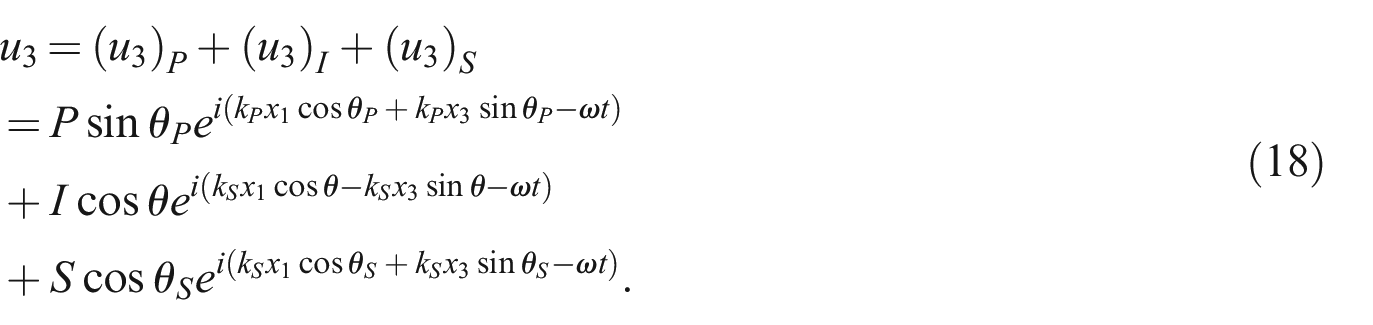
By substituting the displacement field into the given boundary condition (Equations (2) and (3)), we obtain:


The exponential terms within Equations (19) and (20) are linearly independent functions of
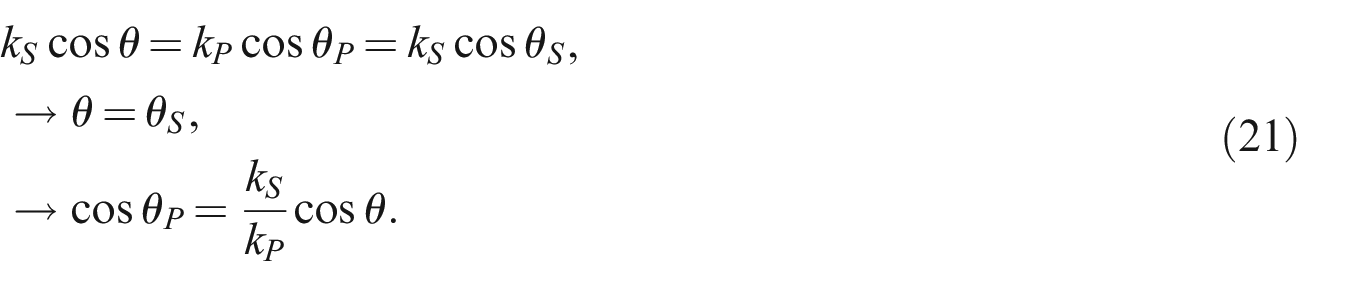
For the incident angle
2.2.1. Incident angle
greater than the critical angle
When the angle


Thus, for an incident shear wave at an incident angle larger than the critical angle, the reflection angles
2.2.2. Incident angle
less than the critical angle
As illustrated in Figure 2, when the angle
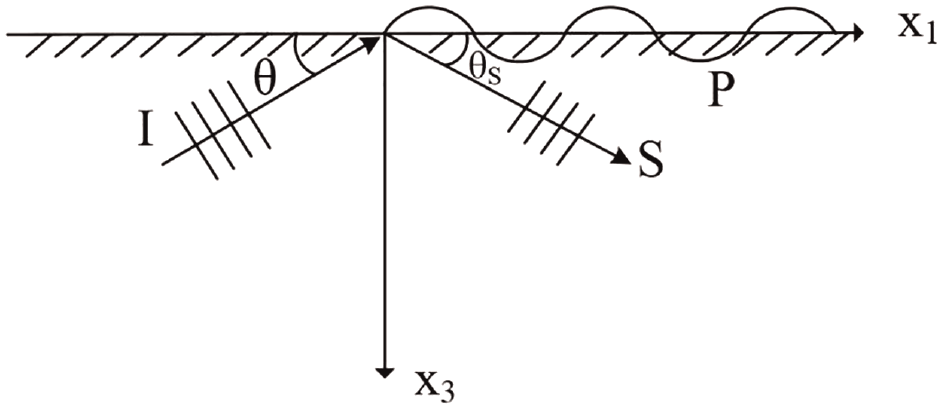
The reflected shear plane wave and the surface wave of an incident shear plane wave with an incident angle less than the critical angle.
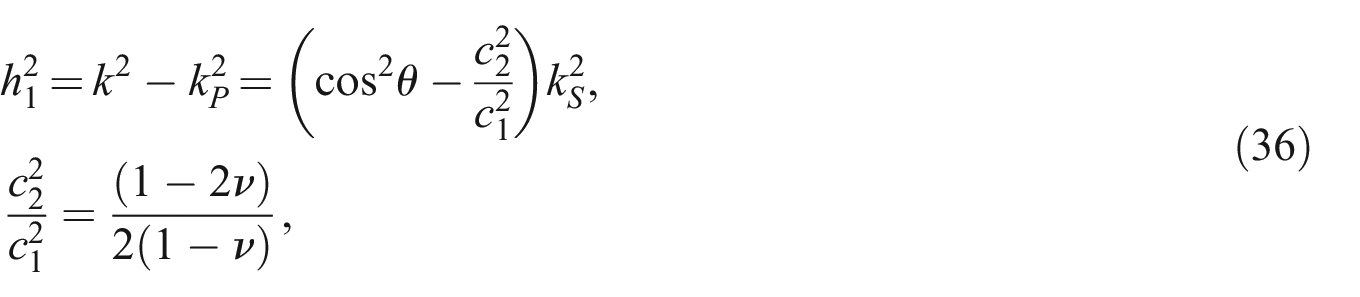
To compute the decay index




in which


here, R and J represent the dimensionless real numbers as defined in Equation (54). By substituting Equations (28) and (29) into Equations (24) and (26), we obtain:


The conditions for the existence of non-zero solution


Therefore, with the


where

where


where
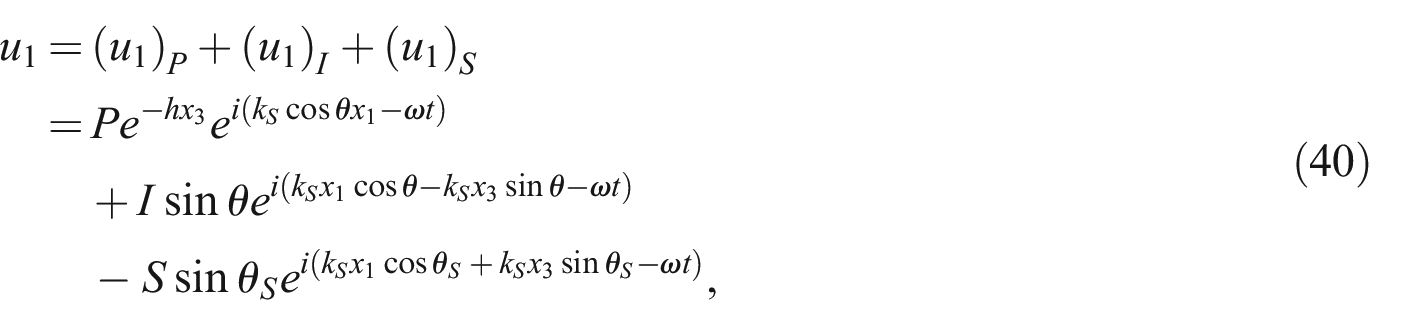
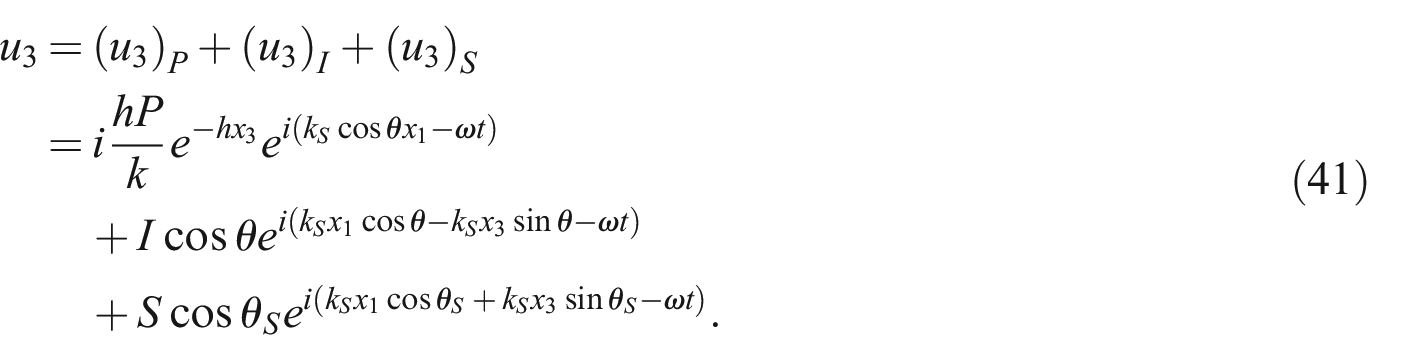
By substituting the displacement field into the provided boundary condition equations (Equations (2) and (3)), we derive:


These equations have only trivial solutions for the complex amplitudes P and S unless


Thus, for an incident shear wave at an incident angle smaller than the critical angle, the amplitudes
3. Illustrated examples
Various examples are presented in this section to evaluate the performance of the effective medium model used in the present work. The characteristic parameters of the particulate metacomposites used in this analysis are listed in Tables 1 and 2.
3.1. Validation of the model with known data on plane waves in an infinite body
In this section, we examine the validation of the present model for wave propagation in heavy hard sphere-filled random composites. To this end, since numerical results on the reflection of plane waves from the free surface of a particulate composite are not yet available in the existing literature, we compare the phase velocity and attenuation of plane waves in a whole (infinite) space predicted by Equations (56)–(59) of the present model with the known data provided by the numerical models in two commonly cited or most recent papers [23,24]. For this purpose, Figure 3(a) illustrates the phase velocity diagram of a compressional wave, normalized to the matrix’s longitudinal velocity, plotted against the normalized frequency of a metacomposite. This composite consists of an epoxy matrix (EPON 828Z) embedded with lead inclusions. The material characteristics of this metacomposite are represented in Table 1 and are taken from Sabina and Willis [23]. Also, Figure 3(b) plots the normalized attenuation of compressional wave versus the normalized frequency of the abovementioned metacomposite. In Figure 3,
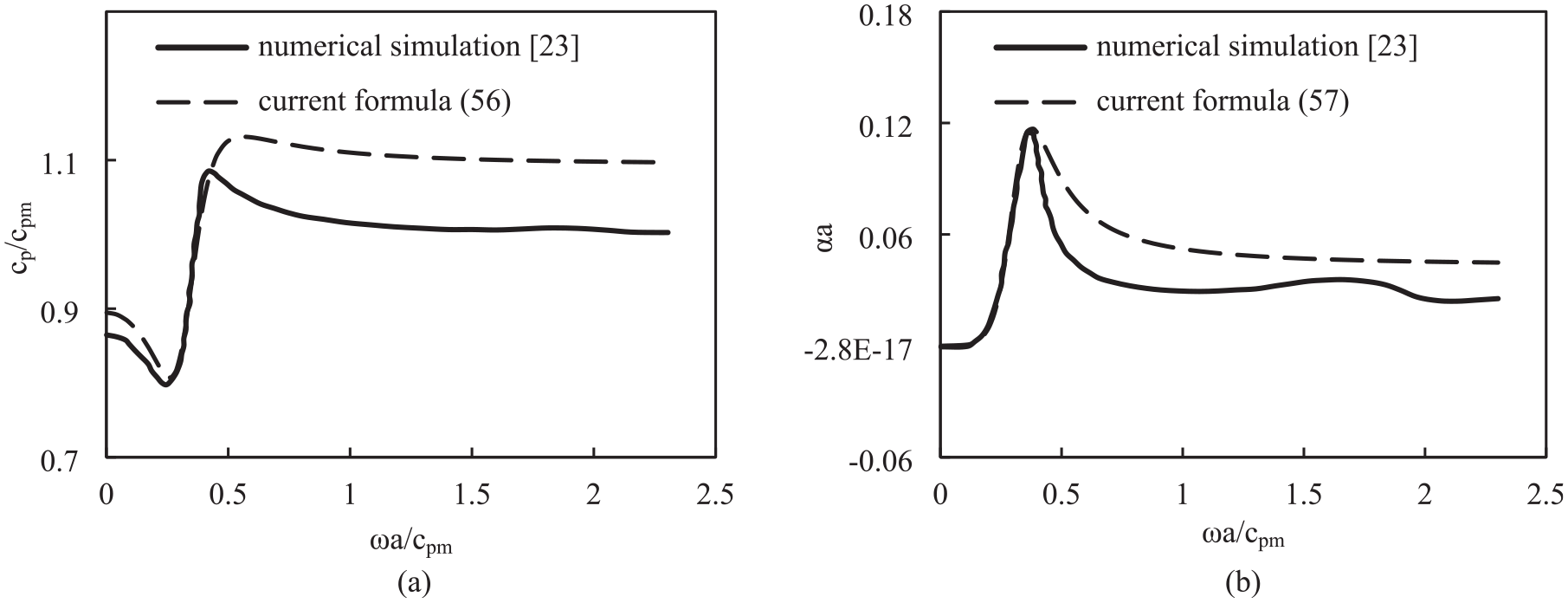
Plots of dimensionless compressional wave (a) phase velocity and (b) attenuation against the normalized frequency of the metacomposite as mentioned in Table 1.
Moreover, the wave propagation behavior of the shear wave for the two models is compared in Figure 4. Figure 4(a) presents the phase velocity diagram of a shear wave, normalized to the longitudinal velocity of the matrix, plotted against the normalized frequency of the abovementioned metacomposite in Table 1. Furthermore, Figure 4(b) illustrates the normalized attenuation of the shear wave versus the normalized frequency of the same material. Also, the volume fraction of lead in the composite is
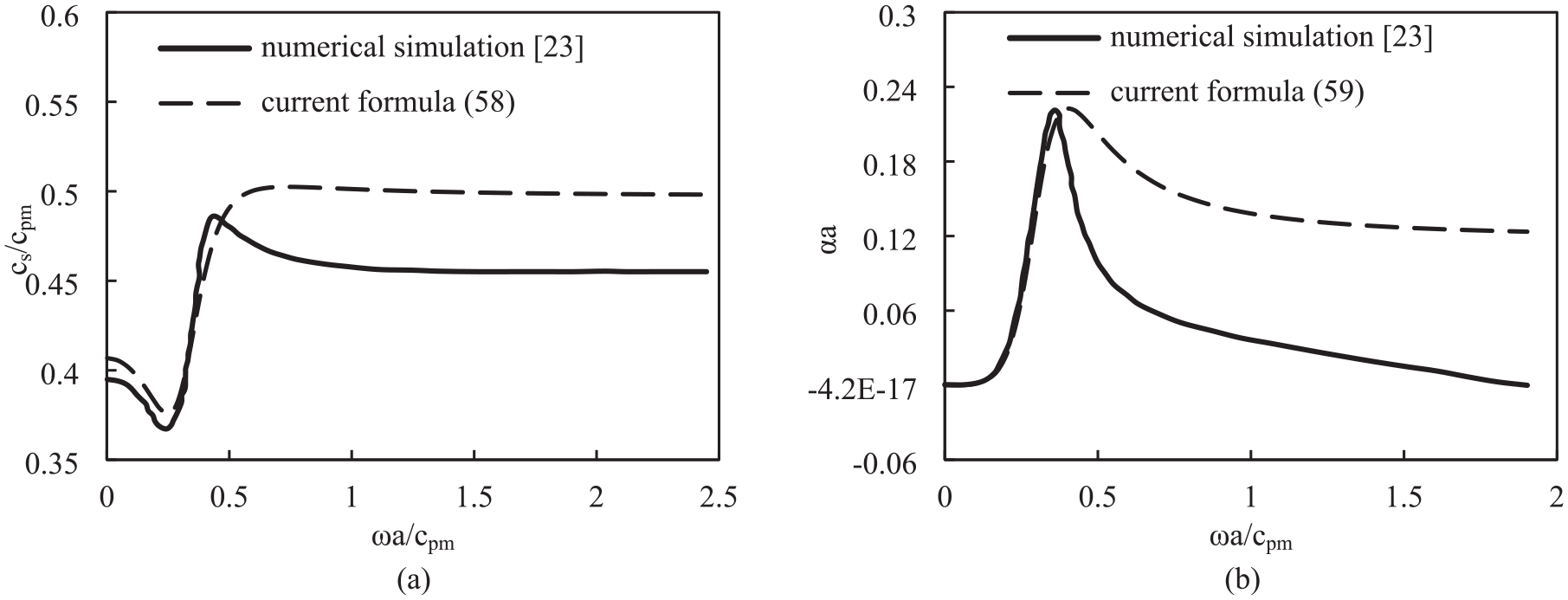
Plots of dimensionless shear wave (a) phase velocity and (b) attenuation against the normalized frequency of the metacomposite as mentioned in Table 1.
According to both diagrams in Figures 3 and 4, the current wave propagation model is generally in reasonable agreement with known data reported by numerical simulation [23] for both compressional and shear waves, except the higher-frequency range in Figure 4(b) beyond the local resonance frequency peak. In view of the fact that even different numerical models often give quite different results for exactly the same examples (e.g., Kim et al. [6], Sabina and Willis [23]), the agreement between the predicted results of Equation (56)–(59) of the present model with known data is considered to be quite good.
To demonstrate the utility of the current wave propagation model, two additional examples are presented here. Figure 5(a) depicts the phase velocity diagram of a compressional wave plotted against the frequency of a metacomposite, composed of an epoxy matrix embedded with tungsten carbide inclusions. The material characteristics of this metacomposite are detailed in Table 2 and sourced from Luppé et al [24]. In addition, Figure 5(b) illustrates the attenuation of the compressional wave versus the frequency of the aforementioned metacomposite. In Figure 5,
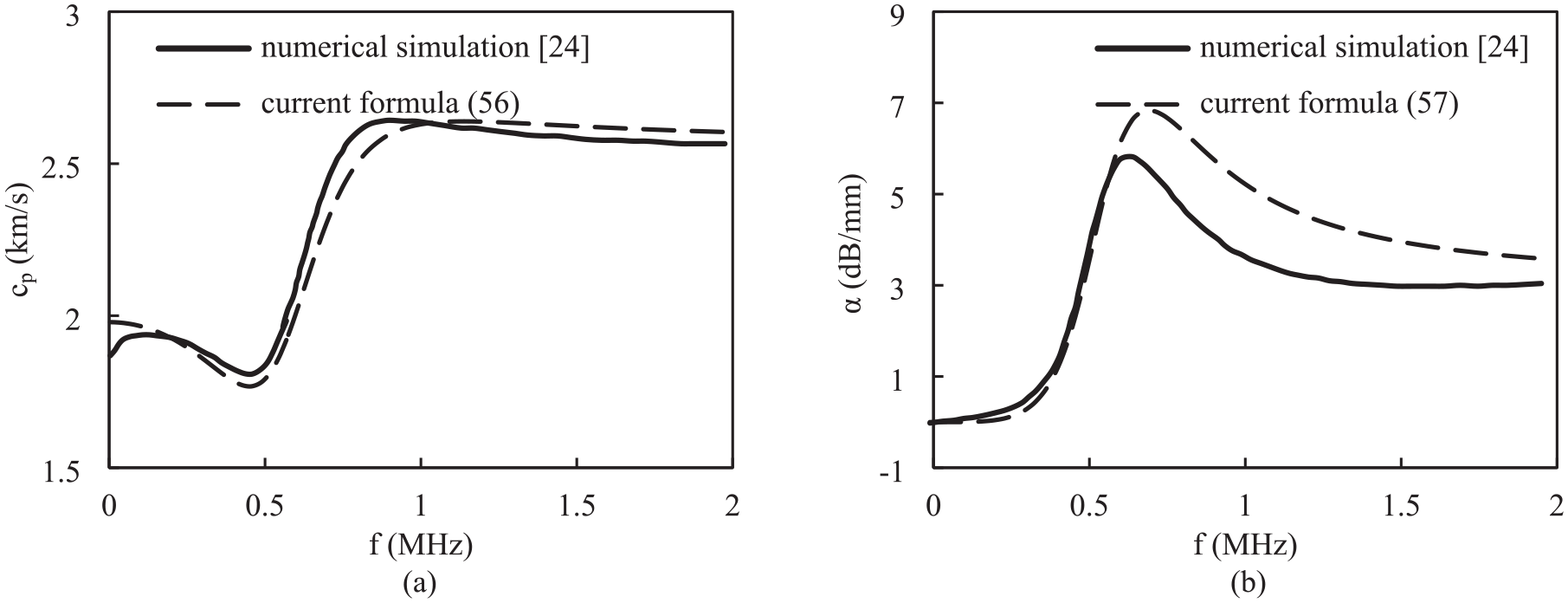
(a) phase velocity and (b) attenuation of a compressional wave of the metacomposite as mentioned in Table 2.
Furthermore, a comparison of the wave propagation characteristics of the shear wave for the two models is depicted in Figure 6. In Figure 6(a), the phase velocity diagram of a shear wave is presented and plotted against the frequency of the metacomposite as mentioned in Table 2. In addition, Figure 6(b) illustrates the attenuation of the shear wave versus the frequency of the same material. Moreover, the volume fraction of lead in the composite is represented in Figure 6; the radiation damping coefficient of this metacomposite is determined by Equations (55), where
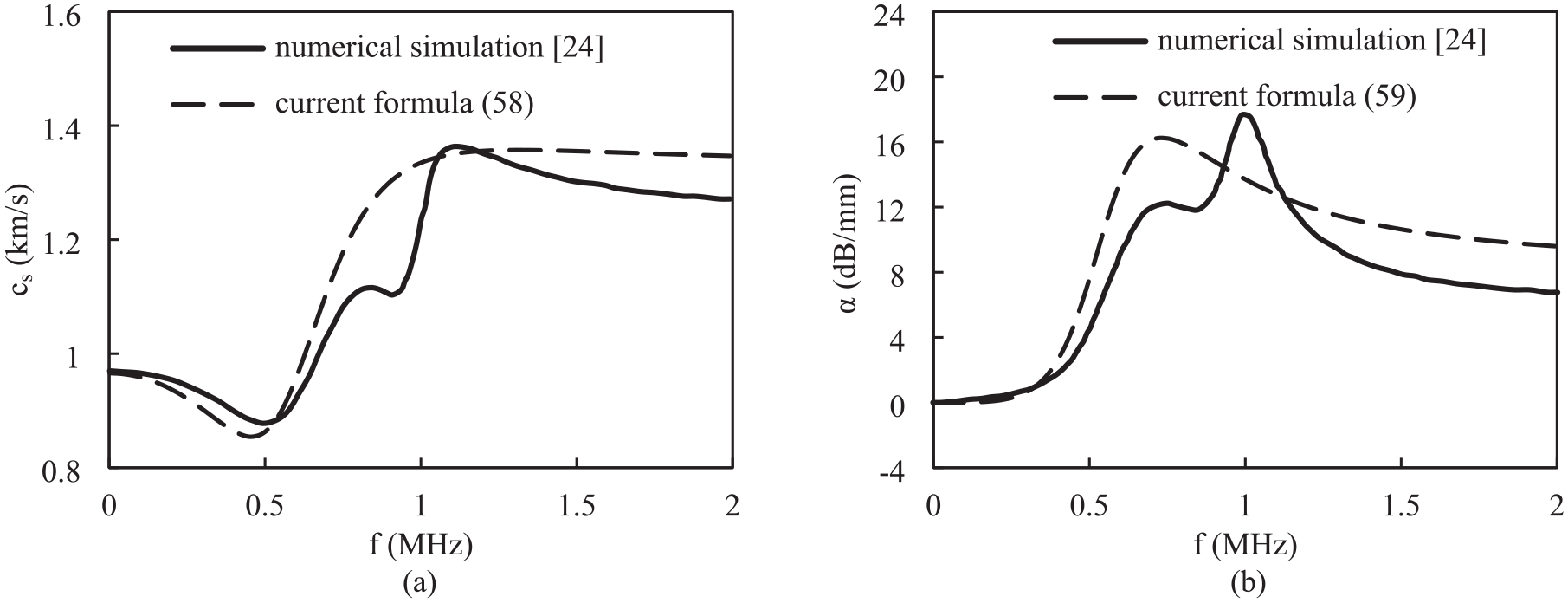
(a) phase velocity and (b) attenuation of a shear wave of the metacomposite as mentioned in Table 2.
Based on the information depicted in both Figures 5 and 6, the current wave propagation model generally aligns reasonably well with the established data obtained through numerical simulations [24], for both compressional and shear waves.
3.2. Examples for reflection of an incident compressional wave
In this section, we consider two examples concerning the wave reflection of both compressional and shear incident waves at the free boundary of a half-space metacomposite. Initially, the analysis focuses on the wave reflection of incident compressional waves for two distinct types of metacomposites. Subsequently, a similar analysis is conducted for incident shear waves for two different metacomposites. Figure 7 depicts plots of the amplitude ratio of the reflected compressional and shear waves resulting from an incident compressional wave at the free surface of the metacomposite as mentioned in Table 1, as a function of
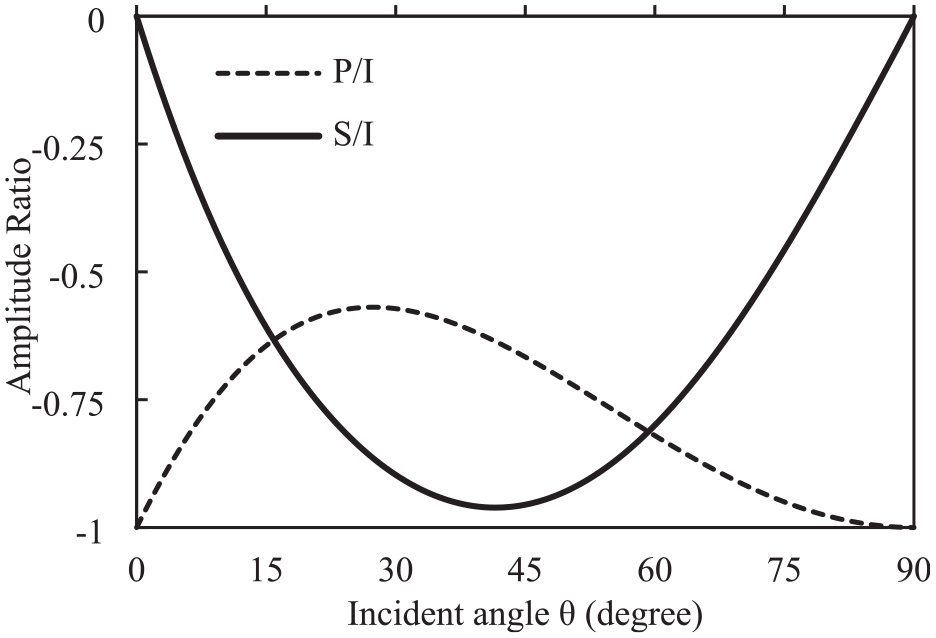
Amplitude ratio of the reflected shear and compressional wave of the metacomposite as mentioned in Table 1 for an incident compressional wave with the incident angle of θ.
Similar to the previous example, Figure 8 presents the amplitude ratio of reflected waves as a function of for a different metacomposite as detailed in Table 2. As indicated in Figure 8, the reflected shear wave vanishes at
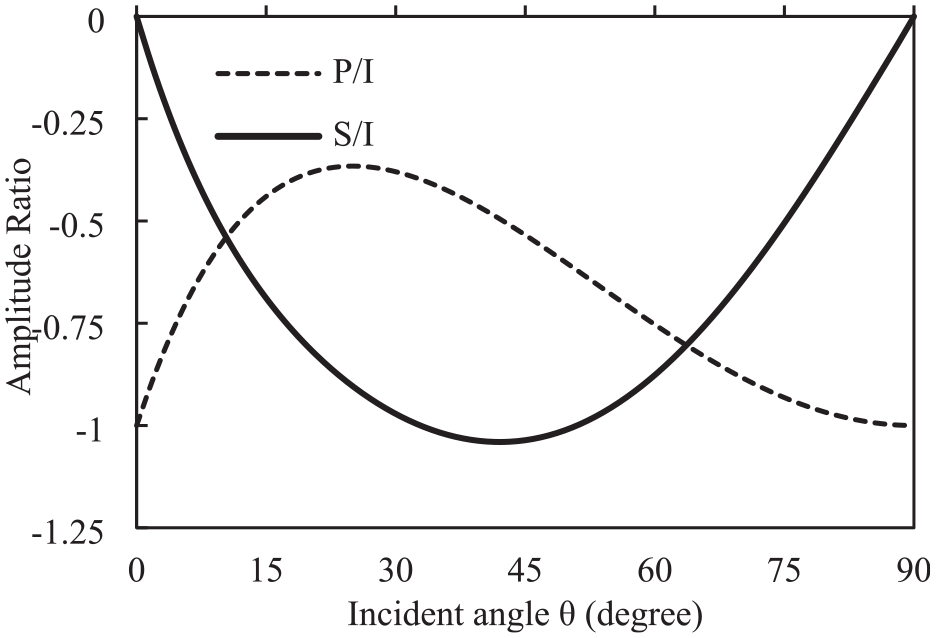
Amplitude ratio of the reflected shear and compressional wave of the metacomposite as mentioned in Table 2 for an incident compressional wave with the incident angle of θ.
3.3. Examples for reflection of an incident shear wave
In this section, a comparable analysis to the previous section is carried out for incident shear waves in two different metacomposites. However, as previously noted, the wave reflection analysis differs for incident angles greater or less than the critical angle. Initially, the wave reflection of two types of metacomposites is examined for incident angles greater than the critical angle. Subsequently, for the same metacomposites, a wave reflection analysis is presented for incident angles less than the critical angle. Figure 9 illustrates plots of the amplitude ratio of the reflected compressional and shear waves resulting from an incident shear wave at the free surface of the metacomposite as detailed in Table 1, as a function of
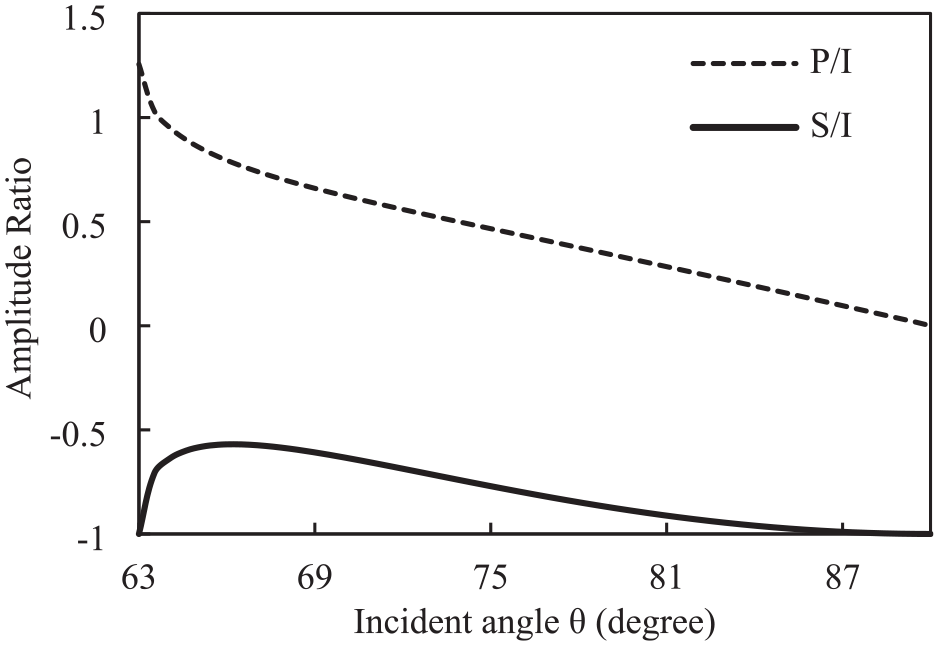
Amplitude ratio of the reflected shear and compressional wave of the metacomposite as mentioned in Table 1 for an incident shear wave with incident angle θ greater than the critical angle.
Similar to the previous example, Figure 10 depicts the amplitude ratio of reflected waves as a function of
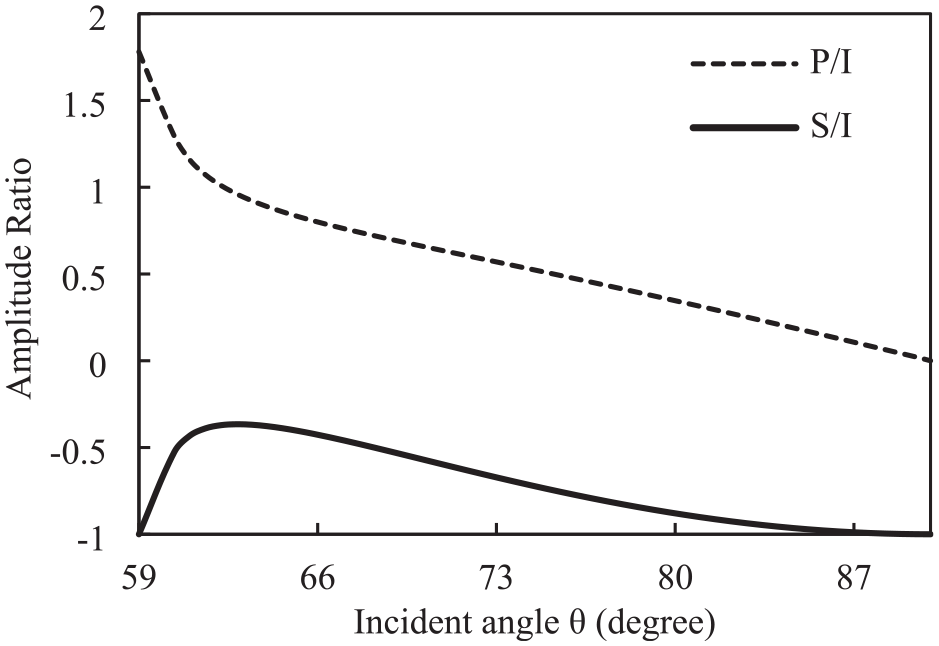
Amplitude ratio of the reflected shear and compressional wave of the metacomposite as mentioned in Table 2 for an incident shear wave with incident angle θ greater than the critical angle.
As previously mentioned, when the angle of incidence for the shear wave is less than the critical angle, there is not only a reflected shear wave but also a reflected surface wave that propagates in the
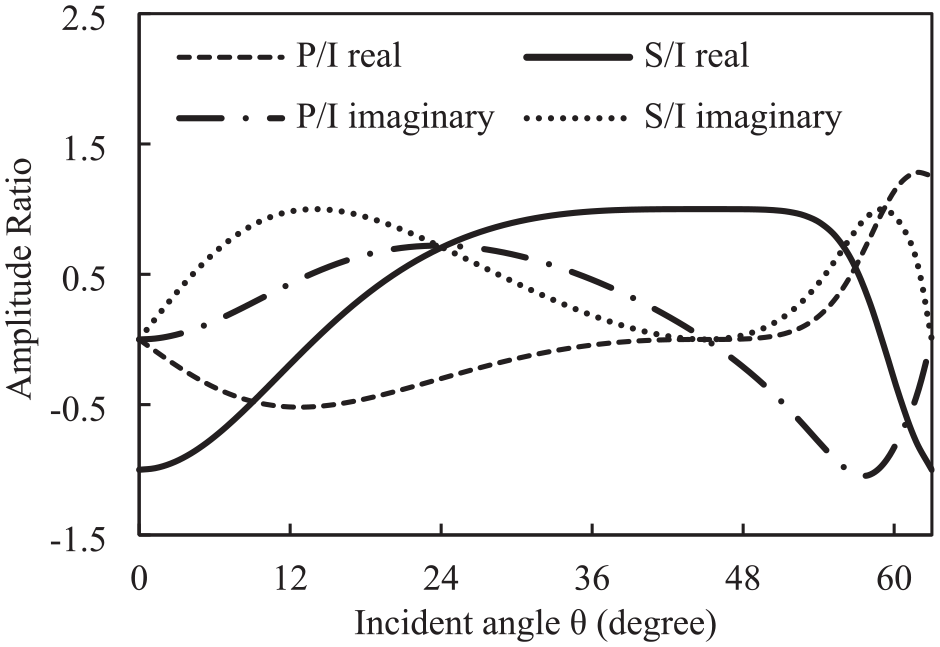
Amplitude ratio of the reflected shear and surface wave of the metacomposite as mentioned in Table 1 for an incident shear wave with incident angle θ less than the critical angle.
Similar to the previous example, incident shear waves with an angle less than the critical angle result in both a reflected surface wave and a shear wave. Importantly, the amplitude ratio of these reflected waves is represented by complex numbers. Figure 12 illustrates both the real and imaginary parts of the amplitude ratio for these reflected waves reflecting from the free boundary of the metacomposite as detailed in Table 2. Unfortunately, a comparison with known data for the results predicted by the present model on the reflection of plane waves from the free surface of a particulate composite cannot be made here due to the lack of available data in the existing literature
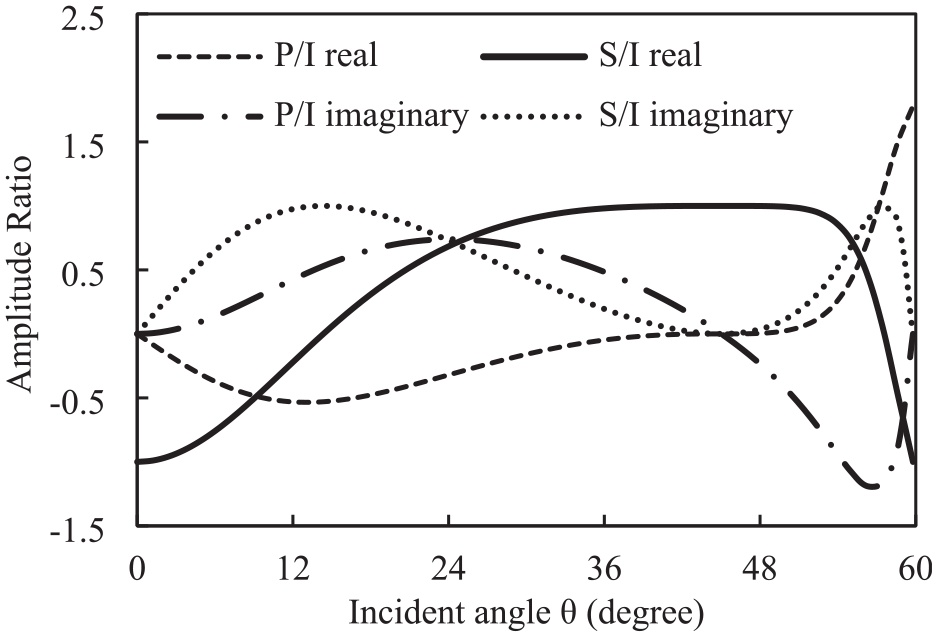
Amplitude ratio of the reflected shear and surface wave of the metacomposite as mentioned in Table 2 for an incident shear wave with incident angle θ less than the critical angle.
4. Summary and conclusion
In this paper, we focus on the reflection of an incident plane compressional or shear wave on the free surface of a hard sphere-filled metacomposite half-space. The main findings are as follows:
To the best of our knowledge, for the first time in the literature, the present work offers explicit formulas and numerical examples for the reflection of plane waves on the free surface of a hard sphere-filled metacomposite half-space.
The efficiency and accuracy of the present effective medium model for particulate elastic composites are demonstrated by comparing the predicted phase velocity and attenuation coefficient of plane waves in an entire (infinite) space with established known data in the literature.
Explicit formulas are presented for the reflection angles and amplitudes of the reflected waves for an incident compressional or shear plane wave for a hard sphere-filled metacomposite half-space with wave attenuation.
In addition, we provide an in-depth analysis of the reflected plane shear wave and the surface compressional wave when an incident shear wave propagates at an angle less than the critical angle.
Notably, unlike reflected plane waves in a homogeneous elastic body characterized by real wave numbers and constant amplitudes, the wave numbers of reflected plane and surface waves in a hard sphere-filled metacomposite are generally complex-valued with the amplitudes decaying with the propagating distance.
Footnotes
Appendix 1
Declaration of conflicting interests
The author(s) declared no potential conflicts of interest with respect to the research, authorship, and/or publication of this article.
Funding
The author(s) disclosed receipt of the following financial support for the research, authorship, and/or publication of this article: This work was supported by a Discovery Grant from the Natural Sciences and Engineering Research Council of Canada (grant no. RGPIN-2023-03227 Schiavo).
