




Abstract
Non-axisymmetric frictionless JKR-type adhesive contact between a rigid body and a thin incompressible elastic layer bonded to a rigid base is considered in the framework of the leading-order asymptotic model, which has the form of an overdetermined boundary value problem. Based on the first-order perturbation of the Neumann operator in the Dirichlet problem for Poisson’s equation, the decohesion initiation problem is formulated in the form of a variational inequality. The asymptotic model assumes that the contact zone and its boundary contour during the detachment process are unknown. The absence of the solvability theorem is illustrated by an example of the instability of an axisymmetric flat circular contact.
1. Introduction
Adhesion between surfaces of contacting solids is usually observed as a reversible phenomenon [1] and is widely used in practice for temporary connecting flat parts [2]. An often encountered situation in engineering is when one of the contacting solids can be regarded as absolutely rigid (e.g., made of steel) whereas another one is fabricated from a highly adhesive thin layer of rubber-like material. Namely, this combination was utilized in recently conducted experiments in Lyashenko and Popov [3] and Li et al. [4]. In particular, it was noticed that the theory of adhesive contact created by Johnson et al. [5] is suitable for fitting quasi-static decohesion processes.
In the present mathematical modeling study, we develop an asymptotic model for describing the quasi-static adhesive detachment process, which is characterized by a small variation of the contact zone. Our asymptotic model of the JKR-type adhesive contact [6] for a thin incompressible elastic layer [7] serves as a cornerstone of the developed decohesion model. We note that different contact problems (with a known or an a priori unknown contact zone) for a thin incompressible elastic layer were previously examined in the literature [8–11] (see [12] for more references) using different analytical techniques. The JKR-type adhesive contact for an incompressible layer was previously considered in Yang [13], but only in the axisymmetric setting. Here, the main difficulty is the absence of this simplifying assumption.
Recently, a perturbation study of the JKR model was conducted in Argatov [14] in the basic case of local contact when the Hertzian elastic half-space hypothesis applies. Using a direct analogy with crack propagation [15–17] (which for the JKR-type contact has been established in Maugis [18, 19]; see also [20]), the variational equation for a contact contour perturbation was obtained in Argatov [14, 21]. In the present work, an additional difficulty is provided by the assumption that the contact contour may be partially perturbed (as in the crack propagation problem [17, 22]), as it is the case in the stage of decohesion initiation.
It should be emphasized that a concept of a partially perturbed contour has been previously utilized in asymptotic modeling of crack propagation [17]. Here, we make use of this analogy with fracture mechanics [23] and derive a variational inequality for the contact contour perturbation similar to the original studies [17, 22]. Still, this study is limited to the phenomenon of decohesion initiation as a flat punch contact geometry is assumed. In contrast to the original study by Kendall [24], we consider an arbitrary flat punch (with a smoothly parameterized edge contour) being in a full JKR-type adhesive contact with a thin incompressible elastic layer instead of a thin compressible elastic layer bonded to a rigid base (see section 5 “Strength of glue films”). Although the assumption of incompressibility drastically changes the thin layer’s elastic response, the energy balance considerations in the axisymmetric case of a cylindrical punch support Kendall’s finding that as fracture of the adhesive joint proceeds, a surplus energy is produced with a meaning that the initiated decohesion process is unstable (appearing as an acceleration of a propagating crack).
The rest of this paper is organized as follows. First, we formulate the problem of a quasi-static decohesion initiation in the asymptotic modeling framework [7]. Then, following [25, 26], we derive the first-order perturbation formula for the Neumann operator in the Dirichlet problem for Poisson’s equation. After that, following [22], we outline a variational formulation for the decohesion initiation problem. The absence of the solvability theorem is illustrated by two examples, including one about the instability of a flat circular adhesive contact. Finally, we outline a discussion of the obtained results and formulate concluding remarks.
2. Asymptotic model of the JKR-type adhesive contact
We consider an incompressible transversely isotropic elastic layer bonded to a flat rigid base (see Figure 1). Let
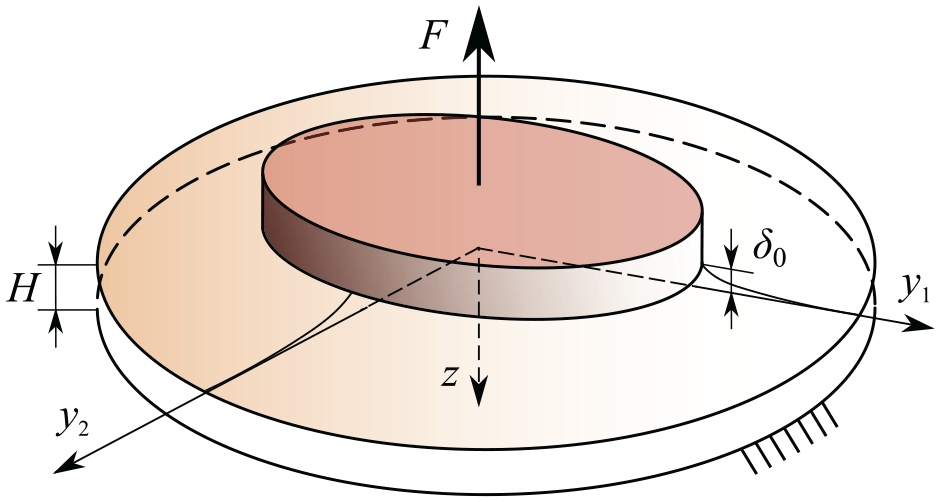
Schematics of the adhesive detachment of a flat-ended punch from a thin elastic layer bonded to a rigid base.
The upper surface of the elastic layer can experience an adhesive contact with a rigid solid (henceforth called the punch), which is characterized by the shape function
The level of contact stresses produced in the elastic layer in the deformed state can be characterized either by the value of external load,
Under the simplifying assumption that friction forces at the contact interface may be neglected, the frictionless contact between the punch and the elastic layer can be characterized by the density

By exploiting the assumption that the characteristic sizes of the contact domain


here,
In the case of unilateral contact, both the contact domain

here,
We note that the boundary-value problem (2)–(4) is known as the Cauchy problem for Poisson’s equation and is severely ill-posed [27]. However, it should be remembered that the contour
2.1. Problem of decohesion initiation
To fix our ideas, we consider the case of a flat-ended punch, when


According to our previous analysis [7], the condition of full JKR-type contact can be formulated as:

In other words, so long the above condition is satisfied, the contact between the flat-ended punch and the surface of the thin incompressible elastic layer is maintained over the entire domain
The decohesion starts at a point or several points where the inequality (7) turns into equality. We assume that after the decohesion initiation, the process of quasi-static detachment, which can be characterized by a time-like variable
With this aim, we introduce the natural parametrization of the contour
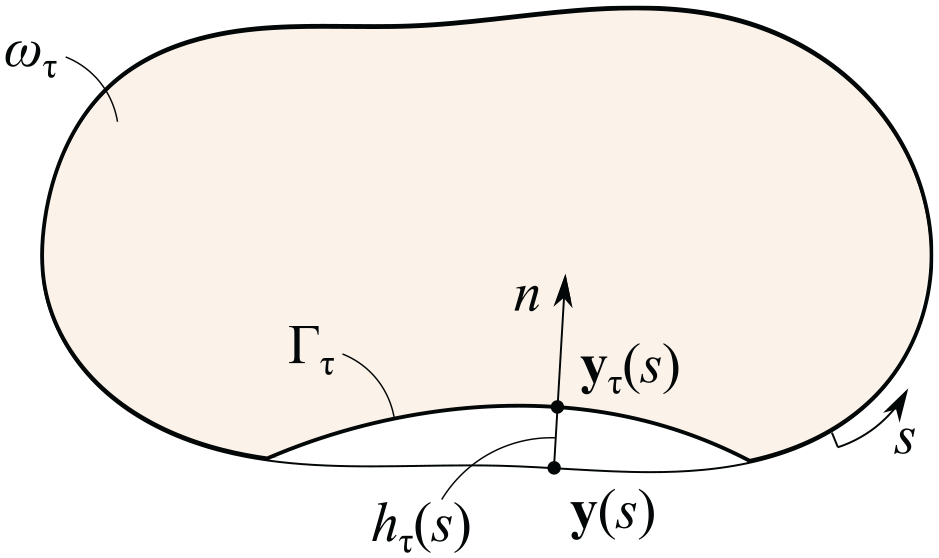
Perturbation of the contact domain.
Let

where
Thus, if
The function


Here, we have introduced the notation:


Furthermore, it can be shown that the unit inward normal vector to the curve

where
For a slightly perturbed contact contour, both functions

when the terms of the second order of smallness have been neglected.
Now, let

where the dot denotes the scalar product.
Finally, we note that so far the dependence of the contact pressure density

here,

Without any loss of generality, we may fix the constant
Thus, the concrete problem of decohesion initiation, which will be studied in the next sections, is comprised of equation (16), relations (9), (10), and the Dirichlet boundary condition

In particular, we are interested in the special case of an elliptical domain of initial contact, which is consistent with the experimental setup utilized in Li et al. [4].
3. Perturbation of the Neumann operator
By treating the variable



which follow from relations (16), (18), and (7), respectively.
The Neumann operator is defined as follows (see equation (15)):

Now, abstracting from relation (21) and considering the Dirichlet boundary-value problems (19) and (20), let us examine the perturbation of the Neumann operator under a small perturbation of the boundary


We note that equation (23) differs from equation (16) by dropping out the driving term
To simplify the analysis, we put:

where
Following Argatov and Mishuris [12], we employ the perturbation technique (see, e.g., [29]) and formally write:

where
In light of the first-order expansion (26), we look for the solution to the perturbed problems (23) and (24) in the form:

The substitution of the asymptotic expansions (26) and (27) into the boundary condition (24), in view of equation (20), yields the non-homogeneous Dirichlet boundary condition:

Moreover, the substitution of equation (27) into equation (23), in view of equation (19), yields the Laplace equation:

We also note that, in view of equation (22), equation (28) can be rewritten as:

Now, in view of the first-order approximation (14), for the unit normal vector

which can be further simplified by making use of the asymptotic expansion (27) as:

Finally, taking into account equations (20) and (22), we simplify the above asymptotic formula as follows:

where
To this end, we still need to relate the normal derivative

where

We note that by the application of Green’s identity, it can be easily established that:

Thus, in view of equations (25), (30), and (32), formula (31) can be represented in the form:

We note that:

and thus, in view of equations (19) and (22), we have:

where
The first-order perturbation formula (34) will be used in formulating the problem of decohesion initiation.
4. Variational formulation of the decohesion initiation problem
Let us return to the problems (16), (18), and (9)–(11). By comparing equations (16) and (19), we readily see that an additional term should be introduced to the right-hand side of formula (34) as:

where

and

Furthermore, in view of equations (7) and (9)–(11), we have:




From equations (40)–(42), it follows that

Let
Therefore, for any trial function

Thus, in the framework of the general scheme [31], from equations (43) and (44), it follows that:

where

Observe that the variational inequality (45) is of the same type as those studied in Kolton and Nazarov [22]. Following Kolton and Nazarov [22], we introduce the notation:

Then, the substitution of equation (36) into equation (45) yields:

for all
The main problem with the variation inequality (47) is that even in the case when
5. Examples
In this section, we consider two special cases of the contact geometry, which are of interest for interpreting the experimental results obtained in Li et al. [4].
5.1. Elliptical contact domain
We consider the Dirichlet problems (19) and (20) in an elliptical domain

where without loss of generality, we assume that

It can be easily verified that the solution of the Dirichlet problems (19) and (20) is given by:

so that:

From equations (49) and (51), it follows that:

We recall that in the case of detachment, we have

where the positive parameter
Thus, in view of equations (22), (52), and (53), we can write:

Furthermore, the curvature of the elliptical contour

and it is readily seen that
This example illustrates the negative assertion made above regarding the solvability of the variational inequality (47).
5.2. Instability of circular adhesive contact
Now, we consider a circular domain

Let
Then, in the polar coordinates, we will have:

In the case under consideration, the solution to the Dirichlet problems (19) and (20) is given by formula (50) with

Using Poisson’s formula, it can be shown that:

where the integral is understood in the Cauchy principal value sense, and:

Thus, according to equations

Since in the axisymmetric case, the decohesion initiates along the entire contour

At the same time, the asymptotic formulas (34) and (36), in view of equations (55),

Hence, the substitution of equation (61) into equation (60) yields:

We recall that the Neumann operator

where it is assumed that
The apparent non-uniqueness of the perturbation solution (63) (it should be remembered that the direction of the shift of the center of
6. Discussion
First, it should be emphasized that the analysis presented above is based on the asymptotic model [7] of the JKR-type adhesive contact for a thin incompressible elastic layer. At the same time, the assumption of incompressibility is essential, because the layer’s deformation response becomes non-local compared to that of a thin compressible elastic layer, which responses to compression like a Winkler foundation (see, e.g., [12, 33]). It is of interest to note [34] that the model of an incompressible elastic material is applicable for describing the instantaneous response of a biphasic or poroelastic material [35, 36] (see also [12]). That is why, the developed asymptotic model has a wider area of application than just elastic incompressible coatings. We also note [37, 38] that the manifestation of adhesion is different from that of surface tension [39, 40]. Whereas the “inner” asymptotic model for a thin bonded incompressible elastic layer coated with an elastic membrane was derived in [41], the analysis of the boundary layer solutions, which allow to derive the boundary conditions on the contact contour, is still an open question.
Regarding the asymptotic character of equations (5)–(7), which assume that characteristic sizes of the contact domain
Still, following Kolton and Nazarov [22], one can consider a localized asymptotics for the contact contour perturbation in terms of the fast coordinate
It would be tempting to deduce some mechanical conclusions from the considerations of instability of detachment process and non-uniqueness of solutions. However, it must be bared in mind that in the JKR type of adhesion, any viscous effects, which may depend on the rate of separation of the contacting surfaces, have been completely neglected. As such, the multiple solutions cannot be ranged with the account for the energy dissipated due to separation of the molecular bonds during the decohesion process.
When looking at the results of the displacement-driven decohesion experiments [4] through a prism of the constructed asymptotic model, we can make the following conclusions. The decohesion initiation at the interface between a flat-ended elliptical punch occurs near the vertices of the minor semi-axis of the initial elliptical area of contact. With increasing the eccentricity of the initial elliptical contact contour, the decohesion zone rapidly widens, as it follows from formula (54). However, further analytical studies are needed to extend the theory to the case of rate-dependent adhesion (see, e.g., [44]).
Footnotes
Funding
The author(s) disclosed receipt of the following financial support for the research, authorship, and/or publication of this article: V.L.P. and I.I.A. thank the financial support from the Deutsche Forschungsgemeinschaft (DFG PO 810-55-3). G.S.M. acknowledges funding from the H2020 MSCA RISE project EffectFact ID: 101008140. Both G.S.M. and I.I.A. would like to thank the Isaac Newton Institute for Mathematical Sciences, Cambridge, for support and hospitality during the program “Mathematical theory and applications of multiple wave scattering” where work on this paper was essentially finalized. This work was supported by EPSRC grant no. EP/K032208/1.
