




Abstract
Soft materials exhibit significant nonlinear geometric deformations and stress–strain relationships under external forces. This paper explores weakly nonlinear elasticity theories, including Landau’s and Murnaghan’s formulations, advancing understanding beyond linear elasticity. We establish connections between these methods and extend strain-energy functions to the third and fourth orders in power of
1. Introduction
Soft materials, such as biological tissues and gels, often undergo significant geometric deformations when subjected to external forces [1]. Unlike hard materials, which typically only experience small deformations, the stress–strain relationship in soft materials is best described using nonlinear elasticity theory due to the large deformations involved [2–5]. Linear elasticity theory is often insufficient to accurately represent the stress–strain relationship in these materials, necessitating the use of nonlinear finite-deformation theory and precise constitutive modeling [6].
For homogeneous isotropic hyperelastic materials, finite-deformation analysis commonly relies on the strain-energy function represented by the three principal invariants of the strain tensor [6]. The stress–strain relationship can be obtained by solving the partial derivatives of the strain-energy function. Under the assumption of incompressibility, the strain energy can be further simplified as a function of two principal invariants. Analytical solutions for large deformation problems of incompressible materials in simple structures have been found based on finite deformation theory [7]. However, obtaining analytical solutions that account for large deformations becomes difficult for complex problems like nonlinear contact [8] and post-buckling analysis [9]. Linear elastic approximations also fail to meet the precision requirements. Instead, weakly nonlinear theory provides an effective approach in such cases [10].
Weakly nonlinear elasticity theory, particularly the formulation proposed by Landau et al. [11] and Murnaghan [12], represents a significant advance in nonlinear elasticity theory. The use of the strain-energy function in polynomial form allows for the precise determination of elastic moduli through curve fitting of experimental data using standard linear regression techniques [10, 13].
Landau’s [11] approach, based on the Landau invariants of the Cauchy–Green strain tensor, with terms up to the third and/or higher orders of the strain-energy functions, includes both material and geometric nonlinearity [10]. It finds applications in material science, geophysics, acoustics, and other fields, accurately predicting the mechanical response of materials under realistic loading conditions [14–16].
Murnaghan’s [12] framework, which expresses the strain-energy function as a triply-infinite power series in the principal invariants of the Cauchy–Green strain tensor, is also widely used. This approach has shown the ability to solve simple problems involving compressible materials and specific cross-sectional shapes of prisms under incompressible conditions [7]. It approximates the strain-energy function to any desired order in the power-series expansion, utilizing the symmetric functions of principal invariants. In addition, under the assumption of small deformations, the higher-order Murnaghan model extends the classical linear elastic theory into the weakly nonlinear region, providing a robust method. By considering the superposition of displacements of higher orders and substituting them into the motion equations and boundary conditions according to the corresponding orders, the Murnaghan model [12] demonstrates the linearization of the nonlinear problem by neglecting higher-order terms and simplifying solutions to quasi-nonlinear problems [17, 18].
This article aims to organize the definitions of different strains, invariants, and strain-energy functions in these two different weakly nonlinear elastic theories and the various forms of strain-energy functions and material parameters in non-linear elastic theory to establish their relationships. We expand the strain-energy functions in the weakly nonlinear theory up to the third and fourth orders, corresponding to the second-order and third-order elasticity theories. In addition, we consider the simplified strain-energy functions and stress–strain relationships of materials under incompressible conditions, as many soft materials can be assumed to be incompressible.
2. Connections among different strain invariants
In the context of finite deformation, let us consider an elastic body undergoing a finite displacement field

where we separate

In linear elasticity, providing that the displacement gradient tensor

The strain-energy function of an ideal isotropic elastic material, capable of undergoing finite deformation, can generally be expressed in terms of three independent scalar invariants of the strain tensor. For a general second-order tensor

where the invariants of the tensor

On the other hand, the scalar invariants of the tensor

where
Some commonly used invariants and the relationships between them are
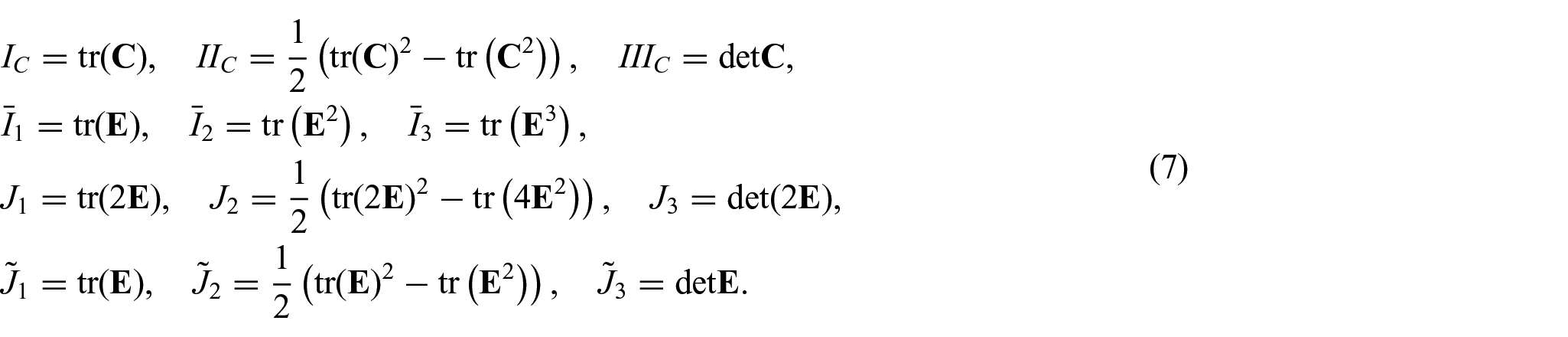
Among them,
Given the often utilization of both fully nonlinear and weakly nonlinear elasticity theories in the derivation of nonlinear deformation problems, it becomes imperative to comprehensively outline the interconnections between the invariants and the strain-energy functions they engender.
2.1. Connections between
,
and
,
In this subsection, we shall demonstrate the connections between the principal invariants,

Then, the first and second principal invariants of the right Cauchy–Green strain tensor

Next, by tracing equation (4), we obtain

Using this equation, the third principal invariant of the right Cauchy–Green strain tensor

Inversely, from equations (9) and (11), we can express the Landau invariants

2.2. Connections between
,
,
,
, and
,
As the two sets of definitions of the Murnaghan invariants
From equation (7), we obtain

Furthermore, utilizing equations (2) and (7), we can deduce the following relationships between the Murnaghan invariants

Inversely, we have

Moreover, considering the connections between

and

2.3. Connections among
,
,
,
, and
,
This subsection explores the connections between the Landau invariants

Solving these equations yields

and

Analogously, according to equation (13), we can obtain the connections between the Landau invariants

and

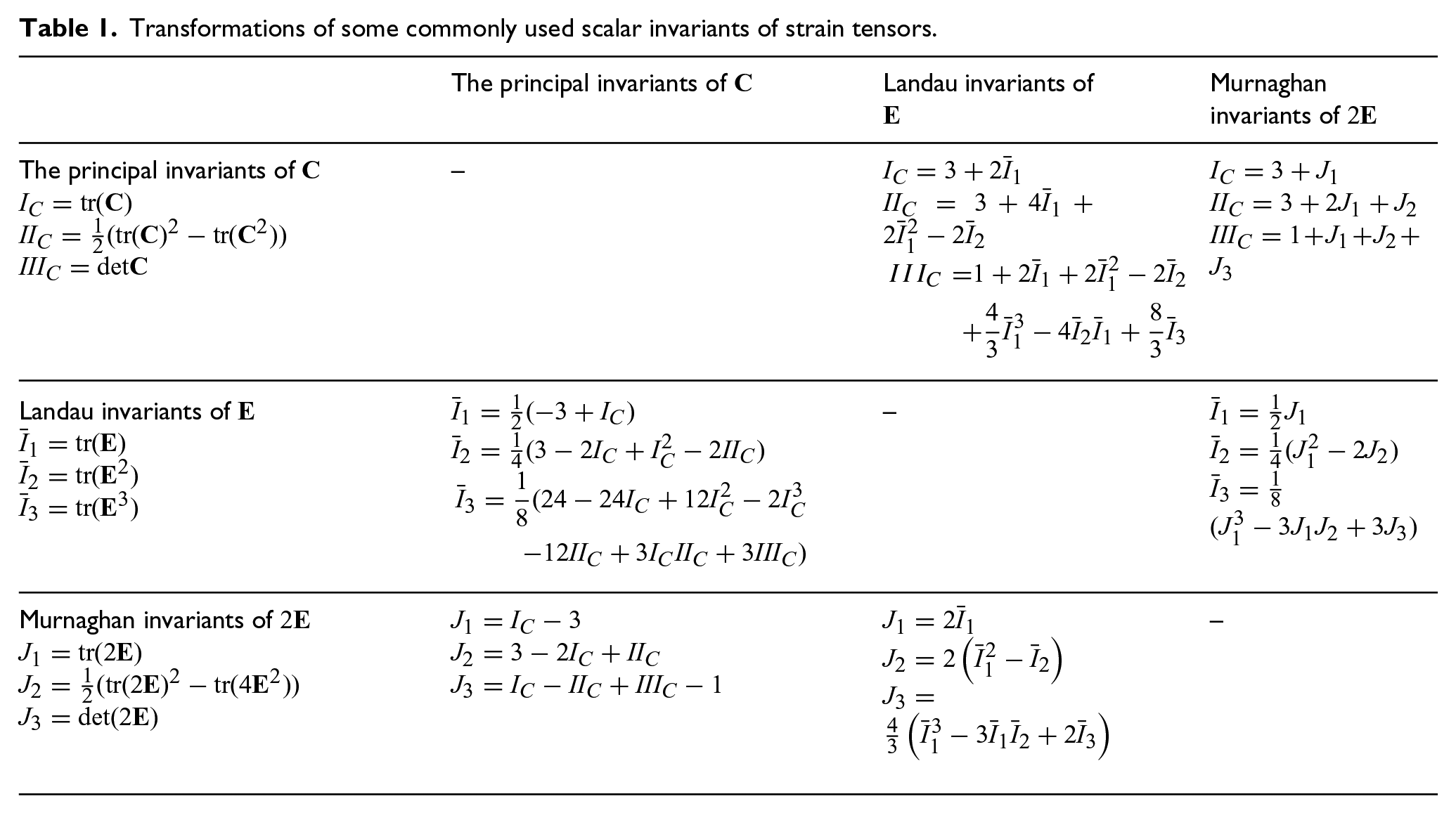
Finally, the summary of transformations for the principal invariants,
Transformations of some commonly used scalar invariants of strain tensors.
3. Weakly nonlinear elasticity for isotropic compressible materials
In fully nonlinear elasticity, the strain-energy function of the isotropic compressible material

where
3.1. Second-order elasticity
3.1.1. Strain-energy functions
In second-order elasticity, we require the terms of

where

where
Referring to the connections between Murnaghan invariants and Landau invariants in equation (20), the third-order strain-energy function in Murnaghan expansion can be rewritten as

Thus, we can obtain the following relationships among the material constants:

Similarly, referring to the connections between Landau invariants and Murnaghan invariants in equation (19), we can rewrite the third-order strain-energy function in Landau expansion as:

This leads to

3.1.2. Stress–strain relationships
Second-order elasticity requires the stress and strain tensors to be expanded to
From equation (1) and defining

the first principal invariant

and

By tracing this equation and using equation (30), we obtain

where

and the third principal invariant

where

Thus, the third principal invariant

In addition, using the Cayley–Hamilton theorem and equations (31), (32), and (34), we have

Analogously, from equation (30), we have

where

Hence, equation (38) can be finally rewritten as

Next, following the connections between the Murnaghan invariants and the principal invariants in equation (17), we have

In addition, using the chain rule, we can replace the derivatives of the strain-energy function

With respect to the third-order Murnaghan strain-energy function in equation (24), we have

Moreover, recalling that

Finally, substituting equations (31), (34), (37), (41), (44), and (45) into equation (23) and ignoring the higher-order terms, we can derive the second-order expansion of the Cauchy stress tensor

From this, we extract the first-order linear elastic term

and the second-order term

3.2. Third-order elasticity
3.2.1. Strain-energy functions
The third-order elasticity requires expanding the stress and strain tensors up to third-order smallness

where
In addition, the fourth-order energy function can be expressed in terms of the Landau invariants as

where
Referring to the connections between the Murnaghan invariants and Landau invariants in equation (20), we can rewrite the fourth-order strain-energy term in the Murnaghan expansion as

Thus, the relationships between the material constants are

Similarly, referring to the connections between the Landau invariants and Murnaghan invariants in equation (19), we can rewrite the fourth-order strain-energy term in the Landau expansion as follows:

which gives the relationship among the material constants

3.2.2. Stress–strain relationships
Here, our aim is to expand all terms in equation (23) up to the third-order terms and obtain the third-order expansion of the Cauchy stress tensor, represented by

and its trace

where

Next, referring to equations (30) and (35) and expand to the third-order terms, we find

where

Moreover, according to the Cayley–Hamilton theorem, we have

By following the connections between the Murnaghan invariants and principal invariants in equation (17) and expanding to third-order terms, we find

In addition, using the chain rule, we can replace the derivatives of the strain-energy function

In the case of the fourth-order Murnaghan strain-energy function in equation (49), we have
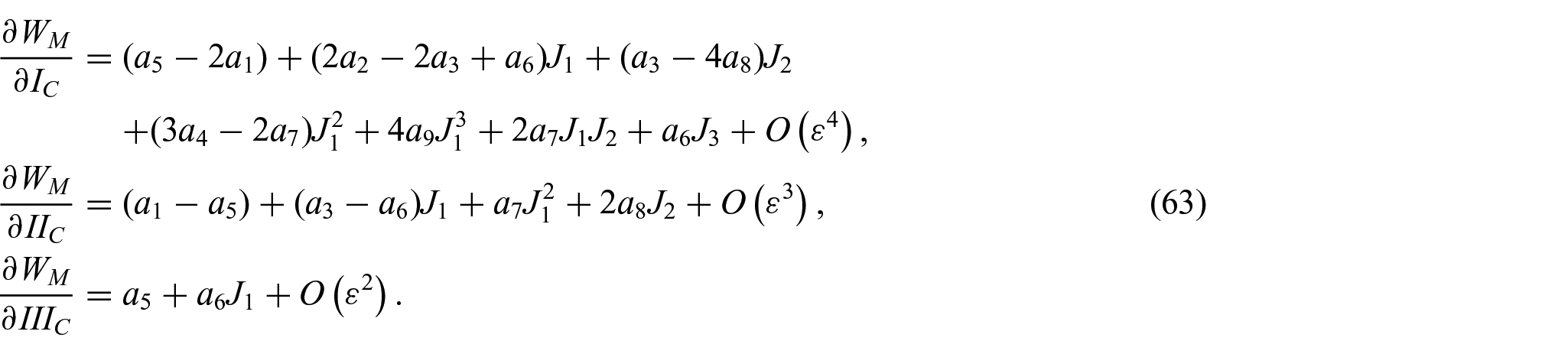
Moreover, recalling that

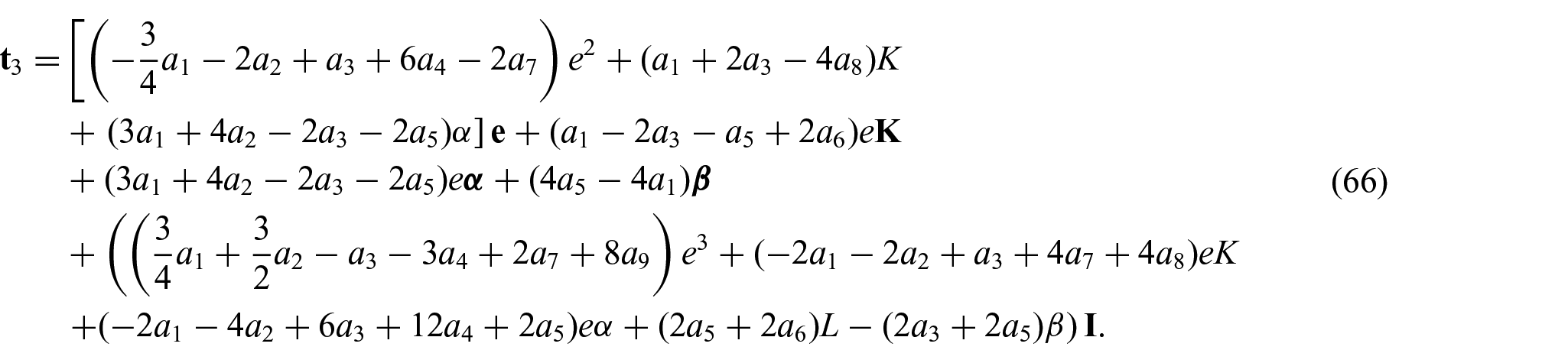
Finally, substituting the equations (31), (57), (59), (60), (64), and (64) into equation (23) and ignoring the higher-order terms, we can obtain the Cauchy stress up to the third-order terms to be

in which the third-order term is
4. Weekly nonlinear elasticity for isotropic incompressible materials
Most soft biological materials are assumed to be incompressible, so that

where

In this section, we present the weakly nonlinear expansion of energy functions for commonly used incompressible isotropic hyperelastic solids in the Landau and Murnaghan forms. These include the neo-Hookean model

4.1. Second-order elasticity
4.1.1. Strain-energy functions
For the incompressible materials, the equation (68) indicates that

Thus, we have

Substituting this equation in equation (69), we can obtain the expansion form of the energy functions as follows:

Following the third-order incompressible isotropic elasticity analysis by Destrade and Ogden [19], the weakly nonlinear expansion of the strain-energy functions in terms of Landau invariants up to third-order is

From this, we can obtain the following connections between the material constants of the incompressible neo-Hookean, two-parameter Mooney–Rivlin and five-parameter Mooney–Rivlin solids

Next, recalling the connections between

Substituting equation (75) into equation (69) and neglecting the terms of

According to equations (73) and (29), the strain-energy functions in terms of Murnaghan invariants becomes

Thus, for the incompressible neo-Hookean, two-parameter Mooney–Rivlin and five-parameter Mooney–Rivlin models, we have the following connections between the material constants:

4.1.2. Stress–strain relationships
To simplify the calculation, we use the third-order Murnaghan form strain-energy function to derive the second-order Cauchy stress tensor. First, using the chain rule, we can rewrite the derivatives of the strain-energy function

According to equation (37), the incompressibility condition

which indicates that

Therefore, substituting the equations (79) and (81) into equation (67) and ignoring the higher-order terms, we have the second-order Cauchy stress tensor

Specifically, according to the equation (78), for incompressible neo-Hookean solid, the Cauchy stress tensor is given by

For incompressible two-parameter Mooney–Rivlin solid, the Cauchy stress tensor can be rewritten as

and for incompressible five-parameter Mooney–Rivlin solid, the Cauchy stress tensor can be expressed by

4.2. Third-order elasticity
4.2.1. Strain-energy functions
For the third-order elasticity, the strain-energy function is expanded to the fourth order. The incompressibility condition, in terms of the Landau invariants, is

Therefore,

Hence, we can rewrite equation (69) as
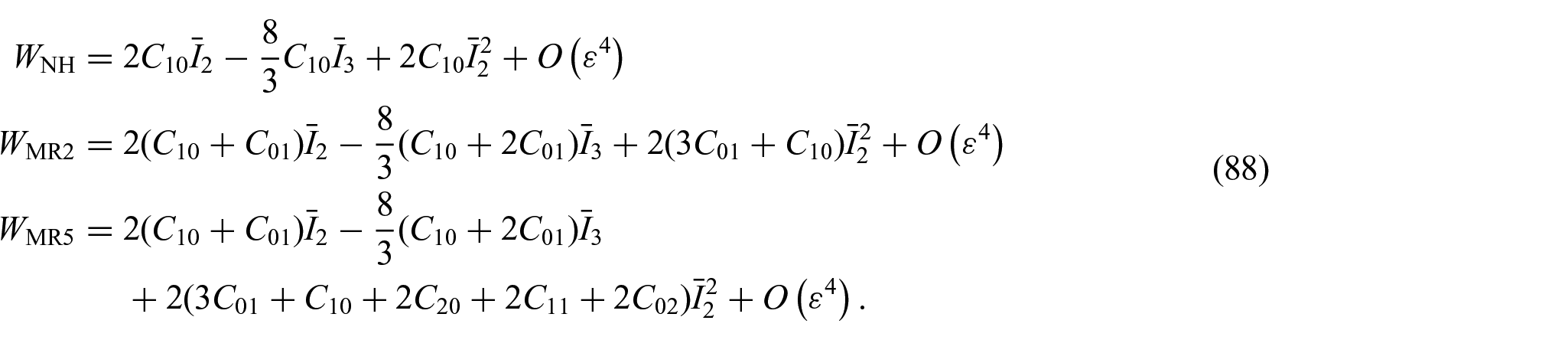
Following Destrade and Ogden [19], the weakly nonlinear expansion of the strain-energy functions in terms of Landau invariants to fourth order is

where

To represent the strain-energy function in terms of the Murnaghan expansion, we substitute equation (75) into equation (69) to get

Similarly, from equations (89) and (29), the expansion of the strain-energy functions in terms of Murnaghan invariants is

where

4.2.2. Stress-strain relationships in third-order elasticity
Similarly, we use the fourth-order strain-energy function in Murnaghan expansion to solve the third-order Cauchy stress tensor. Then, based on equation (92), we have

Referring to equation (59), the incompressibility condition

With this equation, equation (60) can be rewritten as

In addition, considering the

Therefore, substituting equations (94) and (96) into equation (67), we can derive the Cauchy stress tensor by

Specifically, according to equation (93), for incompressible neo-Hookean solid, the Cauchy stress tensor is given by

For incompressible two-parameter Mooney–Rivlin solid, the Cauchy stress tensor is given by

For incompressible five-parameter Mooney–Rivlin solid, the Cauchy stress tensor is given by

5. Conclusion
The nonlinear elastic behavior of soft materials is of significant importance across many fields, including biology, materials science, geophysics, and acoustics. In this paper, we have given new results for the expansion of the strain-energy functions and Cauchy stress tensor to
By examining distinct invariants of strain tensors, strain-energy functions, stress–strain relations, and transformation relations of material parameters, we reveal the connections between different elastic theories and expand the energy density function to third-order and fourth-order terms under the framework of weak nonlinear theory. Such efforts not only guide further research on the elastic behavior of soft materials but also contribute to finding solutions for practical problems. It is worth highlighting that this paper also addresses the strain-energy function and stress–strain relationship of soft materials under incompressible conditions. This consideration facilitates the modeling and analysis of practical problems while providing a simplified approach to tackling complex problems.
Footnotes
Acknowledgements
The authors thank the EPSRC for funding this research through grants EP/S030875/1 and EP/S020950/1. Y.D. also acknowledges support from the European Union GA n°101105740 “Multi-scale and Multi-physics Modelling of Soft Tissues - MULTI-SOFT.” (The views and opinions expressed are those of the author(s) only and do not necessarily reflect those of the European Union or the European Research Executive Agency. Neither the European Union nor the granting authority can be held responsible for them.)
Funding
The author(s) received no financial support for the research, authorship, and/or publication of this article.
