




Abstract
It is well known that propagation of waves in homogeneous linearized elastic materials of infinite extent is not dispersive. Motivated by the work of Rubin, Rosenau, and Gottlieb, we develop a generalized continuum model for the response of strain-limiting materials that are dispersive. Our approach is based on both a direct inclusion of Rivlin–Ericksen tensors in the constitutive relations and writing the linearized strain in terms of the stress. As a result, we derive two coupled generalized improved Boussinesq-type equations in the stress components for the propagation of pure transverse waves. We investigate the traveling wave solutions of the generalized Boussinesq-type equations and show that the resulting ordinary differential equations form a Hamiltonian system. Linearly and circularly polarized cases are also investigated. In the case of unidirectional propagation, we show that the propagation of small-but-finite amplitude long waves is governed by the complex Korteweg–de Vries (KdV) equation.
Keywords
1. Introduction
As Rajagopal [1] mentions, nonlinear relationships between the Cauchy stress and the linearized strain appear in continuum mechanics, especially in the studies of inelastic materials. However, classical Cauchy elasticity is unable to give a complete reasoning to such situations since the linearized strain is not an objective quantity. On the contrary, the implicit constitutive theoretical approach introduced by Rajagopal [2, 3] allows these unexplained phenomena to be clearly understood.
The idea behind Rajagopal’s pioneering work is that starting with an implicit constitutive relation, one is able to express the strain as a function of the stress rather than vice versa without contradicting the principle of causality. As a result, after linearization, it is possible to maintain nonlinear relationship between the linearized strain and the stress which is not possible in Cauchy elasticity when a constitutive relation giving the stress explicitly as a function of the strain is adopted. This gives rise to strain-limiting theories which are introduced and studied extensively by Rajagopal [1, 4, 5] and Rajagopal and Saccomandi [6].
In the absence of dissipative and dispersive effects, the propagation of transverse waves in various materials was investigated from the point of view of hyperbolic nonlinear systems in the literature. For transverse waves propagating in homogeneous isotropic elastic solids, Carroll [7] found a class of exact solutions which are global in space and time, proving that not all solutions blow-up (see also Saccomandi and Vitolo [8]). On the contrary, the propagation of transverse waves in an infinite elastic medium involving dispersive effects still remains to be investigated.
Rubin et al. [9] introduced the idea of modifying the free energy and the stress so that dispersive effects are modeled without altering the usual restrictions on the unmodified constitutive relations obeying the first and second laws of thermodynamics. The interesting feature of this theory is that the constitutive equation proposed in Rubin et al. [9] is a simple material à la Noll [10], and no additional boundary conditions with respect to the classical elastic theory are needed. This is a major advantage with respect to dispersive theories based on the second gradient or microstructure where additional boundary conditions are necessary.
Following this approach, Destrade and Saccomandi [11, 12] considered the problem of wave propagation in an isotropic elastic solid by taking the dispersive effects into account and determined a class of global in time and space solutions, the structure of the traveling waves in the incompressible and unconstrained case, and some asymptotic model equations. We note that the strain-limiting approach is not considered in these works. It is also worth remarking that in constitutive relations wherein the strain is expressed as a nonlinear function of the stress, it is possible to generate “stress waves” (see Kannan et al. [13]).
In this paper, we incorporate analysis of transverse wave propagation in an isotropic homogeneous medium with dispersion within the context of the strain-limiting theory for incompressible material response. In section 2, we first propose an model including dispersive effects and investigate the corresponding strain-limiting approximation. This results in a constitutive relation including the linearized strain, its second-order time derivative, and the Cauchy stress. In the same section, using this constitutive equation, we also derive the coupled system of nonlinear wave equations governing the propagation of pure transverse waves. Also, in section 5, we look at the exact solutions of this partial differential equations system, including the Carroll solutions. Section 3 is devoted to the traveling wave solutions of this coupled system where the resulting ordinary differential equation system is a Hamiltonian system. Linearly and circularly polarized cases are also studied in this section. Finally, in section 4, we derive the equations governing the propagation of unidirectional long waves and obtain the complex modified KdV equation.
2. Basic equations
In this section, we introduce the dispersive model we want to study by modifying the general implicit constitutive modeling approach with the addition of Rivlin–Ericksen tensors. Following Rajagopal’s approach, we look at the strain-limiting behavior by linearizing the strain.
2.1. Kinematics and implicit modeling
Let

A body is said to be Cauchy elastic, if the Cauchy stress is given explicitly as a function of the deformation gradient. Here, we generalize this idea and start with an implicit constitutive relation between the stress and the kinematic variables as proposed by Rajagopal [12]. We consider a special class of implicit models

where

When

2.2. Strain-limiting approximation
Within the context of the new generalized elasticity introduced by Rajagopal [3, 4], an approximation based on linearization under the assumption that the displacement gradient is small leads to constitutive relations wherein the strains are bounded. Following this approach, the first simplification of equation (1) is obtained using the approximations:

where the linearized strain is given by:

Such approximations are possible if there exists a number
The second simplification is to consider

Finally, we assume that the only constitutive function remaining is:

This is just for the simplicity of expressions since by the above definition of

2.3. Propagation of nonlinear transverse waves
We consider the deformation given by:

where

where

where

where

where

Equivalently, introducing the notation


Systems (7) and (8) are equivalent to the two coupled nonlinear wave equations:

or introducing the complex unknown

where we have used the complex representation
If we linearize equation (9) about the stress-free state, we get two decoupled linear dispersive wave equations. In such a case, the linear dispersion relation is given by:

where
3. Traveling wave solutions
In this section, we look for traveling wave solutions for equation (9) in the form

Integrating twice, while assuming

Multiplying the first equation by

A similar equation also holds for

Assume existence of a potential function

Now, integrating, we obtain:

where

We define the following Hamiltonian:

It is easy to see that the Hamiltonian system:

is equivalent to equation (12) for

for

If we consider the constant

When
We now study the nature of the equilibrium points

where

where

We can write the linearized form of the Hamiltonian system (19) as:

where:

Denoting the coefficient matrix on the right-hand side by

where we used the fact that
1. when
If
2. when
In order to write the Hamiltonian in polar coordinates, we define:

Since

We define the new variables:

Then, equation (21) can be expressed as:

In this case, the Hamiltonian system (18) can be written as:
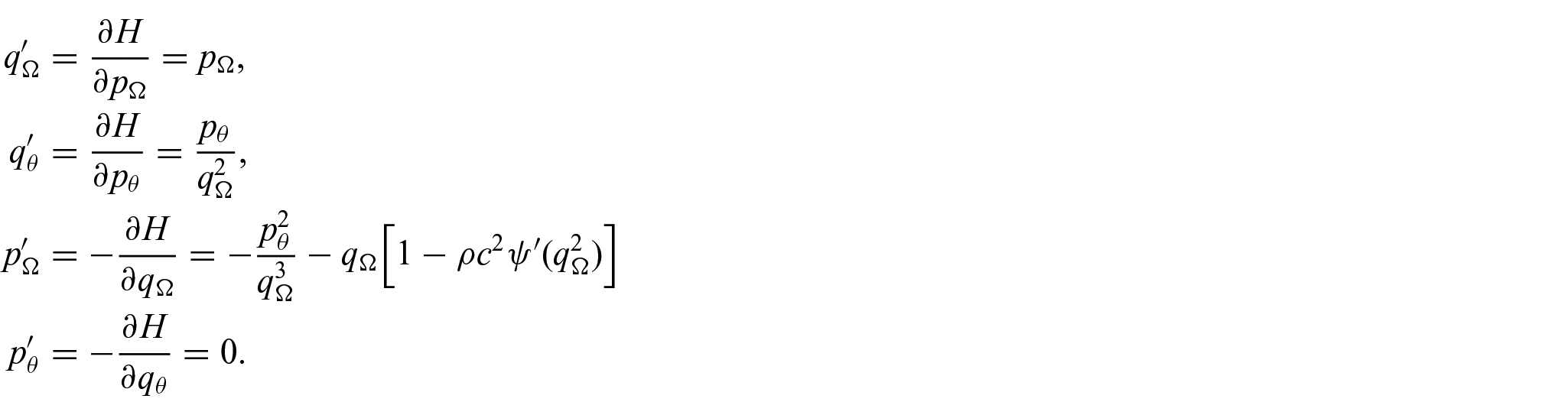
The third equation is equivalent to:

and the fourth one is:

In the linearly polarized case, i.e., when

The existence of a pulse-like traveling wave solution of equation (24) depends on the nature and the number of zeros of the antiderivative of the second term. In the following, we discuss the existence of solitary wave solutions for two special forms of
We first consider

which satisfies

with

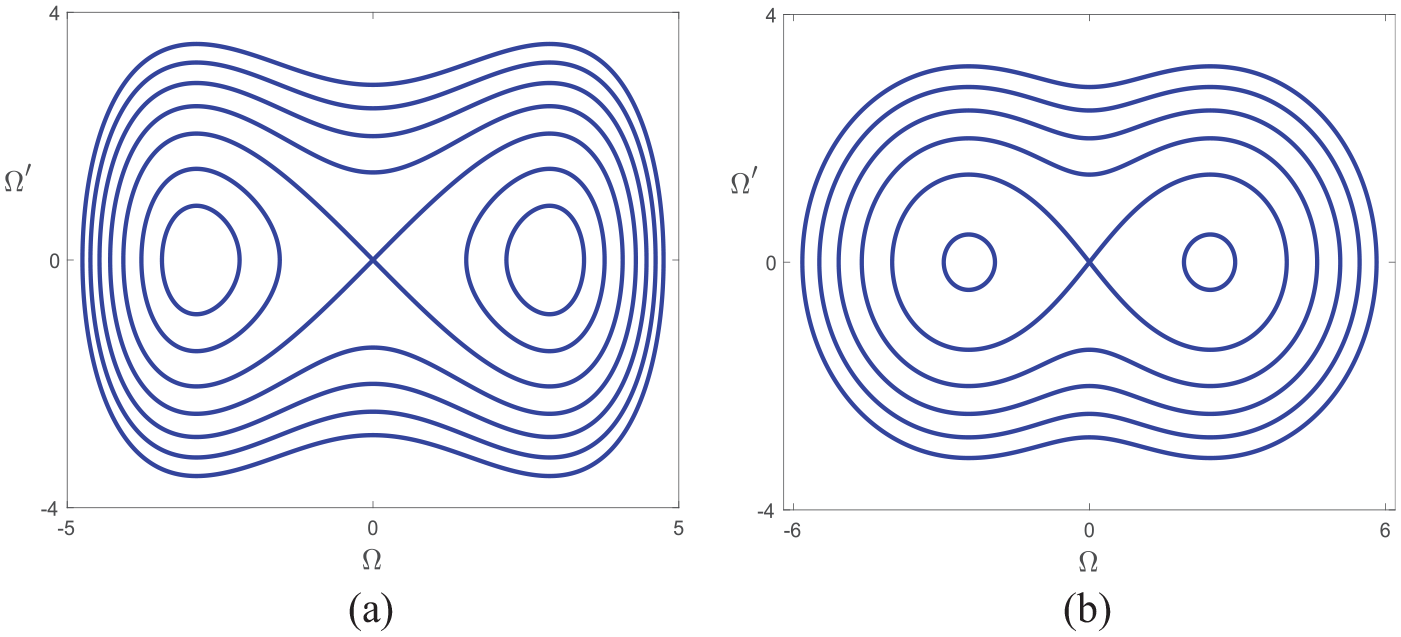
Phase portraits of equation (24) for two different forms of
The graph of the solitary wave solution can be seen in Figure 2(a), where only half of the profile is shown due to symmetry with respect to the origin. Recall that
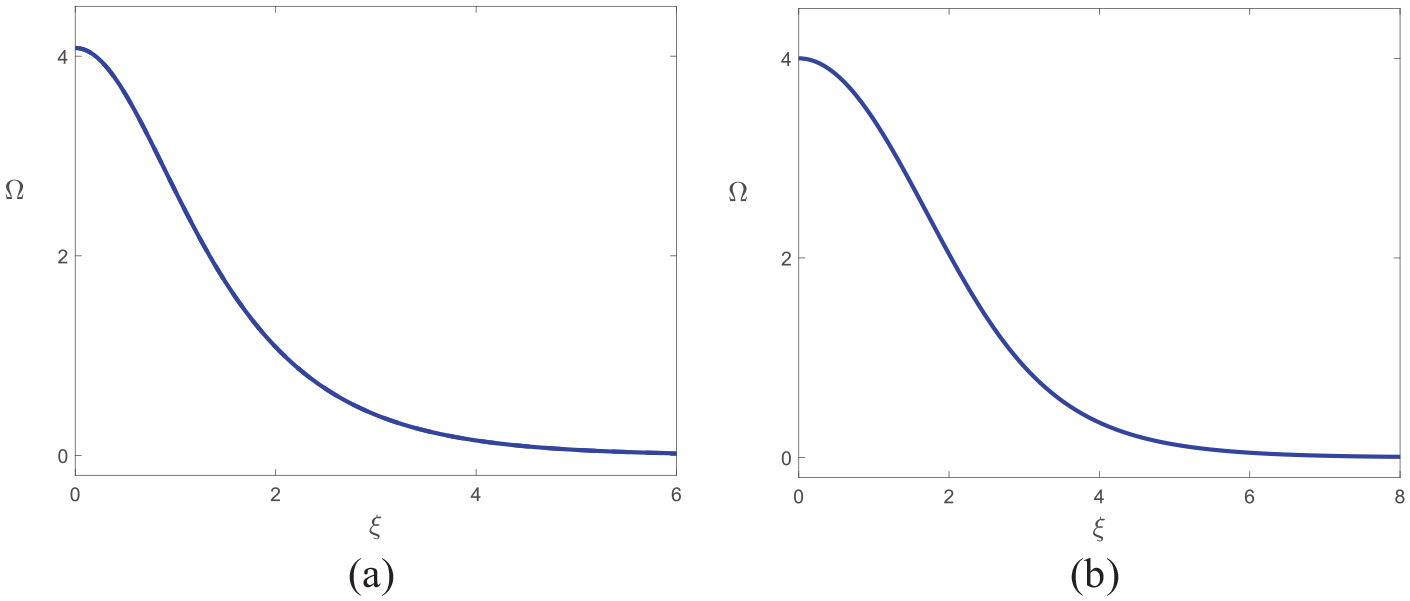
Solitary wave solutions of equation (24) for two different forms of
As the second special form, we take

which satisfies

with
4. Unidirectional waves
In this section, we derive the equations governing the propagation of unidirectional long waves. In order to get the appropriate scaling, we consider the Taylor series expansion of the linear dispersion relation

for which the phase

Assuming that

Equation (9) takes the following form in terms of


We now consider the following series expansion about the stress-free state:

from which we have:

When we substitute the above series expansions into equations (28) and (29), we get a hierarchy of equations. The zeroth-order equations are:

Since


where the constants

We now consider waves that travel to the right for which
If we define the complex quantity

This equation is known as the CMKdV (Complex Modified Korteweg–de Vries) equation, and it has been derived to model the propagation of small-but-finite amplitude transverse waves in many different areas of continuum mechanics [11, 17–19]. The above equation has the following solitary wave solution:

which represents a traveling wave with speed
5. Special cases
Equation (9) is symmetric, and we can use this property to determine some remarkable class of exact solutions.
5.1. Carroll’s solutions
A simple but general and remarkable set of exact solutions is provided considering the ansatz:

where

where
5.2. Separable solutions
Let us consider the case where the amplitude and the phase in the complex representation

In this case, we have indeed

This set of equations may be reduced to the problem of motion of a particle in a central force field as in Carroll [20] but in a more direct way since the first integral:

of the angular momentum is in our case immediate. Therefore, the usual transformation:

allows the transformation of equation (38) to:

The role of the dispersive term in equation (39) is fundamental. Indeed, if
Another possibility are the generalized oscillatory shear stress waves where, unlike the previous case,

so that

Introducing the notation

This is an autonomous equation, and the usual transformations

The general solution of the linear equation is the energy integral of equation (41):

where
6. Concluding remarks
In this short note, we have shown that it is possible to generalize to strain-limiting materials a number of classical solutions in the field of nonlinear elastic theory. Although the mathematical structure of the solutions that have been found is similar to their counterparts in the classical field from a physical point of view, it must be noted that there are fundamental differences. Indeed, in our case, the unknown components are the stress components and the corresponding strain is infinitesimal.
In this way, we were able to generalize the strain-limiting models proposed by Rajagopal and co-workers in elasticity to the dispersive case, determining classes of explicit solutions of direct physical interest and some general model equations in the long wave approximation.
Our results show that even in the case where there are similarities with the classical theory of Cauchy elasticity, the strain-limiting models introduce mathematical subtleties and modified physical interpretation that make the new theory particularly interesting on both levels.
Footnotes
Acknowledgements
G.S. is supported by Gruppo Nazionale per la Fisica Matematica (GNFM) of the Istituto Nazionale di Alta Matematica (INdAM). G.S. acknowledges the financial support of Istituto Nazionale di Fisica Nucleare through IS “Mathematical Methods in Non-Linear Physics,” Prin Project 2017KL4EF3 and Fondo di Ricerca di Base of Unipg. K.R.R. thanks the Office of Naval Research for its support.
Funding
The author(s) received no financial support for the research, authorship, and/or publication of this article.
