




Abstract
The mode III fracture performance of an arbitrary location through-crack at the edge of a nano-circular hole in one-dimensional hexagonal quasicrystals is studied. Based on the G-M elasticity theory, the piezoelectric quasicrystal theory and the boundary value problems theory, the phonon, phason and electric fields of the nano-defects (nano-hole and nano-cracks) are obtained, and the analytic expressions of the field intensity factors at both ends of through-crack are present. The present solution can be degenerated into the existing results. The relationship between the field intensity factors with the nano-defects related parameters, far-field loads and piezoelectric quasicrystal coupling coefficient are discussed. The field intensity factors have obvious size effects when the defects size is at nanoscale and the surface effect is considered. The field intensity factors tend to be classical theory with the increase in defect size. The field intensity factors show different changes with the increase in crack location angle and relative size between cracks. The size effect of the field intensity factors is significantly affected by the crack location. The far-field mechanical-electric loads and the piezoelectric quasicrystal coupling coefficient have obvious influence on the field intensity factors.
Keywords
1. Introduction
Quasicrystals (QCs) are new structural materials with long-range order and symmetry axis [1]. QCs are brittle at normal atmospheric temperature [2], so it is prone to produce defects (holes and cracks) in the process of preparation and service. Many scholars have studied the problem of macroscopic defects in one-dimensional hexagonal piezoelectric quasicrystals (1D HPQCs), such as two collinear cracks [3,4], penny-shaped dielectric crack [5] and yoffe-type moving crack [6]. However, when the defects are at nanometer scale, the ratio of surface area to volume of defects is very high [7,8], and the surface properties have a significant influence on the disturbed mesoscale sphere of defects [9–11]. Many scholars and researcher have studied the fracture properties of nano-scale cracks in QCs, which are widely different from macroscopic properties. For instance, Wei et al. [12] gave the mode III fracture mechanics parameters of interference between screw a dislocation dipole and a linear nano-crack in one-dimensional hexagonal piezoelectric quasicrystals (1D HQCs) considering the surface effect. Su et al. [13] gave the mode III fracture mechanics parameters of elliptical hole edge cracks in 1D HQCs considering the surface effect. Wu et al. [14] reported the mode III fracture mechanics parameters of circular hole edge two cracks in 1D HQCs with the surface effect.
Piezoelectric QCs are new kind of intelligent materials, which have phonon field, phason field and electric field coupling effect. Nano-scale cracks in piezoelectric QCs have attracted extensive attention of many researchers, and the G-M theoretical model [15–17] has been widely used to study the fracture characteristics of nano-scale crack in 1D HPQCs. Xiao et al. [18] studied the antiplane fracture performance of a crack emanating from nano-elliptical hole in 1D HPQCs considering the surface effect of nano-defect surface, and give the field intensity factor (FIF) at the crack tip under the condition that the nano-defect surface is electric impermeable. Yang and Liu [19] discussed the antiplane fracture performance at the crack tip of six nano-cracks emanating from a regular hexagonal hole in 1D HPQCs with the surface effect of nano-defect surface. Yang and Liu [20] gave the antiplane fracture performance at the crack tip of three cracks emanating from a regular hexagonal hole in 1D HPQCs with the surface effect of nano-defect surface. Wu et al. [21] studied the antiplane fracture behavior of two cracks emanating from regular 2n-polygon in 1D HPQCs considering the surface effect of nano-defect surface, and the FIF at the crack tip is given. Zhao et al. [22] gave the fracture mechanics parameters of nano-defects (nano-elliptical hole and nano-crack) in 1D HPQCs with the surface effect of nano-defect. Zhao and Guo [23] gave the fracture mechanics parameters of nano-defect pasting a reinforcement layer in 1D HPQCs considering the surface effect of nano-defect. Su et al. [24] investigated the antiplane fracture performance at the crack tip of two nano-cracks emanating from a nano-elliptical hole in 1D HPQCs under the condition that the nano-defect surface is electric impermeable.
At present, most scholars are studying the problem with axial crack emanating from a hole in QCs. However, the mode III fracture performance of an arbitrary location through-crack at the edge of a nano-circular hole in 1D HPQCs has not been studied yet. In this work, based on the G-M elasticity theory and the piezoelectric QC theory, the fracture performance of the antiplane shear problem of an arbitrary location through-crack at the edge of nano-circular hole in 1D HPQCs was reported. The stress and electric fields of the nano-defects (nano-hole and nano-cracks) are obtained, and the analytic expressions of the FIF at the crack tips are present. The influences of the nano-defect related parameters, far-field mechanical-electric loads and piezoelectric QCs coupling coefficient on the FIF are discussed.
2. Model and basic equations
Figure 1 is a mechanical model of an arbitrary location through-crack at the edge of nano-circular hole in 1D HPQCs. The 1D HPQCs are subjected to far-field phonon field load
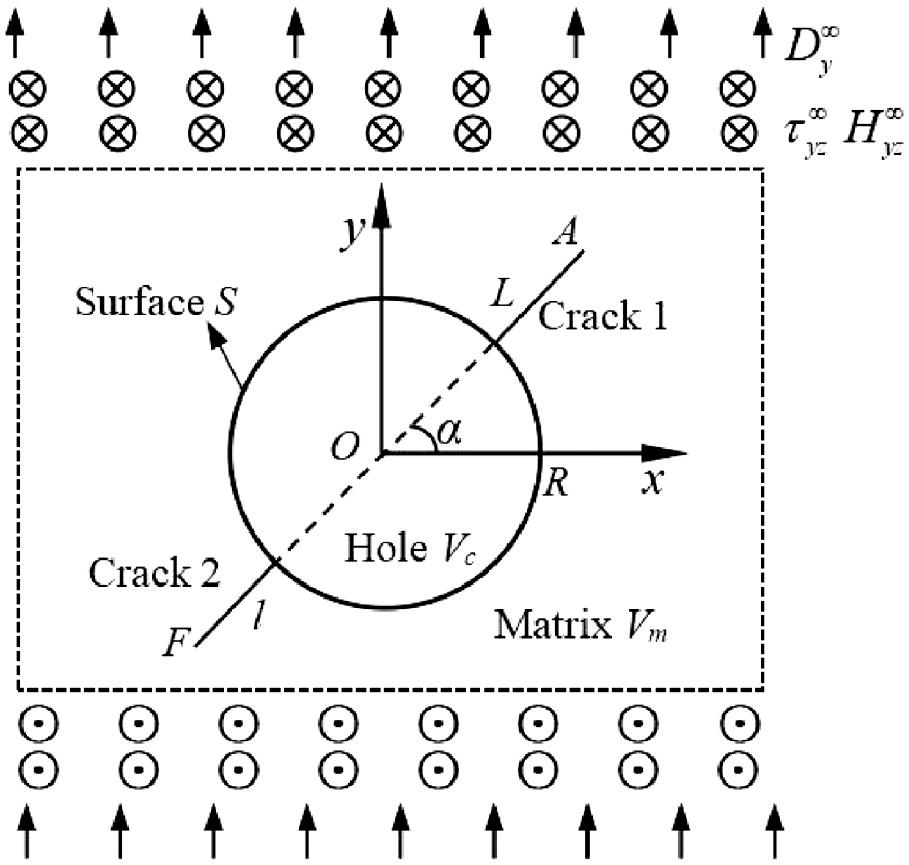
Mechanical model of an arbitrary location through-crack at the edge of a nano-hole in 1D HPQCs.
Based on the piezoelectric QCs theory, under the combined phonon field load, phason field load and electrical displacement load, the governing equation and constitutive equation of 1D HPQCs material are as follows [25, 26]:


where
Based on the complex elasticity theory, the nonclassical displacement and stress field of the mode III fracture problem of an arbitrary location through-crack at the edge of nano-circular hole in 1D HPQCs can be expressed as [18,24]:



where
Based on the G-M elasticity theory, the nonclassical boundary conditions for the displacement and stress at the surfaces of arbitrary location through-crack at the edge of nano-circular hole in 1D HPQCs under the condition that the surface of the nano-defects is electric impermeable are established as follows [18,24]:


where t(ρ, θ) = ρeiθ is the polar coordinate of the points on the nano-hole and nano-cracks surfaces, BS is the surface elastic constant matrix of 1D HPQCs, and
3. Exact solution of electro-elastic fields
The outer area of hole with arbitrary location through-crack at the edge of nano-circular hole in Figure 1 can be conformal mapped onto the outer region of a circular of radius R on a mathematical plane in Figure 2. The mapping function in this work is as follows [27]:



where nano-cracks tip: A→A′ and F→F,′ nano-hole region: Vc→V′c, matrix region: Vm→V′m.
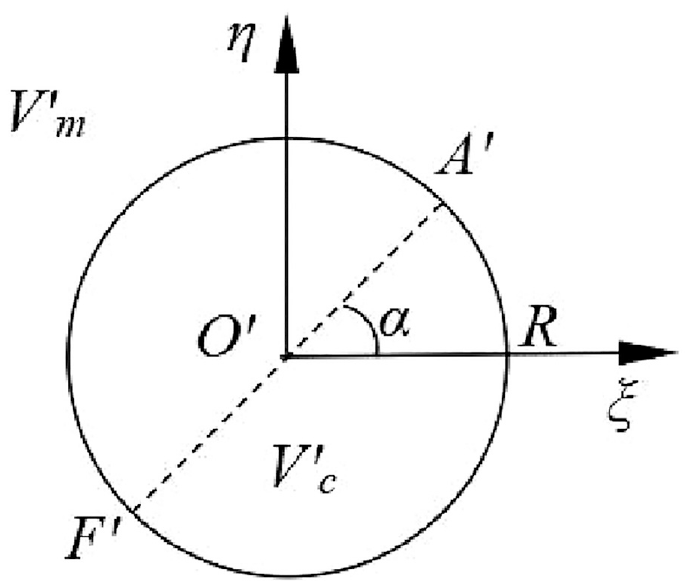
Mathematical plane (ζ-plane, ζ = ξ + iη).
The vector of analytic function be expanded into Laurent series in ζ-plane and an analytic solution of the arbitrary location through-crack emanating from an nano-hole can be obtained by taking the finite terms of the series [24, 28, 29]:


where
Based on the far-field loads conditions, from equations (4) and (12), it can be obtained:

According to the nonclassical boundary conditions of nano-defect surface equations (6) and (7), it is obtained that:


Combining equations (13)–(15), the undetermined complex vectors are obtained as:


From equations (4), (13), (16) and (17), the phonon–phason–electrical fields in 1D HPQCs under the condition that the defects surface with electric impermeable are distribution as:

4. FIFs
The mode III phonon field stress intensity factor (SIF), phason field SIF and electrical displacement FIF at crack tips A and F in Figure 1 can be defined as [30]:


where z1 = (R + L)eiα and z2 = (R + l)ei(α + π) are in Figure 1.
Substituting the phonon–phason–electrical fields into the phonon field SIF, phason field SIF and electrical displacement FIF, it is obtained that:


where


The phonon field dimensionless stress intensity factor (DSIF), phason field DSIF and electrical displacement dimensionless field intensity factor (DFIF) at crack tips can be defined as:


where equivalent crack length
5. Special cases
When nano-crack location angle α = 0 and nano-crack length L = l, the equations (23) and (24) degenerate as:


Equations (27) and (28) are consistent with the result in Su et al.’s study [24] (when a = b).
When nano-crack length l = 0, the equation (23) degenerates as:

Equation (29) is consistent with the result in Xin and Xiao’s study [31].
6. Results and discussions
The material constants of 1D HPQCs in this paper can be taken as [32] C44 = 35.5 × 10⁹ N/m2, K2 = 0.15 × 10⁹ N/m2, R3 = 1.765 × 10⁹ N/m2, e15 = d15 = 17 C/m2 and λ11 = 15.1 × 10⁻⁹ N/m2. The surface elastic constants of the 1D HPQCs can be taken as [12]
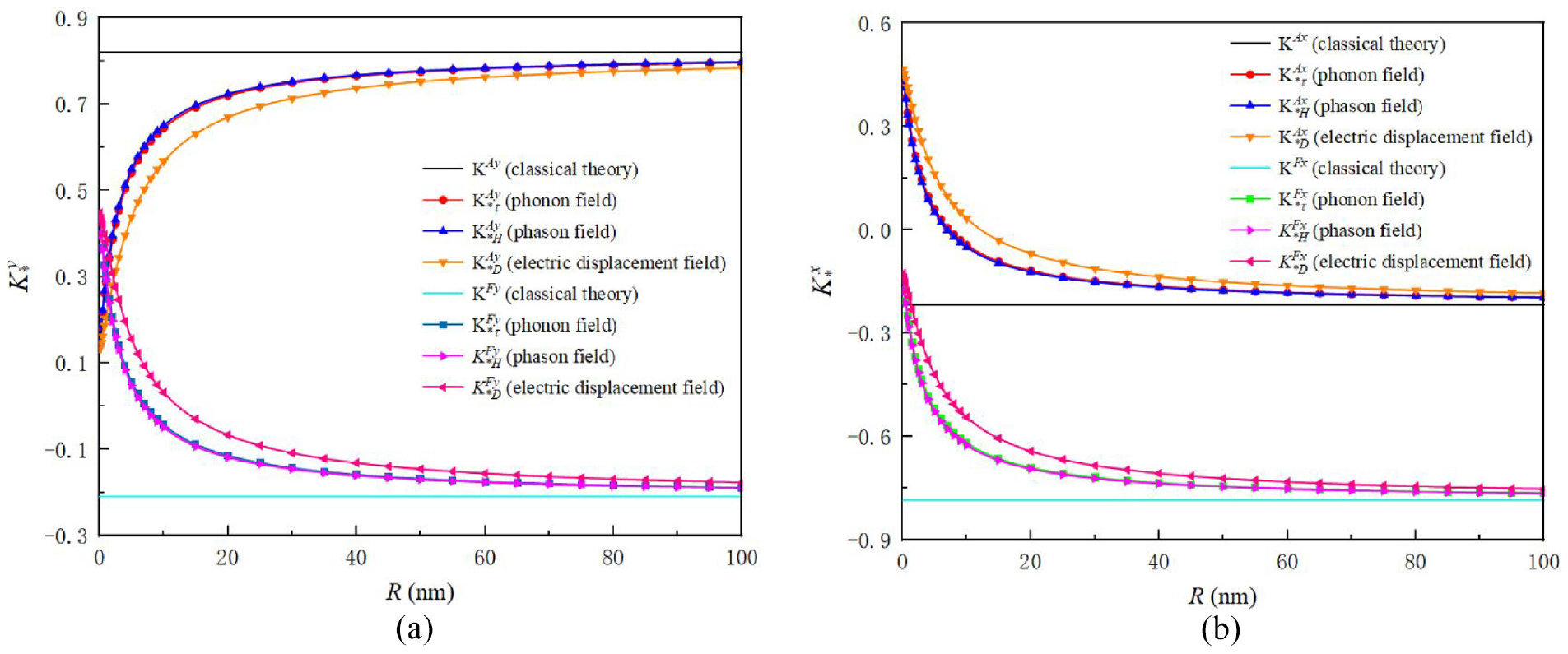
Variations of the DFIFs x and y components with nano-hole radius: (a) field intensity factor y component and (b) field intensity factor x component.
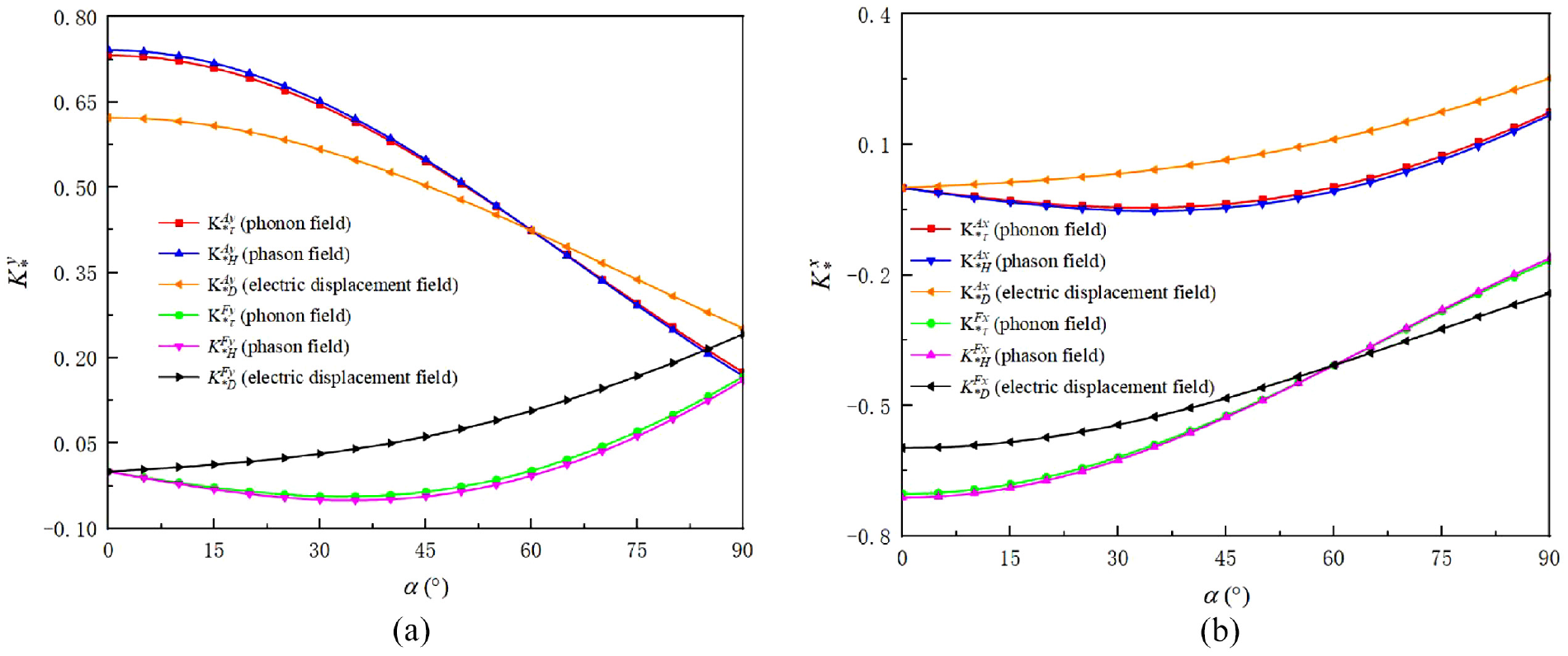
Variations of the DFIFs x and y components with nano-crack location angle α: (a) field intensity factor y component and (b) field intensity factor x component.
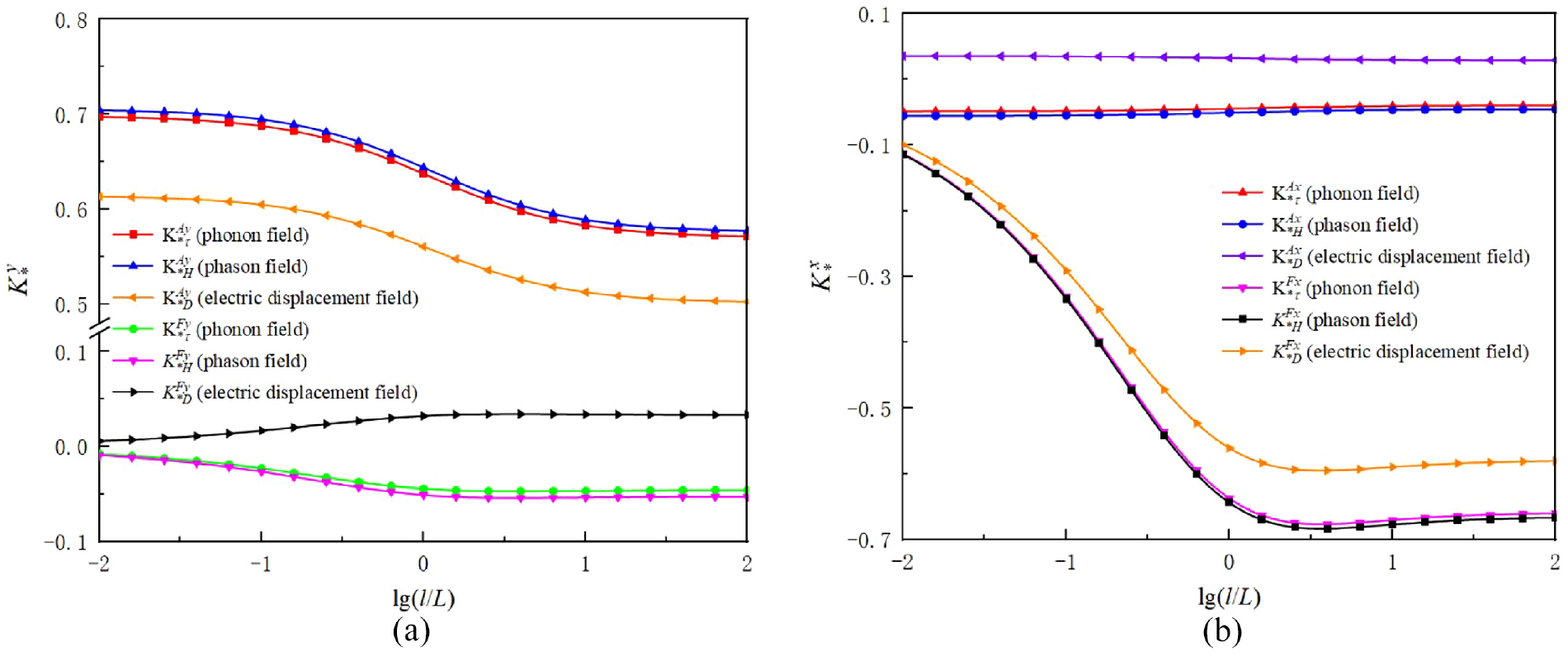
Variations of the DFIFs x and y components with ratio of cracks length. (a) Field intensity factor y component and (b) field intensity factor x component.
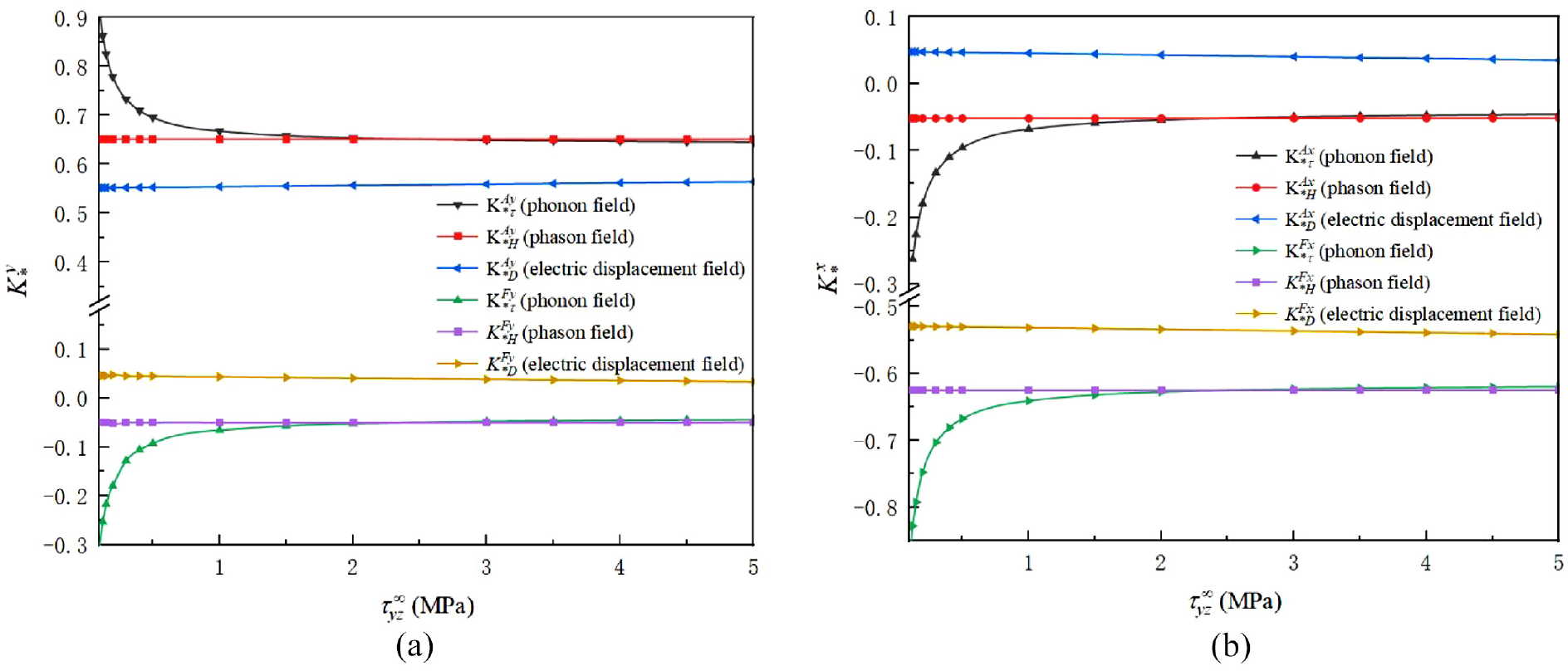
Variations of the DFIFs x and y components with phonon field load: (a) field intensity factor y component and (b) field intensity factor x component.
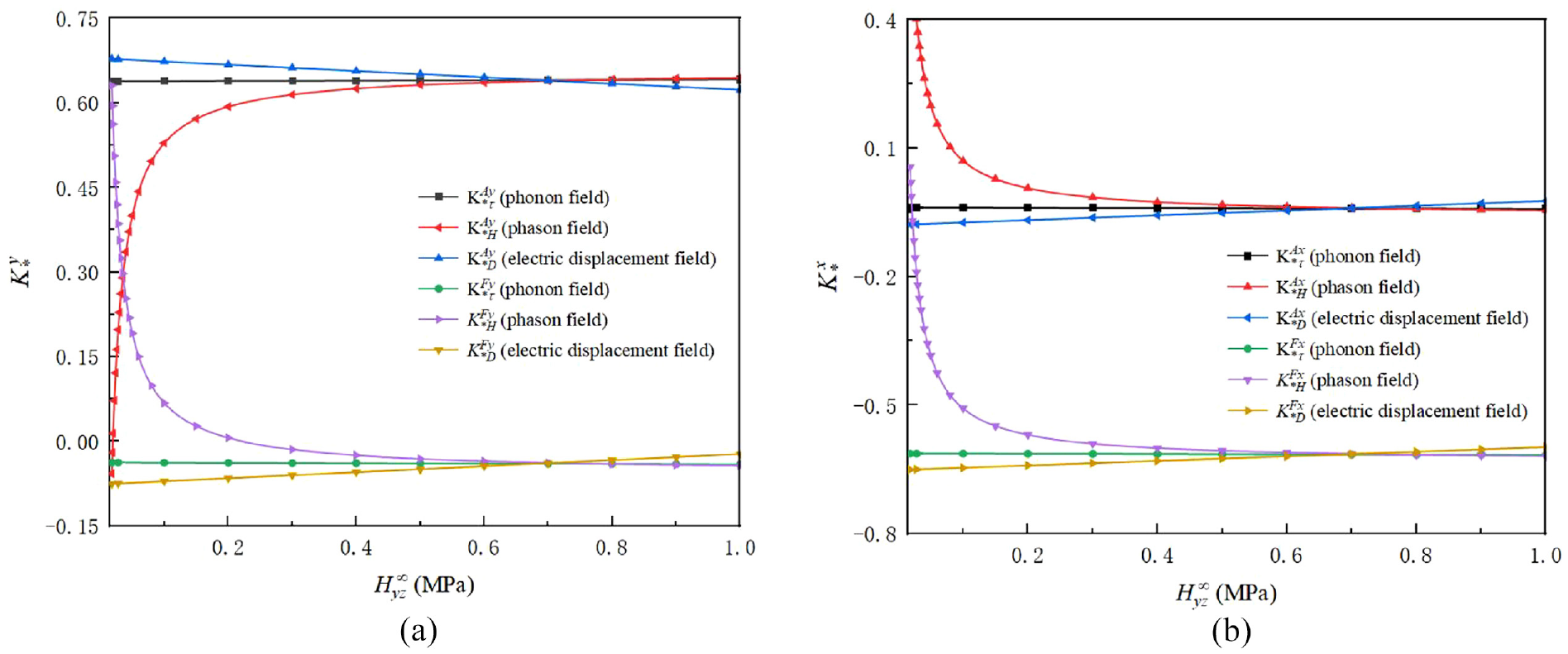
Variations of the DFIFs x and y components with phason field load. (a) Field intensity factor y component and (b) field intensity factor x component.
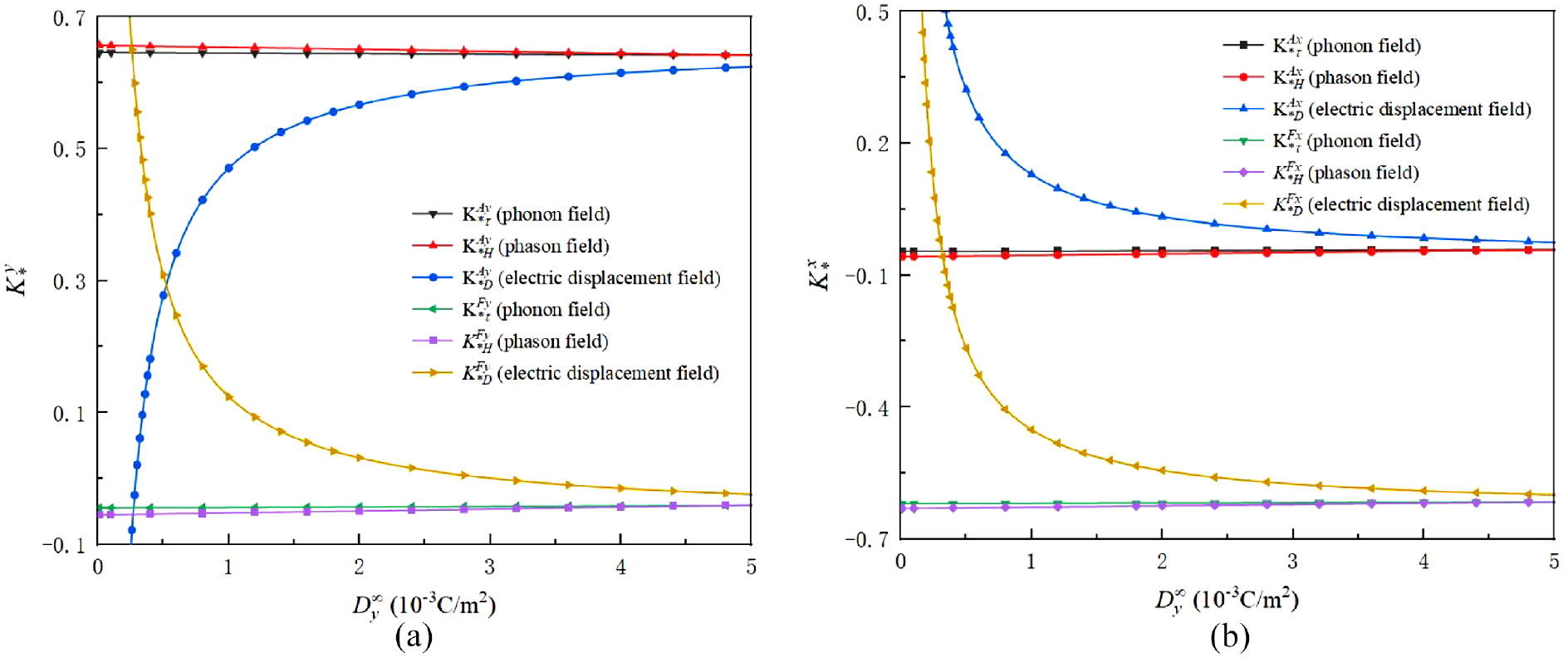
Variations of the DFIFs x and y components with electrical load: (a) field intensity factor y component and (b) field intensity factor x component.
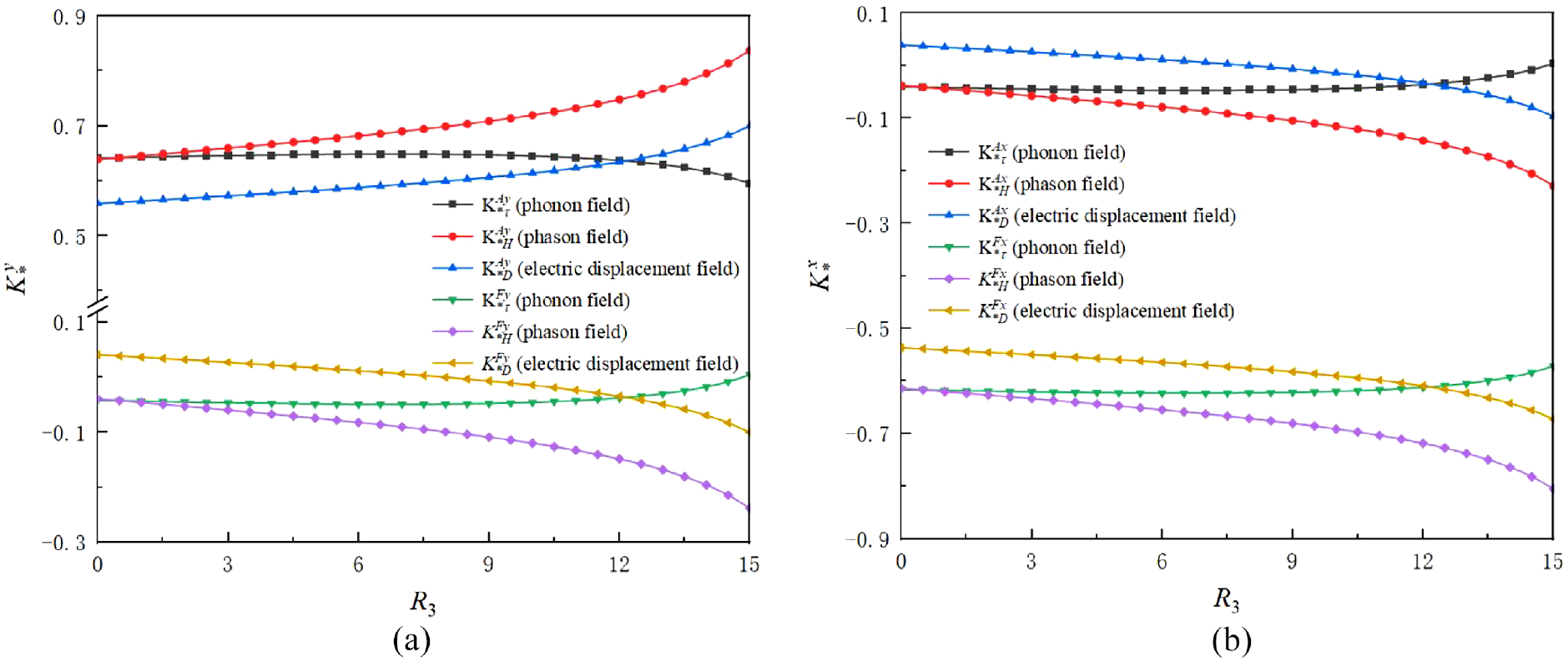
Variations of the DFIFs x and y components with piezoelectric QC coupling coefficient: (a) field intensity factor y component and (b) field intensity factor x component.
7. Conclusion
Based on the G-M elasticity theory, the piezoelectric QC theory and the boundary value problems theory, the antiplane problem of an arbitrary location through-crack emanating from a nano-hole in one-dimensional hexagonal piezoelectric QCs was studied. The analytical solution of the phonon–phason–electrical field at both ends of the crack tip was obtained. The analytical expressions of the FIFs were given. The influences of the defect size, crack location, ratio of cracks length, far-field loads and the piezoelectric QC coupling coefficient on the FIFs are discussed. The main conclusions are as follows:
When the nano-defects have surface effect, the FIFs along x and y components at both ends of crack have significant size effect.
The FIFs along x and y components show complex changes with the crack location angle increasing from 0° to 90°.
With the increase in the ratio of cracks length, the FIFs along x and y components tend to be stable in different ways. The ratio of cracks length has obvious influence on the surface effect.
The far-field loads and the piezoelectric QC coupling coefficient have different effects on the FIFs along x and y components.
Footnotes
Declaration of conflicting interests
The author(s) declared no potential conflicts of interest with respect to the research, authorship, and/or publication of this article.
Funding
The author(s) disclosed receipt of the following financial support for the research, authorship, and/or publication of this article: This work was supported by the Natural Science Foundation of Hebei Province (grant no. A2022203025) and the Science and Technology Project of Hebei Education Department (grant no. ZD2021104).
