



Abstract
This work presents a mechanical isotropic rate-independent theory for plastically deformed materials coupled with species transport. The mass and virtual power balances are natural ingredients used in this work to obtain appropriate local balance laws for species transport, macroscopic, and microscopic forces. The second law of thermodynamics is another key tool used to obtain thermodynamically consistent constitutive relations for the species flux and microscopic stresses. The free energy is approximated as a quadratic form and used to obtain the energetic microscopic stresses as linear combinations of their respective energy conjugates and the species densities. Rate-independent Mises flow rule is deduced in terms of accumulated plastic strain and species density. Furthermore, variational formulation for the coupled theory is obtained as a variational inequality.
Keywords
1. Introduction
Many species, such as hydrogen atoms, are gases at room temperature and so their storage could pose a serious challenge. For instance, hydrogen species transports can severely degrade the ductility of metals, and being the lightest known element in the periodic table, the permeations of hydrogen gases through thin walls cause damage to metallic structures used for storing these gases. It is therefore worthwhile to study the interactions between the transport of some species and elasto-plastic materials [1–3]. Studies based on molecular simulations and experimental measurements have provided insight into diffusion processes of hydrogen in solids at different length scales. For instance, enormous enhancement of diffusivity in body-centered cubic metals have been observed, where hydrogen absorption and diffusion give rise to local hydrogen accumulation with consequent potential defects [4].
Successful attempts have been made to couple species diffusion to elasticity in the classical papers by Larché and Cahn [5, 6]. A detailed description and review of this coupling is found in the work of Gurtin et al. [7] where special case of the substitutional alloy is also discussed. One of the most conceptually challenging features of this coupled theory is associated with the formulation of energy flow due to species transport. This issue has been addressed in the monograph of Gurtin et al. [7]. Among the first few works on interaction of hydrogen species with plastic deformation is the paper by Sofronis and McMeeking [8]. Their theory is based on the postulate of local equilibrium proposed by Oriani [9]. Further extensions to the work of Sofronis and McMeeking [8] were made by Krom et al. [10] to account for trapping sites of hydrogen atoms within plastic materials. This latter theory has been widely used among researchers working on this subject [11–13] partly because of its ability to provide insight into lattice-dilation and hydrogen-induced reduction of plastic flow resistance. However, the Oriani’s microstructural hypothesis on which the work of Krom et al. [10] is based has limitations in formulating a consistent continuum level coupled theory. Within the context of a continuum theory, Anand [14] developed a thermo-mechanical coupled theory for hydrogen transport and large viscoplastic deformation which does not explicitly account for trapping of hydrogen species and without consideration to the Oriani’s postulate. In the same spirit, Di Leo and Anand [15] modified the work of Anand [14] to account for trapping sites of hydrogen species. This latter work placed the concept of equilibrium between hydrogen residing in interstitial lattice site and hydrogen trapped at microstructural defects within the framework of the first and second laws of thermodynamics.
The classical theories of continuum mechanics cannot model coupled species transport and elasto-plastic deformations in the presence of intrinsic material length scales. This implies that these classical theories cannot apprehend size-dependent behaviors of materials. However, experimental results have shown that metallic materials exhibit size-effect phenomena and that strain gradients promote strain hardening [16–18]. The continuum theories developed to circumvent this shortcoming of the classical theories are known as strain-gradient theories [19–32].
It has been predicted and argued that size effects in materials may play a crucial role in aiding hydrogen diffusion [33, 34], although such interactions are yet to be fully assessed experimentally. However, attempts have been made toward the theoretical study of strain-gradient plasticity coupled with hydrogen species transports. For instance, Kristensen et al. [35] proposed a gradient-based framework for determining hydrogen assisted fractures in plastic materials using combination of stress-assisted diffusion of species and hydrogen-sensitive phase field fracture formulation. The phase field fracture method in modeling hydrogen interactions with solids is also used in the works of Martínez-Pañeda et al. [36], Anand et al. [2], and Wu et al. [37]. At the moment, sufficient studies have not been conducted in understanding hydrogen embrittlement and diffusion in elastic-plastically deforming solids under small and large deformations. Thus, precise cause of embrittlement is yet to be well understood, and this has engendered continuous research. Furthermore, most studies on this subject do not account for gradient of plastic distortion which is essential in predicting size-dependent behavior for plastic materials interacting with species. Hence, the need to further study the interactions of species transports (such as ionic, atomic, molecular, or chemical transports) with gradient materials with a view to providing possible cause of species embrittlement in solids. This work presents a continuum mechanical coupled theory for multiple species transport and strain-gradient plasticity compatible with the laws of thermodynamics. Natural deductions from this formulation are the scalar-chemistry plastic strain and vector-chemistry plastic strain gradients which play important roles in measuring plastic diffusivities in solids.
2. Basic kinematic relations
In small deformation theory of elasto-plastic materials, the displacement gradient

into elastic part
The total strain

into elastic strain

The plastic flow direction

The accumulation of plastic strain

Whenever

The basic rate-like variables are
The Burgers tensor

The Burgers tensor rate

Basic to the present work is the assumption that the Burgers tensor

where

3. Macroscopic and microscopic force balances
The basic kinematic rate variables
In order to account for size effects via the Burgers tensor, we assume that there is a microscopic stress
Following the identified conjugate pairs, the power

Also, the power

Following the works of Gurtin et al. [7], we assume the codirectionality hypothesis which states that:

where
Define scalar microtraction

where

and

Let

The principle of virtual power states that:

For a macroscopic motion, it is required that

By the fundamental lemma on calculus of variation, we have:
The macroscopic force balance:

For a microscopic motion, it is required that

By the fundamental lemma on calculus of variation, we have:
The microscopic force balance:

where
4. Species transport and balance
Let

For small deformation in which the current and reference configurations are approximately the same, and applying the Gauss divergence theorem, the global species balance can be written as:

Since

5. Free-energy imbalance (second law of thermodynamics)
Increase in the entropy of a system is not less than the flow of entropy into the system. In the case of coupled species transport with plasticity under isothermal condition, the temporal increase in the entropy is non-negative. The free energy

where

By the power balance

Since

6. Constitutive relations
6.1. Constitutive relations for macroscopic stress, energetic microscopic stresses, and chemical potential
Suppose the defect energy is a function of the Burgers tensor and the accumulated plastic strain, then consistent with the work of Gurtin [25], it is shown by Borokinni and Ajayi [39] that the microscopic stress

into energetic part

respectively, where
Furthermore, we shall assume the defect energy

where

where
The free-energy imbalance equation (25) can be written as:

By the Coleman–Noll procedure, we have the following constitutive relations:
Cauchy stress:

Vector microscopic stress:

Scalar energetic microscopic stress:

Chemical potential:

Hence, the free-energy imbalance reduces to the dissipation inequality:

for all possible

and the mechanical dissipation inequality:

for all
Following the constitutive equations (31)–(34), the time derivatives for the stresses and chemical potential are given as follows:



and

The elasticity tensor

We introduce scalar chemistry-plastic strain

The scalar

respectively.
In small deformation theory, the reference configuration is assumed to be natural with respect to some fixed species density list

It can be assumed that
as

is assumed small.
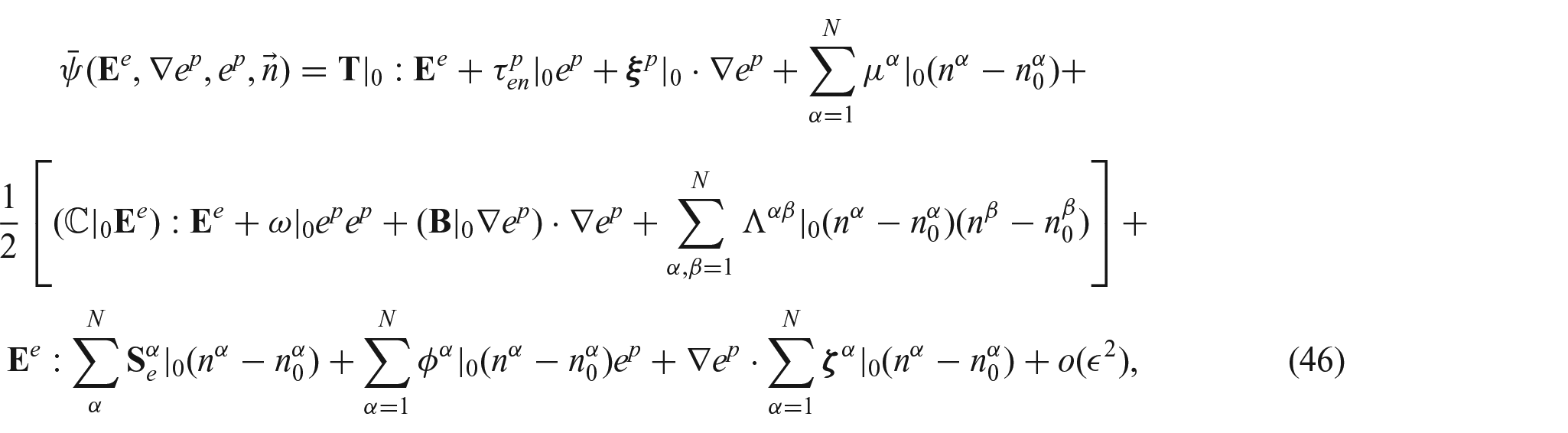
Since the free energy is minimum in a natural reference configuration at

Neglecting higher-order term in the expansion of

then neglecting

Using equations (31)–(34) and (50), we have the following constitutive relations:
Cauchy stress:

Energetic microscopic stresses:


Chemical potential for each species

6.2. Constitutive relation for species flux
We assume the species flux

where

By letting the invariant form of the component

Hence, the constitutive relation for the species flux is given as:

6.3. Dissipative microscopic stress. Mises–Hill flow equations
We take as constitutive assumption the relation:

for the dissipative microscopic stress. Here, the plastic flow is assumed to be rate-independent so that the accumulated plastic strain
The mechanical dissipation

Consistent with the second law of thermodynamics, it is noted that

Equations (58)–(60) imply that the dissipative scalar microscopic stress satisfies the flow equation:

Assume strong isotropy, then the flow resistance would be independent of the flow direction. Consequences of this assumption are:

Equation (61) is the Mises–Hill flow equation for a rate-independent plastic flow.
The elastic range and the no-flow condition are given by:

and

respectively.
7. Governing equations for gradient plasticity with species transport
Following the constitutive relation equation (51), the macroscopic force balance equation (19) can be written in the form:

where:

The microscopic force balance equation (20) using the constitutive relation equations (52) and (53) and plastic flow law equation (61) can be written as:

Define chemical, elastic, plastic, and plastic-gradient diffusivities as:

respectively. Using equations (57) and (66), the divergence of the species flux takes the form:

Hence, the species balance equation (22) can be written as:

8. Initial and boundary conditions of the governing equations
8.1. Initial conditions
We assume the following specification for the species density

where
8.2. Boundary condition for the macroscopic force balance
Let

8.3. Boundary condition for microscopic force balance
Based on plastic flow, it can be assumed that the body is the union of time-dependent complementary sub-bodies

where

of

We note here that the choices in equations (69)2 and (73)1 are consistent with the no flow condition:

8.4. Boundary condition for species balance
Assume that

9. Variational formulation of problem
Here, we follow the variational formulations used by Gurtin and Reddy [40] and Reddy [41]. We keep in mind that the mechanical dissipation

satisfying the initial and boundary conditions equations (69) and (73). A combination of equations (61) and (76) is equivalent to the inequality:

where

Integrating equation (77) over the body

The microscopic force balance equation (20) together with the boundary conditions equation (73) is equivalent to:

Adding equations (79) and (80), we obtain:

The inequality equation (81) is the global variational inequality for microscopic force balance.
Let

The macroscopic force balance equation (19) together with the boundary conditions equation (72) is equivalent to:

where
Combining equations (81) and (82), we have the global variational inequality for macroscopic and microscopic force balances as:

where
Let

10. Isotropic strain-gradient plasticity with species transport
For isotropic homogeneous materials, there exist scalar constants

where
Using equation (85):
The macroscopic force balance equation (64) can be written as:

The microscopic force balance equation (65) can be written as:

The species balance equation (67) becomes:

Equations (86)–(88) together with the initial-boundary conditions equations (69), (70), and (73)–(75) are to be solved for the displacement
11. Conclusion
Within the context of small deformations, this work presents a continuum mechanical coupled theory of strain-gradient plasticity with multiple species transport under thermodynamic restrictions for isotropic solids. The scalar chemistry-plastic strain and vector chemistry-plastic strain gradients are natural deductions arising from the interactions of species with gradient plastic materials.
