




Abstract
The addition of fillers can significantly improve the mechanical behavior of polymers. The responsible mechanisms at the molecular level can be well assessed by particle-based simulation techniques, such as molecular dynamics. However, the high computational cost of these simulations prevents the study of macroscopic samples. Continuum-based approaches, particularly micromechanics, offer a more efficient alternative but require precise constitutive models for all constituents, which are usually unavailable at these small length scales. In this contribution, we derive a molecular-dynamics-informed constitutive law by employing a characterization strategy introduced in a previous publication. We choose silicon dioxide (silica) as an exemplary filler material used in polymer composites and perform uniaxial and shear deformation tests with molecular dynamics. The material exhibits elastoplastic behavior with a pronounced anisotropy. Based on the pseudo-experimental data, we calibrate an anisotropic elastic constitutive law and reproduce the material response for small strains accurately. The study validates the characterization strategy that facilitates the calibration of constitutive laws from molecular dynamics simulations. Furthermore, the obtained material model for coarse-grained silica forms the basis for future continuum-based investigations of polymer nanocomposites. In general, the presented transition from a fine-scale particle model to a coarse and computationally efficient continuum description adds to the body of knowledge of molecular science as well as the engineering community.
1. Introduction
The versatility of polymers can be further expanded by the addition of fillers. In particular, filler particles at the nanoscale have been found to significantly improve the polymers’ mechanical [1,2], thermal [3,4], electrical [5], and optical [6] behavior. Experimental studies show that the presence of filler particles leads to a significant modification of the properties of the surrounding polymer [7–9]. This region of influence, referred to as the interphase, is considered to be responsible for the improved behavior of nanocomposites [10]. The experimental investigation of these nanocomposites is highly challenging due to the extremely small length scales and is further complicated by the large number of influencing factors [11] such as matrix-filler interaction [12] as well as filler size [13], shape [14], distribution [15], and content [16]. In order to identify promising polymer composite configurations more easily, empirical models and virtual testing strategies are increasingly resorted to.
1.1. Empirical models
Initially, attempts were made to estimate the properties of the polymer composites by empirically motivated, mostly analytical models, e.g., by Leidner and Woodhams [17] and Pukanszky [18]. These models, originally introduced for conventional composites, were extended to cover nanocomposites as well [19,20]. With these extensions, mechanical properties such as Young’s modulus [21] or tensile strength [22] can be derived from the material behavior of the individual constituents. However, the complex mechanisms within the interphases responsible for the observed reinforcements can only be represented in a highly simplified way in such empirical models, e.g., by the
1.2. Molecular dynamics studies
By way of contrast, particle-based numerical approaches such as molecular dynamics (MD) inherently capture the effects within the interphase since they are solely based on the particle interactions. Therefore, they are widely used to study nanocomposites: Lu et al. [24] investigate graphene-polymer nanocomposites by means of atomistic MD simulations and identify an interphase that exhibits 1.5 times the polymer matrix stiffness. In previous publications [25,26], we have studied the interphase effects in polystyrene-silica composites using an MD-continuum coupling method [27–30]. This procedure enabled us to perform comparative pseudo-experiments on a large set of samples to identify elastoplastic effects occuring in the interphase [26]. Bocharova et al. [31] use coarse-grained (CG) MD simulations to complement their experimental findings and unravel the molecular mechanism responsible for observed reinforcements in poly(2-vinylpyridine)-silica nanocomposites. Despite these essential findings, MD simulations remain computationally too expensive to investigate engineering problems on macroscopic samples.
1.3. Micromechanics
To reduce the computational costs, micromechanics rely on efficient continuum material descriptions, while still resolving the composite at the level of the nanoparticles. To this end, representative volume elements (RVEs) that include all relevant geometrical information are considered and their mechanical behavior is homogenized to obtain the macroscopic properties of the composite [32]. However, the continuum constitutive laws of the constituents (filler and polymer matrix) necessary for the RVEs are usually not available at these extremely small length scales.
Therefore, the scope of this contribution is to present the calibration of a continuum mechanical constitutive law based on MD simulations of CG silica serving as an exemplary filler material (section 2.1). We employ a strategy introduced in our previous contribution [33] to characterize the material behavior using MD pseudo-experiments (section 2.2). To this end, we perform uniaxial tensile and simple shear tests (section 2.3) with time-proportional and time-periodic loadings. Within the limits of the small strains expected in a polymer nanocomposite, the examined silica exhibits linear elasticity with a pronounced anisotropy (sections 3.1 and 3.2). Based on these pseudo-experimental data, we calibrate linear elastic constitutive laws with different degrees of anisotropy, and thus accurately represent the material behavior (section 3.3).
This study is complementary to the characterization [33,34], and complex continuum modeling of polystyrene using a novel viscoelastic-viscoplastic constitutive law [35].
2. Model and simulation details
2.1. Coarse-grained silica
In this study, we rely on CG force fields introduced by Ghanbari et al. [36], who substitute each SiO2 unit by one CG bead with an aggregated molar mass of 64.0 g mol−1. The CG interaction potentials were derived via iterative Boltzmann inversion [37] and comprise bond, angle, and nonbonded contributions. The obtained force fields were used and validated in the context of silica-enforced polystyrene in numerous studies [25,26,38–40]. The CG beads form a crystalline structure due to the applied physically motivated force fields [36]. We obtain a triclinic unit cell with the lattice parameters
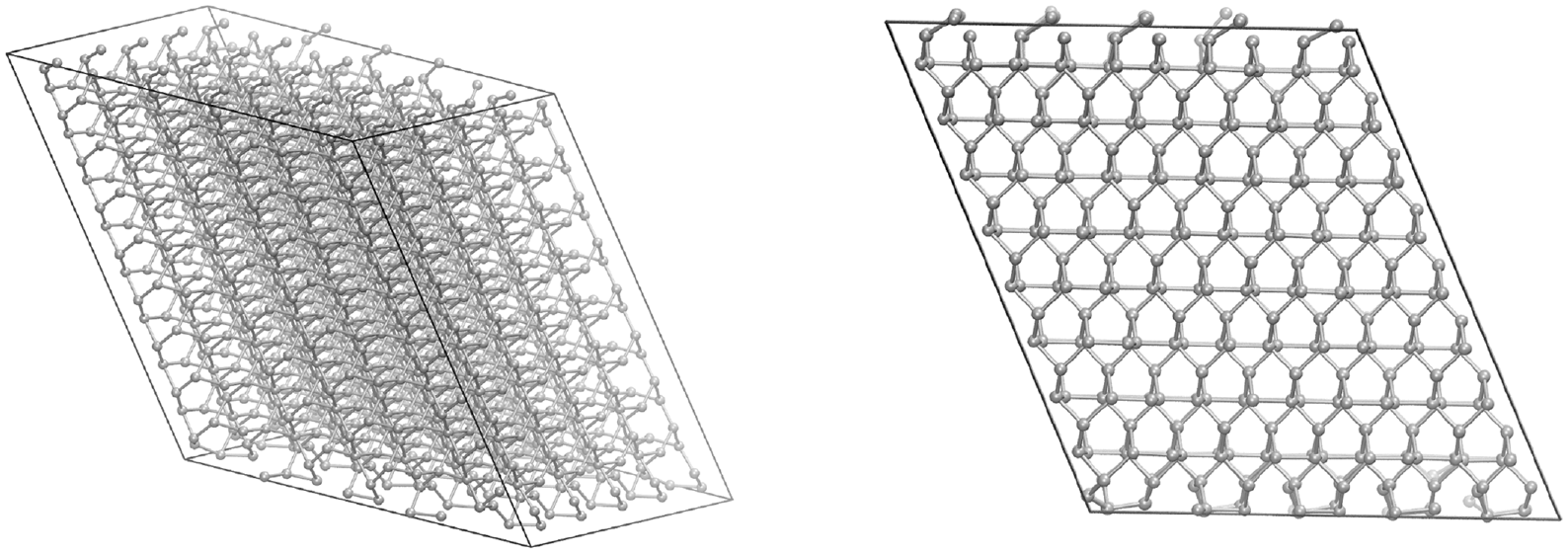
Simulation sample: three-dimensional periodic simulation cell with 1350 coarse-grained atoms in single crystal arrangement (triclinic lattice) with a mass density of 2.32 g cm−3.
Due to the regular structure of the single crystal, the resulting sample is not subjected to stochastic variations. Therefore, a statistical validation using different initial configurations, as carried out in comparable studies of polymers [33,34,41], is not necessary. After the initial placement of the beads, the sample undergoes an equilibration procedure (cf. section “Sample preparation details” in Appendix 1), resulting in a mass density of 2.32 g cm−3 which fits well with the literature [42].
2.2. Material classification scheme and characterization strategy
The mechanical response of a material to an external load can be assigned to one of the four paradigmatic material models: elasticity, plasticity, viscoelasticity, and viscoplasticity [43]. Merely, the presence of rate dependence and quasi-static hysteresis are decisive factors [44] as shown in Figure 2.
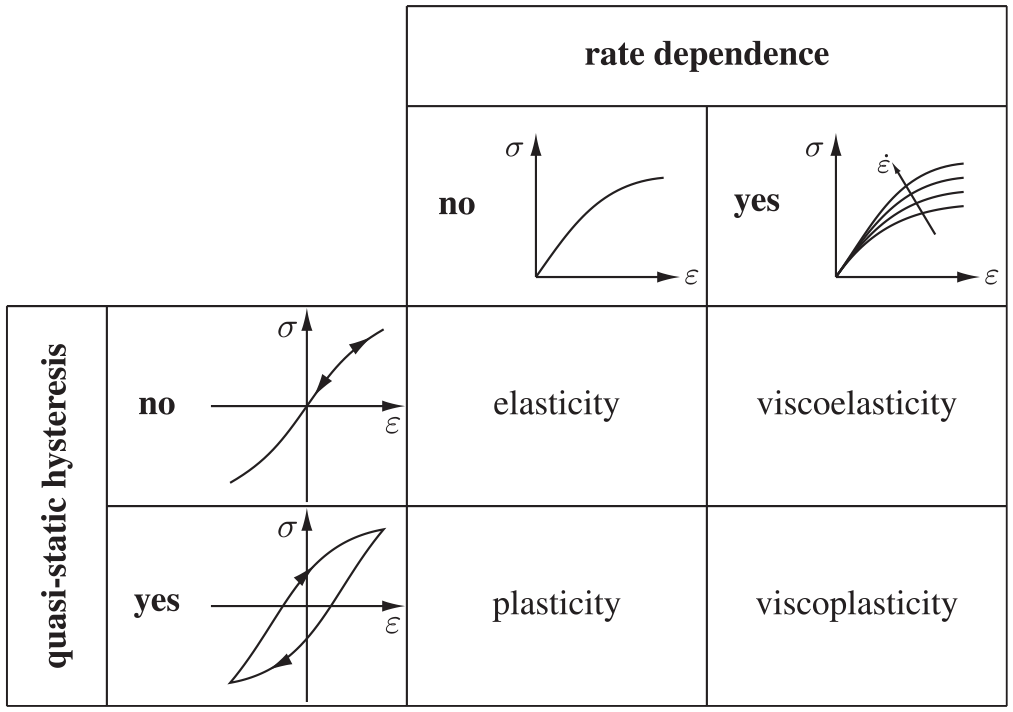
Classification of material behavior based on rate dependence and quasi-static hysteresis into elasticity, plasticity, viscoelasticity, and viscoplasticity according to Haupt [44].
A practical approach to apply this classification scheme based on MD simulations and to quantify the individual contributions was presented as a characterization strategy in the work by Ries et al. [33]: First, time-proportional loading tests with different strain rates are performed to identify whether the material exhibits a rate dependence, i.e., viscous behavior. Second, time-periodic tests reveal whether the material is reversible by means of a quasi-static hysteresis. The application of quasi-static loads is not possible with MD due to the required computational capacities. However, we were able to show in the previous works [33,34] that the occurrence of a stable equilibrium hysteresis as a result of several loading–unloading cycles permits to evaluate the dissipation and thus the inelasticity of the material. Based on the obtained results, relaxation and creep tests may be carried out to decompose the inelasticity into its viscous and plastic components.
2.3. Applied deformation
In order to fully capture the constitutive behavior of the investigated material, both uniaxial and shear deformation, as depicted in Figure 3, need to be considered. In the case of an anisotropic, i.e., direction-dependent, material response, these principal load cases have to be applied for all three spatial directions. The silica considered here is typically embedded into a softer polymer matrix, e.g. in the form of spherical particles [11]. Due to the significant difference in the stiffness of the two phases, it can be assumed that the silica is only undergoing small deformations. In this case, linearized kinematics can be used, described by the Cauchy strain tensor

relying on the assumptions of the infinitesimal strain theory [44].
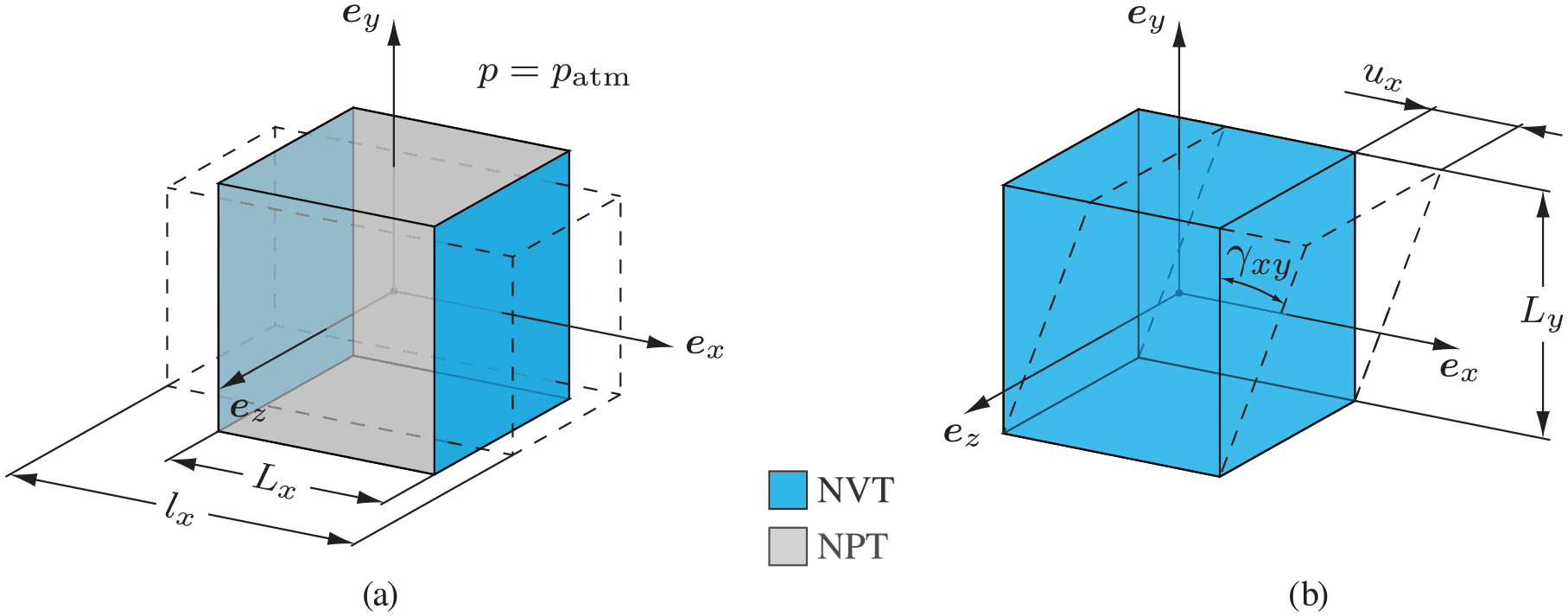
Applied deformation: (a) uniaxial tension with initial and deformed box length
2.3.1. Uniaxial tension
For uniaxial tension the tensile strain

with displacement
2.3.2. Simple shear
Simple shear, on the other hand, is induced by the parallel shifting of planes proportional to their position and is, therefore, by definition isochoric [46]. The associated shear strain

The employed parallelepiped-shaped simulation cell necessitates the use of triclinic boxes (cf. Figure 3(b)). These feature additional angular degrees of freedom
2.3.3. Simulation details
We choose a Nosé-Hoover thermostat [47] and barostat [48] with a temperature and pressure coupling time of 500 fs and 500 fs, respectively. Contrary to our previous studies [33,34,49], the time step is kept constant at

respectively. The former represents a linear ramp-up with a constant strain rate
2.4. Stress measures
We evaluate the internal stress due to the external load using the virial stress tensor [50]

with volume
3. Results and discussions
3.1. Time-proportional loading
The approximately linear stress–strain curves due to uniaxial tension in
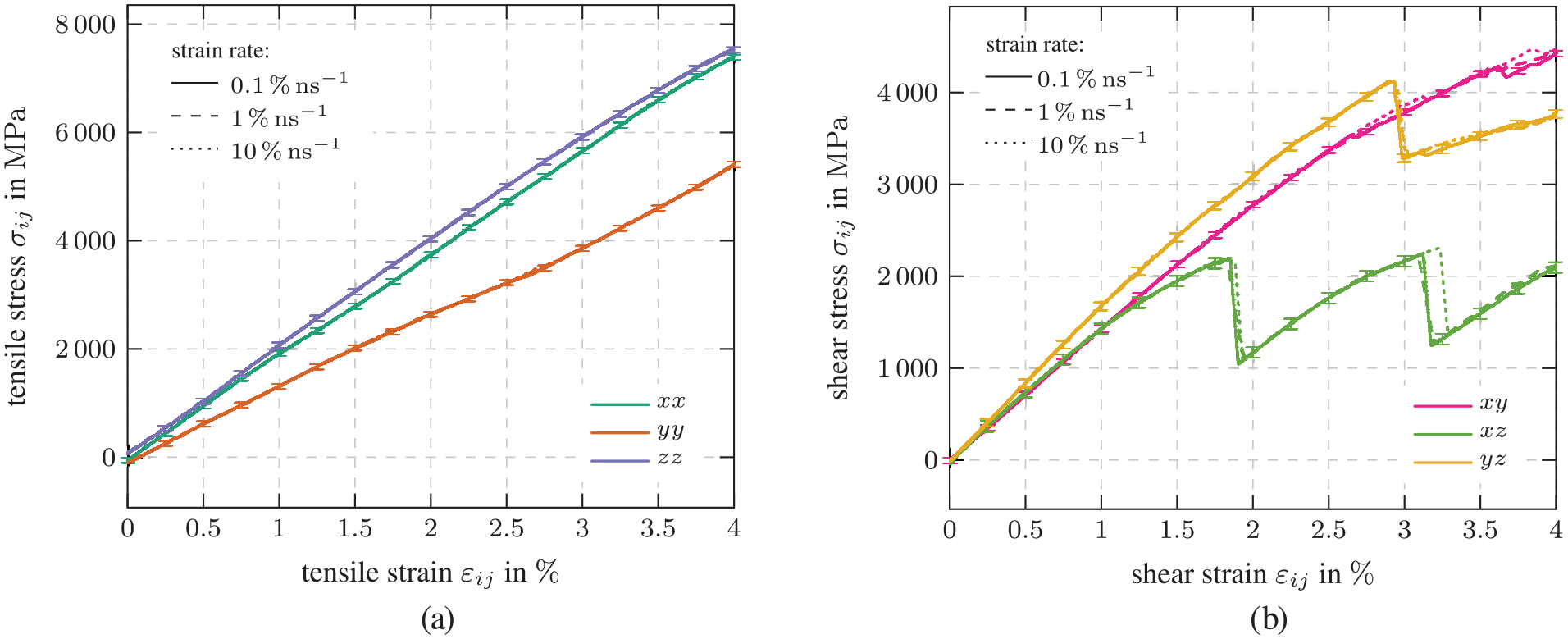
Time-proportional deformation up to 4% strain with strain rates of 0.1–10% ns−1: (a) tensile stress over tensile strain for uniaxial tension simulations in
Very similar results in terms of viscosity and anisotropy are observed for the simple shear deformation in Figure 4(b). Initially, we observe a slightly stiffer material response in the
By evaluating the slope in the stress–strain diagram Figure 4(a), the effective moduli
3.2. Time-periodic loading
The stress response induced by sinusoidal uniaxial tension–compression loading with a strain amplitude of 4% is plotted in Figure 5. For deformation in the
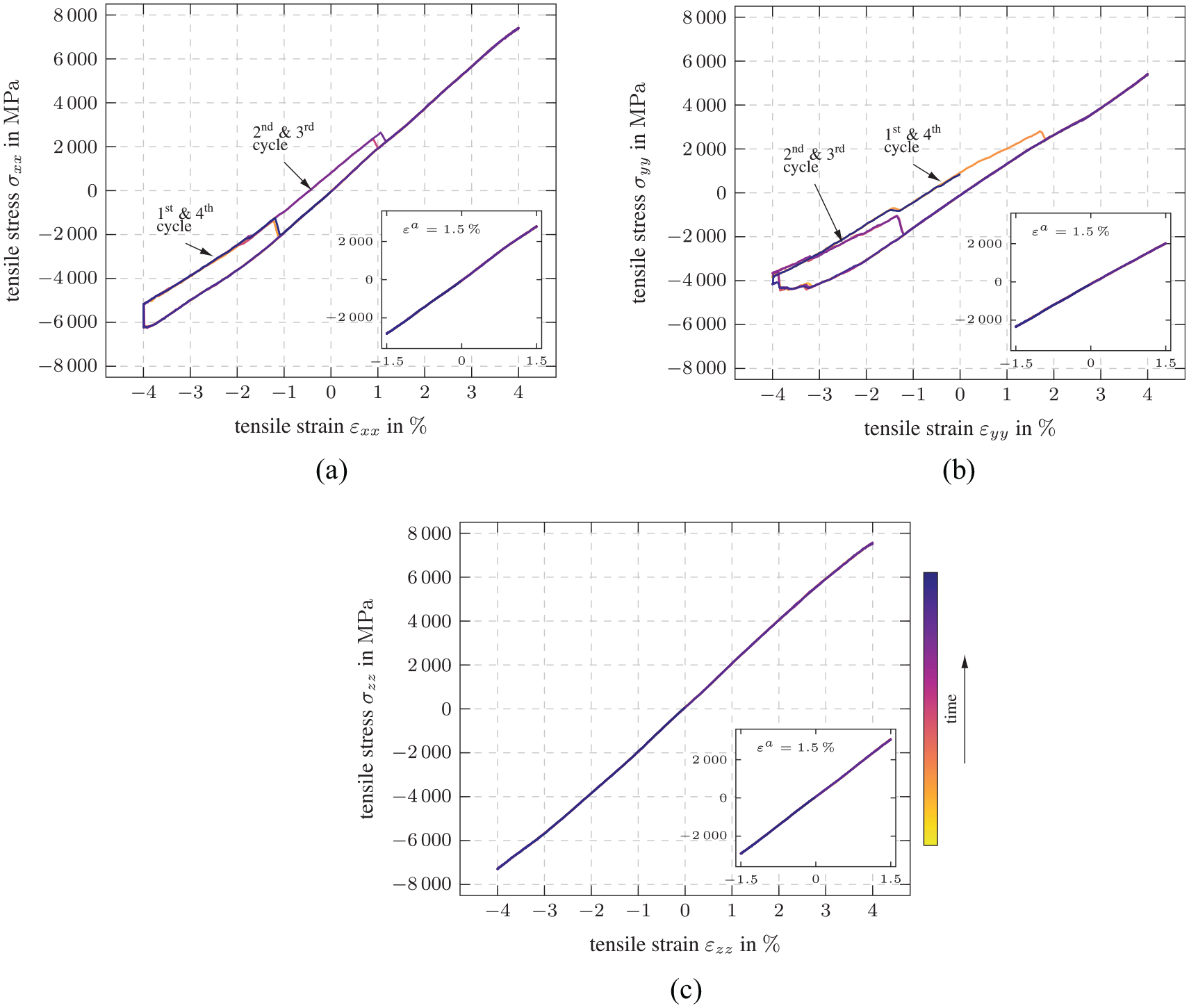
Time-periodic uniaxial tension: tensile stress over tensile strain for sinusoidal loading in
Analogously, the stress–strain curves for sinusoidal simple shear are combined in Figure 6. In contrast to uniaxial deformation, hystereses occur only in the tensile region for deformation in
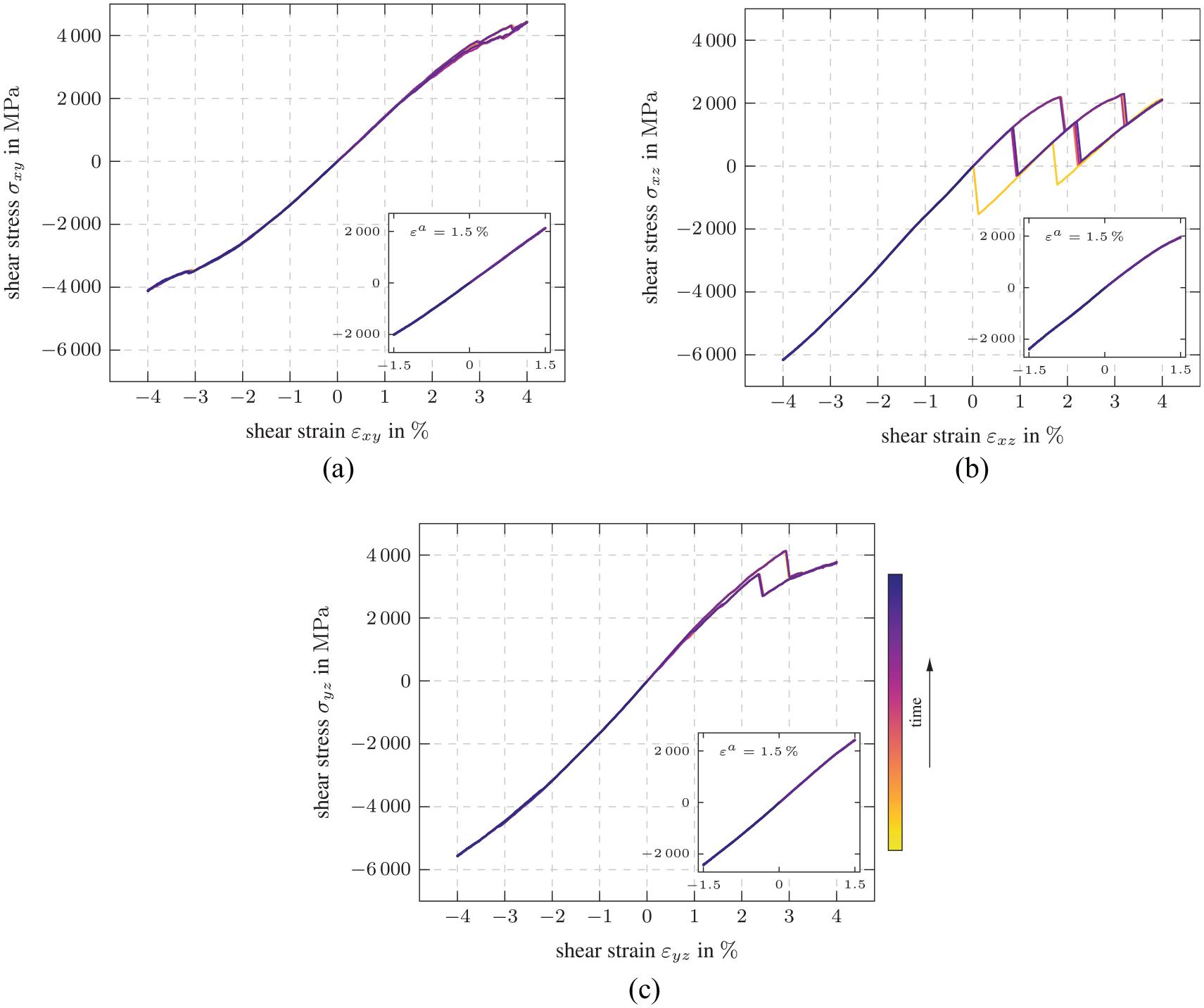
Time-periodic simple shear: shear stress over shear strain for sinusoidal loading in
In summary, the investigated silica can be characterized as elastoplastic with pronounced anisotropy. However, there is a purely elastic range up to 1.5% strain, which is limited by the lattice snapping under shear deformation.
3.3. Calibration of the constitutive model
In the nanocomposite, the nanoparticles are randomly oriented, so the overall directional dependence is expected to disappear. For a precise continuum mechanical model of the neat filler, the observed anisotropy nevertheless needs to be accounted for. When used as a filler for nanocomposites, silica is embedded into a softer polymer matrix, e.g., polystyrene, and therefore experiences comparatively small deformations. Therefore, we aim to accurately model the observed material behavior in the elastic range up to 1.5 % strain by means of a constitutive law based on the generalized Hooke’s law, cf. equation (6) in section “Elastic material models” in Appendix 1. To this end, optimal elastic constants have to be identified for the elasticity matrix
A gradient-based, steepest-descent optimization [59] (
We introduce
Considering an orthothropic or a fully anisotropic constitutive law further decreases the deviation to
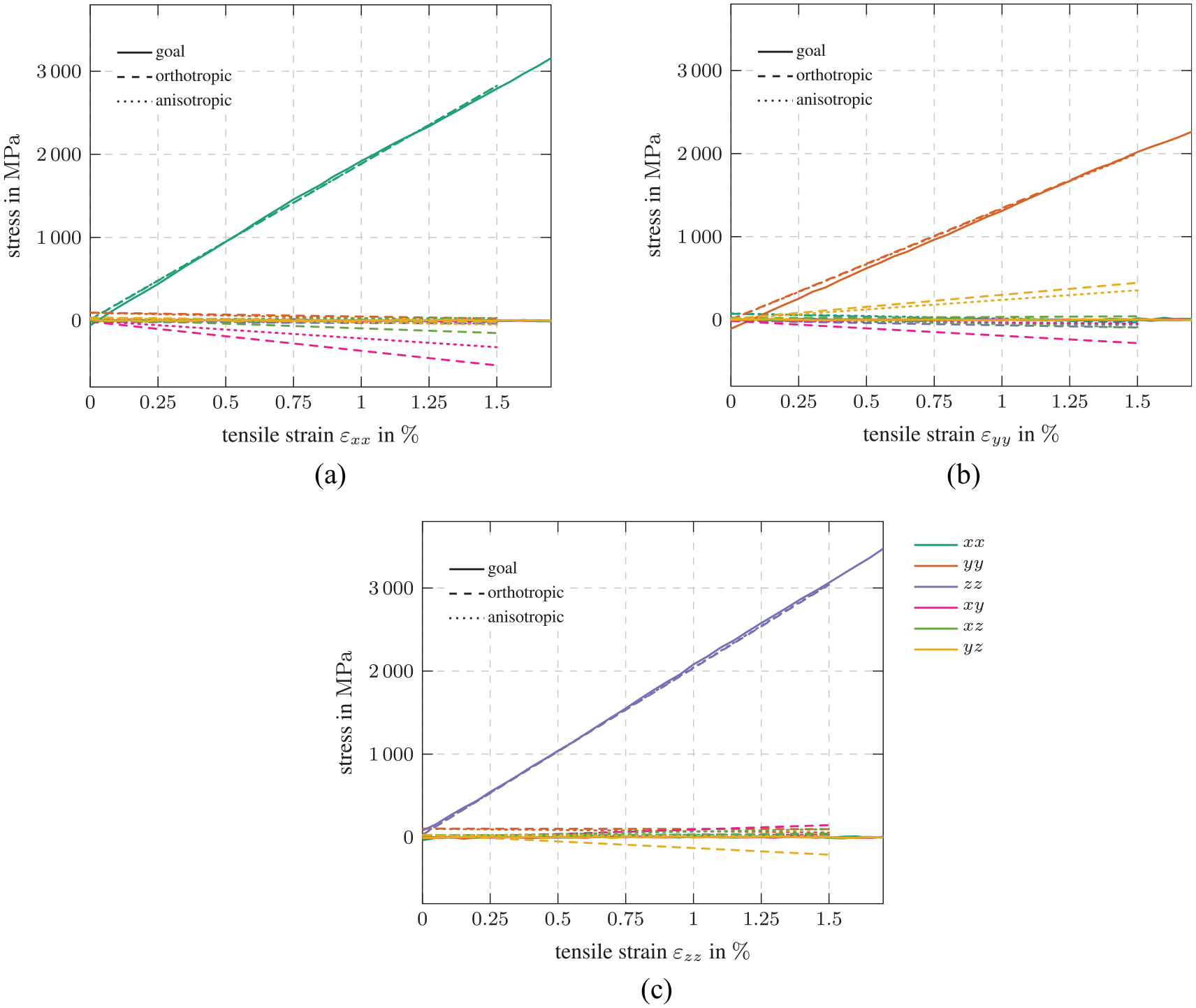
Uniaxial tension fit: comparison of orthotropic and fully anisotropic stress predictions against pseudo-experimental goal data for deformation in
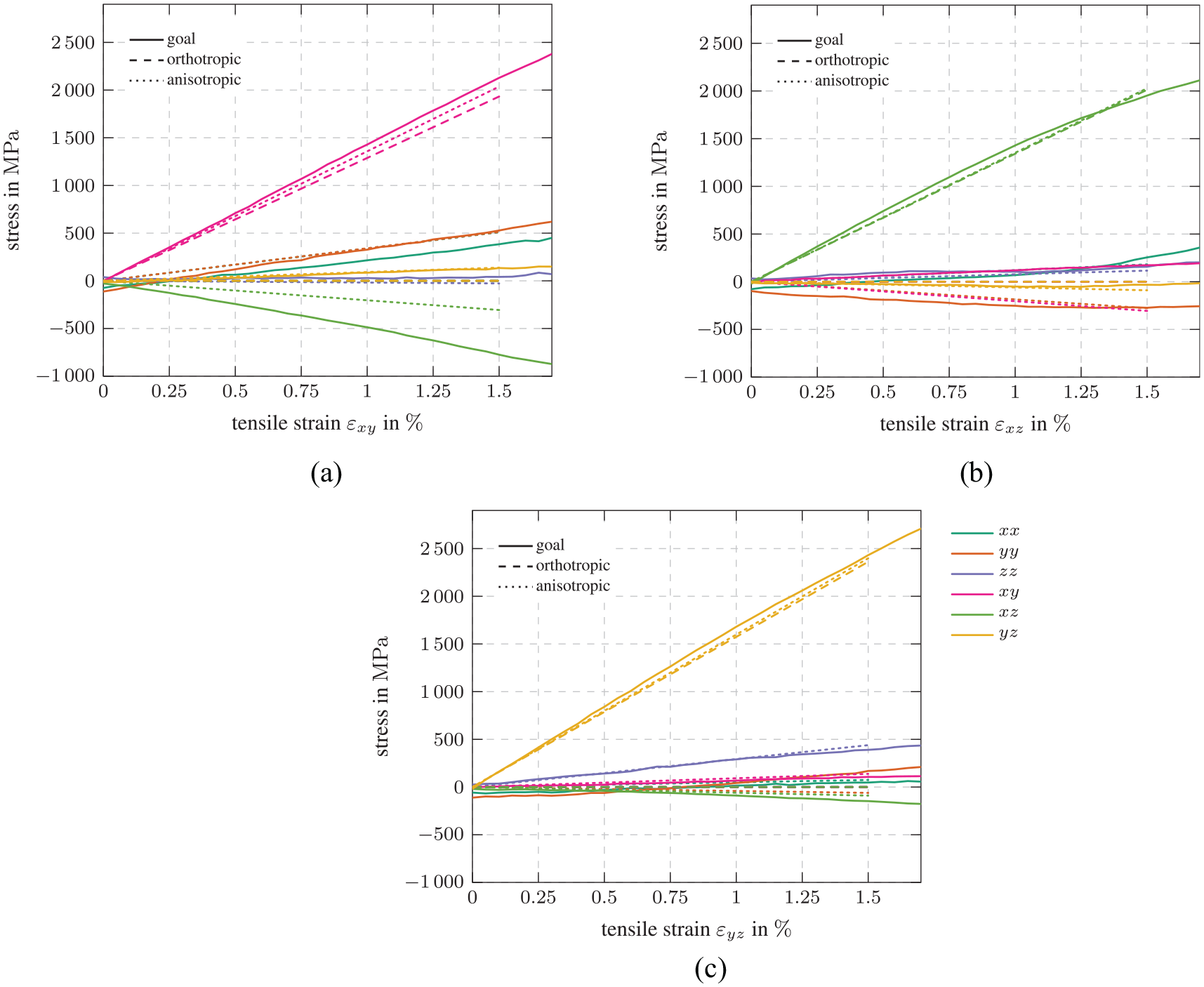
Simple shear fit: comparison of orthotropic and fully anisotropic stress predictions against pseudo-experimental goal data for deformation in (a)
In crystalline materials, the unit cell defines the structure of the crystal lattice and thus its symmetries. These symmetries are also present in the overall elastic properties for a monocrystalline sample, and thus the degree of anisotropy depends directly on the unit cell structure. In our case, the unit cell is triclinic, i.e., fully asymmetric, which is consistent with the sample’s fully anisotropic elasticity.
4. Conclusion and outlook
In this paper, we have approximated the mechanical behavior of silica at the nanoscale by a continuum mechanical constitutive law. For this purpose, a CG sample was examined using MD deformation tests under PBC. Based on uniaxial and shear tests, time-proportional as well as time-periodic, we were able to characterize the present material as elastoplastic with pronounced anisotropy. For the range of small strains up to 1.5%, which is relevant in the context of polymer nanocomposites, we have identified the elastic constants of the generalized Hooke model. These can accurately predict the material behavior in this range.
This study demonstrates that a constitutive law on the nanoscale, as it is necessary for the modeling of an RVE in micromechanics, can be derived on the basis of MD simulations.
This contribution is complementary to an earlier characterization and modeling of polystyrene as an exemplary matrix material [33–35]. Together with our extensive efforts to characterize the interphase between polymer and filler particles [25,26], we can now provide continuum mechanical descriptions of all constituents of a nanocomposite. This enables us to set up RVEs to apply the molecular-level findings on the microscale.
Footnotes
Appendix 1
Acknowledgements
We would like to thank the Erlangen Regional Computing Center (RRZE) at the Friedrich-Alexander-Universität Erlangen-Nürnberg for providing the high-performance computing resources necessary for this contribution. Furthermore, we thank Mattia Livraghi from the PULS Group at Friedrich-Alexander-Universität Erlangen-Nürnberg for the very fruitful discussions.
Funding
The author(s) disclosed receipt of the following financial support for the research, authorship, and/or publication of this article: Sebastian Pfaller is funded by the Deutsche Forschungsgemeinschaft (DFG, German Research Foundation)—396414850 (Individual Research Grant “Identifikation von Interphaseneigenschaften in Nanokompositen”). Maximilian Ries, Christof Bauer, Felix Weber, Paul Steinmann, and Sebastian Pfaller are funded by the DFG—377472739 (Research Training Group GRK 2423 “Fracture across Scales—FRASCAL”).
