




Abstract
The paper deals with elastic wave propagating in a layer on a half-space induced by a vertical force. The focus is on the effect of a sliding contact along the interface and its comparative study with a perfect one. The effective boundary conditions substituting the presence of the layer are derived. The leading order term in these conditions corresponds to vertical inertia of the layer, whereas next order correction involves the effect of plate waves in the coating. Analysis of the associated dispersion relation confirms the existence of a Rayleigh-type wave, along with extensional and shear plate waves. An asymptotic hyperbolic-elliptic formulation for surface wave field is also presented. This includes a hyperbolic equation singularly perturbed by a pseudo-differential operator playing a role of a boundary condition for the elliptic equation governing decay over the interior. The sign of the coefficient at the pseudo-differential operator is demonstrated to be always negative, corresponding to a local maximum of the phase speed at zero wave number, and consequently to a distinct receding type of the Rayleigh-type wave quasi-front induced by an impulse load.
1. Introduction
Coated structures have various important applications in modern engineering [1–3] to name a few. In spite of numerous publications on the subject, dynamic analysis of such structures is still of substantial interest. Among the robust approximate methods in this area the approach based on derivation of the so-called “effective boundary conditions” along the interface, replacing the effect of a thin coating layer, plays a key role, e.g., see the influential paper by Tiersten [4] and more recent contributions [5,6], and also [7], and references therein. Nowadays, the development of effective boundary conditions usually starts from implementation of the properly adapted asymptotic approach, initially established for thin elastic plates and shells [8–10].
The vast majority of mathematical models for coated structures assume a perfect contact between the coating and the substrate in various scenarios, e.g. see [11–14]. At the same time, only a few papers analyse a sliding contact. For the latter, the full dispersion relation for elastic waves in a layer resting on a half-space was first studied in Achenbach and Keshava [15]. In addition to the dynamic phenomena characteristic of a perfect contact, the presence of an extra longitudinal mode propagating along the coating has been observed. We also mention [16], deriving the effective boundary conditions for a sliding contact by expanding the tractions inside the coating as Taylor series.
The main focus of the publications concerned with elastic linear wave propagation on a coated half-space is usually on Rayleigh-type waves [5,6,17]. In particular, an asymptotic formulation for a long Rayleigh-type wave on a coated half-space for a perfect contact was established in Dai et al. [5]. This paper extends the concept of explicit hyperbolic-elliptic models for surface waves, see the literature [18] and references therein. More recent developments take into account anisotropy and pre-stress [19–21], higher order effects [22], Dirichlet boundary conditions along the surface of a coated half-space [23], the effects of surface oscillators [24, 25], and also include composite plate models [26].
In this paper, we extend the asymptotic methodology in Dai et al. [5] to the case of a sliding contact. Two milestones are crucial for the consideration below. First, we derive effective boundary conditions taking into account a weak coupling between the plane-stress motion of coating with the substrate. These conditions are employed in qualitative dispersion analysis of the problem. We concentrate on the long-wave behaviour of the Rayleigh-type wave, and extra extensional and shear plate waves propagating in the layer. Second, we adapt the derived conditions for formulating an asymptotic model for the surface wave, resulting in a singularly perturbed hyperbolic equation on the interface, as in Dai et al. [5]. Peculiarities of wave phenomena governed by this equation are also addressed.
The paper is organised as follows. As a preliminary, we present an illustative numerical example of a single layer subject to a prescribed transient load at its upper face, and either fixed lower face or the latter under a sliding contact with a rigid base. Comparison of mid-plane displacements performed using finite element software shows that for a sliding contact the tangential displacement significantly dominates over the vertical one, whereas for a fixed lower face both displacements seem to be of the same order. This is in line with initial physical insight, as well as observations of an extra longitudinal mode in Achenbach and Keshava [15], and also more recent findings reported for an elastic contact in Erbaş et al. [27,28].
Then, we derive the effective boundary conditions at the coating/substrate interface using a traditional asymptotic procedure. At leading order, these conditions can be interpreted as the effect of distributed surface vertical inertia. At next order, in contrast to a perfect contact, they support plate wave motion in the coating governed by plane-stress theory.
Next, the associated leading order dispersion relation is analysed within both plane-strain and anti-plane setups. In plane-strain case, a Rayleigh-type wave and an additional extensional “plate” wave are observed, with the phase speed achieving its maximum value equal to the classical Rayleigh wave speed at zero wave number. As might be expected, the anti-plane setup supports only a non-dispersive shear wave on the coating.
Finally, a 3D hyperbolic-elliptic formulation for the Rayleigh-type wave field induced by an arbitrary vertical load is obtained. It is comprised of an elliptic equation for the longitudinal wave potential over the interior of the substrate, and a hyperbolic equation singularly perturbed by a pseudo-differential operator, serving as a boundary condition for the elliptic equation. The presented results are formally similar to those earlier reported in Dai et al. [5] for a perfect contact. However, the coefficient at the pseudo-differential term now takes a simpler form than that in Dai et al. [5] and is shown to be always negative, whereas the analogous coefficient in Dai et al. [5] changes its sign depending on problem parameters.
2. Statement of the problem
Consider a linearly isotropic, elastic half-space, coated with a thin layer of thickness
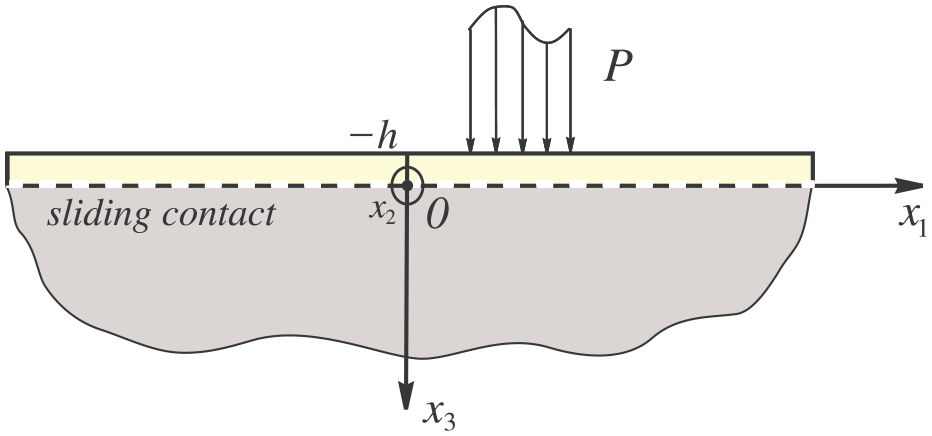
Coated half-space with sliding contact.
The equations of motion are written conventionally as (see [29]):

where

where

with
Hooke’s law is now adopted in the form convenient for the asymptotic procedure of the next section [8,9]:
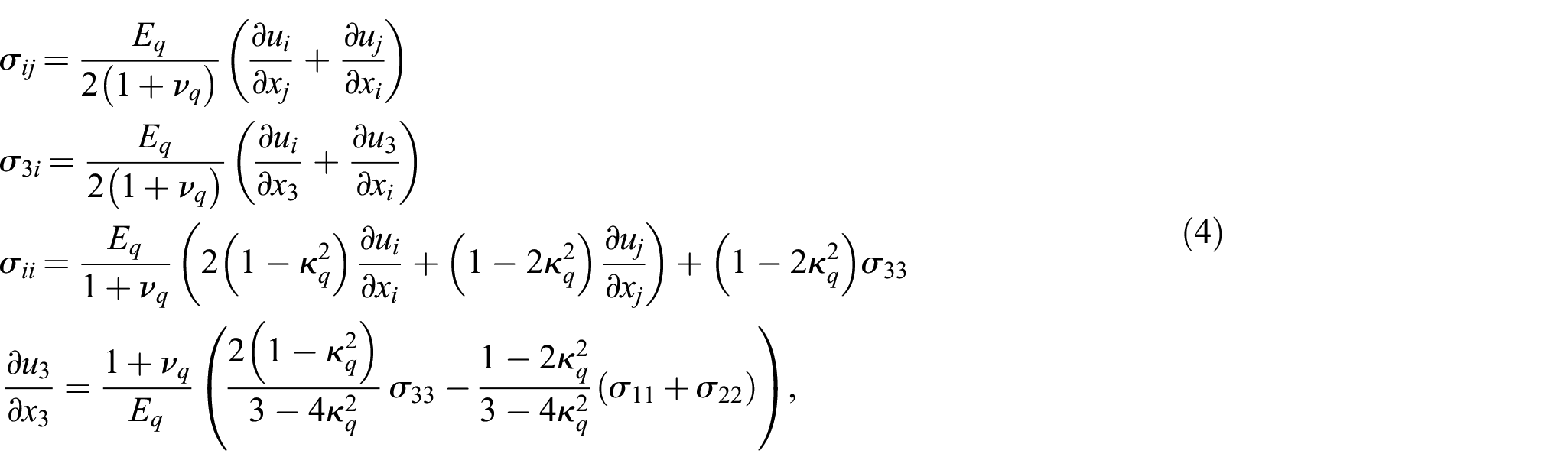
where

where
3. Preliminary numerical insight
Let us present a numerical example stimulating further consideration. For simplicity, we adopt a plane-strain assumption.
Consider an infinite, isotropic, elastic layer

applied over a region
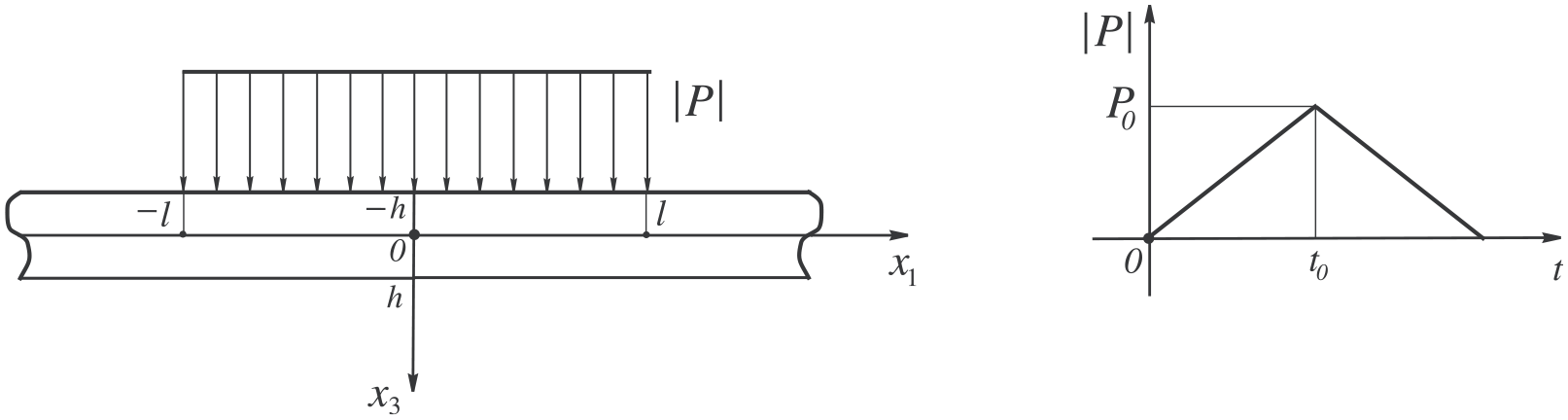
A layer subject to transient load.
In the computations below, the lengths are
Thus, the boundary conditions on the upper face

On the lower face

or imposing mixed boundary conditions (modelling a sliding contact):

The horizontal and vertical mid-plane displacements (at
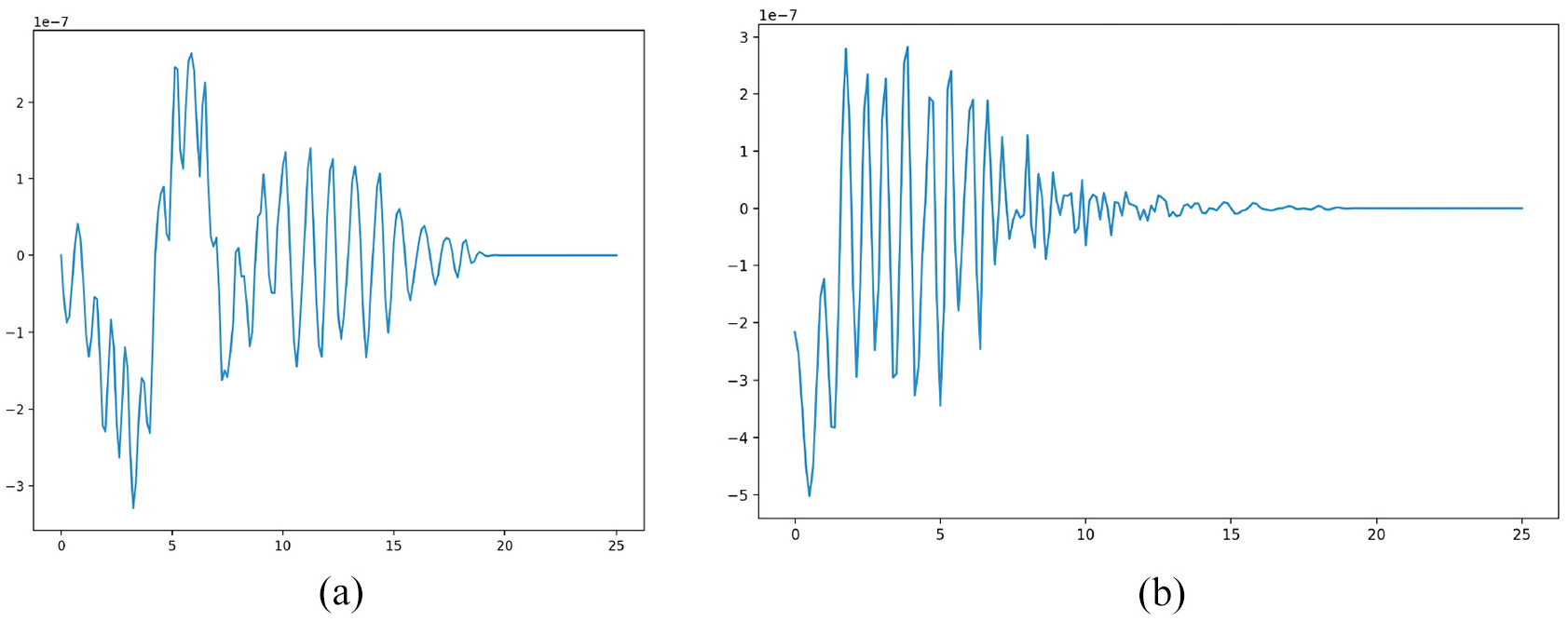
Variations of (a) horizontal and (b) vertical mid-plane displacement along the longitudinal coordinate (fixed lower face
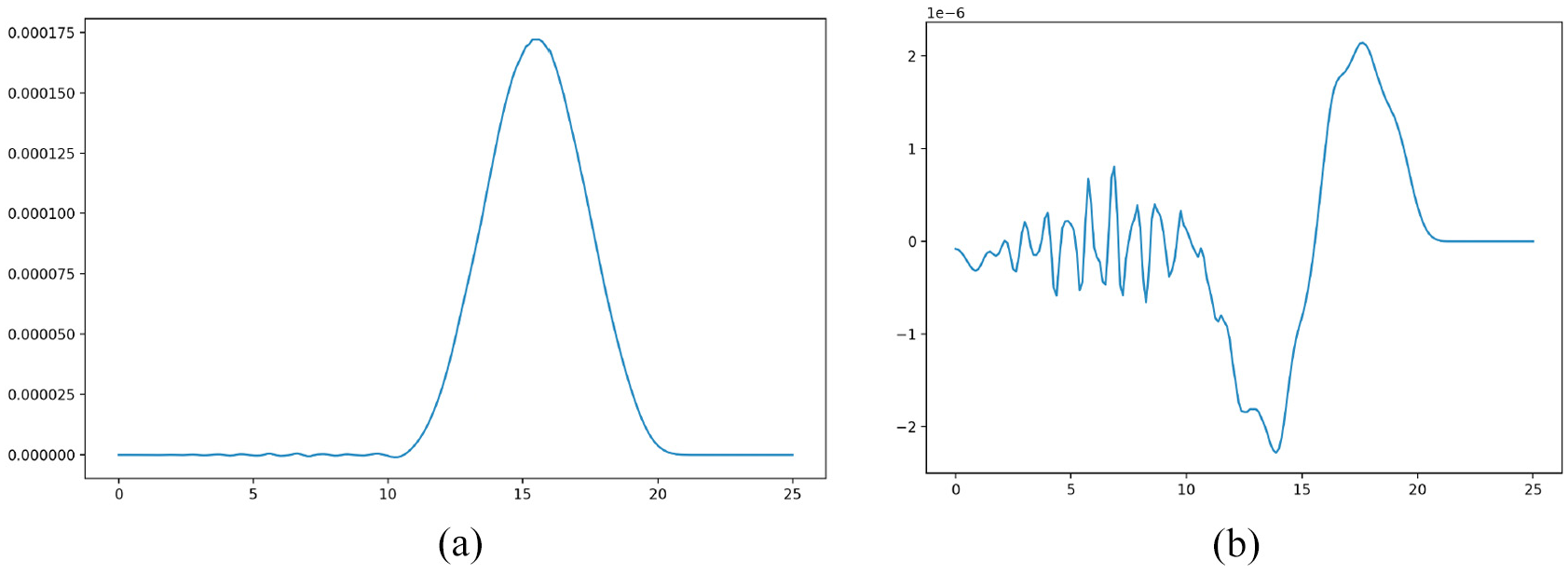
Variations of (a) horizontal and (b) vertical mid-plane displacement along the longitudinal coordinate (sliding contact at
For fixed lower face (8), see Figure 3, both mid-plane displacements are roughly of the same order
This simple numerical experiment, performed in LS-DYNA commercial FEM software, already provides a useful preliminary insight, suggesting existence of an extra longitudinal mode, with the dominance of horizontal displacement, supported by mixed boundary conditions. This feature has been recently noted in Erbaş et al. [27] for elastic contact.
4. Effective boundary conditions
Let us now derive the effective boundary conditions, modelling the effect of the coating, by means of a long-wave asymptotic procedure [5]. Let us focus on the thin layer first. The equations of motion are given by equation (1), with boundary conditions on the upper face

where
Now, to establish an asymptotic procedure, a small parameter associated with the long-wave limit is introduced:

where
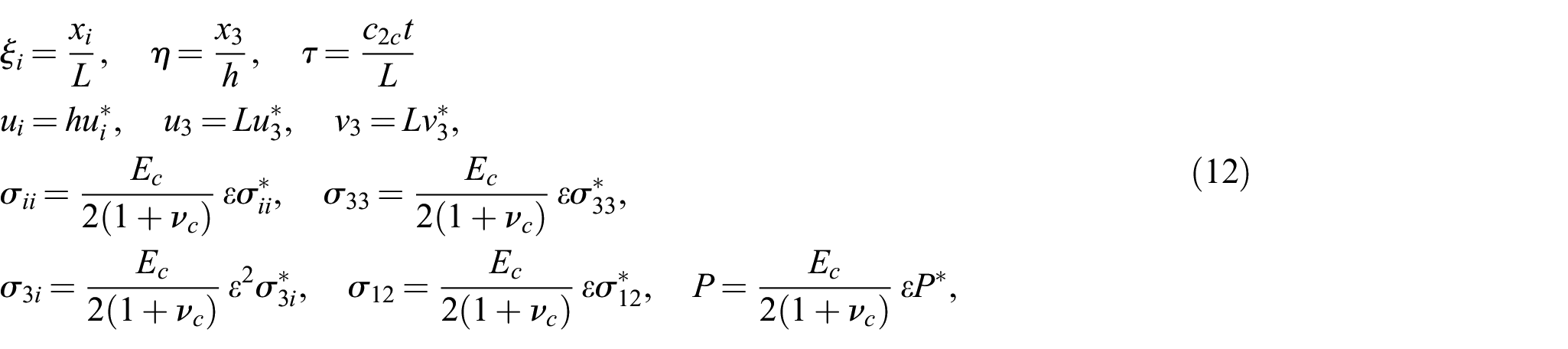
where
The governing equations for the layer can now be summarised as:

along with the constitutive relations:
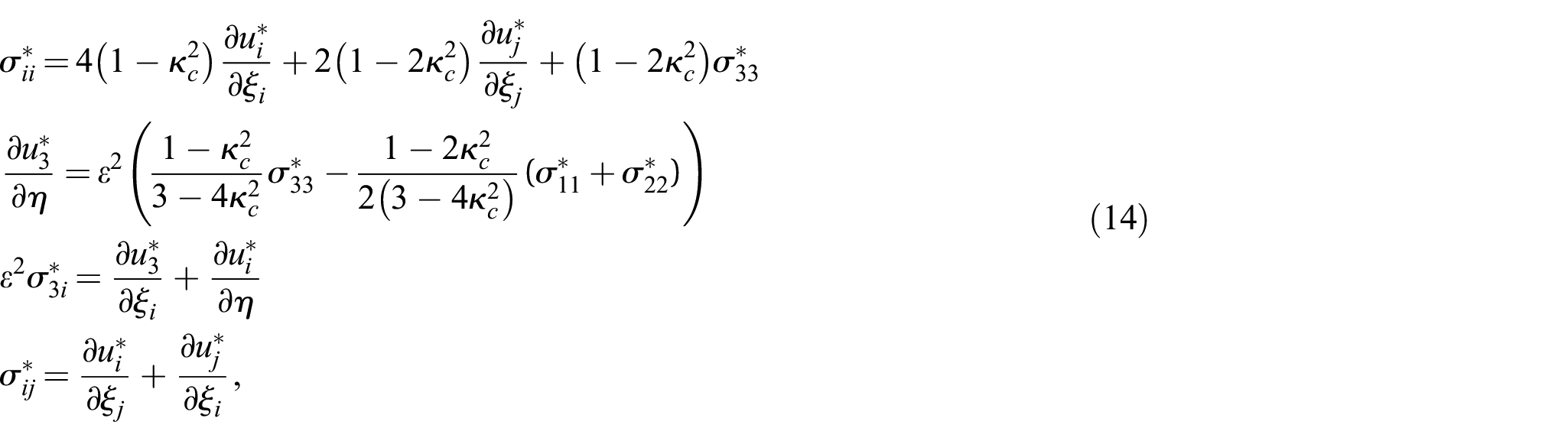
subject to boundary conditions:

where, as above,

The leading order problem is given by:
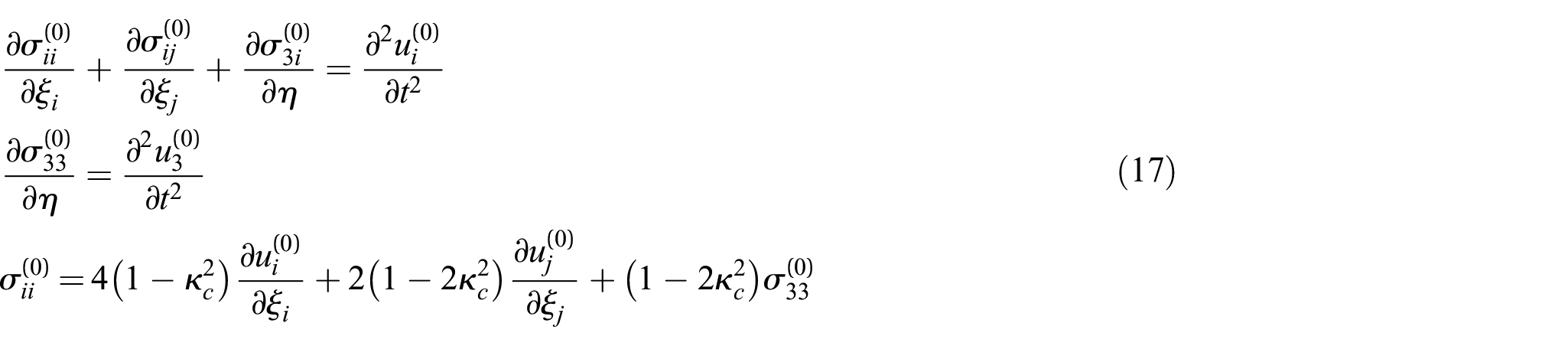
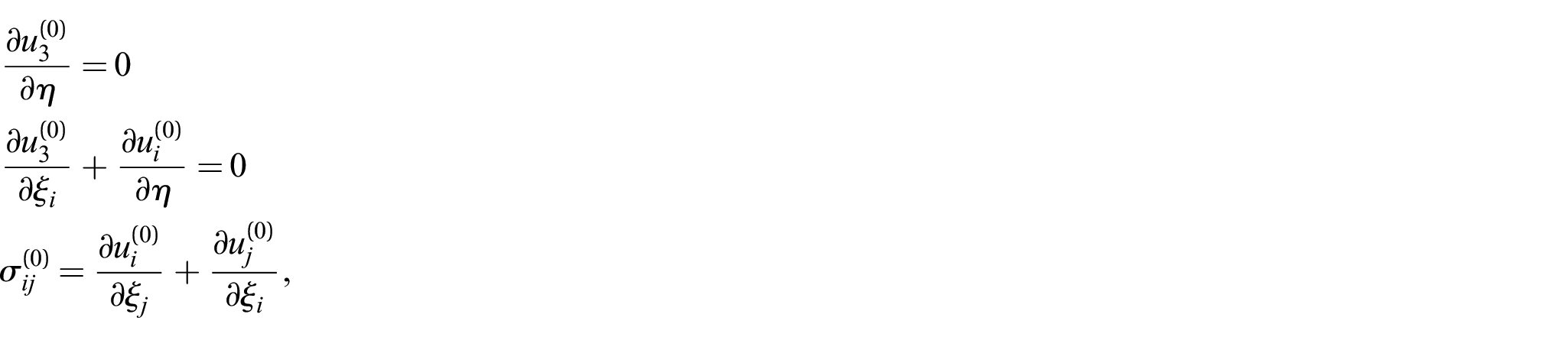
subject to:

The leading order solutions may be found in the form:
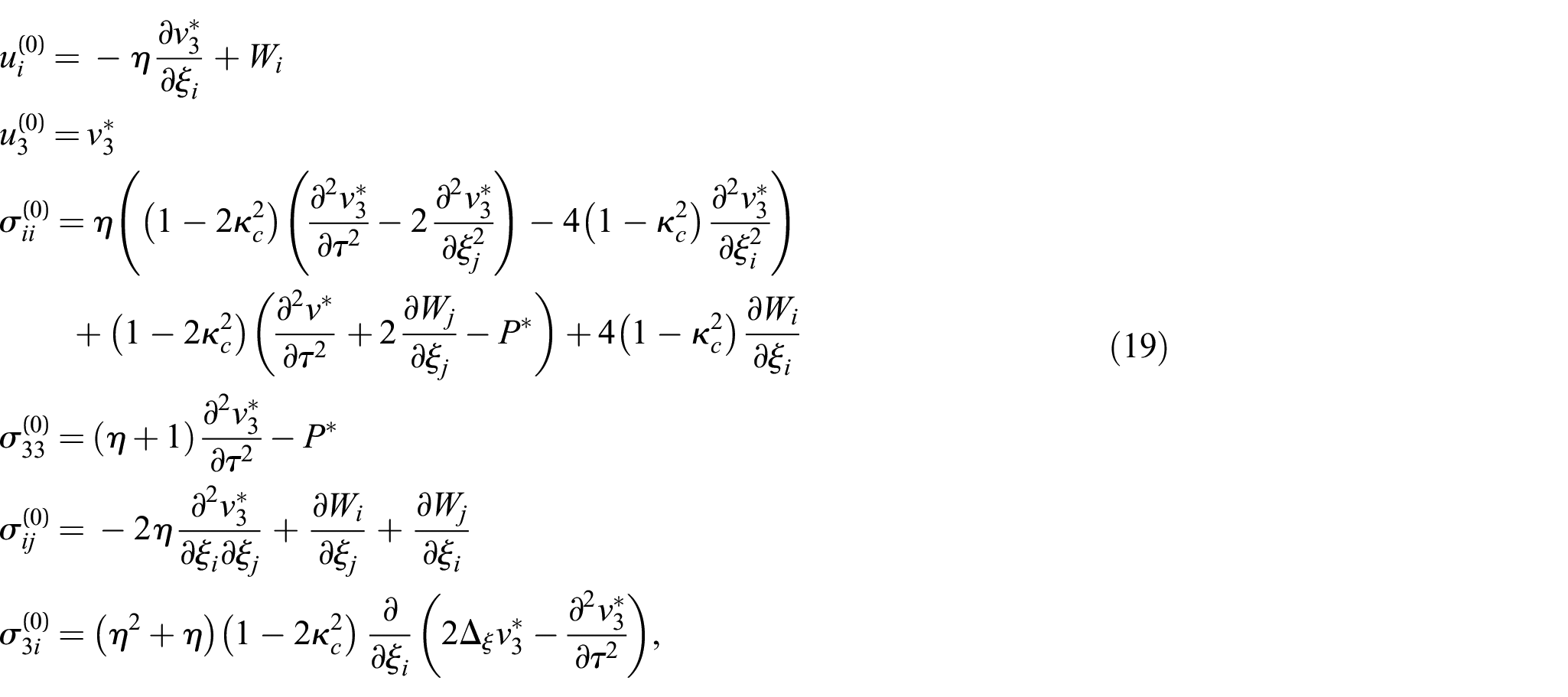
where

is a 2D vector of tangential displacements of the layer at the interface

following from the sliding contact conditions at the interface
At next order, we focus our attention on the correction to the normal stress and a related correction to vertical displacement. For these, we have:

subject to:

The corrector for vertical displacement, satisfying (22, 23) may be written as:

implying the corrector for the normal stress in the form:

Thus, the two-term normal stress on the interface

Returning to the original variables, (26) becomes:

where

It is interesting to observe from (27) that at leading order the effective normal stress is basically comprised of the prescribed vertical force and the vertical inertia of the layer.
The condition (21) becomes:

where div and grad are the usual diffential operators in
Thus, it may be deduced that for the considered type of a sliding contact the derivation of effective boundary conditions does not allow a straightforward reduction of problem to that for a half-space compared with an ideal contact. The effective conditions on the interface

along with the additional conditions (29), relating the interfacial tangential displacements of the layer
At leading order, when the condition (30)1 at the interface

the problem may be first solved for the half-space and then relation (29) may be used to obtain the tangential displacements of the layer at the interface. Note that the R.H.S of equation (31) corresponds to vertical inertia, with
5. Dispersion relation
Now, once effective boundary conditions modelling the interaction with the thin layer have been derived, we proceed with investigation of dispersion of elastic waves in the half-space. Let us first consider plane-strain problem associated with
The conventional equations of motion are written in terms of the elastic Lamé potentials

with the displacements expressed as:

In absence of loading

and

The solutions for the potentials (satisfying the decay conditions at

where

implying a similar harmonic profile for the interfacial displacement of the layer:

Using equation (33) and substituting the quantities (36) and (38) into the boundary conditions (34), we arrive at a homogeneous algebraic system in

where

is the so-called “plate” speed, associated with sliding of the layer. A similar observation was made earlier by Achenbach and Keshava [15] when analysing full dispersion relation for the original problem for a coated half-space (cf. equation (32) in the cited paper).
The first term in square brackets in (39) describes dispersion of the Rayleigh-type wave. On introducing the dimensionless wave number

this relation may be rewritten as:

Clearly, the area of interest is in the long-wave vicinity as

A typical dispersion diagram is shown Figure 5, illustrating dependence of the scaled phase speed
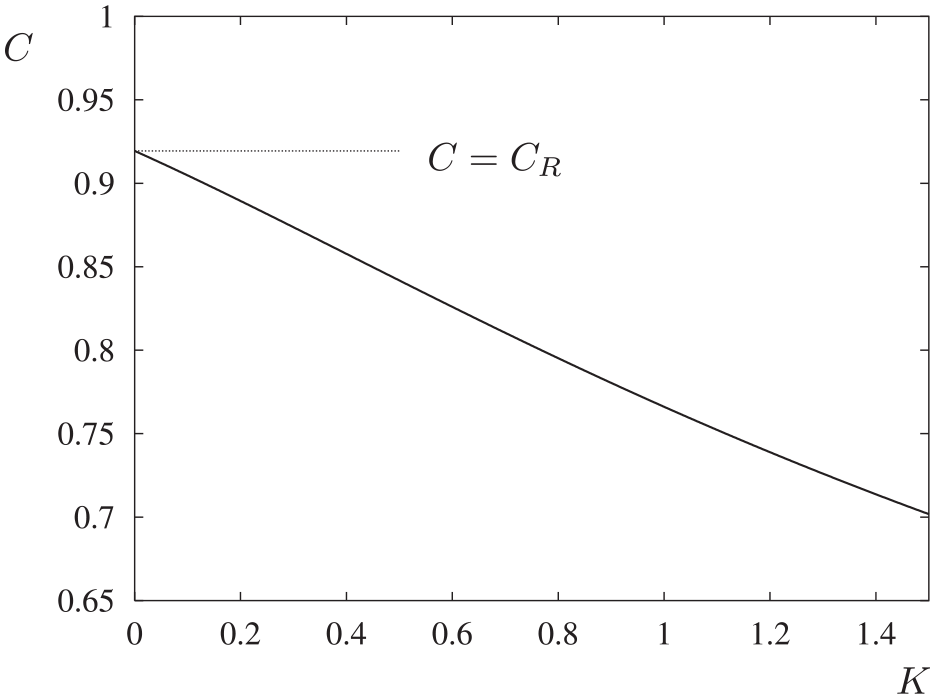
Dispersion curve and the associated long-wave limit
The phase speed

where

with constant
Now, let us discuss briefly the anti-plane setup, following equations (30) and (29). On assuming

subject to conditions at the interface

Thus, in anti-plane setup, the shear motions of the layer and substrate are separated completely. The substrate does not support a localised wave, whereas a shear wave is still a feature of the coating.
6. Asymptotic formulation for the Rayleigh-type wave
Let us now present an explicit model for the Rayleigh-type wave induced by a prescribed arbitrary vertical load

Then, using the same slow-time perturbation procedure as exposed in Dai et al. [5], see also literature [18] and references therein for more details, we obtain an asymptotic formulation for the near-surface zone. This includes an elliptic equation:

for the longitudinal wave potential

along the surface

In the last formula, it is important that
Note that within the plane-strain setup, say for

Taking into account equation (51), the associated dispersion relation becomes:

with the dimensionless wave number
It can be easily verified that the equation (53) provides a long-wave approximation to the dispersion relation (42) and the derivative
In addition, the local maximum of the phase velocity at zero wave number, see Figure 5, which corresponds to negative sign of coefficient
7. Conclusion
3D dynamic problem in linear elasticity for a thin layer in sliding contact with a half-space subject to a prescribed vertical force has been considered. The effective boundary conditions (29) and (30) accounting for the effect of the coating have been derived. At leading order, these contain only the terms corresponding to the vertical inertia of the coating. At next order, they are also effected by plate waves in the layer governed by 2D plane-stress theory. The observed feature seems to be specific for a sliding contact, in contrast to a perfect contact prohibiting natural vibrations of the coating. As a result, the associated dispersion relation involves not only a Rayleigh-type but also extensional and shear plate waves.
In addition, an explicit hyperbolic-elliptic model for the Rayleigh-type wave is formulated, complementing the previously known formulation for a perfect contact [5]. The presented model is comprised of a hyperbolic equation singularly perturbed by a pseudo-differential operator, serving as a boundary condition for an elliptic equation governing decay over the interior. The coefficient at the pseudo-differential operator is shown to be always negative, corresponding to a local maximum of the phase speed observed at zero wave number. For an impulse loading, this results in a receding quasi-front, whereas a similar problem for a perfect contact [5] allows both positive and negative values of the aforementioned coefficient. Consequently, both maximum/minimum of the phase speed and receding/advancing quasi-fronts may arise at a perfect contact.
The obtained results may find various applications in theory and practice of elastic coatings. For example, delamination and fracture of a perfect contact may be accompanied by excitation of extensional and shear plate waves in the coating, and may possibly change the type of the Rayleigh wave quasi-front. Further developments may also incorporate the effects of curvature, anisotropy, as well as more sophisticated types of contact [31,32].
Footnotes
Funding
The author(s) disclosed receipt of the following financial support for the research, authorship, and/or publication of this article: Support from the Russian Science Foundation (Grant No. 20-11-20133) is gratefully acknowledged.