




Abstract
We present a growth model for special Cosserat rods that allows for induced rotation of cross-sections. The growth law considers two controls, one for lengthwise growth and another for rotations. This is explored in greater detail for straight rods with helical and hemitropic material symmetries by introduction of symmetry-preserving growth to account for the microstructure. The example of a guided-guided rod possessing a chiral microstructure is considered to study its deformation due to growth. We show the occurrence of growth-induced out-of-plane buckling in such rods.
1. Introduction
Several theoretical models for elastic rods have been proposed. From Euler’s elastica to Kirchhoff rods, a very rich literature is available, including the general model developed by Green, Naghdi and their collaborators. The general rod theory proposed by Green and Naghdi subsumes classical theories like the Cosserat rod theory as special cases under appropriate constraints. A comprehensive description of different rod theories is provided by Antman [1] and O’Reilly [2].
Rod theories have been employed in many interesting applications in the last few decades, such as in DNA biophysics [3], marine cables [4], tendril perversion in plants [5, 6], surgical filaments [7], slender viscous jets [8], hair curls [9] and carbon nanotubes [10, 11].
Growing filamentary structures are ubiquitous in nature. Plant organs such as tendrils, roots and stem tend to twist while growing axially [12]. There are studies with helical growth models in which straight axial growth is accompanied by rotation of cross-sections [13, 14]. In this paper, we focus on this type of twisting growth, which can lead to non-planar configurations if the material of the rod exhibits some sort of twist–extension coupling.
The standard multiplicative decomposition [15] used to model biological growth has been specialized for one-dimensional growth by Moulton et al. [16]. A recent study by Moulton et al. [17] gives the reduction of three-dimensional energy for a tubular structure to a one-dimensional equivalent via minimization in cross-sections and subsequent averaging; it further demonstrates the generation of intrinsic twists and curvatures due to differential growth. A diverse account on biological growth is available from Goriely [18], containing both mathematical and biomechanical aspects.
Euler buckling of filaments evolving their shape under time-varying loads has been considered by Goldstein and Goriely [19]. Works like that of McMillen et al. [6] consider plant tendrils as Kirchhoff rods, straight in their initial states, which subsequently develop intrinsic curvatures in the grown equilibrium states. Another evolution law for intrinsic curvatures has been proposed by O’Reilly and Tresierras [20] with a focus on tip growth. Guillon et al. [21] modelled tree growth by considering the branch to be a special Cosserat rod growing in both length and diameter. They modelled the reference, relaxed and current configuration of the growing rod with separate base curves and director fields.
Several growing filaments in nature are known to have non-planar configurations [12, 13, 22]. Most existing works that study one-dimensional growth in filaments model them as isotropic rods. Such models usually rely on differential growth [17] or the presence of an external elastomeric matrix [23], multi-rod composites [24] or phototropism [25] to model the generation of curvature and torsion in non-planar configurations. Growth in chiral rods can be another way to obtain such non-planar deformations; this has not been explored in the literature. In this work, we show that growing chiral rods can buckle out of plane, simply with a boundary condition that arrests relative axial rotation at the ends.
There have been several attempts to understand material symmetries in rods. Different types of chiral material symmetries – such as hemitropy and helical symmetry – in initially straight rods with uniform circular cross-section have been investigated in great detail by Healey [26]. Other treatments of material symmetry in the context of rods include the works of Luo and O’Reilly [27] and Lauderdale and O’Reilly [28]. The latter authors [29] draw a few parallel comparisons with some results by Healey [26]. In this paper, we follow the definitions and ideas of material symmetries introduced by Healey [26, 30].
Energy representations for helical symmetry and hemitropy have been derived by Healey [26]. Multi-fold helical symmetry is useful in modelling rods whose micro-structure mimics the symmetries of a rope made up of entwined helices. Hemitropic rods possess the centre-line rotational symmetry of an isotropic rod but lack the reflection symmetries with respect to the longitudinal planes. Energy functions for rods with such chiral symmetries are typically characterized by coupled stretch, twist, shear and curvature terms. These couplings physically manifest as different types of non-traditional Poisson effects [31]. Moreover, the conventional quadratic energy densities associated with linear elasticity are incapable of distinguishing between different orders of helical symmetries and hemitropy.
Out-of-plane deformations are yet another feature of rods with such symmetries. Unshearable hemitropic rods can give rise to out-of-plane buckling when subjected to end displacements with fixed–fixed boundary conditions, but on the other hand an axial load applied to a fixed–free rod always results in a planar solution [32]. Similar bifurcation analysis has also been replicated for chiral rings with circular cross-sections under central loading [33]. Both in-plane and out-of-plane buckling of isotropic rods embedded in elastomeric matrix have been examined [23], revealing that non-planar configurations are obtained whenever the matrix is stiff enough, compared to the bending stiffness of the rod. Primary root growth of certain plants has been investigated [22], drawing analogies from mechanical buckling of a metal filament embedded in a matrix comprising two different gels whose interface is transverse to the filament.
The main focus of this work is to study growth-induced deformation in rods possessing chiral material symmetries – transverse hemitropy and dihedral helical symmetry. The growth law is also assumed to be chiral. Straight growth, where cross-sections do not rotate as they translate lengthwise, is not appropriate for modelling growth in rods with helical symmetry. If the chirality in material symmetry stems from some helical substructure associated with the rod’s microstructure or from some sort of helical fibre-reinforcement, then simple translational growth can alter the pitch of the helix. This, in turn, may modify the chiral constitutive quantities associated with the material law. Moreover, straight translational growth without any rotation can lead to unwinding or over-winding, thus inducing additional stresses; stress-free growth in such cases requires the consideration of a coupled axial and rotational growth. Modelling the virtual configuration obtained from stress-free growth as a special Cosserat rod allows us to consider growth-induced rotation of cross-sections. The exact relationship between the growth law and rod’s microstructure is not well established. In this work, we assume growth and constitutive laws to be independent in general. Additionally, for rods with helical symmetry we postulate the growth law to be symmetry preserving, so that any imaginary helix associated with the microstructure remains unaltered as the rod grows. Such a growth problem depends only on the microstructural pitch and the constitutive laws, keeping aside the boundary conditions and other external factors.
A rod constrained to grow (or decay) in a guided–guided environment is considered, with a chiral constitutive law that is applicable to both helical symmetry and transverse hemitropy. Out-of-plane buckling is observed to occur at certain growth (or atrophy) stages, corresponding to the bifurcation modes. We demonstrate that an exact reversal in chirality of these non-planar solutions requires us to mirror the chiral parameters in both growth and constitutive laws simultaneously. Comparisons are made for the end-to-end distance in the buckled configuration with that in the virtual state to see if the ends have come closer or moved apart, than what they would have been in the absence of the guides. We also show that total growth-induced extension in a rod does not depend monotonically on the degree of chirality – that is, total extension in an isotropic rod need not lie between the total extension of rods with opposite material chirality.
This paper is organized as follows. We begin with a theoretical background of material symmetries in the context of special Cosserat rods in Section 2. A twisting growth law with two control parameters is systematically derived using certain kinematic assumptions such as homogeneity in lengthwise growth and relative rotation of cross-sections in Section 3. In Section 4, we solve the problem of growth-induced out-of-plane bifurcation in a chiral rod with guided–guided boundary conditions to study the interplay between chiralities in growth and material laws. We present our conclusions in Section 5.
1.1. Notation
Throughout this text, the indices
2. Special Cosserat rod formulation
Consider a straight rod of unit length in its stress-free reference configuration as shown in Figure 1. Assumption of the special Cosserat rod requires the transverse cross-sections to stay rigid during the deformation. Let

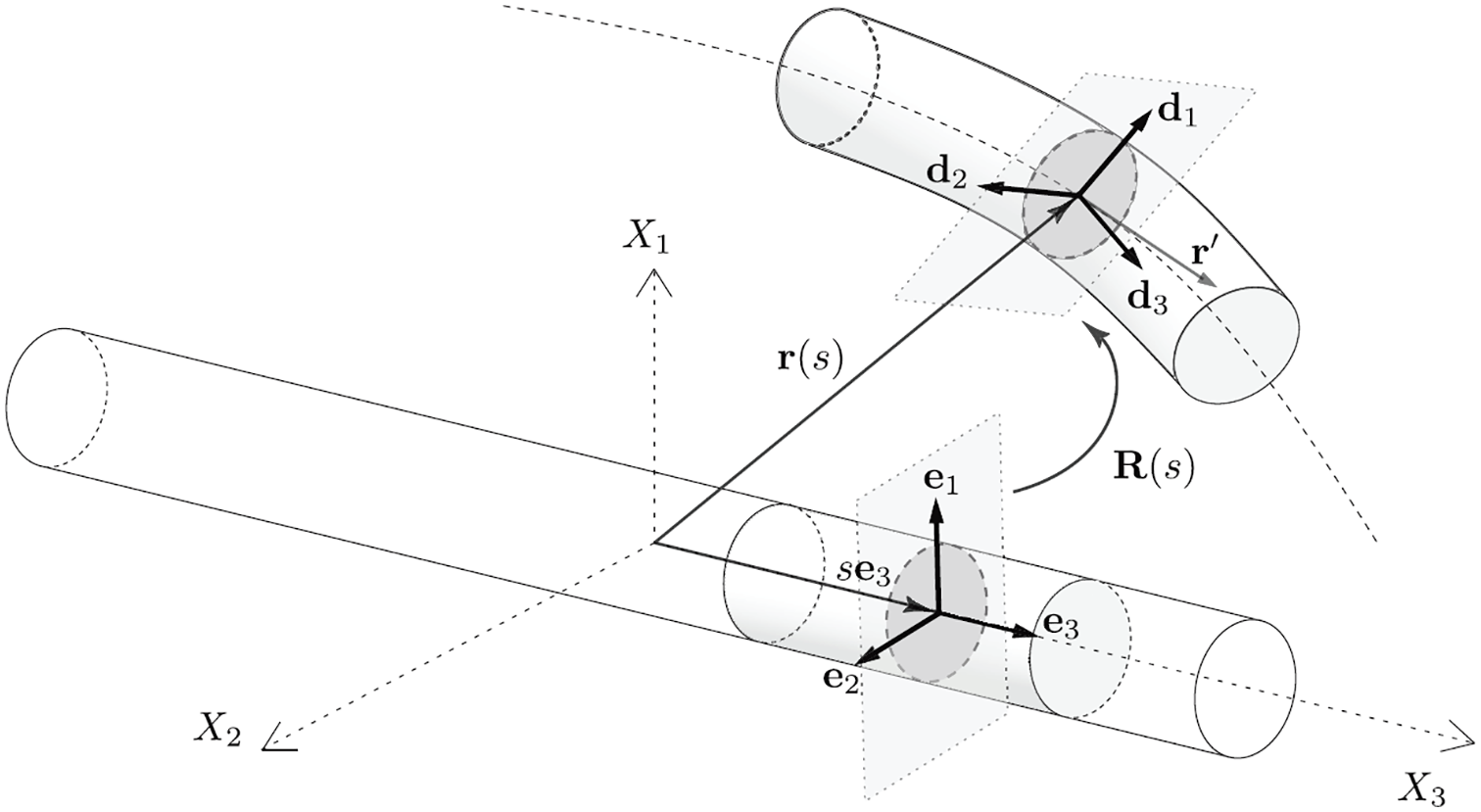
Kinematics of a special Cosserat rod depicting the deformed centre-curve and the triad of orthonormal directors.
The vector fields

define the convected coordinates
We further assume the rod to be hyperelastic with a differentiable energy density (per unit length) function

where W is another differentiable scalar valued function.
The internal force and moment on the transverse cross-section are denoted by

To prevent self-penetration, we require

and the unshearability constraint is expressed as

2.1. Material symmetry in rods
In this section, we present a brief overview of certain classes of material symmetry for special Cosserat rods, as described by Healey [26, 30].
2.1.1. Helical symmetry
Consider a straight rod possessing helical material symmetry [26]. A unique flip axis (or symmetry axis) is associated with every transverse cross-section that rotates as the section plane moves along the length of the rod (Figure 2(a)).
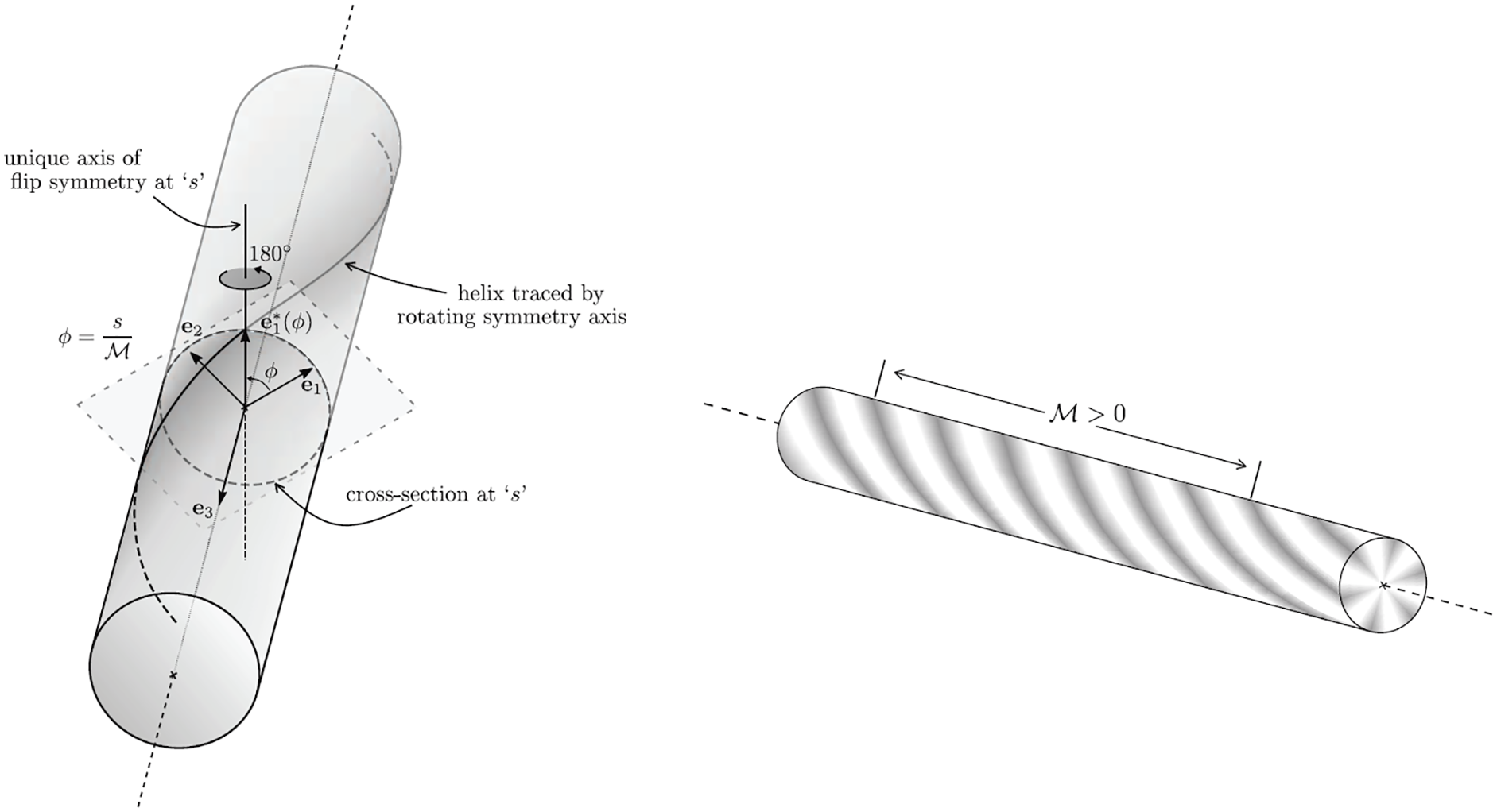
A depiction of symmetry and associated kinematic parameters in chiral rods [26].
A 180-degree rotation (flip) about this axis renders the rod the same as before. We denote by
Unlike flips, reflections about a transverse plane do not result in a coincident helix, nor do the reflections through longitudinal planes. In fact, these reflections change the sign of
We introduce a rotating basis field

and a corresponding triad of director fields given by


where

in the fixed basis.
Assuming

Material properties with respect to the symmetry axis

where

Helical symmetry is characterized by

in terms of the new energy function without s as an argument.
2.1.2. n-fold helical symmetry
Consider a rod with a symmetry analogous to

in addition to equation (14), where

2.1.3. Continuous helical symmetry
For

2.1.4. Transverse hemitropy and isotropy
Let

written in the fixed basis. A homogeneous hyperelastic straight rod with energy function

and flip-symmetric if

Note that flip-symmetry does not belong to the class of transverse symmetry, defined by Healey [26]. A straight rod is transversely isotropic if in addition to equation (19), it also satisfies

Flip-symmetric hemitropy is equivalent to continuous helical symmetry [26]. Another way to obtain flip-symmetric hemitropy is to consider a rod with helical symmetry and take the limit
2.2. Energy function
The energy density per unit length of unshearable hemitropic rods can be expressed as [1, 26]

where

where

where
As demonstrated by Healey [26], quadratic energy functions are incapable of distinguishing between different types of n-fold helical symmetry (
3. Growth formulation
Growth in elastic bodies is typically modelled by introduction of a multiplicative decomposition of the deformation gradient into pure growth and pure elastic deformation parts [15, 34]. This decomposition assumes a virtual stress-free incompatible configuration. For one-dimensional structures where growth manifests as increase in overall length, first the stress-free rod isolated from its environment and boundary conditions can be allowed to grow free into a virtual state, and then the boundary and environmental factors can be forcibly imposed [18, 35].
One-dimensional growth models, where cross-sections simply translate during free growth, are not suitable for several classes of chiral rods. Chiral rods usually have a physical winding bias intrinsic to the microstructure [26]. Length-wise growth with no cross-sectional rotation can modify this microstructure. For example, a rod with helical symmetry made to grow axially will have to change its inherent pitch if the cross-sections are not allowed to rotate during growth; and as a result the constitutive parameters controlling material chirality must change accordingly. In such examples, to be able to look at growth that does not alter the microstructure, or restricts the microstructure to modify itself in a particular manner, it is essential that we look at rod growth in a more general setup.
Similarly, in chiral rods where material symmetry arises from fibre reinforcement [36], rod growth is a result of individual fibre growth and it is the growth pattern of these fibres that dictates whether the rod’s cross-sections must rotate, as they are translated during growth. Consider a rod that is composed of fibres twisted helically in the unstressed reference state; if the cross-sections are not allowed to rotate during growth, it would have an unwinding or over-winding effect on the fibres, thus generating stresses. In such cases, for growth to take place without the generation of any stress, the cross-sections must rotate.
This is why we choose to individually treat all three configurations (reference, virtual and current) as special Cosserat rods, and then analyse the relative rotations.
3.1. General framework for growing rods
Let

where ∥·∥ denotes the Euclidean vector norm.
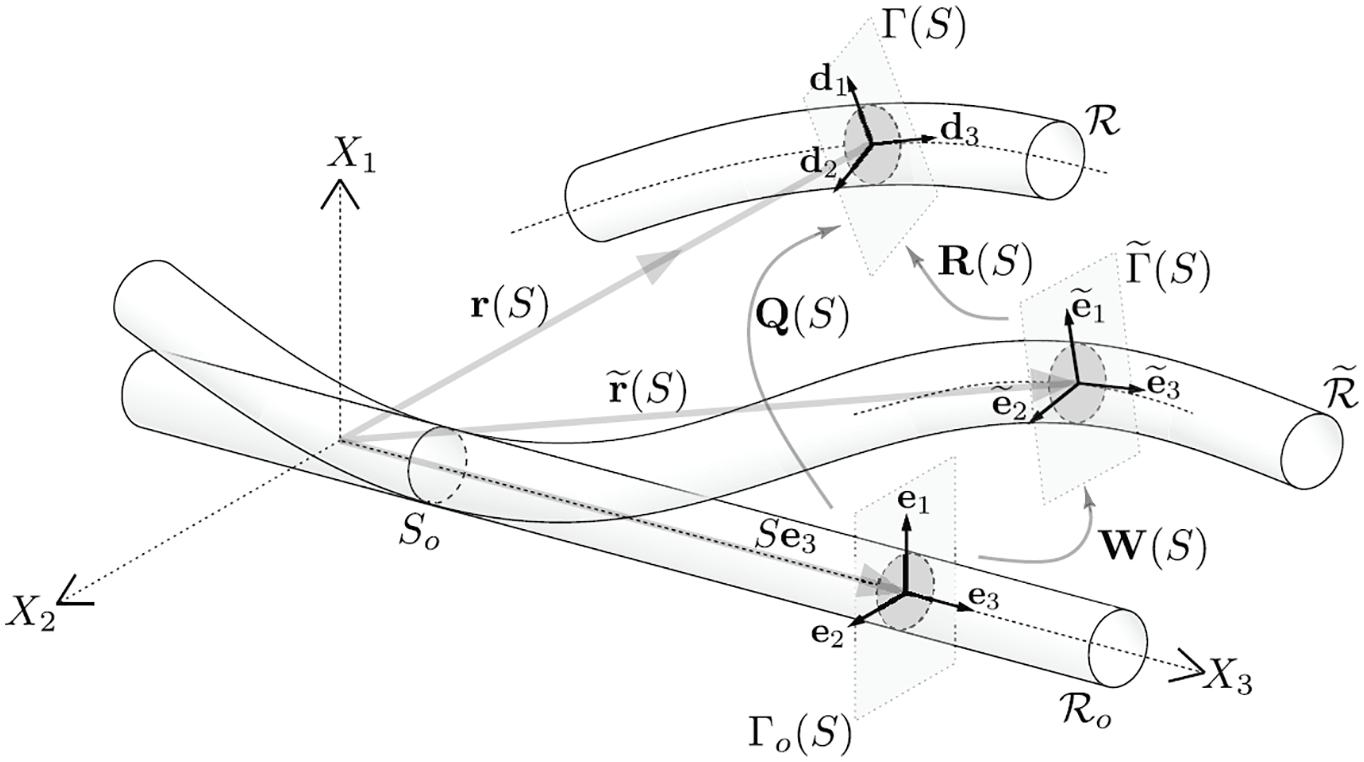
Kinematics of an initially straight rod growing from origin
We denote the transverse cross-section at S in

When the boundary conditions and environmental factors are imposed, let the centre-line take the curve

The virtual director field is transformed into another director field in the current configuration, given by

All the maps we have introduced are assumed to be smooth for the sake of convenience. Analogous to

This implies

where

Similarly, we define

We assume the transverse cross-sections to remain orthogonal to the centre-line in both virtual and current configurations, hence the conditions


must hold, where equation (34) is equivalent to the unshearability constraint (6). The symbols and notations introduced in this section are pictorially represented in Figure 3.
3.1.1. Homogeneous growth kinematics
We consider the growth to be homogeneous throughout the rod. This assumption leads to the following constraints:
The length-wise growth parameter denoted by
Let

For all permissible h, the relative rotation

This gives us the decomposition

Choosing


Dividing by

We define the following tensor fields for our convenience:

Now equation (39) implies

Since h and S can be chosen arbitrarily, independent of each other, we conclude that

We expand the derivative to get


This implies
Moreover, differentiating the condition

that is,
We fix a point on the centre-line that gets mapped to itself under the growth transformation, along with its corresponding cross-section. Thus, we assume the existence of a point

This can also be interpreted as if the rod is allowed to grow while being held at

Since this is also satisfied for the specific point
Thus one can solve the system

for

where tensor exponential is defined by the series expansion of exponential function.
3.1.2. Extension to a general growing curve
Consider a general scenario in which the initial configuration

Homogeneous growth law still requires

This assumption, along with the kind of homogeneity used in induced rotations, gives such a

In fact, the constant vector

We emphasise that equations (51) and (48) do not assume the respective centre-curves to be normal to the cross-sections in
3.2. Growth in straight rods
Consider a straight rod with flip-symmetric hemitropy in its reference configuration. A straight virtual configuration condenses to

which, with the aid of equation (33), results in

This indicates that

so that its corresponding skew tensor is

Since the rotation tensor can also be expressed as

we get

The parameters
This type of growth is helical in nature. Consider any line in the bulk of the rod parallel to its axis, but not the axis itself. As the rod grows this line transforms into a helix of pitch
3.2.1. Growth law
The growth law adopted here considers rotation of cross-sections with respect to each other in the due course of growth. Consider a rotating basis field

representing a helix embedded in the initial configuration of a rod. As the rod grows this transforms into

This is equivalent to

Let


This shows that our chosen growth map transforms the initial helix with pitch

This motivates us to define a symmetry-preserving growth law for rods possessing helical symmetry.
Rods with helical symmetry. Consider a rod which, due to its microstructure, possesses simple helical symmetry or n-fold helical symmetry. Let
We introduce the idea of symmetry-preserving growth – wherein the growth map fixes all helices with pitch the same as that of the microstructure (

where
Hemitropic rods. Although there are different versions [26, 30] of how helical symmetry can be used to arrive at hemitropy, there is no pitch directly associated with transverse hemitropy (equation (19)). So, for hemitropic rods (and even isotropic), one may use the same helical growth law (65) without any notion of microstructural pitch, in which case both
3.2.2. Calculation of strains
The grown configuration is obtained by imposing environmental and boundary effects on the virtual stress-free configuration. Hence the strain energy is a function of

Let their components be




Now define the axial vector

Given the growth parameters, this relation will be used in retracting the actual strains from the apparent curvature

along with their convected components

With the unshearability constraint in place, we have



3.2.3. Equilibrium equations
The local linear and angular momentum balance equations for static equilibrium [18, 35] are as follows:


where


4. Growing rod with guided–guided ends
A fixed–fixed rod subject to axial displacement or load is constrained both axially and rotationally, and is known to buckle out-of-plane with a transversely hemitropic constitutive law. But in a fixed-free hemitropic rod subject to an axial load, material chirality does not lead to any chiral deformation and the solution is always planar [32]. For a growing rod, there can be another intermediate boundary condition pair – with guided ends – which is rotationally constrained, but axially free at both ends. A guided boundary condition is equivalent to fixing the end of the rod to a block constrained by a slot to translate only along the rod’s axis (Figure 4). In this section we show that a growing rod with guided ends can give rise to non-planar chiral solutions by itself, without any additional load. We use the energy function (23) and the growth law (65) to model the rod. Even though all the calculations would be similar, the results can be discussed separately for two different problems – first, a hemitropic rod, and second, a rod with n-fold helical symmetry.
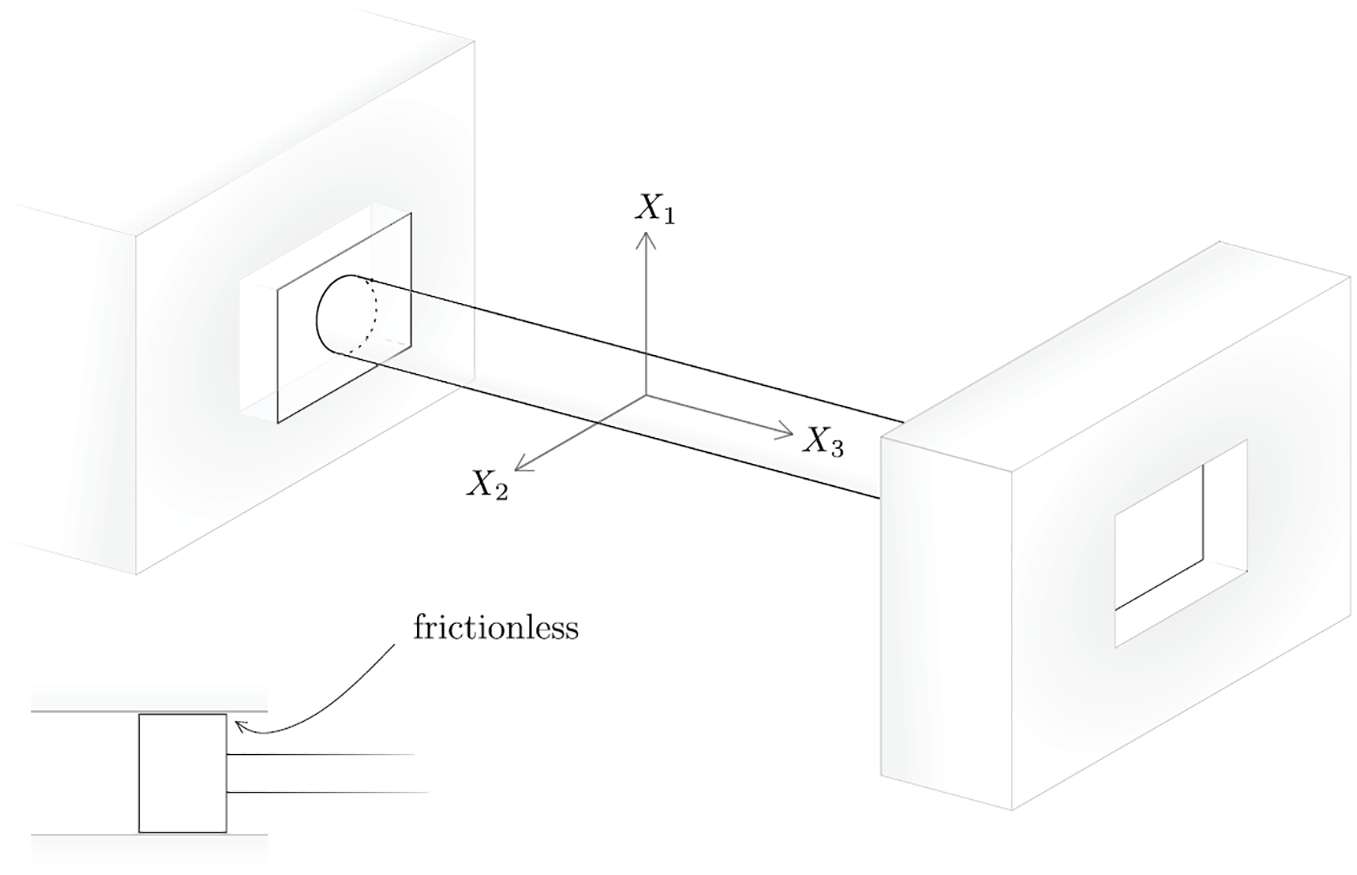
Schematic of guided–guided boundary condition. The guides arrest all degrees of freedom at the ends except for axial translation.
The linear and angular momentum balance equations are


along with the boundary conditions



The unshearability constraint (34) results in

Equations (78)–(83) comprise our boundary value problem to be solved for the fields
The rod is assumed to be of unit length; thus, all the kinematic quantities are dimensionless by default. The components of internal force, internal moment, material constants
4.1. The straight solution
Let us consider a solution in which the rod always remains straight while growing, given by

where




For such a solution to comply with the force boundary condition (80), we require

where A denotes the degree of hemitropy and

approaches
4.2. Perturbed solution
Consider a first-order perturbation of the straight solution (with



where








with details provided in Appendix B. Since

Boundary condition (99) requires

where
Equations (94)–(101) can now be reduced to the following (details in Appendix C):



accompanied by the boundary conditions


The new parameter

It is clear that
For

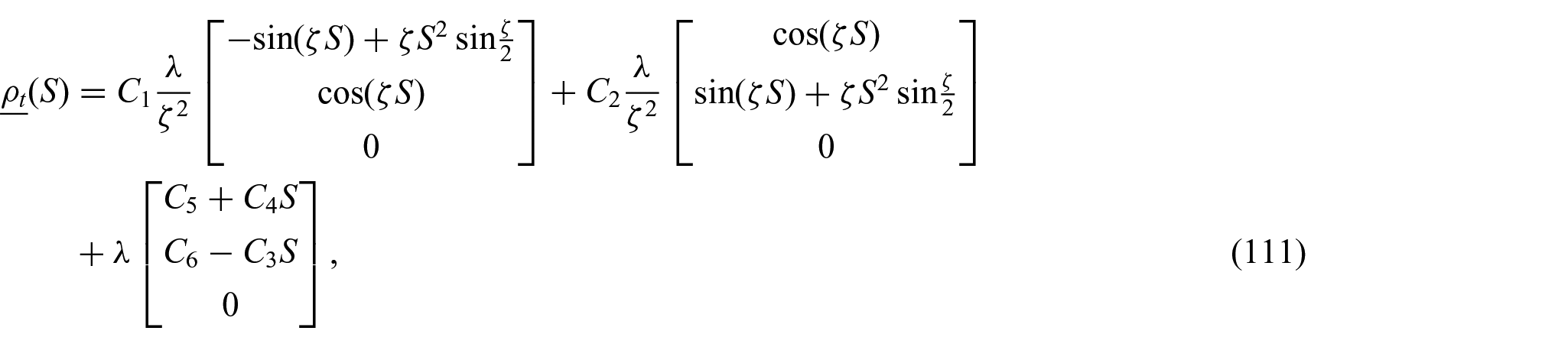
where

simultaneously giving

The values of

It simultaneously requires

Hence we have an out-of-plane solution,
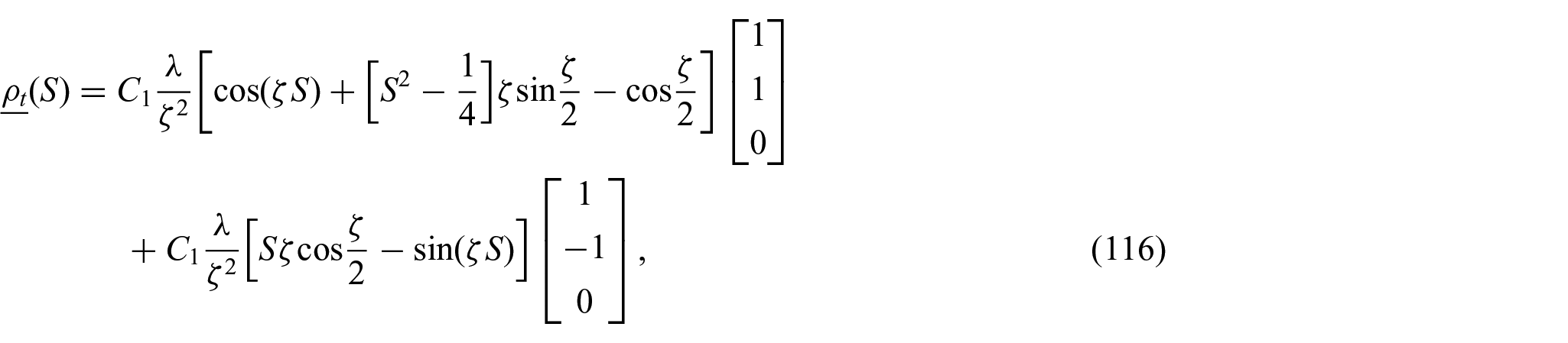
whose existence is subject to the condition that parameters
4.3. Results and discussion
In view of the equivariance properties of our problem (Appendix D), any rotation of equation (116) about




where representations (117) and (118) are with respect to the fixed basis. This solution is clearly flip-symmetric about

represented with respect to the fixed basis, wherein


simultaneously (Table 1, Appendix E). Equations (122)–(123) couple the axial force response of the rod with the bifurcation mode caused due to growth, via the kinematic constraint of symmetry-preserving growth (equation (65)). Whenever this system does not admit a solution
An inspection of equation (121) reveals that the sign change
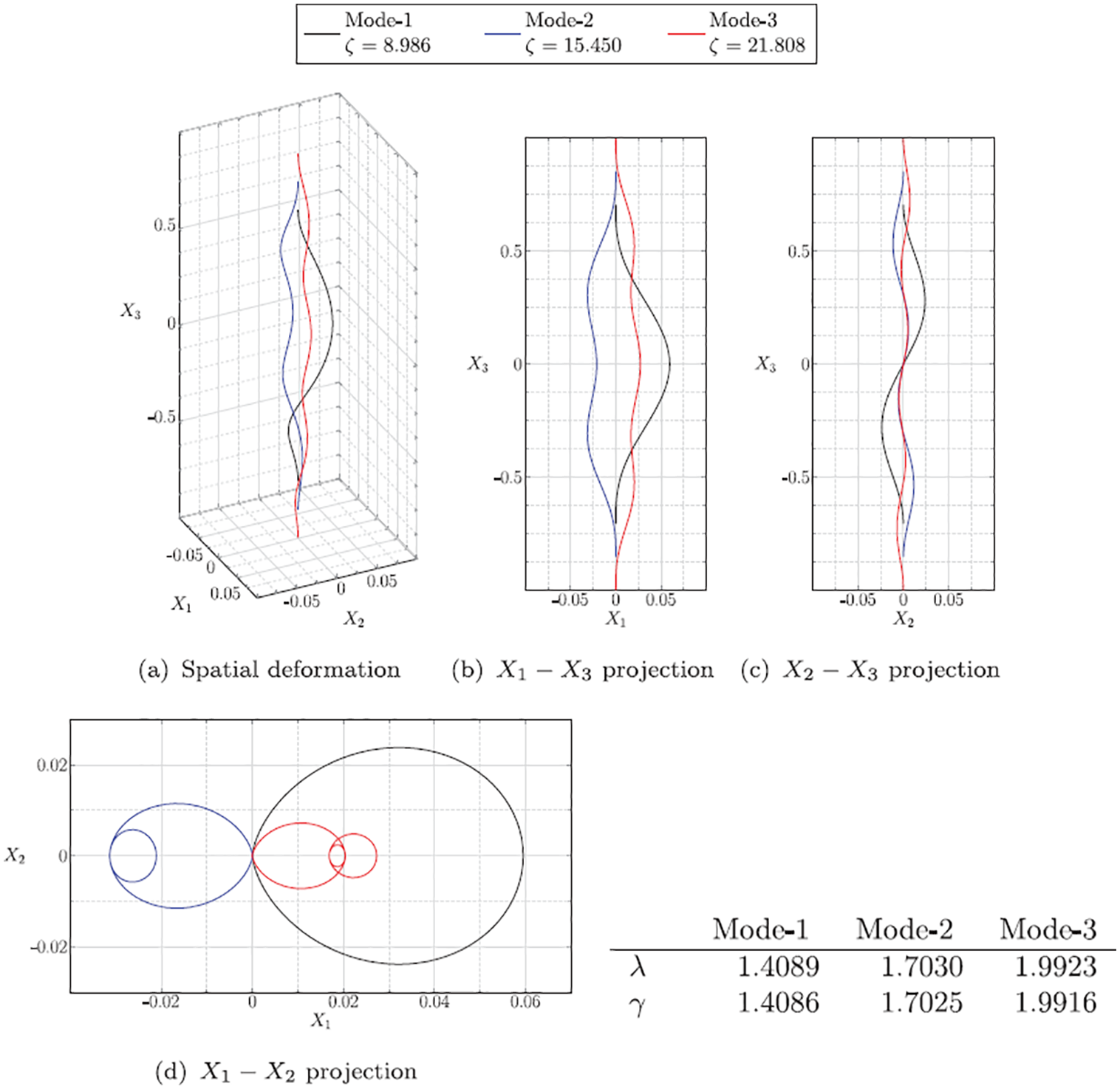
Out-of-plane bifurcated solution for the case
Internal chirality of the rod is taken care of by the constants
Consider two rods with opposite internal chirality with all other material properties the same. Let one of them with chiral constants A,
In the absence of guides, the end-to-end distance of the rod would have been the same as its growth stage
A and
A and
A and
A and
For a rod with n-fold helical symmetry with the growth law assumed to be symmetry-preserving, these results reveal an interesting interplay between chiralities in microstructure and load response of the rod. But for a hemitropic rod, the growth law allowing the cross-section to rotate makes the guided–guided problem similar to a non-growing rod subject to a axial twist at one end while the other end is free to move axially. The results above directly reflect the twist–extension type Poisson effect expected in hemitropic rods.
Case of isotropy A = 0. In this case, the solutions have

A growing isotropic rod has an out-of-plane solution with sign of
For small
Consider two rods with degrees of hemitropy
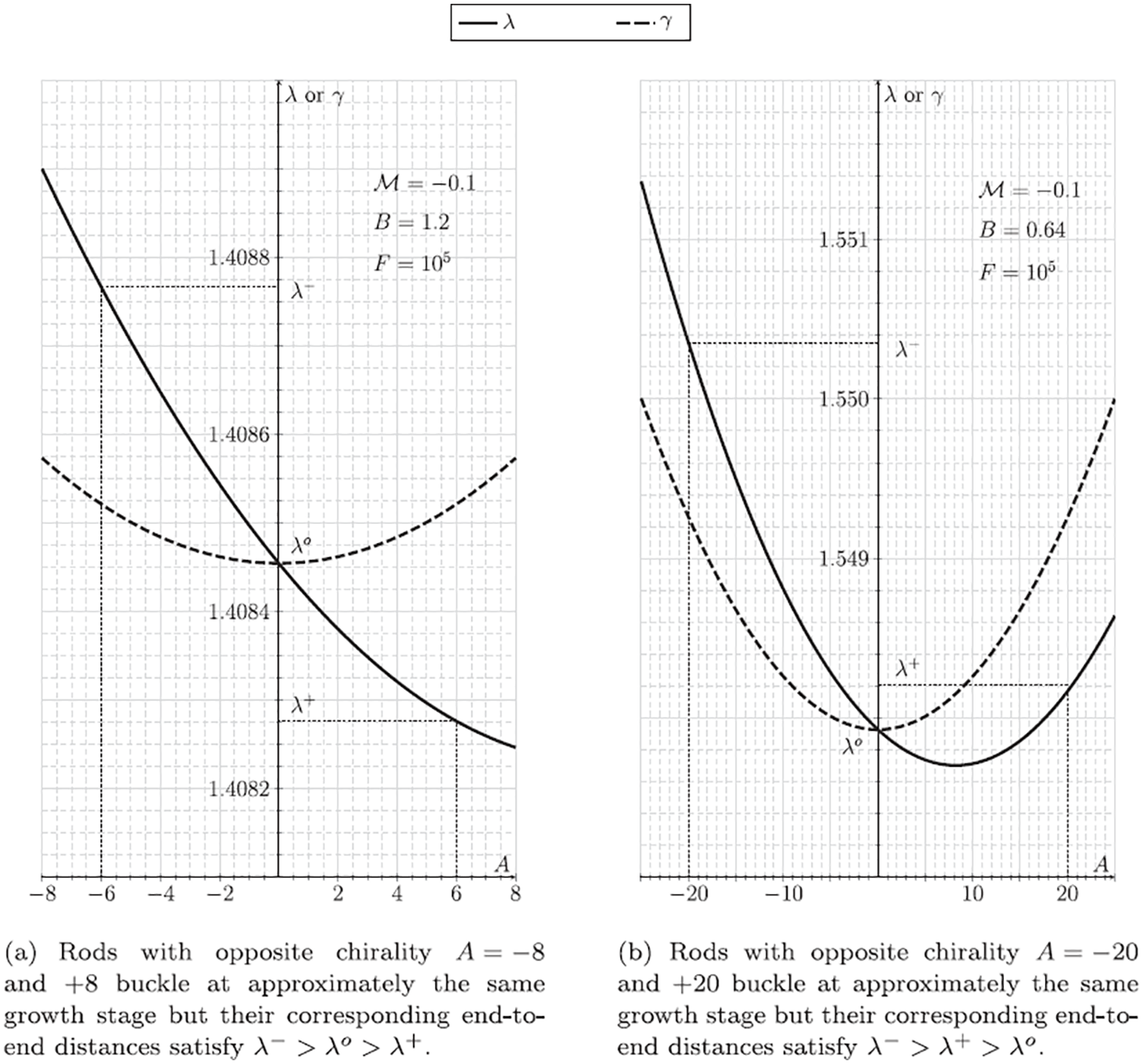
Variation of end-to-end distance
5. Conclusion
In this work we study the growth of slender elastic rods with chiral material symmetries – transverse hemitropy and multi-fold dihedral helical symmetry. Based on the intuitive notion that rods with helical symmetry should twist during growth, we propose a homogeneous growth law that allows for relative rotation of cross-sections. A guided–guided rod setup is considered to illustrate the occurrence of out-of-plane buckling at certain stages of growth (or atrophy). These solutions obtained are flip-symmetric and chiral in nature. A complete mirroring of the rod, including both growth and constitutive properties, gives a solution with opposite chirality, under the same deformation. We show that the end-to-end distance at bifurcation modes for the isotropic case need not lie between those for rods of opposite material chiralities, with the rest of the elastic and growth properties kept the same. The end-to-end distances for different combinations of growth (atrophy) and material chiralities have also been examined to understand the effect of twisting growth on the constitutive twist–extension coupling.
Embedding our biologically active (growth or atrophy) chiral rod setup in an elastomeric matrix and introducing inhomogeneities similar to that by Almet et al. [38] could be an interesting direction to explore. One can also consider a ply of biologically active rods, like growing bi-rods [24], to study the effect of growth and material chiralities of individual rods on the total deformation.
Footnotes
Appendix A: the growth map
Appendix B: derivation of perturbed equations
Appendix C: solution for perturbations
This appendix comprises the details missing in Section 4.2. We first demonstrate how the system (94)–(101) can be simplified to obtain equation (104). Proceeding on similar lines as that of Healey and Papadopoulos [32], we eliminate
for some constant
which upon integration and application of boundary condition (99) gives
thus leading to the differential equation (104) in
Appendix D: equivariance properties of solutions
Let
The components of
For any solution
also solves the system (78)–(83) for all
Equivalently in terms of perturbations, any solution
for all
Our boundary value problem is equivariant with respect to the action of a group generated by rotations about the
A solution is said to be flip-symmetric if
or equivalently if the perturbations satisfy
for all
Appendix E: calculation of λ and γ
First of all, numerical values of
where both r and F are dimensionless. For instance,
We introduce variables
for x. We define the following solution set:
We observe that
where
Clearly m is positive only when
Once we have a solution
and
Note that sometimes we may get an absurd solution
Acknowledgements
The authors thank the anonymous reviewers for their constructive comments and suggestions.
Funding
The author(s) disclosed receipt of the following financial support for the research, authorship, and/or publication of this article: Prashant Saxena acknowledges financial support via start-up funds from the James Watt School of Engineering at the University of Glasgow.
