



Abstract
A brief review is given of the effect of porosity on the Poisson ratio of a porous material. In contrast to elastic moduli such as K, G, or E, which always decrease with the addition of pores into a matrix, the Poisson ratio
1. Introduction
The problem of estimating the effective elastic moduli of a two-phase material is one of the most important and well-studied topics in the mechanics of materials. The specific case of porous materials is of great relevance to the study of geological media (Mavko et al. [1]), ceramics (Rice [2]), and cementitious materials (Lutz et al. [3], Mehta et al. [4]). An increase in porosity will of course cause the elastic moduli, such as K, G, and E, to decrease, at a rate that mainly depends on the pore geometry. But the influence of porosity on the effective Poisson ratio is more subtle, and in fact the Poisson ratio may increase or decrease with the addition of porosity, depending on the pore geometry and the Poisson ratio of the matrix phase.
The topic of the effect of porosity on the Poisson ratio has received a fair amount of study over the past three decades. Among the papers that are devoted to this topic are Zimmerman [5], Dunn et al. [6], Brantut et al. [7], and Uhlířová et al. [8]. The present paper aims to present a brief review of the effect of porosity on the Poisson ratio, with a focus on discussing the topic within a unified framework. In addition to reviewing some of the main known results, several new results will be presented, particularly with regard to two-dimensional materials, materials having an auxetic matrix phase, and materials containing “trapped” fluids in their pore space.
2. General theory of the effective Poisson ratio
This paper will consider the situation in which the pores in a given porous material each have the same shape. In order to focus only on macroscopically isotropic materials, it will be further assumed that the orientation of the pores is random. To fully investigate the effect that these pores have on the macroscopic elastic moduli, and in particular on the Poisson ratio, the porosity will be allowed to vary.
It is obvious and “trivial” (although not easy to prove; see Gol’dshtein et al. [9]) that, for a given pore shape, both the bulk (K) and shear (G) moduli will be monotonically decreasing functions of porosity. The same will of course then be true for the other elastic moduli, such as Young’s modulus (E), and the Lamé modulus (λ). Since 3K and 2G are the eigenvalues of the elasticity tensor (Gurtin [10]), K and G play a special role, particularly with regard to upper and lower bounds and effective medium theories, and so the following discussion will generally refer to K and G, rather than to E or λ.
For small values of the porosity, the effective elastic moduli of a macroscopically isotropic material containing a dilute dispersion of randomly oriented pores of a given shape are given by (David et al. [11]):


where ϕ is the porosity, subscript o denotes the non-porous matrix material, and P and Q are the bulk and shear pore compliances, respectively. As pointed out by Kachanov et al. [12], the expression
It follows from equations (1) and (2), and the identity

As the pre-factor
The above general statements are known to be true for ellipsoidal or spheroidal pores. For three-dimensional pores of other shapes, exact analytical expressions for P and Q are not known. However, the numerical results of Roberts et al. [17] and Uhlířová et al. [8] for materials containing concave pores formed by the interstices between contacting solid spheres, also indicate the existence of a single “critical” value of the matrix Poisson ratio.
3. Critical value of the Poisson ratio for (dry) materials containing spheroidal pores
The expressions for P and Q for the general case of ellipsoidal or spheroidal pores are quite cumbersome (Kachanov et al. [14]; Mavko et al. [1]; David et al. [11]), and in general the critical point
For spherical pores, expressions for P and Q were first derived by Dewey [18], although they can also be found from the general expressions for spheroids, by taking the limit as the aspect ratio goes to 1 (Berryman [19]). The critical Poisson ratio, is then found by setting

For cylindrical pores, P and Q can again be found from the general expressions for spheroids, by taking the limit as the aspect ratio goes to infinity (Berryman [19]):

For thin crack-like pores, modeled as thin oblate spheroids of vanishingly small aspect ratio α, P and Q are essentially given by the results of Sneddon [20] and Segedin [21], respectively, and can also be found from the general expressions for spheroids, by extracting the singular term in each expression as the aspect ratio goes to zero (Berryman [19]):

Brantut et al. [7] computed the first three non-zero terms in the Taylor series for
The critical Poisson ratio
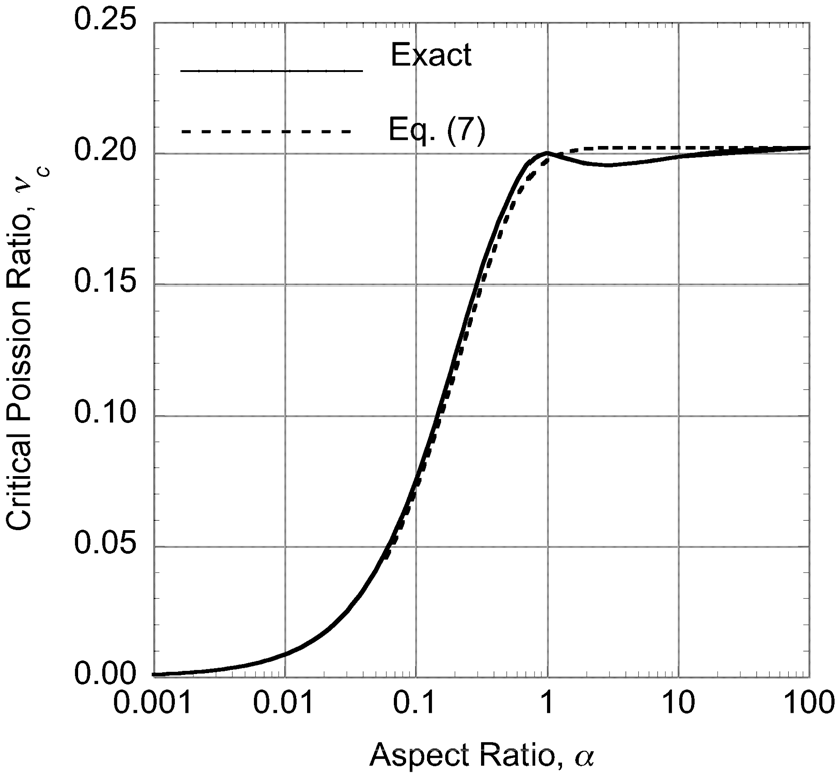
The critical Poisson ratio for spheroidal pores, over the entire range of aspect ratios, from thin cracks to needle-like cylinders (after Dunn et al. [6]). The exact results are plotted as a solid line; the approximate expression given by equation (7) is plotted as a dashed line.
David et al. [16] found that this entire curve could be approximated reasonably well by the simple function

Needless to say, neither of these approximate expressions is capable of capturing the subtle non-monotonic behavior that occurs in the prolate spheroidal range.
4. Evolution of the effective Poisson ratio with increasing porosity
As shown by equation (3), small amounts of porosity will cause the effective Poisson ratio to move toward the critical Poisson ratio at a rate that is linear in the porosity. However, predicting the rate at which the effective Poisson ratio approaches
According to the differential scheme, pores are introduced into the matrix incrementally, and the new effective moduli are computed at each step using the dilute-concentration approximations given by equations (1) and (2). In the limit, as the incremental addition of new porosity becomes infinitesimal, this thought experiment leads to a pair of coupled ordinary differential equations for K and G:

which must be solved subject to the initial conditions
From the identity

In general,
Specifically, in the neighborhood of

In analogy with the theory of first-order dynamical systems,
For the specific case of a material containing spherical pores, equation (9) takes the form (David et al. [16]):

This equation can be integrated analytically to give an equation for the porosity as a function of the effective Poisson ratio (Zimmerman [28]; David et al. [16]), but the resulting expression is complicated and not very informative, and will not be repeated here. The results are more instructive in graphical form (Figure 2). Roughly speaking, when the Poisson ratio of the matrix is non-negative, the Poisson ratio of the porous material varies, more or less linearly, from the matrix value
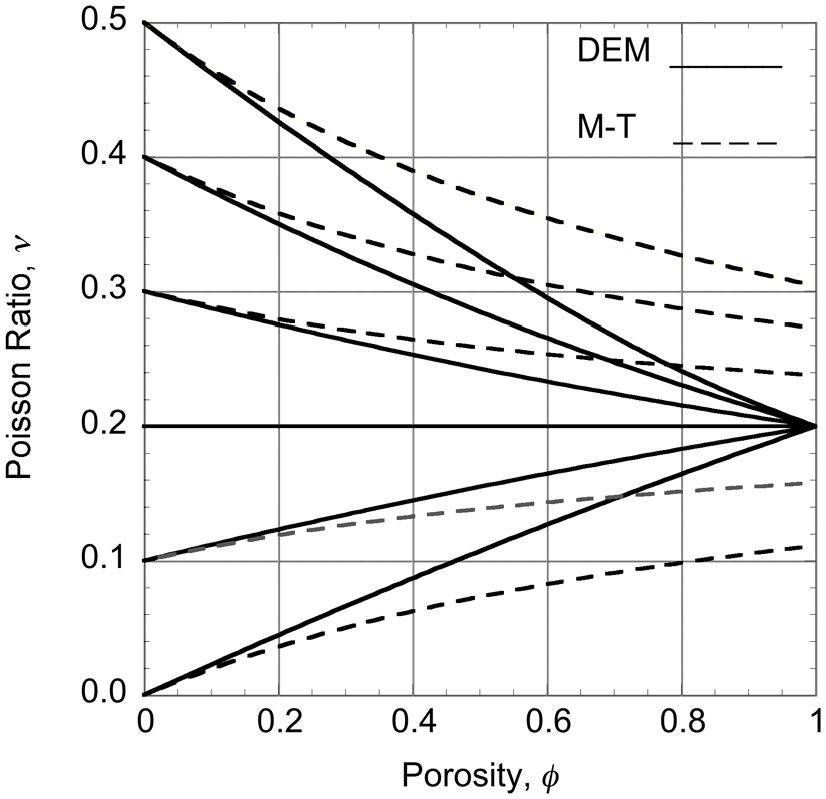
Predicted evolution of the effective Poisson ratio for a material containing spherical pores, as a function of porosity, according to the differential and Mori–Tanaka effective medium theories.
Since
For materials containing prolate spheroidal pores, or oblate spheroidal pores having aspect ratios not too close to 0, the Poisson ratio trajectories predicted by the differential scheme are qualitatively similar to the case of spherical pores, in that
The evolution of the effective Poisson ratio of a cracked body, as a function of the crack density parameter, is shown in Figure 3. It should be noted that, unlike the porosity, the crack density is not restricted to being less than 1. Nevertheless, values of
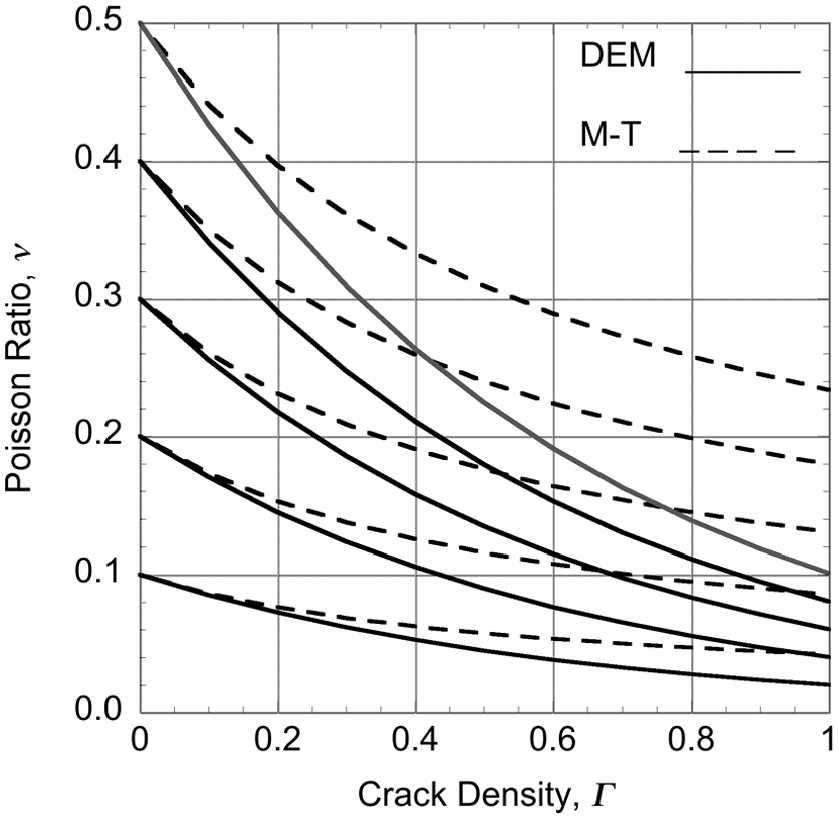
Predicted evolution of the effective Poisson ratio for a material containing thin circular cracks, as a function of the crack density parameter, according to the differential and Mori–Tanaka effective medium theories.
Another widely used effective medium theory is the Mori–Tanaka scheme (Benveniste [26]). The key idea behind this scheme is based on the fact that if a porous body is subjected to a uniform stress σ on its outer boundary, the mean stress in the matrix phase will be

Explicit expressions for the predicted Poisson ratio, as a function of porosity, have been given by Dunn et al. [6] and Uhlířová et al. [8]. The behavior of ν in the general case can easily be understood by noting that since ν is a unique function of the ratio

This expression is not easy to interpret, and does not readily show that the effective Poisson ratio does not reach the critical value. For the three special cases of spheres, cylinders, and thin cracks, the asymptotic values of the effective Poisson ratio, as predicted by the Mori–Tanaka effective medium scheme, are (for spheres: Zimmerman [5]; for cylinders and cracks: Dunn et al. [6]):



Since all reasonable effective medium theories agree to first-order in porosity, the trajectory of the Poisson ratio as predicted by the Mori–Tanaka scheme (see Figures 2 and 3) initially follows the same slope as for the differential scheme, i.e., as given by equation (3). However, the predicted rate of change becomes less severe, as compared with the differential scheme, as the porosity (or crack density) increases, and the Poisson ratio never reaches the critical value,
5. Influence of fluid saturation on the effective Poisson ratio
The previous discussion focused on dry porous materials that contain no pore fluids in their pore space. Particularly with regard to porous rocks, there is great interest in understanding the effect of pore shape, porosity, and pore fluid compressibility, on Poisson’s ratio. In seismic exploration, the ratio of compressional wave speed to shear wave speed is often used to discriminate between different rock types, and to infer information regarding pore fluid saturation (Brantut et al. [7]; Mavko et al. [1]). The ratio

Gassmann [32] derived an exact (albeit implicit) expression for the “undrained” bulk modulus,

This relation is valid for any value of the porosity, regardless of pore shape, although its derivation implicitly assumes that the pores are all interconnected. (The seeming contradiction of assuming a completely interconnected pore space, but using P and Q factors derived for discrete, isolated pores, is ubiquitous in rock physics, and its validity will be assumed in the present discussion.) Furthermore, according to Gassmann’s theory, pore fluids will have no effect on the shear modulus, and so the shear modulus of the rock under fluid-saturated conditions will be the same as under dry conditions. This result is also exact for a material whose pores are all interconnected.
In the limit of small values of the porosity, and using the formalism of equations (1) and (2) for the dry effective moduli, Gassmann’s results can be expressed as

Hence, the mathematical consequence of having pore fluid “trapped” in the pore space is to replace
The critical Poisson ratio for a fluid-saturated rock is therefore found by solving the equation

For fluid-saturated rocks, the parameter

However,
For materials containing cracks or needle-like pores, and arbitrary values of the parameter


This latter expression assumes that, although both ξ and α are small, the condition
6. Effective Poisson ratio of two-dimensional materials
A similar analysis can be given for “two-dimensional” materials. Consider the case of plane strain, in which the displacement is zero in one direction, which can be denoted as the z-direction. The material is then assumed to be permeated with long prismatic pores that are aligned parallel to the z-axis, so that each plane normal to the z-axis has exactly the same microstructure. These pores may have any shape in the x-y plane. In the subsequent discussion, the term “pore shape” will refer to the shape of the pore in the x-y plane.
Before discussing the behavior of the Poisson ratio in the two-dimensional case, it is worthwhile to review the relationships between the “2D” and “3D” elastic moduli. Hooke’s law for plane strain takes the form (Jaeger et al. [31])

If the “2D” Young’s modulus is defined as

The advantage of writing the equations in this form is that the 2D Young’s modulus and 2D Poisson ratio now have the same geometrical interpretation as in 3D, i.e., the Poisson ratio is the negative of the ratio of the transverse strain to axial strain under uniaxial stress, etc. Note that the 2D “areal bulk modulus” will be given by
The case of a 2D material permeated with elliptical pores of aspect ratio α has been treated in detail by Thorpe et al. [33], and Kachanov et al. [12]. After correcting the incorrect minus sign in the expression for Q given in equation (18) of Thorpe et al. [33], the 2D versions of P and Q can be written as

The critical Poisson ratio, found as usual by setting P = Q, is given by (Figure 4)

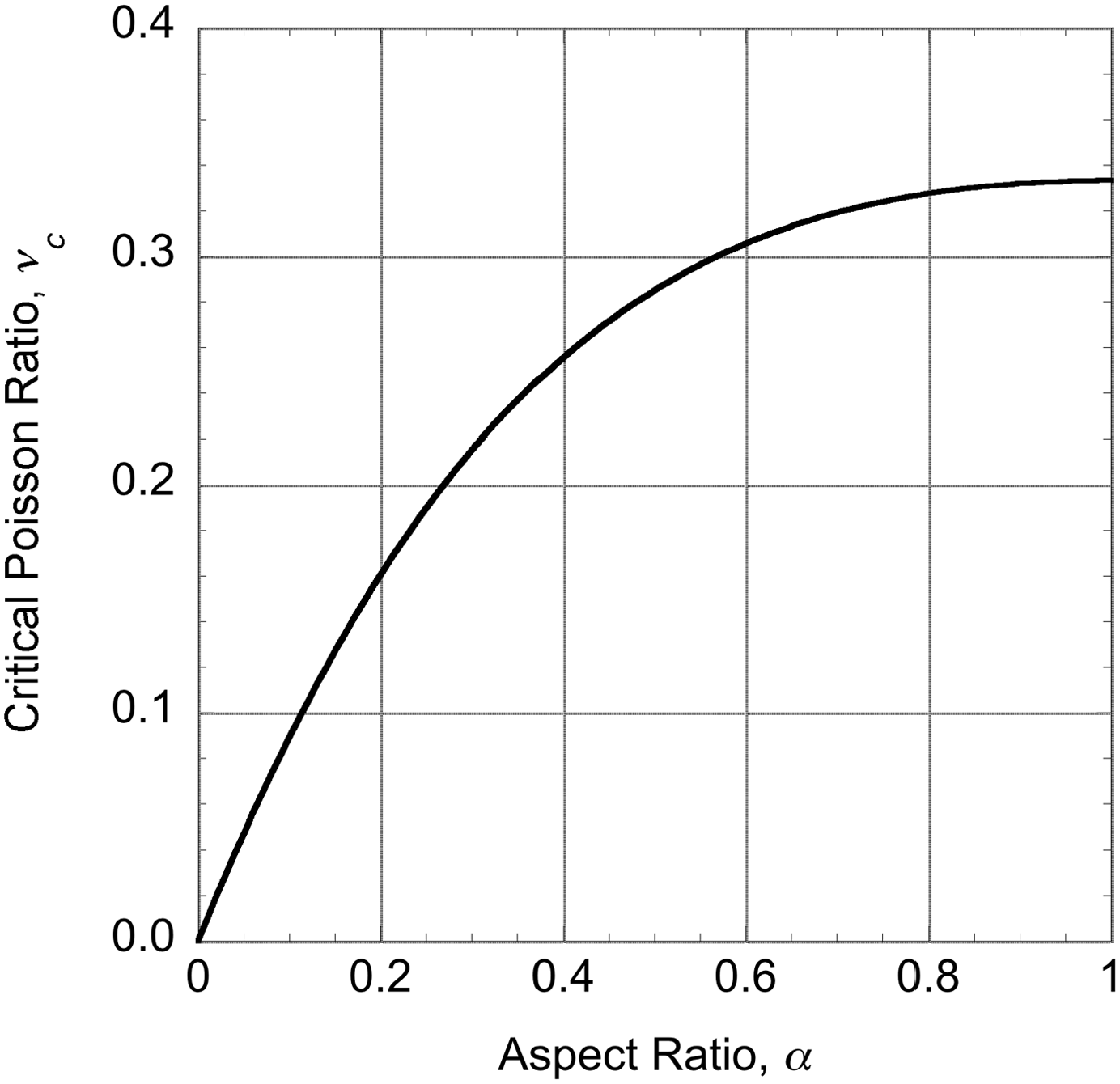
The critical Poisson ratio for two-dimensional elliptical pores, over the entire range of aspect ratios, from thin cracks to circles. Note that in contrast to Figure 1, in this graph the aspect ratio axis is linear, not logarithmic.
The critical Poisson ratio goes to zero for infinitely thin cracks, as in the 3D case. For thin cracks of “finite” aspect ratio,
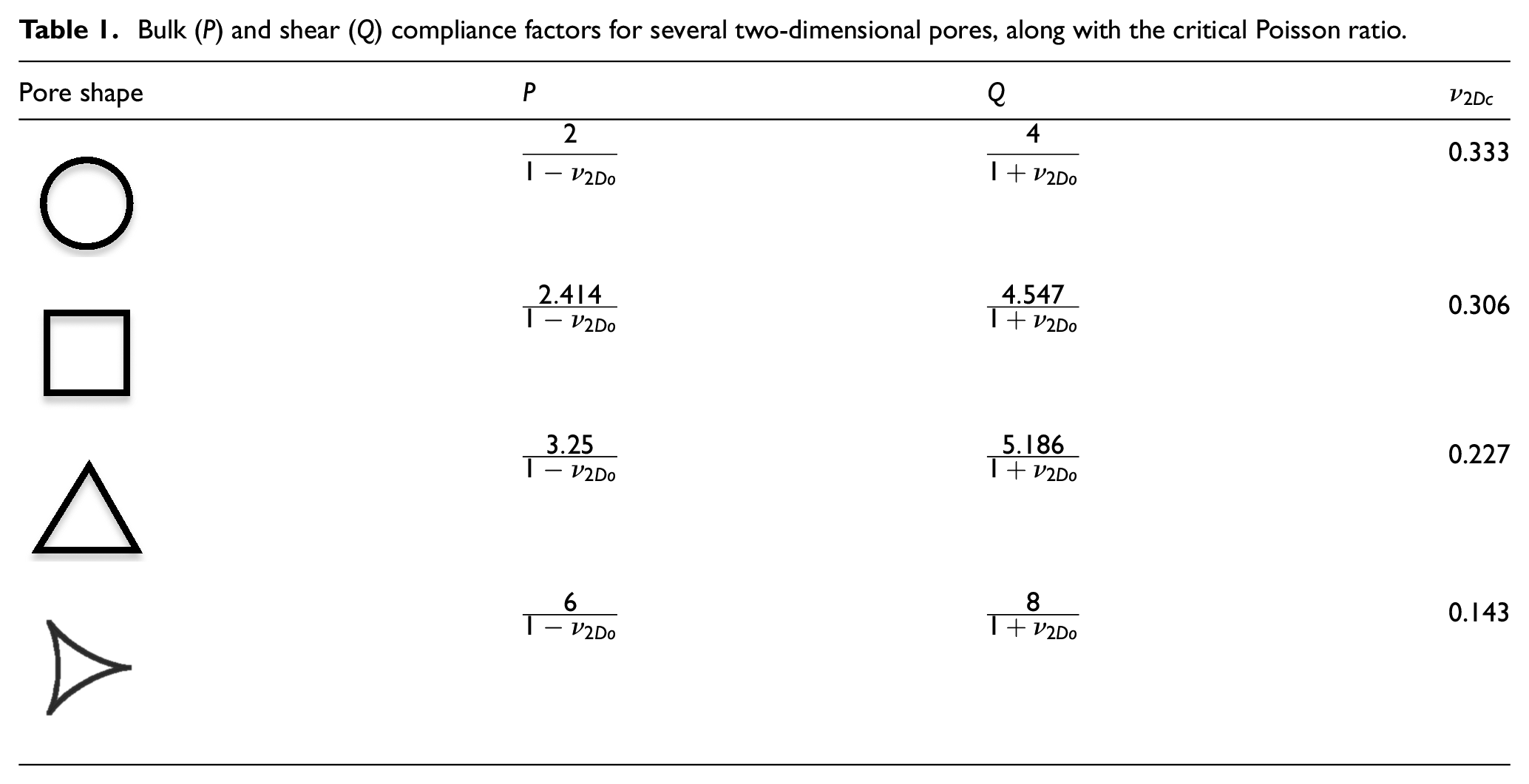
Whereas analytical expressions for three-dimensional pores are available only for ellipsoids and spheroids, two-dimensional pores of essentially any shape can be analyzed using conformal mapping and the Muskhelishvili–Kolosov displacement potentials. These methods have been used to study polygonal pores (Jasiuk et al. [34]; Kachanov et al. [12]; Jasiuk [35]) and cusp-shaped pores that resemble the interstices between circular “grains” (Zimmerman [36]; Kachanov et al. [12]). Table 1 shows some values of P and Q, along with the computed critical Poisson ratio, for a few different two-dimensional pore shapes, such as circles, taken from Thorpe et al. [33], and squares, triangles, and one cusp-shaped pore, taken from Ekneligoda et al. [37, 38]. The expressions for the square and the equilateral triangle were obtained by sequentially including additional terms in the Schwarz–Christoffel mapping function, and extrapolating the results to
Bulk (P) and shear (Q) compliance factors for several two-dimensional pores, along with the critical Poisson ratio.
7. Porous materials having an auxetic matrix phase
Auxetic materials are isotropic materials that have a negative Poisson ratio (Yang et al. [39]). Most known auxetic materials are highly porous materials with foam-like structures; non-porous auxetic materials are very rare (Dagdelen et al. [40]). None of the theories discussed above, which were based on the conceptual model of a solid phase permeated with discrete, non-intersecting pores of a given shape, predict that a material with a non-auxetic matrix phase will become auxetic due to the addition of pores, even at very high porosities. In fact, auxetic foam-like materials require special structural features, such as re-entrant angles, etc., (Uhlířová et al. [8]), that are very different geometrically to the spheroidal shapes discussed in previous sections.
Despite the lack of solid auxetic materials to serve as a matrix phase, it may nevertheless be of interest to examine the behavior of porous materials that have an auxetic matrix phase, for the following reason. As pointed out by Uhlířová et al. [8], such materials could in principle be created by taking a highly porous auxetic foam, and introducing pores into those materials that have a length scale that is much larger than the characteristic length scale of the foam.
The “general theory” discussed above in Sections 2 to 4 continues to hold for such materials, particularly if one accepts that the differential effective medium scheme and the Mori–Tanaka scheme provide reasonably accurate predictions of the effective moduli. The critical Poisson ratio
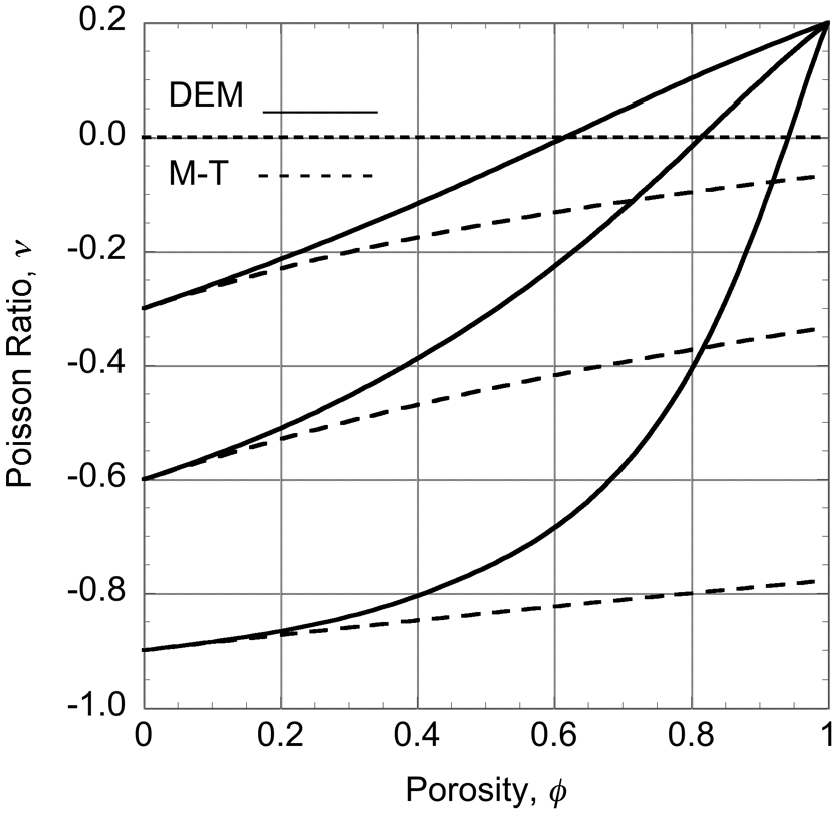
Predicted evolution of the effective Poisson ratio for an initially auxetic material containing spherical pores, as a function of porosity, according to the differential and Mori–Tanaka effective medium theories.
8. Summary and conclusions
This paper has presented a review of the influence of pore shape on the effective Poisson ratio of porous materials. The intention has not been to present an exhaustive review of all previous work that has been done on this topic, but rather to focus on discussing this topic within a unified framework. In addition to reviewing known results, several new results have been presented, particularly with regard to the effect of pore fluids, two-dimensional materials, and porous materials having auxetic matrices. The results can be summarized as follows.
a) Pores of any given shape cause the bulk and shear moduli to decrease toward zero as the porosity increases, but the trend of Poisson’s ratio depends on the pore shape.
b) For any given pore shape, increasing the porosity will drive Poisson’s ratio toward a critical value
c) For spheroidal pores, the critical value varies from 0 for thin cracks, to 0.2 for spheres, to 0.202 (but not monotonically!) for long needle-like pores.
d) In 2D plane strain or plane stress, the critical (2D) Poisson ratio is 0.333 for circles, 0.227 for equilateral triangles, and 0 for thin elliptical cracks.
e) It is not yet known if any pore shapes exist that have values of
f) If the pore space contains a “trapped” pore fluid, as is the case for rapid processes such as seismic wave propagation, as the porosity increases, Poisson’s ratio first approaches a critical value that depends on pore shape and fluid compressibility, but then approaches 0.5 as the porosity increases toward 1.
g) If the matrix phase is auxetic (i.e., has a negative Poisson ratio), the effective Poisson ratio initially increases toward
